Child sexual abuse (CSA) is a nonspecific risk factor for a myriad of negative developmental outcomes (Fergusson, McLeod, & Horwood, Reference Fergusson, McLeod and Horwood2013; Stoltenborgh, Bakermans-Kranenburg, Alink, & van IJzendoorn, Reference Stoltenborgh, Bakermans-Kranenburg, Alink and van IJzendoorn2015). A large study conducted among a representative population sample showed that adult survivors of CSA were three times more likely than nonabused adults to suffer from a mental health problem in their lifetime (Perez-Fuentes et al., Reference Perez-Fuentes, Olfson, Villegas, Morcillo, Wang and Blanco2013). According to the developmental psychopathology framework, adverse childhood events, including CSA, may alter the course of normal development in children (Cicchetti & Valentino, Reference Cicchetti, Valentino, Cicchetti and Cohen2006). Successful mastery of core developmental tasks in early childhood, such as the development of affect regulation and the establishment of secure attachment relationships, is likely to be severely disrupted by the presence of adversity, setting the stage for maladaptation throughout childhood and adolescence (Cicchetti & Toth, Reference Cicchetti and Toth1995; Doyle & Cicchetti, Reference Doyle and Cicchetti2017). Few studies have been conducted among sexually abused preschoolers even though they represent nearly 30% of minor CSA victims (US Department of Health and Human Services, 2013). Despite their young age, preschool CSA victims, like school-age victims, present a wide range of negative outcomes, including more internalizing and externalizing behavior problems than nonabused preschoolers (Beaudoin, Hébert, & Bernier, Reference Beaudoin, Hébert and Bernier2013; Hébert, Langevin, & Bernier, Reference Hébert, Langevin and Bernier2013; Langevin, Hébert, & Cossette, Reference Langevin, Hébert and Cossette2015).
While the link between CSA and children's maladjustment is well established, the mechanisms underlying this association remain unclear. Because CSA is a static variable not amenable to change, it is crucial to explore the mechanisms (i.e., nonstatic factors) through which CSA leads to maladjustment, so as to identify potential intervention targets to help prevent negative developmental outcomes in victims. Attachment security has been identified as a factor reducing subsequent symptomatology in adult victims (Cantón-Cortés, Cortés, & Cantón, Reference Cantón-Cortés, Cortés and Cantón2015; Roche, Runtz, & Hunter, Reference Roche, Runtz and Hunter1999). Thus, assessing adaptation of young CSA victims through the attachment paradigm may be particularly relevant.
Attachment and Psychological Outcomes in Children
A very large body of research has outlined the significant contribution of attachment to child socioemotional adaptation (DeKlyen & Greenberg, Reference DeKlyen, Greenberg, Cassidy and Shaver2016). A central assumption of attachment theory, articulated by Bowlby (Reference Bowlby1982/1969, Reference Bowlby1988), is that the quality of early parent–child attachment relationships plays a determining role in subsequent child adaptation and psychopathology across the life cycle. Empirical work has delineated four main attachment patterns in children (Ainsworth, Blehar, Waters, & Wall, Reference Ainsworth, Blehar, Waters and Wall1978; Main & Solomon, Reference Main, Solomon, Greenberg, Cicchetti and Cummings1990): secure, insecure-avoidant, insecure-ambivalent, and insecure-disorganized. Secure parent–child relationships contribute to the coherent organization of emotional experiences (Cassidy, Reference Cassidy1994). Securely attached children are able to flexibly use their parents as well as their environment to regulate distress in the face of stressors.
In contrast, three patterns of insecure attachment, likely to develop in the absence of consistent or adequate responses to children's emotional needs, have been identified. Avoidance is characterized by a minimization of emotional expression and attachment needs in times of stress. Conversely, ambivalence is defined as a hyperactivation of the attachment system, characterized by conflictual manifestation of resistance and dependence toward the attachment figure (Ainsworth et al., Reference Ainsworth, Blehar, Waters and Wall1978; Cassidy & Berlin, Reference Cassidy and Berlin1994). Disorganization, which is often albeit not exclusively found in victims of abuse and neglect (Cyr, Euser, Bakermans-Kranenburg, & van IJzendoorn, Reference Cyr, Euser, Bakermans-Kranenburg and van IJzendoorn2010), is characterized by dysfunctional and incoherent strategies in times of stress. Avoidance and ambivalence are considered “organized” patterns of insecure attachment because children have developed strategies for dealing with their caregivers’ way of responding. Disorganization, conversely, refers to the failure to develop or call upon an organized strategy (known as breakdown) to gain security from the attachment figure. Main (Reference Main, Goldberg, Muir and Kerr1995) calls it “fright without solution,” that is, distress that is not soothed by the parent and which can escalate to a very high level of stress (Bernard & Dozier, Reference Bernard and Dozier2010).
These attachment patterns are believed to reflect the child's mental representations of self and attachment figures, which develop through early experiences. These attachment representations influence the child's expectations, as well as his or her perceptions of and responses to negative events. It is suggested that as they grow older, children refer to their attachment representations as an internal resource to alleviate their distress (Bretherton & Munholland, Reference Bretherton, Munholland, Cassidy and Shaver2008). Depending on how they anticipate the possibility of overcoming distress, children may react more or less efficiently when trying to cope with adversity. With emotionally safe and adequate attachment experiences, children learn that their needs will either be attended to by a parent or managed by their self-regulation skills (Calkins & Leerkes, Reference Calkins, Leerkes, Vohs and Baumeister2011). In contrast, children with insecure attachment representations are more prone to emotion dysregulation, which may precipitate the development of behavior problems (Calkins & Leerkes, Reference Calkins, Leerkes, Vohs and Baumeister2011; Lyons-Ruth, Easterbrooks, & Cibelli, Reference Lyons-Ruth, Easterbrooks and Cibelli1997).
A large body of empirical studies has highlighted the detrimental effects of insecure attachment, especially disorganization, on both behavioral and emotional adjustment (Brumariu & Kerns, Reference Brumariu and Kerns2010; Lyons-Ruth & Jacobvitz, Reference Lyons-Ruth, Jacobvitz, Cassidy and Shaver2008; van IJzendoorn, Schuengel, & Bakermans-Kranenburg, Reference van IJzendoorn, Schuengel and Bakermans-Kranenburg1999). Meta-analytic data reveal that quality of attachment is a significant predictor of internalizing and externalizing behavior problems in children (e.g., Fearon, Bakermans-Kranenburg, van IJzendoorn, Lapsley, & Roisman, Reference Fearon, Bakermans-Kranenburg, van IJzendoorn, Lapsley and Roisman2010; Groh, Fearon, van IJzendoorn, Bakermans-Kranenburg, & Roisman, Reference Groh, Fearon, van IJzendoorn, Bakermans-Kranenburg and Roisman2017; Groh, Roisman, van IJzendoorn, Bakermans-Kranenburg, & Fearon, Reference Groh, Roisman, van IJzendoorn, Bakermans-Kranenburg and Fearon2012). While these meta-analyses only included studies based on behavioral measures of attachment, a recent meta-analysis by Madigan, Brumariu, Villani, Atkinson, and Lyons-Ruth (Reference Madigan, Brumariu, Villani, Atkinson and Lyons-Ruth2016) focused on representational and questionnaire measures of attachment. Results revealed that all three types of insecure attachment representations were predictive of internalizing behavior problems, but only disorganization was related to externalizing problems.
CSA, Attachment, and Outcomes in Young Victims
The existing literature exploring the links between CSA, attachment, and behavioral outcomes of young victims is very limited. The few studies conducted with preschoolers (Beaudoin et al., Reference Beaudoin, Hébert and Bernier2013; Fresno, Spencer, Ramos, & Pierrehumbert, Reference Fresno, Spencer, Ramos and Pierrehumbert2014), however, reveal that CSA is related to heightened levels of attachment insecurity. The results of a recent cross-sectional study showed that sexually abused preschoolers presented higher levels of disorganization in their attachment representations compared to nonabused children. Moreover, compared to girls, sexually abused boys were at elevated risk for ambivalence and disorganization (Charest, Hébert, & Bernier, Reference Charest, Hébert and Bernier2018). A higher proportion of disorganized attachment was also found in boys compared to girls among a sample of maltreated children (Carlson, Cicchetti, Barnett, & Braunwald, Reference Carlson, Cicchetti, Barnett, Braunwald, Cicchetti and Carlson1989), suggesting a possible differential impact of maltreatment on attachment representations depending on gender. A study conducted by Beaudoin et al. (Reference Beaudoin, Hébert and Bernier2013) explored the association between attachment representations and behavior problems in 116 CSA victims aged 3 to 6 years. Results indicated that disorganized attachment representations contributed significantly to the prediction of internalizing and externalizing disorders, beyond the characteristics of the abuse experienced (relationship with the perpetrator, duration, and severity of the abuse), child age, child gender, and parental distress. Children presenting disorganized attachment representations were six times more likely to develop internalizing behavior problems and four times more likely to present externalizing behavior problems compared to secure children. While these findings are important, these studies were cross-sectional, which precludes them from capturing the putative predictive effect of attachment over time on children's behavior problems.
As described above, research suggests the existence of a relation between CSA and attachment representations, and between attachment representations and behavioral outcomes in preschool victims. However, the mediating role of attachment representations in this population remains unstudied. It is thus crucial to further explore how attachment representations may affect the emergence of negative outcomes following CSA, with the objective of determining how to orient efficient evidence-based treatment programs for vulnerable children.
The Present Study
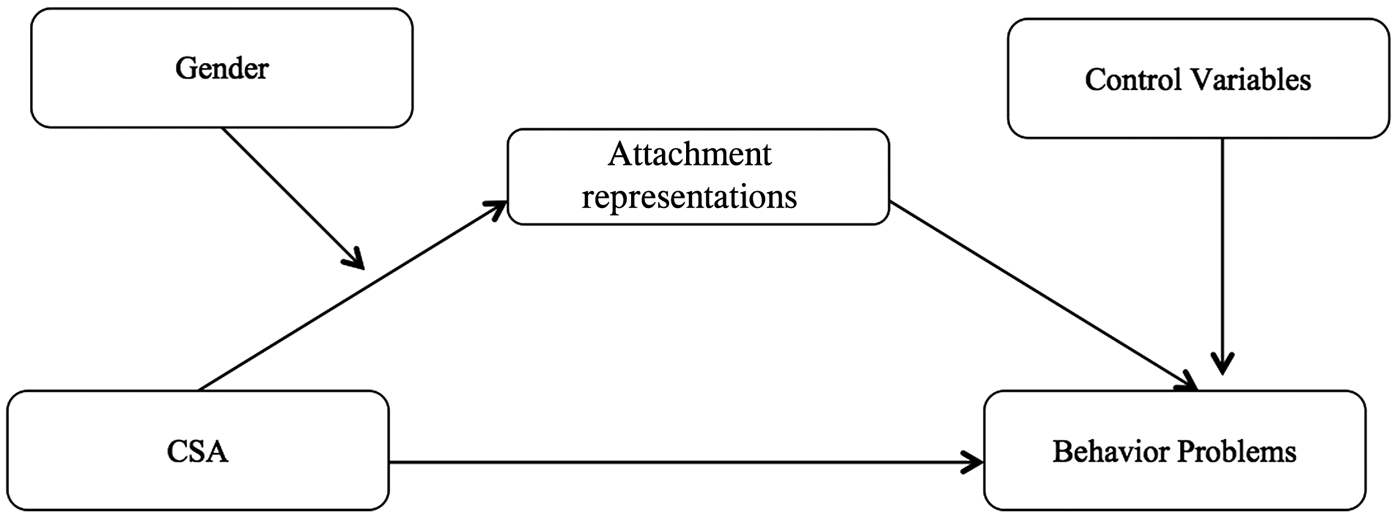
The main objective of the present study was to investigate the mediating role of attachment representations in the association between CSA and preschoolers’ outcomes in terms of internalizing and externalizing behavior problems over a 1-year period. Because maternal history of CSA has been identified as a possible risk factor for the development of child maladjustment (Berthelot, Langevin, & Hébert, Reference Berthelot, Langevin and Hébert2012), we controlled for this variable allowing for conservative and specific predictions. Given that our recent study highlighted the influence of gender on the link between CSA and attachment in the current sample (Charest et al., Reference Charest, Hébert and Bernier2018), gender was considered as a potential moderator of observed links. Therefore, the present study proposed to test moderated-mediation models (see Figure 1) in which attachment representations were hypothesized to mediate the associations between CSA and behavior problems in preschool children. We also hypothesized that gender moderates the association between CSA and attachment representations, with CSA having a larger effect on boys’ attachment representations than on girls’. Family socioeconomic status (SES) and maternal history of CSA were used as control variables.
Conceptual moderated mediation model.

Method
Participants
A sample of 258 sexually abused children, 208 girls and 50 boys, aged 3.5 to 6.5 years old (M = 4.46 years; SD = 0.8) and their nonoffending caregiver (90% a maternal figure) was assessed at Time 1 (T1), after the disclosure of CSA, at two specialized intervention centers in Montreal, Canada. A total of 31.7% of children were abused by a biological parent, and in 95.3% of cases, the perpetrator was a male. The vast majority of children (61.7%) experienced very severe (attempted or completed oral, vaginal, and/or anal penetration) or severe CSA (unclothed touching: 31.3%); 72% of them disclosed the abuse within a month. A comparison group of 133 nonabused children (M = 4.35 years; SD = 0.7), including 96 girls and 37 boys, was recruited in daycare centers and kindergartens in the Montreal area and assessed in their homes. Approximately 1 year later, parents of CSA group children (M = 5.37 years; SD = 0.8) and of comparison group children (M = 5.35 years; SD = 0.7) were interviewed for a follow-up assessment (Time 2; T2). Two hundred and sixty-nine parents (n = 147 from CSA group; n = 122 from comparison group) participated at T2.
Measures
Sociodemographic and abuse characteristics
A sociodemographic questionnaire completed by parents was used to gather information on family structure, parental education, and family income at T1. Using these variables, an SES risk index, ranging from 0 to 3, was created. One point was given for the presence of each of the following risk factors: families with an annual income of less than $30,000 CAN, single-parent families, and families in which the mother had an elementary or high school education level. These points were then summed to create an indicator of cumulative risk. Characteristics of the abuse experienced by the child were collected from the child's medical files using an adaptation of the History of Victimization Form (Parent & Hébert, Reference Parent and Hébert2006). Information regarding the severity (no penetration or attempted/actual penetration), duration of abuse, and relation with the perpetrator (parental vs. nonparental figure) were used in the present study.
Attachment Story Completion Task (ASCT; Bretherton, Ridgeway, & Cassidy, Reference Bretherton, Ridgeway, Cassidy, Greenberg, Cicchetti and Cummings1990)
At T1, children's attachment representations were assessed using a story completion task. This semistructured interview was developed to activate and assess attachment representations in children aged 3 to 7 years old. A warm-up story, which was not coded (birthday party), was presented to children by a trained research assistant. Then, five emotionally laden story beginnings (i.e., juice spilled by a child, hurt knee after a fall, fear of a monster, and parents leaving for a day and then returning the next day) were presented to children. They were invited to complete each story using small figurines representing family members (i.e., a mother, a father, and two girls or two boys depending on children's gender). Children's narratives were audio recorded for later coding.
ASCT Q-Sort
Children's narratives were coded using the ASCT Q-Sort (Miljkovitch, Pierrehumbert, Bretherton, & Halfon, Reference Miljkovitch, Pierrehumbert, Bretherton and Halfon2004), which is composed of 65 statements concerning reactions to separation and reunion, problem solving, and narrative coherence. A score of 1 to 7 is given to each statement (the more representative of the child the item is, the higher the score), according to a normal distribution. Children's scores are then correlated with four attachment prototypes developed by Miljkovitch et al. (Reference Miljkovitch, Pierrehumbert, Bretherton and Halfon2004) and based on expert ratings. Therefore, the Q-Sort yields four dimensional scores representing the levels of security, avoidance, ambivalence, and disorganization in each child's narrative. In secure narratives, children elaborate coherent stories and constructive resolutions, including a wide range of emotions. Parental figures are depicted as responsive to the child's need in distressing situations. In avoidant narratives, children may refuse to complete the story stem or avoid attributing negative emotions and behaviors to parental figures. In ambivalent narratives, children emphasize the negative aspects of the story, and their emotional arousal prevents them from completing stories in a constructive manner. Disorganization is characterized by incoherent narratives, loss of control, and catastrophic endings, and parental figures are depicted as unprotective (for a more detailed description of the scales, see Miljkovitch et al., Reference Miljkovitch, Pierrehumbert, Bretherton and Halfon2004). In the present study, interrater reliability was assessed by independent double-scoring of 20% of the narratives by two coders. Interrater reliability for security, avoidance, ambivalence, and disorganization was 0.95, 0.93, 0.82, and 0.91, respectively. The ASCT Q-Sort has been validated among diverse populations, including a clinical population, and shows adequate construct validity as indicated by its theoretically consistent associations with maternal and paternal attachment state of mind (Bernier & Miljkovitch, Reference Bernier and Miljkovitch2009; Miljkovitch, Danet, & Bernier, Reference Miljkovitch, Danet and Bernier2012; Miljkovitch et al., Reference Miljkovitch, Pierrehumbert, Bretherton and Halfon2004) and maternal sensitivity (Miljkovitch et al., Reference Miljkovitch, Moran, Roy, Jaunin, Forcada-Guex, Pierrehumbert and Borghini2013).
Child Behavior Checklist (CBCL)
At T2, parents were invited to evaluate the presence of internalizing (anxiety, depression, somatization, etc.) and externalizing (e.g., aggression) problems in their child using the age-appropriate version of the CBCL (Achenbach & Rescorla, Reference Achenbach and Rescorla2000, Reference Achenbach and Rescorla2001). Each question is answered on a 3-point Likert scale indicating the frequency of the behavior manifested by the child in the past 2 months (0 = not true, 1 = somewhat or sometimes true, 2 = very true or often true). T scores were calculated for two subscales: internalizing behavior problems (36 items in the preschool version; 32 items in school-age version) and externalizing behavior problems (24 items in the preschool version; 35 items in school-age version). A higher score on these subscales indicates a higher level of behavior problems. Numerous studies support the validity of the CBCL (Achenbach & Rescorla, Reference Achenbach and Rescorla2000, Reference Achenbach and Rescorla2001; Keenan & Wakschlag, Reference Keenan and Wakschlag2000). In this sample, internal consistency for the internalizing problems subscales was 0.92 and 0.81 for the preschool and the school-age versions, respectively. For externalizing problems, it was 0.94 and 0.86.
Procedure
Sexually abused children and one of their parents came to intervention centers in order to receive psychosocial assistance after abuse disclosure. Assessment took place at their first visit, prior to any service provision. Children of the comparison group were met at home. Parents signed a consent form and children consented verbally. At T1, a trained research assistant conducted the ASCT semistructured interview with children while the parent completed the sociodemographic questionnaire in a separate room. At T2, parents completed the CBCL at home for both groups. Parents received a small financial compensation, and children were given small gifts for their participation. This study received the approval of the Ethics Committees of Centre Hospitalier Universitaire Sainte-Justine and Université du Québec à Montréal.
Data analytic plan
Analyses were run in two steps. Preliminary analyses were conducted using SPSS 24 (missing data analyses, chi-square tests, analyses of variance, and bivariate correlations), and then moderation and mediation analyses were performed using full-information maximum likelihood (FIML) estimation with MPlus 5.1 (Muthén & Muthén, Reference Muthén and Muthén1998–2007). We used 95% bias-corrected bootstrapped confidence intervals (CI), with 10,000 iterations, to test the significance of indirect effects (Hayes & Preacher, Reference Hayes, Preacher, Hancock and Mueller2013). Simple mediation analyses were conducted to evaluate the direct and indirect effects of CSA on internalizing and externalizing behavior problems at T2 via attachment at T1. Then, moderation analyses were conducted to examine the effects of CSA on attachment as a function of child gender. Finally, mediation and moderation analyses were combined into a moderated-mediation model estimating the conditional indirect effects of CSA on behavior problems through attachment as a function of gender. Goodness of fit of the models was assessed using three indices: chi-square (χ2) value, comparative fit index (CFI), and root mean square error of approximation (RMSEA). A nonsignificant χ2 value, a χ2 to degrees of freedom ratio (χ2/df) below 3, a CFI value of 0.95 or higher, and a RMSEA value below 0.06 indicate good model fit (Tabachnik & Fidell, Reference Tabachnick, Fidell, Tabachnick and Fidell2013).
Results
Preliminary analyses
Missing data analyses revealed a 43% attrition rate for the CSA group and an 8.3% attrition rate for the comparison group. Analysis of the data set with Little's missing completely at random (MCAR) test indicated that the data was likely MCAR: χ2 (4) = 5.36, p < .05. Given, however, that Little's test suffers from low power (Enders, Reference Enders2010), we further examined patterns of missing data with separate group difference analyses. Results from χ2 tests indicated that group membership, χ2 (1, N = 384) = 45.58, p < .001, SES, χ2 (1, N = 304) = 30.73, p < .001, and mothers’ CSA, χ2 (1, N = 366) = 6.16, p < .05, were associated with the presence of missing data, pointing to the presence of a missing at random rather than MCAR pattern of missing data. FIML maximizes the use of available data and has been found to provide valid results under both missing at random or MCAR patterns of missing data (Little, Jorgensen, Lang, & Moore, Reference Little, Jorgensen, Lang and Moore2013). Data on three of the attachment representations scales (security, avoidance, and disorganization) and on the externalizing behavior scale were not normally distributed and were therefore square-root transformed (Tabachnick & Fidell, Reference Tabachnick, Fidell, Tabachnick and Fidell2013).
Sociodemographic characteristics were compared using χ2 tests. As expected, children in the CSA group presented higher SES risk index scores (M = 1.70) than children in the comparison group (M = 0.22), and their mothers had higher rates of CSA (42.9% vs. 11.3%), χ2 (1, N = 373) = 39.61, p < .001.
To evaluate whether those two potentially confounding variables were linked to the variables of interest used in the mediation analysis (attachment scales, internalizing, and externalizing behavior problems), two analyses of variance were performed. Results indicated that both internalizing and externalizing behavior problems differed according to SES, respectively, F (3, 210) = 8.57, p < .001 and F (3, 210) = 14.33, p < .001, and maternal history of CSA, respectively, F (1, 260) = 10.06, p < .01 and F (1, 260) = 20.34, p < .001. Therefore, SES risk index and maternal history of CSA were retained as covariates in the main models. T tests and χ2 tests were also conducted to compare the sociodemographic characteristics (i.e., age, SES, and maternal history of CSA) of girls and boys. No gender differences were found.
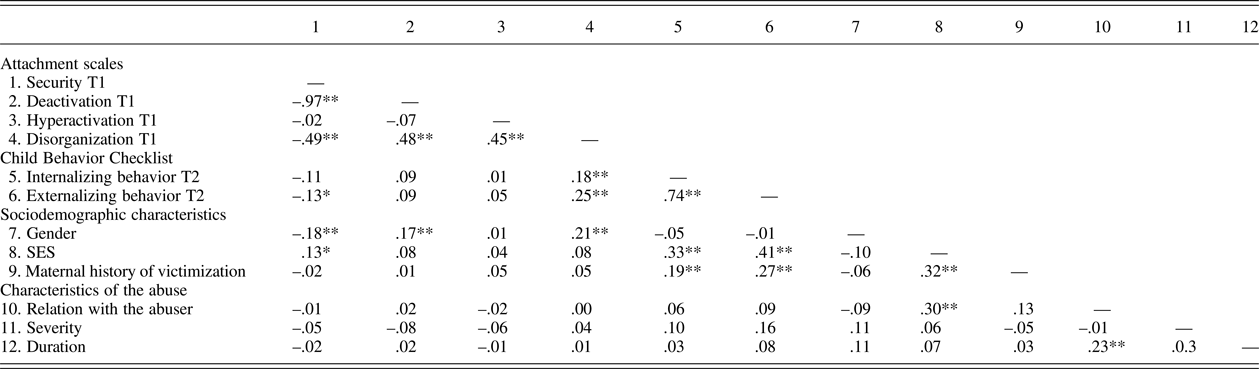
Bivariate relations among variables of interest were tested using Pearson correlation analyses (see Table 1). Characteristics of CSA were not associated with any outcome variable, and thus no further analyses were conducted with these variables. Considering that the security and avoidance scales were highly correlated (r = –.97), analyses were only conducted with the security, ambivalence, and disorganization scales.
Bivariate correlations among the model variables

Note: *p < .05. **p < .01. ***p < .001.
Mediation and moderation analyses
Mediation analyses
Security
Results of the simple mediation analyses indicated that CSA was negatively associated with security: –0.35, 95% CI [–0.58, –0.11]. The direct associations between CSA and both internalizing, 9.78, 95% CI [7.09, 12.36], and externalizing behavior problems, 0.79, 95% CI [0.60, 0.97], were also significant. However, security did not mediate the association between CSA and internalizing, 0.15, 95% CI [–0.24, 0.71], or externalizing behavior problems, 0.01, 95% CI [–0.01, 0.05].
Ambivalence
Simple mediation analyses indicated that CSA was not significantly associated with ambivalence: 1.32, 95% CI [–0.37, 3.03]. The direct associations between CSA and both internalizing, 9.98, 95% CI [7.30, 12.52], and externalizing behavior problems, 0.81, 95% CI [0.61, 0.98], were significant. Ambivalence did not mediate the association between CSA and internalizing, –0.04, 95% CI [–0.43, 0.15], and externalizing behavior problems, 0.00, 95% CI [–0.01, 0.03].
Disorganization
Results indicated that CSA was positively associated with disorganization: 0.40, 95% CI [0.19, 0.61]. Furthermore, a direct effect of CSA on internalizing behavior problems was identified: 9.45, 95% CI [6.78, 12.03]. The direct association between disorganization and internalizing behavior problems was also significant: 1.15, 95% CI [0.03, 2.25]. Indirect effect analyses indicated that CSA was associated with internalizing behavior problems through its effect on disorganization: 0.46, 95% CI [0.05, 1.12]. These findings point to a partial mediation of the association between CSA and internalizing behavior problems by attachment disorganization.
Another mediation analysis was performed on externalizing behavior problems scores. CSA was associated with externalizing behavior problems: 0.75, 95% CI [0.56, 0.93]. Disorganization was also associated with externalizing behavior problems: 0.12, 95% CI [0.05, 0.20]. Indirect effect analyses indicated that CSA was associated with externalizing behavior problems through its effect on disorganization: 0.05, 95% CI [0.02, 0.10]. Disorganization was found to partially mediate the association between CSA and externalizing behavior problems.
Considering that neither the security nor the ambivalence scales were found to mediate the relation between CSA and behavior problems, subsequent analyses were only conducted with the disorganization scale.
Moderation analyses
Child gender was found to moderate the relation between CSA and disorganization: 0.62, 95% CI [0.09, 1.15]. CSA was associated with disorganization both for boys and girls, but the magnitude of this association was higher for boys, 0.93, 95% CI [0.46, 1.40], than for girls, 0.30, 95% CI [0.07, 0.53].
Moderated mediation analyses
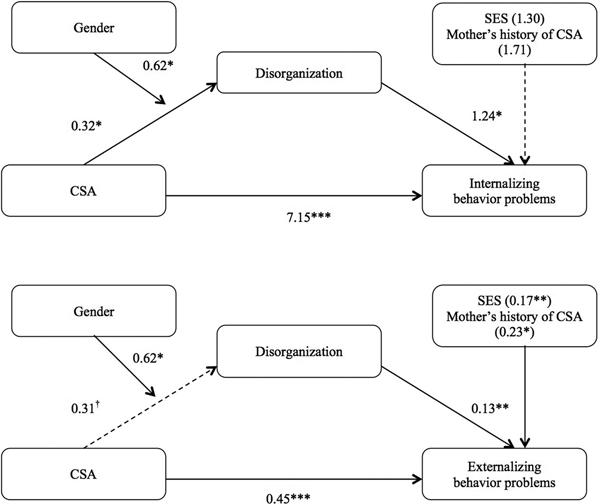
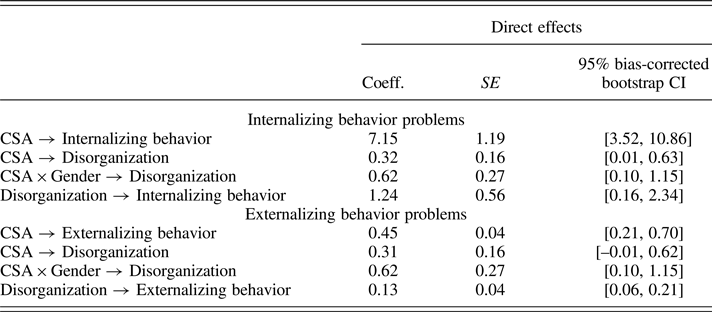
Finally, a moderated-mediation model estimating the conditional indirect effects of CSA on behavior problems at T2 through disorganization at T1, as a function of child gender, was tested (see Figure 2). Given the results of the preliminary analyses presented above, SES and maternal history of CSA were used as covariates. Fit indices indicated adequate fit to the data for internalizing and externalizing behavior problems models, respectively: χ2 (2) = 1.45, p = .49, χ2 / df = 0.73, CFI = 1.00, RMSEA = 0.00, with 90% CI [0.00, 0.09]; and χ2 (2) = 0.15, p = .93, χ2 / df = 0.08, CFI = 1.00, RMSEA = 0.02, with 90% CI [0.00, 0.03]. Coefficients and standard errors of the moderated-mediation model, tested at 95% bias-corrected CI, are presented in Table 2. For the internalizing behavior problems model, CSA was associated with disorganization and a Group × Gender interaction was found for this association. Boy victims were more likely to present disorganized attachment compared to girls. Disorganization was also linked to internalizing behavior problems. CSA was linked to internalizing behavior problems, indicating a direct effect. For the externalizing behavior problems model, CSA was not associated with disorganization, although this association was close to significance. A Group × Gender interaction was found for this association. Boy victims were more likely to present disorganized attachment than girls. Disorganization was also linked to externalizing behavior problems. CSA was linked to externalizing behavior problems, indicating a direct effect. SES risk and maternal history of CSA were significantly associated with more externalizing behavior problems in children.
Conditional indirect effect of child sexual abuse (CSA) on behavior problems through disorganization as a function of child gender. Solid lines indicate significant effects, and dashed lines indicate nonsignificant effects. SES, socioeconomic status. †p = .054. *p < .05. **p < .01. ***p < .0001.

Coefficients and standard errors of the moderated mediation models for internalizing and externalizing behavior problems

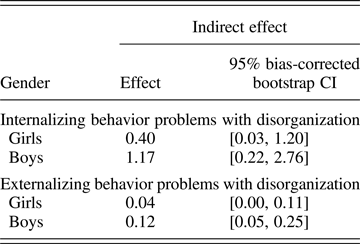
The 95% bias-corrected bootstrapped CI indicated that the conditional indirect effects of CSA on internalizing and externalizing behavior problems through attachment were significant (see Table 3). Disorganization was found to partially mediate the association between CSA and behavior problems at T2, for boys and for girls. The magnitude of these effects was higher in boys. Sexually abused boys presented higher levels of disorganization than abused girls, and this was found to increase the indirect effect of CSA on behavior problems. The moderated-mediation models accounted for 18.5% of the variance in internalizing behavior problems, and for 28.3% of the variance in externalizing behavior problems scores.Footnote 1
Conditional indirect effects of sexual abuse on behavior problems as a function of gender

Discussion
The aim of this study was to investigate the role of attachment representations in the association between CSA and preschoolers’ adjustment in terms of internalizing and externalizing behavior problems over a 1-year period. More disorganized attachment representations at T1 were associated with higher levels of internalizing and externalizing symptoms at T2, 1 year later. These results are consistent with previous studies in suggesting that disorganized attachment in CSA victims can act as a risk factor for the development of various negative outcomes (Beaudoin et al., Reference Beaudoin, Hébert and Bernier2013; Zéphyr, Cyr, Hébert, Bernier, & Beaudoin, Reference Zéphyr, Cyr, Hébert, Bernier and Beaudoin2015) and provide more convincing evidence for this link due to the study's longitudinal design. Moreover, disorganized attachment was found to partially mediate the relation between CSA and both internalizing and externalizing behavior problems 1 year following the first assessment.
According to the traumagenic dynamics theory (Finkelhor & Browne, Reference Finkelhor and Browne1985), child victims may feel betrayed (i.e., disappointed and distrusted) by adults who caused them harm or were unable to protect them from the abuse. Their expectations and perceptions of adults as trustworthy and reliable in time of stress may consequently be distorted, thereby compromising the development of attachment security (Lyons-Ruth & Jacobvitz, Reference Lyons-Ruth, Jacobvitz, Cassidy and Shaver2008). In the absence of adequate protection and responsiveness following disclosure, children may also come to perceive themselves as vulnerable or unworthy of support, putting them at risk of developing internalizing problems, such as depression and anxiety (Brumariu & Kerns, Reference Brumariu and Kerns2010). Moreover, the parent–child relationship is believed to contribute to an emotional self-regulation repertoire in children (Calkins & Leerkes, Reference Calkins, Leerkes, Vohs and Baumeister2011). Studies have suggested that maternal unresponsiveness may lead to disorganization in children because of the fear generated by the absence of help for regulating distress (George & Solomon, Reference George and Solomon2008; Lyons-Ruth, Bronfman, & Parsons, Reference Lyons-Ruth, Bronfman and Parsons1999; Miljkovitch et al., Reference Miljkovitch, Moran, Roy, Jaunin, Forcada-Guex, Pierrehumbert and Borghini2013). Thus, when disclosure of CSA is not followed by an appropriate response from the attachment figure (or when the child expects this), the effects of the abuse may be worsened by the absence of comforting responses and stress regulation. Disorganization would thus reflect inability to rely on attachment figures in times of stress, and would place children at risk of developing adjustment problems. Finally, children's capacity to develop adequate strategies and effectively cope with stressors may be impaired by the occurrence of CSA. This can in turn contribute to increased internalizing and externalizing symptoms given the documented link between emotional dysregulation and behavior problems among CSA victims (Langevin et al., Reference Langevin, Hébert and Cossette2015).
The security and ambivalence scales, in contrast, were not associated with behavior problems. These results are in line with the literature establishing that disorganization is associated with more dysfunctional patterns of behavior compared to other forms of attachment insecurity (Lyons-Ruth et al., Reference Lyons-Ruth, Easterbrooks and Cibelli1997; Madigan et al., Reference Madigan, Brumariu, Villani, Atkinson and Lyons-Ruth2016). Fearon et al. (Reference Fearon, Bakermans-Kranenburg, van IJzendoorn, Lapsley and Roisman2010) found that the behavior problems of insecure-organized children were only slightly higher than those of secure children. Thus, in agreement with the current results, it appears that disorganized children are at higher risk for behavior problems than their insecure organized counterparts. Moreover, as the association between attachment security and behavior problems tends to become clearer with age (Brumariu & Kerns, Reference Brumariu and Kerns2010; Fearon et al., Reference Fearon, Bakermans-Kranenburg, van IJzendoorn, Lapsley and Roisman2010), the absence of an association between insecure-organized attachment and behavior problems in this study could be related to the young age of the children in our sample. One possibility is that insecure-organized attachment representations become a risk factor for child adaptation as CSA victims grow older.
Our results also point to gender differences in the outcomes of preschool CSA victims. Child gender was found to moderate the association between CSA and disorganization, with larger detrimental effects of CSA in boys. These results are in line with those of previous studies showing more disorganization in boys compared to girls (Carlson et al., Reference Carlson, Cicchetti, Barnett, Braunwald, Cicchetti and Carlson1989). Moreover, a recent study revealed a similar mediation-moderation effect of gender in the link between CSA and behavior problems, with emotion regulation as a mediator (Langevin et al., Reference Langevin, Hébert and Cossette2015). Boys may thus be more sensitive to environmental risk factors, which could account for the greater detrimental impact of CSA observed in boy victims (Lyons-Ruth et al., Reference Lyons-Ruth, Easterbrooks and Cibelli1997). Chaplin (Reference Chaplin2015) proposed a model according to which gender differences arise from an interaction between biological and social factors. It is hypothesized that existing biologically based differences (e.g., cognitive and socioemotional maturation) become more manifest as they evoke and are affected by social pressures from the entourage. In addition, these differences are constantly influenced by the interpersonal context in which children find themselves. Gender differences could be even more salient in preschoolers as the effects of differential socialization emerge significantly during this developmental period (Keenan & Shaw, Reference Keenan and Shaw1997).
Maternal history of CSA and SES were found to be associated with child externalizing behavior problems. Among a group of preschool CSA victims, Berthelot et al. (Reference Berthelot, Langevin and Hébert2012) also found that children of mothers reporting a history of CSA presented more externalizing behavior problems, as reported by mother and teacher, than those of nonabused mothers. It appears that mothers’ CSA is an important variable to consider in the perspective of intergenerational transmission of risk. Parents who have experienced childhood trauma may be less able to offer support to their child due to their own difficulties in regulating emotions (Langevin, Hébert, Allard-Dansereau, & Bernard-Bonnin, Reference Langevin, Hébert, Allard-Dansereau and Bernard-Bonnin2016).
Characteristics of CSA were not correlated with attachment representations. This is consistent with past studies that also failed to find consistent results regarding the predictive value of abuse-related variables (Hébert, Langevin, & Charest, Reference Hébert, Langevin and Charest2014; Yancey & Hansen, Reference Yancey and Hansen2010). Assessing details concerning duration and severity of abuse may represent a challenge with preschoolers. Due to their developmental level and verbal skills, characteristics of the abuse are rarely fully documented at initial intake. Thus characteristics of abuse may have greater predictive value in studies of long-term outcomes conducted with adult samples.
Strengths and limitations
This study fills an important gap in the CSA literature. Previous studies have only focused on the link either between CSA and attachment representations (Charest et al., Reference Charest, Hébert and Bernier2018; Fresno et al., Reference Fresno, Spencer, Ramos and Pierrehumbert2014) or between CSA and behavior problems in young children (Beaudoin et al., Reference Beaudoin, Hébert and Bernier2013; Hébert et al., Reference Hébert, Langevin and Bernier2013). To date, this is the first study to examine the association of all three variables in one model. The longitudinal design provides a unique perspective on the potential effects of attachment representations on CSA victims' behavior problems over a 1-year period. The large sample size, especially with regard to this vulnerable population of abused children, represents an important strength of the present study. The presence of a comparison group also enabled us to capture the unique contribution of CSA to the difficulties experienced by young children.
Among the limits of this study, children's behavior problems were only evaluated by a parent. A multi-informant procedure would have been preferable. However, shared method variance is not at play, given that no other central measure was parent reported. Our attachment measure was one of representations, and coding did not allow for the differentiation of the distinct types of disorganized attachment, such as controlling-caregiving and controlling-punitive patterns (Moss, Cyr, & Dubois-Comtois, Reference Moss, Cyr and Dubois-Comtois2004). A behavioral assessment of these subtypes could be of great interest for future studies. Moreover, social and emotion regulation competencies that could have been informative regarding other underlying mechanisms were not considered in the models. The assessment of such variables would be relevant in future studies in order to gather a more comprehensive picture of children's outcomes as well as a more complete description of the developmental processes at play in the links observed here.
It is also important to acknowledge that attrition was higher for the CSA group, which is a commonly encountered problem with this population. CSA is associated with several upheavals in the family, making it difficult to reach participants for follow-ups (Yancey & Hansen, Reference Yancey and Hansen2010). Attrition was also associated with SES and maternal history of CSA; however, possible biases related to this condition were circumvented by the use of FIML procedure (Little et al., Reference Little, Jorgensen, Lang and Moore2013).
Finally, attachment representations did not completely mediate the association between CSA and behavior problems. This can be explained by the presence of a direct effect of CSA on behavior problems, but also suggests that other variables may intervene. Among these, disrupted maternal behaviors (Madigan, Moran, Schuengel, Pederson, & Rotten, Reference Madigan, Moran, Schuengel, Pederson and Rotten2007) and emotion regulation (Alink, Cicchetti, Kim, & Rogosch, Reference Alink, Cicchetti, Kim and Rogosch2009) have been put forward as variables influencing the association between maltreatment and behavior problems in children. The exploration of additional variables may thus be of great interest in order to better explain the effect of CSA on children's adjustment. While advances are being made in the neurosciences, future studies should continue to explore the association between adversity in childhood, biological factors, and relational factors, in order to shed more light on the developmental effect of early adverse environments (Doyle & Cicchetti, Reference Doyle and Cicchetti2017).
Implications
Despite its limitations, the present study makes an important contribution both clinically and empirically. In terms of clinical practice, the current results suggest that intervention with victims of CSA can be carried out on two levels: on the effect of CSA on attachment and on the effect of CSA on behavior problems. Trauma-focused cognitive behavioral therapy (TF-CBT) is currently identified as the best practice intervention for sexually abused victims (Cohen, Mannarino, & Deblinger, Reference Cohen, Mannarino and Deblinger2017). This intervention model contains cognitive components such as communication and understanding of the traumatic experience, which may prove more difficult for some young children given the limits associated with their cognitive immaturity. However, despite this challenge, TF-CBT has been found to be efficient in reducing symptoms in children even in the preschool years (Hébert & Daignault, Reference Hébert and Daignault2015).
Aspects of the parent–child attachment relationship should also be considered in the assessment. In the likely event that children present a form of attachment insecurity, especially disorganization, TF-CBT combined with an attachment-based intervention could represent a valuable treatment option. There is evidence that attachment-based interventions are effective not only for enhancing attachment security but also for decreasing disorganization rates in young children from high-risk samples (Moss et al., Reference Moss, Dubois-Comtois, Cyr, Tarabulsy, St.-Laurent and Bernier2011; Tereno et al., Reference Tereno, Madigan, Lyons-Ruth, Plamondon, Atkinson, Guedeney and Guedeney2017; Valentino, Reference Valentino2017, for a review). A recent meta-analysis assessing the effectiveness of attachment-based interventions in reducing disorganization revealed that such interventions were more effective with maltreated compared to nonmaltreated children (Facompré, Bernard, & Waters, Reference Facompré, Bernard and Waters2017). These results are promising and support the integration of this approach in working with sexually abused children whose developmental pathways appear to mainly involve disorganization. Thus, a treatment combining TF-CBT with an attachment-based intervention could contribute to reduce behavior problems through its effect on attachment security in victims (Fearon et al., Reference Fearon, Bakermans-Kranenburg, van IJzendoorn, Lapsley and Roisman2010; Madigan et al., Reference Madigan, Brumariu, Villani, Atkinson and Lyons-Ruth2016). Our results also point to the importance for clinicians to foresee possible gender differences regarding outcomes, as being a boy victim was identified as a risk factor for disorganization and increased manifestation of later behavior problems.
To our knowledge, this study is the first to assess the mediating role of attachment representations in the link between CSA and behavior problems in preschoolers using a longitudinal design. Our study therefore contributes to knowledge in the field of CSA research by underlining the deleterious influence of CSA on children's adjustment over time and offers a promising avenue for intervention in preschool victims. Results underscore the possibility to intervene on a key variable, that of attachment representations, to foster optimal development in young victims, despite the experience of CSA.