Perfectionism is a complex set of beliefs, emotions and behaviors that are characterized, on the positive pole, by the pursuit of self-improvement, self-demand and a desire for order and organization; and on the negative pole, by an exaggerated level of self-criticism, rigidity, demoralization and frustration (Blatt, Reference Blatt1995). Many studies have analyzed the differential impact of these variants of perfectionism on the health and welfare of people from different cultures. A study performed with Chinese students showed a positive relationship between adaptive perfectionism and higher levels of happiness and satisfaction with life, contrary to maladaptive perfectionism (Chan, Reference Chan2012). Other studies have reported similar results of a positive association between adaptive perfectionism and satisfaction with life, quality of life, psychological well-being and self-esteem; while maladaptive perfectionism has been associated with hopelessness and low levels of self-esteem, quality of life, satisfaction with life and psychological well-being (Arana et al., Reference Arana, Scappatura, Miracco, Elizathe, Rutsztein and Keegan2010; Gnilka, Ashby, & Noble, Reference Gnilka, Ashby and Noble2013; Ongen, Reference Ongen2009; Park & Jeong, Reference Park and Jeong2015). In addition, findings from within the research field of sport have shown that the “perfectionistic strivings” dimension was related to positive motivational orientations, hopes of success and self-serving attributions, which favored the athletes’ performance. In contrast, the “negative reactions to imperfection” dimension was associated with negative motivational orientations, fear of failure and self-depreciating attributions, which was in detriment of athletic performance (Stoeber & Becker, Reference Stoeber and Becker2008).
Research has also reported that maladaptive perfectionists establish a harmful and permanent self-comparison with an “ideal” person, are highly dependent on the responses they generate in others and have excessive thoughts about their own failures. Moreover, they tend to experience negative feelings of guilt, indecision, shame, fear of judgement and low self-esteem, as they underestimate their own performance (Blatt, Reference Blatt1995; Scotti, Sansalone, & Borda, Reference Scotti, Sansalone and Borda2011). Furthermore, research has repeatedly noted the relationship between maladaptive perfectionism and certain psychopathological disorders such as depression (Flett, Panico, & Hewitt, Reference Flett, Panico and Hewitt2011; Frost, Benton, & Dowrick, Reference Frost, Benton and Dowrick1990; Gnilka et al., Reference Gnilka, Ashby and Noble2013; Noble, Ashby, & Gnilka, Reference Noble, Ashby and Gnilka2014), suicidal behavior (Blatt, Reference Blatt1995), eating disorders (Bardone-Cone et al., Reference Bardone-Cone, Wonderlich, Frost, Bulik, Mitchell, Uppala and Simonich2007; Fairburn, Cooper, & Shafran, Reference Fairburn, Cooper and Shafran2003; Shafran & Mansell, Reference Shafran and Mansell2001), obsessive compulsive disorder (Frost & Steketee, Reference Frost and Steketee1997; Martinelli, Chasson, Wetterneck, Hart, & Björgvinsson, Reference Martinelli, Chasson, Wetterneck, Hart and Björgvinsson2014) and anxiety disorders (Flett, Hewitt, & Dyck, Reference Flett, Hewitt and Dyck1989; Scott, Yap, Francis, & Schuster, Reference Scott, Yap, Francis and Schuster2014; Shafran & Mansell, Reference Shafran and Mansell2001), among others. In short, while adaptive perfectionism ensures a good performance, maladaptive perfectionism, which is the main focus of the present study, is associated with many emotional and psychopathological disorders that are a frequent cause of psychological consultations.
Perfectionism is not a dysfunction that is exclusive of the adult world, children can also develop this kind of cognitions, and, although in recent years, research in this field has increased, perfectionism in children has not been sufficiently explored, leaving several unanswered questions regarding its role in anxiety disorders and depression (Affrunti & Woodruff-Borden, Reference Affrunti and Woodruff-Borden2014). One of the most recent and specific articles on this topic (Lozano, Valor-Segura, & Lozano, Reference Lozano, Valor-Segura and Lozano2015) reported that the maladaptive dimensions of perfectionism constitute a significant precedent of anxious and depressive symptoms in Spanish children aged between 8 and 12 years. In Argentina, very few studies have focused on this stage of the life cycle, however, they all emphazise the importance of preventing this imbalance early on. For example, in a previous study (Oros, Reference Oros2004), authors noted that the irrational child perfectionism predicted the use of dysfunctional coping strategies towards stress, characterized primarily by paralysis, cognitive avoidance, the search for alternative rewards, unproductive logical analysis, and lack of emotional control and/or inhibition. The inadequate management of emotions of perfectionist children has been analyzed by Serppe (Reference Serppe2010), who has found that dysfunctional perfectionist beliefs constitute a vulnerability factor of the development of depression in Argentinian children. More recently, Elizathe, Murawsky, Custodio, and Rutsztein (Reference Elizathe, Murawski, Custodio and Rutsztein2012) performed a study with children from Buenos Aires to analyze whether there was relationship between maladaptive perfectionism and the risk of suffering from eating disorders during childhood. Their results confirmed this relationship; children at risk of suffering from eating disorders had a significantly higher score of perfectionism than children without such risk. This result stresses the importance of detection and early intervention of perfectionism in order to prevent psychological imbalances which may trigger serious, possibly life-threatening conditions. An interesting point on which to get started in this line of study is to delve into the possible causes or triggers of perfectionism.
During childhood, parent-child relationships acquire a prime importance as explanatory elements of children’s psychoaffective health, hence warranting the exploration of its features in order to find a connection with the variable of interest. Different theoretical approaches have proposed that child perfectionism develops from a strong desire to obtain approval and affection from potentially demanding, controlling, austere and critical parents (Affrunti & Woodruff-Borden, Reference Affrunti and Woodruff-Borden2014; Cook & Kearney, Reference Cook and Kearney2009; Flett, Hewitt, Oliver, & Macdonald, Reference Flett, Hewitt, Oliver, Macdonald, Flett and Hewitt2002). Those parents that hold exaggerated expectations regarding the performance of their children and/or maintain a high level of criticism towards their failures could predispose them to this type of dysfunction (Blatt, Reference Blatt1995). In line with this, a previous study found that children are more likely to become perfectionists when they come from homes where blaming strategies with a strong emotional content and emotional deprivation are used as ways to correct or prevent misbehavior of children (Oros, Reference Oros2004). A research study performed with Irish teenagers revealed that the low autonomy granted, the high psychological control and the low involvement of parents are related to the development of maladaptive cognitions typical of perfectionism, such as doubt about own actions and concern about errors (McArdle, Reference McArdle2009). A more recent study with Argentinian children has found that excessive parental demands have a high predictive power over perfectionistic beliefs (Serppe, Reference Serppe2010).
However, in the present study, it is hypothesized that the development of perfectionism does not only need pathogenic parental models, but also certain personality traits that foster their emergence and consolidation. Previous studies indicate that certain traits, such as neuroticism (Rice, Ashby, & Slaney, Reference Rice, Ashby and Slaney2007; Ulu & Tezer, Reference Ulu and Tezer2010), low extraversion (Dunkley, Blankstein, Zuroff, Lecce, & Hui, Reference Dunkley, Blankstein, Zuroff, Lecce and Hui2006), low agreeableness (Dunkley et al., Reference Dunkley, Blankstein, Zuroff, Lecce and Hui2006; Ulu & Tezer, Reference Ulu and Tezer2010) and conscientiousness (Hill, McIntire, & Bacharach, Reference Hill, McIntire and Bacharach1997) are associated with maladaptive perfectionism, although results are not entirely consistent and vary according to the assessment tools used and the characteristics of the population being studied. It is not clear yet what aspect of personality would have the most important role and, fundamentally, is not known how these traits relate to perfectionism during the delicate period of childhood.
With regard to emotional experience, maladaptive perfectionists have been reported to have a low frequency of positive emotions and they don’t fully enjoy their successes and achievements (Barrow & Moore, Reference Barrow and Moore1983; Dunkley, Zuroff, & Blankstein, Reference Dunkley, Zuroff and Blankstein2003). The predominant feelings in these individuals are generally negative. These perfectionists often note guilt, anger, sadness, futility, distress and embarrassment (Arana, Scappatura, Lago, & Keegan, Reference Arana, Scappatura, Lago and Keegan2007; Ashby & Kottman, Reference Ashby and Kottman1996; Eum & Rice, Reference Eum and Rice2011; Fedewa, Burns, & Gómez, Reference Fedewa, Burns and Gómez2005; Lombardi, Florentino, & Lombardi, Reference Lombardi, Florentino and Lombardi1998; Stornelli, Flett, & Hewitt, Reference Stornelli, Flett and Hewitt2009). In this regard, numerous studies reported the existence of a relationship between frequent perfectionistic thoughts and the manifestation of depression symptoms, due to a discrepancy or inability of people to meet their own excessively high demands (Blatt, Reference Blatt1995; Hewitt et al., Reference Hewitt, Blasberg, Flett, Besser, Sherry, Caelian and Birch2011; Rovella & Rivarola, Reference Rovella and Rivarola2014; Serppe, Reference Serppe2010; Ye, Rice, & Storch, Reference Ye, Rice and Storch2008). Childhood depression is a mood disorder, characterized mainly by dysphoria and anhedonia, and whose presence causes deterioration in various behavioural areas (Del Barrio, Navarro, & Escrivá, Reference Del Barrio, Navarro and Escrivá1994). In the present study, depression is considered from a non-clinical perspective, including indicators such as sad mood, negative self-image, lack of interest/energy and self-incrimination (Richaud de Minzi, Sacchi, & Moreno, Reference Richaud de Minzi, Sacchi and Moreno2001).
In contrast, positive emotions are seen as protective resources of psychophysical health, as they generate feelings of pleasure, expanding the repertoire of thoughts and actions, stimulating creativity and promoting interpersonal ties (Fredrickson & Joiner, Reference Fredrickson and Joiner2002; Oros, Reference Oros2014). These emotions can be amplified or diminished by the effect of the environment or of individual characteristics. Therefore, it is promising to explore their presence in children with a perfectionistic profile.
For these reasons, the present study has the dual purpose of analyzing the extent to which the child’s personality traits and excessive parental demands can predict maladaptive perfectionism, and how this relates to positive emotions and depression.
Method
Type of study
An empirical study with a cross-sectional descriptive-correlational design was performed.
Participants
A non-random sample of 404 Argentinian children (196 boys and 208 girls), aged between 8 and 12 years (M = 10.30; SD = 1.03). The children attended fourth (35.89%), fifth (32.77%) and sixth grade (31.19%) of primary school, both in public (57.14%) and private schools (42.85%), from within urban areas and predominantly from a medium socioeconomic class. The sample was collected from within the provinces of Entre Rios and Tucumán, Argentina. The schools were selected by convenience, according to access possibilities and institutional approval to collaborate in this study.
Instruments
Parental demands scale
This children’s self-report scale, built by Serppe and Oros (Reference Serppe and Oros2010), includes 18 items in its version referred to mothers and 22 items in its version referred to fathers, each item having three possible answers: Yes, Sometimes, and No. Both versions provide information on three types of excessive demands: a) Affect Demands (involving excessive demands of attention, care, affection and interest towards parents), b) Performance Demands (including demands that the child stands out due to his/her optimal mental performance), and c) Obedience Demands (encompassing high standards of responsibility, obedience, good behavior and discipline). These demands are assessed through the child’s perception since, as Schaefer (Reference Schaefer1965) explains, children’s perception of their parents’ behavior might be more related to their psychological adjustment than their parents’ actual behavior.
The authors (Serppe & Oros, Reference Serppe and Oros2010) reported an excellent Cronbach’s alpha coefficient for the paternal version (α = .90). The reliability of each of the subscales assesed separately also achieved satisfactory results: a) Affection and Closeness Demands (α = .81, seven items); b) Performance Demands (α = .76, seven items); and c) Obedience Demands (α = .83, eight items). On the other hand, the internal consistency coefficient for the maternal version was .80; and the reliability of the subscales yielded the following values: a) Affection and Closeness Demands (α = .73, seven items); b) Performance Demands (α = .57, 5 items); and c) Obedience Demands (α = .68, six items).
While the use of questionnaires that yield reliability indexes lower than .70 is generally not recommended, we decided to administer all facets of this instrument, including the two that fell short of this criterion (maternal performance demands and maternal obedience demands), as they include a small number of items and it is known that the alpha coefficient is sensitive to the number of elements, and because it is a novel construct for which there are no other measuring instruments available locally. Nevertheless, this can be considered a limitation of the present study, which, in turn, forces the results obtained with these two dimensions of the scale to be interpreted with caution.
Children’s personality questionnaire (ICSC)
Personality was assessed through the Argentine Children’s Personality Questionnaire (ICSC), designed by Lemos (Reference Lemos2004). This self-report includes 46 items that are scored using a Likert-type scale of 3 points: Yes, Sometimes, and No. The questionnaire operationalized the following five factors: Neuroticism, Extraversion, Restraint, Conscientiousness and Openness. The Neuroticism factor includes the facets of self-criticism, vulnerability, anxiety and competition; the Extraversion factor includes the facets of confidence, gregarious feeling and positive emotions; the Restraint factor evaluates the dimensions of adaptability, thrill seeking (–) and experience seeking (–); the Conscientiousness factor presents the following facets: order, organization and responsibility; and the Openness factor measures the action and innovation facets. It is noteworthy that the competition facet, usually used to account for the conscientiousness trait, is presented by Lemos’ (Reference Lemos2004) model of children’s personality, as a component of neuroticism. The author reported internal consistency coefficients for these factors of between .71 and .80 (Lemos, Reference Lemos2004).
Children’s perfectionism scale
This scale was built by Oros (Reference Oros2003) to assess the maladaptive aspect of perfectionism. It follows a self-report pattern, consisting of 16 items which are grouped into two dimensions: a) Self-demands, related to perfectionism that is oriented towards oneself (“I must be the best in class”; “I cannot make mistakes”); and b) Reactions towards Failure, which reflects the emotions and attitudes associated to the breach of self-demands (“I find it difficult to forgive myself when I’m wrong”; “I criticize myself a lot”). Regarding its internal consistency, Oros (Reference Oros2003) reported satisfactory results for both, the total of items (General α = .83) and for each of the dimensions (Self-demands α = .82; Reaction towards failure α = .70).
Argentinian adaptation of the dimensions of depression profile for children and adolescents
This adaptation, carried out by Richaud de Minzi et al. (Reference Richaud de Minzi, Sacchi and Moreno2001), also follows a self-report pattern and contains 20 statements with three possible answers, depending on the degree of identification with the content of the sentence: Yes, I fully identify (myself) with that; I slightly identify (myself) with that; and I do not identify (myself) with that. The scale does not assess depression from a clinical perspective but rather it assesses certain indicators of depression through the following dimensions and with the following reliability indexes, as the authors noted: a) Lack of Energy (α = .75), b) Sadness (α = .77), c) Negative Self-Image (α = .69), and d) Self-incrimination (α = .76).
Children positive emotions questionnaire (CIEP)
The CIEP (Oros, Reference Oros2014) is a self-report questionnaire consisting of 23 items, with 3 possible Likert-type responses: Yes, More or less, No. It comprises four dimensions, established through an exploratory factor analysis (Oros, Reference Oros2014), which evaluates five emotions: a) Joy and Gratitude (α = .92); b) Serenity (α = .75); c) Sympathy (α = .64); and d) Personal satisfaction (α = .71). While Joy and Gratitude merge into a single factor, according to Oros (Reference Oros2014), it is possible to set separate values for each emotion, with good internal consistency coefficients (Joy = .86; Gratitude = .89).
Data collection procedure
The evaluation was conducted within a school context, collectively and within the regular schedule of classes, in class groups duly authorized by their principals and teachers. All children had the written consent of their parents or guardians, who were provided with the necessary information regarding the scope and content of the evaluation. Furthermore, it was made clear that even with the written consent of parents, each child would be entitled to refuse or discontinue participation at any stage of the assessment without suffering any type of negative consequence. At the time of evaluation, children were also offered all necessary information for them to become familiarized with the task at hand (item content, format response, response strategies, instructions, and reason for evaluation), and were made aware of who would use their scores and for what purpose. In order to avoid fatigue in the participants, the evaluation process was sectioned into four different days. Those tests that evaluate maternal and paternal parental demands were always administered separately to prevent the possibility of the responses given in one version conditioning the responses of the other.
Data analyses procedure
To analyze the data’s normality assumptions of this study, the asymmetry and kurtosis indexes were calculated, finding values ranging from +1 to –1 for most variables, suggesting a close to normal distribution, except for the dimensions of Joy and Gratitude, which showed a bias towards positive values. A Kolmogorov-Smirnov’s Z test confirmed the significant differences between the hypothesized normal distribution and the distribution of the values of positive emotionality of this sample (z = 1.77; p < .001). For this reason, a nonparametric test (Kruskal-Wallis) was used to study the effect of perfectionism on the positive emotional experience of children, complemented with Mann-Whitney comparisons with the Bonferroni correction. For this analysis, perfectionism values were categorized into three levels (high, moderate and low). As no standardization or normative data of the perfectionism score is available to date, this categorization was carried out while trying to achieve groups equivalent in number, using two percentile breakpoints (33.33 and 66.66), and assuming the risk that the differences between groups could be relatively maximized through this procedure.
To address the other objectives of the project, Multiple Linear Regressions were performed using the stepwise method. Lost data analysis indicated that none of the items showed omission percentages higher than 5%. The mean imputation procedure (Fernández-Alonso, Suárez-Álvarez, & Muñiz, Reference Fernández-Alonso, Suárez-Álvarez and Muñiz2012) was used to replace missing values. The statitical program SPSS 15.0 was used for all analyzes.
Results
Regression analyzes were performed having previously tested whether multicollinearity existed between independent variables. The variance inflation factor in no case reached the value of 2 (10 being the maximum allowable) and tolerance indicators were acceptable (greater than 0.50 in all regressions).
Perfectionism, parental demands and personality
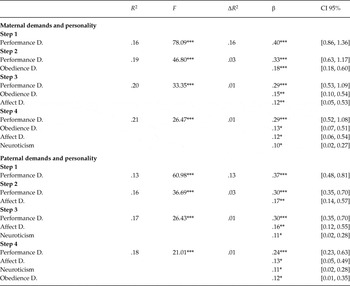
Two regression models of general perfectionism were performed including as predictors the five personality factors together with the three maternal and three paternal demands separately. In the first case, the variables that made up the model with the best predictor ability were maternal performance demands, obedience demands, affection demands and neuroticism of the child, in that order of contribution. In the second case, the best predictor model included paternal performance demands, demands for affection, child neuroticism, and paternal obedience demands, in that order of importance. The contribution of the first above-mentioned model (neuroticism and maternal demands) was slightly higher than the contribution of the second model (neuroticism and paternal demands, see Table 1).
Parental demands and child personality as predictors of child perfectionism

Note: ΔR 2 = Change Increment in R 2. CI = Confidence interval.
* p < .05. **p < .01. ***p < .001.
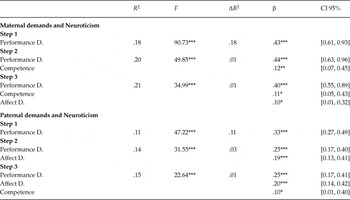
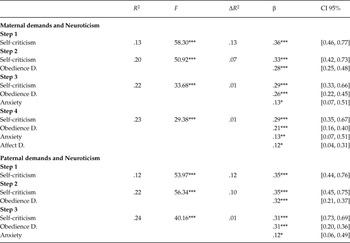
A more detailed analysis in which parental demands and the facets of the only personality trait that yielded significant values were introduced indicated that the combination that best explains the perfectionist self-demands includes parental performance and affection demands and the competence trait of the child. On the other hand, children’s negative reactions to situations of failure are predicted by self-criticism of the child, parental obedience demands, child anxiety, and maternal affection demands (see Tables 2 and 3).
Predictive model for children’s perfectionistic self-demands

Note: ΔR 2 = Change increment in R 2. CI = confidence interval.
* p < .05. **p < .01. ***p < .001.
Predictive model for children’s perfeccionist reactions towards failure

Note: ΔR 2 = Change increment in R 2. CI = confidence interval.
* p < .05. **p < .01. ***p < .001.
Child perfectionism, depression symptoms and positive emotions
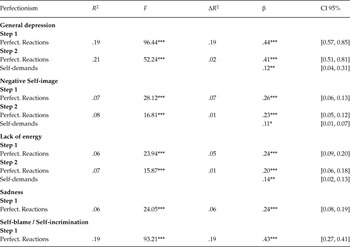
The regression analysis shows that the reactions to failure emerged as the main predictor of depressive symptoms, followed by perfectionist self-demands, which explained 21% of the variance of children’s depressive symptomatology. Additional analyses which studied the predictive role of perfectionism for each dimension of depression symptoms showed that a negative self-image and a lack of energy were explained by both dimensions of perfectionism, but with a strong predominance of the reactions towards failure; while sadness and self-blame were only explained by perfectionist reactions. In spite of being such a detailed analysis, the determination coefficients (R 2) were predominantly low, except for self-blame (see Table 4).
Child perfectionism as a predictor of Depression

Note: ΔR 2 = Change increment in R 2. CI = confidence interval.
* p < .05. **p < .01. ***p < .001.
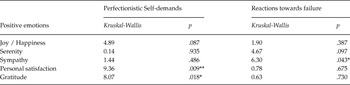
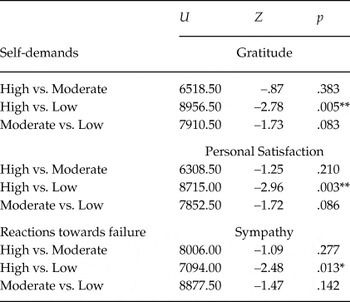
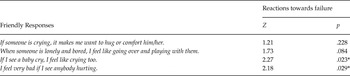
Finally, it was observed that Gratitude (Kruskal-Wallis (2) = 8.07; p = .018) and Personal Satisfaction (Kruskal-Wallis (2) = 9.36; p = .009) varied significantly depending on the perfectionist self-demands (see Table 5). Pairwise comparisons, using the Mann-Whitney method and the Bonferroni correction, showed significant differences between the extreme groups (high vs. low values of self-demands) for both Gratitude (U = 8956.50; z = –2.78; p = .005) and for Personal Satisfaction (U = 8717.00; z = –2.96; p = .003; see Table 6). As perfectionist self-demands increased, the feelings of gratitude decreased and personal satisfaction increased notably. It was also observed that Sympathy (Kruskal-Wallis (2) = 6.30; p = .043), specifically the negative emotional reflection, as a more detailed analysis by items revealed (see Tables 5 and 7), varies according to perfectionistic reactions to situations of failure. Pairwise comparisons indicate that significant differences occur between the extreme groups of perfectionist reactions (high vs. low values; U = 7094.00; z = –2.48; p = .013). The highest score in the dimension of reactions to failure corresponded to a greater negative emotional reflection (see Table 6).
Non-parametric test for the effect of perfectionism on positive emotions

Note: *p < .05. **p < .01.
Contrast statisticals for the effect of perfectionism on gratitude, personal satisfaction and sympathy

Note: *p < .05. **p < .01.
Aspect of children’s friendliness affected by perfectionistic reactions towards failure

Note: *p < .05.
Discussion
The aim of this study was to analyze to what extent the personality traits of the child and excessive parental demands can predict maladaptive perfectionism, and how it relates to positive emotions and symptoms of depression.
In general terms, it can be said that, although slightly, neurotic temperamental traits, combined with excessive parental demands, especially those oriented towards the performance of the child, would constitute a prolific basis for the development of child perfectionism. These results confirm the results found by Ulu and Tezer (Reference Ulu and Tezer2010) and Rice, Ashby, and Slaney (Reference Rice, Ashby and Slaney2007) in the adult population of other countries, who reported that maladaptive perfectionism (assessed from different theoretical approaches) was predicted by neuroticism. Secondly, the results obtained credit the hypothesis that the characteristics of the parent-child relationship are important precedents of child perfectionism. Coinciding with Blatt’s (Reference Blatt1995) and Serppe’s (Reference Serppe2010) proposals, it was observed that excessive parental demands favor the development of perfectionism and, in this study, it favors it to a much greater extent than personality.
This supremacy of parental demands on personality could be explained as a matter of evolutionary stage, from which it is clear that, in childhood, parents have a crucial importance in the establishment of beliefs, behaviors, aspirations and values. As time passes, this influence begins to wane, at the same time as personality becomes structured and consolidated in its most fundamental aspects, and the extensive social group becomes more important. It would be interesting to perform longitudinal studies to test this hypothesis.
The analyses also revealed that the various aspects of perfectionism are related differentially to the facets of neuroticism and to parental demands. Therefore, while parental performance, affection demands and a heightened sense of competition on behalf of the child are important for the development of perfectionist self-demands, for the development of negative reactions to failure, a strong critical and anxious personality of the child is needed, along with high parental obedience demands.
This means that children develop exaggerated performance self-demands, stimulated directly or indirectly by their parents. Their parents carry out a very strict monitoring of the their children’s school performance, comparing them to their peers, expecting them to have better grades, requiring them to be more responsible than they already are and asking them to obey these demands as a sign of affection towards them. All of these demands are among other everyday behaviors reflected in the assessment of parental performance and affection demands (Serppe, Reference Serppe2010). This pressure, which is not perceived as such by the child’s parents, generates within the child a deep desire to avoid actions that displease his/her caregivers and that result in some kind of emotional detachment. It is noteworthy that previous studies have found that parents of perfectionist children often interrupt or remove manifestations of acceptance and affection when children do not meet their high expectations of performance (Flett et al., Reference Flett, Hewitt, Oliver, Macdonald, Flett and Hewitt2002; Oros, Reference Oros2003).
This need for perfection is increased when, additionally, the child has a high sense of competition, that is, when he/she perceives or shows himself/herself as capable of achieving high goals, which, in turn, leads to his/her strong inclination to excel and work with great dedication and care for his/her objectives, hence showing typical perfectionist personality qualities (Franchi, Reference Franchi2010). Coincidentally, Ulu and Tezer (Reference Ulu and Tezer2010) argued that the competition trait is associated with setting high perfectionistic standards, however, while in their study, high standards or perfectionist self-demands were considered as adaptive, in the present work, they have emerged as a factor of vulnerability. Meanwhile, it is true that perfectionist self-demands could have a positive side, and, in our study, they indeed show a less dysfunctional pattern compared to reactions to failure, they should also be considered as harmful to the child’s emotional development, at least in the sense in which they have been operationalized in this study, in view of their association with depression, as will be later discussed.
With regard to the development of perfectionist reactions to failure, the importance that self-critical and anxious temperamental traits, and the excessive parental obedience demands acquire was observed. Therefore, those children who have a natural tendency towards self-criticism will present a greater probability of developing attitudes of guilt and self-punishment when they perceive that they have not performed as well as they believe they should have. Furthermore, children who are naturally prone to concern, tension and nervousness will be more vulnerable to develop ruminations about their failures and to feel discomfort and anger when faced with the failure of their objectives. These results are consistent with the findings of a recent local research, in which it was observed that children at a school age presented a personality profile characterized by neuroticism, mainly due to a tendency towards anxiety and self-criticism (Ocampo & Oros, Reference Ocampo and Oros2015).
The relationship between negative reactions to failure and parental obedience demands can be explained through the parenting styles model proposed by Baurmind (Reference Baumrind1971). In the present study, the operationalization of the excessive obedience demands bears certain similarity to the concept of authoritarian discipline suggested by the author, involving the prescription of high standards without explaining the reasons, the demands of an absolute and unquestionable obedience, and the paternal anger and punishment without justification or release by the child. Some research has noted that children who grow up in authoritarian homes are more likely to develop maladaptive perfectionism (Craddock, Church, & Sands, Reference Craddock, Church and Sands2009), especially characterized by an overriding need to achieve socially prescribed standards (Miller, Lambert, & Speirs Neumeister, Reference Miller, Lambert and Speirs Neumeister2012) and by the concern regarding errors (Kawamura, Frost, & Harmatz, Reference Kawamura, Frost and Harmatz2002), aspects which would be closely linked to the perfectionist reactions to failure.
In relation to emotional experience, perfectionist children, who would be permanently faced with both, external both internal (derived from their strong criticism) and external (derived from excessive parental expectations) pressures, would present a characteristic emotional profile, characterized by: a) feelings of sadness, b) lack of energy, c) negative self-image (which involves self-disgust, dissatisfaction with oneself, and lack of personal acceptance), and d) self-incrimination. These results show that, as observed in adults and young adults, perfectionist children develop a tendency towards depression (Arana, Scappatura, Lago, & Keegan, Reference Arana, Scappatura, Lago and Keegan2006; Hewitt & Flett, Reference Hewitt and Flett1991), probably due to the intense frustration caused by not meeting most of their high aspirations and their expectations of others. Notably, similarly to Lozano et al.’s (Reference Lozano, Valor-Segura and Lozano2015) study, negative reactions showed the most significant role in the manifestation of depression, compared to other perfectionist aspects. This is logical if one takes into account that children with high scores in perfectionist reactions, have a markedly self-critical and anxious profile (precursor or comorbid aspects of depression), and have recurrent ruminations, a tendency to blame themselves and to feel remorse when they are wrong, and a high frustration and anger towards themselves. Hence, it is reasonable that this dysfunctional profile could lead to the experimentation of feelings of sadness, hopelessness and depression.
In this study, it was also noted that perfectionist children are characterized by a diminished ability to experience gratitude towards others, which is probably explained by the strong attentional focus they have on themselves. It has been shown that perfectionists have a greater locus of internal control than non-perfectionists (Periasamy & Ashby, Reference Periasamy and Ashby2002), hence, showing a tendency to attribute failures to themselves and possibly the few successes achieved, a fact that could weaken their ability to recognize the role or involvement of others as they obatin personal gain, thus becoming the experience of gratitude less frequent. In any case, as there are no precedents that allow assertion of this hypothesis, the concern remains open to further explore this issue in future studies.
Furthermore, it was observed that perfectionist children have a high level of personal satisfaction. At first glance, it would seem contradictory that these children would have a negative self-image (assessed through the depression questionnaire) and at the same time, experience personal satisfaction, which is characterized by a high sense of worth (Oros, Reference Oros2014). However, analyzing the way in which both constructs have been operationalized, one might think that the perfectionist child may consider himself/herself as valuable, in the sense that he/she is aware of his/her intrinsic value as a person, an essential aspect of personal satisfaction (e.g., Item 17: “I feel I am very valuable”, item 20: “I feel I’m important”), but nevertheless, this does not fulfill his/her need to feel at ease with himself/herself and be accepted as he/she is, as his/her measure of success as a person is subject to the achievement of daily unattainable goals whose failure can lead to a negative self-image (e.g., Item 1: “I don’t like being me”; item 11: “I’m not satisffied with the way I act”). Viewed in this way, the two concepts do not have to be contradictory. However, this is another scarcely explored field that is worth further analysing in order to further understand the affective mechanisms underlying child perfectionism.
Finally, it was observed that children’s reactions to personal failure increased the experience of negative feelings towards others’ failure or misfortune (“If I see a baby cry, I feel like crying too”; “I feel very bad if I see anybody hurting”). While sympathy is an important psychological resource associated to welfare and positive social relationships, it can be inferred that in this case, in the light of previous results showing a rather unfavorable psychological profile for perfectionists children, and their aforementioned attentional trend towards themselves, high sympathy values would reflect a greater empathic distress rather than a genuine concern or positive movement towards the needs of others. Empathic distress or discomfort indicates an inability to distance themselves from ohers in situations of emotional crisis (Richaud de Minzi, Lemos, & Mesurado, Reference Richaud de Minzi, Lemos and Mesurado2011), and is considered a self-oriented feeling; whereas sympathy or empathic concern are characterized by feelings of concern and compassion towards the suffering of others, and therefore, these are considered feelings oriented towards others (Mestre Escrivá, Frías Navarro, & Samper García, Reference Mestre Escrivá, Frías Navarro and Samper García2004).Thus, one would think that perfectionist children suffer with others’ failure but not because they feel sorry for the other and feel the need to alleviate them, but because they identify vicariously with him (they feel a deep malaise when they imagine themselves in that situation of failure). This is evident by observing that none of the two sympathy items that evaluate the orientation to benefit others have been associated with perfectionism (“If someone is crying, it makes me want to hug or comfort him/her”; “When someone is lonely and bored, I feel like going over and playing with them”). This point has not been sufficiently addressed in previous research and should be analyzed further.
In conclusion, the results of this study confirm that excessive parental demands and child neuroticism have an important role in the development of perfectionism during childhood, and that the latter violates the mental health of minors, promoting feelings of depression, low gratitude, vicar discomfort against other’s failure and a perception of high personal value that fails to satisfy them. This information is highly relevant in clinical settings and in the design of prevention programs. Psychoeducational techniques regarding parental discipline should be incorporated as a crucial element in the treatment or prevention of perfectionism during childhood. Moreover, it is recommended to approach this childhood dysfunction by simultaneously addressing the most salient cognitive aspects (irrational beliefs, absolutist thinking, catastrophization, etc.), negative emotions (especially anxiety, depression and empathic distress) and positive emotional experience of the relationship with others (recognition of others and gratitude).
As for the limitations of this study, it is noteworthy that the sampling method used does not favor population representativeness and therefore, no generalization of the information provided can be extrapolated. On the other hand, data were collected through self-report measures, thus, it would be very helpful if future research could include the perception of parents and teachers, in addition to evaluating the child’s perception about himself/herself, and therefore, allowing for analyses and comparison of results, including other evaluation criteria. Moreover, it should be highlighted that due to the lack of a stadardised scale for the classification of child perfectionism, the comparison groups were formed based on percentiles from the sample. It is important to replicate the analysis after performing a standardization of the questionnaire. In addition, it would be interesting to include the study of other family, social, emotional and cognitive variables related to child perfectionism: a) parental styles and parental perfectionism; b) children’s social skills and assertiveness; c) self-efficacy beliefs, cognitive distortions, etc. The exploration of these variables and their dynamics with child perfectionism will allow for the development of new tools for prevention and treatment.