


Background
Anxiety and depression are common in young people and frequently co-occur (Ford, Goodman and Meltzer, Reference Ford, Goodman and Meltzer2003). Between 25–50% of young people with an anxiety disorder are also diagnosed with depression (Angold, Costello and Erkanli, Reference Angold, Costello and Erkanli1999) and correlations between self-reported anxiety and depressive symptoms frequently range from .40–.80 in clinical and community youth samples (Axelson and Birmaher, Reference Axelson and Birmaher2001); indicating that many youth experiencing depressive symptoms also experience elevated anxiety symptoms and vice versa.
Substantial co-occurrence of anxiety and depression in youth highlight the importance of transdiagnostic theoretical frameworks to understand their development in childhood. Limited transdiagnostic models have proposed both shared and specific components of anxiety and depression. The tripartite model proposes that whilst anxiety and depression are both characterized by elevated negative affect, physiological hyper-arousal is specific to anxiety, and low positive affect is specific to depression (Clark and Watson, Reference Clark and Watson1991). Similarly, the cognitive content-specificity hypothesis proposes that anxiety and depression are both characterized by cognitive distortions for processing emotional information but can be differentiated by divergent cognitive themes. Specifically, anxious cognitions are thought to be characterized by threat and danger whilst depressive cognitions focus on loss and negative self-evaluation (Clark and Beck, Reference Clark, Beck, Kendall and Watson1989).
Identifying shared and specific cognitions in anxiety and depressive symptoms in youth can provide insight into possible mechanisms that explain their co-occurrence. Additionally, identifying converging and diverging cognitive themes can inform cognitive behavioural therapies (CBT). CBT for both anxiety and depression focuses on modifying maladaptive cognitions maintaining emotional symptoms. Identifying converging cognitive themes suggests a transdiagnostic treatment protocol would be effective, whereas differentiated cognitive themes imply interventions specifically targeted to either anxiety or depression.
Despite important implications, research examining specificity between cognitive vulnerability factors and anxiety and depression within a single study is limited; largely separate literature bases focusing on either anxiety- or depression-related cognitions have evolved. Many cognitive vulnerabilities have been implicated in the aetiology of anxiety and depression (Clark and Beck, Reference Clark, Beck, Kendall and Watson1989). The cognitive construct of anxiety sensitivity has received considerable attention as a cognitive vulnerability for anxiety and more recently depression (Naragon-Gainey, Reference Naragon-Gainey2010). Building on previous research, our team identified a three-factor model of anxiety sensitivity (Brown et al., Reference Brown, Trzaskowski, Zavos, Rijsdijk, Gregory and Eley2012), with each dimension differentially associated with anxiety and depressive symptoms in young people (Brown et al., Reference Brown, Waszczuk, Zavos, Trzaskowski, Gregory and Eley2014). In the current study we extend this examination by including rumination, a robust cognitive vulnerability for depression (Nolen-Hoeksema, Reference Nolen-Hoeksema1991), and examining independent associations between these cognitive constructs and anxiety and depressive symptoms.
Anxiety sensitivity
Anxiety sensitivity (AS) refers to the tendency to be fearful of future anxiety symptoms with a belief they are harmful (Reiss, Peterson, Gursky and McNally, Reference Reiss, Peterson, Gursky and McNally1986). Meta-analyses show higher AS in youth with anxiety disorders and robust associations between AS and anxiety symptoms in unselected youth (Noel and Francis, Reference Noel and Francis2011). Furthermore, prospective associations between AS and later anxiety symptoms beyond current anxiety symptoms in childhood implicate AS as a vulnerability for anxiety in young people (McLaughlin, Stewart and Taylor, Reference McLaughlin, Stewart and Taylor2007; Schmidt et al., Reference Schmidt, Keough, Mitchell, Reynolds, Macpherson and Zvolensky2010). However, AS has also been associated with depressive symptoms in young people (Muris, Schmidt, Merckelbach and Schouten, Reference Muris, Schmidt, Merckelbach and Schouten2001; Weems, Hammond-Laurence, Silverman and Ferguson, Reference Weems, Hammond-Laurence, Silverman and Ferguson1997), suggesting AS may represent a transdiagnostic cognitive vulnerability for both anxiety and depression.
Although AS was originally developed as a unitary construct, contemporary conceptualizations propose a number of AS dimensions that may each be differentially associated with anxiety and depression (Olatunji and Wolitzky-Taylor, Reference Olatunji and Wolitzky-Taylor2009). Factor analyses generally support a multidimensional structure consisting of three subscales representing physical, social and mental symptom-related concerns (Brown et al., Reference Brown, Trzaskowski, Zavos, Rijsdijk, Gregory and Eley2012; Wright et al., Reference Wright, Asmundson, McCreary, Stewart, McLaughlin and Comeau2010). The physical concerns subscale pertains to fear of biological symptoms of anxiety (e.g. funny feelings in my body scare me), whilst the social concerns facet represents fear of publicly observable symptoms (e.g. I don't want other people to know when I’m afraid) and the mental concerns subscale depicts worries regarding cognitive control over distress (e.g. When I am afraid, I worry I might be going crazy). Limited studies with adults (Schmidt, Lerew and Joiner, Reference Schmidt, Lerew and Joiner1998; Taylor, Koch, Woody and McLean, Reference Taylor, Koch, Woody and McLean1996) suggest that the physical and social concerns subscales of AS tends to be associated with anxiety but not depressive symptoms. Conversely, mental AS seems more strongly associated with depression. Studies with unselected youth are scarce and reveal a mixed pattern of associations (Dehon, Weems, Stickle, Costa and Berman, Reference Dehon, Weems, Stickle, Costa and Berman2005; Joiner et al., Reference Joiner, Schmidt, Schmidt, Laurent, Catanzaro and Perez2002). For example, one study of unselected adolescents found physical AS was independently associated with anxiety but not depression whilst social and mental AS were associated with anxiety and depression (Brown et al., Reference Brown, Waszczuk, Zavos, Trzaskowski, Gregory and Eley2014; Dehon et al., Reference Dehon, Weems, Stickle, Costa and Berman2005). Similarly, a recent twin study of childhood, adolescence and early adulthood by our group showed that physical AS was independently associated with anxiety at all time points (Brown et al., Reference Brown, Waszczuk, Zavos, Trzaskowski, Gregory and Eley2014). Social AS was not associated with anxiety or depression in childhood but was associated with both anxiety and depression in adolescence, whereas mental AS was associated with both anxiety and depressive symptoms to a similar extent at all ages.
Rumination
Rumination, the tendency to recurrently think about the causes and consequences of depressive symptoms, is consistently implicated in the development and maintenance of depression in adults (Nolen-Hoeksema, Reference Nolen-Hoeksema1991, Reference Nolen-Hoeksema2000). Similarly, meta-analytic findings from studies with unselected children show robust associations with both concurrent and future depressive symptoms (Rood, Roelofs, Bogels, Nolen-Hoeksema and Schouten, Reference Rood, Roelofs, Bogels, Nolen-Hoeksema and Schouten2009). However, similar to studies of AS, limited recent studies have also identified prospective associations with anxiety in children and adolescents (Muris, Fokke and Kwik, Reference Muris, Fokke and Kwik2009; Roelofs et al., Reference Roelofs, Rood, Meesters, Dorsthorst, Bogels and Alloy2009), indicating rumination may also represent a transdiagnostic cognitive vulnerability for anxiety and depression in youth.
Associations between AS, rumination, anxiety and depression
At a conceptual level, AS and rumination are similar constructs; both describing repetitive negative thoughts. However, AS reflects fear of future distressing symptoms whilst rumination is concerned with negative reflections on past symptoms of distress. Despite theoretical similarities, few studies have considered the possible interplay between AS and rumination and their associations with anxiety and depressive symptoms.
A small number of studies have demonstrated associations between rumination and the more general construct of worry in unselected adults (Fresco, Frankel, Mennin, Turk and Heimberg, Reference Fresco, Frankel, Mennin, Turk and Heimberg2002; Segerstrom, Tsao, Alden and Craske, Reference Segerstrom, Tsao, Alden and Craske2000) and children (Muris, Roelofs, Meesters and Boomsma, Reference Muris, Roelofs, Meesters and Boomsma2004; Verstraeten, Bijttebier, Vasey and Raes, Reference Verstraeten, Bijttebier, Vasey and Raes2011). However, conclusions regarding their specific roles in anxiety and depression are mixed. For example, one study showed specific associations between worry and anxiety and rumination and depression (Verstraeten et al., Reference Verstraeten, Bijttebier, Vasey and Raes2011), whilst others find similar associations with anxiety and depression (Fresco et al., Reference Fresco, Frankel, Mennin, Turk and Heimberg2002).
With regards to AS, one study of unselected girls (aged 9–12) showed a substantial correlation between total AS and rumination and between them both and anxiety and depressive symptoms (Epkins, Gardner and Scanlon, Reference Epkins, Gardner and Scanlon2013). However, when controlling for covariance between anxiety and depression, AS was specifically associated with anxiety whilst rumination was specific to depression, so suggesting AS and rumination may represent specific cognitive vulnerabilities for anxiety and depression, respectively. To date, no studies have examined specificity between AS subscales and rumination in relation to anxiety and depression in youth. One study of depressed adults found that only the mental concerns AS subscale was associated with depressive symptoms but was fully mediated by rumination (Cox, Enns and Taylor, Reference Cox, Enns and Taylor2001). The authors concluded that mental AS may represent a broader fear of depressive symptoms (depression sensitivity), driving individuals to ruminate on depressive symptoms, serving to increase depressive symptom severity.
The current study
The current study extends these limited studies, exploring specificity in associations between AS (total and subscales) and rumination and anxiety and depressive symptoms in a sample of unselected children. A number of hypotheses were tested. First, given substantial co-occurrence of anxiety and depressive symptoms, we expected AS and rumination to be correlated with both sets of symptoms. However, when controlling for covariance between anxiety and depression, we expected AS to be more strongly associated with anxiety and rumination to depression, in agreement with limited previous studies examining specificity of associations between AS and rumination and anxiety and depression separately (Hypothesis 1). Furthermore, when controlling for covariance between AS subscales and rumination, we anticipated, in line with the cognitive content-specificity hypothesis (Beck, Brown, Steer, Eidelson and Riskind, Reference Beck, Brown, Steer, Eidelson and Riskind1987) and previous limited studies (Brown et al., Reference Brown, Waszczuk, Zavos, Trzaskowski, Gregory and Eley2014; Verstraeten et al., Reference Verstraeten, Bijttebier, Vasey and Raes2011), that rumination would show a specific relation with depression whilst AS subscales would be solely associated with anxiety; with the exception of mental AS, which we more tentatively expected to be associated with both anxiety and depression (Hypothesis 2). Finally, in line with the only other study to examine specificity in associations between AS subscales, rumination and depression (Cox et al., Reference Cox, Enns and Taylor2001), we explored whether the association between mental AS and depression was mediated by rumination in our child sample (Hypothesis 3). We also extended this to examine whether the mediating effect of rumination was specific to depression or common across both anxiety and depressive symptoms.
Method
Participants
Ethical approval was granted by the Psychiatry, Nursing and Midwifery Research Ethics Subcommittee of King's College London (ref no: PNM/10/12–10). Children aged 7 to 11 years were recruited from a mainstream primary school in Cambridgeshire. A passive consent procedure was used. Parents were sent detailed study information and given a minimum of a week to decline. Reminders were sent via e-mail by school staff. In total, 147 children (69 boys; 78 girls) were included. The mean age of the sample was 9 years 2 months (Range = 7 – 11 years). The sample described themselves as white British (59%), Indian (11%), Pakistani (4%), Chinese (2%) or “other” (20%).
Measures
Anxiety sensitivity
AS was measured using the Children's Anxiety Sensitivity Index (CASI; Silverman, Fleisig, Rabian and Peterson, Reference Silverman, Fleisig, Rabian and Peterson1991), an 18-item self-report questionnaire assessing fear of anxiety sensations (e.g. “It scares me when I feel shaky”). Children rated item agreement on a 3-point scale. Responses were summed to calculate total AS scores. The CASI shows adequate test-retest reliability and validity in unselected children (Silverman et al., Reference Silverman, Fleisig, Rabian and Peterson1991). AS subscales representing physical, social and mental concerns were created following the most replicated factor structure of the CASI (Brown et al., Reference Brown, Trzaskowski, Zavos, Rijsdijk, Gregory and Eley2012; Wright et al., Reference Wright, Asmundson, McCreary, Stewart, McLaughlin and Comeau2010).
Rumination
Rumination was measured using the rumination subscale of the Children's Response Styles Questionnaire (CRSQ; Abela, Brozina and Haigh, Reference Abela, Brozina and Haigh2002), a 13-item self-report questionnaire describing self-focused responses to depressed moods (e.g. “When I am sad, I think about how alone I feel”). Children indicated how often they experienced each item using a 4-point scale. Responses were summed to create a total rumination score. The CRSQ rumination subscale shows adequate reliability and validity with children (Abela et al., Reference Abela, Brozina and Haigh2002).
Anxiety
Anxiety symptoms were measured using the Spence Children's Anxiety Scale (SCAS; Spence, Reference Spence1998), a 38-item self-report questionnaire. Responses were measured on a 4-point Likert scale and summed to create total anxiety scores. The SCAS shows good reliability and concurrent validity (Spence, Reference Spence1998).
Depression
Depressive symptoms were measured using the Short Mood and Feelings Questionnaire (SMFQ; Angold et al., Reference Angold, Costello, Messer, Pickles, Winder and Silver1995), a 13-item self-report measure assessing how often children experienced depressive symptoms in the previous 2 weeks using a 3-point scale. Total depression scores were created by summing all items. The SMFQ has adequate reliability and validity in children as young as 8 (Angold et al., Reference Angold, Costello, Messer, Pickles, Winder and Silver1995).
Procedure
Children completed the questionnaires in groups of 8 or less and were supervised by researchers and members of staff to ensure comprehension. Any children requiring supervision undertook the study individually. Questionnaires were presented in the same order for all participants (anxiety, anxiety sensitivity, depression, rumination). The school were given a monetary voucher for participating.
Data analysis plan
Descriptive statistics were used to examine the means and possible sex differences in self-reported emotional symptoms and cognitive constructs.
In order to identify specificity in relations between the cognitive constructs and anxiety and depression, and account for sex differences in some variables, separate multiple regression models predicted (i) anxiety and (ii) depressive symptoms from; sex, anxiety/depressive symptoms, rumination and total AS (Hypothesis 1) or AS subscales (Hypothesis 2). Age was not included owing to the narrow range and lack of associations with the constructs of interest. Standardized beta co-efficients and semi-partial correlation co-efficients were calculated to estimate the magnitude of independent effects.
Finally, Preacher and Hayes’ (Reference Preacher and Hayes2008) SPSS “PROCESS” macro for mediation was used to examine whether associations between mental AS and anxiety and depressive symptoms were mediated by rumination (Hypothesis 3), One thousand re-samples were taken and 95% bias corrected accelerated confidence intervals were calculated. The magnitude of indirect effects was computed using boot strapped resampling following Preacher and Hayes’ recommendations. The proportion of the total effect mediated by rumination was calculated according to MacKinnon, Warsi and Dwyer (Reference MacKinnon, Warsi and Dwyer1995).
Results
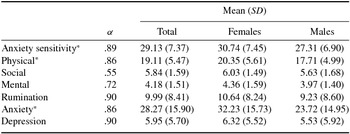
Descriptive statistics are shown in Table 1. Internal consistency was substantial for the majority of scales. Estimates were somewhat lower for social and mental AS, reflecting fewer items within those scales. This is similar to other studies with unselected youth (Brown et al., Reference Brown, Waszczuk, Zavos, Trzaskowski, Gregory and Eley2014; Dehon et al., Reference Dehon, Weems, Stickle, Costa and Berman2005). Mean scores for all measures were comparable to those reported in previous unselected child samples (Brown et al., Reference Brown, Waszczuk, Zavos, Trzaskowski, Gregory and Eley2014). Anxiety, total AS and physical AS were significantly higher for females than males (ps < .001). Pearson's correlations revealed no associations with age (in months).
Descriptive statistics for self-reported anxiety sensitivity, rumination, anxiety and depressive symptoms in unselected children (7–11 years)

*Females significantly higher than males (p < .05)
Hypothesis 1
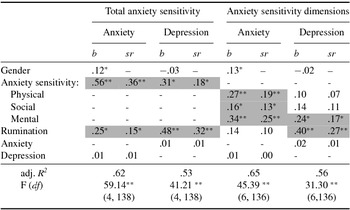
There were substantial associations between total AS, rumination, anxiety and depression (all rs > .56, ps <.001). Regression co-efficients for models predicting anxiety and depressive symptoms are shown in columns 1 and 2 (respectively) of Table 2. Sex significantly predicted anxiety (β (standardized beta) = .88, p < .01) but not depression (β = ‒.08, ns). Total AS and rumination were significant predictors of both anxiety and depression (βs = .25 ‒ .56, ps < .01). However, semi-partial correlation coefficients indicated that anxiety was more strongly correlated with AS than rumination, whilst depression was more strongly associated with rumination. Interestingly, anxiety and depression were not related when controlling for AS and rumination.
Multiple regression predicting anxiety and depressive symptoms in unselected children (7–11 years)

* p < .01, ** p < .001 b unstandardized beta co-efficient sr semi-partial correlation coefficient adj. R2 adjusted proportion of variance explained
Hypothesis 2
Next AS subscales were included to examine specificity between AS subscales and rumination in predicting anxiety and depression (columns 3 and 4 of Table 2). Physical and social AS showed specific relations to anxiety symptoms (βs = .27 and .16, respectively). Rumination was specific to depressive symptoms (β = .40). Mental AS showed independent associations with both anxiety and depression (βs = .34 and .24, respectively). Again, anxiety and depression were unrelated.
Hypothesis 3
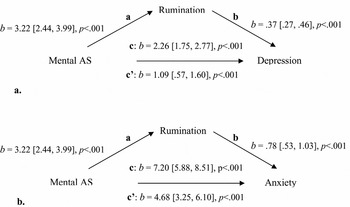
Mediation analyses revealed that mental AS significantly predicted rumination (a paths); explaining 32.34% of the variance in rumination (Figure 1)Footnote 1 . The direct effects of rumination (b paths) and mental AS (c path) significantly predicted anxiety and depression; explaining 55.44% and 57.04% of the variance, respectively. The significant effect of mental AS on anxiety and depressive symptoms (c paths) reduced but remained significant when controlling for rumination (c’ paths), indicating partial mediation. There were significant, large indirect effects of Mental AS, via rumination on depression (b = 1.17 [.69, 1.77], p <.001; κ2 = .32 [.21, .45]) and anxiety (b = 2.52 [1.50, 3.74], p <.001; κ2 = .26 [.16, .37]). Children's rumination scores accounted for 25% of the association between mental AS and anxiety scores (34.95% of the total effect) and 31% of the association with depression scores (52.5% of the total effect).
Mediation model of the direct and indirect (via rumination) associations between mental concerns of anxiety sensitivity (AS) and depression (a) and anxiety (b) b unstandardized beta coefficient p significance value

Discussion
To our knowledge this is the first study to combine AS subscales and rumination and examine specificity of associations with both anxiety and depressive symptoms in children. As expected, we found substantial inter-correlations between all measures, in line with the high co-occurrence of anxiety and depression (Axelson and Birmaher, Reference Axelson and Birmaher2001) and theoretical similarities between anxiety- and depression-related cognitive vulnerabilities (Clark and Beck, Reference Clark, Beck, Kendall and Watson1989). However, in line with previous studies exploring these cognitive vulnerabilities separately (Muris et al., Reference Muris, Fokke and Kwik2009; Weems et al., Reference Weems, Hammond-Laurence, Silverman and Ferguson1997), regression analyses revealed stronger associations between AS and anxiety, and between rumination and depression.
The current findings extend previous studies by exploring specificity in associations between AS subscales and rumination and anxiety and depression, controlling for their covariance, within a single study. Rumination was associated with depression but not anxiety. The physical and social AS subscales were specifically associated with anxiety whilst mental AS was independently associated with anxiety and depression. Rumination partially mediated associations between mental AS and anxiety and particularly depression. Anxiety was not correlated with depression when controlling for covariance with rumination and AS subscales, suggesting that shared cognitive vulnerabilities explained much of the association between anxiety and depression in the current study.
Content-specificity in anxiety and depression
Results were largely in line with a recent study examining specificity between AS subscales and anxiety and depressive symptom reports in children and adolescents (Brown et al., Reference Brown, Waszczuk, Zavos, Trzaskowski, Gregory and Eley2014) and provided partial support for the content-specificity hypothesis (Beck et al., Reference Beck, Brown, Steer, Eidelson and Riskind1987). Specifically, anxiety but not depression was significantly associated with fear of biological and social symptoms of distress and their perceived threatening consequences (e.g. “When my stomach hurts, I worry that I might be really sick”). Conversely, depression but not anxiety was characterized by repetitive negative reflection on the causes and consequences of symptoms of distress (e.g. “When I am sad, I think about all my failures”). However, both anxiety and depression were independently associated with the mental AS subscale, suggesting that worries relating to loss of cognitive control (e.g. lack of concentration, going crazy) are characteristic of both anxiety and depression. Evidence for an independent association between mental AS and depression extends previous studies showing associations between total AS and depression, suggesting associations are driven by fears relating to losing cognitive control rather than worries regarding physical or social symptoms. Furthermore, this association was only partially mediated by rumination, suggesting depression is not only characterized by ruminative thoughts about past distress but also fear of cognitive symptoms of distress in the future.
It has previously been suggested that the mental concerns subscale of AS may reflect a broader “depression sensitivity” whereby normal, although unpleasant, experiences such as fatigue or difficulty concentrating are interpreted as signs of future depressive episodes (Cox et al., Reference Cox, Enns and Taylor2001). Sensitivity to symptoms of depression and the belief they will cause future distress is in line with a “scar hypothesis” positing that chronic depression results in enduring cognitive changes that leave an individual prone to future depressive episodes (Lewinsohn, Steinmetz, Larson and Franklin, Reference Lewinsohn, Steinmetz, Larson and Franklin1981). It could be that the tendency to ruminate on depressive symptoms could reinforce cognitive distortions about the impact of depressed mood and increase sensitivity to future symptoms.
Results of the mediation analysis are somewhat at odds with the only other study to explore associations between rumination and mental AS in clinically depressed adults, which showed complete mediation of the association between mental AS and depression (Cox et al., Reference Cox, Enns and Taylor2001). Discrepancies are not easily explained given the paucity of relevant research. It is possible that these cognitive vulnerabilities play different roles in children or non-clinical samples or perhaps AS acts through other mediators to influence depression (e.g. memory or attentional biases that guide attention to negative stimuli). Extending previous analyses (Cox et al., Reference Cox, Enns and Taylor2001), we found that rumination also partially mediated the association between mental AS and anxiety, suggesting broader interplay between AS subscales and rumination and their role in childhood anxiety and depression. Prospective research is needed to examine the causal relations between mental AS and rumination and anxiety and depression.
Limitations
The main study limitation is the cross-sectional design. Although AS and rumination are hypothesized as cognitive vulnerabilities for anxiety and depression and prospective studies support their causal role, causal associations could not be examined in the current study. Mediation analyses should be interpreted with caution and future longitudinal research is needed to clarify causal relationships. Second, the sample focused on a relatively narrow age range, precluding analysis of age-effects. Future research with broader age ranges and/or larger samples are needed to assess the generalizability of current findings. Third, the study relied on children's self-report of emotional symptoms and cognition. There is some debate regarding the validity of children's reports of such internal processes. However, experimental studies have shown that children as young as 7 years can make valid interpretations of anxiety symptoms (Mattis and Ollendick, Reference Mattis and Ollendick1997; Muris, Hoeve, Meesters and Mayer, Reference Muris, Hoeve, Meesters and Mayer2004) and can reliably report their emotional experiences over time (Michael and Merrell, Reference Michael and Merrell1998). Furthermore, all the selected measures have been validated in children in the current age range and, with the exception of the mental and social AS subscales, all measures demonstrated adequate internal consistency in the current study, suggesting children were responding consistently within them. Reliance on self-report measures, however, may inflate correlations due to common method variance. Future research may benefit from combining self- and/or parent-report with experimental measures. Finally, the lower internal consistency of the social and mental AS subscales is in line with other studies using AS subscales and reflects the small number of items in each scale but could reduce power to detect associations. Future research would benefit from expanded measures of AS, better capturing AS dimensions. Additionally, rumination has been conceptualized as two dimensions: “brooding” and “reflective” rumination (Verstraeten et al., Reference Verstraeten, Bijttebier, Vasey and Raes2011). The CRSQ rumination subscale largely reflects brooding rumination. It would be interesting to explore specificity with regards to both domains.
Implications
Substantial covariation between AS and rumination and anxiety and depressive symptoms highlights the importance of integrative cognitive models of anxiety and depression and transdiagnostic research to examine their differential development (Harvey, Watkins, Mansell and Shafran, Reference Harvey, Watkins, Mansell and Shafran2004). Identifying disorder-specific cognitions, as well as those shared between anxiety and depression, could help to tailor CBT programmes to a given diagnosis. Specifically, reflecting on and reappraising past symptoms of distress is likely to be more applicable in treating depression, whilst targeting fears surrounding future symptoms may be more important in anxiety treatment. However, anxiety is heterogeneous. Although not possible in the current study owing to the relatively small sample, future research would benefit from exploring associations between these cognitive vulnerabilities and anxiety symptom subtypes to tailor cognitive interventions more precisely to specific anxiety disorders.
Conclusions
The current findings extend those from previous studies examining associations with AS and rumination separately. Findings suggested that childhood anxiety and depressive symptoms are characterized by both shared and symptom-specific cognitions. Specifically, anxiety but not depression was characterized by concerns relating to physical and social symptoms of distress, whilst depression was specifically associated with rumination. Conversely, concerns relating to cognitive symptoms of distress were common to both depression and anxiety. The degree of covariance between rumination, AS and both anxiety and depression highlights the importance of transdiagnostic research, combining multiple measures of cognitive vulnerabilities and examining specificity to anxiety and depression to inform theoretical frameworks and clinical interventions for these common problems.



Comments
No Comments have been published for this article.