Advancements in paediatric cardiac surgery and perioperative care have resulted in the evolution of paediatric cardiovascular intensive care medicine over the last two decades, with the development of separate cardiac ICUs or the partitioning of cardiac patients within multidisciplinary paediatric ICUs in most paediatric heart programmes. Most programmes also transitioned to 24/7 in-house attending physician coverage in these ICUs. Reference Horak, Alexander and Amirnovin1 These forces created a demand for physicians with specialised paediatric cardiac critical care training. A 2004 study reported a deficiency in paediatric cardiac intensivists, noting a discrepancy between the number of graduating trainees and available open positions. Reference Stromberg2 In 2015, the American Academy of Pediatrics Cardiology Workforce Assessment noted a continued need for paediatric cardiac intensivists, particularly when compared with other subspecialty areas. Reference Ross, Srivastava and Cabrera3 In the years since those reports, the number of advanced training programmes in paediatric cardiac critical care has increased and more trainees have sought alternative pathways, such as dual fellowships in paediatric cardiology and critical care medicine. While these factors have increased the workforce, updated information on current numbers and projections for future positions are unknown. We undertook a national survey to address this gap and provide guidance to paediatric cardiac programmes.
Materials and methods
Study design
A 185-item survey was distributed to medical directors (“directors”) and faculty who provide care for paediatric cardiac patients in ICUs in the United States. The study was deemed exempt after evaluation by the Nationwide Children’s Hospital Institutional Review Board.
Study institutions and populations
Eligible subjects were directors and faculty at the 120 US centres where congenital heart surgery was performed in 2019 and related data were submitted to the Society of Thoracic Surgeons Congenital Heart Surgery Database.
Survey design
The survey was developed by the investigators and pilot tested to refine content and improve face and content validity. Questions pertained to personal training, current workload, and plans for retirement or decreased ICU service time. Directors were additionally asked to provide current faculty numbers, expected job openings, presence of fellowship training programmes, and number of trainees (Supplemental Digital Content 1,2). Additional data on unit structure, faculty demographics, clinical duties, accreditation and maintenance of certification, and personal health/well-being are reported in separate manuscripts.
Data collection
Survey administration, data collection, and data management utilised Research Electronic Data Capture. Email invitations were sent to directors between May and August 2019 through the Research Electronic Data Capture survey distribution tool. To capture cardiac intensive care faculty, we solicited faculty email addresses from each director. Reminder emails were sent to encourage completion of the survey. The survey closed September 2019.
Additional demographic data from each centre were obtained from a prior study by a co-investigator to allow comparisons of responding and non-responding centres. Reference Horak, Alexander and Amirnovin1 A cardiac ICU was defined as an ICU that cares exclusively for critical cardiac medical or surgical patients, by a core team of providers, in a separate geographical location from a paediatric ICU. If beds were routinely used for non-cardiac patients, the unit was considered to be a multidisciplinary paediatric ICU. Training was defined as categorical if an individual had a single fellowship in cardiology or critical care, dual if they completed both cardiology and critical care fellowships, and advanced if they completed a focused year of cardiac critical care training after categorical fellowship.
Workforce calculations
To assess the current and near-future volume of faculty entering the paediatric cardiac critical care workforce, the numbers of advanced and dual trainees who completed training within the last 5 years were obtained from the director survey and annual averages calculated. We noted the number of anticipated new advanced positions reported as planned within the next 5 years. To estimate the number of categorical trainees that would be directly entering the workforce without additional training, we used, from our results, the current percentage of faculty <40 years with categorical fellowship alone. The total anticipated faculty entering the workforce yearly (influx) was then calculated by adding (a) the average number of advanced and dual graduates, (b) the estimated number of categorical fellow graduates entering paediatric cardiac critical care, and (c) a range of the anticipated new advanced positions. Since the realisation of new advanced positions is uncertain, we used 0 (the lowest number possible) to 14 (the full number of anticipated positions) to provide an annual range.
Workforce efflux data were derived from survey responses. We calculated the total weeks that would be opened by anticipated retirement or decreased clinical time. The number of faculty needed was then calculated using the reported median number of ICU service weeks per faculty. For the purpose of calculations, “faculty” and “clinical full-time equivalent” were used interchangeably. We then converted the yearly faculty efflux to a 5-year number. Current open faculty positions were obtained from director responses. Projected additional faculty needs were calculated using director responses regarding both anticipated faculty recruitment and expansion of ICU beds over the next 5 years. The number of faculty needed to cover these anticipated additional beds was calculated using the median number of faculty per 10 ICU beds. The overall 5-year faculty needs were a sum of current open positions, the range of anticipated faculty due to recruitment/expansion, and faculty efflux from retirement or decrease in clinical service.
As an additional analysis, we modelled future workforce needs by estimating the future number of children and adults with CHD using a study by Gilboa et al. Reference Gilboa, Devine and Kucik4 and projected population growth by age group for 2020 and 2025 using United States Census data. 5 With the assumption that the proportion of children and adults with CHD will remain constant over time, we combined the estimates from Gilboa et al. Reference Gilboa, Devine and Kucik4 and United States Census projections 5 to estimate the number of children and adults with CHD from 2020 to 2025. We then used these projections to calculate the number of provider-hours necessary to maintain current provider-hours per patient and compared these numbers to predicted provider-hour availability. These calculations were done first, using the median weekly clinical work hours and service weeks from our results and then secondly, modelling a decreased service burden of 12 weeks, since reported work hours from the survey greatly exceeded a typical 40-hour work week. 6 For the latter calculation, we chose to decrease service weeks rather than weekly hours, as decreasing hours on service may be impractical for patient care. We also considered a 10% increase and decrease in the number of required provider-hours per patient and refer to these scenarios as the upper and lower bound, respectively.
Statistical analysis
Summary statistics included mean and standard deviation or median and interquartile range for continuous variables, depending on the normality of distributions, and counts and percentages for categorical variables. Open-text responses from the “other” category were re-grouped to existing choices when appropriate. Percentages were calculated using non-missing responses as the denominator. Two-sample t-test or Wilcoxon Rank-sum test was used to compare continuous variables depending on the normality of data, and chi-square or Fisher’s exact test was used to compare categorical variables depending on cell counts. P-values less than 0.05 indicated statistical significance. Statistical analyses were performed using Stata v16.1 and Microsoft Excel v16.4.
Results
Response rate
Complete survey responses were received from 66% (79/120) of directors. Sixty-one directors provided a current faculty email list. We received more faculty email addresses from cardiac ICU directors than multidisciplinary paediatric ICU directors (68 versus 35%; p < 0.001). In total, 477 faculty received the survey, with 294 responses (62%). Faculty response rate by centre averaged 59% (range 14–100%). Response rate was higher from cardiac ICU directors (48/60, 80%) than multidisciplinary paediatric ICU directors (31/60, 52%; p = 0.004) and from directors of larger ICUs (mean cardiac ICU beds 20.0 ± 8.2 in responders versus 13.5 ± 5.3 in non-responders, p = 0.01; mean paediatric ICU beds 22.4 ± 8.1 in responders versus 19.3 ± 4.5 in non-responders, p = 0.07). A larger percentage of responding faculty reported working in a cardiac ICU (68%) versus a multidisciplinary paediatric ICU (32%).
Training pathways
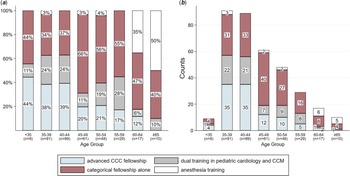
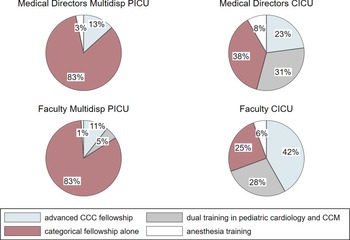
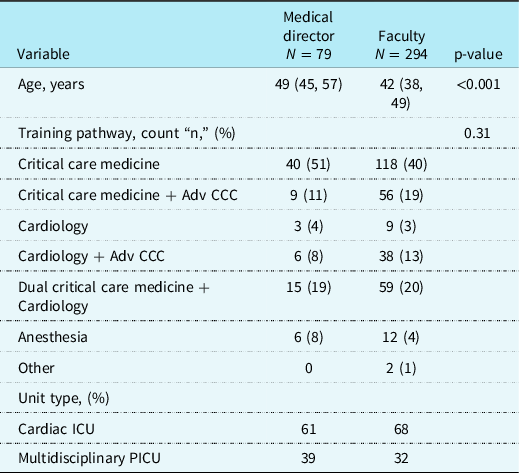
The most common training pathway for respondents in both groups was categorical paediatric critical care fellowship alone with dual training in paediatric cardiology and critical care medicine the second most common single pathway (Table 1). However, if combined, more faculty have had either advanced or dual fellowship training than categorical training alone. Respondents with additional specific training were more likely to be <45 years of age (Fig 1a and b). Training pathways significantly differed by ICU type (Fig 2). Advanced or dual training was predominant in those who work in dedicated cardiac ICUs (p < 0.0001). Reciprocally, directors and faculty with categorical fellowship training alone were predominant in multidisciplinary paediatric ICUs (p < 0.0001).
( a and b ) Training backgrounds of responding cardiac intensivists by age, expressed as percentages (2a) and by number (2b). n = 354, not plotted n = 15 age missing, n = 2 training not provided, n = 2 no fellowship training. CCC = cardiac critical care; CCM = critical care medicine.

Pie chart of training background of responding cardiac intensivists by ICU type. Medical directors are shown in the upper panels and faculty in the lower panels. CCC = cardiac critical care; CCM = critical care medicine; CICU = cardiac ICU; Multidisp = multidisciplinary; PICU = paediatric ICU.

Characteristics of survey respondents.

Values are reported as median (interquartile range) or percentage; p-value indicates difference between Medical Director versus Faculty
Adv CCC = advanced cardiac critical care fellowship; PICU = paediatric ICU
Workforce current status and projections
Faculty influx/efflux
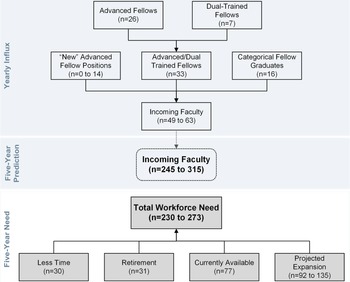
Workforce predictions are represented in Figure 3. Directors from 19 of the 20 known advanced fellowships in the US responded and reported a median of 1.5 (total of 32) available annual positions. Those programmes have trained 129 faculty in the last 5 years (annualised to 26/year). Twelve of these 19 programmes (63%) do not anticipate changing the number of advanced positions in the next 5 years. In the programmes who do anticipate a change, the expected increase and decrease in positions was identical (four each), resulting in no net change. In programmes without an advanced fellowship, 14 (24%) are anticipating establishing one in the next 5 years, with one position in each programme (14 total). Therefore, over the next 5 years there is a potential increase of 14 yearly advanced fellowship positions.
Paediatric cardiac critical care workforce prediction flowchart.

Almost half of directors report that their programme can provide dual training in paediatric cardiology and critical care medicine. In those programmes, 36 fellows have completed dual training in the last 5 years, annualised to 7/year. Using these data, we estimate that at least 33 faculty (26 advanced, 7 dual) currently enter the workforce annually, with a potential increase of another 14 advanced fellows per year in the next 5 years. Based on current statistics, if those 33 faculties represent 2/3 of the current entering workforce, we can estimate that another 1/3 of the entering workforce (or 16) will be made up of trainees with categorical fellowship alone. Thus, we estimate the total yearly entering workforce to be between 49 and 63 faculty, with the range depending on the fulfilment of the additional advanced fellowships.
At median ages of 49 (directors) and 42 years (faculty), the workforce is relatively young; thus, expected workforce departure is small. Only 17% (n = 13) of directors and 6% (n = 18) of faculty plan retirement in the next 5 years, creating 31 total open positions. An additional 44% of directors (n = 34) and 29% of faculty (n = 84) plan to decrease service time by a median of four weeks, most frequently to allow for increased administrative duties (70% directors, 48% faculty) or research (13% directors, 22% faculty). The total predicted coverage need from this is 472 weeks over the next 5 years. If we use reported 15.7 weeks of service per faculty, Reference Horak, Bai and Marino7 an additional 30 faculty would be needed over the next 5 years.
Availability of positions and workforce predictions
Over half of directors (56%, n = 44) reported current open faculty positions [median 2 (IQR 1,2)] at the time of the survey, with a total of 77 open positions. Forty-nine directors (64%) expect to have a median of 2 (IQR 1,2) or total of 92 additional positions in the next 5 years. Forty-five programmes (58%) report a plan to increase by a median of 8 beds (IQR 6,12), with a total of 387 new beds in the next 5 years. Using survey results of 3.5 faculty needed per 10 beds, 6 this translates to a need for 135.5 faculty in that time period. We assume that most of the 92 additional positions reported by the directors are in anticipation of expansion. Therefore, we project a range of 92–135 additional faculty positions in the next 5 years. With the 77 current open positions, 92–135 new positions created for expansion, 31 positions vacated due to anticipated retirements, and 30 positions vacated due to anticipated reduction in clinical time, we project a total need for 230–273 faculty in the next 5 years. With a projected entering workforce of 49–63 faculty per year, between 245 and 315 new faculty may enter the workforce over the next 5 years, likely filling these needs.
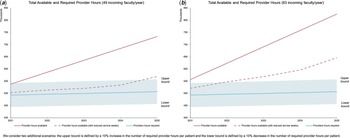
Our secondary analysis yielded similar results. Modelling physician available hours compared to the expected needs of the CHD population, we found that the available workforce hours will exceed the upper bound needed hours in 2021, if workload remains consistent (Fig 4a and b). However, if ICU clinical weeks are decreased from a median of 15.7–12 weeks to decrease overall hours, then the workforce excess would be delayed until 2022 (if 63 faculty enter yearly) or 2024 (if 49 enter yearly).
( a and b ) Physician workforce availability. Workforce availability compared to CHD population using both current workforce hours and reduced hours per physician with 49 and 63 physicians entering the workforce each year from 2021 to 2025. Upper and lower bounds represent a 10% increase or decrease in required provider-hours per patient.

Discussion
Our workforce survey found that, while there remains a current need for trained paediatric cardiac critical care physicians, the predicted number of incoming faculty is robust and will likely fill the excess in open positions over the next 5 years. While there are no comparable predictive models in paediatric critical care, adult critical care models show a growing need for ICU beds, owing to ageing of the baby boomer population. This contrasts to a more fixed rate of growth in the congenital cardiac population. 6
The demand for specialty-trained paediatric critical care faculty increased substantially in the last two decades. However, this accelerated period of growth has likely passed and, as a relatively “newer” subspecialty, the current workforce has little expected departure in the near future, leading to questions about ideal training numbers. While we need to train future specialised providers, we must also be cognisant of future needs, so that graduates have appropriate job opportunities. The use of advanced fellowships to support coverage deficits, attract stronger categorical fellowship candidates, or as a metric for programmatic quality seem inappropriate in light of our findings. Indeed, an argument could be made for concerted efforts to limit new or existing training positions.
An important consideration when estimating workforce needs is anticipating work-hour modifications. Directors and faculty work long hours both on- and off-service. Reference Horak, Bai and Marino7 Work-hour reductions or modifications in clinical expectations may mitigate market saturation. These changes would need to occur systemically and in a coordinated fashion and notably, even with a decrease in clinical expectations, the need for additional faculty may reach a plateau over the next 5 years.
Paediatric cardiac critical care faculty are now more frequently pursuing additional training, demonstrating evolution into a distinct subspecialty. Considerations when choosing a training pathway include non-ICU clinical interests, preferred unit type, and future career goals. Faculty responsibilities and organisational characteristics at individual centres may favour a specific training pathway and future leadership opportunities at some centres may be reduced for individuals with board certification in only one specialty. Dual fellowship training likely provides the most short- and long-term career flexibility. A background in paediatric critical care medicine may also be desirable, particularly in multi-disciplinary paediatric ICUs. As the job market becomes more restrictive, these preferences may become more pronounced and will need to be considered by trainees.
Although we had a strong response rate, our study has limitations. Surveys are limited by voluntary responses and answers cannot be verified. We received a higher response rate from cardiac ICU-based directors and faculty. Those respondents may not reflect the attitudes of the entire workforce. Limitations specific to our calculations include the following: We can only use responses to inform our calculations. While we likely captured all the advanced trainees, there may be additional open positions at non-responding institutions. We estimated the number of categorical fellowship trainees likely to enter the field based on current percentages and acknowledge that this may change over time. We considered one faculty to equal one clinical full-time equivalent and do not account for faculty who may work <1 clinical. We did not account for international medical graduates who may return to their home countries. We used estimates of the predicted CHD population and, as our study was conducted in the United States, findings may not be generalisable to other countries. Calculation of faculty needs is complex and likely dependent on individual institutional characteristics. We did not compare faculty needs in teaching versus non-teaching hospitals and did not evaluate the impact of advanced practice providers, fellows, or advanced fellows on staffing or need for faculty. Finally, we acknowledge that our predictions are based on information obtained before the COVID-19 pandemic, which has impacted programme expansions and faculty hiring.
Conclusions
Paediatric cardiac critical care training has evolved with younger faculty and those in cardiac ICUs more likely to have advanced or dual fellowship training. Our workforce predictions suggest that the field will become saturated in the next 5 years. Institutions with existing training programmes and those contemplating new programmes should be cognisant of these data and prepare their graduates for an increasingly competitive market.
Supplementary material
To view supplementary material for this article, please visit https://doi.org/10.1017/S1047951121004893
Acknowledgements
We acknowledge the Pediatric Cardiac Intensive Care Society Board of Directors for their endorsement of this project.
Financial support
This research received no specific grant from any funding agency, commercial or not-for-profit sectors.
Conflicts of interest
None.