INTRODUCTION
The question of whether conservation policies can achieve their goals in a just and fair manner has long been debated in both academic and policy circles (Neumann Reference Neumann and Zerner2000; Adams et al. Reference Adams, Aveling, Brockington, Dickson, Elliott, Hutton, Roe, Vira and Wolmer2004). This debate has gained renewed significance in the context of the emerging policy of Reducing Emissions for Deforestation and Degradation plus enhancement of forest carbon stock (REDD+). Despite some claims about progress and positive outcomes in REDD+ demonstration projects (Peskett et al. Reference Peskett, Schreckenberg and Brown2011), growing criticisms surround the early assessments of many projects on the ground. Scholars and policy analysts question emergent patterns including violent exclusion and displacement of indigenous peoples (Beymer-Farris & Bassett Reference Beymer-Farris and Bassett2012; Leach & Scoones Reference Leach and Scoones2015); forest re-centralization and tenure insecurity (Phelps et al. Reference Phelps, Webb and Agrawal2010; Sunderlin et al. Reference Sunderlin, Larson, Duchelle, Resosudarmo, Huynh, Awono and Dokken2014); ineffective benefits sharing agreements (Luttrell et al. Reference Luttrell, Loft, Gebara, Kweka, Brockhaus, Angelsen and Sunderlin2013); dangers in social safeguards delivery (Arhin Reference Arhin2014); lack of free, prior and informed consent and effective participation (Mahanty & McDermott Reference Mahanty and McDermott2013); and uncertain funding arrangements (Spergel & Wells Reference Spergel, Wells and Angelsen2009). Because REDD+ is likely to produce both winners and losers, questions of justice become central in REDD+ and other payment for ecosystem services projects.
Recent scholarship has favoured a conception of justice as a social construct that is interpreted and perceived in various ways by different actors at different scales (Sikor Reference Sikor2013) – a departure from justice as a universal principle of fairness in distribution as suggested by Rawls (Reference Rawls1971). Since Fraser (Reference Fraser2009), Schlosberg (Reference Schlosberg2007) and Sikor (Reference Sikor2013) have laid the basis for justice upon the three normative dimensions – distributive, procedural and recognition – more recent works have sought to extend, refine or even challenge this basis (e.g. Bolin & Tassa Reference Bolin and Tassa2012; Fisher Reference Fisher and Sikor2013; Forsyth & Sikor Reference Forsyth and Sikor2013). Meanwhile, Sikor (Reference Sikor2013) suggests that an empirical approach to justice analysis is necessary to analyse the extent to which fairness is pursued in ecosystem governance at the implementation stages. Such an empirical grounding is also instrumental in bridging the gap between critical analysis and actual practices of justice (Suiseeya Reference Suiseeya and Kimberly2015). Despite the importance of empiricism in justice evaluation, an empirical grounding of justice has hardly been sufficiently explored in the West African context. Our study seeks to contribute to this empirical gap in West Africa by focusing on tenure consideration in REDD+ in Nigeria and Ghana.
Thus, the main objective of this paper is to empirically examine how tenure issues are being addressed in order to promote just outcomes in the implementation of REDD+ readiness in Nigeria and Ghana. In doing this, we emphasize an explicit attention to transparency, equity and legitimacy (TEL). Tenure provides an appropriate context for examining justice concerns in REDD+ in these countries for three reasons. First, there is a long historical legacy of state appropriation of rights to forests at the expense of local communities living around forest resources in both countries (e.g. Ite Reference Ite2001; Teye Reference Teye2008). Second, a closely related reason is that forest policies have historically privileged the interests of outside claimants, such as logging and mining companies and even non-governmental organizations (NGOs), as communities bore the cost of conservation (e.g. Teye Reference Teye2008; Schoneveld Reference Schoneveld2014). Third, ownership and use rights of forest resources have often been unclear due to complexity regarding the overlap of the customary and statutory laws that simultaneously govern forest tenure.
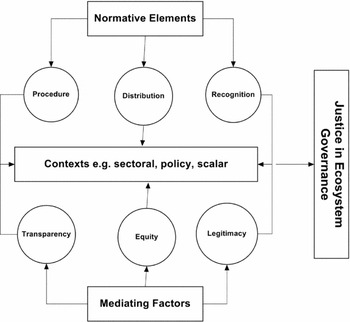
We found the joint insight from the two case study countries complementary, and thus useful for appreciating the persistence of the same underlying justice elements along with their different manifestations. The conceptual framework for this research extends the works of Sikor (Reference Sikor2013), Scholsberg (2004, Reference Schlosberg2007) and others. This framework consists of three interconnected components of justice, namely normative, mediating and contextual (Fig. 1). The first – the normative components – are the three justice elements of distribution, procedure and recognition as advanced by Schlosberg (2004, Reference Schlosberg2007), Sikor (Reference Sikor2013) and Fraser (Reference Fraser2009). Distributive justice deals with the fair sharing of benefits and costs of ecosystem services among different people at different scales. Procedural justice is concerned with how decisions relating to particular conservation interventions are made. It pays particular attention to the roles of different people and the rules that govern decision making. Justice as recognition places emphasis on acknowledging the distinct identities and histories of people and so seeks to eliminate forms of socio-cultural domination of some groups over others. Invariably, recognition is about avoiding discrimination of any kind and respecting the social and cultural norms and institutions of a particular group of people.
Analytical framework of the study.

The second component of the framework presents TEL as mediating dimensions that could give the normative elements more explanatory power in evaluating justice. TEL is concerned with how and to what extent a project's proponents pursue these elements both in the discursive scripting and in the material implementation. Here, the analysis of transparency focuses on disclosure of information and its implications on procedural, recognition and distributive aspects of justice. Equity asks about the fairness of the processes of achieving these three elements, while legitimacy focuses on credibility and acceptability by asking certain pertinent questions. For example, were the procedures used in reaching decisions on REDD+ implementation considered legitimate? How is legitimacy implied in recognizing individuals, organizations or group of actors that participate in the REDD+ policy processes? What were the criteria used in selecting participants and ensuring equitable representation? What rights do actors such as NGOs have to speak on the behalf of others? We posit that elements of TEL have been central to the analysis of REDD+, but have often been examined separately or as implicit aspects of justice.
The third component draws attention to the fact that policies and projects such as REDD+ are grounded in particular contexts. Contexts could refer to one or a combination of sectoral aspects of ecosystem services governance, such as forests, biodiversity and wetlands; specific policy issues (e.g. land tenure and free, prior and informed consent); scalar dimensions of place (e.g. local, national, sub-national and global); and individuals or groups of actors. In our analysis, tenure and property rights constitute the policy context, while the specific countries of focus –Nigeria and Ghana – constitute the geographical contexts. We used these two case studies to compare how REDD+ readiness implementation is addressing tenure concerns in order to achieve just outcomes.
METHODS
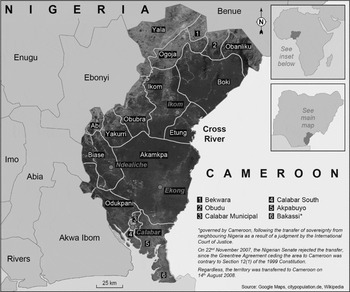
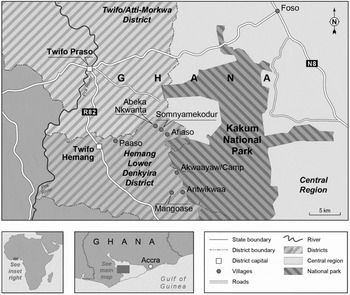
We adopted a qualitative methodological approach that permits the gathering of unquantifiable facts in relation to the actual people researchers observe and talk to (Berg Reference Berg2009). We found qualitative techniques helpful as they allowed for the examination of how people learn about and make sense of themselves as well as others. Data were gathered over a 9-month period of fieldwork in both Nigeria and Ghana from late 2013 to mid-2014. In both countries, we conducted several semi-structured interviews and focus group discussions with different stakeholders at national, sub-national and local levels. In Nigeria, interview data were obtained through interviews with purposively selected project implementers and forest communities drawn from Akamkpa, Ekong and Boki local government areas of Cross River, in which the REDD+ pilots are located (Fig. 2). Eighty respondents participated at different stages of the research. Some of these respondents included: the stakeholder engagement officer of the REDD+ programme, the Anti-deforestation Task Force (ATF) Operations Manager, the Cross River State Coordinator for REDD+ and members and a member of the Cross River State Forestry Commission Board. Respondents from the pilot communities included: leaders of community-based organizations, local chiefs, youths and local conservation groups. These communities were selected based on the relative significance attached to them by the projects’ proponents. In addition to interviews, we also observed everyday activities of communities and REDD+ proponents, as well as reviewing policy and programme documents for both countries. In Ghana, 100 respondents participated in the research. These comprised community leaders, project implementers and farmers participating in the REDD+ project in six communities that were important REDD+ project areas. The communities were Afiaso, Antwikwaa, Somnyamekodur, Paaso, Mangoase and Akwaayaw Camp (Fig. 3).
Map of Cross River State and its 18 local government authorities.

Map showing selected communities participating in the Kakum REDD+ Demonstration Project.

The data collected were analysed qualitatively using grounded theory methodology following the steps described in Corbin and Strauss (Reference Corbin and Strauss1990) and Charmaz (Reference Charmaz2014). Data from interviews and focus group discussions were manually transcribed and coded in two cycles. First, open coding involved marking sentences and texts with highlighters and assigning descriptive names or phrases (codes) on the sides of the transcripts. Second, axial coding involved developing themes or categories by grouping various codes together around a particular word with greater explanatory strength. Throughout the process, we kept journals of analytic and conceptual notes from textual comparisons derived from the ideas emerging from the data. These procedures were repeated until we reached a point of saturation where no new categories or themes were found.
RESULTS
Historical developments of REDD+ in Nigeria and Ghana
In Nigeria, activities leading to the commencement of REDD+ began in Cross River State (Fig. 2). The state's 7361.7 km2 contain a significant portion of the remaining tropical rainforest in Nigeria (Oyebo et al. Reference Oyebo, Bisong and Morakinyo2010). Cross River Forest is also an important biodiversity area, a part of the Guinea Forest biodiversity hotspot (Myers et al. Reference Myers, Mittermeler, Mittermeler, Da Fonseca and Kent2000). An environment summit was convened in Cross River State in June 2008, championed mainly by environmental NGOs and state bureaucrats, who declared that a crisis was afoot in the forestry sector. The summit thus issued a communiqué with the top three recommendations asking the state government to “halt [the] revenue target based on timber exploitation,” “declare a two-year moratorium on logging” and “initiate action to take advantage of the carbon credit market.” The government, promptly buying into the promise of incentivized forest conservation, halted timber-based forestry revenue targets, declared a logging ban and set up a militarized ATF for its enforcement (for accounts of REDD+ in Nigeria, see Asiyanbi Reference Asiyanbi and Bryant2015, Reference Asiyanbi2016; Nuesiri Reference Nuesiri2015).
By October 2011, a National Programme Document (NPD) had been accepted by the UN-REDD, and a US$4 million readiness fund was approved for Nigeria. More funding (US$3.6 million) came from the World Bank's Forest Carbon Partnership Facility (FCPF) after the country's Readiness Preparation Proposal (R-PP) was approved in December 2013. Additional support was provided by the California-led Governors’ Climate and Forests Task Force (GCF). Three clusters have been set aside in the REDD+ proposals: the Ekuri-Iko Esai cluster of 94 000 ha across 12 communities providing an emission saving of 21 341 760 tCO2 over 20 years; the Mbe-Afi River Forest Reserve cluster of 50 000 ha across 18 communities providing an emission saving of 11 352 000 tCO2; and the Mangrove cluster of 58 000 ha, for which a Project Idea Note (PIN) is yet to be developed (Oyebo et al. Reference Oyebo, Bisong and Morakinyo2010: 53–54). By 2015, the REDD+ programme was being extended to two other states – Nasarawa and Ondo. Although various pre-implementation activities and international engagements had continued, programme implementation, especially in Cross River, did not start until January 2014.
In Ghana, REDD+ activities have progressed steadily at both national and project levels. The country is currently participating in three multilateral schemes: the FCPF of the World Bank in order to build its capacity and institutions; the Forest Investment Programme to upscale on-the-ground implementation of projects; and the Carbon Fund, which was created to pilot performance-based emission reduction projects in the cocoa-growing areas of the Western Region (Arhin Reference Arhin and Reyes2015). As a part of these efforts, seven pilot projects were launched in 2012. By 2016, a national strategic decision focused implementation on large-scale, sub-national programmes that follow ecological boundaries (jurisdictions), recognizing the failure of individual pilots to progress significantly as planned (Ghana Forestry Commission 2015). Despite these failures, the Kakum REDD+ Demonstration Project (KRDP), one of the individual pilots, constitutes an interesting isolated case study area for this study. One of the reasons for this is that the KRDP is being implemented in the cocoa-producing landscapes around the Kakum National Park, which, like Cross River, is also an important part of the Guinea Forest zone, a biodiversity hotspot as designated by Conservation International (Fig. 2). The project is being implemented by a national NGO in collaboration with the Ghana Forestry Commission. The pilot seeks to encourage farmers in the project communities to adopt agroforestry and sound agricultural practices as ways of restoring tree cover and reducing the expansion of farms into protected areas (Conservation Alliance 2012). So, how are proponents addressing tenure issues in order to promote just outcomes in the implementation of REDD+ in these case projects of Nigeria and Ghana?
TEL and tenure in Nigeria
In Nigeria, the project's proponents have acknowledged that elements of TEL are necessary for successful REDD+ implementation. This was clearly specified in the R-PP as part of the consultation and participatory processes being pursued. There was a unanimous decision among the stakeholders to address “concerns of transparency at every level of government, the perception that REDD+ means loss of land, carbon rights and equity in benefits sharing” (R-PP 2013: 27–29). In an interview, a member of the Cross River State Forestry Commission Board said: “the people who are managing the process [REDD] must be transparent and accountable, and there must be an institution that monitor the REDD officials themselves. There must be transparency in the whole process. Information of every detail must be published.” The project's proponents had, since the early days of the project, claimed to pursue these concerns regarding determining property rights of forest land and carbon, as well as recognition of ownership. For instance, in pursuing transparency, questions of property rights and tenure had been placed in the domain of public deliberation, such as the National Validation Workshop on the draft NPD held in February 2011. This workshop called for “due clarification and definition of carbon rights and land-tenure matters as they affect REDD+” (Cross River State Forestry Commission 2011: 7). Proponents have also highlighted conditions of inequity in the existing legal–institutional framework for the right to land and forest. For instance, the R-PP (2013) document decries a condition in which the National Land Use Act vests ownership of all land in the state government and fails to recognize community tenure formally. This document emphasized the need to guarantee “forest use rights” to communities, observing that “tenure security will provide incentives for them to protect the area and help to stop encroachment. It will also ensure that local communities will benefit from REDD+. Therefore any National REDD+ Programme must contain an element of ensuring forest use rights to local forest groups” (R-PP 2013: 52).
However, scrutiny of this proposition would begin to lay bare some of the limits of proponents’ pursuit of TEL. For instance, apparent in the above quote is the utilitarian logic that underpins the call to guarantee forest use rights for communities. Guaranteeing use rights for communities was not valued as a measure of equity, being useful in and of itself. Another limit is the reduction of community forest ownership rights to use. As such, the pursuit of transparency by proponents seems to be limited to grounds on which they could claim easy legitimacy. In others words, by recognizing extant inequity in the 1978 Land Use Act's failure to guarantee community land rights, proponents gain some moral legitimacy, upon which they openly propose the guaranteeing of ‘use rights’ for communities, when what are at stake are more robust rights, including controlling and ownership rights.
A great potential for equity and legitimacy that proponents missed was the use of the process of carbon rights determination as an opportunity to more fundamentally reform extant laws for far-reaching equity and environmental sustainability, rather than building on them after minor revisions. Project proposals insist that, with respect to carbon rights, “state ownership would consequently only apply if the land was formally state owned” (R-PP 2013: 60). Yet, the Land Use Act and the National Forest Policy (NFP) are clear that “the 1978 Land Use Act gives the lead on questions of land ownership and tenure. All land is owned, including trees growing on it either by government or private owners” (NFP 2006: 68). As such, indications of intensified state control of forest resources are already emerging, such as in the state-proposed carbon credit sharing formula for REDD+ benefit, which has been included in the appendices of the new “Forestry Regulation and Tariffs for market and transportation of forest products and other forestry prescribed fees” dated August 2012. Community leaders have challenged the proposal, which allocated the least proportion (10%) of carbon benefits in all forest types to communities. Such benefit-sharing instruments that raise questions of equity and legitimacy also emerge within spaces of limited transparency, bereft of effective public debates and deliberation.
The most significant limits to proponents’ pursuit of TEL in tenure conditions arise directly from material practices for specifically implementing REDD+. Two main practices deserve attention here. The first is the logging moratorium that was declared by the State in 2008 as part of the preparation for REDD+ in Nigeria's Cross River. The moratorium that was earlier declared for 2 years has been sustained indefinitely as a means to secure and guarantee the permanence of areas in both community forests and State forest reserves marked out for REDD+. The moratorium is, however, being enforced across the entire area of the state in a bid to avoid leakage or displacement of deforestation to other forest areas. This moratorium also serves another important purpose of demonstrating the government's ‘political will’ for REDD+, thus guaranteeing continued funding from international REDD+ partners. A militarized ATF has been put in place to enforce the ban on logging, which variously undermines local rights and excludes them from accessing the forest. Meanwhile, this process of exclusion is also shifting the now lucrative timber economy into the hands of the ATF and networks of military elites and large-scale timber dealers in a process that has seen the growing use of violence, intimidation and various surveillance strategies to police the forest and render it available for REDD+ (Asiyanbi Reference Asiyanbi2016). Not only does this reflect a broader turn towards the militarization and securitization of conservation in general (Cavanagh et al. Reference Cavanagh, Vedeld and Trædal2015; Duffy Reference Duffy2016), it also evidences a lack of total commitment to equity and legitimacy on the part of proponents.
The second example that evidences the limits of the proponents’ pursuit of TEL in terms of tenure is the practice of forest clustering, by which REDD+ seeks to re-specify local forest governance in ways that have significant implications for communities. Proposing Nigeria's REDD+ to funding agencies, in this case the UN-REDD, the World Bank FCPF and the California-based GCF, required financeable PINs. The PINs for the pilots in Cross River had thus included an important clause: “the project is viable and attractive to carbon finance only if the project area includes the multiple community forests and forest reserves” (Oyebo et al. Reference Oyebo, Bisong and Morakinyo2010: 89). To make community forests financeable, proponents sought to rescale them from their community levels to cluster levels, based on financial consideration, forest contiguity and biodiversity potential. It is on this basis that three clusters were set aside for REDD+ in Cross River State. This process, being the work of experts and REDD+ proponents, did not involve communities on whether to cluster community forests and how to go about clustering. Clustering has increasingly been challenged by communities even as it aggravates tension within local resource governance systems.
Within the Ekuri cluster, for example, clustering has stoked boundary disputes between the neighbouring Ekuri and Iko-Esai communities. There are suspicions in Ekuri that forestry officials and a resident NGO in Iko-Esai plan to readjust forest boundaries in favour of neighbouring Iko-Esai. One of the local chiefs from Ekuri said: “All of a sudden officials of the Centre for Education, Research and Conservation of Primates and Nature (CERCOPAN) came around to tell Iko-Esai that they want to assist them to create a land use plan, and then they decided to map some Ekuri portion across the river into the Iko-Esai area close to our farms. We have reported this several times to the Forestry Commission but nothing was done about it. It was the REDD+ project that motivated Iko-Esai and Agoi Bami through CERCOPAN and Forestry Commission to attempt to take away our forest.” As a result of this contestation, the Iko-Esai community had contacted a REDD+ consultant requesting “the sponsors of the carbon credit scheme to find out the true position of Iko-Esai for an appropriate boundary between the Iko-Esai and Ekuri people, before a concrete execution of this noble project.” Although this request was contained in a letter dated 17 February 2010 and signed by the community chiefs, there was no official response from REDD+ proponents. Despite these exacerbated boundary tensions, the proponents saw clustering as a convenient governance arrangement and so decided to proceed on that basis. Further to these disputes, clustering continues to shape local agency and inter-community relations in ways that favour dominant communities in each cluster, since community representation in REDD+ activities would be organized at cluster level.
Tenure issues in Ghana: achieving TEL?
In Ghana, emergent tenure confronts proponents with a complex case that also raises strong concerns regarding TEL. Unlike Nigeria, where REDD+ focuses mainly on rainforests, the REDD+ project in Ghana is being implemented in a cocoa-growing landscape, where the cocoa is grown and produced predominantly by migrants (Hill 1973). For the migrants living around the Kakum Conservation Area, the main access to lands for cocoa production has been through a rental agreement with the original settlers of the area (i.e. the Twifo people), usually under share-cropping arrangements. As such, tenure is particularly insecure for these migrants (Marfo 2010). Yet, REDD+ has focused on this contested territorial space, which potentially complicates resource relations, as carbon value spurs the rush for resource.
Similarly to Nigeria, the REDD+ proponents in Ghana recognize the importance of justice in the project. For example, they paid attention to the collective identity of most of the people in the project as migrants who, in search of better livelihoods, had come to settle in the project area as cocoa farmers. The proponents have also initiated occasional training and conservation education in order to encourage the participation of the communities in the project, with the expectations of achieving procedural and recognition justice. As one respondent stated, the proponents were also working on a benefit-sharing formula that recognizes the contributions of community members to achieving distributional justice in the future. Part of the efforts of the proponents towards achieving just and fair outcomes has also involved registration of the trees and lands of the participating farmers. Using computer-aided technologies (i.e. ArcGis), the proponents have created a database that stores information about farms, farmers, particular trees located on individual farms and community information. Through these mapping and tree registration processes, the proponents expect to bring clarity to tenure and ownership.
However, it is only an explicit attention to TEL that unmasks the complexity of the emergent nature of land tenure. We found that the training and tree registration activities being undertaken by the proponents did not necessarily resolve tenure ambiguity for the following three reasons. First, the farmer who planted or retained the tree on a particular piece of land (which the implementing NGO is documenting) can claim ownership of the tree. Second, because most of the participating farmers are migrants utilizing the land under share-cropping arrangements, the landowner(s) or their descendants who might have given out the particular piece of land to the share-cropper in question can also claim the same registered tree. Thirdly, through the existing customary laws, the Paramount Chief who is the overlord of that traditional area can also claim ownership of the trees. These multiple claimants are products of the hierarchical structure of chieftaincy in Ghana and the complex land and tree tenure framework that is crucial to understanding emergent tenure conditions in Ghana's REDD+ (Marfo 2010). The arrangement is deeply structural and statutory laws have only added complexity rather than helping to resolve it. Who is recognized as owning what within these layers of property rights claims in REDD+ has become a critical question. This will depend on complex relations of power, in which some actors (e.g. migrants) might already be vulnerably positioned relative to other actors (e.g. the chiefs). Hence, this could have implications for the distribution of benefits, especially when the project progresses into its advanced stages.
DISCUSSION
The cases discussed above highlight the importance of paying explicit attention to TEL in the analysis of justice concerns. In the Nigerian case, it is clear that proponents directly and indirectly pursued considerations of TEL in their efforts to implement REDD+. These efforts manifest in the public debates over tenure and the recognition of extant inequalities in land use laws; however, they are limited by the everyday pragmatism that is entailed in implementing REDD+, such as the instrumental framing of community use rights. Top-down forest clustering without community consultation raises important questions of legitimacy in the Nigerian REDD+ project. This also relates to issues of equity among relevant stakeholders and the extent to which the proponents are showing commitment to these elements. More importantly, efforts to engender TEL have been decisively limited by policies and practices that are quite central to proposing and implementing REDD+ in Nigeria (Asiyanbi Reference Asiyanbi2016). These policies and practices are contingent upon contextual factors in Nigeria, yet they are also partly elements of the general requirements for REDD+, hence there being similar patterns of tenure complexities, exclusion, militarization and spatial reordering in REDD+ elsewhere (Beymer-Farris & Bassett Reference Beymer-Farris and Bassett2012; Cavanagh et al. Reference Cavanagh, Vedeld and Trædal2015; Leach & Scoones Reference Leach and Scoones2015; Nel Reference Nel, Paladino and Fiske2016). Nigeria illustrates how paying explicit analytical attention to TEL might generate a more nuanced evaluation of justice considerations in proponents’ everyday pursuit of REDD+.
In the Ghana case, the proponents are seeking to achieve clarity over tenure in order to improve the justice outcomes of the project through activities such as tree registration. Clarity over tenure has been considered to be an essential ingredient for effective, equitable and efficient REDD+ (Larson et al. Reference Larson, Brockhaus, Sunderlin, Duchelle, Babon, Dokken, Pham, Resosudarmo, Selaya, Awono and Huynh2013; Sunderlin et al. Reference Sunderlin, Larson, Duchelle, Resosudarmo, Huynh, Awono and Dokken2014). The project also sought to achieve just outcomes along the normative dimensions of procedure, recognition and distribution through activities such as community training, publicly communicated benefit-sharing formulae and the preparation of contracts for the participating farmers. However, limits to the pursuit of TEL tend to efface and sometimes reinforce tenure ambiguity. Gupta's (Reference Gupta2008) call for applying ‘governance-by-disclosure’ provisions that are available within the global environmental policy domain (Aarhus Convention) as means of achieving justice through transparency is apposite here. As the case shows, the inadequate attention to information disclosure on the parts of both the proponents and the farmers as to how the lands were obtained and the inadequate attention to whether the proponents are dealing with legitimate owners both have implications for justice. What is evident is that, without paying explicit attention to TEL, it could be difficult to detect the potential effects of there being multiple claimants to the vegetation listed in REDD+.
CONCLUSION
Scholars have continued to argue that secure tenure for communities will be required for equitable and effective REDD+ (Larson et al. Reference Larson, Brockhaus, Sunderlin, Duchelle, Babon, Dokken, Pham, Resosudarmo, Selaya, Awono and Huynh2013; Sunderlin et al. Reference Sunderlin, Larson, Duchelle, Resosudarmo, Huynh, Awono and Dokken2014). Indeed, the propositions in project documents aiming to guarantee community forest ownership rights appear hollow, so much so that the World Bank assessors of the REDD+ Readiness Preparation Proposal demanded “greater clarity on carbon rights is required given state ownership of the land” (World Bank 2013: 4). The two cases have implications for how justice is framed in the context of ecosystem governance. Both reveal the limits of proponents’ pursuit of TEL. We argue that paying explicit attention to TEL is beneficial to analyses of justice for three major reasons. First, while issues of TEL are integral to discussions of justice, they are either implicitly assumed or treated separately rather than in a holistic fashion. The cases show that frameworks for empirically examining justice and injustice concerns could be richer if TEL were made explicit rather than implicit. Second, we argue that viewing justice in terms of procedure, recognition and distribution also has its limits because these dimensions are too mutually referential, as one dimension almost always already entails or at least signals the direction of the others. Even proponents recognize this limitation. For instance, Fraser (Reference Fraser2009: 21) observed that “representation is always already inherent in all claims for redistribution and recognition” (see Forsyth & Sikor Reference Forsyth and Sikor2013). Third, and related to the second point, the normative effects of these dimensions can and should, therefore, be further sharpened. For instance, how does one further specify what is normatively desirable in a procedure or form of representation or pattern of recognition? While moral foundations and universal principles may not be necessary for critical work, the growing call to make more explicit the normative basis for critical work cannot be dismissed outright in discussions of justice in ecosystem services (Castree Reference Castree2008).
Over recent years, justice concerns have become essential parts of REDD+ and other policy mechanisms aimed at achieving conservation outcomes. While issues of TEL are integral to discussions of justice, this paper has argued that their implicit and/or separate treatment could limit the assessment of how justice is being achieved in relation to REDD+. We suggest that paying explicit attention to TEL as mediating factors helps us better to grasp how conservation schemes such as REDD+ can (dis)enable justice for local communities and people who live in and around forests where such interventions take place. Our cases in Ghana and Nigeria have shown that, by introducing the three mediating factors together, the analysis of justice in REDD+ could be deepened. The underlying goal of this paper is to stimulate a broader debate on why paying explicit attention to TEL matters. It is hoped that researchers, practitioners and policy-makers will find this to be a useful basis for strengthening considerations of justice in the governance of ecosystem services and other policy interventions.
ACKNOWLEDGEMENTS
The authors thank the journal reviewers for their helpful comments. This work is part of the PhD studies of the authors. We are grateful to our funding bodies and our supervisors.
FUNDING
Usman Isyaku's work has been supported by the Petroleum Technology Development Fund (PTDF), Nigeria, and Ahmadu Bello University Zaria, Nigeria. Albert A. Arhin's work has been supported by the Gates Cambridge Scholarship. Adeniyi P. Asiyanbi's work was funded by King's Overseas Research Studentship.