Introduction
Gambling on sporting events is embedded within the culture of watching sporting events (Hing et al. Reference Hing, Lamont, Vitartas and Fink2015). Sports gambling is one of the most prevalent forms of online gambling and the most common form of gambling listed in the most recent UK Gambling Commission annual survey (Gambling Commission 2019). In Ireland, a national survey of online gambling behaviors found ‘Horse race betting’ and ‘Sports betting’ accounted for over 50% of the participants gambling daily online (Columb & O’Gara Reference Columb and O’Gara2018). Betting on sports can be an integral part of the economics of the sport as evidenced by an exemption from a voluntary ban on ‘whistle-to-whistle’ advertising during live sport being applied to horse racing due to the ‘commercial importance of gambling on its viability’ (Conway Reference Conway2018).
Live sporting events are the most popular and most-watched broadcasts in the world, with events such as the Olympic Games and the FIFA World Cup attracting audiences of between 3 and 3.6 billion viewers (Fédération Internationale de Football Association 2018; International Olympic Committee 2012). Given the large exposure that these events can offer businesses, advertising opportunities during sporting events are much sought after. The Super Bowl, the final championship game in the US National Football League (NFL), commands an average of 4.5 million US dollars per 32nd slot, which are the most expensive advertising slots in the world (Morrison Reference Morrison2019).
Given the popularity of sports gambling, as well as the large audiences attracted to live sporting events, sports betting advertisement appear to have become prolific during live televised sporting events (Lole et al. Reference Lole, Li, Russell, Greer, Thorne and Hing2019). During the 2018 FIFA World Cup, betting advertisements were the most common advertisements shown, totaling almost 90 minutes of airtime during the month-long tournament (Duncan et al. Reference Duncan, Davies and Sweney2018). Significant betting advertising can be seen within sporting events, with half of the Premier League and 17 out of 24 clubs in the Championship teams in English football sporting gambling sponsors on their football jerseys (Davies Reference Davies2019). In addition, one high-profile football player (i.e. Wayne Rooney) recently made national media headlines by taking the same jersey number (32) as the club’s betting company sponsor (32 Red) in order to promote the betting sponsor (Ingle Reference Ingle2019).
One of the difficulties with betting’s association with popular sporting events and the widespread marketing of gambling during these events is the normalization of gambling behaviors, especially for young men (Deans et al. Reference Deans, Thomas, Derevensky and Daube2017b). Young adults (aged 16–24 years) have the highest prevalence of gambling disorder in the UK (Wardle et al. Reference Wardle, Moody, Spence, Orford, Volberg, Jotangia, Griffiths, Hussey and Dobbie2011), and gambling advertisements have been shown to target content specifically at young male fans, showing gambling as part of the normal sports watching experience and as part of normal socializing with male friends (Deans et al. Reference Deans, Thomas, Daube, Derevensky and Gordon2016). Young male gamblers also described sports betting as ‘normal’ and used sports gambling as a way to provoke discussion with peers and fit into their social group (Deans et al. Reference Deans, Thomas, Daube and Derevensky2017a).
There is also widespread concern about the effect that gambling advertisement has on young children (Monaghan et al. Reference Monaghan, Derevensky and Sklar2008; Lopez-Gonzalez et al. Reference Lopez-Gonzalez, Estévez and Griffiths2017). Children have been shown to have detailed recall of sports betting advertisements and betting products (Pitt et al. Reference Pitt, Thomas, Bestman, Daube and Derevensky2017), and the majority of children perceive sports gambling to be a normal part of sport (Pitt et al. Reference Pitt, Thomas, Bestman, Stoneham and Daube2016). One major concern is the lack of restrictions placed by the government on gambling advertisement prior to the 21:00 h watershed in some countries (Lopez-Gonzalez et al. Reference Lopez-Gonzalez, Estévez and Griffiths2017), including Ireland (Staines Reference Staines2019).
The characteristics of sports betting within advertisements also play a role in influencing the onset of problem gambling behaviors (Lopez-Gonzalez et al. Reference Lopez-Gonzalez, Estévez and Griffiths2017). The advertisement of in-play betting, the greater variety, and frequency of bets leading to faster reward mechanisms and emphasis on skill and control characteristics of betting rather than luck (such as accumulator bets and ‘cash-out’ options) can contribute to the development of problem gambling (Griffiths & Auer Reference Griffiths and Auer2013). These gambling product features can also be seen during live viewing of sports games, with a study of sports betting marketing during live Australian Football League games shown to encourage live betting within games and further embed betting within the sport (Thomas et al. Reference Thomas, Lewis, Duong and McLeod2012).
In Ireland, the establishment of an independent gambling regulator has been approved by the Irish government, and this regulator may play a role in the regulation of gambling advertisement (Bray Reference Bray2019). However, there is no date set for the establishment of this regulator (Bray Reference Bray2019). There have also been concerns expressed by Irish gamblers in relation to gambling advertising, with 76% stating that the dangers of gambling should be advertised (Columb & O’Gara Reference Columb and O’Gara2018). Currently, there are no data relating to the amount of gambling advertisements shown during live sporting events in Ireland or the characteristics of these gambling advertisements, including responsible gambling messaging. Therefore, the aim of the present study was to analyze gambling advertisements shown during popular live sporting events broadcast in Ireland.
Methods
A total of 65 televised live sporting events were randomly selected between the months of December 2018 and July 2019. Sporting events featuring association football (also referred to as ‘football’ or ‘soccer’ and will be referred to as ‘football’ in the present paper), Rugby Union (referred to as ‘rugby’ in the present paper), and Gaelic Athletic Association (GAA) sports (Gaelic football and hurling) were selected due to their popularity in Ireland as well as their similarity in terms of format (two periods of gameplay with an interval between). These live televised events were viewed across a number of different broadcasting platforms available to Irish customers, including Sky Sports, BT Sports, Eir Sports, RTE, TG4, and Virgin Media. Football accounted for 35 matches (53.8%), with rugby and GAA sports accounting for 15 matches each (23.1%). More football matches were collected compared to rugby and GAA sports given the larger amount of live televised games on offer in Ireland.
For each televised live sporting event, data were collected on the advertisements shown before kick-off (up to 30 minutes before the game commenced), during the half-time interval, and after the sporting event (up to 30 minutes after the game ended or until the next scheduled television program commenced). Each advertisement was recorded during these periods and categorized based on the top 20 categories for advertisements shown in Ireland in 2018 (Medialive 2018). The categories listed are ‘Retail’, ‘Household services’, ‘Finance’, ‘Food’, ‘Drink’, ‘Cosmetics and toiletries’, ‘Motors’, ‘Entertainment and the media’, ‘Pharmaceutical’, ‘Government, social, political organizations’, ‘Household stores’, ‘Travel and transport’, ‘Leisure equipment’, ‘Electronic equipment and accessories’, ‘Business and industrial’, ‘Household appliances’, ‘Mail Order’, ‘Computers’, ‘Clothing and accessories’, and ‘Gardening and agriculture’. Separate categories for ‘Gambling’, ‘Responsible gambling’, and ‘Internal advertising’ (i.e. advertising for the platform showing the live sport) were also included as additional categories. The frequency of gambling advertisements was compared to other advertising categories during the live televised sporting events. Advertisements for the national lottery were also included in this analysis as a form of gambling.
A proforma was created for use by the researchers analyzing the advertisements, with sections containing the number of advertisement breaks, when in relation to the televised game the advertisement occurred, and the name of each advertisement shown during the advertisement break. Each sports betting advertisement was analyzed for the type of betting offer promoted (live odds, in-play betting, free bet offer, cash out, and odds boost) and for evidence of responsible gambling (RG) practices, RG message (either audio or text), RG organization advertised, age limit advertised, and RG tools advertised (deposit limit, spending limit, loss limit, and session limit).
Fixed and dynamic advertising shown within the stadium during games were also evaluated. Fixed advertising refers to the advertising on static boards within the stadium (Jones et al. Reference Jones, Barrie, Chapman, Corr and Davoren2013). Dynamic advertising refers to advertising on electronic banners within the stadium that change at regular intervals from one advertisement to another (Jones et al. Reference Jones, Barrie, Chapman, Corr and Davoren2013). In each game, the advertisement categories of each fixed and dynamic advertisement displayed on the broadcast angle of the pitch (i.e. the furthermost side of the pitch displayed on television) were noted and used as a representative sample of the stadium’s fixed and dynamic advertising. To obtain a representative sample of the dynamic advertisements, 15 minutes of dynamic advertising were collected per match. Descriptive statistics were performed on each variable for each of the sports reviewed (football, rugby, and GAA) and the accumulated total advertisements. Comparisons were made between each of the sports in the present study looking at frequency of gambling advertisement.
Results
Gambling advertisements
Out of the total 65 games analyzed, 49 games showed at least one gambling advertisement (including national lottery advertisement) pre-game, during game, and post-game parameters of the present study (75.4%). Of these games, football accounted for 35 games (100% of football sample), rugby accounted for eight games (53.3% of rugby sample), and GAA accounted for six games (40% of GAA sample). The median kick-off times for the matches examined were Football (15:00 h), Rugby (15:15 h), and GAA (16:00 h). All matches examined had a kick-off time prior to the television watershed (21:00 h), with 20:00 h the latest kick-off time.
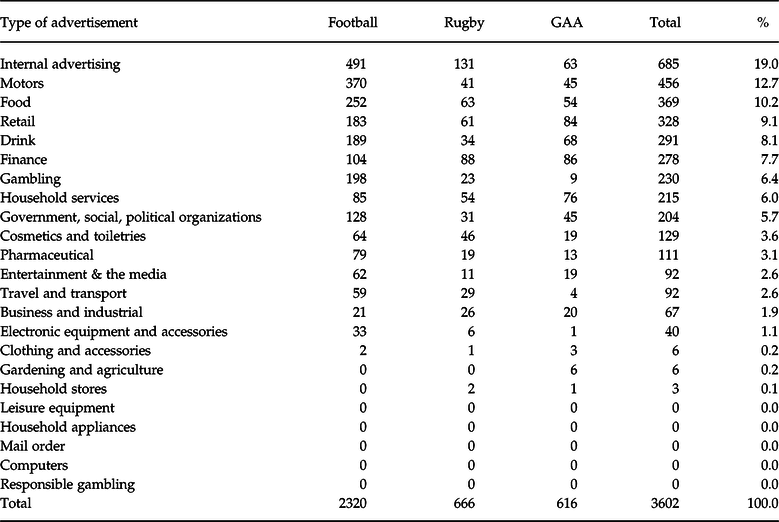
A total of 3602 advertisements were evaluated in the present study. This consisted of 383 advertisement breaks, with 125 advertisement breaks shown pre-kick-off, 157 advertisement breaks during the half-time interval, and 101 advertisement breaks shown after the game ended. Gambling advertisements were shown during 66.2% of pre-game advertisement breaks, 72.3% of in-game advertisement breaks, and 44.6% of post-game advertisement breaks. During televised rugby matches, gambling advertisements were shown during 46.7% of pre-game advertisement breaks (n = 7), 53.3% of in-game advertisement breaks (n = 8), and 33.3% of post-game advertisement breaks (n = 5). During televised GAA matches, gambling advertisements were shown during 13.3% of pre-game advertisement breaks (n = 2), 33.3% of in-game advertisement breaks (n = 5), and 20.0% of post-game advertisement breaks (n = 3). During televised football matches, gambling advertisements were shown during 97.1% of pre-game advertisement breaks (n = 34), 97.1% of in-game advertisement breaks (n = 34), and 60.0% of post-game advertisement breaks (n = 21) (Table 1).
Types of advertising broadcast during different types of sporting events

The most common form of advertisement shown during the televised live sporting events was ‘Internal advertisements’ (19%), followed by ‘Motors’ (12.7%), ‘Food’ (10.2%), ‘Retail’ (9.1%), and ‘Drink’ (8.1%). ‘Gambling’ (6.4%) was listed as the seventh most common advertisement overall. The other categories were ‘Finance’ (7.7%), ‘Household services’ (6.0%), ‘Government, social, political organizations’ (5.7%), ‘Cosmetics and toiletries’ (3.6%), ‘Pharmaceutical’ (3.1%), ‘Entertainment and the media’ (2.6%), ‘Travel and transport’ (2.6%), ‘Business and industrial’ (1.9%), ‘Electronic equipment and accessories’ (1.1%), ‘Clothing and accessories’ (0.2%), ‘Gardening and agriculture’ (0.2%), and ‘Household stores’ (0.1%). There were no ‘Responsible Gambling’ advertisements shown on any advertisement break during the study.
Football advertisements accounted for 2320 advertisements. Advertisements for ‘Internal advertising’ (21.2%) were the most common followed by ‘Motors’ (15.9%), ‘Food’ (10.9%), and ‘Gambling’ (8.5%) and ‘Drink’ (8.1%). ‘Gambling’ (8.5%) was the fourth most common advertisement overall. The other categories were ‘Retail’ (7.9%), ‘Government, social, political organizations’ (5.5%), ‘Finance’ (4.5%), ‘Household services’ (3.7%), ‘Pharmaceutical’ (3.4%), ‘Cosmetics and toiletries’ (2.8%), ‘Entertainment and the Media’ (2.7%), ‘Travel and transport’ (2.5%), ‘Electronic equipment and accessories’ (1.4%), ‘Business and industrial’ (0.9%), and ‘Clothing and accessories’ (0.1%).
Rugby advertisements accounted for 666 advertisements. Advertisements for ‘Internal advertising’ (19.7%) were the most common followed by ‘Finance’ (13.2%), ‘Food’ (9.5%), ‘Retail’ (9.2%), and ‘Household services’ (8.1%). ‘Gambling’ (3.5%) was the 12th most common advertisement overall. The other categories were ‘Cosmetics and toiletries’ (6.9%), ‘Motors’ (6.2%), ‘Drink’ (5.1%), ‘Government, social, political organizations’ (4.7%), ‘Travel and transport’ (4.4%), ‘Business and industrial’ (3.9%), ‘Pharmaceutical’ (2.9%), ‘Entertainment and the Media’ (1.7%), ‘Electronic equipment and accessories’ (0.9%), ‘Household stores’ (0.3%), and ‘Clothing and accessories’ (0.2%).
GAA advertisements accounted for 616 advertisements. Advertisements for ‘Finance’ (14.0%) were the most common followed by ‘Retail’ (13.6%), ‘Household services’ (12.3%), ‘Drink’ (11.0%), and ‘Internal advertising’ (10.2%). ‘Gambling’ (1.5%) was the 13th most common advertisement overall. The other categories were ‘Food’ (8.8%), ‘Motors’ (7.3%), ‘Government, social, political organizations’ (7.3%), ‘Business and industrial’ (3.2%), ‘Cosmetics and toiletries’ (3.1%), ‘Entertainment and the media’ (3.1%), ‘Pharmaceutical’ (2.1%), ‘Gardening and agriculture’ (1.0%), ‘Travel and transport’ (0.6%), ‘Clothing and accessories’ (0.5%), ‘Household stores’ (0.2%), and ‘Electronic equipment and accessories’ (0.2%).
Fixed and dynamic advertising
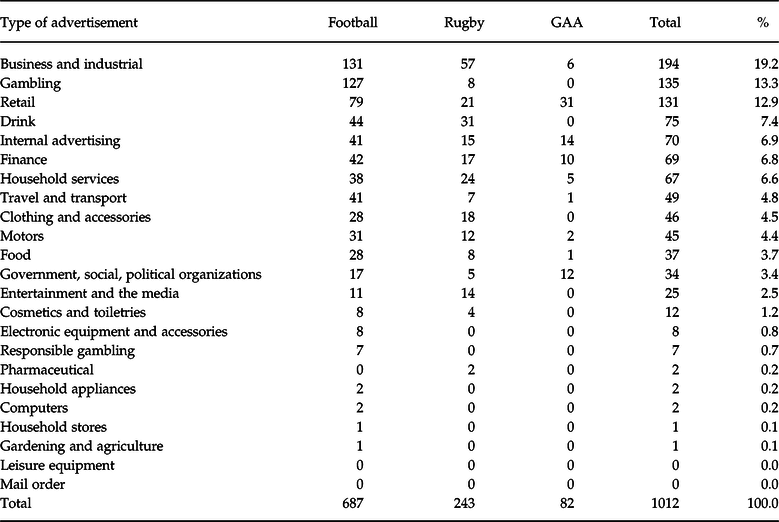
A total of 1012 fixed and dynamic advertisements were evaluated, consisting of 394 fixed advertisements and 618 dynamic advertisements (Table 2).
Types of fixed and dynamic advertising shown during sporting events

Fixed advertising
The most common fixed advertisements shown during televised live sporting events were ‘Business and industrial’ (23.4%), followed by ‘Retail’ (16.2%), ‘Gambling’ (9.1%), ‘Household services’ (7.9%), and ‘Internal advertising’ (7.9%). ‘Gambling’ (9.1%) was the third most common fixed advertisement overall. The other categories were ‘Finance’ (7.1%), ‘Drink’ (6.9%), ‘Clothing and accessories’ (4.8%), ‘Government, social, political organizations’ (4.6%), ‘Food’ (3.6%), ‘Motors’ (3.3%), ‘Travel and transport’ (2.5%), ‘Entertainment and the media’ (2.0%), ‘Cosmetics and toiletries’ (0.3%), ‘Pharmaceutical’ (0.3%), and ‘Responsible gambling’ (0.3%).
Football advertisements accounted for 147 fixed advertisements. Fixed advertisements for ‘Business and industrial’ (28.6%) were the most common followed by ‘Gambling’ (20.4%), ‘Retail’ (11.6%), ‘Household services’ (6.8%), and ‘Finance’ (6.1%). ‘Gambling’ (8.5%) was listed as the second most common advertisement overall. The other categories were ‘Food’ (5.4%), ‘Clothing and accessories’ (4.8%), ‘Internal advertising’ (4.8%), ‘Travel and transport’ (4.1%), ‘Drink’ (3.4%), ‘Motors’ (2.0%), ‘Government, social, political organizations’ (1.4%), and ‘Responsible gambling’ (0.7%).
Rugby advertisements accounted for 165 fixed advertisements. Fixed advertisements for ‘Business & Industrial’ (26.7%) were the most common followed by ‘Drink’ (13.3%), ‘Retail’ (9.7%), ‘Household services’ (9.7%), and ‘Clothing and accessories’ (7.3%). ‘Gambling’ (3.6%) was the tenth most common advertisement overall. The other categories were ‘Internal advertising’ (6.1%), ‘Finance’ (5.5%), ‘Motors’ (4.8%), ‘Entertainment and the media’ (4.8%), ‘Food’ (3.0%), ‘Government, social, political organisations’ (2.4%), ‘Travel and transport’ (1.8%), ‘Cosmetics and toiletries’ (0.6%), and ‘Pharmaceutical’ (0.6%).
GAA advertisements accounted for 82 fixed advertisements. Fixed advertisements for ‘Retail’ (37.8%) were the most common followed by ‘Internal advertising’ (17.1%), ‘Government, social, political organizations’ (14.6%), ‘Finance’ (12.2%), and ‘Business and industrial’ (7.3%). There were no ‘Gambling’ fixed advertisements found in the GAA analysis. The other categories were ‘Household services’ (6.1%), ‘Motors’ (2.4%), ‘Food’ (7.3%), and ‘Travel and transport’ (1.2%).
Dynamic advertising
The most common dynamic advertisement shown during televised live sporting events was for ‘Gambling’ (16.0%) followed by ‘Business and industrial’ (15.9%), ‘Retail’ (10.5%), ‘Drink’ (7.8%), and ‘Finance’ (7.3%). The other categories were ‘Travel and transport’ (6.3%), ‘Internal advertising’ (6.3%), ‘Household services’ (5.8%), ‘Motors’ (5.2%), ‘Clothing and accessories’ (4.7%), ‘Food’ (3.7%), ‘Entertainment and the media’ (2.8%), ‘Government, social, political organizations’ (2.6%), ‘Cosmetics and toiletries’ (1.8%), ‘Electronic equipment and accessories’ (1.3%), ‘Responsible gambling’ (1.0%), ‘Household appliances’ (0.3%), ‘Computers’ (0.3%), ‘Pharmaceutical’ (0.2%), ‘Household stores’ (0.2%), and ‘Gardening and agriculture’ (0.2%). GAA did not contain any dynamic advertisements.
Football advertisements accounted for 540 dynamic advertisements. Dynamic advertisements for ‘Gambling’ (18.0%) were the most common followed by ‘Business and industrial’ (15.7%), ‘Retail’ (11.1%), ‘Drink’ (7.2%), and ‘Finance’ (6.9%). The other categories were ‘Travel and transport’ (6.5%), ‘Internal advertising’ (6.3%), ‘Household services’ (5.2%), ‘Motors’ (5.2%), ‘Clothing and accessories’ (4.3%), ‘Food’ (3.7%), ‘Government, social, political organizations’ (2.8%), ‘Entertainment and the media’ (2.0%), ‘Cosmetics and toiletries’ (1.5%), ‘Electronic equipment and accessories’ (1.5%), ‘Responsible gambling’ (1.1%), ‘Household appliances’ (0.4%), ‘Computers’ (0.4%), ‘Household stores’ (0.2%), and ‘Gardening and agriculture’ (0.2%).
Rugby advertisements accounted for 78 dynamic advertisements. Dynamic advertisements for ‘Business and industrial’ (16.7%) were the most common followed by ‘Drink’ (11.5%), ‘Household services’ (10.3%), ‘Finance’ (10.3%), and ‘Entertainment and the media’ (7.7%). ‘Gambling’ (2.6%) was the 13th most common advertisement overall. The other categories were ‘Clothing and accessories’ (7.7%), ‘Retail’ (6.4%), ‘Internal advertising’ (6.4%), ‘Motors’ (5.1%), ‘Travel and transport’ (5.1%), ‘Food’ (3.8%), ‘Cosmetics and toiletries’ (3.8%), ‘Pharmaceutical’ (1.3%), and ‘Government, social, political organizations’ (1.3%).
Sport gambling advertisement analysis
A total of 230 sport gambling advertisements were observed in the present study. Football accounted for 198 advertisements (86.1%), rugby accounted for 23 advertisements (10.0%), and GAA accounted for nine advertisements (3.9%). Thirteen separate gambling companies produced 35 unique advertisements used in the live televised sporting events described in the present study. In relation to responsible gambling, none of the advertisements shown during the present study promoted responsible gambling tools (such as deposit limits, spending limits, loss limits, and session limits). The majority of advertisements did show an age limit (88.6%) and a responsible gambling message (88.6%). In relation to a responsible gambling organization advertised, 60.0% of the advertisements contained reference to a responsible gambling organization. The overall number of betting offers promoted were small in the present study, with live odds (5.7%) and odds boost (5.7%) being the most common betting promotion offered, followed by in-play betting, free betting, and odds boost (2.9% each). No advertisements offered in-play odds.
Discussion
The aim of the present study was to analyze gambling advertisements shown during popular live sporting events broadcast in Ireland. The main finding of the present study demonstrated that gambling advertisements are common during sporting events televised in Ireland, with over three-quarters of broadcasts showing at least one gambling advertisement and gambling advertisements being the seventh most common form of advertisement shown. The largest number of gambling advertisements was shown during the half-time interval, followed by pre-game. The lowest number was shown post-game. This suggests that gambling advertisements are primarily placed at these times to encourage betting on the sporting event being broadcast.
Football matches showed a high percentage of gambling advertisements during advertisement breaks compared to the other sports examined. Gambling advertisements were the fourth most common form of advertising shown during football advertisement breaks, compared to the 12th most common during rugby advertisement breaks and the 13th most common during GAA advertisement breaks. This aligns with conclusions made from previous research examining advertising during football matches, with football described as being ‘saturated’ with gambling advertisements on both football highlight shows and during broadcast football matches (Cassidy & Ovenden Reference Cassidy and Ovenden2017) and being more common than both hyper-palatable food and alcoholic beverage advertisements (Cassidy & Ovenden Reference Cassidy and Ovenden2017). Football also had gambling advertisements shown in every game examined in the present study, reinforcing the idea of the normalization of gambling in sports (Deans et al. Reference Deans, Thomas, Derevensky and Daube2017b).
Interestingly, gambling advertisements were the most common dynamic advertisement and the second most common fixed advertisement shown during live football broadcasts. This finding, aligned with the fact that over 60% of Premier League and Championship football teams having shirt betting sponsors, shows that the majority of gambling advertising happens within games. This large amount of in-game betting advertising has been seen in previous studies examining football matches (Cassidy & Ovenden Reference Cassidy and Ovenden2017) and in Australian rules football (Thomas et al. Reference Thomas, Lewis, Duong and McLeod2012). Notably, these types of advertisement are not included in the voluntary ‘whistle-to-whistle’ ban agreed by some betting companies (Conway Reference Conway2018). Electronic signage, such as the dynamic advertisements, allow more information to be retained and recalled compared to static messaging (Monaghan & Blaszczynski Reference Monaghan and Blaszczynski2007). Interventions should be aimed at reducing the amount of dynamic and static advertising shown during live sports in order to reduce exposure to this type of advertising.
Rugby union matches showed far fewer gambling advertisements compared to football, with only 3.5% of all advertisements being related to gambling. Rugby also had few static and dynamic gambling advertisements, with gambling advertising ranking tenth and 13th most common, respectively. Rugby union is considered not to have the same relationship to gambling as football (The Rugby Paper 2018), and the low level of advertising seen in the present study may reflect the lesser popularity of the sport compared to football. In Australia, where rugby league is more popular, rugby league attracted more frequent gambling behaviors (25.7% betting at least weekly) compared to the less popular rugby union (12.4% betting at least weekly) and football (12.7% betting at least weekly) (Hing et al. Reference Hing, Lamont, Vitartas and Fink2015). There are concerns about gambling sponsorship becoming more prevalent in the sport, with Premiership Rugby (the top division in English rugby union) announcing BetUK.com as it is official betting sponsor for the 2019–20 season (Premiership Rugby 2019).
GAA matches had the lowest number of gambling advertisements among the three sports with only 1.5% of television advertisements shown relating to gambling advertisements. GAA also had no fixed or dynamic advertising in relation to sports gambling. This may be in part to a recent decision by the GAA Annual Congress to ban all gambling advertising for any ‘competition, team, playing gear, or facility’ (Harrington Reference Harrington2018, para. 2). This move was encouraged by the number of their members seeking help for gambling addiction within the organization and to ‘protect the integrity of our games’ (Harrington Reference Harrington2018, para. 3). The GAA provides an example of proactive gambling regulation that could be beneficial across other sports.
There were no responsible gambling advertisements observed during the present study. There are a number of responsible gambling advertisements running currently during live sports events by gambling operators (e.g. Sky Bet) (Oakes Reference Oakes2017) and responsible gambling organizations such as GambleAware (GambleAware 2019). Given that no responsible gambling advertisements were viewed during the present study highlights the relative scarcity of these advertisements and the need for increased advertisement of this type. The majority of advertisements showed age limits and responsible gambling messages, as well as naming a responsible gambling organization that individuals could contact. These messages have been shown to lack efficacy in increasing responsible gambling practices (Newall et al. Reference Newall, Walasek, Singmann and Ludvig2019) and that these messages are likely to be dismissed in part due to the overwhelmingly positive portrayal of gambling in these advertisements (Parke et al. Reference Parke, Harris, Parke, Rigbye and Blaszczynski2015).
All matches containing gambling advertisements in the present study commenced their broadcast prior to the Irish watershed. This is of concern due to the susceptibility of children watching gambling advertisements (Monaghan et al. Reference Monaghan, Derevensky and Sklar2008). There has been a voluntary campaign from some gambling operators for a ‘whistle-to-whistle’ ban on gambling advertising (Conway Reference Conway2018), but the study here shows that, for live sporting events broadcast in Ireland, there is no shortage of gambling advertising from both in-game advertising and advertising during intermissions. Such interventions require input on a legislative level with further efforts needed in this regard (Monaghan et al. Reference Monaghan, Derevensky and Sklar2008). Countries such as Australia have already taken legislative steps in regulating gambling advertising during live televised sports, with a ‘whistle-to-whistle’ ban on gambling advertisements during their most popular live televised sports (Toscano & Duke Reference Toscano and Duke2018). Italy has passed legislation banning all direct, indirect, sponsorship, and promotional gambling advertisements (iGaming Business 2019). The examples set by these countries could be of benefit to Ireland to improve gambling advertisement standards.
There are some limitations to the present study. Given the availability of the live sporting events, there was an unequal number of sporting events reviewed. Increased numbers of the other sporting events may influence the results of the present study. The sample of football matches watched was taken from one channel only, which may represent the findings from this channel and may not be representative of live football matches on other channels. This paper only analyzed male sporting events broadcast in Ireland and did not include female sporting events. This would affect the generalizability of these findings to female sports, and further studies in this area are recommended including an analysis of female sporting event advertisements. Finally, the present study did not look at other popular televised sports such as golf and boxing, or sports reliant on sports gambling such as horse racing (Conway Reference Conway2018).
In conclusion, there is an argument for the regulation of gambling advertising within sport in Ireland. Gambling advertisements are being regularly shown throughout the day and throughout sporting events increasing exposure to children and adolescents. While some companies have entered into a voluntary ban from in-game advertising, the research here shows that gambling advertisements are still very prominent within sports games, especially matches. Gambling legislation should be introduced to limit gambling advertising during sporting events and to minimize harm to vulnerable groups including children and to avoid the normalization of gambling associated with sporting events.
Supplementary materials
To view supplementary material for this article, please visit https://doi.org/10.1017/ipm.2020.78
Financial support
This research received no specific grant from any funding agency, commercial, or not-for-profit sectors.
Conflicts of interest
David Columb, Man Ching Wong, Vincent O’Mahony, and Colin O’Gara have no conflicts of interest to disclose. Mark D Griffiths’ university currently receives funding from Norsk Tipping (the gambling operator owned by the Norwegian Government) for ongoing research. MDG has also received funding for a number of research projects in the area of gambling education for young people, social responsibility in gambling, and gambling treatment from Gamble Aware (formerly the Responsibility in Gambling Trust), a charitable body, which funds its research program based on donations from the gambling industry. MDG also undertakes consultancy for various gaming companies in the area of social responsibility in gambling.
Ethical standards
The authors assert that all procedures contributing to this work comply with the ethical standards of the relevant national and institutional committee on human experimentation with the Helsinki Declaration of 1975, as revised in 2008. No ethical approval was sought for the present study given that all the data were secondary data.