An important empirical trend in international politics is the legalization or codification of prominent international human rights norms in international treaty law. State commitment to these human rights treaties is exceptionally high. Many in international relations (IR) celebrate this development and advance a largely positive nexus between legalization and social norms.Footnote 1 All else equal, conventional wisdom expects legalization to strengthen norms and facilitate norm compliance. Yet pernicious practices at odds with international norms persist and sometimes even increase following legalization.Footnote 2 Why?
The dominant answer is that agents commit to but do not comply with the law and its underlying norms.Footnote 3 In some cases violation is unintentional and a result of capacity limitations. In others, agents engage in blatant violation with impunity because of weak monitoring and enforcement. The violation of both laws and norms is an important explanation for the puzzle. However, exaggerated attention to norm violations that also violate the law and are therefore illegal conceals a subtler but still damaging practice: agents could legally violate norms.
Conventional wisdom implicitly assumes that because prominent international norms are codified in international law, norm compliance and law compliance are essentially the same. Although there is considerable overlap between social norms and their legalized forms, they are not necessarily identical.Footnote 4 Therefore, legality and normative appropriateness can differ and can even undermine each other. Studies of racial discrimination in the United States reveal that violations of racial equality norms occur not only through illegal strategies but also through technically legal ones.Footnote 5 As a recent article put it: “What's stunning about today's methods of avoiding integration is that they are, by and large, legal, but they nevertheless leave black students stuck in schools that are separate and unequal.”Footnote 6 This problem extends far beyond school segregation and racial equality in the US. There is abundant evidence of similar phenomena in various areas of international law.Footnote 7 The conventional wisdom is unsatisfactory when norm violations persist despite law compliance. Norm breakers are not necessarily lawbreakers.
Drawing on a rich interdisciplinary literature, I develop a theory of evasion to explain why norm violations persist after legalization even when states comply with the law. Just as legalization creates new opportunities for norm proponents, it does the same for norm opponents. Legalization translates international norms into international law imperfectly, creating norm-law gaps. Because of these gaps, legality and normative appropriateness diverge. One can technically comply with the law while violating the underlying norms, a form of behavior I call evasion.
Evasion is a function of strong compliance and violation pressures. This paper relies on a particular version of these pressures, which is frequent in human rights cases: strong international compliance pull and domestic violation push. Caught between these strong pressures from different constituencies, states find evasion appealing. Successful evasion helps states lower normative obligations through norm violation and thus satisfy domestic violation constituencies without the costs of law violation. States are particularly likely to opt for evasion under the theory's two scope conditions: when decision makers deem law violation costlier than norm violation and when they possess the legal resources to identify and exploit norm-law gaps.
Two original case studies illustrate the argument's explanatory value: France's expulsion of Roma immigrants (2008–2016) and the Czech Republic's segregation of Roma children in schools for those with mild mental disabilities (1993–2016). I employ process tracing based on rich primary and secondary sources, most importantly 143 semistructured interviews with government officials, activists, and European bureaucrats. These interviewees have legal expertise, human rights knowledge, or work experience with Roma. To capture the norm independent of its legalized form and identify the relevant norm-law gaps, I rely on a comprehensive and coherent combination of interviews, public opinion polls, archival research of the relevant laws' preparatory works, and discourse analysis of 1,451 texts. The findings demonstrate that France and the Czech Republic engaged in evasion, violating the norm of racial equality under the cover of technical compliance with the applicable international and European legislation.
The study's main contribution is a novel theory for the persistence of norm violations after legalization. Whereas conventional wisdom focuses on behaviors that violate both laws and the underlying norms, I emphasize a particular type of technical compliance with the law that violates underlying norms. Three more specific contributions are worth highlighting. First, the good news about law compliance is not necessarily good news about norm compliance, just as the good news about law compliance is not necessarily good news about cooperation.Footnote 8 Legalization can create norm-law gaps that allow evaders to undermine norms while technically complying with laws. In Peter Shuck's words, “Law's embrace may cast a shadow over norms; indeed, it may kill them with its kindness.”Footnote 9 Legalization and law compliance do not always have a positive impact on norms, and even when they do, it may be more modest than champions of legalization expect.
A second contribution broadens our understanding of norm opponents' agency and the strategies at their disposal. We know much about the strategic agency of norm advocates but less about that of norm opponents. Emerging studies that highlight norm-opponent agency analyze various intriguing norm violation and resistance strategies, but pay insufficient attention to legal strategies.Footnote 10 I develop one specific legal strategy of norm violation that shows how agents can violate norms under the shield of laws whose publicly stated purpose is to uphold those same norms.
Third, the argument also has significant policy implications. The increased legalization of international politics is paralleled by more strategic litigation in human rights advocacy. This study warns that legal instruments should not crowd out nonlegal instruments in practitioners' human rights promotion toolkit. Evasion's technical legality can insulate evaders from legal pressure, but does less to protect them from normative and political pressures. A diversified set of instruments, some legal and some nonlegal, best serves human rights. Although courts can be agents of change, especially legal change, trusting that they can bring about significant social change on their own is a “hollow hope.”Footnote 11
I concur with interesting work that draws attention to the pitfalls of legalism, reminds us that international law is intertwined with power and politics, and challenges the normative bias in favor of legalization.Footnote 12 However, the argument does not imply that norm legalization is always undesirable. Whether it hurts norms more than it helps them is an empirical question best answered on a case-by-case basis. By drawing attention to an overlooked disadvantage of legalization, this study advances our ability to address this question.
The Limits of Legalization
Much of IR emphasizes the benefits of legalization on international human rights norms: “Norms that are encased in the heightened precision, obligation, and delegation associated with legalization are more likely to be secured.”Footnote 13 Legalization can aid the detection of violations, increase the credibility of commitments, and improve the chances of enforcement. Although the relative weakness of enforcement in human rights law inhibits these benefits' full realization, the law's expressive function compensates at least partly for this shortcoming. It elevates their position in the normative hierarchy, decreases their contestation, lowers the likelihood of normative backsliding, and empowers victims and advocates.Footnote 14 Sophisticated accounts examine how norm entrepreneurs achieve legalization and pressure reluctant states to commit to and comply with legalized norms.Footnote 15 Legalization is generally considered a crucial and beneficial phase in the progressive development of norms and the struggle for human rights.
While IR has explored in depth the advantages of legalization, it has done less to examine its disadvantages. A few notable exceptions in the discipline and a rich scholarship in adjacent fields demonstrate this is an important omission. These studies show that when legal standards are too high, they provoke backlash, and when they are too low, they allow backsliding.Footnote 16 International law can shield agents from legal responsibility for harmful behavior.Footnote 17 Scholars also explore how agents comply with the letter of international law in ways that are at odds with its purpose.Footnote 18 The limits of legalization also extend to judicialization.Footnote 19 More generally, critical legal scholars warn that the law might harm human rights more than it helps them when we treat legalization as an end and conflate the legal with the good.Footnote 20
I can only scratch the surface of this rich literature, but one crucial insight that emerges is that legalization creates new opportunities for agents to engage in normatively damaging behavior. For most of these studies, the problem is the gap between international and domestic rules (international norm/law X and domestic norm/law X) or between different laws and norms (international/domestic norm X and international/domestic law Y). An example of the former is the gap between lower international legal standards and higher British legal standards on defendants' rights, which made possible British backsliding.Footnote 21 An example of the latter is the gap between the international norm against female genital mutilation and domestic norms in its favor, which encourages the covert breach of the international norm.Footnote 22
One interesting and less-studied problem is the gap between international law and the underlying norms (international law X and international norm X). This norm-law gap has received little attention in IR.Footnote 23 Given the considerable overlap between international norms and laws, their conflation is sometimes justified. But international laws and norms can diverge, as Percy's pioneering study demonstrates. Legalization transposed the international antimercenary norm inaccurately into antimercenary law, creating a gap between the norm and the law.Footnote 24 In this and similar cases, conflating norm and law compliance conceals that agents can technically comply with the law but violate the underlying norm. While Percy's emphasis is on explaining the creation of norm-law gaps through legalization, my theory of evasion goes beyond it to also explain the subsequent exploitation of these gaps.
A Theory of Evasion: Violating International Norms Under the Cover of the Law
The relationship between norms and laws provides an important backdrop for theorizing evasion. Laws and norms can overlap, interact, and shape each other. To begin, they can be identical. This is the implicit position of much IR theory, which perhaps explains why the discipline has done little to distinguish norms and laws and theorize their relationship. While norms and laws can indeed be the same, this is an empirical possibility rather than a necessity. A thriving body of interdisciplinary scholarship allows for norms and laws to be distinct and offers a useful starting point for theorizing norm-law relationships.Footnote 25 At the most general level, distinct laws and norms can be independent or interdependent. When they are independent of each other, they live parallel lives and exert social control in separate cases. When interdependent, they interact, reinforcing or undermining each other. The literature tends to focus on how laws reinforce desirable norms and undermine undesirable ones. Less studied but no less important is the possibility that laws, intentionally or not, strengthen undesirable norms and undermine desirable ones.Footnote 26 It is the latter scenario this paper illuminates, although evasion itself is applicable to antagonistic norm-law relations regardless of moral valence.
My theory of evasion has three main elements: norm-law gaps, which provide opportunities for evasion; the behavior of evasion—the main effect; and strong pressures on the state by compliance and violation constituencies—evasion's main cause.
Lost in Legal Translation: Social Norms, Legalization, and Norm-Law Gaps
Although not all laws codify norms and not all norms are legalized, much post-World War II human rights law enshrines norms. Conventional wisdom assumes that human rights law accurately mirrors the underlying norms. But the law often only selectively mirrors norms so that legality and normative appropriateness do not align perfectly.Footnote 27 What is appropriate may be illegal, and what is legal may be inappropriate. Although the law may be broader or narrower than the norm, the narrower scenario is more pertinent for evasion. When the law is narrower than the norm, agents can more easily violate the norm while technically complying with the law.
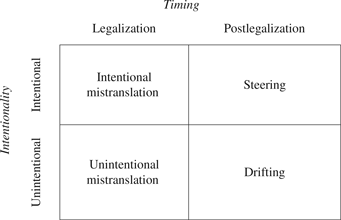
I propose a typology of norm-law gaps based on variation in intentionality and timing, two dimensions that best capture the most prevalent gaps. Four main types of gaps result: unintentional mistranslation, intentional mistranslation, steering, and drifting (see Table 1). The first type, which I label unintentional mistranslation, emerges inadvertently at the time of legalization. One important reason for it is that the idiosyncratic content of certain norms is difficult to accurately translate into law. Despite lawmakers' best efforts to transpose the norm correctly into law, the resulting law can be riddled with loopholes. For example, Percy argues that states unintentionally mistranslated the antimercenary norm into law. The norm's defining features, like the financial motivation attributed to mercenaries and their status as fighters outside state control, were difficult to translate into “legally sensible terms.”Footnote 28 The problem of unintentional mistranslation is further amplified by lawmakers' fallibility, the limits of (legal) language, and other differences between the normative and legal realms.Footnote 29
A typology of norm-law gaps
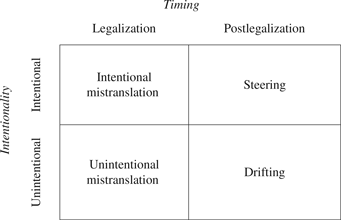
A second type of norm-law gap, intentional mistranslation, also transpires in the legalization phase, but is deliberate. Lawmakers intentionally formulate laws that imperfectly reflect norms. States want some wiggle room that allows the suspension of obligations when honoring them becomes too costly.Footnote 30 Examples include exceptions, escape clauses, reservations, and other designed flexibility mechanisms, all of which can (but do not necessarily) create gaps between the law and the underlying norm. Special interests can also capture the process of legalization, so the law will reflect their preferences rather than the norm it was supposed to mirror.Footnote 31
The next two types of gaps emerge in the postlegalization phase. Even if lawmakers accurately translated norms into laws, subsequent legal and normative changes can lead to gaps. Norm-law gaps can emerge unintentionally in the postlegalization phase through drifting. Over time, through legal interaction, interpretation, and enforcement the meaning of the law becomes more precise and narrower.Footnote 32 A textualist legal interpretation of the law facilitates this narrowing.Footnote 33 Legal professionals seduced by an ideology of formalism play a part in narrowing that leaves the law underinclusive of the norm. The more they and other participants in the legal process focus on the “formal perfection of established rules and procedures, the more removed it may become from the social ends the law serves.”Footnote 34
Postlegalization gaps can also be intentional when agents steer norms and laws in particular directions to create such gaps.Footnote 35 Especially when the law on the books is ambiguous, procedural, and imperfectly enforced, agents at the point of application can construct the meaning of legal compliance narrowly. Consequently, legal compliance will be underinclusive of norm compliance. Domestic organizations constructed compliance with US equal-employment opportunity/affirmative-action legislation narrowly so that compliance with the law became underinclusive of the underlying norm.Footnote 36
One final point is that norm-law gaps are not always readily identifiable prior to evasion. They may be revealed to outside observers only by evasion itself. To summarize, legalization creates or allows norm-law gaps that strategic agents can exploit. One of the strategies they use to do so is evasion.
Evasion
I define evasion as the intentional minimization of normative obligations through technical compliance with international law but violation of the underlying norms. Evasion is a particular type of norm violation, which is both intentional and devious.Footnote 37 It is intentional in that evaders are aware of norm-law gaps and seek to exploit them. This “intent to evade” helps identify evasion, just as incriminating mental states help identify certain crimes.Footnote 38 Behavior that unintentionally undermines norms, say, as a consequence of sincere efforts to comply with the law does not qualify as evasion. Intent to evade is distinct from the intentionality of creating norm-law gaps. Evaders can intentionally exploit norm-law gaps regardless of whether these gaps are intentionally created. Intent to evade is motivated by the desire to lower normative obligations deemed onerous.
The second component of evasion is deviousness. More specifically, evaders violate norms under the cover of legality. What makes evasion attractive as an obligation-minimizing strategy is its claim to legality, rooted in technical legal compliance. Technically compliant behaviors include those that are not pronounced illegal by judicial bodies. Specific evasion strategies vary in the plausibility of their claim to legality. More plausibly legal behaviors clearly follow the law or do not violate it because they fall outside its scope. Less plausibly legal are behaviors that are suspected to violate the law, but it is difficult to rule them illegal because of factors such as procedural impediments and insufficient admissible evidence.Footnote 39 Enforcers might also be reluctant to treat these behaviors as illegal because of concerns that revealing widespread violations would undermine the relevant laws.Footnote 40 The more plausible evasion's claim to legality, the more likely it is to deliver on its promise of shielding evaders from legal sanction.
Caught Between Compliance and Violation Pressures
Violation and compliance pressures are the causal forces of the theory. Although any agent is capable of evasion, I focus here on the state as the chief evader because it is the main duty-bearer under human rights law. Evasion becomes an attractive strategy when the state finds itself caught between compliance and violation pressures. Various compliance and violation pressures can engender evasion, but I focus on violation pressures that are primarily domestic and compliance pressures that are mainly international because they are empirically frequent in human rights.Footnote 41 Domestic constituencies become violation constituencies when they push the state to engage in behaviors that breach the international norm. International actors and their domestic allies that push back against these behaviors constitute the compliance constituencies.
The specific configuration of these constituencies and their means of influence vary across cases. Domestic violation constituencies range from the specific, such as interest groups, to the diffuse, such as the general domestic public. They tend to pressure the state through the possibility of voting (in democracies), protests (across regime types), and lobbying (across regime types). International compliance constituencies include governmental and nongovernmental organizations, as well as other states and foreign publics. They often pressure the state through shaming, the threat of legal action, sanctions, and lobbying.
The state caught between these two pressures is minimally defined. Its preferences and behavior are largely a function of the balance between violation and compliance pressures. I assume that governments are vulnerable to these pressures and do not care strongly enough about the issues involved to overrule this balance. I also assume that state officials are primarily the subjects rather than the active managers of compliance and violation pressures.
Subject to violation and compliance forces, the state must choose a course of action. Evasion's attractiveness depends on the costs of violating (or complying with) laws and norms. These costs are empirically contingent on their perceived magnitude and the likelihood of incurring them. In turn, they are largely a function of the case-specific attributes of agents, violation and compliance pressures, and norms and laws. I largely bracket the first factor and focus on the last two. I assume that law violation is costlier than norm violation (and law compliance is cheaper than norm compliance). This is a scope condition of the theory, based on three reasons. First, law violation is costlier than norm violation because norm violation usually entails only normative costs like guilt and shame, whereas law violation entails both these costs and legal costs. Laws rely as much on these normative mechanisms of enforcement as they do on state-backed coercion (especially when they enshrine “good” norms), whereas norms rely predominantly on the former.
Second, recall that the paper focuses on norm-law gaps that emerge due to narrow laws that are underinclusive of broad norms. These narrow laws tend to entail more limited obligations than broad norms, making law compliance cheaper than norm following. Finally, norm violation costs are especially low when norms are not deeply internalized in agents' proximate social contexts. The result is a permissive normative atmosphere, characterized by public commitment to the norm, tacit acceptance of widespread norm violation, and occasional token punishment, all of which are conducive to evasion.Footnote 42 This scope condition eliminates the possibility that agents subject to strong violation and compliance pressures could engage in behavior that is the mirror image of evasion: violations of the law but not the norm. I return to this possibility in the conclusion.
In this paper, the relevant options for agents subject to compliance and violation pressures include evasion, deep violation, and deep compliance. When compliance pressures are dominant, the theory expects governments to choose deep compliance, following both laws and norms. When violation pressures are dominant, it expects governments to opt for deep violation, transgressing both laws and norms. When compliance and violation pressures are both strong, deep violation and deep compliance are less appealing because they are very costly. Deep violation can result in norm violation costs and law violation costs. Deep compliance can entail significant material costs to fulfill exacting obligations and prohibitive political costs (such as lost votes) given the domestic violation constituency's opposition to these obligations. Evasion becomes more attractive as it shields agents from the costs of law violation and incurs only the costs of norm violation (and law compliance).
While evasion entails norm violation costs, these costs are unlikely to be higher than in the counterfactual case of nonlegalized norms. When legalization is useful, it is because law violation reveals an expectation gap between states' promised and actual behaviors that advocates can exploit through political mobilization and litigation.Footnote 43 Since evasion is legal it does not reveal this expectation gap, lowering the chances of successful litigation and political mobilization. Research shows that the public is less likely to oppose norm violations such as torture when these do not violate international law.Footnote 44 Legalization raises the costs of deep violation but not of successful evasion.
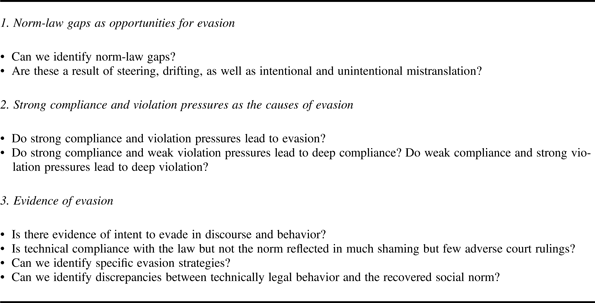
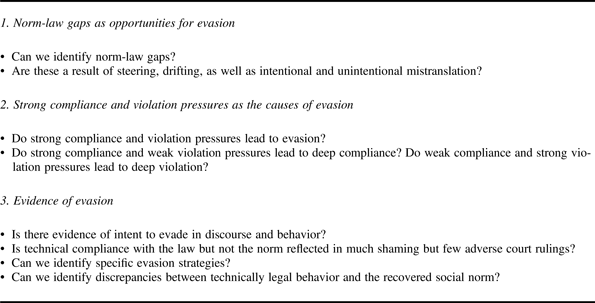
States' possession of legal-administrative resources to identify and exploit norm-law gaps is a second scope condition of the theory. This requirement is not burdensome for most functional states, as the global proliferation of governmental legal offices indicates.Footnote 45 Table 2 summarizes the empirical expectations for each theoretical building block.
Empirical expectations of the theory
Methods
I apply the theory of evasion to the case of racial equality as it relates to the expulsion of Roma immigrants from France (2008–2016) and the segregation of Roma children in Czech schools for the mentally disabled (1993–2016). The case of racial equality law is a hard case for evasion in several respects. Relative to other branches of international and European law, it tends to be broad. The chances of norm-law gaps (in the sense of the law being underinclusive of the norm) should be low, leaving fewer evasion opportunities. I rely on a narrow version of the norm to further diminish the chances that the law would be underinclusive of the norm and that a specific behavior would violate the norm. Racial equality has also been a strong international norm, so we would not expect European democracies to readily violate it.Footnote 46
While the case is hard for evasion in these respects, in two other respects it is easier. Prejudices against the Roma are higher than against other European minorities, making violation pressures stronger and norm violation more likely. The focus on Europe makes law violation less likely (and evasion more likely), since it is the strongest regional human rights regime, with relatively strong monitoring and enforcement. These attributes satisfy the first scope condition that law violation must be costlier than norm violation, while France and the Czech Republic satisfy the second scope condition of having sufficient legal resources to exploit norm-law gaps.
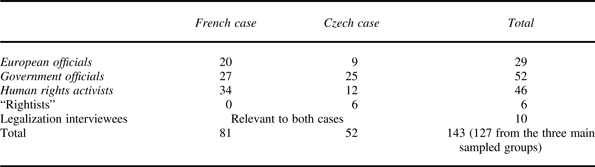
The centerpiece of the cases is the interview material. I conducted 143 semi-structured elite interviews between 1 July 2013 and 7 February 2017 (Table 3).Footnote 47 I selected most individuals (127) from a universe of potential interviewees that have legal expertise, human rights knowledge, or work experience with Roma. They fall into three main categories: (1) government officials from the relevant national ministries and local authorities from regions with larger Roma populations (52); (2) members of European and national human rights nongovernmental organizations (NGOs) (46); and (3) officials from the major European institutions, including the European Union (EU) and the Council of Europe (29). These three groups cut across violation and compliance constituencies. Although European officials and activists who favor compliance are well represented in the sample, this does not bias the argument in favor of evasion since there is no reason they should see French and Czech behavior as evasion, rather than, say, deep violation.
Interviewees
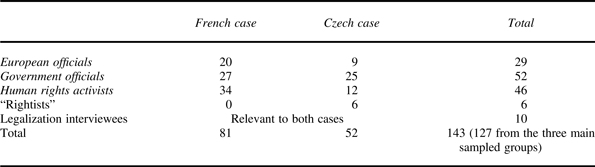
In addition to these three main categories, I interviewed ten individuals who contributed to the relevant norms' legalization as legislators or norm entrepreneurs. These “legalization interviewees” do not fit neatly in the Czech or the French case but are relevant to both because they provide information about the relevant laws and norm-law gaps. To ensure that the violation constituency's position is accurately captured, I also rely on informal conversations with this constituency's ordinary members, public opinion surveys, and the secondary literature. Additionally, I interviewed six Czech members of movements and parties that are farther right on the political spectrum and are largely part of the violation constituency.Footnote 48 To mitigate potential problems from limited representativeness, the study triangulates interview data with a wealth of primary and secondary sources. The appendix contains more details about sampling, response rate and type, format, length, and data reporting. In addition to interviewing, I also employed discourse analysis and archival research, discussed in the Norm of Racial Equality section.
A Brief Note about the Roma
The Roma, known pejoratively as Gypsies, are the largest and arguably most marginalized ethnic group in Europe. They can be divided into diverse subgroups, such as Sinti, Kale, Manouches, Gitanos, and others. It is difficult to find a definition that encompasses their diversity because “this constellation of groups does not share a common denominator … but rather a family resemblance.”Footnote 49 Prominent definitions rely on a combination of ethnocultural characteristics shared by important subsets of these groups, such as cultural attributes like the Romani language and genealogical origins in India.Footnote 50
The Roma were victims of both slavery and the Holocaust (Porrajmos). Today many live in deplorable conditions—facing segregation, hate crimes, unemployment, chronic health problems, illiteracy, and abject poverty. Discrimination by the majority population is not the only cause of the Roma's plight, but is important. In the words of a European Commission official: “What you always have to see as a backdrop, a standard parameter, is discrimination.”Footnote 51
I discuss the unfavorable treatment of the Roma in terms of racial, rather than ethnic discrimination because this terminology is prevalent in international law and advocacy. International law employs “racial discrimination” broadly to refer collectively to discrimination based on race, ethnicity, color, and related grounds.Footnote 52 Specific laws also reflect this conventional usage, as the Racial Equality Directive and the International Convention on the Elimination of Racism illustrate. On the advocacy side, activists I met favor the language of racial discrimination and racism because of its stronger shaming potential. They are careful not to essentialize race, emphasizing that it is a social construct rather than a biological given. The terminology of racial discrimination does not imply that the Roma are a racial rather than an ethnic group. For readers interested in this question, I suggest in the appendix that they are best seen as an “ethnorace.”
The Norm of Racial Equality
I recovered the international (European) norm of racial equality through a comprehensive combination of discourse analysis, public opinion polls, interviews, and archival work (the appendix provides a detailed account). I selected sources primarily from 2000 and 2010. The year 2000 captures norm legalization both in the EU (the Racial Equality Directive) and the Council of Europe (Protocol 12 of the ECHR), while 2010 captures evasion both by France and the Czech Republic. Measuring the norm at these two points in time helps us identify norm-law gaps that emerge both during and after legalization.
I began with discourse analysis.Footnote 53 With the help of my research assistants, I chose two newspapers and two leadership speeches from 2000 and 2010 for the Czech Republic, France, Germany, and the United Kingdom. For each country I selected all op-eds and letters to the editor from two nontabloid newspapers with the highest national circulation and different political leanings for the fifteenth of every other month. I also selected two significant speeches per year by heads of state and government. These procedures yielded 1,451 texts: 1,435 from newspapers and sixteen leadership speeches. I approached the texts inductively, recording the content and valence of references to racial equality. Then, I organized the findings in raw count tables and grouped them into broader categories I identified by moving back and forth between the raw data and the relevant race literature.Footnote 54 The three main categories, each corresponding to an aspect of the racial equality norm, are equal treatment, equal opportunity, and equal outcomes. Once I identified the norm's contours, I turned to the other sources. Eurobarometer opinion surveys measure public support for the different aspects of the norm more precisely.Footnote 55 I also examined the European Council's archive pertaining to the norm's legalization and asked interviewees about how they and people in their country understood the norm of racial equality.
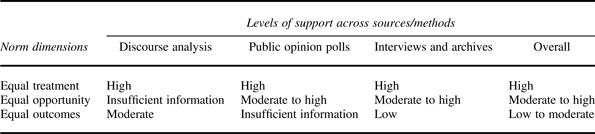
What emerges is a broad norm whose three elements can be conceived of as concentric circles. At its core is equality of treatment, also known as formal equality. It considers all individuals as equal regardless of their race or ethnicity, and prohibits differential treatment based on these grounds. Inspired by the race literature, I coded sources as falling in this category if they referred to discriminatory treatment, the (direct) racism of specific agents, or equality before the law. An example comes from the interviews: “For me and perhaps most of the people in the Czech Republic, equality means equality before the law.”Footnote 56 Eurobarometer 57 found that a combined average of 82 percent considered discrimination wrong in four issue areas: work, housing, services, and education.Footnote 57 Overall, this aspect of the norm enjoys the highest support and is the least contested across sources (Table 4). Although support levels are difficult to aggregate with precision across sources, my assessment is that over three-quarters of the evidence supports equal treatment.
The norm of racial equality
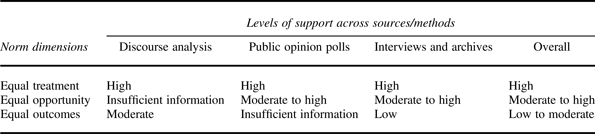
At the norm's periphery is equality of outcomes, an expansive form of substantive equality. Substantive equality recognizes that minorities may be disadvantaged compared to the majority, and treating them equally further entrenches inequality. It requires treating people differently based on race, at least temporarily, to help disadvantaged minorities catch up. Equality of outcomes aims at equal representation across issue areas, usually through affirmative action, redistribution, positive valuations of diversity, and combating institutional (indirect) racism. I coded sources as falling in this category if they referred to any of these. Here is an example from the discourse analysis that mentions institutional discrimination: “Look, too, at the under-representation of people of colour in senior positions in public authorities, as elected representatives in local and central government and in the corporate world, especially where big bonuses are dished out to those who are already obscenely rich. Institutional discrimination has not been effectively tackled.”Footnote 58 This aspect of the norm enjoys the lowest support and is the most contested. Support levels are usually below 50 percent, though occasionally they can reach moderate levels (close to two-thirds).
The normative space between equality of treatment and outcomes contains equality of opportunity, a more modest form of substantive equality. Equality of opportunity overlaps with equality of outcomes, but aims at leveling the playing field at the “starting line” rather than at the “finish line.” I placed sources in this category when they explicitly referred to equal opportunity or discussed measures that facilitate equal access rather than equal outcomes. An example comes from Tony Blair's speech at the 2000 Labour Conference, which references opportunity: “Crime, anti-social behaviour, racial intolerance, drug abuse, destroy families and communities … Fail to confront this evil and we will never build a Britain where everyone can succeed. So we invest to give opportunity.” Eurobarometer 296 found 57 percent support for monitoring the implementation of equal-opportunity measures (Question A 10.1). Across sources, support for equality of opportunity ranges from moderate (about two-thirds) to high (above three-quarters).
For methodological reasons, I focus on a narrow version of the norm that includes only highly supported dimensions: equal treatment and a conservative interpretation of equal opportunity. During the period under study this narrow norm appears stable and subject to relatively low contestation. To identify norm violations, I rely primarily on the collective judgment of the interviewee pool, which I treat as an international interpretive community whose shared understandings set the boundaries of norms' plausible interpretations. I coded an interview as confirming evasion if it discussed complying with the law but not the norm, or if it described the same phenomenon using synonymous terms such as complying with the letter but not the purpose (spirit) of the law, violating rights but not the law, loopholing, window-dressing, or superficial legal compliance. The dearth of adverse court rulings provides an indicator of evasion's legality. Finally, if other observers label Czech and French actions as legal but wrong or inappropriate, we can have more confidence they qualify as evasion.
French Expulsion of Roma Immigrants (2008–2016)
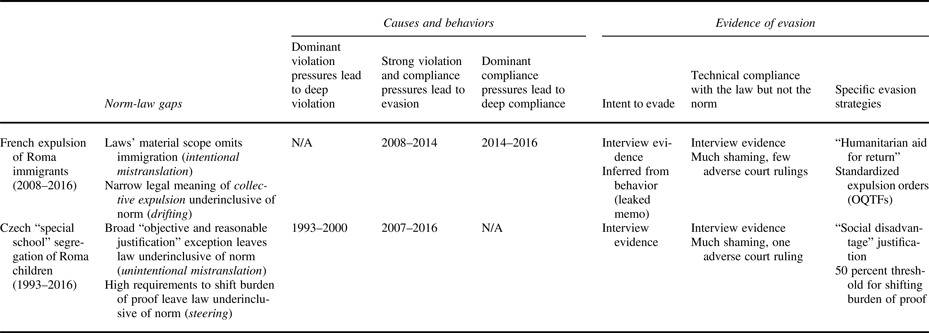
Norm-Law Gaps
The norm of racial equality is enshrined in a number of international and European laws, such as the United Nations' (UN) International Convention on the Elimination of All Forms of Racial Discrimination (ICERD) and the EU's Racial Equality Directive (2000/43/EC). Beyond antidiscrimination, the norm is also “mainstreamed” in laws governing other issues, such as expulsions. The main EU law is the Freedom of Movement Directive (2004/38/EC). It gives all EU citizens, regardless of ethnicity, the right to travel to and reside in member states subject to a few conditions, and prohibits collective expulsion based on ethnicity (Article 27/2). At the Council of Europe, Article 4 of Protocol 4 of the European Convention on Human Rights (ECHR) contains this prohibition. France ratified Protocol 4 of the ECHR (1974), and transposed into domestic legislation the Racial Equality (2003) and the Freedom of Movement Directives (2006).
There are three norm-law gaps pertinent to our discussion that provide opportunities for evasion. The first, an intentional mistranslation, is that antidiscrimination laws' material scope does not cover immigration issues, jealously guarded by states.Footnote 59 Some treaty and case law limits state discretion, but cannot eliminate it. Consequently, states can escape legal control to racially discriminate against foreign citizens: “What I don't like is the hypocrisy behind it, so you take an excuse of nationality in order to perform racial discrimination.”Footnote 60 This norm-law gap “is an enormous hole, because it allows [states] to actively discriminate on an ethnic basis, disguised by nationality basis.”Footnote 61
There are two other gaps in European legislation governing collective expulsion. One is based on the narrow legal meaning of expulsion, which appears to be largely the result of drifting. At the time of legalization, lawmakers enshrined broad prohibitions of collective expulsion based on race and ethnicity in both the Freedom of Movement Directive and the ECHR. Subsequent case law drifted to define collective expulsions more precisely as measures “compelling aliens, as a group, to leave a country.”Footnote 62 Compulsion is central to expulsion, and is defined relatively narrowly because it is understood in contrast with a broad “voluntariness.” This may be a spillover from international refugee law, where voluntariness has been reinterpreted to make it less about the genuine consent of the repatriated and more about the repatriating entity's judgment.Footnote 63 Regardless of its source, the result is a narrow legal meaning of expulsion. Roma repatriations involving subtle means of compulsion may qualify as “voluntary” returns under the law even when they are at odds with the broader normative prohibition of race-based collective expulsion.
The other gap, also a result of drifting, stems from a narrow understanding of “collective” in collective expulsion. The Freedom of Movement Directive and the ECHR prohibit collective expulsions but allow individual expulsions based on sufficiently threatening conduct. However, states must follow particular formal procedures, such as notifying individuals prior to their removal (Article 30, FMD). Over time the meaning of compliance, at least in some French courts, has been narrowed to following these procedures.Footnote 64 Complying with these procedures, however superficially, allows France to disguise collective expulsions as individual and escape legal sanction. Narrow legal compliance creates a gap between the form of the law and the underlying normative substance of racial equality.
Strong Compliance and Violation Pressures Lead to Evasion (2008–2014)
After Central and Eastern European countries joined the EU, some Roma from this region went to Western Europe in search of a better life. In France there are between 15,000 and 20,000 Roma immigrants primarily from Romania and Bulgaria.Footnote 65 They are distinct from the approximately 375,000 Travelers (gens du voyage), who have lived in France for generations. The influx of Roma immigrants elicited strong opposition from the general public, the far right, and segments of the media who dislike the Roma and support their collective expulsion. Because expulsion risks violating the international norm and laws of racial equality, I label this group the violation constituency.
Most French citizens are part of the violation constituency. In recent surveys two-thirds expressed unfavorable views of the Roma, compared to a quarter regarding Muslims and under 10 percent regarding Jews.Footnote 66 Over 70 percent of the French said the Roma make a living from “theft and trafficking,” and blamed them for not wanting to integrate into French society.Footnote 67 A 2013 poll found that 93 percent agreed with then Prime Minister Manuel Valls that the Roma do not integrate in French society and should stay in their home countries.Footnote 68 Most interviewees confirmed that the public harbors strong anti-Roma sentiment. Some French politicians are also part of the violation constituency. In July 2013 alone, former Front National leader Jean-Marie Le Pen described the Roma as “irritant and smelly,” while Gilles Bourdouleix, Member of Parliament and mayor of Cholet, said that “Maybe Hitler did not kill enough [Roma].”Footnote 69 Segments of the media engage in anti-Roma messaging.Footnote 70 Different elements of the violation constituency strengthen each other, leading to a vicious spiral of “anti-Gypsyism” that puts powerful pressure on the government to expel Roma immigrants.
A strong compliance constituency balances violation pressures. The international component includes governmental and nongovernmental organizations, such as the EU, the Council of Europe, the UN's Committee on the Elimination of Racial Discrimination, the European Roma Rights Centre, the Vatican, and Human Rights Watch. Its domestic contingent includes the Roman Catholic Church in France, and human rights and Roma rights NGOs, many of which are part of the loose Romeurope coalition. Notable NGOs include Secours Catholique, Ligue des droits de l'Homme, Roms Action, La voix des Rroms, GISTI, and La Cimade. They exerted compliance pressures through a number of mechanisms, such as shaming and private meetings with officials. Viviane Reding, then vice-president of the European Commission, called France's treatment of Roma immigrants a “disgrace,” “a situation I had thought Europe would not have to witness again after the Second World War.”Footnote 71 In August 2010 the Committee on the Elimination of Racial Discrimination warned about the threat of French racism, and Pope Benedict XVI appealed to French compassion toward the Roma.Footnote 72 The European Commission and NGOs monitored the situation and applied pressure through bilateral dialogues with the government.Footnote 73
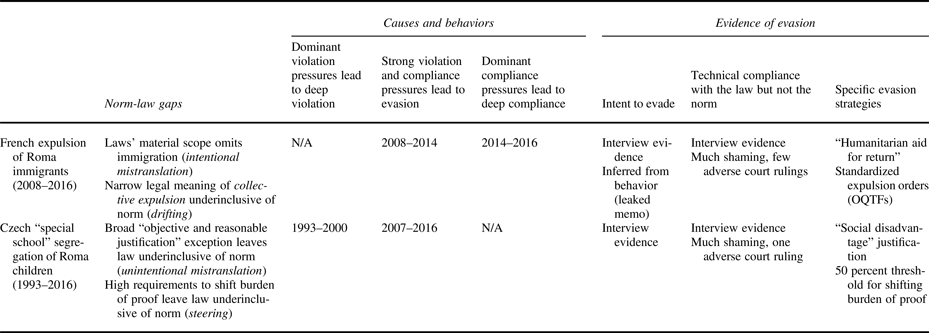
In response to strong compliance and violation pressures, French authorities opted for evasion. I discuss two evasion strategies, and then offer evidence for the defining elements and causes of evasion. One evasion strategy was the “humanitarian aid for return” (aide au retour humanitaire).Footnote 74 This exploited the first and second gaps I discussed earlier. Removing Roma immigrants by force would have clearly violated the legal prohibition of collective expulsions. To achieve the same goal without paying the costs of law violation, France devised a more circuitous but legally safer strategy. It offered the Roma 300 euros per adult and 100 euros per child to leave the country “voluntarily.” Based on incomplete data, it appears that 8,470 individuals were repatriated in 2008 and 10,600 in 2011, the majority of whom were Romanians and Bulgarians.Footnote 75
Then Prime Minister François Fillon and others insisted on the program's legality: “The recent deportations of Roma to their countries of origin made by our country have been made in full compliance with European law.”Footnote 76 Immigration issues are beyond the scope of antidiscrimination laws because of intentional mistranslation. France could also argue that its program is voluntary and free of compulsion. It technically does not qualify as expulsion, since expulsion drifted towards a narrow legal meaning. Critics questioned the voluntariness of returns given extreme Roma poverty and the threat of forceful expulsion if they did not opt into the program.Footnote 77 While the program is technically legal, experts consider it normatively inappropriate: “Regardless of its legality, the repatriation program feels intuitively wrong, and sends a strong message of ‘we don't want you here’ to the Roma people.”Footnote 78 Francois Crépeau of the Office of the UN High Commissioner for Human Rights lamented: “the ultimate objective seems to be the expulsion of migrant Roma communities from France.”Footnote 79 Nonetheless, this strategy shielded France from legal sanction.
Whereas the first evasion strategy exploits the gap caused by intentional mistranslation and the drift to a narrow “expulsion,” a second strategy takes advantage of the gap caused by the drift to a narrow “collective” in the legal prohibition of collective expulsions. One example is the use of standard individual expulsion orders (obligation de quitter le territoire français, OQTF). By giving Roma immigrants OQTFs, France superficially complies with the legal prohibition of collective expulsion and the prior notification requirement discussed earlier, and creates the impression that it assesses expulsion cases individually. According to incomplete data, 10,972 Romanian and Bulgarian citizens received OQTFs in 2010 and 2011, most of them Roma.Footnote 80 A legal expert noted: “I think it's obscene the way they use these forms and just fill in a few details. But there is still the kind of appearance of legality.”Footnote 81
Critics argued that France often uses almost identical standardized forms that provide scarce evidence that Roma individuals' conduct warrants expulsion.Footnote 82 As one Commission official put it, “They tended to put everybody on one bus or plane and go!”Footnote 83 Another added: “But it is certain that the respect of the law, including EU law by national authorities when taking these expulsion decisions is formal, superficial.”Footnote 84 In some cases activists successfully challenged the legality of this evasion strategy in French courts.Footnote 85 Yet the majority of the cases go unchallenged or are ruled legal because of narrow legal interpretation or insufficient admissible evidence, which is why “for the government it has not really changed the calculus.”Footnote 86
Interviews provided additional evidence that French behavior qualifies as evasion. Eighty-one respondents addressed the French case, of whom nearly two-thirds confirmed evasion. NGO representatives and European officials were slightly more likely to confirm evasion, but it is remarkable that nearly half of the French officials also acknowledged it. There is also specific support for the attributes of evasion: intent to evade and technical compliance with the law but not the norm. In 2010 France briefly engaged in deep violation, singling out the Roma for expulsion based on a confidential Ministry of Interior memo.Footnote 87 When French courts declared the leaked memo illegal, France replaced it with a similar one that dropped references to the Roma and allowed the government “to do the exact same thing” legally.Footnote 88 A senior French official provided evidence of intent to evade: “The way we worked, the Valls team, between 2012 and 2014, was to strictly abide by European law, but still use all the margins that were available within the framework of the European [Freedom of Movement] Directive.”Footnote 89
French expulsions were technically legal but inappropriate: “This is a circumvention of EU law in effect, and that goes against human rights.”Footnote 90 One respondent lamented: “It's not illegal, but that's why it's very difficult to make the government be punished by law.”Footnote 91 Other observers also saw French policy as norm breaking. Richard Howitt, a British member of the European Parliament, stated in response to Sarkozy's expulsions: “At some point, you draw a line in the sand and you say whatever the populist motive, if something is wrong it's wrong. And what France has done is wrong.”Footnote 92 Many others, including part of the French political elite and Romanian church leaders, agreed that these expulsions were wrong and “immoral.”Footnote 93 French expulsions are arguably at odds even with a narrow reading of the norm. Based on the best available evidence, the expulsions were largely aimed at Roma individuals, violating the equal treatment core of the norm.
While the empirical evidence discussed earlier shows the presence of strong compliance and violation pressures, interviewees confirmed that these caused evasion.Footnote 94 Compliance pressures from European institutions made deep violation unattractive, but respondents also stressed that the largely domestic violation constituency “undermines the effectiveness of the European pressure.”Footnote 95 As one respondent put it, “Public opinion is catastrophic … and that's why governments speak like they speak, act like they act.”Footnote 96 The threat of voting against officials that appear more Roma-friendly makes deep compliance on Roma issues “political suicide,” undercutting French political will to protect Roma rights.Footnote 97 In sum, between 2008 and 2014 France engaged in evasion to expel Roma immigrants with little legal cost.
Toward Deep Compliance (2014–2016)
Roma expulsions declined after 2014 and so has the frequency of evasion. The relative strengthening of the compliance constituency accounts for much of it, validating another expectation of the theory. Given evasion's technical legality, legal means were not the most effective way to push France toward deep compliance. But the compliance constituency also relied on nonlegal means of influence. The EU continued to exert political pressure on France, while NGOs continued shaming campaigns. The European Roma Rights Centre called on France to “refrain from collectively expelling Romani EU citizens from France.”Footnote 98 Other French and European NGOs engaged in lobbying and organized events to raise awareness about the Roma's plight, mobilize the compliance constituency, and weaken the violation constituency.Footnote 99
When a Roma immigrant schoolgirl, Leonarda Dibrani, was arrested in front of her schoolmates and expelled to Kosovo with her family, the French left and youth also mobilized against expulsions.Footnote 100 The majority of the public still supported expulsions, but those who switched sides tipped the balance in favor of the compliance constituency. This constituency was also aided by the expiration of temporary French restrictions on Romanian and Bulgarian workers on 1 January 2014, which likely made expulsions less effective and more controversial. However, as the number of expulsions declined, evictions increased. France may have moved to deep compliance regarding expulsions, but there are limits to Roma inclusion.
Summary of empirics
Separate and Unequal: Roma in Czech “Special Schools” (1993–2016)
Many Central and Eastern European countries educate Roma children in segregated and substandard schools. One particularly unfortunate practice is the disproportionate placement of Roma students in “special schools” for those with mild mental disabilities. Although the practice is common in the region, the proportion of Roma in these schools is among the highest in the Czech Republic.
Norm-Law Gaps
The norm of racial equality in education is enshrined in a number of international and European laws. The most prominent ones include the ICERD (Article 5v), the Racial Equality Directive (Article 3g), and the ECHR (Article 14 in conjunction with Article 2 of Protocol 1). After the dissolution of Czechoslovakia, the Czech Republic adhered to the ECHR (1992), ICERD (1993), and later transposed into domestic law the Racial Equality Directive (2009). I focus on the European legal instruments because of their stronger enforcement.
There are two relevant norm-law gaps. One is likely the result of unintentional mistranslation. The racial equality norm entails treating similar cases similarly and different cases differently, regardless of race. Translating this norm accurately into law is difficult. The law must guard against discrimination but must also allow for the possibility that differences in treatment might not be discriminatory. Therefore, the law allows differential treatment when based on “an objective and reasonable justification.”Footnote 101 Without this broad exception the law would be overinclusive. Unfortunately, the exception's inherent ambiguity can sometimes leave the law underinclusive of the norm. Although European courts closely scrutinize racial discrimination cases and require “very weighty reasons” for this exception, “sometimes a broader margin of appreciation is granted than maybe many of us here would wish.”Footnote 102 States can deploy the exception too broadly, exploiting the norm-law gap.
A second gap emerges in the postlegalization phase through steering. Except for criminal proceedings, European antidiscrimination law allows the burden of proof to shift to the defendant once the complainant has established the presumption of discrimination. Treaty law leaves open the nature of evidence required to establish this presumption, but the European Court of Human Rights' (ECtHR) case law provides some, albeit not entirely consistent, hints.Footnote 103 Czech courts interpreted this case law to specify very demanding criteria for establishing the presumption of discrimination, which leaves the law underinclusive of racial discrimination. Although we cannot rule out drifting resulting from the judiciary's unfamiliarity with the burden of proof, legal experts and the idiosyncratic legal interpretation involved suggest it is the result of intentional steering: the Czech Supreme Court “read the Strasbourg judgments and reasoned around them.”Footnote 104
Strong Violation and Weak Compliance Pressures Result in Deep Violation (1993–2000)
In an initial phase, the violation constituency's dominance caused the transgression of both law and norm (deep violation). The violation constituency consisted of the domestic public, special-education interest groups, extremist movements, and certain media outlets. The domestic public has held negative views of the Roma since the birth of the Czech Republic and has favored segregated education. Surveys from 1994 to 2010 find that negative attitudes toward the Roma are quite stable, with a high of 73 percent in 1994 and a low of 63 percent in 2005. The same survey conducted between 1999 and 2010 shows that less than a quarter of Czechs agree that “The Czech Republic should pay more attention to the rights of the Roma minority.”Footnote 105 In a 2012 Eurobarometer survey, 52 percent of Czechs said citizens of their country would be uncomfortable with their children having Roma classmates, second only to Slovakia's 58 percent.Footnote 106
Certain domestic groups like the Association of Special Needs Educators have a vested interest in placing Roma children in special schools.Footnote 107 Czech schools are funded by the state on a per-pupil basis, and special schools can claim 50 percent more money for each pupil than regular schools. This provides perverse incentives to maximize special-school enrollment. The declining number of non-Roma children makes the recruitment of Roma vital for special schools' survival. Many parents and teachers also worry that Roma inclusion in mainstream schools lowers the quality of education. These fears and prejudices are amplified by segments of the media.Footnote 108 A final contingent of the violation constituency is farther right on the political spectrum. Although their parties have enjoyed only modest success in mainstream politics, some extremists have exercised considerable pressure through well-attended demonstrations, particularly in the 1990s, 2008, and 2012–13.Footnote 109
As the theory expects, dominant violation pressures engendered deep violation, which took the form of blatant recruitment and segregation of Roma children in special schools. These schools were initially established to assist those with mild mental disabilities, but they quickly become de facto “Roma schools.” There is anecdotal evidence that some special school staff aggressively recruited Roma children.Footnote 110 Conscious and unconscious racial prejudice about Roma intellectual inferiority increased the risk that psychologists interpreted ambiguous intelligence test results as evidence of mental disability.Footnote 111 Principals acted on psychologists' recommendations, pressuring and cajoling Roma parents to consent to their children's placement in special schools.Footnote 112 In fact, Roma children's underperformance on intelligence tests was largely caused by the lack of early childhood education, poor Czech language skills (often Czech is not their native language), and other socio-cultural barriers.Footnote 113
These recruitment-and-placement practices violated the laws and norm of racial equality. It was hard to deny that these practices were at odds with the norm, but it was also hard to prove their illegality. The Czech Republic, like France, did not collect ethnicity- and race-based data. This changed with the European Roma Rights Centre's involvement, an NGO that gathered unofficial data. In the Czech city of Ostrava during the 1998–99 school year, it found 56 percent of the children in special schools were Roma, even though Roma children represented only 2.26 percent of all primary school children in Ostrava. The Roma were twenty-seven times more likely to be placed in special schools.Footnote 114 Partly based on these statistics, the ECtHR ruled Roma special-school placement illegal because it violated the ECHR's Article 14 in conjunction with Article 2 of Protocol 1.Footnote 115
The decision galvanized the compliance constituency. New allies joined the organizations that raised concerns about the issue originally in the late 1990s and early 2000s.Footnote 116 The loose coalition of Czech NGOs, “Together to School,” formed in the ruling's wake. Some countries, such as Norway and the US, started to exert political pressure through ambassadorial probing into school segregation.Footnote 117 Amnesty International continued its shaming campaign: “To date, the government has failed to end racial segregation in Czech schools.”Footnote 118 The compliance constituency expanded significantly to include international organizations such as the EU and the Council of Europe, prominent international human rights NGOs like Amnesty International and Open Society Foundations, and European Roma rights NGOs like the European Roma Rights Centre and Roma Education Fund. Their Czech allies include, but are not limited to, the Czech Society for Inclusive Education, People in Need, Life Together, IQ Roma servis, the League of Human Rights, and the NGO coalition Together to School. Czech Roma also protested segregation, and NGOs such as Slovo 21 and Awen Amenca continue to mobilize them for inclusive education.Footnote 119
The compliance constituency pressured the government through public shaming, the threat of litigation, and meetings with officials. Former Czech minister of human rights, Jiří Dienstbier, and former deputy minister of education, Jiří Nantl, acknowledged their importance, as did the vast majority of my interviewees.Footnote 120 This pressure made deep violation unsustainable, particularly as the country aimed to join the EU. For much of the 2000s the government adopted a mix of denial and tactical concessions, which did little to mitigate compliance pressures.
Strong Violation and Compliance Pressures Result in Evasion (2007–2016)
After the ECtHR decision, the government adopted evasion as its dominant strategy in response to strong compliance and violation pressures. I briefly discuss two evasion strategies before providing evidence for evasion's defining attributes and its causes. The first takes advantage of the burden-of-proof loophole discussed earlier. The Czech state, with the blessing of domestic courts, engaged in steering, and interpreted ECtHR case law opportunistically as requiring at least 50 percent of special school students to be Roma to establish prima facie indirect discrimination.Footnote 121 While Roma children are overrepresented in Czech special schools, their proportion often falls below 50 percent in particular cases. About a third of all Czech children in special schools are Roma, even though Roma students constitute less than 4 percent of all Czech primary school students.Footnote 122 The 50-percent requirement hinders victims' ability to establish the presumption of discrimination and shift the burden of proof to the government. In 2012 the Supreme Court confirmed this threshold, lowering the chances that the government would be found in violation of the law.Footnote 123 In an August 2015 ruling the Constitutional Court finally struck down the 50-percent requirement.Footnote 124 But the decision in other respects upheld the lower courts' ruling that the Roma complainant was placed in a special school based on inferior ability rather than ethnicity. While the ruling closed one loophole, it may have reopened another.
A second strategy exploited the unintentional mistranslation gap. The Czech Republic included “social disadvantage” among the criteria for special-school placement. It defined social disadvantage as “a family environment with a low social and cultural status, threatened by pathological social phenomena.”Footnote 125 This loophole afforded the ministry of education a cover, however thin, against legal accountability. It could argue that special-school placement of those with “social disadvantage” does not constitute racial discrimination. After all, international racial equality legislation condones apparently racially neutral measures that have differential effects if they are based on objective and reasonable justifications.
Although there was no legal action against the government, there was social pressure to close this loophole. Critics argued that the 2007 ruling of the ECtHR delegitimized all justifications for Roma placement in special schools, and that “social disadvantage” was a code for Roma.Footnote 126 The government slightly narrowed this loophole through Decree 147/2011, but did not abolish it. Finally, in response to further criticisms, it appears to have closed the loophole through Decree 103/2014, which prohibits the education of those with social disadvantage in special schools. One problem, however, is that because the Czech Republic on paper (but not in practice) abolished special schools in 2005, it is unclear how compliance with the latest decree can be monitored.
Beyond these specific evasion strategies, interview data also provide evidence of Czech evasion. About two-thirds of the fifty-two interviewees who addressed the Czech case confirmed evasion. The evidence's credibility is strengthened by over half of the Czech officials acknowledging evasion. Some interviewees went as far as to say: “I think it's very common. I call it the ‘Czech way.’”Footnote 127 There is specific evidence of evasion's defining attributes as well. Hinting at intent to evade, one official explained: “We are very skilled—very talented, in a sense—if there is a need, like to avoid a certain stipulation or certain act, we always find a way.”Footnote 128 Respondents discussed evasion's incongruous relationship with laws and norms too. Interestingly, one person referenced Franz Kafka's parable Before the Law, to illustrate the difficulties of accessing and achieving justice through the law.Footnote 129
Interviewees validated the causes of evasion. Many described pressures from the violation constituency. They emphasized the general public's electoral clout: “If local authorities engage in projects that help the Roma, they might lose the next election.”Footnote 130 They also confirmed special-education teachers' segregation efforts, the “Stop Harmful Inclusion” campaign by the tabloid Blesk, and the activities of far-right groups.Footnote 131 Likewise, they acknowledged the importance of compliance pressures. The EU and the ECtHR “helped start the discussion that we didn't have before.”Footnote 132 In addition to compliance pressure from above, some credited compliance pressure from below: “pressure from Europe is important, but I think that main change came from below—that the civil-society organizations started to really be more involved with the government.”Footnote 133 One interviewee discussed the contradictory pressures leading to evasion in these terms: “Because in such situations when you have on one side, the principles, the human rights principles, and on the other you have practical obstacles or resistance from some social groups or from society as a whole, you always end up in more like window-dressing measures or to blur the picture in some way.”Footnote 134
Under a generous interpretation of Czech behavior and a narrow interpretation of the norm, perhaps special-school placement could be justified temporarily: Roma children are placed in special schools to help them catch up. However, the reduced curriculum makes their transition to mainstream schools practically impossible. By offering an inferior education, these schools narrow future opportunities for Roma children, violating the norm's equality-of-opportunity aspect. Roma children transferred from Czech special schools to mainstream British schools did respectably, despite cultural and language barriers, reminding us of the injustice done to their less-fortunate peers.Footnote 135 Segregating Roma in special schools also reinforces prejudices about inferior Roma intellect and hinders Roma integration into mainstream society. The practice is contrary to the racial equality norm, yet there have been no court rulings against the state since the 2007 DH case.Footnote 136
It remains to be seen whether in the longer run the Czech Republic will shift to deep compliance. Obstacles include the availability of ethnic and racial data, Roma distrust of the legal system and unawareness of legal rights, and perhaps most importantly prejudice, which fuels domestic violation pressures.Footnote 137 Promising European initiatives, such as the EU Framework for National Roma Integration Strategies, aim to tackle these obstacles. It is also encouraging that the European Commission started infringement proceedings against the Czech Republic in September 2014. The government started to implement promising reforms on 1 September 2016. Over time, such positive initiatives could weaken violation constituencies and empower domestic compliance constituencies. The result could be deep compliance. However, there are concerns that desegregation in special schools might lead to more segregation in mainstream schools.Footnote 138
Alternative Explanations
Are the cases about internal-external (domestic-international) norm gaps rather than norm-law gaps? There are two ways to interpret this question. One is that it refers to a gap between the international norm of racial equality and domestic norms of racial inequality. There is abundant anti-Roma racism in the countries under study. Yet even if it adds up to a norm of racial inequality, the sources discussed in the appendix indicate that in the Czech Republic and France the norm of racial equality is stronger. Interviewees confirmed that most French and Czech people at least rhetorically oppose racial discrimination, support the narrow norm of racial equality this study relies on, and are offended if called racist.Footnote 139 Of course, we should not exaggerate the norm's strength. Since it coexists with anti-Roma sentiment, it seems widely but not always deeply held, which is typical in evasion cases.Footnote 140 I focus on the norm of racial equality because it is stronger than its rival, and I incorporate racial prejudices in the study as a motivation of the violation constituency.
The other interpretation of the question is that the gap is between the international norm of racial equality and the domestic norm of racial equality. This is a potentially fruitful lens that captures differences between the more expansive versions of the norm held by European norm entrepreneurs and more conservative ones held by segments of domestic publics. It is also supported by the fact that much (but not all) of the compliance pressure is international and much of the violation pressure is domestic. Yet for this study that lens seems less useful. Any potential international-domestic gaps were closed by the fact that I rely on a narrow version of the norm, which is widely (if not deeply) shared across European and national constituencies. Therefore, the more relevant gap in our cases is between the norm and the law.
One might also wonder whether this study focuses too much on outside pressures on elites as determinants of evasion, and not enough on elite characteristics such as political ideology. Available evidence provides limited support for this argument. The impact of ideology is the clearest in France, where the Leonarda case mobilized the left to push the government toward deep compliance. However, much of ideology's influence can be incorporated into “outside pressures” by the compliance constituency, since it was largely the public's ideology rather than the elites' that mattered. Elite ideology alone brought little change in expulsions as the 2012 transition from the Sarkozy to the Hollande administration indicates. Even socialist politicians reluctantly admitted: “More or less we do the same as Sarkozy.”Footnote 141 There is also little support for elite ideology in the Czech case. One minister of education with a positive impact on school desegregation comes from the left-leaning Green Party (Ondřej Liška, 2007–2009), while another was nominated by (but is not a member of) the center-left Czech Social Democratic Party (Kateřina Valachová, 2015–). Beyond these two cases it is hard to identify any connection between ideology and behavior, perhaps because Czech parties exhibit little ideological coherence.Footnote 142
The vast majority of interviewees saw elite ideology as largely inconsequential for Roma policy. The exceptions are far-right parties (which are hostile) and the Czech Green Party (which is sympathetic). In the words of a European Commission official: “Left, right, middle—everybody is against the Roma. Whichever politician will say ‘Let's hit the Roma!’ everybody will say ‘Yes, good idea!’”Footnote 143 Another added: “regardless of the government, they were both [the left and the right] pretty useless in terms of results when it came to Roma integration.”Footnote 144
Conclusion
This study proposed a novel explanation for the persistence of norm violations after legalization. While much of the literature emphasizes the mismatch between commitment and compliance with legalized norms, my argument focuses on the mismatch between law compliance and norm compliance. International law imperfectly mirrors underlying social norms such that legality and normative appropriateness differ. Strategic agents take advantage of these norm-law gaps to lower normative obligations through evasion. I empirically substantiated the argument with the cases of France's expulsion of Roma immigrants and the Czech Republic's segregation of Roma children in schools for those with mild mental disabilities. Subject to strong domestic violation pressures and international compliance pressures, these states engaged in evasion.
Evasion is broadly generalizable whenever its causes and scope conditions are present. States superficially comply with the law but not the underlying norms when they participate in conflict without formally declaring war, or resort to legalistic measures to comply with the Refugee Convention while keeping asylum seekers away.Footnote 145 There are also evasive elements in US violations of the anti-torture norm under (very thin) “plausible legality,” and post-atrocity states' creation of superficial accountability mechanisms that do not deliver justice but help these states eschew international opprobrium.Footnote 146 To further increase evasion's applicability, it helps to broaden our focus from gaps between laws and norms to gaps between the law's letter and purpose (which may not be a norm). States devise creative strategies to comply with the letter of international trade law (think of “voluntary export restraints”) and financial regulations (“regulatory arbitrage” under the Basel I Accord) in ways arguably at odds with the legal purpose.Footnote 147
This study is limited to cases where states deem law violation costlier than norm violation and laws are underinclusive of norms. Future work could examine cases where norm violation is seen as costlier than law violation and norms are underinclusive of laws. In such cases, strong compliance and violation pressures could elicit behavior that is the mirror image of evasion: violations of the law that follow the norm. Scholars could develop more nuanced versions of the argument by incorporating customary and soft laws. Future research should also examine whether there is a relationship between regime type and evasion, whether variation in legalization levels affects evasion, and the extent to which evasion loosens legal constraints. One influential argument regarding the latter is that the European human rights regime emerged largely because newly established democracies could “lock in” their democracy by committing to European human rights law.Footnote 148 Insofar as evasion loosens legal constraints, it can have significant implications for this and similar arguments based on the constraining power of international law.
The separation between norms and laws opens promising research avenues. We can theorize the multiple ways in which distinct norms and laws interact, reinforcing or undermining each other. I have discussed how the divergence of norms and laws in the postlegalization phase creates norm-law gaps that are necessary for evasion. But norms and laws can also converge to close these gaps. Assuming norms are “good,” one might hope that norm-law gaps close as broad norms expand the scope of narrow laws. Behavior that initially counted as evasion because it violated the norm but not the law would come to violate both, turning evaders into deep violators and raising the costs of their behavior. But narrow laws could also contract broad norms.Footnote 149 Behavior that initially counted as evasion would subsequently violate neither the norm nor the law, turning evaders into deep compliers and lowering the costs of their behavior. The possibility of law-induced norm narrowing highlights the limits of this theory of evasion, which applies to cases that exhibit norm-law gaps. Future work should consider the possibility that laws can narrow norms—a potential drawback of legalization that could contribute to normative regress.
Finally, IR scholars could think about evasion in the context of international legal fragmentation.Footnote 150 Fragmentation might facilitate evasion through conflicts of laws, but might also hinder it through better-tailored laws that take into account regional or issue-area specificities. Identifying the conditions under which fragmentation enables or undermines evasion could be useful. A last point of conversation with legal scholars pertains to the relative benefits of formalist versus instrumentalist approaches to international law. Some worry that treating the law as an instrument to safeguard the ethical can be abused by the powerful, and they propose formalism to constrain such abuses.Footnote 151 We should not overestimate the constraining power of formalism (or at least its thin, legalistic version) because it can also be abused to engage in technically legal wrongdoing.
Supplementary Material
Supplementary material for this article is available at <https://doi.org/10.1017/S0020818318000024>.