INTRODUCTION
After having survived a stroke, many patients are confronted with permanent cognitive deficits (Hochstenbach, den Otter, & Mulder, Reference Hochstenbach, Den Otter and Mulder2003). However, the degree of cognitive impairment widely varies across stroke patients. Even when individuals have the same lesion characteristics cognitive profiles vary greatly (Jokinen et al., Reference Jokinen, Melkas, Ylikoski, Pohjasvaara, Kaste, Erkinjuntti and Hietanen2015; Stern, Reference Stern2002). Consequently, some patients may function well in their regular activities, such as work, academic training or leisure activities, whereas other patients experience disability in their daily life due to their cognitive deficits. The cause of these differences in post-stroke cognitive outcome is still largely unknown.
One factor that may explain this variability in outcome is the concept of cognitive reserve. Stern (Reference Stern2002) defined cognitive reserve as “the ability to optimize or maximize performance through differential recruitment of brain networks, which perhaps reflects the use of alternate cognitive strategies” (p. 451). Individuals with more cognitive reserve are presumably able to use alternative networks that are less susceptible to disruption. As a result, the same degree of damage or lesions may have different effects on individuals (Barulli & Stern, Reference Barulli and Stern2013; Stern, Reference Stern2002).
As cognitive reserve cannot be assessed directly, several indices have been used as proxies for cognitive reserve, notably educational attainment, premorbid IQ, as well as occupation or leisure activities (Jones et al., Reference Jones, Manly, Glymour, Rentz, Jefferson and Stern2012; Martins Da Silva et al., Reference Martins Da Silva, Cavaco, Moreira, Bettencourt, Santos, Pinto and Montalban2015). Although educational attainment is one of the most widely used indicators of cognitive reserve, both the use of this proxy measure and the concept of cognitive reserve itself have been debated (see, e.g., Jones et al., Reference Jones, Manly, Glymour, Rentz, Jefferson and Stern2012). Still, educational attainment has been found to have protective effects on cognitive decline due to normal aging or after brain disease, even after accounting for the association between education level and cognitive performance. Much research on the effects of education as a proxy for cognitive reserve has been done in neurodegenerative disorders such as Alzheimer’s disease (Harrison et al., 2015; Stern, Reference Stern2002), showing that higher education results in later onset of dementia, combined with a more rapid decline after the dementia onset (Stern, Albert, Tang, & Tsai, Reference Stern, Albert, Tang and Tsai1999). However, research on the potential effects of educational attainment in relation to the cognitive sequelae of cerebrovascular disease has just started to emerge.
While educational attainment can be considered a proxy of cognitive reserve, compensatory effects of education can also be explained by the Scaffolding Theory of Aging and Cognition (STAC). This theory proposed that scaffolding is the process of building a framework of alternative neural circuits and connections in response to challenges caused by neural or functional damage (Park & Reuter-Lorenz, Reference Park and Reuter-Lorenz2009). The level of formal education has been suggested as one of the factors promoting this scaffolding (Barulli & Stern, Reference Barulli and Stern2013; Park & Reuter-Lorenz, Reference Park and Reuter-Lorenz2009), extending the ideas of Stern (Reference Stern2002).
A recent qualitative review by Nunnari, Bramanti, and Marino (Reference Nunnari, Bramanti and Marino2014), which examined the effects of education, leisure activities, and premorbid IQ as potential proxies for cognitive reserve in patients with stroke, reported that a longer educational history was associated with less cognitive dysfunction. Stroke patients with more years of formal education showed less cognitive decline in different domains (e.g., language, executive functioning, and memory) and were less at risk of developing vascular cognitive impairment (VCI) compared to stroke patients with less years of formal education. However, one complicating factor here is that individuals who had more formal education will be likely to perform better on most cognitive tests compared to individuals who received less education (Schooler, Mulatu, & Oates, Reference Schooler, Mulatu and Oates1999; Van Hooren et al., Reference Van Hooren, Valentijn, Bosma, Ponds, Boxtel and Jolles2007).
Therefore, studies have to adjust for the level of formal education by comparing the test performance of stroke patients with a reference group of a similar age range and education level, or to an age- and education-adjusted performance based on available normative data. The performance of the reference or norm group may serve as an indicator of the premorbid cognitive performance of the stroke patient. While Nunnari et al. (Reference Nunnari, Bramanti and Marino2014) concluded that a long history of education results in less cognitive dysfunction after a stroke, this narrative review did not statistically analyze the available data.
In the current study, we present two studies investigating the effect of educational attainment on VCI. First, we present a meta-analysis investigating the magnitude of the effect of the level of formal education on cognitive impairment in stroke patients, also considering other potentially relevant variables that have been linked to cognitive reserve (i.e., leisure activity, premorbid IQ). This meta-analysis extends the narrative review by Nunnari et al. (Reference Nunnari, Bramanti and Marino2014) and aims to quantify the effect sizes of the existing studies. It is important to gain more insight into the exact magnitude of the effect of formal education as a factor affecting cognitive outcome in stroke patients.
Second, we empirically investigated the effect of formal education level on long-term cognitive impairments in a large cohort of older adults who have experienced an ischemic stroke at a young age (the FUTURE study cohort), taking into account the effect educational attainment has on cognitive performance in itself. The latter was estimated using a stroke-free control group and subsequently examining the additional effect of education on VCI. Previous studies examined relatively older stroke patients, which may have resulted in cohort effects. In general, older patients may not always have had access to higher forms of education as younger individuals have had (Goldin, Reference Goldin1998). Therefore, the level of formal education in younger individuals may be a more valid indicator of cognitive reserve than in older adults. Quantifying the effect of education level on VCI by examining previously published findings and subsequently validating their outcome in an independent sample of young-stroke patients (taking additional confounding factors into account, notably age effects) provides important information that may aid clinical assessment and treatment of stroke patients.
STUDY 1: META-ANALYSIS
Method
Data sources
We have followed the PRISMA guidelines for performing a meta-analysis (Moher, Liberati, Tetzlaff, Altman & The PRISMA Group, Reference Moher, Liberati, Tetzlaff and Altman2009). Articles were identified in PubMed. To select the articles, combinations of (truncated versions of) the following search terms were used: “cognitive reserve”, “stroke”, “Transient Ischemic Attack” or “TIA”, “education”, “premorbid intelligence”, “leisure activity”, “cognitive functioning”, “cognitive decline” and “cognitive deficits”. These search terms were similar to the ones Nunnari et al. (Reference Nunnari, Bramanti and Marino2014) used in their narrative review. Also, reference lists of the identified articles were manually checked for additional publications. We used the Gorelick et al. (Reference Gorelick, Scuteri, Black, Decarli, Greenberg and Iadecola2011) definition of VCI, that is, “a syndrome with evidence of clinical stroke or subclinical vascular brain injury and cognitive impairment” (p. 2677), defined as (assumed) decline in at least one cognitive domain compared to a prior baseline, but we did not include studies focusing on small vessel disease or vascular dementia. The last literature search was carried out in October 2016.
Study selection
For this review, articles were selected only when the following criteria were met: (a) one of the outcome measures had to be cognitive dysfunction; (b) information about cognitive reserve referred to the time before the stroke; (c) the scores indicating cognitive impairment had to be adjusted for the level of education, because individuals who received less education tend to perform worse on any cognitive test compared to individuals with more formal education; (d) studies had to report sufficient information (e.g., means or standard deviations, standardized effect sizes, or exact statistics such as p or F values) to be able to perform a meta-analysis. These criteria were examined by carefully screening the titles and abstracts of studies in the English language.
Data synthesis
Since the studies reported different effect sizes (ESs), these were all converted into a correlation coefficient as an index of the association between education and cognitive dysfunction. Some studies reported odds ratios or t-values, which were converted into a correlation coefficient (r) using a calculator developed by Lipsey and Wilson (Reference Lipsey and Wilson2000; http://www.campbellcollaboration.org/resources/effect_size_input.php). Other studies provided beta-coefficients (ß), which were transformed into correlations (r) using the following formula: r=ß
 ${\times}{{{\rm Sy}} \over {{\rm Sx}}}$
. Subsequently, the correlation coefficients were converted into Fisher’s z' to perform the meta-analysis using a standardized effect size which is normally distributed. Fisher’s z' was computed using the transformation formula:
 $$z'{\equals}{1 \over 2}{\rm ln}\left( {{{1{\plus}{r}} \over {1{\minus}{r}}}} \right)$$
(Fisher, Reference Fisher1915). The calculated ESs were interpreted according to Cohen’s (1992) convention of small (0.10), medium (0.30), and large (0.50) effects.
The calculated ESs were combined into a summary statistic (z’). Random-effects models were used because these are preferred when one wants to generalize the results beyond the observed studies (Clark-Carter, Reference Clark-Carter2010). Sample sizes were incorporated to correct for the biased ES in studies with small sample sizes (Hedges & Olkin, Reference Hedges and Olkin1985). The heterogeneity (Q) of the studies was calculated and 95% confidence intervals were computed.
A categorical analysis was run with two groups of studies: cognitive decline versus dichotomized clinical diagnosis. This was done since not all cognitive outcome measures were comparable. Several studies examined differences in cognitive decline in stroke patients with different levels of education using neuropsychological tests. Age- and education-adjusted normative data were used to indicate the extent of cognitive decline as a continuous measure. If no overall cognitive measure was reported, we calculated an overall mean of the reported effect sizes before transforming this mean effect size into our summary statistic.
Other studies reported the prevalence of a clinical diagnosis as a dichotomous cognitive outcome measure. Some studies diagnosed stroke patients as having either vascular cognitive impairment (VCI) or vascular cognitive impairment, no dementia (VCIND) based on neuropsychological test results and expert opinion. Other studies based their diagnoses of having VCI on a cutoff score by which patients were classified as “impaired” based on either a preset cutoff (Nasreddine et al., Reference Nasreddine, Phillips, Bédirian, Charbonneau, Whitehead, Collin and Chertkow2005), or a test performance of more than 1.5 SD below the control mean. A positive ES indicates that more years of formal education is related to better cognitive outcome (less cognitive decline or lower prevalence of a clinical diagnosis).
To minimize the possibility that a publication bias toward significant results at the cost of null-findings significantly reduces the ES, a funnel plot was made and the fail-safe N was computed (Rosenthal, 1991). The fail-safe N must to be larger than (5×k)+10, where k is the number of studies included in the meta-analysis (Clark-Carter, Reference Clark-Carter2010). All analyses were performed using MetaWin version 2.1 (Rosenberg, Adams, & Gurevitch, 2000).
Results
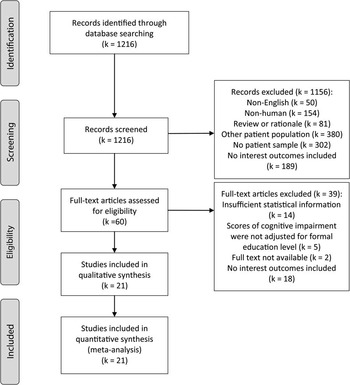
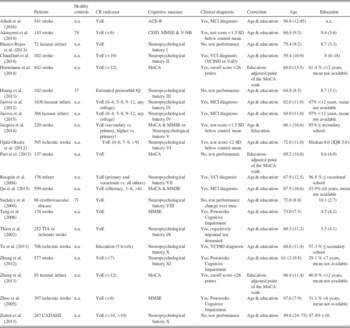
The recent selective search in PubMed resulted in a total of 1216 articles published between 1983 and 2016. Only 21 of these articles met the aforementioned criteria, which examined a total sample of 7770 stroke patients. Cognitive reserve was most commonly measured by years of education. Cognitive dysfunction was defined in the studies as either one score on a global cognitive measure, the mean score of a range of neuropsychological tests, or a dichotomized clinical diagnosis (i.e., “cognitively impaired yes/no” or “VCI yes/no”). Figure 1 shows the flow chart and Table 1 lists the characteristics for each of the studies included in the meta-analysis.
PRISMA flowchart of the studies selected for the meta-analysis.

Characteristics of studies included in the meta-analysis

Notes. CR=cognitive reserve; CD=cognitive dysfunction; Age=mean (SD) age of patients (Zieren et al. Reference * Zieren, Dueringa, Petersb, Reyesc, Jouventc, Hervéc and Dichgans2013 only reported range); Education=mean (SD) years of formal education of patients (Chaudhari et al. Reference * Chaudhari, Verma, Garg, Singh, Malhotra and Sharma2014 only reported range); YoE=years of education, CSID=Community Screening Instrument for Dementia; V-NB=Vascular Neuropsychological Battery; VCI=vascular cognitive impairment; VCIND=vascular cognitive impairment, not dementia; MCI=mild cognitive impairment; ACE-R=Addenbrooke’s Cognitive Examination-Revised; MoCA=Montreal Cognitive Assessment; MMSE=Mini-Mental State Examination; CADASIL=Cerebral Autosomal Dominant Arteriopathy with Sub-cortical Infarcts and Leukoencephalopathy; I=California Verbal Learning Test, Phonetic Verbal Fluency Test, Semantic Verbal Fluency Test, & Digit Span Forward and Backward; II=Digit Span, Luria’s Test, Trail Making Test, Two Dimensional Cross Test, Three Dimensional Cube Test, various non-standardized tasks to evaluate orientation, language, memory, calculation, praxis, visuo-spatial function; III=Raven’s Standard Progressive Matrices, California Verbal Learning Test-II, Brief Visual Memory Test-Revised, Visual Object and Space Perception battery, Purdue Pegboard Test, Category Fluency Test, Design Fluency Test, Stroop Test, & The Intra/Extra Dimension Set Shift Test; IV=Cognitive Assessment Screening Instrument, California Verbal Learning Test, Block Design, Symbol Search, Controlled Oral Word Association, Grooved Pegboard, Digit Span, Clock Drawing; V=Mattis dementia Rating Scale, Rey-Osterrieth Complex Figure, letter and semantic fluency, Delayed Matching-to-Sample, IR/FR-16 words, Oral Denomination-40 pictures; VI=MMSE, Trail Making Test, Stroop Test, Digit Span, modified Wisconsin Card Sorting Test, Verbal Fluency Test, Logical memory and Visual reproduction, Fuld Object Memory Evaluation, Token Test, Boston Diagnostic Aphasia Examination, Block design, Clock Test, & copying various figures; VII=Cambridge Examination for Mental Disorders of the Elderly, Auditory Verbal Learning Test, Trail Making Test, Stroop; VIII=Logical Memory I and II, Visual Reproduction I and II, Digit Span forwards and backwards, Arithmetic, Wechsler Memory Scale-Revised, Boston Naming Test, Trail Making Test, Symbol Digit Modalities Test, Block design, copying simple figures, Western Aphasia Battery, Similarities, Picture Completion, Color Form Sorting Test, Verbal Fluency; IX=Digit Span, Visual Memory Span, Auditory Detection Test, Boston Naming Test, Verbal Fluency Test, Word List, Story Recall, Picture Recall, Wechsler Memory Scale-Revised, Clock Drawing Test, Block Design, Digit Cancellation Task, Digit Symbol Modalities Test, Maze Task, MMSE; X=Montreal Cognitive Assessment, MMSE, Frontal Assessment Battery, Logical Memory section of Wechsler Memory Scale; XI=MMSE, MoCA, Fuld Object Memory Test, Rapid Verbal Retrieve, Block Design, Digit Span; XII=Trail Making Test, Wechsler Adult Intelligence Scale-Revised, Verbal Fluency, Grober & Buschke Free and Cued Selective Reminding Task.
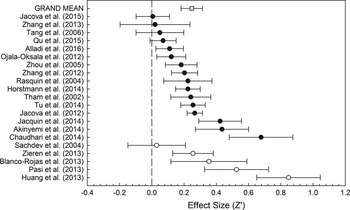
Studies were grouped according to the measure of cognitive functioning since not all measures were comparable. Of the 21 studies found, 5 examined cognitive decline (i.e., comparing patients to a reference group in a continuous manner: Blanco-Rojas et al., Reference * Blanco-Rojas, Arboix, Canovas, Grau-Olivares, Morera and Parra2013; Huang et al., Reference * Huang, Chang, Chang, Liu, Chang, Liu and Ho2013; Pasi, Salvadori, Poggesi, Inzitari, & Pantoni, Reference * Pasi, Salvadori, Poggesi, Inzitari and Pantoni2013; Sachdev et al., Reference * Sachdev, Brodaty, Valenzuela, Lorentz, Psychol and Koschera2004; Zieren et al., Reference * Zieren, Dueringa, Petersb, Reyesc, Jouventc, Hervéc and Dichgans2013), whereas 16 studies examined the prevalence of a clinical diagnosis (Alladi et al., Reference * Alladi, Bak, Mekala, Rajan, Chaudhuri, Mioshi and Kaul2016; Akinyemi et al., Reference * Akinyemi, Allan, Owolabi, Akinyemi, Ogbole, Ajani and Kalaria2014; Chaudhari et al., Reference * Chaudhari, Verma, Garg, Singh, Malhotra and Sharma2014; Horstmann, Rizos, Rauch, Arden, & Veltkamp, Reference * Horstmann, Rizos, Rauch, Arden and Veltkamp2014; Jacova et al., Reference * Jacova, Pearce, Costello, McClure, Holliday, Hart and Benavente2012; Jacova et al., Reference * Jacova, Pearce, Roldan, Arauz, Tapia, Costello and Benavente2015; Jacquin et al., Reference * Jacquin, Binquet, Rouaud, Graule-Petot, Daubail, Osseby and Béjot2014; Ojala-Oksala et al., Reference * Ojala-Oksala, Jonkinen, Kopsi, Lehtonen, Luukkonen, Paukkunen and . . Oksala2012; Qu et al., Reference * Qu, Zhuo, Li, Hu, Chen, Zhou and Zhan2015; Rasquin, Verhey, Van Oostenbrugge, Lousberg, & Lodder, Reference * Rasquin, Verhey, Van Oostenbrugge, Lousberg and Lodder2004; Tang et al., 2006; Tham et al., Reference * Tham, Auchus, Thong, Goh, Chang, Wong and Chen2002; Tu et al., Reference * Tu, Ding, Yang, Bai, Tu and Tang2013; Zhang et al., Reference * Zhang, Zhang, Yang, Li, Zhang, Qu and Zhang2012, Reference * Zhang, Chen, Whang, Yun, Zhang, Yin and Zhu2013; Zhou et al., Reference * Zhou, Wang, Li, Deng, Gao and Chen2004). Figure 2 shows the ESs for the individual studies, as well as the summary statistic.
Effect sizes (Fisher’s z’) and 95% confidence intervals for the individual studies and the overall effect size (gray square=grand mean of all studies taken together, closed circles=dichotomous diagnosis, open circles=cognitive decline).

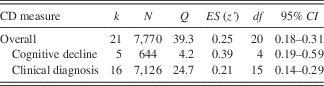
As shown in Table 2, the meta-analysis revealed an overall ES of 0.25, which is according to Cohen (1992) a small to moderate effect. The measure of heterogeneity (Q) was statistically significant (p=.006), indicating a substantial variation in study outcome. Subsequently, we performed categorical analyses on the studies investigating cognitive decline or those examining a clinical diagnosis separately. The categorical analysis for the studies examining cognitive decline as a continuous measure produced an ES of 0.39. The analysis of the studies with a dichotomous clinical diagnosis as an outcome measure revealed an ES of 0.21 (see Table 2). For the categorical analyses, the heterogeneity indices (Q) were not significant (p>.05), indicating that for these subsequent analyses, study outcomes were homogeneous.
Results of the meta-analysis for performance on cognitive tests compared to prevalence

Notes. CD=cognitive dysfunction, k=number of studies, N=number of patients, Q=heterogeneity statistic, ES=effect size, 95% CI=95% confidence interval.
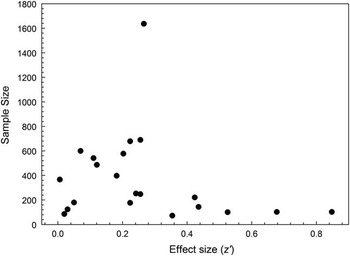
To test the possibility of a publication bias, we present the funnel plot in Figure 3, showing that no published studies report negative associations. The fail-safe N was estimated at 475.2 and is, therefore, larger than (5×21)+10=115, indicating that 476 unpublished studies must exist to achieve a non-significant result.
Funnel plot showing the relation between the effect sizes and sample sizes across studies.

Discussion
In this study, a meta-analysis was performed to quantify the effect of formal education on cognitive dysfunction in stroke patients using the existing literature. Our meta-analysis of 21 studies revealed an overall ES of 0.25, which can be considered as a small to moderate effect. Additional categorical analyses revealed that the level of education was related to both cognitive decline and the prevalence of a clinical diagnosis. Stroke patients with more years of formal education had less cognitive decline compared to stroke patients who received less years of formal education. In addition, stroke patients with more years of formal education had a lower risk of developing a clinical diagnosis (e.g., VCIND or VCI) compared to stroke patients with a lower level of education. The analyses revealed that the existing studies are somewhat heterogeneous, but that the results are unlikely to be biased by unpublished null-findings, while all published papers reported positive associations (ranging from 0.01 to 0.85).
This study extends the review by Nunnari et al. (Reference Nunnari, Bramanti and Marino2014) by giving an estimate of the magnitude of the effect of the level of formal education on cognitive dysfunction in stroke patients. The results of this meta-analysis are in agreement with earlier findings on educational history and cognitive outcome in patients with traumatic brain injury (r=.20; Mathias & Wheaton, Reference Mathias and Wheaton2015), Parkinson’s disease (z’ between 0.08 and 0.38; Hindle, Martyr, & Clare, Reference Hindle, Martyr and Clare2014), dementia (OR=2.61 & OR =1.88; Meng & D’Arcy, Reference Meng and D’Arcy2012), schizophrenia (Cohen’s d=.43; Khandaker, Barnett, White, & Jones, Reference Khandaker, Barnett, White and Jones2011), as well as results in normal aging (r=.30; Opdebeeck, Martyr, & Clare, Reference Opdebeeck, Martyr and Clare2016). Effect sizes found in these studies ranged from small to medium.
While these results are interesting, most of the studied cohorts typically included older adults who have experienced a stroke after the age of 65. As a result, aging-related pathology may exist in some patients. Moreover, cohort effects may be present in samples consisting of older adults, as educational attainment in older adults does not necessarily correspond with their actual educational potential or intellectual ability. Finally, the classification of cognitive impairment varied across studies. That is, some studies only used a cognitive screening test such as the Mini-Mental State Examination (MMSE; Folstein, Folstein, & McHugh, Reference Folstein, Folstein and McHugh1975) or the Montreal Cognitive Assessment (MoCA; Nasreddine et al., Reference Nasreddine, Phillips, Bédirian, Charbonneau, Whitehead, Collin and Chertkow2005) that may be insensitive to post-stroke cognitive deficits (Demeyere et al., Reference Demeyere, Riddoch, Slavkova, Jones, Reckless, Mathieson and Humphreys2016; Nys, Van Zandvoort, De Kort, Jansen, et al., Reference Nys, Van Zandvoort, De Kort, Jansen, Kappelle and De Haan2005). Furthermore, only a minimal correction is performed to adjust the MoCA or MMSE scores for education, which may result in an overestimation of the protective effects of educational attainment. Therefore, we examined the effects of formal education level empirically in a large cohort of patients who had had an ischemic stroke before the age of 50.
STUDY 2: THE FUTURE COHORT
Method
Participants
For this empirical study, data were used from the Follow-Up of Transient ischemic attack and stroke patients and Unelucidated Risk factor Evaluation (FUTURE) study, a study on risk factors and the prognosis of stroke in young patients (Rutten-Jacobs et al., Reference Rutten-Jacobs, Maaijwee, Arntz, Van Alebeek, Schaapsmeerders, Schoonderwaldt and De Leeuw2011). This large cohort study recruited a total of 1006 patients aged 18 to 50 years with transient ischemic attack (TIA), ischemic stroke with presumed arterial origin, or hemorrhage stroke that visited the department of neurology of the Radboud University Medical Center, Nijmegen, between January 1, 1980, and January 11, 2010, for medical services. The Medical Ethics Review Committee region Arnhem-Nijmegen approved the FUTURE study.
Since the 1970s, the department of neurology kept a prospective registry of all consecutive young stroke patients with a standardized collection of baseline, clinical characteristics, and neurological examination. The present study examined the results of the ischemic stroke patients, aged 18 to 50 at onset, referred to as “young stroke” (Rutten-Jacobs et al., Reference Rutten-Jacobs, Maaijwee, Arntz, Van Alebeek, Schaapsmeerders, Schoonderwaldt and De Leeuw2011; Varona, Bermejo, Guerra, & Molina, Reference Varona, Bermejo, Guerra and Molina2004). Only ischemic stroke patients were selected, since this was the largest subset within this sample and a previous study that examined the same sample reported cognitive impairments for different cognitive domains (Schaapsmeerders et al., Reference Schaapsmeerders, Maaijwee, Van Dijk, Rutten-Jacobs, Arntz, Schoonderwaldt and De Leeuw2013). Ischemic stroke was defined as a rapidly evolving focal neurological deficit with no other than a vascular cause lasting longer than 24 hr, diagnosed based on medical records and radiological findings. Note also that ischemic stroke patients with cerebral venous sinus thrombosis and retinal infarction were excluded from the FUTURE study altogether. Control participants were recruited among the patients’ spouses, relatives, or social environment. These participants were included if they were ≥18 years old and had no medical history of stroke or TIA. All participants signed an informed consent.
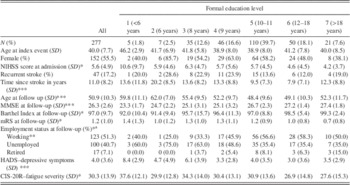
The sample used in this study consisted of 277 ischemic stroke patients and 146 controls. Mean age of patients was 40.0 (SD 7.7) at stroke onset, and 55.5% were women (Table 3). Mean age of the patients was 50.9 (SD 10.3) at the time of the cognitive assessment, which was on average 11.0 years (SD 8.2) after the index event. With respect to ethnicity, the large majority of the patients (94.9%) and control group (99.3%) were of Dutch origin. Detailed information on the demographic variables for the controls and patients is presented in Schaapsmeerders et al. (Reference Schaapsmeerders, Maaijwee, Van Dijk, Rutten-Jacobs, Arntz, Schoonderwaldt and De Leeuw2013). No differences were found between patients and controls with respect to ethnicity (χ2(3)=5.61), sex distribution (χ2(1)=.27), and marital status (χ2(5)=9.62). Small, yet significant differences were found between patients and controls with respect to the distribution of education level (U=16826.0; Z=−2.8; p<.005; controls were slightly higher educated), employment status at follow-up (χ2(2)=13.5; p=.001; a higher percentage of controls were working at the time of the assessment), and age (t(421)=2.08; p=.04; controls were on average 2.3 years younger).
Characteristics of included ischemic stroke patients (FUTURE cohort)

Notes. Data are reported as mean (SD) or number (%). 1=less than 6 years primary education; 2=completed primary education; 3=more than 6 years of primary education, without a secondary school diploma; 4=lower vocational training; 5=advanced vocational training or lower professional education; 6=advanced professional training or upper secondary school; 7=academic degree; N=number of patients; NIHSS=National Institutes of Health Stroke Scale; MMSE=Minimal Mental State Examination; mRS=modified Rankin Scale; HADS=Hospital Anxiety and Depression Scale; CIS-20R=Subjective Fatigue of the revised Checklist Individual Strength.
a The proportion of patients with ischemic stroke with baseline employment (N=240) and who were working, unemployed, or retired at follow-up.
Statistical significance: *p<.05; **p<.01; ***p<.001.
Neuropsychological test battery
Neuropsychological assessment consisted of cognitive tests that have been used in previous epidemiological studies on cerebrovascular disease and aging (de Groot et al., Reference De Groot, de Leeuw, Oudkerk, van Gijn, Hofman, Jolles and Breteler2000; Moller et al., Reference Moller, Cluitmans, Rasmussen, Houx, Rasmussen, Canet and Gravenstein1998), covering the cognitive domains processing speed, visuoconstruction, working memory, episodic memory, attention, and executive function. Trained researchers administered all neuropsychological tests using strict protocols under standardized circumstances. Working memory was assessed using the Paper and Pencil Memory Scanning Test (Sternberg, Reference Sternberg1969), immediate episodic memory was measured using the immediate-recall performance on the Rey-Osterrieth Complex Figure Test (Osterrieth, Reference Osterrieth1944) and the total number of words immediately recalled in the three-trial version of the Rey Auditory Verbal Learning Test (RAVLT; Van der Elst, Van Boxtel, Van Breukelen, & Jolles, Reference Van der Elst, Van Boxtel, Van Breukelen and Jolles2005), delayed episodic memory was assessed using the delayed-recall performance on the Rey-Osterrieth Complex Figure Test and the RAVLT, processing speed was measured using the written administration of the Symbol-Digit Substitution Task (which is a modified version of the Symbol Digit Modalities Test; Lezak et al., 2012) and the Abbreviated Stroop Color Word Test, parts I and II (Houx, Jolles, & Vreeling, Reference Houx, Jolles and Vreeling1993).
Attention was assessed using the Verbal Series Attention Test (VSAT; Mahurin & Cooke, Reference Mahurin and Cooke1996), and executive function with the Verbal Fluency test (1-min animal naming; Van der Elst, Van Boxtel, Van Breukelen, & Jolles, Reference Van der Elst, Van Boxtel, Van Breukelen and Jolles2006) and the Stroop Interference score (dividing the Stroop part III score by the mean of the scores of parts I and II; Houx et al., Reference Houx, Jolles and Vreeling1993). The copy trial of the Rey-Osterrieth Complex Figure Test was used to assess visuoconstruction. More details on the cognitive assessment and study protocol can be found elsewhere (Rutten-Jacobs et al., Reference Rutten-Jacobs, Maaijwee, Arntz, Van Alebeek, Schaapsmeerders, Schoonderwaldt and De Leeuw2011; Schaapsmeerders et al., Reference Schaapsmeerders, Maaijwee, Van Dijk, Rutten-Jacobs, Arntz, Schoonderwaldt and De Leeuw2013).
Education level
We used the level of formal education as measured using a Dutch scoring system developed by Verhage (Reference Verhage1964) and updated by Duits and Kessels (Reference Duits and Kessels2014). This ordinal scale consists of seven categories indicating different levels of formal education within the Dutch educational system. These levels include less than 6 years primary education (1), completed primary education (2), more than 6 years of primary education, without a secondary school diploma (3), lower vocational training (4), advanced vocational training or lower professional education (5), advanced professional training or upper secondary school (6), and academic degree (7). These ordinal scores have been converted into their estimated equivalent of years of education used in the Anglo-Saxon world for descriptive purposes only, based on the table provided in Hochstenbach, Mulder, Van Limbeek, Donders, and Schoonderwaldt (Reference Hochstenbach, Mulder, Van Limbeek, Donders and Schoonderwaldt1998). Note that this is only an estimate of the Anglo-Saxon equivalent, as years of education level are not informative in the Dutch educational system (i.e., the number of years has little relation with the eventual level people accomplish).
Other measurements
Additional measures were collected for descriptive purposes in this study (see Table 3). The Hospital Anxiety and Depression Scale (HADS) was used to assess depressive symptoms and the subscale Subjective Fatigue of the revised Checklist Individual Strength (CIS-20R) was used to assess fatigue (Vercoulen et al., Reference Vercoulen, Swanink, Fennis, Galama, van der Meer and Bleijenberg1994; Zigmond & Snaith, Reference Zigmond and Snaith1983). To determine stroke severity retrospectively, the National Institutes of Health Stroke Scale (NIHSS) was used (Brott et al., Reference Brott, Adams, Olinger, Marler, Barsan, Biller and Walker1989). The Barthel Index and the modified Rankin Scale (mRS) were used to measure impairments and dependence in daily performance at follow-up (Mahoney & Barthel, Reference Mahoney and Barthel1965; Van Swieten, Koudstaal, Visser, Schouten, & Van Gijn, Reference Van Swieten, Koudstaal, Visser, Schouten and van Gijn1988). The MMSE was administered as an index of overall cognitive performance.
Statistical analyses
Composite scores were calculated (accuracy (%)/reaction time) for the scores on the Stroop test, Paper and Pencil Memory Scanning Test, and VSAT, to adjust for the speed-accuracy trade-off. The copy trial score on the Rey Complex Figure test showed a negatively skewed distribution and, therefore, was transformed into a normally distributed variable (e5).
For each cognitive test, the raw mean scores were converted into Z scores, using the mean and SD of the stroke-free controls. The average Z score of the tests assigned to the same cognitive domain was used in all analyses as the domain score. In case of missing test scores, the domain score was based on the remaining tests of that domain (occurring in less than 5.1% of the tests).
Subsequently, the domain scores were adjusted for age and formal education before investigating the effect of formal education on VCI. To adjust for the typical effects of age and formal education on cognitive performance as such, multiple regression analyses were performed within the healthy control group with the domain scores as dependent variables, and age and level of formal education entered as predictors. The intercepts and unstandardized B coefficients were used to calculate expected scores (ExSs).
Thereafter, residual scores (RS) were then calculated for the patient group by subtracting each patient’s ExS from the patient’s observed score (OS): RS=OS–ExS. These residual domain scores reflect the individual patient’s extent of decline or impairment (compared to an age- and education-adjusted reference group). The residual domain scores were then used to investigate the effect of formal education, on cognitive performance only within the stroke patients.
First, domain scores of individual patients were classified as “unimpaired,” “below-average,” or “impaired.” To be classified as “impaired,” performance had to be more than 1.5 SD below the age- and education-adjusted control mean (using the residual domain scores). To be classified as “below-average,” the performance had to be between 1.5 and 1 SD below the age- and education-adjusted control mean. A performance of less than 1 SD below this control mean was classified as “unimpaired” (cf. Bondi et al., Reference Bondi, Edmonds, Jak, Clark, Delano-Wood, McDonald and Salmon2014). Using Chi-square tests, differences in the frequencies of these classifications were examined for the different educational levels, grouping low (1,2), average (3,4), and high (5,6,7) education levels for the purpose of data reduction. Post hoc tests based on adjusted standardized residuals with Bonferroni corrected p-values were applied when significant group effects were found (Beasley & Schumacker, Reference Beasley and Schumacker1995).
Next, for each domain, multiple regression analyses were performed with residual scores as dependent variables and education as predictor. Age was defined as an a-priori factor mediating cognitive dysfunction, for which a second model was tested with education level and age as predictors, followed by a mediation analysis using the bootstrapping method with bias-corrected confidence estimates. This was done to determine the exact role of age as a potentially mediating factor between education level and VCI. The 95% confidence interval of the indirect effects was obtained with 5000 bootstrap resamples (MacKinnon, Lockwood, & Williams, Reference MacKinnon, Lockwood and Williams2004; Preacher & Hayes, Reference Preacher and Hayes2004).
Finally, to take other potentially confounding variables into account which may alter the association between education level and VCI, we computed correlations between education and demographic, as well as stroke and health-related variables (e.g., stroke severity, follow-up duration, mood/anxiety, and fatigue). These background variables were considered as variables of no interest that were entered in a hierarchical regression analysis model with age and education level as predictors of VCI. All statistical analyses were performed with IBM SPSS Statistics for Windows version 21.0 (IBM Corp., Armonk, NY).
Results
Prevalence of below-average and impaired performance across education levels
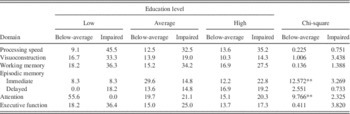
Table 4 shows the prevalence of below-average and impaired performances on the different cognitive domains. The frequency of below-average performance in immediate memory differed significantly as a function of formal education level (χ²(2)=12.57; p<.05), with 8.3% of the patients with the lowest levels of formal education performing below average, 29.6% of the patients with average levels of formal education performing below average, and 12.2% of the patients with the highest levels of formal education performing below average. Post hoc analyses revealed that the observed frequency of below-average performance in immediate memory deviated significantly from the expected frequency in the average and highest levels of formal education.
Frequency (%) of below-average and impaired performances across low, average, and high education levels

Note. Low=Verhage categories 1,2; average=Verhage categories 3,4; high=Verhage categories 5,6,7. Chi-square measures performance differences over the three groups of education.
** p<0.01.
Average levels of formal education were associated with a higher frequency of below-average performances in immediate memory compared to the lowest and highest educational levels. In addition, the frequency of below-average performances in the attention domain differed significantly as a function of formal education (χ²(2)=9.77; p<.05), with 55.6% of the patients with the lowest levels of formal education performing below average, 19.7% of the patients with average levels of formal education performing below average, and 15.1% of the patients with the highest levels of formal education performing below average. Post hoc testing revealed that the observed frequency of below-average performances in the attention domain deviated significantly from the expected frequency for the lowest levels of formal education. Higher levels of formal education were associated with lower frequencies of below-average performance in attention. No differences were found in the frequency of below-average performance between formal education levels within the other domains. The prevalence of impaired performances did not differ between the different formal education level groups in any of the domains.
Cognitive performance associated with formal education level
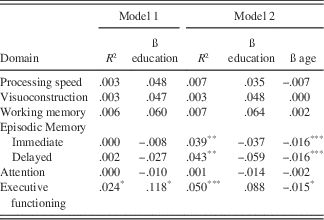
Multiple regression analyses with residual domain scores as dependent variable and the two models (formal education level; formal education level and age) as predictor were performed (Table 5). The first model only showed a significant fit for executive functioning (F(1,268)=6.58; p<.05; R 2 =.024). Higher levels of formal education predicted better cognitive performance in this domain after stroke (ß=.12; p<.05). The second model also showed a significant fit for executive functioning (F(2,267)=6.24; p<.05; R 2 =.050), with age adding significantly to the prediction, showing an association between age and cognitive functioning after stroke in this domain (ß=−.02; p<.05).
Multiple regression analyses of the association between educational history and residual scores

Note. Model 1=formal education level; Model 2=formal education level & age.
Statistical significance: *p<.05; **p<.01; ***p<.001.
However, formal education level did not predict cognitive performance in the executive function domain after adding age as predictor in the second model, which suggests a mediating role of age in the stroke patients (ß=.09; p=.062). Since age and formal education level were significantly correlated (r=−.23; p<.05) and were both associated with performance in executive functioning, a mediation analysis was performed to examine the mediating role of age in the relation between level of formal education and executive functioning. Results of the mediation analysis confirmed the mediating role of age in the relation between formal education level and executive functioning after stroke (ß=.03, 95%CI=.01 to .06). This revealed that stroke patients with higher levels of formal education tend to perform better on executive functioning, which can be explained by their younger age.
In addition, the second model showed a significant fit for immediate (F(2,270)=5.45; p<.05; R²=.039) and delayed episodic memory (F(2,266)=3.71; p≤.05; R²= .043). Only age added significantly to the prediction of immediate (ß=−.02; p<.05) and delayed episodic memory performance (ß=−.02; p=< .05). A higher age at assessment was associated with a lower cognitive performance in executive functioning, immediate memory, and delayed memory after stroke.
To make sure that this effect was not due to other variables potentially affecting cognitive performance, we also performed hierarchical regression analyses taking potential confounding factors into account. Correlational analyses showed that higher levels of formal education were associated with younger age at assessment (r=−.23; p<.05), a shorter follow-up duration (r=-.22; p<.05), less severe stroke (r=−.14; p≤.05), less depressive symptoms at follow-up (r=−.23; p<.05), less fatigue symptoms at follow-up (r=−.14; p<.05), a higher MMSE (r=.36; p<.05), better performance in activities of daily living (r=.15; p<.05), less dependence in daily activities (r=−.13; p<.05), and employment status (r=.14; p<.05). Educational history was not associated with age at event (r=−.07; p=.29), sex (r=−.10; p=.11), and recurrence of stroke (r=.09; p=.14). In the hierarchical regression analysis, stroke severity, depressive symptoms, fatigue, time since stroke were entered as variables of no interest (Block 1) and education and age as predictors (Block 2). These analyses did not alter our findings (R 2 change 0.003–0.020; F-values 0.49–2.91).
Discussion
In Study 2, the effect of formal educational level on long-term VCI was examined in 277 patients who suffered from ischemic stroke at a young age (i.e., before the age of 50). Patients were assessed on seven cognitive domains 1 to 31 years after stroke onset. Results showed that the prevalence of below-average performances in immediate episodic memory and attention differed between the different education levels. Unexpectedly, the frequency of below-average performances in immediate memory was actually lowest in patients with the lowest educational levels, highest in patients with average educational levels and average in patients with the highest educational levels. The frequency of below-average performances in the domain of attention was, in turn, more in line with our expectations. That is, the prevalence of below-average performances was lowest in the patients with the highest levels of formal education and highest in the patients with the lowest levels of formal education. The prevalence of impaired performances was not associated with formal education level.
Regression analyses showed that, of all the investigated domains, the level of formal education was only associated with cognitive decline in the executive function domain. Individuals with higher levels of formal education showed less decline in executive function compared to individuals with lower educational attainment. Age played a mediating role in the relation between the formal level of education and executive dysfunction after stroke. That is, age explained the effect of formal education on performance in executive function, with older stroke patients performing worse in executive function and having lower levels of formal education. Independent of formal education level, age at time of assessment predicted the extent of cognitive decline in executive functioning, immediate memory and delayed memory after stroke, with older patients showing larger deficits than younger patients.
GENERAL DISCUSSION
In these studies, we examined the effect of educational history on post-stroke cognitive function. First, we performed a quantitative meta-analysis on the existing literature. Second, we examined the effect of education level on cognitive performance in individuals with a history of stroke before the age of 50 (the FUTURE Study cohort).
The results of the meta-analysis showed that more years of formal education had a small to moderate association with less cognitive dysfunction in stroke patients in previously published studies. These findings extend a recent narrative review by Nunnari et al. (Reference Nunnari, Bramanti and Marino2014) on cognitive reserve in stroke patients, arguing that educational attainment was associated with better cognitive outcome after stroke. It is also complementary to a recent review focusing on proxies of cognitive reserve and cognitive dysfunction in small-vessel disease (Pinter, Enzinger, & Fazekas, Reference Pinter, Enzinger and Fazekas2015) that also highlights a role for educational attainment.
With respect to the empirical data from the FUTURE study, examination of the frequencies of below-average and impaired performances compared to an age- and education-adjusted control mean resulted in more below-average performances in the domain attention in the stroke patients with low education levels. However, for immediate episodic memory performance, the prevalence of below-average and impaired performances was lower in the low-education group compared to patients with an average or high education. Possibly, the attention domain is more susceptible to cerebrovascular pathology and more characteristic for the cognitive profile of VCI patients than the memory domain (Desmond, Reference Desmond2004).
However, subsequent regression analyses showed that education effects on VCI were mediated by age. This may reflect a cohort effect, in that older patients had on average lower education levels, even in our relatively young stroke sample. Combining age and education in one statistical model only resulted in a significant age effect.
Several findings of our empirical study are in contrast to the results of previous studies. Earlier studies clearly demonstrated an effect of educational history on cognitive impairment in stroke patients independent of age (Horstmann et al., Reference * Horstmann, Rizos, Rauch, Arden and Veltkamp2014; Ojala-Oksala, 2012; Zhang et al., Reference * Zhang, Chen, Whang, Yun, Zhang, Yin and Zhu2013). A mediating role of age, due to a cohort effect, as found in the present empirical study, has not been reported in previous research. Moreover, previous evidence showed that patients with high levels of formal education show less cognitive impairment in almost all cognitive domains (Huang et al., Reference * Huang, Chang, Chang, Liu, Chang, Liu and Ho2013; Ojala-Oksala et al., Reference * Ojala-Oksala, Jonkinen, Kopsi, Lehtonen, Luukkonen, Paukkunen and . . Oksala2012). Several methodological differences between earlier studies and our empirical study might explain these differences in findings.
First, some previous studies have used the MMSE or MoCA as a measure of cognitive impairment. On the MoCA, performance is adjusted for educational history by adding one additional point to individuals with lower levels of formal education. This correction is likely to be insufficient, since several studies have indicated that MoCA scores vary from 2.6 to 5.0 points across formal education groups (Ng et al., Reference Ng, Feng, Lim, Chong, Lee, Yap and Yap2015; Zhou et al., Reference Zhou, Zhu, Zhang, Wang, Li, Lv and Wang2014). Also, for the MMSE, the adjustment for educational attainment is limited (e.g., a lower cutoff score for illiterate individuals and those with less than 6 years of formal education; Zhou et al., 2005). Results from previous studies that have used cognitive screening instruments like the MoCA or MMSE may, therefore, actually reflect the effect of educational history on cognitive performance in itself, rather than the effect of educational attainment on cognitive deficits.
Second, most studies to date have included older individuals, which resulted in samples with an overrepresentation of patients with lower levels of formal education (e.g., Blanco-Rojas et al., Reference * Blanco-Rojas, Arboix, Canovas, Grau-Olivares, Morera and Parra2013; Huang et al., Reference * Huang, Chang, Chang, Liu, Chang, Liu and Ho2013). The patients included in previous studies had approximately 8 years of formal education, whereas in our empirical study individuals had on average 10–11 years of formal education. Moreover, the present empirical study included only a small number of patients (N=11) with up to 6 years of elementary school, indicating a low frequency of individuals with a (very) low level of formal education.
Previous studies showed that overall cognitive performance was worse in individuals with low levels of formal education compared to higher education levels, whereas no differences were found between individuals with average and high levels of formal education (Van Hooren et al., Reference Van Hooren, Valentijn, Bosma, Ponds, Boxtel and Jolles2007). Possibly, the effect of formal education level on cognitive impairment may also be small when patients with average and high levels of formal education are compared directly.
Finally, the frequency of cognitive impairments after an ischemic stroke before the age of 50 is lower compared to older patients (Knoflach et al., 2012; Schaapsmeerders et al., Reference Schaapsmeerders, Maaijwee, Van Dijk, Rutten-Jacobs, Arntz, Schoonderwaldt and De Leeuw2013). Since cognitive impairments are less prominent, the effects of formal education might be smaller in young adults compared to older patients groups who have more cognitive deficits. This might be in line with the study of Zieren et al. (Reference * Zieren, Dueringa, Petersb, Reyesc, Jouventc, Hervéc and Dichgans2013), which showed that the effect of educational history was limited to the domain of processing speed. This domain was affected most in their patients with Cerebral Autosomal Dominant Arteriopathy with Sub-cortical Infarcts and Leukoencephalopathy (CADASIL), while other cognitive domains were less frequently impaired (and in which no effects of education were reported).
However, further analysis showed that the effect of educational history on deficits in processing speed was only present in patients with small to moderate levels of brain damage. This suggests that a longer educational history is not sufficient to compensate for severe brain damage (Zieren et al., Reference * Zieren, Dueringa, Petersb, Reyesc, Jouventc, Hervéc and Dichgans2013). Also, it should be stressed that we previously demonstrated cognitive deficits in many of the FUTURE cohort patients, that is, up to 50% of the young-stroke patients had a below-average performance compared to controls and up to 34.5% had an impaired performance (Schaapsmeerders et al., Reference Schaapsmeerders, Maaijwee, Van Dijk, Rutten-Jacobs, Arntz, Schoonderwaldt and De Leeuw2013).
With respect to the concept of cognitive reserve, the validity of educational attainment as a proxy of cognitive reserve can be questioned, as it can be linked to neuropsychological test performance via alternative pathways, other than cognitive reserve itself (Goldin, Reference Goldin1998; Jones et al., Reference Jones, Manly, Glymour, Rentz, Jefferson and Stern2012; Park & Reuter-Lorenz, Reference Park and Reuter-Lorenz2009). In addition, factors such as sex, ethnicity, or socioeconomic status may affect access to and quality of education, reducing the validity of educational history as a proxy of cognitive reserve (Jones et al., Reference Jones, Manly, Glymour, Rentz, Jefferson and Stern2012). To assess cognitive reserve more accurately, other measures of cognitive reserve have been proposed (Jones et al., 2011). Multiple-indicator methods incorporating several measures of premorbid functioning across an individual’s full lifespan (e.g., hobbies, life-style factors, vocational courses, premorbid cognitive estimates) are likely to be more reliable and valid than potentially biased single measures (Pinter et al., Reference Pinter, Enzinger and Fazekas2015).
Recently developed questionnaires (León, García-García, & Roldán-Tapia, Reference León, García-García and Roldán-Tapia2014; Nucci et al., 2012) are promising, but have not been used in stroke patients to date. Despite its limitations, it should be noted that educational attainment has been used in previous research on cognitive reserve, demonstrating significant effects (e.g., Martins Da Silva et al., Reference Martins Da Silva, Cavaco, Moreira, Bettencourt, Santos, Pinto and Montalban2015; McLaren, Szymkowicz, Kirton & Dotson, Reference McLaren, Szymkowicz, Kirton and Dotson2015; Mirza et al., Reference Mirza, Portegies, Wolters, Hofman, Koudstaal, Tiemeier and Ikram2016; Zahodne et al., Reference Zahodne, Glymour, Sparks, Bontempo, Dixon, MacDonald and Manly2011; Zieren et al., Reference * Zieren, Dueringa, Petersb, Reyesc, Jouventc, Hervéc and Dichgans2013).
Consequences of our results for clinical practice include the relevance of potential age-cohort effects on predicting poor cognitive outcome after ischemic stroke. While our empirical study suggests that formal education level was not associated with severe cognitive impairments in stroke patients, formal education level was related to below-average performance in the domain of attention, which might make this group of patients at risk for further cognitive decline. Future longitudinal research is required to investigate whether patients with lower levels of education might be at higher risk for further cognitive decline over time, given the below-average performance in their 50s. Furthermore, the use of multiple-indicator methods to measure cognitive reserve should be examined. Research should focus on the validity and accuracy of such methods in VCI patients and their capacity to avoid biases accompanied by single measures.
CONCLUSION
To conclude, the present empirical study gives partial evidence for a role of formal education level on long-term VCI in young-stroke patients. The presence of below-average performance in attention was highest in the patients with low levels of formal education, but it remains unclear whether these patients are at risk for further cognitive decline. Age-cohort effects have been found to mediate the relation between formal education level and cognitive performance, which stresses the importance to use multiple-indicator methods to measure cognitive reserve in future research.
ACKNOWLEDGMENTS
W.S.E. was funded by an Erasmus Program Scholarship (Grant 481011/6912869); F.E.d.L. received funding from the Dutch Epilepsy Fund (Grant 10–18). This study was presented at the 44th Annual Meeting of the International Neuropsychological Society in Boston, MA, February 4, 2016, by R.P.C.K. None of the authors have any conflicts of interest to report. Drs. Kessels and Eikelboom contributed equally to this work.