The acquisition of a language's vocabulary entails a myriad of factors, including behavioural, cognitive, demographic and linguistic factors (Stokes, Reference Stokes2006). Many studies have focused on cognitive and linguistic factors, such as examining the types of minimal pair contrasts that young children are able to map onto new words (see recent overviews in Werker & Curtin (Reference Werker and Curtin2005) and Werker & Yeung (Reference Werker and Yeung2005) ). While it is informative to determine the types of new words children are able to acquire, it is also informative to look at the structure of children's existing vocabularies because this can provide insights into the information language-learners extract from the input as they build their lexicons. It has been argued that infants' sensitivities in speech perception are incorporated into language-learners' developing lexical representations, following continuity across development. This predicts that patterns seen in infant speech perception will be mirrored in young children's early lexicons. A recent theory of developmental speech perception that outlines this is PRIMIR (Processing Rich Information from Multidimensional Interaction Representations; Werker & Curtin, Reference Werker and Curtin2005). In PRIMIR, representations are multidimensional, interactive and the result of statistical learning. The first dimension to develop is the General Perceptual Plane, which organizes and represents the sound structure acquired before learners develop a lexicon, such as language-specific phonetic categories. Importantly, representations from the General Perceptual Plane aid the subsequent level of the Word Form Plane, which organizes and represents extracted word forms. Lexical neighbourhoods emerge as words with similar phonetic features cluster in multidimensional space. In turn, phonemes emerge from generalizations made across dense, meaningful words, and are represented in the Phonemic Plane.
The PRIMIR model makes a number of predictions about the nature of learners' early lexicons. Research shows that infants' speech perception abilities vary depending on a segment's position within the word. Infants are more sensitive to patterns and contrasts in word-onset position than in word-offset position. For example, Jusczyk, Goodman & Bauman (Reference Jusczyk, Goodman and Bauman1999) found that nine-month-old infants were sensitive to similarities in word-onset position, but not in word-offset position. Zamuner (Reference Zamuner2006) found that ten-month-old infants are not able to discriminate word-final contrasts, but are able to discriminate the same contrasts when presented in word-initial position. Similarly, findings from Swingley (Reference Swingley2005) indicate that eleven-month-old infants have more detailed encodings of word onsets than word offsets. Because representations in PRIMIR are exemplar based and allow for context sensitivity, segments in word-onset and word-offset position can cluster independently (Werker & Curtin, Reference Werker and Curtin2005: 28). Thus, although not explicitly stated, the General Perceptual Plane can capture positional sensitivities seen in infant speech perception. As stated above, representations at the General Perceptual Plane aid the development of word form representations, and consequently the development of lexical neighbourhoods. Accordingly, we predict that children's early lexicons will mirror the positional sensitivities seen in speech perception, such that phonological neighbourhoods (henceforth neighbourhoods) will be denser for word onsets than for word offsets. Similarly, infant speech perception research has found differences in the developmental trajectory for vowels versus consonants. Infants become attuned to their language-specific vowel categories at around 0 ; 6 (Kuhl, Williams, Lacerda, Stevens & Lindblom, Reference Kuhl, Williams, Lacerda, Stevens and Lindblom1992) and to language-specific consonant inventories by 0 ; 10 (Werker & Tees, Reference Werker and Tees1984). Thus, we also predict that in children's early lexicons, neighbourhood densities will be greater for vowels than for consonants. These two predictions form the central goals of this study: to examine neighbourhood densities in children's early lexicons for word onsets and word offsets, and for consonants and vowels.
The predictions above assume that representations in the General Perceptual Plane and Word Form Plane can aid and influence the types of words that children acquire. This is similar to other claims and findings in the literature, where it has been argued that children's existing phonological and lexical knowledge can influence lexical acquisition. A recent large-scale study by Stokes (Reference Stokes2006) targeted both psycholinguistic factors (processing components of word learning and phonological working memory as measured by fast-mapping and non-word repetition task) and linguistic factors (neighbourhood densities) in the vocabulary development of over 200 children between 2 ; 0 and 2 ; 5. She found that the greatest predictor for vocabulary scores was neighbourhood density. Taking a step back from the stage at which children have already acquired a substantial lexicon, the rationale is that if language learners have richer representations and/or a more cohesive organization for phonetic information in certain word positions or for certain segments, then the language learner is more likely to acquire word forms that are distinguished by these phonemes or features. In turn, analyses of neighbourhood densities should provide a window into the information language learners are extracting from the input as they build their lexicons. Dense neighbourhoods can provide facilitatory effects in spoken word production due to increased activation of similar sounding words, and dense neighbourhoods can also result in inhibitory effects in lexical decision tasks due to the increased lexical competition within similar sounding words. Therefore, neighbourhood densities can provide both facilitatory and inhibitory effects in adult studies of language processing (Vitevitch & Luce, Reference Vitevitch and Luce1999). Work on lexical acquisition has shown that the composition of children's existing lexicons can influence the types of words that children acquire. In an analysis of typical words in children's vocabularies between 0 ; 8 and 2 ; 6 as measured by the lexical norms from the MacArthur-Bates Communicative Development Inventory (Dale & Fenson, Reference Dale and Fenson1996), Storkel (Reference Storkel2004a) found that early acquired words have more dense neighbourhoods than later acquired words (also see Coady & Aslin, Reference Coady and Aslin2003). Similar results by Hollich, Jusczyk & Luce (Reference Hollich, Jusczyk, Luce, Skarabela, Fish and Do2002) found that seventeen-month-old infants only learned a non-word when it was briefly presented within a high-density neighbourhood but not when it was briefly presented within a low-density neighbourhood. When the amount of exposure during training was increased, the opposite effect was found. Infants only learned the non-word when it was presented within a low-density neighbourhood. Swingley & Aslin (Reference Swingley and Aslin2007) compared children's acquisition of two types of non-words at age 1 ; 6. The first type of non-words sounded similar to existing words in the vocabulary (novel neighbours such as tog compared to dog). These were compared to non-words that did not sound similar to any existing words (novel non-neighbours such as meb). Although children learned the novel non-neighbours (meb), they showed difficulty in recognizing the novel neighbours (tog).
As Hollich et al. (Reference Hollich, Jusczyk, Luce, Skarabela, Fish and Do2002) note, it is an open question as to how the properties of neighbourhoods might affect word learning. One possibility they raise is that there may be a greater effect of neighbourhood density with words that share similar word onsets. This possibility is tested in the present study. Taking our starting point from infant speech perception, we examine children's early lexicons for differences in neighbourhood densities for word onsets, vowels and word offsets. A facilitatory effect predicts that neighbourhood densities in children's lexicons would be greater for word onsets, in part from children's increased familiarity with the phonological patterns of the ambient language in word onsets before the learner has even acquired a lexicon (PRIMIR's General Perceptual Plane). Similarly, greater familiarity with vowels over consonants would predict that neighbourhood densities in children's lexicons would be greater for vowels, leading to an inverted distribution. At the same time, emerging neighbourhood densities could lead to inhibitory effects due to increased lexical competition, and this may result in a flat distribution of neighbourhood densities for different positions.
Recall that the rationale is that language learners are more likely to acquire words that contrast in word-initial position due to a richer representation and/or a more cohesive organization for phonetic information for word onsets, and the same argument goes for words that are distinguished by vowels. Thus, neighbourhood density is related to the level of detail in representations. Early language knowledge developing in infancy enables learners to detect specific details of word forms, and in turn this can aid the acquisition of words that are distinguished by this detail. This is slightly different from previous arguments made in the literature, where the logic is that words that share a similar acoustic structure serve to focus the learner's attention on the phonetic characteristics that distinguish the words (e.g. Metsala & Walley, Reference Metsala, Walley, Metsala and Ehri1998; Storkel, Reference Storkel2002). For example, the words bat and pat are distinguished by the voicing on the initial consonant. To distinguish the characteristics of these segments, this can lead to more detailed lexical representations that include, for example, the voicing detail needed to distinguish the two words. If a child's lexicon has a larger number of similar sounding words, more detail is needed to distinguish these words than if the lexicon has maximally dissimilar words.
There is a large body of literature that has examined neighbourhood densities in children's lexicons in an attempt to evaluate the level of detail in children's early lexical representation. One claim is that children's early lexicons have holistic representations because children's neighbourhoods are less dense than in the adult lexicon (Charles-Luce & Luce, Reference Charles-Luce and Luce1995; cf. Coady & Aslin, Reference Coady and Aslin2003). A model that captures these differences is the Lexical Restructuring Model (LRM) of phonological development. This model proposes that lexical representations are initially holistic and become more detailed as the child's vocabulary grows. Lexical representations undergo segmental restructuring to accommodate the sound similarities or segmental overlaps between words (Metsala & Walley, Reference Metsala, Walley, Metsala and Ehri1998). The LRM theory is different from the PRIMIR model, which predicts that phonetic detail is incorporated into early lexical representations, although the PRIMIR model also allows for the restructuring of representations. Under the LRM theory, neighbourhoods in children's early lexicons are qualitatively different from the adult language. There is some evidence for this claim. A study by Storkel (Reference Storkel2002) looked at children's classification of neighbouring words to investigate the structure of children's lexicons. She found that words in dense neighbourhoods were organized by phoneme similarity, but words in sparse neighbourhoods were organized by both phoneme and manner similarity. She argues that as language develops, lexical representations are eventually represented by phoneme similarity in both dense and sparse neighbourhoods. Storkel's claims of the adult end state are based on previous analyses of neighbourhoods, although she does suggest that future studies should investigate whether sparse neighbourhoods in adulthood also have less detailed representations. The issue about the level of detail in children's early lexical representations is still under debate and partly divided by the fields of infant speech perception and child language production. While many researchers argue that children's early lexical representations encode detail (Swingley & Aslin, Reference Swingley and Aslin2002; Werker & Curtin, Reference Werker and Curtin2005), others argue that children's first lexical representations are underspecified and encoded by abstract phonological features (Fikkert, Reference Fikkert and de Lacy2007). The issue is even more difficult to disentangle because the same results from analyses on phonological neighbourhoods in children's early vocabularies have been argued to support both holistic and detailed representations. While some claim that children's early lexicons have few neighbours (Charles-Luce & Luce, Reference Charles-Luce and Luce1995), others, such as Coady & Aslin (Reference Coady and Aslin2003), argue that even though children's lexicons are less dense than adult lexicons, children still need considerable detail to distinguish the neighbours that are found in their early lexicons.
One limitation on previous studies on children's early lexicons is that they consider ‘the overall number of phonological neighbours […] but not the nature of these neighbours’ (De Cara & Goswami, Reference Goswami2002: 417). To assess the nature of neighbours, De Cara & Goswami modified the traditional definition of neighbourhoods, which includes all words created by adding, deleting or substituting phonemes (Luce & Pisoni, Reference Luce and Pisoni1998). They separated neighbours that were distinguished by the rhyme (words distinguished in onset position as in hat/cat), consonant neighbours (words distinguished on the vowel as in hat/hit) and lead neighbours (words distinguished in offset position as in hat/ham). In their analysis of neighbourhoods in English, they found that densities were greatest for rhyme neighbours as compared to consonant and lead neighbours.Footnote 1 To investigate whether the same pattern was found in children's lexicons, they used a measure of age-of-acquisition (AoA) norms. Based on these norms, they created separate lexicons for the subset of English words acquired by children from three to seven years of age. The neighbourhoods for these smaller lexicons were also denser for word onsets.
The focus of De Cara & Goswami's (Reference De Cara and Goswami2002) research was on rhymes; accordingly, they present no analyses focusing on lead neighbours (words that contrast in offset position) or comparing neighbours for vowels versus consonants (rhyme and lead neighbours vs. consonant neighbours). Following De Cara & Goswami, we also examine young children's lexicons to determine how words are distinguished from each other; however, children's lexicons are further examined to determine whether certain positions (word onsets vs. word offsets) and certain segment types (vowels vs. consonants) have denser neighbourhoods. The hypothesis is that early speech perception is linked to the structure and/or organization of lexical representations. The prediction is that the advantages seen in early speech perception for word onsets and vowels will be reflected in children's neighbourhood densities. Specifically, they will be denser for rhyme and/or consonant neighbours. Because De Cara & Goswami found consistency in the neighbourhood densities in child language and adult language, another possibility is that neighbours in children's early lexicons mirror the patterns in the adult language or target language. To test this, we also compare the neighbourhoods in children's early vocabularies to the target language. We predict that children's early vocabularies should minimally be the same as the distributions found in the target language.
One remaining question is when (if at all) the shift from holistic to detailed representations occurs. Various time points have been suggested, starting as early as when the child has between 50 to 100 words in their vocabulary and as late as eight years (see the recent review in Vogel Sosa & Stoel-Gammon, Reference Vogel Sosa and Stoel-Gammon2006: 33). A recent proposal, based on the stability of children's production accuracy, is that the shift occurs somewhere between 150 and 200 words (Vogel Sosa & Stoel-Gammon, Reference Vogel Sosa and Stoel-Gammon2006). Children in Storkel's (2002) study and AoA norms from De Cara & Goswami (Reference Goswami2002) analyses were between the ages of three and seven years. Therefore, if the shift does occur at a very young age, as argued by Vogel Sosa & Stoel-Gammon, a limitation of the De Cara & Goswami study is that the results are based on lexicons that are larger than 150 to 200 words. Positional effects in speech perception results are found in infants' first year of life, therefore the secondary goal of this research was to look at the earliest stages of children's lexical development. To accomplish this, we examined the structure of lexicons of children acquiring English as a first language, based on parental questionnaires of the words typically known to children between the ages of 1 ; 4 and 2 ; 6.
The central goals of the study were to examine the shape of children's early lexicons to determine whether the neighbourhood densities reflect patterns seen in infant speech perception. Children's early lexicons were examined for the proportion of neighbours contrasting in word-onset and word-offset position (rhyme neighbours vs. lead neighbours), and for consonants and vowels (rhyme and lead neighbours vs. consonant neighbours). A facilitatory effect predicts that neighbourhood densities would be greater for word onsets or for vowels, in part from children's increased familiarity for these structures before children have acquired a lexicon. Emerging neighbourhood densities could also lead to inhibitory effects due to increased lexical competition, such that neighbourhood densities might have a flat distribution. If children acquire the same distributions of neighbours as in the target language, the proportion of neighbours should be the same in child language as in the adult language. A secondary goal of the research was to look at the earliest stages of word learning. Therefore, we examined the typical words in children's lexicons starting at age 1 ; 4.
NEIGHBOURHOOD ANALYSES: ENGLISH
METHOD
Corpora
Analyses were based on the lexical norms from the MacArthur-Bates Communicative Development Inventory (CDI; Dale & Fenson, Reference Dale and Fenson1996). The lexical norms provide the percentage of children who produce the words on the CDI for each month between the ages of 1 ; 4 and 2 ; 6. Analyses are based on phonetic transcriptions of the subset of CVC words on the CDI. Words on the CDI are based on the adult target word, and do not measure whether or not children produced the words accurately. Although children's receptive vocabularies are larger than their expressive vocabularies, it was assumed that children's receptive and expressive vocabularies are not qualitatively different.
While the lexical norms from the CDI provide insight into the organization of young children's early expressive lexicons, we also needed a comparison or baseline for the distribution of neighbours in the English language. This is because a limited number of neighbours can be created given the inventory of phonemes in any given language. Moreover, in any given language, not all phoneme combinations create words. For example, although /b/ and /p/ are English phonemes, boat is a word, while poat is not. Second, across languages, the phonemic inventory for word onsets is typically larger than for word offsets, and phonemic inventories also differ for consonants and vowels. Smaller phonemic inventories in word-offset position can arise from phonological processes such as contrast neutralization, in which voicing or place of articulation features are restricted in word-offset position (Zamuner, Gerken & Hammond, Reference Zamuner, Gerken and Hammond2005). In English there are 23 consonants permitted in word-onset position, 16 vowels and 21 consonants permitted in word-offset position. Consequently, there are more likely to be rhyme neighbours than consonant neighbours because there are fewer contrasts in vowel position. By comparing children's lexicons to the target language, we can determine whether children are mirroring the distribution of neighbours in the target language.
The distribution of neighbours for English was based on a corpus of speech compiled from CHILDES (MacWhinney, Reference MacWhinney2000), and we refer to this corpus as the English Target Language (English-TL). This corpus contains all speech except the productions of the child under investigation; therefore, it includes both adult and child speech (from siblings), and adult-directed and child-directed speech (though the majority of the corpus contains child-directed speech). This corpus was collected from seven different corpora conducted in natural settings, with children between the ages of 1 ; 7 and 2 ; 4 (see Zamuner, Gerken & Hammond (Reference Zamuner, Gerken and Hammond2005) for more details on the Child-Directed Speech Corpus). The corpus has approximately 150,000 word tokens and 5,000 word types, and includes both low- and high-frequency words. The subset of CVC words from the corpus consisted of approximately 40,000 tokens and 600 types. We restricted our analyses to just CVC words because these constitute the greatest percentage (43%) of syllables types in English monosyllabic words (De Cara & Goswami, Reference Goswami2002: 417).
Calculations for English phonological neighbourhood densities
The lexical norms from the CDI were examined for each month from 1 ; 4 to 2 ; 6. CVC words that were produced by 25% of the children and over were included in the neighbourhood analyses. The cut-off point of 25% was chosen to obtain large enough lexicons in the youngest age groups (1 ; 4 to 1 ; 6). For example, if the cut-off point of 50% had been used (the criterion used in Storkel (Reference Storkel2004a) ), there would have only been 8 words in children's lexicons at 1 ; 4 and only 12 words in children's lexicons at 1 ; 6 (compared to the cut-off point of 25% which gave 29 words at 1 ; 4 and 43 words at 1 ; 6). We identified fifteen different CVC lexicons, one for each month. Neighbourhood densities were calculated for each month based on the subset of CVC words. By 2 ; 6, all CVC words in the CDI were known by at least 25% of children. Calculations were only done for type counts given the nature of the lexical norm data. The CVC word lexicons were a subset of possible words on the CDI (range between 1 ; 4–2 ; 6, CVC words=25–159, all words=93–681). Vogel Sosa & Stoel-Gammon (Reference Vogel Sosa and Stoel-Gammon2006) noted that children's productions become more variable between 150 and 200 words. This falls approximately between 1 ; 6–1 ; 7 for all words on the CDI, known by 25% of children.
A neighbour was defined as a word that was created by substituting the initial consonant (rhyme neighbours as in pin/bin), substituting the vowel (consonant neighbours as in pin/pan/) and substituting the final consonant (lead neighbours as in pin/pit). This differs from the traditional definition of a neighbour, which also includes all words that are created by adding or deleting phonemes (Luce & Pisoni, Reference Luce and Pisoni1998). The traditional definition includes neighbours with consonant clusters, and/or words that begin or end in a vowel, respectively. For example, /brεd/ bread and /rεd/ red are neighbours, but are distinguished by the number of word-initial consonants. By restricting our definition of neighbours to only words that were created by substituting phonemes, the lexicon analyses parallel studies of infant speech perception, which typically test infants' ability to perceive phonemic contrasts, such as the contrast between /p/ and /b/ in /pin/ pin and /bin/ bin, rather than looking at structural differences, such as the change between bread and red. Our definition of neighbours also differed from the adaptations made by De Cara & Goswami (Reference Goswami2002), who included words with clusters in word onsets and word offsets in their analyses.
Phonological neighbours in typical English children's lexicons
A breakdown of the distribution of neighbours between 1 ; 4 and 2 ; 6 is given in Table 1. The results from the CDI are in line with the type count results from De Cara & Goswami's (Reference De Cara and Goswami2002) study, even though their working definition of phonological neighbours was slightly different. Neighbourhoods in English were greatest for rhyme neighbours as compared to consonant and lead neighbours, and there were approximately the same number of consonant and lead neighbours.
Proportion of rhyme neighbours (RN), consonant neighbours (CN) and lead neighbours (LN) in English-learning children's lexicons (CDI) and English Target Language (English-TL)

The first analyses tested whether the distribution of neighbourhoods in children's typical vocabularies between 1 ; 4 and 2 ; 6 differed for word onsets (rhyme neighbours), vowels (consonant neighbours) and word offsets (lead neighbours). A repeated-measures ANOVA was used with Position (rhyme vs. consonant vs. lead) as the within-subject factor. There was a main effect for Position (F(2, 28)=46·29, p<0·001, ηp2=0·77). Post hoc pairwise comparisons were performed using the Bonferroni adjustment for multiple comparisons. Densities for rhyme neighbourhoods were significantly denser than for consonant neighbourhoods (p<0·001) and significantly denser than for lead neighbourhoods (p<0·001). However, consonant neighbourhoods were not significantly different from lead neighbourhoods (p=1). The first analyses show that at the beginning of lexical acquisition, the typical words known by young children have denser neighbourhoods for word onsets (rhyme neighbours) than word offsets (lead neighbours). This follows the prediction from infant speech perception, which shows an advantage for word onsets over word offsets. The analyses did not find an advantage for vowels (consonant neighbours) as compared to word onsets or word offsets (rhyme and lead neighbours). While no advantage was found for consonant neighbours based on words in the CDI, it is still possible that children have more consonant neighbours than compared to the target language. Recall that English has a different sized inventory for word onsets, vowels and word offsets; therefore, the distribution of neighbourhoods may or may not parallel the distributions in the target language. To test for this, the second analyses compared neighbours in children's typical lexicons to the target language.
Phonological neighbours in typical English children's lexicons compared to the target language
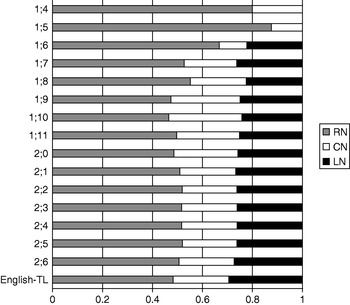
Neighbours from typical children's lexicons were taken from the above analyses. To calculate neighbours in the target language, neighbourhoods for word onsets, vowels and word offsets (rhyme, consonant and lead neighbours) were done for all CVC-words in the English-TL (Table 1). Patterns of neighbours were the same in English across typical children's lexicons and the target language. In the target language, the proportion of neighbours was greatest for rhyme neighbours (0·48). Also there were fewer consonant neighbours (0·22) and lead neighbours (0·30) as compared to rhyme neighbours. Although neighbours in the target language patterned in the same direction as in young children's lexicons, the proportions may still differ. Therefore, we also compared neighbourhoods from the typical children's vocabularies from the CDI between 1 ; 4 and 2 ; 6 to the target language. This was to test whether the typical words from children's early lexicons had the same distribution of neighbours as in the target language. To do this, for each month on the CDI we calculated whether the proportion of neighbours for rhyme, consonant and lead neighbours were above or below the proportion of neighbours established for the target language. The comparison of children's neighbours to the target language revealed a number of general patterns (see Figure 1).
Proportion of rhyme neighbours (RN), consonant neighbours (CN) and lead neighbours (LN) in children's typical vocabularies between 1 ; 4–2 ; 6, and in the English Target Language (English-TL).

The proportion of rhyme neighbours from the CDI for thirteen of the fifteen months between 1 ; 4 and 2 ; 6 was greater in child language than in the target language. This difference was significant based on an exact binomial test (p<0·01). Consonant neighbours were approximately the same in child language and in English. For eight of the fifteen months on the CDI, there were more consonant neighbours as compared to the target language (p=1). Lastly, for all fifteen months of the CDI there were fewer lead neighbours than in the target language (p<0·001).
One possible explanation for the neighbourhood differences between the CDI and the English-TL, is that the corpora contain words with different frequency counts. If low- and high-frequency words have different neighbourhood structures, this might drive the neighbourhood differences in the two corpora. Unlike the CDI, the English-TL corpus includes low-frequency words. To control for this possibility, the same analyses were re-done comparing the CDI lexicons to the English-TL, including only words that occurred with a frequency of two or more times (59 words were excluded). When the English-TL was restricted to higher-frequency words, the results were broadly the same (the only difference was that the effect for rhyme neighbours was in the same direction, but no longer significant; p=0·11). Another possibility is that the English-TL contains more function words or more morphologically complex words than found in children's early vocabularies, which may account for the differences between child language and the target language. To control for these possibilities, the same analyses were also done when the English-TL was restricted to just content words (62 function words were excluded, words such as this and with), and restricted to just monomorphemic words (32 bimorphemic words were excluded, words such as lays and pies). Results were the same as the analyses using all words.
In sum, the distributions of neighbours in child language were both similar and distinct from the distribution of neighbours in the target language. Rhyme neighbours (word-onset position) have the largest proportion of neighbours in both children's early typical lexicons and the target language. They differ in that in child language, the proportions of rhyme neighbours are greater than in the target language, and the proportions of neighbourhoods for lead neighbours (word-offset position) are less than in the target language.
DISCUSSION
Young children's lexicons were examined to determine how words are distinguished from other words. The prediction was that patterns from infant speech perception would be reflected in the structure of children's emerging lexicons. Analyses of the neighbours in children's early lexicons find that this prediction is partially supported. As predicted, neighbours in the early lexicons of children acquiring English were denser for word onsets (rhyme neighbours) than for word offsets (lead neighbours). While these distributions mirror the patterns found in the target language, they are significantly stronger in child language. There was no support for the predicted difference between vowels (consonant neighbours) and consonants (rhyme and lead neighbours). One possibility is that this reflects proposed differences that consonants and vowels play in language, where consonants play a more important role in lexical distinctions than vowels (Nespor, Peña & Mehler, Reference Nespor, Peña and Mehler2003). Research from development to support this theory has shown that consonants are more important than vowels for lexical distinctions in early child language (Nazzi, Reference Nazzi2005). On the surface these results may not seem surprising; however, what is interesting is that despite other pressures in language acquisition, such as the desire to communicate, children's vocabularies show a more polarized distribution of neighbours than found in the target language. The results presented in this paper are similar to De Cara & Goswami's (Reference De Cara and Goswami2002) results for English. Although we used a slightly different definition of phonological neighbours, we also found that there are more rhyme neighbours in English. Moreover, our results also indicate that in the typical lexicons of children acquiring English, there are fewer lead neighbours than found in English. The results from this study also build a bridge between the stage in language development before learners have acquired a lexicon, and later vocabulary development.
The secondary goal of this study was to look at the earliest stages of lexical development. Recall that lexical representations may undergo a shift from holistic to detailed representations between 50 to 100 words, between 150 to 200 words or as late as eight years of age (Vogel Sosa & Stoel-Gammon, Reference Vogel Sosa and Stoel-Gammon2006). In our analyses of English, we found consistency across the typical CVC words in English starting from age 1 ; 4. At the same time, we also found that neighbours in children's early lexicons are significantly different from the target language. While this may suggest a shift in representations, the differences were quantitative rather than qualitative. Thus, the results do not support the hypothesis that early lexical representations undergo a shift from holistic to detailed representations.
A limitation of the current study is that the vocabulary analyses are based on parental reports of children's expressive vocabularies. However, the CDI has been shown to be a reliable method of vocabulary size as compared to other methods of measuring vocabulary development in children (Ring & Fenson, Reference Ring and Fenson2000). Another potential limitation may be that the current study is based on the expressive rather than the receptive vocabulary of children. In this study, it is assumed that children's receptive and expressive vocabularies are quantitatively rather than qualitatively different.
The current results provide new insights into children's early production patterns. An advantage for word onsets over word offsets is not only found in infant speech perception, but also in the accuracy of children's early productions. It has long been noted that children first produce word onsets and delete word offsets (Levelt, Schiller & Levelt, Reference Levelt, Schiller and Levelt1999). The traditional account for this pattern is that this reflects innate linguistic structure. The analyses presented in this paper are not based on how accurately children produce segments in different positions, but rather on the words that children attempt to produce. Our results provide a new explanation for children's difficulty in producing final consonants: children's production errors may reflect language learners representations at a number of different levels. Production errors may reflect context-sensitive representations on the General Perceptual Plane and/or children's emerging lexical representations at the Word Form Plane, where fewer lexical items contrast in word-offset position. The current findings also provide insights into Zamuner (in press), who found a relationship between Dutch-learning children's vocabulary sizes and their mean segment repetition accuracy in word-onset position, but not word-offset position. The relationship between vocabulary size and non-word production accuracy is argued to reflect children's developing phonological representations, which are abstracted from children's acquired lexicon. The findings from the current study show that the clustering of children's early vocabularies differs depending on word position; thus, this could partly account for differences in children's phonological representations based on word position.
The initial starting point was the argument that infants' sensitivities in speech perception can influence language learners' developing lexical representations. One model that captures this development is the PRIMIR model of developmental speech perception (Werker & Curtin, Reference Werker and Curtin2005). Context-specific phonetic representations aid the development of word-form representations and the development of lexical neighbourhoods. Previous claims have argued that the lexicon draws attention to phonetic detail, rather than phonetic detail influencing lexical development. Most likely, the interaction goes in both directions. Similarly, the patterns seen in early speech perception may reflect the target language, and/or early speech perception abilities may have had an evolutionary influence on languages' lexical structure. One argument that has been made is that the vocabulary structures of language reflect the sequential temporal processing of speech. If speech is processed linearly, then vocabularies will develop to maximize contrasts at word onsets because an abundance of words that begin with the same sounds would interfere with lexical retrieval. Cross-linguistic evidence to support this claim comes from other languages that also have a higher proportion of rhyme neighbours or words that contrast in word-onset position (i.e. for German and French, Goswami, Reference Goswami2002).
Although there are similarities in the words that children acquire across languages, there are also differences in the proportion of word types acquired in languages and individuals, demonstrating language-specific influences on vocabulary acquisition, differences in maternal input and cultural differences in the input that children receive (Bornstein & Cote, Reference Bornstein and Cote2005; D'Odorico, Carubbi, Salerni & Calvo, Reference D'Odorico, Carubbi, Salerni and Calvo2001). To fully understand how infant speech perception abilities interact with lexical development and other factors in the acquisition of language, future cross-linguistic research is needed. To date, the majority of work done in infant speech perception has focused on English. However, languages have different segmental inventories and different prosodic structures. If the distribution of neighbours in children's early lexicons stems from learners' early speech-perception abilities (which are presumably the same in learners acquiring different languages), one question is whether the same patterns will be found across different languages. We predict this to be true at the initial state, however, perception abilities are not static, but rather, they also develop according to the phonological patterns in the ambient language (Werker & Curtin, Reference Werker and Curtin2005). For example, language-related variation might also arise from word-length differences, such as a language's average word length or a language's minimal word requirement. For example, English words can consist of monosyllables, whereas in other languages, words must be minimally composed of two syllables (syllabic trochees), as in Cavineña, Diyari and Mohawk (Hayes, Reference Hayes1995: 88). Neighbourhood densities have been shown to vary according to word length (Storkel, Reference Storkel2004b) and by language (Vitevitch & Stamer, Reference Vitevitch and Stamer2006). Although the initial speech-perception abilities in infants acquiring different languages will be the same, these abilities adapt as the learners acquire and interact with the phonological patterns of their native language. Thus, cross-linguistic and developmental studies will provide important test cases for predictions based on the PRIMIR model, and establish the relationship between early speech perception and later language development.
Language-related differences in neighbourhood densities have been reported in the literature. Rosales & Storkel (Reference Rosales and Storkel2006) provided an analysis of the clustering coefficient (a measurement of the proportion of neighbours that are neighbours of each other; Vitevitch, Reference Vitevitch2006) in children's early lexicons for English and Spanish. Results indicated that English vocabularies began to cluster by 1 ; 4, but Spanish vocabularies did not show clustering until 1 ; 10. Differences in the clustering coefficient in children's early vocabularies may reflect average word-length differences, where words in English are on average shorter than words in Spanish. The clustering coefficient is related to word processing, where words with a high clustering coefficient (related to many other words) are processed faster than words with a lower clustering coefficient. Therefore, we would predict language differences in how spoken words are processed in English and Spanish at this early stage of lexical acquisition. Other types of language differences may stem not only from word-length differences, but also from the position within the word or syllables where neighbours occur. English neighbours are more likely to occur at the beginning of the word, whereas in Spanish neighbours are more likely to occur at the ends of words (Vitevitch & Stamer, Reference Vitevitch and Stamer2006). Not surprisingly, differences have been found in how English- and Spanish-speaking adults process and produce language (Vitevitch & Rodríguez, Reference Vitevitch and Rodríguez2005; Vitevitch & Stamer, Reference Vitevitch and Stamer2006). While this may reflect the factors discussed above, it may also reflect differences in the morphological structure of the languages. For example, Spanish has more inflection than English, such as grammatical gender distinctions between male child (niño) and female child (niña) (Vitevitch & Stamer, Reference Vitevitch and Stamer2006: 766).
Another example comes from Hungarian, which is a highly agglutinating language. While the languages that have been studied to date have the highest proportion of rhyme neighbours (Goswami, Reference Goswami2002), Hungarian is an interesting test case because it has more lead neighbours than rhyme neighbours. If children show a preference for the most frequent neighbours in the language, we would predict that Hungarian-learning children would first acquire more lead neighbours than found in Hungarian. However, if children's lexicons reflect early perceptual biases, we predict fewer lead neighbours (more rhyme neighbours) than found in Hungarian. In research together with Judit Gervain, we have begun to look at Hungarian lexical structure in child and adult language (Zamuner & Gervain, Reference Zamuner and Gervain2008). Preliminary results to date have found that there are more lead neighbours than rhyme neighbours in CVC Hungarian words (the opposite pattern than seen in English). Early child Hungarian also has more lead neighbours than rhyme neighbours, but fewer lead neighbours than found in Hungarian. This suggests that the lexicons of Hungarian-learning children reflect both early perceptual sensitivities and mirror the Hungarian input.
To successfully acquire language, children must also learn words with more complex structures and lower-frequency words. The primary use of natural language is to communicate. Thus, a purely statistical mechanism alone cannot account for all of language acquisition. For instance, recent research has shown that interpersonal interaction can predict foreign-language phonetic learning in young infants (Kuhl, Tsao & Liu, Reference Kuhl, Tsao and Liu2003). The degree to which these mechanisms are interrelated may indicate the evolutionary nature of language acquisition. The focus of this research has been on the structure and nature of phonological neighbourhoods in children's early lexicons. Results from infant speech perception have shown that learners acquire language-specific knowledge about more-frequent phonemes before less-frequent phonemes (Anderson, Morgan & White, Reference Anderson, Morgan and White2003). One avenue for future research is to determine whether neighbourhood densities are greater for words that are distinguished by early acquired phonemes as compared to later acquired phonemes. Additionally, other related factors should be examined, such as phonotactic probability and frequency, which have been shown to have various degrees of predictability in language production in individual children (Maekawa & Storkel, Reference Maekawa and Storkel2006). Further work of this type will help characterize the learning processes and provide insights into the PRIMIR model, where early perceptual sensitivities provide a foundation for later lexical development.