





Women remain underrepresented at all levels of political parties, from the grassroots to government cabinets (Heidar and Wauters Reference Heidar and Wauters2019; Barnes and O’Brien Reference Barnes and O’Brien2025). While we know that this under-representation is present right from the beginning of the party membership path (namely, the decision to join), researchers have overlooked the question of whether women become members for the same reasons as men. This is an important omission: if women and men have different motivations for signing up, it is likely to affect their participation in the party, whether that be the activities they engage in or their political career aspirations (Whiteley and Seyd Reference Whiteley and Seyd1996; Bale, Webb, and Poletti Reference Bale, Webb and Poletti2020). In this article, we investigate gender differences in the reasons for joining by looking at the earliest possible entry point: enrolment in youth wings. The latter are party sub-organizations for young people with fixed lower and upper age limits, and thus provide a unique window onto how gendered dynamics in party involvement may manifest early on. They also constitute a key recruitment pool for future representatives, officials, leaders, and prime ministers (Hooghe, Stolle, and Stouthuysen Reference Hooghe, Stolle and Stouthuysen2004; Ohmura, Bailer, Meiβner et al. Reference Ohmura, Bailer, Meiβner and Selb2018; Martínez-Cantó and Verge Reference Martínez-Cantó and Verge2023). Drawing on YOUMEM data – the largest cross-national survey of youth wing members to date (McDonnell, Ammassari, Valbruzzi et al. Reference McDonnell, Ammassari, Valbruzzi, Bolin, Werner, Heinisch, Jungar and Wegscheider2024) – we investigate whether women’s and men’s motivations for getting involved already differ in this initial section of the pipeline to power. Specifically, we ask: Do young women and men join political parties for different reasons?
Existing research identifies three sets of incentives for joining a party: purposive, which refer to the party’s policy goals; social, which derive from the act of associating with other people; and material, which consist of tangible rewards such as intra-party/public office or career benefits (Clark and Wilson Reference Clark and Wilson1961; van Haute and Gauja Reference van Haute and Gauja2015; Bolin, Backlund, and Jungar Reference Bolin, Backlund and Jungar2023). Studies of party membership, however, rarely adopt gender as an analytical lens (Kenny, Bjarnegård, Lovenduski et al. Reference Kenny, Bjarnegård and Lovenduski2022). Consequently, we do not know whether women and men are mobilized differently by the above incentives. In this article, we advance a tripartite argument to assess this. First, while purposive incentives should be equally appealing to both women and men, we envisage that young women will be more likely to join in pursuit of social incentives, and men will value more the material rewards of membership. Second, we propose an original theoretical explanation for these expected gender disparities, focusing on the role of family as a key political socialization agent for young people (Verba, Schlozman, and Burns Reference Verba, Schlozman, Burns and Zuckerman2005; Quintelier Reference Quintelier2015). We argue that, before enrolling, young women will be more likely than men to have party-affiliated family ties – that is, close relatives who have been members of a party. This is because such ties can offset the ‘socialization’ and ‘outsider’ disadvantages women face when entering politics (O’Brien Reference O’Brien2015; Folke, Rickne, and Smith Reference Folke, Rickne and Smith2021). Third, since these ties should influence women’s political participation more than men’s (Harteveld, Dahlberg, Kokkonen et al. Reference Harteveld, Dahlberg, Kokkonen and van der Brug2017; Oshri, Harsgor, Itzkovitch-Malka et al. Reference Oshri, Harsgor, Itzkovitch-Malka and Tuttnauer2023), we expect that they will moderate the relationship between gender and incentives for joining. In particular, the presence of party-affiliated family ties should widen the gender gap in social incentives but reduce the gap in material ones.
We test our tripartite argument using YOUMEM data from over 3500 youth wing members of the main center-left and center-right parties in five countries: Australia, Austria, Germany, Italy, and Spain. In the survey, we asked respondents the extent to which they agreed that they joined the youth wing for eight possible reasons. Using principal component analysis (PCA), we identify three underlying factors of incentives, which largely correspond to the three sets of incentives recognized in the literature. In line with our expectations, we find that while young women and men are similarly mobilized by purposive incentives in their decision to join, women are more attracted than men by social benefits, and less so by material ones. In addition, young women in all five countries are more likely to report that, before joining, they had someone from their immediate family who had been a member of a party. As expected, these ties have a positive association with joining for purposive incentives; somewhat surprisingly, however, a party-affiliated family background is negatively correlated with material incentives. Finally, our results show how party-affiliated family ties moderate the relationship between gender and purposive and material incentives for joining. While they boost women’s purposive motivations more than men’s, they also reduce women’s material motivations to a greater extent. In other words, the presence of these family ties actually widens the gender gap in material incentives.
Our article is the first to identify and explain gender differences in the reasons for joining political parties, and it makes several contributions to the study of women’s and youth political participation. Theoretically, by focusing on the role of family as a socialization agent, we put forward an original argument to shed light on gender disparities in why young people get involved in political parties. Moreover, it is likely that our argument will apply also to the reasons why older generations join: after all, older women are no less subject than younger ones to ‘socialization’ and ‘outsider’ disadvantages – if anything, they should be more so, especially if they have joined prior to some of the advances women have made in party politics over the last few decades. In addition, by examining gender differences in the reasons why young people join political parties, we answer calls to better integrate the study of gender and politics with ‘mainstream’ scholarship on parties (Kenny and Verge Reference Kenny and Verge2016; Kenny, Bjarnegård, Lovenduski et al. Reference Kenny, Bjarnegård and Lovenduski2022). Empirically, we study a section of the pipeline to power that has been largely overlooked by scholars, namely, party youth wings. By focusing on women’s current involvement in youth wings, we can thus obtain a novel perspective into their future representation in political parties. Furthermore, the article provides solid evidence that young women and men join political parties for distinct reasons, and that young women who join parties are more likely than men to have been embedded in a party-affiliated family environment. Not only do these findings enhance our understanding of women’s participation at the grassroots of political parties, but they should also be of interest to any party that is genuinely seeking to improve women’s representation within its ranks.
The article proceeds as follows. In the next section, we develop four hypotheses to investigate gender differences in the reasons why young people join political parties, focusing on the role of party-affiliated family ties. In the third, we present our five country cases and describe the survey method and data used to test our hypotheses. In the fourth and fifth sections, we discuss our findings. We conclude by reflecting on the key implications of our study and highlighting promising paths for future research.
Gendered incentives for joining and party-affiliated family ties
Just like older people, young people join political parties because they are attracted by a series of incentives that membership offers (Bruter and Harrison Reference Bruter and Harrison2009; Fjellman and Rosén Sundström Reference Fjellman and Rosén Sundström2021; Bolin, Backlund, and Jungar Reference Bolin, Backlund and Jungar2023). These incentives can be categorized into three groups: purposive, social, and material (Clark and Wilson Reference Clark and Wilson1961; Bruter and Harrison Reference Bruter and Harrison2009; van Haute and Gauja Reference van Haute and Gauja2015). Purposive incentives concern the policy and ideological goals of a party. Young people who are mobilized by these join because they want to show their support for the party and make a difference in society. Social incentives stem from the act of associating with people who share one’s political views. Youths who find these incentives attractive join because other people in their personal networks are already members, or because they want to make new like-minded friends. Finally, material incentives refer to benefits like career advancement and intra-party or public offices. Young people who consider these incentives appealing join because they are interested in a career in politics and/or because they think it might help them establish networks for their future employment.
Studies from a range of countries show that individuals of all ages join parties first and foremost because of purposive incentives, while social and material incentives are less relevant (Bruter and Harrison Reference Bruter and Harrison2009; van Haute and Gauja Reference van Haute and Gauja2015; Bale, Webb, and Poletti Reference Bale, Webb and Poletti2020).Footnote 1 What the literature on party membership does not consider, however, is whether women and men are equally attracted by these three groups of incentives. Such studies tend to treat memberships as monolithic blocks, without acknowledging how members’ different socio-demographic characteristics – including gender – might affect their attitudes, behavior, and experiences. Despite long-standing calls to introduce gender as an analytical lens in party scholarship (Kenny and Verge Reference Kenny and Verge2016), these have not been answered (Kenny, Bjarnegård, Lovenduski et al. Reference Kenny, Bjarnegård and Lovenduski2022). Moreover, since party memberships are dominated by men and gender is rarely used as an independent variable (but rather features as a marginal control), most of what we know about grassroots members is based on men. As a result, we have no idea whether (young) women and men sign up for the same reasons.
This is a question worth asking. First, not only do these reasons reveal how members perceive their political involvement, but they also affect their levels of activism, political ambition, and long-term commitment to the party (Whiteley and Seyd Reference Whiteley and Seyd1996; Bale, Webb and Poletti Reference Bale, Webb and Poletti2020; Pettitt Reference Pettitt2020). Second, gendered disparities related to family responsibilities and career paths are less established among young people than is the case for older generations (Pfanzelt and Spies Reference Pfanzelt and Spies2019; Ohmura and Bailer Reference Ohmura and Bailer2022; see also Hooghe, Stolle, and Stouthuysen Reference Hooghe, Stolle and Stouthuysen2004). Signing up for a youth wing, therefore, is the moment when gender differences in the incentives for joining should be minimal. In a nutshell: by comparing young women’s and men’s motivations for becoming party members, we can gain new insights into gendered patterns of inequality that shape party politics, along with processes of ‘gendered political socialization’ (Bos, Greenlee, Holman et al. Reference Bos, Greenlee, Holman, Oxley and Lay2022) that affect younger generations. In the remainder of this section, we therefore draw on the literature on gender and politics, party politics, and youth political participation to develop a tripartite argument about gender differences in why young people join political parties, and the role of party-affiliated family ties therein.
Our first hypothesis concerns the different appeal that purposive, social, and material incentives will have for young women and men. The scarce empirical evidence we have in this regard comes from early studies of party officials and activists, primarily focused on the United States. It suggests that women should be more attracted than men by social benefits, and less so by material ones. For example, in their survey of party officials in Georgia, Fowlkes, Perkins, and Tolleson Rinehart (Reference Fowlkes, Perkins and Tolleson Rinehart1979) find that women are less likely to attribute their political activity to office aspirations or the desire to make business contacts. Similarly, Costantini (Reference Costantini1990) finds that women party leaders and activists in California report entering politics more for social reasons – including the fun that political involvement entails and the possibility of meeting new people – and less so because they want to run for office or extend their professional networks. Although these findings are very scattered, we would expect the same gendered trends to characterize the reasons for joining political parties. After all, the above evidence is in line with well-developed bodies of work showing that, first, women place more emphasis than men on interpersonal relationships (Costa, Terracciano and McCrae Reference Costa, Terracciano and McCrae2001; Schmitt, Realo, Voracek et al. Reference Schmitt, Realo, Voracek and Allik2009; Croson and Gneezy Reference Croson and Gneezy2009), and second, that they tend to be less politically ambitious than men (Fox and Lawless Reference Fox and Lawless2004; Allen and Cutts Reference Allen and Cutts2018; Devroe, Coffé, Vandeleene et al. Reference Devroe, Coffé, Vandeleene and Wauters2023). Accordingly, when deciding whether to sign up for a party, we would expect young women to be more attracted by the opportunity of meeting new people and the camaraderie, while the prospect of a career in politics and making new professional contacts should be more appealing to men. As for purposive incentives, since they are by far the most common reasons for enrolling in parties (Bruter and Harrison Reference Bruter and Harrison2009; van Haute and Gauja Reference van Haute and Gauja2015; Bolin, Backlund, and Jungar Reference Bolin, Backlund and Jungar2023), it is unlikely that young women and men will value them differently in their decision to join. This leads us to hypothesize the following:
H1: Young women will be as likely as young men to join political parties for purposive incentives; more likely to join for social incentives; and less likely to join for material ones.
These expected gender differences are likely explained by a combination of both ‘demand-side’ and ‘supply-side’ factors (Norris and Lovenduski Reference Norris and Lovenduski1995; Kenny and Verge Reference Kenny and Verge2016; van Dijk Reference van Dijk2025b). ‘Demand-side’ factors include the gendered rules, norms, and practices of political parties, which tend to discriminate against women; while ‘supply-side’ factors refer to young women’s characteristics, resources, and attitudes as regards their participation in politics. In this study, we primarily take a supply-side perspective. We propose an original theoretical mechanism to shed light on gender differences in incentives for joining parties – one which focuses on a key aspect of youth political socialization, namely, the role of the family. Families are important actors in shaping the political attitudes, preferences, and behaviors of young people. For example, discussions about politics at home can have a positive influence on young people’s political knowledge and participation (McIntosh, Hart, and Youniss Reference McIntosh, Hart and Youniss2007; Ekström and Östman Reference Ekström and Östman2013; Hooghe and Boonen Reference Hooghe and Boonen2015). In addition, parents who are politically engaged can transmit their political interest and sense of efficacy to their children (Verba, Schlozman, and Burns Reference Verba, Schlozman, Burns and Zuckerman2005; Zuckerman, Dasovic, and Fitzgerald Reference Zuckerman, Dasovic and Fitzgerald2007; Jennings, Stoker, and Bowers Reference Jennings, Stoker and Bowers2009). Not surprisingly, therefore, growing up in that type of familial environment is also influential in the path to party membership. In their survey of young party members in Europe, Bruter and Harrison (Reference Bruter and Harrison2009, 41) found that over 50 per cent had one or more relatives who had been party members or indirectly associated with a party. However, they do not investigate whether there are any gender differences in these trends.
We contend that young women who are party members will be more likely than men to have close relatives who are, or have been, members of political parties themselves (cf. Fox and Lawless Reference Fox and Lawless2014). In other words, young women in parties should have more of what we term party-affiliated family ties. We argue this is the case because women are faced with two ‘disadvantages’ when entering politics, and party-affiliated personal ties can help them offset both. The first is a ‘socialization disadvantage’. Namely, due to long-standing processes of gendered socialization casting politics as a men’s domain, women tend to display lower levels of political knowledge, efficacy, and ambition (Fox and Lawless Reference Fox and Lawless2004; Dassonneville and McAllister Reference Dassonneville and McAllister2018; Oser, Feitosa, and Dassonneville Reference Oser, Feitosa and Dassonneville2023), all of which are predictors of party membership and activism (Whiteley and Seyd Reference Whiteley and Seyd1996; Morales Reference Morales2009; Poletti, Webb, and Bale Reference Poletti, Webb and Bale2018). It is true that, among party members – who are a small, select, and very politically engaged group within the general population – these gender gaps may be reduced. However, the little evidence we have from membership studies shows that, even within political parties, women are slightly less efficacious and significantly less ambitious than men (Ammassari Reference Ammassari2025; Bale, Poletti, and Webb Reference Bale, Poletti and Webb2018; Kjaer and Kosiara-Pedersen Reference Kjaer and Kosiara-Pedersen2019; cf. van Dijk Reference van Dijk2025a). Given the lower availability of these cognitive resources, young women wishing to join political parties need additional ones that can help reduce the information costs of participating in politics, such as resources deriving from having relatives who have been involved in parties.
A second, related disadvantage that young women suffer is an ‘outsider disadvantage’. Since men are over-represented in parties (van Haute and Gauja Reference van Haute and Gauja2015; Heidar and Wauters Reference Heidar and Wauters2019), women might feel more encouraged to join if they know someone in the organization, or if they are already familiar with political party life thanks to the experiences of their relatives. In this sense, family members may act as role models who make politics more accessible and appealing for them – even more so if those family members are women (Gidengil, Wass, and Valaste Reference Gidengil, Wass and Valaste2016; Aggeborn and Nyman Reference Aggeborn and Nyman2021). For instance, in their study of adult women in Canada, Gidengil, O’Neill, and Young (Reference Gidengil, O’Neill and Young2010, 350) find that ‘a politically active mother can encourage her daughter to follow in her footsteps and take an active interest in politics’, with the effect being strongest for party membership. Party-affiliated family ties can thus give young women confidence and show them that they, too, can belong in political parties. This mechanism also speaks to gender differences in risk-aversion, with women being more risk-averse than men (Eckel and Grossman Reference Eckel, Grossman, Plott and Smith2008; Charness and Gneezy Reference Charness and Gneezy2012). Joining a party, like any form of political participation, implies a certain degree of risk (Kam Reference Kam2012), but having party-affiliated family ties could mitigate these risks by providing young women with additional skills and knowledge to navigate membership. Moreover, having these ties might also be a way for women to signal to ‘insiders’ (i.e., men members) that they have enough ‘qualifications’ to be enrolled – similar to the widespread phenomenon of women legislators being more likely to come from political dynasties than men (Folke, Rickne, and Smith Reference Folke, Rickne and Smith2021). Based on these considerations, our second hypothesis posits that:
H2: Before enrolling in political parties, young women will be more likely than young men to have party-affiliated family ties.
We also expect family ties to be positively correlated with joining parties for purposive, social, and material incentives. Starting from the first of these, there is extensive evidence about the prominent role that families play in shaping young people’s political ideology and partisan identification (Ventura Reference Ventura2001; Jennings, Stoker and Bowers Reference Jennings, Stoker and Bowers2009; van Ditmars Reference van Ditmars2023). In a similar vein, as regards social incentives, young people growing up in families with close relatives who have been party members should be more inclined to view party social milieux as welcoming. As for the relationship between party-affiliated family ties and material incentives, research shows that having a political family background is a strong predictor of political ambition and running for office. For example, in a survey of US high school and college students, Fox and Lawless (Reference Fox and Lawless2014, 512) find that agents of political socialization, such as the family, ‘play an integral part in fostering and reinforcing future interest in running for office’. Studies from Spain (Galais Reference Galais, Coller, Jaime-Castillo and Mota2018), Sweden (Oskarsson, Dawes, and Lindgren Reference Oskarsson, Dawes and Lindgren2018; Aggeborn, Lajevardi, Lindgren et al. Reference Aggeborn, Lajevardi, Lindgren, Nyman and Oskarsson2020), and the UK (Allen and Cutts Reference Allen and Cutts2018) reach similar conclusions. In sum, having close relatives who have been members of political parties should increase the likelihood that one values the purposive, social, and material incentives of party membership when deciding whether to sign up. We therefore hypothesize that:
H3: Young party members with party-affiliated family ties will report stronger purposive, social, and material incentives for joining than those without such ties.
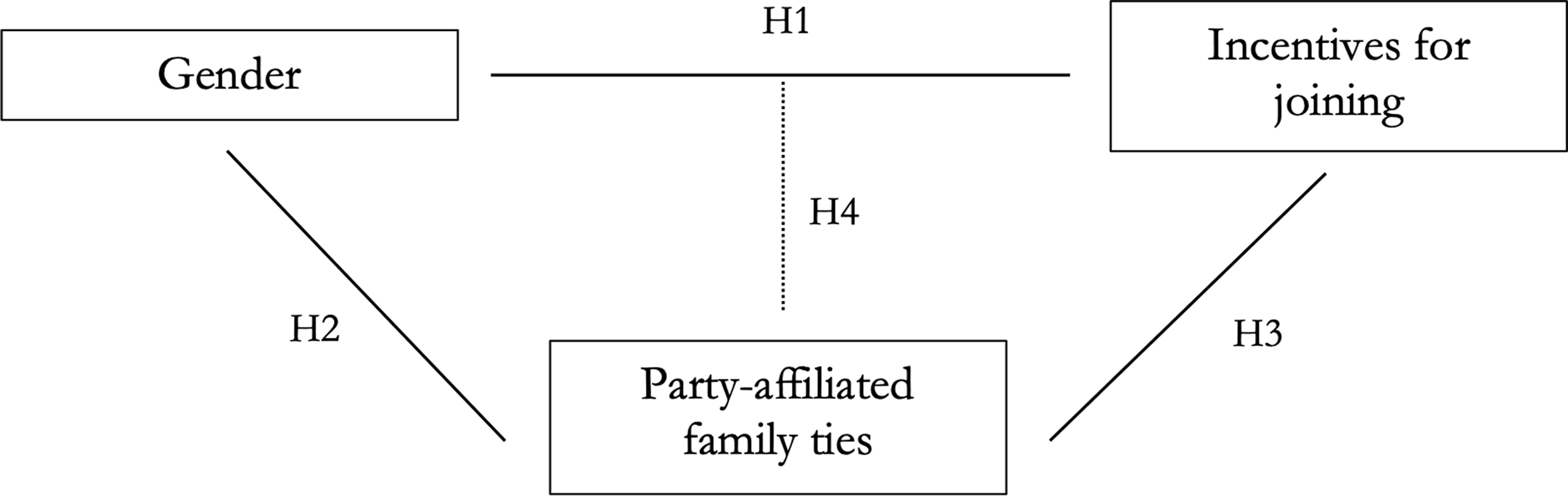
Finally, not only do we anticipate that, before enrolling in parties, young women will have more party-affiliated family ties than young men (H2), but we also expect the positive relationship between these ties and incentives for joining parties to be stronger for young women. Our final hypothesis builds on research showing that women are more attuned to their social environment than men, and that this greater sensitivity shapes gender differences in political attitudes and behavior. For instance, social influences and the desire to conform to social norms are more decisive factors in women’s vote choice than in men’s (Harteveld, Dahlberg, Kokkonen et al. Reference Harteveld, Dahlberg, Kokkonen and van der Brug2017; Harteveld and Ivarsflaten Reference Harteveld and Ivarsflaten2018; Oshri, Harsgor, Itzkovitch-Malka et al. Reference Oshri, Harsgor, Itzkovitch-Malka and Tuttnauer2023). While these studies focus on electoral behavior, the broader underlying principle is that women assign greater weight to the views and experiences of ‘significant others’ in their political participation (Whiteley and Seyd Reference Whiteley and Seyd1996). In this regard, it is telling that young women are far more likely than young men to have political discussions with their parents (Gottfried Reference Gottfried2015). The above mechanism, we contend, should extend to the decision to join a party. Accordingly, we hypothesize that party-affiliated family ties will moderate the relationship between gender and incentives for joining parties (see Figure 1). In other words, while such ties positively affect the motivations of all young members (H3), they should have a disproportionately stronger effect on women. Given the gender differences in incentives envisaged in H1, these ties should therefore widen the gender gap in social incentives, by further boosting women’s social motivations, and narrow the gap in material incentives, by strengthening women’s material motivations relative to men’s. Our fourth and final hypothesis thus states that:
Hypothesized relationships between gender, party-affiliated family ties, and reasons for joining.

H4: Party-affiliated family ties will have a stronger positive effect on women’s incentives for joining than on men’s.
Empirical strategy
Our article tests these hypotheses by focusing on youth wings, which are party sub-organizations for young members.Footnote 2 According to Allern and Verge (Reference Allern, Verge, Scarrow, Webb and Poguntke2017, 119), 78 per cent of parties in Global North countries have youth wings, well ahead of the next most frequent sub-organization, which is women’s wings (41 per cent). In addition to providing parties with campaign volunteers, being a source of recruitment and linkage, and offering a space where young people can interact with like-minded peers and politicians (Mycock and Tonge Reference Mycock and Tonge2012; de Roon Reference de Roon2022; Bolin and Jungar Reference Bolin and Jungar2024), youth wings are an important part of the pipeline for elected representatives and party officials (Hooghe, Stolle, and Stouthuysen Reference Hooghe, Stolle and Stouthuysen2004; Ohmura, Bailer, Meiβner et al. Reference Ohmura, Bailer, Meiβner and Selb2018; Binderkrantz, Nielsen, Pedersen et al. Reference Binderkrantz, Nielsen, Pedersen and Tromborg2020; Martínez-Cantó and Verge Reference Martínez-Cantó and Verge2023). For instance, in their study of the career paths of German MPs between 1998 and 2014, Ohmura, Bailer, Meiβner et al. (Reference Ohmura, Bailer, Meiβner and Selb2018, 178) found that over a quarter of parliamentarians had held positions in their party youth wings. Indeed, at the time of writing in November 2025, the prime ministers in three of our five country cases – Australia, Germany, and Italy – had all begun their political careers in youth wings. The same goes for the main opposition leaders in Austria, Germany, and Italy. Along with office possibilities, youth wings offer members the chance to contribute to the policymaking of their parties (Russell Reference Russell2005). These sub-organizations thus fulfil important democratic roles, and are key agents in the mobilization and socialization of young women and men into party politics.
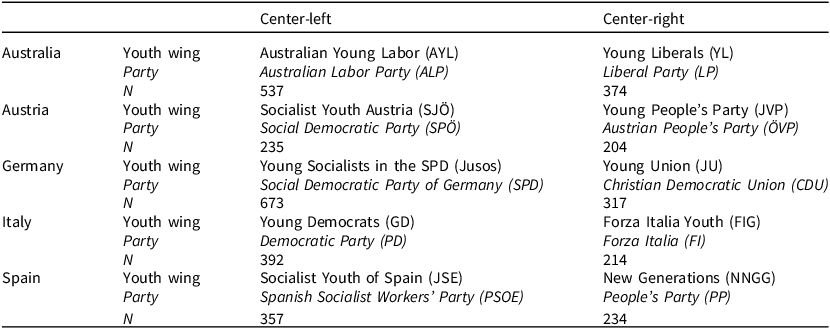
We draw on original survey data collected as part of the YOUMEM project (McDonnell, Ammassari, Valbruzzi et al. Reference McDonnell, Ammassari, Valbruzzi, Bolin, Werner, Heinisch, Jungar and Wegscheider2024) from 3537 members (1097 women and 2440 men) of the ten main center-left and center-right youth wings in Australia, Austria, Germany, Italy, and Spain (see Table 1 below). These five countries are all parliamentary democracies with traditions of strong center-left and center-right parties alternating as the major parties in government and opposition.Footnote 3
Youth wings surveyed

At the same time, the five democracies belong to three regions of the Global North – the Anglo-Saxon world, Western Europe, and Southern Europe – which are characterized by distinct political cultures (Morales Reference Morales2009; see also Dekker and van der Broek Reference Dekker and van den Broek1998) and gender regimes (Sainsbury Reference Sainsbury1999; Woodward Reference Woodward and Magone2014; Walby Reference Walby2020).Footnote 4 They also differ considerably in the extent to which women participate in political parties. To give an illustration, if we look at women’s descriptive representation in the Lower House of Parliament in each country, as of November 2025, Australia has the highest proportion of women MPs (46 per cent), and Germany the lowest (32 per cent), with Spain (44 per cent), Austria (36 per cent), and Italy (33 per cent) sitting in between (Inter-Parliamentary Union 2025).Footnote 5 As for women party leaders, Italy had not had a single woman as leader of a prominent party until 2022, while Austria and Australia had only had one.Footnote 6 By contrast, parties represented in parliament in Germany and Spain have regularly had women among their higher echelons. In sum, these countries provide very different supplies of prominent women politicians who can act as role models and incentivize young women to get involved in party politics (Wolbrecht and Campbell Reference Wolbrecht and Campbell2007; Mariani, Marshall and Mathews-Schultz Reference Mariani, Marshall and Mathews-Schultz2015; Ladam, Harden, and Windett Reference Ladam, Harden and Windett2018). Our ‘diverse’ case selection (Gerring Reference Gerring2006) is thus well suited to account for the disparate contexts in which young women join political parties, and provides a strong basis for the generalizability of our findings among the major center-left and center-right parties in the Global North. At the same time, we cannot claim that newer party families such as the Greens or the populist radical right will necessarily display the same trends as their older, mainstream rivals. As a first step in an area of study that has not been the subject of any cross-national comparative research, we therefore chose to focus on parties that are well-established, have rooted organizational structures (including youth wings), and can thus provide a wide range of purposive, social, and material incentives for joining.Footnote 7
The YOUMEM surveys with the ten youth wings were fielded between 2018 and 2022 and hosted on the online platform LimeSurvey.Footnote 8 The Australian survey was launched in March 2018 and concluded in November that year, the Spanish and Italian ones took place between March 2020 and April 2021, while the Austrian and German surveys were conducted in the second half of 2021 and first half of 2022. The long timeframe for most of the surveys was due to the difficulties of securing distribution among the youth wing memberships in all countries. In Australia, Italy, and Spain, going through the national level was either not feasible or produced few results, so we asked youth wing leaders in all states and territories (Australia), regions (Italy), and autonomous communities (Spain) to distribute the link to their local members. In Austria and Germany, we had better cooperation from national youth wing leaders, but it still took a long time to achieve good distribution among the state-level branches.
While ours is the first cross-national survey of youth wing members, it is worth acknowledging a few limitations. As is the norm in party membership research (Gauja and van Haute Reference Gauja, van Haute, van Haute and Gauja2015, 194), our study is based on a nonrandom sample of youth wing members, meaning we cannot exclude that there are systematic differences between those who participated and those who did not. Relatedly, since most of the youth wings were unwilling to share precise information about how many members they have (or how many received the survey link), we do not know the proportions of young members from all ten parties who responded to our survey.Footnote 9 That said, according to what we know about (young) party members in general, our sample is representative of these populations since our respondents tend to be men, well-educated, with a higher-than-normal level of party-affiliated family background, and are mobilized first and foremost by purposive incentives, followed by social and material ones (Bruter and Harrison Reference Bruter and Harrison2009; van Haute and Gauja Reference van Haute and Gauja2015; Heidar and Wauters Reference Heidar and Wauters2019).Footnote 10 In addition, we were able to secure good geographical coverage, with at least three quarters of all regions and states in each country being represented. These considerations reassure us about the quality of the sample. Finally, we should note that in five of our ten cases (SJÖ and JVP in Austria, Jusos and JU in Germany, and JSE in Spain), it is possible to be a member of the youth wing without formally being a member of the party. While it could be argued that such individuals may join youth wings for different reasons than people join parties, studies show that the incentives for joining parties and youth wings are largely the same (Fjellman and Rosén Sundström Reference Fjellman and Rosén Sundström2021; Bolin, Backlund, and Jungar Reference Bolin, Backlund and Jungar2023). Moreover, in practice, the vast majority of respondents from those five youth wings are also members of the party; and even when youth wing members are not enrolled in the party, they are still members of an organization that is bound to accept the party’s ideology, norms, and rules.
Our dependent variable is incentives for joining political parties. To measure this, we asked respondents to indicate the extent to which they agreed on a four-level scale that they had joined the youth wing for a list of eight common reasons drawn from the literature (Bruter and Harrison Reference Bruter and Harrison2009; van Haute and Gauja Reference van Haute and Gauja2015; Bale, Webb, and Poletti Reference Bale, Webb and Poletti2020):
-
1. I wanted to meet people who share my values.
-
2. I wanted to work on an election campaign.
-
3. I had friends who were already members.
-
4. I wanted to influence [name of the party] policy.
-
5. I had family who were already members.
-
6. I felt very strongly about the [name of party] policies.
-
7. I thought it would help me make contacts for my future career.
-
8. I wanted to stand as a candidate one day.
This approach, as opposed to asking respondents to choose a single item or a single type of incentive, allows for the fact that the reasons for joining political parties tend to be complex and multifaceted (Ammassari Reference Ammassari2024; Fjellman and Rosén Sundström Reference Fjellman and Rosén Sundström2021; Power and Dommett Reference Power and Dommett2020). The scale ran from strongly disagree to strongly agree. We then performed a principal component analysis (PCA) with varimax rotation on our eight survey items to look for potential underlying dimensions. The PCA, whose results can be found in Appendix D, revealed that there are three factors of incentives with an Eigenvalue larger than one and explaining over 50 per cent of the total variance.Footnote 11 From these factors, which largely correspond to the three sets of incentives – purposive, social, and material – proposed in the literature (Clark and Wilson Reference Clark and Wilson1961; Bruter and Harrison Reference Bruter and Harrison2009), we obtained three continuous variables which we use as our dependent variables. For ease of interpretation, we normalized the variables so that their values range from 0 to 1.
Our main independent variable is the gender of young party members, coded as 1 for women and 0 for men.Footnote 12 In line with the aforementioned studies on party membership, the variable party-affiliated family ties was obtained by asking respondents whether anyone in their immediate family (parents or siblings) had ever been a member of a political party (coded as 1 for yes, 0 for no).Footnote 13 In addition, we included standard controls such as age, education, and political interest, as well as a variable measuring the ideology of the party (coded as 1 for center-right, 0 for center-left) and a categorical variable accounting for the country of respondents.Footnote 14 To assess the statistical effects of gender on incentives for joining parties, and to test whether this relationship is moderated by party-affiliated family ties, we ran OLS regressions for each incentive type with robust standard errors clustered at the youth wing level and country-fixed effects.
Gender differences in young people’s reasons for joining political parties
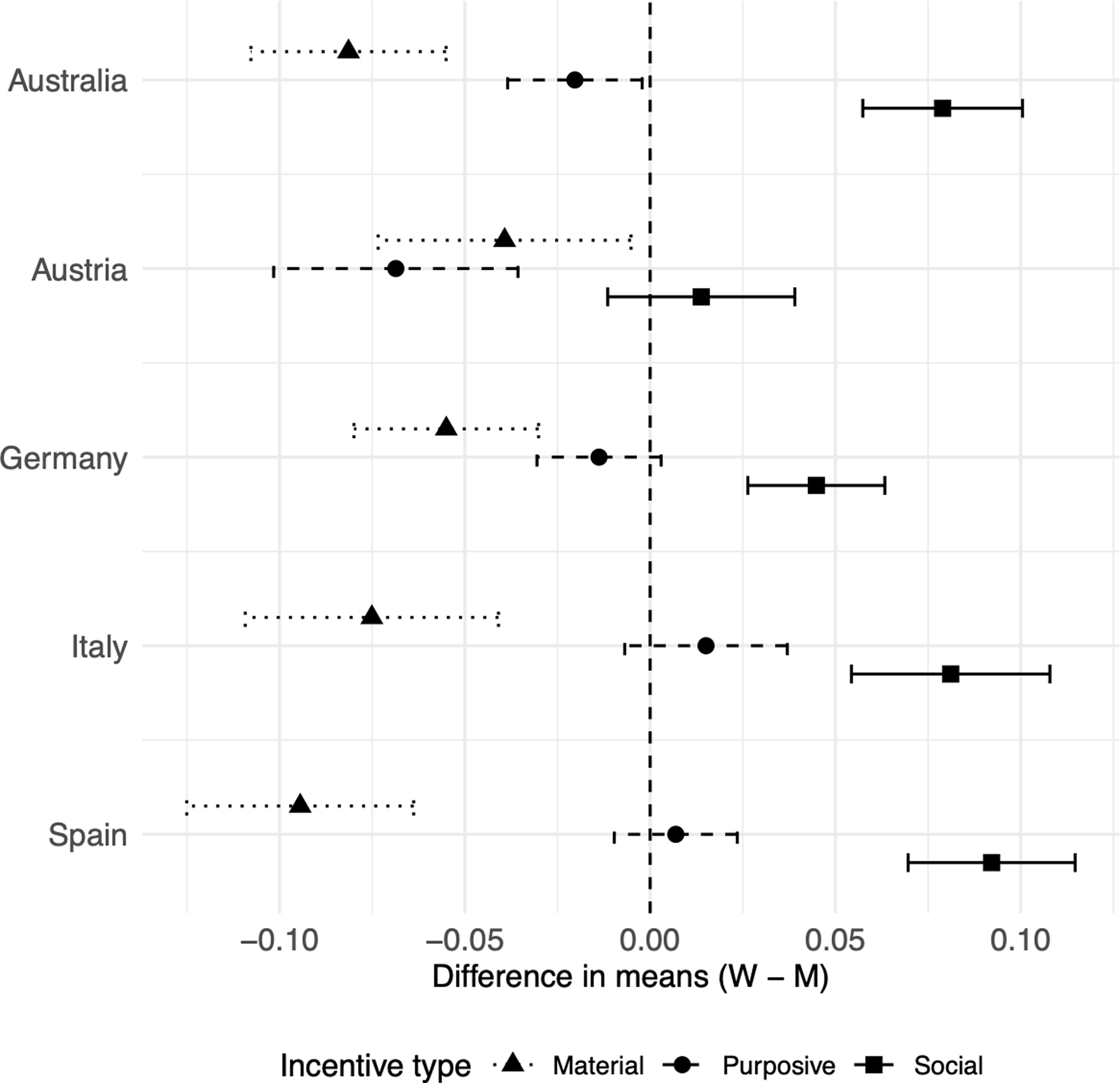
In this section, we use our survey data to investigate whether young women and men join political parties for distinct reasons. We start by comparing the means of our three dependent variables – purposive, social, and material incentives – among young women and men, by country. These differences in means, which are illustrated in Figure 2 below, provide some preliminary partial support for H1. To begin with, young women in all five countries are less likely than men to report material incentives among the reasons why they signed up for the youth wing. While the gender gaps vary across countries, with Spain recording the largest and Austria the smallest, they are all significant, pointing to a very consistent cross-country trend.Footnote 15 Hence, young women seem less interested than men in the potential career benefits of joining. The opposite is true of social incentives. In all countries except for Austria, women are significantly more likely than men to say they joined for these reasons. Furthermore, even in the Austrian sample, the difference-in-means estimate is positive, suggesting that, there too, such motivations are reported more often by women. These preliminary results indicate that, overall, young women are more attracted by the social benefits of being a member. Finally, the evidence for purposive incentives is not as consistent across countries as is the case for the other incentive types. In Germany, Italy, and Spain, there are no significant differences between women and men in the appeal of purposive incentives. In these countries, therefore, young women and men are similarly mobilized by the desire to express their partisan beliefs and support the party. However, in Australia, and even more so in Austria, women are significantly less likely to report having signed up for these reasons. Our gender results are further supported when we split the sample by party ideology instead of country (see Figure F1 in Appendix F).
Gender differences in incentives for joining among young party members, by country.

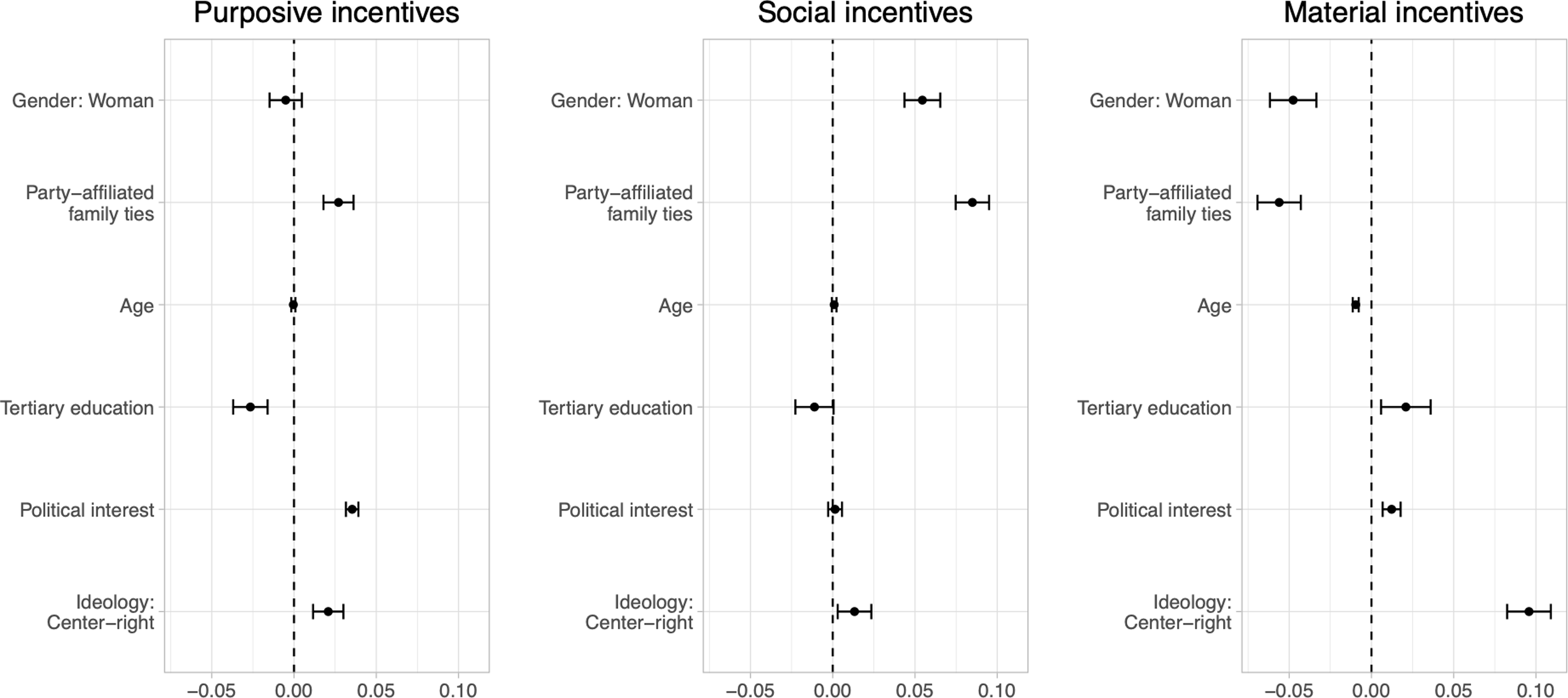
To obtain a more precise estimation of the relationship between gender and reasons for joining (H1), and test whether these gender differences hold when accounting for other factors, we compute a series of OLS regressions with the three sets of incentives as our dependent variables, and gender as the main independent variable. The coefficient plots for these models are displayed in Figure 3 below, and largely confirm the trends observed in Figure 2 above.Footnote 16 In the left-hand plot, which illustrates the model estimating joining for purposive reasons, the gender coefficient does not reach statistical significance. In other words, young women are as likely as men to report purposive incentives among their reasons for enrolling. Moving on to the central plot, gender has a significant and positive effect on joining for social reasons. Namely, when signing up, young women are more driven by the prospect of associating with people who share their political views. Finally, the right-hand plot represents the model predicting material incentives for joining. This shows that being a woman is negatively correlated with enrolling for material reasons, as suggested by the negative coefficient of gender. Young women are thus less likely than men to be attracted by the material rewards that party membership can offer. Overall, these results lend support to H1 and provide strong evidence that young women and men join political parties for different reasons.

Figure 3 also provides insights into the relationship between party-affiliated family ties and incentives for joining (H3). The left-hand plot shows that these ties are positively and significantly correlated with joining for purposive incentives: respondents with close relatives who have been members of a political party are more likely to be mobilized by these ideological and policy rewards. This finding reiterates how families can instill feelings of partisanship and encourage political participation among young people (Verba, Schlozman, and Burns Reference Verba, Schlozman, Burns and Zuckerman2005; Zuckerman, Dasovic, and Fitzgerald Reference Zuckerman, Dasovic and Fitzgerald2007; Jennings, Stoker, and Bowers Reference Jennings, Stoker and Bowers2009). In addition, the central plot indicates that young people with a party-affiliated family background are more likely to join for social reasons. However, this effect disappears when we exclude from the dependent variable the survey item measuring the influence of having relatives in the youth wing (see Table F4, Appendix F). We thus have no evidence that family ties work as a cue signaling to young people that parties are welcoming environments where they can meet people they will like. Lastly, the right-hand plot reveals that party-affiliated family ties are negatively correlated with joining for material incentives – a result which runs against research suggesting that a political family background can foster political ambitions (Fox and Lawless Reference Fox and Lawless2014; Allen and Cutts Reference Allen and Cutts2018; Oskarsson, Dawes, and Lindgren Reference Oskarsson, Dawes and Lindgren2018).Footnote 17 Our results, therefore, provide support for H3 only relative to purposive motivations. We can conceive of three plausible explanations for the unexpected finding regarding material incentives. First, it might be because young people who belong to such families see party membership more as a matter of partisanship – simply something that one does – rather than as a starting point for a political career. Second, it could be the case that parents who have been involved in political parties actively discourage their children from entering politics for material reasons – either because emphasizing these incentives (rather than purposive ones) may be negatively perceived in politically committed households or because parents know these careers can be extremely challenging and stressful. Third, and relatedly, young people who have observed their parents having a negative or unfulfilling candidature experience in the party might conclude that pursuing a career in politics is not something enjoyable.
To corroborate the robustness of our findings, we performed several checks for distinct sample subsets and under different model specifications (see Appendix G). First, we re-estimated our main models by clustering the standard errors by country, rather than by youth wing (Table G1). Second, to ensure that our results hold across national contexts, we re-ran the main models separately for each of the five countries in our sample (Tables G2–G4). We further tested the models on additional sub-samples: one for each party family (Tables G5–G6), one for youth wings with autonomous memberships (Table G7), and one for youth wings whose members must also be members of the party (Table G8). Third, to check that our findings are not sensitive to the operationalization of the dependent variables, we ran binomial logistic regressions using the original eight survey items measuring reasons for joining youth wings as dependent variables (Tables G9–G11). Overall, our results are further corroborated by these tests: in 34 models out of 38, young women are more likely than men to join parties for social incentives, and less likely to do so for material ones, while no consistent gender differences emerge in the appeal of purposive incentives. The only exceptions to these trends are Austria, where we find no significant gender differences in incentives for joining, and Germany and Italy, where young women are significantly less and more likely, respectively, to join for purposive reasons. Nonetheless, the overarching patterns are remarkably consistent across countries, party families, and model specifications, underscoring how young women and men differ in their motivations for joining political parties.
Finally, as an additional analysis, we tested whether the extent to which a party is ‘women-friendly’ shapes the relationship between gender and incentives for joining. For instance, it is plausible that parties with greater numbers of women role models in their upper echelons might foster women’s purposive, social, and material incentives for joining more than is the case for parties with few women in senior positions. To investigate, we create three variables measuring: (1) each party’s proportion of women MPs; (2) whether the party had a woman leader; (3) whether the youth wing had a woman leader (see Table A1, Appendix A).Footnote 18 Specifically, we include in our main models an interaction term between the respondent’s gender and each of the three variables. The results of this analysis are displayed in Table G12 (Appendix G). As the table shows, none of the nine interaction terms’ coefficients reach statistical significance. In other words, the presence of women in leadership positions does not boost young women’s motivations to join political parties.
How family ties moderate the gender gaps in incentives
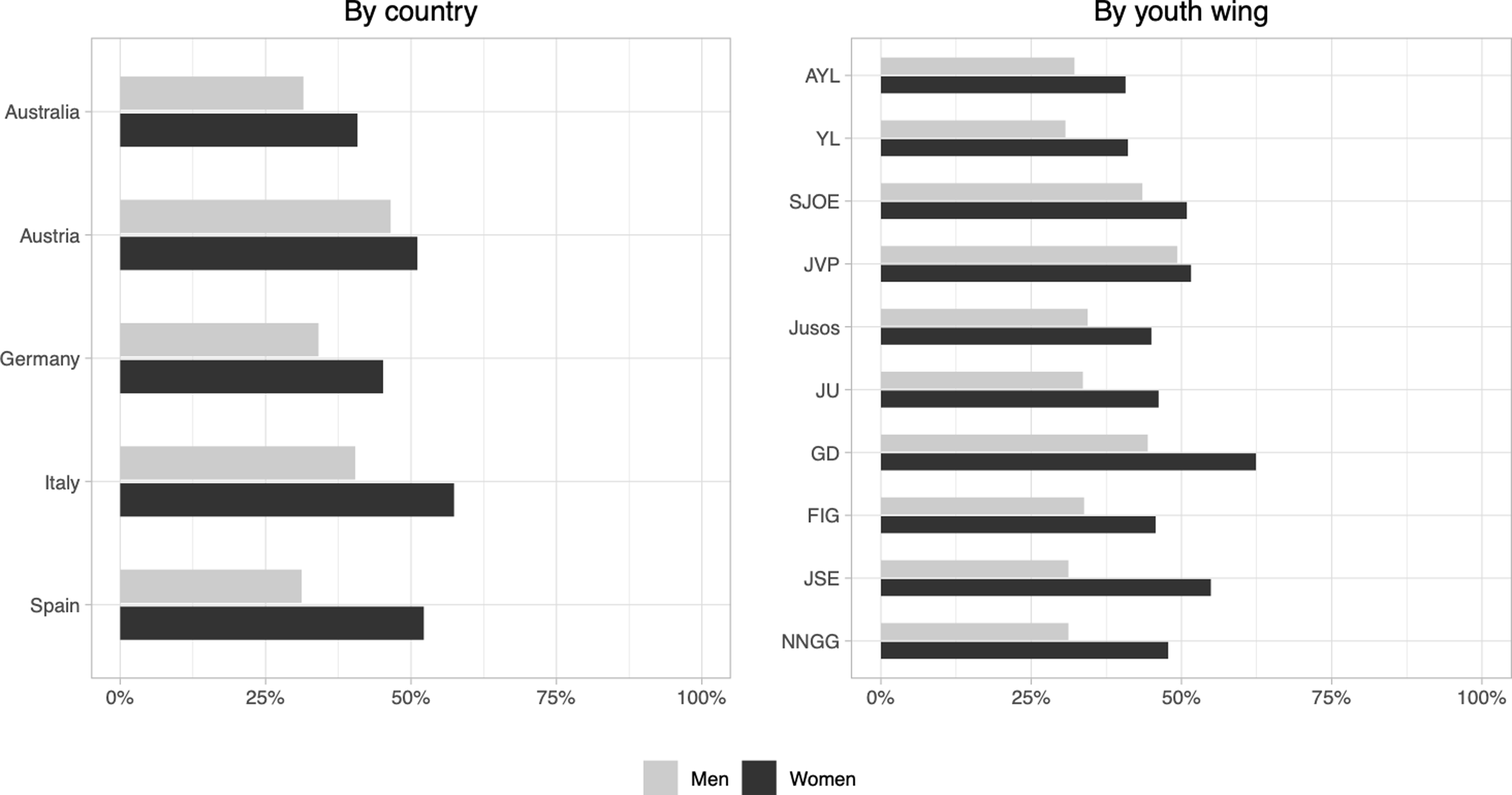
In this section, we test our argument that party-affiliated family ties moderate the relationship between gender and reasons for joining political parties. To do so, we first assess whether, as envisaged in H2, young women indeed have more of these ties before signing up. Figure 4 below, which displays the proportions of young party members with party-affiliated family ties before enrolling by country and youth wing, shows this to be the case. Overall, about 49 per cent of women respondents reported having had someone in their close family who had been a party member, as opposed to 35 per cent of men respondents – a striking 14 percentage point gap. As the left-hand panel in Figure 4 below shows, the trend holds in all five countries surveyed, despite their different political cultures and gender regimes (Morales Reference Morales2009; Woodward Reference Woodward and Magone2014). The countries with the largest gender gaps are Spain (21 percentage points) and Italy (17 percentage points), while the smallest gap is recorded in Austria (about 5 percentage points). In addition, in three countries out of five (Austria, Italy, and Spain), over half of the women respondents said they had party-affiliated family ties at the moment of joining. The lowest percentage of young women with these ties is in Australia, but it is nonetheless quite high (about 41 per cent, which is 9 percentage points more than the respective figure for men).
Proportions of young party members with party-affiliated family ties before joining, by gender.
Note: The right-hand panel lists youth wings in alphabetical order by country, with each country’s center-left youth wing shown first, followed by its center-right counterpart. For example, the first pair includes the Australian center-left and center-right youth wings, the second pair the Austrian ones, and so on. See Table 1 for the full list of youth wing acronyms.

As the right-hand panel of the figure shows, this trend is not only present in all five countries but also in all ten youth wings. In fact, in seven youth wings, the gender gap is over ten percentage points, with the two largest gaps occurring in the Spanish center-left JSE (24 percentage points) and the Italian center-left GD (18 percentage points). The latter is also the youth wing with the largest proportion of women reporting these ties (over 62 per cent). At the same time, the figure reveals no clear gendered trends by party ideology. In three countries – Austria, Italy, and Spain – it is the center-left youth wing that records the largest gap, while the opposite is true in Australia and Germany. When we replicate Figure 4 by splitting the sample into the two party families (see Figure F2 in Appendix F), the overarching trend still holds. In sum, the findings illustrated in Figure 4 provide strong support for our hypothesis that young women party members have more party-affiliated family ties than men (cf. Fox and Lawless Reference Fox and Lawless2014): before joining, young women have often been embedded in a family environment where their parents and/or siblings have been involved in parties themselves.
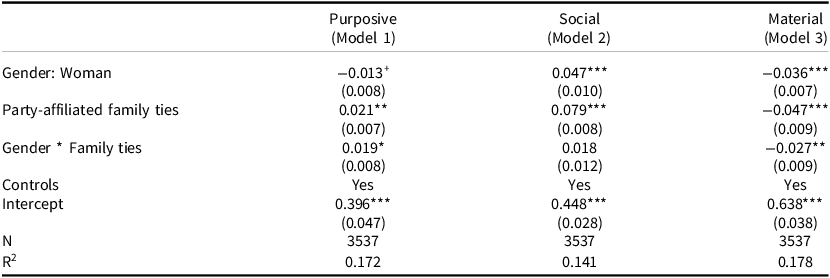
To assess whether party-affiliated family ties moderate the relationship between gender and reasons for joining, we re-run the main models displayed in Figure 3 by adding an interaction between the ‘gender’ and ‘family ties’ variables. The results of these models are displayed in Table 2 below (see Table F6, Appendix F for the full models). As the table shows, we find only partial support for H4, since the interaction term in the model predicting joining for social incentives (Model 2) does not reach statistical significance. Contrary to what we hypothesized, the presence of party-affiliated family ties boosts the social incentives of young women and men in similar ways. At the same time, we find significant moderation effects for purposive and material incentives. The positive coefficient of the interaction term in Model 1 indicates that the positive effect of family ties on joining for purposive incentives is stronger for women than for men. Likewise, the negative coefficient of the term in Model 3 indicates that the negative effect of these ties on joining for material incentives is stronger for women than for men.
OLS regressions predicting joining political parties for purposive, social, and material incentives, with interactions

+p < 0.1, *p < 0.05, **p < 0.01, ***p < 0.001.
Note: Robust standard errors clustered by youth wing in parentheses. The models include controls for age, tertiary education, political interest, party ideology, and country-fixed effects.
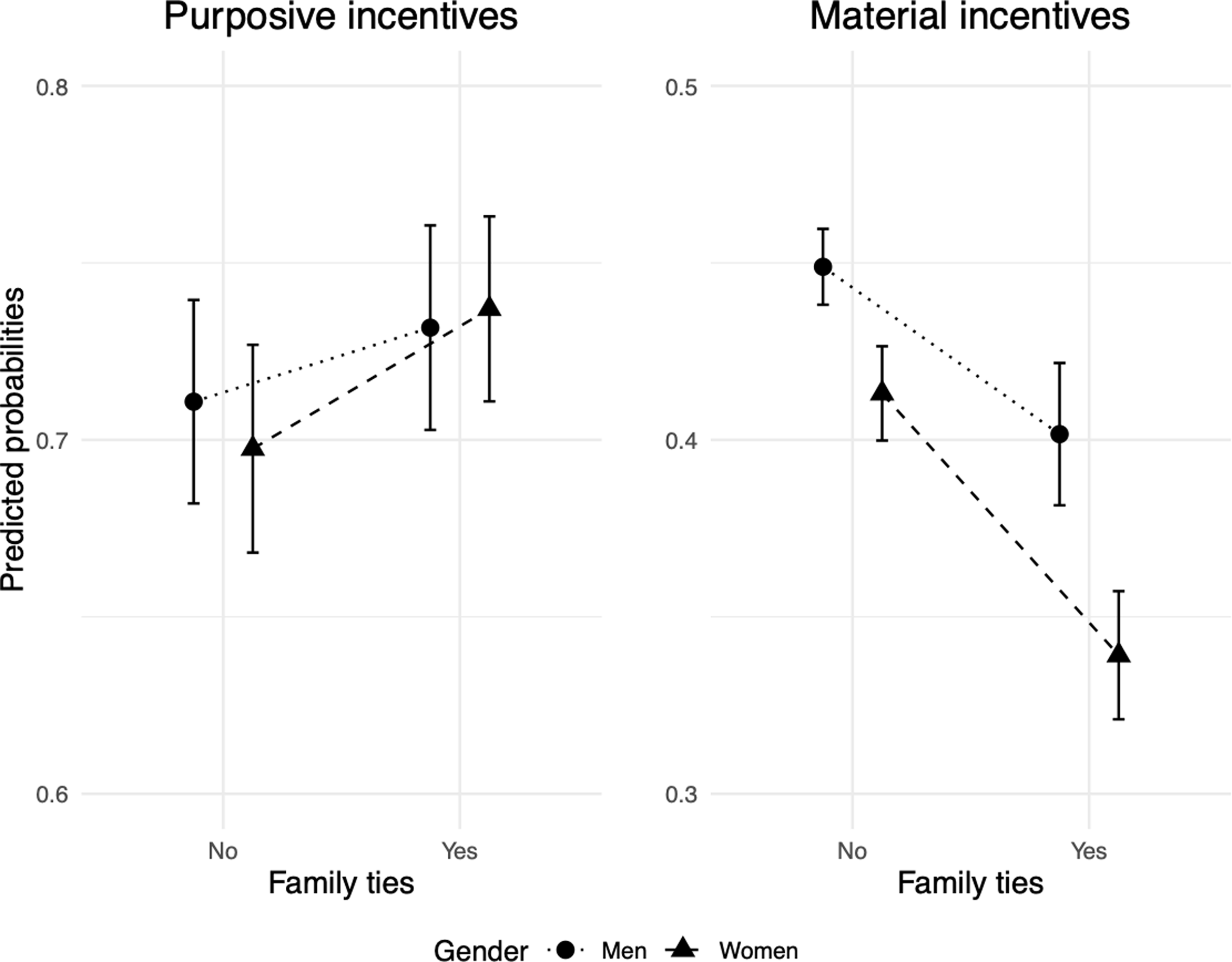
To provide further insights into these results, Figure 5 below displays the predicted probabilities of joining for purposive and material incentives, by gender and party-affiliated family ties. As the left-hand panel shows, while family ties increase the probability of having joined for purposive reasons for both young women and men, the increase is larger among women (4 vs 2 percentage points, respectively). In fact, when we look at the young members who report having had this familial background, the gender gap is reversed, and women report slightly stronger purposive motivations for enrolling in the youth wing. While these effects, albeit significant, are small, those for material incentives are more substantial. The material incentives of both young women and men are reduced in the presence of party-affiliated family ties, with this decline being more pronounced for women. Among women without such ties, the probability of having joined for material incentives is 41 per cent, while among those with such ties, it declines to 34 per cent. Men, in comparison, report a smaller decrease (from 45 to 40 per cent). Overall, these findings provide support for the idea that party-affiliated family ties moderate the relationship between gender on the one hand, and purposive and material incentives on the other; however, in the case of material incentives, they do so in the opposite direction to the one we had envisaged.
Predicted probabilities of joining for purposive and material incentives, by gender and party-affiliated family ties.
Note: Based on Table 2.

Discussion and conclusion
In this article, we addressed the question of whether young women and men vary in their reasons for joining political parties. As part of this, we investigated the role played by party-affiliated family ties. Drawing on the literature on gender and politics, party membership and youth political participation, first, we predicted that women would be more likely than men to join for social incentives and less so for material ones, while they would be similarly mobilized by purposive incentives; and second, we argued that gender differences in motivations for joining would be moderated by the presence of party-affiliated family ties, with women having more of these ties than men. Using YOUMEM survey data from over 3500 party youth wing members in Australia, Austria, Germany, Italy, and Spain, we found solid evidence that young women and men are indeed attracted differently by the three sets of incentives in their decision to sign up. While they are equally likely to join because of the desire to express their partisanship and support the party, women value more the social rewards that party membership offers, and men are more attracted by its career benefits. In addition, young women in all five countries have more party-affiliated family ties than men: that is, prior to enrolling, they are more likely to have had close relatives who have been members of a political party. These ties moderate the relationship between gender and purposive and material incentives for joining. Specifically, they boost women’s purposive motivations more than men’s, but they also suppress women’s material reasons to a greater extent. These findings have important implications for the study of women’s and youth political participation, which we discuss below.
To begin with, our study sheds new light on women’s involvement in political parties by showing that young women’s and men’s motivations for joining are different. The fact that young men are more likely to enroll with a view to a political career is not good news for future gender equality in political parties, since it may exacerbate women’s under-representation among elected representatives and party officials (see also Ohmura and Bailer Reference Ohmura and Bailer2022). At the same time, we found that young women are more attracted than men by the social incentives of being a party member. This finding should be of interest to parties that wish to improve women’s participation within their ranks. First, it indicates that young women will be more receptive to recruitment campaigns emphasizing how parties are venues to meet new people and discuss politics with like-minded peers. Second, it suggests that organizing ‘bring-a-friend/sibling’ type of events for existing members would be especially effective for recruiting more young women. By contrast, campaigns that focus on the possibility of building a political career may appeal less to young women, in addition to attracting more young men (who are already abundant). Given the vital role played by youth wings in socializing and recruiting future party elites, it is important that women’s under-representation in parties is redressed in this early phase of the political pipeline, for instance, with the use of targeted campaigns like those we have mentioned.
Our research has shown that, prior to joining, women possess more party-affiliated family ties than men. This trend is strikingly consistent across all our countries and youth wings. Further research is needed, however, to understand the mechanisms underpinning this trend. In particular, why are women who join parties characterized by this distinctive background? In the theory section, we pointed to two possible explanations: a ‘socialization’ disadvantage – women need more resources to join (see e.g., O’Brien Reference O’Brien2015) – and an ‘outsider’ disadvantage – women see politics as a men’s realm (see e.g., Folke, Rickne, and Smith Reference Folke, Rickne and Smith2021). Future work employing qualitative methods such as interviews and focus groups could investigate, first, the extent to which young women party members feel at a disadvantage in comparison to their men counterparts, and second, how family ties influence these perceptions. Relatedly, it would be interesting to uncover whether the gender of the relative(s) who have been in a party matters. For instance, studies have observed that the intergenerational transmission of political socialization is stronger between parents and children of the same gender (Gidengil, Wass, and Valaste Reference Gidengil, Wass and Valaste2016; Aggeborn and Nyman Reference Aggeborn and Nyman2021). Is it more important, therefore, for women to have women relatives who have been in a party, so that they can be reassured that parties provide a decent environment for them? Research on how party-affiliated family ties work in practice as mobilization agents would provide important insights into women’s perceptions of political parties, and what parties can do to redress them.
Our analysis also revealed an unexpected finding: that having grown up in a family with parents and/or siblings who have been party members has a negative influence on young people’s material incentives for joining. This invites us to problematize the role that this type of familial background can have in shaping political career aspirations – a role that the literature has tended to see as exclusively positive and supportive (Verba, Schlozman, and Burns Reference Verba, Schlozman, Burns and Zuckerman2005; Fox and Lawless Reference Fox and Lawless2014). According to our findings, party-affiliated family ties are better understood as a double-edged sword, as far as the decision to sign up for a party is concerned. On the one hand, they promote a sense of partisan identification and political efficacy, fostering purposive incentives for joining; on the other, they seem to instill a (healthy?) dose of realism about the challenges of embarking on a political career and of being involved in a party beyond the grassroots level. Future qualitative research should delve into the mechanisms behind this finding. As we observed in the results section, it could be a matter of parents and/or siblings sharing their (negative) personal experiences at the kitchen table, and young people developing a rejection toward political careers by being socialized in this type of familial environment. Another possibility is that these young people are more aware of the difficulties of pursuing a career in politics and may be more pessimistic about their career prospects than their peers who did not grow up in politically engaged families. After all, according to our findings, those who join youth wings for material incentives tend to be highly-educated men – a profile which greatly abounds among elected representatives and party officials. This suggests that, ultimately, viewing party membership as a vehicle for a political career may be a matter of perceived opportunities. In addition, studies should investigate why the negative effect of family ties on material incentives is stronger for young women. Is it due to women’s greater sensitivity to their social surroundings (Harteveld, Dahlberg, Kokkonen et al. Reference Harteveld, Dahlberg, Kokkonen and van der Brug2017; Oshri, Harsgor, Itzkovitch-Malka et al. Reference Oshri, Harsgor, Itzkovitch-Malka and Tuttnauer2023), as we hypothesized, or are there other factors at play?
Finally, it is worth acknowledging a couple of limitations of our study that we hope will spur further research on this topic. First, we largely adopted a supple-side perspective. As mentioned in the theoretical framework, however, we are aware that gender differences in incentives for joining parties are likely shaped by both supply- and demand-side factors (Norris and Lovenduski Reference Norris and Lovenduski1995; Kenny and Verge Reference Kenny and Verge2016; van Dijk Reference van Dijk2025b). Although our results indicate that the presence of women role models in the party and youth wing leadership does not significantly foster young women’s motivations, there are other demand-side factors that could be investigated. Some might be easier to gauge, like intra-party voluntary quotas, a well-functioning women’s wing, or tailored party measures aimed at promoting gender-equal participation; while others might be harder, like the extent to which a party’s grassroots culture and informal norms are conducive to women’s engagement. In any case, irrespective of how difficult they are to measure, all of these elements could play a role in determining why young women and men join parties for different reasons. Second, while our research focused on two party families, which in most Global North countries represent the main parties of government and opposition, future work could replicate our study on non-mainstream party families, for instance, the Greens or the populist radical right. If demand-side factors are indeed relevant to explaining gender differences in incentives for joining, this type of work could be revealing, since parties on the (radical) left tend to be much better at promoting women’s participation than parties on the (radical) right (Erzeel and Celis Reference Erzeel and Celis2016; Pruysers, Cross, Gauja et al. Reference Pruysers, Cross, Gauja, Rahat, Scarrow, Webb and Poguntke2017; O’Brien Reference O’Brien2018). In sum, there is much more to learn about young women’s involvement in the political parties of today, which can provide insights into how to have more gender-equal parties, parliaments, and cabinets tomorrow.
Supplementary material
The supplementary material for this article can be found at https://doi.org/10.1017/S1475676526100978.
Data availability statement
The quantitative data that support the findings of this study is openly available in Harvard Dataverse at the following link: https://doi.org/10.7910/DVN/IFMGFU.
Acknowledgements
We would like to thank Hugo Ferrinho Lopes, Michal Grahn, Jennifer Piscopo and Željko Poljak for their extensive feedback on previous drafts of this article. We are also grateful to the participants of the 2024 EPSA Annual Conference, the 2024 European Conference of Politics & Gender, the 2024 AusPSA Youth & Politics workshop in Brisbane, the 2024 Aarhus University Youth & Politics workshop and the 2024 AusPSA Annual Conference for their helpful comments, questions and suggestions.
Funding statement
We did not receive any financial support for this study.
Competing interests
There are no competing interests to declare.
Ethics approval statement
This study was approved by the Griffith University Human Research Ethics Committee (Ref. No. 2016/160). All participants ticked a box on the survey indicating their informed consent prior to participating.


 Open access

