
In 2006, as part of salvage excavations accompanying the Yangzi River diversion mega-project, a Shang village site of the Anyang period (c. 1250–1050 BC) was discovered and almost completely excavated over the course of two years. This site—Guandimiao—located near Zhengzhou in Xingyang county, was recognised as one of China's top-ten archaeological discoveries of 2007. Arguably, however, its real importance has yet to be fully appreciated. The significance of this site for the study of the Shang polity at Anyang and thus, by extension, for the archaeology of early China, resides in the fact that very few Chinese Bronze Age (c. 2000–600 BC) village sites have been excavated—and none for the Anyang period specifically. Indeed, the site's top-ten status among the discoveries of 2007 rested largely on this unique status. Yet Guandimiao is far more important than simply a fine new addition to China's list of archaeological sites, or because it fills a Shang settlement-type lacuna. If an ancient civilisation is known predominantly through its elite centres, then excavating a small rural site should provide useful new information concerning non-urban, non-elites. Nevertheless, it is only when confronted with the actual data from such a site that the full extent of the missing information becomes apparent. Here, we present the preliminary results from ongoing work at Guandimao, and discuss the new information it provides about the Shang polity at Anyang.
Before the discovery of the oracle-bone inscriptions in 1899 and the excavation of Anyang nearly three decades later, the Shang dynasty (c. 1650–1050 BC) was known only from first-millennium BC texts. The excavations at Anyang (1928–1937) and the discovery that the names of kings and ancestors recorded in the oracle-bone inscriptions matched the Shang king lists of Chinese tradition (Wang Reference Wang1923) established the historicity of the Shang dynasty and vindicated the traditional historiography—at least for most scholars of Chinese archaeology. The contemporaneous discovery at Anyang of palatial foundations, caches of writing and monumental tombs replete with sacrificial victims established the site—and ancient China generally—within a comparative framework that included ancient Sumer, where Woolly was making his spectacular discoveries at Ur, and Egypt, where Carter had only recently opened Tutankhamun's tomb. From this point on, the Shang dynasty has lived a dual existence as the object of comparative study (whether as an ‘ancient civilisation’ or ‘archaic state’), and, as the second of the Three Dynasties of traditional Chinese historiography, which has strongly shaped Chinese archaeology, especially of the second millennium BC and later periods (von Falkenhausen Reference von Falkenhausen1993; Bagley Reference Bagley, Loewe and Shaughnessy1999; Liu & Chen Reference Liu and Chen2012).
In mainland Chinese scholarship, which produces the vast majority of archaeological and textual research on ancient China, the comparative and historiographic understanding of the Shang dynasty come together most frequently with the addition of some form of evolutionism. The traditional historiographic and evolutionary frameworks combined in the service of national history have ironically created a tendency to ignore research on non-elites. The traditional sources that influence Chinese archaeology's historiographic orientation are largely concerned with the activities of kings and ministers. Simultaneously, if the nature of non-elites can be determined on the basis of each historical stage and its characteristic mode of production (slave or feudal), then there is no need to study specific instances of non-elite life. Thus, the Institute of Archaeology's synthesis of second-millennium BC archaeology, Chinese archaeology: the Xia and Shang (Zhongguo 2003), delivers a largely culture-historical narrative focused on the sites of the Central Plains that are believed to be the sequential capitals of the Xia and Shang dynasties (Campbell Reference Campbell2014). The majority of the section dedicated to the economy of the Anyang period (Late Shang in their terminology) describes elite material culture, with only two sentences addressing village life. These state that the Shang economy was based on agriculture; the hundreds of small Shang culture sites discovered by survey beyond major centres should therefore be agrarian hamlets (Zhongguo 2003: 300). At the time that volume was written, however, virtually the only second-millennium BC sites in the Central Plains that had seen major excavation were elite centres—and much of that work was focused on tombs.
Both paradigms of traditional historiography and evolutionism are evident in the monumental ten-volume Shangdaishi (Shang dynasty history), assembled over a decade by a team of historians at the Chinese Academy of Social Sciences (Song Zhenhao Reference Song Zhenhao2010). While liberally citing Marx, volume six—Shangdai jingji yu keji (Shang dynasty economy and technology) (Yang & Ma Reference Yang and Ma2010)—presents an encyclopaedic array of textual evidence ranging from contemporaneous oracle bones to much later sources, synthesised with a wide range of recent archaeological materials. Nevertheless, it is assumed that beyond the large centres, the small yi-settlements mentioned in the Shang oracle-bones inscriptions were agricultural villages: “the remnants of the primitive society period's agricultural communes” (Yang & Ma Reference Yang and Ma2010: 169). Conversely, trade and commerce are claimed to be well developed in the Shang dynasty, as the name ‘Shang’ and the word for ‘merchant’ in later Chinese texts are one and the same (or at least written with the same graph) (Yang & Ma Reference Yang and Ma2010: 448). The Lüshi Chunqiu (c. third century BC) mentions commerce in the previous Xia dynasty (c. twenty-first to seventeenth centuries BC) (Yang & Ma Reference Yang and Ma2010: 449). Cowry shells may have been used as currency during the Shang dynasty, indicating a monetised economy (sic), and Shang mortuary treatment shows great inequality, thereby demonstrating that Shang society, although still kinship-based, had moved beyond the stage of primitive equality (Yang & Ma Reference Yang and Ma2010: 451). The argument, therefore, is driven almost entirely by interpretations derived from texts post-dating the Shang dynasty by hundreds of years, and is guided by nineteenth-century evolutionary frameworks; direct, contemporaneous evidence concerning either villages or trade is nearly completely absent.
In summary, the historiographic orientation, elite source bias (whether archaeological, palaeographic or received-textual) and evolutionary frameworks have all provided Chinese scholars with little reason to study actual Shang-dynasty villages or the political economic networks in which they were enmeshed. While Chinese scholarship is vast and far from monolithic, if there is a consensus concerning the nature of Shang-dynasty villages, it is that they were self-sufficient agrarian hamlets, unconnected to the wider political economic networks of tribute and trade that sustained elite consumption patterns.
If Chinese scholarship on the Shang dynasty has been credulous of traditional historiography and transmitted sources, Western scholarship has tended to be critical to the point of rejection (e.g. Bagley Reference Bagley, Loewe and Shaughnessy1999). Moreover, with foreign participation in Chinese archaeology impossible until the 1990s—and even now a relatively minor component of archaeological work in China—Western scholars have relied predominantly on second-hand, often out-dated archaeological information. That English-language narratives concerning the Shang polity/civilisation have been issued through the interpretive conduit of a small group of scholars compounds these issues. The most influential of these researchers remain the archaeologist K.C. Chang and oracle-bone historian David Keightley. Chang (Reference Chang1983: 8) famously argued that Shang—and Chinese civilisation more generally—was characterised by the accumulation of wealth based on political, rather than economic, innovation, with its sources to be found in “exclusive access to gods and ancestors”, kinship hierarchies, moral authority, military power and wealth itself. Keightley, on the other hand, described the Shang polity as “a network of pathways” (Reference Keightley and Keightley1983: 548), “a patrimonial theocracy” (Reference Keightley, Lowe and Shaughnessy1999: 289) and a “proto-state” ruled by a king, “functioning like a ‘big man’ of a pre-state chiefdom” (Reference Keightley, Lowe and Shaughnessy1999: 290).
This influential, but outdated, Western perspective views the Anyang-period polity and its civilisation as a royal monopoly of ritual and coercive power, its political-economic structures fundamentally elite-oriented, segmentary and kinship-based; the integration of the wider population through mass armies, bureaucracies and markets did not appear until the mid first millennium BC. Liu and Chen (Reference Liu and Chen2003, Reference Liu and Chen2012) offer a different narrative, in which the earlier Central Plains sites of Erlitou (c. 1850–1600 BC) and Zhengzhou (c. 1650–1400 BC) are seen as the capitals of vast, centralised bureaucratic states, while the polity of Anyang is a decentralised, diminished successor (see also Bagley Reference Bagley, Loewe and Shaughnessy1999). This account leaves essentially untouched the older paradigm concerning a politically and economically underdeveloped Anyang.
More recently, international collaborative work at Anyang has demonstrated problems with many aspects of the old narrative. It is now known that Anyang was an extraordinarily vast (30km2) centre of population and large-scale industry, in addition to a site of elite burial and ritual (Zhongguo 2003; Tang & Jing Reference Tang and Jing2009, Jing et al. Reference Jing, Tang, Rapp, Stoltman and Underhill2013; Campbell Reference Campbell2014). The royal tombs at Anyang are far larger and richer than those of any earlier Chinese Bronze Age centre, while evidence for mortuary rituals shows much greater inequality (Campbell Reference Campbell2014, Reference Campbell2018). Anyang's workshops and their output dwarf anything hitherto seen within East Asia (and perhaps worldwide). At least one of the major industries—bone working—produced enormous quantities of quotidian goods for widespread consumption (Campbell et al. Reference Campbell, Li, He and Yuan2011; Li et al. Reference Li, He and Campbell2011). Weapons and warriors were distributed widely in Shang lineages, suggesting that warfare should be considered a social, rather than elite, institution (Campbell Reference Campbell2009, Reference Campbell2018; contra Lewis Reference Lewis1990). Ritual, whether in terms of sacrifice, divination or mortuary elaboration, was an arena of universal (if graded, i.e. dictated by status) participation (Campbell Reference Campbell2009, Reference Campbell2018). Combined, these new findings refute the notions that: Anyang was a pale, decentralised shadow of Zhengzhou (Erligang), or was primarily a ritual centre; that war and sacrifice were monopolies of those of high status; and that the Shang economy was elite-centred and underdeveloped at the grassroots level.
The Guandimiao site
The site of Guandimiao lies 18km south of the Yellow River, near the modern city of Zhengzhou and 200km south-west of Anyang (Figure 1). A total of 20 300m2 has been excavated, most of which dates to Anyang periods I–III (c. 1250–1100 BC), based on well-established local ceramic sequences and analogues from Anyang (Henan 2008, 2009). Additionally, the site has yielded remains dating to the Yangshao (c. 5000–3000 BC), the Western Zhou (c. 1050–771 BC), the Eastern Zhou (1050–221 BC), the Han (206 BC–220 AD), Tang (618–907 AD), Song (960–1279 AD) and Qing (1644–1912 AD) dynasties. The most significant evidence, however, comes from excavation of the Anyang-period village (Figure 2) (Henan 2008, 2009).
The location of the Guandimiao site.

Guandimiao, Xingyang site map (source: Henan Kaogusuo, redrawn by Koken Ishii).

Site layout
One of the dividends of Guandimiao's large-scale excavation is the provision of an unusually clear picture of the layout of an Anyang-period village. The remains can be divided into three phases, corresponding to Anyang periods I–III based on ceramic comparison and correlation with site stratigraphy. Remains of the first phase are concentrated in the western part of the site (Figure 2). During the second phase, a narrow encircling ditch or trench was constructed, and the remains of this phase—which make up the majority of the Anyang-period remains—were enclosed within this space. During the third phase, the occupation spread beyond the ditch. The area of phase II activity enclosed by the ditch is approximately 2.5ha. This allows an estimation of site size and suggests that roughly three-quarters of the original village have been excavated. Examining site layout from the perspective of feature density, the northernmost three-quarters of the village appear to lie within the excavation area, with features becoming sparser towards the edges in every direction, except the south-west.
Overall, the settlement appears to have a basic, if informal, layout. The majority of the houses are located in a residential area in the north-west section of the site, along with almost half of the kilns. The rest of the kilns are scattered across the site, with another concentration in the north-east, near the cemetery. Although burials are distributed across the site, they cluster in two main areas: a relatively dense and orderly cemetery area just beyond the eastern encircling ditch and the high ground to the south-west of the excavation (which may have also been a sacrificial area). Sacrificial pits are distributed across the site, but as with the tombs, they also cluster in the south-western excavation area. Also associated with this south-western sacrificial area is a dense distribution of ashy lenses with charcoal inclusions, suggesting practices involving fire. There are a large number of wells distributed evenly across the site, and packed-earth roads or paths lead into the village through an 8m-wide gap in the middle of the southern section of the encircling ditch (Figure 2). Future work will undoubtedly clarify this preliminary picture.
Residential structures
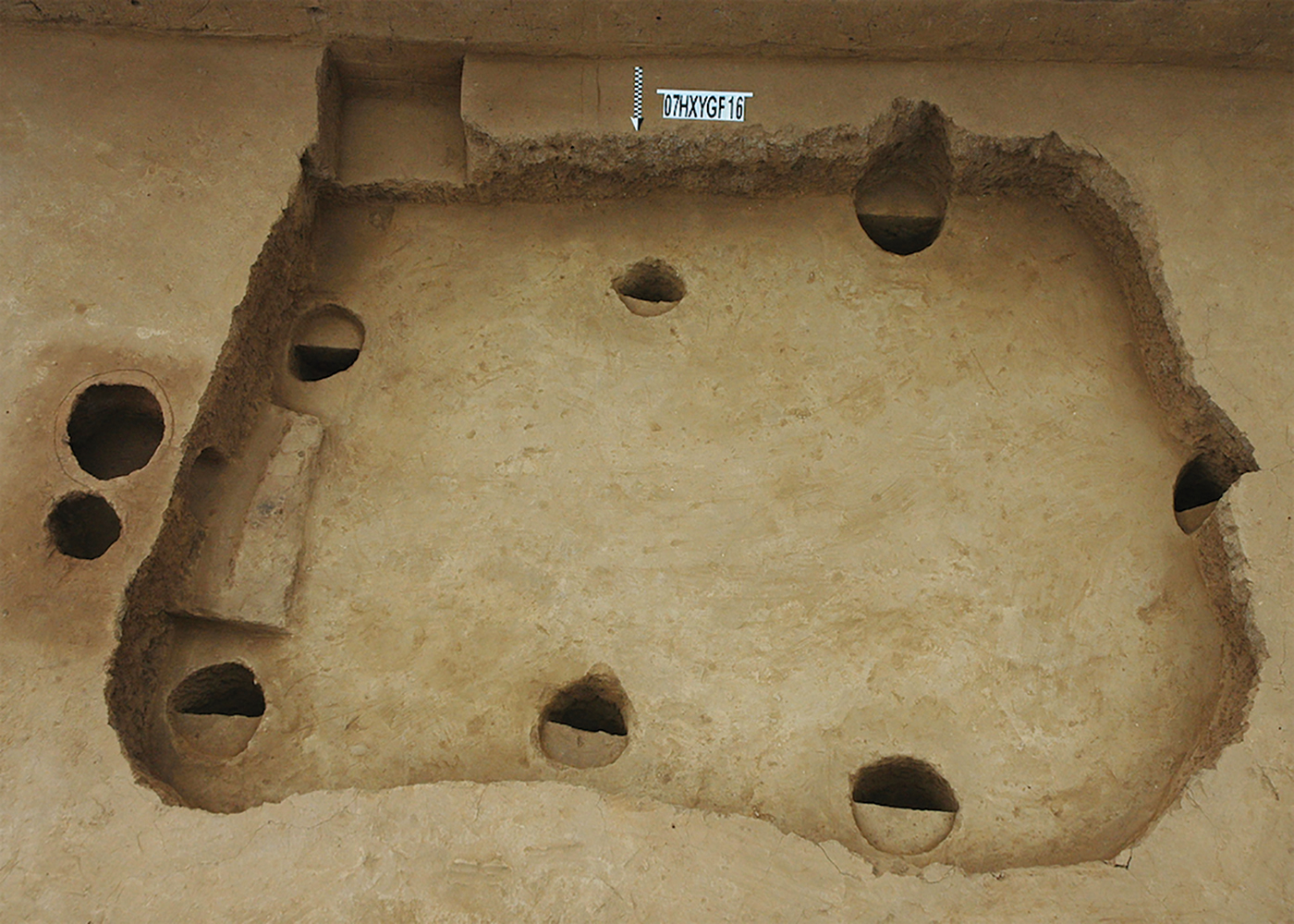
A total of 22 Anyang-period houses have been excavated at Guandimiao. They are all small (5–7m2) rectangular or circular semi-subterranean structures lacking any surviving superstructure (Figure 3). Each house had a hearth, most commonly associated with a fire pit below floor level. Some of the houses had niches with holes for torches and associated charcoal remains. Although a few of the house floors exhibited rows of postholes, the majority were too badly damaged by later activities to determine the presence or absence of this feature. The nature of the superstructure that must have covered these pit houses remains unknown (Henan 2008, 2009). Each house had a south-facing ramp or stairs leading from the semi-subterranean living floor to the ground level. Given the size of the houses, the residential unit could not have been larger than a nuclear family; the cramped dimensions would have restricted the inhabitants to cooking meals, eating and sleeping. Assuming that three-quarters of the original site have been excavated, and thus 75 per cent of the houses represented, a rough estimate of Guandimiao's population would be: 29 houses divided across three phases (assuming one phase was the lifetime of a semi-subterranean house) and multiplied by five persons per house, to equal an average population of 48 inhabitants at any one time. As most of the remains date to phase II, however, the peak population may have been higher than this, but probably never more than 100.
House F16, Guandimiao (photograph by Henan Kaogusuo).

Production remains
One of the most remarkable discoveries of the Guandimiao excavations was the remains of 23 updraft kilns and abundant pottery-manufacturing debris (Figure 2). The kilns were semi-subterranean, each with a kiln chamber connected to a firebox by a grate with 4–8 rectangular vents around the circumference and a single circular vent in the middle. None of the kiln roofs survived. The ceramic sherds associated with the kilns suggest a division of production, with sand-tempered and untempered wares fired in different locations. A large pit was associated with each kiln and characterised by relatively sticky sedimentary deposits with a near-complete lack of material cultural debris. These pits may have been used for clay preparation (Henan 2008, 2009).
Kiln 1 (Figure 4) was one of the better-preserved examples and can be considered representative of this feature type at Guandimiao. The working pit and fire gate were located on the east side of the kiln, on the same level as the firebox. The obloid-shaped, relatively large, firebox (1.7m long, 1.3m wide and 0.68m tall) was located immediately below the kiln. In plan, the kiln chamber was circular, with the walls converging towards the top. The kiln chamber was 1.56m in diameter at its base, surviving to a height of 1m and suggesting a volume of over 2m3. The grate between the firebox and the kiln chamber was approximately 0.11m thick, with four rectangular vents evenly spaced around the circumference (0.4–0.48m × 0.2–0.28m) and a 0.21m-diameter single circular vent in the centre. Many of the vents were plugged by dampers of fired clay. Wasters associated with this kiln were all pen-basins, guan-jars and other non-cookware fine-paste ceramics (Henan 2008, 2009).
Kilns Y1 and Y2, Guandimiao (photograph by Henan Kaogusuo).

Wells
A further striking feature of Guandimiao village was the number of wells—32 were excavated. This large number probably reflects the lack of (known) rivers close to the village; the wells would have supplied water for residents, livestock and pottery production, although this requires geoarchaeological confirmation. The apparent location of Guandimiao away from a waterway is notable, considering that second-millennium BC settlements in northern China were frequently located along rivers. The wells at Guandimiao fall into two broad types: deep and relatively narrow shafts, and cistern-like structures with large openings and an even larger chamber beneath (Figure 5). J12 and J7 can be considered representative of the two well types. J12 had a sub-circular opening (2.2 × 1.8m) leading to a rectangular shaft (approximately 2 × 1m) located 0.8m below. This shaft descended 4.4m, with 11 steps cut alternately into the north and south walls (six north, five south) (Figure 5). At approximately 5m deep, J7 had a large, round-cornered rectangular opening (3.27 × 2.63m), and a long shaft, leading to a cistern-like chamber (Figure 5). While these well morphologies suggest different functions (Henan 2008, 2009), J12 is a more typical north Chinese residential well, and is located near the centre of the site, away from any houses. The size and form of J7, however, might suggest industrial uses. It is located on the edge of the north-west residential cluster, although still in proximity to the kilns of that sector.
Wells J7 (left) and J12 (right) (after Henan 2008: 36, figs 5–6).

Storage and waste disposal
The Anyang-period remains at Guandimiao included 1472 pits of various shapes, sizes and function, although storage and waste disposal were probably the main functional categories. While a finer-grained understanding—based on spatial, ceramic, soil, zooarchaeological and palaeoethnobotanical analyses—awaits, a broad distinction can already be drawn between pits with carefully prepared walls and floors (sometimes with niches, ledges or stairs), and those of irregular shape. While the former were almost certainly used for storage, the latter were probably dug for waste disposal, in addition to the aforementioned clay-preparation pits and sacrificial deposits.
Ritual remains
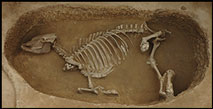
Another remarkable feature of the village was the unexpected richness of its ritual remains. Seventeen circular or sub-circular sacrificial pits were discovered. Most of them contained whole or dismembered cattle (Figure 6), although some contained pig and, occasionally, human remains. These deposits were concentrated in the south-western part of the site on high ground, in what may be a sacrificial area. The sacrificial pits were filled with relatively sterile soil and covered with an ashy deposit. Many other pits in the area were filled entirely with ash and charcoal; one of these (H500)—a massive 400m2 ashy deposit—included a complete turtle plastron (shell) and a cattle scapula, both of which had been prepared and used for oracle-bone divination (Henan 2008). A clearer understanding of the exact nature of the ritual activities at Guandimiao awaits a full analysis of the site and its remains. It is, however, already apparent that this small village—not associated with Shang royalty or other high elites—had a well-developed local ritual life. This contradicts the popular but now outdated view that the Shang kings ruled through a theocratic monopoly. Indeed, 68 oracle-bone fragments (NISP) from a minimum of 32 whole oracle bones (MNE) were recovered, representing 42 per cent of the worked bone assemblage by fragment (Hou et al. Reference Hou, Campbell, Zhang, Li, Li and He2018). Although they mirror the form of uninscribed oracle bones found at Anyang (Flad Reference Flad2008), these oracle bones show differences in the tools and methods used in their preparation. The presence of semi-processed oracle bones suggest that they were the work of a local diviner (Hou et al. Reference Hou, Campbell, Zhang, Li, Li and He2018).
Sacrificial pit: H906, Guandimiao—cattle, missing scapula (photograph by Henan Kaogusuo).

Burials
As described above, the Anyang-period burials at Guandimiao fall roughly into two groups: those clustered densely in the cemetery across the eastern section of the phase II ditch; and those scattered across the rest of the site—including the residential area—but particularly concentrated in the south-east, adjacent to the sacrificial area. The 228 excavated Anyang-period tombs are all rectangular pits, some exhibiting ledges and ‘waist pits’, and there are a minority with coffins. Most of the burials had rammed-earth fill, and some were accompanied by dog sacrifices, typically placed in a small pit below the waist of the deceased (i.e. ‘waist pit’), but sometimes on the ledges or within the grave fill. All of these features are typical of small- to medium-sized Shang-tradition shaft tombs (Tang Reference Tang2004; Campbell Reference Campbell2018). What is unusual when compared to Anyang tombs of the same size and structure is the lack of grave goods. While most of the burials contained no grave goods, a few had a cowry shell placed in the deceased's mouth or hand; only three tombs had a single ceramic vessel. The largest tomb, M3 (Figure 7), had ledges, a waist pit, inner and outer coffins and three sacrificial dogs. It also contained a bronze arrowhead, a small bronze bell (placed on a ledge) and a piece of worked shell beside the deceased's head. In comparison, more than 90 per cent of the tombs at Anyang were equipped with grave goods, although only seven per cent had ledges and inner and outer coffins (as with M3 at Guandimiao), and those that did typically had rich burial assemblages, including bronze vessels, weapons and jades (Tang Reference Tang2004; Campbell Reference Campbell2018). Thus, while seeming to follow general Anyang practices with respect to burial structure and sacrificial offerings, the inhabitants of Guandimiao either did not wish, or were unable, to follow Anyang's metropolitan standards in terms of grave goods. This is particularly surprising given the evidence of extensive ceramic production at Guandimiao.
Burials: tomb M3, Guandimiao—plan and profile views (after Henan 2008: 37, fig. 7).

The large number of Anyang-period tombs (228) and the length of site occupation (approximately 150 years) suggest that roughly seven and a half 20-year generations of villagers lived at Guandimiao. At least 30 individuals per generation were therefore buried at Guandimiao (228/7.5 = 30.4)—and probably closer to 35 when the unexcavated quarter of Guandimiao is included. As more than one generation would have been alive at the same time and as the site was most intensively occupied in phase II, an approximate maximum population estimate from the burials might be as high as 100 (comparable to the estimate based on from houses, above).
Material culture
Preliminary analysis of the Guandimiao artefact assemblages shows that they were typical for an Anyang-period, Anyang-variant, Central Plains Metropolitan Tradition site (Zhongguo 2003; Campbell Reference Campbell2014). The ceramics mostly resemble those of Anyang phase II and include li tripods, guan pots, zeng steamer-bowls, yan steamers, pen basins, gui footed-bowls, gu goblets, dou stemmed-plates, bo bowls, ladles, as well as net weights and pottery paddles (Figure 8). A systematic study of the Guandimiao ceramic assemblage is in progress. The initial impression is one of an overwhelming predominance of li-tripod cooking vessels and very few fine-paste serving vessels associated with house and midden features. This is despite the fact that fine serving ware seems to dominate the kiln waster assemblages, and may suggest that the Guandimiao potters produced ceramics predominantly for consumption elsewhere.
Guandimiao ceramics. Li-tripods) 1–3, 5–7, 9, 10, 12, 16; yan-steamers) 4 & 17; ben-bowls) 8 & 13; gui-vessels) 11 & 15; pen-basin) 14; guan-jar) 18 (from Henan 2008: 42, fig. 15).

The stone artefacts recovered include sickles, axe/adzes, chisels and grinding stones. These represent domestic tools typical of Anyang-period Central Plains sites of all sizes (Figure 9) (Zhongguo 2003; Campbell Reference Campbell2014). Shell artefacts include sickles and spades, while bone artefacts comprised (in addition to the oracle-bones mentioned above), hairpins, arrowheads, awls, spatulas, knives and spades (Figure 9). Although the bone artefact assemblage is unremarkable typologically, a preliminary study demonstrates that it can be divided into two categories: crude, locally made tools, and the products of large-scale, highly specialised workshops (Hou et al. Reference Hou, Campbell, Zhang, Li, Li and He2018)—workshops that have thus far only been found at Anyang (Campbell et al. Reference Campbell, Li, He and Yuan2011; Li et al. Reference Li, He and Campbell2011). In addition to this evidence for the long-distance exchange of selected bone artefacts (hairpins and arrowheads), the scarcity of bone arrowheads at Guandimiao was also remarkable; only two were recovered. The general lack of weapons is also reflected in the sparse bronze assemblage, which, in addition to the bronze arrowhead and bell found in tomb M3, comprises another arrowhead and a single ring-handled knife recovered from other contexts. The total number of (potential) weapons recovered consists of four arrowheads (two bone, two bronze) and a small knife—an insignificant quantity compared to any similarly sized excavation area at Anyang, and paling in comparison to the thousands of weapons accompanying the burials of some Shang elites.
Tools and small artefacts: 1) stone ceramic stamp; 2) stone chopper; 3) bone knife; 4) bone spatula; 5–6) decorated bone hairpins; 7) undecorated bone hairpin; 8) stone sickle; 9) bronze arrowhead; 10) antler awl; 11–12) shell sickle; 13) ceramic stamp; 14) stone blade; 15–17) shell blades; 18) shell sickle; 19) stone adze; 20) ceramic spindle whorls.

Zooarchaeological assemblage
Zooarchaeological analysis of the Guandimiao materials provides some surprising results. The first unusual feature—at least in comparison with Anyang assemblages—is the relative scarcity of animal remains at the site. The NISP for Guandimiao is 4291 fragments—roughly one-tenth of the size of the zooarchaeological assemblage from the contemporaneous and similarly sized non-elite residential locus of Xiaomintun at Anyang (Li Reference Li2009). Compared to even non-elite urbanites, such as those at Xiaomintun, the villagers at Guandimiao were apparently consuming little meat. It is also surprising that, given the connection between Anyang-period Shang cattle and elite sacrifice and feasting (Li Reference Li2008; Campbell et al. Reference Campbell, Li, He and Yuan2011), cattle were the most common taxa by NISP (38 per cent) in the Guandimiao zooarchaeological assemblage. It is that possible that Guandimiao, and sites like it, may have raised cattle for elite centres (Li Reference Li2009; Li et al. Reference Li, Campbell, Brunson, Yang, Tao and Greenfield2014; Campbell & Li Reference Campbell, Li, Atici and Arbucklein press). There was also a relative paucity of wild taxa at Guandimiao (fewer than 2 per cent by NISP), which corresponds with the near lack of arrowheads. While a fuller discussion awaits publication of the zooarchaeological analysis, preliminary observations of animal use at Guandimiao are that cattle were raised at or near the site, livestock were only occasionally consumed and hunting was rare.
Discussion
The preliminary results from Guandimiao provide a new insight into the form and development of an Anyang-period village site. Inhabited continuously for approximately 150 years, Guandimiao reached its zenith in phase II (in the early twelfth century BC). With a population probably never exceeding 100 inhabitants at its peak, Guandimiao was a tiny settlement. Nevertheless, with approximately one kiln and one and a half wells per household, it was clearly a site specialised in ceramic production. As the relative abundance of cattle remains in an otherwise sparse zooarchaeological assemblage suggests, some cattle and pig husbandry was practised. Moreover, despite the distance from the mega-centre at Anyang, this tiny village acquired some of its finished goods from the distant workshops of the capital (Hou et al. Reference Hou, Campbell, Zhang, Li, Li and He2018).
Survey of the surrounding area has demonstrated that Guandimiao—located in what was once the metropolitan area of the Erligang period (Zhengzhou had, by this time, lost its urban, elite character (Zhongguo 2003; Campbell Reference Campbell2014))—was only one in a constellation of small Anyang-period sites (Henan 2009). Many questions remain unanswered. Did Guandimiao supply pottery to the region? Were its stone tools produced in another village specialising in lithic manufacture, such as the Erlitou-period Huizui (Liu et al. Reference Liu, Chen and Li2007)? Did its few bronze artefacts come from metropolitan workshops? If the village was raising cattle for elite consumption, were they taken all the way to Anyang, or were they consumed at some as yet undiscovered regional elite centre? If lineages were the basic Shang social unit and these were communities of the living and dead, of sacrifice and of war (Chang Reference Chang1980; Keightley Reference Keightley2000; Campbell Reference Campbell2009, Reference Campbell2018), why were the Guandimiao villagers apparently unarmed? If the villagers were specialised pottery producers, following general metropolitan mortuary practices in burial structure and sacrifice, why were grave goods so sparse?
While definitive answers to most of the above questions require further research, some initial inferences can be made. The first is the strong indication that the Anyang's political economy was not the primitive prestige goods redistributive economy proposed by older scholarship. Indeed, while the elite biases in both text and archaeological research have led to a focus on gift-giving and the distribution of ritual vessels, the size and complexity of the Shang economy—suggested by Anyang's scale, its inferred provisioning needs and its industrial output—is now confirmed by the evidence for economic specialisation and integration emerging from the tiny village of Guandimiao. The rich ritual life, lack of weapons and general impoverishment at Guandimiao, however, pose some serious problems for even recent interpretations of the Shang polity and its wider organisation (e.g. Campbell Reference Campbell2009, Reference Campbell2018). If “the great affairs of the state” were “sacrifice and war” (Duke Cheng 13, Zuo Zhuan trans. 2016), then the villagers at Guandimiao participated in one but apparently not the other. Guandimiao's numerous anomalies, moreover, remind us that we have been attempting to reconstruct a vast and complex socio-political network from partial and biased sources that give evidence of only a few atypical nodes. The non-urban, non-elite 90 per cent, on whose backs Shang civilisation was built, have been taken for granted and ignored both in Chinese and Western scholarship. If, however, the first glimpse from Guandimiao is indicative of what lies beyond the palaces, elite tombs and royal inscriptions, the story of that 90 per cent may be more important than any have so far realised.