Contextualising the Research
This article presents the results of a mixed methods research project that investigated the current extent of Education for Sustainability (EfS) in primary pre-service teacher education at a university in the Australian Capital Territory, and examined factors that might impact on embedding EfS across the Bachelor of Education (BEd) course. The study aimed to explore the perspectives of participants in the course and collect empirical data through analysis of documents, surveys, focus groups and interviews.
The research was part of an Australian Research Institute of Education for Sustainability (ARIES) project that aimed to identify models for mainstreaming EfS into pre-service teacher education. The article presents the results of one of five teams investigating the implementation of EfS in teacher education as part of a broader ARIES project (Steele, Reference Steele2010). The overarching ARIES project used participatory collaborative action research (Kemmis & McTaggart, Reference Kemmis, McTaggart, Denzin and Lincoln2000). It built on previous research that developed a systems model of change incorporating action research (Ferriera, Ryan & Tilbury, Reference Ferreira, Ryan and Tilbury2006).
The term ‘EfS’ encompasses environmental, socio-cultural and economic-political dimensions (Littledyke, Taylor, & Eames, Reference Littledyke, Taylor and Eames2009). The ARIES study referenced the Australian Government documents (Department of the Environment and Heritage [DEH], 2005, Department of the Environment, Water, Heritage and the Arts [DEWHA], 2009) and viewed EfS as including environmental, social, economic and political sustainability. The policy of the Australian government is set out in the National Action Plan on Education for Sustainability — ‘Consistent with the systemic approach to sustainability in schools adopted by AuSSI [the Australian Sustainable Schools Initiative], the Australian Government will work with state and territory governments to ensure sustainability is appropriately embedded in policies, programs, procedures and systems’ (DEWHA, 2009, p. 20).
EfS is an educational philosophy based on the idea of social change, including concepts of citizenship, peace, health, multiculturalism, global human rights and anti-racist education, with central themes concerned with integrating knowledge, critical thinking, values analysis, skills development, and active citizenship (Huckle & Stirling, Reference Huckle and Stirling1996). According to Holdsworth, Wyborn, Bekessy, and Thomas (Reference Holdsworth, Wyborn, Bekessy and Thomas2008), addressing environmental and social problems faced by the global community requires a way of educating our students ‘that empowers them with the capabilities and skills to seek out and examine their own frameworks for thinking’, and EfS ‘differs from traditional approaches to education in its structure, content and pedagogy’ (p. 133). Sterling describes transformative learning as ‘a quality of learning that is deeply engaging, and touches and changes deep levels of values and belief’ (Reference Sterling2010, p. 512). Thus, EfS can be seen as a catalyst for educational change that will allow for more meaningful transformative learning to emerge in our schools and universities.
‘Mainstreaming’ refers to the inclusion of EfS in pre-service teacher education so that it becomes part of its core focus and activity, embedded in practices and policies. It goes beyond the addition of sustainability into the curriculum, to the broad-scale adoption and re-orientation of the entire system (Ferreira, Ryan, Davis, & Cavanagh, Reference Ferreira, Ryan, Davis, Cavanagh and Thomas2009).
The aim of this project was to provide data on the extent to which EfS was already addressed in the course, and gather preliminary data to inform further studies. It investigated the current situation by identifying the principles and content of EfS included in units, lecturer understandings of sustainability, and issues involved in embedding EfS in the course. In particular, it identified perceived enablers and obstacles to the embedding of EfS across the BEd as a whole. It also gauged primary pre-service teachers' responses to teaching strategies which built on existing relationships with community groups, including the Education section of the Commonwealth Scientific and Industrial Research Organisation (CSIRO Education), AuSSI and Engineers without Borders (EwB).
A Focus on Sustainability
The focus on issues of sustainability has increased, both internationally and nationally. The growing emphasis on sustainability in school curricula in Australia reflects international trends in education. The United Nations Educational, Scientific and Cultural Organization (UNESCO) views universities as places of learning and research about sustainability. The United Nations Decade of Education for Sustainable Development (2005–2014) aims for educators at all levels to include sustainable development concerns and goals in their curricula (UNESCO, 2004).
Teachers make a vital contribution to understanding important societal issues. Hopkins and McKeown (Reference Hopkins, McKeown, Tilbury, Stevenson, Fien and Schreuder2002) provide an international perspective and highlight the contribution of teachers to sustainability issues. Although they state that education is an essential tool for achieving sustainability, they emphasise that formal education is only one means to encourage sustainability, and cannot carry the sole responsibility for people's learning of sustainability. The Bonn Declaration (2009) also stresses the need to involve local and scientific communities in approaches to EfS (UNESCO, 2009).
The concept of EfS had dimensions beyond those of environmental education, but according to Littledyke, Taylor, and Eames (Reference Littledyke, Taylor and Eames2009) the connectedness is often lost. Primary and secondary teachers have a limited understanding of EfS. Some are reluctant to deal with EfS because of controversial topics (Summers, Corney, & Childs, Reference Summers, Corney and Childs2004) with possible impacts on students (Cross, Reference Cross1998). Researchers have expressed concerns that levels of primary teachers' knowledge are inadequate for teaching about sustainability (Cutter-Mackenzie & Smith, Reference Cutter-Mackenzie and Smith2003). This lack of teacher knowledge can impede the implementation of EfS in the curriculum (Spork, Reference Spork1992).
Australian government initiatives have recognised the need to support educators to address issues of EfS (DEH, 2005; DEWHA, 2009) and AuSSI, which places emphasis on a whole-school approach to EfS, and provides support and guidance for schools. In Australia, recent curriculum documents have emphasised sustainability. The Australian Curriculum (ACARA, 2012) has identified sustainability as one of three cross-curriculum perspectives. In the new curriculum, integrated curricula such as Studies of Society and Environment (SOSE, also termed Human Society and Its Environment [HSIE], in some states) will be replaced by separate Geography and History curricula. It is intended that issues of sustainability will be addressed across the whole curriculum.
The Australian Capital Territory (ACT) Curriculum, Every Chance to Learn, was introduced into ACT schools in 2008. In this, EfS is relevant to the essential learning achievement: The student acts for an environmentally sustainable future (ACT Department of Education and Training, 2007, p. 196), included under the science learning area. This is consistent with the Australian Curriculum, where sustainability still receives its greatest emphasis in the science curriculum.
These curriculum developments have consequences for teacher education courses, as university courses are required to align with developments in school education. Teacher education is considered a vital strategy for the incorporation of EfS in school curricula, and its importance globally is emphasised by the UNESCO Reorienting Teacher Education towards Sustainability initiative (UNESCO, 2005). Although teacher education is widely recognised as a key strategy for embedding EfS in schools, researchers claim that is yet to be effectively utilised and that ‘mainstreaming sustainability in Australian schools will not be achieved without the preparation of teachers for this task’ (Ferreira et al, Reference Ferreira, Ryan, Davis, Cavanagh and Thomas2009, p. 1). Thus, further research in teacher education is crucial.
Pre-service teachers (PST) develop their educational practices in relation to sustainability during their course. Prospective primary teachers come to teacher education courses with a range of beliefs. They need a strong sense of efficacy before they try to apply what they have learnt or try to learn new things. Bandura's theory of self-efficacy indicates the significance of teachers' beliefs in their own capabilities for student learning and achievement. He defines self-efficacy as ‘people's beliefs about their capabilities to produce designated levels of performance that exercise influence over events that affect their lives’, and states that ‘self-efficacy beliefs determine how people feel, think, motivate themselves and behave’ (Reference Bandura and Ramachaudran1994, p. 71). In a study of their perceived efficacy in teaching environmental education, Sia (Reference Sia1992, p. 7) reported negative self-efficacy due to insufficient knowledge and skills and that PST did not feel able to answer questions and would not welcome questions from students. Thus, pre-service teachers' beliefs about their own ability are a significant factor in their approach to teaching EfS, and it is important that this is addressed in teacher preparation.
EfS in Teacher and Higher Education
The expectations of the role that universities will play in the education of their students about sustainability issues have increased. The Australian Vice-Chancellors’ Committee in 2006 declared a commitment to undertaking research that will strengthen education for sustainable development, embedding a study of sustainability in their academic programs, and striving to ensure that universities are major drivers to society's efforts to achieve sustainability (AVCC, 2006). In spite of this, Holdsworth et al. (Reference Holdsworth, Wyborn, Bekessy and Thomas2008) reported that even though a high number of Australian universities had signed sustainability declarations, including commitments to developing sustainability literacy for both students and staff, there was minimal evidence of professional development (PD) programs for academics to support them in educating students about sustainability issues. PD is important to enhance academics’ concepts of sustainability and provide them with capacity to undertake curriculum change, with specific materials and guidance with how these might best be used.
In reference to teacher education, Wals (Reference Wals2009, p. 51) reports that:
The whole school approach is on the rise in primary and secondary education, it is hardly mentioned in the context of teacher education and professional development. The emergence of these new forms of learning is likely to have implications the teacher education and educated professional development in the years to come.
Educators play a key role in developing and presenting the values associated with sustainability, hence it is critical that they have the understanding and capacity to impart this knowledge. Sustainability knowledge and content is important, but so too is the pedagogy associated with individual teaching practices (Holdsworth et al., Reference Holdsworth, Wyborn, Bekessy and Thomas2008). It is vital that the capacity of teacher educators to fulfill these roles is enhanced, as researchers have reported instances where ‘prospective teachers' preparedness in environmental education is diluted by their teacher education experience’ (Miles, Harrison, & Cutter-Mackenzie, Reference Miles, Harrison and Cutter-Mackenzie2006).
Researchers have reported that issues such as lack of time, lack of resources, and lack of teacher knowledge and skills hamper EfS in schools (Spork, Reference Spork1992; Cutter-Mackenzie & Smith, Reference Cutter-Mackenzie and Smith2003; Kennelly, Taylor, & Maxwell, Reference Kennelly, Taylor and Maxwell2008). In particular, past research shows time as a repeated barrier (Spork, Reference Spork1992; Cutter-Mackenzie & Smith, Reference Cutter-Mackenzie and Smith2003). Hargreaves (Reference Hargreaves1994) sees time as a scarce resource ‘enhancing or inhibiting preferred educational changes which affect the character and orientation of teachers' work’ (p. 97). This connects to the nature of teachers and teacher education, which Nias (Reference Nias1989) characterised as demanding ‘but also shifting and elusive’ (p. 194). She found that professional identity also impacts on teachers' ability to cope with change. Teachers reported the nature of teaching involving ‘ongoing professional demands’ and ‘constant change’ impacts on their willingness to undertake professional learning (Cutter & Smith, Reference Cutter and Smith2001, p. 54).
Similar factors linked to the nature of teaching as work are identified in studies of higher education institutions, overseas and in Australia. The report of the United Kingdom Higher Education Academy on sustainable development in higher education identified four ‘major barriers to the successful of embedding ESD [education for sustainable development] into many of the subject disciplines. These were:
1. Overcrowded curriculum
2. Perceived irrelevance by academic staff
3. Limited staff awareness and expertise
4. Limited institutional drive and commitment’ (HEA, 2005, p. 5).
Moore (2005) identified four main barriers to sustainability education at a Canadian university. They were:
1. The organisation structure was tied to discipline boundaries;
2. The competitive environment and perceived prestige of disciplines;
3. University evaluative structures were not coordinated; and
4. Unclear priority-setting and decision-making.
Holdsworth et al. (Reference Holdsworth, Wyborn, Bekessy and Thomas2008) summarised the boundaries to integrating sustainability into curricula in Australian universities as limited time, crowded curriculum, traditional discipline, and academic culture. According to their report, academic staff members are sympathetic to sustainability education, but constraints include lack of leadership and training and lack of information about integration into curricula.
These three studies identify factors outside the teaching and learning spaces, hence, change will involve more than change in curricula. It will require the capability and drive to reorient teaching and organisational structures. Universities need to address sustainable development issues and according to Scott and Gough (Reference Scott and Gough2007) this will involve institutional change. Such change will relate particularly to:
• how the university presents its role through vision and mission statements;
• how its estates and resources are managed;
• what (and how) it teaches to its students;
• how that teaching is managed (p. 108).
Conceptual Framework
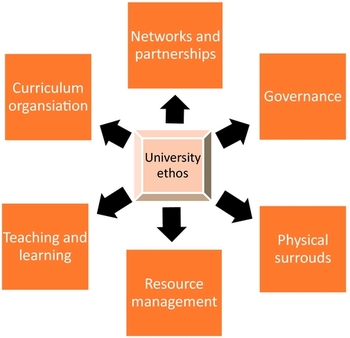
To incorporate aspects beyond the curriculum, the structure (see Figure 1) informed the project. It is based on the national environmental education statement for Australian Schools (DEH, 2005), which was developed for sustainability, not for course development in universities. However, as Scott and Gough (Reference Scott and Gough2007) emphasise, incorporating EfS involves more than just changing the written curriculum.
A structure for university Education for Sustainability.
Note: Based on Department of the Environment and Heritage, 2005, p. 7.

Methodology
The research involved a mixed methods approach. In accordance with the ethics guidelines, data were gathered through mapping principles of EfS across unit outlines, interviews with lecturers, student focus groups, lecturer focus groups, and lecturer reflections on discussions with community members. The researcher kept a reflective journal during the time of the project. The study used the conceptualisation of EfS in the Australian government documents to analyse the unit outlines and identify any gaps.
The main limitation on the research was the short timeline of the project. Research was conducted over one semester and there was a time frame of 4 months to complete the study and submit the report.
Participants and Location
The study was located on a small ACT campus of a multi-campus university. Six lecturers were involved in surveys and focus groups. PST who participated in this project were studying a second semester unit in Science and Technology. Twenty-two students (43% of the cohort) volunteered to be surveyed at the end of their science and technology unit, to collect data on student efficacy, and 13 students participated in focus groups.
Audit of Units
The unit audit was carried out at two levels: a broader analysis to identify principles of EfS in all units, and a more detailed audit to identify EfS content in three units. The principles and key concepts from the Australian government documents were used as indicators of EfS in the audit of units and in the lecturer survey.
The BEd course unit outlines for second semester were audited with respect to the principles of EfS to map its current extent across the whole course. All lecturers of second semester units were asked to submit unit outlines for audit. The initial audit comprised 11 unit outlines from a possible 15. The audit identified the principles of EfS (DEWHA, 2009, p. 9).
Then a more detailed study was completed of three units: Science and Technology; SOSE; and Religious Education (RE); to audit EfS content terms (DEH, 2005, pp. 16–17). These three units were studied in more detail as these lecturers identified a specific focus on EfS, and SOSE units may be replaced in response to the discipline emphasis of the new Australian curriculum, so it is important to identify the content currently covered. The more detailed audit of content terms mapped the nature and depth of EfS in these units.
Lecturer Survey (Science & Technology, and SOSE)
A survey of lecturers in Science & Technology and SOSE identified relevant documents and specific pedagogical practices used in class, to analyse the content and teaching of their units in more depth.
Student Survey and Focus Groups
The project investigated pre-service teachers' learning and experiences, by means of a student survey and open-ended focus group questions. Participants were surveyed to collect data on student efficacy at the end of their Science & Technology unit, and participated in focus groups. The unit included formal and informal learning of knowledge and skills for sustainability, studying innovative technologies and practices with respect to energy production and consumption, conservation, and waste management. It presented EfS in terms of ecological, social, economic and political sustainability, by making connections to community groups to include social, economic and political issues.
The student survey was based on an existing science efficacy survey (Riggs & Enochs, Reference Riggs and Enochs1990). The student survey measured the extent to which the teaching of EfS enhanced the learning experience of students and gave them opportunities to develop knowledge and competence, and enabled capacity-building. Students in focus groups were encouraged to describe how they felt about their future role as a teacher and its contribution to sustainability. This provided the student perspective on EfS outcomes in the course.
Lecturer Focus Groups
All lecturers teaching the course were invited to take part in focus groups about implementing EfS in units across the BEd program. Six lecturers participated, spanning six different teaching areas. It was difficult to find times to engage all lecturers in this study, as part-time staff were available at limited times, and some sessional staff had completed their contracts.
Focus group interviews were carried out using a semistructured interview protocol. Questions identified academic staff members’ current understandings of sustainability, how EfS was addressed in the units they taught, and the perceived barriers and enablers for embedding EfS across the course. Lecturers were asked what changes would be necessary to implement more EfS in individual units. In addition, the researcher maintained a reflective journal throughout the project to record issues, possibilities that would drive the implementation of EfS in teacher education, and the problems that might block this.
The focus groups aimed to raise awareness and stimulate professional conversations among lecturers, to begin the process of identifying ‘best practice’ in EfS, to develop skills of participants to interpret sustainability, and actions and practice towards sustainable living. Teacher educators’ understandings of sustainability, current practices and perception of factors that impacted on embedding EfS across courses were analysed.
Research Findings
The audit of unit outlines and lecturer survey demonstrated a foundation of EfS principles across the course. The principles of EfS and almost all the content concepts were included in the teaching of existing units. However, these teachings are discrete, and not coordinated. The biggest challenge will be achieving deeper understandings by integrating and connecting, instead of teaching in discipline silos. Mapping of existing EfS links between Science & Technology and SOSE teacher education units started this process. A more detailed analysis is needed to identify ways to make connections with and enhance existing practice.
Pre-service primary teachers studied sustainability concepts in Science & Technology and SOSE. The Science & Technology unit involved PST in specific discussions of sustainability as an environmental and social issue, and the vital role of education and its contribution to sustainability. Students reported that enhancing partnerships and building networks were important. In Science & Technology, students networked with community colleagues with experience in EfS, such as the ACT AuSSI coordinator and a team from EwB. Students responded enthusiastically to a hands-on technology design project with a sustainability focus, developed in conjunction with CSIRO Education. The involvement of community groups and other stakeholders strengthened existing partnerships, and provided enriching experiences for students.
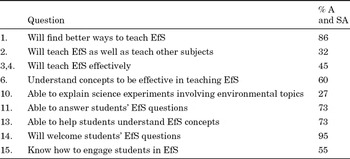
Students exhibited a wide range of experiences of sustainability (see Table 1). A majority of students demonstrated positive attitudes towards the teaching of sustainability, and a level of confidence in their ability to engage and teach their students. Although only 73% (n = 16) of students felt they would be able to answer their students' questions, the fact that 95% (n = 21) of students would still encourage questions to be asked, differs from the findings of Sia (Reference Sia1992) and is evidence of their commitment to sustainability education.
EfS Student Survey Results

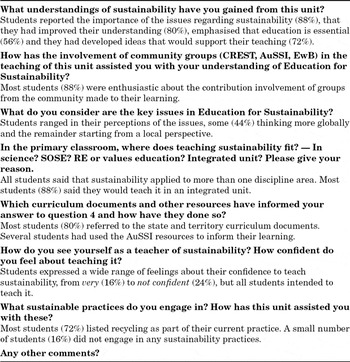
Students confirmed the importance of the issues regarding sustainability, that they had improved their understanding, emphasised that education is essential, and felt that they had developed ideas that would support their teaching (see Table 2). Most students engaged in sustainable practices. Students said that sustainability applied to more than one discipline area, and they would teach it within an integrated unit. Students' comments illustrate the positive impact of engaging with the wider community on their learning outcomes:
• ‘Yes, it has broadened my understandings of sustainability.’
• ‘It has been good to see EfS at a larger scale in the community. Also raising awareness of EfS.’
• ‘It has made me more willing to teach EfS. Promoted my learning, they're great organisations.’
• ‘It was very helpful and interesting because these are people dealing directly with the issues and with schools.’
• ‘Made us active learners in looking at ways to improve/design concepts to further help the education of sustainability.’
The student feedback on units will allow lecturers to identify connections that will lead to greater integration of EfS into the B.Ed. course, as a transformative approach through which students develop skills and competencies for partnership, participation and action.
EfS Student Focus Group Questions — Summary

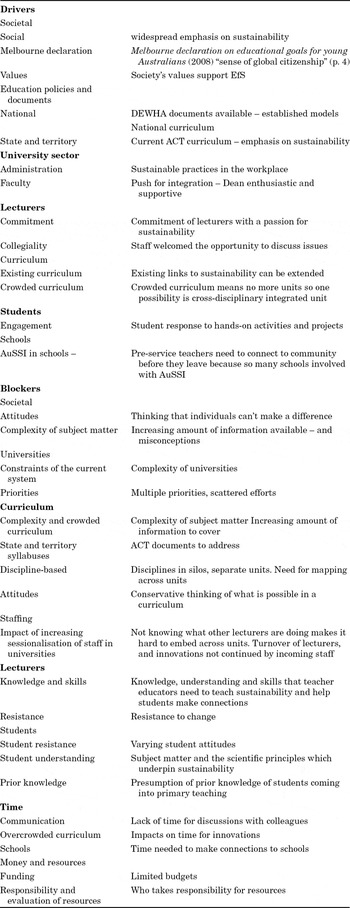
Lecturers acknowledged that the Faculty of Education is supportive of the teaching of EfS; the campus has made a commitment to the sustainable use of resources, and some lecturers participate in local sustainability activities. Their perception was that these were important factors underpinning the teaching of sustainability. The lecturers exhibited a range of understandings of sustainability and perception of the issues involved in EfS. Not all lecturers were aware of the scope of EfS. Some had not realised that they already addressed some of the principles and concepts in their units, as their perception was that EfS was limited to environmental sustainability (see Table 3).
Summary of Lecturer Focus Group

At the university a high proportion of the education lecturers were sessional lecturers, and this was seen as an issue in coordinating unit offerings. A range of EfS principles and content were addressed by existing units; however, there was no organisational framework, and individual lecturers were not fully aware of the principles and content of EfS covered by other lecturers. Lecturers saw a need for tracking of students' exposure and engagement with EfS, to ensure that it was coordinated, and that students' experiences in lectures or assessment tasks were connected to ensure that students received a cohesive picture to direct their EfS learning. Current practices do not involve such detailed tracking.
Lecturers valued the professional conversations stimulated by the questions, and appreciated the opportunity to contribute. Lecturer feedback emphasised that they were keen to continue the discussions and enhance their understanding of EfS. The results supported some of the findings of the HEA (2005) report, in that staff acknowledged the impact of the overcrowded curriculum and raised concerns about limited staff awareness and expertise; but in contrast to the HEA report, they did not perceive the issue as irrelevant, and perceived the university as supportive.
The researcher journal reflected on the issues and effective strategies that would lead to improved student learning outcomes. The involvement of community groups and other stakeholders in the units built new partnerships and strengthened existing partnerships, and provided enriching experiences for students. Community groups provide:
understanding that broadening from environmental education to EfS is a broadening of perspective. The value to PST of the direct involvement of AuSSI and other collaborators is that it can model a whole school approach for these PST. Advocating adding a few generic principles to other units may not really promote whole school thinking. (Researcher reflective journal notes)
Discussion
Modelling sustainable practices in institutions demonstrates a commitment to the fundamentals of EfS. When tertiary institutions manage, conserve and recycle natural resources, and adopt energy and environment design measures, they model sustainable values and practices for PST. Developing teachers skilled in identification of sustainability concerns and with appropriate knowledge and skills will contribute to the upskilling of the potential teacher workforce. This will depend on the development of relevant and appropriate understandings of teacher educators.
The drivers of change include the need to align with societal changes and address the demands of the new Australian curriculum. The timing of the project was strategic, providing background research to inform the coordination of existing disparate and fragmented efforts into a coordinated course. The major blocker of lack of time was found in other ARIES projects undertaken at the same time (Steele, Reference Steele2010) and was identified by previous researchers (Kennelly et al., Reference Kennelly, Taylor and Maxwell2008). There is no prospect of decreasing the demands on lecturers, so strategies must be found to work within time constraints and heighten the priority given to EfS across the course. This will require a change in attitudes and the culture of the way that lecturers work together, particularly the increased inclusion of part-time and sessional staff. The high proportion of sessional staff was not reported as a factor in other ARIES in other studies, and this may have a greater impact because of the small campus.
This project built on existing relationships with colleagues at CSIRO Education, AuSSI and EwB to develop a learning community that will support and contribute to pre-service teacher education courses in the ACT. Community networks have been enhanced, as partnerships between the university, schools, government agencies, AuSSI, EwB, and the CSIRO have been strengthened. Involvement of the broader community can boost knowledge of sustainable practices and ultimately give ownership of solutions and strategies to learners and the community, which have been identified as important (Hopkins & McKeown, Reference Hopkins, McKeown, Tilbury, Stevenson, Fien and Schreuder2002; UNESCO, 2009).
Conclusion and Recommendations
The primary recommendation from this preliminary study is that lecturers are supported to build on these findings and sustain reflection on mechanisms for enabling EfS in the pre-service teacher courses. An important strategy for this is targeted PD for teacher educators, to increase their knowledge of the key role EfS plays as a tool for sustainable living and to support interdisciplinary approaches to sustainability education. Second, it is recommended that the community EfS communication network be extended to support lecturers in participatory action research to explore practices in EfS in all units. Collaboration with partner organisations will provide a challenge for them to reflect upon their experience, learn from others, and take action to improve their practice, and hence contribute to lecturer learning and change. This will enable them to identify their aspirations for increasing EfS within PST education. The extension of existing support networks is especially important on a small campus with a high turnover of sessional staff.
The voice of PST was an important contribution to the project, and the evaluation of student understandings about sustainability in teacher education units must be used to inform strategies to further develop students' knowledge and competence in EfS. Developing and extending community partnerships will allow student access to mentors who will encourage sustainability values and principles, and promote social inclusion.
Future studies should build on the foundation of this project to investigate the utilisation of flexible delivery modes, including e-learning, onsite delivery and the integration of formal and informal learning to allow more units addressing EfS to be offered. Proposed developments include the introduction of a new elective focusing on EfS. Understanding the change process that PST undergo will lead to the design of better continuing PD for teachers. This would enhance and inform the inservice context and offer teachers opportunities to increase their skills.
Acknowledgments
The author wishes to thank Amy Cutter-Mackenzie for her insightful comments and advice regarding draft versions of this article.
The project is part of the ARIES ‘Mainstreaming Education for Sustainability in Pre-service Teacher Education’ project, and was funded by the Australian Government Department of the Environment, Water, Heritage and the Arts.
Author Biography
Sue Wilson is a lecturer in Science & Technology Education and Mathematics Education at the Canberra Campus of the Australian Catholic University. Sue's research interests include Education for Sustainability and using bibliotherapy to address mathematics anxiety in pre-service teachers. She is the Deputy Hub Cap and Science Coordinator of SiMERR ACT, the ACT Coordinator of the Interest and Recruitment in Science (IRIS) study, and the Coordinator of the ACT Education for Sustainability in Pre-service Teacher Education project, and a Council member of local (CMA, SEA*ACT, COACTEA) and national (APTA) Professional Teaching Associations, and has forged many links with community and professional science organisations. Sue is a member of PermaBlitz ACT.