INTRODUCTION
Studies on parasites of marine fish have increasingly been incorporated into the normal protocols of fish population studies (e.g. Williams et al. Reference Williams, MacKenzie and McCarthy1992; Abaunza et al. Reference Abaunza, Murta, Campbell, Cimmaruta, Comesaña, Dahle, Garcfa-Santamaria, Gordo, Iversen, MacKenzie, Magoulas, Mattiucci, Molloy, Nascetti, Pinto, Quinta, Ramos, Sanjuan, Santos, Stransky and Zimmermann2008; Lester and MacKenzie, Reference Lester and MacKenzie2009), mainly because they have been shown to provide useful and cheap information to fisheries scientists. To the best of our knowledge, however, they have been almost irrelevant to fisheries management in the South Eastern Pacific (SEP).
In this review we summarize fish population studies using parasites in SEP, whether or not the hosts are of economic importance. Sampling sites for all studies are indicated in Fig. 1. Those taken into account compare parasite prevalence, abundance, morphology, reproduction or assemblage composition between sampling localities and/or between sampling times. Whenever possible, we additionally emphasize, for each host species, on the documented changes through time that catches have experienced because of their potential impact on changes on parasite communities. We also add information on parasite taxa suggested as tags, as well as on other indicators of host populations (i.e. genetic or morphometric studies). Finally, we address two scarcely explored and critical issues for the use of parasites as biological tags: (1) the extent to which geographic differences in parasitism are stable through years, and (2) the relationship between the probability of harbouring parasites with total host body length. These are important aspects because parasites are expected to be more variable between years than other tags (genetic, morphometric, etc.), and also because there might be more variability in infracommunity properties among small fish species (Mouillot et al. Reference Mouillot, George-Nascimento and Poulin2005). This would occur not only because of the effect of fisheries on host populations and eventually on parasite communities (Wood et al. Reference Wood, Lafferty and Micheli2010), but also because of other natural sources of temporal variation of host and parasite populations, such as the strong population cycles that are partially coupled with between-years, interdecadal or even lower frequency climatic variations (Lehodey et al. Reference Lehodey, Alheit, Barange, Baumgartner, Beaugrand, Drinkwater, Fromentin, Hare, Ottersen, Perry, Roy, van der Lingen and Werner2006), especially among small pelagics, which account for most of the fisheries catch everywhere.
Map of the Southeastern Pacific Ocean indicating the main landing ports where samples of fish listed in Table 2 were examined for parasites in fish population studies.

LARGE-SCALE FISHERIES
The Humboldt Current Large Marine Ecosystem extends from central Chile (≈42°S) to northern Peru (≈5°S), and is one of the most important upwelling systems in the world, with high rates of primary and secondary production supporting some of the most massive fisheries in the world. Large-scale fisheries in the South Eastern Pacific (SEP), especially in Chile, began in the 1960s. Since then, and probably long before commercial exploitation (see Lehodey et al. Reference Lehodey, Alheit, Barange, Baumgartner, Beaugrand, Drinkwater, Fromentin, Hare, Ottersen, Perry, Roy, van der Lingen and Werner2006), all major ‘resources’ have had drastic increases and decreases in abundance, as reflected by the landings. Nowadays, 10 fish species account for 98·7% of the reported landings in Chile, and just three (Engraulis ringens, Strangomera bentincki and Trachurus murphyi) explain 92·8% of the catch, with E. ringens the most important, at 65·3% of total catch. Most if not all of these species are overexploited; for instance, the Chilean fisheries of the jack mackerel was the second most important in the world, overtaken only by the Peruvian anchovy in the early 70s (>10 000 000 tonnes in Peru) supporting landings of c. 3 600 000 by 1995, while the reported landings for 2012 do not reach 215 000 tonnes (for historical landing reports see www.sernapesca.cl).
Small pelagic clupeoid fishes
Two small pelagic species (E. ringens and S. bentincki) support most of the industrial landings along Chile. The common sardine S. bentincki has a geographically restricted distribution, from c. 33°S to 42°S (see Oliva, Reference Oliva2013). However, the Chilean fishing regulations assume a single stock for both species, as for all other marine resources. It must be mentioned that another clupeoid species, Sardinops sagax, sustained a large fishery during the 80s (up to 2 200 000 tonnes per year), but no studies on their parasites were carried out before the fishery vanished. Surprisingly or not, there is only one report on parasites of S. bentincki, the most important small pelagic fish resource in Chile (landing > 880 000 tonnes, 2011). The study showed that the absence of the larval Anisakis simplex s. l. in samples from central Chile but heavy infections in fish from southern localities strongly suggested the existence of two stocks (Oliva, Reference Oliva2013).
The anchovy E. ringens is distributed from northern Peru (c. 6°S) to southern Chile (c. 42°S, see Valdivia et al. Reference Valdivia, Chávez and Oliva2007). Anchovy landings peaked at 1 million tonnes in 1999, and declined to less than 200 000 tonnes in 2010. Based mainly on landing reports and on its discontinuous distribution, it has been suggested there are three stocks for E. ringens (Llanos-Rivera and Castro, Reference Llanos-Rivera and Castro2004). However, the only study on population genetics based on allozymes concluded that a unique panmictic population existed in the area (between Iquique (20°S) and Talcahuano (37°S, Ferrada et al. Reference Ferrada, Hernández, Montoya and Galleguillos2002)).
Parasites of the anchovy E. ringens as biological tags for stock discrimination were first examined in 359 specimens obtained in a narrow window of time (2 months) from six landing ports in northern and central Chile, which spanned a latitudinal gradient of c. 18°. Six metazoan parasite species (three ectoparasites and three endoparasites) were obtained, and a correspondence analysis suggested that anchovy from northern and central Chile comprise two stocks, whose identification was largely based on the absence of both the monogenean Pseudanthocotyloides heterocotyle and the copepod Caligus sp. in the southernmost localities (Valdivia et al. Reference Valdivia, Chávez and Oliva2007).
Local variability in component communities of parasites in E. ringens was assessed in five independent samples taken from two nearby localities in northern Chile (Península de Mejillones – 23°S) in a short temporal window (every 2 days), and found to be low (Chávez et al. Reference Chávez, Valdivia and Oliva2007). Consequently, these authors concluded that a single sample of about 60 host individuals would suffice to characterize the composition of component communities of parasites of this host species. However, the picture was dissimilar when local and geographic variability at the infracommunity level was assessed at three fishing areas off Chile: Caldera (27°S), Talcahuano (37°S) and Valdivia (39°S). In that study, seven samples from the three localities were taken close to one another in space and time from different vessels (c. 30 fish each, see George-Nascimento and Moscoso, Reference George-Nascimento and Moscoso2013). Body length of fish in the samples, richness, diversity and composition of parasite infracommunities revealed significant variation among trawls within localities, while only the composition of infracommunities showed significant geographic variation among fishing macrozones. Parasite infracommunities in hosts from Caldera were the most different and were characterized by ectoparasites, whereas those from Talcahuano and Valdivia harboured mostly digeneans. These results reinforce the independent evidence that there are two stocks on the Chilean coast, as suggested earlier by Valdivia et al. (Reference Valdivia, Chávez and Oliva2007). Thus, two independent studies reached the same conclusion.
Several population studies have been done on S. bentincki. Cortés et al. (Reference Cortés, Oyarzún and Galleguillos1996) suggested that at least two discrete populations of S. bentincki occurred along the Chilean coast: a northern population associated with the landing port of San Antonio–Talcahuano, and a southern population associated with Puerto Montt. This conclusion was based on an analysis of number of vertebrae and gill rakers, as well as multivariate analyses of selected morphometric and meristic data. Later, Galleguillos et al. (Reference Galleguillos, Troncoso, Monsalves and Oyarzún1997), on the basis of allozyme variation, indicated a tendency to separate samples from Puerto Montt and those obtained from Talcahuano and San Antonio. More recently, Cubillos et al. (Reference Cubillos, Ruiz, Claramunt, Gacitúa, Núñez, Castro, Riquelme, Alarcón, Oyarzún and Sepúlveda2007) identified two spawning areas for S. bentincki within its overall distribution. Important life history traits, such as daily rate of egg production and length-frequency distribution, differ between the two geographic strata considered, the north-central (33°–37°S) and the southern (37°–40°S). Finally, Curin-Osorio et al. (Reference Curin-Osorio, Cubillos and Chong2012) stated that intraspecific variability in otolith morphometry revealed geographic differences in size that were not attributable to allometric effects. Thus, five independent studies reached similar conclusions.
Jack mackerel T. murphyi
Trachurus murphyi has supported large fisheries not only in Chile, but also off Ecuador, Peru and recently in New Zealand, as well as in international waters outside the Exclusive Economic Zone (EEZ) off Chile (Ashford et al. Reference Ashford, Serra, Saavedra and Letelier2011). Following a large increase in SEP landings from the early 1970s, which peaked at 4·6 million tonnes per year in 1994, a dramatic decrease of landings followed, down to 0·2 million tonnes in 2012. Further, during the development of the fishery, the fleet not only increased in size (number and fishing capacity of vessels and also electronic devices) but also experienced dramatic changes in the fishing grounds. Thus, jack mackerel may have also experienced changes in its distribution and abundance, and parasites.
The jack mackerel is the most studied fish species in SEP from the point of view of their parasites (George-Nascimento and Arancibia, Reference George-Nascimento and Arancibia1992; Oliva, Reference Oliva1994, Reference Oliva1999; Aldana et al. Reference Aldana, Oyarzún and George-Nascimento1995; George-Nascimento, Reference George-Nascimento2000). The first report dealt with stock identification between Iquique and Talcahuano with monthly samples taken during 1990 (50 specimens each), plus 183 specimens caught in oceanic fishing grounds. Univariate and multivariate statistical analyses on infracommunities and component parasite communities, as well as on host morphometrics, suggested the existence of two ecological stocks.
At that time, Avdeyev (Reference Avdeyev1992) suggested that the presence of the isopod Ceratothoa trigonocephala, a species proper of the Southwest Pacific in jack mackerel off Chile, could be explained by migratory movements from the west to east Pacific, in a way that was not clearly stated. A migration from the eastern Pacific to western Pacific has been known since 1989 (see Ashford et al. Reference Ashford, Serra, Saavedra and Letelier2011), but not in the opposite direction. In that vein, isopod fecundity, size and proportion of species as well as of gravid females were compared between four localities for both Ceratothoa gaudichaudii and C. trigonocephala: Iquique, Caldera, Coquimbo and Talcahuano (Aldana et al. Reference Aldana, Oyarzún and George-Nascimento1995). The differential reproductive pattern shown by the two isopod species in northern and southern Chile led again to the conclusion that there were two ecological stocks of jack mackerel in Chilean waters (Aldana et al. Reference Aldana, Oyarzún and George-Nascimento1995).
Univariate statistical analyses of the metazoan parasites were performed in samples seasonally taken in 1992–1993 of 3034 specimens from seven localities in SEP (from Paita – Perú (6°S) up to Talcahuano–Chile), covering c. 30° and almost spanning its whole latitudinal distribution in SEP (Oliva, Reference Oliva1999). Results suggested the existence of two stocks: a northern Peruvian stock characterized by the presence of the larval trypanorhynch Eutetrarhynchus sp. and the monogenean Cemocotyle aff. trachuri, absent in samples from Chile, as well as by the absence of the acanthocephalan Rhadinorhynchus trachuri and some larval nematodes (Anisakis physeteris and Hysterothylacium sp.) in samples from Peru.
The last published article included 3946 fish collected between 1990 and 1996 in 71 samples at six localities along the Chilean coast, from Iquique to Valdivia, though localities were pooled a priori for analysis in north and south fishing macrozones (George-Nascimento, Reference George-Nascimento2000). Jack mackerel from northern Chile had a higher abundance of cymothoid isopods, Ceratothoa spp., whereas those from southern Chile had more R. trachuri, Hysterothylacium sp. larvae and Anisakis type I larvae. There were significant differences in composition of parasite communities between years in each fishing zone (in the abundance of isopods and acanthocephalans), presumably as a result of the increase in offshore catches since 1994.
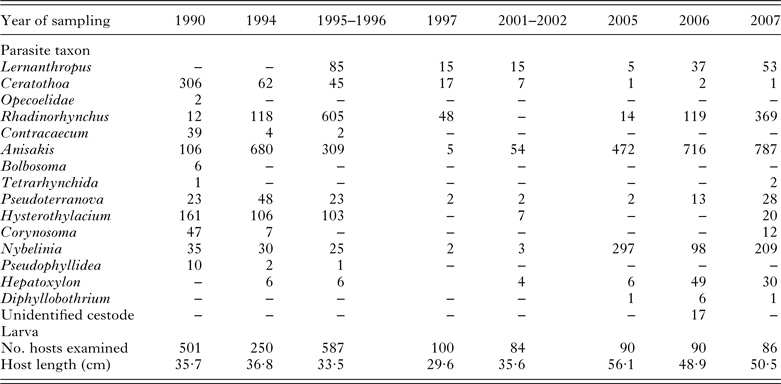
The conclusion of these papers is the presence of two ecological stocks (northern and southern) along the Chilean coast. These stocks could arise as schools of fish larvae drifting from the open ocean toward coastal areas while fragmenting and growing to create groups of young fish with divergent geographic ontogenies. These differences would then be reflected in the variations in the relative abundance of parasite taxa between fishing zones. In sum, and although the stock structure of the jack mackerel remains unclear (Gerlotto et al. Reference Gerlotto, Gutiérrez and Bertrand2012), parasites indicate latitudinal and longitudinal trends in the qualitative and quantitative characteristics of the infections at SEP. A further topic of relevance for our discussion is the variability of component communities shown by the jack mackerel landed at Talcahuano between 1990 and 2007 (partially unpublished data), where changes occurred not only in fish body size but also in the composition of parasite communities, including parasites such as Anisakis sp. larvae, which has been considered to be a good biological tag (Table 1).
Number of parasites collected per taxon in samples of jack mackerel landed at Talcahuano, Chile, between 1990 and 2007

Hakes Merluccius gayi, Merluccius australis
There are two congeneric hake species in SEP whose geographical distributions almost do not overlap: M. gayi and M. australis. Also, two subspecies of M. gayi are recognized: Merluccius gayi peruanus from Peru and Merluccius gayi gayi from Chile. Catch records for M. gayi began c. 1940, and peaked twice (in 1968 and 2002) with c. 140 000 tonnes per year, and decreased to 40 000 tonnes in 2012. In Chile, as mentioned, a single stock and thus a global catch quota has been assumed (ruled) that hake M. gayi is composed of a single stock. However, Vidal et al. (Reference Vidal, Carson and Gold2012) studied the mtDNA (a better marker than allozymes for population studies used by Galleguillos et al. (Reference Galleguillos, Troncoso, Oyarzún, Astorga and Peñaloza2000)) in samples taken in Peru (c. 7°S), Coquimbo, Valparaíso (33°S) and Valdivia, and demonstrated the existence of a southern stock associated with samples from Corral (=Valdivia) and a northern stock from Talcahuano to Coquimbo.
A report was done on geographic and monthly variations of populations and infracommunities of metazoan parasites in 1172 Chilean hake M. gayi landed at two major ports, and caught during 1991–1992 in three major fishing areas off central Chile (San Antonio, Talcahuano and Corral) by George-Nascimento (Reference George-Nascimento1996). At least two ecological stocks are suggested, based on consistent differences in parasitism between body length classes for Grillotia dollfusi, Hysterothylacium sp., Clestobothrium crassiceps and Aporocotyle wilhelmi (George-Nascimento, Reference George-Nascimento1996). Specifically, fish caught in San Antonio and Talcahuano belonged to the northern ecological stock and fish landed in Corral (but captured south of Corral) correspond to the southern stock.
In a similar way, Oliva and Ballón (Reference Oliva and Ballón2002) studied 782 hake (M. gayi gayi), obtained from the four most important landing ports in central and southern Chile (Coquimbo, San Antonio, Talcahuano and Puerto Montt) as well as from previously published data on 140 Peruvian hake (M. gayi peruanus) collected at Callao, Peru (12°S). A canonical discriminant function using the most prevalent parasites (prevalence >5%) suggests that fish landed in Talcahuano, San Antonio and Coquimbo belong to the same stock, and those from Puerto Montt to another one. Samples from Peru were used as an ‘outgroup’ to test the value of parasites as biological markers for hake. Identification of stocks was based on significant differences in the mean intensity of adult C. crassiceps and larval Hepatoxylon trichiuri (Eucestoda), the monogenean Anthocotyle merlucci and the copepod Neobrachiella insidiosa f. pacifica. Again, two independent studies (George-Nascimento, Reference George-Nascimento1996; Oliva and Ballón, Reference Oliva and Ballón2002) reached the same conclusion, as did a recent molecular study (Vidal et al. Reference Vidal, Carson and Gold2012).
The austral hake M. australis appeared for the first time in landing reports in 1984 (before that, both hake species were jointly registered as ‘merluzas’) with 31 000 tonnes, that increased to 69 000 tonnes by 1988. The last report in 2011 was 21 000 tonnes. In this host species, component communities of parasites were first compared between inshore and offshore fishing areas at Chiloé Archipelago (c. 42°S). Despite the fact that a comparison was made between samples taken in distant years, the authors suggested some parasites that could be used as biological tags (González and Carvajal, Reference González and Carvajal1994). Later, parasite infracommunities of southern hake M. australis were examined in 18 samples comprising 685 fishes collected between 1992 and 1993 from inshore and offshore fishing areas along the southern coast of Chile (between 44° and 56°S), up to the vicinity of Malvinas-Falkland islands in South West Atlantic (SWA). Mild but significant differences were found in infracommunity composition suggesting migratory patterns and ontogenetic variations in feeding habits of southern hake as well as on the ecological conditions that surround them as they get older (George-Nascimento and Arancibia, Reference George-Nascimento and Arancibia1994).
A prospective study on the identification of potential parasite tags for this species in SEP and SWA focused on myxozoans, though samples from SEP were scarcely represented (Kalavati et al. Reference Kalavati, Longshaw and MacKenzie1995; MacKenzie and Longshaw, Reference MacKenzie and Longshaw1995). The most promising biological tags for stock identification, where long lifespans are important, were several myxozoan species, the metacestodes Grillotia sp. and H. trichiuri, and the parasitic copepod Trifur tortuosus. The adult digenean Elytrophalloides oatesi showed some potential as a tag for following seasonal migrations of hake.
Southern blue whiting Micromesistius australis
This species supports a fairly stable, large fishery in SEP and SWA (from 41°S at SEP) with c. 25 000 tonnes per year in Chilean waters. It is also distributed off New Zealand with small genetic differentiation with SEP population (Takeshima et al. Reference Takeshima, Hatanaka, Yamada, Yamazaki, Kimura and Nishida2011).
There are two papers, based on a similar database, that have been published on parasites of the southern blue whiting M. australis, which supports one of the largest industrial fisheries in South America (c. 20 000 tonnes per year in SEP). In contrast with other fish species from SEP, it is still in debate, but it is recognized that there are two main spawning/nursery grounds: one in SWA, southwest from the Falkland (Malvinas) Islands; and another in the SEP, south from the Taitao Peninsula (Niklitschek et al. Reference Niklitschek, Secor, Toledo, Lafon and George-Nascimento2010). Juveniles originating from both grounds are believed to mix during migration and/or in feeding areas in the Scotia Sea. One study, dealing with parasites found in fish between 5 and 10 years old (Niklitschek et al. Reference Niklitschek, Secor, Toledo, Lafon and George-Nascimento2010), compared results from different approaches: trace metals, stable isotopes in otolith cores and parasite assemblage composition in adults from SWA and SEP spawning grounds This integrative approach revealed significant differences in trace metals, stable isotopes and parasite assemblages which supported 80–100% correct assignment of samples to capture location. Those results supported the existence of at least two ecologically distinct sub-populations of southern blue whiting in South America, highlighting the importance of holistic approaches using different techniques to test hypotheses concerning stocks in marine fishes (Begg and Waldman, Reference Begg and Waldman1999). The other study (George-Nascimento et al. Reference George-Nascimento, Moscoso, Niklitschek and González2011) used the same samples but included the whole range of ages (n = 155 instead of 90 included in Niklitschek et al. Reference Niklitschek, Secor, Toledo, Lafon and George-Nascimento2010). After adjusting for the effect of host body size, they found that the fishing zone had a significant effect on the variations in total abundance, taxonomic richness, diversity and composition of parasite infracommunities, concluding that southern blue whiting do not constitute an ecologically homogeneous unit across the study area.
Long-tailed hake or hoki Macruronus magellanicus
This benthopelagic species inhabits the outer border of the continental slope at SEP. Seasonal migratory movements have been reported. It is distributed off New Zealand with small genetic differentiation with the SEP population (Takeshima et al. Reference Takeshima, Hatanaka, Yamada, Yamazaki, Kimura and Nishida2011). Hoki supports an important fishery, with a reported peak above 300 000 tonnes year−1 in the 90s and a reduction to below 30 000 tonnes in recent years. The hoki has a wide distribution around the coast of South America, from Punta Medanos (37°S) in the South Atlantic Ocean, Argentina, as far as to Valparaíso (33°S) in the South Pacific Ocean, Chile (Pino et al. Reference Pino, Cubillos, Araya and Sepúlveda2004). Two studies deal with parasites in hoki populations. In one, 450 specimens examined for parasites from two fishing grounds in southern Chile (Talcahuano, 37°S and Punta Arenas, 54°S) were compared, and a migratory pattern deduced from south to north, with the metacestode H. trichiuri acquired in the southern zone not being lost during migratory movement northwards (Oliva, Reference Oliva2001).
More recently, in a prospective study on the protozoan and metazoan parasite fauna of hoki M. magellanicus in SEP and SWA, although the samples were small and scattered in time, the most promising parasites for hoki stock identification were the long-lived larvae of the cestodes H. trichiuri and Pseudophyllidea gen. sp. and of the nematode Anisakis sp. Three others – the myxosporean Myxidium baueri, the nematode Pseudascarophis sp. and the acanthocephalan Echinorhynchus longiproboscis – were identified as potentially useful for following seasonal migrations of hoki and for estimating the proportions of fish of different origin in mixed samples (MacKenzie et al. Reference Mackenzie, Brickle, Hemmingsen and George-Nascimento2013).
Patagonian toothfish Dissostichus eleginoides
The Patagonian toothfish was included in landing reports in 1985, with 4400 tons, increasing to 30 000 tons by 1992. Since 2006, landings have stabilized at ≈5000 tons year−1. This is a widespread and long-lived circum-Antarctic species, being exploited in widely separated geographic localities in the southern hemisphere.
In SEP, this species has been examined twice for parasites, with similar results. The taxonomic composition of trophically transmitted endohelminth infracommunities was assessed in 49 host individuals collected in two samples taken 50 Nm off Santa María Island, central Chile (Rodríguez and George-Nascimento, Reference Rodríguez and George-Nascimento1996). Component communities were compared with previous reports elsewhere and it was found that the geographic distance between 1ocalities paralleled differentiation in composition of component communities; the community from central Chile was more similar to that found in the Falklands, while those in the Indian Ocean and in the South Georgia were most alike. More recently, the taxonomic composition of the metazoan parasites found in the stomach of 629 specimens, from two localities in southern Chile (Lebu and Quellón), was recorded. Parasitological evidence, based on univariate and multivariate analysis, did not support either the existence of discrete stocks, migratory movements between areas or seasonality in pattern of infection (Oliva et al. Reference Oliva, Fernández, Oyarzún and Murillo2008a ).
SMALL-SCALE FISHERIES
Róbalo or rockcod Eleginops maclovinus
This nothotenoid fish has a geographic distribution in SEP from Valparaíso down to Punta Arenas, and extends in SWA to Uruguay. This coastal species is associated with estuaries where local fishermen use gillnets to catch them. This small-scale fishery shows landings that are below 200 tonnes per year (Licandeo et al. Reference Licandeo, Barrientos and González2006). The only genetic study showed a low among-population genetic variance between several populations across the species’ geographic range (Ceballos et al. Reference Ceballos, Lessa, Victorio and Fernández2012).
There are two studies in SEP on parasites of róbalo considered relevant for this review. In one, infracommunities of 126 fish were compared between three widely separated localities along south-central Chile (Talcahuano, Puerto Montt and Punta Arenas), which were sampled in two different years each. Variations in both chronological time (two different years) and space (three localities) showed that, beyond the effects of host ontogeny, infracommunity descriptors at a given place vary as much between years as between places at a similar time. These results revealed the need to use more rigorous sampling designs whenever parasites are going to be used as biological tags of host populations. They also highlighted the importance of using time and space replicated sampling schemes (George-Nascimento et al. Reference George-Nascimento, Mellado, Saavedra and Carvajal2009).
Another study on parasites of róbalo showed high local spatial variation of 268 infracommunities among three localities in southern Chile. A linear discriminant analysis showed that 89·7% of fish were correctly assigned to their respective locations suggesting that parasites could be a reliable tool to discriminate fish from geographically close locations (Henríquez et al. Reference Henríquez, González, Licandeo and Carvajal2011).
Red rockfish Sebastes capensis
The red rockfish inhabits the nearshore Chilean fish assemblage and is exploited mainly by local fishermen. Knowledge of its fishery, basic biology and ecology is scarce (Ojeda and Fariña, Reference Ojeda and Fariña1996). However, snapshot studies dealing with qualitative characteristics of the parasitism by metazoans of S. capensis at a local scale are available (Balboa and George-Nascimento, Reference Balboa and George-Nascimento1998; González and Acuña, Reference González and Acuña1998, Reference González and Acuña2000). In addition, Oliva and González (Reference Oliva and González2004) compared the metazoan parasites of 290 specimens between two fishing grounds in northern Chile (Antofagasta and Coquimbo) and concluded the existence of two different stocks.
Thumb grenadier Nezumia pulchella
Nezumia pulchella is a non-commercial bentho-pelagic and non-migratory species distributed from northern Peru (7°S) to the central Chilean coast (33°S), caught as by-catch with deep-sea shrimp and squat lobster fisheries, inhabiting waters between 250–960 m depth. Salinas et al. (Reference Salinas, González and Acuña2008) compared the parasite fauna of the thumb grenadier, in 217 specimens from four fishing grounds (Taltal, Caldera, Coquimbo and Valparaíso) and concluded that parasites discriminated three fishing grounds well (multivariate discriminant analysis, 79% correct classification): Taltal, Caldera+Coquimbo and Valparaíso. Differences in parasite composition between fishing grounds were mainly due to Corynosoma sp. cystacanths and the copepod Jusheyhoea macrura.
Big eye flounder Hippoglossina macrops
Oliva et al. (Reference Oliva, González and Acuña2004) showed that univariate analyses of parasites of 123 specimens of the big eye flounder, caught as by-catch (target fishery shrimps and squat lobster) differed along a depth gradient in mean intensity and prevalence of the acanthocephalan Floridosentis sp., with higher mean intensity and prevalence of infection in fish from midwater. Among the ectoparasites, the monogenean Neoheterobothrium chilensis exhibited differences in mean intensity with depth, increasing with depth of host habitat. The results show that parasites can be good biological tags for the habitat depth occupied by a fish and also that this method can be a good tool for identifying the depth of capture. Overall, a multivariate analysis showed that 84% of the fishes were correctly classified in their original depth class.
Croaker Cilus gilberti
Geographical distribution of this species spans from Peru down to southern Chiloé (47°S) in Chile, inhabiting coastal habitats such as the surf zone in sandy beaches and feeding on macroinvertebrates and fishes. Total landings peaked in 1992 with c. 2000 tonnes and reached c. 900 tonnes in 2011. Catches are mostly due to local fishermen.
When infracommunities collected over 15 years from croaker of similar body length were compared between samples taken off Talcahuano, Chile, significant variations in composition between years were found: a high abundance of Corynosoma sp. cystacanths was found in 1983, while the digenean Villarealina peruanus dominated in 1998. There were, however, no differences between years in richness, abundance, diversity and dominance in infracommunities (Garcías et al. Reference Garcías, Mendoza and George-Nascimento2001). Similar results were reported in another sciaenid fish Sciaena deliciosa in Peru (Iannacone et al. Reference Iannacone, Morón and Guizado2010).
Other fish species
A few other fish species, mainly inhabitants of intertidal rocky pools, have been compared between nearby (a few km apart) or more distant localities (a few hundred km apart), shedding light on small temporal and/or spatial scale variability of parasite infracommunities, and consequently, on the use of parasites as biological tags.
One study looked for persistence of richness, diversity, abundance and composition of parasite infracommunities in three samples of the blenny Scartichthys viridis taken within a 17-month period during 3 consecutive years at a given sampling site in the central Chilean coast. Seventy-five per cent of all eight metazoan taxa occurred in all 3 years. In the overall sample, total host body length was a relevant predictor of the variations in composition, richness, total abundance and diversity of parasite infracommunities. In contrast, the year of sampling was not, especially when infracommunities compared between years came from hosts of similar body size. These results revealed the low compositional and aggregated variability of parasite infracommunities over time (Díaz and George-Nascimento, Reference Díaz and George-Nascimento2002).
Another study on the same host species and in the congeneric Scartichthys gigas was carried out to assess the between-site variability in richness, abundance, diversity, dominance and composition of parasite infracommunities between three localities separated by no more than 6 km, off the coast of northern Chile (c. 20°S). Samples were collected in a narrow window of time (1 month). The great similarity in the aggregated and compositional properties of the infracommunities, both between host species as well as among study sites, was interpreted as indicating that ecological factors such as habitat use and dietary composition, and evolutionary factors, such as the close relatedness between Scartichthys species, played a role in influencing the high similarity found in parasite communities of these fish species (Flores and George-Nascimento, Reference Flores and George-Nascimento2009).
Geographic variations in composition of parasite infracommunities of juvenile thornfish Bovichthys chilensis in 108 specimens collected from the intertidal zone at four localities along the south-central coast of Chile (between 33° and 40°S) were documented (Muñoz et al. Reference Muñoz, Valdebenito and George-Nascimento2002). Almost 40% of fish examined harboured parasites. However, prevalence, total intensity, richness and diversity of parasites were similarly low among juvenile fish, which may be due to the fact that infections were necessarily recent.
Finally, a study carried out on the clingfish Gobiesox marmoratus showed a high similarity in the composition of the endoparasitic fauna between three localities off the central coast of Chile separated about 400 km from their nearest neighbour(s). Clingfish in the samples were similar in total body length (c. 6 cm total length). Parasites were found in 38·8% of the 108 clingfish examined. Composition of parasite infracommunities changed along host ontogeny though total abundance, diversity and richness of infracommunities were similar between the localities and along the host ontogeny (Pardo-Gandarillas et al. Reference Pardo-Gandarillas, Garcías and George-Nascimento2004).
CONCLUDING REMARKS
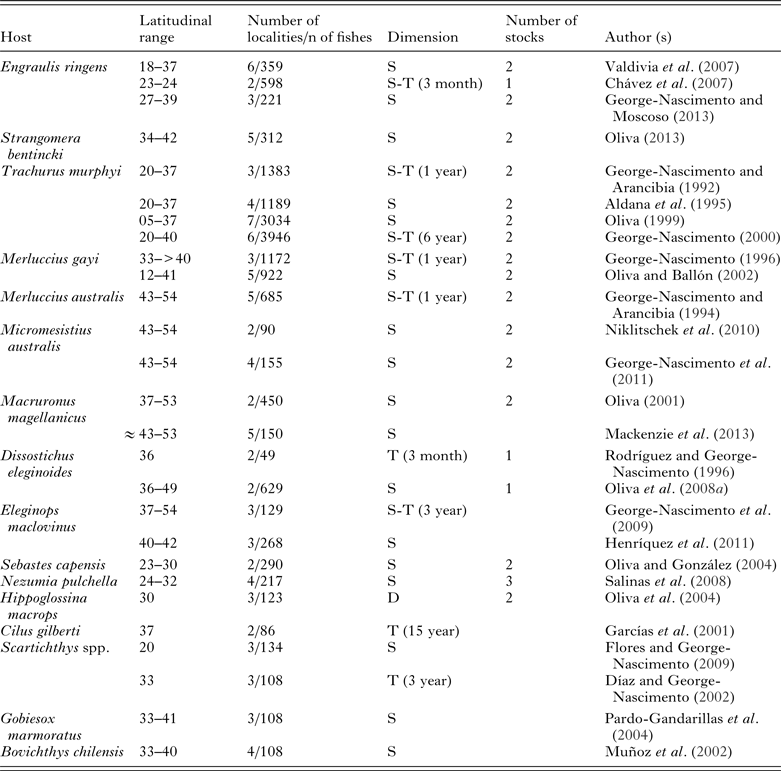
This review shows a persistent though scattered effort, in space and time, to use parasites in fish population studies in SEP. In sum, the main aspects considered in most studies are the sampling site, and a less frequent combination of sampling in time and space, and an even lower frequency of studies dealing with variability along time (Table 2). There is only one study on between-years variation of parasite communities showing the variable nature of parasite tags (George-Nascimento, Reference George-Nascimento2000).
Host species, range of latitudes of sampled localities, number of localities/number of fish examined and dimension analysed in fish population studies using parasites in SEP
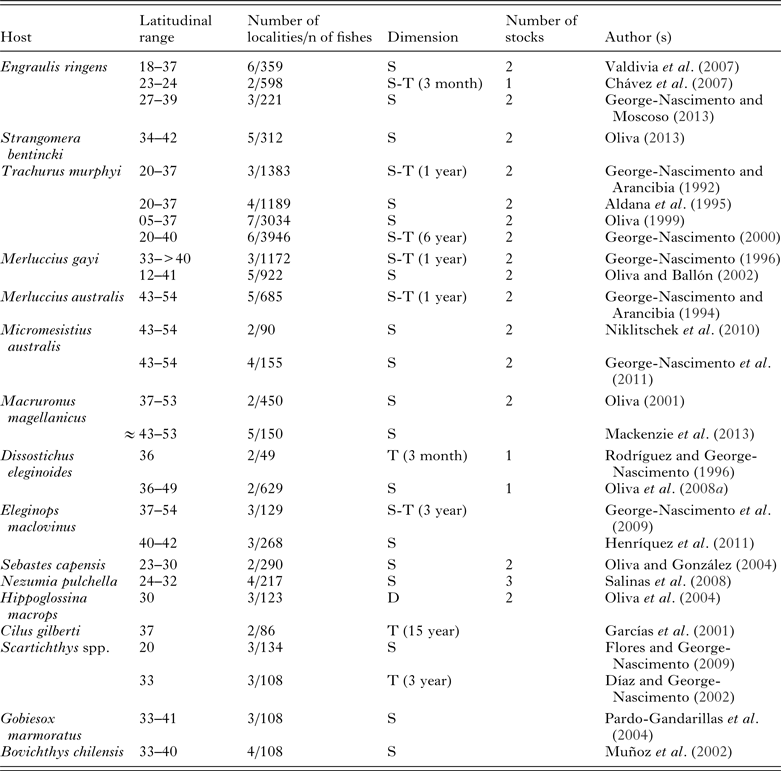
S, Spatial variability; T, Temporal variability; D, depth gradient.
Nowadays, seven out of the top 11 Chilean fisheries, in terms of landings, have been studied in terms of how parasites relate to stock structure and/or migration (T. murphyi, E. ringens, S. bentincki, M. magellanicus, M. gayi, M. australis and M. australis). For the remaining species (Brama australis, Genypterus spp., Scomber japonicus, Normanichthys crockeri and Scomberesox saurus scombroides) this aspect remains unknown, but parasitological databases are available for some of them, such as B. australis and S. japonicus. George-Nascimento et al. (Reference George-Nascimento, Garcías and Muñoz2002) studied parasites of B. australis from samples taken at Talcahuano, and Oliva et al. (2008b) analysed parasites of the circumtropical S. japonicus from Callao (Peru) and Antofagasta. None of these articles were devoted to analysing stock structure, but constitute the basal information (parasite composition) needed for subsequent studies. In addition, most studies in SEP use only macroscopic metazoans (Monogenea, Digenea, Cestoda, Nematoda, Acanthocephala and Crustacea) despite the fact that microscopic metazoans like Myxozoa have been signalled as potential biological markers for stock identification (Kalavati et al. Reference Kalavati, Longshaw and MacKenzie1995; MacKenzie and Longshaw, Reference MacKenzie and Longshaw1995; George-Nascimento et al. Reference George-Nascimento, Lobos, Torrijos and Khan2004a ).
Several studies dealing with parasites and fish stock identification in SEP need also to be considered from a biogeographic point of view, and examined with models such as those proposed by Camus (Reference Camus2001) for free-living species off the Chilean coast, and by Timi's model (2007) for fish parasites off the Argentinean coast: water circulation on the continental shelf determines a characteristic thermal gradient, which in turn influences the latitudinal distribution of parasites, allowing the identification of stock units of fish hosts. There are three major biogeographic zones distinguished along the Chilean continental coast: a northern area which comprises a warm-temperate biota (Peruvian Province PP, from northern Peru to ≈ 30°S), an intermediate area, between 30°S to 41–43°S (TIZ), and a southern area which comprises an austral biota (Magellan Province, MP: 41–43° to 56°S). For example, studies dealing with stocks of E. ringens, N. pulchella and S. capensis can be associated with the PP and the TIZ zones. Two studies related to M. gayi and one study on S. bentincki identified stocks that are closely associated to the TIZ and the MP. For M. australis (MP) and D. eleginoides (northern boundary of MP and TIZ) no stock structure or migratory patterns were evident and for M. magellanicus, a migratory pattern was suggested between MP and TIZ. A wide-ranging different picture is evident for T. murphyi for which the two ecological stocks suggested by Aldana et al. (Reference Aldana, Oyarzún and George-Nascimento1995) and George-Nascimento (Reference George-Nascimento2000) agree well with the PP and TIZ, but Oliva (Reference Oliva1999) suggested migratory movements instead of ecological stocks along the PP and TIZ. A few biogeographic studies in SEP, on the parasites of the rockfish S. capensis, have shown partial agreement with the biogeographic provinces proposed (González and Moreno, Reference González and Moreno2005; González and Poulin, Reference González and Poulin2005; González et al. Reference González, Barrientos and Moreno2006). However, the latitudinally most extensive survey of a fish species in SEP found no relationship between mean surface temperature with mean species richness, total richness and richness of component communities (Oliva, Reference Oliva1999).
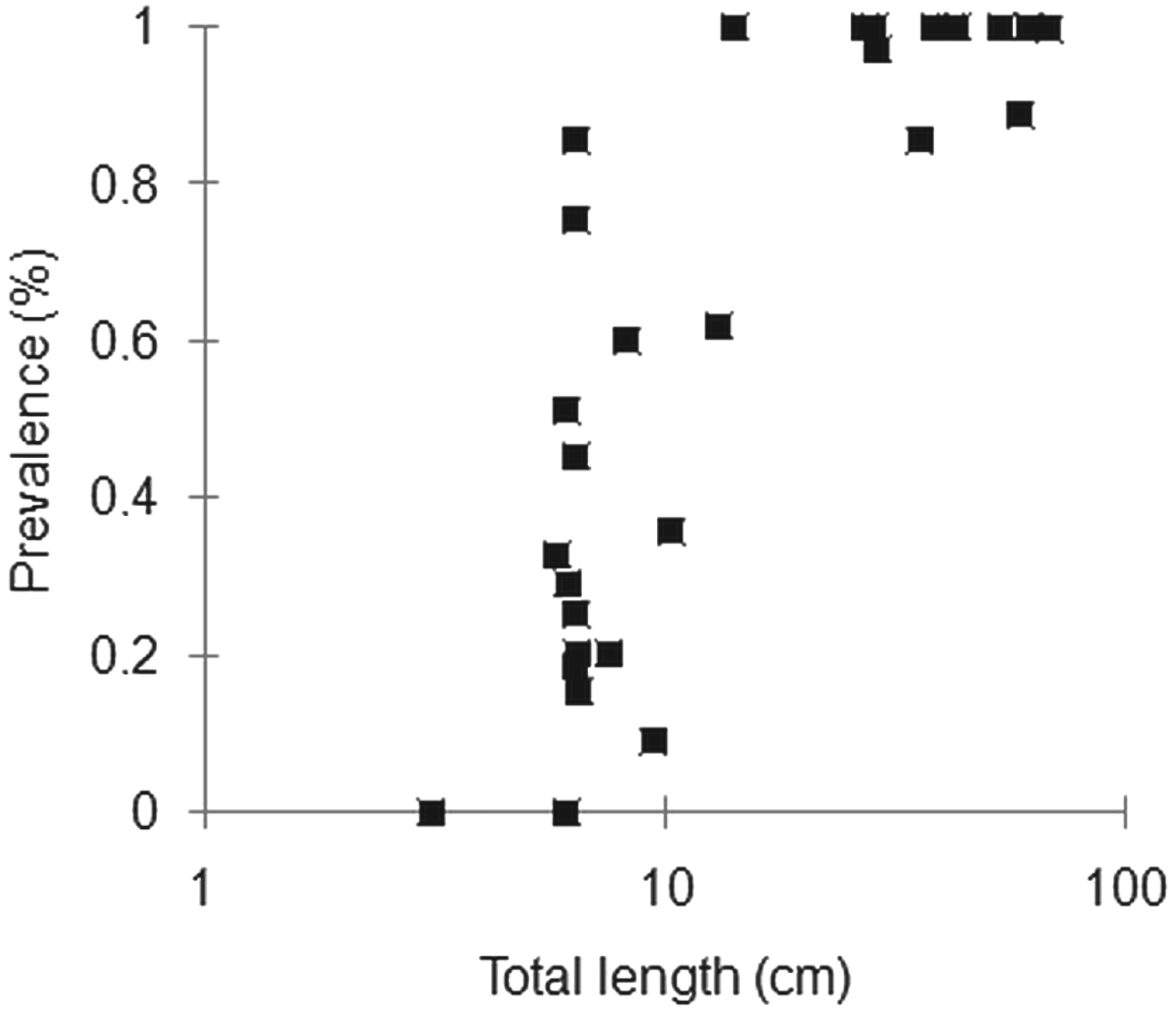
A final aspect to consider in the future is that patterns of abundance and distribution of parasites within a host species may be part of a broader pattern of distribution among host species (Poulin, Reference Poulin2004). As an example, the relationship between the host species’ mean body length and the probability of harbouring parasites among 38 fish species from SEP shows that it is highly variable for fish smaller than c. 10–20 cm in total body length (Fig. 2). Thus, looking for patterns beyond single host species could help to answer whether parasites (in some host species) are too variable to be useful biological tags. We emphasize the host species’ body mass as the factor to consider, among others, because it is determinant on the amount of parasitism (numbers, richness, biovolume) in host individuals or infracommunities (George-Nascimento et al. Reference George-Nascimento, Muñoz, Marquet and Poulin2004b ; Poulin and George-Nascimento, Reference Poulin and George-Nascimento2007; Hechinger, Reference Hechinger2013). It is already known that in marine fishes from SEP (several of which are listed in Table 2), the coefficient of variation of total infracommunity biovolume decreases in richer parasite communities (Mouillot et al. Reference Mouillot, George-Nascimento and Poulin2005), which instead are found in large host species. So, statistically speaking, more sampling will be needed on small fish than on large fish host species, as parasitoses are rarer and more variable than in large host species.
Total prevalence of parasitism in 38 fish species in SEP according to the total length of the host. All species sampled in more than 30 hosts.

ACKNOWLEDGEMENTS
Thanks are due to Juan Timi and Ken MacKenzie for inviting us to write this review. The following people are warmly acknowledged: Juan Carvajal, Gabriela Muñoz, Sebastián Muñoz, Karen González, Alex Mellado, Paulina Arancibia, Fabiola Sepúlveda, David Moscoso, Rosa Chávez, Isabel Valdivia, David Jofré, Monique Sánchez, Betsy Maluenda and Marcela Pachao.
FINANCIAL SUPPORT
Financial support is acknowledged to FONDECYT grant 1050528 to both authors.