Introduction
Maltese popular culture describes a black feathered chicken as being indigenous. Mallia (Reference MALLIA1998) claims that the Maltese Black may represent a relict population of relatively unselected breed that were formerly characteristic of the Mediterranean, and furthermore he claims that documentation describing the breed is not available. A small population is still present and is utilised exclusively for show purposes. With the lack of breed standard awareness, breeders and poultry judges have had a free hand at interpreting the breed's characteristics and phenotype. Nonetheless, this breed is widely known as non-sitting, with excellent egg laying potentials, both characteristics typical of Mediterranean breeds. Anderson (Reference ANDERSON1802), Borg (Reference BORG1933), Brockman (Reference BROCKMAN1961) and Mallia (Reference MALLIA1998) all state that additionally the breed has acceptable carcass qualities.
The Secretaries of Agriculture of the European Union (EU) passed a directive in June 1999 prohibiting the use of conventional layer cage in all EU member states as from January 1st, 2012. A form of extensive poultry production systems (Organic poultry production) is governed by EU Council Regulation 1804/1999 which has the status of a law. Annex 1 section 3.1 of this regulation stipulates that:
1) the choice of breed or strain of bird must consider the capacity to adapt to extensive rearing conditions, vitality and resistance to disease;
2) preference should be given to indigenous breeds or strains.
Large animal production under the organic certification program in Malta is severely challenged due to the scarcity of available land base, the average farm size being only 0.8 hectare. Given this limitation of the Maltese territory, poultry represent most probably the only form of organic livestock production possible.
Mallia (Reference MALLIA1998; Reference MALLIA1999) describes the first attempt to have an in-situ conservation of the Maltese Black. The small nucleus flock consisting of three lines with a total population of about 400 chickens was relocated to the Agricultural Research and Development Centre (Ghammieri, Malta) to maintain a protected genetic pool as a measure for future long term ex-situ conservation strategy. Due to the lack of appropriate resources and knowhow required to manage such projects the progress achieved is very limited and has, over the years, served mainly as a source for the procurement of genetic stock to amateur breeders. The lack of a defined breed standard has further hindered any attempt for objective breeding, multiplication and selection. In addition, the United Nations’ Food and Agriculture Organisation (2009) supports initiatives for the preservation of local and indigenous genotypes and safeguarding farm animal biodiversity.
The aim of this paper is to retrieve, analyse and combine information to propose a hypothesis on the origins of the breed, and to develop a comprehensive standard for the Maltese Black that conforms with the format of the American Breed Standard.
Historical background of the poultry industry in Malta
Various reports indicate that, prior to the 1960's, the Maltese poultry industry was unstructured and influenced by various historical issues. Having been part of the Spanish Empire in 1479 and later, in 1530, handed to the Knights of Saint John, Malta established strong cultural and commercial links with Spain, Portugal and Italy to the extent that livestock from these countries including poultry could have landed into Malta, a hypothesis supported by Mallia (Reference MALLIA1998). Ireland H. William (1828) states that, towards the conclusion of the siege of Malta during the French era (1798-1800), all livestock had been consumed and animal populations dwindled to very low numbers, and poultry was no exception. It is not clear if the drastic fall in livestock numbers was concentrated in centres where the French forces were stationed or if it was wide spread all over the rest of the islands. The fact that Anderson (Reference ANDERSON1802) described the rearing of poultry as being wide spread among the middle and lower social classes tends to suggest that the country side may have been spared from the drastic decline in farm animals.
With the arrival of the British forces in the early 1800's, and the utilisation of the island as a military and maritime hub, it would be appropriate to assume that there was not enough locally produced chicken and eggs to meet market demands for consumption. Patrick's (1975) reference to the importation of ‘Barbary Hens’ is supported by Cornell (Reference CORNELL1857), who stated that cattle, sheep, and poultry were exported from Tripoli to Malta.
During the peak of poultry mania in Britain and, more specifically, post 1850's until 1930's, the Maltese poultry sector may have shared the same enthusiasm and absorbed imports of various types of exotic fowl. Azzopardi (Reference AZZOPARDI1933) reported that live poultry together with hatching eggs were imported from England, America and Australia, and hence the local population of chicken at that time was a random concoction of predominantly mixed Mediterranean breeds, and no true Maltese Breed was present. On the other hand, Borg (Reference BORG1933), while insisting that a Maltese breed having phenotypical resemblance to the Minorcan does exist, supports the fact that the pure form had been diluted due to cross breeding, in particular with the Leghorn, Livorno and the Langshan breeds. Shepard (Reference SHEPARD1920) proposed that the poultry populations were of mixed character, but perhaps retaining affinities with the Minorcan and the Leghorn breeds. The existence of Andalusian and Black Leghorn parentage was further supported by Patrick (Reference PATRICK1975). Out of all the breeds mentioned, the Langshan was viewed as a problem (Borg, Reference BORG1933) and held responsible for negatively influencing the production potential of the local flock and for impregnating brown taint onto the egg shells.
A Government of Malta report (Government Departments Report, 1933-1934) indicated that, in 1933, attempts to create a Maltese breed was undertaken. A nucleus flock consisting of entirely black feathered chickens was obtained from various sources from all over the islands. The program was continued over several generations at the Government experimental farm, and a multiplication and selection breeding programme was implemented until the desired phenotypic traits were fixed and bred true.
The origins of the Maltese Black breed
These historical reports conflict with the hypothesis proposed by Mallia (Reference MALLIA1998) that the Maltese population of black poultry represent a relict population of relatively unselected poultry that were formerly characteristic of the Mediterranean. The mongrel nature of the local population is supported by the fact that, on breeding the unselected phenotypically black chicken, the offspring were of different size, colour and form. Cesareo (Reference CESAREO1950), states that the Maltese Black originated in 1934 from the Maltese Department of Agriculture using locally available indigenous stock comprising of 40 hens and 3 cockerels, and all were ‘...mongrels and were gathered from several farms irrespective of any type and conformation, but all of one colour, that is black feathers…’. On hatching, progeny from these all black parents were all colours including black and brown, brown, brown and white and Andalusian colours. Some chicks had tufts of white feathers on their heads like Polish and Houdan breeds. The expression of these different phenotypes agrees with Azzopardi (Reference AZZOPARDI1933) and confirms the introduction of different fowl into the gene pool.
Following multiplication to maximise genetic expression, a selection procedure was undertaken to standardise and define the breed. The best cockerels and pullets hatched from preferred hens were selected as parents for the next generation. Selection was continued for four consecutive years during which the birds gradually and steadily improved in colour and type. Egg production increased from 120 to 170 per year, with exceptional families producing over 200 eggs per year. In 1938, the prolificacy of this breed was already recognised and documented by the Commonwealth Bureau of Animal Breeding and Genetics, which stated that ‘As regards fertility in poultry, the Maltese Black proved to be superior to imported breeds, Rhode Island Reds being next in merit’. In 1939, Minorcan eggs were imported and the hatched chickens were introduced into the genetic pool to improve feather colour, whitening of the earlobe and egg size. Minorcan blood was reintroduced again in 1948.
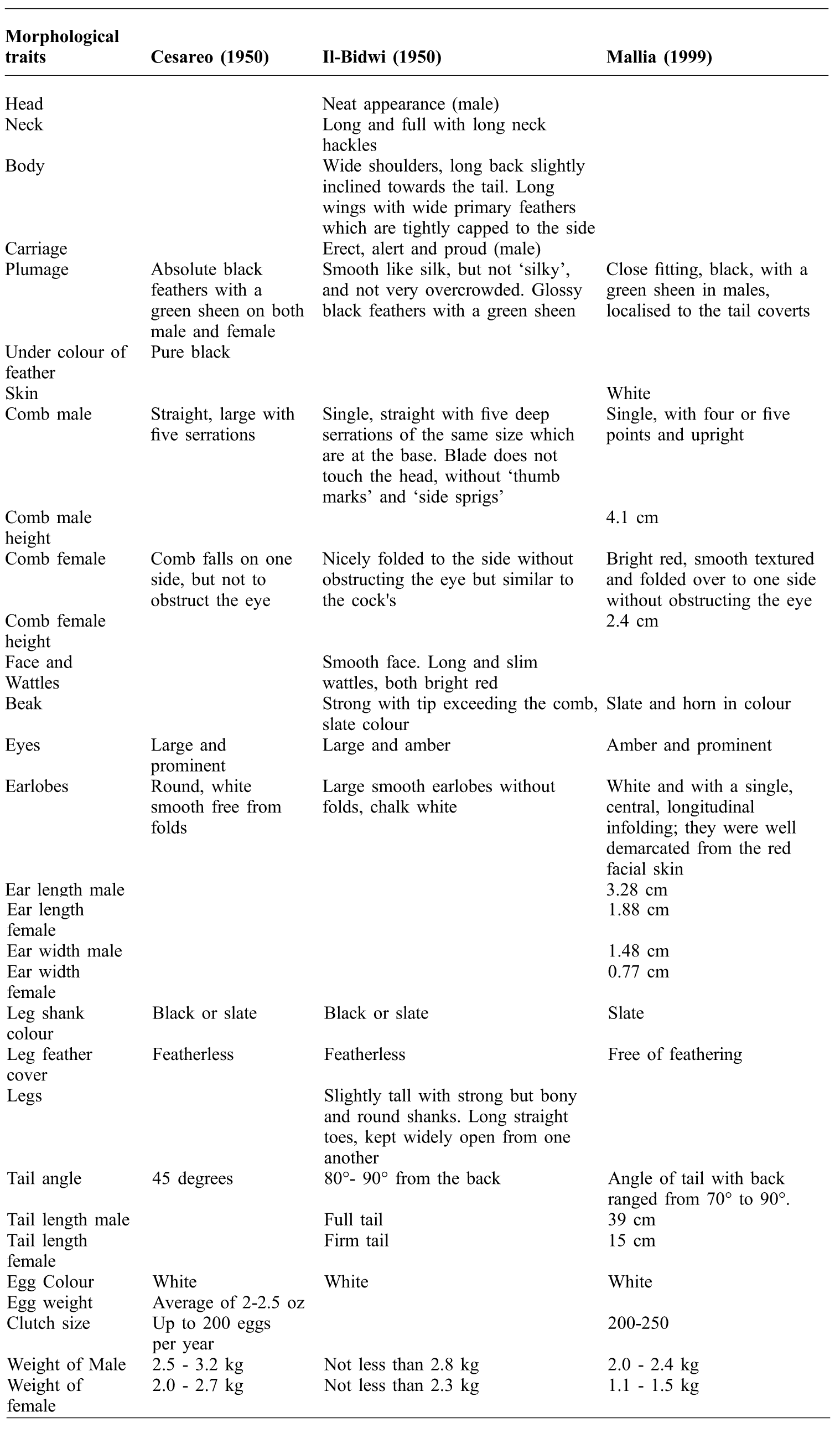
Contrary to Mallia (Reference MALLIA1998), who asserts that no written record or descriptions of the breed are available, the University of Hawaii (1945) quotes a communication in which the results of a comparative study carried over several years involving three imported breeds were compared with native stock of Maltese Black; and the breed standard was presented to both a local and international audience in 1950 in two separate publications, summarised in Table 1. For all intents and purposes, the Maltese Black breed was deemed to have been fixed as a specific breed in 1950 with the publication of the standards by Cesareo (Reference CESAREO1950), which is further supported by an article ‘New Breed Developed’ published in 1951 in the March issue of Poultry Digest.
Published standards for the Maltese Black breed.

While the two breed descriptions presented in the 1950's complement each other to give a strong indication as to the definition of the breed, the combined description still lacks completeness and is not compatible with the formats usually acceptable in international breed standards of perfection. When these definitions are compared to data published by Mallia (Reference MALLIA1998), deviation is evident in parameters pertaining to comb, ear lobes, tail and weight, and such drifts have been reported by Aquilina (Reference AQUILINA2012).
In an effort to consolidate the breed standard definition of the Maltese Black, the standards of the other Mediterranean breeds mentioned by Shepard, (Reference SHEPARD1920), Cesareo (Reference CESAREO1950) and Patrick (Reference PATRICK1975) and confirmed by Ceccobelli (Reference CECCOBELLI2013), that have contributed to genetic makeup were consulted to interpret and complete the gaps missing in Table 1.
Genetic origins
The genetic link with the Minorcan breed is documented as having been introduced at various stages of the breed stabilisation process. The link with the Andalusian breed is automatic since this breed was developed from the Minorca and originally known as ‘Blue Minorcas’ (Brown, Reference BROWN1906). It is interesting to note that Brown (Reference BROWN1906) discusses that the black variety Minorcas, can be traced back to the Tiverton district to as far back as 1780. Renowned for its exceptional prolificacy and the large size of the eggs, some significant changes were implemented through selection and out-crossing with other breeds. Such alterations were not always beneficial from a production point of view but may have contributed to the external characters evolving into a better looking show bird.
The Hamburgh breed has been bred in Britain since early 1700's and a black variety was developed. The breed is well known for its high egg laying capabilities, though the eggs are too small to satisfy market demands. Its prolificacy was capitalised upon by crossing it with other breeds that may not have been as productive, but which produced larger eggs. For this reason many breeders crossed them with the Minorcan and obtained beneficial results. An outstanding feature of the Hamburgh breed is the prominent round ears; this may be the path through which the Maltese Black acquired its round ear, as defined by Cesareo (Reference CESAREO1950).
The Andalusian breed is assumed to have originated from the Minorcan and was earlier on known as Blue Minorcas. They were first introduced into Britain in 1851. Over time, significant changes have taken place in the type, making it finer. It is a remarkable egg producer both in number and in size, and it is claimed to be superior to the Minorcan. Males were highly sought after for the production of birds known as ‘petits poussins’. Brown (Reference BROWN1906) commented that the breed was nervous and easily agitated, and such traits were substantiated by Cesareo (Reference CESAREO1950), Mallia (Reference MALLIA1999) and Aquilina (Reference AQUILINA2012).
The Leghorn breed was introduced into Britain in the 1870's. Many colours are known together with a black feathered variety with yellow legs that is very hardy and an excellent egg producer. Black Minorcas were crossed with the Black Leghorn to improve egg weight. The Langshan were imported into Britain in 1872. This breed was more renowned for its superior carcass qualities and the dark rich brown tint on the eggshell. It is known to have very poor egg production capacity.
Chronologically speaking, it follows that most probably the first landing of live poultry from Britain in the early 1800's consisted of Black Minorcas and may also have included black Hamburgh and Minorca/Hamburg out-crosses. By the late 1800's the other breeds mentioned above followed and eventually inter-bred to form the bulk of the mongrel flock.
The modern Maltese Black breed
genetic aspects
According to the genetic origin, the modern Maltese Black breed can be considered as being a composite breed. The breed is critically endangered, with <50 breeding adults (as reported by Mallia in 1999) and 96 breeding adults (as reported by Aquilina in 2012). The lack of a Herd Book makes it very difficult to know the exact status of this breed.
A recent survey by Aquilina (Reference AQUILINA2012) examined, in detail, 96 breeding adults belonging to the conservation centre and other private breeders. Effective population size (Ne) for Maltese Black breed was calculated from this survey by means of the formula Ne = (4MF)/(M+F) (Gandini, Reference GANDINI2004) was estimated to be 65.6. This estimate can be considered to be the best evaluation since the number of fancy breeders and the number of breeding adults in these small flocks is considered to remain fairly constant.
Preliminary results from ongoing research on Mediterranean chicken breeds (Ceccobelli, Reference CECCOBELLI2013) utilising molecular markers (mtDNA and microsatellites) indicate some genetic relationship with the Andalusian and Leghorn breeds, confirming the historical origin of this breed as expressed by Shepard, (Reference SHEPARD1920), Cesareo (Reference CESAREO1950) and Patrick (Reference PATRICK1975), and gives scientific support for consulting with these breed standards for the compilation of the Maltese Black breed standard. Most of the animals in this study were included in the haplogroup E, which is widespread in Europe, Middle East and India. The presence of one Maltese Black bird on the haplogroup A could be due to the possible genetic contamination with chickens of Chinese origin, as reported by Borg (Reference BORG1933). Additionally, Ceccobelli (Reference CECCOBELLI2013) observed a deficiency of heterozygosity with an high (0.16724) inbreeding coefficient of the population, confirming the importance of establishing a National Herd Book to structure the breeding scheme, develop pedigree and minimise the incidence of mating between close relatives. The Maltese Black breed, as showed by the Reynolds genetic distance, is closely linked to other Mediterranean chicken breeds (Italian breeds: Ancona, 0.24; White Leghorn, 0.21; Romagnola, 0.23; Valdarnese, 0.21; Spanish breeds, Pita Pinta Asturiana, 0.19; Gallina de Sobrarbe, 0.18; Albanian population, 0.14) and a Serbian breed (Banat Nacked Neck; 0.18). Structure analysis showed a genetic mixture in the Maltese Black of Italian and Spanish breeds suggesting the possible genetic relationship between them.
productive performance
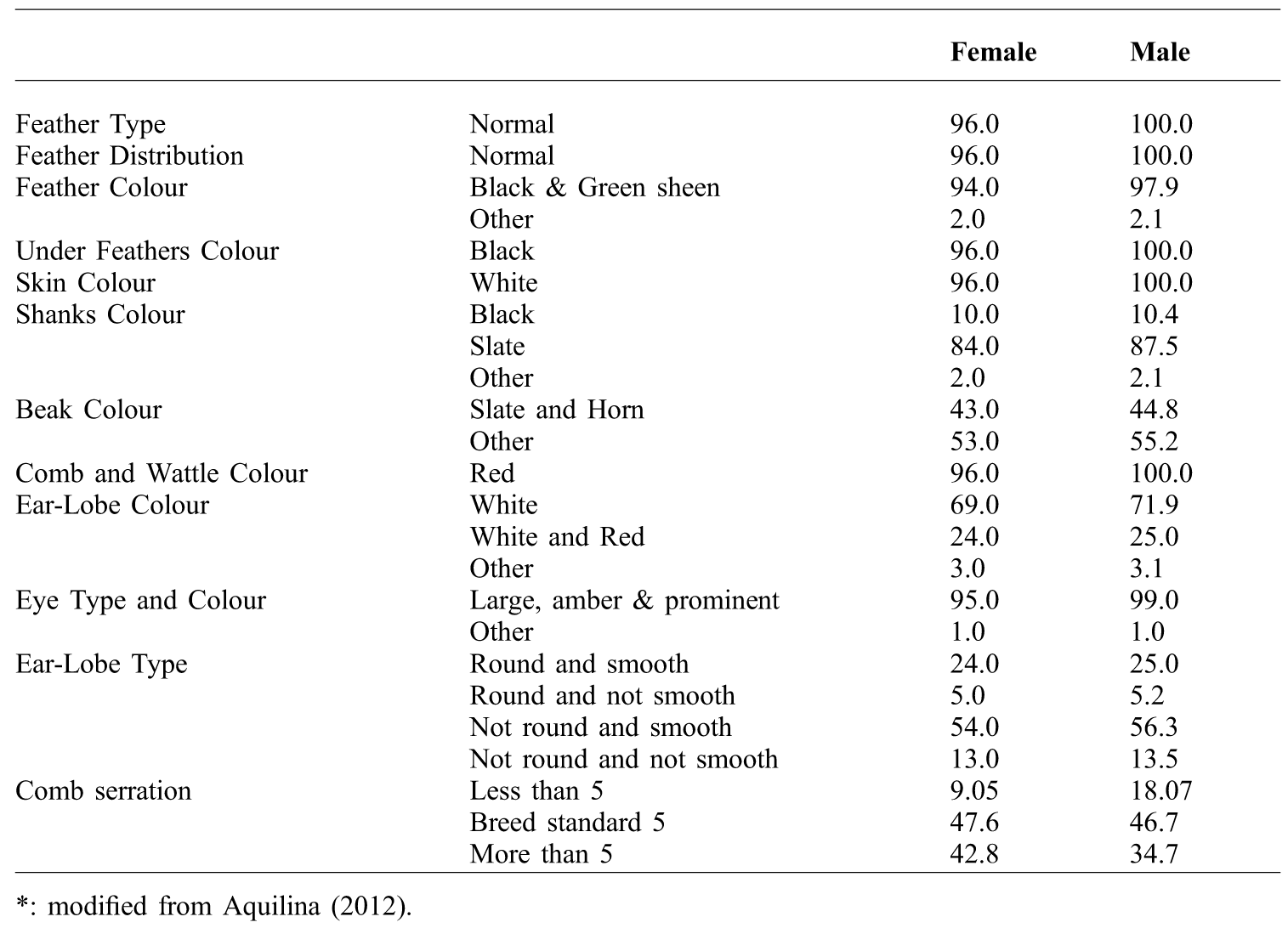
The main phenotypic characteristics of the population evaluated by Aquilina in 2012 are showed in Table 2. Results indicate that while some phenotypical traits are according to standards, others show a significant drift away. Significant deviations are evident in traits pertaining to comb serration, ear lobes, tail and live weight (Table 3). The live weights of the current Maltese Black population are 1.76+ 0.29 kg and 1.39 + 0.22 kg for cocks and hens respectively, which is too small a body frame to fulfil its original intention as a dual purpose breed.
Main phenotypic traits of Maltese Black chicks (expressed as %)*.
*: modified from Aquilina (Reference AQUILINA2012).
The Maltese Black was developed as a rustic breed to produce eggs and chicken meat for rural families. Most breeders today claim that the breed is capable of producing 205 ± 15 eggs per year which could be somewhat smaller in weight than the ones normally available as table eggs (50 ± 5 g). All breeders confirmed that the egg shell is white, and different shades of whites are also possible. Growth rate is similar to very slow-growing lines with a mean weight at 12 weeks of 1.3 ± 0.1 kg. All breeders claim that hatching usually shows a 75% rate in favour of male chicks. This phenomena needs to be explored further as it may have significant economic implications especially in the light that traditionally males were castrated and reared up as capons (Griffiths, Reference GRIFFITHS1803) to supply high quality meat.
the new breed standard
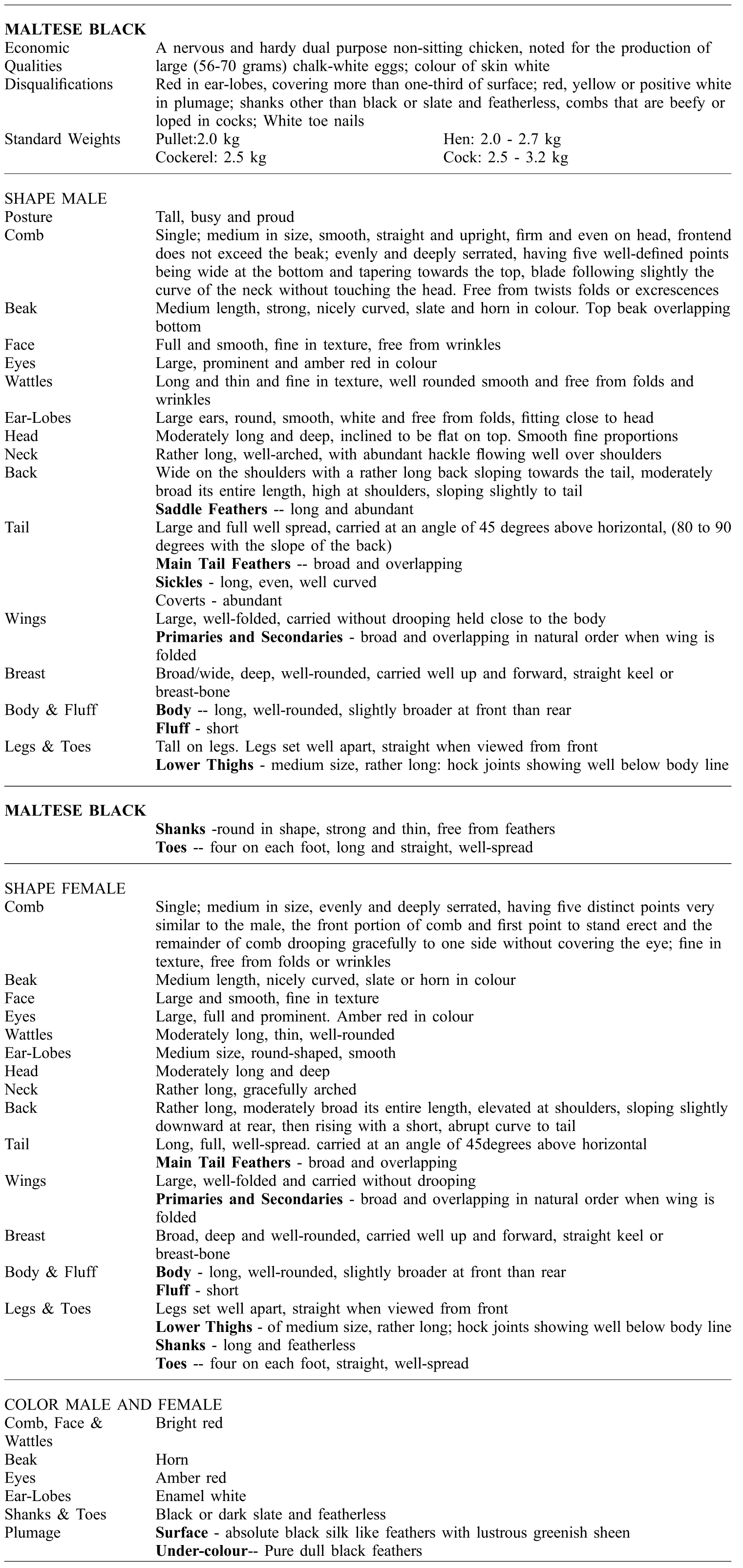
In efforts to complete the breed standard definition of the Maltese Black, the standards of the other related Mediterranean breeds as defined in the American Standards of Perfection (American Poultry Association, 1998) were consulted to interpret, describe and complete the missing information in Table 1. The results of this exercise are presented in Table 3 and follow the format adopted by the American Standards of Perfection.
Breed Standards for the Maltese Black chicken.
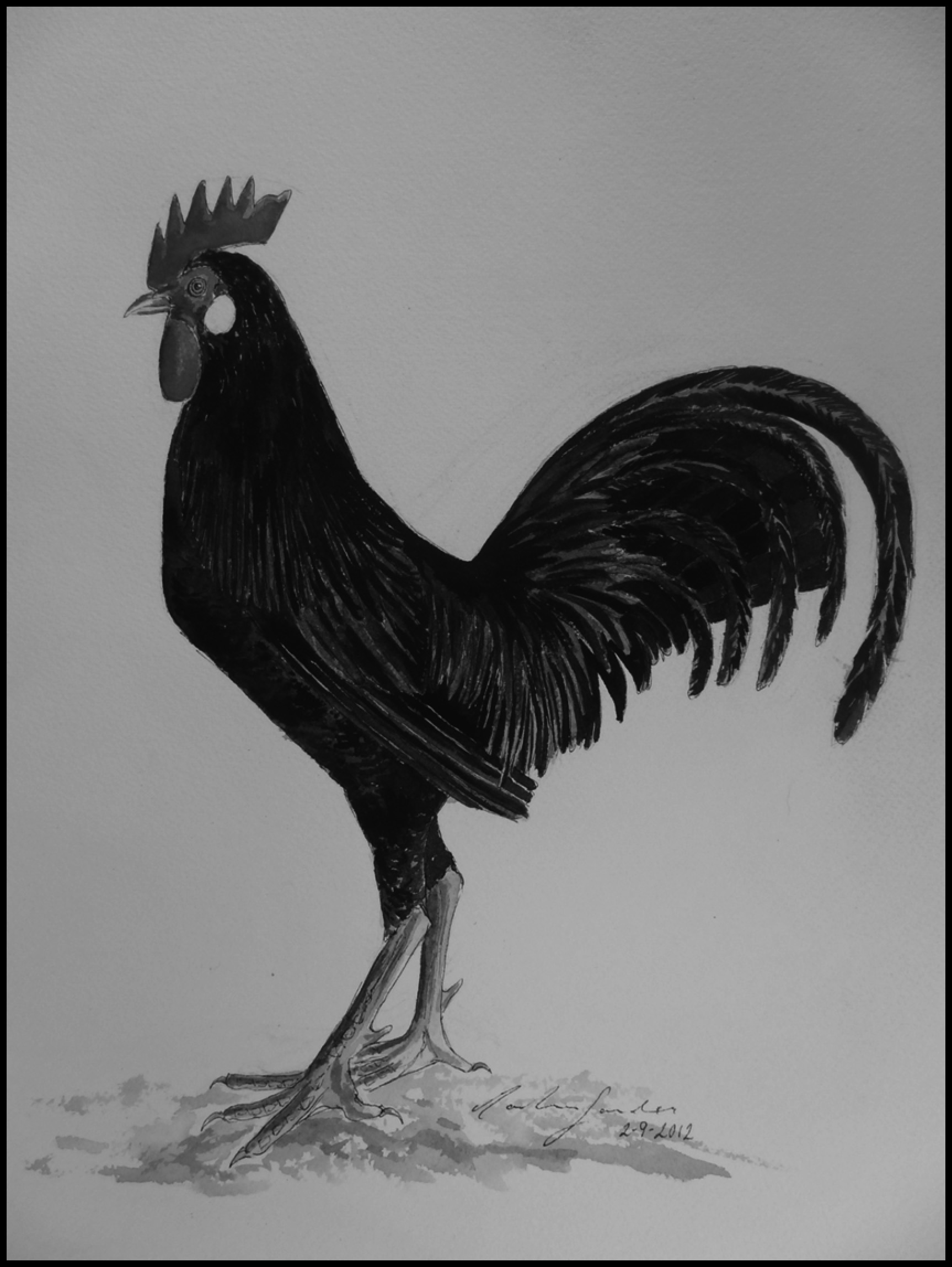
On completion of the standard, the parameters were given to a professional artist to give a visual phenotypic interpretation of the breed standard (Figure 1).
Artistic interpretation of the complete Maltese Black breed standard (Gouder, Reference GOUDER2012).
Conclusions
The present Maltese Black population has drifted away from the original standard, and in doing so, has lost its rustic capacity. There is an urgent need to implement an appropriate breeding program focusing on 1) the recuperation of this genetic pool, 2) appropriate mating schemes to breed back to standard while minimising inbreeding, and 3) the setting up of a herd book to catalogue pedigree.
The breed standard as presented in this study should be circulated amongst all local poultry clubs to bring awareness to amateur breeders and guide them in selection programs. The updated standards will not only act as the standard against which all future breeding programs are directed, but also as guidelines for judges involved in poultry shows. Once re-established, the dual purpose nature of this breed will once again occupy its niche within the Maltese agro-environment and compliment the national agricultural patrimony and heritage.