Children growing up in postconflict settings are exposed to a high number of adversities, such as poverty, community violence, family violence, disruption in family relationships, parental psychological impairment, and additional trauma and loss (Miller & Rasmussen, Reference Miller and Rasmussen2010; Pynoos, Steinberg, & Piacentini, Reference Pynoos, Steinberg and Piacentini1999). As a consequence, children are at an increased risk of developing a range of psychopathological symptoms (e.g., Betancourt, McBain, Newnham, & Brennan, Reference Betancourt, McBain, Newnham and Brennan2012; Catani et al., Reference Catani, Schauer, Elbert, Missmahl, Bette and Neuner2009; Catani, Jacob, Schauer, Kohila, & Neuner, Reference Catani, Jacob, Schauer, Kohila and Neuner2008; Klasen, Oettingen, Daniels, & Adam, Reference Klasen, Oettingen, Daniels and Adam2010; Panter-Brick, Eggerman, Gonzalez, & Safdar, Reference Panter-Brick, Eggerman, Gonzalez and Safdar2009). In order to effectively identify vulnerable children and to provide targeted interventions in low-income postconflict settings, it is important to understand the differential contributions of the various types of adversities on different mental health outcomes (Belkin et al., Reference Belkin, Unützer, Kessler, Verdeli, Raviola and Sachs2011; Miller & Rasmussen, Reference Miller and Rasmussen2010; Reed, Fazel, Jones, Panter-Black, & Stein, Reference Reed, Fazel, Jones, Panter-Brick and Stein2012; Silove, Reference Silove2013).
Previous research in conflict-affected populations usefully applied socioecological systems models (Bronfenbrenner, Reference Bronfenbrenner1979) to conceptualize different types of risk factors in relation to adverse mental health outcomes among children (e.g., Betancourt et al., Reference Betancourt, McBain, Newnham and Brennan2012; Reed et al., Reference Reed, Fazel, Jones, Panter-Brick and Stein2012). These ecological frameworks commonly included risk factors at the individual level, the relationship level, the family system level, and the community level (e.g., Betancourt et al., Reference Betancourt, McBain, Newnham and Brennan2012; Krug, Dahlberg, Mercy, Zwi, & Lozano, Reference Krug, Dahlberg, Mercy, Zwi and Lozano2002; Reed et al., Reference Reed, Fazel, Jones, Panter-Brick and Stein2012). Studies in postconflict settings that included exposure to war and community violence (as a community-level risk factor) as well as maltreatment within the family (as a family-level risk) found that violence on both levels made a unique contribution to the prediction of children's psychopathological symptoms. Both types of violence independently predicted increased posttraumatic stress disorder (PTSD) symptoms (Catani et al., Reference Catani, Jacob, Schauer, Kohila and Neuner2008; Klasen et al., Reference Klasen, Oettingen, Daniels and Adam2010), depression symptoms (Klasen et al., Reference Klasen, Oettingen, Daniels and Adam2010), and internalizing and externalizing behavior problems (Klasen et al., Reference Klasen, Oettingen, Daniels and Adam2010) among children.
In order to account for the interrelationship among community violence, child maltreatment, and children's functioning over time Lynch and Cicchetti (Reference Lynch and Cicchetti1998) introduced the concept of an ecological–transactional model. Studies conducted within this conceptual framework showed that risk factors at a more distal ecological level affected the child directly as well as events occurring at a more proximal level of the child's ecology. Children who experienced higher levels of violence in the community were more likely to experience physical abuse and neglect by parents (Lynch & Cicchetti, Reference Lynch and Cicchetti1998). In addition, children with a high exposure to violence in the community reported a less positive emotional quality of the relationship with their maternal caregivers, more psychological proximity seeking, more separation anxiety, and more perceived negative maternal behavior (Lynch & Cicchetti, Reference Lynch and Cicchetti2002). Studies in postconflict settings also supported the link between community-level violence and adversities within the child's family environment. Children who had been exposed to higher levels of war-related traumatic events witnessed and experienced higher levels of violence in the family (Catani et al., Reference Catani, Jacob, Schauer, Kohila and Neuner2008, Reference Catani, Schauer, Elbert, Missmahl, Bette and Neuner2009; Haj-Yahia & Abdo-Kaloti, Reference Haj-Yahia and Abdo-Kaloti2003). A study in Gaza found that war-affected Palestinian children who had been exposed to a greater number of traumatic experiences perceived their parents as more punitive and less loving (Punamäki, Qouta, & El Sarraj, Reference Punamäki, Qouta and El Sarraj1997).
Family-level and relationship-level variables including household violence and the quality of parenting practices have been discussed as important mediators in the relationship between children's exposure to traumatic events and mental health outcomes (Gewirtz, Forgatch, & Wieling, Reference Gewirtz, Forgatch and Wieling2008; Masten & Narayan, Reference Masten and Narayan2012). Longitudinal studies in postconflict settings suggested that ongoing family violence was associated with internalizing symptoms in a sample of war-affected youths in Sierra Leone (Betancourt et al., Reference Betancourt, McBain, Newnham and Brennan2012) and internalizing and externalizing behavior problems and depression symptoms among children in postconflict Afghanistan (Panter-Brick, Goodman, Tol, & Eggerman, Reference Panter-Brick, Goodman, Tol and Eggerman2011). A longitudinal study in Northern Ireland found a two-stage mediation of the relationship between children's exposure to secular violence in the community and children's internalizing and externalizing symptoms via higher levels of conflict in the family and less emotional security in relationships with guardians (Cummings et al., Reference Cummings, Merrilees, Schermerhorn, Goeke-Morey, Shirlow and Cairns2012). However, a longitudinal study that followed 65 Palestinian adolescents found only a marginally significant effect of parenting style on adolescents’ PTSD and depression symptoms 4 years after the baseline assessment when controlling for children's exposure to traumatic events, child characteristics, and children's active coping (Qouta, Punamäki, Montgomery, & El Sarraj, Reference Qouta, Punamäki, Montgomery and El Sarraj2007).
Taken together, these findings suggest that in postconflict settings, risk factors at the community level, the family system level, and presumably the dyadic relationship level are associated with increased psychopathological symptoms in children. More specifically, the effects of structural and collective violence at the community level on mental health outcomes among children appear to be mediated by violence at the family system level and by impairments in the guardian–child relationship.
However, the studies reviewed above relied on children's self-report data and focused on children as individuals. Beyond individual-level exposure, intergenerational risk factors may contribute to negative mental health outcomes among children (Serbin & Karp, Reference Serbin and Karp2004). In postconflict settings children stay with guardians who have been affected by war-related violence and may suffer from increased psychopathological symptoms as a consequence (de Jong, Komproe, & Van Ommeren, Reference de Jong, Komproe and Van Ommeren2003). A number of studies from various postconflict settings suggest a linkage between parents’ psychopathology and children's psychopathology. A study in Gaza examined 121 war-affected Palestinian mother–child dyads and found that mother-reported hostility and depression symptoms were associated with higher levels of child- or parent-reported PTSD symptoms among children (Qouta, Punamäki, & El Sarraj, Reference Qouta, Punamäki and El Sarraj2005). In line with these findings another study in the Gaza Strip reported an independent effect of parental PTSD and anxiety symptoms on children's PTSD and anxiety symptoms even when controlling for children's trauma exposure (Thabet, Abu Tawahina, El Sarraj, & Vostanis, Reference Thabet, Abu Tawahina, El Sarraj and Vostanis2008). A cross-sectional study that examined 364 Afghan children and their caregivers in Kabul and 317 children and their caregivers in refugee camps near the Afghan border found that poor guardian mental health was associated with internalizing and externalizing behavior problems, depression symptoms, and PTSD symptoms in children when controlling for children's exposure to traumatic events (Panter-Brick et al., Reference Panter-Brick, Eggerman, Gonzalez and Safdar2009). When a subsample of 331 dyads was reinterviewed 1 year after the first wave of data collection, the authors found that impaired caregiver mental health prospectively predicted higher PTSD symptoms, higher depression symptoms, and higher internalizing and externalizing symptoms among children when controlling for baseline characteristics and past-year events in the family context (Panter-Brick, Grimon, & Eggerman, Reference Panter-Brick, Grimon and Eggerman2014). A longitudinal study that examined 118 caregiver–youth dyads in Sierra Leone showed that internalizing symptoms in youth positively covaried with adult depression and anxiety symptoms over a 4-year study period (Betancourt, McBain, Newnham, & Brennan, Reference Betancourt, McBain, Newnham and Brennan2015).
Although a number of studies have highlighted guardian mental health as a proximal risk to child mental health in postconflict settings, the role of guardians’ previous trauma exposure in the development of psychopathological symptoms among children remains to be elucidated. Earlier research on the intergenerational transmission of violence suggests that guardians who expierenced high levels of violence in the past may place their children at risk because they are more likely to employ harsh parenting behaviors and tend to raise their children in a more stressful family environment (Serbin & Karp, Reference Serbin and Karp2004; Thornberry, Knight, & Lovegrove, Reference Thornberry, Knight and Lovegrove2012). Recent studies in postconflict northern Uganda showed that female guardians’ own exposure to family violence during childhood as well as exposure to war trauma were related to children's experiences of violence in the family (Saile, Ertl, Neuner, & Catani, Reference Saile, Ertl, Neuner and Catani2014; Saile, Neuner, Ertl, & Catani, Reference Saile, Neuner, Ertl and Catani2013). On a dyadic relationship level, female guardians’ history of abuse during childhood and exposure to traumatic war experiences increased female guardians’ risk of perpetration in dyadic interactions with their child (Saile et al., Reference Saile, Ertl, Neuner and Catani2014). In another study with war-affected asylum-seeking mothers, maternal PTSD symptoms were associated with more hostile behaviors and less sensitivity in direct behavior observations of parent–child interactions (Van Ee, Kleber, & Mooren, Reference Van Ee, Kleber and Mooren2012). In a sample of 240 Palestinian children and their parents, parental war exposure was linked to more child-reported emotional maltreatment in the family and impairments in attachment security although the effect differed for female and male guardians (Palosaari, Punamäki, Qouta, & Diab, Reference Palosaari, Punamäki, Qouta and Diab2013). Thus, guardians’ exposure to war appears to adversely affect proximal levels of the child's social ecology in the postconflict period. However, it is yet unclear whether guardians’ previous trauma exposure may transgenerationally affect the development of psychopathological symptoms among children who grow up after the war (Skinner, Reference Skinner2014).
In order to determine children at risk of developing psychopathological symptoms in the postconflict period, it seems important to better understand the interplay of ecological risk factors of the postconflict setting and intergenerational risk factors in guardians (Betancourt et al., Reference Betancourt, McBain, Newnham and Brennan2015; Panter-Brick et al., Reference Panter-Brick, Grimon and Eggerman2014). The present study was designed to measure ecological as well as intergenerational risk factors in order to predict externalizing and internalizing symptoms, depression symptoms, and PTSD symptoms in children growing up in postconflict northern Uganda. Between 1986 and 2006, the rebel movement Lord's Resistance Army waged a guerrilla war against the Ugandan government. During this conflict, most of the population in the northern regions was forcibly displaced into internally displaced person (IDP) camps (UNOCHA, n.d.). High exposure to war-related violence resulted in high levels of PTSD symptoms, depression symptoms, and alcohol-related symptoms among IDP populations (Ertl, Pfeiffer, Schauer-Kaiser, Elbert, & Neuner, Reference Ertl, Pfeiffer, Schauer-Kaiser, Elbert and Neuner2014; Roberts, Ocaka, Browne, Oyok, & Sondorp, Reference Roberts, Ocaka, Browne, Oyok and Sondorp2008; Roberts et al., Reference Roberts, Ocaka, Browne, Oyok, Sondorp and Ocaka2011). The erosion of family and social relationships (Hovil & Moorhead, Reference Hovil and Moorhead2002) and high levels of domestic violence against women (Uganda Bureau of Statistics & Macro International Inc., 2007) constituted major problems within IDP camps in northern Uganda. Every fourth child in the camps was reported to have lost at least one parent (27%; Uganda Bureau of Statistics & Macro International Inc., 2007). In the years following the cease-fire, the majority of families left the camps and resettled closer to their homes (UNOCHA, n.d.). In the postconflict period, adversities such as social disorder within the community (e.g., land disputes and community violence; Betancourt, McBain, Newnham, & Brennan, Reference Betancourt, McBain, Newnham and Brennan2014; Uganda Ministry of Gender, Labour and Social Development, 2009), economic hardship (Klasen et al., Reference Klasen, Oettingen, Daniels and Adam2010), parental loss (Betancourt et al., Reference Betancourt, McBain, Newnham and Brennan2012), and elevated levels of family violence (Catani et al., Reference Catani, Jacob, Schauer, Kohila and Neuner2008, Reference Catani, Schauer, Elbert, Missmahl, Bette and Neuner2009; Klasen et al., Reference Klasen, Oettingen, Daniels and Adam2010; Panter-Brick et al., Reference Panter-Brick, Eggerman, Gonzalez and Safdar2009) may increase children's vulnerability to developing long-lasting emotional and behavioral problems (Kessler et al., Reference Kessler, McLaughlin, Green, Gruber, Sampson and Zaslavsky2010). Previous studies in northern Uganda have investigated psychopathological symptoms in war-affected children and adolescents in the camps (e.g., Ertl et al., Reference Ertl, Pfeiffer, Schauer-Kaiser, Elbert and Neuner2014; Klasen et al., Reference Klasen, Oettingen, Daniels and Adam2010). Despite the far-reaching consequences of the war on individuals, families, and communities there is a paucity of research addressing the intergenerational effects of war and the mental health needs of children growing up in postconflict northern Uganda.
In the present study, we assessed second-grade children (aged 6–13, M = 8.79, SD = 1.29) who have largely grown up after the end of the war in northern Uganda, together with their female guardians. We examined the effects of risk factors at multiple levels (i.e., within the community, within the family, and at a dyadic relationship level) to predict different types of psychopathological symptoms among children (including internalizing and externalizing symptoms, depression symptoms, and PTSD symptoms). In order to control for the effects of guardian risk factors, we included female guardians’ history of childhood maltreatment, war exposure, and ongoing psychopathology as covariates in the model. We proposed that children's exposure to general traumatic events in the community context, the loss of at least one parent, exposure to violence within the family, and lower child-perceived care from female guardians would independently contribute to higher levels of psychopathological symptoms in children. In addition, we predicted that caregiver characteristics (such as previous victimization experiences during childhood and in the course of the war) as well as ongoing psychopathology would independently be associated with increased psychopathological symptoms in children. In order to examine specific risk constellations that increase children's psychopathological symptoms, we further explored direct and indirect risk trajectories. We hypothesized that children's exposure to violence in the community context would influence children's psychopathology directly and through its adverse effect on events in children's proximal environment (i.e., more violence within the family system and lower perception of care within the dyadic relationship), even when controlling for the intergenerational effects of guardian risk factors.
Methods
Sample
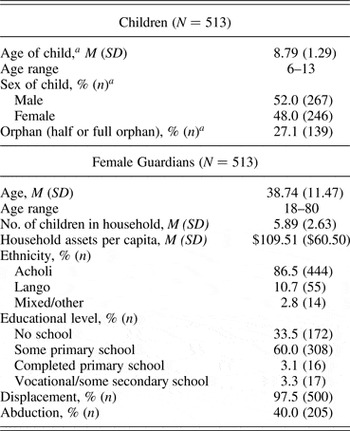
In 2010 we obtained interview data from 516 second-grade children and their female guardians (N = 513) from an epidemiological study in nine war-affected communities in Gulu and Nwoya Districts in northern Uganda. We purposively sampled communities according to their distance to Gulu Municipality because we assumed that secondary adversities such as poverty, restricted access to education and health care, and relative war exposure would increase with distance from Gulu town. Within these communities, we then exhaustively sampled all second-grade students and their primary male and female guardians (except for the first community where only children and their female guardians were included). Because a considerable proportion of children in northern Uganda do not stay with both biological parents (45% in the present study), we defined guardians as the male and female adult persons living in the same household and being primarily responsible for taking care of the child's upbringing, education, and the fulfillment of the child's material and emotional needs. For the current study, we used child and female guardian data only based on the assumption that female guardians in northern Uganda traditionally provide more caregiver support and are thus more central to young children's immediate rearing environment than are male guardians (Karimli, Ssewamala, & Ismayilova, Reference Karimli, Ssewamala and Ismayilova2012). Three children had to be excluded because they lived in a male-guardian-only household leaving 513 female guardian–child dyads for the present analysis. Sample characteristics are displayed in Table 1.
Sample characteristics of female guardians and children

a Child report.
Instruments
Luo versions of the instruments were created according to recommended procedures in transcultural research (Flaherty et al., Reference Flaherty, Gaviria, Pathak, Mitchell, Wintrob and Richman1988; Van Ommeren et al., Reference Van Ommeren, Sharma, Thapa, Makaju, Prasain and Bhattarai1999) including translation, lexical back translation, blind back translation, and separate focus group discussions with bilingual local therapists and study participants from the first two schools. All questionnaires were administered in an interview format.
Sociodemographic information
The first part of the interview captured individual and household characteristics as well as abduction history and displacement.
Child measures
Emotional and behavioral symptoms
The Strengths and Difficulties Questionnaire (SDQ; Goodman, Reference Goodman1997) is one of the most widely used screening instruments to assess children's emotional and behavioral symptoms and interpersonal behavior. The SDQ has also been employed to assess child mental health in postconflict settings (e.g., Panter-Brick et al., Reference Panter-Brick, Eggerman, Gonzalez and Safdar2009). Multiple-informant ratings by parents and teachers as well as self-reports of children assess the pertinence of 25 child attributes relating to the SDQ subscales emotional problems, peer relationship problems, conduct problems, hyperactivity/inattention, and prosocial behavior. Items are recorded on a 3-point Likert-type scale (0 = not true, 1 = somewhat true, or 2 = true). The SDQ total difficulties score can be calculated by summing up all symptom scores except prosocial behavior scores. Although the self-report form of the SDQ has mostly been employed in children aged 11 and above, it has also proven useful in the assessment of children aged 8 to 13 (Muris, Meesters, Eijkelenboom, & Vincken, Reference Muris, Meesters, Eijkelenboom and Vincken2004). A total difficulties score of 16 has been proposed to indicate the borderline range of psychopathological symptoms (Goodman, Reference Goodman1997). In order to evaluate the validity of the Luo self-report version of the SDQ in the current study, a subsample of 58 children was reinterviewed by clinical psychologists and a local interpreter on the basis of the Youth Self-Report form of the Achenbach System of Empirically Based Assessment (Achenbach, Reference Achenbach1991) as a gold standard. Good concurrent validity and significant correspondence between the interviewer-assisted SDQ self-report and clinician's judgement of clinically relevant symptom levels based on the Youth Self-Report (κ = 0.36) were found. The optimal agreement between raters and measures was determined using a SDQ total difficulties cutoff score of 15 in the child-report version (Hinterding, Reference Hinterding2011). Across the entire sample, the Cronbach α value of 0.69 for the SDQ symptom scales was comparable to internal consistencies reported in other studies (e.g., Panter-Brick et al., Reference Panter-Brick, Goodman, Tol and Eggerman2011).
Depression symptoms
The Children's Depression Inventory (CDI; Kovacs, Reference Kovacs1992) is a brief self-report screening instrument that was designed to assess cognitive, affective, and behavioral signs of depression in children and adolescents aged 6 to 17 years. Children report their symptoms in a 3-point multiple-choice format. Allgaier et al. (Reference Allgaier, Frühe, Pietsch, Saravo, Baethmann and Schulte-Körne2012) examined the 10-item short version of the CDI and found that the short version performed comparably well in terms of validity and reliability as the original 26-item version in a sample of 406 German pediatric patients aged 9 to 12 years. A cutoff score of ≥3 or alternatively ≥4 proved futile in detecting cases of depression. In the current study, we employed the short version of the CDI. The internal consistency was a Cronbach α value of 0.60. We calculated the sum of item scores to reflect children's level of depression symptoms and established the presence of clinically relevant depression symptom levels according to the recommended cutoffs.
PTSD symptoms
The University of California at Los Angeles PTSD Reaction Index for DSM-IV (UPID) for children (Pynoos, Rodriguez, Steinberg, Stuber, & Frederick, Reference Pynoos, Rodriguez, Steinberg, Stuber and Frederick1998) has been designed to assess PTSD symptom severity in 7- to 18-year-old children and adolescents. The UPID features good psychometric properties and has been employed in different countries including postconflict settings (e.g., Catani et al., Reference Catani, Jacob, Schauer, Kohila and Neuner2008, Reference Catani, Schauer, Elbert, Missmahl, Bette and Neuner2009). Frequencies of DSM-IV symptoms for PTSD (American Psychiatric Association, 2000) are coded on a 5-point Likert scale ranging from 0 (none of the time) to 4 (almost every day). The sum of scores on the 17 PTSD symptom items make up the total symptom scale score. In the present study, the Cronbach α was 0.78 for the 17 PTSD symptom items. Previous validation studies showed good correspondence of the assisted UPID self-report and clinicians’ diagnoses based on the Mini International Neuropsychiatric Interview for children and adolescents (Sheehan et al., Reference Sheehan, Lecrubier, Sheehan, Amorim, Janavs and Weiller1998) in Sri Lanka (κ = 0.80; Elbert et al., Reference Elbert, Schauer, Schauer, Huschka, Hirth and Neuner2009) and the clinician-administered PTSD Scale for Children and Adolescents (Nader et al., Reference Nader, Newman, Weathers, Kaloupek, Kriegler and Blake2004) in Afghanistan (κ = 0.56; Catani et al., Reference Catani, Schauer, Elbert, Missmahl, Bette and Neuner2009). Based on the results from these studies, we used a UPID symptom score of 1 and the DSM-IV criteria for PTSD to calculate prevalence rates of PTSD in children. The developmental appropriateness of DSM-IV symptom criteria and particularly Cluster C symptoms in preschool and school-aged children has been subject to extensive discussion (Pynoos et al., Reference Pynoos, Steinberg, Layne, Briggs, Ostrowski and Fairbank2013). At least concerning children aged 6 years and younger, the DSM-5 advocates an alternative diagnostic algorithm with the presence of one instead of three avoidance symptoms considered sufficient to diagnose PTSD if all other criteria are fulfilled (Scheeringa, Myers, Putnam, & Zeanah, Reference Scheeringa, Myers, Putnam and Zeanah2012). Given that the C-criterion has also been criticized as culturally insensitive with respect to PTSD diagnosis (Renner, Salem, & Ottomeyer, Reference Renner, Salem and Ottomeyer2006), we employed the Scheeringa criteria in an exploratory fashion to estimate PTSD prevalence even though children in our sample were 6 years and older.
Traumatic exposure
The Violence, War and Abduction Exposure Scale (Ertl et al., Reference Ertl, Pfeiffer, Saile, Schauer, Elbert and Neuner2010, Reference Ertl, Pfeiffer, Schauer, Elbert and Neuner2014) lists different event types relevant to the northern Ugandan context. The items on the scale cover general traumatic events, war-related traumatic events, Lord's Resistance Army–specific events, and forced perpetration. We used a 29-item version of the checklist. The level of traumatic exposure was reflected by the sum score of items endorsed excluding two items on family violence.
Family violence
Children reported on a 31-item checklist on experiences of physical abuse (13 items), emotional abuse (4 items), sexual abuse (5 items and 1 item as witness), witnessing violence between family members (5 items), deliberate deprivation of food and water (2 items), and one open question. Each item was coded for lifetime occurrence (happened ever in life) and as ongoing (happened in the past month). The questionnaire had previously been employed with children in different cultural contexts (Catani et al., Reference Catani, Jacob, Schauer, Kohila and Neuner2008, Reference Catani, Schauer, Elbert, Missmahl, Bette and Neuner2009). We used the cumulative number of different aversive experiences during the lifespan to estimate the level of exposure to family violence. Using a separate scale, we recorded perpetrators and recipients of violence within the family (e.g., father abuses mother, grandparents abuse parents).
Parental bonding
The Parental Bonding Instrument (PBI; Parker, Tupling, & Brown, Reference Parker, Tupling and Brown1979) measures fundamental parenting behaviors and attitudes as perceived by the child on the dimensions care (12 items) and control (13 items). Children evaluate the likeliness of each parental behavior on a 4-point Likert-type scale ranging from 0 (very unlike) to 3 (very like). The PBI shows generally good indices of validity and reliability (Parker, Reference Parker1998). Although the PBI has mostly been used for adults in retrospective, it has also been usefully employed in children and adolescents from varying cultural backgrounds (e.g., Phuong, Huong, Tien, Chi, & Dunne, Reference Phuong, Huong, Tien, Chi and Dunne2013; Tsaousis, Mascha, & Giovazolias, Reference Tsaousis, Mascha and Giovazolias2012) with the care dimension appearing to be most relevant when assessing primary school children (Amato, Reference Amato1990). A cutoff score of 27 has been proposed to differentiate between poor and good perceived maternal care (Parker, Reference Parker1998). In the current study, we only used the 12 care items of the PBI to assess child-perceived care/rejection in the previous year. The PBI care scale demonstrated a high internal consistency (Cronbach α = 0.91).
Female guardian measures
History of childhood family violence
For female guardians, we used the same measure as for children in retrospective. Acts of childhood family violence were coded if the recipient was below the age of 18 years at the time, and if they occurred in the home environment and were perpetrated by family members (but not partners) who were in a relationship of responsibility, trust, and power to the recipient.
War-related trauma exposure
The same event list was used for adults and children. For female guardians we employed a 33-item version of the scale. Out of all items, we summed up 24 items describing war-related traumatic events and excluded general traumatic events (e.g., experiencing or witnessing an accident) to represent the level of war-related traumatic exposure.
PTSD symptoms
The Posttraumatic Diagnostic Scale (PDS; Foa, Reference Foa1995) assesses PTSD symptom severity on the basis of frequency ratings on 17 DSM-IV PTSD symptom items with codings ranging from 0 (never or only once in the past month) to 3 (almost daily in the past month). The Luo version of the PDS has proven good concurrent validity and correspondence with expert diagnoses of PTSD (κ = 0.54; Ertl et al., Reference Ertl, Pfeiffer, Saile, Schauer, Elbert and Neuner2010) that were based on the Clinician Administered PTSD Scale (Blake et al., Reference Blake, Weathers, Nagy, Kaloupek, Gusman and Charney1995) as gold standard. Ertl et al. (Reference Ertl, Pfeiffer, Saile, Schauer, Elbert and Neuner2010) recommended a PDS sum score of 16 in addition to the DSM-IV PTSD criteria as a diagnostic algorithm for the Luo version of the PDS.
Depression symptoms
We employed the 15-item depression section of the Hopkins Symptom Checklist (DHSCL; Derogatis, Lipman, Rickels, Uhlenhuth, & Covi, Reference Derogatis, Lipman, Rickels, Uhlenhuth and Covi1974) to measure perceived severity of depression symptoms in the week preceding the interview. The DHSCL uses a 4-point Likert scale ranging from 0 (no distress) to 3 (extreme distress). The DHSCL is one of the most extensively used instruments in transcultural research including northern Uganda (Roberts et al., Reference Roberts, Ocaka, Browne, Oyok and Sondorp2008). In the present study depression symptom severity was calculated on the basis of the total scale mean score. Based on validity data from a previous study in northern Uganda (Ertl et al., Reference Ertl, Pfeiffer, Saile, Schauer, Elbert and Neuner2010), the presence of clinically relevant depression symptoms was derived using a cutoff mean score of 1.65.
Procedure
After consulting the District Education Offices in Gulu and Nwoya Districts we convened several meetings at selected schools to introduce the study to school staff, community representatives, and guardians as a research project on trauma and family functioning. We provided detailed information about the purpose, content, and procedure of the study and that participation was completely voluntary. If guardians were interested in participating, they could arrange individual interview appointments at the end of the meeting while giving informed guardian consent to interviewing the child. All guardians who had not been to the meeting were invited on an individual basis. Children were informed about the purpose and procedure of the study in class. Guardians returned to the school premises at appointed times, and children's interviews took place after lessons ended. The assigned interviewer provided information about content, procedure, risks, the right to withdraw, and confidentiality again to the participant before the interview started. Participants were asked to give their written consent (signature or fingerprints). All interviews were conducted individually at a secluded place in the vicinity of the school. The interviews took between 1 and 2 hr.
The interviewers were nine local therapists who had several years of experience in the diagnostics of mental health symptoms and in the treatment of PTSD in children and adolescents as well as adults. They were accompanied by an international team of clinical psychologists who had at least attained a master's degree in clinical psychology, had been working in the context of northern Uganda before and had extensive experience in transcultural research on PTSD. Prior to the current study, project local interviewers received two trainings of 7 and 3 days with guided practice of the study instrument.
Overall only two male guardians declined participation in the study. Except for an expense allowance of 2000 UGX (US ~$0.90) for guardians’ transportation costs and lunch or a snack for children, participants did not receive any material compensation for taking part in the interview.
The ethics committee of the German Research Foundation, the ethics committee of Gulu University in Uganda, and the National Council for Science and Technology in Uganda approved of the study protocol.
Statistical analysis
For the description of sample characteristics, outcome measures, and predictors we calculated means, standard deviations, and frequencies on the basis of unweighted data from the whole sample. In order to identify the independent effects of risk factors on different levels of children's socioecological context on child psychopathological symptoms, we entered children's traumatic exposure levels, children's status as orphan or half-orphan, adverse experiences in the family context, and child-perceived care by female guardians as predictor variables in multiple linear regression models while controlling for a number of female guardian variables (history of childhood maltreatment, war exposure, depression symptoms, and PTSD symptoms) that potentially impact on children's mental health outcomes. Children's SDQ total difficulties sum score, the UPID sum score, and the CDI sum score represented dependent variables in the models. In all multiple linear regression models, we entered location as a fixed factor to adjust for clustering. Sociodemographic characteristics including child age and gender, age of female guardians, and estimated value of household assets per capita were also entered in the models as control variables. All predictors were entered simultaneously.
Next, we examined indirect pathways from children's trauma exposure to children's mental health symptoms. The SDQ total difficulties score, the CDI sum score, and the UPID sum score were entered as dependent variables in separate models. We used serial multiple mediator models with child-reported levels of family violence and child-perceived female guardian care as potential mediators. In order to control for intergenerational effects on all levels of the mediation model, we entered female guardian variables as covariates. Location, age and gender of child, age of female guardian, socioeconomic status, and whether the child was an orphan were also included as control variables. Effect sizes for specific indirect effects are represented by the product of unstandardized beta weights that result from a set of ordinary least square regressions in the model. In order to test specific indirect effects for significance, 95% confidence intervals (CIs) were inferred from bootstrapping based on 10,000 bootstrapping samples (Hayes, Reference Hayes2012). Standardized betas for the hypothesized paths were also calculated. Data analysis was carried out with SPSS version 21.
Results
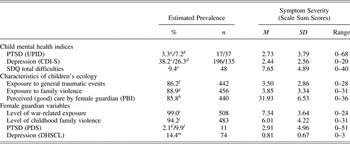
With regard to estimated prevalence rates of psychological disorders in children, we found low rates of PTSD (3%) when using the DSM-IV criteria. Estimated PTSD prevalence was about double as high (7%) when using the alternative algorithm for young children proposed by Scheeringa et al. (Reference Scheeringa, Myers, Putnam and Zeanah2012). Prevalence of depressive symptoms appeared to be high (38%) with rates dropping to 26% when using the stricter cutoff score of 4. The SDQ identified clinically significant internalizing and externalizing symptom levels in 9% of children. The majority of children (85%) perceived their female guardian as caring according to the PBI. Prevalence rates of children's psychopathological symptoms and perceived (good) female guardian care as well as mean symptom scores are depicted in Table 2.
Indices of children's mental health symptoms, risk factors in children's environment, and indices of female guardian's previous victimization and ongoing psychopathology

Note: PTSD, posttraumatic stress disorder; UPID, University of California at Los Angeles PTSD Reaction Index for DSM-IV; CDI-S, Child Depression Inventory; SDQ, Strengths and Difficulties Questionnaire; PBI, Parental Bonding Instrument; PDS, Posttraumatic Diagnostic Scale; DHSCL, depression section of the Hopkins Symptom Checklist.
a Based on DSM-IV criteria.
b Algorithm proposed by Scheeringa et al. (Reference Scheeringa, Myers, Putnam and Zeanah2012).
c Based on CDI sum-score cutoff ≥ 3.
d CDI sum-score cutoff ≥ 4.
e Based on SDQ total difficulties score ≥ 15.
f At least one traumatic event.
g At least one event from the family violence spectrum.
h Based on a PBI sum-score cutoff ≥ 27.
i At least one war-related traumatic event.
j At least one event from the family violence spectrum experience in childhood.
k Based on DSM-IV criteria for PTSD and a symptom severity cutoff ≥ 16.
l Based on DSM-IV criteria for PTSD.
m Based on a DHSCL cutoff ≥ 1.65.
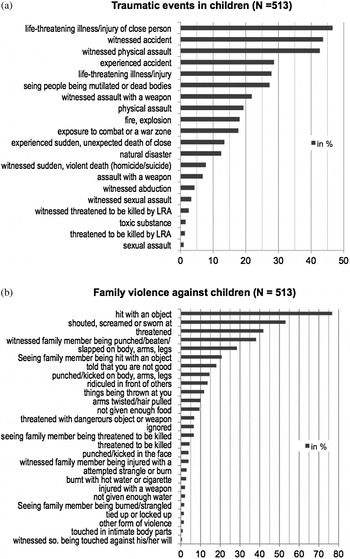
On average children were highly exposed to traumatic and adverse events in different socioecological contexts: on the community level children reported to have been exposed to a mean of 3.50 (SD = 2.86) general traumatic experiences in their lives. A closer examination of the different types of general traumatic events encountered by children showed that some of the most frequently mentioned events (e.g., life-threatening illness/injury of a close person or of oneself and experiencing or witnessing an accident) were likely to mirror the structural impediments and generally aggravated living conditions of a postconflict setting. Children reported high levels of interpersonal violence in the community: around one in five children had been physically assaulted and/or witnessed some other person being assaulted with a weapon. Almost one in ten children reported to have witnessed homicide or suicide, and 7% of children reported having been assaulted with a weapon. Experiences of interpersonal violence had the highest relative likelihood of being named as the worst event by children (e.g., 58% for witnessing a sudden violent death including homicide and suicide). Although 18% of children remembered exposure to a combat or war zone, children on average experienced their worst traumatic event at an age of 7.06 (SD = 1.69); that is, the worst event occurred only after the end of the war.
In the family context, children indicated to have experienced a mean number of 3.85 (SD = 3.33) different adverse events from the family violence spectrum. The most common form of abuse experienced by children was being hit with an object (77%), followed by acts of verbal abuse such as being shouted at (53%) and being threatened (42%). Children also frequently reported to have witnessed other family members being beaten, punched, or kicked (38%). A considerable proportion of children reported episodes of severe physical maltreatment (e.g., 15% reported having been punched or kicked on the body) and 1% to 4% percent of children fell victim to very severe acts of maltreatment (e.g., 3% were burnt with hot water or a cigarette on purpose, 4% of children were threatened to be killed). Figure 1a gives a detailed overview of traumatic experiences in general, and Figure 1b of different events from the family violence spectrum.
Percentage of children who experienced or witnessed (a) different types of traumatic events and (b) aversive events from the family violence spectrum in their lifetime.

The investigation of intergenerational risk factors that potentially promote psychopathological symptoms in children revealed that female guardians were burdened with high levels of previous traumatic exposure in terms of war-related violence (M = 7.34, SD = 3.64) and experiences of childhood maltreatment (M = 6.01, SD = 4.22). Ongoing psychopathological symptom levels found in female guardians were low with respect to PTSD symptoms and high in terms of depression symptoms. Ten percent of female guardians fulfilled DSM-IV criteria of PTSD, but PTSD prevalence dropped to 2% when using an additional symptom severity cutoff of 16. Fourteen percent of female guardians suffered from clinically relevant symptom levels of depression. Table 2 summarizes means and standard deviations of child and female guardian exposure and mental health indices.
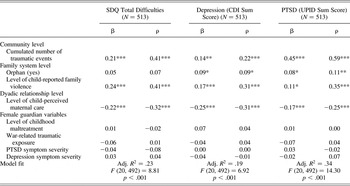
As shown in Table 3, children's exposure to traumatic events and children's victimization in the family context independently predicted all kinds of psychopathological symptoms in children. The strongest independent association was found for traumatic exposure levels and PTSD symptom severity (β = 0.45, p < .01). Perceptions of care from female guardians were negatively associated with all types of child psychopathology. Standardized β coefficients ranged between β = –0.17 (p < .01) for children's PTSD symptom severity and β = –0.25 (p < .01) for depression symptoms in children. Female guardians’ previous trauma and ongoing psychopathology did not explain additional variance in child-reported mental health symptoms when controlling for children's exposure to community violence, family violence, and perceived maternal care.
Zero-order correlations (Spearman rho) and regression coefficients (standardized betas) to determine bivariate and independent relationships between predictor variables and different types of child psychopathological symptoms

Note: The age and sex of child, age of female guardian, household assets per capita, and location were entered as control variables, but are not provided. SDQ, Strengths and Difficulties Questionnaire; CDI, Child Depression Inventory; PTSD, posttraumatic stress disorder; UPID, University of California at Los Angeles PTSD Reaction Index for DSM-IV.
*p < .05. **p < .01. ***p < .001.
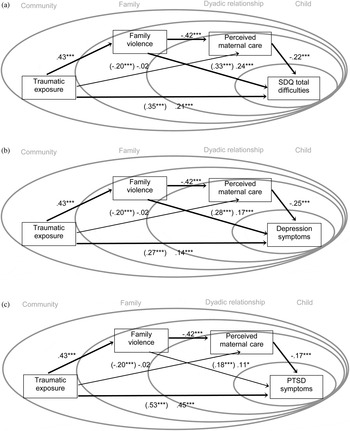
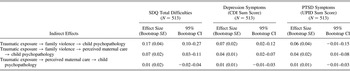
In order to identify specific indirect pathways from children's trauma exposure to children's mental health outcomes while controlling for intergenerational risk factors in female guardians, we conducted serial mediation analyses. Exposure to violence in the family context and perceived maternal care represented mediators in the model. Effect sizes (products of unstandardized β weights) of indirect pathways, bootstrap estimates of effect standard errors, and 95% CIs derived from the 10,000 samples bootstrapping procedure are shown in Table 4. With respect to SDQ total difficulties and children's depression score, we found two significant indirect pathways that partially mediated the relationship between children's general traumatic exposure and psychopathological symptom levels. The first partial mediation was two staged. Higher levels of family violence and lower levels of perceived maternal care partially mediated the relationship between child traumatic exposure and internalizing and externalizing symptoms (effect size = 0.07, 95% bootstrap CI = 0.02, 0.12). Higher levels of family violence and lower levels of perceived care by female guardians also partially mediated the relationship between child exposure and depression symptoms (effect size = 0.04, 95% bootstrap CI = 0.02, 0.07). The second specific indirect effect related children's traumatic exposure level to children's internalizing and externalizing behavior problems and to children's depression symptoms through higher levels of family violence (effect size = 0.17, 95% bootstrap CI = 0.10, 0.27, and effect size = 0.07, 95% bootstrap CI = 0.02, 0.13, respectively). In terms of PTSD symptoms, we could determine only one specific indirect effect represented by a two-staged partial mediation. Family violence and less perceived care by female guardians partially mediated the association between children's traumatic exposure and child PTSD symptoms (effect size = 0.04, 95% bootstrap CI = 0.01, 0.08). Figure 2a–c illustrates specific direct and indirect pathways in the serial mediation models. Standardized β weights are shown in order to quantify relationships between variables in the models. Comparing the total and direct effects of traumatic exposure on child psychopathological symptoms showed that mediation accounted for a greater reduction in beta weights in the SDQ total difficulties and depression models (Figure 2a, b) relative to the PTSD symptoms model (Figure 2c). This result implies that the mediated pathway via family violence and perceived maternal care appeared to have comparatively less impact on the association between child traumatic exposure and PTSD symptom severity.
Serial mediation models of direct and mediated pathways among children's (a) traumatic exposure and Strengths and Difficulties Questionnaire total difficulties scores, (b) depression symptoms, and (c) posttraumatic stress disorder symptoms. Sociodemographic variables (i.e., age and sex of child, orphan status, age of female guardian, household assets per capita, and location) and female guardian variables (i.e., history of childhood maltreatment, traumatic war exposure, posttraumatic stress disorder, and depression symptom severity) were entered as covariates in all models.

Effect size (product of unstandardized beta weights), bootstrap standard errors (SE), and bootstrap (10,000) confidence intervals (CI) of mediated pathways from children's traumatic exposure to children's psychopathological symptom levels

Note: SDQ, Strengths and Difficulties Questionnaire; CDI, Child Depression Inventory; PTSD, posttraumatic stress disorder; UPID, University of California at Los Angeles PTSD Reaction Index for DSM-IV.
Discussion
In the present study, we investigated the mental health of children growing up amid the remnants of a long-lasting civil war. We aimed to identify risk constellations across multiple levels of the child's socioecological context that potentially impede children's healthy psychological development in the rebuilding phase. Using a two-generational design, we controlled for previous exposure to war and childhood family violence as well as mental health indicators in female guardians because we assumed that these intergenerational variables might covary with ecological risk factors at the family and relationship levels and potentially affect mental health outcomes among children.
In the present study, different types of ecological risk factors independently predicted various psychopathological symptoms among children in the postconflict setting. Both exposure to traumatic events at the community level and violence within the family were independently associated with higher levels of emotional and behavioral symptoms, depression symptoms, and PTSD symptoms in children. Our finding that exposure to general traumatic events and family violence are independent risks to children's mental health is consistent with earlier studies (Catani et al., Reference Catani, Jacob, Schauer, Kohila and Neuner2008, Reference Catani, Schauer, Elbert, Missmahl, Bette and Neuner2009; Klasen et al., Reference Klasen, Oettingen, Daniels and Adam2010) and highlights the importance of family-level stressors in relation to mental health outcomes among children in postconflict settings (Betancourt et al., Reference Betancourt, McBain, Newnham and Brennan2012; Miller & Rasmussen, Reference Miller and Rasmussen2010; Panter-Brick et al., Reference Panter-Brick, Grimon and Eggerman2014). In line with previous research in Afghanistan (Panter-Brick et al., Reference Panter-Brick, Goodman, Tol and Eggerman2011), the present study showed that the strength of the relationship between the two types of adversity and child mental health outcomes varied for different types of psychopathological symptoms. Lifetime traumatic experiences were the most influential predictor of PTSD symptoms in children, whereas exposure to family violence was more closely associated with depression symptoms and internalizing and externalizing behavior problems in children. As was reported in a previous study in Sierra Leone (Betancourt et al., Reference Betancourt, McBain, Newnham and Brennan2012), coping with the loss of at least one parent imposed an additional emotional burden on children. In the present study, orphaned children suffered from more depression and PTSD symptoms when taking exposure to traumatic events, family violence, and perception of care from female guardians into account.
Children's perception of care from a female guardian seemed to mitigate psychopathological symptoms in children across different psychological disorders. We found that perceived care was independently associated with lower levels of internalizing and externalizing symptoms, depression symptoms, and PTSD symptom in children. This finding highlights that a responsive and caring parent can potentially protect against psychological problems even in high-risk contexts (Gewirtz et al., Reference Gewirtz, Forgatch and Wieling2008; Masten & Narayan, Reference Masten and Narayan2012). To date little is known about distinct positive parenting practices in northern Uganda that may benefit child mental health. Future studies may employ detailed methods of assessment including direct behavioral observations of parent–child interactions and parenting practices in order to deepen the understanding of parenting practices in northern Uganda.
In the present study, female guardians’ psychopathological symptoms were not associated with child psychopathology. This result is inconsistent with findings of studies in Afghanistan (Panter-Brick et al., Reference Panter-Brick, Eggerman, Gonzalez and Safdar2009, Reference Panter-Brick, Goodman, Tol and Eggerman2011, Reference Panter-Brick, Grimon and Eggerman2014) and Sierra Leone (Betancourt et al., Reference Betancourt, McBain, Newnham and Brennan2015). A possible explanation for the lack of an association between maternal and child mental health symptoms in northern Uganda may be due to guardians’ attempts to hide their own distress in order to appear strong and to not burden another person (Akello, Reis, & Richters, Reference Akello, Reis and Richters2010). It is also possible that the impact of parental trauma exposure and psychopathology on child exposure and child psychopathology only emerges over an extended period of time. When guardians perceive “war as normal” (Hovil & Moorhead, Reference Hovil and Moorhead2002) and potentially cope with stressors by comparing them to worse calamities (Akello et al., Reference Akello, Reis and Richters2010), guardians may fail to adequately identify threats to the child's safety and integrity. In the long term, guardians who experienced high levels of trauma may fail to protect children from exposure to potentially traumatizing events (Roberts et al., Reference Roberts, Galea, Austin, Cerda, Wright and Rich-Edwards2012). Longitudinal studies that assess guardians and children over time may help to clarify mechanisms in the intergenerational transfer of risk (Serbin & Karp, Reference Serbin and Karp2004) in northern Uganda.
In the present study, children who were exposed to a higher number of traumatic events were more likely to be revictimized in the family context, perceived less care from female guardians, and as a consequence experienced higher levels of psychopathological symptoms. This partial two-stage mediation is in line with previous findings showing that the effect of exposure to community violence on child adjustment was mediated by dysfunctional family-level and dyadic relationship level interactions (Cummings et al., Reference Cummings, Merrilees, Schermerhorn, Goeke-Morey, Shirlow and Cairns2012). Thus, even when controlling for female guardian risk factors, children in postconflict northern Uganda appear to be at an increased risk of adverse mental health outcomes as risk factors accumulate across distal and proximal levels of children's environment (Lynch & Cicchetti, Reference Lynch and Cicchetti1998).
Identifying distinct pathways that compound children's vulnerability in the context of general hardship and adversity is important because it can inform strategies to identify and protect vulnerable children (Uganda Ministry of Gender Labour and Social Development, 2011). The mediation effect between community-level traumatic events and child mental health outcomes through dysfunctional family processes was stronger for child depression and child internalizing and externalizing behavior problems than for children's PTSD symptoms. This result implies that interventions at a family level are likely to have a great potential to benefit children who suffer from depression and more general emotional and behavioral symptoms. Given that perceived maternal care mitigated the adverse effect of family violence in all three serial mediation models, conferring positive parenting practices may help improve children's mental health (Gewirtz et al., Reference Gewirtz, Forgatch and Wieling2008).
As suggested by results from earlier studies (Betancourt et al., Reference Betancourt, McBain, Newnham and Brennan2012; Betancourt, Meyers-Ohki, Charrow, & Wietse, Reference Betancourt, Meyers-Ohki, Charrow and Wietse2013), interventions designed to improve child mental health should target multiple levels of the child's social ecology in a stepped-care approach (Belkin et al., Reference Belkin, Unützer, Kessler, Verdeli, Raviola and Sachs2011). Structural, community-based approaches such as income generation and substance abuse prevention, legal child protection efforts, improved education, and access to health care may be beneficial in reducing children's exposure to trauma and adversity on the community level. Results from the present study suggest that family interventions tailored to reduce interparental and parent-to-child violent behavior may be effective in reducing children's depression symptoms and internalizing and externalizing behavior problems. A previous randomized controlled trial that involved northern Ugandan children (but not their families) pointed to the limited effectiveness of interpersonal therapy in reducing child depression, anxiety, and conduct problems (Bolton, Bass, & Betancourt, Reference Bolton, Bass and Betancourt2007). These findings highlight the need for more research that systematically evaluates the effectiveness of family interventions in postconflict settings (Betancourt et al., Reference Betancourt, Meyers-Ohki, Charrow and Wietse2013) to improve child mental health. Because a caring and responsive parent appears to mitigate the adverse effects of community and family-level violence on child mental health, future studies are needed to guide the development, implementation, and evaluation of culturally sensitive programs that target parenting practices. Considering that family violence and a lower perception of care by female guardians seemed to exert comparably less influence on children's PTSD symptoms, severely traumatized children are likely to require individual trauma-focused therapy (Salloum & Overstreet, Reference Salloum and Overstreet2012). Narrative exposure therapy has been shown to be a viable tool for the individual treatment of PTSD in northern Ugandan war-affected children and youths (Ertl, Pfeiffer, Schauer, Elbert, & Neuner, Reference Ertl, Pfeiffer, Schauer, Elbert and Neuner2011).
In line with previous findings (Lynch & Cicchetti, Reference Lynch and Cicchetti2002), results from the present study suggested that children's traumatic experiences in the community context and in the family context affected their perceptions of care from female guardians. At the same time, guardians’ exposure to war may also affect children's attachment security (Palosaari et al., Reference Palosaari, Punamäki, Qouta and Diab2013). In situations where female guardians and children have both been victims of domestic violence or share the same war-related traumatic experiences, relationship-focused psychotherapy that helps to create a joint narrative of traumatic events (Lieberman, Van Horn, & Ippen, Reference Lieberman, Van Horn and Ippen2005) may be preferable to either parenting training or individual psychotherapy alone.
Limitations
Because we assessed a considerable number of risk factors in a two-generational design, the present study presents a comprehensive analysis of risks for psychopathological symptoms in children in a postconflict setting. However, recruitment of participants did not follow a random sampling procedure, which means that results may not be easily translated to other populations. With the exception of the SDQ, none of the instruments used to assess child mental health symptoms in the current study have been validated in northern Uganda. In addition, children in the current study were still young and may have lacked the full capability to reflect on their mental health symptoms. Reported prevalence rates of mental health disorders have to be regarded with caution. Cross-sectional designs inherently fail to provide evidence of causal relationships. Report bias constitutes another shortcoming of cross-sectional data, particularly concerning retrospective reports. Longitudinal studies are needed in order to substantiate hypothesized trajectories. Furthermore, longitudinal designs are needed to investigate potential bidirectional effects between parent and child behavior that have been largely neglected in the current study.
Conclusion
Children in postconflict settings are at an increased risk of suffering from psychopathological symptoms because risk factors at distal and proximal levels of children's socioecological context accumulate. Community violence, disruptions in family relationships, high levels of family violence, and less caring behaviors by parents jeopardize children's mental health. Depending on children's diagnosis and symptom severity, interventions may be applied at the individual level, the dyadic relationship level, or the family level. In a postconflict setting, the promotion of child mental health constitutes an important part of the peace process as it builds upon society's most valuable resource for social transformation and nonviolent development. Interventions supporting children should continue beyond the point where the immediate life threat is removed. In the postconflict era, multileveled intervention programs are required that are tailored specifically to the needs of the individual child.