In the present paper we report the results of a priming study conducted with bilingual children proficient in Spanish and English. Our method involved describing pictures to children in one language and having them describe pictures in the other language. We examined whether the use of the passive voice by the experimenter primed the subsequent use of the passive voice by the child. In order for such cross-linguistic priming to occur, the child would need to form an abstract representation of the target syntactic structure in each language and to integrate the corresponding structures across languages. Thus, we used the priming technique to explore the nature of syntactic representations and, in particular, to examine possible interrelations among syntactic structures of two languages in bilingual children.
The issue of the relation between linguistic representations in bilinguals is of great interest to both linguists and psychologists and has generated substantial debate. One possible scenario is that when speakers become proficient in two or more languages, the representations of the different linguistic systems may interact and influence each other. The opposite scenario is that each language in bilingual individuals operates as a relatively independent system. Much of the research carried out to distinguish these possibilities has focused on the relation between lexical items across languages (e.g. Costa & Caramazza, Reference Costa and Caramazza1999; Green, Reference Green1998). Other investigations, including the present one, have focused on syntax. Existing empirical work on the nature of syntactic representations in bilinguals can be roughly divided into two groups: research that has utilized observational methods, which has been carried out primarily on bilingual children, and research that has utilized experimental techniques, which has been done primarily with adults.
Examining syntactic representations in bilinguals through observational methods
The first category typically involves studies that investigate cross-linguistic influence by examining the structural properties of speech in bilingual versus monolingual individuals (De Houwer, Reference De Houwer1998; Döpke, Reference Döpke1992; Reference De Houwer1998; Hulk & Van der Linden, Reference Hulk and Van der Linden1998; Müller, Reference Müller1998; Müller & Hulk, Reference Müller and Hulk2001; Nicoladis, Reference Nicoladis2003; Reference Nicoladis2006; Paradis & Genesee, Reference Paradis and Genesee1996; Serratrice, Sorace & Paoli, Reference Serratrice, Sorace and Paoli2004). The findings of this work indicate that in children acquiring two languages from an early age, certain structural properties of speech are different from those of monolingual speakers. Specifically, bilingual children are somewhat more likely than their monolingual peers to use structures that are ungrammatical or sound awkward in the target language (cf. Nicoladis, Reference Nicoladis2006). This unusual usage can be explained by cross-linguistic transfer from another language. For example, Müller & Hulk (Reference Müller and Hulk2001) have shown that German–French bilingual children tend to drop objects from their French sentences more often than French monolingual speakers, possibly reflecting the influence of German, in which object drop is common.
This research has provided important insights into the nature of language in the case of bilingual acquisition. Whereas an earlier view posited that children exposed to two languages may start with a single undifferentiated system (Arnberg, Reference Arnberg1987; Volterra & Taeschner, Reference Volterra and Taeschner1978), most of the currently available evidence indicates that children differentiate their two languages from a very young age (e.g. Genesee & Paradis, Reference Genesee and Paradis1997; Lanza, Reference Lanza1992). The two language systems, however, are not viewed as completely independent (De Houwer, Reference De Houwer, Fletcher and MacWhinney1995; Oller & Eilers, Reference Oller, Eilers, Oller and Eilers2002; Pearson, Reference Pearson, Oller and Eilers2002) and recent work has focused on specifying the conditions under which the two systems are likely to interact (Döpke, Reference Döpke1998; Hulk & Müller, Reference Hulk and Müller2000; Nicoladis, Reference Nicoladis2006; Serratrice et al., Reference Serratrice, Sorace and Paoli2004). Researchers have suggested that the likelihood of cross-linguistic transfer depends, in part, on the extent of overlap between the two languages, both at the structural (syntactic) and pragmatic levels – the transfer may be limited if there are differences in the pragmatic contexts in which a given structure typically occurs (Hulk & Müller, Reference Hulk and Müller2000). This line of work underscores the importance of taking into account both syntactic and pragmatic variables when considering specific cases of cross-linguistic influence.
Examining syntactic representations in bilinguals through cross-linguistic priming
The second type of research exploring the nature of syntactic representations in bilinguals involves experimental techniques, in particular a priming paradigm. The syntactic priming paradigm has been introduced in work with monolingual adults (Bock, Reference Bock1986, Reference Bock1990; Bock, Loebell & Morey, Reference Bock, Loebell and Morey1992). Typically, in priming studies researchers manipulate the syntactic properties of input sentences presented to participants and examine whether subsequent language production or comprehension varies as a function of input characteristics. The priming paradigm has been adopted recently as a tool for investigating syntactic representations in bilinguals. However, until now it has been used only in work with bilingual adults (Bernolet, Hartsuiker & Pickering, Reference Bernolet, Hartsuiker and Pickering2007; Desmet & Declercq, Reference Desmet and Declercq2006; Hartsuiker & Pickering, Reference Hartsuiker and Pickering2008; Hartsuiker, Pickering & Veltkamp, Reference Hartsuiker, Pickering and Veltkamp2004; Loebell & Bock, Reference Loebell and Bock2003; Meijer & Fox Tree, Reference Meijer and Fox Tree2003; Salamoura & Williams, Reference Salamoura and Williams2006, Reference Salamoura and Williams2007; Schoonbaert, Hartsuiker & Pickering, Reference Schoonbaert, Hartsuiker and Pickering2007).
The adult study most relevant to the present investigation involved the cross-linguistic priming of passives in Spanish–English bilinguals (Hartsuiker et al., Reference Hartsuiker, Pickering and Veltkamp2004). The participants were native speakers of Spanish with moderate to high proficiency in English. On each trial, the participants heard a picture description in Spanish and then described another picture in English. The results showed that, after hearing a Spanish passive, they were more likely to use an English passive with a parallel structure. Thus, activating the passive structure in one language made the corresponding structure in the other language more accessible. However, this study did not allow for a comparison of cross-linguistic effects in both directions, as it was limited to the investigation of priming from Spanish to English.
Present study: extending the use of cross-linguistic priming methodology to children
In reviewing the existing literature on the syntactic representation of bilinguals, we find evidence of the interconnection between linguistic systems in children as well as adults. It should be noted, though, that the work carried out with adults is not directly comparable to that with bilingual children because of the differences in methods employed. The current paper provides a bridge between these two bodies of research. We use cross-linguistic priming, an experimental paradigm commonly utilized with adults, but extend it to the investigation of language representations in children. The key question addressed in this cross-linguistic study is whether the children represent syntactic structures in a sufficiently abstract and integrated way so that the use of a structure in one language would activate the corresponding structure in the other.
Addressing the question of abstractness of syntactic representations is relevant to the unfolding debate about the nature of early syntax with respect to both monolingual and bilingual children (Conwell & Demuth, Reference Conwell and Demuth2007; Genesee, Paradis & Crago, Reference Genesee, Paradis and Crago2004; Tomasello, Reference Tomasello2000; Huttenlocher, Vasilyeva & Shimpi, Reference Huttenlocher, Vasilyeva and Shimpi2004). Some investigators have suggested that early syntactic representations may be lexically based (Tomasello, Reference Tomasello2003). In line with this view, Savage and colleagues found that three- and four-year-olds showed priming effects only when prime sentences had a high lexical overlap with target sentences, whereas six-year-olds showed priming even when there was a low lexical overlap between primes and targets (Savage, Lieven, Theakston & Tomasello, Reference Savage, Lieven, Theakston and Tomasello2003, Reference Savage, Lieven, Theakston and Tomasello2006). However, an accumulating body of work indicates that younger children can establish a link between sentences that have a common syntactic form but different lexical items (Huttenlocher et al., Reference Huttenlocher, Vasilyeva and Shimpi2004; Shimpi, Gámez, Huttenlocher & Vasilyeva, Reference Shimpi, Gámez, Huttenlocher and Vasilyeva2007; Thothathiri & Snedeker, Reference Thothathiri and Snedeker2008a). A cross-linguistic priming investigation may provide the strongest test of the generalized nature of syntactic representations – it allows us to examine whether children can extract a syntactic structure from a priming sentence and use that structure with a completely new set of lexical items from a different language.
In addition to contributing to the current scientific discourse on the lexical independence of children's syntactic representations, the present study will provide further information about the nature of integration of these representations in bilinguals. As indicated above, studies of spontaneous speech involving bilingual children point to inter-connections between their language systems (e.g. Döpke, Reference Döpke1998; Hulk & Müller, Reference Hulk and Müller2000). Approaching this issue from an experimental perspective enables us to determine whether different methodologies provide converging evidence concerning bilingual language structures in children. Furthermore, the availability of evidence from adult priming studies makes it possible to compare the nature of bilingual representations in children to that of adults. The present study examines a syntactic structure that has the same required elements in both languages, which enables us to address the question of whether bilingual children form a shared representation of parallel structures, as has been proposed for bilingual adults (e.g. Hartsuiker et al., Reference Hartsuiker, Pickering and Veltkamp2004; Hartsuiker & Pickering, Reference Hartsuiker and Pickering2008).
Passive voice: commonalities and differences between English and Spanish
The target syntactic structure in the present research is the passive form of the transitive construction. Generally, transitive relations can be expressed either through active or passive voice. Passives are used to focus attention on the patient of an action while also de-emphasizing the agent of the action (Brooks & Tomasello, Reference Brooks and Tomasello1999). In most Indo-European languages, including English and Spanish, the active voice is the more common way of expressing transitive relations than the passive (deVilliers & deVilliers, Reference deVilliers, deVilliers and Slobin1985; Gordon & Chafetz, Reference Gordon and Chafetz1990; Jisa, Reilly, Verhoeven, Baruch & Rosado, Reference Jisa, Reilly, Verhoeven, Baruch and Rosado2002). Yet work with English-speaking monolingual children indicates that their use of this relatively infrequent form can be increased by exposing them to passive primes (Huttenlocher et al., Reference Huttenlocher, Vasilyeva and Shimpi2004; Shimpi et al., Reference Shimpi, Gámez, Huttenlocher and Vasilyeva2007). Here, we examine whether a similar increase occurs cross-linguistically in bilingual children.
There are parallel passive structures available in English and Spanish. English passives contain a patient as the syntactic subject, followed by an auxiliary and the past participle form of a transitive verb. Full passives contain a prepositional phrase that includes the preposition by and the agent of an action (e.g. The tree was broken by the lightning bolt), whereas truncated passives omit the by-phrase (e.g. The tree was broken). In Spanish, one can form a sentence that has the same elements and word order as the English passive (e.g. El árbol fue quebrado por el rayo=The tree was broken by the lightning bolt); we will refer to this form as the fue-passive. However, in addition to fue-passives, Spanish offers other ways of emphasizing the patient of a transitive action, such as se-passives (e.g. Se quebran los árboles=The trees are broken).
The main focus here is on the fue-passive because of its structural similarity to the English passive. It should be noted, though, that this form is viewed as rather formal in Spanish and it is not common in everyday speech (e.g. Berman & Slobin, Reference Berman and Slobin1994). The use of this form by both children and adults is less frequent than the use of the parallel passive in English (Jisa et al., Reference Jisa, Reilly, Verhoeven, Baruch and Rosado2002). Despite the infrequent use of fue-passives in spoken language, their comprehension is above chance in five- to six-year-old Spanish speakers (Pierce, Reference Pierce1992). Based on the comprehension studies, the developmental course in the acquisition of passives appears to be similar in English- and Spanish-speaking monolinguals (deVilliers & deVilliers, Reference deVilliers and deVilliers1973; Pierce, Reference Pierce1992). Thus, we selected five- to six- year-olds as a target age for the present study because of the evidence from both languages that children at this age have a sufficient level of understanding of passives, which is an important prerequisite for priming.
Our priming study involved elements of both comprehension and production. On each trial, children first listened to the experimenter's picture description and then described their own picture. In order for priming to occur, children would have to comprehend the experimenter's sentence and reproduce its structure in their own response. The differences between English and Spanish in the frequency of passives in spontaneous speech may, in principle, affect the production of passives in a priming study. That is, bilingual participants may produce passives in Spanish at a lower rate than in English because this form is generally rare in everyday Spanish. The study of Spanish–English passive priming in adults (Hartsuiker et al., Reference Hartsuiker, Pickering and Veltkamp2004) examined priming in one direction, from Spanish to English, and thus did not allow for a direct comparison of the production of passives in the two languages. In the present research, we extended this line of investigation by examining two-way priming. In the Spanish-to-English condition, children heard the experimenter's sentences in Spanish and produced their own responses in English. In the English-to-Spanish condition, the languages were reversed.
METHOD
Participants
The study involved 65 bilingual children (33 boys, 32 girls) who ranged in age from 5 ; 2 to 6 ; 5 (mean age 5 ; 11). The participants were recruited from urban schools that had a large proportion of students from Spanish-speaking families. To obtain information about the language backgrounds of potential participants, we sent out questionnaires to parents and interviewed teachers. Based on parental responses, we identified a group of children who were exposed to Spanish at home for at least the first three years of their life, followed by exposure to English at school for one and a half to two and a half years. At the time of the study, the children spoke Spanish at home and English at school (they attended kindergarten classrooms with English-only instruction). The parents reported that they used Spanish when addressing the child and that the child responded in Spanish. The teachers reported that the children had no difficulty following class instruction and were using English when talking to classmates.
Materials
The materials included twenty drawings depicting simple events that could be described with transitive sentences. Ten of these drawings were designated as the experimenter's set and the other ten served as test pictures for children to describe. The drawings within each set varied in the animacy of the agent and the patient. Figure 1 presents an example of drawings from the experimenter's and the child's set. For each drawing in the experimenter's set, we created two Spanish sentences to be used as primes in the Spanish-to-English condition and two corresponding English sentences to be used as primes in the English-to-Spanish condition. In each language, one sentence described the picture in the active voice and the other described the picture in the passive voice. The syntactic forms of active and passive primes in Spanish were equivalent to the active and passive English primes in terms of word order and verb form. The Appendix presents a complete list of priming sentences.
Sample drawings and priming sentences.

Procedure
Participating children were randomly assigned to either the Spanish-to-English (n=34) or the English-to-Spanish (n=31) condition. Within each language condition, children were randomly assigned to Active or Passive priming. Thus, in contrast to adult studies where the prime type is usually varied within subjects, in the present study the priming was manipulated between subjects. The latter is consistent with prior work involving children (Huttenlocher et al., Reference Huttenlocher, Vasilyeva and Shimpi2004; Shimpi et al., Reference Shimpi, Gámez, Huttenlocher and Vasilyeva2007; Thothathiri & Snedeker, Reference Thothathiri and Snedeker2008a). Between-subjects designs are viewed as maximizing the likelihood of detecting priming effects (Thothathiri & Snedeker, Reference Thothathiri and Snedeker2008b). In a few developmental studies where priming was varied within subjects, the two prime types were blocked and presented on separate days (e.g. Savage et al., Reference Savage, Lieven, Theakston and Tomasello2003). These and other design features specific to child research are based on concerns about carry-over effects across trials as well as constraints on the number of potentially productive trials with children.
Each child was tested individually by a researcher who was a Spanish–English bilingual speaker. The researcher told the child that they were going to play a game, in which they would take turns describing what happened in the pictures. The researcher added that, as part of the game, she would describe her pictures in one language and the child would describe his/her pictures in the other. In the Spanish-to-English condition, all instructions were provided in Spanish and the experimenter continued to speak Spanish throughout the study, whereas in the English-to-Spanish condition the experimenter always spoke English. Children's picture descriptions were audiotaped and later transcribed.
Coding of responses
First, we examined children's responses to determine whether each utterance was a syntactically complete sentence. This coding was done to obtain a measure of mastery of basic syntactic relations in our participants. To be categorized as syntactically complete, a sentence had to contain a verb and its obligatory arguments. We applied this coding scheme to both English and Spanish responses, taking into account the differences between the syntactic rules of the two languages. For example, in English a declarative sentence requires a subject, whereas in Spanish grammatical subjects can be omitted. Thus, a declarative sentence missing a subject was coded as syntactically incomplete in English but not in Spanish.
To examine priming effects, we categorized transitive responses as passive or active. English responses were coded as ‘passive’ if they contained a patient in the subject position, followed by an auxiliary and a transitive verb. As in other developmental research (Harris & Flora, Reference Harris and Flora1982; Israel, Johnson & Brooks, Reference Israel, Johnson and Brooks2000), the ‘passive’ category included both full passives (e.g. The boy was tickled by the girl) and truncated passives (e.g. The boy was tickled). An utterance containing an agent in the subject position followed by a transitive verb was coded as ‘active’. A third coding category, ‘other’, was designed to include non-clausal utterances, incomplete transitive sentences and complete sentences with intransitive verbs.
For the coding of Spanish responses, we used three parallel categories, ‘active’, ‘passive’ and ‘other’. However, as we discussed above, Spanish has more than one structure that can be referred to as passive. A canonical form, the fue-passive, involves the same structural elements (and in the same order) as the English passive (e.g. El árbol [the tree] fue [was] quebrado [broken] por [by] el rayo [the lightning bolt]). In addition, Spanish speakers may emphasize the patient of a transitive action using an alternative se-passive construction (e.g. Se [impersonal marker] quebran [break] los árboles [the trees]). In our coding of responses in the English-to-Spanish condition, the ‘passive’ category was reserved only for fue-passives which mirrored the structure of English passive primes. Responses containing se-passives were included in the ‘other’ category because of their structural differences from both English passive and active primes.
RESULTS
Examining broad language measures
Because our participants did not receive formal evaluation of their language proficiency in English and Spanish, we examined their picture descriptions to obtain general indicators of their productive skills in each language. Overall, we found that children had no difficulty describing pictures either in English (Spanish-to-English condition) or Spanish (English-to-Spanish condition). All of our participants produced multiword utterances in the appropriate language on every trial. In analyzing English responses, we found that the average number of words per utterance (MLUw) was 6·32 (SD=0·94). The findings were similar for Spanish responses: MLUw=6·43 (SD=1·17).
We determined what percentage of children's utterances were syntactically complete sentences. The analysis of English responses showed that 97% were complete sentences, of which 85% were transitive and 15% intransitive. The few remaining responses included incomplete transitive sentences (e.g. He found) and non-clausal utterances (e.g. The frog and the butterfly). The pattern was very similar for Spanish responses: 96% were complete sentences, of which 88% were transitive and 12% intransitive. The few remaining responses included incomplete transitives (e.g. El perro mordió=The dog bit) and non-clausal utterances (e.g. El niño la abeja=The boy the bee). The high proportion of syntactically complete sentences indicates children's mastery of basic syntactic relations in both languages, including the ability to form transitive sentences with obligatory verb arguments.
Some of the children's responses presented evidence of code-switching, such as inserting a Spanish word in the frame of an English sentence. This phenomenon has been widely reported in bilinguals (e.g. Bauer, Hall & Kruth, Reference Bauer, Hall and Kruth2002; Myers-Scotton, Reference Myers-Scotton2006). In most cases of code-switching observed in the present study, the substitute word was a noun (e.g. The snake ate the ratón [mouse]; El sapo cogio una butterfly [mariposa]=The toad caught a butterfly). A majority of participants who demonstrated code-switching did it only on one trial; a few children did it on two trials and one child did it on three trials. The overall incidence of code-switching was somewhat higher when children described pictures in Spanish (4% of utterances) than in English (2% of utterances). We compared the frequency of code-switching in Spanish and English statistically, using a chi-square test. Specifically, the test compared the proportion of children in each condition who had zero, one, two or three switches. The results showed no significant differences between Spanish and English (χ 2 (3, N=65)=3·80, p>0·05). In sum, the incidence of code-switching was relatively low, involved primarily a single noun substitution and did not differ significantly across languages.
Examining priming effects
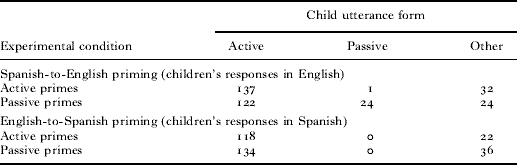
To explore possible priming effects, we compared the frequency of passive responses following active versus passive primes. Table 1 presents the number of utterances in the ‘active’, ‘passive’ and ‘other’ categories across conditions. As shown in the table, our participants tended to describe transitive actions using mostly active sentences, which is similar to the findings with monolingual children. The production of passives, lower overall than the use of actives, clearly varied across conditions. To examine this variability statistically, we carried out an analysis of variance (ANOVA) using the percentage of passives out of all transitive sentences as the dependent variable. Independent variables included the direction of priming (Spanish-to-English versus English-to-Spanish) and prime type (Passive versus Active). The ANOVAs were carried out first with subject and then with item as the unit of analysis (F1 and F2, respectively).
Children's responses by condition
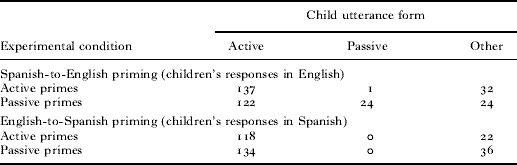
note: In the Spanish-to-English condition, 17 children were presented with Active primes and 17 with Passive primes (for a total of 170 responses with each prime type); in the English-to-Spanish condition, 14 children were presented with Active primes (for a total of 140 responses) and 17 with Passive primes (for a total of 170 responses).
The ANOVA by subject showed significant effects of priming direction (F 1(1, 61)=28·02) and prime type (F 1(1, 61)=32·95, both ps<0·001). Critically for the interpretation of these effects, there was a significant interaction between the two factors (F 1(1, 61)=28·02, p<0·001). A parallel ANOVA by item yielded the same pattern of results: main effects of priming direction (F 2(1, 9)=8·72) and prime type (F 2(1, 9)=8·80), and the interaction between them (F 2(1, 9)=8·80, all ps<0·05). The significant interaction obtained in both analyses indicates that the effect of prime type in our study varied depending on the direction of priming. Essentially, the observed priming effect was carried by English responses (Spanish-to-English condition), in which the use of passives was higher following passive primes than following active primes.
Although Spanish responses (English-to-Spanish condition) did not contain any fue-passives, the children did produce a few utterances that contained a passive alternative, the se-passive. Furthermore, the number of such utterances was slightly higher following passive compared to active primes (6 out of 170 responses versus 2 out of 140 responses, respectively). We performed an analysis of variance on Spanish responses only to examine the frequency of se-passives as a function of prime type. The results showed that the difference between the two priming conditions was not significant (F(1, 29)=1·29, p>0·05).
DISCUSSION
Evidence for the integration of syntactic representations in bilingual children
The present study examined the relation between the syntactic structures of two languages in bilingual children. Although cross-linguistic priming has been shown in adults, it was not clear whether children's syntactic representations have both a sufficient level of abstraction in each language and integration across languages to show comparable effects. The results obtained in the Spanish-to-English priming condition suggest that linguistic representations in five- to six-year-old bilinguals are similar to those of adults. Specifically, processing Spanish sentences containing a passive led to the activation of the corresponding English form, as evidenced by the increase in its production. These findings parallel the results obtained with Spanish–English bilingual adults (Hartsuiker et al., Reference Hartsuiker, Pickering and Veltkamp2004). The occurrence of cross-linguistic priming in children indicates that their representation of passives is independent of lexical items and integrated across languages. Indeed, if children did not represent an abstract passive structure in both Spanish and English, or if they did not connect these linguistic representations, they would be unable to extract the structure from the Spanish prime and reproduce it in the English sentence.
The cross-linguistic syntactic integration demonstrated by our participants in the Spanish-to-English priming is particularly impressive given their developmental level and the difficulty of the passive structure. Although English and Spanish monolinguals can produce passives and comprehend them above chance by the age of five or six years, there are also clear indications that passives still pose challenges for this age group (Pierce, Reference Pierce1992; Vasilyeva, Huttenlocher & Waterfall, Reference Vasilyeva, Huttenlocher and Waterfall2006). The children in our study most likely had less input in each language than same-age monolinguals (even though their overall input may be similar). Furthermore, our participants were exposed to each language in different contexts, with Spanish used at home and English at school. Despite the limited exposure and the difference between sociolinguistic contexts for each language, children were able to integrate the representations of a challenging and infrequently used syntactic structure across the two languages.
The asymmetry of syntactic priming
Whereas the priming of passives from Spanish to English provides a strong evidence of cross-linguistic syntactic influence, the lack of priming from English to Spanish suggests that the relation between the two languages in our participants is asymmetric. One potential explanation of this asymmetry may invoke the concept of language dominance. Several studies examining bi-directional interference between languages have shown that the dominant language influences the weaker one more than the other way around (e.g. Bernardini & Schlyter, Reference Bernardini and Schlyter2004; Hohenstein, Eisenberg & Naigles, Reference Hohenstein, Eisenberg and Naigles2006; Yip & Matthews, Reference Yip and Matthews2000). One could argue that our participants may have been Spanish-dominant and thus exhibited only the influence of the dominant language on the weaker one. We cannot directly evaluate this possibility because language dominance was not formally assessed in the present study. However, we did examine several measures of language proficiency by analyzing children's responses and these measures indicated comparable and high levels of syntactic mastery in English and Spanish.
Furthermore, even if our participants were dominant in one of their languages, it would not necessarily mean that they must display asymmetry in priming patterns. The findings from cross-linguistic studies with adults did not show strong effects of language dominance on priming (Loebell & Bock, Reference Loebell and Bock2003; Meijer & Fox Tree, Reference Meijer and Fox Tree2003; Schoonbaert et al., Reference Schoonbaert, Hartsuiker and Pickering2007). In particular, a study involving Dutch–English bilinguals who were native speakers of Dutch showed cross-linguistic syntactic priming of comparable magnitude in both directions (Schoonbaert et al., Reference Schoonbaert, Hartsuiker and Pickering2007). Thus, even though participants were unbalanced bilinguals, their performance did not depend on the direction of priming.
Given these findings, it seems more likely that the differences in the production of English and Spanish passives in the present study could reflect the corresponding distinctions in the baseline use of passives in everyday speech. There are well-documented differences between English and Spanish passives at the discourse level (Berman & Slobin, Reference Berman and Slobin1994; Green, Reference Green1975). Even though both English and Spanish speakers use passives rather infrequently, the ‘avoidance’ of fue-passives appears stronger in Spanish than in English conversational speech as this structure is considered a literary form. In fact, a study of bilingual adults, in which both primes and responses were in Spanish, showed a very small increase in the production of passives in Spanish-dominant speakers (Flett, Reference Flett2003). A recent study with monolingual Spanish-speaking children also showed that their exposure to Spanish primes containing fue-passives did not increase their own production of this form (Gámez, Shimpi, Waterfall & Huttenlocher, Reference Gámez, Shimpi, Waterfall and Huttenlocher2009). It should be noted that Gámez et al. (Reference Gámez, Shimpi, Waterfall and Huttenlocher2009) study demonstrated the priming of alternative se-passives within Spanish language. However, in the present study we did not observe a significant increase in the production of se-passives in Spanish following English passive primes, perhaps because of the lack of structural overlap between these syntactic forms, which has been identified as an important condition for cross-linguistic transfer (Hulk & Müller, Reference Hulk and Müller2000).
Possible implications for the models of syntactic representation in bilinguals
The findings of the present study indicate that the production of passives in the context of cross-linguistic priming is similar to the production of passives in the context of within-language priming in each corresponding language. The lack of fue-passive responses in the English-to-Spanish condition is consistent with the evidence indicating difficulty of within-language priming of Spanish passives (Flett, Reference Flett2003; Gámez et al., Reference Gámez, Shimpi, Waterfall and Huttenlocher2009), and the priming effects obtained in the Spanish-to-English condition are consistent with the demonstrations of within-language priming of English passives (Huttenlocher et al., Reference Huttenlocher, Vasilyeva and Shimpi2004; Savage et al., Reference Savage, Lieven, Theakston and Tomasello2003). In fact, the magnitude of the cross-linguistic effect observed in the Spanish-to-English condition is comparable to the increase in the production of English passives reported in work with monolingual English-speaking children. The comparability of within- and between-language priming is consistent with the models positing the existence of shared representations underlying the production of parallel syntactic structures in bilinguals (e.g. Hartsuiker & Pickering, Reference Hartsuiker and Pickering2008; Meijer & Fox Tree, Reference Meijer and Fox Tree2003). Indeed, if certain syntactic structures from two languages have a shared representation, it should become activated by the use of the structure in either language.
Activating a structure, however, does not guarantee a subsequent production of that structure. There are multiple factors that may affect the individual's syntactic choice in production. The likelihood of producing a passive depends, for example, on the salience of the patient of the transitive action (Brooks & Tomasello, Reference Brooks and Tomasello1999; Vasilyeva et al., Reference Vasilyeva, Huttenlocher and Waterfall2006) and on the pragmatic discourse context (Berman & Slobin, Reference Berman and Slobin1994; Jisa et al., Reference Jisa, Reilly, Verhoeven, Baruch and Rosado2002). When comparing the use of English and Spanish passives, it appears that the main differences have to do with the frequency of usage related to pragmatic restrictions on their production in different contexts. Because the use of Spanish fue-passives is so infrequent and largely reserved for literary contexts (more so than the English passive), this structure may sound too unusual, even awkward, for an oral description of a cartoon. The existence of these additional constraints on the use of Spanish passives compared to English may explain the lack of English-to-Spanish priming. That is, exposing a bilingual individual to an English passive prime may activate the parallel Spanish structure, but that activation may not be sufficient to reach a production threshold.
Future directions
Until now, investigations of cross-linguistic syntactic influences in children and adults have utilized somewhat different methodologies, making it hard to draw comparisons across developmental span. The present study has demonstrated the possibility of utilizing a priming paradigm, widely used in work with bilingual adults, as an experimental tool for investigating the cross-linguistic relation between syntactic representations in bilingual children. The findings underscore the importance of exploring bidirectional syntactic influences in bilinguals. To better understand the nature of syntactic representations in bilingual individuals, further investigations will need to address several additional questions.
It remains to be determined whether the present findings would hold across the developmental span. The participants in our study were five- to six-year-olds and the claims of lexical specificity have been generally based on work with younger children (e.g. Savage et al., Reference Savage, Lieven, Theakston and Tomasello2003). Cross-linguistic priming can serve as a useful tool for investigating the abstractness of syntactic structures in children early on. At the same time, it may be informative to examine bi-directional syntactic priming in Spanish–English bilingual adults. Currently, there are no data available on the passive priming from English to Spanish in adult samples, and it is not clear whether the asymmetry observed in the present study is a phenomenon specific to children. In addition to addressing developmental questions, it would be important to further evaluate the role of pragmatic factors in cross-linguistic influence. Investigators exploring syntactic transfer in spontaneous speech have suggested that the asymmetry of transfer can be explained by considering the relation between structural and pragmatic features of the two languages (e.g. Hulk & Müller, Reference Hulk and Müller2000). We propose that examining the patterns of cross-linguistic priming may illuminate the role of pragmatic variables in syntactic transfer. Whereas the present study showed the asymmetry of priming, some other priming investigations have revealed symmetric bi-directional effects (e.g. for datives in Dutch and English, Schoonbaert et al., Reference Schoonbaert, Hartsuiker and Pickering2007). It is possible that these distinct patterns can be traced to the differences in the use of target structures at the discourse level in the two languages. To explore this possibility, it would be informative to systematically investigate bi-directional cross-linguistic priming with different syntactic structures and/or languages for which information about pragmatic constraints is available. This type of investigation can reveal the extent to which differences at the pragmatic level may limit the syntactic transfer across languages.
APPENDIX
Spanish primes and corresponding English primes, Active/Passive
(1) El rayo golpeó al árbol. / El árbol fue golpeado por el rayo.
The lightning struck the tree. / The tree was struck by lightning.
(2) El perro persiguió al conejo. / El conejo fue perseguido por el perro.
The dog chased the rabbit. / The rabbit was chased by the dog.
(3) La trampa atrapo al oso. / El oso fue atrapado por la trampa.
The trap caught the bear. / The bear was caught by the trap.
(4) El viento sopló las hojas. / Las hojas fueron soplados por el viento.
The wind blew the leaves. / The leaves were blown by the wind.
(5) El oso llevo al mono. / El mono fue llevado por el oso.
The bear carried the monkey. / The monkey was carried by the bear.
(6) La pelota rompió la ventana. / La ventana fue rota por la pelota.
The ball broke the window. / The window was broken by the ball.
(7) El sol derritió al hombre de nieve. / El hombre de nieve fue derretido por el sol.
The sun melted the snowman. / The snowman was melted by the sun.
(8) La jirafa lamió al hipopótamo. / El hipopótamo fue lamido por la jirafa.
The giraffe licked the hippopotamus. / The hippopotamus was licked by the giraffe.
(9) El tigre empujó al pato. / El pato fue empujado por el tigre.
The tiger pushed the duck. / The duck was pushed by the tiger.
(10) El perro trajo al niño. / El niño fue traído por el perro.
The dog brought the boy. / The boy was brought by the dog.