INTRODUCTION
Brain injury (BI) often results in significant neuropsychological deficits, particularly in cognition, emotion, and behavior (Cattelani, Zettin, & Zoccolotti, Reference Cattelani, Zettin and Zoccolotti2010; Doering & Exner, Reference Doering and Exner2011; Koponen et al., Reference Koponen, Taiminen, Portin, Himanen, Isoniemi, Heinonen, Hinkka and Tenovuo2002). While some abilities improve over time, deficits frequently persist, with significant long-term consequences. One year following traumatic brain injury (TBI), as many as 80% of patients have notable cognitive difficulties (Cicerone, Reference Cicerone2007; Wilson, Reference Wilson2008) and over 50% are depressed (Hibbard, Uysal, Kepler, Bogdany, & Silver, Reference Hibbard, Uysal, Kepler, Bogdany and Silver1998; Hibbard et al., Reference Hibbard, Ashman, Spielman, Chun, Charatz and Melvin2004). Although depression may increase or decrease over time, its prevalence is sustained 10 and even 20 years postinjury (Hoofien, Gilboa, Vakil, & Donovick, Reference Hoofien, Gilboa, Vakil and Donovick2001). The detrimental consequences of BI also decrease the ability to integrate or reintegrate at work, and over 50% of patients experience chronic vocational instability (Malec, Reference Malec2001; van Velzen, van Bennekom, Edelaar, Sluiter, & Frings-Dresen, Reference van Velzen, van Bennekom, Edelaar, Sluiter and Frings-Dresen2009). These cognitive, emotional, behavioral, and vocational difficulties, which often co-occur with motor and/or sensory deficits, in addition to long-term psychological and financial costs, dramatically damage quality of life for patients and their families (Cuthbert et al., Reference Cuthbert, Pretz, Bushnik, Fraser, Hart, Kolakowsky-Hayner, Malec, O’Neil-Pirozzi and Sherer2015; Klonoff, Reference Klonoff2010; Klonoff et al., Reference Klonoff, Watt, Dawson, Henderson, Gehrels and Wethe2006).
BI is a widely recognized major public health problem with devastating personal and societal costs (Mar et al., Reference Mar, Arrospide, Begiristain, Larrañaga, Elosegui and Oliva-Moreno2011). As such, the role of services aimed at mitigating its effects is crucial (Langlois, Rutland-Brown, & Wald, Reference Langlois, Rutland-Brown and Wald2006). Recovery generally progresses in two phases, acute and postacute, each associated with different standards of treatment and care. During the acute phase, the physical and mental states of patients are largely determined by the primary and secondary effects of their injuries (Katz, Zasler, & Zafonte, Reference Katz, Zasler, Zafonte, Zasler, Katz and Zafonte2007). Once basic physical and functional recovery has peaked, commonly within weeks or months, the postacute phase begins (Teasell et al., Reference Teasell, Bayona, Marshall, Cullen, Bayley, Chundamala, Villamere, Mackie, Rees, Hartridge, Lippert, Hilditch, Welch-West, Weiser, Ferri, McCabe, McCormick, Aubut, Comper, Salter, Van Reekum, Collins, Foley, Nowak, Jutai, Speechley, Hellings and Tu2007). At this stage, neuropsychological rehabilitation (NR) comes into play.
NR has been defined as an interactive process involving enhancement of the cognitive, emotional, psychosocial, and behavioral deficits caused by BI, with the goal of improving various aspects of everyday function, particularly personally meaningful ones (McLellan, Reference McLellan, Swash and Oxbury1991; Wilson, Reference Wilson2008). NR offers various interventions aimed at mitigating or compensating for cognitive, emotional, behavioral, and psychosocial deficits, enhancing independence and integration into employment and society, and improving well-being (Cicerone, Reference Cicerone2004; Cullen, Chundamala, Bayley, Jutai, & Erabi Group, Reference Cullen, Chundamala, Bayley, Jutai and Group2007; NIH Consensus Development Panel on Rehabilitation of Persons With Traumatic Brain Injury, 1999; Prigatano & Wong, Reference Prigatano and Wong1999). NR services are increasingly being defined based on specific patient needs rather than on diagnosis- or pathology-based protocols, particularly since it is recognized that injury outcome is widely accounted for by noninjury-related factors (Yeates, Levin, & Ponsford, Reference Yeates, Levin and Ponsford2017). NR programs are therefore called upon to provide comprehensive interventions that address the persevering, and often most challenging, cognitive, emotional, and behavioral consequences of injury, with the goal of improving functional outcome (Morton & Wehman, Reference Morton and Wehman1995; Turner-Stokes, Pick, Nair, Disler, & Wade, Reference Turner-Stokes, Pick, Nair, Disler and Wade2015; Wilson, Reference Wilson2008). These efforts are commonly delivered at community-based outpatient day centers, in individual, group-based, or combined programs. Common NR day treatment programs include: individual neuropsychological rehabilitation (INR), vocational (or prevocational)-focused neuropsychological rehabilitation (VNR), and comprehensive–holistic neuropsychological rehabilitation (CNR) programs (Gordon et al., Reference Gordon, Zafonte, Cicerone, Cantor, Brown, Lombard, Goldsmith and Chandna2006; Malec & Degiorgio, Reference Malec and Degiorgio2002; NIH, Reference Yeates, Levin and Ponsford1999). While the three share the common goal of improving functional outcome, they differ in structure, intensity, content, and duration.
INR programs aim to mitigate or compensate for specific, relatively confined dysfunctions and are thus relatively flexible. Treatments are tailored to meet the specific needs of individual patients (NIH, Reference Yeates, Levin and Ponsford1999) in terms of content, scope, and frequency and may target deficits through cognitive training, behavior modification, emotional support, functional skills related to reintegration at home or work, and/or vocational counseling (Cicerone et al., Reference Cicerone, Dahlberg, Kalmar, Langenbahn, Malec, Bergquist, Felicetti, Giacino, Harley, Harrington, Herzog, Kneipp, Laatsch and Morse2000; Malec & Degiorgio, Reference Malec and Degiorgio2002; Powell, Heslin, & Greenwood, Reference Powell, Heslin and Greenwood2002).
VNR programs, which are usually intensive, emphasize vocational education, and acquisition of work habits and specific proficiencies relevant to employment goals. Participants devote most of their time to supervised vocational training in simulated work environments, while receiving individual vocational counseling, psychotherapy, cognitive training, case management, and group therapy sessions with specific aims (e.g., vocational, cognitive therapy, psychoeducation, and support groups) (Cullen et al., Reference Cullen, Chundamala, Bayley, Jutai and Group2007; Malec & Degiorgio, Reference Malec and Degiorgio2002; Malec & Moessner, Reference Malec and Moessner2006).
Finally, CNR programs are conceptually based on the holistic theory of human functioning (e.g., Ben-Yishay, Reference Ben-Yishay, Christensen and Uzzell2000), according to which cognitive, emotional, and behavioral functions are perceived as a combined entity. As disabilities and abilities constantly interact to affect functioning, rehabilitation addresses them in an integrative manner. CNR programs are thus recommended for rehabilitation after moderate and severe TBI, particularly when multiple domains are affected (Cattelani et al., Reference Cattelani, Zettin and Zoccolotti2010; Cicerone et al., Reference Cicerone, Mott, Azulay, Sharlow-Galella, Ellmo, Paradise and Friel2008; Gordon et al., Reference Gordon, Zafonte, Cicerone, Cantor, Brown, Lombard, Goldsmith and Chandna2006). Furthermore, to generate progress in functional domains (e.g., work, daily living activities), rehabilitation efforts primarily focus on improving specific and interactive core deficits (i.e., cognition, emotion, and behavior) rather than on the dysfunctions themselves (Cicerone et al., Reference Cicerone, Dahlberg, Kalmar, Langenbahn, Malec, Bergquist, Felicetti, Giacino, Harley, Harrington, Herzog, Kneipp, Laatsch and Morse2000). CNR programs thus offer highly structured cognitive, behavioral, and psychosocial interventions that are administered intensively several days a week, individually and predominantly in groups, for several consecutive months. Successful integration in social and work life is considered their optimal outcome.
Despite substantial methodological limitations related to clinical and ethical issues, and the extreme variability of patients, several studies have attempted to assess the efficacy of postacute rehabilitation programs with a neuropsychological emphasis. Much of this work has focused on single cognitive, behavioral, psychosocial, and/or functional domains. This line of research, which includes controlled prospective experimental designs, has generally shown significant posttreatment gains and, at times, in delayed follow-up testing as well (see Cattelani et al., Reference Cattelani, Zettin and Zoccolotti2010; Cicerone et al., Reference Cicerone, Dahlberg, Kalmar, Langenbahn, Malec, Bergquist, Felicetti, Giacino, Harley, Harrington, Herzog, Kneipp, Laatsch and Morse2000; Gordon et al., Reference Gordon, Zafonte, Cicerone, Cantor, Brown, Lombard, Goldsmith and Chandna2006; Teasell et al., Reference Teasell, Bayona, Marshall, Cullen, Bayley, Chundamala, Villamere, Mackie, Rees, Hartridge, Lippert, Hilditch, Welch-West, Weiser, Ferri, McCabe, McCormick, Aubut, Comper, Salter, Van Reekum, Collins, Foley, Nowak, Jutai, Speechley, Hellings and Tu2007 for reviews). Meanwhile, due to the heterogeneity of patients, the types of services offered, and the outcomes assessed, the evaluation of NR programs poses greater challenges to traditional interventional or randomized controlled trial (RCT)-based methods and to integrating findings through meta-analyses (Horn, DeJong, Ryser, Veazie, & Teraoka, Reference Horn, DeJong, Ryser, Veazie and Teraoka2005; Turner-Stokes et al., Reference Turner-Stokes, Pick, Nair, Disler and Wade2015). To overcome some of these challenges, Turner-Stokes et al. (Reference Turner-Stokes, Pick, Nair, Disler and Wade2015) reviewed 19 studies on multidisciplinary rehabilitation and other types of interventions following BI, including RCTs. Their results supported the provision of rehabilitation in an environment that provides patients with predominantly group-based interventions alongside peers facing similar challenges. They also noted that RCTs and other methodologically strong experimental approaches cannot address all questions in rehabilitation and highlighted the importance of complementing such research with practice-based evidence gathered from large, systematic, longitudinal cohort studies conducted in the context of routine clinical practice (Turner-Stokes et al., Reference Turner-Stokes, Pick, Nair, Disler and Wade2015).
In line with these recommendations, the current study aimed to expand the cumulative data on the nature and efficacy of community-based NR programs. Before beginning treatment, participants accepted to existing programs at an active community-based NR institute agreed to participate in a long-term study, which had three key advantages: (1) a prospective within-subject, longitudinal, double-blind, research design; (2) a long-term follow-up period including assessments at program start and end and annually for 3 years post program completion; and (3) evaluation of a broad range of interventions and outcome measures, encompassing vocational functioning, domestic and social integration, perceived quality of life (PQoL), and mood. We hypothesized that these measures would improve over the course of rehabilitation and that gains would be maintained at a level significantly above the pretreatment state. Importantly, taking into account that group placement was a nonrandomized process based on clinical considerations (described below), the current study did not aim to compare between treatment groups, but rather to assess their long-term benefits.
METHODS
Participants
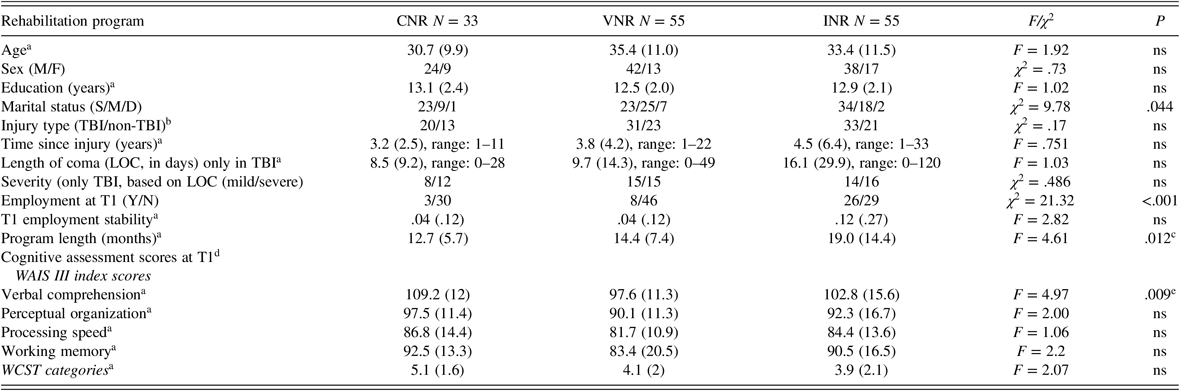
Participants were 143 patients (39 females) over 18 who were accepted for treatment at the National Institute for the Rehabilitation of the Brain Injured (NIRBI), a postacute rehabilitation institute with three branches located in Israel. Mean age was 33.5 years [standard deviation (SD) = 11.01] and mean education period was 12.8 years (SD = 2.1). Seventy-nine percent of participants were referred to NIRBI by the social security system, 15.5% were army veterans, and the remainder were either self-referred or referred by health or private insurance organizations. All participated in one of the three aforementioned NR programs, also described below, during the course of the study. Inclusion criteria were age 18 and older, BI at least 1 year previous to referral, and capacity to meet the program demands (e.g., sufficient communication and self-care abilities, transportation to and from institute). Exclusion criteria were active drug or alcohol abuse disorder, active psychotic symptoms, severe aggressive behavior, concurrent medical condition requiring intense care in another facility (e.g., pain disorder), severe sensory and/or communication disorder, and dementia. Table 1 summarizes the participants’ demographic and injury-related characteristics.
Demographic, injury-related, and other baseline characteristics of participants

CNR = comprehensive–holistic neuropsychological rehabilitation; VNR = vocational-focused neuropsychological rehabilitation; INR = individual neuropsychological rehabilitation program; TBI = Traumatic brain injury; WAIS = Wechsler Adult Intelligence Test; WCST = Wisconsin Card Sorting Test.
a Mean (standard deviation).
b TBI causes: CNR = 17 motor vehicle accidents (MVA), 1 fall, 1 work-related injury, 1 other cause; VNR = 22 MVA, 3 falls, 6 work-related injuries; INR = 23 MVA, 2 falls, 6 combat-related injuries, 2 others. Non-TBI causes: CNR = 2 strokes, 1 anoxic, 3 tumor removals, 7 others; VNR = 4 strokes, 2 anoxic, 1epilepsy, 16 others; INR = 3 strokes, 3 anoxic, 1 epilepsy, 1 tumor removal, 13 others. Other diseases = mostly inflammatory, due to viral or autoimmune causes.
c Post hoc comparisons indicated that the INR program lasted significantly more months than the CNR program.
d Cognitive test results reported only for 85 participants who underwent assessment onsite (21 CNR, 34 VNR, and 30 INR participants).
e CNR participants’ verbal comprehension scores were significantly higher than those of VNR participants.
Previous rehabilitation
In Israel, depending on individual needs, BI acute-phase care, including intensive care, inpatient, and outpatient rehabilitation hospitalization, is funded by mandatory public health insurance and is not categorically limited in terms of time and/or budget. Patients with chronic neurological handicaps undergo formal evaluation for recognition of the extent of their disability by the National Insurance Institute (Israel’s national social security system) and, if relevant, by the Veterans Administration. If found eligible by either organization, patients requiring further rehabilitation receive funding for community-based treatment (Vakil & Hoofien, Reference Vakil and Hoofien2016). Ineligible patients requiring further care may activate private insurance or pay out of pocket.
All participants in the current study received acute-phase care in accordance with the above standards, with individual treatment and rehabilitation pathways varying dramatically based on injury type and severity, the services available in their geographical location, the extent of additional physical injuries, and other characteristics. Participants had not received previous community-based rehabilitation interventions of the type provided in the current study. They were also asked to refrain from participation in other neuropsychological interventions during the course of treatment. All participants were considered chronic, having demonstrated stable functioning for an extended period previous to referral, such that further spontaneous recovery processes and functional improvements were considered highly unlikely (Seale et al., Reference Seale, Caroselli, High, Becker, Neese and Scheibel2002). Similar to a waiting list group design, this increased the likelihood that changes between testing time-points (i.e., time effects) could be attributed to the interventions and not to the passing of time alone.
Enrollment procedure
As an integral part of the pretreatment intake process, patients were asked if – in addition to participating in the treatment program to which they were allocated – they would be willing to participate in an ongoing, long-term follow-up study. They were informed that the primary aim was assessment of the institute’s treatment programs over time, as a basis for continual improvement of care. They were also informed that they would need to complete study measures at multiple time-points, including after program completion. All participants agreed to these conditions and gave informed consent. Agreement to participate in the study had no bearing on allocation to treatment group, which was based on clinical considerations alone.
Data were collected in a within-subject design between January 2005 and December 2017, at five time-points: 1 month within the start of the rehabilitation program (T1), upon program completion (T2; mean time between T1 and T2 was 15.7 months, SD = 10.6), and 1 (T3), 2 (T4), and 3 years (T5) after completing the program. By the end of 2017, we had T1 data on 783 patients, T2 data on 471, T3 data on 332, and T4 data on 205. As the study concerned the long-term treatment effects, it focused on a cohort of 143 patients for whom we had data from five time-points by December 2017. No refusals were encountered at T1. Dropout ratios between T1 and T5 were 36.3% of the 783 patients, of which 6.9% dropped out during the treatment phase and 29.4% were either not traced or refused to participate in follow-up. To verify that the final study sample is representative of the original T1 sample and not biased by intention to treat, we compared patients who dropped out during treatment (6.9% dropouts between T1 and T2) to those who completed treatment, and compared patients who dropped out during the follow-up period (29.4% dropouts between T2 and T5) to those who persisted throughout follow-up assessments. In both comparisons, we examined all T1 variables stemming from the T1 questionnaires, demographic and injury-related variables, and neuropsychological assessment data, and found no significant differences between the groups on any of the variables.
Data were self-reported by patients. Demographic and injury-related data were also verified with an additional informant, typically a family member over 18 years old, who lived with and/or knew the patient well. The study was approved by the NIRBI Ethics Committee and all participants signed informed consent forms.
Rehabilitation Programs and Placement
CNR program
The clinical concept and application of CNR programs have previously been described in detail (Ben-Yishay, Reference Ben-Yishay, Christensen and Uzzell2000; Ben-Yishay & Diller, Reference Ben-Yishay and Diller1993; Cicerone et al., Reference Cicerone, Dahlberg, Kalmar, Langenbahn, Malec, Bergquist, Felicetti, Giacino, Harley, Harrington, Herzog, Kneipp, Laatsch and Morse2000; Malec, Reference Malec2001). The program administered at NIRBI entailed 10 months of intensive treatments, 5–7 hr daily, 4 days a week. Based on clinical and scheduling considerations, some patients entered the program following a short period of individual therapy (typically 1–2 months) to allow gradual adjustment. In each group, 5–10 participants attended a highly structured, obligatory curriculum of group treatments (about 20 weekly hours) and individual therapy sessions (about 4 weekly hours). Cognitive interventions included group sessions addressing attention, memory, communication, logical reasoning (executive functioning), and psychoeducation about the brain and BI. Additional interventions addressed functional skills, such as arithmetic, reading comprehension, and basic computer use, tailored to meet individual needs. Psychological interventions included individual psychotherapy, group therapy, and vocational counseling. Family members participated in monthly psychoeducational group meetings, and family therapy was optional. The program was initially devoted to social cohesion and preliminary goal-setting and then focused on enhancing self-awareness and adapting goals to the feedback given by group and staff members. The last 2 months were devoted to the formulation of future vocational and personal plans and to preliminary on-site work trials. Upon completing this intensive stage, patients were placed at the job or education program most suited to their abilities and interests, as determined by the vocational counseling process.
VNR program
The VNR program was also an intensive group-based day program. Patients spent two-thirds of their time in prevocational workshops that resembled a work environment, and a third of their time in individual and group treatments. Unlike the CNR program, in which there were predefined start and end points for the entire group, VNR groups were ongoing, with individual participants joining and leaving in accordance with their specific needs. Program length was thus individually determined, with a range of 4–18 months. Program intensity increased gradually from 2 to 5 days a week, according to the patient’s abilities, perseverance, and diligence. This facilitated adaptation to program demands, which by and large resembled those of an average workplace. The workshops included technical assembly, clerical and office tasks, carpentry, or gardening. Treatments included individual psychotherapy, cognitive rehabilitation, vocational counseling, and case management, as well as group therapy sessions with specific aims, including vocational, cognitive, psychoeducation, and support groups. Upon completing the workshop stage, patients were placed at workplaces or in more advanced vocational education and/or training. The program was not aimed at specific vocational education but rather at general preparation for entering or reentering employment. Thus, its main emphasis was on acquiring work habits and basic vocational aptitudes.
INR programs
Similar to the treatment generally provided at private neuropsychological clinics, INR programs comprised 1–4 hr of treatment a week, primarily including individual psychotherapy, cognitive rehabilitation, family therapy, vocational counseling, and job placement, as described elsewhere (Ho & Bennett, Reference Ho and Bennett1997). The content, intensity, and length of program were tailored to address the needs, goals, prognosis, and progress of each patient. In comparison to the CNR and VNR programs, most patients enrolled in the INR program either did not require the more intensive programs (e.g., were already satisfactorily integrated at work but complained of family or emotional distress) or were unable to cope with their demands. Because this program was not structured or group-dependent, treatment durations were more varied, based on both funding limitations and clinical considerations.
Program placement
Highly experienced senior staff members, all certified rehabilitation psychologists and clinical neuropsychologists, decided about patient admittance to the programs. Recommendations were based on clinical considerations, to facilitate optimal matching between: (1) patient capabilities, disabilities, challenges, needs, goals, and prognosis and (2) program characteristics. Decisions were also based on data from neuropsychological evaluations conducted onsite or elsewhere, medical records and psychosocial reports, and intake meetings. In general, patients who had mild-to-moderate cognitive disabilities and emotional distress, but good prognosis for integration in jobs or advanced vocational education, expressed high motivation, and had reasonable learning habits, were referred to the CNR program. Current employment did not preclude admittance to the CNR program when patients expressed realistic motivation for upgrading vocational status or stability. Patients whose prognosis tended toward lower vocational levels, including semi- or fully-sheltered jobs, who needed a preparatory period to acclimate to the demands of productive functioning, and could benefit from neuropsychological cognitive therapy and psychotherapy, were accepted to the VNR program. Patients who for various reasons (e.g., motivation, psychological resilience, time constraints due to existing employment) did not fit into group-based day programs were accepted to the INR program. Compared to the other two groups, significantly more patients in the INR program were already employed at the time of referral, though they reported low vocational stability and were referred to NR with the goal of improving this aspect, among others (see Table 1). The INR group was characterized by notable heterogeneity in participant characteristics, including but not limited to severity of injury. Some participants were indeed placed in this program because of severe impairments precluding participation in one of the other two programs. However, in contrast, others were placed in the INR program because they were deemed capable of moving forward successfully without the intensive care provided in the other programs.
Program Duration
Participation durations in the CNR and VNR programs were predominantly dictated by their structured nature and by standard limits set by the organizations funding care for most participants (Israel’s National Insurance Institute, Veterans Administration). Durations in the INR program were much more varied and, on average, longer. However, as this program generally involved significantly fewer weekly hours than the other two, longer durations do not signify more treatment. Likewise, longer treatment duration in the INR was not an indication of greater injury severity, but rather a reflection of the various needs and characteristics of the participants in this group (e.g., fewer weekly hours to accommodate existing employment schedule).
Measures
A battery of questionnaires and structured interviews was compiled to address demographic and injury-related information, professional history and vocational status, self-reported level of participation (integration) in the community, and psychological well-being (measured by perceived life satisfaction and mood). Importantly, this battery was separate from the assessment tools used for initial patient evaluation and program placement. Measures were translated to Hebrew and psychometrically tested in an unpublished pilot study that included 250 patients. The relevant psychometric results are presented in the detailed descriptions of each measure below.
Demographic and injury-related information
Data regarding age, gender, marital status, residential status, and etiology and severity of BI were obtained upon enrollment (T1), based on a structured interview with the patient and a family member (or other informant), and a review of available medical and other records.
Employment status and vocational stability
Information regarding professional (educational and occupational) history, vocational level and status, and vocational stability, was collected at each of the five time-points, using a structured interview. Employment status (yes/no) was recorded at all time-points. Vocational stability was calculated at T1 using the following equation: months of employment since end of rehabilitation hospitalization divided by (total months since end of hospitalization multiplied by number of jobs since end of hospitalization), and at T2–T5 using the following equation: months of employment since previous assessment divided by (total months since previous assessment multiplied by number of jobs since previous assessment).
Community Integration Questionnaire (Willer, Ottenbacher, & Coad, Reference Willer, Ottenbacher and Coad1994)
This measure evaluates functional outcome among individuals with BI undergoing rehabilitation, specifically addressing their participation in social, vocational, and domestic activities. It has adequate test–retest reliability and internal consistency (Willer et al., Reference Willer, Ottenbacher and Coad1994; Willer, Rosenthal, Kreutzer, Gordon, & Rempel, Reference Willer, Rosenthal, Kreutzer, Gordon and Rempel1993). The Community Integration Questionnaire (CIQ) includes 15 items covering 3 subdomains: home integration (i.e., who does the shopping), social integration (i.e., frequency of social activities), and productivity level (e.g., employment status, educational training). Items are scored on a scale of 0–2, with higher scores indicating greater community integration and functioning (maximal score = 30). The Hebrew version yielded good inter-item reliability (Cronbach’s alpha = .714).
Wimbledon Self-Report Scale (Coughlan & Storey, Reference Coughlan and Storey1988)
The Wimbledon Self-Report Scale (WSRS) was designed to assess emotional state and mood in neurological patients and patients with substantial physical illness. As such, it asks only about feelings and, unlike more commonly used measures, refrains from asking about somatic symptoms, memory, and concentration problems, which are likely to produce false positives in this population. It has been used previously to assess neurological patients (e.g., Bowen, Chamberlain, Tennant, Neumann, & Conner, Reference Bowen, Chamberlain, Tennant, Neumann and Conner1999; Valk-Kleibeuker, Heijenbrok-Kal, & Ribbers, Reference Valk-Kleibeuker, Heijenbrok-Kal and Ribbers2014). The scale is composed of 30 items, of which 24 pertain to unpleasant feelings (e.g., worthlessness) and 6 pertain to pleasant feelings (e.g., confidence). Participants reported on the occurrence of each state during the week previous to administration: (a) most of the time, (b) quite often, (c) only occasionally, and (d) not at all. The order was reversed for pleasant feeling items. Responses (a) and (b) scored 1, and responses (c) and (d) scored 0. Higher scores indicated more unpleasant feelings (maximal score = 30). Scores were classified as follows: 0–7 = no mood disturbance; 8–10 = borderline mood disturbance; 11–30 = clinically significant mood disturbance (Coughlan & Storey, Reference Coughlan and Storey1988). Following previous guidelines for score interpretation (e.g., Bowen et al., Reference Bowen, Chamberlain, Tennant, Neumann and Conner1999; Valk-Kleibeuker et al., Reference Valk-Kleibeuker, Heijenbrok-Kal and Ribbers2014), borderline and mood disturbance cases were combined, essentially generating a categorical score of 0 (no significant mood disturbance) and 1 (borderline/significant mood disturbance). The Hebrew version yielded high inter-item reliability (Cronbach’s alpha = .959, split-half = .953).
Perceived Quality of Life questionnaire (Patrick, Kinne, Engelberg, & Pearlman, Reference Patrick, Kinne, Engelberg and Pearlman2000)
The Perceived Quality of Life (PQoL) questionnaire includes 20 items pertaining to the degree of satisfaction with various aspects of life, including physical health, self-care ability, social interactions, and functioning in various domains. Patients rate their satisfaction with each aspect on a 0–10 scale, with higher scores indicating greater satisfaction. The average for all items serves as an overall score (maximal score = 10). The Hebrew version yielded high inter-item reliability (Cronbach’s alpha = .930, split-half = .904).
Procedure
Data collection
All participants signed informed consent forms and completed the aforementioned battery at five time-points: within 1 month of beginning the rehabilitation program (T1), at the end of the program (T2), and 1, 2, and 3 years later (T3, T4, and T5, respectively). Participants were contacted by trained members of the institutional research team and completed the study measures in written form or orally, during face-to-face or phone appointments, respectively.
Data collection was entirely separate from the clinical decision-making procedure and was performed by research assistants (graduate psychology interns) who were not members of the NIRBI clinical staff. Hence, at the time of admittance (T1), the senior staff members who made the clinical recommendations were blind to the research data (i.e., questionnaire scores). Similarly, research assistants were blind to the programs in which the participants were placed. This partial double-blind design was strictly maintained at all time-points.
Data analysis
Differences between program participants on demographic and injury-related variables, other T1 measures, and length of treatment were analyzed using one-way analyses of variance with Bonferroni post hoc comparisons or χ 2 tests for categorical variables. Long-term effects of NR programs on the various measures were determined using General Linear Model repeated measures analyses, with a Greenhouse–Geisser correction. Independent variables were within-subject testing time-point (five levels) and between-subject NR program (three groups). Dependent variables were summary scores of the questionnaires described above, assessed at T1 through T5. Post hoc tests using the Bonferroni correction were used to identify the sources of significant differences. Effect sizes were estimated using Partial Eta Squared (η p 2) values. Differences in proportion of categorical variables (employment status; WSRS score) over time were determined using Cochran’s Q test. Analyses were conducted using the IBM SPSS Statistics program, version 24 (Armonk, NY: IBM Corp.).
Results
Employment rate
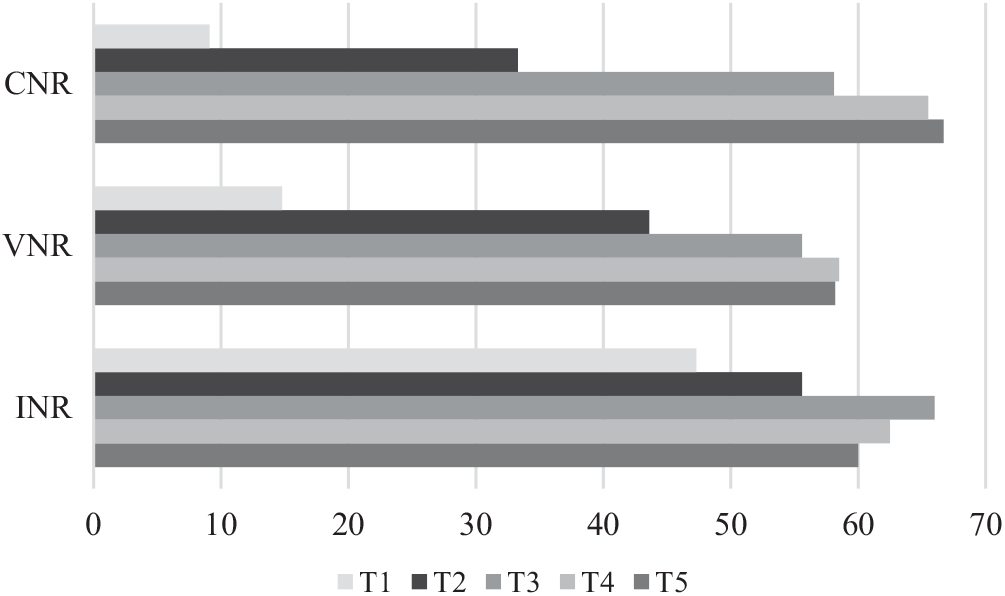
The percentages of employed patients at T1 through T5, by NR program, are presented in Figure 1. In the entire sample, employment rates at T1 through T5 were 26%, 46%, 60%, 62%, and 61%. Thus, employment rates clearly increased between T1 and T2 and between T2 and T3, then remained stable between T3 and T5. Cochran’s Q test determined that the proportion of employed participants significantly increased between time-points (χ 2(4) = 63.75, p < .001).
Proportion (%) of employed patients by treatment program across time (N = 143). INR = individual neuropsychological rehabilitation program; CNR = comprehensive–holistic neuropsychological rehabilitation program; VNR = vocational-focused neuropsychological rehabilitation program. T1 = Beginning of program; T2 = End of program; T3 = 1-year post program end; T4 = 2 years post program end; T5 = 3 years post program end.

Work stability
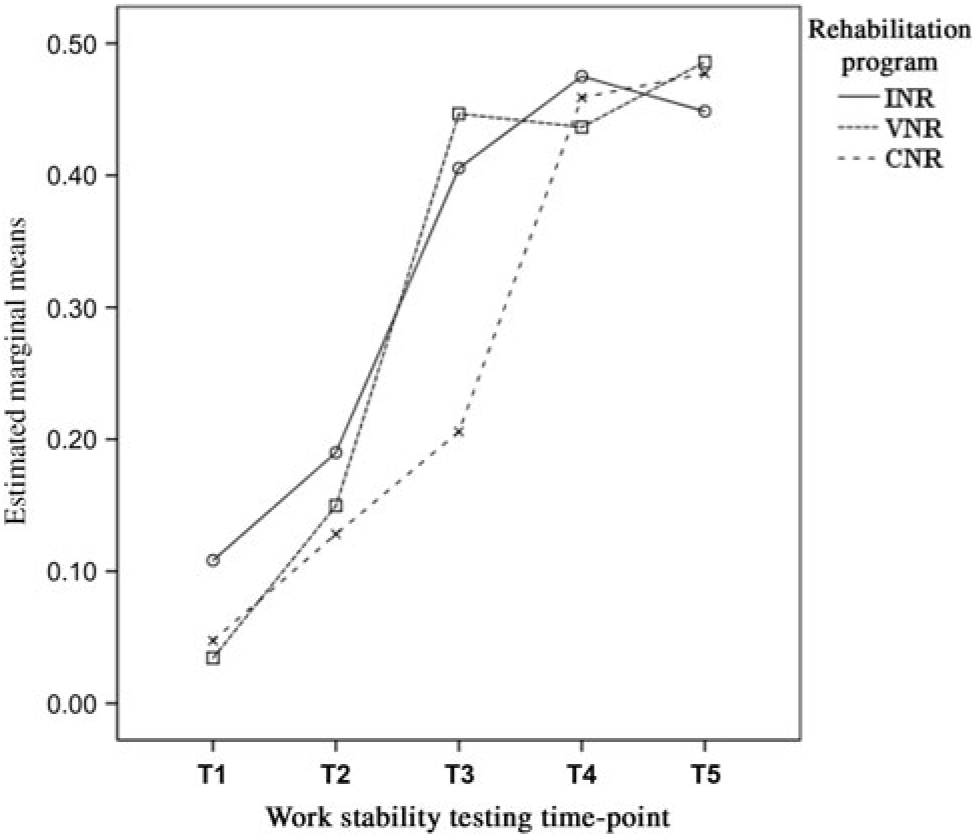
Work stability improved significantly across time, regardless of program type, F(3.39,410) = 41.62, p < .001, η p 2 = .256. This was corroborated by a significant linear effect for time across groups, F(1,121) = 102.64, p < .001, η p 2 = .459). Effect sizes were large for both results. Data regarding all five time-points were available for 124 patients. In the entire sample, mean (and SD) vocational stability scores at T1 through T5 were .06 (.2), .16 (.32), .38 (.44), .46 (.47), and .47 (.46). Post hoc tests revealed significant differences between all pairs of testing time-points, except for the following three pairs: T3–T4, T3–T5, and T4–T5. Group and interaction effects were insignificant. The results are presented in Figure 2.
Stability at work by treatment program across time (N = 124). INR = individual neuropsychological rehabilitation program; CNR = comprehensive–holistic neuropsychological rehabilitation program; VNR = vocational-focused neuropsychological rehabilitation program. T1 = Beginning of program; T2 = End of program; T3 = 1-year post program end; T4 = 2 years post program end; T5 = 3 years post program end.

Community integration
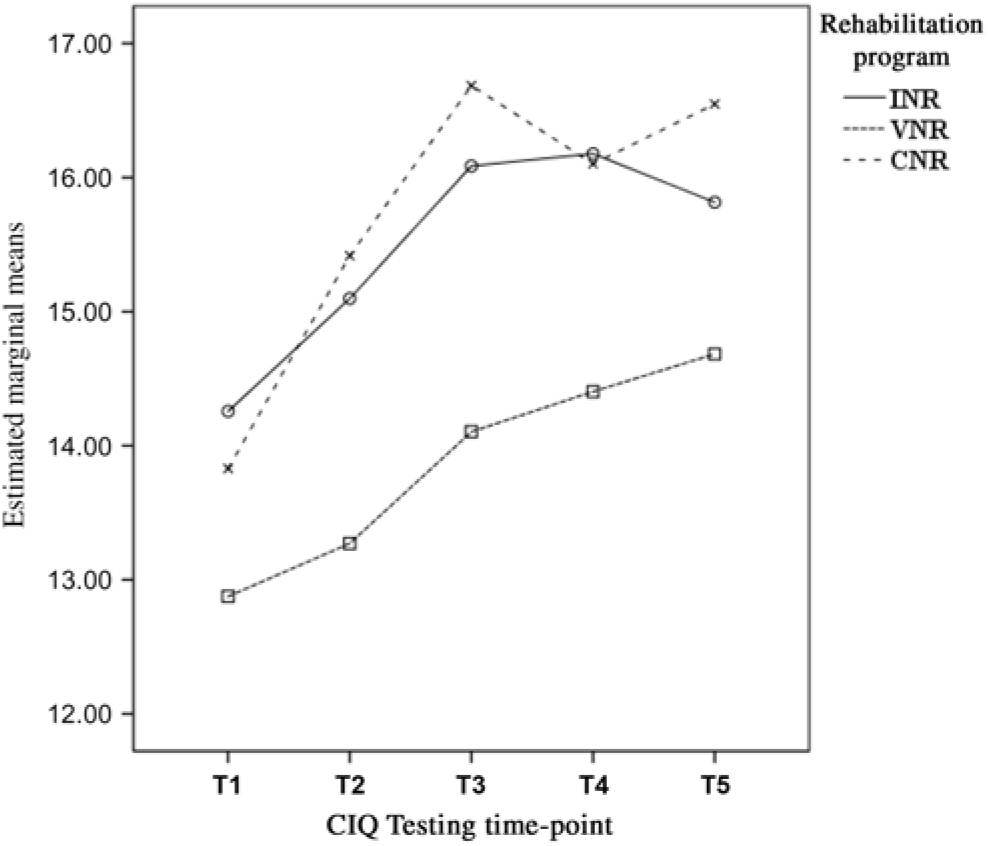
Community integration overall score (reflecting social, vocational, and domestic functioning) improved significantly across time, regardless of program type, F(3.38,413) = 8.79, p < .001, η p 2 = .067), with a significant linear effect for testing time, across groups, F(1,122) = 18.79, p < .001, η p 2 = .133). Effect sizes were medium for both results. Data regarding all five time-points were available for 125 patients. In this entire sample, mean (and SD) CIQ scores at T1 through T5 were 13.6 (4.9), 14.4 (5), 15.4 (5.4), 15.4 (5.7), and 15.5 (5.6). Post hoc tests revealed significant differences between the following testing time pairs: T1–T3, T1–T4, and T1–T5. Group and interaction effects were insignificant. The results are presented in Figure 3.
Community integration (CIQ) by treatment program across time (N = 125). INR = individual neuropsychological rehabilitation program; CNR = comprehensive–holistic neuropsychological rehabilitation program; VNR = vocational-focused neuropsychological rehabilitation program. T1 = Beginning of program; T2 = End of program; T3 = 1-year post program end; T4 = 2 years post program end; T5 = 3 years post program end.

Perceived quality of life
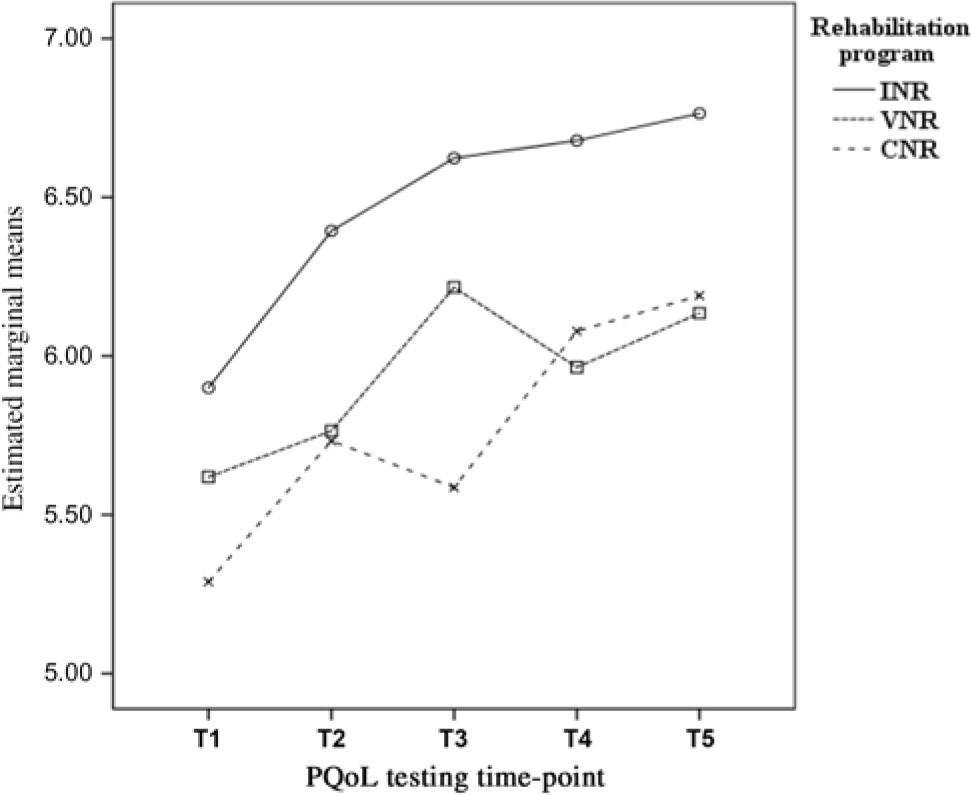
PQoL improved significantly across time, regardless of program type, F(3.35,615) = 8.0, p < .001, η p 2 = .062), and there was a significant linear effect for time across groups, F(1,122) = 19.56, p < .001, η p 2 = .138). Effect sizes were medium for both results. Data regarding all time-points were available for 125 patients. In this entire sample, mean (SD) PQoL scores at T1 through T5 were 5.7 (1), 6 (1.9), 6.2 (1.8), 6.3 (1.9), and 6.4 (1.9). Post hoc tests revealed significant differences between the following testing time-points: T1–T3, T1–T4, T1–T5, and T2–T5. Group and interaction effects were insignificant. The results are presented in Figure 4.
Perceived Quality of Life (PQoL) by treatment program across time (N = 125). INR = individual neuropsychological rehabilitation program; CNR = comprehensive–holistic neuropsychological rehabilitation program; VNR = vocational-focused neuropsychological rehabilitation program. T1 = Beginning of program; T2 = End of program; T3 = 1-year post program end; T4 = 2 years post program end; T5 = 3 years post program end.

Mood disturbance rate and persistence across time
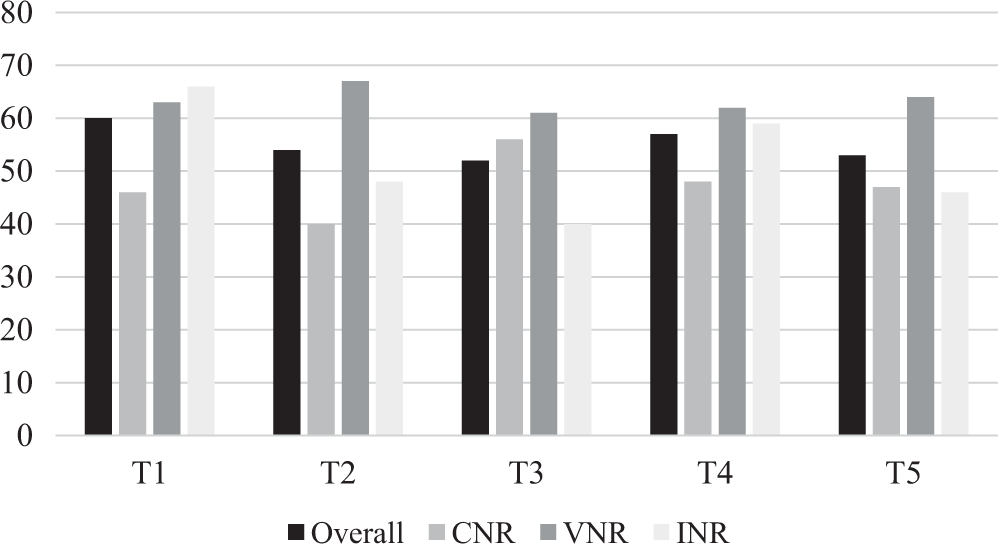
Sixty percent of the patients in our sample scored in the borderline or significant mood disturbance range (i.e., WSRS score > 7) at T1. At T2 through T5, rates of mood disturbance were 54%, 52%, 57%, and 53%. The proportions of borderline and significant mood disturbance in each group are presented in Figure 5. Changes in mood disturbance rates did not have a particular pattern. Accordingly, Cochran’s Q test determined that the proportion of mood disturbance did not significantly differ between time-points (χ 2(4) = 2.943, ns).
Proportion (%) of patients with mood disturbance (WSRS score > 7), by treatment program, across time (N = 113). INR = individual neuropsychological rehabilitation program; CNR = comprehensive–holistic neuropsychological rehabilitation program; VNR = vocational-focused neuropsychological rehabilitation program. T1 = Beginning of program; T2 = End of program; T3 = 1-year post program end; T4 = 2 years post program end; T5 = 3 years post program end.

Discussion
The current study tracked the long-term maintenance of treatment outcomes among postacute patients with brain injury in community-based neuropsychological rehabilitation programs. Using a partial double-blind prospective design to evaluate participants in several domains before, immediately after, and annually for 3 years following intervention, the study makes a unique contribution to the existing literature, much of which describes cross-sectional or shorter-term within-subject follow-up studies and addresses interventions in focused domains.
Between starting and completing rehabilitation, patients across groups showed significant improvements in measures chosen for their known ties with overall health and well-being (Salter, McClure, Foley, & Teasell, Reference Salter, McClure, Foley and Teasell2011), including: employment status and stability, community integration, and PQoL. Moreover, these positive outcomes remained remarkably stable and even continued to improve for 3 years after the programs had ended.
Employment
Patients with BI often lose their jobs or have difficulty finding a new job, sometimes years after their injury (Malec, Reference Malec2001). Vocation is an essential element of personal and social identity, and its loss is damaging to self-worth, purpose, and productivity (West, Targett, Yasuda, & Wehman, Reference West, Targett, Yasuda, Wehman, Zasler, Katz and Zafonte2007). Indeed, patients with BI who are able to reintegrate into the workforce report a better sense of well-being, health, social function, and overall quality of life (Corrigan, Bogner, Mysiw, Clinchot, & Fugate, Reference Corrigan, Bogner, Mysiw, Clinchot and Fugate2001; van Velzen et al., Reference van Velzen, van Bennekom, Edelaar, Sluiter and Frings-Dresen2009). With over 50% of BI patients unable to return to work or maintain a stable job, return to work is viewed as a central rehabilitation goal (van Velzen et al., Reference van Velzen, van Bennekom, Edelaar, Sluiter and Frings-Dresen2009; West et al., Reference West, Targett, Yasuda, Wehman, Zasler, Katz and Zafonte2007). In line with this, the majority of patients referred to our community-based postacute rehabilitation center were unemployed. Upon program completion and during the following years, there was a clear-cut rise in employment rates in all groups (Figure 1). As participants were in the chronic, stable phase, we assume that this rise can largely be attributed to the interventions (Seale et al., Reference Seale, Caroselli, High, Becker, Neese and Scheibel2002). Changes in employment rate were particularly evident among day program (CNR, VNR) patients, who were selected for these groups due to their low starting points and potential for vocational integration. A greater number of INR participants were already employed when they entered the program, such that employment status is likely not the most informative measure of rehabilitation effects on this group.
The positive effect of NR in the vocational realm was also reflected in the findings on vocational stability. The gradual increase in this measure indicated the ability to maintain a single job over time, which is a known challenge following BI (Malec & Moessner, Reference Malec and Moessner2006). Vocational stability in the INR group was similar to that of the two day-program groups initially and showed similar improvement following intervention and over time. This reveals difficulties in the INR group that were not reflected in the employment status measure, and highlights the importance of addressing job maintenance alongside employment per se.
While the results clearly demonstrate improvements associated with the three NR programs examined, it cannot be ignored that not all patients benefited from treatment. Thirty to forty percent of patients remained unemployed, and the work stability index plateaued at around .5. While we continually strive to increase these numbers, they should be considered in the context of general employment rates and employment rates for individuals with other types of disability (e.g., Lidal, Huynh, & Biering-Sørensen, Reference Lidal, Huynh and Biering-Sørensen2007). Furthermore, we can speculate that the inclusion of patients with more severe injuries who entered the programs several years after being injured increased the potential for a selection bias toward those whose ability to benefit from rehabilitation was limited (Ahman, Saveman, Styrke, Björnstig, & Stålnacke, Reference Ahman, Saveman, Styrke, Björnstig and Stålnacke2013).
Community integration
As a measure of participation, community integration goes beyond physical functioning and self-care to include engagement in vocational, social, and community roles (Sandhaug, Andelic, Langhammer, & Mygland, , Reference Sandhaug, Andelic, Langhammer and Mygland2015). It is widely recognized as a central target in rehabilitation following BI, because of its positive relationship with health and well-being (Cicerone, Reference Cicerone2004; Forslund, Roe, Sigurdardottir, & Andelic, Reference Forslund, Roe, Sigurdardottir and Andelic2013). We examined community integration using the CIQ, which comprises several elements including relationships with others, independence at home, and participation in meaningful activities (Willer et al., Reference Willer, Ottenbacher and Coad1994). Across treatment programs, CIQ scores improved between T1 and T2, in accordance with previous reports (Cicerone et al., Reference Cicerone, Mott, Azulay, Sharlow-Galella, Ellmo, Paradise and Friel2008; Seale et al., Reference Seale, Caroselli, High, Becker, Neese and Scheibel2002). Furthermore, the current results showed that CIQ continued to increase for a year following rehabilitation, before stabilizing and maintaining significantly raised levels at T3 and throughout later follow-ups. This suggests that during the years following rehabilitation, patients continue to apply various tools and compensations that enable them to extend functional treatment gains. This is in stark contrast with the reported unlikelihood of spontaneous functional gains later than 1 year following BI among individuals who do not undergo postacute rehabilitation (Seale et al., Reference Seale, Caroselli, High, Becker, Neese and Scheibel2002).
Perceived quality of life and mood
Improving psychological well-being is a central aim of NR programs, bearing in mind that continued psychological distress negatively impacts the functional outcome of brain injuries (Yeates et al., Reference Yeates, Levin and Ponsford2017). Rehabilitation-related gains in PQoL have previously been reported (e.g., Cicerone et al., Reference Cicerone, Mott, Azulay, Sharlow-Galella, Ellmo, Paradise and Friel2008). In the current study, PQoL scores improved gradually between T1 and T3 and stayed high until T5. In contrast, mood was the only variable we examined that did not show clear improvement across groups at any point. This is an interesting dissociation, given that these measures seem to overlap conceptually and have been found to be related in previous work (e.g., Kreuter, Sullivan, Dahllöf, & Siösteen, Reference Kreuter, Sullivan, Dahllöf and Siösteen1998). In the current study, we did not directly assess the relationship between our mood and PQoL measures. We can, however, consider possible explanations for this counterintuitive finding. It appears that PQoL is more sensitive to concrete changes in functioning, which are a primary goal of neuropsychological, and particularly vocational, rehabilitation. Meanwhile, measures of mood, like the WSRS, may more likely reflect the robust negative emotions associated with multiple losses and changes in self-identity that often occur in response to BI (Gracey et al., Reference Gracey, Palmer, Rous, Psaila, Shaw, O’Dell, Cope and Mohamed2008; Klonoff, Reference Klonoff2010). Furthermore, increased self-awareness, another major rehabilitation aim, would be expected to have a differential effect on these two measures (PQoL and WSRS), as it has been associated with improved functioning on one hand (Hoofien, Gilboa, Vakil, & Barak, Reference Hoofien, Gilboa, Vakil and Barak2004) and with lowered mood on the other (Ownsworth et al., Reference Ownsworth, Fleming, Strong, Radel, Chan and Clare2007). Finally, beyond psychological reactions to the injury and its consequences, treatment-resistant mood disturbances can also be a direct result of neurological damage leading to symptoms such as apathy, impaired reward processing, or emotional dysregulation (Szczepanski & Knight, Reference Szczepanski and Knight2014).
Limitations and future directions
The limitations of the current work primarily stem from the nonrandomized controlled study design. This is a common concern in assessing the efficacy of rehabilitation interventions, as it is considered unethical to withhold time-sensitive treatments from patients (Malec & Basford, Reference Malec and Basford1996) and because correct client-program matching is an integral component of most rehabilitation programs, precluding randomized allocation. While our results must be interpreted with these limitations in mind, the associated concerns are mitigated by our use of a longitudinal design among chronic patients in whom spontaneous recovery was unlikely. In addition, it should be noted that the intervention programs we examined were relatively long, which may limit the generalizability of our findings to countries with medical systems that restrict rehabilitation length. Future work examining whether long-term maintenance of treatment outcomes can be achieved in shorter programs can provide important guidance to public and private third-party organizations responsible for funding BI rehabilitation beyond the acute phase. Another important direction for future research involves the examination of how pre and postinjury patient characteristics, such as personality characteristics, age at injury, family support, injury severity, neurobehavioral disturbances, and depression, among other measures, explain variability in intervention outcomes and maintenance. This type of research will be an important foundation for treatment decisions and allocation to treatment programs and may also guide the development of additional programs to benefit treatment-resistant patients.
CONCLUSION
Long-term maintenance of improvements is an imperative aspect of successful brain injury neuropsychological rehabilitation. The finding that, with the exception of mood, all the measures we assessed continued to show significant improvement after program completion suggests that patients successfully applied the various tools, skills, and psychological perspectives that they gained. This continuation of rehabilitation outcomes and generalization to real life indicates that improvements measured at the end of treatment are not temporary phenomena related only to the treatment environment, but rather reflect enduring transformational processes with stable long-term benefits.
ACKNOWLEDGMENTS
We are extremely grateful to the patients treated at the National Institute for the Rehabilitation of the Brain Injured, who took part in this study, as well as to the entire clinical and research staff of the institute. We especially thank Dr. Sari Maril for her invaluable contribution to manuscript preparation and editing. The authors report no disclosures or conflicts of interest. The study was partly supported by the Ministry of Aliyah and Integration’s Center for Absorption in Science Research Fellowship to Dr. Shany-Ur. We report no other sources of financial support.
CONFLICT OF INTEREST
The authors have nothing to disclose.