Of the 33 recognised extant subfamilies of rove beetles (Yamamoto Reference Yamamoto2021), Phloeocharinae comprises seven genera with about 60 species worldwide, representing only a tiny fraction of the overwhelming mega-diversity of Staphylinidae. Roughly two-thirds of the known species belong to the genus Phloeocharis van Mannerheim, Reference von Mannerheim1830, and the remaining genera are each monogeneric or containing, at most, only several species (Newton et al. Reference Newton, Thayer, Ashe, Chandler, Arnett and Thomas2000; Chatzimanolis et al. Reference Chatzimanolis and Engel2013; Assing Reference Assing2015). They are generally small staphylinids that inhabit forest-associated microenvironments such as leaf litter and under bark. Very little is known of their biology, but they are considered to be predatory (Thayer Reference Thayer, Beutel and Leschen2016) and frequently flightless (e.g., Assing Reference Assing2015). Some phloeocharines have reduced eyes, suggesting endogean lifestyles in deep layers of soil (Coiffait Reference Coiffait1957; Smetana & Campbell Reference Smetana and Campbell1980; Hernando Reference Hernando2003). Most phloeocharine species are distributed in the Holarctic region but are also known from North America, Central America, Chile, Australia, and New Zealand (Newton et al. Reference Newton, Thayer, Ashe, Chandler, Arnett and Thomas2000; Chatzimanolis et al. Reference Chatzimanolis and Engel2013).
Phloeocharinae is one of the most problematic subfamilies of Staphylinidae and is not at all likely to be monophyletic based on morphological and molecular evidence (Ashe & Newton Reference Ashe and Newton1993; Ashe Reference Ashe2005; Chatzimanolis et al. Reference Chatzimanolis and Engel2013; McKenna et al. Reference McKenna, Farrell, Caterino, Farnum, Hawks, Maddison, Seago, Short, Newton and Thayer2015; Thayer Reference Thayer, Beutel and Leschen2016; Gusarov Reference Gusarov, Betz, Irmler and Klimaszewski2018; Lü et al. Reference Lü, Cai, Zhang, Newton, Thayer and Zhou2020). In fact, it has for a long time been a dumping ground for relatively primitive staphylinids that do not fit well elsewhere (Newton et al. Reference Newton, Thayer, Ashe, Chandler, Arnett and Thomas2000). In their molecular study of Staphyliniformia, McKenna et al. (Reference McKenna, Farrell, Caterino, Farnum, Hawks, Maddison, Seago, Short, Newton and Thayer2015) showed that Charhyphus Sharp, 1887 is a sister group to the non-Osoriini Osoriinae. Consequently, Phloeocharis, the type genus of the subfamily, is phylogenetically very distant from Charhyphus (McKenna et al. Reference McKenna, Farrell, Caterino, Farnum, Hawks, Maddison, Seago, Short, Newton and Thayer2015). Similarly, the close phylogenetic relationship of Charhyphus to Osoriinae has also been confirmed by Lü et al. (Reference Lü, Cai, Zhang, Newton, Thayer and Zhou2020). In general, the placement of the genus within Phloeocharinae is open for discussion. On the other hand, Phloeocharis may form a monophyletic group with the two other phloeocharine genera – namely, Phloeognathus Steel, Reference Steel1953 and Pseudophloeocharis Steel, Reference Steel1950 – occurring in the Australian and Oceanic regions (Newton Reference Newton and Ball1985; Chatzimanolis et al. Reference Chatzimanolis and Engel2013), with the addition of Dytoscotes Smetana & Campbell, 1980 from North America and an undescribed genus from Chile (Chatzimanolis et al. Reference Chatzimanolis and Engel2013). In contrast, this generic group is morphologically quite dissimilar from the other three genera of Phloeocharinae (i.e., Charhyphus; Ecbletus Sharp, 1887; Vicelva Moore & Legner, Reference Moore and Legner1973) (Chatzimanolis et al. Reference Chatzimanolis and Engel2013; Yamamoto, pers. obs. 2019). Each systematic placement should be phylogenetically tested in the future to confirm if they are indeed true members in the subfamily or represent new subfamilies.
Charhyphus is a small but distinct genus within the subfamily. In general, members can be distinguished from other taxa of Phloeocharinae by the significantly flattened body, moderately short antennae with antennomeres 6–10 transverse, and serrate lateral margins of the pronotum along with other morphological details (Herman Reference Herman1972; Newton et al. Reference Newton, Thayer, Ashe, Chandler, Arnett and Thomas2000; Brunke et al. Reference Brunke, Newton, Klimaszewski, Majka and Marshall2011). Except for Charhyphus picipennis (LeConte, Reference LeConte1863), other extant species are rare in collections and known mostly only from females. Adults and larvae of Charhyphus are known as subcorticolous inhabitants and can be found under tree bark, especially in hardwoods (e.g., Herman Reference Herman1972). Smetana & Campbell (Reference Smetana and Campbell1980) noted that ‘…Phloeocharinae has never been adequately characterised and even after Herman (Reference Herman1972) suggested several additional subfamilial characters, the delimitation of the subfamily still remains inadequate’, and provided a key to the Nearctic genera of Phloeocharinae including Charhyphus. Ashe & Newton (Reference Ashe and Newton1993) discussed some aspects of the phylogeny of the tachyporine group of Staphylinidae based on the larval morphology and demonstrated the monophyly of Charhyphus. Detailed comparative morphological analysis of main internal and external structures of the body of extant species of Charhyphus as well as other taxa of Phloeocharinae, Osoriinae, and Piestinae is necessary to determine phylogenetic relationships. Another problem with Charhyphus is that they are rarely collected outside of North and Central Americas, resulting in very limited and patchy distributional records for the Palaearctic Region. The recent discovery of the first fossil of Charhyphus based on a single male amber inclusion from Eocene Baltic amber has added new insight into the palaeobiogeography on the genus, but more information from additional fossils have been needed to consider their morphological evolution, palaeodiversity, and palaeodistributions.
The present study provides a description of a new extinct species of Charhyphus based on a single female specimen from Baltic amber, representing the first female fossil of the genus. The external and internal morphological characters were explored and visualised using X-ray micro-computed tomography (μCT). The interspecific relations between species of Charhyphus, particularly that of the sole extinct species in the genus from the same amber deposit, are briefly discussed. Additionally, a modified key for the entire genus including both extant and extinct species is provided.
1. Taxonomic history of Charhyphus and its fossil records
The genus Charhyphus was described by Sharp (Reference Sharp1887) within ‘Group Phloeocharina’ and in the original description, only Charhyphus brevicollis Sharp, Reference Sharp1887 was included. LeConte (Reference LeConte1863) described Hypotelus picipennis LeConte, Reference LeConte1863 from ‘Middle States and Kansas’, which was later placed by Fauvel (Reference Fauvel1878a [=Reference Fauvel1878b]) to the monotypic genus Triga Fauvel, 1878a within ‘Piestini’. Handlirsch (Reference Handlirsch1907) and Bernhauer (Reference Bernhauer1923) moved Triga into Trigites Handlirsch, 1907 and Pseudeleusis Bernhauer, 1923, respectively. Bernhauer (Reference Bernhauer1933) described the monotypic ‘Piestinen’ genus Chapmania Bernhauer, 1933, with the species Chapmania paradoxa Bernhauer, Reference Bernhauer1933 from the Russian Far East, which Blackwelder (Reference Blackwelder1952) later replaced the generic name with Siberia Blackwelder, 1952 since the name Chapmania was preoccupied. Herman (Reference Herman1972) redescribed Charhyphus within Phloeocharinae, synonymised Trigites and Siberia with it, and described Charhyphus arizoniensis Herman, Reference Herman1972. Additionally, one fossil species from Eocene Baltic amber, †Charhyphus balticus Shavrin, Reference Shavrin2020 in Shavrin & Kairišs (Reference Shavrin and Kairišs2020) was recently described. Another enigmatic fossil species, †Charhyphus coeni (Scudder, Reference Scudder1900), originally described as a member of Triga from the upper Eocene of Florissant, Colorado, USA (Scudder Reference Scudder1900) but later transferred to Charhyphus due to the synonymy of Trigites, is considered ‘Staphylinidae incertae sedis’ in this study, following such taxonomic treatment by Chatzimanolis et al. (Reference Chatzimanolis and Engel2013). The taxonomic position of the fossil was not considered as a member of Charhyphus in our study. Thus, four extant and one extinct species of the genus are known at the present time. Newton et al. (Reference Newton, Thayer, Ashe, Chandler, Arnett and Thomas2000) noted that one species from Mexico and Guatemala still remains undescribed.
2. Materials and methods
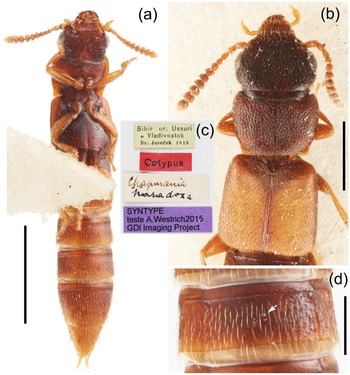
The amber piece with the inclusion of †Charhyphus serratus sp. nov. was polished using emery papers of different grain sizes by the first author (S.Y.) without further treatment. Two fossil specimens examined in this study are deposited in the Institute of Life Sciences and Technologies, Daugavpils University, Daugavpils, Latvia (Daugavpils University, Beetles Collection (DUBC); the holotype of †C. serratus sp. nov.: Figs 1–6b, 7–9) and the private collection of Vitalii I. Alekseev (Kaliningrad, Russia, but to be deposited in the Borissiak Paleontological Institute of the Russian Academy of Sciences, Moscow, Russia; the holotype of †C. balticus). For comparative purposes, all four extant species of Charhyphus were studied for the present study (Figs 8, 9). All of the following specimens are deposited in the Gantz Family Collections Center, Field Museum of Natural History (FMNH), Chicago, Illinois, USA: (1) Charhyphus arizoniensis Herman, Reference Herman1972 (Figs 8a, 9d), one female, with the following label data: ‘Ariz.: Grah. Co., Pinaleno Mtns. Wet Canyon 6000' IV-11-1977’, ‘DSChandler under bark of Arizona Walnut’, ‘Charhyphus arizonensis Herman det. L.E. Watrous 1978’; (2) Charhyphus brevicollis Sharp, Reference Sharp1887 (Figs 8b, 9a), one female, with the following label data: ‘MEXICO: México 19 mi SW Toluca, Mex. 134, 9600 ft ix.12.1973’, ‘under pine bark A. Newton’; (3) Charhyphus paradoxus (Bernhauer, Reference Bernhauer1933) (Figs 8c, 9b), one female, syntype, with the following label data: ‘Sibir or. Ussuri Vladivostok Dr. Jureček 1919’, ‘Cotypus’, ‘Chapmania paradoxa’, ‘SYNTYPE teste A.Westrich2015 GDI Imaging Project’ (Fig. 9c). The photographs of the habitus and type labels of other cotypes (female) are available in the Arthropod Collections Database of FMNH (last access: 08.VI.2021); (4) Charhyphus picipennis (LeConte, Reference LeConte1863) (Fig. 8d), one female, with the following label data: ‘MASS[ACHUSETTS].: Boxford VI.15.1974’, ‘und[er]. H[ar]dw[oo]d. bark A. Newton’.
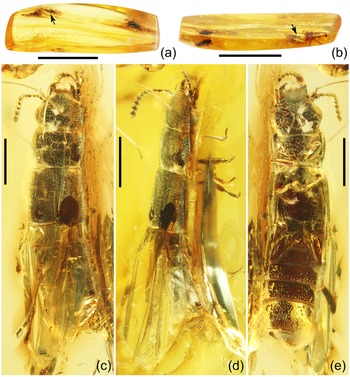
†Charhyphus serratus sp. nov., 001 DUBC, holotype: (a) amber specimen with beetle inclusions, holotype (arrow) in dorsal view; (b) amber specimen with beetle inclusions, holotype (arrow) in dorsolateral view; (c) habitus, dorsal view; (d) habitus, dorsolateral view; (e) habitus, ventral view. Scale bars = 1.0 cm (a, b); 0.5 mm (c–e).

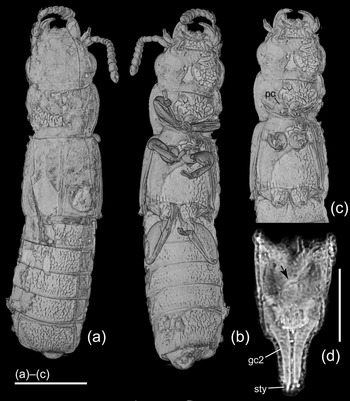
†Charhyphus serratus sp. nov., 001 DUBC, holotype, X-ray micro-CT reconstructions: (a) habitus, dorsal view; (b) habitus, ventral view; (c) forebody (without antennae and legs), ventral view; (d) abdominal terminalia with female genital segments, ventral view. Abbreviations: gc2 = gonocoxite 2; pc = procoxa; sty = stylus. Scale bars = 0.6 mm (a–c); 0.1 mm (d).

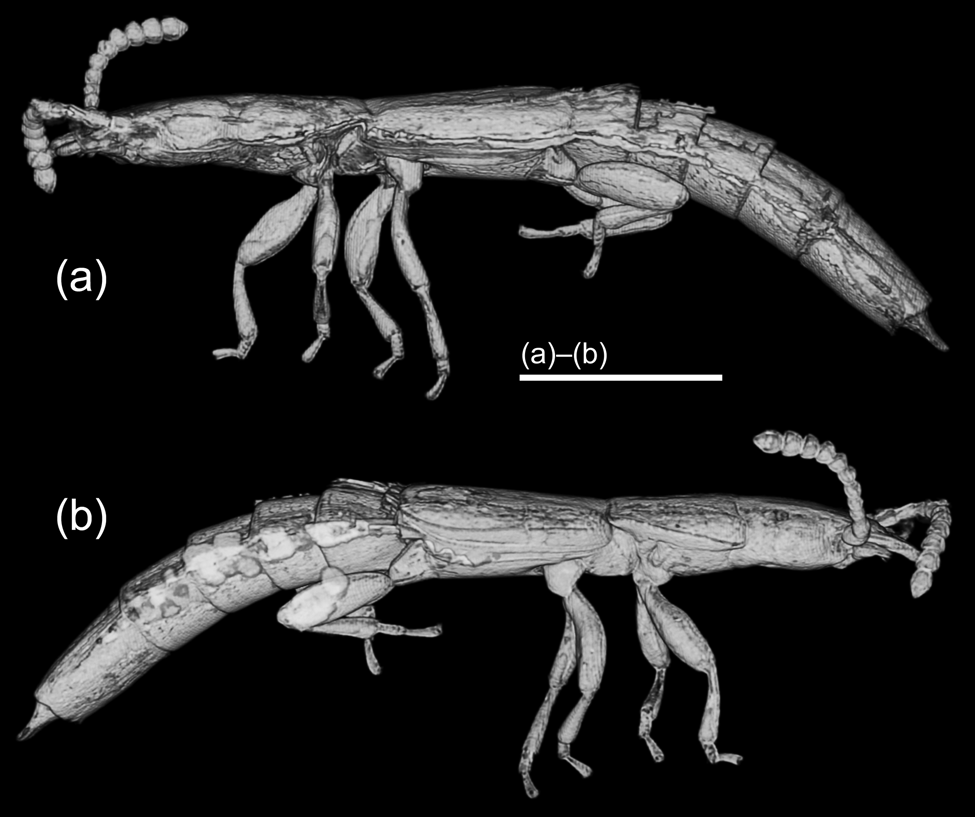
†Charhyphus serratus sp. nov., 001 DUBC, holotype, X-ray micro-CT reconstructions: (a) lateral habitus, left; (b) lateral habitus, right. Scale bar = 0.6 mm.

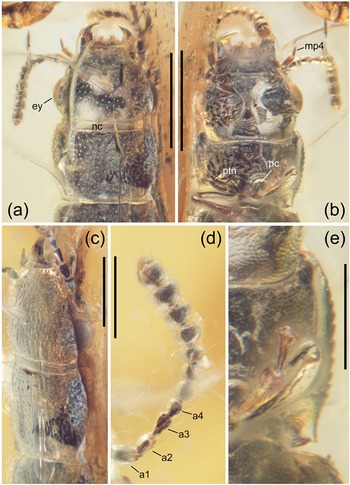
†Charhyphus serratus sp. nov., 001 DUBC, holotype, microphotographs: (a) head and pronotum, dorsal view; (b) head and pronotum, ventral view; (c) head and pronotum, dorsolateral view; (d) antenna, left; (e) pronotum and prosternum, ventral view. Abbreviations: a1–a4 = antennomeres 1–4; ey = eyes; mp4 = maxillary palpomere IV; nc = neck-like constriction; pc = procoxa; ptn = protrochantin. Scale bars = 0.5 mm (a, b); 0.3 mm (c); 0.2 mm (d, e).

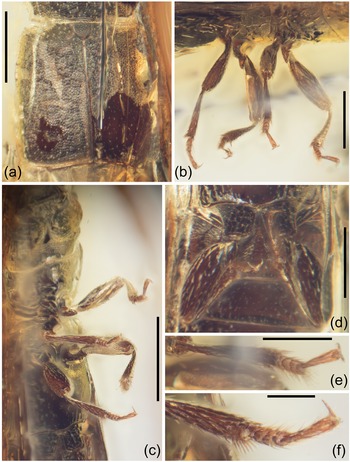
†Charhyphus serratus sp. nov., 001 DUBC, holotype, microphotographs: (a) elytra and scutellum, dorsal view; (b) thorax and legs, lateral view, right; (c) head and thorax with legs, ventrolateral view; (d) posterior part of metaventrite and hind legs; (e) protibia and protarsus, right; (f) mesotibia and mesotarsus, right. Scale bars = 0.3 mm (a, b, d); 0.5 mm (c); 0.2 mm (e); 0.1 mm (f).

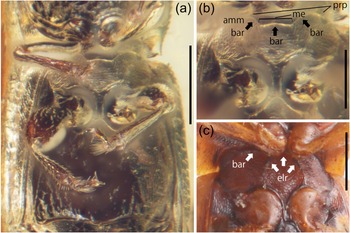
†Charhyphus serratus sp. nov., 001 DUBC, holotype, microphotographs: (a) pro-, meso-, and metathorax, ventral view; (b) metaventrite, ventral view. Charhyphus brevicollis Sharp, Reference Sharp1887, microphotographs: (c) mesoventrite. Abbreviations: amm = anterior margin of mesoventrite; bar = basal apical ridges on mesoventrite; elr = posteriorly directed elliptical ridge; me = medial emargination of the basal apical ridges on anterior margin of the mesoventrite; prp = paired rounded portions of the medioapical margin of the mesoventrite. Scale bars = 0.25 mm (a); 0.15 mm (b); 0.2 mm (c).

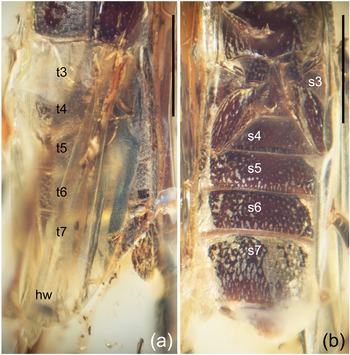
†Charhyphus serratus sp. nov., 001 DUBC, holotype, microphotographs: (a) abdomen, dorsal view; (b) abdomen, ventral view. Abbreviations: hw = hind wings; s3–s7 = sternites 3–7; t3–t7 = tergites 3–7. Scale bars = 0.5 mm.

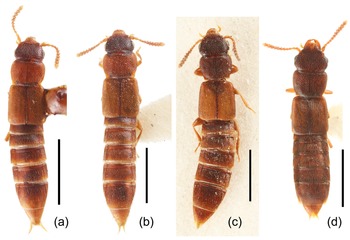
Habitus of all extant species of Charhyphus, dorsal view: (a) Charhyphus arizoniensis Herman, Reference Herman1972 (USA: Arizona, Pinaleño Mts.); (b) Charhyphus brevicollis Sharp, Reference Sharp1887 (Mexico: 19 mi south-west of Toluca); (c) Charhyphus paradoxus (Bernhauer, Reference Bernhauer1933), syntype (Russia: Vladivostok); (d) Charhyphus picipennis (LeConte, Reference LeConte1863) (USA: Massachusetts, Boxford). Scale bars = 1.0 mm.

Habitus and body parts of extant species of Charhyphus: (a) Charhyphus brevicollis, habitus, ventral view; (b) Charhyphus paradoxus, syntype, forebody, dorsal view; (c) syntype labels of C. paradoxus, associated with (b); (d) Charhyphus arizoniensis, abdominal tergite V, arrow showing small median pair of cuticular combs. Scale bars = 1.0 mm (a); 0.5 mm (b); 0.2 mm (d).

The accurate age of Baltic amber has been controversial and the subject of great debate, with a broader range of lower–upper Eocene in most modern literature (Bogri et al. Reference Bogri, Solodovnikov and Żyła2018; Bukejs et al. Reference Bukejs, Alekseev and Pollock2019). Here, we tentatively accept the Middle Eocene based on the analysis of the stratigraphy of amber-bearing Blue Earth layers in central Europe by Bukejs et al. (Reference Bukejs, Alekseev and Pollock2019). Rich and abundant staphylinid fossils have been known from Baltic amber, represented by the following 14 subfamilies, each with at least a single formally described species: Aleocharinae, Euaesthetinae, Mycetoporinae, Omaliinae, Oxyporinae, Paederinae, Phloeocharinae, Piestinae, Proteininae, Pselaphinae, Scydmaeninae, Staphylininae, Steninae, and Tachyporinae (e.g., Chatzimanolis & Engel Reference Chatzimanolis, Newton, Soriano and Engel2011; Alekseev Reference Alekseev2013). However, many undescribed rove beetle fossils in Baltic amber await further studies (Shavrin & Yamamoto Reference Shavrin and Yamamoto2019).
Morphological terminology generally follows Herman (Reference Herman1972) and Shavrin & Kairišs (Reference Shavrin and Kairišs2020). All measurements are given in millimetres. Observations were made with a stereoscopic microscope equipped with an ocular micrometre, and †Charhyphus serratus sp. nov. was further checked by Dragonfly PRO (version 2020.1) software during preparation of tomographic images; the resulting approximate values are marked with ‘~’. The type labels are cited in inverted commas and separated from each other by a comma, different lines in labels of the types are separated with the vertical line; explanations of the type labels are given in square brackets, necessary notes within the label are given in angle brackets.
The photographs (Figs 1, 6c, 8–9) were taken using a Canon EOS 80D digital camera in conjunction with a Canon MP-E 65 mm f/2.8 1–5 × macro lens and a Canon MT-24EX Macro Twin Lite Flash used as the light source. Additional figures (Figs 4–6b) were obtained using Dun Inc BK PLUS Lab System equipped with a Canon EOS 6D digital camera and a 10 × lens. During the imaging sessions, the amber specimen was completely submerged in clove oil to enhance the visibility of the beetle inclusion and to reduce extra reflection of the amber surface. The obtained images were later processed using the software Helicon Focus 7.5.4 for focus stacking. All figures were edited using Adobe Photoshop Elements 15 software.
Micro-CT observations of the specimen were conducted at the Daugavpils University, Daugavpils (Latvia) using Zeiss Xradia 510 Versa system. Scans were performed with a polychromatic X-ray beam at an energy of 30 kV and power of 2 W. Sample-detector distance was set to 43.2 mm and source to sample distance 27.6 mm. Tomographic slices were generated from 1601 rotation steps through a 360-degree rotation, using a 4 × objective, and exposure time during each projection was set to 18 s. Variable exposure was at the thickest part of the amber to achieve similar amounts of photon throughput over the whole sample. Acquired images were binned (2 × 2 × 2), giving a voxel size of 2.6 μm. Since specimen length was longer than the field of view for selected parameters, we carried out image acquisition using an automated vertical stitch function for two consecutive scans with identical scanning parameters. Between scans, field of view was set to overlap 42 % of data between adjacent fields of view. Images were imported into Dragonfly PRO (version 2020.1) software platform for interactive segmentation and three-dimensional (3D) visualisation. Prior to the full scan, a 29-min warm-up scan was conducted with identical stitch parameters but with reduced rotational steps 201, and exposure time was set to 1 s. To acquire detailed images of the apical part of the abdomen, we filtered initial data using Gaussian smoothing with a 3D kernel and standard deviation was set to 1, followed by Laplacian edge detection, which was also done with a 3D kernel.
The original figures used in this study have been deposited in the Zenodo repository (https://doi.org/10.5281/zenodo.5564635; accessed on 12 October 2021). This published work and the nomenclatural acts it contains have been registered in ZooBank, the proposed online registration system for the International Code of Zoological Nomenclature (ICZN). The ZooBank LSIDs (Life Science Identifiers) can be resolved, and the associated information viewed through any standard web browser by appending the LSID to the prefix ‘http://zoobank.org/’. The LSIDs for this publication are as follows: urn:lsid:zoobank.org:pub:065038E1-56FF-4DF4-A367-D2085C071FF6; urn:lsid:zoobank.org:act:45AA361F-62CA-47FB-8D6D-D4C62776CCD7.
3. Systematic palaeontology
Order Coleoptera Linnaeus, Reference Linnaeus1758
Family Staphylinidae Latreille, Reference Latreille1802
Subfamily Phloeocharinae Erichson, Reference Erichson1839
Genus Charhyphus Sharp, 1887
Type species
Charhyphus brevicollis Sharp, Reference Sharp1887 (original designation).
†Charhyphus serratus sp. nov. Yamamoto & Shavrin.
LSID: urn:lsid:zoobank.org:act:45AA361F-62CA-47FB-8D6D-D4C62776CCD7
(Figs 1–6b, 7, supplementary Videos 1–3 available at https://doi.org/10.1017/S1755691021000360)
Type material
Holotype: female, complete specimen in a piece of narrow, medium-sized yellow Baltic amber, 24.0 mm × 7.0 mm × 4.0 mm in size (Fig. 1a, b), deposited in DUBC.
Preservation
The body details of both dorsal and ventral surface are clearly visible except for the dorsoapical part of the right elytron obscured by an oval air bubble and most of the dorsal surface of the abdomen by the hind wings. Syninclusions: an adult of Mycetophagidae (Coleoptera) in the opposite edge of the amber and imago of Ephemeroptera with very long antennae, located very close to the specimen of Charhyphus.
Type stratum and age
Mid-Eocene (Bartonian) Baltic amber from amber-bearing Blue Earth layers (Bukejs et al. Reference Bukejs, Alekseev and Pollock2019).
Type locality
Baltic Sea coast, Yantarny mine, Sambian (Samland) Peninsula, Kaliningrad Oblast, westernmost Russia.
Description
Measurements: maximum width of head, including eyes: 0.55; length of head (from base of labrum to neck constriction along midline of head in dorsal view): 0.36; ocular length: 0.18; length × width of segments III and IV of maxillary palpi: III 0.07 × 0.05, IV 0.05 × 0.03; length of antenna: ~0.58; length of pronotum: 0.37; maximum width of pronotum: 0.56; sutural length of elytra from the apex of scutellum to the posterior margin of sutural angle: 0.44; length of elytron from basal to apical margin: 0.57; maximum width of elytra: 0.60; length of metatibia: 0.28; length of metatarsus: 0.18; maximum width of abdomen (at segment IV): 0.56; length of forebody: 1.38; total length (from anterior margin of clypeus to apex of abdomen): ~2.78.
Body long, narrowly elongate (Figs 1c, 2a), flattened (Fig. 3). Body and antennomeres dark brown; legs brown; mouthparts, tarsi, intersegmental membranes, and apical part of abdomen yellow-brown. Forebody with regular, semi-erect, short pubescence; lateral margins of pronotum with short and moderately regular setation; setation of elytra slightly denser than that on pronotum; setation of dorsal surface of abdomen invisible in detail but seems to be moderately fine, dense, and regular (ventral surface of abdomen with dense, regular, slightly elongate pubescence). Body dorsally as in Figures 1c, 2a; body ventrally as in Figures 1e, 2b; body dorsolaterally as in Figure 1d; head and pronotum dorsally as in Figure 4a; forebody ventrally as in Figure 2c; head and pronotum ventrally as in Figure 4b; head and pronotum dorsolaterally as in Figure 4c; forebody lateroventrally as in Figure 5c.
Head 1.5 times as wide as long, slightly convex in middle; vertex transverse, with moderately straight apical and widely rounded basal margins; latero-apical portion of head weakly convex in middle, gradually narrowing apicad, with lateral margin between apical angles of vertex and antennal insertion slightly concave; postocular portion short, about twice shorter than longitudinal length of eye, from basal margins of eyes gradually narrowing toward neck (Figs 1c, 2a, 4a, c). Punctation moderately sparse and fine, irregular in middle, finer on clypeus and around eyes (Figs 1c, 4a, c). Microsculpture of dorsal surface dense, isodiametric, finer in apical portion, somewhat oval in middle (Fig. 4a, c); microsculpture of ventral surface transverse in middle and moderately large and isodiametric on laterobasal portions (Fig. 4b). Eyes medium-sized, relatively convex (Figs 1c, 4a–c, ey). Labrum wide, distinctly protruding anteriad, with widely concave apical portion and long latero-apical setae. Mandibles strong, wide, each with narrow, elongate, and curved apical portions with very acute apices, left mandible with indistinct smooth tooth at about middle (Figs 1c, e, 2a–c, 4a, b). Mentum and labium wide; two widely and deeply concave medioapical lobes of hypopharynx wide, strongly protruding anteriad, with truncate apices; preapical labial palpomeres moderately wide and transverse, apical segments narrow, about as long as preapical segment (Figs 2b–c, 4b). Preapical segment of maxillary palpus wide, about 1.4 times as long as wide; apical maxillary palpomere distinctly shorter than preceding segment, narrow, 1.6 times as long as wide, from basal portion gradually narrowed apicad toward rounded apex (Figs 2a–c, 4a–c). Gular sutures with widely rounded apical parts, gradually and widely diverging posteriad; shortest, very narrow distance between sutures located at level of posterior third of eyes (Figs 1e, 2b, c, 4b, 5c). Head with clear neck-like constriction, distinct all around, moderately distant from posterior margins of eyes (Figs 2a, 4a, c, nc); neck without visible punctation, covered by dense isodiametric microsculpture, more oval than that in middle portion of head (Figs 1c, 2a, 4a). Antenna moderately short, reaching about anterior third of pronotum, with antennomeres 5–10 progressively widened apicad; antennomeres 4–11 densely covered by short pubescence with additional long latero-apical setae; basal antennomere moderately wide, about twice as long as wide, antennomere 2 distinctly narrower, about 1.6 times as long as antennal scape, antennomere 3 with narrow basal portion, gradually widened apically, about as long as and slightly narrower than antennomere 2, antennomere 4 small, with narrow basal portion, markedly widened apically, longer than wide, shorter and narrower than antennomere 3, antennomere 5 short (indistinctly seen in detail), slightly wider than antennomere 4, antennomere 6 more transverse than antennomere 5, about 1.4 times as wide as long, antennomeres 7 and 8 transverse, distinctly wider than antennomere 6, antennomere 9 transverse, slightly less than twice as wide as long and markedly wider than antennomere 8, antennomere 10 about as wide as long, slightly longer than antennomere 9, apical antennomere slightly longer than antennomere 10, from apical third sharply narrowed toward subacute apex (Fig. 4d).
Pronotum transverse, 1.5 times as wide as long, about as wide as head, widest in anterior third, from about middle gradually narrowing toward subacute posterior angles (Fig. 4a), with basolateral margins slightly sinuate (Fig. 4b, e); laterobasal portions indistinctly impressed (Fig. 4a); anterior angles rounded, slightly protruding anteriad (Figs 1c, 2a, 4a); apical margin somewhat straight, slightly shorter than posterior margin (Figs 2a, 4a); lateral portions narrowly flattened, with almost entire lateral margin irregularly serrate, the teeth indistinct in basolateral and latero-apical portions, more or less progressively and regularly increasing in size lateromedially, with slightly flattened apices directed apically (Fig. 4a). Punctation moderately dense, slightly finer than that on middle portion of head, sparser in middle portion (Figs 1c, d, 4a, c). Medioapical margin of ventral part of prothorax widely rounded, with short, rounded intercoxal process, reaching about middle of procoxae (Figs 1e, 2b, c, 4b). Mesoventrite narrow, transverse, apical margin, with very wide, rounded pair of portions along medioapical margin (Figs 2c, 6a, b, prp); basal apical ridges (Fig. 6b, bar) on anterior margin of mesoventrite (Fig. 6b, amm), strongly protruding anteriad laterally, separated by widely and deeply emarginate medial margin (Fig. 6b, me), resulting in lack of any modification (e.g., elliptical ridge) on surface; mesoventrite with very long and moderately wide intercoxal process reaching basal portion of mesocoxae (Figs 1e, 2b, c, 4b). Scutellum large, subtriangular, with rounded apical margin, without punctation, covered with dense, transverse microreticulation (Figs 1c, 4a, c). Metaventrite elongate, with wide and deep intercoxal cavities and moderately short, widely rounded intercoxal process apically reaching mesosternal process (Figs 1e, 2b, c, 4b, 5d, 6a); surface smooth without longitudinal furrow near posteromedial margin (cf. Fig. 9a).
Elytra subparallel, moderately short, somewhat wider than long, and slightly longer than pronotum, almost reaching apical margin of abdominal tergite III; hind margins of each elytron slightly truncate toward suture (Figs 1c, 2a, 5a). Punctation moderately sparse, somewhat finer than on pronotum (Figs 1c, 5a). Hind wings fully developed (Figs 1c, d, 7a, hw).
Legs short, covered by moderately long pubescence, with femora very wide in middle (Figs 1d, 2b, 3a, b, 5b, c); procoxal fissure open, with well-exposed protrochantin (Figs 4b, 6a, ptn); apical tarsomeres of all legs distinctly longer than previous four segments; tarsomeres 1–4 with very long lateroapical setae; protarsomeres 1–4 transverse, each segment twice as wide as long; meso- and metatarsomeres 1–4 less transverse than those of protarsi (Figs 1e, f, 5b, c).
Abdomen slightly narrower than elytra, very long, more or less parallel-sided, indistinctly widened toward tergite VI and insignificantly narrowing apically (Figs 1c, 2a, 3a, b, 7a). Abdominal tergites with fine and sparse punctation, presence/absence of small median pair of cuticular combs on tergites IV and V (cf. Fig. 9d, arrow) not observable. Ventral part of abdomen as in Figure 7b.
Male
Unknown.
Female
Apical margins of abdominal tergite VIII (Fig. 2a) and sternite VIII (Fig. 2b) rounded. Genital segment with very long gonocoxite 2 (Fig. 2d, gc2), gradually narrowing apically and bearing a short stylus (Fig. 2d, sty), each with a short apical seta; middle portion of genital segment with round structure (Fig. 2d, arrow).
Etymology
The specific epithet is the Latin adjective serratus, -a, -um (serrated, toothed like a saw). It alludes to the strongly serrate lateral edges of the pronotum.
Differential diagnosis
†Charhyphus serratus sp. nov. differs from the other species of the genus by the darker body, the presence of strong serration on lateral edges of the pronotum (Fig. 4e), and the shape of the basal apical ridges on anterior margin of the mesoventrite (Fig. 6b, bar) with very deep medial emargination (Fig. 6b, me). Based on the general proportions of the body and shape of the temples which gradually narrow toward neck, it is similar to †Charhyphus balticus recently described from Baltic amber, from which it can be distinguished by its slightly larger body and eyes, less transverse antennomeres 7–10, narrower distance between gular sutures, finer punctation of the shorter pronotum, structures of the basal apical ridges on the mesoventrite, denser and finer punctation of the elytra, narrower and longer metaventrite, and longer apical segments of tarsi.
Remarks
This new species can unambiguously be assigned to the phloeocharine genus Charhyphus based on the distinctly flattened body, structure of the neck-like constriction of the head, crenulate pronotal margins, epipleural keel on elytron, short legs with a 5–5–5 tarsal formula, and other morphological characteristics including those of the maxillary palpi and mesoventrite (Herman Reference Herman1972; Newton et al. Reference Newton, Thayer, Ashe, Chandler, Arnett and Thomas2000; Brunke et al. Reference Brunke, Newton, Klimaszewski, Majka and Marshall2011). There are four extant Charhyphus species in the fauna of the world, with three species known from North and Central America and one from the Russian Far East (Herman Reference Herman2001):
1) Charhyphus arizoniensis Herman, Reference Herman1972 (Figs 8a, 9d). The species was originally described from ‘Arizona: Cochise County Chiricahua Mountains: northwest slope of Barfoot Peak, 8250 feet’ (Herman Reference Herman1972). Habitats: specimens were collected under the bark of pine logs.
2) Charhyphus brevicollis Sharp, Reference Sharp1887 (Figs 8b, 9a). The species was originally described form ‘Guatemala, Totonicapam 8500 to 10,500 feet’ (Sharp Reference Sharp1887). It was redescribed by Herman (Reference Herman1972), including a new record from Mexico. The male is unknown (Herman Reference Herman1972). Habitats: the holotype of C. brevicollis was collected under the bark of a pine (Sharp Reference Sharp1887).
3) Charhyphus paradoxus (Bernhauer, Reference Bernhauer1933) (Figs 8c, 9b). The species was originally described as Chapmania from ‘Ostsibirien: Ussuri, Wladiwostok [ = Vladivostok, Khabarovsk Territory, Far Eastern Russia]’ (Bernhauer Reference Bernhauer1933) and redescribed by Herman (Reference Herman1972). Coiffait (Reference Coiffait1974) recorded the unsexed specimen from Ussuriysk, Maritime Province, Russia. The male of C. paradoxus and details of the ecology are unknown.
4) Charhyphus picipennis (LeConte, Reference LeConte1863) (Fig. 8d). The species was originally described as Hypotelus from ‘Middle States and Kansas’ and redescribed by Herman (Reference Herman1972). Notably, C. picipennis is a widely distributed species in eastern Canada and USA (e.g., Herman Reference Herman1972, Reference Herman2001). Habitats: specimens of C. picipennis were found from logs and under bark of trees (e.g., Quercus, Ulmus, Betula, or Abies) in various types of deciduous or mixed forests (Brunke et al. Reference Brunke, Newton, Klimaszewski, Majka and Marshall2011; Webster et al. Reference Webster, Sweeney and DeMerchant2012).
An extinct species, †Charhyphus balticus Shavrin, Reference Shavrin2020 in Shavrin & Kairišs (Reference Shavrin and Kairišs2020) was recently described based on a single male adult from Eocene Baltic amber.
All extant species are pale (Fig. 8) and the main interspecific differences are related to punctation of head and pronotum, shape of apical part of the head and relations of length of eyes and temples (see Herman Reference Herman1972, figs 1–4), and shape of the anterior margin of the mesoventrite (Herman Reference Herman1972, figs 18, 19) and apical angles of the pronotum. The male aedeagus is known only for three species (Charhyphus arizonensis, C. picipennis, and †C. balticus). It has an elongate median lobe and long, thin parameres not or slightly exceeding apex of the median lobe, with a row of relatively short setae along inner edge (Herman Reference Herman1972, figs 23–25). Details of the external structure of the aedeagus in males are unknown. Both extinct species have darker colouration of the body (although it could be considered as an artefact of the fossilisation processes), and finer and sparser punctation of the head, which is gradually narrowed toward neck from basal margin of eyes. In general, the shape of the male aedeagus of †C. balticus (Shavrin & Kairišs Reference Shavrin and Kairišs2020, figs 3J–l) is similar to those of extant species. Based on the shape of the fine and irregular serration of the lateral edges of the pronotum, †C. balticus is also more similar to extant species. In contrast, †Charhyphus serratus sp. nov. has more developed and distinctly larger teeth along lateral edge of the pronotum (Fig. 4e). Additionally, it has a characteristic shape of the medioapical margin of the mesoventrite with paired widely rounded basal apical ridges, strongly protruding anteriad, and a very deep medial emargination between them (Figs 2b, c, 4b, 6a, b), which distinguishes it from other known species of the genus. The medioapical portion of the mesoventrite of extant species is located at about the same level, with paired rounded portions (see Herman Reference Herman1972, figs 18, 19). The elliptical ridge (see Herman Reference Herman1972, fig. 19) on the median portion of the base of the mesoventrite in †C. serratus sp. nov. is missing. In turn, this portion of the mesoventrite in the specimen of †C. balticus is poorly visible within the darker amber, but seems to lack both a deep emargination between paired rounded parts on the medioapical margin and elliptical ridges.
4. Key to all extinct and extant species of Charhyphus
The key below is significantly modified from that provided for extant Charhyphus species by Herman (Reference Herman1972).
1. Punctation of head fine and sparse. Extinct species, Eocene Baltic amber……………………………………… 2
-
–. Punctation of head large and dense. Extant species……………………………………………………………… 3
-
2. Lateral edges of pronotum with strong serration (Fig. 4e). Anterior margin of mesoventrite with very deep medial emargination (Figs 4b, 6a, b, me) along basal apical ridges on mesoventrite (Figs 4b, 6a, b, bar). Punctation of pronotum and elytra fine. Body length: 2.78 mm. Habitus as in Figures 1c, 2a…………………… …………………………………………………………………………………………………†C. serratus sp. nov.
-
–. Lateral edges of pronotum slightly serrate. Apical margin of mesoventrite without emargination along basal apical ridges on mesoventrite. Punctation of pronotum and elytra markedly large and deep. Aedeagus as in figure 3J in Shavrin & Kairišs (Reference Shavrin and Kairišs2020). Body length: 2.35 mm. Habitus as in figures 1C, 2A in Shavrin & Kairišs (Reference Shavrin and Kairišs2020)………………………………………………………………………………………………… †C. balticus
-
3. Medioapical portion of mesoventrite without basal elliptical ridge (Herman Reference Herman1972, fig. 18)…………………… 5
-
–. Medioapical portion of mesoventrite with elliptical ridge on base (Fig. 6c; Herman Reference Herman1972, fig. 19)…………… 6
-
5. Antennomere 8 narrow, about as wide as long. Male aedeagus as in figure 25 in Herman (Reference Herman1972). Body length: 2.7–3.9 mm. Habitus as in Figure 8d. Distribution: Canada, USA………………………………… C. picipennis
-
–. Antennomere 8 distinctly transverse, wider than long. Body length: 3.5–3.7 mm. Habitus as in Figure 8c. Distribution: Far Eastern Russia…………………………………………………………………… C. paradoxus
-
6. Anterior angles of pronotum subacute. Punctation of pronotum large, deep and dense (Herman Reference Herman1972, fig. 4). Body length: 3.5–3.9 mm. Habitus as in Figure 8b. Distribution: Mexico, Guatemala…………… C. brevicollis
-
–. Anterior angles of pronotum widely rounded. Punctation of pronotum fine and shallow (Herman, Reference Herman1972, fig. 3). Male aedeagus as in figure 24 of Herman (Reference Herman1972). Body length: 2.8–3.3 mm. Habitus as in Figure 8a. Distribution: USA………………………………………………………………………………… C. arizoniensis
-
5. Discussion
Prior to our study, only two definitive fossil taxa of the subfamily Phloeocharinae had been described. The oldest phloeocharine fossil is known from Upper Cretaceous (Turonian) New Jersey amber from the USA, suggesting a long-term morphological stasis of the extant genus Phloeocharis (Chatzimanolis et al. Reference Chatzimanolis and Engel2013). Another recently described fossil represents the sole extinct species of Charhyphus from Eocene Baltic amber based on a single adult male (Shavrin & Kairišs Reference Shavrin and Kairišs2020). Our discovery of a new extinct Charhyphus species with the first female fossil from the same amber deposit is significant for considering a possible higher palaeodiversity, more common occurrence, and palaeobiogeography of Charhyphus in the Eocene. Interestingly, no extant Charhyphus species has a distribution which overlaps with another species in the genus (see Shavrin & Kairišs Reference Shavrin and Kairišs2020, fig. 1E). For example, the most commonly found species, Charhyphus picipennis, is restricted to the north-eastern part of the USA and its adjacent areas in Canada, whereas the other two species in North America have only been known from Arizona (Charhyphus arizoniensis) or south-western Mexico and Guatemala (Charhyphus brevicollis). No distributional detail is known for an undescribed species mentioned in Newton et al. (Reference Newton, Thayer, Ashe, Chandler, Arnett and Thomas2000) in the latter region. The sole extant Palearctic species, Charhyphus paradoxus, has been known only from Vladivostok and Maritime Province (Far Eastern Russia) until now (Bernhauer Reference Bernhauer1933; Coiffait Reference Coiffait1974). Thus, the finding of †Charhyphus serratus sp. nov. from Baltic amber demonstrates the co-occurrence of two Charhyphus species in the same locality, a case of overlapping distribution found in the genus for the first time. Since there are no extant Charhyphus species found from the entire European region, our discovery suggests hidden palaeodiversity of the genus in Europe and even the west Palaearctic region. According to Alekseev (Reference Alekseev2017), 33 genera of fossil Coleoptera described from Baltic amber are known both from the Palaearctic and Nearctic Regions. Some of these genera have a wide disjunction in the Palaearctic Region between Europe and the Far East (e.g., Microbregma Seidlitz, Ptinidae: see distributional map in Alekseev Reference Alekseev2017, fig. 29). It can be postulated that some extant species survived in high biodiversity refugia in East Asia as determined by climatic factors following glaciations (in our case, possibly C. paradoxus). These beetles may be rather easily trapped in tree resin based on a presumably subcortical lifestyle of Charhyphus as inferred by its probable adaptative morphological features, particularly the dorsoventrally flattened body (Fig. 3; Shavrin & Kairišs Reference Shavrin and Kairišs2020, figs 2C, D) and the globular procoxae (Figs 2c, 4b, 6a, b, pc; Shavrin & Kairišs Reference Shavrin and Kairišs2020, fig. 2B), with potentially a higher flight activity. Thus, it is probable that more Charhyphus beetles will be found from Eocene European amber. Such discoveries will probably be made mainly from Baltic amber but with some possibility of potential discovery from Bitterfeld and Rovno ambers in the future.
Recently, non-destructive techniques have been used more frequently to examine amber inclusions based on 3D reconstructions (Penney Reference Penney2016). The recent advancement of μ-CT and propagation phase-contrast X-ray synchrotron imaging has opened new windows for achieving high-quality reconstructions and individual X-ray sliced images for amber beetles (e.g., Chatzimanolis et al. Reference Chatzimanolis and Engel2013; Zanetti et al. Reference Zanetti, Perreau and Solodovnikov2016; Jałoszyński et al. Reference Jałoszyński, Brunke, Yamamoto and Takahashi2018, Reference Jałoszyński, Luo, Hammel, Yamamoto and Beutel2020; Bukejs et al. Reference Bukejs, Bezděk, Alekseev, Kairišs and McKellar2020a, Reference Bukejs, Reid and Biondib; Shavrin & Kairišs Reference Shavrin and Kairišs2020, Reference Shavrin and Kairišs2021; Alekseev et al. Reference Alekseev, Mitchell, McKellar, Barbi, Larsson and Bukejs2021; Perreau et al. Reference Perreau, Haelewaters and Tafforeau2021; Schmidt et al. Reference Schmidt, Scholz and Maddison2021). They are useful in excluding extra bubble layers surrounding the surfaces of inclusions (e.g., Yamamoto & Maruyama Reference Yamamoto and Maruyama2018; Kundrata et al. Reference Kundrata, Bukejs, Prosvirov and Hoffmannova2020; Kypke & Solodovnikov Reference Kypke and Solodovnikov2020; Shavrin & Yamamoto Reference Shavrin and Yamamoto2020) and in removing certain extra body parts from reconstructions (e.g., Perreau & Tafforeau Reference Perreau and Tafforeau2011; Bukejs et al. Reference Bukejs, Bezděk, Alekseev, Kairišs and McKellar2020a, Reference Bukejs, Reid and Biondib). Our attempt to visualise the holotype of †Charhyphus serratus sp. nov. using the X-ray μ-CT recovered remarkably good results. In fact, not only the chitinised external body parts but also some internal structures of the female genitalia were successfully reconstructed (Figs 2, 3; supplementary Videos 1–3). Compared to generally well-chitinised male genitalia, the female genital morphology in Coleoptera has rarely been extracted from amber fossils, likely due to fossil preservation and insufficient sclerotisation for scans, though, notably, Brunke et al. (Reference Brunke, Żyła, Yamamoto and Solodovnikov2019) successfully reconstructed the female genital segments of a Staphylininae rove beetle in Baltic amber. Of note, our reconstruction shows an enigmatic rounded structure in the middle of the female abdominal segment (Fig. 2d, arrow), which resembles the female accessory sclerite of some phylogenetically unrelated Omaliini McLeay (e.g., Shavrin Reference Shavrin2020). The so-called ‘ring structure’, possibly derived from sternum X and apparently homologous to similar female structures in the omaliines, is also known in some genera of Oxytelinae (Makranczy Reference Makranczy2006). In contrast, analogous structures have not been described for the extant species of Charhyphus (see Herman Reference Herman1972). It is still unclear if this ‘ring structure’ is important for elucidating the phylogenetic hypothesis of the genus within Staphylinidae pending a thorough investigation for exploring such structures in the related staphylinid subfamilies.
6. Data availability
All fossil material included in the paper is deposited either in the Institute of Life Sciences and Technologies, Daugavpils University (Daugavpils, Latvia (DUBC); the holotype of †Charhyphus serratus sp. nov.) or the private collection of Vitalii I. Alekseev (Kaliningrad, Russia); the latter will subsequently be deposited in the collection of the Borissiak Paleontological Institute of the Russian Academy of Sciences (Moscow, Russia; the holotype of †Charhyphus balticus). All specimens of the extant Charhyphus species are housed in the Gantz Family Collections Center, Field Museum of Natural History (Chicago, Illinois, USA). All data are included in the description and its associated supplementary material. Supplementary videos of X-ray micro-CT volume renderings of †C. serratus sp. nov. are available through the Zenodo repository (https://doi.org/10.5281/zenodo.5564635).
7. Acknowledgements
We thank Alyssa L. Suzumura (The Hokkaido University Museum, Sapporo, Japan) for the English revision. We are also grateful to two anonymous reviewers and the editors for their helpful comments and suggestions to an earlier version of this manuscript. This research was supported by the Grant-in-Aid for JSPS Fellows given to S.Y. (20J00159) from the Japan Society for the Promotion of Science (JSPS), Tokyo, Japan.