INTRODUCTION
Invasive species may exert strong effects on structure and function of marine ecosystems (Ruiz et al., Reference Ruiz, Carlton and Grosholz1997; Reise et al., Reference Reise, Olenin and Thieltges2006). Invaders can alter ecosystem processes such as primary productivity (Fahnenstiel et al., Reference Fahnenstiel, Lang, Nalepa and Johengen1995), decomposition (Hahn, Reference Hahn2003), hydrology (Darrigran, Reference Darrigran2002), geomorphology (Schwindt et al., Reference Schwindt, Iribarne and Isla2004), nutrient cycling and disturbance regimes (Mack & D'Antonio, Reference Mack and D'Antonio1998; Schindler et al., Reference Schindler, Knapp and Leavitt2001). Also, they can affect the trophic web by competing with native species for resources such as food (Byers, Reference Byers2000) or space (Brown & Moyle, Reference Brown and Moyle1991). The introduction and establishment of invasive filter-feeder species in marine coastal ecosystems have been well documented and have indicated remarkable shifts in the food web structure of pelagic communities (e.g. Chauvand et al., Reference Chauvand, Ragueneau and Thouseau2000; Sommer & Sommer, Reference Sommer and Sommer2006; Lonsdale et al., Reference Lonsdale, Cerrato, Caron and Schaffner2007). Therefore, the impacts of invasive filter-feeders on marine coastal ecosystems are high and their effects should be evaluated.
The main direct effect of benthic filter-feeders in several ecosystems (e.g. rivers, estuaries, lakes) is a decrease of phytoplankton biomass (Dolmer, Reference Dolmer2000; Riisgaard et al., Reference Riisgaard, Seerup, Jensen, Glob and Larsen2004) and a consequent increase in water clarity (Davies et al., Reference Davies, Stuart and de Villiers1989; Nelson et al., Reference Nelson, Leonard, Posey, Alphin and Mallin2004). Also, several studies have shown that certain filter-feeders can affect the pelagic food web and reduce zooplankton abundance (e.g. ascidians: Bingham & Walters, Reference Bingham and Walters1989; bivalves: Davenport et al., Reference Davenport, Smith and Packer2000; Descy et al., Reference Descy, Everbecq, Gosselain, Viroux and Smitz2003) and species composition (Kimmerer et al., Reference Kimmerer, Gartside and Orsi1994). This effect takes place through direct predation on zooplankton (normally small zooplankton; MacIsaac et al., Reference MacIsaac, Lonee and Leach1995; Davenport et al., Reference Davenport, Smith and Packer2000; Idrisi et al., Reference Idrisi, Mills, Rudstam and Stewart2001) or early life stages (eggs, nauplii; Lonsdale et al., Reference Lonsdale, Cerrato, Caron and Schaffner2007), and indirect mechanisms such as depletion of food resources by grazing on phytoplankton (MacIsaac, Reference MacIsaac1996), or both factors acting at the same time (see Jack & Thorp, Reference Jack and Thorp2000).
Abiotic factors (e.g. salinity, temperature, turbidity) are important in structuring zooplankton communities in lentic environments (e.g. Soetaert & Van Rijswijk, Reference Soetaert and Van Rijswijk1993; Elliott & Kaufmann, Reference Elliott and Kaufmann2007) but the trophic interactions may play an important role in the control of zooplankton assemblages (e.g. Laprise & Dodson, Reference Laprise and Dodson1994). However, the effect of primary consumers such as filter-feeders on the zooplankton community is scarcely documented (e.g. MacIsaac et al., Reference MacIsaac, Lonee and Leach1995; Lonsdale et al., Reference Lonsdale, Cerrato, Caron and Schaffner2007).
The reef-forming polychaete Ficopomatus enigmaticus (Fauvel, 1923) was possibly introduced to Argentina from Australia (Allen, Reference Allen1953) as a fouling species (Rioja, Reference Rioja1943). It has successfully invaded estuaries and confined coastal ecosystems of the world (e.g. South Africa, Davies et al, Reference Davies, Stuart and de Villiers1989; Spain: Fornós et al., Reference Fornós, Corteza and Martínez-Taverner1997; USA: Jewett et al., Reference Jewett, Hines and Ruiz2005; Italy: Bianchi & Morri, Reference Bianchi and Morri2001; England: Dixon, Reference Dixon1981; New Zealand: Read & Gordon, Reference Read and Gordon1991; Argentina: Schwindt et al., Reference Schwindt, Bortolus and Iribarne2001; Uruguay: Muniz et al., Reference Muniz, Clemente and Brugnoli2005).
Ficopomatus enigmaticus is the main benthic filter-feeder of the Mar Chiquita coastal lagoon (37°40′S 57°23′W) located in the south-west Atlantic coast of Argentina. This serpulid polychaete is a non-indigenous species (Orensanz & Estivariz, Reference Orensanz and Estivariz1972) and one of the main direct effects of this invasive polychaete on the water column is its impact on the phytoplankton biomass and subsequent increase in clarity of the lagoon water (Bruschetti et al., Reference Bruschetti, Fanjul, Rosenthal, Luppi and Iribarne2008). The effects of these filter-feeders have consequences on the resource availability (e.g. increase of the light penetration into the water column) and therefore they can be considered to be ecosystem engineers (e.g. Schwindt et al., Reference Schwindt, Bortolus and Iribarne2001; Sousa et al, Reference Sousa, Gutierrez and Aldridge2009). Probably, this invasive polychaete can control the overall estuarine primary production of this lagoon as well as the sources of carbon to higher trophic levels (see Bruschetti et al., Reference Bruschetti, Fanjul, Rosenthal, Luppi and Iribarne2008; Pan & Marcoval, Reference Pan and Marcoval2014). Also, F. enigmaticus generates faeces and pseudo-faeces that can enrich the sediment closer to reefs, and consequently augment flux of nutrients from the sediment to the water column, increasing the benthic-pelagic coupling (Bruschetti et al., Reference Bruschetti, Bazterrica, Fanjul, Luppi and Iribarne2011). Moreover, the increase in spatial heterogeneity by this biogenic structure increased the abundance of refuges for the macrofauna (e.g. crabs; Luppi & Bas, Reference Luppi and Bas2002; Méndez Casariego et al., Reference Méndez Casariego, Schwindt and Iribarne2004), possibly modifying ecological interactions of the different species that inhabit the benthos of the lagoon. For example, the reefs provide a three-dimensional substrate for settlement and survival of the red algae Polysiphonia subtilissima, and consequently change the relative biomass contribution of the macroalgae species to the overall production in the lagoon (Bazterrica et al., Reference Bazterrica, Botto and Iribarne2012). Reef structure not only generates a strong impact on the sedimentary dynamic of the lagoon by changing the flow of water (Schwindt et al., Reference Schwindt, Bortolus and Iribarne2001) but also impacts on the habitat use by shorebirds that prefer these structures as resting and feeding areas (Bruschetti et al., Reference Bruschetti, Bazterrica, Luppi and Iribarne2009). Also, the effect of F. enigmaticus on phytoplankton biomass is important to counteract some effects of eutrophication (see Bruschetti et al., Reference Bruschetti, Fanjul, Rosenthal, Luppi and Iribarne2008), but the changes in pelagic food web structure are complex and difficult to predict. Possibly, the impact of F. enigmaticus has cascading effects on other trophic levels of the food web (e.g. zooplankton). Therefore the aim of our work was to evaluate the effect of this polychaete on the zooplankton assemblage in the Mar Chiquita coastal lagoon. We hypothesized that grazing impact of the invasive polychaete F. enigmaticus can directly and/or indirectly affect the abundance and structure of zooplankton assemblage.
MATERIALS AND METHODS
Study area
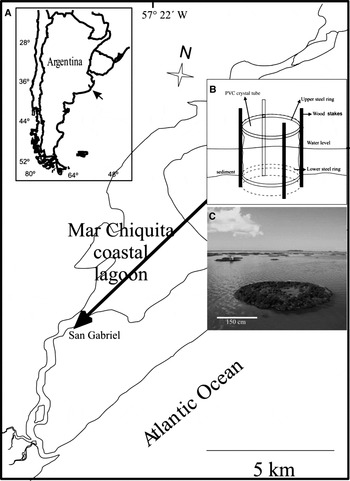
The study was performed at the Mar Chiquita Coastal Lagoon (a UNESCO Man and the Biosphere Reserve; Figure 1A), during spring of 2005, summer of 2006 and winter of 2006. This is a body of brackish water (46 km2) of low tidal amplitude (~1 m) permanently connected to the sea (Reta et al., Reference Reta, Martos, Perillo, Piccolo, Ferrante and Iribarne2001). The lagoon may be divided into an innermost shallow zone where the tidal effect is low and with high freshwater influx, and an estuarine zone subjected to tidal action (amplitude < 1 m, Fasano et al., Reference Fasano, Hernández, Isla and Schnack1982). Wind and local rain control variations in water level within the lagoon but not in areas closer to the mouth. The tidal wave enters the lagoon inlet and its strength decreases as it gets far from the inlet, reaching the study site (named San Gabriel; Lanfredi et al., Reference Lanfredi, Balestrini, Mazio and Schmidt1987; see Figure 1A). The reefs of Ficopomatus enigmaticus occupy 86% of the surface at the innermost zone of the lagoon, reaching up to 370 reefs ha−1 (mean density = 89 reefs ha−1) and 7 m in diameter (average diameter = 3.7 m; see Schwindt et al., Reference Schwindt, Iribarne and Isla2004; Figure 1C).
(A) Map of Mar Chiquita lagoon (Buenos Aires, Argentina) showing the site of sampling and experiments. (B) Schematic drawing of a mesocosm. (C) Photo of the reefs of F. enigmaticus in Mar Chiquita lagoon.

The main study site where we performed the experiments was located in the central part of the lagoon (San Gabriel), about 6 km from the lagoon inlet.
Experimental setup
In situ experimental mesocosms were used to evaluate the potential impact of the polychaete F. enigmaticus on zooplankton assemblage in the Mar Chiquita coastal lagoon. Mesocosms have been used successfully in other similar studies (fresh waters: Jack & Thorp, Reference Jack and Thorp2000; estuaries: Bruschetti et al., Reference Bruschetti, Fanjul, Rosenthal, Luppi and Iribarne2008), permitting the evaluation of biological interactions under relatively realistic in situ conditions.
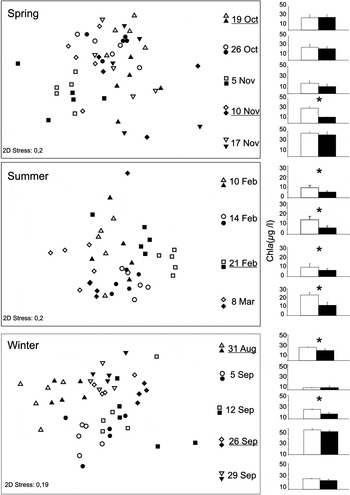
The experiment ran for 30 days in spring of 2005, 27 days in summer of 2006 and 30 days in winter of 2006. The samples were obtained on five different days in spring (19 and 26 October, 5, 10 and 17 November; Figure 2A), four days in summer (10, 14, 21 February and 8 March; Figure 2B), and five days in winter (31 August and 5, 12, 26 and 29 September; Figure 2C). The mesocosms (N = 10) were mounted and disassembled at the end of each period during the three seasons. It were made in transparent PVC crystal (500 µm thickness, 95% translucence; dimensions: 1 m diameter and 1.2 m height; see Figure 1B), and were open to the sediment and atmosphere. The enclosures were located in a zone where F. enigmaticus reefs naturally occur. The upper open end was attached to a steel ring with plastic seals and was kept at about 40 cm above the maximum tidal level. The open lower border was also attached to a steel ring and buried 30 cm into the sediment.
Results of non-metric multidimensional scaling (NMDS) determining patterns of composition of zooplankton among treatments in experiment of mesocosms with reefs (filled symbols) and without reefs (open symbols) during spring of 2005 (A), summer of 2006 (B) and winter of 2006 (C). The bar graphs show the concentration of chlorophyll a (μg L−1) between treatments with reefs (black bars) and without reefs (white bars) in the mesocosms during the sampling days. Asterisks and underlined dates indicate differences between treatments.

The mesocosms were randomly located 20 m from the coastline and attached to four stakes (2 m) buried 50 cm into the sediment. There were two treatments: (1) without reef (hereafter ‘no-reef treatment’), in which there was no reef addition and (2) reef (hereafter ‘reef treatment’), in which we added reef fragments with live polychaetes. Three equally sized reef fragments (0.4 × 0.4 m, 0.3 m height) were included in each replicate.
The initial physical (i.e. temperature, salinity, turbidity etc.) and biological (phytoplankton and zooplankton) parameters were assumed to be equal because the mesocosms were mounted in the same place and time. Also, we were able to install all mesocosms simultaneously and therefore the starting conditions were similar. Since the evaluation of the number of live polychaetes in each mesocosm is a destructive method, we have assumed that similar sizes of reefs have similar numbers of live polychaetes (i.e. we have included similar sizes of reefs in the mesocosms and therefore we have assumed that each mesocosm has a similar number of live polychaetes). However, in order to elucidate the number of live polychaetes in the reefs, samples outside the mesocosms (N = 10) were obtained, and all live polychaetes were counted. The density of live polychaetes of F. enigmaticus in the reefs was 34,644.7 worms m−3 of reef (SD = 17,526). Although the abundance of polychaetes showed a large variability, these data represent the variability found in the lagoon and consequently in the mesocosms. Considering that all reef fragments used in the experiment have approximately the same size, the average initial number of worms was approximately 1663 (SD = 841). The area of the sediment occupied by the reefs in the mesocosms was similar to the area occupied by the reefs in medium density zones of the lagoon (approximately 60%; data unpublished) and lower than in high density zones (86%, see Schwindt et al., Reference Schwindt, Iribarne and Isla2004).
A treatment consisting of reefs without worms to control the hydrodynamic effects (e.g. sedimentation) was not included in this work because water flow was expected to be negligible inside mesocosms. The height of the water column inside the mesocosms was always equal to the surrounding water. The mesocosms were not sealed during the experimentation. Therefore, the water of the mesocosms was partially renewed every day because there was water exchange through the bottom of the sediment of the enclosures.
To assess the effect of F. enigmaticus on the zooplankton assemblage, 40 L of water were obtained in each sampling day from mid depth (35 cm approximately) inside the mesocosms with a Van Dorn bottle and filtered through a 62 µm plankton net. The plankton net was conical in shape and consisted of a rigid ring (diameter = 20 cm), with a collecting bucket (volume = 100 mL) to take in organisms. The zooplankton obtained was fixed in 4% formalin solution for later analysis. For identification of the organisms, the samples were examined under a binocular microscope. The zooplankton were quantified in a Bogorov counting chamber of 6 mL and at least 100–150 individuals were counted per sample (Postel et al., Reference Postel, Fock, Hagen, Harris, Wieb, Lenz, Skjoldal and Huntley2000). Aliquots (N = 3, vol = 5 mL) were extracted from each sample and the specimens were identified, counted and averaged.
In order to evaluate the filtration activity of polychaetes, the in vivo chlorophyll a concentration (Chla, μg L−1) was determined in each mesocosm during all sampling days with an Aquafluor handheld fluorometer (Turner Design, Model 8000–01. Detection range: 0.05– 300 µg Chla l−1).
Factors such as salinity, dissolved oxygen and water temperature could affect phytoplankton and zooplankton biomass and produce artifacts in the mesocosms, therefore these parameters were evaluated and quantified. No differences were found between treatments during the experiment (see Bruschetti et al., Reference Bruschetti, Fanjul, Rosenthal, Luppi and Iribarne2008). However, there was a positive correlation between Chla concentration of the mesocosms (both treatments) and the Chla concentration of the water of the lagoon (see Bruschetti et al., Reference Bruschetti, Fanjul, Rosenthal, Luppi and Iribarne2008). Therefore, the mesocosms showed realistic conditions when compared with the natural environment.
Statistical analyses
Permutational multivariate analysis of variance (PERMANOVA) was used to evaluate differences in the structure of zooplankton assemblages between treatments (reef treatment and no-reef treatment), seasons (winter, spring and summer) and time (sampling days). The two main factors (i.e. treatment and season) were considered as fixed factors and time was considered as a random factor nested in season, as an approximation to a repeated-measures design where time was the repeated measures factor (following Anderson et al., Reference Anderson, Gorley and Clarke2008). To perform the Repeated Measured PERMANOVAs, PRIMER 6 software was used (Clarke & Gorley, Reference Clarke and Gorley2006). To test the multivariate null hypothesis of no differences in assemblage structure among groups, Bray–Curtis abundance similarity matrices, on fourth root transformed data, were constructed to reduce the influence of the most abundant groups (Clarke & Warwick, Reference Clarke and Warwick2001). Similarity matrices were used to explore zooplankton assemblage structure with non-metric multidimensional scaling (NMDS) ordination, where a stress value below 0.25 gives an adequate representation of the 2D NMDS (Clarke & Warwick, Reference Clarke and Warwick2001). Zooplankton taxa most responsible for the multivariate pattern were identified using a similarity percentages analysis (SIMPER) on zooplankton abundance data. This method compares average abundances and examines the contribution of each species to similarities within a given group, or dissimilarities among groups (Clarke & Warwick, Reference Clarke and Warwick2001). To evaluate the null hypothesis of no difference in the structure of zooplankton assemblage between experimental treatments, PERMANOVA tests were performed. Using pair-wise comparisons with 999 random permutations to obtain P significant at the 0.05 level, the interactions were compared through a posteriori values.
For each season, the null hypothesis of no differences in Chla concentration between treatments and sampling days was evaluated with a repeated measure ANOVA (Zar, Reference Zar1999). When a significant interaction between factors was found, main effects were not considered, due to lack of independence between them (Underwood, Reference Underwood1997). Here and thereafter, LSD multiple comparison tests were used to identify specific differences between means after significant ANOVAs. Normality of the data and homoscedasticity were estimated using the Shapiro–Wilk test (Zar, Reference Zar1999) and Levene tests (Underwood, Reference Underwood1997) respectively.
RESULTS
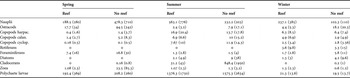
There were no differences between treatments (reef addition and control) on the structure of the zooplankton assemblage. However, there was an interactive effect of time and treatment (Table 1, Figure 2), indicating that on some days of sampling there were differences in the structure of zooplankton assemblage by the addition of reefs of F. enigmaticus in the mesocosms. The mean abundance (ind. 40 L−1) of each zooplankton taxon found between treatments during spring, summer and winter is shown in Table 2.
Summary of the PERMANOVA for multivariate repeated measured tests to assess differences in the structure of the zooplankton assemblage between treatments (with and without reefs), seasons (spring, summer and winter) and days of sampling (time).

Mean (+ SE) abundance (ind. 40 L−1) of each group in each of the treatments.

In spring, pair-wise comparisons revealed differences in the zooplankton assemblage between treatments (with reefs and without reefs) on 19 October (t = 2.1, P < 0.05) and 10 November (t = 1.62, P < 0.05). In the first case, the differences were due to the decrease of the abundance of nauplii (36.3% contribution of the overall dissimilarity among samples), polychaete larvae (27.2%), ostracods (15%), foraminiferans (10.3%), calanoid copepods (13.9%) and nauplii (13.3%) in the treatment with reefs. On 10 November, SIMPER analysis showed that there was lower abundance of ostracods (19.4%), zoea (18.8%) and polychaete larvae (18.5%) in the reef treatments.
In summer, pair-wise comparisons revealed differences between treatments in January 21 (T = 2.6, P < 0.05), which were due to the consistent decrease of cladocerans (38.7% contribution of the overall dissimilarity among samples) in the treatments with added reefs. Cladocerans assemblage was represented only by the Moina genus (Moinidae family). Higher number of this genus (up to 53 times) were found in mesocosms without reefs (100.6 ind l−1, SD = 58).
In winter, the differences between treatments were found on 31 August (t = 1.5, P < 0.05) and 26 September (t = 3.84, P < 0.05). The SIMPER analysis showed that changes were mainly caused by a decrease in the number of cladocerans, rotiferans and diatoms which contribute 16.1, 16 and 13.1% respectively to the overall dissimilarity among samples. On 26 September, the differences were found in the decrease of number of ostracods (23.8%) and foraminiferans (17.6%) in the reef treatments. The NMDS ordination was split by season given the complexity of showing the data in a single one (Figure 2).
There were differences in the Chla concentration between treatments (with reef and without reefs) in summer (F = 13, MS = 0.95, P < 0.01; Figure 2), and interactive effects between factors (treatment and time) in spring (F = 8, MS = 131.7, P < 0.001) and winter (F = 3.6, MS = 33.9, P > 0.05). In summer, the reefs of F. enigmaticus decreased the concentration up to 50% (X = 8.4 µg L−1 Chla) compared with control treatments (X = 16.8 µg L−1 Chla), and fluctuated between 3.4 and 24 µg L−1 for the reef treatment and 7.4 and 32.5 µg L−1 for the no-reef treatment. In spring, LSD multiple comparisons indicated that the Chla concentration in the reef treatment was lower than in the no-reef treatment on 10 November (Figure 2). In this season, Chla concentration fluctuated between 8.5 and 51 µg L−1 for the reef treatment and 14.1 and 48.8 µg L−1 for the no-reef treatment. In winter, Chla concentration was lower in the reef treatment than in the no-reef treatment on 31 August and 12 September (Figure 2). In this period, Chla concentration fluctuated between 3.7 and 46.1 µg L−1 for the reef treatment and 3 and 50.3 µg L−1 for the no-reef treatment.
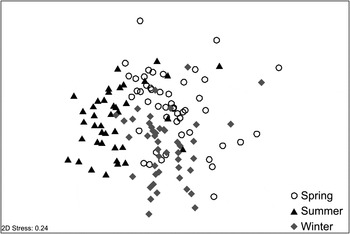
There was a significant effect of the seasonality on the structure of zooplankton assemblage (Table 1, Figure 3) in the mesocosm experiments. Pair-wise comparisons showed that the assemblage of the zooplankton in summer differed from the winter (t = 1.9, P < 0.05) and spring assemblage (t = 2.1, P < 0.05), but there were no differences between spring and winter assemblages (P > 0.05, Figure 3). SIMPER analysis showed that the differences between summer and winter zooplankton assemblage were due to the increase of the abundance of polychaete larvae (21.9% contribution to the overall dissimilarity among treatments), cladocerans (15.5%) and nauplii (12.5%) in the summer samples compared with the winter samples. There was a decrease in the abundance of ostracods (8.3% contribution to the overall dissimilarity among season), foraminiferans (6.5%) and diatoms (4.4%) in summer compared with the winter samples. SIMPER analysis showed that the differences between summer and spring assemblages were due to the increase in the abundance of polychaete larvae (19.1% contribution to the overall dissimilarity among samples), cladocerans (15.4%) and nauplii (13.8%) in the summer samples.
Results of non-metric multidimensional scaling (NMDS) determining patterns of composition of zooplankton among seasons (spring of 2005, summer of 2006 and winter of 2006) in mesocosm experiments at Mar Chiquita lagoon.

DISCUSSION
Our results show that the invasive polychaete Ficopomatus enigmaticus generates minor changes on overall composition of zooplankton assemblage in mesocosm experiments at the Mar Chiquita coastal lagoon. Although the structure of the zooplankton assemblage from Mar Chiquita was different between seasons, the effect of F. enigmaticus on the zooplankton was not significant in any of them. However, on some days, the addition of the reefs of F. enigmaticus generated changes in the structure of the zooplankton assemblage.
Benthic filter-feeders play a significant ecological role in shallow coastal waters because they remove planktonic particulate matter from the system and can generate a strong top-down control of the primary producers (Riisgaard et al., Reference Riisgaard, Seerup, Jensen, Glob and Larsen2004; Caraco et al., Reference Caraco, Cole and Strayer2006), which is likely to affect upper levels of the trophic web (e.g. mesozooplankton; Davenport et al., Reference Davenport, Smith and Packer2000). Among the most important groups are the filter-feeding bivalves (Wetz et al., Reference Wetz, Lewitus, Koepfler and Hayes2002), ascidians (Petersen & Riisgaard, Reference Petersen and Riisgaard1992) and polychaetes (Davies et al., Reference Davies, Stuart and de Villiers1989; Jordana et al., Reference Jordana, Charles, Gremare, Amouroux and Chretiennot-Dinet2001a). The importance of this type of control has been recognized by several studies (e.g. Officer et al., Reference Officer, Smayda and Mann1982; Pomeroy et al., Reference Pomeroy, Délia and Schaffner2006; Heck & Valentine, Reference Heck and Valentine2007). However, most of the studies assessing effects of filter-feeders on plankton communities have been carried out on bivalves (see Prins et al., Reference Prins, Smaal and Dame1998; Hwang et al., Reference Hwang, Kim, Shin, Oh and Kong2004). For example, the invasions in the estuary of San Francisco Bay (USA) of the clam Potamocorbula amurensis and in the Hudson River (USA) of the mussel Dreissena polymorpha have caused a strong decline of zooplankton biomass (Kimmerer et al., Reference Kimmerer, Gartside and Orsi1994; Jack & Thorp, Reference Jack and Thorp2000) affecting the pelagic trophic levels. However, feeding performances and effects of filter-feeders on food webs may differ depending on feeding modes (see Riisgaard & Ivarsson, Reference Riisgaard and Ivarsson1990). Our work clearly demonstrated an effect of the polychaete F. enigmaticus on primary producers (phytoplankton biomass) but a weak impact on the zooplankton structure. However, the feeding mechanics of species (i.e. bivalves vs. polychaetes) are completely different and therefore the effects could be different too. Surprisingly there are few examples of effects of polychaetes on plankton communities (see Jordana et al., Reference Jordana, Gremare, Lantoine, Courties, Charles, Amouroux and Vétion2001b), and therefore the assessment of the impact of filter-feeding polychaetes on the zooplankton assemblages clearly require new experimental studies.
Ficopomatus enigmaticus is one of the most important factors of control of the primary producers in the Mar Chiquita coastal lagoon (Bruschetti et al., Reference Bruschetti, Fanjul, Rosenthal, Luppi and Iribarne2008; Pan & Marcoval, Reference Pan and Marcoval2014), and therefore the filter-feeder zooplankton should be the most indirectly affected by grazing. The relationship between the decrease of primary producers (phytoplankton) and zooplankton abundance has been well documented (e.g. Deneke & Nixdorf, Reference Deneke and Nixdorf1999; Sommer & Sommer, Reference Sommer and Sommer2006). In summer, there was one day (21 February) where the Chla strongly decreased in the reef-treatments and the structure of the zooplankton changed. The zooplankton composition on 21 February was dominated by cladocerans (filter-feeders) and they decreased up to 50-fold in the reef-treatment. This group was one of the main contributors to the overall dissimilarity among treatments (with reefs and without reefs), but this effect was only on this sampling day. Cladocerans are efficient grazers of phytoplankton in lakes and estuaries (Sommer & Sommer, Reference Sommer and Sommer2006), and their food requirement is high. Studies of food limitation and predation (e.g. fishes) in cladocerans suggest that both factors regulate their population size (Tessier, Reference Tessier1986). The lower and upper limits of the food size consumed by cladocerans are in the order of 1 µm and 20–30 µm respectively (Geller & Müller, Reference Geller and Müller1981). This range overlaps with the food size range of F. enigmaticus, and therefore it is possible that exploitative competition occurs between groups. If the polychaetes indirectly affect the zooplankton (by competing for food) then it is important to consider a time-lag in the zooplankton data. Unfortunately, information on the time-lag between Chla concentration decrease and changes in zooplankton assemblages in the Mar Chiquita lagoon does not exist. Ficopomatus enigmaticus can remove up to 50% of the biomass of phytoplankton in mesocosm experiments in a relatively short time (i.e. ~1.5 h; Pan & Marcoval, Reference Pan and Marcoval2014). Therefore, it is reasonable to think that there might be a short time-lag (i.e. days) between the decrease of primary producers (food) and changes in abundance of the filter-feeding zooplankton. In the future we need new studies to establish the effect of filter-feeding polychaetes on the abundance of cladocerans in the Mar Chiquita lagoon.
Direct effects (e.g. predation) of benthic filter-feeder organisms on zooplankton communities can be important (MacIsaac et al., Reference MacIsaac, Lonee and Leach1995; Jack & Thorp, Reference Jack and Thorp2000). However, direct predation of polychaetes on filter-feeding zooplankton has not been documented. The maximum particle sizes that polychaetes are able to capture is related to the length of the external lateral cilia (in serpulids this is 250 µm; see Riisgaard et al., Reference Riisgaard, Grémare, Amouroux, Charles, Vétion, Rosenberg and Nielsen2002) that comprise the tentacles used to capture food. Ficopomatus enigmaticus subtracts particles within the size range 2–12 µm with maximum efficiency (Davies et al., Reference Davies, Stuart and de Villiers1989). Therefore, it is unlikely that F. enigmaticus can capture larger prey sizes such as cladocerans (between 500 and 3000 µm; Dodson & Frey, Reference Dodson, Frey, Thorp and Covich1991).
There are many factors that can potentially affect the feeding activity of filter feeders. In benthic filter-feeding polychaetes, exogenous factors such as food availability (Jordana et al., Reference Jordana, Duchêne, Charles, Grémare and Amouroux2000) and water temperature (Riisgaard & Ivarsson, Reference Riisgaard and Ivarsson1990) are known to be important. In our work, there was a significant decrease in Chla concentration in the reef treatments during summer. This effect was lower in spring and winter and might represent a decrease in the feeding rates of polychaetes. Such a decrease could be attributed to overloading of the feeding system or gut saturation (see Riisgaard & Ivarsson, Reference Riisgaard and Ivarsson1990). Nevertheless, significant grazing impact was observed during peaks of chlorophyll concentration in summer. Thus, high particle concentrations and feeding thresholds would not be sufficient to explain the observed seasonal variations in grazing and the lower effect of F. enigmaticus on phytoplankton biomass in winter and spring. These patterns could be better explained as a consequence of temperature effects on feeding rates (e.g. Riisgaard & Ivarsson, Reference Riisgaard and Ivarsson1990) or some sort of interaction between temperature and particle concentration.
On the other hand, some assumptions of this work could affect the results. For example, the initial number of live polychaetes in each mesocosm could not be determined, and consequently the effect of the reefs on plankton assemblage could be different among replicates. In this work we have assumed that similar sizes of reefs have similar numbers of worms and therefore each mesocosm had a similar initial abundance. Although the number of polychaetes outside the mesocosms showed a large variability, these data represented the variability found in the lagoon and consequently in the mesocosms.
In summary, our results showed that the reefs of Ficopomatus enigmaticus generated minor changes in abundance and composition of zooplankton assemblage in mesocosm experiments in the Mar Chiquita lagoon. There was no connection between the decrease of Chla concentration from grazing activity and changes in the structure of zooplankton assemblage. Thus, contrary to our hypothesis, the grazing impact of the invasive polychaete F. enigmaticus on the biomass of primary producers (see Bruschetti et al., Reference Bruschetti, Fanjul, Rosenthal, Luppi and Iribarne2008) did not generate cascading indirect effects to higher trophic levels (i.e. zooplankton). However, changes in some components of the zooplankton assemblage (e.g. cladocerans in summer) clearly show that the reefs of F. enigmaticus have the potential to affect the structure of the zooplankton community. The lack of data on community composition and abundance of zooplankton before the invasion limits the understanding of how this polychaete might have affected the structure of the zooplankton of this lagoon; nevertheless this work suggests that the changes may not be so significant.
ACKNOWLEDGEMENTS
We thank M. A. Gonzalez Sagrario for lending part of the field equipment and P. Ribeiro and C. Bazterrica for their assistance in the field. We are grateful to D. Blanco for allowing us to work in the study site (Recreo San Gabriel). Also, we are grateful to J. Alberti and P. Daleo for helping with the statistical analysis.
FINANCIAL SUPPORT
This project was supported by grants from the Universidad Nacional de Mar del Plata, CONICET, ANPCyT, to O. Iribarne. C.M. Bruschetti was supported by a Doctoral scholarship from CONICET (Argentina).