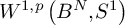



1 Introduction
In this paper, we study unoriented variants of the two-dimensional Aviles–Giga functional. We first recall the main features of the classical (oriented) Aviles–Giga functional, which is nothing else than the Ginzburg–Landau energy restricted to curl-free vector fields, that is, gradients if the domain is simply connected. More precisely, the functional is defined on the space of vector fields
 $\boldsymbol {u}:\Omega \subset \mathbb {R}^2\to \mathbb {R}^2$
by
 $$\begin{align*}E_{\varepsilon}(\boldsymbol{u}):=\begin{cases}\dfrac\varepsilon2 \displaystyle\int_{\Omega} |\nabla \boldsymbol{u}|^2\, + \dfrac1{2\varepsilon}\int_{\Omega} (1-|\boldsymbol{u}|^2)^2&\text{ if }\operatorname{\mathrm{curl}} \boldsymbol{u}=0,\\ \qquad+\infty&\text{otherwise}.\end{cases} \end{align*}$$
This model, first introduced in [Reference Aviles and GigaAG96], as well as some of its variants, appear in the modelling of various phenomena in materials science such as blistering of thin films, liquid crystals configurations and magnetization orientation in ferromagnetic materials. They have attracted considerable attention in the mathematical literature over the last 20 years; see, for example, [Reference Aviles and GigaAG87, Reference Aviles and GigaAG96, Reference Jin and KohnJK00, Reference Ambrosio, De Lellis and MantegazzaADLM99, Reference DeSimone, Kohn, Müller and OttoDKMO01, Reference Jabin and PerthameJP01, Reference Jabin, Otto and PerthameJOP02, Reference Rivière and SerfatyRS01, Reference Alouges, Rivière and SerfatyARS02, Reference Ambrosio, Kirchheim, Lecumberry and RivièreAKLR02, Reference De Lellis and OttoDLO03, Reference Conti and De LellisCDL07, Reference PoliakovskyPol07, Reference IgnatIgn12, Reference Ignat and MerletIM11, Reference Ignat and MerletIM12, Reference LorentLor14] and are still the subject of active research as witnessed by more recent articles [Reference Lorent and PengLP18, Reference Lamy, Lorent and PengLLP20, Reference Ghiraldin and LamyGL20, Reference MarconiMar20, Reference MarconiMar21, Reference Lorent and PengLP21].
The main question is to understand the behavior as
 $\varepsilon \downarrow 0$
of configurations with bounded energy (such as minimizers) and in particular to derive a
 $\Gamma $
-limit of the energy. The conjecture is that, in the limit, the energy concentrates on line singularities corresponding to interfaces (‘domain walls’) in micromagnetics. In full generality and despite substantial progress, this question is still open to this date.
The first step of the program, which was carried in [Reference Ambrosio, De Lellis and MantegazzaADLM99, Reference DeSimone, Kohn, Müller and OttoDKMO01], is to prove strong
 $L^1$
convergence of sequences of bounded energy. This shows in particular that in the limit we obtain curl-free unit-norm vector fields. The proof combines a compensated-compactness argument together with the fact that the energy controls a certain entropy production. The latter was already observed by [Reference Jin and KohnJK00] which introduced the first entropies for this problem. This is inspired by the analysis of scalar conservation laws, observing that the eikonal equation
 $$ \begin{align} \operatorname{\mathrm{curl}} \boldsymbol{u}=0,\qquad |\boldsymbol{u}|=1 \end{align} $$
can be considered as a one-dimensional scalar conservation law
 $\partial _1 u_1 + \partial _2 (\sqrt {1-u_1^2})=0$
. To be more specific, an entropy is any mapping
 $\Phi \in C^{\infty }(\mathbb {S}^1,\mathbb {R}^2)$
such that
 $$ \begin{align}\mu_{\Phi}[\boldsymbol{u}]:=\nabla\cdot[\Phi(\boldsymbol{u})]=0 \end{align} $$
for any smooth
 $\boldsymbol {u}$
satisfying equation (1.1). For solutions
 $\boldsymbol {u}$
of equation (1.1) obtained as limits of bounded energy configurations
 $\boldsymbol {u}_{\varepsilon }$
and any entropy
 $\Phi $
, the entropy production
 $\mu _{\Phi }[\boldsymbol {u}]$
is typically not zero but a signed measure, of mass controlled by
 $E_{\varepsilon }(\boldsymbol {u}_{\varepsilon })$
in the sense that
 $$ \begin{align} |\mu_{\Phi}[\boldsymbol{u}]|(\Omega)\le C \liminf_{\varepsilon\downarrow 0} E_{\varepsilon}(\boldsymbol{u}_{\varepsilon}) \end{align} $$
for some positive constant C depending on
 $\Phi $
. In the particular case of the so-called Jin–Kohn entropies, [Reference Jin and KohnJK00, Reference Ambrosio, De Lellis and MantegazzaADLM99] proved the sharp inequality (1.3) with
 $C=1$
, leading to a characterization of the
 $\Gamma -$
liminf (see also [Reference Rivière and SerfatyRS01, Reference Alouges, Rivière and SerfatyARS02, Reference Ignat and MerletIM11, Reference Ignat and MerletIM12]). For
 $BV$
vector fields, this was complemented by a corresponding
 $\Gamma -$
limsup construction in [Reference Conti and De LellisCDL07, Reference PoliakovskyPol07]. However, as shown in [Reference Ambrosio, De Lellis and MantegazzaADLM99], limit configurations are in general not
 $BV$
. In order to complete the program, it was therefore necessary to investigate further the fine structure of configurations
 $\boldsymbol {u}$
satisfying (1.1) such that
 $\mu _{\Phi }[\boldsymbol {u}]$
is a signed measure for any entropy
 $\Phi $
. A first step considered in [Reference Jabin, Otto and PerthameJOP02] was to study the case of configurations such that
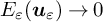 $E_{\varepsilon }(\boldsymbol {u}_{\varepsilon })\to 0$
as
 $\varepsilon \downarrow 0$
or, more precisely, in regions of the domain where the energy does not concentrate and where
 $\mu _{\Phi }[\boldsymbol {u}]$
vanishes by equation (1.3). In this case, the limiting configurations, called zero-states, must be Lipschitz continuous away from a locally finite singular set S. The singularities near the points of S must be of vortex-type, that is,
 $u(x) =\pm \, x/|x|$
locally, up to an origin-shift). Recently, [Reference Lorent and PengLP18, Reference Lamy, Lorent and PengLLP20] proved that the same conclusion can be obtained under the weaker assumption that the entropy production coming from the Jin–Kohn entropies vanishes.
An important further step was obtained in [Reference De Lellis and OttoDLO03] (see also [Reference Ambrosio, Kirchheim, Lecumberry and RivièreAKLR02]), where it is shown that configurations of finite energy share some of the characteristic properties of
 $BV$
-mappings. In particular, it is possible to define a countably rectifiable jump set
 $J_{\boldsymbol {u}}$
with weak traces
 $\boldsymbol {u}^{\pm }$
on both sides. Probably the main open question to complete the proof of the
 $\Gamma -$
convergence is to show that the entropy production is concentrated on
 $J_{\boldsymbol {u}}$
, see [Reference Ghiraldin and LamyGL20, Reference MarconiMar20, Reference MarconiMar21, Reference Lorent and PengLP21] for recent progress on this question.
According to [Reference Ercolani, Indik, Newell and PassotEINP03, Reference Ercolani and VenkataramaniEV09, Reference Zhang, Acharya, Newell and VenkataramaniZANV21], considering unoriented Aviles–Giga functionals is motivated by the modelling of physical systems far from equilibrium which spontaneously break translational symmetry by forming striped patterns. This includes for instance convection patterns in ordinary fluids, more specifically Rayleigh–Bénard convection rolls in high Prandtl numbers, liquid crystals and optical patterns in Raman and Maxwell–Bloch laser systems. Two of the authors started to study in [Reference Merlet and SerfatyMS23] some unoriented variants of the Aviles–Giga functional, that is, variants in which
 $\boldsymbol {u}$
and
 $-\boldsymbol {u}$
are identified. More precisely, working in the
 $SBV$
setting, that is,
 $BV$
functions whose differential has no Cantor part; see [Reference Ambrosio, Fusco and PallaraAFP00]) they consider the energy
 $$ \begin{align} E^{\prime}_{\varepsilon}(\boldsymbol{u}\otimes \boldsymbol{u}):=\begin{cases} \dfrac\varepsilon2 \displaystyle\int_{\Omega} |\nabla_a \boldsymbol{u}|^2\, + \dfrac1{2\varepsilon}\int_{\Omega} (1-|\boldsymbol{u}|^2)^2 & \text{if }\begin{cases}&\boldsymbol{u}\in SBV(\Omega,\mathbb{R}^2),\\ &\boldsymbol{u}^++\boldsymbol{u}^-=0\text{ on }J_{\boldsymbol{u}}\\ &\text{and }\operatorname{\mathrm{curl}}_a \boldsymbol{u}=0,\end{cases}\\ \qquad+\infty&\text{otherwise,}\end{cases} \end{align} $$
where
 $\nabla _a\boldsymbol {u}=(\partial _1 \boldsymbol {u},\partial _2 \boldsymbol {u})$
denotes the absolutely continuous part of the distributional gradient
 $\nabla \boldsymbol {u}$
,
 $\operatorname {\mathrm {curl}}_a \boldsymbol {u}=(\partial _1 u_2)_a-(\partial _2 u_1)_a$
,
 $J_{\boldsymbol {u}}$
is the jump set of
 $\boldsymbol {u}$
and
 $\boldsymbol {u}^{\pm }$
the traces of
 $\boldsymbol {u}$
on
 $J_{\boldsymbol {u}}$
. This preserves the original model as much as possible while allowing nonorientable fields. One can check that this functional is unambiguously defined as a function of
 $\boldsymbol {u} \otimes \boldsymbol {u}$
since if
 $\tilde {\boldsymbol {u}}\otimes \tilde {\boldsymbol {u}}=\boldsymbol {u}\otimes \boldsymbol {u}$
, then
 $\tilde {\boldsymbol {u}}(x)=\pm \boldsymbol {u}(x)$
almost everywhere in
 $\Omega $
and
 $|\nabla _a \tilde {\boldsymbol {u}}|=|\nabla _a \boldsymbol {u}|$
.
As shown in [Reference Merlet and SerfatyMS23], the passage from the oriented to the unoriented setting has a dramatic impact on the properties of configurations with moderate energy. First, the optimal jump profiles are not always one-dimensional and are thus difficult to precisely characterize (in particular they are different from the two-dimensional ‘cross-tie’ patterns found in its micromagnetics variants [Reference Alouges, Rivière and SerfatyARS02]). Second and maybe more importantly, the curl-free constraint may be lost in the limit
 $\varepsilon \downarrow 0$
. This shows in particular that following the program described above will be very challenging in the unoriented case.
Nevertheless, the aim of this paper is to perform the first two steps and prove compactness, which happens, maybe surprisingly, despite the possible loss of the curl-free condition, as well as to investigate the structure of zero-states, thus providing a parallel to the results of [Reference DeSimone, Kohn, Müller and OttoDKMO01] and [Reference Jabin, Otto and PerthameJOP02].
Since we have no control on
 $\boldsymbol {u}$
but only on
 $\underline {\boldsymbol {v}}=\boldsymbol {u}\otimes \boldsymbol {u}$
, an important preliminary step is to express the energy
 $E^{\prime }_{\varepsilon }$
in terms of
 $\underline {\boldsymbol {v}}$
. To this aim, we introduce a good notion of curl for unoriented configurations (see Definition 1.4 and equation (1.8) below) and denote it by
 $\operatorname{\mathrm{\mathbf{\widehat{curl}}}} \underline {\boldsymbol {v}}$
. It turns out that a convenient requirement is that
 $\operatorname{\mathrm{\mathbf{\widehat{curl}}}} \underline {\boldsymbol {v}}= (\operatorname {\mathrm {curl}} \boldsymbol {u}) \boldsymbol {u}$
for smooth
 $\boldsymbol {u}$
with
 $\underline {\boldsymbol {v}}=\boldsymbol {u}\otimes \boldsymbol {u}$
. It is thus a vector-valued and nonlinear operator. We also need to define the entropy production in terms of
 $\underline {\boldsymbol {v}}$
. For
 $\Phi $
an even entropy, that is,
 $\Phi (-z)=\Phi (z)$
for
 $z\in \mathbb {S}^1$
and
 $\underline {\boldsymbol {v}}=\boldsymbol {u}\otimes \boldsymbol {u}$
, we define
 $$\begin{align*}\widehat\mu_{\Phi}[\underline{\boldsymbol{v}}]:=\nabla\cdot[\Phi(\boldsymbol{u})]. \end{align*}$$
Our first main result is then the following.
Theorem 1.1. Let
 $\Omega \subset \mathbb {R}^2$
be a domain of finite area and
 $\varepsilon _k\downarrow 0$
. If
 $\underline {\boldsymbol {v}}_k=\boldsymbol {u}_{k}\otimes \boldsymbol {u}_{k}$
is such that
 $\sup _k E^{\prime }_{\varepsilon _k}(\underline {\boldsymbol {v}}_{k})<\infty $
, then there exists
 $\underline {\boldsymbol {v}}=\boldsymbol {u}\otimes \boldsymbol {u}$
with
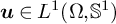 $\boldsymbol {u}\in L^1(\Omega ,\mathbb {S}^1)$
such that up to extraction,
 $\underline {\boldsymbol {v}}_k\to \underline {\boldsymbol {v}}$
in
 $L^1$
. Moreover, for every even entropy
 $\Phi $
, the corresponding entropy production
 $\widehat \mu _{\Phi }[\underline {\boldsymbol {v}}]$
is a signed measure with
 $$\begin{align*}|\widehat\mu_{\Phi}[\underline{\boldsymbol{v}}]|(\Omega)\le C \liminf_{k\to \infty} E^{\prime}_{\varepsilon_k}(\underline{\boldsymbol{v}}_{k}) \end{align*}$$
for some constant
 $C>0$
depending on
 $\Phi $
.
Let us point out that we actually prove a more general compactness result which allows for a relaxation of the curl-free condition (see Theorem 5.4).
Theorem 1.1 shows in particular that configurations of vanishing energy are zero-states in the sense that
 $\underline {\boldsymbol {v}}=\boldsymbol {u}\otimes \boldsymbol {u}$
for some
 $\boldsymbol {u}$
of unit length with
 $\widehat \mu _{\Phi }[\underline {\boldsymbol {v}}]=0$
for every even entropy. Our second main result proves that in the unoriented setting the structure of zero-states is very similar to that described in [Reference Jabin, Otto and PerthameJOP02] in the classical oriented setting. The only difference is that point singularities may be vortices but also
 $1/2$
-disclinations (we can also interpret a vortex as two glued
 $1/2$
-disclinations so that, essentially, these latter are the only type of singularities).
Theorem 1.2 (Structure of zero-states).
Let
 $\underline {\boldsymbol {v}}=\boldsymbol {u}\otimes \boldsymbol {u}$
be a zero-state. Then
 $\operatorname{\mathrm{\mathbf{\widehat{curl}}}} \underline {\boldsymbol {v}}=0$
and there exists a locally finite set
 $S\subset \Omega $
such that
-
(i)
 $\underline {\boldsymbol {v}}$
is locally Lipschitz continuous in
$\Omega \backslash S$
.
-
(ii) For
$x\in \Omega \backslash S$
,
$\underline {\boldsymbol {v}}=\underline {\boldsymbol {v}}(x)$
on the connected component of
$[x+\mathbb {R}\boldsymbol {u}(x)]\cap [\Omega \backslash S]$
which contains x. -
(iii) For every
$B:=B_{r}(x^0)$
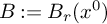
such that
$2B:=B_{2r}(x^0)\subset \Omega $
and
$2B\cap S=\{x^0\}$
, we can choose
$\boldsymbol {u}$
such that-
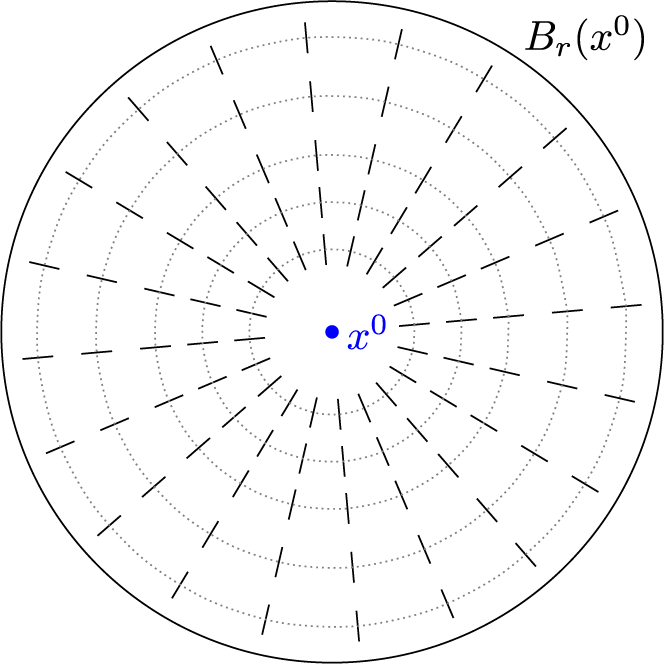
(a) either
$\boldsymbol {u}(x)=(x-x^0)/|x-x^0|$
in
$B\backslash \{x^0\}$
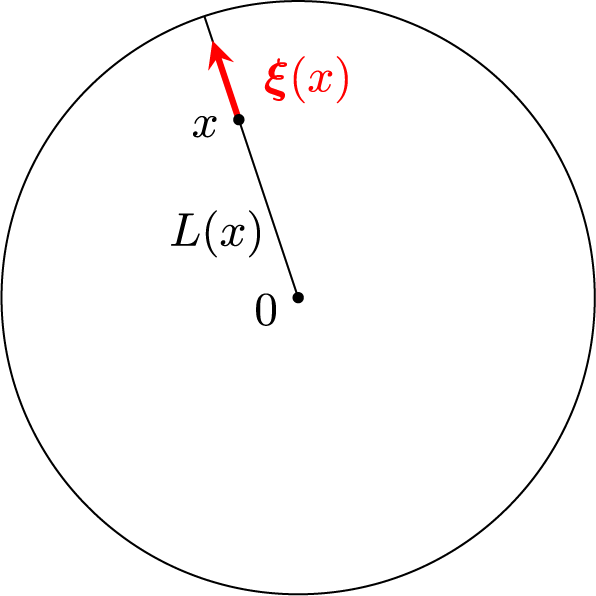
(see Figure 1),Figure 1Case (iii)(a) a vortex.
-
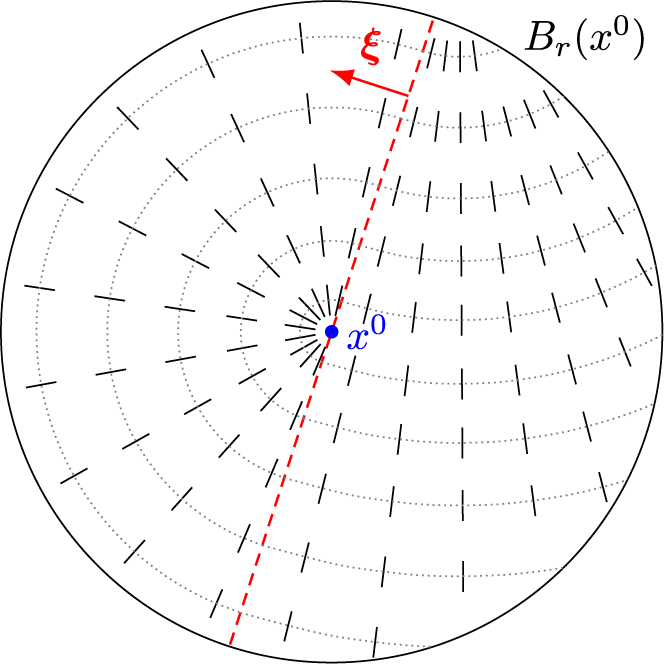
(b) or there exists
$ \boldsymbol {\xi }\in \mathbb {S}^1$
such that (see Figure 2)Figure 2Case (iii)(b) a 1/2-disclination.
-
∘
$\boldsymbol {u}(x)=(x-x^0)/|x-x^0|$
in
$\displaystyle \left \{x\in B\backslash \{x^0\} : (x-x^0)\cdot \boldsymbol {\xi }\ge 0\right \}$
, -
∘
$\underline {\boldsymbol {v}}$
is Lipschitz continuous in
$\displaystyle \left \{x\in B\backslash \{x^0\}: (x-x^0)\cdot \boldsymbol {\xi }\le 0\right \}$
.
-
-













Structure of a zero-state near a singularity
 $x^0$
. Line segments represent the director field
 $\pm \boldsymbol {u}$
. Dotted curves are orthogonal to this field.
An important conclusion of Theorem 1.2 is that zero-states are curl-free. As already mentioned, this is generally not true for arbitrary limit configurations (see [Reference Merlet and SerfatyMS23]). This shows that the creation of curl must come with a cost.
To sum up, our main accomplishments are the following:
-
(a) We introduce a good notion of curl for unoriented configurations, which we denote
$\operatorname {\mathrm {\mathbf {\widehat {curl}}}}$
and which extends the usual notion of
$\operatorname {\mathrm {curl}}$
in the sense that
$\operatorname {\mathrm {\mathbf {\widehat {curl}}}} (\boldsymbol {u}\otimes \boldsymbol {u})=(\operatorname {\mathrm {curl}}\boldsymbol {u})\boldsymbol {u}$
. This
$\operatorname {\mathrm {\mathbf {\widehat {curl}}}}$
operator is vector-valued and nonlinear. -
(b) We introduce a new family of entropies, which we call the trigonometric entropies and which have remarkable arithmetic properties. These are at the core of the proofs of both theorems. To the best of our knowledge, albeit being quite natural (in particular they contain the Jin–Kohn entropies; see Remark 1.8), these entropies have never been used so far. We thus anticipate that they could also prove useful for other related problems. In order to use entropies in the unoriented setting, these have to be even in the usual sense. This is not the case for the standard entropies of [Reference Jin and KohnJK00, Reference DeSimone, Kohn, Müller and OttoDKMO01]. We are able to show that, despite this constraint which reduces the admissible family, controlling just the entropy production for the family of (even) trigonometric entropies is enough to recover compactness.
-
(c) We prove a parallel structure theorem to [Reference Jabin, Otto and PerthameJOP02], precisely that zero-states (in particular limits of vanishing energy configurations obtained by the compactness result) are locally Lipschitz continuous away from a locally finite singular set. Moreover, every singular point corresponds either to a vortex
$x/|x|$
or to a disclination with degree
$1/2$
; see Figures 1, 2. Because of the unoriented situation, the kinetic formulation approach employed in [Reference Jabin, Otto and PerthameJOP02] is no longer available. Instead, the route we follow is to prove
$W^{1,p}$
regularity of zero-states. This is inspired by ideas from [Reference Lorent and PengLP18]. Using results from the Ginzburg–Landau theory (see [Reference Bethuel, Brezis and HéleinBBH94, Reference Sandier and SerfatySS07, Reference Alicandro and PonsiglioneAP14]) allows to identify the location of the vortices (or disclinations). At this point, thanks to the
$W^{1,p}$
regularity we can follow the characteristics (here its level lines) in a classical sense to conclude on the geometric structure.





We now give an outline of the proofs of Theorem 1.1 and Theorem 1.2 together with more precise definitions of the objects under consideration.
1.1 Main definitions and outline of the proofs
Complex representation
Inspired by [Reference Goldman, Merlet and MillotGMM20] where a related unoriented functional of Ginzburg–Landau type (thus without constraints on the curl) was considered, we find it actually convenient not to work with tensor products
 $\boldsymbol {u} \otimes \boldsymbol {u}$
but rather in complex number representation. We will use a bold font for elements of
 $\mathbb {R}^2$
and a regular font for the corresponding elements of
 $\mathbb {C}$
, in the sense that
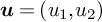 $\boldsymbol {u}=(u_1,u_2)$
is identified with
 $u=u_1+iu_2\in \mathbb {C}$
.
We now observe that for
 $u, \tilde u\in \mathbb {C}$
we have
 $$\begin{align*}\tilde u^2 = u^2 \quad\Longleftrightarrow\quad \tilde u=\pm u \quad\Longleftrightarrow\quad\tilde{\boldsymbol{u}}\otimes\tilde{\boldsymbol{u}}=\boldsymbol{u}\otimes\boldsymbol{u}. \end{align*}$$
We can thus identify unoriented vector fields
 $\underline {\boldsymbol {v}}=\boldsymbol {u}\otimes \boldsymbol {u}$
with complex-valued functions
 $v=u^2$
. In the sequel, we heavily use the multiplicative structure of
 $\mathbb {C}$
. From now on, we also identify all the quantities depending on v and
 $\underline {\boldsymbol {v}}$
(we write
 $\operatorname {\mathrm {\mathbf {\widehat {curl}}}} v$
for
 $\operatorname {\mathrm {\mathbf {\widehat {curl}}}} \underline {\boldsymbol {v}}$
and so on). Notice that if
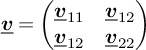 $\underline {\boldsymbol {v}}=\begin {pmatrix} \underline {\boldsymbol {v}}_{11} & \underline {\boldsymbol {v}}_{12}\\ \underline {\boldsymbol {v}}_{12} & \underline {\boldsymbol {v}}_{22}\end {pmatrix}$
and
 $v=v_1+i v_2$
we have the correspondence
 $$ \begin{align} v_1=\underline{\boldsymbol{v}}_{11}-\underline{\boldsymbol{v}}_{22} \qquad v_2= 2\underline{\boldsymbol{v}}_{12} \qquad \textrm{and} \qquad |v|=\mathrm{Tr\,} \underline{\boldsymbol{v}}. \end{align} $$
In order to define unambiguously a square-root
 $\sigma $
on
 $\mathbb {C}$
, we set
 $$ \begin{align} \sigma(r e^{i\theta})=\sqrt{r}e^{i\theta/2}\quad\text{ for }-\pi< \theta\le\pi\text{ and }r\ge0. \end{align} $$
So,
 $\sigma $
is a right inverse on
 $\mathbb {C}$
for
 $\Pi :z\in \mathbb {C}\mapsto z^2$
and a left inverse for
 $\Pi $
on
 $\{re^{i\theta }:r\ge 0, -\pi /2<\theta \le \pi /2\}$
. In particular, we have
 $\sigma (v)^2=v$
.
Remark 1.3. In the study of nematic liquid crystals and in other fields, directors
 $\{\pm \boldsymbol {u}\}$
with
 $\boldsymbol {u}\in \mathbb {S}^1$
are usually represented as
 $Q_{\boldsymbol {u}}=\boldsymbol {u}\otimes \boldsymbol {u} -(1/2) \operatorname {\mathrm {Id}}$
. Taking local averages, the theory is extended to
 $Q-$
tensors: mappings taking values into the space of
 $2\times 2$
symmetric traceless matrices. Here, in the energy (1.4), the vector fields
 $\boldsymbol {u}$
are not supposed to have unit length and a representation by Q-tensors is not straightforward (the trace of
 $\boldsymbol {u}\otimes \boldsymbol {u}$
is not prescribed). Moreover, it is not clear how to properly define a curl operator for general
 $Q-$
tensors (we could extend formula (1.8) below but many other choices are possible).
Unoriented curl and energies
We may now define our unoriented curl operator, which has the particularity of being nonlinear and vector-valued. It is defined so that if
 $v=u^2$
with u smooth, then
 $\operatorname {\mathrm {\mathbf {\widehat {curl}}}} v= (\operatorname {\mathrm {curl}} \boldsymbol {u}) \boldsymbol {u}$
.
Definition 1.4. For
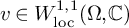 $v\in W^{1,1}_{\text {loc}}(\Omega ,\mathbb {C})$
,
 $\operatorname {\mathrm {\mathbf {\widehat {curl}}}} v$
denotes the measurable vector field
 $\Omega \to \mathbb {R}^2$
which vanishes on the set
 $\{x\in \Omega :v(x)=0\}$
and is defined by
 $\operatorname {\mathrm {\mathbf {\widehat {curl}}}} v:=(\rho _1,\rho _2)$
elsewhere with
 $$ \begin{align*} \rho_1&:=\dfrac14\left( \dfrac{v_1}{|v|} + 1\right)(\partial_1v_2 - \partial_2 v_1) -\dfrac14\dfrac{v_2}{|v|} (\partial_1v_1 + \partial_2 v_2),\\ \rho_2&:=\dfrac14\dfrac{v_2}{|v|} (\partial_1v_2 - \partial_2 v_1) +\dfrac14 \left( \dfrac{v_1}{|v|} -1\right) (\partial_1v_1 + \partial_2 v_2). \end{align*} $$
This can be rewritten in compact form as
 $$ \begin{align} \operatorname{\mathrm{\mathbf{\widehat{curl}}}} v =\dfrac14 \left(\begin{array}{cc} \dfrac{v_1}{|v|} + 1\ & -\dfrac{v_2}{|v|}\ \\ \\ \!\dfrac{v_2}{|v|} & \dfrac{v_1}{|v|} - 1 \end{array}\right) \binom{\nabla^{\perp}\cdot\boldsymbol{v}}{\nabla\cdot\boldsymbol{v}}, \end{align} $$
where
 $\nabla ^{\perp }:=(-\partial _2,\partial _1)$
. Notice that
 $\operatorname {\mathrm {\mathbf {\widehat {curl}}}} v\in L^1_{\text {loc}}(\Omega ,\mathbb {R}^2)$
defines a distribution.
Remark 1.5. Using for instance equation (1.5), it is not hard to see that
 $$ \begin{align} \operatorname{\mathrm{\mathbf{\widehat{curl}}}} \underline{\boldsymbol{v}}=\frac{1}{2 \mathrm{Tr\,}(\underline{\boldsymbol{v}})} \underline{\boldsymbol{v}}\left(2 (\nabla\cdot \underline{\boldsymbol{v}})^{\perp} +\nabla^{\perp}( \mathrm{ Tr\,}(\underline{\boldsymbol{v}}))\right), \end{align} $$
where
 $\boldsymbol {u}^{\perp }:=(-u_2,u_1)$
and
 $$\begin{align*}\nabla \cdot \underline{\boldsymbol{v}}=(\nabla \cdot \underline{\boldsymbol{v}}_1,\nabla \cdot \underline{\boldsymbol{v}}_2) \end{align*}$$
is the column-wise divergence of
 $\underline {\boldsymbol {v}}$
.
Remark 1.6. We cannot use only one component of
 $\operatorname {\mathrm {\mathbf {\widehat {curl}}}}(u^2)=(\rho _1,\rho _2)$
to retrieve
 $\operatorname {\mathrm {curl}} u$
or even the condition
 $\operatorname {\mathrm {curl}} u=0$
. Indeed, if u takes only real values then
 $v=u^2$
satisfies
 $v_1-|v|=v_2= 0$
, hence
 $\rho _2=0$
whereas u is curl-free only if
 $\partial _2u= 0$
. Symmetrically, if u takes values in
 $i\mathbb {R}$
then
 $v_1+|v|=v_2= 0$
and
 $\rho _1=0$
while
 $\operatorname {\mathrm {curl}} u$
vanishes only if
 $\partial _1u= 0$
.
We can now use the
 $\operatorname {\mathrm {\mathbf {\widehat {curl}}}} $
operator to encode the curl-free constraint and replace the functional
 $E^{\prime }_{\varepsilon }$
defined in equation (1.4) by
 $$ \begin{align} E_{\varepsilon}^{\prime\prime}(v):= \begin{cases} \dfrac\varepsilon2 \displaystyle\int_{\Omega} \dfrac{|\nabla v|^2}{4|v|} + \dfrac1{2\varepsilon}\int_{\Omega} (1-|v|)^2 &\text{if }v\in W^{1,1}(\Omega,\mathbb{C})\text{ and }\operatorname{\mathrm{\mathbf{\widehat{curl}}}} v=0,\\ \qquad+\infty &\text{otherwise.} \end{cases} \end{align} $$
By convention,
 $|\nabla v|^2/(4|v|)=0$
wherever
 $v=0$
(recall that
 $\nabla v=0$
a.e. on
 $\{v=0\}$
). We will show in Proposition 2.2 that the functionals
 $E^{\prime }_{\varepsilon }$
and
 $E^{\prime \prime }_{\varepsilon }$
are indeed equivalent.
Drawing analogy with both the Aviles–Giga functional and micromagnetics models, [Reference DeSimone, Kohn, Müller, Otto and SchäferDKM+01, Reference Desimone, Kohn, Müller and OttoDKMO02, Reference DeSimone, Kohn, Müller and OttoDKMO05, Reference Rivière and SerfatyRS01, Reference Alouges, Rivière and SerfatyARS02], we will actually consider a larger class of energies where the curl-free constraint is relaxed. We will consider two possible relaxations. The first one is meant to allow dislocations at small scales while penalizing their energy; the other contains an analogue of the stray-field energy in micromagnetics.
We assume here that
 $g $
and W are measurable functions from
 $\mathbb {C}$
to
 $[0, +\infty ]$
, that
 $\lambda ^0_{\varepsilon },\lambda ^1_{\varepsilon }\in [0,+\infty ]$
and that there exists a constant
 $\kappa>0$
such that
 $$ \begin{align} \left\{ \begin{array}{rll}g&\ge \kappa &\text{in some neighborhood of }\mathbb{S}^1,\\ W(v) &\ge \kappa \min\left( (1-|v|)^2,|1-|v|| \right)\quad&\text{for }v\in\mathbb{C},\\ \max(\lambda^0_{\varepsilon},\lambda^1_{\varepsilon})&\ge \kappa&\text{for }\varepsilon>0. \end{array} \right.\end{align} $$
We then define
 $$ \begin{align} \widehat{E}_{\varepsilon}(v)&:=\varepsilon \displaystyle\int_{\Omega} g\left(v\right) |\nabla v|^2\, + \dfrac1{\varepsilon}\int_{\Omega} W(v)\,+ \lambda_{\varepsilon}^0\int_{\Omega} |\operatorname{\mathrm{\mathbf{\widehat{curl}}}} v|+\dfrac{\lambda_{\varepsilon}^1}{\varepsilon}\left\|\operatorname{\mathrm{\mathbf{\widehat{curl}}}} v\right\|_{H^{-1}(\Omega)}^2. \end{align} $$
Notice that
 $E_{\varepsilon }^{\prime \prime }$
corresponds to the choice
 $g(v)=1/(8|v|)$
,
 $W(v)=(1-|v|)^2/2$
and
 $\max (\lambda ^0_{\varepsilon },\lambda ^1_{\varepsilon })=+\infty $
.
Unoriented and trigonometric entropies
We define entropies as mappings
 $\Phi \in \mathbb {C}^{\infty }(\mathbb {S}^1, \mathbb {C}^2)$
such that the real and imaginary part of
 $\Phi $
are usual entropies, that is, they satisfy equation (1.2). We fix an arbitrary function
 $\chi _0\in C^{\infty }_c([0,+\infty ),[0,1])$
with
 $\chi _0(1)=1$
and
 $\operatorname {\mathrm {supp}} \chi _0\subset (1/2,2)$
. With a slight abuse of notation, we identify any entropy
 $\Phi $
with its extension to
 $\mathbb {C}$
by
 $$\begin{align*}\Phi(z)=\chi_0(|z|)\Phi\left(\frac{z}{|z|}\right). \end{align*}$$
For any
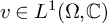 $v\in L^1(\Omega ,\mathbb {C})$
and any even entropy
 $\Phi $
, we define the entropy production
 $$ \begin{align} \widehat\mu_{\Phi}[v]:=\nabla\cdot\left[\Phi(\sigma(v))\right]. \end{align} $$
In order to motivate the definition of the trigonometric entropies, let us recall from [Reference DeSimone, Kohn, Müller and OttoDKMO01] that setting
 $\mathbb {T}:=\mathbb {R}/(2\pi \mathbb {Z})$
, we can associate to any
 $\lambda \in C^{\infty }(\mathbb {T},\mathbb {C})$
the entropy
 $\Upsilon [\lambda ]:=\Phi \in C^{\infty }(\mathbb {S}^1,\mathbb {C}^2)$
defined by
 $$ \begin{align} \Phi(e^{i\theta}):= \lambda(\theta) \binom{-\sin\theta}{\cos\theta} -\lambda'(\theta) \binom{\,\cos\theta\,}{\,\sin\theta\,}. \end{align} $$
Moreover, if
 $\lambda $
is
 $\pi -$
antiperiodic, then
 $\Phi $
is even.
Definition 1.7. For
 $n\in \mathbb {Z}$
, we set
 $\Phi ^n:=\Upsilon [2i e_n]$
, where
 $e_n$
is the trigonometric monomial
 $\theta \in \mathbb {R}\mapsto e^{in\theta }\in \mathbb {C}$
. We call these functions trigonometric entropies. More explicitly, for
 $n\in \mathbb {Z}$
and
 $z\in \mathbb {S}^1$
,
 $$\begin{align*}\Phi^n(z)=(n-1)z^{n+1} \binom1{-i} + (n+1) z^{n-1} \binom1i. \end{align*}$$
Notice that if n is odd, then
 $\Phi ^n$
is even. The main properties of these entropies that we will use are the very favorable algebraic expressions of
 $$\begin{align*}\Phi^{n}(z)\wedge \Phi^{-n}(z') \qquad \textrm{and} \qquad \left[\Phi^{n}(z)-\Phi^{n}(z')\right]\wedge \left[\Phi^{-n}(z)-\Phi^{-n}(z')\right], \end{align*}$$
from Lemma 4.4.
Remark 1.8. Defining the Jin–Kohn entropies on
 $\mathbb {S}^1$
by
 $\Sigma _1(z):=(z_2(1- (2/3)z_2^2), z_1(1-(2/3)z_1^2))$
and
 $\Sigma _2(z):=(2/3)(z_1^3,-z_2^3)$
(see [Reference Jin and KohnJK00]) we can easily check that
 $\Phi ^{\pm 2} = 6\Sigma _2 \pm 6 i\, \Sigma _1$
.
Sketch of proof of Theorem 1.1
The proof of Theorem 1.1 (for
 $\widehat {E}_{\varepsilon }$
) follows closely the strategy of the proof of its oriented counterpart in [Reference DeSimone, Kohn, Müller and OttoDKMO01]. The first step (see Proposition 5.1) is to prove that the energy controls the entropy production in the sense that for every even entropy
 $\Phi $
, there exists a constant
 $C\ge 0$
depending on
 $\Phi $
such that, for every
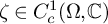 $\zeta \in C^1_c(\Omega ,\mathbb {C})$
,
 $$ \begin{align} \left|\int_{\Omega} \widehat\mu_{\Phi}[v] \zeta\right|\le C\left(\widehat{E}_{\varepsilon}(v)\|\zeta\|_{\infty} + \varepsilon^{1/2}\widehat{E}_{\varepsilon}^{1/2}(v)\|\nabla \zeta\|_2\right). \end{align} $$
Thanks to [Reference MuratMur78, Reference MuratMur81, Reference TartarTar79], this yields that, for sequences
 $(v_k)$
of bounded energy,
 $( \widehat \mu _{\Phi }[v_k])$
is compact in
 $H^{-1}_{\text {loc}}(\Omega )$
. Using the div-curl lemma of Murat and Tartar (see [Reference MuratMur78, Reference TartarTar79]), we conclude that, for every pair of even entropies
 $\Phi ^a$
,
 $\Phi ^b$
we have as weak limits in
 $L^2$
,
 $$ \begin{align} \lim_{k\uparrow \infty} \left[\Phi^a(\sigma(v_k))\wedge \Phi^b(\sigma(v_k))\right]=\left[ \lim_{k\uparrow \infty} \Phi^a(\sigma(v_k))\right]\wedge\left[\lim_{k\uparrow \infty} \Phi^b(\sigma(v_k))\right]. \end{align} $$
If we now consider the Young measure
 $\nu _x\otimes \mathcal {L}^2$
generated by
 $(v_k)$
(
 $\mathcal {L}^2$
denotes the Lebesgue measure), this translates into
 $$\begin{align*}\int_{\mathbb{S}^1} \Phi^a(\sigma(z))\wedge \Phi^b(\sigma(z)) d\nu_x(z)=\left[\int_{\mathbb{S}^1} \Phi^a(\sigma(z))d\nu_x(z)\right]\wedge \left[\int_{\mathbb{S}^1}\Phi^b(\sigma(z)) d\nu_x(z)\right]. \end{align*}$$
The question is then to understand if the class of entropies we have at our disposal is rich enough to conclude that
 $\nu _x$
must be a Dirac mass (which then classically implies strong convergence of
 $(v_k)$
; see [Reference MüllerMül99] for example). It is at this point that our proof departs from the one of [Reference DeSimone, Kohn, Müller and OttoDKMO01]. Indeed, to reach the conclusion in the oriented case [Reference DeSimone, Kohn, Müller and OttoDKMO01] used (after an approximation argument) the following entropies for
 $\xi \in \mathbb {S}^1$
,
 $$ \begin{align} \Phi^{\xi}(z):=\begin{cases}\boldsymbol{\xi}&\text{when }\boldsymbol{\xi}\cdot\boldsymbol{z}^{\perp}>0,\\0&\text{when }\boldsymbol{\xi}\cdot\boldsymbol{z}^{\perp}\le0.\end{cases} \end{align} $$
Alternatively, in [Reference Ambrosio, De Lellis and MantegazzaADLM99] the Jin–Kohn entropies of [Reference Jin and KohnJK00] are used for a similar conclusion. None of these entropies are even and therefore available in the unoriented setting. We use instead the trigonometric entropies
 $\Phi ^n$
for odd n to prove that the first Fourier coefficient of
 $\nu _x$
is of modulus equal to
 $1$
. Since
 $\nu _x$
is a probability density on
 $\mathbb {S}^1$
, this implies that it is a Dirac mass (see Lemma 4.5).
Remark 1.9.
-
(1) Notice that we can also obtain an alternative proof to the compactness results of [Reference DeSimone, Kohn, Müller and OttoDKMO01, Reference Ambrosio, De Lellis and MantegazzaADLM99] in the oriented case by using instead the trigonometric entropies
$\Phi ^n$
with n even. -
(2) On the contrary, if we replace
$v=u^2$
by
$v=u^q$
for some
$q\ge 3$
in the model, that is, we identify the elements of
$\{e^{2i k\pi /q} u : 0\le k\le q-1\}$
, then the space of entropies with the respective symmetry reduces to the space of constant mappings
$\mathbb {S}^1\to \mathbb {C}^2$
. In this case, it turns out that the compactness result analogous to Theorem 5.4 does not hold and the corresponding
$\Gamma -$
limit is trivial (see [Reference Merlet and SerfatyMS23]).





Sketch of proof of Theorem 1.2
Our proof of Theorem 1.2 is totally different from the proof in [Reference Jabin, Otto and PerthameJOP02] for the oriented case. Indeed, that proof is almost entirely based on the use of the entropies
 $\Phi ^{\xi }$
defined in equation (1.16) in order to follow in a weak sense the characteristics of the eikonal equation (which are lines). In the unoriented case, we build instead on a method of Lorent and Peng [Reference Lorent and PengLP18, Theorem 4] (see also [Reference Lamy, Lorent and PengLLP20, Lemma 7]) which in turn is inspired by the earlier work [Reference ŠverákŠ93] of Šverák on differential inclusions. We apply it in Proposition 6.1 with the trigonometric entropies to show that if v is a zero-state, then
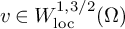 $v\in W^{1, 3/2}_{\mathrm {loc}}(\Omega )$
(actually
 $W^{1,p}_{\mathrm {loc}}$
for every
 $p<2$
; see Remark 6.2) and for every open set
 $\omega \subset \subset \Omega $
and
 $|h|\ll 1$
,
 $$ \begin{align} \int_{\omega} |v(x+h)-v(x)|^2 dx\le C |h|^2 \ln(1/ |h|). \end{align} $$
From
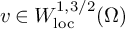 $v\in W^{1, 3/2}_{\mathrm {loc}}(\Omega )$
and the vanishing of any nontrivial even trigonometric entropy, we recover the condition
 $\operatorname {\mathrm {\mathbf {\widehat {curl}}}} v=0$
. Before commenting on the implications of equation (1.17), let us give a sketch of the proof. For the sake of simplicity, we focus on the first nontrivial even trigonometric entropy
 $\Phi ^3$
and derive the weaker Besov estimate:
 $$ \begin{align} \int_{\Omega} |D_h v|^4 \zeta^2\le C |h|^{\frac{4}{3}}, \end{align} $$
that is,
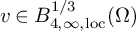 $v\in B^{1/3}_{4,\infty ,\mathrm {loc}}(\Omega )$
. This is the exact analog of [Reference Lorent and PengLP18, Theorem 4] replacing the Jin–Kohn entropies by the trigonometric entropies
 $\Phi ^{\pm 3}$
. Letting
 $D_h f(x):=f(x+h)-f(x)$
, the main point is that as a consequence of Lemma 4.4,
 $$ \begin{align} |D_h v|^4\le \frac{C}{2i} \left(D_h[\Phi^{-3}(\sigma(v))]\wedge D_h[\Phi^3(\sigma(v))]\right). \end{align} $$
We then use once again the div-curl structure of the right-hand side (recall equation (1.15)). Indeed, we notice that
 $\Phi ^{-3}(\sigma (v))$
is divergence free (since
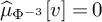 $\widehat \mu _{\Phi ^{-3}}[v]=0$
) to find a Lipschitz function F with
 $\Phi ^{-3}(\sigma (v))=\nabla ^{\perp } F$
. For every smooth test function
 $\zeta $
, we then have
 $$ \begin{align*} \int_{\Omega} |D_h v|^4 \zeta^2&\le C\left| \int_{\Omega} \left[\nabla^{\perp} D_h F\right]\wedge \left[D_h[\Phi^3(\sigma(v))]\right] \zeta^2\right|\\ &=C\left| \int_{\Omega} \left[\nabla D_h F\right]\cdot \left[D_h[\Phi^3(\sigma(v))]\right]\zeta^2\right|\\ &\le C \int_{\Omega} |D_h F| \left|D_h[\Phi^3(\sigma(v))]\right| |\zeta| |\nabla \zeta|, \end{align*} $$
where we used integration by parts and
 $\nabla \cdot \left [D_h[\Phi ^3(\sigma (v))]\right ]=0$
. Since both F and
 $\Phi ^3\circ \sigma $
are Lipschitz continuous, we find by Hölder inequality,
 $$\begin{align*}\int_{\Omega} |D_h v|^4 \zeta^2\le C |h| \left(\int_{\Omega} |D_h v|^4 \zeta^2\right)^{\frac{1}{4}}. \end{align*}$$
After simplification, this yields (1.18).
In order to improve from the Besov regularity to the stronger
 $W^{1,p}$
estimate and to equation (1.17), we need to implement a refined version of this argument involving all the even trigonometric entropies.
Defining the Ginzburg–Landau energy in the open set
 $\omega $
(see [Reference Bethuel, Brezis and HéleinBBH94, Reference Sandier and SerfatySS07]) as
 $$\begin{align*}\operatorname{\mathrm{GL}}_{\eta}(u;\omega):=\dfrac{1}{2}\int_{\omega} |\nabla u|^2 +\frac{1}{4\eta^2}\int_{\omega}(1-|u|^2)^2 \end{align*}$$
we deduce in Lemma 6.4 from equation (1.17) that for every mollification
 $v_{\eta }$
of v we have
 $$ \begin{align} \operatorname{\mathrm{GL}}_{\eta}(v_{\eta};\omega)\le C \ln(1/\eta). \end{align} $$
From the theory of Ginzburg–Landau vortices and in particular [Reference Alicandro and PonsiglioneAP14], we find that v has degree zero outside a locally finite set S. In particular, we can use the theory of lifting for Sobolev maps [Reference Brezis, Mironescu and PonceBMP05, Reference DemengelDem90] to find locally outside of S a curl-free square-root of v with Sobolev regularity. At this point, we can follow the characteristics in a classical sense to conclude on the geometrical structure.
Remark 1.10. As for Theorem 1.1, our proof of Theorem 1.2 can be used to give a new proof in the classical (oriented) Aviles–Giga setting.
Remark 1.11. Let us point out that, in order to conclude that the number of singularities is locally finite, it is crucial to obtain a sharp estimate in equation (1.17). Indeed, even a logarithmically failing estimate would lead to a potentially infinite number of vortices. In particular, if
 $(v_k)$
is such that
 $v_k\to v$
and
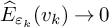 $\widehat {E}_{\varepsilon _k}(v_k)\to 0$
, equation (1.20) should be compared with the much weaker bound
 $$\begin{align*}\operatorname{\mathrm{GL}}_{\varepsilon_k}(\omega;v_k)=o(1/\varepsilon_k). \end{align*}$$
This work is the first where the connection between Ginzburg–Landau vortices and zero-states of the Aviles–Giga energy is made a priori rather than a posteriori.
1.2 Organization of the paper
In Section 2, we show the equivalence between considering the variable u and
 $v=u^2$
both for the curl-free constraint and for the energy. In Section 3, we collect all the properties of entropies and entropy productions that we need. In Section 4, we study the family of trigonometric entropies and establish some of their properties. Compactness issues are dealt with in Section 5, in particular the general compactness result, Theorem 5.2, is established. The structure of zero-states is obtained in Section 6. We indicate throughout the article how our methods apply to the classical Aviles–Giga functional.
1.3 Conventions and notation
We identify the target spaces
 $\mathbb {R}^2$
with
 $\mathbb {C}$
and recall the following conventions.
-
(i)
$\mathbb {S}^1:=\{z\in \mathbb {C}:|z|=1\}$
. -
(ii) For
$u=u_1+iu_2\in \mathbb {C}$
with
$u_1,u_2\in \mathbb {R}$
, we write
$\boldsymbol {u}=(u_1,u_2)\in \mathbb {R}^2$
. This applies to functions.
$u:\Omega \to \mathbb {C}$
corresponds to
$\boldsymbol {u}:\Omega \to \mathbb {R}^2$
with
$\boldsymbol {u}(x)=(u_1(x),u_2(x))$
and
$u(x)=u_1(x)+iu_2(x)$
.However, we do not use bold fonts for the elements of the domain
$\Omega \subset \mathbb {R}^2$
: we write
$x=(x_1,x_2)\in \Omega $
. -
(iii) We recall that
$\sigma $
is defined by
$\sigma (r e^{i\theta })=\sqrt {r}e^{i\theta /2}$
for
$-\pi < \theta \le \pi $
and
$r\ge 0$
.














Throughout the paper,
 $\Omega $
is an open domain of
 $\mathbb {R}^2$
and
 $\omega \subset \subset \Omega $
means that
 $\omega $
is an open set with
 $\overline \omega \subset \Omega $
compact.
For
 $\boldsymbol {z}\in \mathbb {C}^2$
,
 $\boldsymbol {z}^{\perp }:=(-z_2,z_1)$
. We also denote
 $\nabla ^{\perp }=(-\partial _2,\partial _1)$
.
For
 $\boldsymbol {z}^{a}=\binom {z_1^a}{z_2^a},\boldsymbol {z}^{b}=\binom {z_1^b}{z_2^b}\in \mathbb {C}^2$
, we denote by
 $\boldsymbol {z}^a\wedge \boldsymbol {z}^b$
the wedge product defined by
 $$\begin{align*}\boldsymbol{z}^{a}\wedge\boldsymbol{z}^{b}=\det(\boldsymbol{z}^{a},\boldsymbol{z}^{b}) = (\boldsymbol{z}^{a})^{\perp}\cdot\boldsymbol{z}^{b}= z^{a}_1z^{b}_2-z^{a}_2z^{b}_1. \end{align*}$$
For
 $\phi :\omega \subset \mathbb {R}^2\to \mathbb {C}^2$
,
 $\nabla \cdot \phi :=\partial _1\phi _1+\partial _2\phi _2$
.
For
 $u:\omega \subset \mathbb {R}^2\to \mathbb {C}$
,
 $\operatorname {\mathrm {curl}} u:=\operatorname {\mathrm {curl}} \boldsymbol {u}=\nabla \wedge \boldsymbol {u}=\partial _1 u_2-\partial _2 u_1=-\nabla \cdot \boldsymbol {u}^{\perp }=\nabla ^{\perp }\cdot \boldsymbol {u}$
.
 $|z|$
denotes the modulus of the complex number z, and
 $|x|$
the Euclidean norm of
 $x\in \mathbb {R}^2$
. For complex vectors
 $\boldsymbol {w}\in \mathbb {C}^2$
, we write
 $\|\boldsymbol {w}\|_{\ell ^2(\mathbb {C}^2)}$
for the Euclidean norm
 $\sqrt {|w_1|^2+|w_2|^2}$
. The associated bilinear dot products are denoted by ‘
 $\cdot $
’.
For
 $u\in BV_{\text {loc}}(\Omega )$
(see [Reference Ambrosio, Fusco and PallaraAFP00]), we denote by
 $D_au$
the absolutely continuous part of its differential and by
 $D_cu$
its Cantor part. Similarly,
 $\nabla _a u$
and
 $\operatorname {\mathrm {curl}}_a u$
denote the absolutely continuous part of
 $\nabla u$
and
 $\operatorname {\mathrm {curl}} u$
. The jump set of u is denoted by
 $J_u$
and
 $\nu _u$
is a unit normal vector to
 $J_u$
. The traces of u at some point
 $x\in J_u$
are defined with the convention
 $u^{\pm }:=\lim _{t\downarrow 0}u(x\pm t\nu _u(x))$
.
We denote by
 $SBV^2(\Omega )$
the subspace of elements
 $u\in SBV(\Omega )$
such that
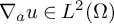 $\nabla _a u\in L^2(\Omega )$
. Notice that unlike [Reference Ambrosio, Fusco and PallaraAFP00] we do not impose the condition
 $\mathcal {H}^1(J_u)<+\infty $
.
2 Equivalence of the models
We first show that
 $\operatorname {\mathrm {\mathbf {\widehat {curl}}}} (u^2)$
allows to recover
 $\operatorname {\mathrm {curl}}_a u$
:
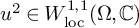
Lemma 2.1.
-
(i) Let
$u\in SBV^2_{\text {loc}}(\Omega ,\mathbb {C})$
such that
$(u^+)^2=(u^-)^2 \ \mathcal {H}^1$
-almost everywhere on
$J_u$
, then
$u^2\in W^{1,1}_{\text {loc}}(\Omega ,\mathbb {C})$
and (2.1)
$$ \begin{align} \operatorname{\mathrm{\mathbf{\widehat{curl}}}} (u^2)= (\operatorname{\mathrm{curl}}_a u)\boldsymbol{u}\qquad\text{ in }L^1_{\text{loc}}(\Omega). \end{align} $$
In particular (with the convention
$\boldsymbol {u}/|u|^2=0$
wherever
$\boldsymbol {u}$
vanishes), there holds
$$\begin{align*}\operatorname{\mathrm{curl}}_a u = \operatorname{\mathrm{\mathbf{\widehat{curl}}}} (u^2)\cdot\dfrac{\!\!\boldsymbol{u}\,}{|u|^2}\qquad\text{ in }L^1_{\text{loc}}(\Omega). \end{align*}$$
-
(ii) Let
$u\in SBV_{\text {loc}}(\Omega ,\mathbb {S}^1)$
with
$(u^+)^2=(u^-)^2 \ \mathcal {H}^1$
-almost everywhere on
$J_u$
, then
$u^2\in W^{1,1}_{\text {loc}}(\Omega ,\mathbb {C})$
and (2.1) holds true.



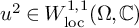





Proof. We only establish the first point, the second being similar. Let
 $u\in SBV^2_{\text {loc}}(\Omega ,\mathbb {C})$
such that
 $(u^+)^2=(u^-)^2$
on its jump set
 $J_u$
. By the chain rule for
 $BV$
-functions (see [Reference Ambrosio, Fusco and PallaraAFP00, Theorem 3.96]), for every
 $f\in C^1(\mathbb {C})$
with
 $\|Df(z)\|_{\infty }\le C(1+|z|)$
for some
 $C\ge 0$
,
 $f\circ u\in SBV_{\text {loc}}(\Omega )$
and

Setting
 $v:=u^2$
and applying this formula with
 $f(z)=z^2$
, we get

In particular,
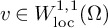 $v\in W^{1,1}_{\text {loc}}(\Omega )$
. We first consider the domain,
 $\Omega ':=\{x\in \Omega :u(x)\ne 0\}$
. With the abuse of notation
 $(\partial _1 u, \partial _2u):=\nabla _a u$
, we have,
 $$ \begin{align} \operatorname{\mathrm{curl}}_a u = \partial_1 u_2-\partial_2 u_1. \end{align} $$
Now, we express the components of v in terms of the components of u and use the chain rule to compute their partial derivatives. Almost everywhere in
 $\Omega '$
, there hold
 $$\begin{align*}v_1=u_1^2-u_2^2,\qquad v_2=2u_1u_2,\qquad |v|=u_1^2 + u_2^2, \end{align*}$$
which yield
 $$ \begin{align*} \partial_1 v_2 - \partial_2 v_1&=2\left[u_1\partial_1 u_2 + u_2\partial_1 u_1 - u_1\partial_2 u_1 + u_2\partial_2 u_2 \right],\\ \partial_1 v_1 + \partial_2 v_2&=2\left[u_1\partial_1 u_1 - u_2\partial_1 u_2 + u_1\partial_2 u_2 + u_2\partial_2 u_1 \right]. \end{align*} $$
Using these identities in the formula of Definition 1.4 and simplifying, we get, almost everywhere in
 $\Omega '$
and with
 $(\rho _1,\rho _2):=\operatorname {\mathrm {\mathbf {\widehat {curl}}}} v$
,
 $$ \begin{align*} |v|\rho_1&=u_1^2\left[u_1\partial_1 u_2 + u_2\partial_1 u_1 - u_1\partial_2 u_1 + u_2\partial_2 u_2 \right]\\&\qquad\qquad -u_1u_2\left[u_1\partial_1 u_1 - u_2\partial_1 u_2 + u_1\partial_2 u_2 + u_2\partial_2 u_1 \right]\\&=|v|u_1(\partial_1u_2 -\partial_2u_1)\, \stackrel{(2.2)}=\, |v|u_1\operatorname{\mathrm{curl}}_a u,\\|v|\rho_2&=u_1u_2\left[u_1\partial_1 u_2 + u_2\partial_1 u_1 - u_1\partial_2 u_1 + u_2\partial_2 u_2 \right]\\&\qquad\qquad -u_2^2\left[u_1\partial_1 u_1 - u_2\partial_1 u_2 + u_1\partial_2 u_2 + u_2\partial_2 u_1 \right]\\&=|v|u_2(\partial_1u_2 -\partial_2u_1)\, \stackrel{(2.2)}=\, |v|u_2\operatorname{\mathrm{curl}}_a u. \end{align*} $$
We obtain the desired identity
 $\operatorname {\mathrm {\mathbf {\widehat {curl}}}} v = (\operatorname {\mathrm {curl}}_a u)\boldsymbol {u}$
almost everywhere in
 $\Omega '$
.
In the remaining region
 $\Omega ":=\{x\in \Omega :u(x)=0\}$
, we have
 $\operatorname {\mathrm {\mathbf {\widehat {curl}}}} v=0$
by definition and
 $D_au=0$
, hence
 $$ \begin{align}\operatorname{\mathrm{curl}}_a u=0\text{ almost everywhere in }\Omega" \end{align} $$
(see below). Therefore, the identity
 $\operatorname {\mathrm {\mathbf {\widehat {curl}}}} v = (\operatorname {\mathrm {curl}}_a \boldsymbol {u})\boldsymbol {u}$
holds true almost everywhere in
 $\Omega $
and since both sides of the identity define locally integrable functions, the identity holds in
 $L^1_{\text {loc}}(\Omega )$
. This ends the proof of the lemma.
Justification of equation (2.3): Let
 $T\in C^1(\mathbb {C})$
such that
 $T(z)=z$
for
 $|z|\le 1$
,
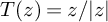 $T(z)=z/|z|$
for
 $|z|\ge 2$
. For
 $\delta>0$
, let us set
 $u_{\delta }:=\delta T(\delta ^{-1}u)$
. On one hand, we have
 $u_{\delta } \to 0$
in
 $L^1_{\text {loc}}(\Omega )$
as
 $\delta \downarrow 0$
so
 $D u_{\delta }\to 0$
in the sense of distributions. On the other hand, by the chain rule

As
 $\delta \downarrow 0$
, the second term in the right-hand side goes to
 $0$
in
 $\mathcal {D}'(\Omega )$
and the first term converges to
 $ \boldsymbol {1}_{\Omega "}D_a u$
in
 $L^1_{\text {loc}}(\Omega )$
by the dominated convergence theorem. Identifying with the limit
 $D u_{\delta }\to 0$
in
 $\mathcal {D}'(\Omega )$
, we get
 $D_au=0$
in
 $\Omega "$
.
We now justify the equivalence of the energies
 $E^{\prime }_{\varepsilon }$
and
 $E^{\prime \prime }_{\varepsilon }$
(recall definitions (1.4) and (1.9)). The problem is mostly to find a ‘good’ square root for v; see [Reference Dávila and IgnatDI03, Reference MerletMer06, Reference Ignat and LamyIL17] for related results.
Proposition 2.2. Let
 $\varepsilon>0$
, and let
 $\Omega $
be an open set with finite measure.
-
(i) Let
$u\in SBV(\Omega ,\mathbb {C})$
be such that
$E^{\prime }_{\varepsilon }(\boldsymbol {u}\otimes \boldsymbol {u})<\infty $
, and let
$v:=u^2$
. Then,
$v\in W^{1,1}(\Omega ,\mathbb {C})$
,
$\operatorname {\mathrm {\mathbf {\widehat {curl}}}} v=0$
and (2.5)
$$ \begin{align} E_{\varepsilon}^{\prime\prime}(v)=E^{\prime}_{\varepsilon}(\boldsymbol{u}\otimes\boldsymbol{u}). \end{align} $$
-
(ii) Conversely, if
$v\in W^{1,1}(\Omega ,\mathbb {C})$
is such that
$E_{\varepsilon }^{\prime \prime }(v)<\infty $
, then there exists
$u\in SBV^2(\Omega ,\mathbb {C})$
with
$v=u^2$
,
$\operatorname {\mathrm {curl}}_a\boldsymbol {u}=0$
and
$u^++u^-=0 \ \mathcal {H}^1$
-almost everywhere on
$J_u$
. In particular, equation (2.5) holds.













Proof.
(i). Let
 $v:=u^2$
with u as in (i). The condition
 $E_{\varepsilon }'(\boldsymbol {u}\otimes \boldsymbol {u})<\infty $
implies
 $u\in SBV^2(\Omega )$
and from the assumption on
 $\Omega $
also
 $u\in L^2(\Omega )$
. As a consequence
 $v\in L^1(\Omega )$
. By Lemma 2.1(i) (replacing
 $SBV_{\text {loc}}^2$
by
 $SBV^2$
in the hypothesis), we have
 $v\in W^{1,1}(\Omega ,\mathbb {C})$
with
 $\nabla v=2u\nabla _au$
and
 $\operatorname {\mathrm {\mathbf {\widehat {curl}}}} v=0$
. Moreover, using the convention
 $|\nabla v|^2/|v|=0$
wherever
 $v=0$
, we have
 $$\begin{align*}\int_{\Omega} \dfrac{|\nabla v|^2}{4|v|}\, = \int_{\Omega} |\nabla_au|^2. \end{align*}$$
Eventually,
 $(1-|v|)^2=(1-|u|^2)^2$
from which (2.5) follows.
(ii). Let v be as in (ii).
Step 1. Selection of a
 $BV$
square root u of v. We would like to define a square root of v of the form
 $u_{\varphi }:=e^{i\varphi /2} \sigma (e^{-i\varphi } v)$
for some
 $\varphi \in \mathbb {R}$
. We follow a strategy similar to the one of [Reference Dávila and IgnatDI03]. To deal with the discontinuity of
 $\sigma $
through
 $(-\infty ,0)$
and the fact that
 $z\mapsto |\sigma (z)|=\sqrt {|z|}$
is not smooth at 0, we need to smooth out
 $\sigma $
. First, we introduce
 $\chi \in C^{\infty }(\mathbb {R}_+)$
such that
 $\chi (s)=s$
for
 $0\le s\le 1$
,
 $0\le \chi '\le 1$
and
 $\chi (s)=1$
for
 $s\ge 2$
. Next, we consider for
 $0<\delta <\pi $
a
 $2\pi $
-periodic odd function
 $f_{\delta } \in C^{\infty }(\mathbb {R},(-\pi /2,\pi /2))$
such that
 $$\begin{align*}\begin{array}{rlrl} &f_{\delta}(\theta)=\theta/2&\text{ for }&\theta\in[0, \pi-\delta],\\ 1/2&\ge f_{\delta}'(\theta)\ge 0 &\text{ for }&\theta\in[\pi -\delta, \pi-\delta/2],\\ 0&\ge f_{\delta}'(\theta)\ge -2\pi/\delta & \text{ for }&\theta\in[ \pi-\delta/2, \pi]. \end{array} \end{align*}$$
For
 $z=r e^{i\theta }\in \mathbb {C}$
and
 $0<\delta <\pi $
, we define
 $\sigma ^{\delta }(z):=\sqrt {r}f_{\delta }(\theta )$
and for
 $0<\delta <\pi $
,
 $\lambda \ge 1$
,
 $$\begin{align*}\sigma^{\delta,\lambda}(z):=\chi(\lambda|z|) \sigma^{\delta}(z). \end{align*}$$
Eventually, we set
 $$\begin{align*}u_{\varphi}^{\delta,\lambda} := e^{i\varphi/2}\sigma^{\delta,\lambda}(e^{-i\varphi}v). \end{align*}$$
By construction,
 $u_{\varphi }^{\delta ,\lambda }\in W^{1,1}(\Omega ,\mathbb {C})$
and
 $(u_{\varphi }^{\delta ,\lambda })^2\to v$
pointwise, uniformly in
 $\varphi $
as
 $\delta \downarrow 0$
and
 $\lambda \uparrow \infty $
. We also easily see that
 $$\begin{align*}\int_0^{2\pi}|\nabla u_{\varphi}^{\delta,\lambda}|\, d\varphi \le C \dfrac{|\nabla v|}{\sqrt{|v|}}\qquad\text{almost everywhere in }\Omega, \end{align*}$$
for some universal constant
 $C>0$
. Integrating on
 $\Omega $
and using Fubini, we have
 $$\begin{align*}\int_0^{2\pi} \left(\int_{\Omega} |\nabla u_{\varphi}^{\delta,\lambda}|\,\right)\, d\varphi \le C \int_{\Omega} \dfrac{|\nabla v|}{\sqrt{|v|}}\le |\Omega|^{1/2}\left(\int_{\Omega} \dfrac{|\nabla v|^2}{|v|}\,\right)^{1/2}<\infty. \end{align*}$$
Let
 $(\delta _n)\downarrow 0$
and
 $(\lambda _n)\uparrow \infty $
; we deduce that there exists a sequence
 $(\varphi _n)\subset [0,2\pi )$
such that
 $(u_{\varphi _n}^{\delta _n,\lambda _n})$
is bounded in
 $W^{1,1}(\Omega ,\mathbb {C})$
. Therefore, there exists
 $u\in BV(\Omega ,\mathbb {C})$
such that, up to extraction,
 $u_{\varphi _n}^{\delta _n,\lambda _n}\to u$
almost everywhere and weakly star in
 $BV(\Omega ,\mathbb {C})$
. Passing to the limit in the relation
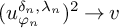 $({u_{\varphi _n}^{\delta _n,\lambda _n}})^2\to v$
as
 $n\uparrow \infty $
, we get
 $u^2=v$
, with
 $u\in BV(\Omega ,\mathbb {C})$
.
Step 2. Properties of u. From the chain rule for
 $BV$
functions, we have

By identification, we obtain
 $\nabla v=2u\nabla _au$
,
 $\nabla _c u=0$
and
 $(u^+)^2=(u^-)^2 \ \mathcal {H}^1$
-almost everywhere on
 $J_u$
. Using
 $|u|^2=|v|$
, we have
 $$\begin{align*}\int_{\Omega} |\nabla_a u|^2\, = \int_{\Omega} \dfrac{|\nabla v|^2}{4|v|}\,<\infty, \end{align*}$$
hence
 $u\in SBV^2(\Omega ,\mathbb {C})$
. Eventually, by Lemma 2.1 (i), we obtain
 $\operatorname {\mathrm {curl}}_au=0$
, and from the above identity, we get equation (2.5).
3 Entropies and entropy production
We recall that we have fixed an arbitrary function
 $\chi _0\in C^{\infty }_c([0,+\infty ),[0,1])$
with
 $\chi _0(1)=1$
and
 $\operatorname {\mathrm {supp}} \chi _0\subset (1/2,2)$
and that for us an entropy is a function
 $\Phi \in C^{\infty } (\mathbb {C},\mathbb {C}^2)$
such that, for
 $z\neq 0$
,
 $$\begin{align*}\Phi(z)= \chi_0(z)\Phi\left(\frac{z}{|z|}\right) \end{align*}$$
and such that, for every
 $u\in C^{\infty }(\Omega ,\mathbb {S}^1)$
with
 $\operatorname {\mathrm {curl}} u=0$
, we have
 $\nabla \cdot [\Phi (u)]=0$
. Let us also recall that, as an alternative, we could equivalently define entropies by the condition (see, e.g., [Reference Ignat and MerletIM12, Proposition 3])
 $$\begin{align*}\dfrac{d}{d\theta}[\Phi(e^{i\theta})]\in \mathbb{C} \binom{\cos\theta}{\sin\theta} \quad\text{ for every }\theta\in\mathbb{R}. \end{align*}$$
Notice that this condition differs from the one of [Reference DeSimone, Kohn, Müller and OttoDKMO01] since we consider the constraint
 $\operatorname {\mathrm {curl}} \boldsymbol {u}=0$
instead of
 $\nabla \cdot \boldsymbol {m}=0$
(they are equivalent up to a rotation of angle
 $\pi /2$
). We now set up some definitions that will be used throughout the paper.
Definition 3.1.
-
(i) We denote by
$\operatorname {\mathrm {ENT}}$
the space of entropies and by
$\mathrm {ENT}_{\mathrm {ev}}$
the subspace of even entropies, namely the elements
$\Phi \in \operatorname {\mathrm {ENT}}$
such that
$\Phi (-z)=\Phi (z)$
for every
$z\in \mathbb {S}^1$
. -
(ii) We denote by
$C^{\infty }_a(\mathbb {T},\mathbb {C})$
the subspace formed by the
$\pi $
-antiperiodic functions, that is, such that
$\lambda (\cdot +\pi )=-\lambda $
) in the space
$C^{\infty }(\mathbb {T},\mathbb {C})$
of smooth
$2\pi $
-periodic complex-valued functions. -
(iii) We denote by
$\widehat {\mathcal {A}}(\Omega )$
the set of measurable functions
$v:\Omega \to \mathbb {S}^1$
such that (recall definition (1.12))
$\widehat \mu _{\Phi }[v]$
is a Radon measure for every
$\Phi \in \mathrm {ENT}_{\mathrm {ev}}$
. -
(iv) We call zero-states the functions
$v\in \widehat {\mathcal {A}}(\Omega )$
such that
$\widehat \mu _{\Phi }[v]= 0$
for every
$\Phi \in \mathrm {ENT}_{\mathrm {ev}}$
. The subset of zero-states is denoted by
$\widehat {\mathcal {A}}_0(\Omega )$
.








Recall from equation (1.13) the definition of
 $\Upsilon [\lambda ]$
which associates to each
 $\lambda \in C^{\infty }(\mathbb {T},\mathbb {C})$
an entropy. The following lemma is adapted from [Reference DeSimone, Kohn, Müller and OttoDKMO01, Lemma 3] (see also [Reference Ignat and MerletIM12, Proposition 4]).
Lemma 3.2.
-
(i) The functions
$\Upsilon [\lambda ]$
are entropies. Moreover, the mapping
$\Upsilon : C^{\infty }(\mathbb {T},\mathbb {C})\to \operatorname {\mathrm {ENT}}$
is one-to-one and onto. -
(ii)
$\Upsilon $
maps
$C^{\infty }_a(\mathbb {T},\mathbb {C})$
onto
$\mathrm {ENT}_{\mathrm {ev}}$
.




Proof. The first point is the counterpart of [Reference Ignat and MerletIM12, Proposition 4] with the changes
 $\boldsymbol {u}\leftrightarrow \boldsymbol {m}:=\boldsymbol {u}^{\perp }$
,
 $\operatorname {\mathrm {curl}} u\leftrightarrow \nabla \cdot \boldsymbol {m}$
.
For the second point, if
 $\lambda \in C_a^{\infty }(\mathbb {T},\mathbb {C})$
, we easily check from the formula that
 $\Upsilon [\lambda ]$
is even, hence from the first point,
 $\Upsilon [\lambda ]\in \mathrm {ENT}_{\mathrm {ev}}$
.
Conversely, if
 $\Phi \in \mathrm {ENT}_{\mathrm {ev}}$
, by equation (i), there exists
 $\lambda \in C^{\infty }(\mathbb {T},\mathbb {C})$
such that
 $\Phi =\Upsilon [\lambda ]$
. Writing
 $\Phi (e^{i(\theta +\pi )})=\Phi (-e^{i\theta })=\Phi (e^{i\theta })$
and taking the dot product with
 $(-\sin \theta ,\cos \theta )$
, we obtain
 $-\lambda (\theta +\pi )=\lambda (\theta )$
so
 $\lambda \in C_a^{\infty }(\mathbb {T},\mathbb {C})$
, that is,
 $\Phi \in \Upsilon [C^{\infty }_a(\mathbb {T},\mathbb {C})]$
.
We now recall the decomposition of
 $D \Phi $
established in [Reference DeSimone, Kohn, Müller and OttoDKMO01] and reformulate it in our setting of
 $\operatorname {\mathrm {curl}}$
-free and
 $\mathbb {C}^2$
-valued entropies. The resulting formula (3.1) will provide a control of the entropy productions
 $\widehat \mu _{\Phi }[v]$
in
 $H^{-1}(\Omega )$
and in the space of Radon measures at the limit as stated in Proposition 5.1 and in equation (5.5).
Lemma 3.3. Let
 $\Phi \in \operatorname {\mathrm {ENT}}$
, and for
 $z\in \mathbb {C}$
let
 $\left (D\Phi \right )_{i,j}(z):=\left (\dfrac {\partial \Phi _i}{\partial z_j}(z)\right )_{i,j}\in \mathcal {M}_{2,2}(\mathbb {C})$
denote the matrix representation of the differential of
 $\Phi $
at
 $z\in \mathbb {C}\sim \mathbb {R}^2$
.
-
(i) There exist
$\Psi \in C^{\infty }_c(\mathbb {C},\mathbb {C}^2)$
and
$\alpha \in C^{\infty }_c(\mathbb {C},\mathbb {C})$
both supported in
$B_2\backslash \overline B_{1/2}$
such that In particular, for
$$\begin{align*}D \Phi(z) + 2\Psi(z)\otimes \mathbf{z} =\alpha(z)J\qquad \text{for every }z\in\mathbb{C}\text{ and with }\ J:=\left(\begin{array}{cc} 0&1\\ -1&0\end{array}\right). \end{align*}$$
$u\in W^{1,2}(\Omega ,\mathbb {C})$
, we have (recall definition (1.2))
$$\begin{align*}\mu_{\Phi}[u]= \Psi(u)\cdot\nabla(1-|u|^2) + \alpha(u)\operatorname{\mathrm{curl}} u. \end{align*}$$
-
(ii) If moreover
$\Phi \in \mathrm {ENT}_{\mathrm {ev}}$
, there exist
${\widehat \Psi },{\widehat \alpha }\in C^{\infty }_c(\mathbb {C},\mathbb {C}^2)$
such that-
(a)
$\operatorname {\mathrm {supp}}{\widehat \Psi },\ \operatorname {\mathrm {supp}}{\widehat \alpha } \subset B_{\sqrt {2}}\backslash \overline B_{1/\sqrt {2}}$
, -
(b) for every
$z\in \mathbb {C}$
,
${\widehat \alpha }(z)$
is collinear to
$\boldsymbol \sigma (z)$
, -
(c) for every
$v\in W^{1,1}(\Omega ,\mathbb {C})$
, (3.1)
$$ \begin{align} \widehat\mu_{\Phi}[v]= {\widehat\Psi}(v)\cdot\nabla(1-|v|) + {\widehat\alpha}(v)\cdot\operatorname{\mathrm{\mathbf{\widehat{curl}}}} v. \end{align} $$
-













Proof. The first point is just a transposition of [Reference DeSimone, Kohn, Müller and OttoDKMO01, Lemmas 1 and 2] with the changes
 $\boldsymbol {u}\leftrightarrow \boldsymbol {u}^{\perp }=:\boldsymbol {m}$
and
 $\operatorname {\mathrm {curl}} \boldsymbol {u} \leftrightarrow \nabla \cdot \boldsymbol {m}$
. The statement about the supports of
 $\alpha $
and
 $\Psi $
is obvious from the explicit definitions of
 $\Psi $
and then
 $\alpha $
given there. We now assume that
 $\Phi $
is even, that is,
 $\Phi \in \mathrm {ENT}_{\mathrm {ev}}$
and establish (ii).
Step 1. Symmetrization. Differentiating the identity
 $\Phi (-z)=\Phi (z)$
and using the first part of the lemma, we obtain
 $$\begin{align*}-D\Phi(-z)= -2\Psi(-z)\otimes \mathbf{z} -\alpha(-z)J = -2\Psi(z)\otimes \mathbf{z} + \alpha(z)J. \end{align*}$$
In view of these identities, we can substitute the mean value
 $\frac 12\left (\Psi (z)+\Psi (-z)\right )$
for
 $\Psi (z)$
and the quantity
 $\frac 12\left (\alpha (z)-\alpha (-z)\right )$
for
 $\alpha (z)$
. The new functions still comply to the conclusions of point (i), and we now have
 $$ \begin{align} \left\{\begin{array}{rcl}\Psi(-z)&=&\Psi(z),\\ \alpha(-z)&=&-\alpha(z),\end{array} \right. \ \text{for }z\in \mathbb{C}. \end{align} $$
From now on, we assume that
 $\Psi $
and
 $\alpha $
satisfy equation (3.2) and the properties stated in (i).
Step 2. Smoothing. Let
 $v\in W^{1,1}(\Omega ,\mathbb {C})$
. Let
 $(v_k)\subset C^{\infty }(\Omega ,\mathbb {C})$
be a sequence of approximations of v such that, as
 $k\uparrow \infty $
,
 $(\nabla v_k,v_k)\to (\nabla v,v)$
in
 $L^1(\Omega )$
and pointwise at every Lebesgue point of the mapping
 $$\begin{align*}x\in\Omega\mapsto (\nabla v(x),v(x))\in\mathbb{C}^3.\end{align*}$$
By definitions (1.7) & (1.12) of
 $\operatorname {\mathrm {\mathbf {\widehat {curl}}}} v$
and
 $\widehat \mu _{\Phi }$
, the assumptions on the sequence
 $(v_k)$
yield
 $$ \begin{align} \begin{cases}\operatorname{\mathrm{\mathbf{\widehat{curl}}}} v_k\to\operatorname{\mathrm{\mathbf{\widehat{curl}}}} v,\\ \widehat\mu_{\Phi}[v_k]\to \widehat\mu_{\Phi}[v],\end{cases} \ \text{ at every Lebesgue point of }(\nabla v,v). \end{align} $$
Let us fix x, Lebesgue point of
 $(\nabla v,v)$
with
 $v(x)\ne 0$
, let us fix k large enough so that
 $v_k(x)\ne 0$
and let
 $\xi :=v_k(x)/|v_k(x)|$
. By continuity, there exists
 $0<r<\operatorname {\mathrm {dist}}(x,\mathbb {R}^2\backslash \Omega )$
(depending on k) such that
 $\boldsymbol {v}_k\cdot \boldsymbol {\xi }>0$
in
 $B_{r}(x)$
. The function
 $v_k/\xi $
is smooth and takes values in
 $\{z\in \mathbb {C}:\Re z>0\}$
in
 $B_r(x)$
so
 $u_k:=\sigma (\xi )\sigma (v_k/\xi )$
is smooth in
 $B_{r}(x)$
and
 $(u_k)^2=v_k$
. Using Step 1 and recalling that
 $\Phi $
is even, we write in
 $B_r(x)$
 $$\begin{align*}\widehat\mu_{\Phi}[v_k]= \mu_{\Phi}[u_k] = \Psi(u_k)\cdot\nabla(1-|u_k|^2) + \alpha(u_k)\operatorname{\mathrm{curl}} u_k. \end{align*}$$
Using Lemma 2.1 (i) and the identities,
 $u_k^2=v_k$
,
 $|v_k|=|u_k|^2$
, we get
 $$ \begin{align} \widehat\mu_{\Phi}[v_k]&=\Psi(u_k)\cdot\nabla(1-|v_k|)+ \dfrac{\alpha(u_k)}{|v_k|} \boldsymbol{u}_k\cdot\operatorname{\mathrm{\mathbf{\widehat{curl}}}} v_k. \end{align} $$
Now, taking into account the symmetries (3.2), we define for
 $z\in \mathbb {C}$
,
 $$\begin{align*}{\widehat\Psi}(z):=\Psi(\sigma(z))=\Psi(-\sigma(z)),\qquad {\widehat\alpha}(z):=\dfrac{\alpha(\sigma(z))}{|z|}{\boldsymbol \sigma}(z)=\dfrac{\alpha(-\sigma(z))}{|z|}(-\boldsymbol \sigma(z)). \end{align*}$$
These mappings are smooth, supported in
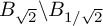 $B_{\sqrt {2}}\backslash B_{1/\sqrt {2}}$
and by construction,
 ${\widehat \alpha }(z)$
is collinear to
 $\boldsymbol \sigma (z)$
. Moreover, by equation (3.4), the identity (3.1) holds true in
 $B_r(x)$
with
 $v_k$
in place of v.
Step 3. Sending k to
 $+\infty $
and concluding.
Writing equation (3.1) with
 $v=v_k$
at point x, sending k to
 $+\infty $
and recalling
 $$\begin{align*}(\nabla v_k(x),v_k(x))\ \stackrel{k\uparrow\infty}\longrightarrow\ (\nabla v(x),v(x)), \end{align*}$$
and equation (3.3), we obtain equation (3.1) at point x. This holds at every Lebesgue point x of
 $(\nabla v,v)$
such that
 $v(x)\ne 0$
. At Lebesgue points with
 $v(x)=0$
, both sides of the identity vanish (because
 $\chi _0,{\widehat \Psi },{\widehat \alpha }= 0$
in the neighborhood of 0) so equation (3.1) holds almost everywhere in
 $\Omega $
. Eventually, since both sides define locally integrable functions, the identity holds in
 $L^1_{\text {loc}}(\Omega )$
.
We conclude this section by proving that if
 $v\in W^{1,1}(\Omega ,\mathbb {S}^1)$
and if
 $\widehat \mu _{\Phi }[v]=0$
for at least one even entropy
 $\Phi $
which satisfies a mild nondegeneracy condition, then
 $\operatorname {\mathrm {\mathbf {\widehat {curl}}}} v=0$
. For instance, this holds for
 $\Phi =\Upsilon [\lambda ]$
with
 $\lambda :\mathbb {T}\to \mathbb {C}$
analytic, nonconstant and
 $\pi $
-antiperiodic, in particular for the trigonometric entropies
 $\Phi ^{n}$
with n odd,
 $n\ne \pm 1$
. The converse property is also true, if
 $\operatorname {\mathrm {\mathbf {\widehat {curl}}}} v=0$
and
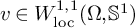 $v\in W^{1,1}_{\text {loc}}(\Omega ,\mathbb {S}^1)$
, then
 $v\in \widehat {\mathcal {A}}_0(\Omega )$
.
Lemma 3.4. Let
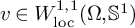 $v\in W^{1,1}_{\text {loc}}(\Omega ,\mathbb {S}^1)$
and
 $\lambda _0\in C_a^{\infty }(\mathbb {T},\mathbb {C})$
be such that the set of zeros of
 $\lambda _0+\lambda _0^{\prime \prime }$
is at most countable.
Then the three following properties are equivalent:
-
(i)
$\widehat \mu _{\Upsilon [\lambda _0]}[v]=0$
in
$L^1_{\text {loc}}(\Omega )$
, -
(ii)
$\operatorname {\mathrm {\mathbf {\widehat {curl}}}} v=0$
in
$L^1_{\text {loc}}(\Omega )$
, -
(iii)
$v\in \widehat {\mathcal {A}}_0(\Omega )$
.
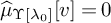


Proof. Let
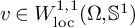 $v\in W^{1,1}_{\text {loc}}(\Omega ,\mathbb {S}^1)$
and
 $\lambda _0\in C_a^{\infty }(\mathbb {T},\mathbb {C})$
as in the statement of the lemma. The implication (iii)
 $\Rightarrow $
(i) is obvious; we prove below the implications (i)
 $\Rightarrow $
(ii) and then (ii)
 $\Rightarrow $
(iii). In both cases, we use a
 $BV_{\text {loc}}$
lifting of v.
Step 1. Choose a good lifting of v and expressions of
 $\widehat \mu _{\Phi }[v]$
and
 $\operatorname {\mathrm {\mathbf {\widehat {curl}}}} v$
.
Looking at the proof of Proposition 2.2 (or directly using [Reference Dávila and IgnatDI03, Reference MerletMer06]), we see that there exists
 $\theta \in BV_{\text {loc}}(\Omega )$
such that
 $v=e^{2i\theta }$
. By the chain rule for
 $BV$
-functions, we have with obvious notation

Identifying, we have
 $D_c\theta =0$
,
 $\theta ^+-\theta ^-\in \pi \mathbb {Z}\ \mathcal {H}^1$
-almost everywhere on
 $J_{\theta }$
and, denoting
 $(\partial _1\theta ,\partial _2\theta ):=\nabla _a \theta $
,
 $$ \begin{align} \partial_j v = 2(-\sin(2\theta) + i \cos(2\theta))\partial_j\theta,\qquad \text{for }j=1,2. \end{align} $$
Let
 $\Phi \in \mathrm {ENT}_{\mathrm {ev}}$
, and
 $\lambda \in C^{\infty }_a(\mathbb {T},\mathbb {C})$
be such that
 $\Phi =\Upsilon [\lambda ]$
. Using the chain rule and denoting
 $R[\theta ]:=\cos (\theta )\partial _1\theta + \sin (\theta )\partial _2\theta $
, we compute
 $$ \begin{align}\widehat\mu_{\Phi}[v]=\nabla\cdot\left[\Upsilon[\lambda](e^{i\theta})\right] =-\left[(\lambda"+\lambda)(\theta)\right] \,R[\theta]. \end{align} $$
Similarly, using again the notation
 $(\rho _1,\rho _2):=\operatorname {\mathrm {\mathbf {\widehat {curl}}}} v$
and (3.5), there holds
 $$ \begin{align*} 2\rho_1&=\left(\cos(2\theta) + 1\right)(\cos(2\theta)\partial_1\theta + \sin(2\theta)\partial_2\theta) \\ &~\qquad\qquad \qquad\qquad\qquad\qquad-\sin(2\theta) (-\sin(2\theta)\partial_1\theta + \cos(2\theta)\partial_2\theta)\\ & =\left[\left(\cos(2\theta) + 1\right)\cos(2\theta) + \sin(2\theta) \sin(2\theta) \right]\partial_1\theta \\ &~\qquad\qquad\qquad\qquad\qquad\qquad+\left[\left(\cos(2\theta) + 1\right)\sin(2\theta) - \sin(2\theta) \cos(2\theta)\right]\partial_2\theta\\ &=\left(\cos(2\theta) + 1\right)\partial_1\theta + \sin(2\theta) \partial_2\theta\\ &=2\cos(\theta)R[\theta], \end{align*} $$
and
 $$ \begin{align*} 2\rho_2&=\sin(2\theta)\cos(2\theta)\partial_1\theta + \sin(2\theta)\partial_2\theta\\ &~\qquad\qquad \qquad\qquad\qquad\qquad + \left( \cos(2\theta) -1\right) (-\sin(2\theta)\partial_1\theta + \cos(2\theta)\partial_2\theta )\\ & =\left[\sin(2\theta)\cos(2\theta) - \left(\cos(2\theta) - 1\right)\sin(2\theta)\right]\partial_1\theta \\ &~\qquad\qquad\qquad\qquad\qquad\qquad+\left[\sin^2(2\theta)+\left(\cos(2\theta) - 1\right)\cos(2\theta)\right]\partial_2\theta\\ &=\sin(2\theta)\partial_1\theta +\left(1-\cos(2\theta)\right) \partial_2\theta\\ &=2\sin(\theta)R[\theta]. \end{align*} $$
Hence, we have the identity
 $$ \begin{align} \operatorname{\mathrm{\mathbf{\widehat{curl}}}} v = R[\theta]\binom{\cos\theta}{\sin\theta}. \end{align} $$
Step 2. (i)
 $\Rightarrow $
(ii). Let us assume that
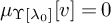 $\mu _{\Upsilon [\lambda _0]}[v]=0$
. Let
 $$\begin{align*}Z_0:=\left\{\varphi\in(-\pi,\pi]:(\lambda_0^{\prime\prime}+\lambda_0)(\varphi)=0\right\}.\end{align*}$$
Using equation (3.6) with
 $\Phi =\Upsilon [\lambda _0]$
, we obtain that
 $R[\theta ]=0$
almost everywhere in
 $\Omega \backslash \theta ^{-1}\left (Z_0\right )$
and by equation (3.7),
 $\operatorname {\mathrm {\mathbf {\widehat {curl}}}} v=0$
almost everywhere in
 $\Omega \backslash \theta ^{-1}\left (Z_0\right )$
.
The complement of
 $\theta ^{-1}\left (Z_0\right )$
is the union of the sets
 $v^{-1}(e^{2i\varphi })$
for
 $\varphi \in Z_0$
. By assumption, this family of sets is at most countable and on each one
 $\nabla v$
vanishes almost everywhere by a standard property of Sobolev functions (see the justification of equation (2.3) where the case of
 $SBV$
functions is treated). We conclude that
 $\nabla v=0$
in
 $\theta ^{-1}\left (Z_0\right )$
, hence
 $\operatorname {\mathrm {\mathbf {\widehat {curl}}}} v=0$
almost everywhere in
 $\Omega $
which is (ii).
Step 3. (ii)
 $\Rightarrow $
(iii). We assume that
 $\operatorname {\mathrm {\mathbf {\widehat {curl}}}} v=0$
so that equation (3.7) implies
 $R[\theta ]=0$
. From equation (3.6), we deduce that
 $\widehat \mu _{\Phi }[v]=0$
for every
 $\Phi \in \mathrm {ENT}_{\mathrm {ev}}$
, as required. We have established
 $(iii)\Rightarrow (i)\Rightarrow (ii)\Rightarrow (iii)$
, hence the lemma.
Remark 3.5. Notice that combining equations (3.6) and (3.7) we see that, as opposed to the oriented setting where the curl is the entropy production associated to the identity (see Properties 4.3), there is no
 $\Phi =\Upsilon [\lambda ]\in \mathrm {ENT}_{\mathrm {ev}}$
such that
 $\operatorname {\mathrm {\mathbf {\widehat {curl}}}} v=(\Re (\widehat \mu _{\Phi }[v]),\Im (\widehat \mu _{\Phi }[v]))$
. Indeed,
 $\lambda $
should solve
 $-(\lambda "+\lambda )=e^{i\theta }$
which does not have a periodic solution.
4 The trigonometric entropies
In this section, we collect the main properties of the trigonometric entropies from Definition 1.7. We recall that, with
 $\Upsilon $
defined in equation (1.13), for every
 $n\in \mathbb {Z}$
, we have set
 $\Phi ^n=\Upsilon [2i e_n]\in \operatorname {\mathrm {ENT}}$
, where
 $e_n$
is the trigonometric monomial
 $\theta \in \mathbb {R}\mapsto e^{in\theta }\in \mathbb {C}$
. We start with some immediate consequences of the definition and of Lemma 3.2.
Properties 4.1.
-
(i) For
$n\in \mathbb {Z}$
, we have
$\Phi ^{-n}=-\overline {\Phi ^n}$
. Indeed, from equation (1.13), the mapping
$\lambda \mapsto \Upsilon [\lambda ]$
is
$\mathbb {C}$
-linear and
$\Upsilon [\lambda ]$
is real valued whenever
$\lambda $
is, consequently,
$\Upsilon [\overline \lambda ]=\overline {\Upsilon [\lambda ]}$
. Hence,
$$\begin{align*}\Phi^{-n}=\Upsilon[2ie_{-n}]=\Upsilon[-\overline{2ie_n}]=-\overline{\Upsilon[2ie_n]}=-\overline{\Phi^n}. \end{align*}$$
-
(ii) By point (i) of Lemma 3.2 and density of the trigonometric polynomials in
$C^{\infty }(\mathbb {T},\mathbb {C})$
,
$\operatorname {\mathrm {span}}\{\Phi ^n\}_{n\in \mathbb {Z}}$
is dense in
$\operatorname {\mathrm {ENT}}$
. -
(iii) We have
$e_n\in C^{\infty }_a(\mathbb {T},\mathbb {C})$
if and only if n is odd. In fact,
$\operatorname {\mathrm {span}} \{e_{2m+1}\}_{m\in \mathbb {Z}}$
is dense in
$C_a^{\infty }(\mathbb {T},\mathbb {C})$
. From Lemma 3.2 (ii), we see that
$\operatorname {\mathrm {span}}\{\Phi ^{2m+1}\}_{m\in \mathbb {Z}}$
is dense in
$\mathrm {ENT}_{\mathrm {ev}}$
.




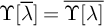









We derive an expression for the
 $\Phi ^n$
’s that first easily leads to the Properties 4.3 below and then is used to establish the ‘wedge products’ formulas of Lemma 4.4.
Lemma 4.2.
-
(i) For
$n\in \mathbb {Z}$
and
$z\in \mathbb {S}^1$
, we have (4.1)
$$ \begin{align} \Phi^n(z)=(n-1)z^{n+1} \binom1{-i} + (n+1) z^{n-1} \binom1i. \end{align} $$
-
(ii) For
$m\in \mathbb {Z}$
and
$w\in \mathbb {S}^1$
, we have (4.2)
$$ \begin{align} \Phi^{2m+1}(\sigma(w))=2\left[m w^{m+1} \binom1{-i} + (m+1) w^m \binom1i\right]. \end{align} $$


Proof. Let us establish the first point. We write
 $z=e^{i\theta }$
. Using
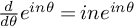 $\frac {d}{d\theta }e^{in\theta }=ine^{in\theta }$
and then the formulas
 $2i\sin \theta =e^{i\theta }-e^{-i\theta }$
,
 $2\cos \theta =e^{i\theta }+e^{-i\theta }$
, we get
 $$ \begin{align*} \Phi^n(z)&= e^{in\theta} \left[2i \binom{-\sin\theta}{\cos\theta}+2n\binom{\cos\theta}{\sin\theta}\right]=e^{in\theta}\left[\binom{-e^{i\theta}+e^{-i\theta}}{ie^{i\theta}+ie^{-i\theta}}+n\binom{e^{i\theta}+e^{-i\theta}}{-ie^{i\theta}+ie^{-i\theta}}\right]\\ &= e^{in\theta}\binom{(n-1)e^{i\theta}+(n+1)e^{-i\theta}}{-i(n-1)e^{i\theta}+i(n+1)e^{-i\theta}} = e^{in\theta}\left[(n-1)e^{i\theta} \binom1{-i} +(n+1)e^{-i\theta} \binom1i\right]. \end{align*} $$
Substituting back
 $z=e^{i\theta }$
,
 $z^n=e^{in\theta }$
, we obtain equation (4.1).
Identity (4.2) is obtained by substituting
 $n=2m+1$
and
 $z=\sigma (w)$
in the first one and then using
 $z^2=w$
.
Let us stress some immediate consequences of formulas (4.1) and (4.2).
Properties 4.3.
-
(i) For
$n=0$
, we have
$\Phi ^0(z)=2i \boldsymbol {z}^{\perp }$
, so
$\mu _{\Phi ^0}[u]=2i\operatorname {\mathrm {curl}} u$
for
$u\in W^{1,1}(\Omega ,\mathbb {S}^1)$
. -
(ii) For
$n=\pm 1$
, we have
$$\begin{align*}\Phi^{\pm1}(z)=\pm 2 \binom1{\pm i}, \end{align*}$$
and the pair
$\Phi ^{-1}$
,
$\Phi ^{1}$
spans the space of constant vector fields
$\mathbb {C}\to \mathbb {C}^2$
. -
(iii) For
$n=2$
and
$z\in \mathbb {S}^1$
, we have
$\Phi ^{\pm 2}(z)=\pm 6\,\Sigma _2(z)+ i\,6\,\Sigma _1(z)$
where for
$z\in \mathbb {S}^1$
,
$$\begin{align*}\Sigma_1(z):=(z_2(1- (2/3)z_2^2), z_1(1-(2/3)z_1^2)),\qquad \Sigma_2(z):=(2/3)(z_1^3,-z_2^3) \end{align*}$$
define the Jin–Kohn entropies.
-
(iv) For
$n\in \mathbb {Z}$
and
$\theta \in \mathbb {R}$
, (4.3)
$$ \begin{align} \left\|\Phi^n(e^{i\theta})\right\|_{\ell^2(\mathbb{C}^2)}=2\sqrt{n^2+1}\ \quad\text{and}\ \quad \left\|\frac d{d\theta}\left[\Phi^{n}(e^{i\theta})\right]\right\|_{\ell^2(\mathbb{C}^2)}\!=2|n^2-1|. \end{align} $$

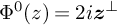







Lemma 4.4. Let
 $n\in \mathbb {Z}$
and
 $z,w\in \mathbb {S}^1$
. There holds
 $$ \begin{align} \Phi^{n}(z)\wedge\Phi^{-n}(w) &=2i\left((n+1)^2 \left(z \overline w\right)^{n-1} - (n-1)^2 \left(z \overline w\right)^{n+1} \right), \end{align} $$
 $$ \begin{align} \Phi^{n}(z)\wedge\Phi^{-n}(z)&=2i \left((n+1)^2-(n-1)^2\right)=8in, \end{align} $$
and
 $$ \begin{align} &\left( \Phi^{n}(z)-\Phi^{n}(w)\right)\wedge\left( \Phi^{-n}(z)-\Phi^{-n}(w)\right) \\[3pt] &\qquad\qquad =2i\left[(n+1)^2 \left|w^{n-1}-z^{n-1}\right|{}^2 - (n-1)^2 \left|w^{n+1}-z^{n+1}\right|{}^2\right]. \notag \end{align} $$
Proof. The first equality is a direct application of equation (4.1),
 $\Phi ^{-n}=-\overline {\Phi ^n}$
and of the identities
 $$ \begin{align} \binom1i\wedge\binom1i= \binom1{-i}\wedge\binom1{-i}=0,\quad\binom1{-i}\wedge\binom1i= -\binom1i\wedge\binom1{-i}=2i. \end{align} $$
We get the second identity by taking
 $w=z$
in equation (4.4). For the last one, we use the bilinearity of the wedge product and the two firsts to obtain that the left-hand side of equation (4.6) is equal to:
 $$ \begin{align*} 2i(n+1)^2 &\left[2-(\overline z w)^{n-1}-(z\overline w)^{n-1}\right] - 2i (n-1)^2 \left[2-(\overline z w)^{n+1}-(z\overline w)^{n+1}\right] \\ &=2i(n+1)^2 \left|z^{n-1}- w^{n-1}\right|{}^2- 2i(n-1)^2\left|z^{n+1}- w^{n+1}\right|{}^2. \notag \end{align*} $$
We used
 $z,w\in \mathbb {S}^1$
for the last equality. This proves equation (4.6) and the lemma.
The next result is the key for passing from weak convergence to strong convergence at the end of the proof of the compactness result.
Lemma 4.5. Let
 $\nu $
be a Borel probability measure on
 $\mathbb {S}^1$
. If one of the following assumptions holds true, then
 $\nu $
is a Dirac mass.
-
(i) For every trigonometric entropy
$\Phi ^n$
with
$n=2m$
even
$$\begin{align*}\int_{\mathbb{S}^1} \left[\Phi^{n}\wedge\Phi^{-n}\right] d\nu=\left[\int_{\mathbb{S}^1} \Phi^{n}\, d\nu\right]\wedge \left[\int_{\mathbb{S}^1} \Phi^{-n}\, d\nu \right]. \end{align*}$$
-
(ii) For every trigonometric entropy
$\Phi ^n$
with
$n=2m+1$
odd (4.8)
$$ \begin{align} \int_{\mathbb{S}^1} \left[\Phi^{n}\circ\sigma\wedge\Phi^{-n}\circ\sigma\right] d\nu=\left[\int_{\mathbb{S}^1} \Phi^{n}\circ\sigma\, d\nu\right]\wedge\left[\int_{\mathbb{S}^1} \Phi^{-n}\circ\sigma\, d\nu \right]. \end{align} $$


Proof.
Case of assumption (ii). Let m be a positive integer and set
 $n:= 2m+1$
. Integrating identity (4.5) of Lemma 4.4 with respect to
 $\nu $
we obtain for the left-hand side of equation (4.8),
 $$ \begin{align} \dfrac1{8i}\int_{\mathbb{S}^1}\left[\Phi^{n}\circ\sigma\wedge\Phi^{-n}\circ\sigma\right] d\nu= \dfrac14\left[(n+1)^2-(n-1)^2\right]=(m+1)^2-m^2. \end{align} $$
Next, using equation (4.2) and integrating with respect to
 $\nu $
, we get
 $$\begin{align*}\dfrac{1}{2}\int_{\mathbb{S}^1} \Phi^{n}\circ\sigma\, d\nu = m \left[\int_{\mathbb{S}^1} w^{m+1} \, d\nu(w)\right] \binom1{-i} + (m+1) \left[\int_{\mathbb{S}^1} w^{m} \, d\nu(w)\right] \binom1i. \end{align*}$$
Denoting by
 $$\begin{align*}c_k:=c_k(\nu)=\int_0^{2\pi} e^{-ik\theta}\,d\nu(e^{i\theta})=\int_{\mathbb{S}^1} w^{-k }\, d\nu(w), \end{align*}$$
the
 $k^{\text {th}}$
Fourier coefficient of the probability measure
 $\nu $
, the last identity writes as
 $$\begin{align*}\dfrac{1}{2}\int_{\mathbb{S}^1} \Phi^{n}\circ\sigma\, d\nu =m\,c_{-(m+1)} \binom1{-i} + (m+1) c_{-m} \binom1i. \end{align*}$$
Using
 $\Phi ^{-n}=-\overline {\Phi ^{n}}$
, the identities (4.7) and the relations
 $c_{-k}=\overline {c_k}$
for
 $k\in \mathbb {Z}$
(because
 $\nu $
is real valued), we get, for the right-hand side of equation (4.8),
 $$ \begin{align*} &\dfrac1{8i}\left[\int \Phi^{n}\circ\sigma\, d\nu\right]\wedge\left[\int\Phi^{-n}\circ\sigma\, d\nu\right]= \dfrac{-1}{2i} \left[\dfrac12\int \Phi^{n}\circ\sigma\, d\nu\right]\wedge\overline{\left[\dfrac12\int \Phi^{n}\circ\sigma\, d\nu\right]} \\ =& \dfrac{-1}{2i}\left[m\,c_{-(m+1)} \binom1{-i} + (m+1) c_{-m} \binom1i\right]\wedge\left[m\,\overline{c_{-(m+1)}} \binom1i + (m+1) \overline{c_{-m}} \binom1{-i}\right]\\ &\qquad\qquad\qquad\qquad\qquad\qquad\qquad\qquad =(m+1)^2|c_m|^2 -m^2|c_{m+1}|^2. \end{align*} $$
By assumption this quantity is equal to equation (4.9). We deduce the relations
 $$\begin{align*}m^2(1- |c_{m+1}|^2) = (m+1)^2(1-|c_m|^2)\quad\text{ for }m\ge1. \end{align*}$$
This leads by induction to
 $1-|c_m|^2=m^2(1-|c_1|^2)$
for
 $m\ge 1$
. Since
 $\nu $
is a (finite) measure, the sequence
 $(c_k)$
is bounded and we must have
 $|c_1|=|c_1(\nu )|=1$
. We conclude that the probability measure
 $\nu $
is a Dirac mass (we can for instance compute the variance
 $\operatorname {\mathrm {Var}}(\nu )=\int |w|^2\, d\nu (w) - \left |\int w\, d\nu (w)\right |{}^2=1-|c_1(\nu )|^2=0$
).
Case of assumption (i). Performing the same computations with
 $n=2m$
in place of
 $n=2m+1$
and
 $\Phi ^{2m}$
in place of
 $\Phi ^{2m+1}\circ \sigma $
leads to the identities
 $$\begin{align*}1-|c_{2m-1}(\nu)|^2=(2m-1)^2(1-|c_1(\nu)|^2)\quad\text{ for }m\ge 1.\end{align*}$$
We conclude again that
 $|c_1(\nu )|=1$
and then that
 $\nu $
is a Dirac mass.
5 Compactness
In this section, we prove Theorem 1.1. As explained in the introduction, we first use Lemma 3.3 to prove that the energy controls the entropy production (see equation (1.14)). We will actually prove a slightly stronger statement which gives a more explicit control in terms of
 $1-|v|$
,
 $\nabla v$
and
 $\operatorname {\mathrm {\mathbf {\widehat {curl}}}} v$
of the entropy production.
Fix
 $\chi \in C^{\infty }_c( (0,+\infty ),[0,1])$
with
 $\chi (1)=1$
and
 $\chi \ge 1/2$
on
 $[1/\sqrt {2},\sqrt {2}]$
. For
 $\lambda _0,\lambda _1\ge 0$
with
 $\max (\lambda _0,\lambda _1)\ge 1$
, we define
 $$ \begin{align} Q(v)&:=\|\chi(|v|)\,(1-|v|)\,\nabla v\|_{1} + \lambda_0 \|\operatorname{\mathrm{\mathbf{\widehat{curl}}}} v\|_{1} +\lambda_1^{1/2}\|\chi(|v|)\,\nabla v\|_{2} \,\|\operatorname{\mathrm{\mathbf{\widehat{curl}}}} v\|_{H^{-1}(\Omega)}, \nonumber\\R(v)&:=\|\chi(|v|)\,(1-|v|)\|_{2}+ \lambda_1^{1/2}\|\operatorname{\mathrm{\mathbf{\widehat{curl}}}} v\|_{H^{-1}(\Omega)}. \end{align} $$
Proposition 5.1. Let
 $\Omega \subset \mathbb {R}^2$
be an open set. Then, for every
 $\Phi \in \mathrm {ENT}_{\mathrm {ev}}$
there exists
 $C=C(\Phi , \chi )>0$
such that for every
 $v\in W^{1,1}(\Omega ,\mathbb {C})$
and every
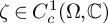 $\zeta \in C^1_c(\Omega ,\mathbb {C})$
,
 $$ \begin{align} \left|\int_{\Omega}\widehat\mu_{\Phi}[v]\,\zeta\, \right| \leq C\left( Q(v)\|\zeta\|_{\infty} + R(v) \|\nabla \zeta\|_{2}\right). \end{align} $$
Proof. It is enough to prove the claim for either
 $(\lambda _0,\lambda _1)=(1,0)$
or
 $(\lambda _0,\lambda _1)=(0,1)$
. Let
 ${\widehat \Psi }$
,
 ${\widehat \alpha }$
denote the functions given by Lemma 3.3 (ii) with the entropy
 $\Phi $
. Applying equation (3.1) to
 $v\in W^{1,1}(\Omega ,\mathbb {C})$
, we write
 $$ \begin{align*} \nabla\cdot\left[\Phi(\sigma(v))\right] & = \nabla\cdot\left[\Phi(\sigma(v)) - (1-|v|){\widehat\Psi}(v)\right] + \nabla\cdot\left[(1-|v|){\widehat\Psi}(v)\right] \\ &=-(1-|v|) D{\widehat\Psi}(v) D v + {\widehat\alpha}(v)\cdot\operatorname{\mathrm{\mathbf{\widehat{curl}}}} v+ \nabla\cdot\left[ (1-|v|){\widehat\Psi}(v)\right]\\ & =:\, f_1 + f_2 + f_3. \end{align*} $$
Let
 $\zeta \in C^1_c(\Omega ,\mathbb {C})$
. We estimate successively the terms
 $\left |\int f_j\zeta \,\right |$
for
 $j=1,2,3$
. For
 $f_2$
, we consider two different bounds.
-
(1) Since
$D{\widehat \Psi }$
is bounded and supported in
$B_{\sqrt {2}}\backslash B_{1/\sqrt {2}}$
$$\begin{align*}\left|\int_{\Omega} f_1\zeta\,\right|\le C\left\|\chi(|v|)(1-|v|)\nabla v\right\|_{1}\|\zeta\|_{\infty}. \end{align*}$$
-
(2) Next, since
${\widehat \alpha }$
is bounded, we have on the one hand the bound On the other hand, by definition of the
$$\begin{align*}\left|\int_{\Omega} f_2\zeta\,\right| \leq C \|\operatorname{\mathrm{\mathbf{\widehat{curl}}}} v\|_{1} \|\zeta\|_{\infty}. \end{align*}$$
$\|\cdot \|_{H^{-1}}$
norm, we also have As for
$$ \begin{align*} \left|\int_{\Omega} f_2\zeta\,\right|&\le \|\operatorname{\mathrm{\mathbf{\widehat{curl}}}} v\|_{H^{-1}(\Omega)} \left(\int_{\Omega}|\nabla[{\widehat\alpha}(v)\zeta]|^2\,\right)^{1/2}\\ &\le \|\operatorname{\mathrm{\mathbf{\widehat{curl}}}} v\|_{H^{-1}(\Omega)} \left[\left(\int_{\Omega} |D{\widehat\alpha}(v)Dv|^2\,\right)^{1/2} \|\zeta\|_{\infty} + \|{\widehat\alpha}(v)\|_{\infty} \|\nabla \zeta\|_{2}\right]. \end{align*} $$
${\widehat \Psi }$
, the function
${\widehat \alpha }$
is bounded and supported in
$B_{\sqrt {2}}\backslash B_{1/\sqrt {2}}$
and thus
$$\begin{align*}\left|\int_{\Omega} f_2\zeta\,\right|\le C \|\operatorname{\mathrm{\mathbf{\widehat{curl}}}} v\|_{H^{-1}(\Omega)} \Big[\left\|\chi(|v|)\nabla v\right\|_{2} \|\zeta\|_{\infty} + \|\nabla \zeta\|_{2}\Big]. \end{align*}$$
-
(3) In the last term, we integrate by parts and use the Cauchy–Schwarz inequality to get
Summing the estimates for
$$\begin{align*}\left|\int_{\Omega} f_3\zeta\,\right|=\left|\int_{\Omega} (1-|v|){\widehat\Psi}(v)\cdot\nabla\zeta\right|\le C \left\| \chi(|v|)(1-|v|)\right\|_{2}\|\nabla \zeta\|_{2}. \end{align*}$$
$j=1,2,3$
, we conclude the proof of equation (5.2).

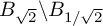


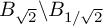


We may now prove the main compactness result.
Proposition 5.2. Let
 $\Omega \subset \mathbb {R}^2$
be an open set of finite area and
 $(v_k)\subset L^1(\Omega ,\mathbb {C})$
. Assume that:
-
(i)
$(|v_k|)$
converges to 1 in
$L^{1}(\Omega )$
, -
(ii) for every
$\Phi \in \mathrm {ENT}_{\mathrm {ev}}$
and every
$k\ge 1$
, there exists
$C\ge 0$
and
$\eta _k \downarrow 0$
such that we can write
$$\begin{align*}\left|\int_{\Omega} \widehat\mu_{\Phi}[v_k] \zeta \right|\le C\|\zeta\|_{\infty} +\eta_k \|\nabla \zeta\|_2, \quad \text{for every }\zeta\in C^1_c(\Omega,\mathbb{C}). \end{align*}$$


Then, up to extraction
 $v_k\to v$
in
 $L^1(\Omega )$
, for some
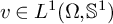 $v\in L^1(\Omega ,\mathbb {S}^1)$
.
Proof.
Step 1. Convergence of
 $(v_k)$
as a sequence of Young measures.
Up to extraction, there exists a positive Radon measure
 $\gamma $
over
 $\Omega \times \mathbb {C}$
such that, for every
 $\varphi \in C_c(\Omega \times \mathbb {C},\mathbb {R})$
,
 $$ \begin{align} \int_{\Omega} \varphi(x,v_k(x))\,dx\ \stackrel{k\uparrow\infty}\longrightarrow\ \int_{\Omega\times\mathbb{C}} \varphi\,d\gamma. \end{align} $$
Moreover,
 $\gamma $
disintegrates as
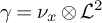 $\gamma =\nu _x\otimes \mathcal {L}^2$
where, for almost every
 $x\in \Omega $
,
 $\nu _x$
is a positive Radon measure on
 $\mathbb {C}$
. By assumption (i) and the fundamental theorem on Young measures (see, e.g., [Reference MüllerMül99, Theorem 3.1, (iii)&(iv)]),
 $\nu _x$
is a probability measure supported in
 $\mathbb {S}^1$
. Moreover, in order to prove the strong
 $L^1$
convergence of
 $(v_k)$
, it is enough to establish
 $$ \begin{align} \nu_x\text{ is a Dirac mass for almost every }x\in\Omega. \end{align} $$
This follows from assumption (i) again, [Reference MüllerMül99, Corollary 3.2] and Vitali convergence theorem. Let us now establish equation (5.4).
Step 2.
 $H^{-1}_{\text {loc}}$
compactness of the sequences of entropy productions. We observe that from assumption (ii) of the proposition and a simple variant of a lemma by Murat [Reference MuratMur81] (see also [Reference TartarTar79, Lemma 28] and [Reference DeSimone, Kohn, Müller and OttoDKMO01, Lemma 6]) applied to the (uniformly bounded) sequence of mappings
 $\Phi (\sigma (v_k))$
, for any
 $\Phi \in \mathrm {ENT}_{\mathrm {ev}}$
, the sequence
 $(\widehat \mu _{\Phi }[v_k])$
is relatively compact in
 $H^{-1}_{\text {loc}}(\Omega )$
.
Step 3. End of the proof.
Let
 $n=2m+1$
and
 $\Phi ^n$
be the corresponding trigonometric entropy. By Step 2, the sequences with terms
 $\widehat \mu _{\Phi ^{\pm n}}[v_k]=\nabla \cdot \left [\Phi ^{\pm n}(\sigma (v_k))\right ]$
are relatively compact in
 $H^{-1}_{\text {loc}}(\Omega )$
and we can apply the div-curl lemma of Murat and Tartar [Reference MuratMur78, Reference TartarTar79] to the pair of sequences
 $$\begin{align*}\left(\Phi^{-n}(\sigma(v_k))\right),\qquad \left(\left[\Phi^n(\sigma(v_k))\right]^{\perp}\right), \end{align*}$$
to get
 $$\begin{align*}\lim_{k\uparrow\infty}\Phi^{-n}(\sigma(v_k)) \wedge \Phi^n(\sigma(v_k))=\left[\lim_{k\uparrow\infty} \Phi^{-n}(\sigma(v_k))\right]\wedge \left[\lim_{k\uparrow\infty} \Phi^n(\sigma(v_k))\right], \end{align*}$$
where the above limits are weak limits in
 $L^2_{\text {loc}}(\Omega )$
. Rewriting this identity with the limit Young measure, we obtain, for almost every
 $x\in \Omega $
,
 $$\begin{align*}\int_{\mathbb{S}^1} \left[\Phi^{-n}\circ\sigma\wedge\Phi^n\circ\sigma\right]d\nu_x = \left[ \int_{\mathbb{S}^1} \Phi^{-n}\circ\sigma\,d\nu_x\right]\wedge\left[\int_{\mathbb{S}^1} \Phi^n\circ\sigma\,d\nu_x \right]. \end{align*}$$
This identity holds true almost everywhere for any fixed n. Since we consider a countable number of entropies, it holds true for any odd n on a set of full measure. For every x in this set, we can apply Lemma 4.8 (ii) to the probability
 $\nu _x$
and deduce that it is a Dirac mass, that is equation (5.4). This concludes the proof.
As a direct consequence of Proposition 5.1 and Proposition 5.2, we have the following compactness result.
Corollary 5.3. Let
 $\Omega \subset \mathbb {R}^2$
be an open set of finite area, and let
 $(v_k)\subset W^{1,1}(\Omega ,\mathbb {C})$
. Assume that:
-
(a)
$(|v_k|)$
converges to 1 in
$L^{1}(\Omega )$
, -
(b)
$(R(v_k))$
converges to 0 and
$(Q(v_k))$
is bounded.


Then, up to extraction,
-
(i)
$v_k\to v$
in
$L^1(\Omega )$
, for some
$v\in L^1(\Omega ,\mathbb {S}^1)$
. -
(ii) The distributions
$\widehat \mu _{\Phi }[v]$
are Radon measure and there exists
$C=C(\Phi )\ge 0$
such that(5.5)
$$ \begin{align} |\widehat\mu_{\Phi}[v]|(\Omega) \leq\, C\, \liminf_{k\uparrow\infty} Q(v_{k}). \end{align} $$


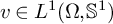



Recalling the definition (1.11) of
 $\widehat {E}_{\varepsilon }$
, we finally obtain the anticipated generalization of Theorem 1.1.
Theorem 5.4. Assume that hypothesis (1.10) holds. Let then
 $\Omega $
be an open set of finite measure and
 $\varepsilon _k\downarrow 0$
. If
 $(v_k)$
satisfies
 $\sup _k \widehat {E}_{\varepsilon _k}(v_k)<+\infty $
, then there exists
 $v\in L^1(\Omega ,\mathbb {S}^1)\cap \widehat {\mathcal {A}}(\Omega )$
such that up to extraction,
 $v_k\to v$
in
 $L^{1}$
. Moreover, for every
 $\Phi \in \mathrm {ENT}_{\mathrm {ev}}$
, there exists
 $C=C(\Phi ,\kappa )\ge 0$
such that
 $$\begin{align*}|\widehat\mu_{\Phi}[v]|(\Omega) \leq\, C\, \liminf_{k\uparrow\infty} \widehat{E}_{\varepsilon_k}(v_k). \end{align*}$$
Proof. We first notice that by definition of
 $\widehat {E}_{\varepsilon }$
, and
 $$ \begin{align} \int_{\Omega} W(v)+\lambda_{\varepsilon}^1\|\operatorname{\mathrm{\mathbf{\widehat{curl}}}} v\|^2_{H^{-1}(\Omega)}\le \varepsilon \widehat{E}_{\varepsilon}(v). \end{align} $$
Using equation (1.10) for W, this yields in particular
 $$\begin{align*}\int_{\Omega} \min ((1-|v|)^2,|1-|v||) \le \varepsilon \widehat{E}_{\varepsilon}(v)/\kappa. \end{align*}$$
Since
 $\Omega $
is assumed to have finite area, we get first that if
 $ \widehat {E}_{\varepsilon _k}(v_k)$
is bounded, then
 $(|v_k|)$
converges to
 $1$
in
 $L^1(\Omega )$
. Moreover, recalling the definition (5.1) of
 $R(v)$
, equation (5.6) also gives
 $$ \begin{align} R(v)\le \left(\varepsilon \widehat{E}_{\varepsilon}(v)/\kappa\right)^{1/2}. \end{align} $$
Next, using Young’s inequality we find
 $$ \begin{align*} \int_{\Omega} g^{1/2}(v)W^{1/2}(v) |\nabla v|+\lambda_{\varepsilon}^0\int_{\Omega} |\operatorname{\mathrm{\mathbf{\widehat{curl}}}} v| + &\left(\lambda_{\varepsilon}^1 \|\operatorname{\mathrm{\mathbf{\widehat{curl}}}} v\|^2_{H^{-1}(\Omega)}\right)^{1/2}\left(\int_{\Omega} g(v) |\nabla v|^2\right)^{1/2}\\ &\qquad\qquad\qquad \le C \widehat{E}_{\varepsilon}(v). \end{align*} $$
Using again equation (1.10) and recalling the definition (5.1) of Q, we get
 $$ \begin{align} Q(v)\le C \widehat{E}_{\varepsilon}(v). \end{align} $$
From equations (5.7) and (5.8), we conclude that if
 $\widehat {E}_{\varepsilon _k}(v_k)$
is bounded, then
 $Q(v_k)$
is also bounded and
 $R(v_k)$
goes to zero. We may therefore apply Corollary 5.3 to conclude.
Remark 5.5. Let us point out that inserting equations(5.7)&(5.8) in equation (5.2) from Proposition 5.1 we obtain (1.14), that is,
 $$\begin{align*}\left|\int_{\Omega} \widehat\mu_{\Phi}[v] \zeta\right|\le C(\Phi,\kappa)\left(\widehat{E}_{\varepsilon}(v)\|\zeta\|_{\infty} + \varepsilon^{1/2}\widehat{E}_{\varepsilon}^{1/2}(v)\|\nabla \zeta\|_2\right). \end{align*}$$
6 Structure of zero-states
In this section, we prove Theorem 1.2. We first establish a regularity result for zero-states. We recall the notation
 $$\begin{align*}D_hf(x)=f(x+h)-f(x). \end{align*}$$
Proposition 6.1. Let
 $\Omega $
be an open set and
 $v\in \widehat {\mathcal {A}}_0(\Omega )$
(see Definition 3.1). Then
-
(i)
$v\in W^{1,3/2}_{\text {loc}}(\Omega )$
. -
(ii)
$\operatorname {\mathrm {\mathbf {\widehat {curl}}}} v= 0$
in
$\Omega $
. -
(iii) For every open set
$\omega \subset \subset \Omega $
, there exists
$C=C(\omega ,\Omega )\ge 0$
such that for every
$h\in \mathbb {R}^2$
with
$\displaystyle |h|\le \min \left (1/2,\operatorname {\mathrm {dist}}(\omega ,\mathbb {R}^2\backslash \Omega )/2\right )$
, (6.1)
$$ \begin{align} \int_{\omega} |D_h v|^2 \le C |h|^2 \ln(1/|h|). \end{align} $$
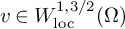






Remark 6.2.
-
(1) Let us stress once more that, with point (ii), we recover a property which is not true for general configurations of
$\widehat {\mathcal {A}}(\Omega )$
. -
(2) Substituting
$2^{(2-p)k}$
to
$2^{k/2}$
in the proof of Step 3 below, we can establish that
$v\in W^{1,p}_{\text {loc}}(\Omega )$
for
$1<p<2$
. However, the constant degenerates as
$p\uparrow 2$
leading to a weaker version of equation (6.1) with
$ |h|^2 [\ln (1/|h|)]^2$
in place of
$ |h|^2 \ln (1/|h|)$
(see Remark 1.11).


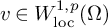


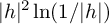
Proof of Proposition 6.1
Since the result is local, it is enough to prove it for
 $\omega $
a ball (we will only use the fact that
 $\omega $
is simply connected). Set
 $r:= \min \left (1/2,\operatorname {\mathrm {dist}}(\omega ,\mathbb {R}^2\backslash \Omega )/2\right )$
and
 $\omega ':= \omega +B_r\subset \subset \Omega $
(which is also simply connected). We fix in the proof a cutoff function
 $\zeta \in C^1_c(\Omega ,\mathbb {R}_+)$
supported in
 $\omega '$
and such that
 $\zeta \ge 1$
in
 $\omega $
.
We first introduce some notation.
-
(a) For every
$x\in \omega $
, we denote by
$\delta _h(x)$
the unique element of
$(-1,1]$
such that
$v(x+h)=e^{i\pi \delta _h(x)}v(x)$
. -
(b) For
$k\ge 0$
, we define
$$\begin{align*}\omega_k:=\left\{x\in\omega : \dfrac12<2^k|\delta_h(x)|\le1\right\}. \end{align*}$$
-
(c) For positive odd integers n and
$x\in \omega $
, we define (recall Definition 1.7 of the trigonometric entropies
$\Phi ^n$
)
$$\begin{align*}q_n(x):=\dfrac1{2i}\dfrac1{(n-1)^2(n+1)^2} \left[D_h\left[\Phi^{n}(\sigma(v))\right](x)\right]\wedge\left[D_h\left[\Phi^{-n}(\sigma(v))\right](x)\right]. \end{align*}$$
-
(d) For
$k\ge 0$
and
$x\in \omega $
, we set
$$\begin{align*}Q_k(x):=\sum_{m=2^k}^{2^{k+1}-1}q_{2m+1}(x). \end{align*}$$
-
(e) Eventually, for
$k\ge 0$
, we define the quantities (In this formula, the quantity
$$\begin{align*}\mathcal{Q}_k:=\int_{\Omega} Q_k\zeta^2. \end{align*}$$
$Q_k(x)$
is arbitrary for
$x\in \Omega \backslash \omega $
(say
$Q_k(x)=0$
). This makes no difference since
$\operatorname {\mathrm {supp}}\zeta \subset \omega $
.)
-
(f) In this proof, we use the notation
$A\lesssim B$
to indicate that there is a universal constant
$C\ge 0$
such that
$A\le C B$
.





We split the proof into four steps. In the first two steps, we obtain bounds on the quantities
 $\mathcal {Q}_k$
from below and then from above. In Step 3, we multiply these bounds by
 $2^{k/2}$
and sum over
 $k\ge 0$
. Using Hölder and sending
 $|h|$
to
 $0$
leads to
 $v\in W^{1,3/2}(\omega )$
. This establishes point (i) of the lemma. By Lemma 3.4, we then get
 $\operatorname {\mathrm {\mathbf {\widehat {curl}}}} v=0$
, which is equation (ii). In the last step, we sum the bounds of Steps 1 and 2 over
 $k\in \{0,\dots ,k_0\}$
where
 $k_0:=\lceil \log _2(1/|h|)\rceil $
. Using
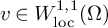 $v\in W^{1,1}_{\text {loc}}(\Omega )$
, we obtain equation (6.1).
Step 1. Lower bound. We notice that since
 $\Phi ^{\pm (2m+1)}\in \mathrm {ENT}_{\mathrm {ev}}$
, we have
 $$\begin{align*}\Phi^{\pm(2m+1)}(\sigma(\xi e^{2i\varphi}))=\Phi^{\pm(2m+1)}(\sigma(\xi)e^{i\varphi})\qquad\text{for any }\xi\in\mathbb{S}^1,\ \varphi\in\mathbb{R}. \end{align*}$$
In particular, for
 $x\in \omega $
and
 $m\ge 1$
 $$\begin{align*}\Phi^{\pm(2m+1)}\left(\sigma(v(x+h))\right)= \Phi^{\pm(2m+1)}\left(e^{i(\pi/2)\delta_h(x)}\sigma(v(x))\right). \end{align*}$$
With this in mind, we apply equation (4.6) of Lemma 4.4 with
 $n=2m+1$
,
 $m\ge 1$
and
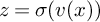 $z=\sigma (v(x))$
,
 $w=\sigma (v(x+h))=e^{i(\pi /2)\delta _h(x)}\sigma (v(x))$
. We get in
 $\omega $
 $$ \begin{align*} q_{2m+1}&=\dfrac{\left|e^{i\pi m\delta_h}-1\right|{}^2}{4m^2} - \dfrac{\left|e^{i\pi (m+1)\delta_h}-1\right|{}^2}{4(m+1)^2}\\ &=\dfrac{\sin^2\left(m(\pi/2)\delta_h\right)}{m^2} - \dfrac{\sin^2\left((m+1)(\pi/2)\delta_h\right)}{(m+1)^2}. \end{align*} $$
Summing these identities for m ranging over
 $\{2^k,\dots ,2^{k+1}-1\}$
, we get for
 $k\ge 0$
 $$\begin{align*}Q_k =\dfrac{\sin^2\left((\pi/2)2^k\delta_h\right)}{2^{2k}}-\dfrac{\sin^2\left((\pi/2)2^{k+1}\delta_h\right)}{2^{2(k+1)}} =\dfrac1{2^{2k}}\left(\sin^2\theta-\dfrac14\sin^2(2\theta)\right), \end{align*}$$
with
 $\theta :=(\pi /2)2^k\delta _h$
. Using
 $\sin (2\theta )=2\sin \theta \cos \theta $
and
 $1-\cos ^2\theta =\sin ^2\theta $
, we obtain
 $$\begin{align*}Q_k=\dfrac1{2^{2k}}(\sin^2\theta-\sin^2\theta\,\cos^2\theta)=\dfrac{\sin^4\theta}{2^{2k}} =\dfrac{\sin^4\left((\pi/2)2^k\delta_h\right)}{2^{2k}}. \end{align*}$$
For
 $x\in \omega _k$
, we have
 $1\ge 2^k|\delta _h(x)|>1/2$
; hence, since
 $|\sin \theta |\ge (2/\pi )|\theta |$
for
 $|\theta |\le \pi /2$
,
 $$\begin{align*}Q_k\ge \dfrac1{2^{2k}}\left|2^k\delta_h\right|{}^4 =2^{2k}|\delta_h|^4\gtrsim |\delta_h|^2. \end{align*}$$
Multiplying by
 $\zeta ^2$
and integrating over
 $\Omega $
, we obtain
 $$ \begin{align} \mathcal{Q}_k \,\gtrsim\, \int_{\omega_k}|\delta_h|^2 \zeta^2\,. \end{align} $$
Step 2. Upper bound. Let
 $m\ge 1$
, since by assumption
 $\nabla \cdot [\Phi ^{-(2m+1)}(\sigma (v))]=0$
in the simply connected domain
 $\omega '\subset \subset \Omega $
, there exists
 $F^m\in \operatorname {\mathrm {Lip}}(\omega ',\mathbb {C})$
such that
 $\nabla ^{\perp } F^m=\Phi ^{-(2m+1)}(\sigma (v))$
. Using an integration by parts and
 $\nabla \cdot [\Phi ^{2m+1}(\sigma (v))]=0$
, we compute for
 $m\ge 1$
 $$ \begin{align} \int_\Omega q_{2m+1}\zeta^2 &= \dfrac1{4m^2(m+1)^2} \int_\Omega \left[D_h\nabla^\perp F^m\right]\wedge \left[D_h\Phi^{2m+1}(\sigma(v))\right]\zeta^2 \nonumber\\ &= -\dfrac1{4m^2(m+1)^2} \int_\Omega \left[\nabla D_hF^m\right] \cdot \left[D_h\Phi^{2m+1}(\sigma(v))\right]\zeta^2 \nonumber\\ &=\dfrac1{2m^2(m+1)^2} \int_\Omega D_hF^m \left[D_h\Phi^{2m+1}(\sigma(v))\right]\cdot [\zeta\ \nabla \zeta]. \end{align} $$
(To make the argument rigorous, we first regularize
 $\Phi ^{-2m-1}(\sigma (v))$
, perform the integration by parts and pass to the limit.)
Let us recall the identities (4.3). We have, for
 $\theta \in \mathbb {R}$
,
 $$ \begin{align*} \left\|\Phi^{\pm(2m+1)}(e^{i\theta})\right\|_{\ell^2(\mathbb{C}^2)}&=2 \sqrt{(2m+1)^2+1}\le 4(m+1),\\ \left\|\frac d{d\theta}\left[\Phi^{\pm(2m+1)}(e^{i\theta})\right]\right\|_{\ell^2(\mathbb{C}^2)}&=8m(m+1). \end{align*} $$
In particular, for
 $x\in \omega '$
,
 $$\begin{align*}\left\|\nabla F^m(x)\right\|_{\ell^2(\mathbb{C}^2)}=\left\|\Phi^{2m+1}(\sigma(v(x)))\right\|_{\ell^2(\mathbb{C}^2)}\lesssim m. \end{align*}$$
We use these bounds in the form
 $$\begin{align*}\left\|D_hF^m(x)\right\|_{\ell^2(\mathbb{C}^2)}\lesssim m |h|,\qquad\quad \left\|D_h\Phi^{2m+1}(\sigma(v))\right\|_{\ell^2(\mathbb{C}^2)}\lesssim m \min\left(1,m|\delta_h|\right). \end{align*}$$
Using these inequalities to estimate the right-hand side of equation (6.3), we get
 $$\begin{align*}\int_{\Omega} q_{2m+1}\zeta^2\, \lesssim\dfrac{|h|}{m^2} \int_{\Omega} \min\left(1,m|\delta_h|\right)\zeta |\nabla \zeta|\,. \end{align*}$$
Summing over
 $m\in \{2^k,\dots ,2^{k+1}-1\}$
, we obtain
 $$ \begin{align} \mathcal{Q}_k=\int_{\Omega} \,\sum_{m=2^k}^{2^{k+1}-1} q_{2m+1}\zeta^2 \lesssim \dfrac{|h|}{2^k} \int_{\Omega} \min\left(1,2^k|\delta_h|\right)\zeta |\nabla \zeta|\,. \end{align} $$
Step 3. Proof of equations (i) and (ii).
Multiplying equations (6.2) and (6.4) by
 $2^{k/2}$
and summing over
 $k\ge 0$
, we obtain
 $$\begin{align*}\sum_{k\ge0} \int_{\omega_k} 2^{k/2}|\delta_h|^2 \zeta^2\,\lesssim\, \sum_{k\ge0} 2^{k/2}\mathcal{Q}_k\,\lesssim\, |h| \int_{\Omega} \left[\sum_{k\ge0}\dfrac1{2^{k/2}} \min\left(1,2^k|\delta_h|\right)\right]\zeta |\nabla \zeta|\,. \end{align*}$$
We use again
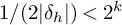 $1/(2|\delta _h|)<2^k$
in
 $\omega _k$
to estimate the left-hand side from below. We get
 $$ \begin{align} \int_{\Omega} |\delta_h|^{3/2} \zeta^2\,\lesssim\, |h| \int_{\Omega} \left[\sum_{k\ge0}\dfrac1{2^{k/2}} \min\left(1,2^k|\delta_h|\right)\right]\zeta |\nabla \zeta|\,. \end{align} $$
We now estimate the right-hand side. For
 $K\ge 0$
, we have in
 $\omega _K$
 $$\begin{align*}\sum_{k\ge0}\dfrac1{2^{k/2}} \min\left(1,2^k|\delta_h|\right)\lesssim \pi\sum_{k=0}^K 2^{k/2}|\delta_h| +\sum_{k>K} 2^{-k/2} \lesssim |\delta_h| 2^{K/2} +2^{-K/2} \lesssim |\delta_h|^{1/2} \end{align*}$$
where in the last inequality we used that
 $2^{-(K+1)}\le |\delta _h|\le 2^{-K}$
in
 $\omega _K$
.
Plugging this estimate in (6.5) and dividing by
 $|h|^{3/2}$
, we obtain
 $$\begin{align*}\int_{\Omega} \left(\dfrac{|\delta_h|}{|h|}\right)^{3/2}\zeta^2\,\lesssim \int_{\Omega}\left(\dfrac{|\delta_h|}{|h|}\right)^{1/2}\zeta|\nabla\zeta|\,. \end{align*}$$
Applying Hölder inequality with parameters
 $p=3$
,
 $q=3/2$
to the functions
 $f=\left (|\delta _h|/|h|\right )^{1/2}\zeta ^{2/3}$
and
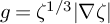 $g=\zeta ^{1/3}|\nabla \zeta |$
and simplifying, we get
 $$\begin{align*}\left(\int_{\Omega} \left(\dfrac{|\delta_h|}{|h|}\right)^{3/2}\zeta^2\,\right)^{2/3}\,\lesssim \left(\int_{\Omega}\zeta^{1/2}|\nabla\zeta|^{3/2}\,\right)^{2/3}. \end{align*}$$
Using that
 $|D_hv|\le \pi |\delta _h|$
, and a standard characterization of Sobolev spaces, we deduce that
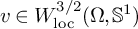 $v\in W^{3/2}_{\text {loc}}(\Omega ,\mathbb {S}^1)$
with the estimate
 $$\begin{align*}\left(\int_{\Omega} |\nabla v|^{3/2}\zeta^2\,\right)^{2/3}\,\lesssim \left(\int_{\Omega}\zeta^{1/2}|\nabla\zeta|^{3/2}\,\right)^{2/3}. \end{align*}$$
Point (i) of the Lemma is established. As already explained at the beginning of this proof, since v is a zero-state point (ii) then follows from Lemma 3.4.
Step 4. Proof of equation (iii).
Let
 $k_0:=\lceil \log _2(1/|h|)\rceil $
, that is
 $k_0$
is the integer defined by
 $1/2 < 2^{k_0} |h| \le 1$
. Since
 $|h|\le 1/2$
, we have
 $k_0\ge 1$
. Summing equations (6.2) and (6.4) over
 $k\in \{0,\dots ,k_0-1\}$
, we get
 $$ \begin{align} \sum_{k=0}^{k_0-1} \int_{\omega_k} |\delta_h|^2 \zeta^2\,\lesssim\, \sum_{k=0}^{k_0-1} \mathcal{Q}_k\,\lesssim\, |h| \int_{\Omega} \left[\sum_{k=0}^{k_0-1}\dfrac1{2^{k}} \min\left(1,2^k|\delta_h|\right)\right]\zeta |\nabla \zeta|\,. \end{align} $$
We proceed as in Step 3 to estimate the right-hand side. Let us fix
 $K\ge 0$
, we estimate the sum in brackets in
 $\omega _K$
as follows
 $$ \begin{align*} \sum_{k=0}^{k_0-1}\dfrac1{2^{k}} \min\left(1,2^k|\delta_h|\right) &\lesssim \sum_{k=0}^{\min(k_0,K)-1} |\delta_h|+ \sum_{k=\min(k_0,K)}^{k_0} \dfrac1{2^{k}}\\ &\lesssim \, k_0 |\delta_h| + 2^{-K} \lesssim \, ( k_0 + 1) |\delta_h| \lesssim\, |\delta_h| \ln(1/|h|). \end{align*} $$
In the last two inequalities, we used
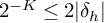 $2^{-K}\le 2|\delta _h|$
in
 $\omega _K$
and
 $1\le k_0\le \log _2(1/|h|)$
. Putting this inequality in (6.6), we obtain
 $$\begin{align*}\sum_{k=0}^{k_0-1} \int_{\omega_k} |\delta_h|^2 \zeta^2\,\lesssim\, |h| \ln(1/|h|) \int_{\Omega} |\delta_h|\,\zeta |\nabla \zeta|\,. \end{align*}$$
Using
 $|\delta _h| \le 2 |D_h v|$
and recalling that by Step 3,
 $v\in W^{1,3/2}_{\text {loc}}(\Omega )\subset W^{1,1}_{\text {loc}}(\Omega )$
, we deduce
 $$ \begin{align}\sum_{k=0}^{k_0-1} \int_{\omega_k} |\delta_h|^2 \zeta^2\,\le C |h|^2 \ln(1/|h|), \end{align} $$
where
 $C>0$
only depends on
 $\zeta $
.
Eventually, for
 $k\ge k_0$
and
 $x\in \omega _k$
we have
 $|\delta _h(x)|\le 2^{-k_0}\le 2 |h|$
so that
 $$\begin{align*}\sum_{k\ge k_0} \int_{\omega_k} |\delta_h|^2 \zeta^2\,\lesssim |h|^2 \int_{\Omega} \zeta^2. \end{align*}$$
Together with equation (6.7) (and
 $|h|\le 1/2$
) this leads to
 $$\begin{align*}\int_{\Omega} |\delta_h|^2 \zeta^2 \,\le C |h|^2 \ln(1/|h|). \end{align*}$$
Since
 $|D_h v|\le \pi |\delta _h|$
, we conclude the proof of equation (6.1).
Before going further into the proof, let us state the analogue of Proposition 6.1 for classical zero-states.
Proposition 6.3. Let
 $\Omega $
be an open set and
 $u\in L^1_{\text {loc}}(\Omega ,\mathbb {S}^1)$
be a classical zero-state, that is,
 $\mu _{\Phi ^n}[u]=0$
for
 $n\in \mathbb {Z}$
. Then
 $u \in W^{1,3/2}_{\text {loc}}(\Omega )$
, and for every open set
 $\omega \subset \subset \Omega $
, there exists
 $C=C(\omega ,\Omega )\ge 0$
such that for every
 $h\in \mathbb {R}^2$
with
 $\displaystyle |h|\le \min \left (1/2,\operatorname {\mathrm {dist}}(\omega ,\mathbb {R}^2\backslash \Omega )/2\right )$
,
 $$ \begin{align} \int_{\omega} |D_h u|^2 \le C |h|^2 \ln(1/|h|). \end{align} $$
Proof. Let us first notice that
 $v:=u^2\in \widehat {\mathcal {A}}_0(\Omega )$
so that Proposition 6.1 provides
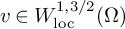 $v\in W^{1,3/2}_{\text {loc}}(\Omega )$
and a control on
 $|D_hv|$
of the form (6.1). In order to conclude, we only have to establish that for any simply connected open set
 $\omega \subset \subset \Omega $
and any
 $h\in \mathbb {R}^2$
such that
 $|h|\le \min \left (1/2,\operatorname {\mathrm {dist}}(\omega ,\mathbb {R}^2\backslash \Omega )/2\right )$
there holds
 $$ \begin{align} \mathcal{L}^2(A_h\cap\omega) \le C(\omega) |h|^2\qquad\text{ where }\qquad A_h:=\left\{x\in \Omega : \ |D_h u(x)|>\sqrt{2}\right\}. \end{align} $$
Indeed, assuming equation (6.9), we have for every
 $p>0 \ \zeta \in C^1_c(\Omega ,\mathbb {R}_+)$
and
 $h\in \mathbb {R}^2$
with
 $\displaystyle |h|\le \min \left (1/2,\operatorname {\mathrm {dist}}(\operatorname {\mathrm {supp}} \zeta ,\mathbb {R}^2\backslash \Omega )/2\right )$
,
 $$\begin{align*}\int_{\Omega} |D_h u|^p\zeta^2\,= \int_{A_h} |D_h u|^p \zeta^2\,+\int_{\Omega\backslash A_h} |D_h u|^p\zeta^2\,\le C(\zeta) |h|^2 + 2^{-p/2}\int_{\Omega} |D_h v|^p\zeta^2. \end{align*}$$
Here, we used equation (6.9) and
 $\sqrt 2|D_hu|\le |D_h v|$
in
 $\Omega \backslash A_h$
. Choosing
 $p=3/2$
and using
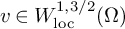 $v\in W^{1,3/2}_{\text {loc}}(\Omega )$
, we deduce
 $$\begin{align*}\int_{\Omega} |D_h u|^{3/2}\zeta^2 \le C(\zeta) |h|^{3/2}\qquad\text{for }h\in \mathbb{R}^2\text{ with }|h|\text{ small enough}, \end{align*}$$
and we conclude that
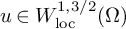 $u\in W^{1,3/2}_{\text {loc}}(\Omega )$
. Similarly, choosing
 $p=2$
, equation (6.1) yields equation (6.8).
Let
 $\omega \subset \subset \Omega $
be an open ball, let
 $\zeta \in C^1_c(\omega ,\mathbb {R}_+)$
and let
 $h\in \mathbb {R}^2$
with
 $$\begin{align*}|h|\le\operatorname{\mathrm{dist}}(\omega,\mathbb{R}^2\backslash\Omega)/2. \end{align*}$$
To establish equation (6.9), we proceed as in the proof of Proposition 6.1 but using the pair of Jin–Kohn entropies
 $\Phi ^{\pm 2}$
(the first computations below correspond to the beginning of the proof of [Reference Lamy, Lorent and PengLLP20, Lemma 7] rewritten with our notation). Let us set
 $$\begin{align*}q_2(x):=\dfrac1{18\,i} \left[D_h\left[\Phi^{2}(u)\right](x)\right]\wedge\left[D_h\left[\Phi^{-2}(u)\right](x)\right]. \end{align*}$$
On the one hand, from equation (4.6) and elementary calculus,Footnote 1 we have
 $$ \begin{align} \int_{\Omega} q_2\zeta^2 =\int_{\Omega}\left(\left|D_h u\right|{}^2 - \dfrac{\left|D_h [u^3]\right|{}^2}{9}\right)\zeta^2\, \ge\dfrac89 \int_{\Omega}\left|D_h u\right|{}^4\zeta^2\, \ge\dfrac{32}9 \int_{A_h} \zeta^2\,. \end{align} $$
On the other hand, using
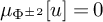 $\mu _{\Phi ^{\pm 2}}[u]=0$
we get, as in the proofs of Proposition 6.1 or of equation (1.18),
 $$\begin{align*}\int_{\Omega} q_2\zeta^2 \le C\,|h|\int_{\Omega} |D_hu| \zeta\, =C\,|h|\int_{A_h\cup [\Omega\backslash A_h]} \!|D_hu|\zeta\, \le C'\left(|h|\left(\int_{A_h} \zeta^2\,\right)^{1/2} +|h|^2\right), \end{align*}$$
with
 $C,C'\ge 0$
depending on
 $\zeta $
. In the last estimate, we used the Cauchy–Schwarz inequality and
 $\sqrt 2|D_hu|\le |D_h v|$
in
 $\Omega \backslash A_h$
with
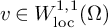 $v\in W^{1,1}_{\text {loc}}(\Omega )$
. With equation (6.10), we obtain
 $\int _{A_h} \zeta ^2\le C(\zeta )|h|^2$
and then equation (6.9) thanks to a covering argument.
We now return to the proof of Theorem 1.2 and show that equation (6.1) translates into a local control of the Ginzburg–Landau energy of any mollification of v. To this aim, we fix
 $\rho \in C^{\infty }_c(\mathbb {R}^2,\mathbb {R}_+)$
with
 $\int \rho =1$
and for
 $\eta \in (0,1/2]$
, we set
 $\rho _{\eta }:=\eta ^{-2}\rho (\eta ^{-1}\cdot )$
and
 $v_{\eta }:=v*\rho _{\eta }$
.
Lemma 6.4. Let
 $\Omega $
be an open set, and let
 $v\in L^1_{\text {loc}}(\Omega ,\mathbb {S}^1)$
such that the conclusion (iii) of Proposition 6.1 holds true. Then, for every open set
 $\omega \subset \subset \Omega $
, there exists
 $C=C(\omega ,\Omega )\ge 0$
such that for
 $\eta \in (0,1/2]$
with
 $\eta \le \operatorname {\mathrm {dist}}(\omega ,\mathbb {R}^2\backslash \Omega )/4$
 $$ \begin{align} \operatorname{\mathrm{GL}}_{\eta}(v_{\eta};\omega):=\dfrac12\int_{\omega} |\nabla v_{\eta}|^2 + \dfrac1{4\eta^2} \int_{\omega} (1-|v_{\eta}|^2)^2 \,\le\, C \ln(1/\eta). \end{align} $$
Proof. For the reader’s convenience, we recall some classical computations (see for instance [Reference De Lellis and IgnatDLI15, Reference Lorent and PengLP18]). We first compute for
 $x\in \omega $
 $$ \begin{align*} \nabla v_{\eta}(x)&=\int_{B_{\eta}} v(x-y)\nabla \rho_{\eta}(y)\, dy = \int_{B_{\eta}} [v(x-y)-v_{\eta}(x)]\nabla \rho_{\eta}(y)\, dy\\ &=\int_{B_{\eta}\times B_{\eta}} [v(x-y)-v(x-z)]\nabla \rho_{\eta}(y)\, \rho_{\eta}(z) \,dy\, dz, \end{align*} $$
where we used
 $\int \nabla \rho _{\eta }=0$
. We deduce the estimate
 $$\begin{align*}|\nabla v_{\eta}(x)|\le \frac{C}{\eta^3} \int_{B_{\eta}} \int_{B_{\eta}} |v(x-y)-v(x-z)|\rho_{\eta}(z)\, dz\, dy. \end{align*}$$
Squaring, integrating on
 $\omega $
, using Jensen inequality and Fubini, we obtain
 $$\begin{align*}\int_{\omega} |\nabla v_{\eta}|^2 \le \dfrac {C}{\eta^4} \int_{B_{\eta}} \int_{\omega+B_{\eta}} |v(y)-v(y-h)|^2\, dy\, dh. \end{align*}$$
Using equation (6.1) from Proposition 6.1 (iii), we get
 $$ \begin{align} \int_{\omega} |\nabla v_{\eta}|^2 \le C \ln(1/\eta). \end{align} $$
Next, since v takes values in
 $\mathbb {S}^1$
, we have for
 $x\in \omega $
,
 $$ \begin{align*} 0\le 1-|v_{\eta}(x)|^2 &= \int_{B_{\eta}\times B_{\eta}} \left(1-v(x-y)\overline v(x-z)\right)\rho_{\eta}(y)\rho_{\eta}(z)\, dy\, dz\\ &=\dfrac12 \int_{B_{\eta}\times B_{\eta}}\left |v(x-y)-v(x-z)\right|{}^2\rho_{\eta}(y)\rho_{\eta}(z)\, dy\, dz, \end{align*} $$
where we used the trigonometric formulas
 $1-\cos \theta =2\sin ^2(\theta /2)=(1/2)|1-e^{i\theta }|^2$
. Integrating over
 $\omega $
, using Jensen inequality, Fubini and equation (6.1) as above, we get
 $$\begin{align*}\int_{\omega} (1-|v_{\eta}|^2)^2\le C \eta^2 \ln(1/\eta). \end{align*}$$
We may now prove Theorem 1.2, which we restate in terms of v. We set
 $u^*(x):= (x_1+ix_2)/|x|$
.
Theorem 6.5. For each
 $v\in \widehat {\mathcal {A}}_0(\Omega )$
, there holds
 $\operatorname {\mathrm {\mathbf {\widehat {curl}}}} v=0$
and there exists a locally finite set
 $S\subset \Omega $
such that:
-
(i) v is locally Lipschitz continuous in
$\Omega \backslash S$
, -
(ii) For
$x\in \Omega \backslash S$
,
$v=v(x)$
on the connected component of
$[x+\mathbb {R}\boldsymbol \sigma (v(x))]\cap [\Omega \backslash S]$
which contains x. -
(iii) For every
$B=B_r(x^0)$
such that
$2B:=B_{2r}(x^0)\subset \Omega $
and
$2B\cap S=\{x^0\}$
-
(a) either
$v(x)=(u^*)^2(x-x^0)$
in
$B\backslash \{x^0\}$
, -
(b) or there exists
$ \boldsymbol {\xi }\in \mathbb {S}^1$
such that-
∘
$v(x)=(u^*)^2(x-x^0)$
in
$\displaystyle \left \{x\in B\backslash \{x^0\} : (x-x^0)\cdot \boldsymbol {\xi }\ge 0\right \}$
, -
∘ v is Lipschitz continuous in
$\displaystyle \left \{x\in B\backslash \{x^0\}: (x-x^0)\cdot \boldsymbol {\xi }\le 0\right \}$
.
-
-



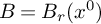







Remark 6.6. We can deduce the structure of zero-states in the classical setting by proceeding as in the proof below using Proposition 6.3, Lemma 6.4 and (more) simple geometric arguments. This provides an alternative proof of the main results of [Reference Jabin, Otto and PerthameJOP02].
Proof of Theorem 6.5 (Theorem 1.2)
The fact that
 $\operatorname {\mathrm {\mathbf {\widehat {curl}}}} v=0$
is established in equation (ii) of Proposition 6.1 so we only need to prove (i)–(iii).
Step 1. Identification of the singular set. By equation (6.11) of Lemma 6.4 and [Reference Alicandro and PonsiglioneAP14, Theorem 4.1], the Jacobians
 $\operatorname {\mathrm {curl}} (v_{\eta } \wedge \nabla v_{\eta })$
locally weakly converge as
 $\eta \downarrow 0$
(for the flat norm) to a measure
 $\mu =2\pi \sum _{i} z_i \delta _{x_i}$
with
 $z_i\in \mathbb {Z}$
. Moreover, for every
 $\omega \subset \subset \Omega $
, there exists
 $C,C'\ge 0$
depending on
 $\omega $
and
 $\Omega $
such that
 $$\begin{align*}|\mu|(\omega)\le C \limsup_{\eta\downarrow0}\frac{\operatorname{\mathrm{GL}}_{\eta}(v_{\eta};\omega)}{\ln(1/\eta)} \stackrel{(6.11)}{\le} C'. \end{align*}$$
Therefore, the sum is locally finite. From equation (i) of Proposition 6.1,
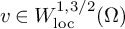 $v\in W^{1,3/2}_{\text {loc}}(\Omega )$
; hence,
 $\nabla v_{\eta }$
converges strongly in
 $L^{3/2}_{\text {loc}}(\Omega )$
to
 $\nabla v$
and
 $v_{\eta }$
converges strongly in
 $L^6_{\text {loc}}(\Omega )$
to v so that
 $v_{\eta } \wedge \nabla v_{\eta }$
converges to
 $v\wedge \nabla v$
in
 $L^1_{\text {loc}}(\Omega )$
. Hence,
 $\mu =\operatorname {\mathrm {curl}} (v\wedge \nabla v)$
. We set
 $$\begin{align*}S:=\operatorname{\mathrm{supp}} \mu \backslash\{x\in\Omega : v\text{ is continuous in some neighborhood of }x\}. \end{align*}$$
Step 2. Local Lipschitz regularity of v in
 $\Omega \backslash S$
.
Let
 $B=B_r(x)$
be an open ball such that
 $2B\subset \subset \Omega $
and
 $v_{|2B}\in C(2B,\mathbb {S}^1)$
or
 $2B\subset \subset \Omega \backslash \operatorname {\mathrm {supp}}\mu $
. Let us show that
 $v=e^{i\varphi }$
in
 $2B$
for some
 $\varphi \in W^{1,1}(2B)$
. Indeed, on the one hand if
 $v_{|2B}\in C(2B,\mathbb {S}^1)$
, there exists a lifting
 $\varphi \in C(2B)$
such that
 $v= e^{i\varphi }$
in
 $2B$
and since
 $v\in W^{1,3/2}(2B)$
and
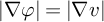 $|\nabla \varphi |=|\nabla v|$
, we have
 $\varphi \in W^{1,1}(2B)$
. On the other hand, if
 $2B\subset \subset \Omega \backslash \operatorname {\mathrm {supp}}\mu $
, since
 $v\in W^{1,3/2}(2B)$
and
 $\mu = \operatorname {\mathrm {curl}} (v\wedge \nabla v)=0$
on
 $2B$
, we can apply [Reference DemengelDem90, Reference Brezis, Mironescu and PonceBMP05] to get
 $\varphi \in W^{1,1}(2B)$
with
 $v= e^{i\varphi }$
in
 $2B$
.
We now set
 $\theta :=\varphi /2$
and
 $u:=e^{i\theta }$
so that
 $u^2=v$
with
 $u\in W^{1,1}(2B,\mathbb {S}^1)$
. From point (ii) of Proposition 6.1, we have
 $\operatorname {\mathrm {\mathbf {\widehat {curl}}}} v=0$
in
 $2B$
so that Lemma 2.1 (ii) implies
 $\operatorname {\mathrm {curl}} u=0$
. By the chain rule, this translates into
 $$ \begin{align} \boldsymbol{u}\cdot\nabla\theta=0\quad\text{almost everywhere in }2B. \end{align} $$
For
 $\lambda \in \mathbb {R}$
we define the level sets

By equation (6.13) and since
 $\theta \in W^{1,1}(2B)$
, for almost every
 $\lambda $
these sets have finite perimeter in
 $2B$
and the tangent on
 $\partial E_{\lambda }^{\pm }$
is collinear to
 $\boldsymbol e^{i\lambda }$
. Therefore,
 $E_{\lambda }^{\pm }$
is the intersection with
 $2B$
of a locally finite number of stripes parallel to
 $\boldsymbol e^{i\lambda }$
. Observing that for
 $\lambda _-\le \lambda _+$
the sets
 $E_{\lambda _-}^-$
and
 $E_{\lambda _+}^+$
do not intersect in
 $2B$
and taking into account the orientation of the stripes, we claim that for almost every
 $\lambda _-,\lambda _+$
with
 $\lambda _-<\lambda _+\le \lambda _-+\pi /2$
 $$ \begin{align} \operatorname{\mathrm{dist}}(E_{\lambda_-}^-\cap B, E_{\lambda_+}^+\cap B) \ge 2r\sin\left(\dfrac{\lambda_+-\lambda_-}2\right). \end{align} $$
Indeed, let
 $x_{\lambda _-}\in E_{\lambda _-}^-\cap B$
and
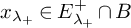 $x_{\lambda _+}\in E_{\lambda _+}^+\cap B$
, where
 $\lambda _-<\lambda _+\le \lambda _-+\pi /2$
. Since
 $E_{\lambda _-}^-$
is made of stripes parallel to
 $\boldsymbol e^{i\lambda _-}$
, the line segment

is contained in
 $E_{\lambda _-}^-$
(see Figure 3). Similarly,

. Since
 $\lambda _+\not \equiv \lambda _- \pmod {\pi }$
, the lines spanned by
 $L_{\lambda _-}$
and
 $L_{\lambda _+}$
intersect, and since
 $L_{\lambda _-}\cap L_{\lambda _+}\subset E_{\lambda _-}^-\cap E_{\lambda _+}^+=\varnothing $
they do not intersect in
 $2B$
. Minimizing
 $\operatorname {\mathrm {dist}}(L_{\lambda _-}\cap B,L_{\lambda _+}\cap B)$
under these constraints, the minimizer is given up to rotation by
 $$ \begin{align*} L_{\lambda_-} &= \left(x+\left[-2r+\mathbb{R} \boldsymbol e^{-\frac{i\beta}{2}}\right]\right)\cap 2B,\\ L_{\lambda_+} &= \left(x+\left[-2r+\mathbb{R} \boldsymbol e^{\frac{i\beta}{2}}\right]\right)\cap 2B, \end{align*} $$
with
 $\lambda _{\pm } = \pm \frac {\beta }{2}$
(see Figure 4). Is is then easy to see that
 $$ \begin{align} |x_{\lambda_-}-x_{\lambda_+}|\ge\operatorname{\mathrm{dist}}(L_{\lambda_-}\cap B, L_{\lambda_+}\cap B) \ge 2r\sin\left(\dfrac{\lambda_+-\lambda_-}2\right), \end{align} $$
hence the claim (6.14) by the arbitrariness of
 $x_{\lambda _-}\in E_{\lambda _-}^-\cap B$
and
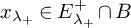 $x_{\lambda _+}\in E_{\lambda _+}^+\cap B$
.
Example of
 $E_{\lambda _-}^-$
(dashed region) and
 $L_{\lambda _-}$
.

As in equation (6.15)
 $d=\operatorname {\mathrm {dist}}(L_{\lambda _-}\cap B,L_{\lambda _+}\cap B)$
.

From equation (6.14), we deduce that
 $\theta $
admits a Lipschitz continuous representative in
 $ B$
with
 $\|\nabla \theta \|_{L^{\infty }(B)}\le 1/r$
. Therefore,
 $v=e^{2i\theta }$
admits a Lipschitz continuous representative in
 $\overline B$
with Lipschitz constant at most
 $2/r$
. Eventually, returning to equation (6.13), we see that for every
 $x\in B$
there holds
 $$\begin{align*}v=v(x)\quad\text{on }[x+\mathbb{R} \boldsymbol e^{i\theta(x)}]\cap B. \end{align*}$$
Equivalently,
 $$\begin{align*}v=v(x)\quad\text{on }[x+\mathbb{R}\boldsymbol \sigma(v(x))]\cap B. \end{align*}$$
We have established points (i) and (ii) of the theorem.
Step 3. Structure of v near the singularities. Let
 $x^0\in S$
and
 $r>0$
such that
 $2B=B_{2r}(x^0)\subset \subset \Omega $
with
 $2B\cap S=\{x^0\}$
. By translation and scaling, we assume that
 $B= B_1$
and we set
 $B':=B\backslash \{0\}$
,
 $2B':=2B\backslash \{0\}$
. Notice that by Step 2 and definition of S, v is continuous in
 $2B'$
and discontinuous at
 $0$
.
Step 3.a. Preliminaries. For
 $x\in 2B'$
, we denote by
 $L(x)$
the connected component of
 $[x+\mathbb {R}\boldsymbol \sigma (v(x))]$
in
 $2B'$
which contains x.
 $L(x)$
is an open segment in
 $\mathbb {R}^2$
with
 $L(x)\subset 2B'$
. There are two cases:
-
(a) Either
$2B'\backslash L(x)$
splits into two connected components. In this case, the two endpoints of
$L(x)$
lie on
$\partial (2B)$
; see Figure 5,Figure 5Case (a).
-
(b) or
$L(x)$
is a radius of the form
$(0,2 x/|x|)$
; see Figure 6.Figure 6Case (b).


For shortness, we denote
 $\xi (x):=\pm \sigma (v(x))$
where the sign is not important in case (a) but is chosen such that
 $\boldsymbol \xi (x)=x/|x|$
in case (b). With this notation,
 $L(x)$
is the connected component of
 $[x+\mathbb {R}\boldsymbol \xi (x)]$
in
 $2B'$
which contains x.
From Step 2, v is constant on
 $L(x)$
with value
 $(\xi )^2(x)$
. This has the following consequences:
-
1. If
$x,y\in 2 B'$
are such that
$L(x)$
and
$L(y)$
intersect, then
$v(x)=v(y)$
and
$L(x)=L(y)$
. -
2. If
$L(x)$
is of type (b), then
$v=(u^*)^2$
on
$L(x)$
.


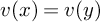
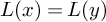


We use these properties repeatedly in the sequel with no further references.
Step 3.b. Construction of two radii of type (b). Let us establish the following.
 $$ \begin{align} \text{There exist }x^1, x^2\in B'\text{ with }L(x^j)\text{ of type (b) for }j=1,2 \text{ and }\xi(x^2)\ne\pm \xi(x^1). \end{align} $$
Since v is continuous in
 $B'$
and discontinuous at
 $0$
, there exist
 $\varepsilon>0$
and two sequences
 $(x_k^1)$
,
 $(x_k^2)$
converging to
 $0$
such that
 $|v(x^1_k)-v(x^2_k)|\ge \varepsilon $
for every
 $k\ge 1$
. Up to extraction, there exist
 $z^1, z^2\in \mathbb {S}^1$
with
 $|z^1-z^2|\ge \varepsilon $
such that
 $v(x^{j}_k)\to z^{j}$
for
 $j\in \{1,2\}$
. For the sequence of sets
 $(L(x^j_k))$
, we have
 $$\begin{align*}L(x^j_k) \to L^j\quad \text{in Hausdorff distance, for }j\in \{1,2\}, \end{align*}$$
where
 $L^j$
is one of the segments
 $(0,\pm 2\sigma (\boldsymbol z^j))$
or the union of these two segments. By continuity of v in
 $2B'$
, we have obtained two radii
 $L^1=(0,2\boldsymbol \xi ^1)$
,
 $L^2=(0,2\boldsymbol \xi ^2)$
with
 $\xi ^1, \xi ^2\in \mathbb {S}^1$
such that
 $v=(\xi ^j)^2=z^{j}$
on
 $L^j$
and with moreover
 $|(\xi ^2)^2- (\xi ^1)^2|\ge \varepsilon $
. In particular,
 $L^2\ne \pm L^1$
. Choosing
 $x^1\in L^1$
and
 $x^2\in L^2$
, the sets
 $L^1=L(x^1)$
,
 $L^2=L(x^2)$
are of type (b) with
 $x^1$
,
 $x^2$
not collinear. This proves claim (6.16).
Step 3.c. Behavior of v in convex sectors.
Let
 $L^1=L(x^1)$
,
 $L^2=L(x^2)$
be two radii with
 $x^1$
,
 $x^2$
as in equation (6.16). Let us denote by P the open convex sector in
 $2B'$
delimited by
 $L^1$
and
 $L^2$
. We claim that
 $$ \begin{align} v=(u^*)^2\quad\text{in }P. \end{align} $$
Let us notice that since
 $L^2\ne \pm L^1$
, the inner angle of P at 0 is strictly smaller than
 $\pi $
. Let
 $x\in P$
, and let us consider the sequence
 $(x_k)=(2^{-k}x)$
and the sequence of segments
 $(L(x_k))$
. Since the inner angle of P is smaller than
 $\pi $
, for k large enough
 $x_k$
belongs to the convex hull of
 $L^1\cup L^2$
, but
 $L(x_k)$
cannot intersect
 $L^1$
nor
 $L^2$
; thus, it is necessarily of type (b) (see Figure 7). Recalling that
 $x \in L(x_k)$
, we deduce
 $v(x)=(u^*)^2(x)$
on
 $L(x)=L(x_k)$
. This proves equation (6.17).
Figure 7

We now assume that P is the open sector of
 $2B'$
with maximal inner angle such that equation (6.17) holds true. We denote by
 $\alpha \in (0,2\pi ]$
this angle and if
 $\alpha <2\pi $
(so that
 $P\ne 2B'$
),
 $L^1$
and
 $L^2$
still denote its delimiting radii.
Step 3.d. The case
 $\alpha> \pi $
. If
 $\pi <\alpha <2\pi $
, then the complement of
 $\overline P$
in
 $2B'$
is a convex sector with inner angle strictly smaller than
 $\pi $
and delimited by the two radii
 $L^1$
,
 $L^2$
(see Figure 8). Since by continuity
 $v=(u^*)^2$
on
 $L^1$
and
 $L^2$
, we deduce from Step 3.c that
 $v=(u^*)^2\text { in }2B'\backslash \overline P$
. Hence,
 $v=(u^*)^2$
in
 $2B'$
which contradicts the maximality of P. In conclusion,
 $\alpha =2\pi $
and
 $v=(u^*)^2$
in
 $2B'$
. This corresponds to the case (a) of the point (iii) of the theorem.
Figure 8

Step 3.e. The case
 $\alpha < \pi $
. Let us assume
 $\alpha <\pi $
, and let us consider two sequences
 $(x^j_k)_{k\ge 1}\subset 2B'\backslash \overline P$
for
 $j\in \{1,2\}$
such that
 $|x_k^1|=|x_k^2|=1$
for every k and
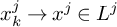 $x_k^j\to x^j\in L^j$
as
 $k\uparrow \infty $
.
Let us assume by contradiction that
 $L(x_k^j)$
is of type (b) (see Figure 9) for
 $j=1$
or
 $j=2$
. In this case, at least for k large enough we can apply Step 3.c. to the convex sector
 $Q_k$
generated by
 $x_k^j$
and
 $L^j$
, we have
 $v=(u^*)^2$
in
 $P\cup Q_k$
and since P and
 $Q_k$
have a common side this contradicts the maximality of P. Therefore, for
 $j=1$
and
 $j=2$
,
 $L(x_k^j)$
is of type (a) for k large enough (see Figure 10).
 $L(x_k^1)$
(or
 $L(x_k^2)$
) is of type (b). This contradicts the maximality of P.

Both radii
 $L(x_k^1)$
and
 $L(x_k^2)$
are of type (a). This contradicts
 $L(x_k^1)\cap L(x_k^2)=\varnothing $
.

Next, by continuity of v in
 $2B'$
, the segment
 $L(x_k^j)$
tends to be parallel to
 $L^j$
as
 $k\uparrow \infty $
and since
 $\alpha <\pi $
we see that
 $L(x_k^1)\cap L(x_k^2)\ne \varnothing $
for k large enough and thus
 $L(x_k^1)= L(x_k^2)$
. Passing to the limit we get
 $L^1=\pm L^2$
which gives a contradiction.
Step 3.f. The case
 $\alpha =\pi $
. In this last case, there exists
 $\xi \in \mathbb {S}^1$
such that
 $P=\{x\in B':\boldsymbol \xi \cdot x>0\}$
. Let us establish that this corresponds to the case (b) of the point (iii) of the theorem. By equation (6.17), we already know that
 $v=(u^*)^2$
in P and we only have to prove that v is Lipschitz continuous in
 $\{x\in B': x\cdot \boldsymbol \xi \le 0\}$
.
Let us set
 $Q:= \{x\in B: x\cdot \boldsymbol \xi <0\}$
. Let
 $x^1,x^2\in Q$
such that
 $v(x^1)\ne v(x^2)$
and
 $|v(x^1)-v(x^2)|<\sqrt {2}$
. Then there exist
 $\theta _1,\theta _2\in \mathbb {R}$
such that
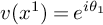 $v(x^1)=e^{i\theta _1}$
,
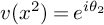 $v(x^2)=e^{i\theta _2}$
and
 $|\theta _1-\theta _2|<\pi /2$
. Since
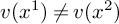 $v(x^1)\ne v(x^2)$
, necessarily
 $L(x^1)\cap L(x^2)=\varnothing $
, and since
 $v(x^1)\neq \pm v(x^2)$
the lines spanned by
 $L(x^1)$
and
 $L(x^2)$
intersect outside
 $2B$
. Hence, the constraints on
 $L(x^1)$
and
 $L(x^2)$
are the same as those on
 $L_{\lambda _-}$
and
 $L_{\lambda _+}$
in Step 2, with
 $\theta _1$
,
 $\theta _2$
in place of
 $\lambda _-$
,
 $\lambda _+$
. Recalling that
 $\operatorname {\mathrm {dist}}(L(x^1)\cap B,L(x^2)\cap B)$
is minimized in the situation of Figure 4, we find
 $$\begin{align*}|x^1-x^2|\ge \operatorname{\mathrm{dist}}(L(x^1)\cap B,L(x^2)\cap B) \ge 2\sin(|\theta_1-\theta_2|). \end{align*}$$
This implies that v is indeed Lipschitz continuous on Q. Eventually, by continuity of v in
 $B'$
we have that v is Lipschitz continuous in
 $\{x\in B': x\cdot \boldsymbol \xi \le 0\}$
.
Acknowledgments
M. Goldman was partially supported by the ANR grant SHAPO. B. Merlet and M. Pegon are partially supported by the Labex CEMPI (ANR-11- LABX-0007-01). S. Serfaty is supported by NSF grant DMS-2000205 and by the Simons Foundation through the Simons Investigator program.
Competing Interests
None.