Introduction
A mass gathering can be defined as an event where a group of people come together for a common purpose within a particular space or venue for a pre-determined range of dates and times. Examples of mass-gathering events (MGEs) include agricultural shows, music festivals, and sporting events. In a health context, an MGE can be defined as an event “where there is the potential for a delayed response to health emergencies because of limited access to patients or other features of the environment and location.”1 For many years, it has been widely argued that three domains influence the presentations of patients at MGEs: environmental, psychosocial, and biomedical.Reference Arbon2 An exploration began within the context of biomedicalReference Ranse and Hutton3 and environmentalReference Arbon, Bridgewater and Smith4 aspects of care; this paper takes the third step by examining reporting on the psychosocial aspects of MGEs, in relation to health outcomes.
Background
Although there are many descriptors and theories of crowd behavior, the psychosocial domain is the least understood of the three domains used to understand the potential drivers for injury and illness at MGEs.Reference Hutton, Zeitz, Brown and Arbon5 Psychosocial literature has traditionally focused on crowd behavior, mood, motivation, and event type, but also includes alcohol and other drugs and length/duration of event.Reference Arbon2,Reference Hutton, Ranse and Munn6 Measurement of the crowd-related variables is still one of the most difficult to measure due to their subjective nature.Reference Zeitz, Tan, Grief, Couns and Zeitz7,Reference Hutton, Munt, Zeitz, Cusack, Kako and Arbon8 Hutton, et alReference Hutton, Munt, Zeitz, Cusack, Kako and Arbon8 showed that through using subjective descriptors of crowd behavior, mood, and crowd type, a picture of activities during the event can be developed.Reference Hutton, Munt, Zeitz, Cusack, Kako and Arbon8 When described against the environmental backdrop of the event, behavior creates context for patient outcomes. For example, the music program at a music festival is a strong influence on behavior and should be considered as part of the psychosocial domain.Reference Whittemore and Knafl9,Reference Arbon, Bottema and Zeitz10 A comprehensive approach to psychosocial data collection would ideally encapsulate the types of variables discussed above.
Aim
This review aims to initiate a consistent data reporting standard for the psychosocial domain, including a set of variables for research and consideration for patient presentations at MGEs.
Methods
Design
This research used an integrated literature reviewReference Whittemore and Knafl9 to identify psychosocial factors that are reported in the MGE literature.
Search Strategy
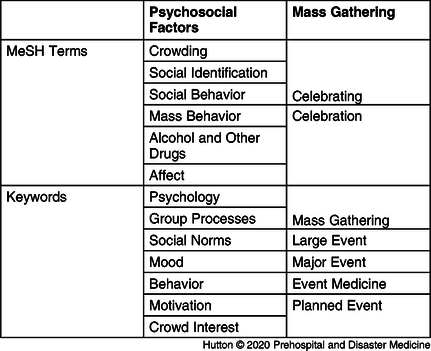
The search strategy included different combinations of Medical Subject Headings (MeSH) terms and keywords that are relevant to psychosocial factors and MGEs (Table 1). Terms and keywords in the columns were combined using the OR search strategy, while terms and keywords in the rows were combined using AND combinations. The papers were located through MEDLINE (US National Library of Medicine, National Institutes of Health; Bethesda, Maryland USA) database search.
MeSH Terms and Keywords

Abbreviation: MeSH, Medical Subject Headings.
Inclusion and Exclusion Criteria
All identified papers were assessed against the following inclusion and exclusion criteria. Inclusion criteria were: event-level data, written in English language, peer-reviewed journal, and published between 2003-2018. Exclusion criteria were: editorials, discussion papers, and theoretical papers. Determination of what literature to include and exclude was done between three authors: Ms. Gray, Professor Hutton, and Mr. Ranse.
Data Analysis
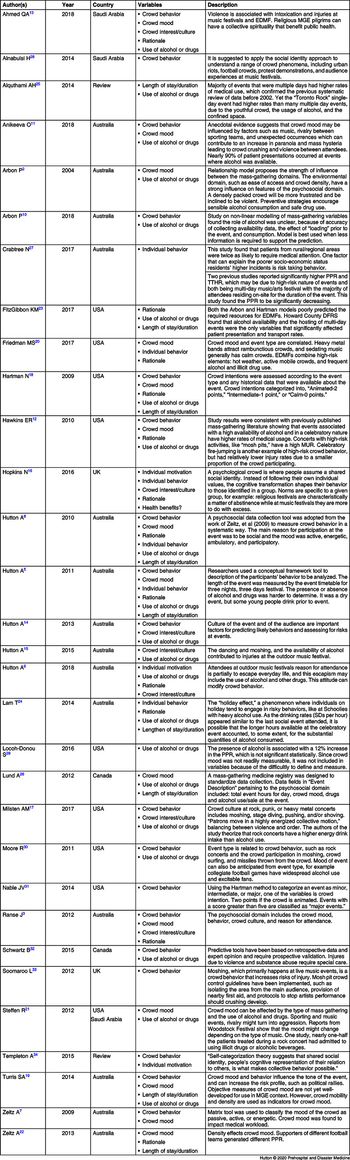
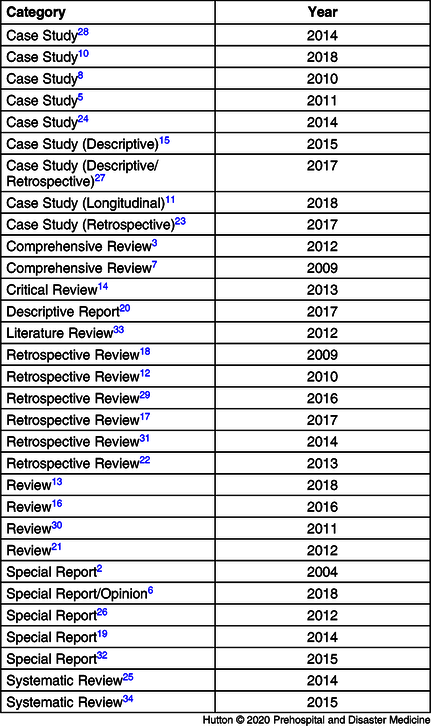
In order to determine psychosocial factors that influence patient presentation rates (PPRs) at mass gatherings, articles were grouped in a pragmatic manner (Table 2Reference Arbon2,Reference Ranse and Hutton3,Reference Hutton, Zeitz, Brown and Arbon5–Reference Hutton, Munt, Zeitz, Cusack, Kako and Arbon8,Reference Arbon, Bottema and Zeitz10–Reference Templeton, Drury and Philippides34 ).
Psychosocial Factors which Influence PPR at MGEs
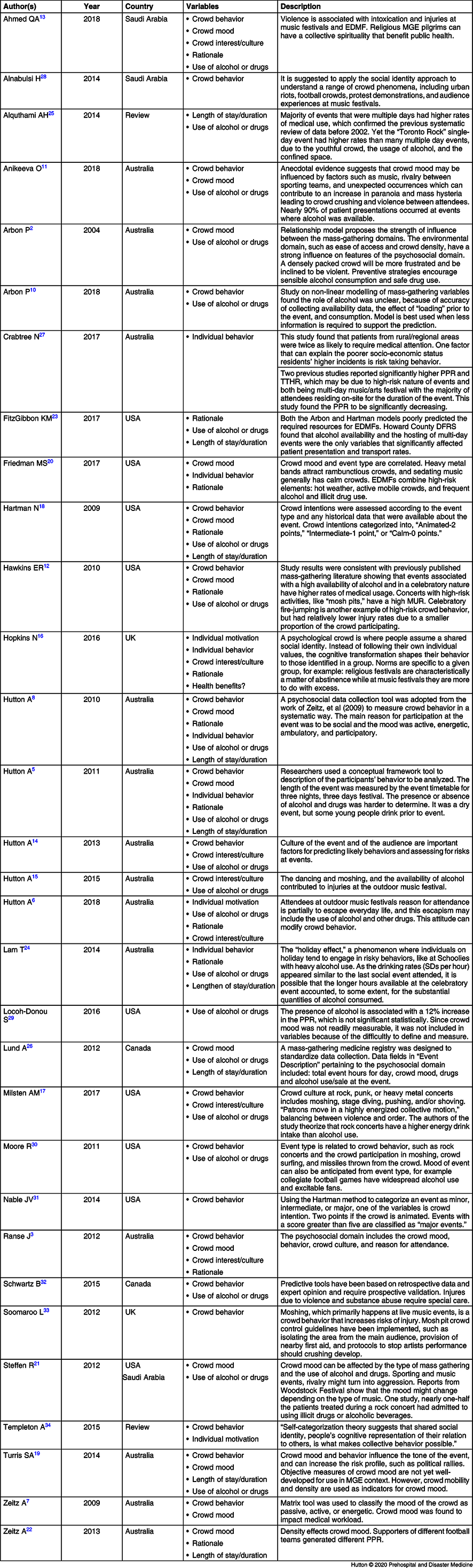
Abbreviations: EDMF, electronic dance music festival; MGE, mass-gathering event; MUR, medical usage rate; PPR, patient presentation rate; TTHR, transfer to hospital rate.
Findings
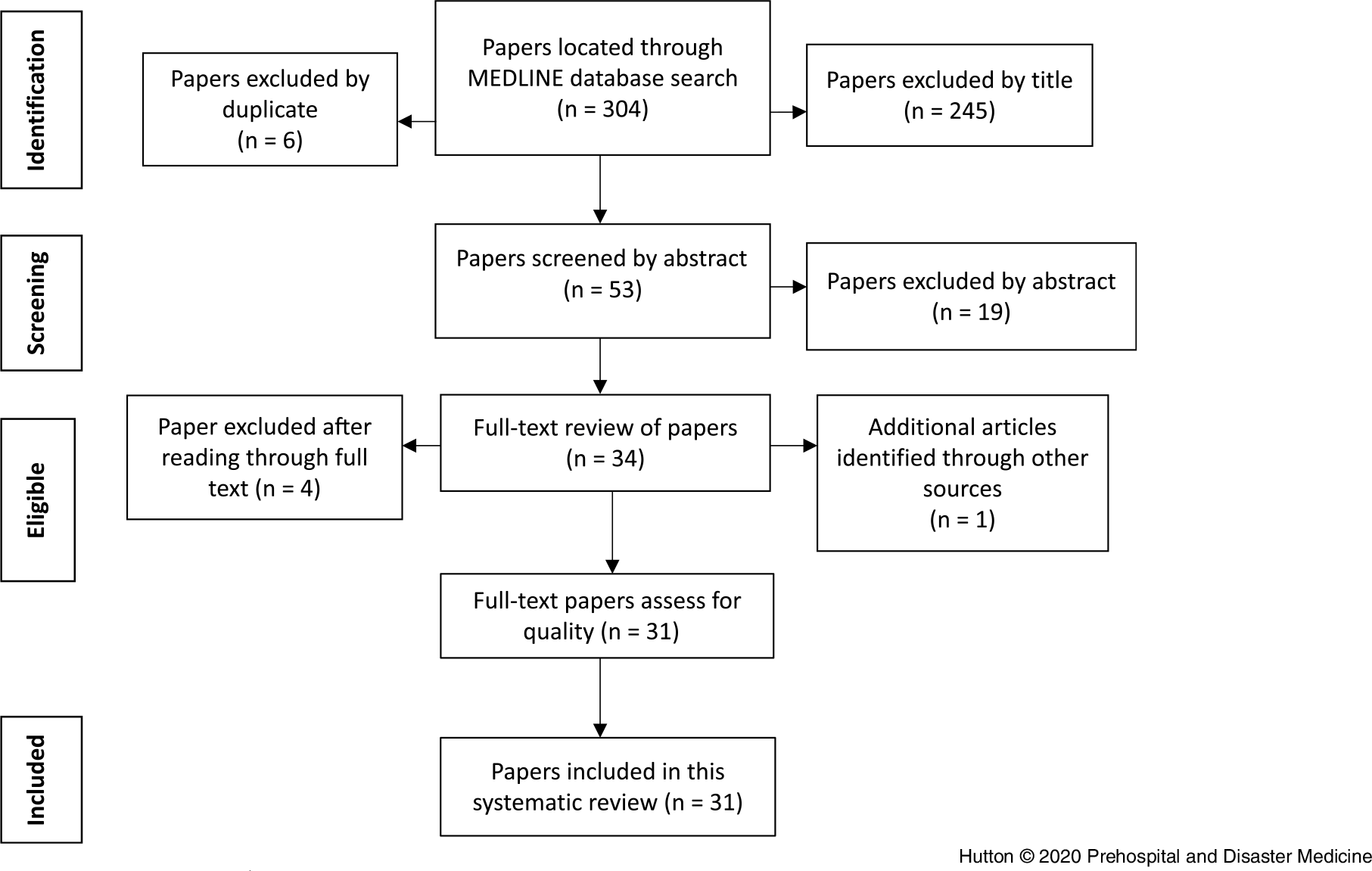
The search returned 304 potentially relevant papers (Figure 1Reference Liberati, Altman and Tetzlaff35). Of the 304 articles retrieved, 245 papers were excluded based on title. There were six duplicates, 19 papers were excluded based on abstract review, and the remaining 53 papers underwent a detailed full-text examination (Supplementary Table; available online only). One additional paper was identified through scanning the reference lists of included papers. After full examination of the remaining 35 papers, four of those were excluded because they did not meet the inclusion criteria.
PRISMA Flow Diagram.Reference Liberati, Altman and Tetzlaff35 Evaluation Tools - Scoping Review.

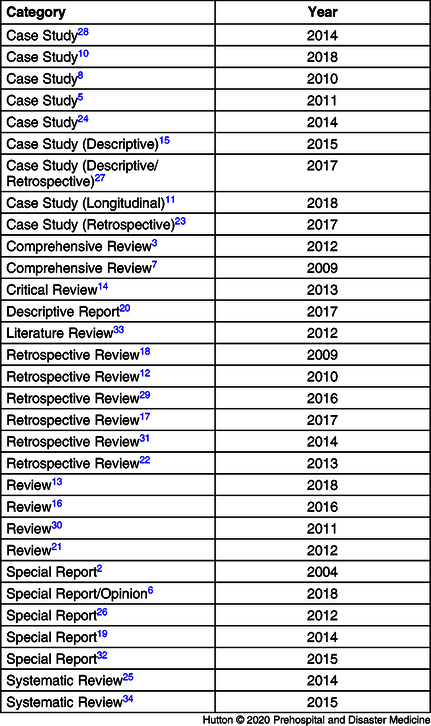
Overall, the quality of the current evidence was low. Sixteen of the studies reviewed were retrospective, systematic, literature, comprehensive, or critical reviews. Four of the studies were reports, and nine of the studies were original research case studies. There was one expert opinion and position statement.
Arbon’sReference Arbon2 mass-gathering model was used as a starting point for this review. Psychosocial variables reflected in this model and other variables identified in the literature are outlined in Table 2.
Discussion
The purpose of reviewing psychosocial variables at MGEs is to continue the discussion for consistency of data collection.Reference Ranse and Hutton3,Reference Arbon, Bottema and Zeitz10 The psychosocial domain, as originally conceptualized by Arbon,Reference Arbon2 included: crowd type, crowd mood, and crowd behavior. Upon interrogating the literature, the authors have determined that the variables fall under the categories of alcohol or drugs; maladaptive and adaptive behaviors; crowd behavior, crowd culture, and crowd mood; reason for attending event (motivation); duration; and crowd demographics. Together, these variables paint a picture of the attendees at the MGE and how their behavior can lead to injury and/or illness.
Use of Alcohol or Drugs
Use of alcohol or drugs was the most common variable reported, highlighting the need for preventive strategies such as encouraging sensible alcohol consumption and safe drug use. In a study of 15 MGEs in Australia, during summer months, the authors reported 90% of patient presentations occurred at events where alcohol was available.Reference Anikeeva, Arbon and Zeitz11 Alcohol and substance use were the most commonly identified variables in this review (n = 21/31; 67%).
Anikeeva, et alReference Anikeeva, Arbon and Zeitz11 reviewed 15 MGEs in South Australia in which alcohol availability was categorized as either “alcohol available for purchase” or a “dry event.” In contrast, in most (n = 18/21; 86%) of the reviewed literature for the present study, the use of alcohol is not categorized in this way. Rather, the approach to how alcohol and drug use is captured is haphazard. The nonlinear study conducted by Arbon, et al argued that the accuracy of collecting alcohol or drug use data is limited to possible discrepancy between official and actual presence, and the effect of “loading” prior to the event.Reference Arbon, Bottema and Zeitz10 Additionally, Hawkins and Brice, studying the National Collegiate Athletic Association Final Four Semi-Final and National Championship games, found that the patients evaluated by Emergency Medical Services (EMS) had a rate of 70% alcohol use.Reference Hawkins and Brice12 Of note, intoxication, violence, and traumatic injuries occur through the use of drugs and alcohol at both sporting and music MGEs.Reference Ahmed and Memish13–Reference Hutton, Savage, Ranse, Finnell and Kub15
Maladaptive and Adaptive Behaviors
Consequences to attendees at MGEs due to norm behavior changes of participants have been quantified through the Hawkins, et al study.Reference Hawkins and Brice12 The authors did a retrospective review of ambulance (EMS) and hospital emergency department records of patients injured as a result of risk-taking celebratory behavior from University of North Carolina (Chapel Hill, North Carolina USA) sports championship game. Characteristics of patients evaluated in relation to crowd behavior included assault and bonfire-associated burns.Reference Hawkins and Brice12 Another study reviewed used a two-part self-reporting survey of respondents from the school leavers’ celebrations outside of Perth, Australia which recorded the likelihood of negative consequences associated with alcohol and other drug use, as well as other risk factors, at the school leavers’ celebration. Consequences relating to individual behavior included emotional outburst, heated argument, physical aggression, unprotected sex, blackout, stolen private/public property, act of vandalism, and arrests for intoxicated behavior.Reference Hutton, Brown and Verdonk14 Sampsel, et alReference Sampsel, Godbout, Leach, Taljaard and Calder36 published the first reports of MGEs associated with sexual assaults and found that sexual assaults peak at MGEs on specific holiday events, including New Year’s Eve, Canada Day, Halloween, and University Freshman’s week.Reference Sampsel, Godbout, Leach, Taljaard and Calder36
In addition to sexual assaults, stampedes have been recorded as crowd behavior.Reference Ahmed and Memish13 Stampedes can occur as a result of unmanageable crowd density; however, crowd density is not necessarily documented as a stressor. Hopkins reported that if participants felt greater identification with fellow attendees, they then felt less crowded, stating the joy of crowds related to “collective self-realization” can be a potential health benefit for participants.Reference Hopkins and Reicher16
Crowd Behavior
There are numerous theories of crowd behavior attempting to explain the tendencies of crowds; however, there are few practical applications to monitor and assess crowd behaviors in MGEs that have been discussed or examined. Of the 18 papers that cited crowd behavior as a key influence on MGE PPRs, nine provided a tool for collecting this data.
Patient presentation trends at 15 MGEs in South Australia had fieldworker’s record behavior on the crowd characteristics questionnaire.Reference Anikeeva, Arbon and Zeitz11 The crowd characteristics questionnaire recorded the number and proportion of patients presenting to in-site health care service by crowd characteristics variables, which included crowd density, male to female ratio, proportion of crowd seated or stationary, proportion of crowd in motion, proportion of crowd displaying cohesive behavior, and proportion of crowd wearing cohesive dress.Reference Anikeeva, Arbon and Zeitz11 Additionally, Hutton, et al’sReference Hutton, Zeitz, Brown and Arbon5 study collected crowd behavior once every hour at five designated collection points using a tool adopted from the work of Zeitz, et al.Reference Zeitz, Tan, Grief, Couns and Zeitz7 The main form of data collected were descriptive field notes collected via observation categorized into behaviors: dancing, singing, sitting, resting, walking, talking, chatting, talking on a mobile, sending SMS, fighting, wrestling, videotaping, taking pictures, celebrating, or socializing.Reference Zeitz, Tan, Grief, Couns and Zeitz7,Reference Hutton, Munt, Zeitz, Cusack, Kako and Arbon8 Hutton, et al’sReference Hutton, Zeitz, Brown and Arbon5 study evaluated crowd mood using descriptive tools developed by Pines and Maslach,Reference Pines and Maslach37 and crowd type using Berlonghi’s model,Reference Berlonghi38 applying a scoring system. Although the study was interpretive using participant observation, pre-event training was provided to ensure comprehensive and uniform data collection.
Crowd Culture
Crowd culture can include behaviors such as moshing and pushing and shoving. Hutton, et al documented social environmental factors at MGEs using Haddon’s matrix, an epidemiology tool used to determine potential injuries, through behaviors such as dancing or “moshing.”Reference Hutton, Savage, Ranse, Finnell and Kub15 Three studies used different methods to collect different variables to measure and/or identify crowd culture. For example, Milsten, et alReference Milsten, Tennyson and Weisberg17 analyzed retrospective data from prehospital patient care reports to identify mosh-pit-related injuries at rock concerts, festivals, and electronic dance music events.Reference Milsten, Tennyson and Weisberg17 Hartman, et al used a scoring system that measured crowd intention as either “animated, intermediate, or calm,” but did not outline the merits behind classification.Reference Hartman, Williamson and Sojka18 Finally, Turris, et al listed classification examples of crowd behavior as: mood, activity levels, queuing, movement, behavior, predispositions, motivations, crowd movement, and flow.Reference Turris, Lund and Hutton19
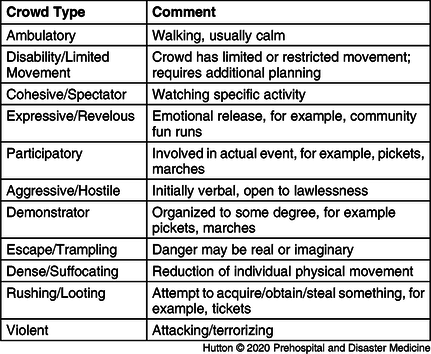
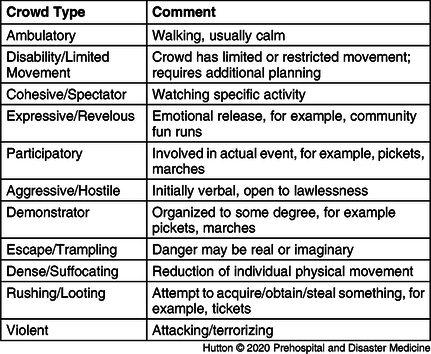
The Emergency Management Australia (Canberra, Australia) descriptors for “crowd types” include behavior (Table 3Reference Berlonghi38).39 Within this comprehensive review, the authors underline the lack of congruence with the use of terminology between “crowd behavior,” “crowd type,” “crowd management,” and “crowd mood.” Moreover, demographics of a crowd is used as an environmental descriptor of a “crowd type.”Reference Zeitz, Tan, Grief, Couns and Zeitz7 For example, the profile at a football game is typically male-dominated who are passionate and loyal fans. This crowd type makes predictable crowd behavior.Reference Challenger, Clegg, Robinson and Leigh40
Crowd Types/BehaviorsReference Berlonghi38
Crowd Mood
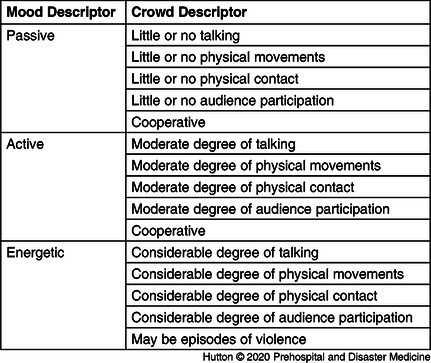
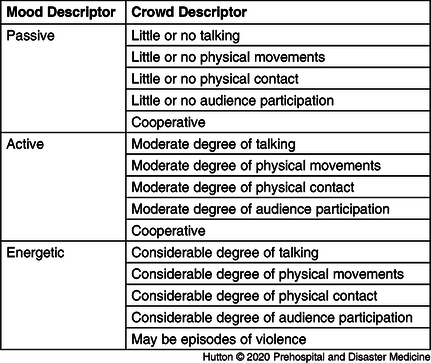
The term “crowd mood” is a descriptor of crowd emotion and tone which has become an indicator of probable crowd behavior outcomes.Reference Hutton, Zeitz, Brown and Arbon5 Although crowd mood is less visible than crowd behavior, it can still be assessed and quantified. Pines and Maslach developed a practical matrix that classified the mood of crowd as passive, active, or energetic (Table 4).Reference Pines and Maslach37 The table scores the amount of verbal noise, physical movement, and overall audience participation into a numerical grading system.Reference Hutton, Zeitz, Brown and Arbon5
Crowd Mood ClassificationsReference Zeitz, Tan, Grief, Couns and Zeitz7
Quality of Research
Hutton, et al adapted a psychosocial data collection tool from Zeitz, et alReference Zeitz, Zeitz and Arbon41 and Emergency Management Australia39 to group crowd mood as energetic, active, festive, passive, subdued, or delighted.Reference Hutton, Munt, Zeitz, Cusack, Kako and Arbon8 Despite Pines and Maslach’sReference Pines and Maslach37 tool being successfully used in Hutton, et al’s study,Reference Hutton, Zeitz, Brown and Arbon5 Turris, et alReference Turris, Lund and Hutton19 found that objective measures of crowd mood are not yet well-developed for use in the mass-gathering context; “Crowd mobility and density are sometimes used as proxies for crowd mood or indicators of risk (qualitative).”Reference Milsten, Tennyson and Weisberg17 Evidence suggests that crowd mood can be influenced by factors such as type of musicReference Friedman, Plocki and Likourezos20,Reference Steffen, Bouchama and Johansson21,Reference Robertson, Hutton and Brown42 or sporting rivalry.Reference Zeitz, Haghighi, Burstein and Williams22 Hutton, et al found that crowd mood at sporting events is influenced by the level of engagement with the event.Reference Hutton, Ranse and Munn6 For example, they found that spectators displayed a myriad of emotions, such as yelling, cheering, shouting, jumping up and down, and getting angry and upset.Reference Hutton, Brown and Verdonk14 The animated mood at sporting events and festivals was also exacerbated by the “conspicuous consumption” of large amounts of food and alcohol, which in turn can have adverse health effects.Reference Laing and Frost43 Further adverse circumstances can result in paranoia and mass hysteria leading to crowd crush and violence between attendees at MGEs.Reference Anikeeva, Arbon and Zeitz11 To further understand crowd mood, Ranse and HuttonReference Ranse and Hutton3 included anxiety and psychiatric disorder under the mental health header in their patient data set and entry codes. Anxiety was observed as “Presentation related to anxiety or panic attack, not necessarily psychiatric in nature or substance related,” and psychiatric disorder was defined as “Psychiatric or mental health related presentations.”Reference Ranse and Hutton3 This remains the only documented evidence of mental distress and is an area that needs further attention in the MGE space.
Reason for Attending Event (Motivation)
The reason for attending an event has a strong impact on the bio-medical domain, as the individual’s motivation for attending and their behavior at an MGE can also be a factor in injury presentation.Reference Hutton, Munt, Zeitz, Cusack, Kako and Arbon8 Motivation for attending an event is a key influence on crowd behavior. However, due to visibility, Hutton, et alReference Hutton, Zeitz, Brown and Arbon5 suggested crowd behavior should be the focus as the observable and measurable element. Reasons for attendance were categorized in the comprehensive review by Ranse, et al within individual demographics as either participant, spectator, official, or other.Reference Ranse and Hutton3 Hartman, et al scored crowd intentions data with a point value as animated, intermediate, or calm.Reference Hartman, Williamson and Sojka18 Hawkins, et al carried out a retrospective review of an MGE to celebrate the success of University of North Carolina men’s basketball championship.Reference Hawkins and Brice12 They found that participants’ behavior at celebratory riots ranged from non-threatening behavior to rioting, burning of personal property, and physical violence against other participants or bystanders.Reference Hawkins and Brice12 Although FitzGibbon, et alReference FitzGibbon, Nable and Ayd23 and Friedman, et alReference Friedman, Plocki and Likourezos20 did not specifically collect data on motivation for crowd attendance in their studies, Jaensch, et alReference Jaensch, Whitehead, Prichard and Hutton44 and Lam, et alReference Lam, Liang, Chikritzhs and Allsop24 found that a core part of motivation for festival-goers at outdoor music festivals was to use alcohol and other drugs in a group setting. Whereas participants’ motivations that go to religious festivals or pilgrimages are focused on abstinence and faith.Reference Hopkins and Reicher16 Like religious festivals, sporting events bring attendees together for a shared sense of belonging.Reference Hutton, Ranse and Munn6,Reference Ahmed and Memish13 However, many of these sport enthusiasts may be motivated to fit in with the crowd, which can lead to an over-consumption in alcohol.Reference Hutton, Ranse and Munn6
Duration
Of the papers reviewed, nine included the event duration as a variable that was or should be collected at MGEs.Reference Hutton, Zeitz, Brown and Arbon5,Reference Hutton, Munt, Zeitz, Cusack, Kako and Arbon8,Reference Hartman, Williamson and Sojka18,Reference Turris, Lund and Hutton19,Reference Zeitz, Haghighi, Burstein and Williams22–Reference Lund, Turris, Amiri, Lewis and Carson26 Multiple-day events are generally associated with higher rates of medical use.Reference Alquthami and Pines25 Data from Hutton, et al’s pilot projectReference Hutton, Munt, Zeitz, Cusack, Kako and Arbon8 showed that there is a change in crowd behavior from the start of the event and the end of the event.Reference Hutton, Zeitz, Brown and Arbon5 For some of the research papers, duration was a fixed variable determined during data collection, which remained the same for all of the events.Reference Zeitz, Haghighi, Burstein and Williams22
Crowd Demographics
Crabtree, et al’sReference Crabtree, Mo and Ong27 study found that patients from rural/regional areas were twice as likely to require advanced treatment and review by health care professionals. Additional variables such as crowd interest/culture and individual motivation are not as frequently mentioned, but for specific MGEs, are an important aspect of data collection.
Study Limitations
Despite the use of a rigorously designed search strategy, there is potential that the search outcomes and the subsequent findings of this literature review are at-risk of selection bias. In addition, manuscripts included in this review were of a low quality, descriptive, and retrospective (Table 5). The search strategy was restricted to studies published in English, and as such, may have not identified relevant studies written in other languages.
Conclusion
As outlined by Arbon,Reference Arbon2 there are three categories which influence the presentation of patients to in-event health services at MGEs: biomedical, environmental, and psychosocial. This review has provided a framework for collecting psychosocial variables that influence PPRs at MGEs. In regards to crowd behavior, the majority of the literature focuses on the negative effects to crowd safety; however, there are some potential benefits to social well-being which may be explored in future research.Reference Alnabulsi and Drury28 In addition, there is an opportunity to develop a standardized set of scales for crowd measurement. Overall, this review is one of three to pull together sets of variables to document the impact of MGEs on the health of attendees. This manuscript has presented a range of psychosocial variables that are documented within academic literature as being collected at MGEs. Even though the rationale behind the collection of variables are subjective, they identify activities that take place which influence injury and illness at events. It is not expected that all variables documented in this manuscript will be collected at each MGE; however, through identifying what is currently collected, researchers can determine which variables can be collected to suit their own needs. As MGE science develops, data collected under these specific psychosocial variables can be used for the purpose of making comparisons across societies for MGEs, which will in turn propel forward the science of MGEs.
Conflicts of interest
none
Supplementary Material
To view supplementary material for this article, please visit https://doi.org/10.1017/S1049023X20000047