Healthcare-associated methicillin-resistant Staphylococcus aureus bloodstream infections (HA-MRSA) result in significant morbidity, mortality, and healthcare costs.Reference Cosgrove, Sakoulas, Perencevich, Schwaber, Karchmer and Carmeli 1 Over the past 20 years, decreases in HA-MRSA incidence in the United States,Reference Anderson, Miller and Chen 2 , Reference Dantes, Mu and Belflower 3 Germany,Reference Meyer, Schroder, Gastmeier and Geffers 4 Europe,Reference De Kraker, Jarlier, Monen, Heuer, van de Sande and Grundmann 5 and Australia have been well documented.Reference Mitchell, Collignon, McCann, Wilkinson and Wells 6 Concomitantly, decreases in central-line–associated bloodstream infection (CLABSI) incidence have also been reported;Reference Dudeck, Edwards and Allen-Bridson 7 – Reference Worth, Spelman, Bull and Richards 10 these were largely attributed to evidence-based interventions in infection prevention and control such as hand hygiene and checklist bundles. Many of these interventions are also cornerstones of MRSA prevention. In the Canadian province of Québec, the Institut national de santé publique du Québec (INSPQ), through its healthcare-associated infection (HAI) surveillance program (Surveillance Provinciale des Infections Nosocomiales [SPIN]), reported on S. aureus bloodstream infections, with decreasing rates of HA-MRSA between 2006 and 2015. 11
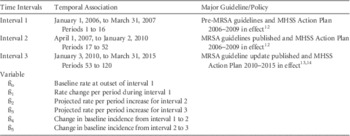
Given the increases in MRSA incidence and associated costs as well as the sense of urgency in the early 2000s, the Québec Ministry of Health and Social Services (MHSS) included the prevention of HA-MRSA in its strategic goals for the prevention of HAIs. A first Action Plan was published for 2006–2009. The updated and reaffirmed Action Plan for 2010–2015 included progress and milestones and reinforced the fundamental goals in HAI prevention: (1) creating a strong and easily accessible surveillance program, (2) facilitating laboratory and disinfection processes, (3) facilitating antibiotic stewardship, and (4) using evidence-based practices for preventing HAIs including CLABSI and bacteremia from multidrug-resistant organisms. 12 , 13 Provincial MRSA prevention guidelines were developed in 2006, and their implementation was evaluated in 2009. 14 We aimed to quantify the change in incidence rate for HA-MRSA following the implementation of MRSA prevention guidelines and policy directives by comparing changes in HA-MRSA incidence with incidence variations for another HAI, intensive care unit (ICU)–associated CLABSI. Although CLABSI incidence decreased during the study period,Reference Fontela, Platt and Rocher 8 , Reference Li, Fortin, Tremblay, Ngenda-Muadi and Quach 15 we expect that the timing of CLABSI decrease should be, for the most part, independent from that of HA-MRSA because ICU CLABSIs are not organism specific, and only a few cases (eg, MRSA CLABSI in the ICU) are common to both surveillances. In this study, we looked at incidence rate fluctuations for the following periods: (1) prior to the release of INSPQ MRSA guidelines (January 1, 2006, to March 31, 2007), (2) immediately after MRSA guideline release (April 1, 2007, to January 2, 2010), and (3) during the postguideline period (January 3, 2010, to March 31, 2015, a timeframe within the updated second MHSS Action Plan for 2010–2015) (Table 1). By examining fluctuation trends for HA-MRSA and CLABSI incidence during these time intervals, we investigated whether combined guideline directives and policy had an impact on reducing the incidence of HA-MRSA in Québec.
Description of Poisson Segmented Regression Models Variables, Time Intervals, and Break Points With Corresponding Guidelines Publication DatesFootnote a

NOTE. MRSA, methicillin-resistant Staphylococcus aureus; MHSS, Québec Ministry of Health and Social Services.
a The full equation is denoted by the following (the successive 4-week periods are in subscripts):
Y(t)=ßo + ß1(t1-16)+ß2(t17-52)+ß3(t53-120)+ß4(tint1)+ß5(tint2)
METHODS
SPIN Surveillance Network
SPIN is a year-round, prospective, province-wide surveillance program that monitors both HA-MRSA (SPIN-SARM) 16 and CLABSI (SPIN-BACC). 17 HA-MRSA reporting has been mandatory for all healthcare facilities with more than 1,000 admissions since January 7, 2007. CLABSI reporting has been mandatory for all intensive care units (ICUs) with ≥10 beds in the province of Québec since 2007.Reference Li, Fortin, Tremblay, Ngenda-Muadi and Quach 15 Retrospective analysis of the SPIN-BACC reporting validity showed excellent results compared with other regional surveillance networks with a sensitivity of 88% and specificity of 92%.Reference Fontela, Rocher and Platt 18 Overall, 37 of 56 adult facilities (66%), including 21 nonteaching and 16 adult teaching ICUs, participated in the ICU CLABSI surveillance program for the entire study period. Furthermore, 79 of 86 acute-care hospitals (92%), including 57 nonteaching and 22 teaching facilities, participated in the HA-MRSA surveillance during all study years.
Definitions and Data Collection
The SPIN definition for CLABSI requires that a bloodstream infection occur in a patient with a central venous catheter (CVC) in place and inserted prior to infection onset in the ICU or within 2 days after ICU discharge. Since April 1, 2010, SPIN has used the most recent National Healthcare Safety Network (NHSN) CLABSI definition.Reference Horan, Andrus and Dudeck 19 Cases from 2007 to 2010 were retrospectively reclassified to reflect the new definition. SPIN surveillance measures and definitions have been described previously and are publicly available.Reference Li, Fortin, Tremblay, Ngenda-Muadi and Quach 15 , Reference Fontela, Platt and Rocher 20 , 21
Starting in April 2013, MRSA bloodstream infections were classified as HA if the infection occurred ≥2 days after admission or within 2 days following discharge (within 7 days for procedure-related bloodstream infections and within longer delays for surgical site infections). 21 Prior to that date, a period of 4 weeks following discharge was used to classify MRSA BSI as HA. Data were extracted in June (CLABSI) and July 2015 (HA-MRSA). The present study is a retrospective longitudinal cohort analysis that was approved by the INSPQ and did not require institutional board review because it was a secondary analysis of previously collected data.
Statistical Analyses
Incidence rates
Pooled HA-MRSA and CLABSI incidence rates for adult facilities were computed by facility type (teaching vs nonteaching), surveillance year, and 4-week period. Poisson confidence intervals were used. Facilities were defined as “teaching” if they were associated with medical training and research programs and as “nonteaching” otherwise.
Segmented Poisson regression analysis
To evaluate the effectiveness of the Québec MRSA guidelines on HA-MRSA incidence rates, we performed a segmented Poisson regression to examine the change in incidence rates for CLABSI and HA-MRSA for 3 distinct periods (Table 1). Models were built using data from facilities that participated in each surveillance program from 2006 to 2015. SPIN-SARM surveillance began in 2006, and the model’s first interval coincided with the pre-MRSA guideline period (January 1, 2006, to March 31, 2007), with March 31, 2007 as the first break point. The next time segment, interval 2 (April 1, 2007, to January 2, 2010) represented the period immediately after the INSPQ MRSA guideline was published. Although INSPQ guidelines were published in June 2006, an 11-month window in the pre-guideline interval was reserved to account for distribution, training, and implementation periods. Interval 2 also encompassed the MHSS “Action Plan on the Prevention and Control of Nosocomial Infections” for 2006–2009 as well as the evaluation of guideline implementation. 14 The second break point, January 3, 2010, marked the beginning of interval 3, which encompassed the period after MRSA guidelines were published (January 3, 2010, to March 31, 2015) and corresponded to the timeframe outlined in the MHSS “Action Plan on the prevention and control of Nosocomial Infections 2010–2015.” 12
Equations used in segmented regression for HA-MRSA and CLABSI incidence variation are shown in Table 1. Incidences for successive 4-week surveillance periods were calculated from January 1, 2006, to March 31, 2015. The time intervals were based on data availability and publication date of MRSA guidelines; corresponding calendar timing of each interval and period are shown in Table 1. Due to well-established secular trends of decreasing rates of HAIs,Reference Dudeck, Edwards and Allen-Bridson 7 , Reference Fontela, Platt and Rocher 8 , Reference Li, Fortin, Tremblay, Ngenda-Muadi and Quach 15 , Reference Dudeck, Horan and Peterson 22 – Reference Edwards, Peterson and Mu 26 we chose a control comparator that would not be impacted by the change in MRSA guidelines: CLABSI rates.
The coefficients of segmented regression include ßo, the baseline rate at the start of surveillance, and ß1, ß2, and ß3, the coefficients for incidence change by 4-week periods during the respective time intervals (Table 1). The change in baseline incidence from interval 1 to interval 2, is denoted by int2 with the coefficient ß4; similarly, the change in baseline incidence from intervals 2 to 3, is denoted by int3 and the coefficient ß5. All coefficients were adjusted for autocorrelation for counts by incorporating an error term for short-term (4 months) effects of guidelines on incidence change, as specified by Schwartz et alReference Katsouyanni, Schwartz and Spix 27 and Katsouyanni et al.Reference Schwartz, Spix and Touloumi 28 The duration of 4 months was empirically estimated by examining residual function plots. The outcomes of interest from segmented regression models were the incidence rate ratios (IRRs) for CLABSI and HA-MRSA BSI. The IRR is defined as the ratio of rates for any single time segment compared to the previous one. The IRR was modeled for (1) the ratio of any single 4-week period compared to the previous period, and (2) the ratio of baseline rates from one interval to the next. The covariate of interest was time, as measured by periods (4-week surveillance intervals). Models were run for all facilities and separately for teaching and nonteaching facilities. Subgroup analyses were also performed between full and partial participators in surveillance. We completed 2 sensitivity analyses to account for the HA definition change that occurred for HA-MRSA BSI surveillance: (1) April 1, 2013, was included as a third break point and (2) an abridged dataset excluding data collected after April 1, 2013 (Online Supplemental Appendix). All statistical calculations were performed using Stata version 14 software (StataCorp 2015, College Station, TX).
RESULTS
Incidence Rates of HA-MRSA and CLABSI
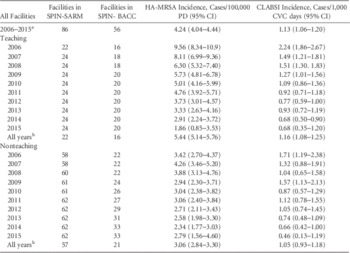
Table 2 summarizes the annual incidence rates of HA-MRSA and CLABSI. Adult teaching facilities had higher incidences than nonteaching facilities. The HA-MRSA incidence decreased in teaching facilities from 9.56 in 2006 (95% CI, 8.34–10.9) to 1.86 cases per 100,000 patient days in 2015 (95% CI, 0.85–3.53). For nonteaching facilities, the incidence remained stable during the study period: 3.42 (95% CI, 2.70–4.37) in 2006 and 2.79 cases per 100,000 patient days (95% CI, 1.56–4.60) in 2015 (Table 2). CLABSI incidence was also higher in teaching facilities than in nonteaching facilities. Incidence rates decreased in both facility types: adult teaching CLABSI incidence dropped from 2.24 (95% CI, 1.86–2.67) to 0.68 cases per 1,000 CVC days (95% CI, 0.35–1.20), while adult nonteaching incidence dropped from 1.71 (95% CI, 1.19–2.38) to 0.46 cases per 1,000 CVC days (95% CI, 0.13–1.19). No significant changes in CLABSI incidence were observed between full and partial participator subgroups. For HA-MRSA, significant differences were seen in 2007 and 2011 for nonteaching facilities and in 2007 for teaching facilities. The addition of new facilities to the small number of partial participators (8% of total facilities) may account for these differences. The results shown in Table 2 include both partial and full participators.
Number of Facilities (Full and Partial Participators) and Incidence of HA-MRSA and CLABSI by Year and Facility Type With 95% Confidence Interval

NOTE. HA-MRSA, hospital-associated methicillin-resistant Staphylococcus aureus; CLABSI, central-line–associated bloodstream infection; SPIN, Surveillance Provinciale des Infections Nosocomiales; SPIN-SARM, SPIN program that monitors HA-MRSA; SPIN-BACC, SPIN program that monitors CLABSI; PD, patient days; CI, confidence interval; CVC, central venous catheter.
a Participation at any time during the study period.
b Continuous participation during the study period.
Segmented Regression for HA-MRSA and CLABSI
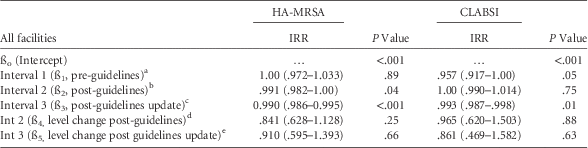
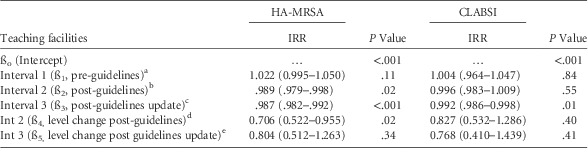
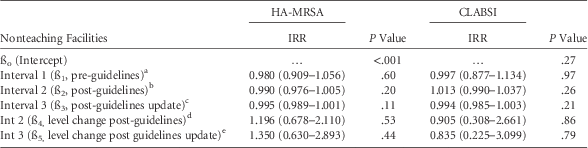
Table 3 lists coefficients and IRRs for all facilities for each interval, separated by the 2 break points (April 1, 2007, and January 3, 2010). In terms of quantification of the incidence trends, when looking at all adult facilities, IRR per 4-week period for HA-MRSA was not different from 1.0 during interval 1, but it was significant at 0.991 during interval 2 (95% CI, 0.982–1.00) and during interval 3 at 0.990 (95% CI, 0.986–0.995), corresponding to decreases of 0.9% and 1.0% per 4-week period, respectively. Cumulatively, we estimated 25% and 22% relative rate reductions during intervals 2 and 3, respectively. By facility type, the significant reductions were observed only in teaching facilities, which had an IRR of 0.989 for interval 2 (95% CI, 0.979–0.998) and an IRR of 0.987 for interval 3 (95% CI, 0.982–0.992), corresponding to incidence decreases of 1.1% and 1.3% per 4-week period or, cumulatively, of 30% and 49%, respectively. Teaching facilities also showed a significant decrease in baseline incidence between intervals 1 and 2, with an IRR of 0.706 (95% CI, 0.522–0.955) a decrease of 29.4%. Nonteaching facilities did not have significant incidence rate reductions for any time interval.
Incidence Rate Ratio (IRR) for HA-MRSA and CLABSI Incidence for (A) All Facilities, (B) Teaching Facilities, and (C) Nonteaching FacilitiesFootnote a Table 3A. Incidence Rate Ratio (IRR) for HA-MRSA and CLABSI Incidence for All Facilities

NOTE. HA-MRSA, hospital-associated methicillin-resistant Staphylococcus aureus; CLABSI, central-line–associated bloodstream infection.
a Interval 1: January 1, 2006, to March 31, 2007 (periods 1 to 16).
b Interval 2: April 1, 2007, to January 2, 2009 (periods 17 to 52).
c Interval 3: January 3, 2010, to March 31, 2015 (periods 53 to 120).
d Int 2 represents the change in baseline rate going from interval 1 to 2.
e Int 3 represents change in baseline rate going from interval 2 to 3.
The IRR was 0.957 (95% CI, 0.917–1.00) for CLABSI including all facilities before the guidelines were published. This IRR indicated a significantly decreasing incidence rate corresponding to a 4% decrease per 4-week period (Table 3). CLABSI IRR did not show any decrease in rates immediately after MRSA guideline publication (IRR, 1.00; 95% CI, 0.990–1.01), but the decrease became significant again during interval 3 (IRR, 0.993; 95% CI, 0.987–0.998) when a decrease of 1% per 4-week period was observed. When stratifying by facility type, teaching facilities had a significant 1% incidence rate reduction per 4-week period from 2010 to 2015; nonteaching facilities had no significant reduction for any interval.
DISCUSSION
Our study’s overarching findings revealed that in Québec, HA-MRSA incidence significantly decreased after MRSA guidelines were implemented, while CLABSI rates remained stable. Later, rates for both infections followed similar decreasing trends over time, with teaching facilities driving these decreases. Our analysis showed nonsignificant rate fluctuations in HA-MRSA incidence but significant decreases in CLABSI incidence at 4% per 4-week period when all facilities were included. Because of the small sample size, CLABSI IRR became nonsignificant when stratified by facility type. During that period, because provincial guidelines had not yet been released, we did not expect any significant decreases in HA-MRSA incidence.
The first break point of January 1, 2007, represents the period immediately after the publication of INSPQ MRSA guidelines. A statistically significant sudden decrease in teaching facilities’ HA-MRSA incidence rates was observed, followed by a decrease of 1% per 4-week period from 2007 to 2009. In comparison, CLABSI incidence rates did not change significantly. This finding strongly suggests that the MRSA guidelines had a direct impact on lowering HA-MRSA incidence. A survey of the implementation of preventive measures showed that in 2004, only 53% of Quebec hospitals had implemented MRSA screening upon hospital admission and during hospitalization, whereas in 2009, 94% of facilities had implemented these protocols. 14 Undoubtedly, MRSA screening was and continues to be an important measure in infection prevention and control.
Interval 3, spanning 2010 to 2015, marked a postguideline period when many of the evidence-based MRSA prevention measures continued. During this time, concurrent significant incidence reductions in both CLABSI and HA-MRSA occurred at 1% per 4-week period. Some significant decreases during interval 3 may be explained by the HA-MRSA BSI definition change that occurred April 1, 2013, when follow-up postdischarge was reduced from 4 weeks to 1 week. Sensitivity analysis showed that including April 1, 2013, as a third break point resulted in a significant decrease for HA-MRSA but not for CLABSI (which did not undergo definition changes) as well as removal of significant incidence changes during interval 3 (Online Supplemental Appendix; Table 3). In another sensitivity analysis only including data up to April 1, 2013, nonsignificant rate changes per 4-week period in interval 3 were also observed. The results of neither sensitivity analysis affected CLABSI IRRs.
Interestingly, the resumption of significant decreases in CLABSI rates during interval 3 may suggest an increased effort to target device-related HAIs such as CLABSI. For instance, new NHSN guidelines on CLABSI practices were published in 2010,Reference O’Grady, Alexander and Burns 29 and guidelines for catheter-associated urinary tract infections were published in 2009.Reference Gould, Umscheid, Agarwal, Kuntz and Pegues 30 These newer recommendations may have prompted CLABSI incidence trend decreases. A new web portal for surveillance data entry (April 1, 2013) and related training sessions may have improved the quality of data and may have decreased the number of skin contaminants reported as CLABSIs. For HA-MRSA, the continuing and steady significant incidence reductions from interval 2 likely stemmed from ongoing infection prevention and control efforts introduced during interval 2. As mentioned earlier, the MHSS published the “Action Plan on the Prevention and Control of Nosocomial Infections” for 2006–2009, which included specific steps towards prevention and control of HAI; the plan was later updated for the 2010–2015 period. Meanwhile, during this interval, both HAI and MRSA-specific prevention measures continued. Internationally, the World Health Organization Hand Hygiene Campaign was launched in 2009,Reference Pittet, Allegranzi and Boyce 31 and the Association of Professionals in Infection Control (APIC) guidelines on elimination of MRSA in hospital settings was published in 2010. 32 These continued, and new initiatives may have contributed to a decrease in all HAIs, including HA-MRSA and CLABSI. However, the second break point of January 3, 2010, was not significant for HA-MRSA incidence decreases; the rate of decrease was the same in intervals 2 and 3. This finding may suggest (1) that the effectiveness of the MRSA guidelines diminished over time and was replaced by an effect of new horizontal HAI interventions, (2) that guidelines continued to have an effect over time, as the rate of decrease remained constant between intervals 2 and 3, or (3) that a combination of both occurred. However, given that this study was ecological in nature, it is impossible to infer causality between interventions and decreases in rates. Assuming independence between HA-MRSA rates and CLABSI rates, the abrupt decrease in HA-MRSA rates and not in CLABSI rates after the first break point may allude to a temporal association with compliance to provincial MRSA guidelines.
Another interesting finding was that the incidence decreases in HA-MRSA and CLABSI were seen only in teaching facilities. These results suggest that a swifter response and implementation of MRSA guideline recommendations may have occurred in teaching facilities. Nonteaching facilities did not demonstrate the same significant decreases. One reason may be that teaching facilities have greater lengths of stay and perform more invasive procedures than nonteaching hospitals,Reference Khuri, Najjar and Daley 33 , Reference Polanczyk, Lane, Coburn, Philbin, Dec and DiSalvo 34 thereby having higher infection rates and thus a greater potential for improvement. While all facilities surveyed provide acute care, nonteaching facilities may have lower acuity and a lower-risk case mix than teaching facilities. Moreover, it is possible that teaching hospitals implemented IPC recommendations more aggressively than nonteaching hospitals. In the survey of practices for the prevention of MRSA in Quebec, teaching hospitals had reached their IPC-to-bed ratio, while nonteaching hospitals had not. 14 Consequently, the incidence of any HAI may be lower in nonteaching facilities but may have improved less rapidly.
Limitations
Limitations of the study include its ecologic design and potential selection bias from the ongoing enrollment of facilities into the surveillance programs. While horizontal infection control interventions such as hand hygiene promotion might explain observed trends for both HA-MRSA and CLABSIs, the effect of MRSA-specific guidelines should be mostly observed in HA-MRSA, which was seen in this study. Only cases MRSA CLABSIs occurring in the ICU were common to both surveillances. This study’s ecological design also limited our ability to infer causality between guideline implementation and incidence rates. The quasi-experimental study design with a comparator group showed immediate significant incidence decrease after break point 1 and MRSA guideline publication and prolonged incidence decreases thereafter. This finding suggests that these recommendations were associated with the decreasing HA-MRSA incidence.
Notably, MRSA surveillance became mandatory for all acute-care facilities in January 2007, and CLABSI surveillance became mandatory for ICUs with≥10 beds in April of the same year. SPIN monitors both HA-MRSA and CLABSI, and having a centralized surveillance system may minimize systematic errors due to data entry. Finally, although there was a change in the definition of HA-MRSA bloodstream infection: to be considered an HAI, the MRSA bloodstream infection had to occur within 2 days rather than 4 weeks after discharge. This change occurred in April 2013 during interval 3, after publication of MRSA guidelines.
In summary, this study has shown that province-wide efforts in Québec, following the publication of MRSA guidelines, resulted in a significant and abrupt decrease in HA-MRSA incidence rates with no temporal change in CLABSI rates. The sustained significant reduction in HA-MRSA incidence in the postguideline period suggests a continued impact of the MRSA-specific guidelines years after its publication, along with improved control of both MRSA and other HAIs. These results are encouraging, and future analysis to follow the continuing trend of decreased incidence for CLABSI and HA-MRSA would be helpful in determining whether continuing and new interventions have been helpful to sustain this decrease.
Incidence Rate Ratio (IRR) for HA-MRSA and CLABSI Incidence for Teaching Facilities

NOTE. HA-MRSA, hospital-associated methicillin-resistant Staphylococcus aureus; CLABSI, central-line–associated bloodstream infection.
a Interval 1: January 1, 2006, to March 31, 2007 (periods 1 to 16).
b Interval 2: April 1, 2007, to January 2, 2009 (periods 17 to 52).
c Interval 3: January 3, 2010, to March 31, 2015 (periods 53 to 120).
d Int 2 represents the change in baseline rate going from interval 1 to 2.
e Int 3 represents change in baseline rate going from interval 2 to 3.
Incidence Rate Ratio (IRR) for HA-MRSA and CLABSI Incidence for Nonteaching Facilities

NOTE. HA-MRSA, hospital-associated methicillin-resistant Staphylococcus aureus; CLABSI, central-line–associated bloodstream infection.
a Interval 1: January 1, 2006, to March 31, 2007 (periods 1 to 16).
b Interval 2: April 1, 2007, to January 2, 2009 (periods 17 to 52).
c Interval 3: January 3, 2010, to March 31, 2015 (periods 53 to 120).
d Int 2 represents the change in baseline rate going from interval 1 to 2.
e Int 3 represents change in baseline rate going from interval 2 to 3.
ACKNOWLEDGMENTS
We are grateful to all the infection control practitioners and infectious disease physician/medical microbiologists who participate in the SPIN program: (1) SPIN-BACC working group members: Charles Frenette, Lise-Andrée Galarneau, Sylvie Latreille, Isabelle Rocher, Noémie Savard, and Mélissa Trudeau, Élise Fortin, Danielle Moisan, Jasmin Villeneuve, Muleka Ngenda Muadi, Caroline Quach, and Claude Tremblay; and (2) SPIN-SARM working group members: Natacha Des Rosiers, Charles Frenette, Lise-Andrée Galarneau, Cindy Lalancette, Noémie Savard, Mélissa Trudeau, Simon Lévesque, Anton Mak, Josée Massicotte, Isabelle Rocher, Christophe Garenc, Claude Tremblay, Jasmin Villeneuve, Danielle Moisan, and Muleka Ngenda Muadi.
Financial support: This work was supported by the Surveillance provinciale des infections nosocomiales (SPIN), a program of the Quebec Institute of Public Health, funded by the Quebec Ministère de la Santé et des services sociaux (Ministry of Health).
Potential conflicts of interest: All authors have reported no conflicts of interest.
SUPPLEMENTARY MATERIAL
To view supplementary material for this article, please visit https://doi.org/10.1017/ice.2017.81