Disasters in vulnerable communities can have negative direct and indirect consequences with the destruction of vital infrastructures leading to a disruption of the supply chain and the transfer of essential items. Reference Azarmi, Dabbagh Moghaddam and Baniyaghoobi1 According to the standards of the SPHERE project, the beneficiary of welfare facilities, hygiene kits, and dignity are the rights of all refugees and displaced and injured individuals. Reference Association2
Sanitation kits can include soap, combs, mirrors, shampoo, sanitary pads, razors, towels, nail clippers, and underwear for men, women, and children, as well as scarves, socks, and long-sleeved shirts for women in Muslim countries. 3 Health kits should be provided based on the culture and needs of the region and the needs of both genders and different ages. Reference Al-Shurbji4 Health items are especially important for women because in some cultures, it is difficult to distribute a sanitary pad because it is taboo, and men do not feel comfortable getting it for their wives, sisters, or daughters. Therefore, access to sanitary pads is a challenge in disasters. In addition, immigration and relocation make it harder for people to access health items Reference Al-Shurbji4,Reference Fatemi and Moslehi5 ; based on a UNHCR report, the number of global forced displacement likely exceeded 84 million by mid-2021. Reference Adibi Larijani, Barghi Shirazi and Moslehi6 Gender inequality intensifies in critical situations. Women and girls face many difficulties in obtaining health items in low-income countries. Governments should strive to provide women with shame-free access to health items such as sanitary pads in times of disasters. Reference Sommer, Schmitt and Clatworthy7 In humanitarian settings, refugee camps such as the Rohingya refugee camps of Cox’s Bazar, women and adolescent girls have insufficient access to hygiene items. Reference Ahmed, Aktar and Farnaz8 To ensure the health, well-being, and dignity for all women, children, and men, health items should be provided and distributed in culturally appropriate ways. Moreover, training should be provided for their use if necessary. Reference VanLeeuwen and Torondel9
The hygiene kit has a significant effect on preventing infectious diseases, Reference Quattrochi, Bisimwa and Thompson10 improving mental health, developing human dignity, and ensuring the security of women and girls. For example, the unavailability of sanitary pads affects the participation of women and girls in society, economic activities, school attendance, and education in normal circumstances and disasters. Accordingly, distributing a hygiene and dignity kit as a right of the community is of importance. Reference Abbott, Bailey and Louis11 Due to coronavirus disease (COVID-19), the distribution of hygiene kits in camps is felt necessary more than ever. Reference Truelove, Abrahim and Altare12 One of the best experiences in the world to perform humanitarian activities was during the 2015 Nepal earthquake, during which the Ministry of Women’s Affairs launched the “Dignity First” campaign and distributed health packages among the woman and adolescent girls affected by the Nepal earthquake. Reference Chaudhary, Vallese and Thapa13 Additionally, the United Nations (2014) issued a hygiene kit to Somali refugees in Yemen. 14 Based on the evidence, access to hygiene kits such as shampoos, women’s health items, and detergents was the main challenge of the affected population in Southern Syria. Reference Sikder, Daraz, Lantagne and Saltori15
There are various experiences in this regard in Iran. In a study conducted after the earthquake on December 26, 2003, in Bam, people pointed to problems such as lack of access to sanitary items in the early hours after the earthquake and improper distribution of sanitary items, especially sanitary pads. Women in Bam used broken mirrors in the rubble, which was highly effective for them psychologically. Reference Parsizadeh and Skandari16 During the Varzaqan and Ahar earthquakes that occurred in East Azerbaijan Province in 2012, even after years of the Bam earthquake, some people, especially women, still considered the distribution of the hygiene kits inappropriate. Reference Oveisi, Farsad and Sarikhani17 In the recent disasters (eg, the 2019 Lorestan and Mazandaran floods and the 2017 Kermanshah earthquake), studies demonstrated that the distribution system of hygiene kits and essential health items among the affected population was one of the responses that could be improved in disaster management in Iran, Reference Doroudi18 confirming the need to inform authorities and take measures in this regard. The lack of proper planning in the selection, distribution, and monitoring of distribution can lead to parallel work, inequality in access, waste of time, and waste of financial resources. Reference Mishra, Chiwenga, Mishra and Choudhary19
This study aimed to evaluate the challenges and barriers in the supply chain, and distribution and access to essential hygiene kits in recent disasters in Iran. The findings of this study are expected to improve the level of awareness and attention of the authorities to the real needs of the affected population from the early hours of the response phase.
Methods
The purpose of a qualitative study is to identify the challenges and barriers of managing humanitarian hygiene items in recent disasters in Iran.
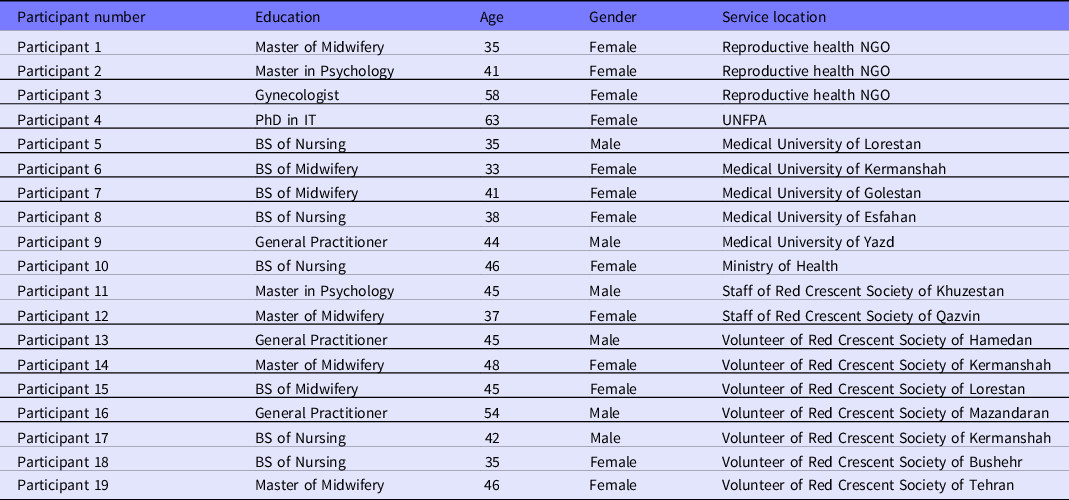
The inclusion criteria were having 5 years of experience in the field of disasters and being present in at least one of the response operations of the Varzaqan earthquake, Reference Razzaghi and Ghafory-Ashtiany20 Bushehr earthquake, Reference Ardalan, Hajiuni and Zare21 Kermanshah earthquake, Reference Ahmadi and Bazargan-Hejazi22 Golestan flood, Reference Solaimani, Sharifipour and Abdoli Boozhani23 Lorestan flood, Reference Hamidi Farahani, Niknam Sarabi and Farsi24 and Khuzestan flood, Reference Rajabizadeh, Ayyoubzadeh and Ghomeshi25 or having responsibility in participating organizations. On the other hand, the exclusion criteria were the person’s unwillingness to participate in this study and insufficient information on the supply and distribution of required hygiene items in disaster-affected areas. Participants included 19 people, including 3, 1, 5, 1, 7, and 2 cases from reproductive health non-governmental organizations (NGOs), the United Nations Population Fund (UNFPA), medical universities, the Ministry of Health, Red Crescent volunteers, and the Red Crescent Society, respectively. Purposeful sampling based on the snowball method was used in this study. To consider the maximum diversity in the samples, it was attempted to sample people with different genders, age ranges, education levels, experiences, and roles in disasters. Sampling continued until complete data saturation. The semi-structured interview was conducted for data gathering. The guide was applied in 2 experimental interviews, and the results were confirmed by the research team.
After the interviews, each taking approximately 90 minutes, all their contents were transcribed, and then a code was assigned to each of the texts. Graneheim and Lundman’s thematic analysis method was used. Reference Graneheim and Lundman26 Further, a basic conceptual framework was defined according to the interview guides, and then the codes were extracted from the interview texts. This guide was written by the researchers, and 3 interviews were conducted as a pilot evaluation to improve the guide. First, the researcher explained the purpose of the research to the participants, and an interview was conducted after obtaining an informed written consent upon each participant’s acceptance. The interviews were performed using a tape recorder, and data saturation occurred from the 15th interview.
Participants were asked the question, “What were the challenges and problems with household hygiene needs in the disaster in which you were involved?” Each interview also included follow-up questions such as, “Can you explain more about this?” and “What did you mean by that …?” Finally, the participants were asked to state their final remarks. Several questions were designed based on the participants’ answers and the interview process, followed by comparing and interpreting the relationship between the components. MAXQDA software (version 10) Reference Schönfelder27 was used to analyze the obtained data. According to the objectives of the study, a theme bank was created and the main and secondary themes were extracted accordingly. The final report was completed, and, finally, testimonies were quoted directly from the interviewees inside the quotations based on the obtained data for each subtheme related to its main theme. For assessing the quality of the current qualitative study, 4 trustworthiness criteria were used, including credibility, transferability, dependability, and conformability according to the Lincoln and Guba framework. Reference Connelly28 The constant comparison, active listening, prolonged engagement with data, and immersion in data were employed to increase credibility. Furthermore, researcher triangulation techniques were used, followed by striving to recruit a sample with the maximum variation of findings for improving transferability. Documentation and record-keeping of analytic activities were used for the dependability of the findings. The confirmability of the study findings was ensured using peer-checking and member-checking techniques. Reference Graneheim and Lundman26
Results
Participants of the study were 19 people with experience in one of the recent disasters in Iran (Table 1).
Characteristics of participants in the study

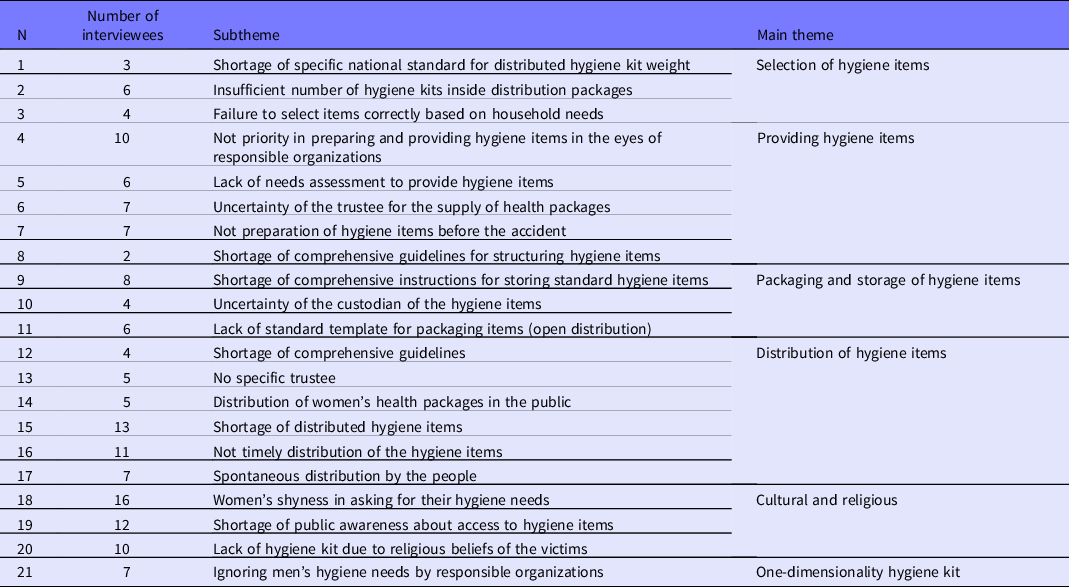
According to the analysis of interviews, 6 main themes and 21 subthemes were extracted, which are described in Table 2.
Challenges and barriers related to hygiene items management

The main themes included problems and challenges detected in the selection of hygiene items, provision, packaging and storage, and distribution of the hygiene kit, cultural challenges, and the 1-dimensional nature of these packages.
Based on the study findings, no organization(s) have been assigned to be responsible for the supply and distribution of health items needed by people in disasters. In this regard, 1 participant stated: In the field of supply and distribution of health equipment and supplies, there is no organization in the country that is responsible for this issue.
Some women suffer from increased abortion rates Reference Undelikwo and Ihwo29 and vaginal bleeding disorder Reference Sohrabizadeh, Jahangiri and Jazani30 due to trauma and stress, and need the sanitary pads. These items were unavailable for distribution in the early hours. According to 1 participant: Some of the victims told us not to give me water or food, please pay attention to our hygiene needs. In the early days, after the 2017 Kermanshah earthquake, some hygiene kits were distributed as ready-made packages by the UNFPA and the Iranian Red Crescent Society’s health teams (EMT1). Moreover, these voluntary and spontaneous actions of the people and NGOs can be helpful and better managed. Another noted challenge was the inappropriate number and type of included items in the package so that some items were completely ignored or the predicted number for those cases was more or less. According to the authorities and their preferences, the provision and distribution of the relief items such as tents, heating equipment, food, and water were considered priorities over the hygiene kit.
Based on religious beliefs, the distribution of certain items, which may not be hygienic in nature but are urgently needed by the family, especially women, is of great importance. Reference Al-Shurbji4 Additionally, some of these items are effective and subsequently prevent the spread of sexually transmitted diseases, reducing the burden of visits to the health care system and staff workload while saving limited resource consumption. The hygiene kit had not been assessed or prepared prior to the disaster, and there was a need for instructions on how to prepare, distribute, and store these items. In some recent disasters, the hygiene kit was distributed without packaging, and in public view, making it difficult for women to receive these items due to shyness and cultural issues, thus they hid them under their clothes when carrying them home. One participant added: People had difficulty delivering hygiene items and some of them refused to receive the required supplies because some items were distributed openly and in bulk.
According to research findings, another posed challenge by the participants was the lack of attention to men’s hygiene needs by organizations. The men were responsible for providing security and livelihood for the family, thus they paid less attention to meeting their health needs. Further, the responsible organizations paid less attention to providing hygiene needs for affected people. One participant commented: Due to the lack of hygiene items such as soap, underwear, and sanitary pads, the rate of sexually transmitted infections had increased and we had to send medicine to treat affected people for STIs. Men, like women, needed underwear and felt the shortage of it.
Discussion
In the occurrence of disasters, the vulnerability of the community endangers the health of individuals and poses serious problems in providing health services. Reference Usher and Mayner31 In addition, the health and well-being of the community become extremely poor due to violence and insecurity, population displacement, and the collapse of the health care system. In particular, women’s hygiene and cosmetic needs are felt in a more highlighted way. Reference Leaning and Guha-Sapir32 Unfortunately, the lack of access to hygiene kits can have a greater impact on people’s health in poor areas, along with having more consequences that require special attention in these areas. Reference Rodriguez-Llanes, Ranjan-Dash and Degomme33
According to the study findings, the organization with specialized responsibility in the supply chain of hygiene items has not been determined in the structure of response to the disasters of the country, and there is a lack of national protocols and standards for choosing the items of a hygiene kit. Similarly, NGOs and the private sector have good capacities in the supply chain of the required items by the affected people that can be used in the best way by organizing and concluding a memorandum of understanding in advance. Reference Schiffling, Hannibal, Tickle and Fan34
Accordingly, choosing the right hygiene items based on household needs and their timely distribution plays an important role in community health, including disease prevention, ultimately leading to reduced harm and risk in the affected community, especially vulnerable groups. It is necessary to pay attention to meeting these needs in the disaster response program. Reference Alipour and Hasheminejad35 The results of another study showed that policy-makers, health planners, and health care providers should meet women’s hygiene needs as a priority. Reference Kohan, Yarmohammadian, Bahmanjanbeh and Haghshenas36 After a disaster, untimely bleeding is expected due to severe stress on women, and most of them declare that pad and underwear are one of the essential items in the early hours. Reference Parsizadeh and Skandari16 Another study reported that some of the problems women experienced in the post-disaster context were due to the lack of access to health resources, including the lack of access to adequate water for sanitation, lack of sanitary napkins, and reduced access to detergents. Reference Sommer, Schmitt and Clatworthy7 It has also been linked to the spread of genital infections. Insufficiency of the distributed hygienic items was another challenge noted in the study. In addition to the shortage of resources, in general, the specified items to each person were inappropriate in type and number in a way that some items were ignored or their predicted number was inefficient.
Another challenge expressed in the study results has been the provision of disaster-affected health items. According to officials, 37 relief items such as tents, heating equipment, food, and water were prioritized over the hygiene kit. Regarding the provision of the necessary hygiene items for the households, the results of a study Reference Carballo, Hernandez, Schneider and Welle38 demonstrated a correlation between the formation of assessment teams, training of these teams, rapid assessment of needs, and strengthening of the position of management knowledge with improving the level of on-time accountability in a disaster. Most countries provided dignity and hygiene kits through water and sanitation kits and some countries considered these items as a separate kit. Reference Anjum, Pouramin, Glickman and Nagabhatla39
The 1-dimensionality of the hygiene kit was another challenge, and this is one of the lesser-known issues in the disasters. During disasters, women’s health is more at risk compared to men, and as a vulnerable group, suffer more severe injuries due to personal and social factors. Further, their vulnerability in emergencies such as natural disasters is highlighted for a variety of reasons, including inequality in access to resources. Reference Alipour and Hasheminejad35,Reference Liang and Cao40
It is noteworthy that ignoring men’s hygiene needs, which was also mentioned in the findings of the present study, can be highly effective in relation to health needs at the time of disasters. As a half of the community’s active population, men pay less attention to their own needs because they are responsible for providing facilities for the family and thus do not seek hygiene items for satisfying their requirements. 41 Despite all of these interpretations, men’s health status, which is one of the most vital health issues in society, has received less attention. 42
There were also problems with the packaging and storage of the hygiene kit, indicating the need to take steps in providing the supply chain of the kit before the crisis and in the preparation phase. Thus, the environmental and safety standards of the warehouses of the required hygiene kit in the disaster for a certain period of time should be considered, especially according to the climatic conditions of each region, the conditions and location of the warehouse, and the type of items. In this regard, establishing some standards is extremely crucial for the packaging and storage of hygiene kits, and the existence of evaluation checklists in the responsible organizations is a necessity. Reference Davidson and McFarlane43
The distribution of the hygiene kit was another feature of the study findings. For an appropriate and effective response, the selection of the hygiene kit distribution method should be based on the needs of the affected people and should be performed in consultation with this group. In the distribution of dignity and hygiene kit timing, safe location and the engagement of female personnel are extensively essential for the mitigation of gender-based violence. Reference VanLeeuwen and Torondel9 The lesson learned from the 2017 Kermanshah earthquake in relation to the hygiene kit has shown that having enough information about how and where to distribute essential items to affected people was of high importance, which is possible to achieve by training responsible personnel before and early after the disasters. Reference Ahmadi and Bazargan-Hejazi22
In another study, people’s dispersal, the lack of knowledge about the time and place of hygiene kits distribution, and women’s shyness are among the factors that prevent people from access to hygienic items. Reference Layton44 The findings of another study related to hygiene kits revealed that the disaster relief and management in the affected area are often conducted regardless of the culture, beliefs, and special needs of the victims while the choice and method of distributing the required hygiene kit by the affected people should be planned based on full knowledge and attention to social and gender differences. In the face of a crisis, ignoring the differences between different ethnic groups and communities can challenge society in some way. Reference Mitima-Verloop, Boelen and Mooren45 To distribute hygiene kits, recognizing different needs of societies is critical for planning and managing disasters. Reference Waring and Brown46
Hygiene items should also be prepared and distributed according to the religious and cultural beliefs of the victims. Furthermore, in selecting, packing, and distributing hygiene items, paying attention to the culture and ethnicity of women in each region is of great importance to provide basic needs such as sanitary pads, underwear, and other items to the victims in case of a crisis, based on the culture of the region. Reference Zhong, Clark and Hou47 Hence, responding to the health needs of affected people by disasters requires defining a specific process with trained personnel. Reference Moslehi, Ardalan and Waugh48,Reference Moslehi, Fatemi and Mahboubi49
Given the importance and necessity of providing the health needs of the family, especially women at the time of disasters, it is necessary to consider responsive organizations to meet these needs in the structure of disaster responses. Reference Endler, Al Haidari and Chowdhury50
Limitations
In this study, only the experts’ opinions were evaluated for identifying the challenges. Thus, it is recommended to assess the opinions of the affected population in future studies.
Conclusions
Overall, providing affected people with the hygiene kits and distributing them are among the priorities of a successful disaster response program, which reduce the health problems of affected people, prevent some health-related diseases, and save rare resources. It is recommended that the preparation, storage, and distribution of health packages be managed in an integrated manner. Additionally, the standard guidelines for each of the abovementioned steps regarding hygiene packages should be provided by the responsible organization.
Desirable coordination between the responsible organizations is one of the basic steps prior to and during disaster circumstances. Moreover, hygiene kits should be prepared in terms of quality, quantity, and type of items and according to the cultural and religious sensitivities of each region. Packages should be made waterproof, shockproof, standard, and portable as possible by a woman, and a suitable place should be considered for easier access for women at the time of distribution. In addition to the required hygiene kit, it is possible to pay attention to men’s hygiene needs. Distribution in stages and based on continuous evaluations is also suggested as one of the appropriate solutions. Further, due to the necessity of continuing meeting people’s hygiene needs, it is possible to properly organize large capacities of public donations and funds. Due to the impassability and remoteness of some areas or the insecurity of access roads, it is recommended that health packages be distributed on a mobile basis in these areas.
Acknowledgment
The authors thank the Semnan University of Medical Sciences and Health Services.
Ethical standards
The ethical approval of this study was obtained from the Ethics Committees of the Semnan University of Medical Sciences and Health Services in Semnan, Iran (IR.SEMUMS.REC.1400.093).