Introduction
The peach fruit fly Bactrocera zonata (Saunders) (Diptera: Tephritidae) is among the most harmful insect pests, attacking over 50 fruit species including guava Psidium guajava L., mango Mangifera indica L., peach Prunus persica L., apricot Prunus armeniaca L. and citrus Citrus spp. (Kapoor, Reference Kapoor1993; White and Elson-Harris, Reference White and Elson-Harris1994). Female flies lay their eggs beneath the skin of suitable hosts, and the emerging larvae feed on the flesh, destroying large proportions of the fruit and making it unsuitable for consumption or marketing (Christenson and Foote, Reference Christenson and Foote1960). Bactrocera zonata originated from South and South East Asia (White and Elson-Harris, Reference White and Elson-Harris1994), but it has invaded several countries in the Middle East; for example, it has been established in Egypt since 1998 (Iwahashi and Routhier, Reference Iwahashi and Routhier2001). Bactrocera zonata is regarded as a serious threat to countries in the Middle East and North Africa and, to a lesser extent, southern Europe (EPPO, 2008). Given the importance of this insect pest, the Food and Agriculture Organization of the United Nations (FAO) and the International Atomic Energy Agency (IAEA) have developed a detailed action plan for its management and potential eradication (FAO/IAEA, 2000).
Mauritius has had pest problems with fruit flies ever since the beginning of the last century (Orian and Moutia, Reference Orian and Moutia1960). Bactrocera zonata was found in 1987 (MAFNR, 1988), and since then, it has displaced the Natal fruit fly Ceratitis rosa Karsch and the Mediterranean fruit fly Ceratitis capitata (Wiedemann) (Sookar et al., Reference Sookar, Permalloo, Gungah, Alleck, Seewooruthun, Soonnoo, Sugayama, Zucchi, Ovruski and Sivinski2008). In Mauritius, it is regarded as the most destructive insect pest of mango, guava, peach and jujube Ziziphus spp. (Burn, Reference Burn1997). The Indian almond Terminalia catappa L. is an important wild host in the coastal areas where populations of B. zonata exist in high densities, even outside the fruiting season (Soonnoo et al., Reference Soonnoo, Smith, Joomaye, Permalloo, Gungah, Chua and Khoo1996; Permalloo et al., Reference Permalloo, Seewooruthun, Joomaye, Soonnoo, Gungah, Unmole, Boodram, Lalouette, Bachraz, Sukurdeep and Seebaluck1998). Farmers have used large quantities of broad-spectrum insecticides (Baythroid, Deltamethrin, Imidacloprid, Lambda-cyhalothrin and Trichlorfon) to protect their crops from the attacks of B. zonata and other fruit fly pests. The use of these insecticides has negative consequences for the environment (Miller, Reference Miller2004), constitutes a health hazard for the farmers, and kills natural enemies, resulting in the emergence of secondary pest complexes. Spider mites, scales and leafminers are examples of such secondary or pesticide-created pests (Luck and Dahlsten, 1975; Van Driesche and Taub, Reference Van Driesche and Taub1983; DeBach and Rosen, Reference DeBach and Rosen1991). Therefore, the Government of Mauritius has decided to target B. zonata using an area-wide integrated pest management approach (Klassen, Reference Klassen, Dyck, Hendrichs and Robinson2005; Vreysen et al., Reference Vreysen, Robinson and Hendrichs2007) that includes a sterile insect technique (SIT) component. The IAEA, through its Department of Technical Cooperation and the Joint FAO/IAEA Programme of Nuclear Techniques in Food and Agriculture, has provided technical and financial support for this work.
A prerequisite for applying the SIT is the ability to rear the target insect in large numbers and at a reasonable cost. There is little experience in rearing B. zonata, and so the objective of this study was to develop and improve techniques for producing high-quality B. zonata flies that could be used in a SIT programme.
Materials and methods
Assessment of fruit juices as an oviposition stimulant
Ten pairs of 1-day-old B. zonata flies (ca>150 generations) were placed in separate Perspex cages (40 × 40 × 50 cm) to assess fecundity. Adults were provided with water and a 3:1 volumetric mixture of sugar and enzymatic yeast hydrolysate (United States Biochemical, Cleveland, OH). An egging device, consisting of a plastic cylindrical tube with a volume of 30 cm3 and perforated with evenly spaced holes of 1 mm diameter, was used for oviposition. A dark cloth (5 × 5 cm) was saturated with commercial fruit juice (guava, mango, peach or papaya Carica papaya L.) and placed inside the egging device. A cloth dampened with water was used as a control. Each treatment was replicated five times. For each treatment and replicate, a new clean cloth was used. Any dead flies and eggs laid were collected and counted each day for 18 days. To determine egg hatch, a sample of 100 eggs was taken from each egg collection and, with a small camel-hair brush, spread on moist blotting paper in a Petri dish. After 3 days, the number of unhatched eggs was counted and the percentage of egg hatch calculated.
Egg production in fruit fly rearing cages
Until 2004, B. zonata was reared in the laboratory in suspended cylindrical nylon netting cages, with each cage (0.7 m diameter and 1.2 m long) holding about 20,000 flies. However, these cages had several disadvantages, and flies could escape when the cages were opened to collect eggs or supply adult food and water. In addition, maintaining flies in these cages was labour intensive. The adult food, consisting of a 3:1 volumetric mixture of sugar and enzymatic yeast hydrolysate, had to be replaced three times a week, and the water source, a wet sponge, had to be washed and soaked in fresh water every day.
New adult metal cages (62 cm wide, 123 cm deep and 178 cm high), each with two compartments, were obtained from Hawaii through the support of the IAEA. These cages were seeded with 1 litre of pupae ( ≈ 50,000 pupae) in one compartment and provided with adult food for the entire egg collection period. Water was provided in inverted cups placed on the nylon netting on top of the cages. Cages were kept in a rearing room at 26 ± 1 °C and 60 ± 5% relative humidity (RH) under a natural photoperiod. Egg collection was initiated 1 week after adult emergence. Eggs were collected twice a week using five 1-litre polyethylene bottles mounted on the sides of the cages. Each of these egging devices was perforated with evenly spaced holes (0.5–1.0 mm diameter). The egging devices contained a wet sponge to prevent dehydration of the eggs. After 24 h, the egging devices were removed and the volume of eggs was measured (1 ml of eggs ≈ 14,000 eggs). For each collection, egg hatch was determined as described above.
Evaluation of larval diets
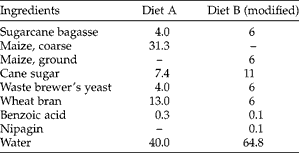
B. zonata larvae have been reared in our laboratory for >150 generations on a diet based on sugarcane bagasse, waste brewer's yeast, ground maize and wheat bran (diet A) (Table 1). The waste brewer's yeast and wheat bran were obtained as waste products from the brewery industry (Phoenix Camps Minerals, Phoenix, Mauritius). Sugarcane bagasse was obtained from a sugar factory (Belle Vue Sugar Estate, Belle Vue, Mauritius), and ground maize was purchased from a mill (Golden Eagle, Pailles, Mauritius). However, using this diet was problematic, and on numerous occasions, fungal growth occurred on the diet. The adult colony was maintained at 26 ± 1 °C and 60 ± 5% RH.
Composition (%) of the larval diets of Bactrocera zonata
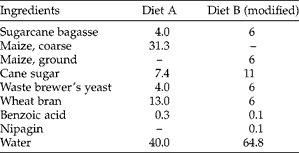
Therefore, the performance of the colony was assessed using a modified diet (diet B) based on Tanaka et al. (Reference Tanaka, Steiner, Ohinata and Okamoto1969) (Table 1). The individual ingredients were weighed with an electronic balance (Kern and Sohn GmbH) and then mixed thoroughly for 30 min in an electric mixer (Altrad Baromix, Minor Alcester) with a capacity of 40 kg. Fibreglass trays (75 × 40 × 6 cm) were filled with 2.5 kg of diet and seeded with 2 ml of eggs. The eggs were transferred using tissue paper to the middle of the diet and then sprinkled with water using a fine dropper to create an even distribution. Five trays of each replicate were placed in larval cabinets in a room at 26 ± 1 °C and 80 ± 5% RH. The larvae were allowed to feed ad libitum on the diet. After 5 days, the cabinet with the larval trays was transferred to a room at 22 ± 1 °C and 60 ± 5% RH. When mature larvae popped out of the diet, they were collected in a tray of water. The water was removed daily and sieved, and the collected larvae were placed into vermiculite to pupate. Mature larvae were collected for 4 days; the diet was discarded when most of the larvae had left the diet. Five groups of 100 2-day-old pupae were weighed for each larval collection. Five separate groups of 100 pupae each were placed on Petri dishes for emergence and flight tests. Open-ended black Perspex tubes (internal diameter 9 cm and 10 cm high) were coated on the inside with talcum powder (the powdered wall surface prevented flies from crawling out of the tubes) and placed over the pupae. After emergence, flies with adequate flight ability flew out of the tubes. One week after emergence, the numbers of non-emerged pupae, partially emerged pupae, deformed flies and non-fliers were recorded to determine the percentage of emergence and percentage of fliers (FAO/IAEA/USDA, 2003). In the second generation, a third diet (diet C), in which ground maize was replaced with ground rice, was also tested. The same quality control parameters were observed.
Rearing of Bactrocera zonata on diet B for four consecutive generations
The production parameters of B. zonata during four generations on the diet identified as modified diet B (Table 1) were determined. The percentage of egg hatch, percentage of pupation, number of pupae in 10 ml, percentage of emergence and percentage of fliers were assessed following the procedures described in FAO/IAEA/USDA (2003) (see the methodology described above).
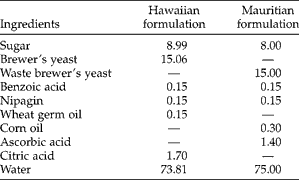
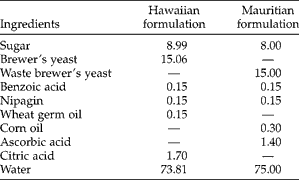
Assessment of liquid larval diets
The United States Department of Agriculture, Agricultural Research Service, in Hawaii provided a liquid larval diet as a starter kit (Table 2). A modified liquid diet (Mauritius liquid diet) was prepared with waste brewer's yeast as the main ingredient (Table 2). Diet B with sugarcane bagasse, ground maize and wheat bran served as the control diet (Table 1). Egg seeding for the liquid larval diets was done according to the method of Chang et al. (Reference Chang, Caceres and Jang2004). The diets were seeded with 0.5 mL eggs ( ≈ 7000 eggs).
Composition (%) of the liquid larval diets of Bactrocera zonata
Larvae were fed ad libitum, and mature larvae were allowed to leave the rearing tray for pupation in a larger plastic tray containing a 1 cm-deep layer of moist (5–8% water) superfine vermiculite. After 5 days in the vermiculite, the pupae were separated from the pupation medium by gentle sifting. The following data were obtained: (i) percentage of pupal recovery (calculation based on the number of eggs seeded onto the diet); (ii) pupal weight; (iii) adult emergence (based on three lots of 100 pupae from each diet); and (iv) flight ability (percentage of fliers) as described in FAO/IAEA/USDA (2003).
Evaluation of pupation media
The pupation of B. zonata larvae was assessed in two pupation substrates and compared with a technique wherein the pupae remained uncovered. Mature B. zonata larvae were collected in water over a 12-h period from the laboratory-reared colony and placed in Perspex containers (40 × 40 × 50 cm). For covered pupation, 25 ml of larvae were used for each treatment and the following substrates were used:
(1) 500 ml of dry sand;
(2) 500 ml of sand wetted with 20 ml water;
(3) 500 ml of fine vermiculite; and
(4) 500 ml of fine vermiculite wetted with 20 ml water.
For uncovered pupation, 25 ml of larvae were placed in a Perspex container.
Each treatment was replicated three times. The experiment was carried out in a room at 22 ± 1 °C and 60 ± 5% RH. The larvae placed in a pupation medium pupated within 24 h, but those left uncovered required up to 72 h to pupate. For each pupation method, the following quality control parameters were assessed: (i) pupal weight; (ii) adult emergence; and (iii) volume of pupae as determined in FAO/IAEA/USDA (2003). These parameters were assessed in a quality control room maintained at 24 ± 1 °C and 60 ± 10% RH.
Statistical analyses
To normalize the data, data on pupal weight were transformed to natural logarithms, and those on the percentage of adult fliers, egg hatch, pupation and adult emergence were arcsine-transformed for the analysis, but untransformed means are presented. Analysis of variance was used to determine differences among quality control parameters, and means were compared using Tukey's HSD (honest significant difference) test. All analyses were carried out using the SAS package (SAS Institute, 2001).
Results
Assessment of fruit juices as an oviposition stimulant
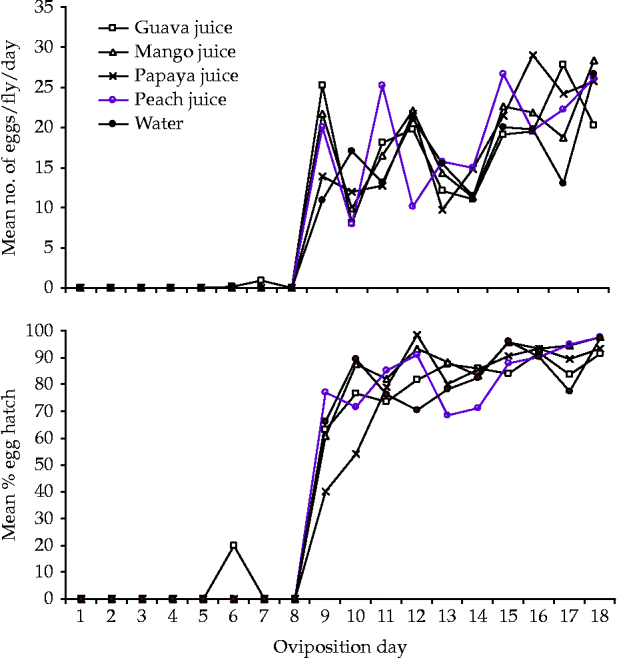
The commercially available fruit juices (papaya, mango, peach and guava) and water were equally effective oviposition stimulants (F 4,249= 0.34; P= 0.8450). Fecundity for the 18-day period ranged from 182 to 189 eggs per adult female. There were also no significant differences in fertility (egg hatch) (F 4,249= 0.92; P= 0.4554), which ranged from 80 to 88%. Bactrocera zonata had a pre-oviposition period of 8 days. For all the treatments including water, fertility rose above 70% from day 10 (Fig. 1).
(colour online) Mean number of eggs per Bactrocera zonata female fly per day and percentage of egg hatch in oviposition bottles containing fruit juice (guava, mango, papaya or peach) or water during the 18-day test period.

Egg production in fruit fly rearing cages
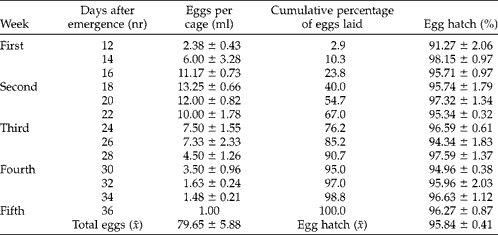
The volume of eggs collected per cage and fertility during the egg collection period are summarized in Table 3. An average of 1,115,100 ± 82,338 eggs per cage was produced over the 36-day period. The eggs from the first 3 weeks of collection represented approximately 90% of the total eggs collected; production dropped during the fourth week. Considering the percentage of adult emergence and sex ratio, the mean number of eggs per female was 52 for the 36-day period (until the cage was discarded).
Fecundity (eggs obtained in each collection) and fertility (egg hatch) (±SE) of Bactrocera zonata from June to December 2007
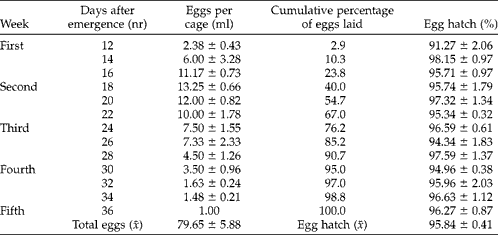
nr, number.
Evaluation of larval diets
All diets remained free of fungal infection during the experiments. Larvae reared on diets A and B developed at approximately the same rate. Popping lasted for 4 days in both generations. Pupae from larvae reared on diet B (5.2 g) were significantly heavier than those from larvae reared on diet A (4.3 g) in the first generation (F 1,10= 257.55; P< 0.0001). There were no significant differences between larvae reared on the two diets with respect to egg hatch, which was above 91% (F 1,10= 0.02; P= 0.8829), pupal recovery, which was above 95% (F 1,5= 1.37; P= 0.3073), adult emergence (F 1,10= 0.41; P= 0.5365) and fliers, which was at least 89% in the first generation (F 1,10= 11.07; P= 0.3282). Replacement of ground maize with ground rice (diet C) resulted in significantly fewer fliers (66%) compared with diet B (83%) (F 2,8= 8.79; P< 0.0165). No significant differences were found in egg hatch (F 2,33= 1.79; P= 0.183), pupal recovery (F 2,8= 1.59; P= 0.2800), pupal weight (F 2,16= 0.52; P= 0.6045), pupation (F 2,8= 0.26; P= 0.7798) and adult emergence (F 2,8= 2.32; P= 0.1793) for larvae reared on the three diets in the second generation. The sex ratio of the flies was 1:1 in both generations.
Rearing of Bactrocera zonata on diet B for four consecutive generations
There were no significant differences in egg hatch, which varied from 86 to 94% (F 3,19= 2.83; P= 0.0717), adult emergence (89 to 94%) (F 3,19= 2.52; P= 0.0947) and fliers (73 to 82%) (F 3,19= 1.37; P= 0.2873) during four consecutive generations. Pupation was above 95%, and 500 pupae weighed 4.2 g. Moreover, the parameters assessed were generally constant.
Assessment of liquid larval diets
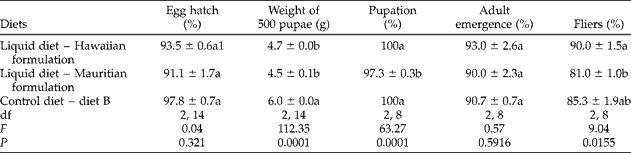
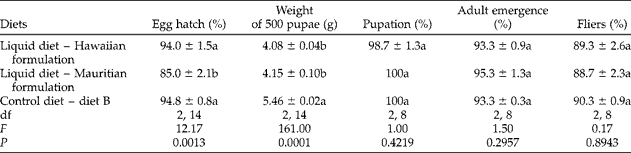
In the first generation, larvae reared on the control diet (diet B) had the shortest popping duration (4 days) followed by those reared on the Hawaiian liquid diet (5 days) and the Mauritian liquid diet (6 days). In the second generation, the popping duration was the same (4 days) for larvae reared on the three diets. For larvae reared on the three diets in both generations, the sex ratio was 1:1. In the first generation, pupal recovery for larvae reared on the control diet was 79% compared with 48 and 42% for those reared on the Hawaiian and Mauritian liquid diets, respectively. In the second generation, pupal recovery for larvae reared on the Hawaiian liquid diet and diet B increased to 63 and 85%, respectively.
The weight of 500 pupae from larvae reared on the two liquid diets was significantly lower than that of pupae from larvae reared on the control diet (diet B) in both generations (Tables 4 and 5). There were no significant differences in pupation (>97%), adult emergence (>90%) and fliers (>85%) between larvae reared on the Hawaiian liquid diet and those reared on the control diet (diet B) in both generations (Tables 4 and 5).
Quality control parameters of Bactrocera zonata reared on two liquid diets and on control diet B in the first generation
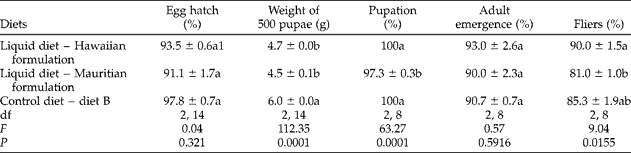
Mean values ( ± SE) within a column followed by the same letter are not significantly different by Tukey's HSD test (P= 0.05).
Quality control parameters of Bactrocera zonata reared on two liquid diets and on control diet B in the second generation
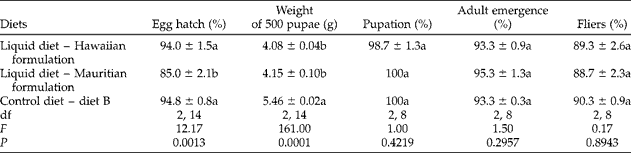
Mean values ( ± SE) within a column followed by the same letter are not significantly different by Tukey's HSD test (P= 0.05).
Evaluation of pupation media
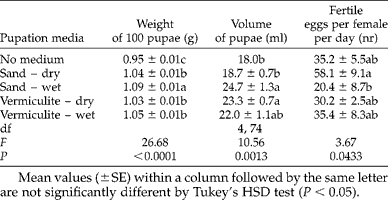
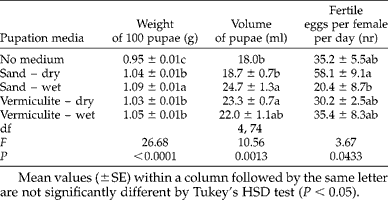
The weight of pupae was significantly affected by the type of pupation medium. Pupae obtained from sand were significantly heavier than those obtained from vermiculite (F= 6.07; df = 1; P= 0.0162). Pupae obtained from wet media were significantly heavier than those obtained from dry media (F= 12.82; df = 1; P= 0.0006). The heaviest pupae developed in wet sand, and the lightest pupae developed in the absence of a medium (Table 6).
Weight and volume of pupae and fecundity of Bactrocera zonata larvae that pupated in sand, vermiculite or without pupation medium
nr, number.
Mean values ( ± SE) within a column followed by the same letter are not significantly different by Tukey's HSD test (P< 0.05).
Pupation was not significantly affected by medium type (F= 0.18; df = 1; P= 0.6761), with 82.0% pupation occurring in vermiculite, 78.4% in sand and 65.1% in the absence of a pupation substrate. Furthermore, the absence or presence of water in the medium did not significantly affect pupation (F= 2.78; df = 1; P= 0.1238), with 84.4% pupation occurring in a wet medium versus 76.0% in a dry medium.
Among the types of pupation substrates used, there were no significant differences with regard to the volume of pupae collected (F= 0.51; df = 1; P= 0.4888), and the presence or absence of water in the substrate also did not significantly affect the volume of pupae recovered (F= 2.79; df = 1; P= 0.1229). Adult emergence (F 2,11= 0.52; P= 0.6102) and fliers (F 2,11= 1.07; P= 0.3840) were not significantly different for pupae obtained from the various treatments. The number of fertile eggs per female per day for the 27-day period ranged from 20 for wet sand to 58 for dry sand (Table 6). Fertility was above 88% in flies subjected to the treatments. However, there were no significant differences in fertility (F 4,14= 0.75; P= 0.5795) among the treatments.
Discussion and conclusions
According to Tanaka (Reference Tanaka1965), using a preferred host juice or extract in an oviposition bottle is important for obtaining a consistent egg harvest from tephritid species. Vargas and Chang (Reference Vargas and Chang1991) reported that artificial oviposition bottles treated with fresh frozen juice of Citrus sinensis (L.) Osbeck increased the egg harvest of Bactrocera dorsalis (Hendel) by 55.2% when compared with those treated with canned guava juice with sugar and/or corn sweetener, citric acid and ascorbic acid. However, they found that water was an effective agent for C. capitata when compared with an extract of coffee Coffea arabica L. Nevertheless, in our study of B. zonata, the various host extracts (papaya, mango, peach and guava) resulted in similar fecundity and fertility when compared with water alone.
Eggs from the first 3 weeks of collection represented approximately 90% of the total eggs collected. During the fourth week, egg production dropped considerably. Collection of eggs from flies older than 34 days would probably not increase overall egg production. Furthermore, old cages are a source of fungal and mite infections in a rearing room. Therefore, it is suggested that 3 weeks of egg collection is optimal for rearing B. zonata and that production cages be emptied 28 days after adult emergence.
In the trial assessing fruit juices as an oviposition stimulant for B. zonata, fecundity for the 18-day period ranged from 182 to 189 eggs per adult female fly. However, in the metal adult cages that were obtained from Hawaii, fecundity of only 52 eggs was achieved for the 36-day period before the flies were discarded. Vargas and Chang (Reference Vargas and Chang1991) reported that when B. dorsalis was maintained in mass-rearing metal cages (29.2 × 118.1 × 118.1 cm) that were seeded with ≈ 83,000 pupae, significantly more eggs were collected from oviposition bottles that contained orange juice than from those that contained water. The efficacy of papaya, mango, peach and guava juices as an oviposition stimulant for B. zonata will need to be assessed in mass-rearing metal cages. It is also probable that the supply of water in two inverted cups on top of the cages is insufficient and that egg production might have suffered from an inadequate supply of water to the flies. Furthermore, there were only three light tubes on the ceiling of the room (5 × 5 m) where the cages were kept. As the cages were 1.78 m high and the top was covered with an aluminium sheet with two openings for the water cups, probably enough light did not enter the cages. Additional light tubes should either be placed on the walls or be suspended at regular intervals from the ceiling to provide uniform light to the entire adult colony cage. An adequate supply of water and uniform light around a B. zonata rearing cage can increase egg production.
A heavy pupa is considered to be a desirable quality of fruit flies reared on artificial diets. Churchill-Stanland et al. (Reference Churchill-Stanland, Stanland, Wong, Tanaka, McInnis and Dowell1986) reported that the size of a Mediterranean fruit fly is important for mating success. Using pupal weight as an estimate of size, it was found that the heaviest flies (8–9 mg) were most successful in securing a mate, followed, in decreasing order, by 6 and 4 mg flies. Similarly, Sharp et al. (Reference Sharp, Boller and Chambers1983) found that large male Mediterranean fruit flies have higher flight ability than small males. The present study demonstrated that, in the first generation, B. zonata larvae reared on the modified diet B had a higher pupal weight than those reared on the old larval diet. Furthermore, no fungal contamination was observed when B. zonata larvae were reared for four consecutive generations. Therefore, it is recommended that diet B be adopted for the rearing of B. zonata larvae.
A liquid diet is promising for rearing B. zonata. Bulking agents such as sugarcane bagasse, wheat bran and maize require considerable storage space, and this would no longer be needed. However, larvae reared on the liquid diet, Hawaiian formulation, were smaller and had a lower pupal weight than those reared on the control diet. The liquid diet should be tested on a mass-rearing scale to evaluate its potential in terms of both quality of flies produced and cost.
At 24 ± 1 °C and 60 ± 10% RH, the larvae placed in pupation media pupated within 24 h, but those in the uncovered pupation technique required up to 72 h to pupate. This observation corroborates data reported by Vargas et al. (Reference Vargas, Chang, Komura and Kawamoto1986) for C. capitata. Their study demonstrates that pupation in the absence of sand or vermiculite resulted in significantly lighter pupae. The proximity of larvae and the generation of metabolic heat by larvae in the uncovered pupation technique could have affected the quality of pupae. However, a pupation medium not only absorbs heat but also spatially separates the larvae. Nevertheless, the absence of a pupation medium did not affect the fecundity and fertility of flies. Vargas et al. (Reference Vargas, Chang, Komura and Kawamoto1986) found that the adult emergence and fecundity of C. capitata were significantly higher when larvae pupated in boxes of vermiculite than when they pupated in trays without any pupation medium. However, similar results were not obtained for B. zonata. Probably, B. zonata flies were able to make up any lateness in development by feeding on the balanced adult food provided ad libitum. A pupation medium, either sand or vermiculite, should be used when rearing B. zonata.
This study demonstrated that B. zonata could be reared on an artificial diet composed of ingredients that are mostly available locally. The quality of flies, namely egg hatch (>85%), pupal recovery (>67%), weight of 500 pupae (>4.2 g), pupation (>95%), adult emergence (>89%) and fliers (>65%), was considered to be satisfactory.
Acknowledgements
This study was partially financed by IAEA Research Contract No. 12786/R0. The authors are grateful to the United States Department of Agriculture, Agricultural Research Service, in Hawaii for donating a liquid diet starter kit, to Phoenix Camps Minerals, Phoenix, Mauritius, for providing waste brewer's yeast and to Belle Vue Sugar Estate, Belle Vue, Mauritius, for providing sugarcane bagasse.