The Regulative Theory of Temperament (RTT), developed by Strelau (Reference Strelau1987, Reference Strelau1996, Reference Strelau1998), mainly evolved from Pavlovian central nervous system (CNS) typology. Differing from other fashionable temperament theories, RTT emphasizes the “formal” (energetic and temporal) aspects of behavior. The basic idea of the RTT may be characterized as follows:
"...temperament takes part in regulating the relationship between man and his/her external world. Of special significance in this regulatory process are two temperamental traits-reactivity and activity. They play a significant role in regulating the stimulative value of the surroundings and the person’s own action, in accordance with the individual’s need of stimulation. Temperamental traits codetermine the individual’s style of action, the choice of situations and behaviors of given stimulative value, as well as the psychophysiological costs inherent in performing activity under highly stimulating demands". (Strelau, Reference Strelau1996, p.131).
Thus, temperament traits may be described as the formal characteristics of behavior that denote underlying, recurrent mechanisms that form stable patterns and account for the relative stability of individual characteristics (Fajkowska, Reference Fajkowska2013). The Formal Characteristics of Behavior-Temperament Inventory (FCB-TI; Strelau & Zawadzki, Reference Strelau and Zawadzki1993, Reference Strelau and Zawadzki1995) is a self-report questionnaire which includes six scales and twelve characteristics (Figure 1). These six scales have been distinguished as follows: briskness (BR) and perseveration (PE), as dimensions referring to the temporal characteristics of behavior (TCB), and sensory sensitivity (SS), endurance (EN), emotional reactivity (ER) and activity (AC), as traits representing the energetic characteristics of behavior (ECB). These traits have been defined as follows (Strelau & Zawadzki, Reference Strelau and Zawadzki1993, Reference Strelau and Zawadzki1995):
-
• Briskness (BR): the tendency to react quickly, to keep high tempo in performing activities, and to shift easily in response to changes in the surroundings from one’s behavior (reaction) to another.
-
• Perseveration (PE): the tendency to continue and repeat behavior and experience emotional states after cessation of stimuli (situations) evoking this behavior or states.
-
• Sensory Sensitivity (SS): the ability to react to sensory stimuli whose stimulating value is low.
-
• Emotional Reactivity (ER): the tendency to react intensively to emotion-generating stimuli, expressed in high emotional sensitivity and in low emotional endurance.
-
• Endurance (EN): the ability to react adequately in situations requiring prolonged or highly stimulating activity or under conditions of intensive external stimulation.
-
• Activity (AC): the tendency to undertake highly stimulating behavior or behavior providing intensive external (environmental) stimulation.
Schema illustrating the relationship of six scales and twelve subscales of the FCB-TI. TCB: Temporal Characteristics of Behavior; ECB: Energetic Characteristics of Behavior; S = Speed; T = Tempo; M = Mobility; P = Persistence; R = Recurrence; SS = Sensory Sensitivity; ES = Emotional Sensitivity; EE = Emotional Endurance; EF = Endurance-fatigue; ED = Endurance-distractors; AD = Activity-direct; AI = Activity-indirect.

According to RTT, each of the characteristics, TCB and ECB, primarily on functional grounds, also contain separate and different characteristics that are strongly correlated and empirically related (Strelau & Plomin, Reference Strelau and Plomin2008, p.92). Hence, five characteristics were distinguished within TCB: Speed, Tempo, Persistence, Recurrence, and Mobility, whereas seven characteristics were distinguished within ECB: Sensory sensitivity, Emotional sensitivity, Emotional endurance, Endurance-distractors, Endurance-fatigue, Activity-direct, and Activity-indirect (Strelau & Plomin, Reference Strelau and Plomin2008; Strelau & Zawadzki, Reference Strelau and Zawadzki1993).
According to the traits defined above, temperament scales are expressed in behavior that may be culturally specific. Some behaviors included in questionnaire may be specific only for the original culture, which means that merely translating questionnaire items may be not adequate to obtain a cross-culturally equivalent tool. In addition, directly revising an inventory from the stage of item generation in the target culture may result in measuring different traits and in the development of noncomparable instruments (van de Vijver & Hambleton, Reference van de Vijver and Hambleton1996). The least risky adaptation procedure seems to construct a broad initial pool of items, developed in the original culture to the target culture and selecting the best of them, according to the identical psychometric procedures as in the original version (De Pascalis, Zawadzki, & Strelau, Reference De Pascalis, Zawadzki and Strelau2000; Strelau & Zawadzki, Reference Strelau and Zawadzki1993). As a result, the original and target versions of the inventory should consist of a pool of identical (etic) and specific (emic) items (De Pascalis et al., Reference De Pascalis, Zawadzki and Strelau2000; Zawadzki, van de Vijver et al., Reference Zawadzki, Strelau, Oniszczenko, Riemann and Angleitner2001). Therefore, Strelau and his colleagues distinguished about six hundred items describing the manifestations of temperament within the twelve characteristics. During the stages of item generation and itemmetric analysis, an item pool named RTTQ which contains 381 items was generated for each characteristic that assesses behaviors found in various cultures (Strelau & Plomin, Reference Strelau and Plomin2008, p. 97).
Follow-up psychometric analysis for the two different large samples was used based on classical test theory (Lord & Novick, Reference Lord and Novick1968) and exploratory factor analysis (EFA). The Cronbach’s α values are above .70 for all characteristics but one (Speed: .64 and .65) and cross-validation was satisfactory. Six factors were extracted with EFA, including four factors for the ECB (sensory sensitivity, emotional reactivity, endurance, and activity) and two factors for the TCB (briskness and perseveration). Finally, scale construction based on factorial loading of twelve characteristics and item selection based on corrected item total correlation (CITC) were conducted to constitute FCB-TI (Strelau & Plomin, Reference Strelau and Plomin2008, p. 99–100). Confirmatory factor analysis (CFA) revealed good support for the temperament structure with eight samples from eight countries (Germany, Italy, Netherland, Poland, Russia, South Korea, Ukraine, USA). For instance, by applying an appropriate psychometric procedure recommending above, the final Polish version of the questionnaire, named FCB-TI, contained 120 items (20 for each of the 6 scales), which was the same number of items as others versions of FCB-TI. The Polish and Russian versions had the largest number of shared items (81 items, 68 percent) and Korean versions had the fewest (56 items, 47 percent). On average the various language versions had 60 percent shared items (72 out of 120, Strelau & Plomin, Reference Strelau and Plomin2008; Zawadzki et al., Reference Zawadzki, Strelau, Oniszczenko, Riemann and Angleitner2001). The Polish version of FCB-TI had satisfactory internal consistency (Cronbach α), ranging from .72 (SS) to .86 (EN) and temporal stability (from .68 to .85 after a 2-week interval; from .69 to .83 except SS .55, after a period of 6 months). The validity of the FCB-TI has also been established in several studies (De Pascalis et al., Reference De Pascalis, Zawadzki and Strelau2000; Fajkowska, Wytykowska, & Riemann, Reference Fajkowska, Wytykowska and Riemann2012; Zawadzki et al., Reference Zawadzki, Strelau, Oniszczenko, Riemann and Angleitner2001), which includes a comparison of the FCB-TI to other personality measures, such as the Sensation Seeking Scale Form V (SSS-V), the NEO-FFI Personality Inventory (NEO-FFI), the Sixteen-Personality-Factor Questionnaire (16PF), the Revised Dimensions of Temperament Survey (DOTS-R), the Eysenck Personality Questionnaire-Revised (EPQ-R) and the Emotionality-Activity-Sociability Temperament Survey (EAS-TS; De Pascalis et al., Reference De Pascalis, Zawadzki and Strelau2000; Strelau & Zawadzki, Reference Strelau and Zawadzki1995). For instance, studies have found that neuroticism correlates significantly with emotional reactivity, perseveration and endurance (negatively); extraversion correlates mainly with activity and briskness; and psychoticism does not correlate with the FCB-TI scales (De Pascalis et al., Reference De Pascalis, Zawadzki and Strelau2000).
The FCB-TI has been applied in many studies in genetics, psychology, and psychiatry. Several studies demonstrated that temperament traits have strong genetic components (Dragan & Oniszczenko, Reference Dragan and Oniszczenko2005; Oniszczenko et al., Reference Oniszczenko, Zawadzki, Strelau, Riemann, Angleitner and Spinath2003; Zawadzki et al., Reference Zawadzki, Strelau, Oniszczenko, Riemann and Angleitner2001). A recent finding demonstrated that genes had a significant association with SS, suggesting that variability in dopamine genes may have an impact on the development of SS (Dragan, Oniszczenko, Czerski, & Dmitrzak-Węglarz, Reference Dragan, Oniszczenko, Czerski and Dmitrzak-Węglarz2012). The analyses indicated that the scales of the FCB-TI can predict illness-related variables, such as somatic anxiety and self-reported illness/injury (Fruehstorfer, Veronie, Cremeans-Smith, & Newberry, Reference Fruehstorfer, Veronie, Cremeans-Smith and Newberry2012). Furthermore, other studies suggest that environmental mechanisms (extreme stress) and persistent situational-related disorder (PTSD) can modify briskness and emotional reactivity, as well as influence the temporal aspect of their changes. In addition, temperament seems to be involved in the process of onset and alteration of PTSD symptoms over time (Zawadzki & Popiel, Reference Zawadzki and Popiel2012).
Cross-cultural studies of the assessment and structure of temperament using the FCB-TI have been conducted on eight samples from different countries (Strelau & Plomin, Reference Strelau and Plomin2008, p. 109; Zawadzki et al., Reference Zawadzki, Strelau, Oniszczenko, Riemann and Angleitner2001). FCB-TI showed good validity and replicability in these different cultures, and the internal consistencies for all scales reached satisfactory values. The ranges of sample alpha reliability of all six scales are identical for both versions: .77 to .82 for combined etic-emic and .75 to .80 for the derived-etic version (Zawadzki et al., 2001).
Nevertheless, these versions have yet to be subjected to a systematic validation study with a large sample, and there are scarcely any psychological assessment tools to measure adult temperament in China. Furthermore, a Chinese version would include the Chinese people in the cross-cultural study of the temperament profile, as well as permit the examination of the correlates of its scales at the individual and cultural levels. With the aim of filling this gap, the present study was conducted in order to obtain evidence of the validity of the Chinese FCB-TI. The characteristics of the Chinese FCB-TI were analysed using itemmetric analysis (Strelau & Plomin, Reference Strelau and Plomin2008, p. 99–100), EFA and CFA with two undergraduate samples. We also addressed reliability and validity in a large adult sample, using CFA while examining both temporal stability and internal consistency. Finally, evidence for convergent and discriminant validity was obtained. Convergent and discriminant validity was explored in relation to the EPQ-RSC model dimensions.
Method
Participants
Three samples of adults were selected by the use of cluster sampling. A first sample of undergraduates from three universities in Dalian of Northeast Liaoning Province (N = 626), which consisted of 278 males and 348 females, agreed and completed the RTTQ. The age of the respondents ranged from 18 to 26 years (M = 21.05, SD = 1.28). A second group of undergraduates (N = 2.980) from nine universities in Dalian completed the FCB-TI. The average age of this sample was 20.32 years (SD = 1.36), with females comprising 50.3% of the sample. A third sample of adults was recruited from nine cities in Liaoning, Jilin, Shandong, Sichuan, Guangdong provinces in eastern, central and western China. This sample (N = 2.265) consisted of 879 males (36.7%) and 1517 females (63.3 %) and was composed of undergraduates, public officials, professionals, managers, businessmen, service sectors, soldiers, workers, and freelancers. The age ranged from 17 to 80 years (M = 31.08, SD = 11.20). A subgroup of 586 participants in Dalian from the third group also completed the FCB-TI in addition to the Eysenck Personality Questionnaire-Revision Short Scale (EPQ-RSC). Finally, to assess the test-retest reliability of the Chinese version of the FCB-TI, a subsample of 132 participants in Dalian from the third group (113 females and 19 males) answered the FCB-TI twice 2 weeks later. All participants volunteered to take part in this study, and no incentives were awarded.
Procedure
The adaptation procedures used in this study were selected based on the guidelines developed by the International Test Commission (Hambleton, Reference Hambleton2001; van de Vijver & Hambleton, Reference van de Vijver and Hambleton1996), and also by Laverdière’s (2010) method. Considering the advantages and drawbacks of the forward-adaptation and the backward-adaptation methods (Hambleton & Kanjee, Reference Hambleton and Kanjee1995), two functionally bilingual translators translated all 381 RTTQ items into Chinese, after which a psychological professor who was proficient in both languages blindly translated the items back into English. Afterwards, five doctoral candidates compared the items with the original version of the RTTQ, and five items were modified in order to rule out the risk of cultural diversity. All 626 undergraduates completed the Chinese version of the RTTQ, then 2980 undergraduates and 2265 adults completed the FCB-TI.
Measures
RTTQ
The RTTQ (Strelau & Plomin, Reference Strelau and Plomin2008) is a temperament item pool containing 381 yes-no items. Based on the RTT, an original item pool containing 600 items was generated and the twelve TCB and ECB scales were operationalized. Following an appropriate psychometric procedure, the item pool was finally reduced to 381 items and was named RTTQ. The Cronbach’s α values are above .70 for all characteristics but Speed (.64 and .65). The correlation matrix of twelve subscales revealed the presence of many coefficients of .3 and above. Cross-validation was satisfactory.
FCB-TI
The FCB-TI (Strelau & Zawadzki, Reference Strelau and Zawadzki1993, Reference Strelau and Zawadzki1995) is a yes-no format, self-report instrument developed to evaluate 6 temperamental scales (briskness, perseveration, sensory sensitivity, endurance, emotional reactivity, and activity) as well as its 12 characteristics. It contains 120 items which were adopted after an itemmetric analysis and EFA for RTTQ. FCB-TI had satisfactory internal consistency, temporal stability and validity. The inventory was translated into Chinese earlier with the permission of the publisher and then back translated to ensure accuracy.
EPQ-RSC
EPQ-RSC (Qian, Wu, Zhu, & Zhang, Reference Qian, Wu, Zhu and Zhang2000) is a 48-item self-report of yes-no items and measures 4 scales (Extraversion, E; Neuroticism, N; Psychoticism, P; Lie, L). Each of the included 12 items has an identical format with the EPQ-R Short Scale. The EPQ-RS has demonstrated good internal consistency (.61 to .62 for P; .84 to .88 for E; .80 to .84 for P; .73 to .77 for L) (Eysenck, Wilson, & Jackson, Reference Eysenck, Wilson and Jackson1996). A study on the psychometric properties of the EPQ-RS in the sample of Chinese adults and adolescents suggested acceptable internal consistencies of all 4 scales for different genders (ranging from .74 to .77 for men, except .57 for P, and from .75 to .77 for women, except .54 for P) and acceptable test-retest reliability (.67 to .78, p < .01).
Statistical Analyses
All analyses were conducted using SPSS version 20.0 and R version 2.11.1, apart from the CFAs, which were conducted using AMOS version 20.0 for Windows. The items of the Chinese RTTQ were selected as the starting point on the basis of their correlation with their own scale (CITC > .30). Principal axis factor analysis (PA; direct oblimin rotation with Kaiser normalization) and analysis for the TCB was executed for the first sample and then for the ECB (Burisch, Reference Burisch1986). There was no restriction placed on the number of factors within the TCB, but a forced four-factor solution was setted within the ECB according to the scree test and the structure coherent with theoretical assumptions. After EFA, some items with lower CITC than correlations with other scales were excluded, and then only items with high CITC were selected. Finally, scales with 20 items each were constructed to constitute the Chinese version of the FCB-TI. For internal consistency, Cronbach’s α values (Streiner, Reference Streiner2003) of twelve subscales for the first sample and six scales for the second and third samples were calculated. The Pearson correlation coefficient was used to estimate the correlation matrix of twelve subscales for the first sample and six scales for the second sample and retest reliabilities for the scales for the first sample. Correlations were calculated between the FCB-TI scales and EPQ-RSC.
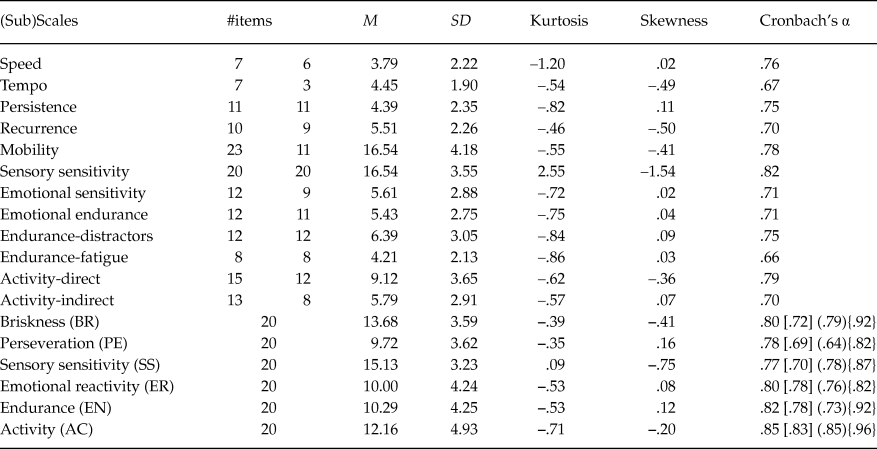
CFA with maximum likelihood estimation was also conducted independently for the second sample. Item-parceling was also used for CFA. After itemmetric analysis, there are twelve parcels including three (Tempo) to twenty-three (Sensory sensitivity) items per parcel for CFA (see table 1). The factorial structures of the TCB and ECB of the FCB-TI were examined respectively through CFA. The chi-square goodness-of-fit statistic (Crowley & Fan, Reference Crowley and Fan1997; Curran, West, & Finch, Reference Curran, West and Finch1996), goodness of fit indices (GFI; Hu & Bentler, Reference Hu and Bentler1998), the comparative fit index (CFI; Bentler, Reference Bentler1990), the root mean square error of approximation (RMSEA; Browne & Cudeck, Reference Browne and Cudeck1992; MacCallum, Browne, & Sugawara, Reference MacCallum, Browne and Sugawara1996), and the standardised root mean-square residual (SRMR; Hu & Bentler, Reference Hu and Bentler1998) were all evaluated to assess the degree of fit of the model. A value of .95 or higher for GFI and CFI implies an acceptable fit, while RMSEA values less than .08 indicate a moderate fit, and values higher than .08 signify an unacceptable fit (Browne & Cudeck, Reference Browne and Cudeck1992; Steiger, Reference Steiger1989). SRMR below .08 of which is indicative of a good fit (Hu & Bentler, Reference Hu and Bentler1998; Schreiber, Nora, Stage, Barlow, & King, Reference Schreiber, Nora, Stage, Barlow and King2006).
Number of items, Means (M), Standard Deviations (SD), Skewness, Kurtosis and Comparison of Internal Consistency Indexes of Scales of the Chinese Version of the RTTQ and FCB-TI

Notes: Scales: BR, PE, SS, ER, EN, AC. The others are subscales. The first column of items lists the number of subscales of RTTQ after itemmetric analysis, and the second one lists the number of subscales of FCB-TI. Cronbach’s α values: the first sample, N = 626; [the second sample, N = 2980]; (the third sample, N = 2265); {test-retest correlations, N = 132}.
Results
Reliability and Items
Table 1 summarizes the numbers of items, means, standard deviations, skewness, kurtosis, and Cronbach’s α values of twelve subscales, six scales and the test-retest correlations. The skewness and kurtosis values indicate that the data was normal distribution. The Cronbach’s α values of five subscales of TCB are .67 (Tempo) to .78 (Mobility) and seven subscales of ECB are .66 (Endurance-fatigue) to .82 (Sensory sensitivity). All their scales were acceptably reliable except Tempo (.67) and Endurance-fatigue (.66). The test-retest correlations ranging from .82 to .96 for all scales indicate high temporal stability. In the consecutive stage of the FCB-TI construction, 150 items of twelve subscales were selected for follow-up EFA. FCB-TI contains 120 items and 67 items (56%) were common to both the Chinese and Polish FCB-TI versions.
EFA
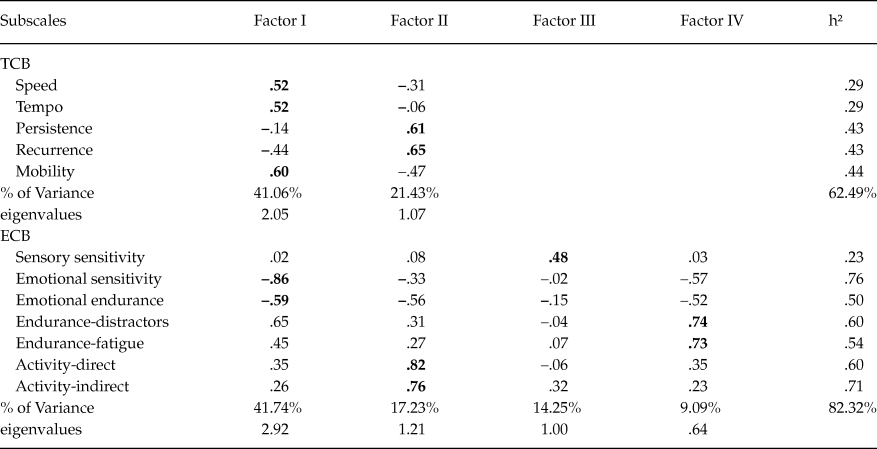
The subscale scores were entered as observed variables into the exploratory factor analysis (Aluja & Blanch, Reference Aluja and Blanch2011; Strelau & Zawadzki, Reference Strelau and Zawadzki1993). In total, there are twelve parcels, with seven (Speed and Tempo) to twenty-three (Mobility) items per parcel for EFA (see table 1). The factorial structure of the FCB-TI was checked using EFA (Table 2). Inspection of the correlation matrix of the TCB and ECB revealed the presence of many coefficients of .30 and above. Bartlett-test of sphericity was 397.57 for the TCB and 1167.91 for the ECB (ps < .001). Kaiser-Meyer-Olkin measure of sampling adequacy was .70 for the TCB and .75 for the ECB. Based on Kaiser’s criterion, two factors referring to the TCB were obtained with eigenvalues higher than 1. The first factor was recognized as ‘briskness’ with highest loadings of speed, mobility, and tempo. The second factor was labeled ‘perseveration’ with highest loadings of recurrence and persistence. We also investigated parallel analysis to retest this result. It turned out that only two eigenvalues from the actual data were greater than the random data eigenvalues. Parallel analysis was also used to explore the number of ECB, which extracted only one factor. Although parallel analysis was considered to the most accurate method to retain the number of factors, Henson and Roberts (Reference Henson and Roberts2006) suggested parallel analysis should better be combined with other multiple standards to carefully decide to keep the number of factors. Therefore, two factors referring to the ECB were obtained with eigenvalues higher than 1 based on Kaiser’s criterion. Finally, a forced four-factor solution was finally accepted within the ECB, with respect to the scree test and the structure coherent with theoretical assumptions and comparable to the findings obtained in the Polish sample (Strelau & Zawadzki, Reference Strelau and Zawadzki1993). In this solution, the first factor was recognized as ‘endurance’ with highest loadings of endurance-fatigue and endurance-distractors. The second factor was labeled ‘activity’ with high loadings of activity-indirect and activity-direct. The third factor was labeled ‘sensory sensitivity’ with high loadings on only one scale (SS). The last factor was recognized as ‘emotional reactivity’ with a high negative loading on emotional sensitivity and a high positive loading on emotional endurance.
Factorial Structure (principal axis, oblimin direct rotation) of Temporal Characteristics of Behavior (TCB) and Energetic Characteristics of Behavior (ECB)

Notes: N = 626. Factor loadings largest in absolute magnitude are shown in bold.
CFA
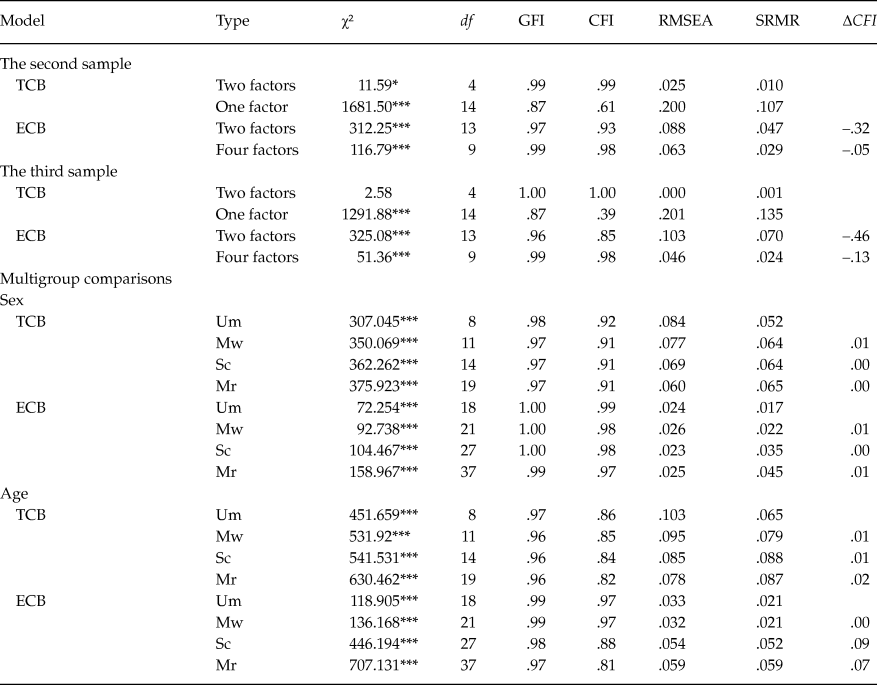
Item-parceling was also used for CFA. After item metric analysis, there were twelve parcels including three (Tempo) to twenty (Sensory sensitivity) items per parcel for CFA (see table 1). In the second and third samples, the factorial structures of the TCB and ECB of the FCB-TI were examined respectively through CFA. The results of the CFA are presented in Table 3. For the TCB, the exact fit (χ² = 11.59, p < .05) was rejected in the second sample but not rejected in the third sample (χ² = 2.58, p > .05), whereas the other model indices were considered a good model fit with GFI, CFI above .95, and RMSEA, SRMR well below .08. The exact fit for ECB was rejected in two samples, but the other model indices were acceptable.
Primary Goodness of Fit and Comparative Indices for the Six Models of Temporal Characteristics of Behavior (TCB) and Energetic Characteristics of Behavior (ECB) and Tests of structural invariance for multigroup model

Notes: *p < .05, ***p < .001, TCB: Temporal Characteristics of Behaviour; ECB: Energetic Characteristics of Behaviour. Um: Unconstrained model; Mw: Measurement weights; Sc: Structural covariances; Mr: Measurement residuals.
Three different factorial models of ECB were tested. A one-factor model was tested. Also, we tested a two-factor model and a four-factor model. Since the two-factor model and four-factor solutions are nested within the one-factor solution, it is possible to test if the one-factor solution fits the data significantly worse. To determine whether the assumption of a one-factor solution should be rejected, a cutoff value of .01 was selected for the CFI difference test (Cheung & Rensvold, Reference Cheung and Rensvold2002). Therefore, the two-factor model and four-factor models fits the data better than the one-factor model should be confirmed if CFI decreases higher than .01. Table 3 shows the fit indices for each model. The one-factor model of the ECB was first fitted for the second and third samples. The exact fits were rejected in both samples, whereas the other model indices were not considered an acceptable model fit. The exact fit of the two-factor model was rejected in two samples, but the other model indices were acceptable except RMSEA in the second sample and CFA, RMSEA in the third sample. The exact fit of the four-factor solutions was rejected in two samples, but the other model indices were acceptable. Moreover, the values of the CFI difference test for the one- and the four-factor solutions were more than .01. Thus, the four-factor model did fit the data, supporting the four-factor solution.
Relationship between FCB-TI Scales and Structural Equivalence
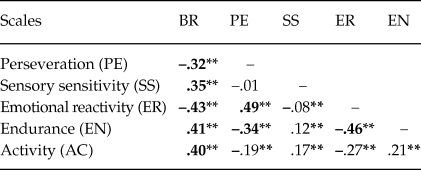
The correlation matrix of the six FCB-TI scales is presented in Table 4. Correlations among six scales ranged from –.46 to .49 in the second sample.
Correlations among Scales of the Chinese Version of the FCB-TI

Notes: The correlations for the second sample (N = 2980) are presented. Correlations above .30 are in boldface. ** p < .01
In addition, in order to examine the structural invariance across sex and age, we tested these by means of multigroup CFA analyses with increasingly restricted specifications. The second and third sample were combined into the fourth sample. As for age in the fourth sample, age variable is divided into two groups: the adolescent group (between 16 and 25 years) and the adult group (between 26 and 80 years; Arnett Reference Arnett2000, Reference Arnett2004; Smetana, Campione-Barr, & Metzger, Reference Smetana, Campione-Barr and Metzger2006).
The unconstrained model just tested for the same number of scales across TCB and ECB of different groups. The measurement weight model required the same factor loadings across TCB and ECB of different groups. The structural covariances model additionally assumed that the equal factor covariances across TCB and ECB of different groups. The measurement residual model which was the most restricted model demanded equal residual variances. The results of the multigroup analyses across TCB and ECB of different groups are summarized in Table 3.
In both TCB and ECB of sex and age, there was not a significant decrease of fit between the unconstrained model and the measurement weight model, suggesting the assumption that the differences in the factor loadings across TCB and ECB of sex and age, which allow us to accept equivalence across sex and age. Furthermore, comparing with the fit of models across sex, the residual variances of TCB and ECB was not equal across age groups, which means that this restriction leads to a significant decrease of fit (ΔCFI > .01) in comparison to the structural covariances model. It was also observed in the structural covariances variances of ECB.
Convergent and Discriminant validity
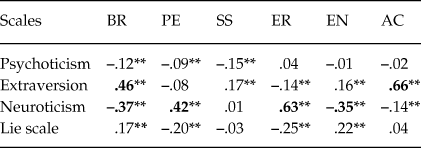
Correlations were calculated between the six scales of the FCB-TI and four scales of the EPQ-RSC. The correlations are shown in Table 5. As can be seen, even weak correlations were significant at the p = .05 level due to the large sample. The correlations supported discriminant validity for the FCB-TI scales in that most correlations were weak, and only a few were moderate. In contrast, the correlation pattern supported convergent validity. In particular, all FCB-TI scales correlated significantly with E and N except for SS. The highest correlations were obtained for the BR and AC scales (E) and for the BR, PE, ER, and EN scales (N).
Correlations between FCB-TI Scales and EPQ-RSC Scales

Notes: **p < .01, BR = Briskness; PE = Perseveration; SS = Sensory sensitivity; ER = Emotional reactivity; EN = Endurance; AC = Activity. Correlations above .30 are in boldface.
Discussion
The aim of the research was to report on the Chinese adaptation of the FCB-TI as well as to provide information about the adaptation procedure and the psychometric properties of this version using several large samples of Chinese individuals. Translation was carried out with an integration of forward and backward procedures. This allowed us to assess reliability and factor structure of the Chinese FCB-TI.
As expected, the internal consistencies were similar to those found in other versions of the FCB-TI (.64 to .87, Zawadzki et al., Reference Zawadzki, Strelau, Oniszczenko, Riemann and Angleitner2001) and were considered satisfactory, with all Cronbach’s α values ranging from .77 to .85 for the first sample, .69 to .83 for the second sample, and from .64 to .85 for the third sample. The test-retest correlations suggest good stability, which is necessary in a stable construct such as temperament. The number of items of Chinese FCB-TI in common with eight countries versions of FCB-TI is 67, which is similar as the total averaged number of common items from eight countries versions of FCB-TI (n = 72; Zawadzki et al., Reference Zawadzki, Strelau, Oniszczenko, Riemann and Angleitner2001).
EFA on the first sample allowed the extraction of two factors explaining 63.83% of the total variance referring to TCB, and four factors explaining 85.13% of the total variance representing ECB. These factors are closely associated to the theoretical scales proposed by Strelau (Reference Strelau1996), thus confirming the replicability of the original six-factor structure. The CFA model applied on both the adolescent and adult samples also showed adequate fit. Exact fit was rejected except for the TCB in the third sample. The RMSEA, CFI, GFI, and SRMR indices indicated acceptable fit. Differences between the two samples in terms of model fit may be explained by differential sample sizes and homogeneity (Laverdière et al., Reference Laverdière, Diguer, Gamache and Evans2010).
Inter-correlations among FCB-TI scales in the second sample were also quite similar to those observed in the Italian version (De Pascalis et al., Reference De Pascalis, Zawadzki and Strelau2000). In the multiplegroup analyses of sex variable, evidence for the progressive incorporation of constraints in the factor loadings was found, meaning that structural equivalency of sex of the FCB-TI as sufficient to ensure cross-cultural equivalency. Through these results was not exactly the same as outcomes of the multiplegroup analyses of age groups, we still observed there was not a significant decrease of fit between the unconstrained model and the measurement weight model, supporting an invariant factor solution of the FCB-TI in both age groups. This result may be a consequence of the fact that the two samples were not sufficiently homogeneous and implies that more representative of the age groups should be selected to be used for a meaningful comparison on the temperament scales of the FCB-TI.
On another issue, the correlation patterns observed between the scores of the FCB-TI and the EPQ-RSC scales offered further evidence for the validity of the instrument as adapted into Chinese. All FCB-TI scales correlated significantly with extraversion. The highest correlations were obtained for AC and BR scales with extraversion and PE, ER, BR and EN scales with neuroticism. SS scales do not correlate significantly with P, E, N dimensions except for the extraversion scale, which appeared to be weakly correlated. Compared with data obtained in Polish samples, the correlations in the Chinese sample were much lower (Strelau & Zawadzki, Reference Strelau and Zawadzki1995). The highest correlations for the Polish FCB-TI version ranged between AC and E, and ER and N (both about .70); however, a significant correlation has been obtained between P and SS scales (about –.15), which are also low. These results are compatible with the previous literature regarding temperament, and follow a very similar trend of correlations as reported in previous works (De Pascalis et al., Reference De Pascalis, Zawadzki and Strelau2000; Strelau & Zawadzki, Reference Strelau and Zawadzki1995, 1997).
The results indicate that the Chinese FCB-TI allows for a valid assessment of temperament in adults. One implication is that there is a great social need to have normative tables for this population. Screening for temperament profiles should predict illness-related variables such as somatic anxiety and inflammations in adults (Fruehstorfer et al., Reference Fruehstorfer, Veronie, Cremeans-Smith and Newberry2012) from the point of health protection. The Chinese FCB-TI can be used in both clinical and research settings. However, given that this sample is not representative of the whole adult Chinese population, extending the search through stratified sampling method for evidence of the validity of this study to Chinese adults with other characteristics is desirable. A shorter version could also be developed for situations where time is limited. Overall, the evidence provided in this study is a considerable step forward for both researchers and practitioners. No less important is the existence of a new tool to allow future studies to analyze temperament within Chinese culture.
Authors wish to thank J. Strelau and B. Zawadzki for their helpful comments on EFAs and CFAs in our research.