Social isolation and loneliness are major health and social problems in older adults (Keefe, Fancey, Andrew, & Hall, Reference Keefe, Fancey, Andrew and Hall2006; Nicholson, Reference Nicholson2012). Conceptually, social isolation is the objective lack of relationships, social support, and social networks in individuals whereas loneliness, a closely related term, is a subjective distressing feeling that results from social isolation (Ashida & Heaney, Reference Ashida and Heaney2008; Cloutier-Fisher, Kobayashi, & Smith, Reference Cloutier-Fisher, Kobayashi and Smith2011).
Being socially isolated and/or lonely can lead to lower self-rated physical health (Cornwell & Waite, Reference Cornwell and Waite2009), reduced responsiveness to stress (Hackett, Hamer, Endrighi, Brydon, & Steptoe, Reference Hackett, Hamer, Endrighi, Brydon and Steptoe2012), increased risk of coronary heart disease (Thurston & Kubzansky, Reference Thurston and Kubzansky2009), increased risk of dementia (Fratiglioni, Wang, Ericsson, Maytan, & Windblad, Reference Fratiglioni, Wang, Ericsson, Maytan and Windblad2000), and mortality (Holt-Lunstad, Smith, & Layton, Reference Holt-Lunstad, Smith and Layton2010). Some of the identified risk factors for social isolation and loneliness include gender, health status, widowhood, and other critical life transitions, disability, and a lack of social networks (British Columbia Ministry of Health, 2004; De Jong-Gierveld & Van Tilburg, Reference De Jong Gierveld, van Tilburg, Knipscheer, de Jong Gierveld, van Tilburg and Dykstra1995; Hall, Havens, & Sylvestre, Reference Hall, Havens and Sylvestre2003; Perissinotto, Stijacic Cenzer, & Covinsky, Reference Perissinotto, Stijacic Cenzer and Covinsky2012). In terms of societal consequences, the absence of social networks and relationships have been linked to elder abuse (Gorbien & Eisenstein, Reference Gorbien and Eisenstein2005), lack of integration and participation in the community (Keefe et al., Reference Keefe, Fancey, Andrew and Hall2006) and lower self-perceived well-being (Cornman, Goldman, Glei, Weinstein, & Chang, Reference Cornman, Goldman, Glei, Weinstein and Chang2003). Within Canada, approximately one in four seniors indicated that they would have liked to participate in more social, recreational, or group activities in the past year (Statistics Canada, 2012).
One mechanism for addressing social isolation and loneliness at the community-level has been the age-friendly cities and communities (AFC) movement promoted by the World Health Organization (WHO, 2007). In Canada, the movement has become an emerging priority at the municipal, provincial, and federal levels of government (some examples include Age-Friendly Windsor, 2011; City of Toronto, 2013; Cloutier-Fisher et al., Reference Cloutier-Fisher, Kobayashi and Smith2011; Garon, Paris, Beaulieu, Veil, & Laliberté, Reference Garon, Paris, Beaulieu, Veil and Laliberté2014; MacCourt, Reference MacCourt2007; Menec et al., Reference Menec, Huton, Newall, Nowicki, Spina and Veselyuk2015; Nova Scotia Seniors’ Secretariat, 2007; Plouffe et al., Reference Plouffe, Garon, Brownoff, Eve, Foucault, Lawrence and Toews2013; Public Health Agency of Canada, 2007; The Council on Aging of Ottawa, n.d.). As a multi-sectoral policy approach, the AFC framework considers how policy makers, city planners, and other stakeholders can facilitate older adults’ positive social connectedness with each other and with their environment through eight community dimensions – outdoor spaces and buildings, transportation, housing, respect and inclusion, social participation, civic participation and employment, communication and information, and community supports and health services (Emlet & Moceri, Reference Emlet and Moceri2012; Lui, Everingham, Warburton, Cuthill, & Bartlett, Reference Lui, Everingham, Warburton, Cuthill and Bartlett2009; WHO, 2007). Two major benefits of this framework are that the dimensions specifically focus on promoting well-established active aging models and are consistent with the determinants of health (Menec, Means, Keating, Parkhurst, & Eales, Reference Menec, Means, Keating, Parkhurst and Eales2011). The framework provides a theoretical grounding to assess age-friendliness in diverse contexts, and has been successfully applied to rural communities (Walsh, Scharf, & Shucksmith, Reference Walsh, Scharf and Shucksmith2014), grassroots non-profits (Scharlach, Davitt, Lehning, Greenfield, & Graham, Reference Scharlach, Davitt, Lehning, Greenfield and Graham2014), and purpose-built retirement communities (Liddle, Scharf, Bartlam, Bernard, & Sim, Reference Liddle, Scharf, Bartlam, Bernard and Sim2014). To date, over 900 communities across Canada are participating in age-friendly initiatives to promote active aging with the aim to reduce social problems such as social isolation and loneliness in older adults (Plouffe & Kalache, Reference Plouffe and Kalache2010; Plouffe & Kalache, Reference Plouffe and Kalache2011; Public Health Agency of Canada, 2014).
A growing body of scholarship is concerned with how well age-friendly initiatives can respond to the needs of communities with older adults from different ethnicities, cultures, socio-economic backgrounds, and living arrangements (Buffel, Phillipson, & Scharf, Reference Buffel, Phillipson and Scharf2012; Menec et al., Reference Menec, Means, Keating, Parkhurst and Eales2011; Phillipson, Reference Phillipson, Settersten and Angel2011). This is unsurprising given that older adults from diverse ethnic, cultural, and immigrant backgrounds may become socially isolated and lonely in Canada due to stresses of migration, limited social support, and networks outside of kin, strained family and intergenerational relationships, financial instability, income insecurity, and possible lack of knowledge of English or French (De Jong Gierveld, Van der Pas, & Keating, Reference De Jong Gierveld, Van der Pas and Keating2015; Ip, Lui, & Chui, Reference Ip, Lui and Chui2007; Koehn, Spencer, & Hwang, Reference Koehn, Spencer, Hwang, Durst and MacLean2010; McDonald, Reference McDonald2011; National Seniors Council, 2014; Ng, Lai, Rudner, & Orpana, Reference Ng, Lai, Rudner and Orpana2012; Wu & Penning, Reference Wu and Penning2015).
Among groups of ethnically diverse older adults, Chinese older adults experience numerous barriers to societal participation in Canadian urban settings (Chan, Reference Chan1991; Hsu, Reference Hsu2014; Tam & Neysmith, Reference Tam and Neysmith2006). In Canada, Chinese older adults make up the highest percentage (approximately 30%) of all visible minority elderly and represent about 3 per cent of Canada’s total older adult population (Statistics Canada, 2011). More than 80 per cent of all Chinese older adults in Canada reside in the provinces of Ontario and British Columbia (Statistics Canada, 2011).
Although individuals of Chinese descent are typically subsumed under the umbrella term Chinese, there is significant diversity within this community. For instance, Mandarin and Cantonese-speaking communities from Mainland China and Hong Kong represent two of the most commonly reported mother tongues of Chinese older adults (Statistics Canada, 2011). These communities possess distinct regional identities, histories of migration, customs, service needs, preferences, and barriers (Lindsay, Reference Lindsay2001; Statistics Canada, 2011; Yee Hong Centre for Geriatric Care, 2013).
In terms of a socioeconomic profile, Canadian census statistics from 2006 indicated that Chinese individuals comprised one of the largest groups living in poverty (National Council of Welfare, 2008). Given that recent immigrant older adults consistently report lower-income levels compared to their Canadian counterparts (Dempsey, Reference Dempsey2009; Kaida & Boyd, Reference Kaida and Boyd2011), a disadvantaged socioeconomic status has been reported in Chinese older immigrants, including those living alone (Lindsay, Reference Lindsay2001; Lai, Reference Lai2004; Kuo & Guan, Reference Kuo, Guan and Zinga2006). This is significant given the role of socioeconomic disparities in perpetuating the economic exclusion of individuals (Lightman & Good Gingrich, Reference Lightman and Good Gingrich2012). Factors contributing to Chinese older adults’ financial precarity may include lack of access to economic and income security resources as newcomers and increased financial dependence on their adult children (Zhou, Reference Zhou2013).
Related to this, there is also evidence that Chinese older adults experience numerous barriers to societal participation in Canadian urban settings (Chan, Reference Chan1991; Hsu, Reference Hsu2014; Tam & Neysmith, Reference Tam and Neysmith2006). Empirical research based on national studies (e.g., Lai, Reference Lai2004, Reference Lai2007a, Reference Lai2007b; Lai & Chau, Reference Lai and Chau2007) and Canadian census statistics (e.g., Lindsay, Reference Lindsay2001) have flagged several risk factors and consequences related to social isolation and loneliness within this population including intergenerational tensions, living alone, and lack of knowledge of official languages. However, there is still a paucity of research and lack of consensus on what social and environmental factors influence urban-dwelling Chinese older adults’ social isolation and loneliness in Canada and, more broadly, Western societies. The applicability of the WHO AFC model in communities with high numbers of Chinese residents has not been explored despite the historical and urban significance of Chinatowns (i.e., urban enclaves) in highly dense inner-city neighbourhoods in Canada (Chinese Canadian Historical Society, 2005). Residents in these neighbourhoods have been identified as at risk of being socially isolated and lonely due to factors such as living alone and having limited knowledge of official Canadian languages (Lai, Reference Lai1988; City of Toronto, 2010; City of Calgary, 2014). Furthermore, health and social service sectors need to better understand the state of knowledge in this area in order to devise strategies that facilitate Chinese older adults’ social inclusion in their neighbourhoods and communities.
In order to address this gap in knowledge, we undertook a scoping review to describe the current state of knowledge on social isolation and loneliness in urban-dwelling Chinese older adults in Canada and other Western societies. Findings from beyond Canada were included to supplement the Canadian evidence and account for similarities between these countries such as urban development strategies, immigration policies, and patterns of transpacific migration by Chinese older adults. Taken together, we use these findings to derive research, practice, and policy recommendations for AFC planning specifically in Canada.
Methods
We chose a scoping review because its methodology maps the existing literature, examines the nature of research activity, disseminates research findings, and identifies gaps in the literature (Arksey & O’Malley, Reference Arksey and O’Malley2005). It also provides a rapid summary of the research and situates the available knowledge within research, policy, and practice implications (Arksey & O’Malley, Reference Arksey and O’Malley2005; Levac, Colquhoun, & O’Brien, Reference Levac, Colquhoun and O’Brien2010). This review followed Levac et al.’ s (Reference Levac, Colquhoun and O’Brien2010) six-stage process for scoping reviews.
Stage 1: Identifying the Research Question
The research question guiding this review was, What is known about social isolation and loneliness in urban-dwelling Chinese older adults living in Western societies? A key conceptual and methodological consideration in this review was the range of definitions and measurements associated with the terms social isolation and loneliness (Menec, Newall, & Nowicki, Reference Menec, Newall and Nowicki2016). A comprehensive scoping review conducted by the National Seniors Council (2014) indicates that terms such as social exclusion, social disconnectedness, and social vulnerability are often used interchangeably with social isolation and loneliness in the literature (British Columbia Ministry of Health, 2004; Cornwell & Waite, Reference Cornwell and Waite2009; Keefe et al., Reference Keefe, Fancey, Andrew and Hall2006; National Seniors Council, 2014; Medical Advisory Secretariat, 2008). Given the inherent purpose of scoping reviews to produce a broad synthesis of the available literature, we included several terms related to social isolation and loneliness in the search strategy to identify studies for inclusion (see Table 1).
Search terms for literature on social isolation and loneliness in Chinese older adults in Western societies

Stage 2: Identifying Relevant Studies
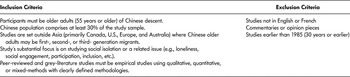
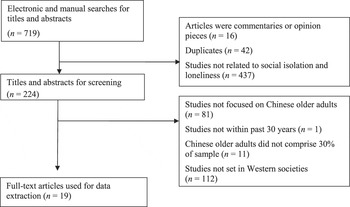
Peer-reviewed and grey literature sources were reviewed for appropriate literature. Peer-reviewed literature included Ageline, CINAHL, Social Sciences Abstracts, MedLine, PsycINFO, Applied Social Sciences Index and Abstracts (ASSIA), Canadian Research Index, Social Services Abstracts, Sociological Abstracts, Social Work Abstracts, and JSTOR. Grey literature was considered from the following databases: Proquest Theses and Dissertations databases, Canadian Public Policy Collection, Canadian Health Research Collection, U.S. National Institutes of Health, OpenGrey (Europe), and a custom Google search of government documents and community reports. The final search terms used for the review were identified through a preliminary literature review, feedback from an expert panel (see Stage 6), manual searches, and expert librarian consultation (see Table 1 for a list of the selected search terms, Table 2 for the inclusion/exclusion criteria, and Figure 1 for the search process).
Inclusion and exclusion criteria

Flow diagram of identifying articles for inclusion and exclusion in the scoping review

Stage 3: Study Selection
Two reviewers independently evaluated the generated titles and abstracts using the specified inclusion and exclusion criteria. A third reviewer was available to mediate in case of a disagreement between the reviewers about a study’s selection in the review. The third reviewer resolved one disagreement that arose during this stage.
Stage 4: Charting the Data
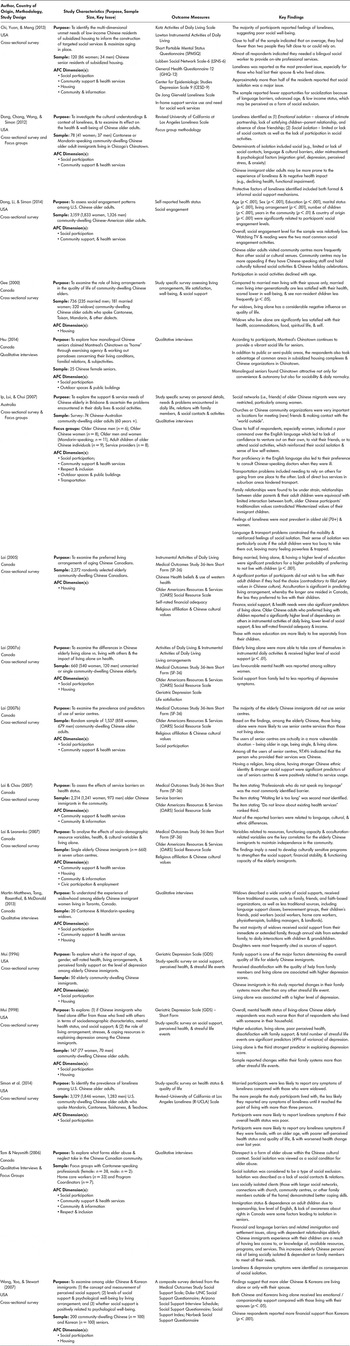
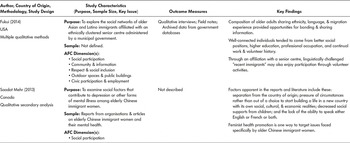
The included studies were presented in descriptive summary tables (see Tables 5 and 6). The tables described the study design, year of publication, key area, outcome measures, relevant findings and conclusions, and the AFC dimension(s) most relevant to the study (see Stage 5 for a description of the coding process used to assign AFC dimensions to a study).
Stage 5: Collating, Summarizing, and Reporting Results
The data charting process described in Stage 4 served as the basis to code the studies according to AFC’s eight community dimension(s), and the WHO AFC framework was used to contextualize the review’s findings on these dimensions. This framework was deemed particularly useful for understanding factors that contribute to social isolation in aging populations, and for formulating suggestions to targeted stakeholders who may participate in enacting change at the practice and policy level through age-friendly initiatives.
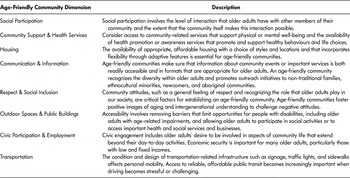
Two reviewers (MAS, CS) met twice for a consultation meeting to exchange preliminary ideas and clarify the process of coding the included studies according to the eight AFC dimensions (see Table 3 for descriptions of the AFC dimensions). To increase the study rigour, the reviewers independently reviewed the articles and the descriptive numerical summary to code the studies into the AFC dimensions (see Tables 5 and 6). Subsequently, members of the authorship team (MAS, CS, KL, SLH) met to discuss the initial coding results and discuss the process of synthesizing the literature under the eight dimensions. This process was done iteratively, whereby subsequent versions of the draft manuscript were reviewed to ensure that the dimensions were sufficiently expansive to capture the core findings of each included study. This approach is consistent with a directive or deductive content analysis (Potter & Levine-Donnerstein, Reference Potter and Levine-Donnerstein1999), and has been successfully applied in other reviews (see McDonald et al., Reference McDonald, Hitzig, Pillemer, Lachs, Beaulieu, Brownell and Thomas2015).
World Health Organization (WHO)’s age-friendly community (AFC) dimensions a

a Descriptions reproduced from Ontario Seniors’ Secretariat (2013). Finding the Right Fit: Age-Friendly Community Planning. Retrieved from http://www.seniors.gov.on.ca/en/resources/AFCP_Eng.pdf
Stage 6: Consultation
An optional feature of the scoping review methodology is establishing an expert panel that can guide the development of the research question and inform the interpretation of the findings (Levac et al., Reference Levac, Colquhoun and O’Brien2010). For the present review, a diverse expert panel (n = 6) was assembled, which included representation from municipal and provincial levels of government, non-governmental organizations (NGOs) with expertise in aging, urban planning, age-friendly communities, and issues related to the Chinese community. The expert panel was consulted on all stages of the methodology in three team meetings from June 2015 to February 2016. The panel was consulted for focused input during the development of the initial protocol (Stages 1–3) and during the presentation of a condensed report which included a summary of the review’s results and the research, policy, and practice recommendations (Stage 5).
Results
A total of 719 results were generated from the search strategy. Nineteen studies met the inclusion criteria. The majority of the studies (n = 17) were peer-reviewed; the grey literature comprised two dissertations. Geographically, the studies were mainly set in Canada (n = 10) and the rest originated from the United States (n = 8) and Australia (n = 1). In terms of research methodologies, 15 studies adopted a cross-sectional survey design (Chi, Yuan, & Meng, Reference Chi, Yuan and Meng2013; Dong, Chang, Wong, & Simon, Reference Dong, Chang, Wong and Simon2012; Dong, Li, & Simon, Reference Dong, Li and Simon2014; Gee, Reference Gee2000; Ip et al., Reference Ip, Lui and Chui2007; Lai, Reference Lai2005, Reference Lai2007a, Reference Lai2007b; Lai & Chau, Reference Lai and Chau2007; Lai & Leonenko, Reference Lai and Leonenko2007; Mui, Reference Mui1996, Reference Mui1998; Simon, Chang, Zhang, Ruan, & Dong, Reference Simon, Chang, Zhang, Ruan and Dong2014; Tam & Neysmith, Reference Tam and Neysmith2006; Wong, Yoo, & Stewart, Reference Wong, Yoo and Stewart2007), and seven studies used a variety of qualitative designs, including face-to-face qualitative interviews (Hsu, Reference Hsu2014; Martin-Matthews, Tong, Rosenthal, & McDonald, Reference Martin-Matthews, Tong, Rosenthal and McDonald2013; Tam & Neysmith, Reference Tam and Neysmith2006), focus groups (Dong et al., Reference Dong, Chang, Wong and Simon2012; Ip et al., Reference Ip, Lui and Chui2007), secondary qualitative analysis (Saadat Mehr, Reference Saadat Mehr2013), and a combination of qualitative approaches (Fukui, Reference Fukui2014). Tables 5 and 6 outline the characteristics, AFC dimension codes, and key findings of the included studies.
Profile of Social Isolation and Loneliness
Issues of isolation and loneliness in Chinese older adults were the main premise in four studies (Dong et al., Reference Dong, Chang, Wong and Simon2012; Ip et al., Reference Ip, Lui and Chui2007; Simon et al., Reference Simon, Chang, Zhang, Ruan and Dong2014; Tam & Neysmith, Reference Tam and Neysmith2006); however, no studies specifically explored the role of AFC dimensions in reducing this issue. All four studies, including one population-based study set in the United States (Simon et al., Reference Simon, Chang, Zhang, Ruan and Dong2014), found that feelings of social isolation and loneliness were apparent in Chinese older adults. Older Chinese women and the oldest age segment within the Chinese elderly population appear to be most impacted or at risk of feeling socially isolated and lonely (Ip et al., Reference Ip, Lui and Chui2007; Simon et al., Reference Simon, Chang, Zhang, Ruan and Dong2014). Across all four studies, the most significant factor perpetuating social isolation and loneliness in this population was the lack of positive social support, social networks, or companionship. Closely tied to this factor was the negative impact of a strained relationship between Chinese elderly parents and their adult children because of issues such as recent migration or the financial dependency of the former on the latter (Dong et al., Reference Dong, Chang, Wong and Simon2012; Ip et al., Reference Ip, Lui and Chui2007; Tam & Neysmith, Reference Tam and Neysmith2006).
Other factors enabling the perpetuation of this issue included poor self-perceived or declining health (Simon et al., Reference Simon, Chang, Zhang, Ruan and Dong2014), a lack of proficiency in the primary language(s) of the country of migration (Ip et al., Reference Ip, Lui and Chui2007), lack of affordable and efficient transportation options (Ip et al., Reference Ip, Lui and Chui2007), and the absence of Chinese-speaking professionals in health and community services (Ip et al., Reference Ip, Lui and Chui2007). The implications of social isolation and loneliness for Chinese elderly adults included adverse physical, cognitive, and mental health consequences (Dong et al., Reference Dong, Chang, Wong and Simon2012), and a greater vulnerability to elder abuse and mistreatment (Dong et al., Reference Dong, Chang, Wong and Simon2012; Tam & Neysmith, Reference Tam and Neysmith2006). Finally, all four studies proposed that interventions aiming to ameliorate this issue must be culturally specific, provide opportunity and space for socialization in the community, and focus on the functioning and social capacity of older adults and their families.
AFC Dimensions
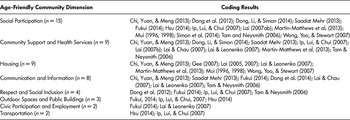
When categorized into the AFC dimensions, 15 studies fell under the ”social participation” umbrella, nine under “community support and health services” and “housing”, eight under “community and information”, four under “respect and social inclusion”, three under “outdoor spaces and public buildings”, and two studies under “civic participation and employment” and “transportation”. It should be noted that each study had been coded under two or more AFC dimensions (see Table 4). Overall, issues relevant to social participation were salient (n = 15 studies) whereas “civic participation and employment” and “transportation” insights were limited (two studies under each dimension).
Age-friendly community dimensions across identified studies

Summary of study characteristics (peer-reviewed)

Summary of study characteristics –grey literature

Social Participation
The 15 studies (Chi et al., Reference Chi, Yuan and Meng2013; Dong et al., Reference Dong, Chang, Wong and Simon2012; Dong, Li, & Simon, Reference Dong, Li and Simon2014; Saadat Mehr, Reference Saadat Mehr2013; Fukui, Reference Fukui2014; Hsu, Reference Hsu2014; Ip et al., Reference Ip, Lui and Chui2007; Lai, Reference Lai2007a, Reference Lai2007b; Martin-Matthews et al., Reference Martin-Matthews, Tong, Rosenthal and McDonald2013; Mui, Reference Mui1996, Reference Mui1998; Simon et al., Reference Simon, Chang, Zhang, Ruan and Dong2014; Tam & Neysmith, Reference Tam and Neysmith2006; Wong et al., Reference Wong, Yoo and Stewart2007) coded under the “social participation” dimension reveal the nature and types of social support that Chinese older adults may maintain and where they might socialize with others.
Having access to positive social support was found to reduce loneliness (Chi et al., Reference Chi, Yuan and Meng2013; Dong et al. Reference Dong, Chang, Wong and Simon2012), lessen depressive symptoms (Lai, Reference Lai2007a) and predict the likelihood of using seniors centres (Lai, Reference Lai2007b) in Chinese older adults. Within the family circle, spouses were a source of positive emotional or companionship support (Simon et al., Reference Simon, Chang, Zhang, Ruan and Dong2014; Wong et al., Reference Wong, Yoo and Stewart2007). Among children, daughters were found to be the main source of support for widows for assistance with daily living activities such as grocery shopping and participating in recreational activities (Martin-Matthews et al., Reference Martin-Matthews, Tong, Rosenthal and McDonald2013). On the other hand, a perceived dissatisfaction with the quality of family relationships contributed to feelings of isolation and loneliness and lowered mental health status in Chinese older adults (Ip et al., Reference Ip, Lui and Chui2007; Mui, Reference Mui1996, Reference Mui1998; Saadat Mehr, Reference Saadat Mehr2013). Other types of social contacts positively contributing to Chinese older adults’ social participation in their community and neighbourhood included other seniors with similar ethnicity, language, and migration background (Fukui, Reference Fukui2014), and less common groups such as “children’s friends, paid workers (social workers, home care workers, physiotherapists), building managers and landlords” (Martin-Matthews et al., Reference Martin-Matthews, Tong, Rosenthal and McDonald2013, p. 511).
Community and neighbourhood spaces where Chinese older adults may socialize or meet with others include faith-based organizations such as churches (Ip et al., Reference Ip, Lui and Chui2007; Martin-Matthews et al., Reference Martin-Matthews, Tong, Rosenthal and McDonald2013; Tam & Neysmith, Reference Tam and Neysmith2006) and community centres (Dong et al., Reference Dong, Li and Simon2014; Tam & Neysmith, Reference Tam and Neysmith2006).
Community Support and Health Services
Nine studies indicated the range of factors that may impact Chinese older adults’ ability to access and uptake of community services (Chi et al., Reference Chi, Yuan and Meng2013; Dong et al., Reference Dong, Li and Simon2014; Ip et al., Reference Ip, Lui and Chui2007; Lai, Reference Lai2007b; Lai & Chau, Reference Lai and Chau2007; Lai & Leonenko, Reference Lai and Leonenko2007; Martin-Matthews et al., Reference Martin-Matthews, Tong, Rosenthal and McDonald2013; Saadat Mehr, Reference Saadat Mehr2013; Tam & Neysmith, Reference Tam and Neysmith2006). These factors included their lack of knowledge of existing resources, programs, and services, and financial and language barriers (Tam & Neysmith, Reference Tam and Neysmith2006). In line with these factors, the availability of Chinese-speaking professionals was especially important for the Chinese elderly population to access community and health services (Chi et al., Reference Chi, Yuan and Meng2013; Dong et al., Reference Dong, Li and Simon2014; Lai & Chau, Reference Lai and Chau2007; Lai, Reference Lai2007b).
Housing
No studies provided insights about whether and how the availability of appropriate or affordable housing influenced Chinese older adults’ social isolation and loneliness. However, a handful of studies indicated the choice of living arrangements by Chinese older adults (Chi et al., Reference Chi, Yuan and Meng2013; Gee, Reference Gee2000; Lai, Reference Lai2005, Reference Lai2007a; Lai & Leonenko, Reference Lai and Leonenko2007; Martin-Matthews et al., Reference Martin-Matthews, Tong, Rosenthal and McDonald2013; Mui, Reference Mui1996, Reference Mui1998; Wong et al., Reference Wong, Yoo and Stewart2007). In some instances, living alone was a risk factor and pre-condition to feeling socially isolated and lonely (Mui, Reference Mui1996, Reference Mui1998; Wong et al., Reference Wong, Yoo and Stewart2007) as well as a low self-perceived quality of life and well-being (Gee, Reference Gee2000). Chinese widows living alone, in particular, appeared to be the most vulnerable to isolation and loneliness (Chi et al., Reference Chi, Yuan and Meng2013).
On the other hand, living alone did not consistently translate into increased feelings of loneliness in this population. Some older Chinese adults, despite living alone, did not wish to live in an intergenerational living arrangement (i.e., with their adult children) (Gee, Reference Gee2000; Hsu, Reference Hsu2014; Lai, Reference Lai2005). In fact, in some samples, living with children resulted in a higher level of dependency on others for instrumental activities of daily living, lower level of social support, and less self-rated financial adequacy and income (Lai, Reference Lai2005, Reference Lai2007a; Lai & Leonenko, Reference Lai and Leonenko2007).
Communication and Information
Eight studies (Chi et al., Reference Chi, Yuan and Meng2013; Fukui, Reference Fukui2014; Dong et al., Reference Dong, Li and Simon2014; Lai & Chau, Reference Lai and Chau2007; Lai & Leonenko, Reference Lai and Leonenko2007; Saadat Mehr, Reference Saadat Mehr2013; Tam & Neysmith, Reference Tam and Neysmith2006) acknowledged that a lack of knowledge about community events and services is a common condition experienced by socially isolated and vulnerable Chinese seniors.
These studies recommended a combination of formal and informal interventions to reach out to socially isolated Chinese seniors. One sub-section of these studies recommended that administrators and professionals design formal awareness and outreach programs that address common barriers faced by Chinese older adults including lack of knowledge of English or French, facing discrimination while accessing services, possible incompatibility of Western service models to Chinese health and social practices, and cultural stigma attached to accessing formal services (Lai & Chau, Reference Lai and Chau2007; Lai & Leonenko, Reference Lai and Leonenko2007; Tam & Neysmith, Reference Tam and Neysmith2006). A second type of proposed intervention was for service agencies to use informal communication networks to deliver awareness and information about community activities (Chi et al., Reference Chi, Yuan and Meng2013; Fukui, Reference Fukui2014; Lai & Chau, Reference Lai and Chau2007). These informal networks may include community-dwelling volunteers and community leaders of Chinese background who may be more familiar with their communities and possess personal knowledge of vulnerable older residents. These networks may also be trained to provide information about community services and programs in a simplified and culturally sensitive way (Chi et al., Reference Chi, Yuan and Meng2013; Fukui, Reference Fukui2014; Lai & Chau, Reference Lai and Chau2007).
Respect and Social Inclusion
Some studies indicated that intergenerational tension between Chinese elderly parents and their adult children results in the former’s isolation (Dong et al., Reference Dong, Chang, Wong and Simon2012; Fukui, Reference Fukui2014; Ip et al., Reference Ip, Lui and Chui2007; Tam & Neysmith, Reference Tam and Neysmith2006). Some typical scenarios that led to intergenerational tension included elderly parents feeling that their needs were not understood by their adult children and spouses (Dong et al., Reference Dong, Chang, Wong and Simon2012), elder mistreatment and abuse by adult children (Dong et al., Reference Dong, Chang, Wong and Simon2012; Tam & Neysmith, Reference Tam and Neysmith2006), familial and social maladjustments due to migration in later life (Fukui, Reference Fukui2014), having family members and adult children violate Chinese cultural, filial, and familial norms and values (Tam & Neysmith, Reference Tam and Neysmith2006), being infantilised by adult children or other family members (Ip et al., Reference Ip, Lui and Chui2007) and being made to feel that they are a financial burden on their families (Ip et al., Reference Ip, Lui and Chui2007).
Civic Participation and Employment
Only two studies provided a cursory view of the “civic participation and employment” dimension (Fukui, Reference Fukui2014; Lai & Leonenko, Reference Lai and Leonenko2007) and the socioeconomic factors that may reduce the risk of social isolation and loneliness. In particular, favourable socioeconomic characteristics, such as an already-present financial stability, proficiency in English, higher educated background, and having professional adult children better predicted Chinese seniors’ participation in civic engagement, employment, volunteering, and ability to extend support to other isolated and marginalized Chinese seniors (Fukui, Reference Fukui2014).
A nuanced view about the employment experiences of Chinese elderly was not apparent in the literature. A finding gleaned from one study was that financial security (sourced either from income through work or government sources and pensions) was a critical safety net for Chinese older adults to avoid social isolation when living alone (Lai & Leonenko, Reference Lai and Leonenko2007).
Outdoor Spaces and Public Buildings
An ethnic enclave neighbourhood such as a “Chinatown”, which included public spaces to socialize and exercise, was identified as a source of protection from social isolation for Chinese residents (Hsu, Reference Hsu2014). In particular, neighbourhoods with Chinese cultural organizations and physical spaces that incorporated Chinese cultural symbols were particularly beneficial to Chinese older adults’ perceptions of well-being and belonging (Fukui, Reference Fukui2014; Hsu, Reference Hsu2014; Ip et al., Reference Ip, Lui and Chui2007).
Transportation
Chinese older women were identified as more likely to be dependent on others for their transportation needs and to rely on their family members to meet those needs (Ip et al., Reference Ip, Lui and Chui2007). As well, unilingual road signage in only English or French (Ip et al., Reference Ip, Lui and Chui2007) and inadequate, inefficient, and infrequent public transportation (Hsu, Reference Hsu2014) were identified as transportation barriers.
Discussion
The objective of the present scoping review was to map the literature related to social isolation and loneliness in urban-dwelling Chinese older adults living in Western societies. To help organize the mapping process, the studies were coded using the WHO AFC framework. The identification of 19 studies (17 peer-reviewed; 2 grey literature) indicates that the scope of the literature in this area is small. The research base appears to be limited in its geographical distribution as all but one study originated from North America (Ip et al., Reference Ip, Lui and Chui2007).
All key dimensions of the WHO (2007) AFC model were represented in some capacity throughout the literature; however, some dimensions (i.e., social participation; community support and health services; housing; and communication and information) were more prominently represented than others (see Table 4). Overall, the studies coded under these dimensions indicated that immediate family members (especially adult children) may be the most common source of social support for those Chinese immigrant families that have a strong affiliation with traditional Chinese cultural values and positive familial relationships. Outside the home, ethnic-enclave neighbourhoods such as “Chinatowns” which included the presence of Chinese symbols in physical spaces may contribute to increased affiliation with one’s immediate neighbourhood and community. In particular, one study (Hsu, Reference Hsu2014) specifically focused on the positive social participation of Chinese older adults in their community as a result of living in a Chinatown neighbourhood. As well, the presence and availability of Chinese-speaking professionals in the social service sector greatly encouraged Chinese older adults to access community and health services (Chi et al., Reference Chi, Yuan and Meng2013; Dong et al., Reference Dong, Li and Simon2014; Lai, Reference Lai2007b; Lai & Chau, Reference Lai and Chau2007). Furthermore, there appears to be heterogeneity in the experiences of Chinese older adults living alone. Although some Chinese older adults may actually prefer living alone, others who are living alone due to life circumstances, such as widowhood, may be particularly vulnerable to being socially isolated and lonely (Chi et al., Reference Chi, Yuan and Meng2013; Gee, Reference Gee2000; Mui, Reference Mui1996, Reference Mui1998; Wong et al., Reference Wong, Yoo and Stewart2007). In these situations, safety nets such as extended social networks and socioeconomic factors such as financial security could play a beneficial role.
Finally, one significant gendered insight can be gleaned from this analysis. Chinese older women living alone may be particularly vulnerable to social isolation and loneliness given their greater self-reporting of this phenomenon and less favourable mental health compared to those living with others (Lai, Reference Lai2007a; Martin-Matthews et al., Reference Martin-Matthews, Tong, Rosenthal and McDonald2013). Importantly, comparisons across gender on specific outcomes were scarce in this pool of studies, indicating that this issue remains glaringly under-studied.
This review points to the potential of the age-friendly approach to address the issue of social isolation and loneliness in ethnic-minority older adults living in urban, Western communities. Based on the findings, some suggestions relevant for future research, policy, and practice emerge.
Recommendations for Research
In terms of research, it is clear that further work is needed on the applicability of the age-friendly approach in tackling social isolation and loneliness in older adults. The AFC framework has yet to be explored across different ethnic and cultural groups, including the Chinese community (Moulaert & Garon, Reference Moulaert and Garon2016). The findings of our review confirm that even though several studies highlighted a number of complex social, cultural, and environmental issues impacting Chinese older adults’ social isolation and loneliness, none adopted an age-friendly perspective to explore this phenomenon. In line with this, one research challenge facing the age-friendly field is how its standardized models will adapt to issues such as the growing complexity of urban living (e.g., ethnic enclaves), global/international forces (e.g., migration patterns and areas of settlement), and the unique social and economic inequalities faced by diverse older adults in Western societies (e.g., racial discrimination and socioeconomic disparities based on neighbourhood or community choice) (Buffel et al., Reference Buffel, Phillipson and Scharf2012; Phillipson, Reference Phillipson, Settersten and Angel2011).
Furthermore, there are conceptual challenges in the research community about how to precisely define “age-friendly” communities. For instance, an issue of contention is whether age-friendly communities can be considered to comprise two distinct features – physical (e.g., transportation and housing) and social (e.g., respect, social inclusion, and social participation) (Scharlach & Lehning, Reference Scharlach and Lehning2015) – or as an integrated environment of social and physical factors that overlap, interact, and influence each other (Lui, et al., Reference Lui, Everingham, Warburton, Cuthill and Bartlett2009). The latter approach may be more appropriate for research on social isolation and loneliness as several studies in this review shed light on the closeness between social and environmental factors influencing this phenomenon. For instance, Ip et al. (Reference Ip, Lui and Chui2007) identified inadequate public transportation as a barrier to Chinese older adults’ social participation in the community. At the same time, the researchers contextualize this environmental issue within larger social factors such as barriers to mobility, lack of accessibility, and possible strained familial relationships because of Chinese older adults’ frequent dependence on their adult children for their transportation needs.
Beyond the need for definitional clarity regarding “age-friendly communities”, a variety of research designs are needed in empirical research to explore linkages between social isolation and loneliness and age-friendly initiatives. As evidenced in this review, 12 out of the 19 studies adopted only one type of data collection approach (e.g., a cross-sectional survey) (Chi et al., Reference Chi, Yuan and Meng2013; Dong et al., Reference Dong, Li and Simon2014; Gee, Reference Gee2000; Lai, Reference Lai2005, Reference Lai2007a, Reference Lai2007b; Lai & Chau, Reference Lai and Chau2007; Lai & Leonenko, Reference Lai and Leonenko2007; Mui, Reference Mui1996, Reference Mui1998; Simon et al., Reference Simon, Chang, Zhang, Ruan and Dong2014; Wong et al., Reference Wong, Yoo and Stewart2007). In line with this, Menec et al. (Reference Menec, Means, Keating, Parkhurst and Eales2011) and Dellamora et al. (Reference Dellamora, Zecevic, Baxter, Cramp, Fitzsimmons and Kloseck2015) have advocated for mixed-methods research designs and multiple approaches to data collection to gain a nuanced view of diverse older adults’ interaction with their physical and social environment.
Recommendations for Policy
In Canada, the WHO-based age-friendly movement has been adopted in hundreds of communities and is implemented through federal, provincial, and municipal governance (Plouffe et al., Reference Plouffe, Garon, Brownoff, Eve, Foucault, Lawrence and Toews2013). Given this growing prominence of pan-Canadian age-friendly policies and initiatives, policy recommendations should focus on achieving long-term sustainability and the ability to address local social issues such as social isolation and loneliness.
In the age-friendly literature, a major policy recommendation is for policy makers to adopt an integrative approach and collaborate with researchers, practitioners, and other stakeholders working with older adults (Glicksman, Clark, Kleban, Ring, & Hoffman, Reference Glicksman, Clark, Kleban, Ring and Hoffman2014). For instance, Glicksman et al. (Reference Glicksman, Clark, Kleban, Ring and Hoffman2014) used integrative theory principles to derive questions that policy makers may ask themselves while coordinating with other age-friendly stakeholders. These questions include asking (1) whether funding commitments are adequate to address both the physical and social environment needs of a community, (2) to what extent do policies mandate community organizations to collaborate with one another, and (3) whether the policy is expansive enough to allow for age-friendly work with subgroups of older adults. Although no studies identified in our review adopted a research design that encouraged this type of collaboration to target social isolation and loneliness, three studies (Fukui, Reference Fukui2014; Saadat Mehr, Reference Saadat Mehr2013; Tam & Neysmith, Reference Tam and Neysmith2006) collected data from multiple sources including secondary literature and community professionals. Such approaches are important first steps towards bringing policy makers closer to evidence that is collected from multiple sources within the community.
This integrative approach can also be used to promote collaboration across multiple policy domains that may impact age-friendly community planning and interventions targeted towards social isolation and loneliness in older adults. For instance, a greater collaboration across policy areas including public transportation, housing, public health, social welfare, finance, and immigration could transform age-friendliness and older adults’ social inclusion and participation into national priorities rather than siloed community-based issues (Ball & Lawler, Reference Ball and Lawler2014; Greenfield, Oberlink, Scharlach, Neal, & Stafford, Reference Greenfield, Oberlink, Scharlach, Neal and Stafford2015).
Ongoing policy discussions related to the changing demographics in Canada will impact the implementation of these policy recommendations. For instance, policy concerns about the financial costs associated with an aging population in Canada can lead to cost-saving measures such as a reduction in publicly funded programs and services and shifting the responsibility for AFC initiatives away from government and onto communities (Menec et al., Reference Menec, Means, Keating, Parkhurst and Eales2011). Ultimately, the success of these integrative policy recommendations will depend on the difficult balancing act between cost-cutting pressures and the need for governmental financial commitment in AFC initiatives.
Recommendations for Practice
The results of this review indicate that front-line professionals in health and social services can be important members of older adults’ social networks (Chi et al., Reference Chi, Yuan and Meng2013; Dong et al., Reference Dong, Li and Simon2014; Lai, Reference Lai2007b; Lai & Chau, Reference Lai and Chau2007). Despite the fact that social isolation and loneliness is a significant issue among community-dwelling older adults, it is not adequately assessed, and is often overlooked in practice (Nicholson, Reference Nicholson2012). Nicholson (Reference Nicholson2012) noted the importance of capitalizing on the ability of community-based practitioners to screen for social isolation and loneliness when they interact directly with older adults, such as during home visits. In our review, only one study (Tam & Neysmith, Reference Tam and Neysmith2006) included home care workers in their sample who provided rich, detailed qualitative insights about the daily challenges, abuse, and isolation faced by older clients.
Our review also highlights the importance of Chinese-speaking professionals in the community-based workforce in increasing Chinese older adults’ access to and uptake of community-based services (Chi et al., Reference Chi, Yuan and Meng2013; Dong et al. Reference Dong, Li and Simon2014; Lai, Reference Lai2007b; Lai & Chau, Reference Lai and Chau2007). The larger implication of this finding is that community-based health and social services should include culturally competent and linguistically diverse professionals who are able to understand the lived realities of older adults and how issues of race, culture, ethnicity, immigration status, socioeconomic status, and other markers impact them (Min, Reference Min2005).
Finally, most age-friendly community initiatives are still in the development stage, and there is a significant research and policy gap in understanding their effectiveness (Plouffe & Kalache, Reference Plouffe and Kalache2011). Front-line professionals in the health and social service sectors such as social workers, public health nurses, home care workers, and housing workers can make significant contributions to the evaluation of these age-friendly initiatives. They can provide insights about how different subgroups of older adults respond to age-friendly activities, the effectiveness of local strategies, challenges and best practices, and which local needs are still unmet.
Additional Expert Stakeholder Insights
Our scoping review sought input from a stakeholder group of professionals with knowledge and experience in the field of aging, urban planning, Chinese culture, and age-friendliness. The aforementioned recommendations were endorsed by this expert stakeholder group who provided several additional insights. For instance, the panel noted how regional differences in language, socioeconomic status, and educational opportunities in China can influence Chinese older adults’ choice of neighbourhood after arriving in Canada. As well, expert panel members highlighted that social isolation and loneliness is multi-dimensional and may trigger or be triggered by other social problems including homelessness, poverty, hoarding, elder abuse, substance abuse, and mental health conditions and service gaps (see also Guruge, Thomson, & Seifi, Reference Guruge, Thomson and Seifi2015). These issues were largely absent from the studies included in this review.
Limitations
A broad research question guided this scoping review and, as such, the literature was reviewed from a descriptive rather than analytical approach. As well, findings of studies from the United States and Australia were contextualized to inform future research, practice, and policy for Canada. However, varying levels of differences exist between those countries and Canada in areas such as caregiving policies (Martin-Matthews, Tamblyn, Keefe, & Gillis, Reference Martin-Matthews, Tamblyn, Keefe and Gillis2009), welfare models (Cooke, Reference Cooke2006), and health care systems (Prus, Tfaily, & Lin, Reference Prus, Tfaily and Lin2010). These may likely affect the social, health, and mental health outcomes for older Chinese adults residing in those countries. Despite these differences, the dearth of literature on this topic necessitated a bird’s-eye view, and issues noted in studies from outside Canada might serve as good indicators for areas of further investigation in Canada and globally. Finally, although efforts were made to conduct a thorough scan of both the peer-reviewed and grey literature, it is possible that not all pertinent records were found for inclusion.
Conclusion
Social isolation and loneliness are significant issues for Chinese older adults, and the AFC framework appears to be a useful model for contextualizing these issues into research, policy, and practice recommendations. Age-friendly literature is beginning to address how its framework is applicable for specific social issues such as social isolation and loneliness, but there is still room for research with diverse communities through multiple research methodologies. In Canada, the issue is especially timely given that the majority of older adults arriving in the country come from the Asia and Pacific region (Government of Canada, 2015) and settle in dense urban areas. The findings and recommendations of this review indicate that multi-sectoral interventions which involve multiple stakeholders in the aging field are needed to address the physical and social challenges that inhibit older adults’ successful social participation and active aging in their neighbourhoods.