Introduction
During the last 20 years, we have witnessed a stream of discoveries of new superconducting materials with critical temperatures T c in the range of 10 < T c < 60 K, filling the gap between conventional low-T c superconductors (LTS) and high-T c cuprates. In 2001, the discovery of MgB2 with T c = 40 K was announced.Reference Nagamatsu, Nakagawa, Muranaka, Zenitani and Akimitsu1 It was quickly recognized that high T c and other unusual properties of MgB2 result from the well-known multiband electron-phonon-mediated superconducting pairing but on different disconnected sheets of the Fermi surface (FS). In conventional metallic superconductors such as Nb or Pb, the superconducting gap Δ opens up below T c in only a single band crossing the Fermi level. In contrast, the two-band MgB2 has two different superconducting gaps Δσ ≈ 7.2 meV and Δπ ≈ 2.3 meV on the σ and π sheets of the Fermi surface formed by the in-plane (σ) and out-of-plane (π) orbitals of Boron.Reference Kortus, Mazin, Belashchenko, Antropov and Boyer2, Reference Choi, Roundy, Sun, Cohen and Loule3
In 2008, the discovery of superconductivity in LaFeAsO1–xFx at 26 KReference Kamihara, Watanabe, Hirano and Hosono4 initiated investigations of the diverse family of ferropnictides. As a result, T c has been increased up to 56 K by substituting La with other rare earthsReference Wang, Li, Chi, Zhu, Ren, Li, Wang, Lin, Luo, Jiang, Xu, Cao and Xu5 to create members of the family called RE-1111. Other Fe-based superconductor (FBS) families have also been found, most notably BaAs2(Fe1–xCox)2 and Ba1–xKxAs2Fe2 (Ba-122) with T c ≤ 38 K;Reference Rotter, Tegel and Johrendt6 FeSe1–xTex (Fe-11) with T c ≤ 15 K;Reference Fang, Pham, Qian, Liu, Vehstedt, Liu, Spinu and Mao7, Reference Hsu, Luo, Yeh, Chen, Huang, Wu, Lee, Huang, Chu, Yan and Wu8 and LiFeAs with T c ≤ 18 KReference Wang, Liu, Lv, Gao, Yang, Yu, Li and Jin9. Like MgB2, FBS are also multiband superconductors, with several bands crossing the Fermi level and superconductivity occurring on several disconnected electron and hole sheets of the FS. Yet MgB2 is a metallic superconductor with comparatively large in-plane coherence length at T = 0 K of ξ0 ≈ 5–10 nm, which quantifies the radius of the Cooper pairs. In contrast, the semi-metallic FBS become superconducting only upon doping the parent antiferromagnetic compoundsReference Johnston10 and have much shorter ξ0≈ ħv F/2πk BT c = 1–2 nm because of their smaller Fermi velocities v F= 106–107 cm/s (the speed of the electrons on the FS).Reference Johnston10 The significant difference in ξ0 in MgB2 and FBS suggests very different ways of improving H c2 in these materials.
Multiband superconductivity in MgB2 is different from that in FBS. MgB2 is a two-band superconductor with strong intraband and weak interband electron-phonon pairing, resulting in Cooper pairs in the s-orbital state (s-wave pairing).Reference Kortus, Mazin, Belashchenko, Antropov and Boyer2, Reference Choi, Roundy, Sun, Cohen and Loule3 Superconductivity in FBS is dominated by strong interband coupling mediated by antiferromagnetic excitations. This coupling results in either d-wave pairing or in s-wave Cooper pairs, whose order parameter changes sign on different sheets of the FS (called s ± pairing).Reference Mazin and Schmalian11, Reference Kuroki, Onari, Arita, Usui, Tanaka, Kontani and Aoki12 As a result, MgB2 and FBS behave very differently in high magnetic fields.
A magnetic field H suppresses superconductivity above the upper critical magnetic field H c2. The temperature dependence of H c2 is one of the fundamental properties of Type II superconductors and a key characteristic for high-field-magnet applications. For this reason, finding effective ways of increasing H c2 is one of the challenges of materials science.
In conventional metallic superconductors, H c2 can be enhanced by introducing disorder that reduces the mean free path l below ξ0 within the so-called dirty limit of l < ξ0. This approach works for materials such as Nb-TiReference Fietz and Webb13 and Nb3Sn.Reference Orlando, McNiff, Foner and Beasley14 According to the well-known Werthamer-Helfand-Hohenberg (WHH) theory,Reference Werthamer, Helfand and Hohenberg15 the value of H c2 at T = 0 can be determined by: H c2(0) = 0.69 T c|dH c2/dT|T c, where |dH c2/dT|T c is the slope of H c2(T) at T c. The theory also predicts that the value of H c2(0) should increase proportionally to the residual resistivity ρ0. However, the short value of ξ0 in FBS makes the alloying route much less effective, because the dirty limit would require l of the order of the interatomic spacing.
Clean MgB2 single crystals have rather unremarkable values of H c2⊥(0) = 3.5–5 T and H c2‖(0) = 12–15 T, where ⊥ and ‖ correspond to H perpendicular and parallel to the ab plane, respectively, but alloying MgB2 can increase Hc 2⊥(0) if the mean free path l becomes shorter than ξ0. In contrast, clean FBS crystals exhibit very large H c2(T), which in the case of RE-1111 and Ba-122 extrapolate to unmeasurably high values of H c2(0)∼ 100–200 T. These large values of μ0H c2(0) ∼ϕ0/2πξ02 for FBS result from their short coherence lengths of ξ0 = 1–3 nm (ϕ0 is the magnetic flux quantum), the effect of impurities on H c2 being much weaker than for MgB2.
Moreover, H c2(0) in many FBS significantly exceeds the BCS paramagnetic limit H p (Tesla) = 1.84 T c (Kelvin), above which the Zeeman energy exceeds the binding energy of the Cooper pair. Temperature dependencies of H c2(T) for Ba-122 and Fe-11 show clear evidence of strong Pauli limiting, which tends to align all electron spins parallel to the magnetic field, thus suppressing superconductivity by breaking Cooper pairs built of electrons with antiparallel spins. This indicates that these materials may be close to the Fulde-Ferrell-Larkin-Ovchinnikov (FFLO) instability, in which the Zeeman splitting causes a nonzero momentum of the Cooper pairs and spatial oscillations of the superconducting order parameter along the field direction.Reference Matsuda and Shimahara16 Here we discuss the behavior of H c2(T) in MgB2 and FBS and the different ways in which they can be tuned to increase H c2.
Magnesium diboride
The relatively large values of ξ0= 5–10 nm in clean MgB2 make it possible to increase H c2 by disorder, which shortens l and pushes MgB2 to the dirty limit of l < ξ0. In the single-band case, one would expect the results to follow the WHH theory,Reference Werthamer, Helfand and Hohenberg15 explained previously, which describes Nb-TiReference Fietz and Webb13 and Nb3Sn.Reference Orlando, McNiff, Foner and Beasley14
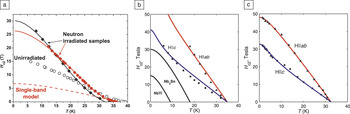
Disorder in MgB2 was introduced by chemical substitutionReference Lee, Masui, Yamamoto, Uchiyama and Tajima17–Reference Wilke, Bud’ko, Canfield, Finnemore, Suplinskas and Hannahs22 or irradiation,Reference Eisterer, Zehetmayer, Tonies, Weber, Kambara, Babu, Cardwell and Greenwood23–Reference Gandikota, Singh, Kim, Wilkens, Newman, Rowell, Pogrebnyakov, Xi, Redwing, Xu, Li and Moeckly28 or appeared naturally in films.Reference Patnaik, Cooley, Gurevich, Polyanskii, Jiang, Cai, Squitieri, Naus, Lee, Choi, Belenky, Bu, Letteri, Song, Schlom, Babcock, Eom, Hellstrom and Larbalestier29–Reference Ferdeghini, Ferrando, Tarantini, Bellingeri, Grasso, Malagoli, Marrè, Putti, Manfrinetti, Pogrebnyakov, Redwing, Xi, Felici and Haanappel32 However, the single-band model cannot explain the high H c2(T) of alloyed MgB2 and, in most cases, strongly underestimates it. An example of this for irradiated MgB2 is shown in Figure 1a, where the WHH prediction based on the measured |dH c2/dT|T c extrapolates to only H c2(0) ∼7 T, three times smaller than the observed H c2(0). Such a discrepancy is a consequence of multiband effects, which can cause upward curvature of H c2(T) near T c. Figure 1b and 1c show how far H c2 has been increased by structural disorder for carbon-doped films and for fiber-textured films, respectively. Notice that H c2(T) for both field orientations shown in Figure 1b significantly exceeds H c2 of the widely used NbTi and Nb3Sn.
H c2(T) of MgB2 samples fitted by the two-band model.Reference Braccini, Gurevich, Giencke, Jewell, Eom, Larbalestier, Pogrebnyakov, Cui, Liu, Hu, Redwing, Li, Xi, Singh, Gandikota, Kim, Wilkens, Newman, Rowell, Moeckly, Ferrando, Tarantini, Marré, Putti, Ferdeghini, Vaglio and Haanappel37, Reference Gurevich38 (a) Examples of the dirtier σ band in neutron irradiated bulk samples (full symbols) showing a strong increase with respect to the clean, unirradiated sample.Reference Tarantini, Aebersold, Braccini, Celentano, Ferdeghini, Ferrando, Gambardella, Gatti, Lehmann, Manfrinetti, Marré, Palenzona, Pallecchi, Sheikin, Siri and Putti27 For comparison, the Werthamer-Helfand-Hohenberg (WHH) single-band curve (red dashed line) is plotted for one of the irradiated samples (red dots). The WHH curve shows a clear discrepancy from the experimental data. (b) The case of dirtier π band in carbon-doped thin films.Reference Braccini, Gurevich, Giencke, Jewell, Eom, Larbalestier, Pogrebnyakov, Cui, Liu, Hu, Redwing, Li, Xi, Singh, Gandikota, Kim, Wilkens, Newman, Rowell, Moeckly, Ferrando, Tarantini, Marré, Putti, Ferdeghini, Vaglio and Haanappel37 (c) High-field data for a fiber-textured MgB2 film,Reference Gurevich, Patnaik, Braccini, Kim, Mielke, Song, Cooley, Bu, Kim, Choi, Belenky, Giencke, Lee, Tian, Pan, Siri, Hellstrom, Eom and Larbalestier31 which exhibits the upturn in H c2(T) at low T and H‖c characteristic of the dirtier π band. Solid lines show fits to the theory.Reference Gurevich38

The σ and π bands of MgB2 yield two parallel transport channels, hence H c2 is not proportional to ρ0. For instance, Putti et al. showed that, despite a fivefold increase in ρ0 due to substitution of Mg with Al, both H c2 and |dH c2/dT|T c decreased. In this case, Al doping increased the resistivity only in the π band, which is more susceptible to disorder on the Mg sites, while leaving the σ band in the clean limit. The suppression of H c2 was attributed to the decrease in Δσ upon increasing the Al content.Reference Putti, Ferdeghini, Monni, Pallecchi, Tarantini, Manfrinetti, Palenzona, Daghero, Gonnelli and Stepanov20
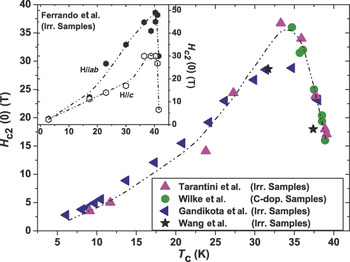
Unlike Al doping, C substitution on the B siteReference Lee, Masui, Yamamoto, Uchiyama and Tajima17–Reference Karpinski, Zhigadlo, Schuck, Kazakov, Batlogg, Rogacki, Puzniak, Jun, Müller, Wägli, Gonnelli, Daghero, Ummarino and Stepanov19, Reference Serrano, Serquis, Dou, Soltanian, Civale, Maiorov, Holesinger, Balakirev and Jaime33 or SiCReference Matsumoto, Kumakura, Kitaguchi, Senkowicz, Jewell, Hellstrom, Zhu, Voyles and Larbalestier21, Reference Serrano, Serquis, Dou, Soltanian, Civale, Maiorov, Holesinger, Balakirev and Jaime33 doping or irradiation disorder can significantly increase H c2 (see examples in Figure 1). Figure 2 shows a collection of extrapolated H c2 (0) data as a function of T c for MgB2 films irradiated with α particles, carbon substituted wires, and neutron-irradiated bulk samplesReference Putti, Braccini, Ferdeghini, Gatti, Manfrinetti, Marré, Monni, Palenzona, Pallecchi, Tarantini, Sheikin, Aebersold and Lehmann24–Reference Tarantini, Aebersold, Braccini, Celentano, Ferdeghini, Ferrando, Gambardella, Gatti, Lehmann, Manfrinetti, Marré, Palenzona, Pallecchi, Sheikin, Siri and Putti27 for which H c2 (0) has a maximum at Tc∼35 K. For MgB2 with incorporated carbon nanotubes, H c2(0) can reach 44 T due to an upturn in H c2(T) at low temperatures.Reference Serrano, Serquis, Dou, Soltanian, Civale, Maiorov, Holesinger, Balakirev and Jaime33, Reference Serquis, Serrano, Moreno, Civale, Maiorov, Balakirev and Jaime34 Higher H c2 observed for irradiated thin films with T c > 40 K,Reference Zeng, Pogrebnyakov, Kotcharov, Jones, Xi, Lysczek, Redwing, Xu, Li, Lettieri, Schlom, Tian, Pan and Liu35H c2(0) ≈ 50 T, and weak T c suppressionReference Ferrando, Pallecchi, Tarantini, Marre, Putti, Gatti, Aebersold, Lehmann, Haanappel, Sheikin, Xi, Orgiani and Ferdeghini36 are shown in the inset in Figure 2. Even higher H c2(0) of up to 70 T can be reached in carbon-doped films.Reference Braccini, Gurevich, Giencke, Jewell, Eom, Larbalestier, Pogrebnyakov, Cui, Liu, Hu, Redwing, Li, Xi, Singh, Gandikota, Kim, Wilkens, Newman, Rowell, Moeckly, Ferrando, Tarantini, Marré, Putti, Ferdeghini, Vaglio and Haanappel37 These H c2 values for MgB2 films are above the BCS paramagnetic limit.
Extrapolated H c2extr.(0) for disordered MgB2 as a function of T c in α-particle irradiated MgB2 films,Reference Gandikota, Singh, Kim, Wilkens, Newman, Rowell, Pogrebnyakov, Xi, Redwing, Xu, Li and Moeckly28 neutron irradiated bulk samples,Reference Wang, Bouquet, Sheikin, Toulemonde, Revaz, Eisterer, Weber, Hinderer and Junod26, Reference Tarantini, Aebersold, Braccini, Celentano, Ferdeghini, Ferrando, Gambardella, Gatti, Lehmann, Manfrinetti, Marré, Palenzona, Pallecchi, Sheikin, Siri and Putti27 carbon-doped wiresReference Wilke, Bud’ko, Canfield, Finnemore, Suplinskas and Hannahs22 (main panel), and neutron irradiated films for the two main field orientationsReference Ferrando, Pallecchi, Tarantini, Marre, Putti, Gatti, Aebersold, Lehmann, Haanappel, Sheikin, Xi, Orgiani and Ferdeghini36 (inset).

Most of these data can be understood using a two-band theory of H c2 in the dirty limit.Reference Braccini, Gurevich, Giencke, Jewell, Eom, Larbalestier, Pogrebnyakov, Cui, Liu, Hu, Redwing, Li, Xi, Singh, Gandikota, Kim, Wilkens, Newman, Rowell, Moeckly, Ferrando, Tarantini, Marré, Putti, Ferdeghini, Vaglio and Haanappel37, Reference Gurevich38 The shape of the H c2(T) plot is controlled by the ratio of electron diffusivities D π/D σ in the π and σ bands and by the pair-breaking interband scattering rate Γ, which is usually weakReference Mazin, Andersen, Jepsen, Dolgov, Kortus, Golubov, Kuz’menko and van der Marel39 in MgB2: ħΓ < 2πk BT c. In this case, H c2(T) has an upward curvature at low temperatures if the π band is dirtier than the σ band (D π< D σ), while for D π> D σ, an upward curvature of H c2(T) only occurs close to T c. Interband scattering suppresses the low-temperature upturn in H c2(T) for D π< D σ. An example of the fits of this theory to the H c2(T) curves observed on MgB2 are shown with a solid line in Figure 1, where the diffusivities D π and D σ are the free parameters.
The analysis of experimental data using this model (see Figure 1a) shows that neutron irradiation of bulk MgB2 causes more disorder in the σ band,Reference Tarantini, Aebersold, Braccini, Celentano, Ferdeghini, Ferrando, Gambardella, Gatti, Lehmann, Manfrinetti, Marré, Palenzona, Pallecchi, Sheikin, Siri and Putti27 whereas C- and SiC-doped bulk samples and films exhibit a low-temperature upturn in H c2(T), indicative of a disordered π band similar to those shown in Figure 1b and 1c.Reference Patnaik, Cooley, Gurevich, Polyanskii, Jiang, Cai, Squitieri, Naus, Lee, Choi, Belenky, Bu, Letteri, Song, Schlom, Babcock, Eom, Hellstrom and Larbalestier29, Reference Gurevich, Patnaik, Braccini, Kim, Mielke, Song, Cooley, Bu, Kim, Choi, Belenky, Giencke, Lee, Tian, Pan, Siri, Hellstrom, Eom and Larbalestier31, Reference Braccini, Gurevich, Giencke, Jewell, Eom, Larbalestier, Pogrebnyakov, Cui, Liu, Hu, Redwing, Li, Xi, Singh, Gandikota, Kim, Wilkens, Newman, Rowell, Moeckly, Ferrando, Tarantini, Marré, Putti, Ferdeghini, Vaglio and Haanappel37 Irradiated MgB2 films have almost linear H c2(T) curves, because the pristine samples have a naturally disordered Mg sublattice with a dirty π band, so it takes high irradiation doses to make the σ band dirtier.
Fe-based superconductors
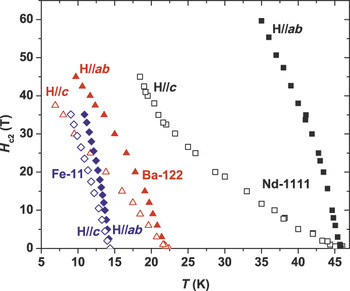
The first high-field magneto-transport measurements up to 45 T on a polycrystalline La-1111Reference Hunte, Jaroszynski, Gurevich, Larbalestier, Jin, Sefat, McGuire, Sales, Christen and Mandrus40 with T c ≈ 28 K showed H c2(0) extrapolated to ≈60 T. Subsequent experiments have confirmed that FBS have extremely high H c2, as illustrated in Figure 3 for Nd-1111, Ba-122, and Fe-11. Moreover, the temperature dependence of H c2(T) was different from the single-band WHH theoryReference Werthamer, Helfand and Hohenberg15 but consistent with multiband pairing scenarios.Reference Hunte, Jaroszynski, Gurevich, Larbalestier, Jin, Sefat, McGuire, Sales, Christen and Mandrus40, Reference Jaroszynski, Hunte, Balicas, Jo, Raičević, Gurevich, Larbalestier, Balakirev, Fang, Cheng, Jia and Wen41 Substituting La with Nd and Sm significantly increased T c and H c2(0).Reference Jaroszynski, Riggs, Hunte, Gurevich, Larbalestier, Boebinger, Balakirev, Migliori, Ren, Lu, Yang, Shen, Dong, Zhao, Jin, Sefat, McGuire, Sales, Christen and Mandrus42 In the case of La-1111, the slope |dH c2/dT|T c ranges between 2 and 6.6 T/K,Reference Fuchs, Drechsler, Kozlova, Behr, Köhler, Werner, Nenkov, Klingeler, Hamann-Borrero, Hess, Kondrat, Grobosch, Narduzzo, Knupfer, Freudenberger, Büchner and Schultz43 while reaching ∼9 T/K for Sm-1111.
H c2(T) of NdFeAsO1–xFx, BaAs2(Fe1–xCox)2, and FeSe1–xTex single crystals for the two main field orientations showing multiband behavior and paramagnetic effects.Reference Jaroszynski, Hunte, Balicas, Jo, Raičević, Gurevich, Larbalestier, Balakirev, Fang, Cheng, Jia and Wen41, Reference Yamamoto, Jaroszynski, Tarantini, Balicas, Jiang, Gurevich, Larbalestier, Jin, Sefat, McGuire, Sales, Christen and Mandrus46, Reference Putti, Pallecchi, Bellingeri, Cimberle, Tropeano, Ferdeghini, Palenzona, Tarantini, Yamamoto, Jiang, Jaroszynski, Kametani, Abraimov, Polyanskii, Weiss, Hellstrom, Gurevich, Larbalestier, Jin, Sales, Sefat, McGuire, Mandrus, Cheng, Jia, Wen, Lee and Eom51

Measurements on FBS single crystalsReference Jaroszynski, Hunte, Balicas, Jo, Raičević, Gurevich, Larbalestier, Balakirev, Fang, Cheng, Jia and Wen41 have also shown that the temperature dependencies of H c2‖(T) and H c2⊥(T) can be very different, so that the anisotropy parameter γ(T) = H c2‖(T)/H c2⊥(T) depends on T. Shown in Figure 3 is the case of Nd-1111, for which H c2(T) could only be measured at T > T c/2, but almost full H c2(T) curves have been measured for (Ba,K)Fe2As2Reference Yuan, Singleton, Balakirev, Baily, Chen, Luo and Wang44, Reference Altarawneh, Collar, Mielke, Ni, Bud’ko and Canfield45 and BaAs2(Fe1–xCox)2Reference Yamamoto, Jaroszynski, Tarantini, Balicas, Jiang, Gurevich, Larbalestier, Jin, Sefat, McGuire, Sales, Christen and Mandrus46, Reference Kano, Kohama, Graf, Balakirev, Sefat, Mcguire, Sales, Mandrus and Tozer47 single crystals. Here both H c2‖(T) and H c2⊥(T) have downward curvatures, but H c2‖(T) at low T exhibits stronger “flattening” than H c2⊥(T), so the curves H c2‖(T) and H c2⊥(T) become closer at low T, and γ decreases from ≈2 to ≈1 at 0 K.Reference Yuan, Singleton, Balakirev, Baily, Chen, Luo and Wang44 Fe-11 has even higher slopes |dH c2/dT|T c > 20 T/K and more pronounced flattening in H c2‖(T) at low T.Reference Kida, Matsunaga, Hagiwara, Mizuguchi, Takano and Kindo48–Reference Putti, Pallecchi, Bellingeri, Cimberle, Tropeano, Ferdeghini, Palenzona, Tarantini, Yamamoto, Jiang, Jaroszynski, Kametani, Abraimov, Polyanskii, Weiss, Hellstrom, Gurevich, Larbalestier, Jin, Sales, Sefat, McGuire, Mandrus, Cheng, Jia, Wen, Lee and Eom51 These trends in H c2(T) have been attributed to multiband orbital pair-breaking in cleanReference Yuan, Singleton, Balakirev, Baily, Chen, Luo and Wang44, Reference Fang, Yang, Balakirev, Kohama, Singleton, Qian, Mao, Wang and Yuan50 and dirtyReference Kano, Kohama, Graf, Balakirev, Sefat, Mcguire, Sales, Mandrus and Tozer47 limits, or to paramagnetic pair-breaking.Reference Fuchs, Drechsler, Kozlova, Behr, Köhler, Werner, Nenkov, Klingeler, Hamann-Borrero, Hess, Kondrat, Grobosch, Narduzzo, Knupfer, Freudenberger, Büchner and Schultz43, Reference Kida, Matsunaga, Hagiwara, Mizuguchi, Takano and Kindo48, Reference Braithwaite, Lapertot, Knafo and Sheikin49
The behavior of H c2(T) near T c is limited by orbital effects for which γ(T) is controlled by the anisotropy of the electron mass m. As T decreases, the contribution of nearly isotropic paramagnetic effects increases, and γ(T) decreases toward 1. Many FBS exhibit strong paramagnetic pair-breaking, whose strength is characterized as the Maki parameter.Reference Matsuda and Shimahara16 This parameter is defined as αM= π2Δ/2mvF 2 for H‖c and αM= π2Δ/2mvFvFc for H‖ab and can be of order 1 in these materials (vFc is the Fermi velocity along the c-axis). The significance of αM is that for materials with αM > 1, the upper critical fields are mostly limited by the paramagnetic Pauli pair-breaking. This strongly reduces H c2 as compared to what would be expected from the orbital pair breaking due to the motion of Cooper pairs in a magnetic field that is characteristic of most LTS. Paramagnetic effects in FBS flatten H c2(T) at low T,Reference Matsuda and Shimahara16, Reference Gurevich53 particularly for H‖ab where αM is enhanced by the factor vF/vFc > 1. Paramagnetic effects are most pronounced for the Fe-11 chalcogenides because of their small Fermi energies E F∼ 20–50 meV and large effective masses m∼(5–16)m 0, where m 0 is the free electron mass,Reference Tamai, Ganin, Rozbicki, Bacsa, Meevasana, King, Caffio, Schaub, Margadonna, Prassides, Rosseinsky and Baumberger52 yielding αM∼kBT cm/m 0E F ∼ 1 even for H‖c.
The variety of different H c2(T) curves in FBS can be understood using a theory of H c2 in clean multiband superconductors, which takes into account the effect of pairing symmetries, orbital and paramagnetic pair-breaking, and the FFLO instability.Reference Gurevich53 This theory shows that the s ± pairing enhances the orbitally limited H c2, and for different Fermi velocities vF 1 and vF 2 in bands 1 and 2 results in upward curvature in H c2(T) at intermediate temperatures. This behavior is different from the conventional s++ pairing in dirty MgB2 with D 1<< D 2, for which the upturn in H c2(T) occurs at low temperatures.Reference Gurevich38 Paramagnetic effects flatten H c2(T) curves, eliminating the upward curvature, if αM is large enough. Since αM is inversely proportional to E F, the emergence of small FS pockets upon doping can enhance paramagnetic pair-breaking,Reference Gurevich53 as may happen in Fe-11 chalcogenides.Reference Kida, Matsunaga, Hagiwara, Mizuguchi, Takano and Kindo48–Reference Putti, Pallecchi, Bellingeri, Cimberle, Tropeano, Ferdeghini, Palenzona, Tarantini, Yamamoto, Jiang, Jaroszynski, Kametani, Abraimov, Polyanskii, Weiss, Hellstrom, Gurevich, Larbalestier, Jin, Sales, Sefat, McGuire, Mandrus, Cheng, Jia, Wen, Lee and Eom51 For even larger αM, greater than about 1.8, a clean single-band superconductor with a spherical FS is unstable to the formation of the spatially modulated FFLO state. In multiband FBS, the critical value of αM can be rather different from 1.8, since the FFLO instability criterion becomes dependent on the topology of the FS, its anisotropy, etc.Reference Gurevich53
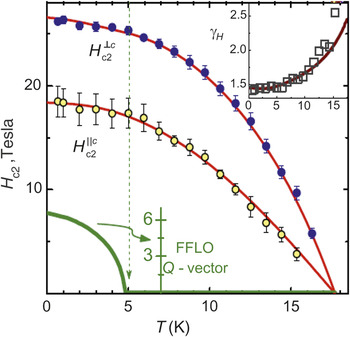
The orbital and paramagnetic effects in FBS can be tuned by doping, which expands one FS and shrinks the other. Because the shrinking FS facilitates the FFLO instability while the expanding FS dampens it, the former may enforce the global FFLO state. In FBS, several shadow bands are close to the Fermi level, thus a small FS pocket emerging upon doping may trigger the FFLO transition.Reference Gurevich53 In single-band superconductors, the FFLO instability manifests itself in a characteristic upturn in H c2(T) at low T and a steep increase of H c2(T) near T c.Reference Gurevich53 However, the s ± FFLO state in FBS may not be apparent from the shapes of H c2(T), since the interplay of several bands can give rise to WHH-like H c2(T),Reference Werthamer, Helfand and Hohenberg15 even if the FFLO state exists at low T. An example of such a “hidden” FFLO state is shown in Figure 4, which presents H c2(T) for a clean LiFeAs single crystal.Reference Cho, Kim, Tanatar, Song, Kwon, Coniglio, Agosta, Gurevich and Prozorov54 The theoryReference Gurevich53 describes both H c2⊥(T) and H c2‖(T) well, predicting the FFLO state for H‖ab at T < 5 K. Such “hidden” FFLO states may be more common than one would infer from the shapes of H c2(T), so detecting the first-order FFLO transition may require specific heat or torque measurements,Reference Kurita, Kitagawa, Matsubayashi, Kismarahardja, Choi, Brooks, Uwatoko, Uji and Terashima55 particularly for Fe-11 chalcogenides with their large values of αM.
H c2(T) of a LiFeAs single crystal.Reference Cho, Kim, Tanatar, Song, Kwon, Coniglio, Agosta, Gurevich and Prozorov54 Solid lines show fits to the theory.Reference Gurevich53, Reference Cho, Kim, Tanatar, Song, Kwon, Coniglio, Agosta, Gurevich and Prozorov54 The Fulde-Ferrell-Larkin-Ovchinnikov (FFLO) wave vector Q(T), which appears spontaneously at T < 5 K for H‖ab, is plotted in the units of 40 πk BT c/ħv F1. Inset shows the anisotropy parameter γ(T). Here the symbols ‖ and ⊥ correspond to H parallel and perpendicular to the c-axis, respectively.

Conclusion
MgB2 and Fe-based superconductors (FBS) are multiband superconductors with high H c2 but with very different properties. MgB2 is a conventional s ++ two-band superconductor for which H c2(T) can be greatly increased by introducing selective disorder in the σ or π bands. Both upward- and downward-curving H c2(T) can occur, depending on the level of disorder and the field orientation. The variety of behaviors of H c2(T) in FBS is less susceptible to disorder because of their very short coherence lengths, making doping-induced tuning of different FS pockets more effective than disorder in enhancing H c2. The upward-curving H c2(T) curves observed in RE-1111 with H‖c are consistent with multiband s ± pairing. Moreover, the strong downward curvature of H c2(T) for Ba-122 and Fe-11 FBS provides clear evidence of strong Pauli limiting effects, indicating that some FBS can exhibit the Fulde-Ferrel-Larkin-Ovchinnikov state. Both MgB2 and FBS may be used to develop conductors for high-field-magnet applications.