Introduction: Architecture as a register
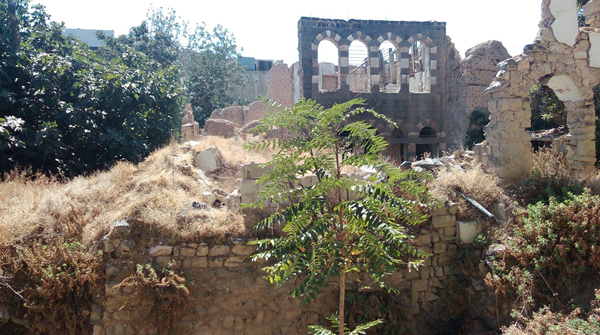
Syria is a place with a very long history of sequenced civilizations which have been layered architecturally within the heart of almost every town and city (see Figure 1). Over time these multi-layered cores have developed new parts, resulting in two different characters (and mostly two city centres) in each city: one is new and modern, while in the other, history has been interrupted and the area has been transformed into what is now called the Old City. These Old Cities are accumulations of many different civilizations that date back to Hellenistic and Roman times, where the most recent layer, the layer manifested in shape of houses, monuments and souks, generally belongs to a mix of the Ottoman, Mamluk and Ayyubid Islamic architectural styles, containing the remnants of past archaic architectures within its newest built iteration.
Layers of Old Homs. Photo © Marwa Al-Sabouni.

Before the war in Syria erupted, the Old Cities were silently wearing out as they were subject to many wrongful acts of urban vandalism and destruction, mostly performed by city authorities seeking instant profit and easy solutions. Replacing the old, viable model with a new one tailored solely for individual gains and control of those authorities created an urban decline which came hand in hand with a general moral and social one, as the cycle of replacing the valuable with the profitable set a bad example beyond the level of the street. I tell the story of this multi-layered decline in my book The Battle for Home,Footnote 1 where I introduce architecture as a vital factor in sparking the war that has been raging for seven years now in my country. The book presents the case of architecture as a unifying agent to all of the other factors that enflamed the conflict – not only as a stage upon which the conflict played out, but also as a director.
Indeed, architecture offers a register of what has worked for the inhabitants of a certain place and what has not in their built environment, the most evident aspect of human life. By tracking this built register, evidence of what have proven to be successful models of living will be found. People tend to keep and maintain those successful models for their functionality, beauty, sustainability and so on. In this manner they form a relationship with their surroundings that exceeds the mere practicality offered by modern social housing projects and slum shelters.
It is no overstatement to say that the Syrian Old Cities had cultivated a life of tolerance, peace and coexistence. Looking at their architectural history, the proof of that statement is found everywhere, from the closely knit neighbourhoods to the mosques and churches built back to back and face to face, down to the small details such as the well-proportioned front doors nestling amidst the welcoming aromas of the jasmine and lemon trees dotting the shady alleyways.
This sense of neighbourliness was cultivated by urban connections, beautiful surroundings and sustainable economic cycles. The architecture of those old neighbourhoods allowed for a complex network of people and businesses, through its configuration, property sizes, heights, proportions and aesthetic details, which created not only a pleasant place for living but also sustainable micro-systems of local production and thriving economies that interconnected the whole city. This last point, the economic impact, will be tackled in more detail later on in this Opinion Note when the work of Jane Jacobs is discussed, but for the time being the alternative model of architecture that has taken over the Old City with the rise of modernization should first be considered. Like many cities after World War II, the cities of what was at the time the Levant were introduced to the imported “modern world” mainly through the urban policies imposed by French colonization. Within a very short time, newly built neighbourhoods were created, first to enable the rich to come out from the modest alleyways and live in separate, upscale areas, and then, as socialist ideologies took over in the 1960s, to allow the masses from the countryside to settle around the city, closer to work in factories and institutions. In that sense, the city was dissected into “territories” instead of neighbourhoods.
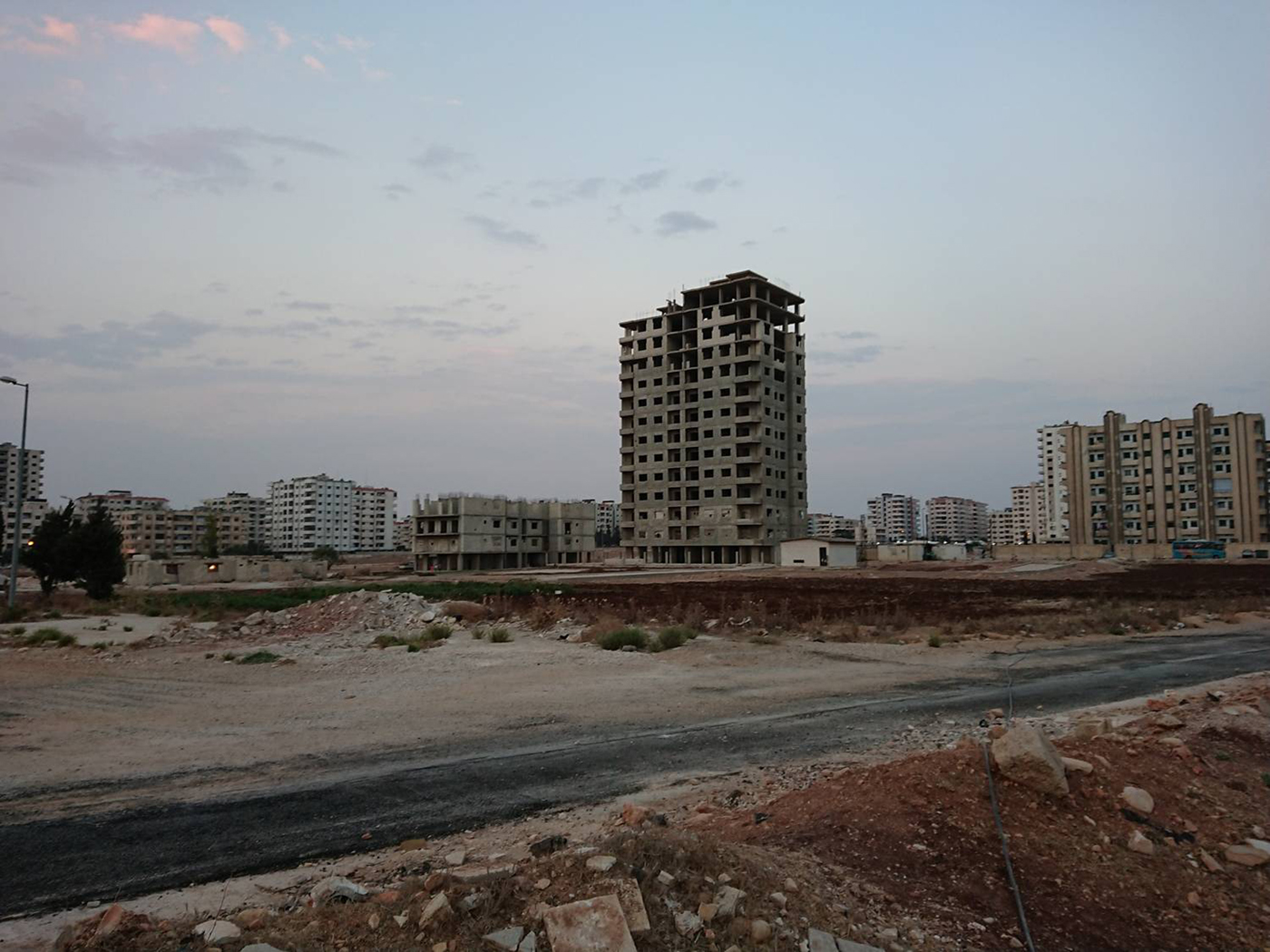
With the new housing demand on the city, old models of slow building and harmonious aesthetics no longer worked. The featureless block building that was built so fast dominated, wide roads for vehicles replaced nature, and segregated zones for each “group” replaced the mixed neighbourhoods. Each new neighbourhood has become an alternative city on its own. These neighbourhoods have surrounded the old cores, then continued to sprawl far out. Segregated and ugly, the “modern” neighbourhoods managed to destroy the values which were shared and lived in the Old Cities and to cut the ties which used to bind their communities to each other and to the city (see Figure 2).
Vacant blocks due to failing urban sprawl. Photo © Marwa Al-Sabouni.

It is no surprise to learn that 40% of the Syrian population, before the current war, were living in slumsFootnote 2 – namely, neighbourhoods that were built “informally”, mostly as bare blocks of cement boxes, with bad infrastructure and poor amenities. People were forced to create their own “models” in the face of their unmet demand by the city's “modern” buildings, not because there was not enough space for them – many vacant “units” pierce the skyline of Syrian cities – but because, unlike the old houses, the new ones had no feature of living in their make-up. In architectural terminology, when people build their own structures organically without the help of professional builders or architects, the result is known as “vernacular architecture” – that is, a structure which holds the character of local solutions to building and living problems, using local means and local materials. However, those newly built slums are far from “vernacular”, and they answered only one problem: shelter. Moreover, their urban location in peripheral areas around the city turned them into isolated compartments which divided people based on labels such as religion, origin and social class. This has resulted in parallel lives within the life of the city, where disconnected communities practice their daily life within the imaginary boundaries created by urbanism, alien from the city as a cooperative place and from the so-called “other” who resides on the other side of that imaginary wall.
It was only a matter of time before things reached an explosive critical mass. It could be argued that there is not much difference in this story from the story of almost every city around the world after the World Wars, industrialization, and subsequent developments in technology. This inevitable process of change is simply called “progress”, and this is partly accurate, if it is taken only as a simple measure of junctures in time: important events that have marked recent history. But these junctures shouldn't be taken as events without consequences. The way we are building collectively around the world is creating a global threat, which is accumulating as it did in Syria. It has led to war in Syria – why has it not led to war all over the world? The reasons are multifold: the first is the geographical location, where different international interests are involved and where the spark of war can easily find winds to flame it; the second is corruption, which exacerbates the problems; and finally there is colonization, which leaves behind it a heavy burden, especially with its imposed models of architecture and urban planning. This article will explore the process of this built transformation on Syrian cites and the background of their creation, and will discuss the effects of this process on the social fabric and how the damage sustained by that fabric has led inevitably to the unravelling of a country.
The urban fabric
Urbanism can dictate the degree to which people encounter and communicate with each other as a basis for social relationships, and can consequently affect the nature of social structure in a given context. It also contributes to shaping the economic activity within urban localities. This important aspect has been explored in the work of various scholars and architects, perhaps most influentially and coherently in the work of Jane Jacobs, the American urban activist who wrote the 1961 book The Death and Life of Great American Cities. In her book, she explains the hazards of blind urbanism, which is embodied in modern approaches. The monotonous order of such approaches, as shown through Jacobs's argument, blocks economic activity in the locality by hindering its diversity. This is exactly how the Syrian government's ill-thought-out social housing projects and policies became the reason why the informal urban sprawls in Syria were created. Jacobs warns: “Slums and their populations are the victims (and the perpetuators) of seemingly endless troubles that reinforce each other. Slums operate as vicious circles. In time, these vicious circles enmesh the whole operations of cities.”Footnote 3
Nonetheless, it could be argued that such consequences can only be related to urban planning (and not architecture) – namely, the larger-scale design by which urban planners look at different “zones” of the city and design the city's main networks, connections, land uses, and so on. I would argue that urban planning (which is sometimes considered a separate speciality from architecture) should only be done by thinking architecturally. If we examine the job of an architect, we find that his or her main mission is to find a creative solution to a group of “problems” posed by both the nature of the location and the user(s) of the location. This means taking a wide variety of different kinds of data into consideration: numerical, aesthetic, historical, social, psychological, economic, political, and so on. This is why architecture is described as creative, since architects must find one answer that can address many questions. Therefore, in that problem-solving sense, architecture (which is the act of designing) can and should encompass different ranges of scale, from what we call “urban” down to the very small scale of furniture and utilities.
Moreover, successful urban design can only be accomplished by moving away from the map perspective of modern urban planning (objected to by JacobsFootnote 4) and into the street-level perspective where additional (and much more important) factors must also be considered, such as the angles by which light hits a surface or the air flows and the smells they may carry. After all, this is what the people who occupy or use the place will be affected by. Such an approach is nowadays termed as “place-making”, but it has always been considered in serious works of art and architecture; it is, as Roger Scruton describes it in his Aesthetics of Architecture, “the architectural experience”.Footnote 5 Indeed, “experience” is the key word, as every planner and architect should aim at creating a pleasant experience through his or her building design.
Beauty matters
People need to experience their buildings, and those experiences must be pleasant ones; otherwise, there is no point in creating the building. On the exterior, people are affected by the shape of their buildings both at the street level and at the horizon level. The shape of a building is modelled by the combination of aesthetic choices made regarding its materials, colours, proportions, details, and so on.
Architects aspire to design beautiful buildings, and people wish to live and be surrounded by such buildings. However, since Mies van der Rohe's “less is more” and Le Corbusier's “the house as a machine”, beauty in modernism has become undervalued and a subject of dispute.
From the definitions of beauty postulated by Plato, Aristotle and Longinus, until the revival of the discussion in the eighteenth century and beyond, there have been differences in the definition of beauty, but beauty has been considered an essential value to our understanding of the world. Whether it is considered as “leading to the thought of God”Footnote 6 or merely to “cause love in humans”,Footnote 7 it is commonly agreed that beauty satisfies an essential psychological need and is capable of providing moral inspiration.Footnote 8 Nonetheless, with the functionality of modernism and the nihilism of its age, architects have neglected this core part of their profession and have surrendered the job of aesthetics to the money-driven developers.
So what effect does beauty have on the relationships between people and their surroundings? In his book A Pattern Language, the architect Christopher Alexander describes the effect as a resolving of “inner forces” (in other places he calls them “conflicts”Footnote 9), while Alain de Botton, the Swiss philosopher, refers to it as the “architecture of happiness”.Footnote 10 What we can make of this is that it is very important to recognize the pivotal role of beautiful built environments in our lives. I believe that the Syrian devastation of the current war can tell us something: that when people are surrounded by an ugly environment, they tend to care less about its destruction.
Achieving the sense of home
Alternatively, when a sense of home is achieved, partly through providing a collective accomplishment, in the form of great buildings, attractive cities, historic sites which have managed to survive throughout history (i.e. lineage civilizations) and so on, and when people can take pride in this environment and identify with it, and when they identify with the values embodied in this accomplishment and the success it represents, they tend to preserve and try to maintain their environment.Footnote 11
In order to become a home, our built environment should offer two main relationships: belonging and sharing. To belong to place means to feel that “I care about this place and am willing to share it with others, which means I must care about them too.” This can only be reached through creating a caring built environment that is capable of acting like a womb for all its inhabitants; an environment that can surround them with beauty and remind them of what matters to them, and that can encourage their daily paths to cross, make their encounters a pleasant experience, and embrace their shared living. In such a place, we love our place and we care about our neighbour. To belong and share is a physical experience that largely depends on proximity, size and aesthetics. However, this world of physical appearances can be overwhelmingly broad and general, and consequently difficult to analyze and to diagnose faultiness in when it occurs. This state of puzzlement in comprehending the phenomena of collapse is evident in the Syrian situation today.
Almost all of those who have lived in or visited the Levant tend to confirm that such a place has existed once in that part of the world, and more specifically in Syria. So what has changed?
Four transformations
I believe the answer can be reached by examining the transformations which have occurred in four components of the city: the religious sites, the commercial spaces, housing, and the natural environment.
Religious sites
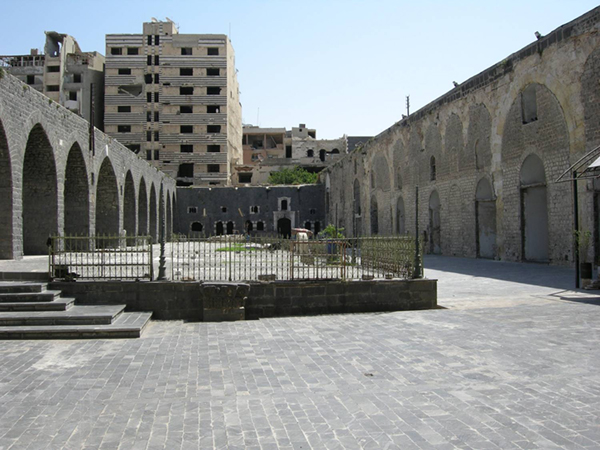
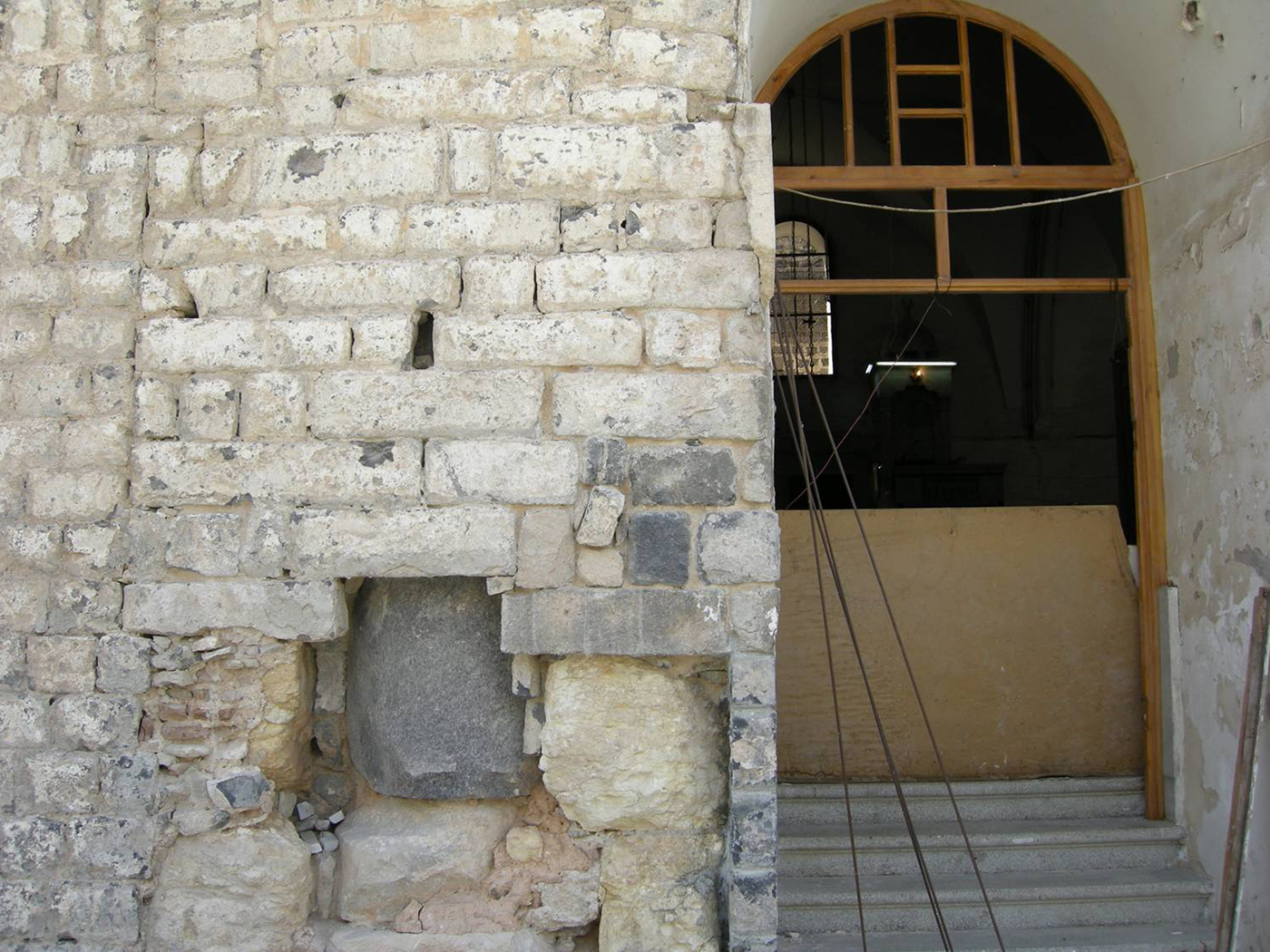
A good example of such transformations of religious sites is the Great Mosque of al-Nuri in Old Homs, which has gone through a process of metamorphosis (a case that could be made in general for most major locations in Syria). Natural disasters, fire and wars have been the causes of the changes to buildings like al-Nuri. The mosque owes its final shape to Nour al-Din al-Zenki in the Mamluk Islamic era. It sits at the heart of the Old City of today's Homs (see Figure 3). Its location was part of the ancient Temple of the Sun, while in more recent times it has become adjacent to the city's protecting wall at one end, and to the souk at the other. Parts of its structure were built incorporating pillars from the remnants of the Temple of the Sun, which became visible after being exposed by damage caused by recent battles (see Figure 4). In such a structure, the relationship with its surroundings and the people can be read by looking at the embodiment of certain values, manifested aesthetically in the building's simplicity and use of local, durable materials, and morally in the creation of a sense of “no waste” and harmonious incorporation of detail without compromising character.
Interior courtyard of the Great Mosque of al-Nuri, Homs. Photo © Marwa Al-Sabouni.

Old pillars from the Temple of the Sun revealed by battle damage in the Great Mosque of al-Nuri, Homs. Photo © Marwa Al-Sabouni.

About 200 metres from al-Nuri lies another religious site: the Saint Mary Church of the Holy Belt. The church dates back to 59 BC, with a Roman cellar beneath. It was rebuilt in 1852 using the same building material as the mosque – black basalt – and displaying the same austerity and serenity along with the same sense of incorporation of all the different layers of styles and building. On an urban scale, examination of such examples indicates that the Islamic architecture which followed and which has shown itself to us through the architectural record was not given to destroying cities; on the whole, it allowed them to grow organically, with respect for the religious sites and for the principle that the mosque minaret and church tower should stand higher than their surroundings without overwhelming them.
In this sense, architecture played a role in reconciling (and later alienating) communities. Mosques and churches grew side by side, with humane streets and alleyways connecting them, never set apart, isolated or imposed from above. They were connected to the life of the street, living among people as the lemon and olive trees did.
Nonetheless, the presence of buildings representing multiple religious faiths is not always seen as a sign of harmony and reconciliation. Work by the anthropologist Robert Hayden argues that the presence of multiple religious structures can also be read through the lens of antagonism and competition. However, I believe that homogeneity leads to more isolation and lack of natural interactions between people of different convictions, which in turn enhances antagonism – in most cases, on the basis of supposition rather than reality. Variety should be tempered with justice in order to create the example of peaceful coexistence that was practiced in Islamic cities in places like Syria for centuries.
Unfortunately, this did not continue to be the case as modern mosques and churches in Syria were built later on. Originally interwoven within the existing urban fabric, they now stand separated from their surroundings, cost a fortune to build (or rebuild), and are alienated from people's lives and difficult to attend, with their extravagant look and closed, guarded doors. They are not protected as those old ones were; they are not embraced and rooted in everyday life, either structurally or logistically. They are not situated to bring people together in the same way as those which used to cause people's paths to cross and create pleasant encounters. They do not lead by example in their location, structure or details. Rather, they promote isolation as they stand proudly, mere labels or flags to mark out territories, where instead of seeing faces, all you see are the backs of departing cars.
Commercial spaces
This leads to the next urban component of the city, which has played an equally important role in people's lives: the marketplace, or souk. The souk's importance stems from the fact that it is a productive public space – a place that should ideally be for conversation and polite commerce. In order to understand the architecture of these places in our Old Cities, Edmund Burke, the eighteenth-century Irish philosopher and politician, may offer some guidance. He describes the quality of “fitting in” as a quality of beauty:
The mind of man has naturally a far greater alacrity and satisfaction in tracing resemblances, than in searching for differences; because by making resemblances, we produce new images; we unite, we create, we enlarge our stock; but in making distinctions we offer no food at all to the imagination; the task itself is more severe and irksome, and what pleasure we derive from it, is something of a negative and indirect nature.Footnote 12
This is brought home today by the philosopher Roger Scruton, who offers an expression that eloquently summarizes Burke's words: “Things that fit in, instead of standing out.” In the souk, “fitting in” was done both aesthetically, in the architectural details, and morally, in the manners and attitudes of the people. In all major Old Cities such as Homs, Aleppo and Damascus, the souk grew as an artery that connected the residential neighbourhoods. Within and around its winding alleyways, it had spaces for leisure and culture such as the hammams (public baths), schools, religious places and workshops. Each alley embraced a certain speciality: one for goldsmithing, one for blacksmithing, another for copper works, others for fabric and textile production, and so on. Thanks to the nature of this architecture, production took place in parallel with retail businesses, with the right balance between the local and the imported. At the souk, people used to be able to come to shop, or to gather at the hammam, to go to the mosque or church nearby, or just to pass through to get to their house at the end of this or that route. People could greet each other on the way; they passed by each other on their bicycles or on foot with their children. They saw each other's faces and heard each other's voices. There were times when they all came together for the help and protection of their neighbours.
In order to understand the effect of the wrongs that modern renovation and new additions visited upon such urban constructions, clear evidence may be found in comparison with the reconstructed souks of Beirut, another city that was devastated by civil war and once had similar structural and historical features in its Ottoman central souk. The new reconstruction changed not only the nature of the place, but also its entire economic activity, social classes and social interaction.
An excellent study of this was published online in an article for the Architectural Association School of Architecture Projective Cities programme,Footnote 13 which explained how the new design demanded a change in the size and configuration of the shops and spaces of the souk. By changing the size of the expropriated properties, the souk was turned into a shopping mall, owners became tenants, producers became vendors, the relationship between the central market and the port city ceased to exist, and the relationship between the merchants and the city's inhabitants also died out, all to be replaced by elites, brands and multi-level parking lots.
Housing
In our Old Cities, people maintained their privacy along with the livelihood of their cities. The sense of security was not imposed within those alleyways; rather, it grew organically as a fruit of community-sustaining architecture. Due to this, we loved our cities, with their public spaces, sacred places and self-maintaining houses, which were the result of cooperation and consensus. People built those places not in order to “stand out”, but in order to “fit in”, as Burke and Scruton remind us. Fitting in meant fitting in socially and civically, as well as architecturally. Different social classes and different religions were neighbours, with a shared language of harmony that left little room for distinctions in appearance. But love for these cities was not a thing built by experts in urban planning; it was natural and unexpressed. As a result, it did not defend itself as vigorously as it should have against colonial regimentation and the vandalism wrought by modernist architecture. And in this we find the answer to the following question: how has the Levantine city gone so wrong?
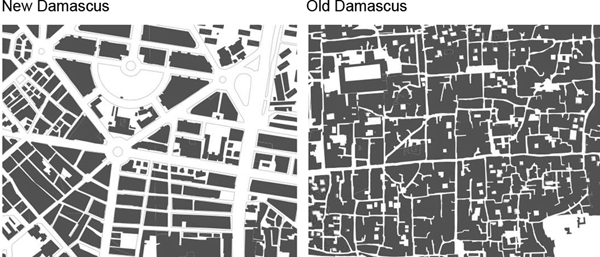
After the fall of the Ottoman Empire, the French–British agreement on the region put Syria under the French Mandate, during which time many changes occurred (see Figure 5). The French sought control over what they saw as a chaotic built environment. They started making aggressive clearances around the interwoven monuments, some of which didn't “stand out” enough for them, so they took them apart and reconstructed them in other positions. They cleared out large chunks of the fabric of the Old City and encouraged the rich to “stand out” too, by moving outside the walls of the shamed Old City and living in newly built boulevards planned according to Haussmann principles.Footnote 14
The French urban effect. Source: Daniel Stockhammer and Nicola Wild, The French Mandate City: A Footprint in Damascus, ETH Studio Basel Contemporary City Institute, Middle East Studio, 2009, pp. 95, 98.

This radically changed the model of housing that was part of an urban fabric in which rich and poor, Muslim and Christian, were woven together in unostentatious, closely knit houses; now these communities were segregated in terms of both location and the architectural appearance of their environment. But how was this process carried out?
The obsession with comprehensive plans and modernization seen in the colonial period was carried out by the Mandate's designated French architect Michel Ecochard, to whom, ironically, the Syrian independent government in the 1960s reassigned the mission to continue drawing up the city's general plan.Footnote 15 Both events opened the door wide for the continuous decline we still suffer today. The boulevard housing didn't look bad, with its elegant details and proportions and its imported street furniture; it was built to look just as beautiful as the housing on any Parisian boulevard, as the French were convinced they were staying for far longer than they actually did.
By the time of Syrian independence in 1946, Syria had already shifted from its natural trajectory of growth and formation. The socialists’ ideals were adopted and the eager desire to join the modern world continued, but this time in the fashion of progressive communism. With the help of expropriation acts and industrialization, the shock of the high-rise concrete block was introduced into the Levantine city. Labour from the countryside was called upon, but there was a failure, mainly on the part of city authorities, to provide for the new arrivals. People came to cities only to be entombed in the ready-made block boxes or heaped in the derelict informal settlements where they were divided into sections according to their community and religious affiliation. This created tensions that were ripe to explode as soon as civil war broke out.
Our cities started to look like a Frankenstein hybrid of lost identity, with upscale centres surrounded by derelict informal settlements. And even when people managed to establish a measure of peaceful living, huge investment projects came to attack that very way of life. This has been exemplified in many places all over Syria, most recently in 2015 in the locality of South Mazza in Damascus, which is referred to as “the Orchards” for the agricultural land it occupies. It is an “informal settlement”, where people have built over time their own small residential blocks, with mixed-use properties, and where they have opened small shops and workshops, and have mainly farmed the surrounding agricultural land. The area is definitely not a beautiful place; it is an improvised solution to the problems created by blind urbanism. Indeed, the government has issued Decree 66, a measure intended to “regulate” the master plan of the area, ordering the demolition of the informal buildings and the complete evacuation of the residents, to whom shares in the yet-to-be-built planned city will be granted as compensation.Footnote 16
Unfortunately, this approach of moving forward from bad to worse, which creates poor solutions and dead ends, has repeatedly proven to be a fatal one, as seen most evidently in the Syrian war. Pushing people further and further away from the life of the city, as if sweeping them under the carpet, and forcing them to adopt alien solutions and means of living away from the land and their small, sustainable businesses, will never have positive outcomes.
Nature
The natural environment has suffered because of the destruction caused by the comprehensive modern approach to building and planning. The industrial orientation of the modern age, whether in factory building or in the use of cars, has led to the sacrifice of “unprofitable” resources such as riverfronts.
Major cities in Syria were all built upon rivers, which in addition to their natural use provided vitality and complemented their appearance. The river as an element of nature was incorporated into traditional architecture just as the old pillars were in the al-Nuri mosque and other old structures, which used to pick up from where previous civilizations had finished.
The al-Asi or Orontes river – the river of my city, Homs – used to run in full force to water the orchards and flow into the city through irrigation canals. The river had productive structures built upon it, such as mills, and was also used for free, collective leisure pursuits in the lush orchards surrounding its banks. Over time, the mills have been demolished, the free picnics have been curtailed by the construction of new restaurants which occupy parts of the orchards and block the view, and the canals have been damaged and in many places smothered by roads and pavements.
This happened not only in Homs but also in other places such as Damascus, where the river Barada runs through the capital and was used by people in much the same way. In the 1960s the river was buried, covered by roads for cars to pass over, and the rest became a filthy stream of rubbish. The costs of such ill-considered actions have been enormous; not only is the road network, which is the reason such natural treasures are attacked, suffering from traffic congestion and pollution (part of the problem created by conjunction points with the Old City's network), but clean drinking water has also been lost, along with the irrigation needed for agriculture. More critically, people have lost yet another thread that used to connect them with each other and with their cities and settlements.
Rebuilding
It has become an unfortunate fact that big cities all around the world, and not only in Syria, are now “up for sale”. We all suffer the consequences of the arrogance of those architects and planners, in collaboration with developers and decision-makers who collectively believe that they alone own the places where they build and are in charge of reorganizing the entire community. In much commercial business, even the role of the architect has become dispensable unless he or she is a “trademark” to sell. Without the services of socially responsible and aesthetically trained architects, our cities have lost face both literally and figuratively. On the other hand, people cannot build upon their environment as the low-rise small town used to allow. Today, we have automobiles and multi-storey buildings which cannot be subject to the vernacular norms. So where does this leave us?
Without identity, without home, we are left in the dark. In panic, some try to look back and hold onto the past's disappearing images, while others run after the latest advances as a cover-up for what is really missing.
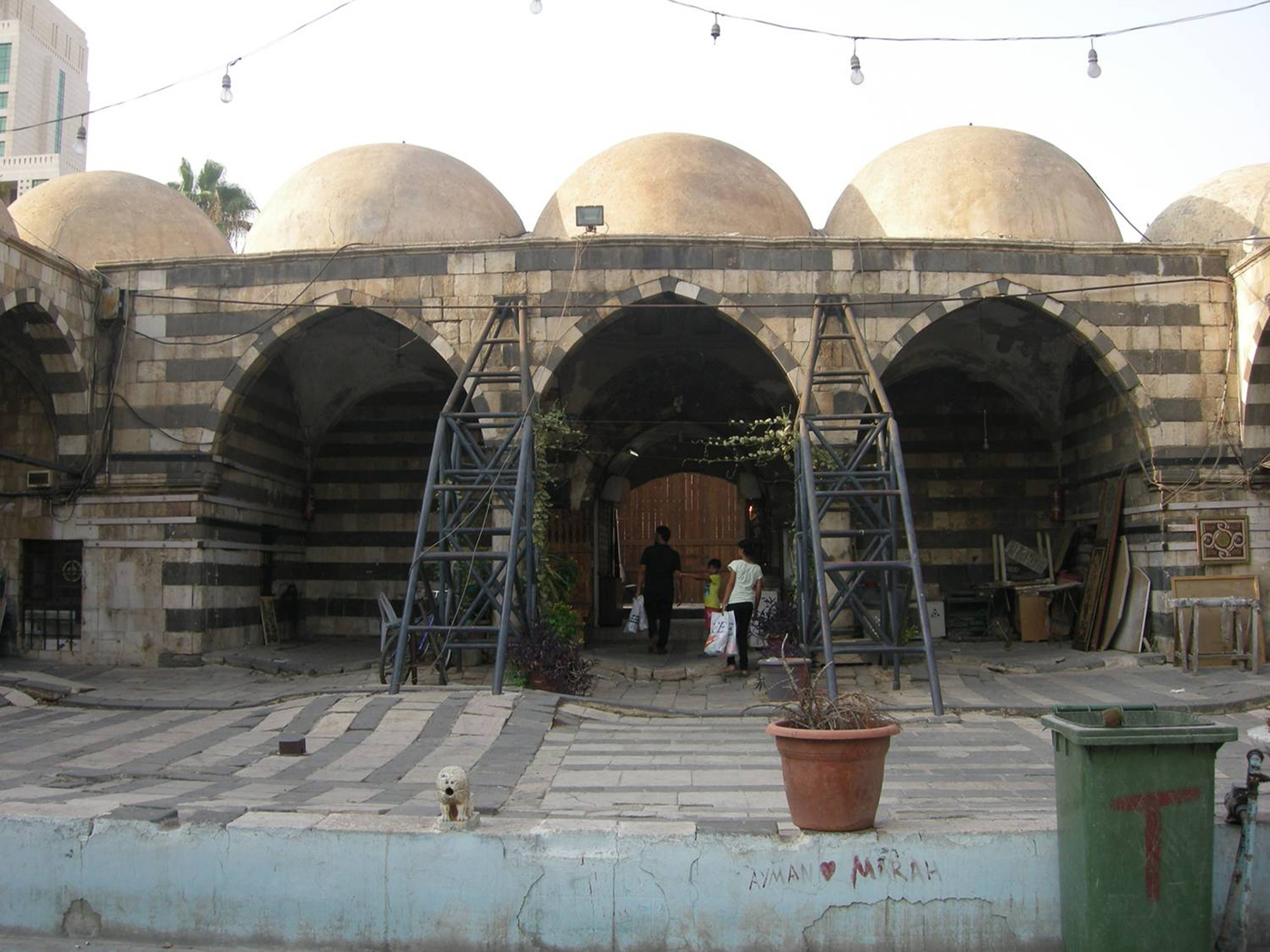
Heritage, for example, has become a tool instead of a resource. Take a place like al-Takkia al-Sulaimanya, which is a Damascus mosque complex built by the Ottoman sultan Suleiman the Magnificent in the sixteenth century, designed by his architect Mimar Sinan. The complex was built on the riverbank of the Barada to host travellers on their way to the Hajj (pilgrimage) to Mecca, and also as a residence for foreign students seeking knowledge. It is a compound of two major buildings, a mosque and a school, including arcaded cells with amenities. In 1974, these former functions ceased and the complex became a national war museum and a market for traditional crafts and Syrian antiques. Today, the latest development is being completed by the Syrian Trust for Development in collaboration with the Syrian Company for Traditional Artefacts, in order to “modernize” the character of the complex and “preserve” its tangible and intangible heritage.
In order to fulfil those goals, the small shops of the original craftsmen were evacuated and replaced with refurbished shops and modernized “products” in the same spirit as Beirut's central district. Unfortunately, al-Takkia today is braced with iron as if wearing orthopaedic devices (see Figure 6). The place that represented, in every architectural detail and purpose, the values for which it was built has turned into a platform for “modernized heritage”, which represents the absence of real identity and the embodiment of fakeness. The old structures, along with the masters’ wisdom behind their creation, are vanishing under the economic pressure of the “new”, evident in the facades of luxurious five-star hotels. Syrian city planners, long before the war, had adopted a firm approach of creating “modern cities”. In such areas, modest workshops have no place as they do not represent the “civilized” face of the modern city.
Al-Takkia al-Sulaimanya, Damascus. Photo © Marwa Al-Sabouni.

This penchant for modernizing and being placed on the world map has affected not only the old, but also the new. In 2007, the trend of modernization attracted a group of “star architects” to create a landmark for Damascus. The Danish architectural firm Henning Larsen Architects was chosen to design a discovery centre for children, called Masar (which means “trajectory”), to be located next to the Takkia, on the land previously occupied by the National Expo.
As with most of the major projects in Syria, the project has experienced many delays and has not been completed, first due to corruption and bureaucracy, followed by war. The design is supposed to be inspired by the atmosphere of the old alleyways, with a symbolic embodiment of the Damascene rose shape. In order to fulfil this vision, the land originally expropriated was left empty around the centre to be landscaped, with an area of 16 hectares (almost the size of twenty-five football pitches) as a public space. With the help of a good pair of binoculars and a scooter, you will be able to find a face you can talk to.
Aside from the state of the confiscated land and the project's enormous budget, the urban scars caused by the whole development are problematic. If you left the children the nature and the river, they could have explored far more than they will be able to when navigating this artificial mega-rose.
So, what kind of architecture should we be supporting?
The need to integrate the present and the past could not be more pertinent – not in the current mainstream fashion of superficial “borrowing”, but through preserving the wisdom of the past and learning its lessons. We need the balance of the historical use of human scales and of sustainable and beautiful materials. The Islamic tradition in our cities has much to offer in this regard, with its Levantine idiom, in which people built side by side, following basic rules concerning height, alignment and materials, productivity, and spirituality. We can return from colonial-style planning, with its symmetrical boulevards and squares, and rebuild in another way, respecting heritage, repairing what we can, and finding an architectural language that will speak of a shared home. We can move away from concrete bunkers and crude modernized metaphors, and turn towards the architecture of place, which will welcome people back through its embracing streets and doorways, with all the beautiful little things that open the door for negotiation between people as it inspires them with its built forms. If we were to learn this lesson, we would be able build settlements and not ugly capsules and tourist destinations.
A shining example of how to build in this way can be found by examining a view from inside the Great Umayyad Mosque in Damascus, one of Syria's most treasured landmarks. The axis of the main door, framed by its beautiful ceiling, leads to another view centred on the Roman remnants of the Temple of Jupiter; built originally in Aramaean times, that view in turn frames the main axis of the old covered Ottoman souk. This harmonious planning and meticulous architecture bring to mind the famous definition of beauty coined by Leon Battista Alberti (1404–1472): “Beauty: the adjustment of all parts proportionately, so that one cannot add, or subtract, or change, without impairing the harmony of the whole. A man can do all things if he but wills them.”
Planning is now ongoing for the rebuilding of Syria. Questions of when and how much are strongly present on the international agendas; however, this is hardly good news. In Syria the approach towards rebuilding does not differ much from what preceded the war, though there is one notable addition: aggressive investment. Foreign investment is likely to be strongly present, which means more imported solutions – the kind of solutions which are taking over globally, with much focus on function, sustainability, saving energy, and the use of passive design techniques, but mostly as an isolated layer, separate from architectural thinking where aesthetics lie at the core. When it comes to rebuilding massively destroyed areas like my country, many may argue that beauty is a luxury. However, contrary to this kind of argument, creating beautiful buildings does not necessarily have to be costly, and definitely not artificial or contrived. In order to create beautiful architecture and not mere buildings, beauty must lie at the heart of function, at the heart of sustainability, and at the heart of durability and efficiency. It becomes the common thread which unites all of these qualities in one coherent tapestry. Those who make sense of Alberti's definition of beauty will notice that beautiful buildings indeed have something in common. There is no isolation of one function or one quality at the expense of the whole; the parts make up one whole in the same way that our historical cities were harmonized.
Hence, beautiful old structures should not be revered as a “lost glory” or viewed in a spirit of nostalgia. Rather, they should be cherished for their use of local materials and their expressions of culture, their elegant proportions, their accord with nature and harmony with their surroundings in every detail and dimension. They should be valued for taking into consideration what is next to them and what is above, who is passing by and who is residing within, how everyone involved is going to be affected, and what kind of relationships they are going to build.
If we rebuild in this way, our country might have a chance. A chance at restoring its worn-out urban fabric and reclaiming its lost identity. A chance to recreate its roots for people and their place, where love for one's neighbour, labour and land was part of a unified whole called home.