Introduction
Invasive alien plant species have considerable effects on natural ecosystems and land use, because they displace native communities (Thiele et al., Reference Thiele, Isermann, Otte and Kollmann2010) and change ecosystem processes (McNeish et al., Reference McNeish, Benbow and McEwan2012). One of the current explanations for the exceptional success of invasive plants is the ‘novel weapon hypothesis’ (Callaway and Ridenour, Reference Callaway and Ridenour2004). It predicts plant invasions based on the ability to release novel phytochemicals into the invaded ecosystem. These allelopathic compounds have phytotoxic or fitness-reducing effects on the susceptible non-coevolved competitors; here ‘allelopathy’ is used in a broad sense (Inderjit and Weiner, Reference Inderjit and Weiner2001). The novel weapon hypothesis has been introduced to understand the invasion success of Centaurea diffusa (Callaway and Aschehoug, Reference Callaway and Aschehoug2000; but see Blair et al., Reference Blair, Nissen, Brunk and Hufbauer2006), Alliaria petiolata (Prati and Bossdorf, Reference Prati and Bossdorf2004) and Solidago canadensis (Abhilasha et al., 2008). More recently, Yan et al. (Reference Yan, Bi, Liu, Zhang, Zhou and Tan2010) showed negative effects of phenolic compounds of the invasive alien Merremia umbellata on germination of Arabidopsis thaliana.
Thus, the novel weapon hypothesis might also help in understanding the success of the giant hogweed (Heracleum mantegazzianum) in Europe. However, despite numerous studies on population dynamics and management of this problematic plant (cf. Pyšek et al., 2007), there are no published data on allelopathy. It is well known that species within the Apiaceae family produce a multitude of secondary metabolites, such as coumarins, essential oils, flavones, terpenes and acetylenic compounds (Bohlmann, Reference Bohlmann and Heywood1971), and furanocoumarins are characteristic for the Peucedaneae tribe to which the genus Heracleum belongs (Molho et al., Reference Molho, Jössang, Jarreau, Carbonnier and Heywood1971). These enzyme-inhibiting substances support plant defence against herbivorous insects and pathogens (Murray et al., Reference Murray, Méndez and Brown1982), as also described for H. mantegazzianum (Hattendorf et al., Reference Hattendorf, Hansen, Nentwig, Pyšek, Cock, Nentwig and Ravn2007). Seed germination can be negatively affected by plant leachates (Ruprecht et al., Reference Ruprecht, Donath, Otte and Eckstein2008; Hassan et al., Reference Hassan, Daffalla, Yagoub, Osman, Gani and Babiker2012), and Baskin et al. (Reference Baskin, Ludlow, Harris and Wolf1967) showed that psoralen and furanocoumarins present in seeds of Apiaceae are responsible for inhibition of a competing species of Psoralea subacaulis. Junttila (Reference Junttila1976) found inhibitory effects of the furanocoumarins of Heracleum laciniatum on the germination of lettuce, as also supported by Reynolds (Reference Reynolds1989). A recent study on coumarins as allelopathic agents comes from Razavi (Reference Razavi2011). However, our study is the first attempt to investigate whether or not the furanocoumarins produced by H. mantegazzianum have negative effects on the germination of native species, and thus may act as a novel weapon facilitating invasion. Allelopathy could be due to leaf litter, seeds or root exudates of the species acting directly or mediated through the soil (P. Dostal, pers. comm.).
The focus of this study is on soil and seed effects on germination of co-occurring native herbs. Thus, a series of experiments was performed to investigate whether or not germination of these species is negatively affected by soil or soil extracts from H. mantegazzianum stands, or by seeds or seed extracts of the invasive alien species.
Materials and methods
Study species
Heracleum mantegazzianum Sommier and Levier (giant hogweed, Apiaceae) is a monocarpic, perennial, tall forb (Tiley et al., Reference Tiley, Dodd and Wade1996). It is native in the Western Greater Caucasus, where it occurs in tall-herb vegetation, abandoned grasslands, forest clearings and alluvial forests (Otte et al., Reference Otte, Eckstein, Thiele, Pyšek, Cock, Nentwig and Ravn2007). H. mantegazzianum has invaded most temperate regions of Europe and North America. It often grows along roads, rivers and forest margins, on abandoned grasslands, rubbish dumps and other urban habitats (Pyšek and Pyšek, Reference Pyšek and Pyšek1995; Thiele and Otte, Reference Thiele and Otte2006).
Like other members of the Apiaceae, H. mantegazzianum is an aromatic plant producing essential oils. The fruits (‘seeds’) of H. mantegazzianum are 6–18 mm long and 4–10 mm wide, with four oil ducts on the outer and two on the inner surface. H. mantegazzianum is known to contain high concentrations of furanocoumarins in its roots, leaves and seeds (Molho et al., Reference Molho, Jössang, Jarreau, Carbonnier and Heywood1971). The following furanocoumarins occur in seeds (Herde, Reference Herde2005) in descending concentrations: angelicin, imperatorin, bergapten, pimpinellin, unknown hydroxycoumarin, isopimpinellin, unknown furanocoumarin, sphondin, psoralen and xanthotoxol. Glowniak et al. (Reference Glowniak, Mroczek, Zabza and Cierpicki2000) also found limettin and a derivative of anisocoumarin.
To investigate whether or not the invasive plant has allelopathic effects on germination of other plants, we selected 11 native species that co-occur with H. mantegazzianum in the invaded range (NW Europe; Thiele and Otte, Reference Thiele and Otte2006). H. mantegazzianum seeds were collected in January and October 2008 from 25 plants within large populations in peatland near Hillerød (55.914943N, 12.3058E) and Ballerup, eastern Denmark (55.758017N, 12.282639E); seeds were stratified at 1–6°C until late March. Seeds of the native species were obtained from the Botanical Gardens, University of Copenhagen, except Calystegia sepium (L.) R.Br. (Botanical Garden Graz). For logistic reasons not all experiments could be performed with the full species set.
Germination experiments
In Experiment 1 seeds of H. mantegazzianum, Rumex obtusifolius L. and Urtica dioica L. were grown on soil sampled from invaded and un-invaded sites with otherwise similar conditions. In early March 2008 the soil was collected from 19 locations near Copenhagen (Ballerup-Knadrup, Faxe Bay, Hillerød), eastern Denmark. The soil was sieved and placed as a 2-cm layer in transparent plastic boxes with lids (11.5 × 7.7 × 4.5 cm). Within the boxes 40 seeds of one species were exposed on blotting paper (Munktell Filter Paper Grade 3 W) placed on top of c. 200 ml moist soil. The sample size was 111 boxes [(19 invaded soil +18 un-invaded soil) × 3 species]; one sample of un-invaded soil was lost. The design was completely randomized, and boxes were rearranged at each date of counting. The experiment started in late March 2008 in a climate cabinet set to 10/20°C (12 h light). Germination was recorded over 8 weeks; seeds were considered germinated when the radicle had emerged, and seedlings were removed.
Experiment 2 investigated effects of aqueous extract of soil from H. mantegazzianum stands on germination of Lapsana communis L. and R. obtusifolius. Peat soil was collected at the above location near Hillerød from invaded and un-invaded sites in early March 2007. The soil samples were pooled, sieved, homogenized and stored in the greenhouse. Soil extracts were prepared by adding 5 litres of water to 5 litres of air-dried soil, stirring the mixture and letting it rest for 2 h. The standing water was transferred to other containers; the extract of the invaded soil had a pH 7.3 and a conductivity of 218 μS, compared with pH 6.5 and 174 μS for the un-invaded soil. About 50 ml of extract was poured into the plastic boxes, and seeds of the study species were placed on a plastic bridge covered with blotting paper inside the box. Samples comprised 20 seeds and were repeated eight times per species, on invaded and un-invaded soil, and as a control, the set-up was repeated with de-ionized water. The total number of samples was 48 (3 treatments × 2 species × 8 replications); one sample of R. obtusifolius with invaded soil was excluded. Germination was recorded as above for 5 weeks.
Experiment 3 focused on the allelopathic effects of moist seeds of H. mantegazzianum on germination of Brachypodium sylvaticum (Huds.) P.B., Calystegia sepium, Euphorbia helioscopia L., Festuca gigantea L., Mentha arvensis L., Poa trivialis L., R. obtusifolius L., Vicia hirsuta (L.) Grey and U. dioica. The seeds of C. sepium and V. hirsuta were manually scarified by scratching the seed coat with sandpaper as suggested by Baskin and Baskin (Reference Baskin and Baskin1998). The experiments were conducted in Petri dishes (BD Falcon Optilux™, 10 × 2 cm; Fisher Scientific, Slangerup, Denmark) on blotting paper (9 cm diameter), moistened with de-ionized water. Ten control dishes were prepared for each of the native species by placing 40 seeds per dish in a regular 8 × 8 mm grid pattern. In the mixed treatment 21 seeds of H. mantegazzianum were evenly distributed between the seeds of the native species. Sample size was 180 Petri dishes, i.e. 10 replicates per treatment and species. The dishes were cold stratified in a refrigerator set to 4°C for 3 weeks, after which they were transferred to a climate cabinet set to 10/20°C (12 h light). Germination was recorded as above for 18 weeks.
Experiment 4 tested the effects of H. mantegazzianum seed extracts on germination of M. arvensis, P. trivialis, Sonchus oleraceus L. and U. dioica. Seeds of these native species were exposed in five Petri dishes, respectively, to six treatments. In treatment 1, 40 seeds of each species were placed in a regular 8 × 8 mm grid pattern on blotting paper moistened with de-ionized water. In treatment 2, 21 seeds of H. mantegazzianum were added to the native seeds. For treatments 3 and 4, H. mantegazzianum seeds were frozen in liquid nitrogen, ground with a pestle and mortar, and two concentrations (0.02 and 0.2%, estimated after Herde, Reference Herde2005) of aqueous solution of ground seeds were used to moisturize the blotting papers with native seeds. In treatment 5, the blotting paper was moistened with a 0.2% bergapten solution (Sigma-Aldrich, Brøndby, Denmark, 69 664, Fluka, 484-20-8) in 5% dimethyl sulphoxide (DMSO, Sigma-Aldrich, CAS67-68-5), and treatment 6 was a control with aqueous 5% DMSO solution. The furanocoumarin bergapten was chosen because it is common in seeds of the study species and was readily available. All Petri dishes were placed in a climate cabinet at 10/20°C and 12 h light, and seed germination was recorded as above for 14 weeks.
Statistical analyses
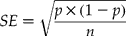
We calculated mean proportions of germinated seeds as the sum of all germinated seeds divided by the total number of exposed seeds within each combination of treatment and species. Standard errors (SE) of the mean proportions were calculated using the equation
 $$\begin{eqnarray} SE = \sqrt {\frac { p \times (1 - p )}{ n }} \end{eqnarray}$$
where p is the proportion of germinated seeds and n is the number of exposed seeds (Crossley, 2008). Effects of treatments were assessed with tests of equal proportions (‘prop.test’ from the ‘binom’ package; Dorai-Raj, Reference Dorai-Raj2009) conducted on all pairwise comparisons of treatments within species. Statistics were done in R 2.14.1 (R Development Core Team, 2011).
Results
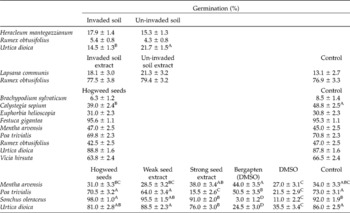
Soil from stands of the invasive alien H. mantegazzianum significantly reduced germination in the co-occurring native herb U. dioica compared with similar soil from nearby vegetation (Table 1; test of equal proportions, P< 0.001). However, in Experiment 1 there was no significant difference in germination of R. obtusifolius and H. mantegazzianum on invaded and un-invaded soil (P>0.05). Soil extracts from stands of H. mantegazzianum had no significant effects on germination of L. communis and R. obtusifolius (Experiment 2; P>0.05). There was also no significant difference between un-invaded soil extract and de-ionized water as a control (P>0.05). Of the nine native herbaceous species tested in Experiment 3 only C. sepium showed reduced germination with seeds of H. mantegazzianum present (P< 0.01). Hogweed seeds and weak seed extract did not have negative effects on the four species tested in Experiment 4, while strong seed extract negatively affected germination of P. trivialis (P< 0.001) and U. dioica (P< 0.05) compared with germination on blotting paper with de-ionized water. Bergapten in DMSO solution affected germination of S. oleraceus (P< 0.01) and U. dioica (P< 0.05) more strongly than DMSO solution without bergapten.
Germination percentages (means ± SE) from four experiments on the effects of the invasive alien H. mantegazzianum on germination of native herbs in the invaded range. Treatments include soil and soil extracts from invaded sites versus un-invaded sites; mixtures of native seeds with 21 seeds of H. mantegazzianum per Petri dish; extracts of ground seeds of H. mantegazzianum at two concentrations (weak, strong); bergapten in DMSO solution and DMSO solution without bergapten. In the control treatments, seeds were exposed in Petri dishes with only de-ionized water. Values without common superscript letters are significantly different (test of equal proportions; P<0.05). In rows without letters there were no significant differences

Discussion
The germination experiments conducted with soil, soil extracts, seeds or seed extracts of H. mantegazzianum showed only limited and partly inconsistent negative effects on 11 native plant species. Germination of U. dioica was reduced by 11–33% through strong seed extract, bergapten and soil from invaded stands (increasing order). P. trivialis was affected by strong seed extract, but not by bergapten, while S. oleraceus showed the opposite pattern (both were not tested in the soil experiment). C. sepium was the only species with reduced germination in the presence of H. mantegazzianum seeds. Negative effects of root exudates of H. mantegazzianum on germination of Dactylis glomerata and Plantago lanceolata were found in a recent experiment conducted by P. Dostal et al. (pers. comm.). In their studies, soils from dominant stands of H. mantegazzianum showed variable patterns of allelopathic effects depending on target species and presence of soil biota. These findings indicate that allelopathic effects may be species-specific and depend on the source of the allelochemicals used in experiments.
The experiments with soil from H. mantegazzianum stands on U. dioica indicate that some compounds from this invasive species could have inhibitory effects on native plants from NW Europe. The apparent inconsistency with the results from the seed experiments could be due to indirect effects of these allelochemicals on native plants through changes in the chemical or microbial conditions of the soil (cf. Weir et al., Reference Weir, Park and Vivanco2004), or due to different concentrations of potential allelochemicals in soil, aqueous solutions and extracts from seeds.
Another possible explanation could be the enrichment and accumulation of such inhibitory compounds in soil over time. Friedman et al. (Reference Friedman, Rushkin and Waller1982) identified the coumarin xanthotoxin from the epicuticular waxes of the seeds of Ammi majus as a major compound in aqueous leachates inhibiting germination. Though Friedman et al. (Reference Friedman, Rushkin and Waller1982) found a slow rate of efflux, with the inhibitory potential of the leachate increasing after 4 d, in many cases the presence of potential allelochemicals in the soil seems to be ephemeral (Weidenhamer and Callaway, Reference Weidenhamer and Callaway2010). While the identification of potential inhibitory compounds is relatively easy (e.g. Glowniak et al., Reference Glowniak, Mroczek, Zabza and Cierpicki2000), it is a much more challenging task to measure the leaching and degradation of these compounds.
The difficulty in using realistic concentrations of potential allelochemicals in germination experiments can be a reason for the incongruent results on P. trivialis treated with concentrated aqueous solutions from ground seeds of H. mantegazzianum compared with the moist seed mixtures with this species. While solutions of ground seeds may contain concentrations of compounds that are too high, mixtures of seeds often underestimate the microbial degradation of plant material and the chemical reactions with other compounds in soil. The use of Petri dishes distorts further the time that these compounds remain in contact with the seeds, as they cannot leach out from the dishes, and using distilled water as a medium has limitations for poorly water-soluble compounds. Finding natural or neutral solvents for such compounds is a methodological challenge, as many solvents have additional effects on the tested species. This can be seen in the overlapping results of the germination experiments conducted with bergapten and DMSO.
Furthermore, changes in soil pH or nutrient concentrations in stands invaded by H. mantegazzianum could explain differences in germination of other species. Rodgers et al. (Reference Rodgers, Wolfe, Werden and Finzi2008) found that soils in North American temperate deciduous forest invaded by the European forb Alliaria petiolata were higher in nutrients and soil pH, in addition to the allelopathic effects observed by Prati and Bossdorf (Reference Prati and Bossdorf2004). As seedling growth is often more sensitive to allelochemicals than germination (Araniti et al., Reference Araniti, Sorgona, Lupini and Abenavoli2012), seed extracts of H. mantegazzianum could also directly inhibit the growth of native plants (J. Thiele, unpubl. data). Should H. mantegazzianum contain compounds that have negative effects on the plant performance of native species in its invasive range, it still remains to be seen if allelopathy facilitates the invasion of this species, acting as a novel weapon, as shown for other species (Ridenour and Callaway, Reference Ridenour and Callaway2001; Inderjit et al., Reference Inderjit, Callaway and Vivanco2006).
We conclude that detection of allelopathic effects of invasive alien plant species depends on the experimental methods used and varies among the native species investigated. Despite high concentrations of potentially allelopathic furanocoumarins in the study species, there is only limited evidence that seeds or soil from H. mantegazzianum stands have negative effects on germination of co-occuring native herbs.
Acknowledgements
This research was supported by the ‘Centre for Invasive Species’ (University of Copenhagen) and the Aage V. Jensen Foundation. We would like to thank Mai-Britt Sauer and Lis Dybvad for help with seed and soil collection, and preparation of the germination experiments. Karen R. Munk contributed to the laboratory work. The Botanical Museum of Graz provided seeds of one species. Two referees and the Editor of the journal improved an earlier version of the manuscript.