The term “traditional music” is widely used in musicological discourse as well as in everyday conversations, and is, indeed, in the name of our organisation: the International Council for Traditional Music.Footnote 1 It was also used in the titles of classic studies of Asian music by our elders, such as Yi Hye-gu (Reference Yi (Lee) and Provine1981), Kishibe Shigeo (Reference Kishibe1969), William Malm (Reference Malm1959), A. C. Scott (Reference Scott.1967, Reference Scott.1969, Reference Scott.1975), David Morton (Reference Morton and Duriyanga1976), Judith Becker (Reference Becker1980), Terry Miller (Reference Miller1985), and others, and in the titles of many journal articles. In short, the term is at the core of the discipline of ethnomusicology and for this organisation.
Despite the above, the term does not seem to have been defined rigorously: the meaning and implication of “traditional” (or indeed, “tradition”) in traditional music are not always clear, and sometimes misleading. Like the term “music,” its subcategory “traditional music” is assumed to be understood by all and need not be explained as a concept. A commonly accepted notion, though seldom spelled out explicitly, and dare I propose here, is that traditional music refers to those that have been transmitted from generation to generation with relatively little change, retaining much that is from the past.Footnote 2 An unspoken assumption is that most traditional music does not have an identifiable composer, and that its origin is often unknown and untraceable, which may be one reason that it contrasts with “composed music” where the identity of a composer is paramount. That traditional music is thought to embody an older time and musical style may be deemed valuable to some, but it is also assumed to lack much newness and therefore somewhat out of sync with, and thus less relevant to, contemporary times.
No one is so naive as to think that traditional music does not change with time. But because much of it is transmitted orally, even those with musical notation, the process of change leaves little evidence, hence cannot be readily studied. Furthermore, because the change is usually not attributable to a specific person, such changes are deemed less noteworthy. It is therefore easy to assume that the music is static, which feeds into the romantic notion that one is listening to music from another age.Footnote 3
In fact, performances of traditional music are seldom exact copies of their predecessors. Performers do not merely parrot what they learn from their masters or read from the notation, but inevitably instill their creativity and individuality. Their contributions may be minimal, subtle, and subconsciously produced, but may also be drastic, obvious, the result of deliberate and interactive discussion among a group of people. Yet, a commonly held erroneous opinion among scholars outside the discipline of ethnomusicology, and certainly for non-academics, is that traditional music is considered as the polar opposite to “composed music,” which implies a lack of creativity. In fact, even “composed music” is to a degree “traditional” because it does not pop out from a vacuum but is also inevitably rooted in its own tradition.
Today, when musical creativity is invoked, one is largely referring to activities in “composed music” by the great European masters and to contemporary “composers” or to jazz improvisation by jazz greats in America. I contend that traditional music does also involve creativity, even though the specific kind of “creativity” may not fit into the pre-conceived idea that has been defined by others. I will explore such creativity by examining performance practice and the transmission process within the music’s broader historical, cultural, and social contexts. I shall identify not only what these creative elements and activities are but also suggest a broader and nuanced notion of what creativity is. Even more importantly, I suggest that what is called traditional music should not be narrowly and rigidly relegated to and defined by what other musics are not, but that it at its core has both traditionality and creativity, like all musics.Footnote 4
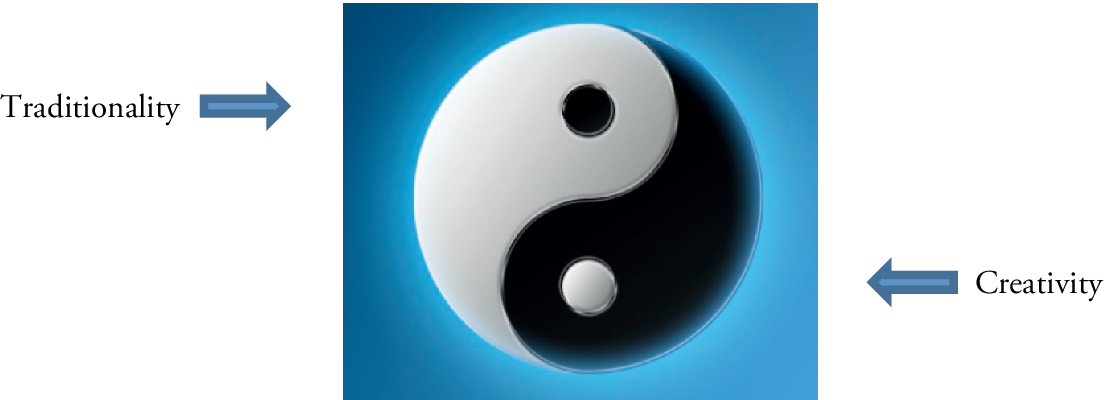
Following Adelaida Reyes Schramm, who has asserted that “tradition and innovation not only co-exist but co-occur, where these not only contrast with but complement each other…” (Schramm Reference Schramm1986:99), I propose to set up a paradigm for research into the Traditionality and Creativity in all music (Figure 1). The two could be viewed as a yin-yang duality that are mutually oppositional but complementary.Footnote 5
A model for Traditionality and Creativity.

All music, and indeed all literary, dramatic, and artistic work and activities may be considered to encompass this duality, each balancing the other. The concluding section of this article will explicitly show that the meaning of this diagram is not static: each half necessarily expands or contracts relative to the other from one musical genre to another, and as any one musical genre evolves in time.
How are they oppositional and complementary? Creativity, in the broadest sense and simplest terms, is a basic human urge and capacity to seek change in our natural and social environments, as a way to overcome obstacles that threaten our survival, or to pursue a fuller life experience of joy and fulfillment. More importantly for our discussion here, human beings also cope with life’s challenges and aspirations through the construction of imagined universes of literature, drama, music, the visual arts, and other artistic activities and products as a means to transform and transcend the reality of life. Creativity is justifiably valued as a vital and important force in human existence.
Traditionality is oppositional yet complementary to creativity; it is the urge to adhere to customs and practices established by our forefathers, to connect with the past in order to legitimise the present, and to aspire for the future. In East Asian cultures, emphasis on traditionality is itself inherited, treasured, followed, or even resisted; we share a long-standing recognition, reverence, and preservation of the past. This is reflected in our respect for our parents and ancestors, reluctance to rebel openly from received customs and habits, and an emphasis on education through the study of the past, which we believe contain immeasurable wisdom—a part of Confucianist ideology that pervades East Asian cultures.Footnote 6
I certainly am not suggesting that we are unique among world cultures, but examples in East Asian music allow us to pioneer in a critical revision of the misleading assumptions applied to traditional music. Using the above paradigm, I shall examine three kinds of Chinese music that are considered “traditional”: the State Sacrifices and Music in imperial times, the qin music of the literati, and the aria types of Cantonese Opera.
State Sacrifices and Music
The State Sacrifices and Music are arguably the most important rituals in imperial China, but also among the least known. The ritual began about 2,500 years ago in the Zhou dynasty (1046–256 BC), and continued through the successive dynasties, with some interruptions, until the early twentieth century, when the last dynasty ended. Among the dozen or so rituals that were performed regularly within a calendrical cycle, each State Sacrifice honoured a celestial or mortal deity, the most important and elaborate of which was the Sacrifice to Heaven (Lam Reference Lam1998:19–28; Yao Reference Yao2000:196–198). Heaven bestowed the legitimacy to the emperor’s rulership; the emperor, who declared himself the son of Heaven, served as the chief celebrant for this ritual, supplemented by over a hundred assistant celebrants, singers, dancers, instrumentalists, and other minor functionaries (Rawski Reference Yung, Rawski and Watson1996). In the early twelfth century, these rituals were introduced to Korea during the Koryo dynasty (935–1392), and were subsequently conducted fairly continuously until the end of the nineteenth century (Provine Reference Provine1996). In the twentieth century, the only State Sacrifice that survived was the one honouring Confucius, which is still being conducted in Mainland China, Taiwan, and Korea (see, for example, Pian Reference Pian and Wade1997).
For all emperors who first ascended the throne, and in particular for the first emperor of a new dynasty, the Sacrifice to Heaven must be performed, and performed properly. A new emperor must continue the tradition by adhering to the details of the ritual from the past in order to legitimise his rule as a successor to earlier emperors. Documents from previous dynasties provided details of the ritual to follow, although ambiguities existed in the text because of changing time and circumstance from dynasty to dynasty. There was also the issue of which of the earlier dynasty’s rituals should be the model. Long-serving court officials who had direct knowledge of earlier rituals provided yet other opinions. On the other hand, each new emperor also wanted to assert his own identity by instilling new elements into the ritual. Thus, to realise every step of the ritual was no simple matter, but involved complex negotiations among the emperor himself, the high-level scholar-officials, and the knowledgeable experts in the court. The negotiations could be contentious, but, in the end, had to be resolved. These discussions and negotiations, which sometimes were like tugs of war between traditionality and creativity, were recorded in detail in court documents, which provide evidence for the study of such processes (Lam Reference Lam1998).
Music was at the core of the ritual. The performance involved a large number of singers, dancers, and instrumentalists, who played a great variety of musical instruments. These instruments were among the oldest known in China, having been preserved in these rituals through the dynasties. The best-known were the bronze bells and the stone chimes; but also many wind and string instruments to play melodies, and drums and percussion instruments for rhythmic marking, and textural variety and richness.Footnote 7 The singers, dancers, and instruments perform specific songs with well-defined tunes written in the lülü notation. The majority of these short tunes have units of four-note phrases, which form binary structures (Pian Reference Pian and Wade1997).
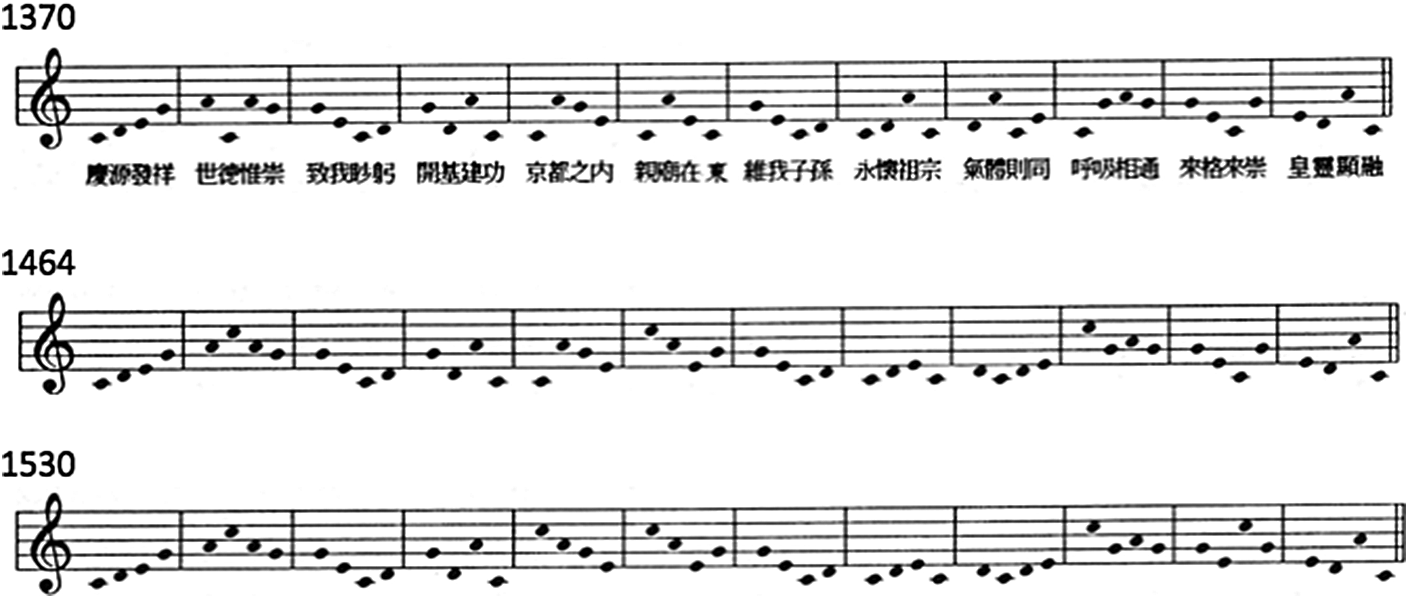
In the Ming dynasty (1368–1644), which was studied and reported by Joseph Lam (Reference Lam1998), there were 323 such songs, each one sung at a particular segment of a particular ritual. An example is the song sung at the segment Welcoming the Deities of the Sacrifice to Heaven. The performance practice, including the instrumentation, orchestral texture and colour, and tempo remained largely unchanged through the centuries; the critical component that did change was the specific melody of the songs. The documents of the Ming dynasty show three versions of the song “Welcoming the Deities” from the documents of 1370, 1464, and 1530 (Figure 2).
Three versions of the song for Welcoming the Deities from 1370, 1464, and 1530 (Lam Reference Lam1998:147).

Note that the tune remained largely unchanged from century to century. There was switching of a few octave equivalents in order to make the melodic contour smoother, and a few altered notes towards the end of the song. These minor changes instilled originality to satisfy the requirement for the new emperorship. Were such minimal changes in fact noticeable in a performance? According to Joseph Lam, they were. He notes that they were obvious signs of musical creativity to anyone familiar with the style and who knew the boundaries within which creativity could operate, even though to us, these changes may seem barely noticeable (Lam Reference Lam1998:155–162).
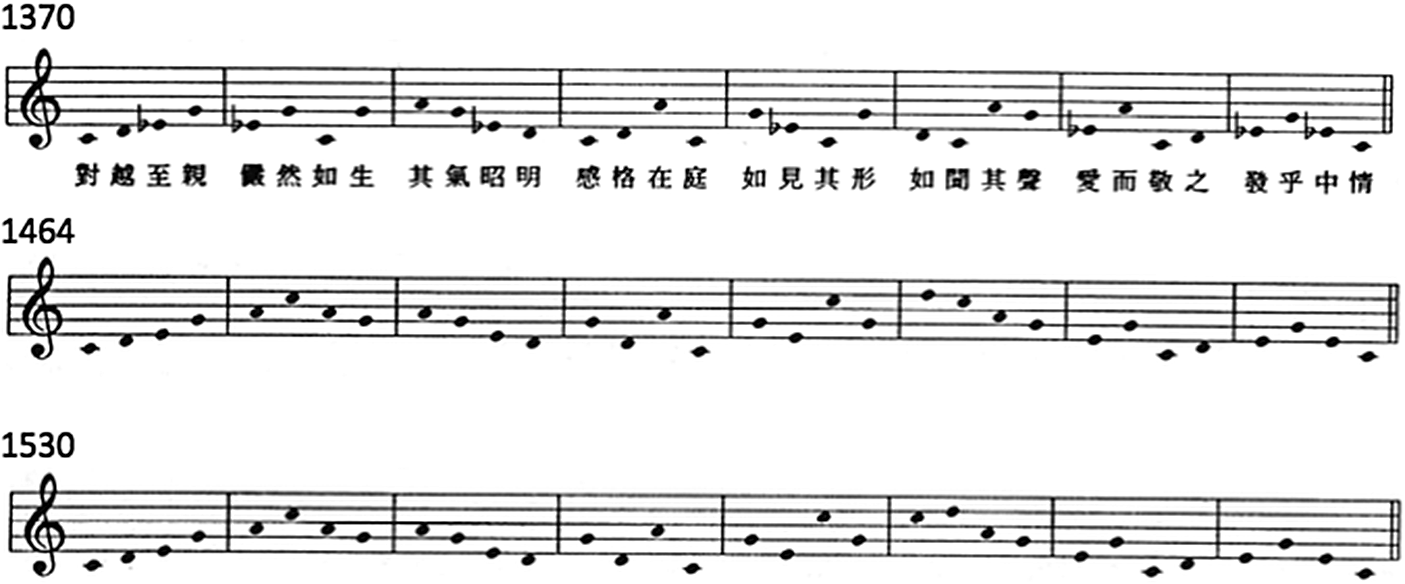
Another example is the song sung at the Second Offering of Wine in the Sacrifice to Heaven. The three versions from the three documents can be seen at Figure 3.
Three versions of the song for the Second Offering of Wine from 1370, 1464, 1530 (Lam Reference Lam1998:149).

This example appears to have a more drastic change from the 1370 version to the 1464 version when the Eb of the 1370 version was substituted by E in the latter two versions. Joseph Lam points out that the use of Eb resulted in a hemitonic scale, which evoked historical music from the Ming period, while substituting it with E transformed the tune into anhemitonic, which was used in many types of music performed contemporaneously in mid-Ming (Lam Reference Lam1998:146).
The example of the songs in the Sacrifice to Heaven shows that the creativity was carried out deliberately, and was the result of negotiation by group participation. It also shows that, to our musical sense, the new elements instilled were minimal and negligible. But to the Ming dynasty experts and ritual participants, the changes were significant and served the purpose of creativity.
Qin or Guqin
My second example is the music of the instrument qin, or guqin (Chinese seven-string zither), on which many writings are available (see, for example, van Gulik Reference Van Gulik1940; Lieberman Reference Lieberman1983; Yung Reference Yung and Shapiro1997). Its legacy rests in the large body of philosophical treatises, incidental essays, poems, memoires, instruction handbooks, and a repertory of compositions preserved in its own distinctive musical notation. There were also paintings and calligraphy, and millennia-old samples of the qin instrument still in playable condition. These materials from the last two millennia formed indisputable and compelling evidence of a tradition that is not easy to resist to any qin player.
Just like the State Sacrifices and Music, which catered to an exclusive audience in the imperial Court, the music of qin also catered to a near-exclusive group that consisted mainly of the literati and scholar-officials. They were society’s political and economic elites, and they played the instrument mainly for themselves without having to please an anonymous audience. For that reason they faced little external criticism and pressure to change, and could conform to its tradition with a sense that they were the continuation of a historical legacy dating back a number of millennia.
Most qin players followed that tradition, but a small number asserted their creativity to render the music more dynamic. Their most obvious activity is the practice of so-called dapu, which is related to the qin’s distinctive notation called jianzipu (Yung Reference Yung and Shapiro1985). Suffice it to note here that the jianzipu notation does not directly record or prescribe pitch, as in Western staff notation; instead it provides detailed finger positions and movements. More importantly, it does not provide explicit durational, rhythmic or phrasing instructions. In order to play a composition from notation, one needs to interpret the literary content of the piece, according to which one introduces rhythm into the music. In short, the person who carries out the dapu process is somewhat similar to a composer of Western art music.
Some scholars criticise the jianzipu notation as flawed because of the lack of rhythmic notation. Yet from another point of view, the jianzipu allows qin players of later generations to exercise their freedom to instill rhythm (Yung Reference Yung and Shapiro1994). It all depends upon one’s notion of the function of musical notation: does the notation aim to preserve music as accurately as possible for posterity? Or, in the case of jianzipu, it allows and encourages the qin players to exercise their creativity to recreate the past to suit the needs of their own times. Therein lie the essence of creativity that is built into the performance practice and the musical notation.
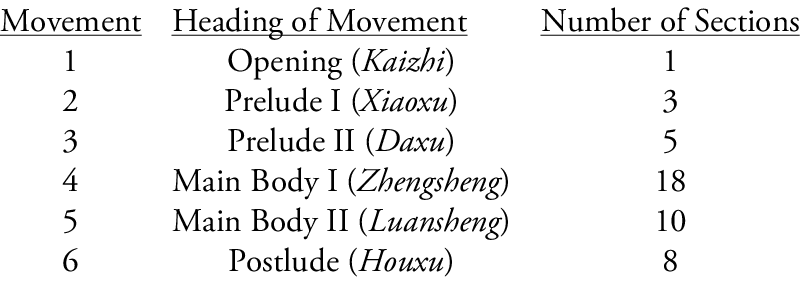
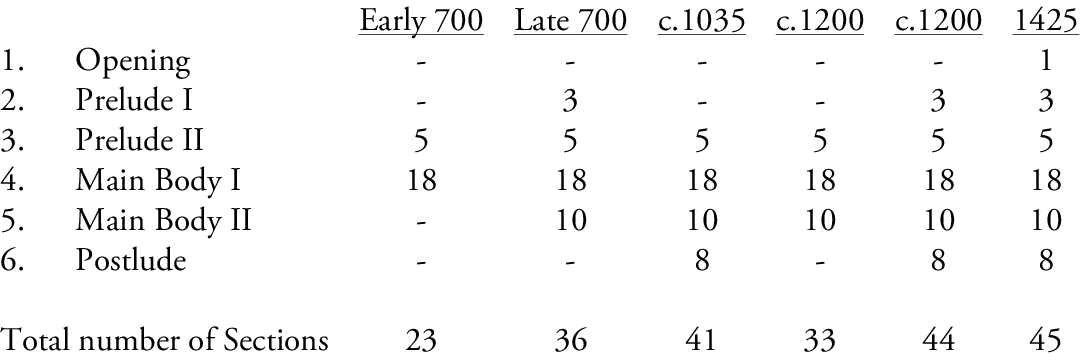
The qin musician’s creative input is not limited to the dapu process; it may also change the jianzipu itself by changing the finger positions and finger movements, and by adding or deleting segments to a composition (Yung Reference Yung and Shapiro1987). The most interesting case is the composition called “Guanglingsan” (Niezheng Assassinates the King of Han), which evolved and expanded through several centuries (see Yung Reference Yung and Shapiro1997, Reference Yung and Shapiro2008). Its oldest extant jianzipu notation is from 1425, which shows that the composition has six movements, each of which contains many sections: Figure 4 outlines its complete structure.
Structure of Guanglingsan (Yung Reference Yung and Shapiro1997:16).

Many historical documents through the earlier centuries show that the composition existed before 1425, some with important details based upon which researchers have deduced that its notation could have existed as early as 700 CE, and, through detective-like analysis by qin scholars (Zhongyang 1958), proposed that the composition’s original shape consisted of movements three and four, adding to a total of twenty-three sections. Later musicians added new movements and sections to it so that the composition expanded to a total of the full six movements and forty-five sections as recorded in 1425 (see Figure 5).
Evolution of Guanglingsan, ca. 700 to 1425 (Zhongyang 1958:3; Yung Reference Yung and Shapiro2008:1040).

It is interesting to note that, in recent decades, there has been a tendency to shrink the number of sections to shorten the piece. A quick check on YouTube, where many qin players post their performance of this composition, shows that the duration of the piece ranges from almost 25’ (24’53” by Wu Wenguang) to a little over 4’ (4’14” by Chen Leiji). These qin players took the liberty to delete parts of the movements or section, or completely eliminate some of them.
Guanglingsan was not the only composition that received revisions from generations of qin players. Other compositions received similar treatments and many of these new versions were subsequently published. One of the most popular qin compositions is “Pingsha Luoyan” (Wild Geese Landing on the Sandy Beach); there exist today fifty-six versions in qin notational collections, the earliest in 1634, the latest 1931. Many of these were simply copies of earlier versions, but others were quite different, having been revised by qin musicians (Luo Reference Luo2003). These examples show that the qin tradition, despite its generally conservative nature and historical legacy, nevertheless tolerate, if not encourage, musicians to exercise their creativity to express their personal aesthetic preferences (see Yung Reference Yung and Shapiro1987).
Cantonese Opera
The last example is Cantonese Opera, which is called “traditional” in contrast to newly composed operas by, say, Guo Wenjing (b.1956), Tan Dun (b.1957), Zhou Long (b.1953), and a host of other Western-trained Chinese composers who recently came into fame. Not relying on such a composer, the two-hundred-year old Cantonese Opera uses instead a pool of pre-existent tunes, each with a label. The label identifies the original tune such as Bongji, and its tempo-metrical variant such as zungbaan, or medium tempo. For example, the label Bongji Zungbaan is “the tune Bongji with its variant in medium tempo” which prescribes a metrical pattern of alternations of strong beat and weak beat. Rulan Chao Pian, who pioneered the study of traditional opera with her work on Peking Opera, called these variants of pre-existent tunes “aria types” (Pian Reference Pian and Wade1993).
These aria types not only have structural identities in terms of melodic and rhythmic characteristics so that knowledgeable audience would recognise what they are, but they also have dramatic associations so that knowing the music enhances the effect of the dramatic content. Scriptwriters compose a poetic passage; they then attach a label of an aria type to this passage. In composing the poetic passage, they must adhere to the prosodic rules specific to the aria types, which the singer then sings accordingly without needing any musical notation.
Because these aria types are not written down in musical notation but are internalised by performers, scriptwriters, and audience, a singer of an aria type may, and often does, vary the details of the melody within certain constraints that would preserve the aria type’s structural identity. These constraints—handed down by tradition—include:
• the general form of the aria type, which is normally in couplet form, with a basic rhythmic pattern of mapping the individual syllable into a prescribed metrical structure;
• mixed cadential notes and cadential patterns at the end of each of the two lines of the couplet; and
• matching of melodic contour more or less to the linguistic tones of the text.
Within these constraints, the singer has the freedom to manipulate the melodic contour and the rhythmic pattern (Yung Reference Yung1989). To illustrate creativity in Cantonese Opera, I shall limit my discussion to the rhythmic pattern and use an aria type called Fast Bongji Zungbaan for illustration (Yung, Reference Yungin press). Fast Bongji Zungbaan means that the aria type is the medium tempo version of the Bongji tune, sung at a fast clip. This aria type has seven syllables in each poetic line sung to six bars. The basic rhythmic pattern of how the syllables are placed within the metrical structure in the full couplet of twelve bars is shown in Figure 6.
Rhythmic pattern and syllables of Fast Bongji Zungbaan.

Note that the rhythmic pattern has many crotchet (quarter-note) syncopations, in bars 1, 2, 4, 5 of the first half of the couplet, and the corresponding bars 7, 8, 10, 11 in the second. Because of these syncopations, the aria type could in fact be heard as 3/4 metre, so that the syncopations fall on strong beats instead, as shown in Figure 7.
Rhythmic emphasis in Fast Bongji Zungbaan.

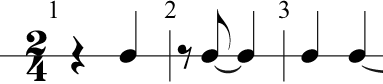
In actual performance, the singer may vary this basic rhythmic pattern to create new musical interest so long as the original pattern is not drastically altered. Among the recorded performances I transcribed, many of them introduce an additional quaver (eighth-note) syncopation to the original crochet (quarter-note) syncopations in bars 2, 5, 8, 11. Figure 8 shows the additional syncopation added to bar 2 of Figure 7.
Example of an additional syncopated rhythm to Fast Bongji Zungbaan.

Some performers retained the original pattern, others sang one, two, or three additional syncopations in bars 2, 5, 8, 11. One of them, however, sang additional syncopations in all four bars, resulting in the rendition as shown in Figure 9.
An expanded syncopated rendition of Fast Bongji Zungbaan.

It is my contention that this singer is particularly bold and inventive: he is the incomparable Lam Ka-Sing (Lin Jiasheng in Mandarin, 1933–2015, active on stage from the 1950s to the 1990s). By introducing these additional syncopations consistently throughout, he projected the illusion that the metre has been transformed into an alternation of 6/8 and 3/4 as shown in Figure 10.Footnote 8
Alternating rhythmic feel in Lam Ka-Sing’s rendition of Fast Bongji Zungbaan.

This single example illustrates that Cantonese Opera singers could still exercise their creativity to project new expressions, despite the rather rigid formulaic rhythmic patterns of aria types structured by traditional aesthetics.
Conclusion
To summarise, in the case of Sacrifice to Heaven, we learned that, on the one hand, the ritual must observe the long tradition of how it should be conducted because the legitimacy of a new emperor hung on the balance. On the other hand, the emperor wanted to assert the authority of his new reign by instilling a certain amount of distinctiveness to separate him from the past. Therein lies a conflict between traditionality and creativity for which the resolution was reached through deliberation and negotiation among a group of personnel endowed with such power.
From the qin example, we learn that despite the strong traditionality as defined by historical documents, ideology, performance practice, repertory etc., there always existed an enormous amount of creativity in terms of the dapu process, and the freedom to change the structure of the composition, sometimes drastically. The creative input is individualistic and deliberate, and the balance to be achieved between traditionality and creativity is almost entirely dependent on the individual qin player.
From the Cantonese Opera example of an aria type, we learn that the singers must adhere to the tradition in terms of the basic structure of the aria types and their close link to the dramatic elements. Within these constraints the singers could manipulate the melodic and rhythmic details to alter or enrich musical expressions, and to assert their personal musical stamp. The creative process is individualistic, spontaneous, and possibly subconscious, so long as these changes were within the constraints of keeping the link between aria type and drama to effectively tell the story.
To conclude, the story at the Durham Oriental Music Festival that was held in Durham, UK in 1979 is relevant. The Chinese instrumental ensemble, led by the conductor Fang Kun, performed at the festival, billed as Chinese Traditional Music. After the concert, many audience members were vocal in their displeasure at the claim of traditionality, pointing out many elements that they considered to be the results of Westernisation, such as the introduction and emphasis on functional harmony. The post-concert discussion became so heated that a special session was hastily added to address the issue, allowing Fang to respond to the criticism. While the offended audience felt cheated at having been given what they considered “bastardised” Chinese traditional music, Fang insisted that in fact his music was “traditional” in the Chinese sense of the term: as chuantong, literally meaning to transmit a framework (of governance, of practice, of thought, etc.). Eventually publishing his views, Fang argued that traditional music has great vitality but is never static. In the article he used the pipa piece “Shimian Maifu” (Ambush on All Sides) as an example, but we could very well substitute it with the song for the Welcoming the Deities in the Sacrifice to Heaven, or the qin composition Guanglingsan, or the aria type Fast Bongji Zungbaan Medium Tempo in Cantonese Opera. Fang writes:
If we consider Ambush on All Sides, [we find that] in China today, it is played differently by at least ten schools, each of which has its own special [treatment of it]. So which school may be regarded as representing the correct tradition? We believe that they are all part of the tradition. At least several hundred years passed between the first writing down of this ancient piece and the definition of its score in 1818, and in any number of periods it must have undergone reconstruction by artists among the people, as apprentices often surpassed their teachers and one generation was more prolific than another. So is it the teachers or the pupils who are traditional? We say that both are traditional. This really shows that tradition itself is in [a state of] development. The more excellent it is the more vitality it has, and it is certainly not in the static state that some scholars imagine.
(Fang et al. Reference Dorson1981:6)Clearly, Fang’s emphasis was to consider tradition as a process, mediated by individuals, and constantly developing. His point echoes those by Charles Seeger, who distinguishes one of three meanings of oral tradition as “the process of inheritance, cultivation, and transmission thereof” (Seeger Reference Seeger1950:826; italics in original). In addition, referring to Milman Parry’s study of epics, Dan Ben-Amos notes that for Parry, “tradition…refers to a transmission process that also becomes a composition process” (Ben-Amos Reference Ben-Amos1984:117; italics in original). The three case examples of Chinese traditional music discussed above emphasise the role of the individual, or groups of individuals, whose musical creativity are enacted in response to a broad array of historical, socio-political, personal, and musical parameters, and which are part and parcel of the transmission of these musical traditions.
Viewed as processes of transmission, tradition and creativity are inextricably bound. Indeed, as Fang implied, creativity constitutes and molds the tradition. Returning to Figure 1 of this article, the yin-yang diagram is therefore not static but dynamic: each half necessarily expands or contracts relative to the other from one musical genre to another, and as any one musical genre evolves in time. The yin half constantly instills creativity into the yang half, which absorbs the new elements into the larger yang half of traditionality. The dance of creativity and traditionality perpetuates as the waxing and waning of the moon.
Glossary

* Cantonese pronunciation