Yesterday morning the bodies of two infants, supposed to be twins, were found in the Canal firmly enveloped in a linen bag, in which were also two bricks. There was also a shawl round the bodies, which it is to be hoped may lead to the discovery of the unfeeling mother. The Police are on the alert, and we are confident that no exertions on their part will be wanting to discover the perpetrator of so foul a deed. The bodies were interred, and the shawl may be seen at Police Station B.Footnote 1
The preceding narrative is, in many ways, illustrative of the complex and contradictory phenomenon of infanticide in the district of Montreal during the first half of the nineteenth century. Although notices regarding the finding of infant bodies were frequent, discovery of twin infant bodies was not. This account was also unconventional in its tone: lacking the usual sterile narration typical of newspaper coverage of that topic, it cried out for the apprehension of the “perpetrator of so foul a deed.” Although the call for justice might have appeared strong, infanticide prosecutions were fairly rare and convictions rarer still. The prevalent view might have been to characterize the responsible party as an “unfeeling mother,” but the reality surrounding infanticide was altogether more complicated, yet fully as tragic.
This article argues that infanticide, and the legal and social responses thereto, exhibited a compromise between conflicting sentiments, realities, and paradigms. As a result, the actions of defendants, prosecutors, judges and jurors, and the public at large were characterized by competing motives and countervailing sympathies. The infant victims were nominally the focus of the law, but in reality these acts were viewed as crimes against social conventions. The issue of infanticide during this period therefore presents a fascinating study in this heavily gendered area of nineteenth-century criminal law, reflecting stark differences between law and custom. This article will provide a brief discussion of the historiography and underlying methodology, followed by the political and historical context for the Montreal experience, before moving on to the issue of infant abandonment, coroner's inquests, and the legal mechanics of infanticide prosecutions.
Historiography and Methodology
A fundamental conceptual difficulty encountered in studying infanticide is one of definition. The contemporary terms used, besides infanticide, included “willful child murder” and other variations.Footnote 2 Infancy also had various legal definitions, as historically the common law did not distinguish between murder of adults and that of newborns or adolescents.Footnote 3
Another obstacle, common to studies of criminality in general, is the difficulty in reconstructing social pathologies that tended to be deeply closeted. Studies of infanticide are hobbled as many of the issues related to this crime—such as sexuality and single motherhood—were not deemed appropriate fodder for public discussion, whereas the gruesome nature of the crime further stifled commentary. The cases of infanticide discussed herein were not captured in trial reports or records of appeals, but were compiled from a comprehensive review of judicial records and contemporary newspaper accounts. For the period 1825–1850, the Montreal Archives holds voluminous records that offer the patient scholar a rich body of documents related to the administration of criminal justice. Examining these documents by year and then cross-indexing allowed for tracing the procedural history of trials, and for the reclamation of alleged crimes that were never prosecuted. Coroners’ reports provide information on the frequency with which infant bodies were discovered, as well as the investigative and prosecutorial response. All extant criminal records for this period were examined, identifying thirty-one cases within the District of Montreal.Footnote 4
Despite their incontrovertible value, there are myriad methodological issues raised by these sources. The collections suffer from obvious lacunae, including gaps where documents have not survived the ravages of time. Verbatim testimony was not generally recorded, despite appearances to the contrary within the depositions made before justices of the peace; therefore, locating the true authorial voice in these documents is daunting especially given linguistic, class, and power differentials.Footnote 5 The judicial apparatus was also class and gender driven, which has important repercussions on the reporting and prosecution of a crime that was overwhelmingly committed by women. There is also an element of self-interest in these depositions, and their perspectives are inherently unidimensional.Footnote 6 These sources only reflect cases of which some legal cognizance was taken, and therefore cannot encompass the “dark figure” of unrecorded crimes.Footnote 7 The sources preclude the historian from knowing what actually transpired in many instances; and even when known, one must concede that judicial sources are rarely reliable and objective illuminators of personal relationships.
During this period. numerous Montreal newspapers were in publication, representing a variety of political, socioeconomic, and ethnic agendas, but largely embodying white, middle-class, male sensibilities; as such they likewise pose significant interpretative issues and are rather more impressionistic than reliably statistical.Footnote 8 Nonetheless, they provide valuable context and allow for reclamation of detail lost within the judicial archives, including witness testimony, discussions of court procedures, and the events surrounding noteworthy trials, and are valuable repositories of “unconscious testimony” about social mores.Footnote 9 The extent to which they do so is prescribed, as mentioned earlier, but utilizing them in conjunction with judicial sources allows for a richer and more nuanced narrative. These documents help illuminate the actor's lives, backgrounds, and interaction with relatives, neighbors, and the criminal justice system, illustrating how “the public and private arenas were inextricably linked and gendered.”Footnote 10
The secondary literature on this topic is considerable and, as will be shown, the Montreal experience largely mirrored that of other jurisdictions. It is hoped that this study will be nonetheless a valuable addition to the historiography for several reasons: it analyzes all available primary source documents for the period rather than providing a general survey or focusing on reported cases;Footnote 11 it adds to our knowledge of the everyday administration of criminal justice in Montreal, which has traditionally been under-examined;Footnote 12 and it examines these issues during the first half of the nineteenth century, which has been largely forsaken for the latter half, perhaps as the rise later in the century of institutions, social care agencies, formalized police forces, court reporters, and the like facilitated reclamation of these issues to an extent not as easily done for the earlier half of the century. Moreover, Montreal offers an attractive setting given its demographic flux during the period and the general interplay and tension between its French roots and its English-based criminal law.
Studies have repeatedly demonstrated that nineteenth-century courts exhibited leniency and compassion toward women accused of infanticide, with concomitantly low prosecution and conviction rates in the United States, the United Kingdom, and elsewhere in Europe.Footnote 13 Canadian scholars have echoed those same themes. Marie-Aimée Cliche's work surveys the period 1660–1969, showing that although over time the frequency of infanticide prosecutions decreased, the underlying causes did not appreciably change. She was able to contrast this with a change from “merciless severity” to the leniency exhibited from the early nineteenth century onwards.Footnote 14 Constance Backhouse has chronicled like results in other parts of Canada;Footnote 15 Judith Osborne has offered a historical and contemporary study that reflects similar patterns;Footnote 16 and Mary Ellen Wright's study of Halifax shows the same.Footnote 17 All these works have enriched our understanding of this complex crime.
For, indeed infanticide was complex: the crime itself and the legal regime that governed it raise a multiplicity of issues, even more acutely reflected in the Montreal experience. Gender, sexuality, age, class, ethnicity, religion, justice, legal structure, power dynamics, geography, history; all these, and others besides, are implicated and reflected in infanticide with gender constructions being especially central. These cases followed a familiar pattern of men siring children and evading responsibility, whereas other men (generally from the “respectable” or middle class) dictated the legal response from within a male-dominated societal and institutional structure that established and enforced the hegemony of social standards to which women were expected to adhere. Fundamentally, the legal response to infanticide was designed rather more to regulate motherhood and sexuality than to protect a child's right to life.Footnote 18
Montreal: Demographics and History
The phenomenon of infanticide was also impacted by the social, political, and other realities shaping Montreal. The Province of Quebec, and Montreal itself, went through a wide array of demographic and other changes in the eighteenth and nineteenth centuries.Footnote 19 At the time of the English conquest, Quebec was a colony of 70,000 inhabitants, the preponderance of whom were Roman Catholics of French ethnicity.Footnote 20 This number grew rapidly, with Quebec reaching a population of approximately 500,000 in 1831, and doubling again within 20 years.Footnote 21 In addition to population changes, there were alterations to the province's ethnic composition. Although Quebec in 1760 was largely populated by French-speaking Roman Catholics, by 1851 the province was a quarter non-French-speaking, including many English-speaking Protestants.Footnote 22 Demographic change was even more significant in Montreal. In 1825, the city's population was 22,540,Footnote 23 ballooning to over 90,000 less than 40 years later, making it the largest urban center in pre-Confederation Canada.Footnote 24 One third of Montreal's inhabitants were English-speaking immigrants in 1825; however, by 1832, English speakers constituted a majority.Footnote 25
The province of Quebec underwent fundamental economic transformations in addition to social and political upheaval. By the first decade of the nineteenth century, the fur trade—long an economic linchpin—was in rapid decline, offset by growth in timber and agriculture. Quebec remained an artisan-based economy, although the first half of the century saw major public works projects, namely canal construction, as well as the growth of other large manufacturing industries.Footnote 26 Montreal was the province's economic driver and main commercial and industrial region; by 1825, Montreal also reigned supreme as the commercial, transportation, construction, and manufacturing capital of Canada, presided over by an affluent English-speaking elite.Footnote 27 After 1840, the transition from an agrarian to an industrial economy accelerated, reflected in (and nourished by) the construction of industrial belts along the Lachine and other canals, and the growth of railway systems.Footnote 28 A busy port city with a large military garrison, Montreal also had the issues typical of cities with sizeable transient naval, merchant, and military personnel, coupled with thousands of peripatetic unskilled day laborers and immigrants; circumstances that promoted predatory and opportunistic sexual dalliances.Footnote 29
In addition to economic and social flux, this period was marked by significant political change. Certainly the Conquest was a transformative event in the history of Quebec, but no less so were the Rebellions of 1837–1838, prompted by an increasingly chaotic and polarized political landscape. When pressed to enact reforms, the British government refused, leading to conflict with French-Canadian elites.Footnote 30 This, in turn, led to the Rebellions of 1837–1838 between reformers (largely French-Canadians) and loyalists (largely British). The end of military conflict ushered in political reform, leading to the union of Upper and Lower Canada in 1840.Footnote 31
If Quebec underwent dramatic demographic, political, and social changes, the situation involving the administration of criminal justice was no less true. Although the civil law system was preserved in Quebec following the Conquest, English criminal law supplanted the existing ancien régime law under the terms of the 1763 Royal Proclamation.Footnote 32 A hierarchy of criminal and other courts was established, closely modeled after that of England, with English substantive and procedural law transplanted largely in its entirety.Footnote 33 Justice remained localized, but by the 1840s, the rise of modern police forces and a professional magistracy were the dominant forms of social and legal control.Footnote 34 Until the reforms ushered in following the Rebellions, little significant legislative overhaul of the criminal law or criminal justice system took place in nineteenth-century Quebec.
Infant Abandonment and Coroner's Inquests
In the winter of 1826, a group of boys skating on the creek discovered a female fetus lying under the bridge, indifferently wrapped in a cloth.Footnote 35 Every year saw a number of infant corpses discovered in and around the city of Montreal, most often of fully developed newborns. Some of the bodies bore evident marks of violence and had been unceremoniously dumped in garbage heaps and sewers, thrown down privies and wells, tossed into canals and rivers, and left in alleyways and fields. Others appeared to have been respectfully, even lovingly, dressed in baby clothes and buried in coffins of polished wood. As such, even their interments were suggestive of widely differing circumstances surrounding their births and deaths.
An unmarried woman facing an unwanted pregnancy in Montreal generally had limited options, often facing a desperate situation and desperate choices.Footnote 36 Adoption was generally an unattractive option given the importance placed upon blood lineage as well as legal impediments.Footnote 37 Until 1795, single mothers had recourse to bastardy prosecutions to enable them to secure financial support from recalcitrant fathers, but after that date this option was no longer available in Quebec.Footnote 38 Institutions that provided day care, the “salle d'asile,” were established slightly later than this period. Run predominantly by Catholic charities, they were not open to unmarried women, generally did not assist non-Catholics, and did not take infants.Footnote 39 The civil law equivalent of seduction suits, “dommages pour seduction,” was one alternative. Unlike common law seduction suits, the woman herself could act as plaintiff but typically faced onerous evidentiary requirements including a showing of misrepresentation, fraud, or trickery. Furthermore, damages were limited to payments for loss of reputation and only occasionally for lost wages, making it of limited utility.Footnote 40 Although there were most likely to have been informal systems of support open to some women, including the assistance of extended family, three of the most common options would have been abortion, abandonment, and infanticide.Footnote 41
Abortion was an illegal procedure and, unless self-administered, required that the mother disclose her situation to at least one other person, and involved issues of access, expense, and effectiveness, as well as personal safety, as many of the substances and procedures used were dangerous to mother and child alike.Footnote 42 For some unmarried mothers, abandonment and infanticide were more efficacious options, especially if alternatives had proven unavailing.Footnote 43 Abandonment, or “dropping,” consisted of leaving the child in a public space such as a church, wharf, or market square. If left in an appropriate place and quickly recovered, the child's chances of survival were probably fair.Footnote 44 In many other instances, however, the child predictably died from exposure or other causes, and abandonment therefore should be seen as a coherent adjunct to infanticide.Footnote 45 Abandonment was usually the preserve of a mother who had given birth out of wedlock, although not exclusively.Footnote 46 Dropping existed at the intersection of the private and public spheres; given the centrality of public spaces to laboring women, it is unsurprising that some infants ended up in these courtyards, gardens, squares, and streets as their mothers lived and worked there.Footnote 47 These were familiar and well-travelled areas chosen for the possibility of third parties retrieving the child, one example of the contradictions and tensions inherent in infanticide.
To better combat that phenomenon, foundling hospitals were established in major European and North American cities, with the Grey Nuns in Montreal establishing such an institution in 1754.Footnote 48 Foundling hospitals often met with controversy, as critics believed that they rewarded promiscuity by unmarried women.Footnote 49 The Grey Nuns took in thousands of infants during this period—4,400 between 1821 and 1850—with the numbers increasing decade after decade.Footnote 50 The foundlings they took in made up a steady eight to nine percent of all Catholic baptisms during this period, spiking dramatically after 1850.Footnote 51 The University Lying-in Hospital was founded in 1844 as an extension of the Faculty of Medicine of McGill University (then McGill College) to provide care for pregnant women.Footnote 52 The directors of the Lying-in Hospital repeatedly emphasized that their institution was not meant to foster immorality but rather to prevent pernicious acts:
[T]he admissions of unmarried women form a very large proportion of the whole….While every Christian and benevolent mind must deplore this fact, it will be some satisfaction to the public to know, that the cases by no means all belong to this city, but very many were strangers and emigrants, who fled from their homes to conceal their disgrace, and who were, generally speaking, in a most destitute condition. The Ladies of the Committee humbly believe that, through the medium of this Institution, many an unfortunate and guilty creature, has been preserved from being hurried prematurely into the presence of an offended Maker, from adding sin to sin, or perhaps from the commission of infanticide–and that many have been spared to repentance and restored to usefulness and happiness.Footnote 53
As that passage makes clear, supporters of the Lying-in Hospital believed they were protecting unwed mothers from “vicious courses and eternal ruin;” most notably, prostitution, infanticide, and suicide. Although such institutions sought to save infant lives, they were largely ineffective, as staggeringly high mortality rates essentially reduced them to glorified mortuaries for the very young.Footnote 54 The age and vulnerability of these infants played a determinant role in their survival, and the preponderance of children abandoned to the Grey Nuns were less than 1 year old, with most being less than 1 week of age.Footnote 55
The frequency with which child abandonment was practiced is indeterminate, but it was a tangible reality during this era. Older children were left to fend for themselves, whereas younger children were deserted in the hope that charity would induce someone to intervene:
Yesterday evening a female child apparently about six weeks old, was left in the passage of the house in Craig Street occupyd (sic) by Mr. McLean, Tailor, Mr. D.A. Smith, and others. The servant girl having been out on an errand saw…some woman leave the house in a great hurry and pull the hood of her cloak over her head. The servant supposed she had been stealing something, and immediately acquainted her master with what she had observed—when on going into the passage with a candle the infant was discovered. The child has a small bruise on the left temple, and laid so still that they thought it was dead. On being touched, however, the little innocent moved–as it did not at all cry, the family conceive that some sleepy potion had been administered.Footnote 56
References to dropping near private homes were rare; it was much more common for infants to be dropped in areas frequented by the public and to be found some time after the fact.
Dropping was hazardous to the lives of these “little innocents” and as mentioned earlier “active” versus “passive” infanticide was often a distinction without a difference. For a mother, too, dropping had its attendant risks, including prosecution for abandonment, although such instances were decidedly rare.Footnote 57
No doubt infanticide sometimes presented itself as the best option. Regardless of how it was brought about, “[a] distraught and desperate mother might, with luck, save herself and her reputation but her baby was almost always destined for an early death.”Footnote 58 Infanticide did not entail the same risk to the mother's health as abortion, and her chances of escaping discovery, prosecution, and conviction were probably high, although this could differ greatly depending upon geographical, social and economic factors.Footnote 59 The stealthy nature of the offense worked to shelter the mother, and infants were readily disposed of-(metaphorically and otherwise) as they were easily hidden and decomposed quickly. There were generally no third parties to report the child's disappearance.Footnote 60
When an infant body was discovered, it fell to the coroner to hold an inquest, a quasi-judicial proceeding tasked with determining cause of death when circumstances warranted investigation.Footnote 61 For that purpose, twelve men constituting a jury of inquest were convened to hear medical and other testimony, with the aim of issuing a verdict on the supposed cause of death; were the verdict one of willful murder and the culprit identified, an arrest warrant would issue. As one historian wrote, inquests were “a lantern that uncomfortably illuminated the dark recesses of society's guilt over infanticide.”Footnote 62 The records of inquests are of limited utility, as some coroners had little in the way of formal medical training, and their verdicts were often inconclusive given the limitations of forensic science. An infant body that was found in the river, for example, might leave little evidence of whether the child had died of natural causes, was murdered and then dropped into the water, or had drowned as the result of accident or intention.
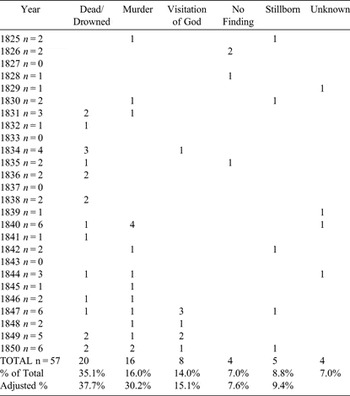
As shown in Table 1, the coroner for the District of Montreal held inquests on the bodies of at least fifty-seven infants during the period from 1825 to 1850, as compiled from coroners’ reports and newspaper accounts.Footnote 63 Because of the spotty nature of existing sources, these figures are inaccurate representations of the actual number of infants found in Montreal, and much smaller than those of illegitimate children left with agencies such as the Grey Nuns. Inquest juries were to reach a conclusion of willful murder in nearly a quarter of verdicts,Footnote 64 but the mothers were identified in only fourteen cases, such as the 1840 investigation that determined that an unmarried domestic's child had died because of her “negligence and ignorance.” Nonetheless, the mother was not charged.Footnote 65 In seven other instances in which the inquest determined the infant was murdered, the mother was also identified.Footnote 66 Most commonly, the verdict was unedifying, simply stating the infant had been “found dead” or the like.Footnote 67 In other instances, the inquest concluded without a finding, and such verdicts obviated the need to pursue the matter further. As has been suggested, that inertia may have been motivated by a sense of futility, given very low prosecution and conviction rates, as well as by more chivalrous and charitable motives.Footnote 68 That contrasts vividly with the depictions of infanticide as “so foul a deed” committed by “unfeeling” and “unnatural” mothers.”Footnote 69
Verdicts of Coroner's Inquests on Found Infants, 1825–1850.

Although it may prove tempting to extrapolate infanticide rates from these sources, it should be emphasized that the statistical frequency of this crime is unknowable.Footnote 70 Many infant bodies were never recovered, and the limitations of forensic analysis often resulted in inaccurate findings. The results of coroners’ inquests allow some additional detail to emerge with respect to the circumstances of infant deaths; in most cases, however, autopsies yielded no clues as to the identity of the guilty party.Footnote 71
The fact that a child had not been interred in traditional fashion often led to suspicions of murder. The discovery of an infant cadaver found floating on the river in a coffin in 1848 resulted in a jury of inquest concluding that the child had been “maliciously destroyed by some person or persons unknown;” not because of any signs of violence, but solely as the infant had been “ruthlessly thrown into the creek” rather than being accorded a customary burial.Footnote 72
Whereas some of the bodies discovered in and around the city were the result of instances of dropping that ended tragically, the preponderance of those infants had been secreted after death. Some scholars have argued, perhaps naively, that the very fact that children were found in a sewer, buried near a cemetery or in a garden, or submerged in a river, points to the conclusion that they had been the victims of passive or active infanticide, a modern inclination that seems to mirror that of many nineteenth-century coroners.Footnote 73 Whereas in some instances the circumstances surrounding the discovery of infant bodies were indeed suggestive of murder, in others the truth was more elusive.Footnote 74 A newspaper account from 1842 depicts the ambiguity of one such discovery:
On Sunday morning a Coroner's Inquest was held on the body of a male infant, about six weeks old, which was found floating in a box…. From its appearance, it could not have been dead above 24 hours. It was dressed in decent, though not handsome, attire. There being no external marks of violence, the body was opened by the medical attendant, who declared that it could not have come to its death by disease; and the Jury being of opinion that it must have been drowned in the box, brought in a verdict of wilful murder against some person or persons unknown. There is in this more mystery than usual in such occurrences; for, if the child had been illegitimate and that it was intended thus to conceal its birth, one would think that it would have been destroyed immediately after its entrance into the world. The infant was a remarkable fine boy.Footnote 75
It was only in rare cases that the child was identified.Footnote 76 The circumstances surrounding most such deaths must therefore remain inscrutable, but two cases help in providing possible motivations for these untraditional internments. In March of 1830, a carter observed a small coffin being thrown into the St. Lawrence River, which was found to contain a “male infant neatly dressed in a white muslin frock, cap, etc.”Footnote 77 A boy standing nearby identified it as his brother, whom he alleged had been stillborn. When confronted, his father admitted that he had paid a third party to deposit the coffin in the river: as his son was stillborn, he reasoned that his place of burial did not matter. At the inquest, a midwife corroborated the story and identified the infant by aid of a birthmark. The coroner decided criminal charges were not warranted, but reprimanded the father, ordering him to pay for the inquest and his child's interment.
Occasionally, these events illustrate the dynamics between the child's parents. During the summer of 1825, an infant was found lying in a box on a city street. Unusually, the inquest identified both parents, established that the child was stillborn, and explicated the circumstances surrounding the child's discovery:
It appears that…the mother of the child…being without a husband sent to the reputed father for some pecuniary assistance, to enable her to have the infant interred; which request, the man refused to comply with, alleging that he was not bound to furnish any sum for such purpose, denying, at the same time, that he was the father….Upon which some officious woman who was in the confidence of the unfortunate mother, wrapped the corps[e] up, and placing it in a box, sent it as a present to the man….The box was left, and, like Pandora's, it produced curiosity in the landlady of the mansion…[and] she therefore opened the lid, and was horror struck on beholding the contents. She then resolved upon casting the whole into the street; an altercation took place between her and her husband, but the woman's arguments prevailed, and the box, and the child, were both committed to the pavement. At this moment a gentleman was passing who, on viewing the box, discovered an arm of the infant; he immediately…prevailed on the woman to permit the child to be returned to the house until he went for the Coroner. He also traced the maternal parent, and also the woman, whose inhuman and unfeminine behaviour casts so great a portion of obloquy upon her….Footnote 78
Every infant found buried in a box, lying in the street, or fished out of the river was therefore not necessarily the victim of murder; some were clearly legitimate children who had died prematurely but naturally, whereas others were illegitimate stillbirths. A variety of reasons could account for such disposals: parties may have been unwilling or unable to pay for more conventional interments.Footnote 79 Still others may have denied responsibility for providing for the infant's burial; or acted out of panic, guilt, or a desire to prevent discovery. Many such cases share disrespect for an infant's physical integrity, emblematic of a view that the child had been less than fully human. This view was also reflected in the law's failure to regard children (especially newborns) as deserving of protection. For other parents, the rituals of infant death were simply unimportant.Footnote 80
It is also true that the circumstances attendant to the discovery of infant bodies were not always suggestive of irreverence. Infants were found interred at various points around the city in coffins that were products of considerable craftsmanship, buried respectfully—perhaps even lovingly—in linen shifts or baby clothes. There are numerous such accounts; for example, the female infant found in the Common in a coffin “made with fine wood, and decently covered with a piece of linen;”Footnote 81 the male child found “thrust in a wooden coffin with handles” in a meadow outside the city;Footnote 82 and the baby found buried in a “very decent coffin” in the government garden.Footnote 83 These examples do not easily square with the view of these infants as being unwanted and unloved. Traditionally, unbaptized infants were commonly denied funerary rites and interment in consecrated ground, particularly in Catholic communities.Footnote 84 Whereas this tenet might have had currency in Montreal's Irish and French-Canadian Catholic communities, or even among Protestant cohorts, roughly twelve percent of births were recorded as illegitimate for this period, with few infant births or deaths going unrecorded. Infants in danger of death were promptly baptized, even among Protestants, making unbaptized infants an unlucky minority.Footnote 85 Given the nature of these burials it is likely that other factors were in play. Some parents may have wished to avoid the potential shame of publicly burying an illegitimate child.Footnote 86 Custom often encouraged interring a child near home or a place of personal connection rather than in a cemetery, whereas working-class Irish immigrants often allocated scarce resources toward food and drink for funeral guests rather than on funerary trappings.Footnote 87 In some instances clandestine burials may have reflected a parent's wish to grieve privately.
The situation involving newborns that exhibited signs of violence was often simultaneously more and less ambiguous. On the one hand, many of those infants were disposed of in especially ignominious fashion, such as the infant tossed into the snowbank in the winter of 1844 and found by surveyors working on the Lachine Canal,Footnote 88 or the infant of nearly 1 year of age discovered in the river “wrapped up in a bag of bed tick…[with] a piece of tape tied under its chin. To the bag a stone of about 12 lbs. weight was attached by a rope.” The coroner's jury reached a unanimous verdict that the child had been cast alive into the river.Footnote 89
What is more curious, however, were those newborns whose appearance may have suggested violence, but who were interred more traditionally. In March of 1834, for example, a “neat coffin” containing a male infant was found near the wharf at the Old Market. The child displayed a deeply bruised forehead, leading to the conclusion that “the little innocent has been made away with.”Footnote 90 But was there a more innocuous explanation for the premortem bruising, perhaps the result of an inexpert delivery? Was the coffin a sign of subconscious guilt, or did it illustrate a desire to preserve the integrity of an infant's body, even one who had been murdered?Footnote 91 More chillingly, was it evidence of premeditation? Did a party enlisted to inter the body properly fail to do so? A mother might have killed her infant and yet attempted to provide a decent burial that would still preserve anonymity. These found infants were buried in city cemeteries at public expense, thus alleviating parents from the attendant financial burden as well as public scrutiny. Those cases suggest that the circumstances surrounding the disposing of an infant body were no less diverse than those leading up to the birth and death itself, although other infants must have been disposed of in secret and remained so.Footnote 92
When found, infant bodies tended to provide coroners with little information. In many inquests no findings were made even if the infant had been found under suspicious circumstances, such as the “abortive [male infant] of five or six months old,” whose inquest resulted in no finding because “how, when, and by what means he came to his death, no evidence thereof doth appear to the jurors.”Footnote 93 The circumstances under which remains were found often foreclosed a determination of the cause of death, as was the case with the mutilated cadaver of a newborn discovered in a city street in 1844; as the Montreal Transcript recorded, the remains had, “shocking to say, been taken from the jaws of a dog, and nothing but the upper part of the body and two arms remained.”Footnote 94
The inability of inquests to provide determinative findings no doubt resulted in some miscarriages of justice, and certainly their failure to shed light on infant deaths was not without criticism.Footnote 95 Between the limitations of forensics and the reluctance of coroners to make findings of murder, many inquests delivered verdicts that were as unedifying as they were inimical to prosecution.Footnote 96 To aid coroners in their professional responsibilities, commentators compiled manuals that explained their legal duties as well as the nuances of dissection techniques and tests. In all such works, infanticide constituted a prominent topic; as one Canadian commentator noted, “the importance of the subject to Coroners requires that it should be dwelt upon at greater length and with more particularity….”Footnote 97 As stated in one 1842 work:
That a young female of character and reputable connexions (sic) may be betrayed by the arts of a base seducer, and when reduced to a state of pregnancy, to avoid the disgrace which must otherwise be her lot, may stifle the birth of the womb, or after it is born, in a state of frenzy imbrue her hands in the infant's blood, in the expectation of throwing the mantle of oblivion over her crime, is a case which too frequently occurs; but even such a case, with all its palliations, cannot be considered as less than wilful murder, and as such demands exemplary punishment.Footnote 98
These statements served as reminders to physicians of their central role in prosecuting such crimes, but however much they may have sought the imposition of “exemplary punishment,” the legal outcome tended to be much more muted. Indeed, medical and legal definitions of infanticide differed. Medically speaking, infanticide involved either the destruction of a baby in utero, or after birth ex utero. Legally, however, infanticide was more narrowly construed: it was only after birth that the infant became a “life in being;” prior to that its destruction could not constitute murder.Footnote 99
Infants who showed overt evidence of mistreatment were the most obvious examples of infanticide, but rarely surfaced in these records. The fragility of infant life meant that little effort needed be expended to extinguish it, and in most cases there was insufficient evidence to indicate whether an infant had been stillborn. As Boys stated, the “hydrostatic” test had traditionally been used to ascertain whether an infant had breathed, respiration being considered the “best test of a child having been alive.”Footnote 100 That test involved immersing the lungs (or portions thereof) in water, the logic being that if the lungs floated the child had breathed.Footnote 101
Seen from the vantage point of modern forensics, the hydrostatic test was highly dubious, and even by the early eighteenth century, English practitioners were doubtful about its efficacy.Footnote 102 In his work, Boys emphasized that the hydrostatic test should only lead to an inference weighed in conjunction with other evidence.Footnote 103 The pressures facing a coroner in such situations were obvious: application of the hydrostatic test could theoretically make the difference between conviction and acquittal. As another treatise writer stated, the question of whether a child was born alive was “of great importance” in allegations of infanticide, and the issue “is unfortunately one which, in respect to the proofs upon which medical evidence is commonly founded, has given rise to considerable controversy.”Footnote 104 The importance of the medical evidence lay in the fact that “[w]hen it is stated that in most cases of alleged infanticide which end in acquittals in spite of the strongest moral presumptions of guilt, the proof fails on this point only, it must be obvious that this question especially claims the attention of a medical jurist.”Footnote 105 In the context of eighteenth-century English infanticide trials, hesitation on the part of medical witnesses offered juries another source of reasonable doubt of a defendant's culpability,Footnote 106 and many coroners and doctors likely wished to avoid implicating women in crimes of infanticide.Footnote 107
Conversely, however—and despite the warning—these tests may have also resulted in “false positives” that led to inquest prosecutions. A century after many English physicians were discounting the importance of the immersion test, a local physician by the name of Dr. Archibald Hall held an autopsy on the body of a 6-month-old male infant found in a hole in the ice. Immersing the infant in water for several hours to thaw, he observed:
no external marks of violence [were found]….In order to ascertain whether it had breathed or not, the hydrostatic test was [employed]. For this purpose the thorax was opened; the lungs did not fill the whole cavity of the chest….They together with the heart were carefully removed, and immersed in the tepid water; the mass sank rapidly to the bottom. The heart was then separated from the lungs, and the lungs subjected to the test–they likewise sank. In order to obviate a fallacy likely to occur in the employment of this test from a partial establishment of the respiratory functions, the lungs were lastly divided into small portions, all of which sank in immersion in the water.
Dr. Hall concluded that the appearance of the infant's organs, “coupled with the evidence afforded by the hydrostatic test, indicated with certainty that it never respired.”Footnote 108 Notwithstanding the emphatic nature of his conclusions and his efforts to “obviate a fallacy” that occurred with the misapplication of that test, Dr. Hall was nonetheless conducting an experiment that proved nothing. Perhaps, as Malcolmson has stated, the doubts expressed by medical witnesses about the usefulness of such tests “clearly favoured the cause of the defendant;” but it is equally possible that the certainty espoused by practitioners such as Dr. Hall could have a non-salutary effect if an innocent defendant was identified and charged.Footnote 109
Ascertaining the cause of death was daunting, but identifying the party responsible for abandoning an infant body was virtually impossible. Even when it was evident an infant had been murdered, the culprit usually remained unknown.Footnote 110 As was the case for homicide in general, if an initial investigation did not easily yield a suspect, further efforts to pursue justice were rarely made.Footnote 111 In the occasional case in which there were strong suspicions about the mother's identity, indictments could still be difficult to obtain. An inquest held to determine the cause of death of a newborn found near the city locks featured testimony from several witnesses who identified a domestic servant named Ann Murphy as the parent, including a fellow servant who observed a “visible change in her size” during the 2 months she was employed, and attested to her bad character. The grand jury nonetheless declined to indict.Footnote 112 Likewise, in succeeding years two inquests were held in which deaths were attributed to violence, and the alleged mothers named, but in which neither were prosecuted.Footnote 113
Not all unmarried mothers were so fortunate, however. In November of 1845, an investigation was held into the death of a male infant, supposed to be the son of Bridget Cloone, a young, unwed live-in domestic servant. Three weeks earlier she had begun to feel unwell, and obtained medicine for chronic indigestion. Cloone became bedridden a week before the inquest, and a local physician ascertained that she was in the advanced stages of pregnancy. She was conveyed to the University Lying-in Hospital, where she persisted in denying her pregnancy even while in labor, and despite “appearances… which led to the belief, that a twin had been already born.”Footnote 114 That supposition having been confirmed following her delivery, her bedroom was searched and the dead twin was found stashed in a wooden clothes chest. The coroner determined that he had been born alive and subsequently strangled, and the jury returned a finding of “wilful and intentional suffocation”Footnote 115 Cloone was convicted of concealment and sentenced to six months’ imprisonment.Footnote 116
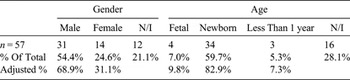
The condition in which many infant bodies were found made it impossible for coroners to ascertain such rudimentary details as age or even gender. Table 2 displays statistics regarding those characteristics, including absolute percentage and adjusted percentage, the latter derived by omitting the unknown or “not identified” figures. It is not possible to determine the actual number of found infants who died as a result of active or passive infanticide. It can be observed, however, that a majority of these infants were males. Some scholars have posited that as males had more economic value than females during the period, such a disparity suggests that gender was an irrelevant consideration, at least compared to the socioeconomic circumstances of the mother.Footnote 117 However, a counter (and perhaps stronger) argument is that daughters were of greater usefulness to their mothers in terms of performing household duties and may have been easier for a single mother to raise than sons.
Characteristics of Found Infants from Coroners’ Inquests, 1825–1850.

It is evident that a significant percentage of those children, and a majority by adjusted percentage, were newborns. That fact is unsurprising, as not only were mortality rates for newborns notoriously high, but unwanted children tended to be prone to early deaths. In the context of infanticide prosecutions, the majority of victims were also newborns.Footnote 118 Children were always at their most vulnerable, for many different reasons, shortly after birth.
The Law of Infanticide
In those cases in which a victim was found and a culpable party identified, the law provided mechanisms that were designed to deal with infanticide and the related offense of concealment. However, the manner in which this law was administered in the nineteenth century and, to a lesser extent the circumstances surrounding the amendment of the criminal law regarding infanticide, were reflective of tension between conflicting moral dictates and societal norms. Historically, the English common law did not differentiate between infanticide and other conventional forms of homicide.Footnote 119 Infanticide remained an “invisible evil” in England for centuries, and rarely fell under the purview of the criminal law at all. Some historians have suggested that the reign of Queen Elizabeth I (1558 to 1603) was a turning point, when heightened attention was drawn to that crime.Footnote 120
The first legislative provision to specifically address infanticide was enacted in 1624, and sought to address the evidentiary hurdles that hampered infanticide prosecutions through enlarging the offense's scope.Footnote 121 Under the Act of 1624, a woman who gave birth to an illegitimate child who died, and attempted to conceal that fact, was statutorily presumed to have committed the capital felony of murder. That presumption could only be rebutted by the testimony of a witness attesting that she was present at the birth and that the child had been stillborn. Given the secrecy that attended most such births, that presumption would have been impossible to overcome in most instances.Footnote 122
French legislation of the period governing the offense of concealment was similar to that of England. The Edict of Henri II was applied in the province of New France (later Lower Canada and Quebec) and provided that “each woman who hides her pregnancy and delivery and the infant dies, is held responsible for the death and punished by death….”Footnote 123 Following the Conquest, the Act of 1624 replaced the Edict of Henri II, as it was received in British North America through an act of Parliament that introduced the general criminal law of England into the colonies.Footnote 124 Whereas there were sea changes in other areas of criminal law, the law governing infanticide in the pre-and post-Conquest period were not appreciably altered, because of the similarities between French and English legislation.Footnote 125
The draconian Act of 1624 resulted in few convictions but it was to have a lengthy lifespan. In practice, the legislation's intent was largely undermined by shifting the burden of proving live birth onto the Crown.Footnote 126 It was not until nearly two centuries later, in 1803, that the Act's provisions respecting infanticide were repealed shortly after it was received into Lower Canada.Footnote 127 The statutory presumption of live birth was removed from the Act of 1803, thus bringing the law in line with the practice of requiring the Crown to prove that fact as an element of the crime. The law as modified, although more equitable, was not changed out of concern for the accused but rather to “relieve the judges from the difficulties they labor under in respect to the trial of women indicted for child murder, in the case of bastards,” according to its sponsor, as “[a]t present the judges were obliged to train the law for the sake of lenity, and to admit the slightest suggestion that the child was stillborn as evidence of the fact.”Footnote 128
Sensitive to the ever-present challenges associated with proving the Crown's case, the Act provided that should a defendant be acquitted of murder, the charge of concealment (similar in substance to that provided for in the Act of 1624) could be substituted. Conviction for murder remained a capital offense, but the lesser-and-included offense of concealment was punishable by a maximum of 2 years’ imprisonment.Footnote 129 Lower Canada was to enact similar legislation in 1812.Footnote 130
In England, the next significant amendments were made in 1828, expanding the statute's reach to encompass married women and allowing for the freestanding charge of concealment rather than requiring an accused first be tried and acquitted of murder.Footnote 131 The crime of concealment as it was interpreted left considerable discretion to judges and jurors, and anti-concealment laws were “vitiated by the courts’ notorious aversion to convicting mothers.”Footnote 132 The amended Act took effect in Lower Canada on January 1, 1842 and governed the concealment of both legitimate and illegitimate infants.Footnote 133 It is the manner in which these laws were applied in Montreal to which we now turn.
Infanticide Prosecutions in Montreal
In April 1840, Elizabeth “Betsey” Williams was arrested for a crime that was characterized (inaccurately) by one newspaper as “until the present unknown in the criminal annals of Canada.”Footnote 134 Fortunately for historians, her story can be reclaimed from a number of sources.Footnote 135 Williams, a 20-year-old mulatto woman, was accused of having left her illegitimate infant son, François Xavier, to die in the forest. As she attested:
I have two children living with my father the eldest of which will be three next Spring. I gave birth roughly five weeks ago at the said René's, a native living in the native village of the Lake of Two Mountains, where the male child in question was baptised by the resident priest. I left the lake… with my child to return to my father's where I arrived around one in the afternoon. Along the way, fearing that my father would mistreat me if I arrived at his house with my child, I came up with the idea…to leave it in the woods and…I left it under a pine in the area called “le petit brulé”. I was taken prisoner at my father's, in St. André, by the police last Monday the 13th of this year, and returning from Montreal I saw my child, dead, at the [J]ustice of the [P]eace's…. It was purely fear of my father [that] caused my child's death. My child was in good health when I abandoned it.Footnote 136
In corroborating affidavits filed before the same justice, a farmer's daughter attested that on Saturday morning an unknown mulatto woman arrived at her father's house, cradling a young infant swaddled in a piece of blanket and waistcoat fabric. She stopped for about 2 hours to warm up the infant and suckle it, tenderly washing the baby and wrapping it in cast-off clothing, and stated she was headed for the Lake of Two Mountains to meet a native named René. The deponent later heard that the woman had stopped at the premises of a blacksmith, some 2 miles away, but without the child.Footnote 137 The farmer's testimony was similar but added that when he later saw her walking in the distance she was alone. Suspicious, the farmer retraced her route and found the body of the child, which he subsequently delivered to town for autopsy, lying near a fallen tree.Footnote 138 Her tenderness towards her child, juxtaposed against the horrific of act she committed moments later, is a stark example of the contradiction and complexity inherent in infanticide.
Williams benefitted little from her anonymity as she was quickly apprehended and charged.Footnote 139 Foreshadowing sentiments that were to surface after her trial, the editor of L'Ami du Peuple wrote that “[w]e have only provided below the facts that are public and would be angered if they were to caution the public against this poor creature, the trial of whom may disclose certain circumstances which attenuate a crime we believe to be completely out of keeping with the Canadian nature or sentiment.”Footnote 140 It would be 5 months before she was tried, during which she did not have benefit of counsel and offered no defense.Footnote 141 Williams also did not testify, as defendants were incapable of testifying under English law until 1898.Footnote 142 Presented with no alternative narrative, the jury returned a guilty verdict without deliberation.Footnote 143 In the absence of a defense, and given her socially marginal status as an impoverished mulatto woman who had borne an illegitimate child with a member of the First Nations, Williams’ fate was likely sealed from the first moment. Following the verdict, the chief justice followed the venerated custom of donning a black cap before delivering a solemn invocation of the law's authority and retribution and sentencing her to hang, a punishment for infanticide that was exceptional for its severity during this period.Footnote 144
Despite the jury's alacrity in convicting Williams, more than a dozen of her neighbors delivered their “humble petition of the notables and other inhabitants of the County of Two Mountains” to the governor general. Pointing to the circumstances of the crime as “demonstrating her imbecility of mind, more clearly, than a wilful intention of depriving her infant of life,” the petitioners felt compelled to “recommend her as an object of commiseration” and “implore the extension of the Royal Clemency….”Footnote 145 The petition proved successful as her sentence was commuted to 3 years in the provincial penitentiary, a vivid example of the primacy of custom over law in infanticide cases.Footnote 146 Williams’ conviction, sentence, and commutation therefore made her case both eminently typical as well as highly aberrant. The phenomenon of defendants convicted of infanticide or other capital crimes routinely having their death sentences commuted was well established.Footnote 147 Prior to the creation of the provincial penitentiary in Lower Canada, banishment was the customary alternative.Footnote 148 Commutation of capital punishment was a central adjunct to the criminal law. With a large number of capital crimes inhabiting the “Bloody Code” until the first quarter of the century, the law alternated between a showing of its terrible majesty and its boundless mercy.Footnote 149 Gender was a significant factor, as women were more likely to be pardoned for capital crimes in general. Clemency tempered the law's severity in individual cases but ultimately did little to redress more systemic inequalities.Footnote 150
Williams was one of a small number of Montreal defendants charged with infanticide and related offenses during the years from 1825 to 1850. These thirty-one cases, involving twenty-eight defendants, offer varying levels of detail.Footnote 151 Many merited only passing reference in the popular press, reflective of newspapers’ reluctance to divulge details that were considered too sordid for public consumption. However, in canvassing those cases through a variety of sources, a clearer picture of this crime emerges.
Women historically have comprised a smaller criminal class than men, especially in respect to violent crimes,Footnote 152 but were much more likely to harm intimates, including husbands and children.Footnote 153 Infanticide was one of a handful of violent crimes in which women constituted a clear majority of offenders, and in Montreal twenty-three of the twenty-five alleged perpetrators were female.Footnote 154 Given that women paid the price for societal disapprobation of unmarried motherhood, and bore the brunt of caregiver responsibilities, it is unsurprising that they were more likely than men to commit infanticide.Footnote 155 Some scholars have suggested that infanticide was one of the most common violent crimes for which women were prosecuted during the nineteenth century.Footnote 156
The reluctance of juries to convict women of infanticide, abundantly documented in other jurisdictions, was also evident in Montreal.Footnote 157 As set out in Table 3, only four out of thirty-one complaints for infanticide-related offenses resulted in trial and conviction, or approximately thirteen percent. For murder, only one case resulted in conviction for the full offense, whereas the rate of conviction for the lesser crime of concealment was closer to ten percent.Footnote 158 At least three known defendants thwarted justice by fleeing the jurisdiction, although the figure for unknown dispositions may include others. It is also possible that prosecutors simply chose to discontinue those cases or to ignore the indictments outright.Footnote 159
Dispositions of Proceedings for Infanticide and Related Offenses, 1825–1850.

It is apparent that significant pretrial filtering took place, as grand juries returned “no bills” in forty-five percent of the cases.Footnote 160 Just such an instance occurred in 1840 in the Parish of Laprairie. A farmer's wife swore out an affidavit attesting that on the evening of November 9 between the hours of 11:30 and midnight, she had entered the home of Françoise Coullard, a widow, and found her in bed: “[The deponent] heard something crying in the cellar…the aforesaid [Coullard] replied, she put [the child] there to keep it from the knowledge of her brother in law, and told her she might take it out, she (the deponent) found it under a little hole in the floor in front of her bed, it was a male child, said, why did you bring forth your child by yourself and call no person to be with you, she replied, she did not want [assistance as] she was well…” The deponent further claimed that she prepared to wash the child, but was “so much afraid that she ran away and brought another neighbour woman, and afterwards washed and dressed the child, and put it into the bed in its mother's arms.” Coullard declined further assistance or company. The next morning, the deponent found the child had died. She finished her deposition by stating that Coullard had concealed her pregnancy and refused to disclose the father's identity, and that “ although her neighbours might suspect [his identity] they could not be sure, as there were many men [who] went about her house….”
A warrant was issued for Coullard 3 days later for “infanticide and concealment of pregnancy” and she was committed to jail.Footnote 161 In her examination, she admitted to having had an illegitimate child and that “fearing discovery by her brother-in-law who lived with her in the same house…she put the child in a trunk wrapped in linens: and realizing that the child's cries could be heard she put the child in the cellar to stifle its voice; that she sent for a neighbour to help her take care of the said child. That the neighbour by name of Marguerite Doré came at her request and in the evening and that nonetheless the child died during the night.” A grand jury declined to indict.Footnote 162
Despite the fact that, unusually, she had requested a neighbor's assistance, the undercurrent of fear that runs through this account is vivid: the neighbor's terror; Coullard's dread of discovery by her brother-in-law. These emotions must have been shared by many mothers, too petrified to confide in others, and fearing the rage and condemnation of relatives as was the case with Coullard and Williams. It is unlikely that they would have been comforted by the low conviction rate for these offenses. Women charged with these crimes were clearly a small minority of perpetrators; in most instances the culprit was never identified.Footnote 163 Furthermore, many illegitimate infants were delivered and disposed of without a trace; however, the undercurrent of fear in these cases is palpable.
At least three suspects during this period fled before they could be arrested. A 42-year-old widow came to the attention of authorities after neighbors discovered a dead infant in her home; she had apparently been pregnant during the previous autumn.Footnote 164 An inquest resulted in a finding of murder, but she defaulted on her court appearance. A neighbor provided identifying information to authorities to facilitate her apprehension, alleging she had fled with her cousin during the night to the United States, but she never stood trial.Footnote 165 Some women clearly evaded prosecution with the collusion of third parties, and indeed flight might have been the expedient outcome for all concerned.Footnote 166 In 1830, an unmarried domestic servant secretly gave birth to, and disposed of, her child in the privy of the boarding house where she lived and worked. Her claims of stillbirth were negated by the coroner, and the inquest returned a finding of willful murder after an autopsy ostensibly revealed that the child had respired.Footnote 167 Left to recuperate, she escaped from house arrest because of her guardian's laxity. One newspaper, making sarcastic mention of the “watchful” constable on duty, pointedly asked: “[w]e understand that both the physicians examined on the inquest gave their opinion that her removal to the Gaol was practicable and not dangerous to her life, so why was she not removed accordingly?” Sniffed the editor, “[t]his is the second instance of escape from an accusation of infanticide which has fallen under our observation.”Footnote 168
In addition to the offenses of murder and concealment, a mother could find herself facing the charge of attempted murder, a non-capital offense that carried with it harsher penalties than did concealment. Only one prosecution for attempted murder was found, no doubt reflecting the fragility of infant life and the ease with which an infant could be dispatched. That prosecution, of an unmarried domestic named Marie Carmel, also reflects the reality that even in those cases in which indictments had been secured, juries remained loath to convict.
On a June morning in 1846, a boarding house lodger on Great St. James Street heard the wail of a newborn infant emanating from the courtyard. Summoning the landlord and the police, they discovered a male infant “feebly struggling” at the bottom of a 10-foot-deep privy. A search of the house quickly pointed the finger of suspicion at Carmel, who was found lying unconscious in a pool of blood on the floor of her room. At first denying culpability, she confessed when the attending physician confronted her with the infant. Too ill to be moved following her arrest, she was not incarcerated for some weeks.Footnote 169 While Carmel recuperated, the child was placed in the care of the Grey Nuns.Footnote 170 She was committed to prison on June 29, 1846 and a true bill found against her for attempted murder on August 6.Footnote 171 She languished in jail for 6 months before her trial. As was common—despite Williams’ experience to the contrary—counsel had been secured for her. The prosecution called as witnesses the lodger at her boarding house who had first heard the infant's cry, and two physicians whose testimony was said to have “supported the medical part of this case.”Footnote 172 Carmel's purported confession was to play no role at trial. Defendants could not testify under oath in their defense but neither were they commonly allowed to incriminate themselves through their pretrial statements: judges evidenced an institutionalized distrust of confessions grounded on the common law principle that “no man shall convict himself.”Footnote 173
Carmel's attorney presented a two-pronged defense in which he argued that she was feeble minded, and furthermore that there was insufficient evidence to tie her to the crime. Two “gentlemen” men were called as witnesses who testified that they “considered the prisoner to have been always of weak intellect, in fact a kind of idiot”; to this the Crown offered no rebuttal. After the defense rested, the chief justice summed up the evidence to the jury, which quickly acquitted her in the face of what appeared to be strongly inculpatory circumstances.Footnote 174 The difference in result between this case and that of Williams is striking. Carmel benefitted from a spirited defense, an anemic Crown prosecution, and a sympathetic jury. Why Williams did not have the same experience is a matter of speculation, but without legal representation at trial she had no one to advocate on her behalf until after her conviction and sentence.
Unlike both Williams and Carmel, the most common related offense with which these mothers were charged was concealment of birth.Footnote 175 At least prior to 1842, when it became a freestanding misdemeanor, concealment was a lesser-and-included offense. Generally, defendants tried for infanticide were much more likely to be convicted of concealment.Footnote 176 Even so, only three defendants were convicted of that crime during this period, and then only after having been unsuccessfully prosecuted for murder. The charge of concealment was a gendered compromise that prevented women from evading legal penalties completely, while still ensuring that judges and jurors did not have to grapple with a capital charge.Footnote 177
Among those few convicted was Jane Hughes, against whom a grand jury found a true bill for the suffocation death of her illegitimate son. A “well looking genteelly dressed young woman,” Hughes pleaded not guilty before the Court of King's Bench in September 1834.Footnote 178 The evidence presented against her was largely medical, and revolved around the issue of whether the child had been born alive. She was acquitted of murder but found guilty of concealment, and was sentenced to 12 months at hard labor. In another example of custom trumping law, she was granted a full pardon 3 months later.Footnote 179 A young woman tried in 1840 for murdering her illegitimate infant son was sentenced to 4 months’ hard labor for concealment, the Montreal Gazette observing that the “particulars of this affair are of a nature which cannot with propriety be placed before our readers.”Footnote 180 A third defendant received a 6-month sentence after pleading guilty to “having hidden the birth of her male infant” in 1846.Footnote 181
It was rarer still for a defendant to be charged outright with concealment rather than infanticide, which the law explicitly allowed in Lower Canada after 1841. During the period 1841–1850, two such cases were found, as detailed earlier in Table 3. The charge of concealment implied a belief the child had died of natural causes or been stillborn. In the absence of corroborative witnesses—and with many such women having every incentive to lie—one might assume that concealment charges would not have been brought without convincing evidence. In the case of Sarah Thomas, however, her claims went unquestioned. When interrogated by a justice of the peace, she alleged that she had secretly delivered a stillborn infant and secreted the body under a tree stump.Footnote 182 A physician attested that he went to her home in the company of several other persons, “it being expected that Sarah Thomas had been secretly delivered of a child and that she had disposed of the said child with a view to conceal the birth,” which his examination confirmed.Footnote 183 She was bound to trial but no evidence of further proceedings were found and it seems likely that she, like others before her, felt that flight was the most expedient option. The experience in other jurisdictions was that concealment charges were often brought when facts pointed clearly to infanticide; however, this was not the case in this instance.Footnote 184 It is interesting to contemplate that the conviction rate, as low as it was, could have been considerably lower had many cases—ostensibly the weakest of them—not failed to pass the indictment stage.Footnote 185
Analysis of the infanticide prosecutions brought during this period demonstrates that the circumstances leading up to most of those cases were similar, and that the Montreal experience mirrored that of other Western jurisdictions. As shown in Table 4, nearly all of the twenty-eight victims had been born to single women or widows, with only one having been born within a legal marriage.Footnote 186 Second, the impact of gender on a child's survival was murky as these cases and coroners’ reports both indicate that a majority of victims were male.Footnote 187 Third, nearly all were newborns, suggesting that the greatest risk to unwanted children occurred shortly after birth.Footnote 188 Only two children had survived more than a few days, one living to 5 weeks of age, and another surviving nearly a year.Footnote 189 As far as can be determined, nearly all of the women came from underprivileged socioeconomic backgrounds.Footnote 190
Characteristics of Infant Victims in Infanticide and Related Prosecutions, 1825–1850.

In cases of illegitimate births, the mothers had all attempted to conceal their pregnancies and generally gave birth unaided.Footnote 191 Williams’ case was unusual because of her race and sentence, but otherwise was characteristic of a young, unmarried, working-class woman who took drastic action when faced with an unwanted pregnancy. No doubt social condemnation of illegitimacy played a large part, but so too did the prospect of destitution.Footnote 192 A child borne out of wedlock could not only foreclose future employment opportunities, but if known would also likely result in the mother's dismissal. That child was also another mouth to feed and could easily strain a mother's resources past the breaking point.Footnote 193 The physician's account of his visit to Sally Ann Armstrong vividly portrays the privation experienced by some of these mothers: she was “dying with cold” while “very ill-covered in bed”; on the table “the body of a male child [lay] frozen.” It was certain that “if care had not been taken of the prisoner she must have died….”Footnote 194 When poverty, desperation, and ignorance converged, an infant's death was nearly inevitable.Footnote 195
Domestic servants were one subcategory of women who fit the paradigm common to this crime. Young and unmarried, socially and economically vulnerable, their sexual exploitation by employers and members of their masters’ households are well documented.Footnote 196 The corollary is that domestic servants have been identified by scholars in many jurisdictions as figuring prominently, perhaps even predominantly, in the annals of infanticide.Footnote 197 The frequency with which they appear in infanticide cases has led some scholars to conclude that domestics were more likely than other women to resort to that crime, although it must be noted that they were also less able to conceal their crime.Footnote 198 It should also be emphasized that domestics constituted the largest women's occupational group of the period.Footnote 199
Regardless, domestics did not figure as conspicuously in Montreal court records as they have in other jurisdictions. The occupations of many of the women are unknown; however, only a handful of them were classified as domestics, although nearly all were members of the working poor. The case of Zoé Laurin (or Lorrain), for example, is particularly resonant. As graphic and disturbing as is the dispassionate affidavit of her master, even more startling is her reckless lack of attempt at concealment, having left her child in a chamber pot after giving birth unaided in the middle of the night.Footnote 200 From that account, the evidence of whether the child had been stillborn was inconclusive, although her master indicated he had not heard the child cry. The grand jury, for its part, were “unanimously of opinion that the death of the said child was from negligence or want of knowledge (simplicité)” and declined to indict.Footnote 201 Had she been prosecuted the following year, the grand jury could have substituted a charge of concealment, but that was technically not an option in 1840. We are therefore precluded from knowing how a judge and jury would have reacted to the plight of that young servant, but the grand jury's response is instructive.Footnote 202 Cases such as these illustrate that a component of the gendered compromise included not assuming that a woman had to be knowledgeable about pregnancy and childbirth by virtue of her gender.
We are left with the question of why a young woman who had managed to keep her pregnancy a secret under such difficult circumstances did not act more circumspectly with respect to disposing of her child's body. Laurin's master had confronted her with his suspicions only the night before, and even had that not been the case, leaving her infant in a waste bucket was hardly a successful strategy for avoiding detection. Was the non-concealment a sign she was subconsciously seeking discovery and punishment, indicative of a lack of premeditation, or did it reflect a helplessness borne out of depression and despair?Footnote 203 Is it possible that Laurin believed that she had not really given birth? The latter scenario seems improbable from a presentistic perspective; however, contemporary sources indicate clearly that this was a common occurrence, or at least was viewed as such.Footnote 204 Whether it was fear, exhaustion, or some other explanation, remains unknown.
Laurin's story came to light largely because of her own imprudence. Whereas the difficulties attendant in keeping secret an illicit pregnancy under such circumstances were daunting, she might well have feared discovery even if her circumstances had been different. Evidence suggests that prying neighbors did not hesitate to interpose themselves if they felt an unmarried woman was with child. Some felt they were driven by a moral imperative to probe suspicious activities, whereas others simply sought to assist a mother in distress or to provide support for a fragile infant life. The newspaper account of Sally Ann Armstrong's trial, for example, reported that it was her mother's neighbor who was responsible for disclosing Sally Ann's situation:
[T]he neighbour of the prisoner's mother…suspecting the prisoner to be on the eve of confinement…went to her on the morning of the day mentioned in the indictment. She saw the prisoner's mother, who told her that nothing was wrong except a little head-ache which her daughter had. Witness then returned to her house; but as she was quite convinced that her suspicions were correct, her husband advised her to return again, and render all the assistance in her power. She did so return, and was then told that a child had been born; and upon searching, the body of a dead infant was found at the foot of the bed; a stain was also found…which seemed to show that the child had lain there. It was folded up in a cloth which was stained with blood.Footnote 205
This account vividly illustrates some of the gendering which surrounded infanticide—female neighbors would have been uniquely well-equipped to spot expectant mothers, as was the case here; however, it was the husband who prevailed upon his wife to return and give assistance. Women, of course, bore the infants as well as the risk, but men possessed the agency and discretion to dictate the law's response.
Although the preponderance of cases followed those archetypes, there were notable exceptions. As stated previously, married women were virtually invisible in the annals of infanticide prosecutions. Many reasons can be adduced for that fact, most fundamentally that they did not face the despondency associated with unmarried motherhood. Furthermore, an infant who died within a traditional marriage tended to elicit sympathy rather than suspicion. Although “overlaying”—the smothering of an infant while sleeping in bed with its mother—may well have masked many cases of infanticide, it was viewed as accidental rather than something potentially more sinister.Footnote 206
The case of Susan Pengelly was the rare instance in which a married woman was tried for infanticide. In 1839 she ventured into a forest and slashed the throat of her 11-month-old daughter before attempting to kill herself. Married to a prosperous farmer in the Township of Grenville, Pengelly was faced neither with social ostracism nor with the prospect of destitution. She had raised several children, the eldest of which was a 13-year-old boy, and was considered a doting mother.Footnote 207 Her infant was also nearly a year old, well past the age when most infanticides were likely to occur, and Pengelly was further anomalous in attempting suicide.Footnote 208
At her trial, Pengelly's counsel mounted a spirited defense alleging mental infirmity, although she was apparently fully recovered by this time. Her son and neighbors testified that she had begun acting deranged the previous winter, as she “used occasionally to get up during the night, dress herself and dance about the house…say[ing] that the fairies were coming to carry her off.”Footnote 209 The jury seized upon this evidence of her being non compos mentis and promptly found her not guilty by reason of insanity. The attorney general balked at the defense's request that she be immediately discharged as she was “now in a perfect state of sanity” but the Court nonetheless granted the request.Footnote 210
Unlike Pengelly, single mothers often had no choice but to give birth unattended. On those rare occasions when a defendant had assistance, she was most likely to turn to family members who might have been bound by a sense of loyalty or been inclined to assist in removing such an embarrassing burden.Footnote 211 Two cases involved defendants who had secured assistance during their delivery, including that of Sally Anne Armstrong who was aided by her mother. After spending nearly 2 weeks convalescing, Sally Anne was moved to the local jail where she awaited trial for 6 long months on the charge of “wilful murder of her male infant child…by suffocating and stifling the child between two beds.”Footnote 212 At her trial, a neighbor testified to having suspected Sally Anne was pregnant and “eventually discovered the child rolled up in a quilt, with every appearance of having been smothered as soon as born.” The child had evidently been born alive, as upon her first visit the neighbor heard the child crying, and “afterwards the voice of the prisoner saying ‘pussy pussy’ as if to disguise the cause of the cry.” A physician testified that the infant showed no marks of violence and that he concluded the child had died of negligence.Footnote 213 Sally Anne was acquitted of murder but convicted of concealment, and sentenced to 6 months’ hard labor.Footnote 214 Her mother's involvement was not without its attendant risks, as she was arrested 3 days after her daughter, although not indicted.
Unlike the norm of a single mother acting alone, three prosecutions implicated co-defendants who were the parents of the victims.Footnote 215 In two of these cases, the victims were twins. In fall of 1843 a respectable young woman named Eleanor Chance and her partner were charged with murder and concealment. A shopkeeper who boarded in the same house alleged that Chance had been delivered of a child in December but that “the only knowledge he had of this affair is that he found a package of woolen articles covered in blood, in his courtyard close to the house.” He also attested to seeing a mysterious trench that had been recently dug in the cellar.Footnote 216 The shopkeeper's wife claimed that on the night of December 2 she had heard the cries of a newborn emanating from Chance's room. Chance refused all assistance, but the following day when confronted, stated that the infant had died shortly after birth and that it was in a box under the bed, awaiting a cellar burial. Later that evening, the shopkeeper's wife saw Chance's partner enter the cellar with a shovel. Upon examination of the site with her husband, she saw that the earth had been disturbed and she had no doubt that the child had been buried there.Footnote 217
During her voluntary examination, Chance acknowledged that she had delivered a male infant but adamantly denied having caused his death, claiming the child had died shortly after birth. As she subsequently lost consciousness, she asserted, she was not aware of the cause. She further denied having conspired with her partner to bury their child in the cellar, nor did she admit to having any knowledge of the infant found in a thicket in Ste. Thérèse; this latter statement perhaps in response to the authorities’ belief the couple removed the body from the cellar for fear of discovery, as there was no mention of a successful exhumation in the court records.Footnote 218 Her partner's assertions were largely identical, curiously adding that the child had been buried in consecrated ground, the only such claim found within the judicial annals for this period.Footnote 219 Commenting on the case, one newspaper reported that Chance “had borne an unimpeachable character previous to her seduction, and the case excited much interest” but went on to say (as was all too typical for the period) that “[i]t is to be regretted that the circumstances are not better fitted for publication, as they might convey a useful lesson to the public, and possibly prevent much of the immorality which prevails….” Chance was acquitted at trial while a grand jury refused to indict her partner.Footnote 220 Six years later, another couple was implicated in infanticide in a strikingly unusual case insofar as the putative parents were also involved in an incestuous relationship between uncle and niece.Footnote 221 The bodies of their infants were never found, and the grand jury declined to indict them for murder, manslaughter, or even concealment.Footnote 222
The other case involving co-defendants, the Whelan and Brennan trial of 1848, was among the more high-profile prosecutions of the first half of the century, eliciting extensive coverage, which allows for an unusually comprehensive reclamation of the proceedings. The linchpin of the Crown's case was provided by the coroner and the defendant's neighbor. The neighbor testified that the couple had cohabited for approximately 4 years and that it had become apparent by May of the previous year that Whelan was pregnant. After Whelan had delivered, the neighbor visited her at home, and saw her sitting on the bed, looking dejected. When asked what was troubling her, Whelan replied, “whisht: with the help of God I will soon be well.” The neighbor observed a newly delivered infant on the bed and inquired whether it had died, to which Whelan ominously replied “not yet.” Hearing there was a dead twin the neighbor returned a short time later. Pulling back the bed sheets she uncovered the macabre sight of the twin, badly bruised and with a crushed head. Visibly shaken by what she had seen, she testified that in response Whelan offered the explanation that her partner's adolescent son had beaten the infant the night before.
The coroner, a surgeon with the inspiring name of Dr. Verity, followed the neighbor's testimony by describing in vivid detail the injuries sustained by the twin. He was “struck by the extraordinary appearance of the head,” he testified, as it had “lost its rotundity, and was flattened.” The autopsy revealed graphic evidence of head trauma, with the infant's brain reduced to a “pulpy mass, shewing (sic) fearful violence to have been used,” with finger marks clearly visible on the child's scalp. He also found the lungs to be uninflated and the child fully developed, leading him to conclude that the child had not breathed but would have otherwise survived were it not for the injuries he had sustained. On cross-examination, Dr. Verity could not be shaken from his belief that the injuries were deliberately inflicted and were the cause of death.
Whelan and Brennan's defense counsel, rather than offering alternative explanations for the facts in evidence, opted to challenge the Crown's case on legal grounds. It was a long-standing common law precept, counsel argued, that in order for the defendants to be charged with murder it had to be proven both that the child had been “entirely born” as well as that the child had respired. The Crown having failed to prove the elements requisite to a murder charge, counsel moved that the murder charges be dismissed. The chief justice, with great reluctance, agreed that the charges could not be sustained and dismissed them. Noting sternly that the defendants had shown “great moral criminality,” he felt bound to add that although Whelan could conceivably be charged with concealment, the evidence did not support such a charge, and the Court summarily dismissed the concealment charge also.Footnote 223
Faced with a case that was rapidly collapsing, the Crown prosecutor refocused his case on the death of the first twin who unassailably had been fully born and had died under his parent's care. Whelan and Brennan were summarily indicted for manslaughter but quickly acquitted by the jury.Footnote 224 Faced with two dead infants—one of which had sustained a crushed skull and severe bruising—the Crown was therefore unable to secure a conviction for murder, manslaughter, or even concealment against either parent, for either infant death. The Whelan and Brennan case is the most vivid example during this period of the role of judicial filtering and also reflects the legal culture of the time: a combination of informal, almost ad hoc proceedings, coupled with a strongly formulaic and rigid common law. Cases in which acquittals occurred in the face of strong evidence illustrate how the legal system could exhibit extraordinary leniency, either intentionally, or through the complexities of the criminal law, even in instances in which the defendants’ culpability seemed incontrovertible.Footnote 225
Although infanticide, concealment, and attempted murder constituted the main spectrum of legal charges related to these crimes, two variant charges—abandonment and assisting to conceal and murder—were also identified. A complaint in 1834 alleged that a woman named Pollard “did wickedly and maliciously leave her two infant children within the portico of the Deponent's front door saying that she left them there so that the Deponent should take care of them[,] then departed and made her Escape.” Had he not placed them with the Ladies Benevolent Institution as a temporary measure they would have perished, the complainant alleged, and accordingly he “prayeth for relief and further that the said Pollard may be arrested and dealt with according to law.”Footnote 226 There were no legal provisions governing abandonment during this period, however, and therefore no cognizable crime was committed and no formal disposition of this complaint was found.Footnote 227 The other example, “assisting to conceal and murder a child,” was levied against the mother of a defendant who was acquitted of infanticide but convicted of concealment; she spent several days in prison before it was likewise determined this was not an indictable offense.Footnote 228 These alleged crimes, more descriptive than legally valid, were reflective of the discretionary and informal nature of the everyday administration of criminal justice, and the irregular legal training of many justices of the peace and other officers, and also demonstrated either an assumption that the law considered these acts to be crimes, or an attempt by these legal officers to criminalize acts that were deemed immoral.
Those cases provide a wealth of information on the dynamics and circumstances surrounding infanticide in Montreal during this period, demonstrating that juries were reluctant to convict defendants for any acts related to that crime. Evidence, even if facially compelling, was often found insufficient to sustain conviction or even indictment. The few cases in which conviction resulted—one charge for murder and three of concealment—generally resulted in penalties far from the allowable maximum.Footnote 229 It is not possible to offer conclusive reasons why those women were convicted when so many others were not, but the trials offer tantalizing clues. Betsey Williams, unique for being the only defendant convicted of infanticide during these years, presented a clear case of infanticide but she was hardly alone in that regard. Procedurally, the fact that she incriminated herself by making a full allocution to the justice of the peace (despite judges’ reluctance to countenance confessions) and offered no defense at trial were certainly important, and perhaps dispositive, factors. Faced with unambiguous facts and no alternative narrative, the jury might have felt compelled to convict, the likelihood of clemency assuaging whatever qualms they felt about convicting on a capital charge.Footnote 230 Williams’ race and socially marginal status may also have made her an obvious candidate for exemplary punishment.Footnote 231
Sally Ann Armstrong, despite enduring circumstances of extreme privation, was sentenced to 6 months’ imprisonment for concealment.Footnote 232 Her negligence in providing for the child likely prompted the jury to conclude she had intentionally let her child perish. Reluctant to convict for infanticide under any circumstances, the jury may have felt her actions warranted punishment and accordingly convicted her of concealment as a form of compromise. Her conviction also may have been a form of benevolent justice: conditions in Montreal jails were bleak, but the food and shelter she received could well have meant the difference between life and death during the harsh winter months.Footnote 233 Not enough is known about the circumstances of the other two women who were convicted to allow for meaningful extrapolation.Footnote 234
These cases show that the juridical response to infanticide was typified by compromise and a balancing of competing imperatives, with custom often trumping the law. Despite public calls for the punishment of the perpetrators of infanticide, there was strong sympathy for those mothers who found themselves in such untenable situations. Mothers were rarely identified, seldom brought to trial, and even more infrequently convicted. Convictions, when they were had, were more likely for the offence of concealment than infanticide; that these sentences also tended to be less than the maximum is further evidence of judicial clemency.
Jurists could well afford to extend chivalric notions of mercy to these defendants. The accused often had few other options and had given birth under inauspicious circumstances without assistance. Given the fragility of infant life it required no leap of imagination to assume death was the result of a “visitation of God” or that these deaths were unworthy of notice, as high infant mortality rates also served to inure people to the phenomenon of infant death.Footnote 235 Even when the facts clearly condemned a defendant, the desire to exercise forbearance and leniency remained. Period medical literature was deeply gendered, written by men who depicted mothers as uterine driven with mental states that were fragile and easily addled. Indeed, it was a commonly espoused belief that a form of temporary insanity, a “puerpural mania,” often overtook women because of the pain of labor, providing a ready justification for some mothers’ murderous impulses when other explanations might not have been forthcoming.Footnote 236
Jurors and jurists alike were also cognizant of the fact that the father, a party who shared moral if not legal culpability, rarely received censure.Footnote 237 In the case of Marie Carmel, a newspaper editor unusually concluded his account by noting:
It is a terrible thing, a dishonor to society, that it rebuffs…a poor unhappy creature who had the weakness to yield to seduction, perhaps to the promises of marriage of a lover, or rather of an atrocious enemy, and he who is the first cause of all the evil, remains unpunished, and does not lose anything except the consideration which one has for him. In the current case, what is the main cause of this horrible crime that was committed, and which one cannot explain away by delirium, insanity, or a dizzy spell which prevented the call of nature from being heard? A mother barbaric enough to give the fruit of her body such a terrible death is certainly a monster; but what reduced her to this state? If impunity was not ensured to seducers, he would commit less crimes of this kind.Footnote 238
The penalties provided for those acts may well have seemed too draconian, particularly for the capital crime.Footnote 239 Criminal trials were, after all, the culmination of an investigative process that was highly discretionary; inquests and grand juries, prosecutors, judges, and jurors were all links in a chain in which agency could be exercised to suspend prosecution and punishment.Footnote 240 This gender-driven leniency was often triggered by the gendered realities these defendants faced.Footnote 241
Although deeply entrenched societal mores were implicated in the commission of infanticide, those values had relatively little to do with the sanctity of infant life. The notion of a newborn being dispatched by its mother was shocking to period sensibilities, inimical to sentimentalist notions of the purity of motherhood, and violative of Christian precepts. That, however, was counterbalanced by the fact that those were traditional, middle-class constructs: the women most apt to commit infanticide may not have been seen as fitting that paradigm. Children were also viewed more as chattel than as individual rights holders.Footnote 242 Infanticides were always a small number relative to the number of child abandonment cases, which in turn were outnumbered by illegitimate births, and which were but a fraction—albeit a significant fraction—of the overall birth rate. Concern with infanticide had more to do with “moral panic” in response to a social phenomenon than it did to enforcing the law, and its prosecution had less to do with children than with regulating sexuality, reproductive power, and gender roles. The sanctity of infant life was at best an afterthought, with regulation of motherhood and the protection of social morality as the primary focus.Footnote 243 An infant who did not receive protection from a loving mother was unlikely to receive it elsewhere.
One is also forced to conclude that from the viewpoint common in that era, infant deaths within the lower classes posed no tangible threat to the social fabric. Their deaths caused no bereavement, threatened no laws of primogeniture or inheritance, and deprived no one of sustenance.Footnote 244 There were few adoptive families to provide for unwanted children, and no concerted public campaigns on their behalf. One can even go further and suggest, as has been argued in the context of nineteenth-century France, that these crimes against unwanted infants were viewed through the prism of social cleansing as it was thought they were most likely destined to become miscreants and criminals.Footnote 245 Infant murder could therefore be seen as a less-nefarious crime than other forms of murder, which also had the incidental but beneficial result of avoiding scandal.Footnote 246 Ultimately, Montreal society of the period may have been best served by treating infanticide with ambiguity and compromise. The law and its servants could well afford to exhibit mercy, for whereas the individual acts might be characterized as “so foul a deed,” the lives cut short by those acts were perceived as largely insignificant.