Implications
Linseed supplementation in lamb diet increased the meat unsaturated fatty acids but reduced the resistance to oxidation, while linseed combined with olive cake improved meat oxidative stability due to the antioxidant compounds in olive cake. The results of the present investigation demonstrate that linseed and/or olive cake can be included into a concentrate-based diet for lambs, in partial replacement of conventional feedstuffs, with no appreciable effect on the appearance of volatile organic compounds in either raw or cooked meat.
Introduction
Sheep meat is one of the dietary sources of polyunsaturated fatty acids (PUFA) such as linoleic (C18:2 n-6) and α-linolenic (C18:3 n-3), and of monounsaturated fatty acids (MUFA) such as oleic acid (C18:1 n-9), which confer beneficial effects to human health (Enser et al., Reference Enser, Hallett, Hewitt, Fursey and Wood1996). On the other hand sheep meat also contains significant amounts of saturated fatty acids (SFA) with negative impact to human health. Taking into account the beneficial effects of the healthy fatty acids and the well-established influence of diets to meat fatty acid composition, dietary manipulation for livestock has been a common practice to obtain relatively healthier products. However, an increase in unsaturation in the intramuscular fat could lead to a decrease in meat oxidative stability, as the degree of unsaturation determines the susceptibility to oxidation (Luciano et al., Reference Luciano, Monahan, Vasta, Pennisi, Bella and Priolo2009). During the lipid oxidation process, free radicals are produced, which can propagate leading to oxidative damage to both the lipid and protein components in the meat. These damages are correlated with the deterioration of meat quality traits including colour, flavour and nutritional value (Santé-Lhoutellier et al., Reference Santé-Lhoutellier, Engel and Gatellier2008). Therefore, when animal feeding strategies are implemented to increase the levels of PUFA in the muscle, it is also important to provide adequate amounts of dietary antioxidants that could protect the meat from oxidation.
Recently, we have conducted a study to increase the concentration of PUFA n-3 fatty acids in lamb meat by feeding diets containing linseed (Mele et al., Reference Mele, Serra, Pauselli, Luciano, Lanza, Pennisi, Conte, Taticchi, Esposto and Morbidini2014). Considering that PUFA n-3 fatty acids are susceptible to oxidation, we have added olive cake into the diets and we found that the combination of linseed and olive cake effectively increased the content of n-3 PUFA in the muscle (Mele et al., Reference Mele, Serra, Pauselli, Luciano, Lanza, Pennisi, Conte, Taticchi, Esposto and Morbidini2014) and preserved the meat from rapid oxidation (Luciano et al., Reference Luciano, Pauselli, Servili, Mourvaki, Serra, Monahan, Lanza, Priolo, Zinnai and Mele2013). Volatile organic compounds (VOCs) are produced through lipid oxidation, or through Maillard reaction or Strecker degradation (Mottram, Reference Mottram1998), which are responsible for meat flavour development. The VOCs are also strongly correlated with animal diet (Vasta and Priolo, Reference Vasta and Priolo2006); consequently they have been used as tracers of animal feeding (Priolo et al., Reference Priolo, Cornu, Prache, Krogmann, Kondjoyan, Micol and Berdagué2004). In this study we have evaluated the effect of dietary stoned olive cake alone or in combination with rolled linseed on the meat VOCs. We have hypothesized that the differences found previously in the meat fatty acid composition and oxidative stability could lead to differences in the meat volatiles. Therefore, using the solid-phase microextraction (SPME) and subsequent GC-MS analysis, we have determined the volatile compounds in the same meat samples used by Luciano et al. (Reference Luciano, Pauselli, Servili, Mourvaki, Serra, Monahan, Lanza, Priolo, Zinnai and Mele2013) and Mele et al. (Reference Mele, Serra, Pauselli, Luciano, Lanza, Pennisi, Conte, Taticchi, Esposto and Morbidini2014).
Material and methods
Animals and dietary treatments
The detailed animal management and diet composition was published by Luciano et al. (Reference Luciano, Pauselli, Servili, Mourvaki, Serra, Monahan, Lanza, Priolo, Zinnai and Mele2013) and by Mele et al. (Reference Mele, Serra, Pauselli, Luciano, Lanza, Pennisi, Conte, Taticchi, Esposto and Morbidini2014). Briefly, the feeding trial was conducted at the Experimental Station of the Department of Applied Biology at the University of Perugia, Italy and involved 32 Appenninica male lambs. Animals were weaned at the age of 40±5 days and at the live weight of 17.8±1.6 kg, and were randomly distributed into four groups (based on the dietary treatments) of eight lambs each. The adaptation period to the experimental diets lasted 20 days, followed by the 40-day experimental feeding with: barley- and oat-based concentrate with low lipid level and high non-structural carbohydrate content (diet C); concentrates containing 20% on a dry matter (DM) basis of linseed (diet L); concentrates containing 35% DM of olive cake (diet OC); or a mixture of linseed (10% DM) and olive cake (17% on DM; diet OCL). All ingredients were made into pellets (3 mm diameter) using a pelleting machine (CMS IEM-Colognola ai Colli Verona, Italy) operating at 35°C to 40°C. The olive cake was prepared by the mechanical extraction of virgin olive oil using an RCM Rapanelli three phases decanter mod. 44 eco (Rapanelli Inc., Perugia, Italy). The fresh olive cake remained in the process was stored at room temperature for 36 h, and dried through a fluid bed dryer, with an initial temperature of the drying air flow at 120°C. The maximum temperature attained by olive cake during the drying process was 45°C. The dried olive cake was stored at room temperature. The protein content and energy level of the diets were adjusted in order to obtain isonitrogenous and isoenergetic treatments. The concentrates were given to the animals, together with the grass hay (forage) following the 30 : 70 forage:concentrate ratio on the basis of the expected DM intake. The weight of each lamb was recorded at the beginning of the experiment and every 10 days thereafter until the day before slaughter. The amounts of feed offered and refused by animals under each group were recorded daily, and samples of these feeds were collected weekly and stored at −30°C until analysis of CP and ether extract.
Slaughter procedure
At the end of the experimental period, the lambs were slaughtered and were weighed immediately to obtain the hot carcass weight and carcasses were kept at 4°C for 24 h. The longissimus dorsi (LM) muscle between the 2nd and the 13th ribs was removed, vacuum-packed and stored at −80°C until analysis of the VOCs.
Sample preparation and volatile compounds extraction
The analysis of VOCs was done in both raw and cooked meat. The raw meat represented the original state of animal production while the cooked meat represented the cooking condition, in which the heat employed increases the production of VOCs.
Before slicing, the visible fat of the frozen LM (n=32) was trimmed off with a scalpel to a thickness of not more than 1 mm. Six grams of meat was placed in a 20-ml capacity glass vial and then capped with a PTFE septum. The vial was equilibrated for 20 min in a water bath at 45°C (±2°C). Then the solid-phase microextraction (SPME) for VOC extraction was performed by exposing a 75 µm PVB/PDMS fibre (Supelco, Bellefonte, PA, USA) to the headspace of the sample for 30 min, at 45°C. The same sample preparation was done on cooked meat VOC extraction except that cooking in hot water bath at an internal temperature of 70°C (±2°C) for 30 min was done before equilibration and headspace extraction.
GC-MS analysis
Following the VOC extraction, the SPME fibre was withdrawn from the glass vial and was immediately inserted into the GC (TRACE 2000, Thermo-Finnigan, San Jose, CA, USA). The injector temperature was set at 250°C at 4 min desorption time. The GC injector, with an inlet liner of 0.75 mm (Supelco) was operated in a splitless mode at 250°C. The carrier gas used was helium, set at a flow rate of 1.0 ml/min. The extracted volatile compounds were separated through a Supelco SPB 5 column (60 m×0.32 mm×1 µm). The GC oven temperature was held at 40°C for 5 min and then ramped to 230°C at the rate of 3°C/min and maintained at this temperature for 5 min. The total acquisition time was 73 min. The temperature of the GC/MS interface was at 280°C. The mass spectra of the volatile compounds were obtained by using an MS equipped with an ion trap (Polaris Q; Thermo Finnigan, San Jose, CA). The electron impact acquisition mode employed was with 70 eV, and 10 microscans/s using a scanning range of 33 to 230 m/z. The identities of the headspace-extracted VOC were determined by comparing their mass spectra with those in the NIST 7 Mass Spectral Library (2000) and by comparing the calculated linear retention indices (LRI) with those found in literature (Kondjoyan and Berdagué, Reference Kondjoyan and Berdagué1996; NIST Mass Spec Data Center, 2011). The LRI calculation was done by using n-alkanes standards of 5 to 17 carbon-containing atoms. The peak area of the VOCs was integrated using the specific ions for each molecule.
Statistical analysis
The effects of the dietary treatment (Diet: C, L, OC and OCL) on the VOCs in both raw and cooked meat were analysed using one-way ANOVA of the Minitab software version 16. When ANOVA showed a significant effect of the diet (P<0.05), the means were separated by pair-wise comparison using the Tukey’s test. All the data were normalized before the analysis of variance, consequently they were tabulated as log10 of the peak area. Pearson correlations were also performed between the VOC measured in both raw and cooked meat and data published on the tocopherol content (Luciano et al., Reference Luciano, Pauselli, Servili, Mourvaki, Serra, Monahan, Lanza, Priolo, Zinnai and Mele2013) and fatty acid composition (Mele et al., Reference Mele, Serra, Pauselli, Luciano, Lanza, Pennisi, Conte, Taticchi, Esposto and Morbidini2014) of the same muscle used in the present experiment.
Results and discussion
As shown by Mele et al. (Reference Mele, Serra, Pauselli, Luciano, Lanza, Pennisi, Conte, Taticchi, Esposto and Morbidini2014), the inclusion of linseed increased the levels of C18:3 n-3 in the L diet, the inclusion of olive cake increased the levels of C18:1 n-9 in the OC diet, while the C diet had the highest C18:2 n-6 content. Although the diets contained different quantities of SFA, MUFA and PUFA, similar growth rates among animals were observed since the diets were formulated to be isoenergetic and isonitrogenous (Luciano et al., Reference Luciano, Pauselli, Servili, Mourvaki, Serra, Monahan, Lanza, Priolo, Zinnai and Mele2013; Mele et al., Reference Mele, Serra, Pauselli, Luciano, Lanza, Pennisi, Conte, Taticchi, Esposto and Morbidini2014).
Fatty acid oxidation and Maillard reaction or Strecker degradation (Mottram, Reference Mottram1998) in meat result in the production of volatile compounds. In this study, the headspace VOCs were extracted from raw and cooked meat of lambs fed different diets. The temperature used for the VOC extraction was 45°C (±2°C), which is lower than 60°C used by Vasta et al. (Reference Vasta, Jerónimo, Brogna, Dentinho, Biondi, Santos-Silva, Priolo and Bessa2010), to reduce the interference of volatiles formed from heat-related reactions, especially for the raw meat samples. Moreover, the cooking temperature used was 70°C (±2°C) because at low internal temperatures (72°C) minimal degradation of meat components takes place, consequently the influence of the dietary treatments and the production of volatile compounds may be easily correlated (Almela et al., Reference Almela, Jordán, Martínez, Sotomayor, Bedia and Bañón2010). Temperature is critical in VOC studies because changes in extraction temperature modifies the identities and total amount of volatiles derived from meat (Ahn et al. Reference Ahn, Jo and Olson1999). The extraction procedure used in this study was static which, when combined with low extraction temperature, could limit the amount and number of VOCs that can be detected in the samples.
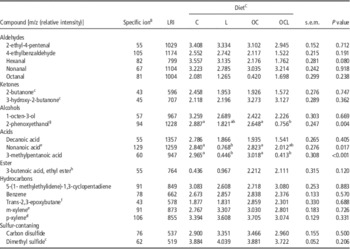
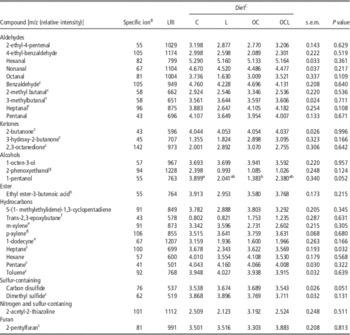
There were 20 volatile compounds identified in the raw meat samples (Table 1) and 30 volatile compounds were detected in the cooked meat samples (Table 2). The VOCs were grouped according to their chemical families: five aldehydes, two ketones, five hydrocarbons, two alcohols, three fatty acids, one ester, and two sulfur-containing compounds in the raw meat, and 10 aldehydes, three ketones, nine hydrocarbons, three alcohols, one ester, two sulfur-containing, one furan, and one sulfur-and-nitrogen compound in the cooked meat. Most of the VOCs in raw meat have previously been reported in lamb meat (Vasta et al., Reference Vasta, Jerónimo, Brogna, Dentinho, Biondi, Santos-Silva, Priolo and Bessa2010), heifer muscle (Vasta et al., Reference Vasta, Luciano, Dimauro, Röhrle, Priolo, Monahan and Moloney2011), and turkey thigh (Ahn et al., Reference Ahn, Jo and Olson1999). The chemical families of VOCs that were found in the cooked meat were similar to those identified in cooked meat from lambs fed diets containing different fat sources (Elmore et al., Reference Elmore, Mottram, Enser and Wood2000). Since most of the VOCs detected in meat in the current study were derived from the oxidation of fatty acids, we correlated the VOC profile of meat with the published data on the fatty acid composition (Mele et al., Reference Mele, Serra, Pauselli, Luciano, Lanza, Pennisi, Conte, Taticchi, Esposto and Morbidini2014) and tocopherol content (Luciano et al., Reference Luciano, Pauselli, Servili, Mourvaki, Serra, Monahan, Lanza, Priolo, Zinnai and Mele2013) which were measured in the same muscle samples.
Volatile organic compounds detected in the raw longissimus dorsi muscle from lambs fed with diets containing olive cake and linseedFootnote A

LRI=linear retention index.
a,bMeans with different letters within the same row are statistically different (P<0.05); Mass spectrum identified using Mainlib/NIST/Wiley 7 Mass Spectral Database; LRI in agreement with Kondjoyan and Berdagué (Reference Kondjoyan and Berdagué1996) and NIST Mass Spec Data Center (2011); LRI: in agreement with linear retention index, obtained with DB5 column; cVasta et al. (Reference Vasta, Ratel and Engel2007); dVasta et al. (Reference Vasta, Luciano, Dimauro, Röhrle, Priolo, Monahan and Moloney2011); LRI: in agreement with linear retention index obtained with other column; eOV-101; fmethyl silicon; gBPX-5; hSE-30.
A Values (log10 specific ion peak area units) are means of eight lambs per dietary treatment.
B MS mass fragment of which area was integrated.
C The dietary treatments were: a barley- and oat-based concentrate with a low level of lipids and a high content of non-structural carbohydrate (diet C); concentrate containing 20% on a dry matter basis (DM) of linseed (diet L); a concentrate containing 35% DM olive cake (diet OC); a diet containing a mixture of linseed (10% DM) and olive cake (17% on DM; diet OCL).
Volatile organic compounds detected in the cooked longissimus dorsi muscle from lambs fed with diets containing olive cake and linseedFootnote A

LRI=linear retention index.
a,bMeans with different letters within the same row are statistically different (P<0.05); Mass spectrum identified using Mainlib/NIST/Wiley 7 Mass Spectral Database; LRI in agreement with Kondjoyan and Berdagué (1996) and NIST Mass Spec Data Center (2011); LRI: in agreement with linear retention index, obtained with DB5 column: cVasta et al. (2007); dVasta et al. (2011); LRI: in agreement with linear retention index obtained with other column; eOV-101; fmethyl silicon; gBPX-5; hSE-30.
A Values (log10 specific ion peak area units) are means of eight lambs per dietary treatment.
B MS mass fragment of which area was integrated.
C The dietary treatments were: a barley- and oat-based concentrate with a low level of lipids and a high content of non-structural carbohydrate (diet C); concentrate containing 20% on a dry matter basis (DM) of linseed (diet L); a concentrate containing 35% DM olive cake (diet OC); a diet containing a mixture of linseed (10% DM) and olive cake (17% on DM; diet OCL).
The dietary treatment did not affect the concentration of aldehydes in either raw or cooked meat. Aldehydes are mainly produced from the oxidation of lipids (Vasta et al., Reference Vasta, Luciano, Dimauro, Röhrle, Priolo, Monahan and Moloney2011), and high amount of aldehydes can be associated with great PUFA oxidation in animal fats (Elmore et al., Reference Elmore, Cooper, Enser, Mottram, Sinclair, Wilkinson and Wood2005; Vasta et al., Reference Vasta, Ventura, Luciano, Andronico, Pagano, Scerra, Biondi, Avondo and Priolo2012). Overall, the aldehydes concentration in the raw meat was lower than in the cooked meat, which is in agreement with the positive relation between volatile concentration and extraction temperature observed by Ahn et al. (Reference Ahn, Jo and Olson1999). In raw meat, the total aldehyde concentration (the sum of the aldehydes detected) was not correlated with the PUFA concentration in the muscle but was positively correlated with some MUFA, such as C14:1 trans-9 (0.353, P=0.047) and C16:1 trans-10 (0.422, P=0.016). Conversely, in cooked meat, aldehydes concentration showed a positive correlation with the concentration of PUFA in the muscle, such as C18:3 cis-6 cis-9 cis-12 (0.385, P=0.030), C22:5 cis-4 cis-7 cis-10 cis-13 cis-16 (0.463, P=0.008), and in tendency with C22:4 cis-7 cis-10 cis-13 cis-16 (0.330, P=0.065). This is consistent with the fact that, generally, cooking represents a stress for meat, which increases the susceptibility of PUFA to lipid peroxidation as compared with raw meat (Nieto et al., Reference Nieto, Estrada, Jordán, Garrido and Bañón2011). Indeed, elevated cooking temperatures increase the rate of chemical reactions (Ahn et al., Reference Ahn, Jo and Olson1999). Moreover, during cooking, endogenous antioxidant defences of muscle are inactivated and the iron-containing meat proteins such as myoglobin and haemoglobin are denatured, releasing free iron, a major oxidative catalyst in meat systems (Campo et al., Reference Campo, Nute, Wood, Elmore, Mottram and Enser2003), which then enhances the interaction between the oxidants and the unsaturated fatty acid substrates (Nieto et al., Reference Nieto, Estrada, Jordán, Garrido and Bañón2011). Regarding the individual aldehydes, hexanal showed a tendency to be affected by the dietary treatment (P=0.097), being lower in raw meat from lambs fed OCL diet when compared with the C diet. Hexanal and other aldehydes such as pentanal could be derived from the oxidation of linoleic acid (C18:2 n-6; Elmore et al., Reference Elmore, Cooper, Enser, Mottram, Sinclair, Wilkinson and Wood2005). However, Mele et al. (Reference Mele, Serra, Pauselli, Luciano, Lanza, Pennisi, Conte, Taticchi, Esposto and Morbidini2014) found no effect of the dietary treatment on the concentration of linoleic acid in the intramuscular fat from the same animals used here, and no significant correlation was found between these aldehydes and linoleic acid. Octanal and nonanal were both present in the raw and cooked meat and originate from the oxidation of oleic acid (C18:1 n-9; Meynier et al., Reference Meynier, Genot and Gandemer1998), which is consistent with the fact that, in the present study, the concentration of these aldehydes in cooked meat was positively correlated with that of oleic acid (0.345, P=0.053). Despite the fact that the inclusion of olive cake in the diet increased the muscle concentration of oleic acid (Mele et al., Reference Mele, Serra, Pauselli, Luciano, Lanza, Pennisi, Conte, Taticchi, Esposto and Morbidini2014), these aldehydes were not affected by the dietary treatment. The Strecker aldehydes, 2-methylbutanal and 3-methylbutanal were identified in the cooked meat and are generally associated with grilled lamb meat aroma profile (Elmore et al., Reference Elmore, Cooper, Enser, Mottram, Sinclair, Wilkinson and Wood2005). Benzaldehyde was also detected in cooked meat and it has been reported to be derived from linolenic acid (C18:3 n-3) degradation (Nuernberg et al., Reference Nuernberg, Fischer, Nuernberg, Kuechenmeister, Klosowska, Eliminowska-Wenda, Fiedler and Ender2005). Linolenic acid was found at higher concentrations in meat from lamb fed linseed-containing diets, L and OCL, in comparison with the other treatments (Mele et al., Reference Mele, Serra, Pauselli, Luciano, Lanza, Pennisi, Conte, Taticchi, Esposto and Morbidini2014). However, in the current study, none of the volatile compounds that typically originate from linolenic acid degradation were found to be significantly affected by the diets. On one hand, it should be considered that individual PUFAs readily form free radicals, which is the initial step in the oxidative degradation of fatty acids, but once the free radicals are formed the subsequent steps in the reaction become more independent of the nature of the fatty acids (Elmore et al., Reference Elmore, Mottram, Enser and Wood1997 and Reference Elmore, Mottram, Enser and Wood1999). This could partly explain why, in the present study, despite the differences in the fatty acid composition of the muscle, only slight correlations were found between these lipid oxidation-derived VOCs and the individual fatty acids. Furthermore, it should be stressed that, besides the susceptibility of PUFA to oxidation (Elmore et al.,Reference Elmore, Mottram, Enser and Wood1997; Luciano et al., Reference Luciano, Monahan, Vasta, Pennisi, Bella and Priolo2009), the oxidative stability of meat ultimately depends on the balance between the oxidizable substrates and the antioxidants (Luciano et al., Reference Luciano, Monahan, Vasta, Pennisi, Bella and Priolo2009 and Reference Luciano, Pauselli, Servili, Mourvaki, Serra, Monahan, Lanza, Priolo, Zinnai and Mele2013). In this trial the increased unsaturation degree of meat lipids did not probably cause extensive lipid oxidation, which could be due to the presence of antioxidants in the feeds, specifically in olive cake (Luciano et al., Reference Luciano, Pauselli, Servili, Mourvaki, Serra, Monahan, Lanza, Priolo, Zinnai and Mele2013). This is consistent with the fact that the total aldehydes in raw meat was negatively correlated with the tocopherol concentration in the muscle (−0.348, P=0.05), which may be an indication that the tocopherol reduced the rate of aldehyde-producing lipid oxidation process.
The 2-butanone and 3-hydroxy-2-butanone (acetoin) were the ketones detected in both the raw and cooked meat. None of the ketone was significantly affected by the dietary treatment; however in cooked meat the concentration of ketones was positively correlated with C18:3 cis-9 trans-12 cis-15 (0.365, P=0.040) and C18:3 trans-9 trans-12 cis-15 (0.359, P=0.043). Some studies showed a relationship between 3-hydroxy-2-butanone and fat-enriched diets (Elmore et al., Reference Elmore, Mottram, Enser and Wood2000 and Reference Elmore, Cooper, Enser, Mottram, Sinclair, Wilkinson and Wood2005), while other authors reported no relationship (Vasta et al., Reference Vasta, Jerónimo, Brogna, Dentinho, Biondi, Santos-Silva, Priolo and Bessa2010). This variation of the findings could be due to the different cooking and extraction conditions, particularly the temperature that has an impact on the volatile profile in the samples being analysed (Vasta et al., Reference Vasta, Jerónimo, Brogna, Dentinho, Biondi, Santos-Silva, Priolo and Bessa2010). The 2,3-octanedione, which has been suggested to originate from n-6 fatty acids oxidation (Meynier et al., Reference Meynier, Genot and Gandemer1998), was detected in cooked meat only. The concentration of 2,3-octanedione was observed to increase with the increase in extraction temperature, which may indicate that 2,3-octanedione could be derived from heat-induced reactions (Vasta et al., Reference Vasta, Jerónimo, Brogna, Dentinho, Biondi, Santos-Silva, Priolo and Bessa2010). This could explain why in the present study 2,3-octanedione was absent in the raw meat samples.
The n-3 fatty acids are probable precursors of benzene (Elmore et al., Reference Elmore, Cooper, Enser, Mottram, Sinclair, Wilkinson and Wood2005). Nute et al. (Reference Nute, Richardson, Wood, Hughes, Wilkinson, Cooper and Sinclair2007) found that addition of linseed oil into lamb diets increased the benzene concentration in the muscle phospholipids. On the contrary, in the current study, no effect of the dietary treatment was observed with regards to the formation of benzene. The lack of effects in the production of n-3 PUFA-derived volatiles could be explained considering that, although the linseed-supplemented feed contained high amounts of C18:3 n-3, the tocopherols in the diet that were deposited in the lamb tissues (Luciano et al., Reference Luciano, Pauselli, Servili, Mourvaki, Serra, Monahan, Lanza, Priolo, Zinnai and Mele2013) were probably enough to overcome the increased unsaturation in the muscle fatty acids. Similarly, in cooked meat, none of the formed hydrocarbon was significantly influenced by the dietary treatment. The presence of hydrocarbons such as hexane, heptane and pentane in the cooked meat and their absence in the raw meat could be due to the reduced oxidative stability of the cooked samples. In fact a positive correlation was found between hydrocarbons and the fatty acids in the longgissimus dorsi muscle such as C18:1 cis-9 (0.375, P=0.034), C18:3 cis-6, cis-9, cis-12 (0.357, P=0.045), C20:3 cis-8 cis-11 cis-14 (0.352, P=0.048), and C22:5 cis-4 cis-7 cis-10 cis-13 cis-16 (0.503, P=0.003) and C22:4 cis-7, cis-10, cis-13, cis-16 (0.348, P=0.05), but not in raw meat.
Regarding the alcohols, both 2-phenoxyethanol and 1-octen-3-ol were detected in raw and cooked meat. In the raw meat, the 2-phenoxyethanol was found to be significantly affected by the dietary treatments, where OCL meat had significantly lower concentration than either C (P=0.006) and OC (P=0.015) meats. The 2-phenoxyethanol has been reported in cooked Irish organic and conventional beef meats (Machiels et al., Reference Machiels, van Ruth, Posthumus and Istasse2003), and 1-octen-3-ol is frequently reported among the lipid oxidation-derived VOCs in meat and meat products. The 1-pentanol was present only in cooked meat and was significantly affected by the dietary treatment, being higher in C meat in comparison with OC meat (P=0.038). This compound was previously reported in cooked lamb meat (Elmore et al., Reference Elmore, Mottram, Enser and Wood2000) and cooked beef muscle (Wettasinghe et al., Reference Wettasinghe, Vasanthan, Temelli and Swallow2001), and could be derived from the reduction of pentanal, which is an oxidation product of linoleic acid (C18:2 n-6). This is consistent with the results of the compositional analysis of the feeds used in this study in which the linoleic acid content of C diet was more than double when compared with OC diet (Mele et al., Reference Mele, Serra, Pauselli, Luciano, Lanza, Pennisi, Conte, Taticchi, Esposto and Morbidini2014). Even so, no significant differences were found in the levels of volatiles, which may be due to the protective effect of the antioxidants derived from the feeds. Indeed, the concentration of volatile alcohols in cooked meat tended to be negatively correlated with the tocopherol concentration in the muscle (−0.328, P=0.067).
In the raw meat, 3-methylpentanoic acid and nonanoic acid were significantly affected by the dietary treatment, while in the cooked meat, no acids were detected. The concentration of 3-methylpentanoic acid was lower in treatments L and OCL as compared with treatment C (P=0.002 and P=0.001, respectively). Similarly, treatments L and OCL resulted in lower concentrations of 3-methylpentanoic acid compared with treatment OC (P=0.001). On the other hand, the concentration of nonanoic acid in treatment L was lower than in both treatments C (P=0.026) and OC (P=0.027) and was comparable with treatment OCL. The branched chain fatty acids are, in general, responsible for the flavour of goat and sheep meat (Vasta and Priolo, Reference Vasta and Priolo2006) and were found to be significantly higher in intramuscular fat from lambs in the C group (Mele et al., Reference Mele, Serra, Pauselli, Luciano, Lanza, Pennisi, Conte, Taticchi, Esposto and Morbidini2014). The 3-methylpentanoic acid is one among the many volatile compounds found in sheep tissues fed either fresh grass or concentrates (Young et al., Reference Young, Berdagué, Viallon, Rousset-Akrim and Theriez1997). Nonanoic acid was identified in the LM muscle of lambs fed different diets (Vasta et al., Reference Vasta, Jerónimo, Brogna, Dentinho, Biondi, Santos-Silva, Priolo and Bessa2010). The dietary carbohydrates are fermented in the rumen producing propionate, which in excessive quantities is used in the synthesis of odd-chain fatty acids in the adipose tissue (Priolo et al., Reference Priolo, Micol and Agabriel2001). Branched and odd chain fatty acids may also be produced directly in the rumen by microorganisms, starting from branched amino acids and propionate, respectively (Mele et al., Reference Mele, Buccioni, Serra, Antongiovanni and Secchiari2008). The lower levels of 3-methylpentanoic acid and nonanoic acid in meat from lambs fed the linseed-containing diets could be a consequence of the changes in the rumen microorganism metabolism. Previous studies, indeed, reported that linseed supplementation in the diet of dairy ewes may induce a decrease in the content of odd and branched chain fatty acids in milk (Mele et al., Reference Mele, Contarini, Cercaci, Serra, Buccioni, Povolo, Conte, Funaro, Banni, Lercker and Secchiari2011).
The 3-butenoic acid ethyl ester, carbon disulfide and dimethyl sulfide were unaffected by the dietary treatment. Similarly, 2-acetyl-2-thiazoline and 2-pentylfuran, which were both detected in the cooked meat only, were not affected by the dietary treatment. According to Wettasinghe et al. (Reference Wettasinghe, Vasanthan, Temelli and Swallow2001), the 3-butenoic acid ethyl ester, which was detected in the meat in the current study, may have little impact in the meat aroma. The carbon disulfide and dimethyl sulfide, on the other hand, are important intermediates of Maillard reaction in the formation of heterocyclic compounds (Mottram and Mottram, Reference Mottram and Mottram2002). The 2-acetyl-2-thiazoline is considered to be a potent odorant in cooked meat patties (Kerler and Grosch, Reference Kerler and Grosch1996), and the presence of this compound confirms the occurrence of the reaction between lipid degradation and Maillard reaction products during cooking (Elmore et al., Reference Elmore, Mottram, Enser and Wood1997). The 2-pentylfuran could be derived from the oxidation of C18:2 n-6 and other n-6 fatty acids (Elmore et al., Reference Elmore, Cooper, Enser, Mottram, Sinclair, Wilkinson and Wood2005). However, no correlation between 2-pentylfuran and any of the n-6 fatty acids was observed. The mild cooking and extraction temperature used here could explain why, unlike other studies, only one furan was detected in this study and the lack of evidence between the occurrence of these compounds and their precursors.
Conclusions
In spite of the strong effect of the dietary treatment on the intramuscular fatty acid composition and on the oxidative stability of the meat, the supplementation of lamb diets with linseed and olive cake, in combination or not, had minimal impact on the production of volatile compounds derived from lipid oxidation both in the raw and cooked lamb meat, except for the branched and odd chain fatty acids and alcohol. The higher concentration of volatile compounds in cooked meat indicated that cooking induced the formation of volatile compounds in meat, most of which derive from fatty acid oxidation. On the basis of the volatile compounds profile, it can be concluded the feeding lambs with diets including high proportions of olive cake and linseed in replacement of the conventional ingredients did not produce appreciable changes in the appearance of VOCs in lamb meat. Sensory evaluation of meat would be certainly of interest to explore in depth the effect of these diets upon meat sensory properties.
Acknowledgements
The study was funded by the University of Pisa under the research project: Progetto di Ricerca di Ateneo ‘Improvement of nutritional and dietetic properties of beef and lamb meat: an interdisciplinary approach’.
The first author is a PhD candidate of the Erasmus Mundus Joint Doctorate (EMJD) in Agricultural Transformation by Innovation (AgTraIn) funded by the European Commission.