




No CrossRef data available.
Does expectant mothers' unresolved trauma predict frightened/frightening maternal behavior? Risk and protective factors
Published online by Cambridge University Press: 28 March 2006
Abstract
This prospective, longitudinal study explored the relationship between mothers unresolved/disorganized (U/d) attachment status and frightened/frightening (FR) maternal behavior and investigated possible variations due to whether mothers were U/d for loss versus abuse. The role of other factors that might predict maternal FR behavior was also examined. Pregnant women (n = 116) were administered the Adult Attachment Interview and later observed at home for 30–40 min interacting with their first-born 8-month-olds. Women classified as U/d with respect to loss and/or abuse displayed substantially higher levels of FR behavior with their infants than did mothers who were not classified as U/d (i.e., secure/autonomous, dismissing, or preoccupied), but these groups did not differ on maternal sensitivity. Mothers classified as U/d who had a secondary secure/autonomous classification also showed FR behavior but at low levels than U/d-insecure mothers. Independent of U/d status, mothers who had lost a parent, versus those who did not, more often displayed FR behavior with their infants. Finally, U/d loss fully mediated the association between loss of an attachment figure other than the parent and FR behavior, and partially mediated the relationship between loss of a parent and FR behavior.
This research was supported by the National Science Foundation and the Hogg Foundation for Mental Health. We are grateful to the mothers and infants for investing time and energy in this project. We also appreciate the thoughtful comments provided by the three reviewers.
Information
- Type
- SPECIAL SECTION ARTICLE
- Information
- Copyright
- 2006 Cambridge University Press
An impressive array of longitudinal studies has documented the intergenerational transmission of child abuse. Mothers' accounts of having experienced sexual or physical maltreatment during childhood have been associated with maltreatment of their own children and with unresponsive, hostile, and intrusive behavior with their infants (Egeland, Jacobvitz, & Sroufe, 1988; Lyons-Ruth & Block, 1996). Bowlby (1969) proposed experiences in addition to physical and sexual abuse as likely traumatic and to compromise a child's development, including the death of an attachment figure, threats of abandonment, and witnessing abuse of other family members. Bowlby (1980) further suggested that the circumstances surrounding loss, including the child's age when the loss occurred and the child's relationship to the person lost, will contribute to the effects of losses on children. When parents have experienced such traumatic events in their own childhood, their fears stemming from the unresolved trauma, not simply the occurrence of the experiences themselves, are thought to interfere directly with their caregiving (Ainsworth & Eichberg, 1991; Hesse & Main, 2000; Main & Hesse, 1990). When the still-traumatized parent responds to memories or ideas surrounding trauma, it has been proposed that the parent may temporarily become frightened and spontaneously behave in ways that frighten their infants. Hence, the present study sought to examine empirically whether mothers who are unresolved/disorganized (U/d) with respect to loss or abuse are more likely than other mothers to engage in frightening behavior with their infants, and to investigate possible variations in caregiving associated with mothers classified as U/d for loss versus abuse. In addition, this study examined the role of risk factors surrounding the loss or trauma that might predict maternal FR behavior above and beyond U/d attachment status.
Unresolved Trauma and Frightening Caregiving
When a person experiences the death of a parent or other significant individual, a period of mourning normally follows. Bowlby (1980) identified several responses related to loss and typical mourning, including angry feelings directed at oneself, others, and the person that died; denial that the person has died; and an unconscious desire to locate the person that has died as if he were instead lost. The final stage of mourning occurs when feelings about the loss are resolved, allowing the person to accept the loss as permanent and to realize that life must continue by means of restructuring their lives without the person that has died. Adults who have difficulty resolving the loss of an important person are thought to be caught in the search process; they have trouble accepting the person has died and reorganizing their lives accordingly. Similarly, the experience of maltreatment may need to be resolved through a mourning process focusing on resolving issues related to not having a supportive, caring, and dependable parent.
Drawing on Bowlby's ideas about the process of resolving trauma, a method was developed to assess mental disorganization in mothers during discussions of loss and abuse, termed U/d states of mind (see Main, Goldwyn, & Hesse, 1984–2003). Individuals are administered the Adult Attachment Interview (AAI), which is a structured 1-hr interview in which subjects are asked to describe and evaluate a number of attachment-related experiences, including loss of attachment figures through death and any threatening experiences, such as abuse. Speakers are considered to be U/d with respect to loss, abuse, or both if they show what Main and Hesse have come to call lapses in the monitoring of reasoning and/or lapses in the monitoring of discourse during discussions of potentially traumatic experiences, such as death of significant persons, physical maltreatment, and/or sexual abuse. Such lapses may occur, for example, because the parent is still searching for the lost person, or denying the person is dead. Lapses in the monitoring of reasoning include indications of incompatible beliefs, such as the belief the person who died many years ago is still alive (in a physical, not religious, sense), as shown, for example, by discussing the deceased person in the present tense. Lapses in the monitoring of discourse include sudden alterations in the person's manner of speaking and sudden attention to extreme details surrounding the trauma that is inappropriate to the discourse context of the AAI.
Main and Hesse (1990) have suggested that parents who have not resolved trauma are expected to appear inexplicably frightened in their infants' presence, in response to aspects of the environment that they have perhaps unconsciously associated with a traumatic experience, and that an inexplicably frightened parent, like a directly frightening and maltreating parent, will inevitably be frightening to the infant. To examine parents' frightening behavior, Main and Hesse (1995) developed a frightening (FR) coding system, comprising frightened, threatening, and dissociative behaviors that a parent who is thought to be traumatized might display during interactions with the infant. FR parental behaviors are generally subtle and often brief (10–30 s), and appear to be unmonitored and inexplicable with respect to the surrounding environment. FR parental behavior is thought to stem from the fact that a parent has not resolved and remains frightened by feelings and thoughts associated with traumatic experiences, that is, not simply from having experienced the trauma itself. Therefore, it is hypothesized that the association between early trauma and FR behavior should be mediated by mothers' U/d status.
To examine the discriminant validity of FR maternal behavior, the association between FR behavior and maternal sensitivity will be explored. It is anticipated that mothers who experience U/d fear stemming from trauma will display FR behavior with their infants; they are not necessarily expected to engage in generally insensitive patterns of care. Ainsworth's ratings of maternal insensitivity are based on patterns of care evident throughout a mother's interaction with her infant, including rejecting the child's bids for comfort (e.g., ignoring the baby's cries, criticizing the baby); interfering with the baby ongoing mood, needs or interests (e.g., grabbing toys from the baby, trying to force the baby look at the mother even though the baby has turned his or her head away); and neglect. In contrast, FR maternal behavior appears suddenly and out of context. It is, in other words, a disruption in patterned caregiving. Mothers scoring high on the FR system can be sensitive and immediately responsive to the baby's signals, and yet engage in bouts of FR behavior, for example, entering into a trancelike state (staring ahead with a blank facial expression, eyes open but not blinking for over 30 s) or approaching the baby from behind and placing both hands on the baby's neck and throat. Ratings of FR behavior and insensitive caregiving are expected to overlap only to the extent that some FR behaviors are considered insensitive as defined by Ainsworth. For example, sudden looming behaviors are considered both FR and interfering, and likewise, dissociative states may interfere with a mother's ability to respond appropriately to her baby's signals; thus, they are likely to be positively correlated but the correlation should be fairly low. Mothers' classified as insecure (either dismissing or preoccupied) but not U/d, in contrast, are expected to engage in insensitive caregiving patterns, but not FR behavior, with their infants. Not yet having attained an integrated understanding of their own past, these mothers may ignore their babies' cries, criticize their babies, or interfere with their babies' ongoing mood, needs or interests, for example, shoving a spoon in the baby's mouth even though the baby has turned his or her head away.
Consequences of Frightening Maternal Behavior
Understanding why parents engage in frightening behavior is particularly important because FR behavior has been related conceptually (Main & Hesse, 1990) and empirically to attachment disorganization during infancy (Abrams, Rifkin, & Hesse, 2006; Lyons-Ruth, Bronfman, & Parsons, 1999; Schuengel, van IJzendoorn, & Bakermans-Kranenburg, 1999; True, Pisani, & Oumar, 2001). According to Bowlby's theory of attachment, infants seek comfort from their caregivers when alarmed or under conditions of potential threat, including separation from the caregiver, in unfamiliar situations, when approached by strangers, or when fatigued, ill, or afraid. Main and Hesse (1990; Hesse & Main, 2000) have proposed that infants whose caregivers are alarming are faced with an unresolvable paradox: their caregiver is at once the source of comfort and the source of fear. It is reasoned that the infant then experiences a tendency to seek comfort from the caregiver and a contradictory tendency to flee, resulting in a collapse of behavioral strategies and a display of mistimed, disoriented, conflicted, and other disorganized behaviors. Disorganized attachment, in turn, has been linked to a group of emotional and behavioral problems in later childhood, including controlling behavior with the caregiver (Main & Cassidy, 1988), odd or emotionally disconnected interactions with peers during the preschool years (Jacobvitz & Hazen, 1999), aggression toward peers (Lyons-Ruth, Easterbrooks, & Cibelli, 1997), internalizing behaviors during middle childhood, and symptoms of dissociation as reported independently by teachers and by the adolescents themselves at ages 17.5 and 19 (Carlson, 1998; see Lyons-Ruth & Jacobvitz, 1999, and van IJzendoorn, Schuengel, & Bakermans-Kranenburg, 1999, for reviews). Thus, identifying antecedents of FR behavior has vital implications for both attachment theory and clinical intervention.
Risk and Protective Factors
Because not all mothers who report having been abused themselves repeat the maltreatment with their own children (Egeland et al., 1988; Kaufman & Zigler, 1987), the present study also examines the conditions under which mothers who have experienced loss or abuse do not engage in FR behavior. It is possible for adults to undergo a brief lapse in the monitoring of reasoning or discourse during discussions of loss or abuse, but nonetheless be clear and coherent during the rest of the interview. These parents can openly and freely discuss their relationships with their parents during childhood, including experiences of parental rejection or abuse, and indicate that they value attachment relationships. They are thus classified as U/d, but also assigned a best-fitting alternate classification of secure/autonomous. A secure/autonomous state of mind with respect to attachment is thought to provide parents with flexibility of thought and an ability to regulate their emotions, allowing them to respond with sensitivity and empathy to their infants' distress (Bretherton, 1991). According to a recent meta-analysis of 10 studies (n = 389; van IJzendoorn, 1995), secure/autonomous mothers are more likely to respond sensitively to their infants, in contrast to mothers classified as insecure (dismissing or preoccupied). Dismissing mothers tend to minimize the importance of negative early experiences and/or idealize their parents, whereas mothers whose AAI text is judged preoccupied appear to remain caught up in their childhood experiences as is evidenced by an inability to “step back” and take a balanced overview of their past. Thus, it is possible that a secondary secure/autonomous classification on the AAI could reduce the likelihood that U/d mothers would engage in FR behavior. Specifically, mothers classified as U/d and insecure are expected to display the highest levels of FR behavior, followed by those who are U/d and secure/autonomous, with mothers who are not U/d showing the lowest levels of FR behavior.
Only one study has addressed this issue by investigating the caregiving behaviors among mothers who were and were not U/d with respect to loss (Schuengel et al., 1999). In this pioneering study in which differences between U/secure and U/insecure mothers were first discovered, mothers with U/d loss were more likely to show FR behavior, but only if they were given an insecure alternate classification. Contrary to expectations, mothers who were U/d-secure showed lower levels of frightening behavior than mothers who were not U/d. In Schuengel and colleagues' (1999) study, naturalistic observations of mother–infant interactions were conducted in the home, so that mothers were free to engage in any type of interaction they chose. Under these conditions of low stress, it may be that the U/d-secure mothers do not engage in frightening behaviors. Thus, a more stressful interaction context was introduced in the present study to determine whether, under stress, U/d mothers with a secure alternate classification would be more likely to engage in FR behavior than those who are not U/d. Specifically, mothers were required to complete a set of caregiving tasks, including a clothes and diaper change, which generated considerable resistance from the infant. In addition, unlike previous studies involving FR phenomena, the present study administered the AAI to expectant mothers before their baby was born and then observed FR behavior in mothers during interactions with their infants at 8 months. By administering the AAI prenatally, it cannot be argued that having a baby triggered fear in the mother resulting in both an unresolved state of mind and FR maternal behavior.
Just as a secure/autonomous secondary attachment may serve as a protective buffering factor, other factors may increase the likelihood of being unresolved, and of displaying FR behavior. Bowlby (1980) proposed that the early loss of an attachment figure is frightening, maybe even terrifying, to a young child who depends on this person for protection and survival. Therefore, we expected that mothers considered unresolved with respect to loss who lost a parent or attachment figure during childhood would be at the greatest risk for engaging in frightening behavior. Loss of a parent at any age, however, is expected to be particularly difficult to resolve. A person's relationship with primary attachment figures is thought to continue to influence them throughout their lives, even if they later seek little or no emotional and instrumental support from these figures. It is also possible that parents who experienced more frequent and/or severe traumas, such as the deaths of more than one close person, both loss and abuse, or particularly severe abuse, will be at an increased risk for showing frightening behavior with their infants. These factors (e.g., loss of a parent or other attachment figure, mothers' age at the time of the loss and frequent and/or severe trauma) may be related to mothers' difficulty resolving trauma and to mothers' propensity to display frightening behavior with their infants.
Frightening childhood experiences other than loss or abuse may also result in unresolved trauma. Because FR behavior is thought to stem from the trauma-related fear that the parent continues to harbor, it is possible that fear surrounding frightening childhood experiences other than loss and abuse may also be related to FR. To investigate this possibility, a frightening experiences scale was developed for the present study. This scale assesses mothers' accounts of frightening experiences during childhood other than loss or abuse, such as threats of abandonment, rape by a stranger, and parents going into a rage and breaking dishes. Associations between mothers' memories of having experienced these events and their propensity to be U/d on the AAI and to engage in frightening (FR) behavior with their infants can thus be examined.
In sum, the present study investigates whether U/d attachment status predict frightening maternal behavior, whether a secure/autonomous state of mind buffers mothers from the negative effects of U/d attachment status on the quality of care they provide their children, and whether these patterns hold true regardless of whether the mother is U/d for loss or for abuse. In addition, we will examine associations between FR behavior and insensitive caregiving, and the extent to which mothers' adult attachment status, U/d versus insecure but not U/d, discriminates these two patterns of care. We will also investigate the extent to which risk factors surrounding loss and abuse and other frightening childhood experiences predict FR behavior independent of unresolved trauma. Circumstances surrounding the loss or abuse include the adult's relationship to the person lost (parent, other attachment figure, or person uninvolved in caregiving), the age of the adult at the time of the loss or abuse, the severity of abuse, and the extent to which the parent recalled other frightening events, such as threatened abandonment, witnessing domestic violence, or a parent hospitalized for mental illness, among others. Finally, we will examine whether mothers' U/d state of mind mediates the relationship between the risk factors surrounding trauma and FR behavior.
Method
Subjects
As part of a longitudinal study following couples over the transition to first-time parenthood (Jacobvitz, Hazen, Curran, & Hitchens, 2004; Riggs & Jacobvitz, 2002), 116 mothers and their first-born 8-month-olds participated in this study. Couples were recruited during the wives' third trimester of pregnancy from birthing classes, public service radio announcements, newspaper press releases, and flyers distributed at maternity stores within the greater Austin area. To ensure a representative sample, couples were recruited from birthing classes at hospitals serving indigent populations as well as those serving middle class families. Moreover, about half the sample was recruited from small classes in rural areas that were not associated with a hospital. Finally, 15% of the sample responded to public service announcements advertising that participants would be paid for their participation.
In the original sample (n = 125) mothers ranged in age from 16 to 41 years (M = 29), most of the mothers were married (91%), most were Caucasian (82%), and the rest were Hispanic (7%), African American (2%), or Native American, Middle Eastern, or Indian (8%). The median family income was $30,000–$45,000. Income level varied widely with 9% reporting family earnings at the poverty level and 17% just above poverty. In contrast, 23% reported earning above $60,000. Sixty percent reported earning a Bachelor's or graduate degree and another 30% reported some college or trade/business school coursework.
Between the prenatal visit and the 8-month visit, 4 of the 125 mothers dropped out of the study. Of these 4 mothers, 2 moved away from the area, 1 mother could not be located, and 1 declined to participate further. In addition, five audiotapes from the prenatal visit were inaudible. The subjects for whom data were missing (n = 9) did not differ demographically from the original 125 families in the study. In return for their participation in the study, each family received a $50 savings bond for their child at the completion of each of the three phases of data collection (for a total of $150 in savings bonds), bimonthly project newsletters, a T-shirt for their infant, and an audiotape of lullabies. At the end of the study parents were sent copies of the videotaped interactions with their child.
Procedure
During the course of the study, families participated in seven sessions of data collection, beginning when mothers were in their third trimester of pregnancy and ending when the target children were 24 months old. Data for the present study were collected when the mother was pregnant and again when the baby was 8 months old. During the prenatal session, mothers were administered the AAI (George, Kaplan, & Main, 1984/1985/1996). When the infant was 8 months old, mothers were videotaped at home playing with their infants, feeding them, and changing their clothes.
Assessment instruments
Adult attachment
During their third trimester of pregnancy, participants' memories of their relationships with their own mothers and fathers during childhood were assessed using the AAI (George et al., 1984/1985/1996). The AAI is a structured 1-hr interview in which subjects are asked to describe and evaluate a number of attachment-related experiences, including loss of attachment figures through death and any threatening experiences, such as abuse. Several trained faculty members and graduate students conducted the AAI. Questions were memorized so that interviewers could use a relaxed conversational style. Prior to beginning the interview, all subjects were informed that the questions would be about their relationships with parents and memories of childhood, and an effort was made to establish rapport and to answer any questions. Interviews lasted from 60 to 90 min, and the protocol utilized frequent probes to increase the specificity of subjects' responses and to facilitate the recall of memories related to attachment.
Interview transcripts from the prenatal visit were scored using the AAI Classification System (Main et al., 1984–2003). Interviews were coded on two 9-point scales, “Unresolved with respect to loss” and “Unresolved with respect to trauma.” Indicators of U loss are lapses in the monitoring of reasoning (e.g., disbelief that lost person is dead), lapses in the monitoring of discourse (e.g., extremely detailed description of events surrounding the death or eulogistic speech), or an extreme behavioral response to the loss (e.g., hospitalization for depression following death of a close person without evidence of recovering from the grief). Indicators of Unresolved trauma included unsuccessful denial of the occurrence of abuse, feelings of being causal in the abuse or deserving of it, psychologically confused statements, and fears of being mentally possessed by the abuser. Women assigned scores above 5 on the “Unresolved with respect to loss” scale and/or above 5 on the “Unresolved with respect to trauma” scale were placed in the U/d group. Trained coders decided whether women assigned a score of 5 on the Unresolved loss or Unresolved abuse scales were placed in the U/d group.
Women were also classified as secure/autonomous, or as one of three insecure categories: preoccupied, dismissing, or cannot classify. The hallmark of a secure/autonomous state of mind with respect to attachment is the ability to describe childhood relationship experiences in a clear, believable, and truthful manner regardless of whether these experiences were positive or negative. Women were judged preoccupied when they provided contradictory accounts of the same experiences, had difficulty keeping track of the discourse topic, or showed involving anger toward one or both parents. Women were judged dismissing when they tended to insist that they had a lack of memory for childhood experiences, idealized one or both parents, minimized traumatic experiences, and/or derogated their relationship with their parents. For example, when asked about the way her parents responded when she fell off a ladder and hurt her knee, there was no indication the subject was comforted. Instead, the subject defended her mother, noting her mother did not baby her and that “it helped her to take better care of herself.” Finally, adults were placed into a cannot classify group when they could not settle on a consistent strategy for describing their relationship with their parents during childhood, showing a mix of secure/autonomous, dismissing, and/or preoccupied strategies. Thus, these transcripts are considered unclassifiable not because of errors in transcription or administering of the AAI, but rather because individuals show a global breakdown in finding a strategy for describing their relationship with their parents during childhood (Hesse, 1996).
Two trained coders independently rated 50% of the AAIs (n = 60). A third trained coder resolved disagreements. All coders were trained by the authors and achieved high interrater reliability on 30 transcripts with Main and Hesse. Exact agreement on the five-way classification (secure/autonomous, dismissing, preoccupied, U/d with respect to loss or trauma, and cannot classify but not U/d) was 78% (k = .83). When placing U/d and cannot classify mothers into their best-fitting primary classification, the percent agreement rose to 85% (k = .86). In addition, because unresolved loss and abuse indices can be brief and more difficult to detect, two trained and certified coders independently rated 100% of the transcripts on the 9-point unresolved loss and unresolved abuse scales. The intraclass correlation between the two raters was α = .86 for unresolved loss and α = .93 for unresolved abuse.
With respect to attrition, of the four mothers who dropped from the study between the prenatal to 8-month period, one was classified as secure/autonomous, two were classified as dismissing, and one was classified as preoccupied. None of the mothers in the U/d and cannot classify groups dropped from the study.
The reliability and validity of the AAI have been demonstrated in several studies. In a sample of 90 English mothers, Fonagy, Steele, and Steele (1991) obtained a test–retest reliability rate of 80% when the AAI was administered on two occasions that were 6 months apart. Discriminant validity has been demonstrated by a meta-analysis, in which AAI classifications have been found to be independent of verbal and performance IQ, autobiographical memory, social desirability, personality, and narrative style when discussing other topics (van IJzendoorn, 1995).
Mothers' traumatic experiences
Each AAI was coded for the occurrence of abusive and frightening incidents and significant losses at any time during the subject's life, regardless of whether the subject was classified as U/d. The age at which abuse, frightening experiences, and losses occurred, as well as the relationship of deceased persons to the subject and whether or not they were close to the subject, were also determined from the AAIs.
Loss experiences
For each loss experience, the relationship of the deceased person to the subject (i.e., whether the person who died was the subject's mother, father, stepparent, grandparent, other relative, spouse/partner, friend, sibling, or other) was recorded. The deceased person was considered to have been an attachment figure if any of the following conditions were met: the subject named the person as a parent figure or went to the person for support, the person was a stepparent and lived with the subject for 2 years or more prior to age 16, or the person was a close grandparent or relative with whom the subject had regular contact. Subjects were coded according to whether or not they experienced the following: (a) loss of parent, (b) loss of a nonparental attachment figure, (c) loss of other persons, and (d) no loss. These groups were not mutually exclusive because an individual could have lost both a parent and a nonparental attachment figure. The age at which each loss occurred was also recorded. Losses that occurred prior to age 16 were considered to be losses that occurred at a young age.
Abuse experiences
The severity of the maltreatment that mothers experienced was determined by coding the AAI on a 7-point severity of abuse scale (Leon, Jacobvitz, & Hazen, 2004). Subjects were assigned a score of 1 for no abuse and low scores (2–3) if the subject described occasional spankings, frequent, but not harsh spankings, or possible sexual abuse that may or may not have actually occurred. Middle to higher scores (4–5) were assigned for harsh physical contact, such as spanking, that does not meet criteria for abuse described in the AAI coding manual, or the subject reported hearing about being beaten during childhood from others, but the subject only remembers nonabusive spankings or nothing. High scores (6–7) were assigned to subjects who described incidents that clearly met the criteria described in the AAI coding manual (Main et al., 1984/2003) for physical or sexual abuse. Examples of these criteria include: physical contact that leaves a mark, repeated hitting of the child in the face, memories of being so severely hit by the parent that the child was very frightened or in pain afterward, and any sexual contact between the parent and child. All maltreatment incidents were rated regardless of the age of the participant when they occurred. Two coders independently rated each interview on the severity of abuse scale. The intraclass correlation for their ratings was .83.
Frightening experiences
A global 7-point scale for assessing the extent of fear-inducing experiences was created for the present study (Leon, 2004). Again, all frightening experiences were rated regardless of the age of the participant when they occurred. Scores were assigned in the same manner as described above for the abuse scale. Five types of incidents are included in the frightening experiences scale: threats of abandonment and frightening separations from parents, witnessing abuse of a parent or sibling, potentially harmful or frightening experiences not caused by parents, potentially harmful or frightening experiences caused by parents, and other frightening experiences. Subjects who reported no frightening incidents received a score of 1; low scores (2–3) were given for brief hospitalizations; mentioning being afraid of parents, but for no particular reason; and joking threats by parents to send the subject away for bad behavior. A score of 4 was assigned for incidents such as separation from parents due to hospitalization for more than a few days, threats of abandonment when the subject was under age 16, and descriptions of excessive fear of a parent without specific reasons. High scores (5–7) were given for incidents such as parents putting the subject in life-threatening situations, witnessing domestic violence, and hospitalization of a parent for mental illness when the subject was younger than 16. Two coders rated all transcripts and the average of the two ratings was used for this study. The weighted kappa coefficient for the two ratings was .75.
Maternal caregiving
Maternal FR behavior
Mothers were videotaped at home diapering, changing their babies' clothes, and feeding and playing with their 8-month-olds for a total of 30 to 40 min. Mothers were asked to feed and play with their infants and change their infants' clothes as they normally would. Videotapes were rated on a 9-point scale for frightening FR parental behavior using a scale developed by Main and Hesse (1995), with additional examples of FR maternal behavior discovered and added to this coding system. Frightening maternal behaviors include threatening, dissociative, frightened, and role-reversing behavior. Specific examples of threatening behavior include the parent making unpredictable invasions of the infant's space, for example, coming up from behind the infant and moving her hand across the infant's face or throat; baring teeth; making unusual vocalizations, such as haunting voice tone; scary pursuits of the baby; and covering the baby's face with stuffed toys. Examples of dissociative behavior include trancelike states or stilling that lasts over 30 s and witchlike voices. Specific examples of frightened maternal behavior include stiff handling of the baby as if he or she were an inanimate object, suddenly moving her hand away from the baby as if fearful of being hurt, guarded postures, and flinching for no apparent reason when the baby moves. Role-reversing behavior includes deferential or sexualized behavior (e.g., prolonged sensualized touching). Two trained coders blind to the scores on all of the other measures, including maternal sensitivity, independently rated mothers using the FR scale. The second coder rated 50% of the videotapes. A third coder rated videotapes when scores differed by more than 2 points. Scores were averaged across all raters. The intraclass correlation between the original two coders was .68.
Maternal sensitivity
In addition, the videotaped mother–infant interactions were rated on the Infant Caregiving Scales (ICS) developed by Nancy Hazen (1997). The ICS includes 90 items rated on a 7-point scale, which were derived from examples of sensitivity, acceptance, and cooperation described in Ainsworth's global scales (Ainsworth, Blehar, Waters, & Wall, 1978). In the present study, we examined the scale scores for sensitivity to assess the extent to which FR behavior is distinct from sensitive caregiving.
The sensitivity scale assessed the extent to which mothers accurately perceive, interpret, and respond to their infants' signals. Seven expert judges rated each of the 90 items according to the extent to which they were judged to be diagnostic of maternal sensitivity. Seventeen items that judges agreed to be highly diagnostic of maternal sensitivity were used to create this scale. Examples of these items include “Parent responds promptly with tenderness to baby's bids for comfort and affection” and “Parent's responses are finely tuned to the baby's wishes.” At least two trained coders independently rated each videotaped interaction and a third coder rated tapes to resolve disagreements. Ratings were averaged across coders. The intraclass correlation between raters was .84, and the coefficient alpha for the sensitivity scale was .90. Coders who rated the ICS had no knowledge of the FR behavior ratings or of mothers' attachment status.
Results
Data analyses are presented in four sections. The first section presents analyses investigating whether mothers' U/d status forecasts frightening (FR) maternal behavior, and whether the type of unresolved trauma, loss versus abuse, produces a different pattern of findings. In the second section, the extent to which U/d trauma predicts FR behavior specifically or insensitive maternal care more generally was examined. The third section presents analyses examining whether the circumstances surrounding loss or abuse increases the likelihood that mothers will be classified as U/d and engage in FR behavior. The final section presents analyses examining whether mothers' U/d state of mind mediates the relationship between the circumstances surrounding loss and abuse and FR behavior.
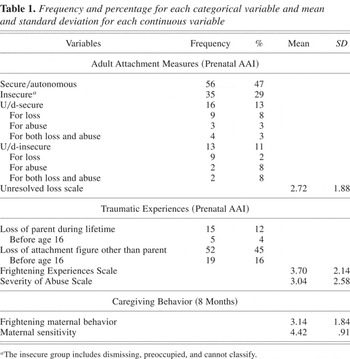
Table 1 presents descriptive statistics concerning the traumatic experiences reported by the women in this study, including the frequencies and percentages who experienced any loss, loss of a parent, and loss of an attachment figure other than a parent, as well as the number who experienced loss of a parent or attachment figure other than a parent before age 16. In addition, Table 1 shows the mean scores for mothers' FR and sensitive behavior.
Frequency and percentage for each categorical variable and mean and standard deviation for each continuous variable

Prediction of maternal FR behavior from AAI classifications
Table 1 also presents the number and percentage of woman classified in each attachment group: secure/autonomous, insecure (including dismissing, preoccupied, and cannot classify), U/d-secure, and U/d-insecure. The number and percentage of women who are U/d for loss, for abuse, and for both loss and abuse, within the U/d-secure and U/d-insecure groups, is also presented, as well as means and standard deviations for maternal FR and sensitive caregiving.
Relation of U/d trauma and FR behavior
It was hypothesized that (a) mothers who are U/d, regardless of their secondary attachment classification, would engage in higher levels of FR behavior than mothers who are not U/d (b) a secure/autonomous secondary classification would buffer U/d mothers from the negative effects on caregiving of being unresolved; that is, U/d-insecure mothers would engage in higher levels of FR caregiving than U/d-secure mothers; and (c) secure/autonomous and insecure mothers would not differ in FR behavior. Three planned orthogonal comparisons were conducted to test these hypotheses: (a) U/d (combining the U/d-secure and U/d-insecure groups, n = 29) versus not-U/d (combining the insecure and secure/autonomous groups, n = 87); (b) U/d-secure (n = 16) versus U/d-insecure (n = 13); and (c) secure/autonomous (n = 55) versus insecure (n = 32).
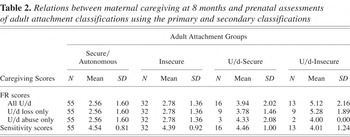
All predictions were confirmed. First, as shown by the means for FR caregiving displayed in Table 2, mothers classified as U/d displayed higher levels of FR behavior compared to mothers who are not U/d, t (112) = 5.11, p < .0001, d = 1.01, one-tailed test. Effect sizes above d = 0.80 are considered strong. The second planned comparison indicated that mothers who were classified as U/d-secure scored lower in FR behavior than U/d-insecure mothers, t (112) = −1.89, p < .05, d = 0.56, one-tailed test. Finally, the planned comparison contrasting secure/autonomous versus insecure (dismissing and preoccupied) mothers indicated no significant differences between these groups, t (112) = −.59, ns.
Relations between maternal caregiving at 8 months and prenatal assessments of adult attachment classifications using the primary and secondary classifications

Relation of U/d loss and FR behavior
We also hypothesized that the U/d classification would predict FR behavior regardless of whether mothers were assigned U/d for abuse or U/d for loss specifically. To examine FR behavior scores for mothers classified as U/d for loss only, the five mothers classified as U/d for abuse and the six mothers classified as U/d for both loss and abuse were deleted from the analyses, and the first two planned comparisons described above (contrasting U/d vs. not-U/d mothers, and contrasting U/d-secure vs. U/d-insecure mothers) were conducted. The first planned comparison revealed that women classified as U/d with respect to loss (n = 18) scored significantly higher on FR behavior than mothers classified as not-U/d (n = 86), t (100) = 4.59, p < .001, d = 1.0, one-tailed test (see Table 2). The second indicated that among mothers who were U/d for loss, U/d-secure mothers (n = 9) engaged in significantly lower levels of frightening (FR) behavior than did mothers classified as U/d-insecure (n = 9), t (100) = −2.14, p < .05, d = 0.90, one-tailed test (see Table 2), indicating that a secondary secure/autonomous attachment did reduce the negative effects on caregiving of being U/d with respect to loss.
Relation of U/d abuse and FR behavior
Only the first planned comparison was conducted for mothers classified as U/d for abuse only, because there was a total of only five mothers who were U/d for abuse after deleting the 18 mothers classified as U/d for loss and the six classified as U/d for both loss and abuse. Still, as shown in Table 2, mothers who were U/d for abuse only (n = 5) also engaged in higher levels of FR behavior than mothers who were not U/d (n = 86), t (87) = 2.08, p < .05, d = 0.82, one-tailed test, again confirming our prediction that U/d mothers (regardless of whether U/d for loss or abuse) would be more likely to show FR caregiving behavior compared to mothers who were not U/d.
A question arises as to whether mothers who experienced loss or abuse but were able to resolve it (or least were not classified as U/d) are more frightening with their babies than those who never experienced a loss or abuse and thus did not need to resolve anything. Only three mothers in this study did not report having experienced a loss or abuse, and thus it was not possible to compare level of FR behavior between these two groups.
Discriminant validity of frightening maternal behavior and maternal sensitivity
It was expected that frightening (FR) behavior would be a distinct construct from maternal insensitivity. FR behavior did show a significant but modest inverse association with maternal sensitivity (r = −.24, n = 119, p < .01), indicating some overlap between the two caregiving patterns. To examine the hypothesis that security of mothers' attachment status, but not their U/d status, forecast maternal sensitivity, the same three planned orthogonal contrasts described previously were again conducted. As shown in Table 2, results revealed no significant difference in maternal sensitivity between mothers classified as U/d versus not-U/d, t (112) = −1.15, ns, or between mothers classified as U/d-secure versus U/d-insecure, t (112) = −1.30, ns. A marginally significant difference emerged for the third planned comparison with secure/autonomous mothers engaging in more sensitive care compared with insecure mothers, t (112) = 2.77, p = .09. When mothers classified as U/d and cannot classify were put in their best-fitting secondary classification (i.e., U/d-secure mothers were included in the secure/autonomous group and U/d-insecure mothers were included in the insecure group), secure/autonomous mothers (n = 71) scored higher than insecure mothers (n = 45) on maternal sensitivity, t (116) = 3.74, p < .05, but these two groups still did not differ on level of frightening behavior, t (116) = 2.72, ns.
Risk factors surrounding trauma, U/d loss and/or abuse, and maternal FR behavior as predictors of U/d status and FR behavior
Descriptive statistics
Most of the mothers (97% of the whole sample) reported having experienced at least one loss with an average of 3.22 losses (SD = 1.89). Of the subjects who experienced any loss 20.35% were classified as U/d loss, and of the subjects who experienced abuse as defined by the AAI criteria (score of 6 or higher on our scale), 34.4% were classified as U/d abuse. Although the 15 mothers who lost a parent ranged from 7 to 38 years old at the time of the loss, most were 20–30 years old. Because only 5 mothers lost a parent before age 16, we did not examine early loss of a parent; rather, analyses examined loss of a parent at any age. Because 19 of the 52 mothers who lost an attachment figure other than the parent did so before age 16, two groups were formed from this variable for analyses: loss of an attachment figure other than the parent before age 16, and loss of an attachment figure other than the parent at any time.
Predicting U/d attachment status from the risk factors surrounding the trauma
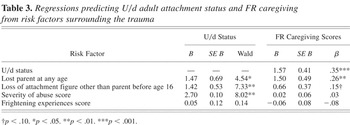
The extent to which the risk factors surrounding abuse or loss increased the likelihood that mothers would be classified as U/d was examined using a simultaneous binary logistic regression in which the risk factors expected to predict U/d status: loss of a parent, loss of nonparental attachment figure(s) other than the parent before age 16, severity of abuse, and frightening experiences, were entered as predictors and U/d (vs. not U/d) attachment status was the criterion. As shown in Table 3, after simultaneously controlling for the effects of every risk factor, loss of a parent at any age, loss of a nonparental attachment figure, and severity of abuse all increased the likelihood of receiving a U/d classification, but other frightening experiences did not predict U/d status.
Regressions predicting U/d adult attachment status and FR caregiving from risk factors surrounding the trauma

Predicting FR caregiving behavior from the risk factors surrounding the trauma
The extent to which the risk factors surrounding the abuse or loss, assessed prenatally, forecast FR maternal behavior at 8 months above and beyond U/d attachment status was examined using a hierarchical multiple regression in which U/d status was entered in the first step as a control, and risk factors that might be expected to independently predict FR behavior were entered simultaneously in the second step: loss of a parent, loss of attachment figure(s) other than the parent before age 16, severity of abuse, and frightening experiences. As expected, in the first step of the regression, U/d status was strongly predictive of FR caregiving (B = 1.82, SE B = 0.36, β = .43, p < .001). The block of risk factors as a whole significantly contributed to predicting FR caregiving above and beyond the variance explained by U/d status, ΔR2 = 1.00, ΔF (4, 110) = 3.82, p < .01. Results of the second step of the regression are shown in Table 3. U/d status still predicted FR caregiving even after entering the risk factors. In addition, loss of a parent at any age independently predicted FR behavior after controlling for U/d and the other risk factors and loss of an attachment figure other than a parent was a marginally significant predictor. However, after controlling for unresolved loss and the other risk factors, neither severity of abuse nor degree of frightening experience reported were associated with FR behavior.
Unresolved loss as a mediator of associations between the risk factors surrounding loss and FR behavior
Mothers' U/d status was hypothesized to mediate the relationship between the risk factors surrounding a loss (specifically, loss of a parent at any time and loss of an attachment figure other than a parent before age 16) and FR maternal behavior. Separate mediational analyses for each of the two risk factors were conducted. For both analyses, 107 mothers were included. Mothers who had not experienced a loss (N = 3) or were unresolved for abuse only (N = 5) were omitted, because these risk factors only related to loss, not abuse. Analyses examining U/d status as a possible mediator between severity of abuse and FR behavior were not conducted because only 11 mothers were U/d for abuse. Additionally, because Sobel's (1982) Test of Mediation requires that the mediator variable is continuous, the 9-point unresolved loss scale was used instead of the categorical variable.
To test for mediation effects, we followed Baron and Kenny's (1986) four steps: (a) examine whether mothers' age at the time of the loss and mothers' relationship to the lost person (the predictor variables) significantly predict the unresolved loss score; (b) examine whether mothers' unresolved score (the mediator) predicts their FR behavior scores; (c) examine whether the predictor variables are associated with FR maternal caregiving; and (d) if all three of these analyses are significant, conduct a regression with both the predictor variables and mediator as the independent variables and FR behavior as the dependent variable. If the relationship between the predictor variable (conditions surrounding the loss) and dependent variable (FR behavior) significantly declines when the mediator (unresolved loss) is included in the regression, then the mediational hypothesis is supported.
We first examined whether unresolved loss mediated the relation between loss of parent and FR behavior. Significant associations were revealed between loss of a parent and FR behavior (β = .38, p = .000), between loss of a parent and mothers' unresolved loss score (β = .22, p < .05), and between mothers' unresolved loss score and FR behavior (β = .47, p < .001). Because all three links were significant, a regression was conducted in which loss of a parent and unresolved loss were entered as the predictor variables and FR behavior was entered as the dependent variable. The association between loss of a parent and FR behavior declined with the addition of mothers' unresolved loss score (β = .28, p < .01). This decline was statistically significant (Sobel Test = 2.20, p < .05), indicating that the relation between loss of parent and FR behavior was partially mediated by mothers' level of unresolved loss.
The second mediational analysis examined whether unresolved loss mediated the relation between loss of an attachment figure other than the parent prior to age 16 and FR behavior. Again, in addition to the association reported between mothers' unresolved loss score and FR behavior, the regression analyses demonstrated significant associations between loss of an attachment figure other than the parent prior to age 16 and FR behavior (β = .19, p < .05) and between loss of an attachment figure other than the parent prior to age 16 and mothers' unresolved loss score (β = .28, p < .01). The association between loss of an attachment figure other than the parent prior to age 16 and FR behavior was no longer significant with the addition of mothers' unresolved loss score, indicating that the association between loss of attachment figure other than the parent and FR behavior was mediated by mothers' unresolved loss scores.
Discussion
This study is one of the first to trace the origins of maternal frightening behavior and explore conditions under which unresolved mothers are more likely to display frightened and/or frightening behaviors in the presence of their infant. We begin by addressing our central findings including (a) strong associations between mothers' lapses in the monitoring of reasoning or discourse during discussions of loss and abuse, assessed prenatally with the AAI, and the display of FR behavior with their infants at 8 months; (b) the significant effect of losing a parent or other attachment figure(s) on mothers' propensity to be unresolved and engage in FR behavior; (c) data demonstrating that unresolved loss fully mediates the link between loss of attachment figure(s) other than the parent and FR behavior, but only partially mediates the relation between loss of a parent and FR behavior; and (d) the central role of the mothers' age at the time of loss and nature of the relationship to the deceased person in determining whether unresolved mothers will engage in FR behavior. Finally, we discuss a way in which mothers might be helped to cope with and resolve trauma and suggest studies which might assist our understanding of how fear becomes transmitted intergenerationally.
Striking associations have been documented between mothers' U/d attachment status on the AAI and disorganized attachment in their infants (Benoit & Parker, 1994; Steele, Steele, & Fonagy, 1996; Ward & Carlson, 1995), as well as notable relations between FR behavior and infant attachment disorganization (Abrams, 2000; Abrams et al., 2006; Lyons-Ruth et al., 1999; Madigan & Pederson, 2003; Schuengel et al., 1999; True et al., 2001). Given these findings, coupled with reports that attachment disorganization forecasts emotional and behavioral problems across childhood, this study sought to understand why mothers engage in FR behavior. Findings from the present study indicate that expectant mothers classified as U/d (vs. not U/d) on the AAI are likely to engage in FR behavior when their infants were 8 months old. These finding occurred even when mothers classified as U/d for loss and U/d for abuse were examined separately. Moreover, unresolved loss and/or abuse in expectant mothers forecast FR behavior but not maternal insensitivity. Conversely, when unresolved mothers were placed into their best-fitting secondary AAI classification, secure/autonomous mothers scored significantly higher than insecure mothers on maternal sensitivity but not FR behavior.
One mother, whose discourse on the AAI prior to her baby's birth predicted both high sensitivity and FR scores (i.e., she was classified as unresolved alternate secure/autonomous), gave the following response to the AAI probe regarding how she thinks having been sexually abused by her stepfather would affect the way she raises her child “I do get nervous and scared sometimes that, what happens if, if some uncontrolled beast comes out of me, and something happens like that.” One of the indices for unresolved abuse in the AAI manual is “subject fears being taken over (‘possessed’) by the abusive figure” (Main et al., 1984/2003, p. 141) and this mother was judged to be U/d with respect to abuse on this basis. When her baby was 8 months old, this same mother responded with warmth and sensitivity to her baby during the entire home interaction except for one moment: her baby was lying face up on the floor and she was sweetly showing him different stuffed animals. At one point, she picked up a bear and said “nice teddy, nice teddy bear” in a sing song voice. Then her pitch dropped suddenly, as she repeated “nice teddy” in a deep baritone, and without warning, smothered the baby's face with the large bear. This observation is consistent with the hypothesis that an attachment figure who shows linguistic or cognitive lapses during the AAI is likely also to show behavioral lapses in the presence of their baby (Main & Hesse, 1990).
A central aim of this study was to identify conditions under which U/d mothers do and do not engage in FR behavior. One possibility was that a secondary secure/autonomous state of mind would reduce the strength of FR behavior in otherwise unresolved mothers. This idea was confirmed in that mothers classified as U/d who also had a secondary secure/autonomous classification showed impressive but lower levels of FR behavior than mothers with a secondary insecure AAI attachment classification. It is also consistent with Schuengel et al.'s (1999) study to the extent that U/d mothers with an alternate insecure classification scored higher on the FR behavior scale than did U/d alternate secure/autonomous mothers. In contrast to the Schuengel et al. (1999) findings, however, U/d-secure mothers in the present study did not score the lowest on the FR behavior scale; rather, all U/d mothers scored higher on FR behavior than all mothers who were not U/d, including those with an insecure AAI classification Introducing stress in the mother–infant interactions by including the clothes changing situation in this study may have increased the likelihood that U/d-secure mothers would engage in frightening behaviors.
The present study contributes to understanding what puts women who experienced a loss or abuse at risk for becoming unresolved and engaging in FR behavior with their children. Specifically, this study examined the extent to which mothers' severity of abuse, loss of a parent, early loss (before age 16) of attachment figure(s) other than the parent, and other potentially frightening experiences (e.g., threats of abandonment) increase the likelihood that a mother would be classified as unresolved and engage in FR behavior. Expectant mothers who were classified as unresolved were more likely than those not classified as unresolved to have experienced the death of a parent during their lifetime and/or an attachment figure other than the parent before age 16. Mothers classified as unresolved also scored significantly higher than not-unresolved mothers on the severity of the physical or sexual abuse experienced.
Only loss of a parent forecast FR maternal behavior independent of U/d loss and other risk factors, including early (before age 16) loss of an attachment figure other than a parent, severity of abuse, and other frightening experiences such as threats of being abandoned, although early loss of an attachment figure other than a parent was marginally predictive of FR behavior independent of these other factors. This is consistent with Main and Hesse's (1990; see also Bowlby, 1980) idea that when a parent harbors fear surrounding the loss of their own parent, who was their primary source of comfort and security, it may be difficult to resolve the loss, and the parent may behave in ways that frighten his or her own child. In addition, if a child loses a parent, the surviving parent (if one is present) may be affected by the loss as well, thus possibly precipitating negative changes in that attachment relationship between the surviving parent and the child. As Krupnick (1984) notes, “The common situation following a parental death may be considerable chaos, disorganization, and a sense of insecurity” (p. 123). These circumstances may create persistent anxiety and fear, which could later be expressed as FR behavior.
It is important to note, however, that only two mothers who lost a parent and were not classified as U/d loss scored above 4 on the FR behavior scale. Put another way, having lost a parent appears to increase the degree of maternal FR behavior displayed but may not intrinsically elevate the level to such a degree that the baby is at risk for developing disorganized attachment status. Future studies should address the extent to which moderate scores on the FR behavior scale (i.e., below 5) predict infant disorganization or other maladaptive child outcomes.
Only one other study has examined links between a mother's relationship to deceased kin and FR behavior. Schuengel et al. (1999) found no difference in scores for FR maternal behavior between mothers who lost a first-degree kin (including fathers, children, or siblings) versus loss of other persons. Due to their sample selection criteria, however, none of their subjects had lost their mother. The difference in findings may have resulted from the fact that, in the present study, loss of parent was separated from loss of other first-degree kin, and four of the mothers had lost their mother.
Results of the mediational analyses suggest that the mothers' unresolved state of mind is a critical factor influencing whether past loss experiences will negatively affect caregiving. The relations between FR behavior and loss of an attachment figure other than a parent before age 16, was fully mediated by U/d loss. The association between loss of a parent specifically and FR behavior, however, was only partially mediated by mothers' U/d loss, again suggesting that loss of a parent is a particularly strong risk factor for FR behavior.
Several questions remain unanswered. Findings from the present study suggest that losing a parent is particularly problematic, contributing to mothers' U/d status, as well as significantly increasing the likelihood that mothers will engage in frightening behavior. Does it matter whether mothers lose their mother versus their father or parent versus stepparent? Too few mothers lost a parent in this study to perform statistical comparisons among these groups. Studies with larger samples should further explore whether loss of a mother might be a stronger risk factor than loss of a father for lack of resolution and frightening behavior.
Another question is whether a mother's ongoing relationship with her attachment figure contributes to her state of mind with respect to trauma and ability to provide adequate care for her child. Most interventions focus on reworking the client's representations of past relationships or helping clients develop trusting relationships with a therapist or other people outside the family of origin. It may be equally important to help individuals directly rework their relationships with their own parents, particularly if these relationships are at the root of their problems. Findings from a longitudinal study following grandmothers, mothers, and infants over time show that mothers' accounts of feeling accepted and loved by their mothers and observational ratings of the quality of their relationship with their mother in adulthood contributed independently to their caregiving quality with their 9-month-old infants (Jacobvitz, Morgan, Kretchmar, & Morgan, 1991).
Finally, some of the processes underlying associations among mothers' U/d status, FR behavior, and attachment disorganization remain elusive. FR maternal behaviors are, by definition, sudden and out of context. They are likely to emerge when parents respond in anomalous ways to memories of past traumas as opposed to the infant, perhaps because something in the environment has provoked them to reexperience the traumatic event. The infant's difficulty understanding the source of such actions is hypothesized to heighten the infant's fear, resulting in disoriented/disorganized behavior on the part of the infant (Hesse & Main, 1999; Main & Hesse, 1990). Studies exploring what triggers mothers' own frightening memories and the circumstances under which infants perceive maternal behaviors as fearful, perhaps by monitoring the mother's and infant's heart rate and then interviewing the mother, may help clarify the process by which a mother's unresolved fear is first aroused and then transmitted to her child. Such information is critical for developing effective intervention programs that prevent the onset of impaired mother–infant interactions.
References
REFERENCES
Abrams, K.
(2000).
Dissociative “FR” parental behavior observed in a
laboratory play session predicts infant disorganization.
Unpublished doctoral dissertation,
University of California at Berkeley.
Abrams, K. Y.,
Rifkin, A., &
Hesse, E.
(2006).
Examining the role of parental frightened/frightening
subcategories in predicting disorganized attachment within a brief
observational procedure.
Development and Psychopathology,
18,
345–361.Google Scholar
Ainsworth, M. D. S.,
Blehar, M.,
Waters, E., &
Wall, S.
(1978).
Patterns of attachment.
Hillsdale, NJ:
Erlbaum.
Ainsworth, M. D. S., &
Eichberg, C. G.
(1991).
Effects on infant–mother attachment of mother's
unresolved loss of an attachment figure or other traumatic
experience. In
P. Marris,
J. Stevenson-Hinde, &
C. Parkes (Eds.),
Attachment across the life cycle (pp.
160–183).
New York:
Routledge.
Baron, R. M., &
Kenny, D. A.
(1986).
The moderator–mediator variable distinction in social
psychological research: Conceptual, strategic, and statistical
considerations.
Journal of Personality and Social Psychology,
51,
1173–1182.CrossRefGoogle Scholar
Benoit, D., &
Parker, K. C.
(1994).
Stability and transmission of attachment across three
generations.
Child Development,
65,
1444–1456.CrossRefGoogle Scholar
Bowlby, J.
(1969).
Attachment and loss: Vol. 1. Attachment.
New York:
Basic Books.
Bowlby, J.
(1980).
Attachment and loss: Vol. 3. Loss.
New York:
Basic Books.
Bretherton, I.
(1991).
Pouring new wine into old bottles: The social self as internal
working model. In
M. Gunnar &
L. A. Sroufe (Eds.),
Self processes in development.
Minnesota Symposia on Child Development
(Vol. 23).
Hillsdale, NJ:
Erlbaum.
Carlson, E. A.
(1998).
A prospective longitudinal study of disorganized/disoriented
attachment.
Child Development,
69,
1107–1128.CrossRefGoogle Scholar
Egeland, B.,
Jacobvitz, D., &
Sroufe, L. A.
(1988).
Breaking the cycle of abuse.
Child Development,
59,
1080–1088.CrossRefGoogle Scholar
Fonagy, P.,
Steele, H., &
Steele, M.
(1991).
Maternal representations of attachment during pregnancy predict the
organization of infant–mother attachment at one year of age.
Child Development,
62,
891–905.CrossRefGoogle Scholar
George, C.,
Kaplan, N., &
Main, M.
(1984, 1985, 1996).
Adult Attachment Interview.
Unpublished manuscript
(1st–3rd eds.).
University of California, Berkeley, Department of Psychology.
Hazen, N.
(1997).
Infant Caregiving Scales (ICS).
Unpublished manuscript.
University of Texas at Austin, Human Development and Family
Sciences.
Hesse, E.
(1996).
Discourse, memory and the Adult Attachment Interview: A note with
emphasis on the emerging cannot classify category.
Infant Mental Health Journal,
17,
4–11.3.0.CO;2-S>CrossRefGoogle Scholar
Hesse, E., &
Main, M.
(1999).
Second-generation effects of unresolved trauma in non-maltreating
parents: Dissociative, frightened, and threatening parental behavior. In
D. Diamond & S. J. Blatt (Eds.), Psychoanalytic theory and attachment
research I: Theoretical considerations.
Psychoanalytic Inquiry,
19,
481–540.Google Scholar
Hesse, E., &
Main, M.
(2000).
Disorganized infant, child, and adult attachment: Collapse in
behavioural and attentional strategies.
Journal of the American Psychoanalytic Association,
48,
1017–1127.CrossRefGoogle Scholar
Jacobvitz, D., &
Hazen, N.
(1999).
Developmental pathways from infant disorganization to childhood
peer relationships (pp. 127–159). In
J. Solomon &
C. George (Eds.),
Attachment disorganization.
New York:
Guilford Press.
Jacobvitz, D.,
Hazen, N.,
Curran, M., &
Hitchens, K.
(2004).
Observations of early triadic family interactions: Boundary
disturbances in the family predict depressive, anxious, and
attention-deficit/hyperactivity disorder symptoms in middle
childhood.
Development and Psychopathology,
16,
577–592.Google Scholar
Jacobvitz, D. B.,
Morgan, E.,
Kretchmar, M., &
Morgan, Y.
(1991).
The transmission of boundary disturbances across three
generations.
Development and Psychopathology,
3,
513–527.CrossRefGoogle Scholar
Kaufman, J., &
Zigler, E.
(1987).
Do abused children become abusive parents?
American Journal of Orthopsychiatry,
57,
186–192.Google Scholar
Krupnick, J. L.
(1984).
Bereavement during childhood and adolescence. In
M. Osterweis,
F. Solomon, &
M. Green (Eds.),
Bereavement: Reactions, consequences, and care (pp.
99–141).
Washington, DC:
National Academy Press.
Leon, K.
(2004).
The Frightening Experiences Scale.
Unpublished manuscript,
University of Texas at Austin.
Leon, K.,
Jacobvitz, D., &
Hazen, N.
(2004).
Maternal resolution of loss and abuse: Association with adjustment
to the transition to parenthood.
Infant Mental Health,
25,
130–148.CrossRefGoogle Scholar
Lyons-Ruth, K., &
Block, D.
(1996).
The disturbed caregiving system: Relations among childhood trauma,
maternal caregiving, and infant affect and attachment.
Infant Mental Health Journal,
17,
257–275.3.0.CO;2-L>CrossRefGoogle Scholar
Lyons-Ruth, K.,
Bronfman, E., &
Parsons, E.
(1999).
Maternal frightened, frightening, or atypical behavior and
disorganized infant attachment patterns.
Monographs of the Society for Research in Child Development,
64,
67–96.CrossRefGoogle Scholar
Lyons-Ruth, K.,
Easterbrooks, A., &
Cibelli, C.
(1997).
Infant attachment strategies, infant mental lag, and maternal
depressive symptoms: Predictors of internalizing and externalizing
problems at age 7.
Developmental Psychology,
33,
681–692.CrossRefGoogle Scholar
Lyons-Ruth, K., &
Jacobvitz, D.
(1999).
Attachment disorganization: Unresolved loss, relational violence,
and lapses in behavioral and attentional strategies (pp.
520–554). In
J. Cassidy &
P. Shaver (Eds.),
Handbook of attachment: Theory, research and clinical
applications.
New York:
Guilford Press.
Madigan, S., &
Pederson, D.
(2003, March).
Developmental precursors to disorganized attachment: Links to
fearful, disoriented, and dissociative maternal behavior.
Paper presented at the Biennial Meeting of the Society for
Research in Child Development, Tampa, FL.
Main, M., &
Cassidy, J.
(1988).
Categories of response to reunion with the parent at age 6:
Predicted from infant attachment classification and stable over a 1-month
period.
Developmental Psychology,
24,
415–426.CrossRefGoogle Scholar
Main, M.,
Goldwyn, R., &
Hesse, E.
(1984/2003).
Adult attachment scoring and classification system.
Unpublished manuscript,
University of California at Berkeley, Department of
Psychology.
Main, M., &
Hesse, E.
(1990).
Parents' unresolved traumatic experiences are related to
infant disorganized attachment status: Is frightened and/or
frightening parental behavior the linking mechanism? In
M. T. Greenberg,
D. Cicchetti, &
E. M. Cummings (Eds.),
Attachment in the preschool years: Theory, research and
intervention (pp.
161–182).
Chicago:
University of Chicago Press.
Main, M., &
Hesse, E.
(1995).
Frightening, frightened, timid/deferential, dissociated, or
disorganized behavior on the part of the parent: Coding system.
Unpublished manuscript,
University of California at Berkeley.
Riggs, S. A., &
Jacobvitz, D.
(2002).
Expectant parents' representations of early attachment
relationships: Associations with mental health and family history.
Journal of Consulting and Clinical Psychology,
70,
195–204.CrossRefGoogle Scholar
Schuengel, C.,
van IJzendoorn, M.,
Bakermans-Kranenburg, M.
(1999).
Frightening, maternal behavior linking unresolved loss and
disorganized infant attachment.
Journal of Consulting and Clinical Psychology,
67,
54–63.CrossRefGoogle Scholar
Sobel, M. E.
(1982).
Asymptotic intervals for indirect effects in structural equations
models. In
S. Leinhart (Ed.),
Sociological methodology (pp.
290–312).
San Francisco, CA:
Jossey–Bass.
Steele, H.,
Steele, M., &
Fonagy, P.
(1996).
Associations among attachment classifications of mothers, fathers,
and their infants.
Child Development,
67,
541–555.CrossRefGoogle Scholar
True, M.,
Pisani, L., &
Oumar, F.
(2001).
Infant–mother attachment among the Dogon in Mali.
Child Development,
75,
1451–1466.CrossRefGoogle Scholar
van IJzendoorn, M. H.
(1995).
Adult attachment representations, parental responsiveness, and
infant attachment: A meta-analysis on the predictive validity of the adult
attachment interview.
Psychological Bulletin,
117,
387–403.CrossRefGoogle Scholar
van IJzendoorn, M. H.,
Schuengel, C., &
Bakermans-Kranenburg, M. J.
(1999).
Disorganized attachment in early childhood: Meta-analysis of
precursors, concomitants, and sequelae.
Development and Psychopathology,
11,
225–249.CrossRefGoogle Scholar
Ward, M. J., &
Carlson, E. A.
(1995).
Associations among adult attachment representations: Maternal
sensitivity and infant–mother attachment in a sample of adolescent
mothers.
Child Development,
66,
69–79.CrossRefGoogle Scholar
Frequency and percentage for each categorical variable and mean and standard deviation for each continuous variable
Relations between maternal caregiving at 8 months and prenatal assessments of adult attachment classifications using the primary and secondary classifications
Regressions predicting U/d adult attachment status and FR caregiving from risk factors surrounding the trauma
 You have
Access
- 88
- Cited by