Implications
Recently the inclusion of animal raw materials has been declining in poultry diets, in favor of plant raw materials that have very little content in Na+ and Cl−. For optimal profitability, the possible effects of Na+ and Cl− and their requirements in yellow-feathered chickens should be assessed. It is shown that supplemental dietary Na+ and Cl− improved growth performance, increased serum Na+ and osmotic pressure (OSM), decreased serum K+, glucose (GLU), triglyceride (TG) levels and duodenal Na + –H + exchanger 2 (NHE2) transcripts. The results help in efficiently improving growth performance and health of birds, and in precision feed formulation of yellow-feathered chickens.
Introduction
Sodium and chloride are the major cation and anion in the extracellular fluid of the body and they are the key factors maintaining normal OSM and volume of the extracellular fluid. In addition, they influence the acid–base balance of body fluids. In recent years, the inclusion of animal raw materials has been declining in poultry diets, in favor of plant raw materials that have very little content of Na+ and Cl−. In order to meet the demand for sodium and chloride in birds fed plant-based diets, common salt (NaCl) is often used as a supplement.
Under commercial production, the dietary Na+ and Cl− requirements of yellow-feathered chickens are based on the feeding standard of National Research Council (NRC) (1994). Previous studies have shown that increasing dietary Na+ level stimulated the growth performance of chickens (Murakami et al., Reference Murakami, Oviedo-Rondon, Martins, Pereira and Scapinello2001; Mushtaq et al., Reference Mushtaq, Mirza, Athar, Hooge, Ahmad, Ahmad, Mushtaq and Noreen2007; Jankowski et al., Reference Jankowski, Zdunczyk, Juskiewicz and Kwiecinski2011). This led to increasing water consumption and higher water content in droppings (Murakami et al., Reference Murakami, Oviedo-Rondon, Martins, Pereira and Scapinello2001). Increasing dietary NaCl resulted in increasing litter moisture level which in turn increases incidence of breast burns and blisters, leg abnormalities, footpad dermatitis and flock diseases in growing birds (Bilgili et al., Reference Bilgili, Alley, Hess and Nagaraj2006; Shepherd and Fairchild, Reference Shepherd and Fairchild2010).
There are no data on the optimal dietary Na+ and Cl− level during the grower phase (22 to 42 days) of yellow-feathered chickens. The objective of the present study was to investigate the effects of increased dietary sodium and chloride intake, and to estimate the optimal dietary sodium and chloride level for yellow-feathered broilers aged from 22 to 42 days, with respect to the growth performance, excreta moisture, blood biochemical indices, intestinal expression of major transporters Na +–glucose transporter 1 (SGLT1) and NHE2, or Na+/K+-ATPase activity.
Material and methods
The experiment was conducted in accordance with the Animal Care Committee of the Institute of Animal Science, Guangdong Academy of Agricultural Sciences, with the approval number of GAASISA-2015-026.
Birds and housing
A total of 900 healthy and well-developed Lingnan yellow-feathered male chickens (22-day-old, BW 506.2±0.3 g) were randomly assigned to five treatments, each of which consisted of six replicate floor pens of 30 birds. Each pen was 1.3×3.5 m and the litter was 5 cm of wood shavings. Natural ambient lighting was adopted throughout the experiment which was carried out during July. The temperature and relative humidity inside the barn were recorded daily at 08:00, 14:30 and 20:00; the average ambient RH inside was 90.90±4.16% and the mean daily temperature was 31.04±1.19oC.
Experimental diets
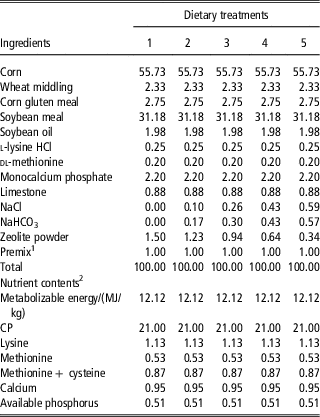
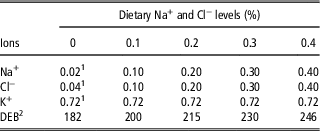
The basal control diet was based on corn and soybean meal (without added NaCl or NaHCO3) to meet recommendations of the Chinese Feeding Standard of Chicken (Wen et al., 2004). Treatments 2 to 5 consisted of the basal diet supplemented with equivalent weights of Na+ and Cl−, providing 0.1%, 0.2%, 0.3% and 0.4% by weight of each ion and was weight balanced with up to 1.5% zeolite. NaHCO3 was used to supplement the Na+ content of NaCl so weights of Na+ and Cl− were the same. The composition and nutritional content of each diet are shown in Table 1. The Na+ content was determined by atomic absorption spectrophotometry, Cl− was measured by AgNO3 titration and K+ by flame photometry. Measured Na+, Cl−, K+ and calculated dietary electrolyte balance (DEB) (Mongin, Reference Mongin1981) for each of the diets are given in Table 2. The birds were provided ad libitum access to water and pelleted diets.
Composition and nutrient levels of the diets (air-dry basis, %) in yellow-feathered chickens of 22 to 42 days of age

1 Supplied per kilogram of diet: VA 5000 IU, VD3 1000 IU, VE 10 IU, VK 0.5 mg, VB1 1.8 mg, VB2 3.6 mg, VB6 3.5 mg, VB12 0.01 mg, niacin 30 mg, d-calcium pantothenate10 mg, folic acid 0.55 mg, biotin 0.15 mg, Fe 80 mg, Cu 8 mg, Mn 80 mg, I 0.35 mg, Se 0.3 mg.
2 Values were calculated from data provided by the Feed Database in China (2016).
Dietary Na+, Cl− and K+ levels, and dietary electrolyte balance (DEB) in yellow-feathered chickens of 22 to 42 days of age

1 Chemical composition data are the results of chemical analyses conducted in duplicate, while the others were calculated values from data provided by the Feed Database in China (2016).
2 Dietary electrolyte balance (mEq/kg)=Na+ (mEq/kg)+K+ (mEq/kg)−Cl− (mEq/kg) (Mongin, Reference Mongin1981).
Growth performance
Chickens were weighed at the beginning and at the end of the experiment (22 to 42 days of age). Average daily feed intake was determined on a per pen basis. The average daily gain (ADG) and feed conversion ratio (FCR) were calculated. Mortality and health status were recorded daily throughout the entire experimental period and dead birds were weighed to adjust the calculated FCR. The weight of the water was recorded and remaining water at 08:00 on the next day was measured to determine water consumption.
Blood sampling and laboratory analyses
At 42 days of age, two birds with average BW were selected from each replicate, bled via the brachial vein to prepare serum, and then were euthanized. After clotting, tubes were centrifuged for 10 min (3000×g) and aspirated serum was stored until analyzed in 500 μl Eppendorf tubes at −80°C. Serum contents of Na+, K+, Cl−, GLU, TG, total cholesterol (TCH) and uric acid were determined spectrophotometrically using assay kits (Nanjing Jiancheng Institute of Bioengineering, Nanjing, Jiangsu, China). Serum OSM was calculated using the formula 2×Na++2×K++GLU + uric acid (Zhang, Reference Zhang2006). Serum cholecystokinin (CCK), ghrelin and growth hormone (GH) levels were measured by ELISA using kits from Beijing Normal Biotechnology Co., Ltd, Beijing, China.
Immediately following euthanasia, the pH of the proventricular contents was measured using a portable pH meter (DELTA 320; Mettler-Toledo, Shanghai, China). The average pH value was from three measurements (upper, middle and lower part) and the procedures used were the same for all of the samples. Five days before the end of the experiment, 10 birds with average BW for the replicate were transferred to cages for collection of droppings for 3 days. The collected excreta was weighed first and then dried at 60°C, reweighed and moisture content was determined.
The duodenum and ileum from 0%, 0.2% and 0.4% treatments were separated and, after removing all connective tissue and fat, was rinsed with cold PBS, blotted, and portions were snap-frozen with liquid nitrogen and stored at −80°C to quantify duodenal and ileal NHE2 and SGLT1 transcripts. Other portions of the duodenum were prepared as above and stored until measuring the activity of Na+/K+-ATPase.
Na+/K+-ATPase determination
Frozen duodenum was homogenized in ice-cold 0.1 M NaCl solution. The homogenates were then centrifuged at 20 000×g for 30 min at 4°C and the supernatants were collected and stored at −70°C until assaying the activity of Na+/K+-ATPase. After thawing and adjusting to room temperature, the activity of Na+/K+-ATPase was analyzed using diagnostic kits (Nanjing Jiancheng Bioengineering Institute) and a microplate reader (SpectraMax M5; Molecular Devices, San Jose, CA). Activity was expressed as μmols of inorganic phosphorus produced by enzymatic decomposition of ATP per milligram of protein per hour; protein was measured with the Coomassie Brilliant Blue G-250 reagent with bovine serum albumin (BSA) as a standard.
Na+–glucose transporter 1 and Na+–H+ exchanger 2 transcript abundance
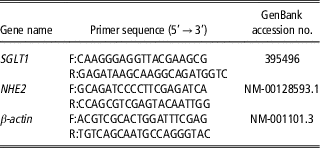
Total RNA was isolated from duodenal and ileal tissues (approximately 50 mg) as described by Dong et al. (Reference Dong, Azzam and Zou2016) using TRIZOL according to the manufacturer’s instructions (Invitrogen, Carlsbad, CA, USA). The quality of total RNA was checked by both native RNA electrophoresis on 1.0% agarose gels and the UV absorbance ratio at 260 and 280 nm. The complementary DNA was synthesized from 2 μg of total RNA by reverse transcription (M-MLV; Takara, Dalian, China) at 42°C for 60 min with oligo dT-adaptor primer using the protocol of the manufacturer. The abundance of messenger RNA (mRNA) was determined on a Step One Plus Real-Time PCR system (ABI 7500; Applied Biosystems, Foster City, CA, USA). Gene-specific primers for NHE2 mRNA in duodenum, SGLT1 mRNA in ileum and the endogenous reference gene (β-actin) are shown in Table 3. The PCR reaction used a SYBR Premix PCR kit (Takara). The PCR program was 95°C for 10 min followed by 40 cycles of 95°C for 15 s and 60°C for 60 s. The standard curve was generated using pooled samples and efficiency was calculated from standard curves. Each sample was run in duplicate and a no-template control was included. Specificity of the amplification was verified by melting curve analysis and specificity of the product was confirmed by electrophoresis on a 1.2% agarose gel, purification using a DNA purification kit (Takara) and sequencing (Shanghai Sangon Biotech Co. Ltd., Shanghai, China). The difference of Ct (cycle threshold) value for 18s ribosomal RNA was <0.5 across all treatments, and, therefore, was considered to be an appropriate endogenous control, as described by Dong et al. (Reference Dong, Wang, Song and Zou2013). Average gene expression relative to the endogenous control for each sample was calculated using the 2–ΔΔCt method (Livak and Schmittgen, Reference Livak and Schmittgen2001). The calibrator for each studied gene was the average ΔCt value of samples from the birds fed the basal diet.
Sequences of primers for the real-time PCR in yellow-feathered chickens of 22 to 42 days of age

SGLT1=Na+–glucose transporter 1; NHE2=Na+ –H+ exchanger 2.
Statistical analysis
The experimental unit was replicate. Effects of Na+ and Cl− supplementation were statistically analyzed by one-way ANOVA of SAS Institute (2001). Orthogonal comparisons were applied for quadratic responses of dependent variables to dietary Na+ and Cl− level. Inflection points in response curves were calculated using three broken line regression models, following Vedenov and Pesti (Reference Vedenov and Pesti2008). A one-slope, straight broken-line model consists of two parts, fitted by least squares: a straight line with an increasing or decreasing slope and a horizontal line; their point of intersection is the breakpoint (the estimated requirement). In the two-slope, straight broken-line model, both intersecting straight lines have non-zero slopes. The single-slope model can be written as Y=L+U×(R−X), where (R−X) is defined as zero when X>R. The two-slope broken-line model is as follows: Y=L+U×(R−X)+V×(X–R), where (R–X) is defined as zero when X>R, and (X−R) is defined as zero when X<R. In these equations, the derived parameters are the breakpoint × value (R), an asymptote for the first segment (L) and slopes for the two line segments (U, V). The dietary Na+ and Cl− levels (R) at the breakpoint is the estimated requirement. The quadratic broken-line model is described by Y=c+b×X+a×X 2. The dietary level at which the response reached 95% of the maximum was estimated as the requirement (Robbins et al., Reference Robbins, Saxton and Southern2006). Mean square error, coefficient of determination (R 2) and the Bayesian information criterion (smaller values indicate a better fit) were used to assess the goodness of fit for the different models. Means for transcript abundances and Na+–K+-ATPase activity were compared by the Tukey’s posthoc test after one-way ANOVA.
Results
Growth performance and optimal dietary Na+ and Cl− from 22 to 42 days
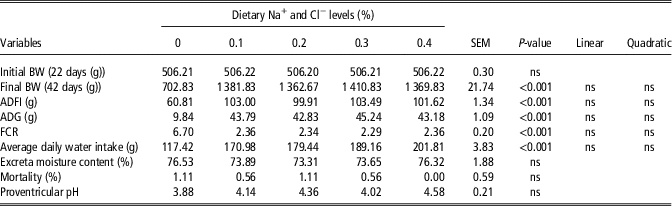
These results showed that when yellow-feathered male chickens were fed a diet that was deficient in Na+ and Cl− (0.02% and 0.04%, respectively, Table 2) a significant decrease (P<0.01) in BW resulted, due to lower ADG stemming from reduced feed and water intake (Table 4). Supplemental dietary Na+ and Cl− improved the growth performance of chickens from 22 to 42 days of age (Table 4). Average daily gain showed a quadratic broken-line regression response to increasing dietary Na+ and Cl− (R 2=0.979, P<0.001), and reached a plateau at 0.10% (Table 5). Addition of dietary Na+ and Cl− increased daily water consumption and reduced FCR (Table 4). Estimates of the dietary sodium and chloride requirements for ADG (0.10%), serum Na+ (0.11%) and serum OSM (0.11%) are shown in Table 5 with the best-fit quadratic models; the corresponding estimates for Na+ and Cl− for optimizing serum K+ and GLU were 0.17 and 0.16.
Effects of dietary sodium and chloride levels on growth performance, daily water consumption, excreta moisture, mortality and proventricular pH in yellow-feathered chickens of 22 to 42 days of ageFootnote 1

ns=no significance (P>0.05); ADFI=average daily feed intake; ADG=average daily gain; FCR=feed conversion ratio.
1 Values are least squares means of 6 replicate pens of 30 birds per treatment.
Estimates of the dietary sodium and chloride requirements based on quadratic regressions of average daily gain (ADG), and serum variables in yellow-feathered chickens of 22 to 42 days of age

Y=dependent variables; X=sodium and chloride levels; OSM=osmotic pressure in serum; GLU=glucose content in serum.
Proventricular pH and other serum variables
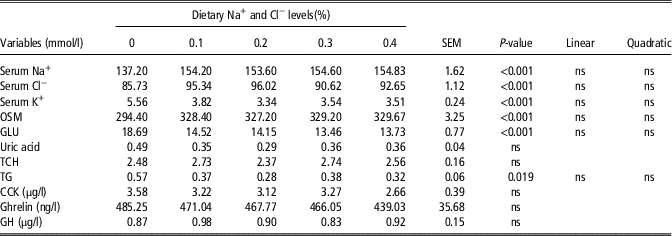
Proventricular pH was not affected by graded levels of dietary Na+ and Cl− (Table 4). Supplemental Na+ and Cl− did increase (P<0.01) serum Na+, Cl−, OSM and decrease (P<0.01) serum K+, GLU and TG from that in birds on the basal diet, but had no effect on TCH, CCK, ghrelin or GH in serum (Table 6).
Effects of dietary sodium and chloride levels on serum biochemical variables in yellow-feathered chickens at 42 days of ageFootnote 1

ns=no significance (P>0.05); OSM=osmotic pressure in serum; GLU=glucose content in serum; TCH=total cholesterol content in serum; TG=triglyceride content in serum; CCK=cholecystokinin content in serum; GH=growth hormone level in serum.
1 Values are least squares means of 6 replicate pens (2 birds sampled) per treatment.
Intestinal abundance of Na+–H+ exchanger 2 and Na +–glucose transporter 1 transcripts, and the activity of Na + /K + -ATPase
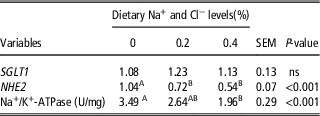
The higher dietary levels of Na+ and Cl− (0.2 to 0.4%) decreased (P<0.01) duodenal expression of NHE2 transcripts, but had no effect on ileal SGLT1 mRNA (P>0.05) (Table 7). The duodenal activity of Na+/K+-ATPase decreased (P<0.01) after adding the highest level of Na+ and Cl− (Table 7).
Effects of dietary sodium and chloride levels on the relative abundance of intestinal SGLT1, and NHE2 transcripts, and the activity of Na+–K+-ATPase in yellow-feathered chickens at 42 days of age1

ns=no significance (P>0.05); SGLT1=Na+–glucose transporter 1; NHE2=Na+–H+ exchanger 2.
A,BMeans within a row without a common superscript differ significantly (P<0.01).
1 Values are least squares means of six replicate pens (two birds sampled) per treatment.
Discussion
There are no data on the sodium and chloride requirements of yellow-feathered chickens during the grower phase (22 to 42 days of age). Yellow-feathered chickens were exampled here by Lingnan, an improved breed raised for meat in China. It reaches market size (~1.75 kg) in about 60 days, compared to Western commercial breeds (~2.8 kg by 42 days).
In the current study, the weight ratio of Na+ to Cl− was held at 1 : 1 and added to the basal diet (0.02% Na+, 0.04% Cl−) to provide total contents of 0.1%, 0.2%, 0.3% and 0.4% by weight. The optimum DEB has been estimated to be 220 to 270 mEq/kg for broiler chickens at different phases of feeding (Mongin, Reference Mongin1981; Oviedo-Rondon et al., Reference Ovido-Rondø´n, Murakami, Furlan, Moreira and Macari2001). A DEB of 236 mEq/kg is reported for maximal BW gain, while a lower level of 207 mEq/kg is required for optimum FCR in broiler chicks (Borges et al., Reference Borges, Fischer da Silva, Majorka, Hooge and Cummings2004). Recently, Szabó et al. (Reference Szabó, Vucskits, Andrásofszky, Berta, Bersényi, Börzsönyi, Pálfi and Hullár2011) reported that during the finisher phase of broiler production, 250 mEq/kg DEB provided the best performance. In the current experiment, DEB ranged from 182 on the un-supplemented diet to 246 (Table 2).
The present findings showed that yellow-feathered male chickens fed a diet deficient in Na+ and Cl− decreased BW due to lower ADFI and ADG. Supplemental dietary Na+ and Cl− improved the growth performance of chickens during the grower phase, without negative effects on mortality. This is in agreement with Jankowski et al. (Reference Jankowski, Zdunczyk, Juskiewicz and Kwiecinski2011) who reported no difference with the lowest and highest Na+ level.
Average daily gain showed a quadratic broken-line regression with increasing dietary Na+ and Cl−, and rose to a plateau at 0.10%. The dietary Na+ and Cl− intake recommendations according to NRC (1994) were 0.15% from 3 to 6 week of age for commercial chickens. The German Society of Nutritional Physiology (GfE) (1999) recommended 0.11% dietary Na+. Recently, lower dietary sodium requirement has been recommended for finisher (15 to 35 days; 0.11%) broiler diets (Jankowski et al., Reference Jankowski, Zdunczyk, Juskiewicz and Kwiecinski2011). In addition, Koreleski et al. (Reference Koreleski, Swiątkiewicz and Arczewska2010) reported better growth responses in diets containing up to 0.12% dietary sodium. Moreover, higher levels of Cl− (0.21% to 0.31%) improved ADG and FCR of chickens only in the starter phase (1 to 15 days) but not the finisher phase (16 to 42 days; Koreleski et al., Reference Koreleski, Swiątkiewicz and Arczewska2011). Earlier, supplementation with 0.25% Cl had been suggested for the finisher phase of broiler production (Murakami et al., Reference Murakami, Oviedo-Rondon, Martins, Pereira and Scapinello2001).Supplemental Na+ and Cl− increased serum Na+ linearly, and showed a quadratic broken-line regression (R 2=0.997, P=0.004) at 0.11%. Supplemental graded levels of Na+ and Cl− increased serum Na+, in agreement with Mushtaq et al. (Reference Mushtaq, Pasha, Mushtaq and Parvin2013) who reported a quadratic increase in serum Na+ with increasing dietary sodium from 1.7 to 4.4 g/kg. Mushtaq et al. (Reference Mushtaq, Sarwar, Nawaz, Mirza and Ahmad2005) had previously reported no effect of dietary Na+ and Cl− on serum Na+, while Mushtaq et al. (Reference Mushtaq, Mirza, Athar, Hooge, Ahmad, Ahmad, Mushtaq and Noreen2007) found that serum Na+ decreased when dietary sodium increased from 0.20% to 0.25%. Mushtaq et al. (Reference Mushtaq, Pasha, Mushtaq and Parvin2013) mentioned that supplemental salts have inconsistent results on avian physiology, as they contribute both cations and anions in the diet. Although supplemental Na+ and Cl− improved growth performance, increased water intake, elevated serum Na+ and serum OSM, serum K+ and GLU decreased linearly. It seems that concentrations of electrolyte salts in the circulation are markers of a combination of supply by the feed and removal for tissue use. This result may be due to supplemental graded levels of Na+ and Cl− without K+ which is a useful tool to maintain acid–base balance. It has been reported that heat stress increased urinary K+ excretion, resulting in a decrease in plasma K+ (Smith and Teeter, Reference Smith and Teeter1987). This explains the decreased level of serum K+ in the present study because it was conducted during July (summer) when temperature averages above 30°C and 80% relative humidity in southern China. Supplementing drinking water with KCl enhances the respiratory efficiency of the bird by increasing the amount of heat dissipated per breath during acute heat stress (Smith and Teeter, Reference Smith and Teeter1987) and consequently decreases the energy needed for thermolysis; this in turn might explain the increased serum GLU noted here (Table 6). Rapid panting was observed throughout the current experiment. It has been suggested that supplemental GLU might help heat-stressed birds maintain thermal balance by providing the energy needed for panting (Iwasaki et al., Reference Iwasaki, Ikawa, Oyama, Horikawa, Zhou and Yamamoto2000).
Sodium (Na+) and chloride (Cl−) occur together in common salt and are found chiefly in the fluids that circulate outside body cells. However, potassium (K+) is present mostly in intracellular fluid. All three ions are necessary in keeping a normal balance of water between fluids and cells, providing for hydration homeostasis. The present results showed that dietary potassium K+ (0.72%) was sufficient for growth performance but not for acid base balance. Moreover, Oliveira et al. (Reference Oliveira, Albino, Rostagno, Paez and Carvalho2005) recommended dietary K+ of 0.71, as used here, for optimized ADG from 22 to 42 days of age.
Increasing dietary levels of Na+ and K+ increase water consumption and litter moisture (Koreleski et al., Reference Koreleski, Swiątkiewicz and Arczewska2010 and Reference Koreleski, Swiątkiewicz and Arczewska2011; Mushtaq et al., Reference Mushtaq, Pasha, Mushtaq and Parvin2013; Jankowski and Zdunczyk, Reference Jankowski and Zdunczyk2014). The addition of dietary Na+ and Cl− in the present study increased daily water consumption but had no effect on dry matter content of droppings; similarly, Jankowski et al. (Reference Jankowski, Zdunczyk, Juskiewicz and Kwiecinski2011) reported an insignificant trend to increased moisture of excreta. The minimum level of K+ in the present study may have the possibility of affecting the moisture content of excreta. It has been reported that increasing dietary levels of K+ resulted in an increase in the moisture content of excreta, whereas no effects of dietary Cl− on this variable was reported (Koreleski et al., Reference Koreleski, Swiątkiewicz and Arczewska2010 and Reference Koreleski, Swiątkiewicz and Arczewska2011). Koreleski et al. (Reference Koreleski, Swiątkiewicz and Arczewska2011) reported that there was a positive correlation between moisture content of droppings and dietary potassium, but not sodium; as noted, potassium was 0.72% in all diets used here.
In the current study, nutrient transport capacity was evaluated indirectly by determining duodenal activity of Na+–K+-ATPase. This decreased with addition of the highest concentrations of Na+ and Cl−. Gal-Garber et al. (Reference Gal-Garber, Mabjeesh, Sklan and Uni2003) reported that Na+ is an important element in nutrient transport across the intestinal wall. They reported that the activity of the enzyme was low with low dietary Na+ and was unchanged at high dietary Na+, which is in contrast with the present results. The activity of this enzyme has been used to estimate intestinal nutrient uptake (Sklan and Noy, Reference Sklan and Noy2000). The highest concentrations of Na+ and Cl− (0.2% to 0.4%) decreased the relative abundance of NHE2 transcripts in duodenum. The NHE family consists of nine subtypes (NHE1-9) that have been found in animal cells. Na+–H+ exchanger 2 is major brush-border Na1/H1 exchanger in colon and is increased by a low-NaCl diet in birds (Donowitz et al., Reference Donowitz, De La Horra, Calonge, Wood, Dyer, Gribble, De Medina, Tse, Shirazi-Beechey and Ilundain1998).
In conclusion, the optimal dietary Na+ and Cl− requirements for yellow-feathered chickens in the grower phase, from 22 to 42 days of age, to optimize ADG and serum Na+ were 0.10% and 0.11%, respectively. The diet that was deficient in both Na+ and Cl− resulted in decreased feed and water consumption and impaired growth performance.
Acknowledgments
The authors sincerely thank Dr W. Bruce Currie (Emeritus Professor, Cornell University) for his help in presentation of this manuscript. This work was supported by National Key R&D Project (2018YFD0500600), ‘Twelve-Five’ national science and technology support program (2014BAD13B02), the earmarked fund for Modern Agro-industry Technology Research System (CARS-41-G10) from Ministry of Agriculture, Science and Technology Planning Project of Guangdong Province (2017B020202003), and Science and Technology Planning Project (201804020091) from Guangzhou science technology and innovation commission, China.
Declaration of interest
The authors certify that there is no conflicts of interest with any financial organization regarding the material discussed in the manuscript.
Ethics statement
The experimental animal protocol of this study was approved by the Animal Care and Use Committee of Guangdong Academy of Agricultural Sciences. All animal care procedures throughout this study followed Experimental Animal Care and Use Guidelines of China.
Software and data repository resources
None of the data were deposited in an official repository.