Prevalence studies vary somewhat in estimates of the frequency of peer victimization, depending upon the definition that is used, the time period under consideration, and how it is assessed. Still, even after taking these factors into account, recent statistics indicate that as many as 10% of children are victimized by their peers sometime during their school years (Solberg & Olewus, 2003). Despite the fact that bullying declines across the elementary and middle school years, children who are the central targets of peer aggression are already established as victims by the later elementary school years (Kochenderfer-Ladd, 2003). As a result, there has been considerable interest in identifying factors that place these children at risk for peer victimization. This work has shown that many victimized school children lack important social skills, such as friendliness, prosocial competence, and a sense of humor, indicating to others that they are obvious targets for peer aggression (Egan & Perry, 1998; Owens, Shute, & Slee, 2000). Children who are frequently victimized by their peers also have low self-esteem (Kochenderfer & Ladd, 1996), are high in emotional arousal and reactivity (Schwartz, Dodge, & Coie, 1993), and behave in ways that make it less likely that they will evoke empathy from nonvictimizing peers (Perry, Willard, & Perry, 1990).
Compared with the vast literature on victimization during the late elementary school years and beyond, relatively few studies have examined this topic in early childhood even though this is a time when children are confronted with the developmental tasks of entering school for the first time and meeting same-age playmates (Pelligrini & Blatchford, 2000). Indeed, incidents of peer aggression are common occurrences in early childhood classrooms (Ostrov & Keating, 2004; McNeilly-Choque, Hart, Robinson, Nelson, & Olsen, 1996), and early victimization predicts loneliness and school avoidance over the first year of grade school (Kochenderfer & Ladd, 1996) and may forecast later victimization (Kochenderfer-Ladd, 2003).
The gap in our knowledge on this topic in early childhood stems, in part, from the lack of availability of appropriate measures of victimization for young children. In studies of school-age children, investigators have used a variety of techniques to assess peer victimization, including peer nominations and children's self-reports of victimization, which can be difficult to obtain from very young children (Ladd & Kochenderfer-Ladd, 2002). Recently, however, Crick and her colleagues developed a reliable and valid teacher-reported victimization measure for preschoolers (Bonica, Arnold, Fisher, Zeljo, & Yershova, 2003; Crick, Casas, & Ku, 1999). Using this instrument, the present study investigated the frequency with which preschoolers were victimized, and was concerned with identifying factors that might predict the degree to which they were at risk for such experiences.
A substantial body of research points to the importance of children's styles of processing social and emotional information for predicting peer-related social competence. With regard to children's social cognitions, social information processing theory suggests that responding appropriately in peer interactions requires several cognitive steps that involve accurate encoding and interpretation of social and emotional cues, generation of potential behavioral responses, evaluating these responses and choosing the most appropriate one, and the proper enactment of the chosen behavioral response (Crick & Dodge, 1994). Moreover, children may draw upon social knowledge stored in memory to assist this process, and the information processed in situations contributes to this database of social knowledge. The model has been frequently applied to understanding the peer competence of aggressive children, with research indicating that aggressive children tend to attribute hostile and angry intent to a peer in ambiguous situations, are more likely to offer aggressive solutions to peer-related problems, and are more likely to possess knowledge structures that are hostile and aggressive in nature, compared to nonaggressive children (Burks, Laird, Dodge, Pettit, & Bates, 1999; Quiggle, Garber, Panak, & Dodge, 1992). In addition, aggressive children tend to have difficulty controlling the expression of anger when provoked by a peer (Crick, 1995), whereas prosocial children reportedly are less distressed and angry in response to peer provocation (Nelson & Crick, 1999).
Obviously, victims of peer aggression must also process social and emotional cues, interpret peers' intent, and make decisions about what to do in the context of challenging situations. In addition, they also develop social knowledge structures about peers that influence their subsequent behavior in the peer environment. Victimized children may have difficulty generating an immediate and adaptive social response to peer aggression, and may be more prone to impulsive and hostile responses that perpetuate their status as victims (Wilton, Craig, & Pepler, 2000). Of interest, responding with hostility, even when warranted, may be one of the least effective strategies for coping with the experience of being victimized (Scamber, Harris, & Milich, 1998). Although this is a question that has yet to be addressed by empirical work in the peer context, children who are victimized by their parents show distorted perceptions of the intentions, emotions, and behaviors of others (Dodge, Pettit, & Bates, 1994). Along these lines, the present work focused on three components of children's social information processing as they imagine being the victim of an ambiguous provocation: attributions of peer intent, social problem-solving response decisions, and attributions of sorrow to a peer.
Because emotions provide social information, we also considered emotion knowledge as a potential correlate of victimization. Emotion knowledge encompasses the ability to comprehend verbal labels for facial displays of emotion and to understand the normative reactions to emotion-eliciting situations. During the preschool years, children's understanding of the situational determinants of emotion and their emotion decoding skills improve dramatically (e.g., Denham, 1998). Moreover, an extensive literature now documents associations between emotion knowledge and peer-related social competence in early childhood in both normative and clinical populations. These relations hold regardless of whether social competence is assessed with teacher reports, peer nominations, sociometrics, or during naturalistic peer interactions (Arsenio, Cooperman, & Lover, 2000; Barth & Bastiani, 1997; Denham, 1998; Garner & Estep, 2001; Garner, Jones, & Miner, 1994).
Unlike other emotions, anger may be especially helpful in providing information about the behavioral intentions of others. For example, children are more likely to attribute hostile intent to provocateurs in the context of ambiguous provocations when the provocateur displays anger than when happiness or sadness is displayed (Lemerise, Gregory, & Fredstrom, 2005). Attributing hostile intention to the behavior of a peer involves perceiving the other as angry and, therefore, on its face, appears very similar to emotion situation knowledge (at least for anger; Schultz, Izard, & Ackerman, 2000), but bias in the perception of anger means that anger cues are attributed to the emotion-related behavior of others where none exists (Izard, Fine, Mostow, Trentacosta, & Campbell, 2002). Unlike anger, emotions such as fear, happiness, sadness, and surprise are more likely to be interpreted as indicators of feelings rather than behaviors (Horstmann, 2003). Thus, deficits in decoding anger cues and difficulty perceiving cues of other emotions may be unique predictors of peer-related social competence (Barth & Bastiani, 1997). Although high levels of anger perception bias have been associated with peer rejection and aggression (Schultz et al., 2000), virtually no research has investigated the relation of different aspects of emotion knowledge to children's likelihood of being victimized by others.
The construct of emotion knowledge is particularly relevant to the study of peer victimization because potential victims must appraise the emotional expressions and behaviors of the aggressors and use this information to affect an appropriate social and emotional response (Wilton et al., 2000). It has been suggested that the ability to recognize and interpret emotions may help children to avoid certain forms of peer-related aggression (Crick & Dodge, 1994). Support for this hypothesis is suggested by the fact that children high in emotion knowledge are more likely to receive help, support, and comfort from their peers than other children (Cassidy, Werner, Rourke, & Zubernis, 2003) and are more likely to develop friendships characterized by high levels of prosocial behavior and low levels of hostility (Dunn & Cutting, 1999). Nevertheless, direct support for an association between emotion knowledge and peer victimization does not exist.
In this research, a distinction was made between physical and relational forms of victimization. Physical victimization involves harming or hurting other children through physical means such as pushing or shoving or threatening them with such harm, whereas relational victimization involves hurting or threatening another child by compromising their relationships with others by excluding them from the peer group or ignoring them (Crick et al., 1999). Children with deficits in emotion knowledge may be at particular risk for relational victimization because it involves subtle emotions and behaviors. In contrast, children who are physically victimized are exposed to more overt social cues and their lack of knowledge about others' intentions, feelings, and social behaviors may not be a major factor for why they are chosen as targets. With regard to the knowledge of anger, victims of parent maltreatment are better at recognizing anger than nonmaltreated children (Pollak & Sinha, 2002), which may mean that victimized children may show an increased attention to anger and decreased attention to the cues for other emotions (Pollak, Cicchetti, Horning, & Reed, 2000). The present study investigated the degree to which children who are maltreated by their peers have a biased view of anger and are less attuned to cues of other emotions.
Income Level and Gender
Also integral to research on peer victimization is family income level. For example, in grade-school children, school levels of poverty have been associated with higher classroom levels of relational and physical victimization (Hoglund & Leadbeater, 2004; Leadbeater, Hoglund, & Woods, 2003). In addition, low-income children are more likely to be victimized than higher income children (Bonica et al., 2003). Low-income children may also attend preschools with less than ample material and human resources, few planned social activities, and staffed with teachers who may not have been adequately trained to deal with the occurrence of victimization in their classrooms (Webster-Stratton, Reid, & Hammond, 2001). The current study is unique in that the sample was ethnically as well as economically diverse. More importantly, the minority children included in this research were being reared in both low- and higher income families. Developmental researchers rarely include affluent minority children as participants because it is so difficult to find an adequate sample of higher income parents among them with a child of a specific age (Hoffman, 2003). Consequently, many prior studies that investigate the potential effects of income level are flawed in that they confound family income level and race, such that low-income children tend to be mostly minority and middle-income children are typically Caucasian.
Another demographic variable that may contribute to victimization is gender. Studies of middle-income and mostly Caucasian children have shown that girls are more likely than boys to be relationally victimized, and that boys are more likely to be physically victimized (e.g., Crick et al., 1999). These same findings may not emerge when a diverse sample is included. Although Hanish and Guerra (2000) found that boys were more likely to be victimized than girls in a sample of grade-school children diverse in terms of race and income level, other research that has included children from more diverse populations has failed to find effects for gender (Hoglund & Leadbeater, 2004). Thus, further research is necessary to better clarify the role of gender in the prediction of peer victimization when a more diverse sample of children is the focus of study.
Associations Among Social Information Processing, Emotion Knowledge, Victimization, and Child Maladjustment
The final goal was to examine the degree to which different aspects of children's adjustment, namely, social competence, internalizing behavior, and externalizing behavior, were associated with preschool children's peer victimization, after explaining variance due to demographic variables. Studies have shown that many indicators of adjustment are associated with the experience of being victimized by one's peers. For example, research has shown that social skills may reduce children's likelihood for being victimized (Hodges, Boivin, Vitaro, & Bukowski, 1999). However, Crick et al. (1999) reported that social competence and peer victimization were unrelated in their sample of preschoolers. At the same time, a recent study demonstrated that preschool children who play more with peers are more likely to be victimized by peers (Hanish, Ryan, Martin, & Fabes, 2005). In terms of maladjustment for victimized children, most frequently reported are internalizing problems such as depression, anxiety, loneliness, and low self-esteem (Hawker & Boulton, 2000; Solberg & Olewus, 2003). A substantial body of research has also demonstrated a linkage between externalizing behavior and physical victimization (Crick et al., 1999; Hodges, Malone, & Perry, 1997). The present study investigated whether these indicators of (mal)adjustment explained significant variance in peer victimization in an ethnically and economically diverse sample of preschoolers.
Summary of Study Goals
This research extended prior work in a number of ways, including (a) considering whether aspects of social information processing (attributions of peers' intent and feelings and social problem-solving response decisions) are associated with children's tendency to be victimized, (b) examining the unique contribution of anger perception accuracy and global emotion situation knowledge to children's victimization experiences, and (c) considering the unique contributions of cognitions about peers and knowledge of emotions to children's experiences of being relationally and physically victimized.
Method
Participants
The participants of this study were 94 preschoolers (48 boys, 46 girls; mean age = 55.56 months, SD = 7.95, range = 41–72 months). The children were recruited from two sites in a large southwestern city, including a Head Start preschool program serving low-income preschoolers and an urban community-based university preschool program serving children from low- and middle- to upper middle-income families. Because specific income information was not available for most families, Head Start income eligibility criteria were used to identify families as low income. Although the university preschool served low- as well as middle-income children, the preschool director provided the income range for enrolled families at the time of the study. For all of these families, annual income was reported to exceed $50,000 and was as high as $200,000. Based upon this information, 51 of the children were considered as being reared in higher income families and 43 were considered economically disadvantaged or low income.
Ninety-five percent of the low-income children were minority (92% African American, 3% Latino American, and 5% Caucasian). Forty-four percent of the children in these families were being reared in two-parent families, 41% were being reared in single-parent families, and 15% of the children had parents who were divorced. Additional families were recruited from a community university preschool program serving a diverse population of families. Eighty-five percent of the higher income children were minority (79% African American, 15% Caucasian, 4% Latino American, and 2% Asian American). Eighty percent of the higher income children were being reared in two-parent families. Approximately 90% of the parents contacted agreed to allow their children participate.
The low- and middle-income children were similar on race, χ2 (3) = 3.73, ns; child gender, 23.60 versus 26.97% male, respectively; χ2 (1) = 0.299, ns; child age, M = 54.41 months, SD = 8.27 versus M = 56.52 months, SD = 7.62, respectively; t (92) = −1.29, ns. However, the low- and middle-income children did differ on family structure, with the middle-income children being more likely to be reared in two-parent families, χ2 (2) = 5.98, p < .05.
Procedure
Each child was interviewed individually in a quiet room in their preschools. At this time, the children were presented with four semiprojective narratives, which were used to assess their social information processing. Emotion situation knowledge and anger perception accuracy were also assessed during this time. These assessments took one session to complete and were approximately 20 min long. Separately, the children's preschool teachers and their assistants reported on the children's internalizing and externalizing symptoms and the degree to which children were physically and relationally victimized. Given the diversity of the sample, examiners included two African American females, two Caucasian females, and a Latina American female.
Measures
Income level
Income level was coded as a dummy variable (0 = low-income children, 1 = higher income children). Many of the families recruited from both sites were uncomfortable reporting income information. Other researchers have also discussed the difficulties associated with obtaining specific and accurate information about family income (Ensminger et al., 2000). Consequently, instead of using income information to categorize families as low- or higher middle income based on admission criteria, the Head Start children were characterized as low income as this is the basis for enrollment for the majority of children there. In some Head Start programs, developmentally disabled children are enrolled despite their income status. However, this was not the case for any of the children in our sample. Although low-income children were eligible to attend the university preschool program, only middle- to upper middle-income children were enrolled at the time of this study (see above reported income information). The children in the private preschool program were categorized as higher income based on the above-described income information. The center staff also verified that none of the families received government financial assistance for tuition or were eligible for the government-subsidized free lunch program. Although it would have been ideal to have data regarding actual income earned in a year, other researchers have found that study findings are unchanged when income in thousands of dollars is considered instead of using the poverty line to categorize families as low or higher income (Boyle, 2002).
Peer victimization
With the help of preschool directors, assistant teachers completed the recently developed Peer Victimization Measure-Teacher Report Form (Crick et al., 1999) to assess the degree to which each child was physically and relationally victimized by their peers. Physical victimization was assessed with two items: “this child gets hit, kicked, or pinched by peers” and “this child gets shoved by peers.” Despite the fact that it was only a two-item subscale, the Cronbach α was .87. Relational victimization was also assessed with two items from the larger scale: “this child gets left out of the group when someone is mad at them or wants to get back at them” and “this child gets told you aren't my friend/buddy if they do not comply with a playmate's request.” Internal consistency for these items was .89. Previous research has shown that scores on the physical and relational victimization measures uniquely predict internalizing behavior problems and are meaningfully associated with indices of peer-related social competence and that the measures are stable across a 30-day period (Crick et al., 1999). The response scale for all of the items ranges from 1 = never or almost never true to 5 = always or almost always true. Research has demonstrated that behavioral observations of preschool peer aggression converge with teacher reports of aggression in the preschool classroom (Ostrov & Keating, 2004).
Global emotion situation knowledge
Using the stories described in Garner et al. (1994), each child was presented 10 emotion vignettes (two each for happy, sad, afraid, surprise, and angry). Each of the audiotaped vignettes was accompanied by a drawing in which the facial features of the story character were blank. After hearing each vignette, children were shown an array of facial drawings depicting the five emotions and instructed to point to the face that indicated the appropriate emotion for the primary story character. Children received two points for a correct choice, one point if the appropriate positive/negative domain was identified, or no points for a totally incorrect response. The global emotion situation knowledge score was the sum of the points for the happy, sad, surprise, and fear vignettes. Following Fine, Trentacosta, Izard, Mostow, and Campbell (2004), responses to the anger vignettes were not used in creating this composite. Instead, a separate measure that represented children's anger perception accuracy was created from these responses to evaluate the hypothesis that knowledge of anger-eliciting situations would contribute uniquely to the prediction of peer victimization. In creating this measure, we first determined the number of correct answers each child made to the two anger vignettes. Next, to correct for chance (Wagner, 1993), this number was then squared and divided by the total number of items multiplied by the total number of anger responses each child made to all of the emotion vignettes. The final score represents children's anger perception accuracy (Fine et al., 2004). One of the higher income children did not complete the emotion knowledge task due to school absence.
Social information processing
Following Cassidy, Kirsh, Scolton, and Parke (1996), children were presented four stories in which they were asked to pretend that they were the “victims” in the stories. In each of the four stories, two children are depicted and one of the children causes an event that hurts the other child (child is hit in the back with a ball, child's drawing has paint spilled on it, child's new toy is broken, and child gets pushed into the mud and his/her new shoes get muddy); in each of the stories the intent of the provocateur is not clear. Children were instructed to assume the perspective of the child who is harmed and asked a series of questions each story: (a) “Why did the boy/girl … (commit the act described in the story)?” (b) “Do you think that the boy/girl did this on purpose or by accident?” (c) What would you do next after … ?”, (d) “Do you think the boy/girl should be punished a lot, a little, or not at all?”, (e) How do you think they boy/girl feels after … ?”, and (f) “Do you think the boy/girl liked you?” One of the low-income children did not complete the social information processing measures due to school absence.
Three variables were coded from children's responses, including attributions of peer intent, social problem-solving response decisions, and attributions of sorrow to peer. Children's responses to the following two questions were used to assess positive attributions of peer intent: “Why did the boy/girl … (commit the act described in the story)?” and “Do you think that the boy/girl do this on purpose or by accident?” Responses were coded as positive and assigned one point if the child attributed accidental or prosocial intent to the peer. To evaluate positive social problem-solving response decisions, children's responses to the “What would you do next after … ?” question were coded as positive and assigned one point if the child indicated a neutral, appropriately assertive response, or prosocial response.
Finally, children's attributions of sorrow to peer were evaluated from children's responses to the “How do you think the boy/girl feels after … ?” question. Children's attributions of sorrow to peer were coded as positive and assigned one point if children indicated that the peer felt sorry about what he/she had done. This variable will be referred to subsequently as “attributions of sorrow to the peer.”
For these three variables, two trained graduate students coded the children's responses. Coders were blind to all other study information and the hypotheses of the study. Sixteen of the cases were coded by both coders. The α values were .78 for positive attributions of peer intent, .82 for positive social problem-solving response decisions, and .87 for children's attributions of sorrow to the peer. These measures have proven reliable and validity is demonstrated by the fact that positive responses to these and similar stories have been associated with secure attachment (Cassidy et al., 1996) and negative responses are associated with aggression and other antisocial behavior (Orobio de Castro, Veerman, Koops, Bosch, & Monshouwer, 2002).
Child (mal)adjustment
The children's teachers were asked to fill out the Social Competence and Behavior Evaluation Short Form (SCBE-30; LaFreniere & Dumas, 1996). The SCBE-30 provides information about positive and negative behaviors in the preschool classroom and yields three subscales (10 items each): social competence, internalizing behavior, and externalizing behavior. Each item is rated on a 6-point Likert type scale (1 = never, 6 = always). Research supports the use of the scale with low-income preschoolers (Dumas, LaFreniere, & Serketich, 1995; Dumas & Serketich, 1993).
Test–retest reliability is high and good internal consistency for the measure has been demonstrated in other research. Construct validity of the SCBE-30 is demonstrated by research that shows that the three subscales are highly correlated with their corresponding scales from the original measure and with the Revised Behavior Problem Checklist (LaFreniere & Dumas, 1996). A sample internalizing item is “sad, unhappy, or depressed” and a sample externalizing item includes “irritable, gets mad easily.” A sample item from the social competence subscale includes “comforts or assists another child in difficulty.” To address the problem of shared method variance, assistant teachers completed the victimization scales with the help of preschool directors and lead teachers completed the internalizing, externalizing, and social competence subscales. Internal consistency for the internalizing behavior subscale was .79 and .83 for externalizing behavior and .86 for social competence. Complete forms were not available for two of the children; therefore, these children were not included in any analyses involving these measures.
Results
Descriptive data
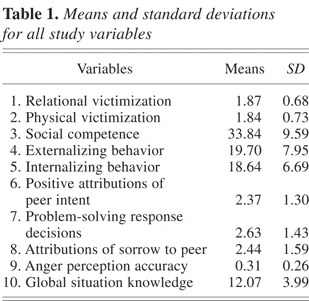
Descriptive statistics for the study variables are presented in Table 1. Before analyses, the variables were examined for normality and all measures were found to be normally distributed. Given that the low- and middle-income children did differ on family structure, family structure was coded as a dummy variable (1 = a one-parent home, 2 = two-parent families). However, it was unrelated to the study variables and, therefore, dropped from further consideration to increase power for the ensuing regression equations.
Means and standard deviations for all study variables

Interrelations among the study variables
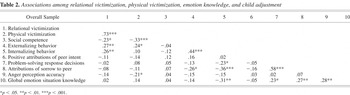
The associations among the variables were first addressed using correlational analyses. As shown in Table 2, for the entire sample, relational victimization was positively related to physical victimization and externalizing behavior. Physical victimization was also positively associated with externalizing behavior and negatively related to anger perception accuracy. Children who scored high on the measures of anger perception accuracy were also more likely to have high scores on global emotion situation knowledge. Preliminary correlational analyses indicated that the separate scores for the happy, sad, surprise, and fear-eliciting vignettes were unrelated to the outcome measures. For this reason and because there were no specific hypotheses regarding these measures, they were dropped from further consideration.
Associations among relational victimization, physical victimization, emotion knowledge, and child adjustment

The interrelations between the victimization measures and the social cognitive variables were also considered separately for boys and girls. However, we computed Fisher r to z analyses for each set of correlations in which the association was significant for one gender and not the other. None of the statistical tests were significant (p < .07). Still, we also computed multiplicative terms of the predictors by gender (after first centering the predictors), but no significant interactions were obtained. Therefore, the regressions are reported for the entire sample.
Multiple regression analyses
The regressions evaluated the predictive power of children's style of processing social information, anger perception accuracy, and global situation knowledge to the frequency with which children were physically and relationally victimized. Separate regressions were conducted for the two victimization measures. In each regression equation, age and income were entered as control variables on the first step. Social competence, externalizing behavior, and internalizing behavior were included on the second step because research has shown that all three indicators of adjustment are associated with the experience of being victimized by peers.
Deciding upon an order of entry for the social information processing variables and the emotion knowledge measures was more difficult as the causal links between emotions and peer-related social competence are unclear. It is possible that children's style of processing emotional information affects their style of processing social information (Lemerise & Arsenio, 2000). It is also possible that children's peer-related social competence affects their understanding of their own and others' emotions (Crick & Dodge, 1994). However recent research suggests that emotion understanding may precede children's abilities to process social information (see Fine et al., 2004). Nevertheless, each set of regressions was run twice, once with the emotion knowledge variables entered first and again with the social information processing variables entered first. The combined variance explained by each step and the unique variance explained by each predictor was investigated.
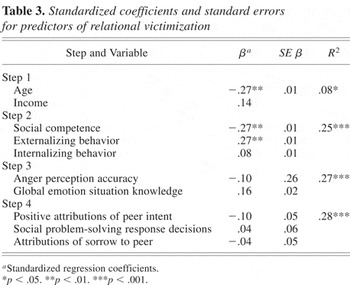
The first regression equation included relational victimization as the dependent variable. The first step that included age and income as predictors was significant, F (2, 90) = 3.82, p < .03, R2 = .08, due mainly to the significant negative effects of age. When the child adjustment measures were included on the second step, the model was significant, F (5, 85) = 5.57, p < .001, and accounted for additional 17% of the variance, ΔF (3, 85) = 6.37, p < .001. The inspection of the betas revealed that social competence was a negative predictor and that externalizing behavior was a positive predictor of relational victimization. When included on the third step, the emotion knowledge variables did not contribute additional unique variance. The inclusion of the social information processing variables on the fourth step also did not produce a significant result. A summary of these analyses is presented in Table 3. The findings were essentially unchanged when the social information processing variables were entered first.
Standardized coefficients and standard errors for predictors of relational victimization

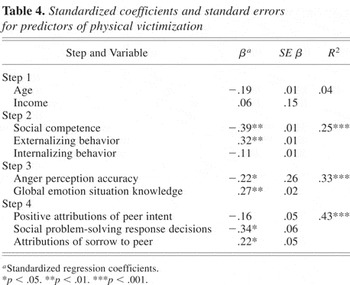
A similar regression analysis was performed for physical victimization. The first step that included age and income as predictors was not significant and accounted for only 4% of the variance. When the child adjustment measures were included on the second step, the model was significant, F (5, 85) = 5.58, p < .001 and accounted for additional 21% of the variance, ΔF (3, 85) = 7.90, p < .001. As before, social competence was a negative predictor and externalizing behavior was a positive predictor of physical victimization. The third step was also significant, F (7, 82) = 5.87, p < .001, and the emotion knowledge variables contributed an additional 8% of the variance, ΔF (2, 82) = 5.06, p < .01. Inspection of the betas revealed that global emotion situation knowledge was positively related to physical victimization and that anger perception accuracy was a negative predictor. The inclusion of the social information processing variables on the fourth step also produced a significant result, F (10, 78) = 5.96, p < .001, and accounted for an additional 10% of the variance, ΔF (3, 78) = 4.34, p < .01. The inspection of the betas revealed that positive social problem-solving response decisions were negatively related to physical victimization and that attribution of sorrow to the peer was a positive predictor. A summary of these analyses is presented in Table 4. Again, the findings were unchanged when the social information processing variables were entered first.
Standardized coefficients and standard errors for predictors of physical victimization

Discussion
The main purpose of this study was to investigate whether children's performance on emotion knowledge tasks and their style of processing social information processing were predictive of the degree to which children are chosen as frequent targets of peer aggression. Evidence was found that similar factors may be involved in peer aggression and victimization, but these factors appear to be operating somewhat differently for the aggressor and the victim. For example, aggressive children are more likely than nonaggressive children to attribute hostile intent and to propose negative behaviors in response to ambiguous peer situations (e.g., Quiggle et al., 1992). The theory is that these children are aggressive because they tend to act on these negative cognitions in their interactions with others (Crick & Dodge, 1994). Interestingly, the results revealed that the victimized children in our study had a pattern of social cognitions about emotions and peers (being poor at detecting anger and biased toward attributing sorrow toward provoking peers) that interfered with the fight or flight response that could help to protect them from victimization. Still, the pattern of associations was the opposite of those that have been reported for children who are highly accepted by their peers. In discussing the specific results, the association between emotion knowledge and peer victimization is first considered and then the role of the social information processing variables in predicting preschoolers' victimization experiences is discussed.
Anger perception accuracy was a negative predictor of physical victimization. Being able to understand situations associated with anger may reduce children's risks for physical victimization because they are able to successfully avoid angry peers and conflict-ridden situations. Other research has shown a negative relation between the accurate perception of anger and girls' aggression (Fine et al., 2004). The present research extends these findings to the experience of being victimized. Children who are accurate at recognizing anger in the bully may be better able to implement strategies that decrease their likelihood of becoming a target of physical aggression. Surprisingly, global emotion situation knowledge, which consisted of children's knowledge about situations that elicit happiness, sadness, surprise, and fear, was a positive predictor of physical victimization. Children who knew more about typical situations eliciting these emotions had a higher risk for physical victimization. This type of knowledge may not always be an accurate guide to avoiding physical victimization in the preschool context. Observational research with preschoolers has demonstrated that initiators of aggression are equally likely to display anger and happiness (39% of the initiators for both emotions; Arsenio et al., 2000). Moreover, children who display aggression-related happiness are more likely than their peers to initiate aggressive episodes (Arsenio et al., 2000). Although bullies display a range of emotions, emotions other than anger may mislead children about the possibility of impending physical aggression (Arsenio et al., 2000; Wilton et al., 2000). As a result, knowledge of emotions other than anger, although valuable to other components of peer-related competence, may not function to protect children from acts of physical intimidation. This hypothesis could be further explored with an interview study that assesses children's emotional reactivity and regulation, their beliefs about aggression, their understanding of emotions, and their understanding of emotional display rules.
We were surprised that the emotion variables were not unique predictors of relational victimization. We predicted that deficits in emotion knowledge would be especially important in predicting relational victimization because it involves subtle emotions and behaviors. It is possible that because relational aggression is more direct in its form among preschoolers (Crick et al., 1999), knowledge of subtle emotions and behaviors may be less important as a predictor than it might be among older children for whom relational aggression is more indirect. In addition, other aspects of emotional competence may be relevant for risks for victimization in preschoolers. For example, the bully may use relational victimization to cause emotional dysregulation in the victim, whereas physical acts of intimidation may be used when the bully desires a more tangible type of “reward.” Along these lines, perhaps the victim's inability to control the expression of negative emotion may be the emotion-related risk factor for relational victimization. Again, research that includes assessments of children's understanding and regulation of emotion would help us to better understand the role of emotional competence in the prediction of relational victimization.
In terms of the social information processing variables, attributions of sorrow to provoking peers were a positive predictor of physical victimization. That is, children who tended to describe peers who provoked them as being sorry for their behavior were more likely to be physically victimized. Children who view the peer as being sorry may be more likely to think of themselves as being liked by the aggressor, and may assume incorrectly that they are deserving of the poor treatment. Along these lines, these children may attribute negative characteristics to themselves rather than to the bully. Also, because they see the bully as “sorry” for his/her behavior, physically victimized children may perceive not perceive the peer as potentially threatening, and therefore make no attempt to avoid the bully. Children who know how to avoid the children and the situations that “pull for” peer aggression may be less likely to become victims. Thus, one interpretation of our results is that the preschool children at the greatest risk for being victimized are those who have difficulty detecting anger and thus see the victimizer as sorry for his/her acts and not potentially threatening. Thus, some children at risk for victimization may approach “risky” peer situations without the appropriate degree of wariness.
The results also indicated that positive social problem-solving response decisions were negatively related to physical victimization. Children who made appropriately assertive, neutral, and/or prosocial responses to the problems in the ambiguous provocation stimuli were less likely to be physically victimized. These findings indicate that children's social skills protect them from being victimized. On the other hand, ineffective and aggressive responses to these stimuli raised risks for physical victimization. This pattern of results is consistent with findings on “aggressive victims” that have been reported in school-age children (see Schwartz, Proctor, & Chien, 2001, for a review).
Despite the fact that internalizing behavior was associated with relational victimization in the univariate analyses, the regression results indicated that it was only externalizing behavior that was positively related to both relational and physical victimization. These findings are consistent with other work, which has shown that peer victimization is more strongly related to externalizing than to internalizing behavior (Schwartz, McFadyen-Ketchum, Dodge, Pettit, & Bates, 1998). Others have reported that peer victimization is correlated both concurrently and longitudinally with externalizing behavior, but only longitudinally associated with internalizing behavior (Hanish & Guerra, 2000). Perhaps, a bidirectional relation exists, such that anxiety and social withdrawal problems in early childhood predict later peer victimization, which may contribute to more long-term internalizing problems. Externalizing behavior may be a stronger predictor of victimization because aggression is more annoying and irritating to children and the bully may take the position that the aggressive victim “has it coming.” The correlational nature of this study means that it is also possible that children develop behavioral problems because of the victimization they experience. Furthermore, the linkages between externalizing behavior and victimization could be bidirectional. Victims may become aggressive to protect themselves from further victimization and, as a result, become more disliked, which contributes to further victimization.
It is also important to note that teachers were the reporters of children's internalizing behavior and it is possible that, although they have a global sense of children's level of adjustment, they may be less precise in their ability to distinguish among the different types of internalizing behaviors such as withdrawal and anxiety (Hanish & Guerra, 2000). These distinctions may be especially important in understanding the linkages between internalizing behavior and victimization for young children. A peer-report measure of internalizing and externalizing behavior has recently been developed (Weiss, Harris, & Catron, 2002) and, although this methodology is limited to use with older children, a combination of peer and teacher assessments could help us to better understand the linkages between behavioral problems and peer victimization.
The findings that social competence was negatively related to relational and physical victimization and that competent problem-solving responses were negatively related to physical victimization are also consistent with much of the research on this topic. According to Hanish and Guerra (2000), socially incompetent children may be viewed as “good targets” because the bully may believe that these children do not have any friends who will intervene on their behalf. For example, reduced victimization is seen in children who perceive that they have a friend who can help them (Kochenderfer & Ladd, 1997). Moreover, children who discontinue their victimization status from one school year to the next are more likely than children who continue their victim status to have mutual friendships (Browning, Cohen, & Warman, 2003). Finally, social support from close friends also seems to buffer the effects of victimization of children's adjustment (Prinstein, Boergers, & Vernberg, 2001). It is also possible that because socially incompetent children lack the social skills to deal with uncomfortable peer situations, they may also have less confidence in these situations, increasing the likelihood of being victimized.
The final issue that should be addressed has to do with the lack of effects for family income level and gender. Regarding income, the absence of an effect was not totally unexpected. The low- and middle-income children in this study were comparable on minority status, child gender, and age, factors that are often confounds in other research, giving credence to the idea that poverty itself is not the main explanation for children's elevated risk for social and emotional problems (Hoffman, 2003). For example, in a series of studies, Ackerman and his colleagues found that the contextual correlates of poverty such as family instability, harsh parenting, and other contextual risk factors such as the timing and persistence of poverty may be the unique predictors of child competence in economically disadvantaged children rather than earned income (Ackerman, Brown, & Izard, 2004; Ackerman, Kogos, Youngstrom, Schoff, & Izard, 1999). Future research should consider the impact of these contextual variables on young children's likelihood to be victimized by peers.
That gender was also unrelated to the victimization measures was a bit more surprising. The majority of research on this topic has indicated that boys are more likely to be physically victimized than girls and that girls tend to be relationally victimized (e.g., Crick et al., 1999). The lack of effects for gender may be due to the fact that teachers rather than independent observers reported on children's victimization experiences. Teachers may have been less aware of victimization, because of their other teaching responsibilities, than independent observers, who are in the preschool to specifically scan the environment for these incidents (Milfort & Greenfield, 2002). Despite the fact that main effects for both income and gender were not found, it is possible that the linkages we found are moderated by these variables, even though significant interactions were not obtained in the current research. The sample size in this research was 94, and there were missing data for some of the children. Therefore, the lack of interactive effects is not surprising given that detecting moderator effects with a sample size of less than 100 is difficult (Aguinis, 2004). It is important that researchers continue to investigate the possibility that gender and family income moderate the relations among the variables we studied.
Conclusion
In summary, despite its limitations, the results demonstrated that cognitions about peers and emotions are separate cognitive appraisal processes that contribute uniquely to relational and physical victimization in the preschool years. Still, future research with a larger sample that includes observer as well as teacher ratings of victimization and child adjustment would be helpful. In addition, a longitudinal design that includes assessments of peer victimization, emotion knowledge, and styles of social information processing at each time point would help to better explain the processes that link these variables.