Introduction
Globally, breast cancer is the most common cancer and the number one cause of cancer death in women. Reference Ferlay, Soerjomataram and Dikshit1,Reference Bray, Ferlay, Soerjomataram, Siegel, Torre and Jemal2 In Thailand, the disease is also a leading cancer, with an age-standardised incidence rate of approximately 28·5 females per 100,000 per annum. Reference Virani, Bilheem and Chansaard3 Currently, most breast cancer treatments are a combination of surgery, radiotherapy and systemic therapy, which lead to higher survival rates. Reference Clarke, Collins and Darby4–Reference McGale and Taylor8
One important complication of breast cancer treatment is arm lymphedema which is a swelling condition of the arm resulting from obstruction or disruption of lymphatic drainage in the axillary lymphatic system. Reference Khan, Amatya, Pallant and Rajapaksa9,Reference Schunemann and Willich10 The condition negatively affects physical, daily functional, social, emotional and quality of life aspects of women. Reference Jäger, Döller and Roth11,Reference Tobin, Lacey, Meyer and Mortimer12
The cumulative incidence of arm lymphedema after breast cancer treatment is approximately 3–70%, depending on the extent of axillary surgery, the use of radiotherapy, the measurement criteria used and the length of follow-up. Reference DiSipio, Rye, Newman and Hayes13–Reference Ribeiro Pereira, Koifman and Bergmann19
Previous studies have identified possible factors increasing the risk of arm lymphedema, including patient age, obesity, dissected numbers and levels of axillary lymph nodes, type of breast cancer treatment, radiation technique, tumour size and arm exercises after post-breast cancer treatment. Reference Ribeiro Pereira, Koifman and Bergmann19–Reference Norman, Localio and Kallan28 In this study, we sought to determine the prevalence and risk factors associated with the occurrence of arm lymphedema in breast cancer patients after surgery, adjuvant radiotherapy and standard adjuvant systemic treatments according to breast cancer stage and risk factors.
Methods
This retrospective cross-sectional study included data from 308 patients who were diagnosed with breast cancer after receiving surgery, adjuvant radiotherapy and standard adjuvant systemic treatments according to disease stage and risk factors at the Department of Radiation Oncology, Faculty of Medicine, Vajira Hospital, Navamindrahiraj University between January 2006 and December 2017. The research protocol was approved by an institutional ethics committee (Ref; COA98/2559). Data were also gathered from patient’s medical records.
Inclusion and exclusion criteria
Inclusion criteria were patients who had a stage I–III breast cancer diagnosis (according to the American Joint Committee on Cancer, 7th edition Reference Edge and Compton29 ) and had undergone surgery, including breast-conserving surgery, mastectomy with sentinel lymph node biopsy or axillary dissection followed by standard systemic treatment, with all patients undergoing adjuvant radiotherapy. Patients were excluded if they had a history of cancer in other organs, incomplete medical records, a history of previous radiation treatment in axillary areas and arm lymphedema before radiation treatment.
Variables
Potential risk factor variables were (1) age, (2) body mass index (BMI), (3) underlying diabetic disease, (4) side of treatment arm, (5) tumour size, (6) type of lymph node excision, (7) number of lymph node excisions, (8) number of positive lymph nodes, (9) staging, (10) type of breast surgery, (11) regional lymph node irradiation, (12) chemotherapy treatment, (13) targeted therapy treatment and (14) arm exercises.
Treatment
All patients underwent breast-conserving surgery or mastectomy as necessary based on tumour characteristics, surgeon recommendation and patient choice. Systemic therapy was delivered at the discretion of the oncologist involved in each case. Typically, cyclophosphamide–doxorubicin regimens and taxane were administered. Most patients started chemotherapy after recovering from surgery, and radiation therapy was delivered after the completion of chemotherapy. For radiation therapy, an axillary field was added if there were four or more nodes positive.
Follow-up and measurement of lymphedema
All patients were followed up to receive breast and arm examinations every 3 months during the first 2 years, then every 6 months until death. Arm lymphedema was determined as a difference in arm circumference on the treated side compared to the opposite arm of ≥2 cm at any one position, when examined twice by a doctor and averaged.
Statistical analysis
Data were analysed using SPSS statistical package for Windows (version 22·0; IBM Corp., Armonk, NY, USA). Data were described using frequency distributions, measures of central tendency and dispersion. Risk factor variables were included in univariate analyses. Variables that were statistically significant in univariate analyses underwent multivariate analyses using the Cox proportional hazards model. All p-values were two-sided and a p-value < 0·05 was considered statistically significant.
Results
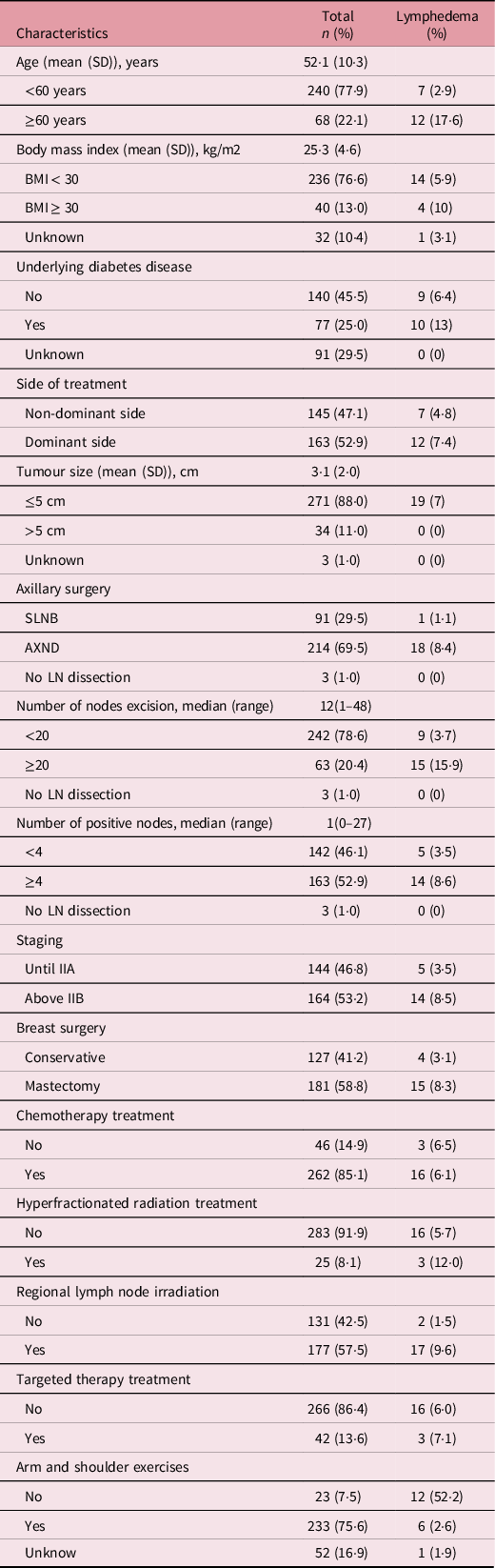
From 2006 to 2017, 308 breast cancer patients meeting study inclusion criteria were recruited. The median length of follow-up since breast cancer diagnosis was 4·4 years (range: 1–14·2 years). The prevalence of arm lymphedema after breast cancer treatment by patient, tumour and treatment characteristics is shown (Table 1). The mean age at breast cancer diagnosis was 52·1 years (standard deviation (SD) = 10·3 years). The mean BMI was 25·3 kg/m2 (SD = 4·6), of which 13% were obese (BMI ≥ 30 kg/m2). The prevalence of arm lymphedema was 6·2%.
Patient, tumour, treatment characteristics and occurrence and lymphedema prevalence of the breast cancer patients

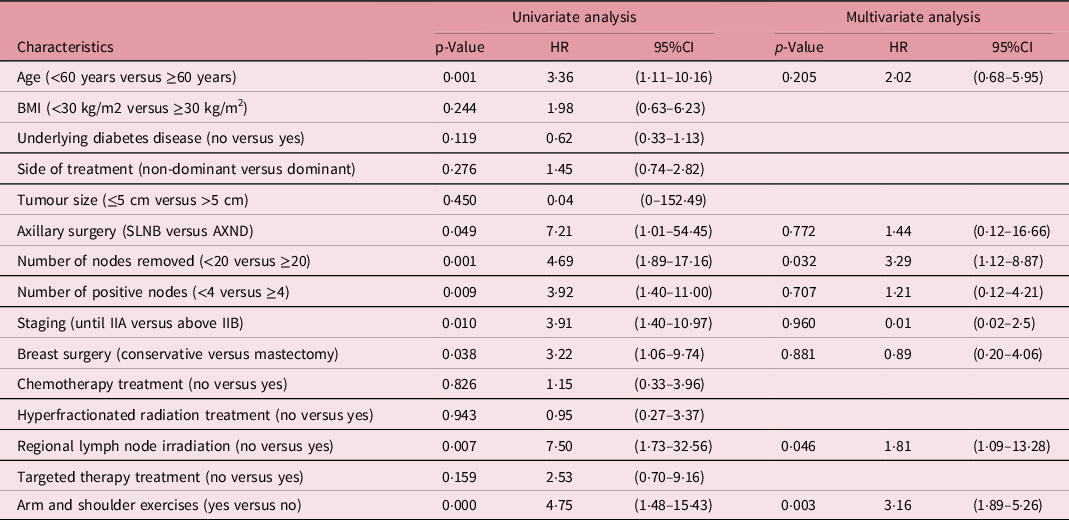
Hazard ratios (HRs) for all individual factors considered as potential risk factors for arm lymphedema are shown (Table 2). In considering patient characteristics, patients >60 years old and performing arm and shoulder exercises after complete treatment showed an increased risk in developing arm lymphedema (HR = 3·36, 95% CI: 1·11–10·16 and HR = 0·08, 95% CI: 0·03–0·20, respectively). In terms of tumour characteristics, a statistically significant increased risk in developing arm lymphedema was observed when patients were staged above IIB (HR = 3·91, 95% CI: 1·40–10·97) and having at least four positive lymph nodes (HR = 3·92, 95% CI: 1·40–11·00). Furthermore, in terms of breast cancer treatment characteristics, mastectomy (HR = 3·22, 95% CI: 1·06–9·74), axillary lymph node dissection (HR = 7·21, 95% CI: 1·01–54·45), removal of ≥20 lymph nodes (HR = 4·69, 95% CI: 1·89–17·16) and regional lymph node irradiation (HR = 7·5, 95% CI: 1·73–32·56) all increased the probability of developing arm lymphedema.
Factors affected lymphedema: univariate and multivariate analysis

Variables that were statistically significant in univariate analyses underwent multivariate analyses (Table 2). The removal of ≥20 lymph nodes, regional lymph node irradiation, and no arm and shoulder exercises after complete treatment were independently associated with an increased risk of arm lymphedema with an adjusted HR of 3·29 (95% CI: 1·12–8·87) for the removal of ≥20 lymph nodes, 1·81 (95% CI: 1·09–13·28) for regional lymph node irradiation, and 3·16 (95% CI: 1·89–5·26) to no arm and shoulder exercises after complete treatment.
Discussion
The prevalence of patients with arm lymphedema after breast cancer treatment was 6·2%. While several studies have reported this prevalence ranges between 3% and 70%, comparisons across studies are difficult because of variability in arm lymphedema definition and measurement techniques, follow-up times, and patient characteristics. Reference DiSipio, Rye, Newman and Hayes13–Reference Ribeiro Pereira, Koifman and Bergmann19 In a recent meta-analysis, the overall estimated incidence of the condition after breast cancer treatment was 16·6%. Reference DiSipio, Rye, Newman and Hayes13 The reason for such a low prevalence rate in our study may have been due to the fact we used only one method of arm lymphedema assessment. From other studies, incidences were high when assessed by more than one diagnostic method Reference DiSipio, Rye, Newman and Hayes13 and also from a lack of diagnostic criteria for breast cancer-related arm lymphedema. Reference DiSipio, Rye, Newman and Hayes13 Another reason for a possible underestimation may have been due to the median follow-up time; in this study, this was 4·4 years, thus the longer a woman’s exposure to risk factors, the greater the chance of developing arm lymphedema. With a 20-year follow-up, Petrek et al. Reference Coen, Taghian, Kachnic, Assaad and Powell25 reported that the ongoing risk of developing the condition was approximately 1% per year for at least 20 years.
Current data on whether arm lymphedema incidence varies by age are inconsistent. A higher incidence of arm lymphedema in older patients was observed in some studies, Reference Bergmann, Mattos, Koiffman and Ribeiro16,Reference Ugur, Arıcı and Yaprak23,Reference Ahmed, Schmitz, Prizment and Folsom24,Reference Clough-Gorr, Ganz and Silliman27 possibly due to a progressive loss of lymphvenous anastomosis due to ageing processes. Reference Deo, Ray and Rath17–Reference Ribeiro Pereira, Koifman and Bergmann19,Reference Ribeiro Pereira, Koifman and Bergmann19–Reference Norman, Localio and Kallan28 This finding was not observed in our study; patients >60 years old showed no increased probability of developing arm lymphedema after adjusting for others characteristics.
BMI is a modifiable risk factor for arm lymphedema; previous studies have shown that patients with a higher BMI were at a higher risk of arm lymphedema. Reference Ribeiro Pereira, Koifman and Bergmann19,Reference Ahmed, Schmitz, Prizment and Folsom24,Reference Petrek, Senie and Peters26,Reference Norman, Localio and Kallan28,Reference Ridner, Dietrich, Stewart and Anmer30 The mechanism whereby excess weight increases the risk of the condition remains unclear; however, extra demands on both the vascular and lymphatic system to transport fluid could impair lymphatic transport capacity and impair lymphatic functions thereby promoting adipose deposition. Reference Ridner, Dietrich, Stewart and Anmer30,Reference Mehrara and Greene31 In contrast, our study failed to show an association between higher BMI and increased risk of arm lymphedema development; therefore, more studies are required to explore such associations.
The majority of studies show that arm lymphedema risk increases with more extensive treatments, in particular breast surgery, Reference DiSipio, Rye, Newman and Hayes13,Reference Ribeiro Pereira, Koifman and Bergmann19,Reference Coen, Taghian, Kachnic, Assaad and Powell25–Reference Norman, Localio and Kallan28 lymph node removal Reference Ahmed, Schmitz, Prizment and Folsom24,Reference Paskett, Naughton, McCoy, Case and Abbott32,Reference Kwan, Darbinian and Schmitz33 and adjuvant treatment. Reference Ragaz, Jackson and Le7,Reference DiSipio, Rye, Newman and Hayes13,Reference Ribeiro Pereira, Koifman and Bergmann19,Reference Jung, Shin and Kim21,Reference Ahmed, Schmitz, Prizment and Folsom24,Reference Paskett, Naughton, McCoy, Case and Abbott32,Reference Kwan, Darbinian and Schmitz33 Several studies have demonstrated arm lymphedema rates of 24% to 49% after mastectomy and 4% to 28% after lumpectomy, with a history of axillary lymph node surgery. Reference Ribeiro Pereira, Koifman and Bergmann19,Reference Coen, Taghian, Kachnic, Assaad and Powell25–Reference Norman, Localio and Kallan28 The Axillary Lymphatic Mapping Against Nodal Axillary Clearance trial demonstrated that lymphedema was observed in approximately 5% of patients who had SLNB versus 13% of those who had ALND. Reference Mansel, Fallowfield and Kissin34 Radiation therapy is an independent risk factor for the development of arm lymphedema with reported rates of 2% to 5%, even in the absence of lymph node surgery. Reference Kiel and Rademacker35,Reference Johansen, Overgaard, Blichert-Toft and Overgaard36 Radiation to the axilla is associated with 2 to 4·5 times greater risk of lymphedema and 8 to 10 times greater risk when a patient receives ALND and radiation treatment. Reference Kissin, Querci Della Rovere, Easton and Westbury37,Reference Kwan, Jackson and Weir38 For systemic treatment, there are conflicting studies about chemotherapy as possible risk factors for arm lymphedema. Some studies indicate that adjuvant chemotherapy is a potential risk factor for arm lymphedema. Reference Ragaz, Jackson and Le7,Reference DiSipio, Rye, Newman and Hayes13,Reference Ribeiro Pereira, Koifman and Bergmann19,Reference Jung, Shin and Kim21,Reference Ahmed, Schmitz, Prizment and Folsom24,Reference Paskett, Naughton, McCoy, Case and Abbott32,Reference Kwan, Darbinian and Schmitz33 DiSipio et al. Reference DiSipio, Rye, Newman and Hayes13 did a meta-analysis of 72 studies published from 2000 to 2012 to assess the incidence rates of BCRL, and a meta-analysis of 29 studies published from 2000 to 2012, to assess the risk factors. This study demonstrated that about 75% of the studies reviewed indicated chemotherapy as a risk factor for developing arm lymphedema. Reference DiSipio, Rye, Newman and Hayes13 Our study also demonstrated that having >20 lymph nodes removed during axillary dissection increased the HR 3.3-fold, and having regional lymph node irradiation increased the HR 1.81-fold. We failed to confirm an association between arm lymphedema development and type of breast surgery, type of lymph node dissection and adjuvant systemic treatment. The reason for this may be due to improvements in treatment techniques to minimise lymphatic disruption and the improved selection of systemic treatments in recent years. Reference Shaitelman, Cromwell and Rasmussen39
From our multivariate analyses, staging at diagnosis did not increase the risk of developing arm lymphedema. This agreed with the systematic review; staging was classified as a weak or inconclusive independent risk factor for developing arm lymphedema. Reference DiSipio, Rye, Newman and Hayes13
Arm and shoulder exercise after breast cancer treatment is an important independent risk factor for arm lymphedema. We observed that arm and shoulder exercises decreased the risk of developing arm lymphedema by 0·08 and 0·15 times, based on univariate and multivariate analyses, respectively. Consistent with others study, arm and shoulder exercises reduced breast cancer treatment complications and side effects, including arm lymphedema, functional limitations and upper limb disability. Reference Courneya, Segal and Mackey40–Reference Milne, Wallman, Gordon and Courneya43
Conclusions
Arm lymphedema-related breast cancer treatment is a significant morbidity affecting many breast cancer patients. Patients having >20 lymph nodes removed during axillary dissection, regional lymph node irradiation, and no arm and shoulder exercises had a higher risk of arm lymphedema. Thus, this condition is a possible preventable morbidity. Planning arm and shoulder exercises post-adjuvant treatment of patients with breast cancer and increasing health professional awareness of the early diagnosis of arm lymphedema could help reduce morbidity in these patients. Future studies should focus on the arm and shoulder exercises that can prevent arm lymphedema after breast cancer treatment.
Acknowledgements
The authors would like to thank the Faculty of Medicine Vajira Hospital, Navamindrahiraj University, for the all-work support and fund.
Financial Support
This work was supported by the Faculty of Medicine Vajira Hospital, Navamindrahiraj University
Conflict of Interest
All authors declared no conflict of interest.
Ethical Standards
The authors assert that all procedures contributing to this work comply with the ethical standards of the relevant national guidelines on human experimentation and with the Helsinki Declaration of 1975, as revised in 2008, and have been approved by the institutional committees of faculty of Medicine, Vajira Hospital, Navamindrahiraj University (Ref; COA98/2559).