Antibiotic use is common in neonatal intensive care units (NICUs). Although much antibiotic use is necessary, an estimated one-third of neonates receive an inappropriate course of antibiotics during hospitalization. Reference Patel, Oshodi and Prasad1 Despite adverse consequences associated with antibiotic exposure in extremely low birthweight (ELBW) infants, including necrotizing enterocolitis and invasive candidiasis, antibiotics are used frequently in NICU settings. Reference Cotten, Taylor and Stoll2 Previous studies have reported that antibiotic use varies greatly across US NICUs, with point prevalence estimates of 17%–46% of neonates receiving antibiotics on any given day. Reference Grohskopf, Huskins and Sinkowitz-Cochran3,Reference Ho, Buus-Frank and Edwards4 Additionally, there is substantial variation in antibiotic use across individual NICUs. Reference Schulman, Dimand, Lee, Duenas, Bennett and Gould5 Understanding factors associated with this variation may guide antimicrobial stewardship efforts. The objectives of this study were to quantify and identify factors associated with among US NICUs in the era of broadly implemented antimicrobial stewardship programs (ASPs).
Methods
We conducted a cross-sectional study of antibiotic use in 51 US NICUs participating in the Pediatric Health Information System (PHIS). The PHIS is a clinical and resource utilization database including data from >50 freestanding children’s hospitals. Patients and hospitals were assigned de-identified study numbers to protect data privacy. The study was exempted from further review by the Vanderbilt University Institutional Review Board.
We previously reported no significant seasonal variation in antibiotic use (see Supplementary Table for NICU subpopulation online); Reference Griffith, Dantuluri and Thurm6 therefore, we selected a single, midweek study day (October 25, 2017) a priori. We included all infants who were hospitalized (including those admitted or discharged) in PHIS NICUs on the study day, regardless of age. Systemic and broad-spectrum antibiotics were defined as previously published (Table 1). Reference Griffith, Dantuluri and Thurm6 We reported antibiotic use according to patient characteristics including age, gestational age at birth, sex, race or ethnicity, and service line (medical or surgical) as determined by all patient-refined diagnosis-related group (APR-DRG, version 32, 3M, Maplewood, MN). Differences between groups were measured using the χ Reference Cotten, Taylor and Stoll2 test or the Fisher exact test. Hospital characteristics included geographic census region and case mix index (CMI), a surrogate for illness severity. Reference Griffith, Dantuluri and Thurm6 We calculated the prevalence of antibiotic use by dividing the number of patients who received at least 1 antibiotic (or 1 broad-spectrum antibiotic) by the number of patients hospitalized in NICUs on the study day. We also measured the association between NICU antibiotic use prevalence and median hospital CMI using the Pearson correlation. Analyses were conducted using Stata version 15.1 software (StataCorp, College Station, TX).
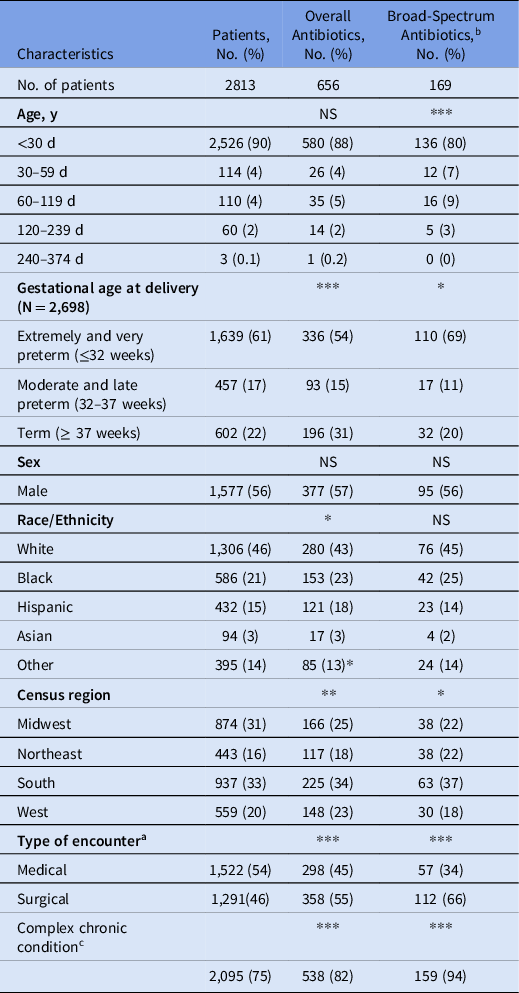
Characteristics of Infants Hospitalized in 1 of 51 Participating US NICUs on the Study Date, October 25, 2017

Note. NS, not significant.
a Each patient encounter day is coded as either medical or surgical based on service line charge data.
b Broad-spectrum antibiotics: cefepime, ceftaroline, piperacillin-tazobactam, carbapenems (meropenem, imipenem, doripenem, ertapenem), fluoroquinolones (ciprofloxacin, levofloxacin, moxifloxacin), vancomycin, daptomycin, linezolid.
c Complex chronic condition (CCC) was defined according to Feudtner et al Reference Feudtner, Feinstein, Zhong, Hall and Dai10 as “any medical condition that can be reasonably expected to last at least 12 months (unless death intervenes) and to involve either several different organ systems or 1 organ system severely enough to require specialty pediatric care and probably some point of hospitalization in a tertiary-care center.” Prematurity is included as a category of CCC.
*P ≤ .05; **P ≤ .01; ***P ≤ .001.
Results
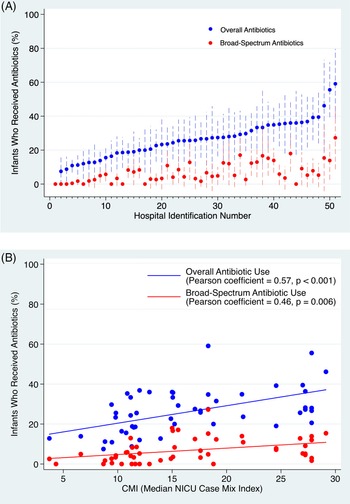
On the study day, 2,813 infants were hospitalized across 51 participating NICUs. Median NICU census was 44 patients (range, 5–220). Patient characteristics are summarized in Table 1. Of 2,813 neonates, 656 (23%) received at least 1 antibiotic on the study day. Of those receiving an antibiotic, 169 (26%) of 656 received at least 1 broad-spectrum antibiotic. The prevalence of overall antibiotic use ranged from 0% to 59% across individual NICUs (Fig. 1A). Ampicillin (25%), gentamicin (19%), vancomycin (10%), and cefazolin (7%) were the most commonly prescribed antibiotics. Across hospitals, NICU antibiotic use prevalence had a positive correlation with hospital CMI (Pearson coefficient, 0.57; P< .001) (Fig. 1B). The proportions of neonates receiving at least 1 antibiotic were highest in the West census region (148 of 559, 26%) and the Northeast (117 of 443, 26%), followed by the South (225 of 937, 24%) and Midwest (166 of 874, 19%; P = .02).
(A) Prevalence of overall and broad-spectrum antibiotic use (circles indicate % antibiotic use; dashed lines indicate 95% confidence intervals) and (B) correlation between prevalence of antibiotic use and case mix index of NICU.

Broad-spectrum antibiotic use
Broad-spectrum antibiotic use prevalence ranged from 0% to 27% across NICUs; 8 NICUs reported no broad-spectrum antibiotic use on the study day (Fig. 1A). The most commonly used broad-spectrum agents were vancomycin (10% of all antibiotic use), cefepime (4%), and piperacillin-tazobactam (4%). Broad-spectrum antibiotic use was significantly and positively correlated with hospital CMI (Pearson coefficient, 0.46; P = .006) (Fig. 1B). Broad-spectrum antibiotic use was highest in the Northeast (9%) and was lowest in the Midwest (4%).
Combination antibiotic use
Overall, 345 (12%) of 2,813 patients received >1 antibiotic, and 345 (52%) of 656 patients who received an antibiotic received >1 antibiotic. Ampicillin and gentamicin accounted for 142 (41%) of 345 patients receiving combination antibiotics. The next most prescribed combinations were ampicillin and ceftazidime (13 of 345, 4%), cefepime and vancomycin (13 of 345, 4%), ampicillin and cefotaxime (12 of 345, 4%), vancomycin and piperacillin-tazobactam (12 of 345, 4%), and vancomycin and gentamicin (11 of 345, 3%).
Antibiotic use and patient-level characteristics
The proportions of infants receiving antibiotics were similar among infants aged <30 days (580 of 2,526, 23%) and ≥30 days (76 of 287, 26%, P = .18), although broad-spectrum antibiotics were used more frequently in infants aged >30 days of age: 33 (11%) of 287 versus 136 (5%) of 2,526 (P < .001). A greater proportion of term infants received antibiotics (196 of 602, 33%) than preterm infants (429 of 2,096, 12%; P < .001). By race or ethnicity, overall antibiotic use varied from 18% to 28%: Asian (18%), White (21%), Other (22%), Black (26%), and Hispanic (28%) (P = .01). In contrast, we detected no significant differences in broad-spectrum antibiotic use by race or ethnicity (P= .67).
Medical versus surgical antibiotic use
Overall antibiotic use was greater in patients admitted to surgical compared to medical service lines: 358 (28%) of 1,291 versus 298 (20%) of 1,522 (P < .001). Among patients receiving antibiotics, broad-spectrum antibiotic use was similarly greater among patients on surgical versus medical service lines: 112 (31%) of 358 versus 57 (20%) of 298 (P < .001). Ampicillin (15% and 30%), gentamicin (14% and 25%), and vancomycin (11% and 8%) were the 3 most frequently used antibiotics for both surgical and medical patients, respectively.
Discussion
In this assessment of US NICUs, 23% of infants received at least 1 antibiotic on a given study day. This rate is substantially lower than the 46% prevalence of antimicrobial use (primarily antibiotic agents) reported in a similar 2005 study, although differences in study designs limit direct comparisons. Reference Grohskopf, Huskins and Sinkowitz-Cochran3 The magnitude of this difference and findings from another recent study suggest that the prevalence of NICU antibiotic use may have declined. Reference Ho, Buus-Frank and Edwards4 This difference may be due to increased recognition of adverse consequences of early-life antibiotics, increasing implementation and acceptance of NICU ASPs, quality improvement collaboratives, Reference Ho, Buus-Frank and Edwards4 and universal group B Streptococcus screening and preventive intrapartum antibiotics.
We identified substantial variability in antibiotic use by NICU, as well as by geographic location, encounter type, gestational age, and race. Although some variability may be explained by patient complexity or acuity, the only moderate correlation between antibiotic use and CMI suggests other factors likely contribute to observed variability. Future studies should consider antibiotic use in the context of healthcare utilization more broadly, which may aid in identifying upstream drivers of use.
Studies in other settings, such as the pediatric ICU, emergency department, and outpatient settings, have often identified higher antibiotic use in the US South census region than other regions, Reference Griffith, Dantuluri and Thurm6–Reference Hicks, Bartoces and Roberts8 a finding not observed in our study, although our estimates were not population-based. This finding may reflect greater patient homogeneity or several other factors associated with care in this specialized setting. This observation may provide an opportunity to better understand why prescribing behavior varies by region and care setting.
Our study has several limitations. We used administrative data, which may provide imperfect measurements and lead to misclassification. Reference Garland, Gershengorn, Marrie, Reider and Wilcox9 We were unable to determine the appropriateness of antibiotic prescriptions with regard to indication, local resistance rates, treatment duration, or dosage. Antibiotics considered ‘reserved’ or requiring ASP approval are not standardized across hospitals, limiting descriptions of the frequency of use of ‘restricted’ antibiotics. Additionally, that status of ASPs at individual hospitals was not available. NICUs that are not associated with a children’s hospital were not included; thus, these findings may not be generalizable to those settings. In this study, we focused on systemic antibiotics; other antimicrobials were not evaluated.
In conclusion, our study has demonstrated substantial variability in antibiotic use among NICUs. Additional studies are needed to identify drivers of variability to guide antibiotic stewardship efforts and mitigate adverse consequences of inappropriate antibiotic exposure in early life.
Acknowledgments
Financial support
This work was supported in part by the Childhood Infections Research Program (NIAID grant no. 5T32-AI095202-08 to M.D.), David T. Karzon Fellowship in Pediatric Infectious Diseases, and the Vanderbilt University TIPS program (grants to C.G.G. and L.M.H. Dr Grijalva is supported by the National Institutes of Health (grant no. K24AI148459). Dr Howard is supported by the National Institutes of Health (grant no. 1K23AI141621).
Conflicts of interest
Leigh M. Howard has received research support from Pfizer, outside the submitted work. Ritu Banerjee has received research support from Biomerieux, Roche, and BioFire, outside the submitted work. All other authors report no conflicts of interest. Carlos G. Grijalva has received consulting fees from Pfizer, Merck, and Sanofi, and has received research support from Sanofi, Campbell Alliance/Syneos Health, the Agency for Healthcare Research and Quality, the National Institutes of Health, the US Food and Drug Administration, and the Centers for Disease Control and Prevention, outside the submitted work.