Five chapters after the famous foggy opening of Charles Dickens's Bleak House (1853), the novel's protagonist Esther Summerson disappears into thick air. Esther's “darling,” the young orphan Ada Clare, first discloses her companion's climatic dissolution when she celebrates her kind-hearted treatment of the hapless Jellyby children. Although Ada and Esther's guardian John Jarndyce maintains that a shower of “sugar-plums, or three-cornered raspberry tarts,” might be a suitable remedy for the children's neglect, Ada contradicts this proposition when she makes the odd claim, “It did better than that. It rained Esther” (61). This assertion that Esther's precipitated personhood is a “better” palliative than an abundance of sugared confections undoubtedly evinces Ada's childlike appreciation of her companion's effusive goodness. Within the larger scope of the novel, however, the remarkable notion that Esther's seemingly embodied actions and emotions are equivalent to rain, raises an unexpected but essential question: To what ends does Dickens's protagonist evaporate into the dense atmosphere we traditionally associate with the setting of Bleak House?
As I will establish in this essay, Esther's disappearance into the ether renders her a tentatively embodied subject, one whose affinity with diffuse forms of vapor, mist, and rain punctuates the novel. Ada's metaphor therefore belongs to a larger pattern of female characterization in Bleak House, one that hardly conforms to the kinds of material embodiment critics usually identify in Victorian realist fiction. “In proposing the body as the source and location of human essence,” William A. Cohen contends, “literary writers established a mode of representation – typified by characterological roundness, depth, and interiority – that has long been regarded as the hallmark of high Victorian literary accomplishment” (xi). Cohen's detailed consideration of how physical identity illuminates an individual's psychology upholds the critical commonplace that characters in nineteenth-century fiction are consistently embodied and typically exhibit a more or less developed interior life.Footnote 1 Yet Ada's metaphor identifies a character-based ethereality that undercuts such claims by disengaging Esther's physicality from her interiority.
Esther's ether is therefore markedly different from the kinds of atmosphere that envelop characters in the sensation novel or detective story. The “living figure . . . pass[ing] darkly along the outer edge of mist” that Marian Halcombe and Laura Glyde observe in Wilkie Collins's The Woman in White (1860) and the “dense bank” of moorland fog that foreshadows the unnatural “shape . . . more savage, more appalling” than “the delirious dream of a disordered brain” in Arthur Conan Doyle's The Hound of the Baskervilles (1902) represent the familiar use of fog to sustain mystery and suspense in popular genres of Victorian fiction (Collins 266; bk. 4, ch. 5 and Doyle 586–88; ch. 14). In the 1850s, however, Dickens's atmospheric representation discloses the perceived corporeal and mental unpredictability of a realistic female body rather than the questionable materiality of an apparition. Esther's instability is all the more noticeable because she is the first-person narrator of Bleak House as well as its protagonist: her prominence within the plot enables her to write her “portion of these pages” in tandem with the omniscient account of the novel's third-person speaker (17; ch. 3). Because she is a first-person narrator, then, we might assume her embodiment would be reliable. Yet, as I argue here, at several key moments in the narrative, the atmosphere disperses Esther's embodiment and occludes her interiority, making her a tentative storyteller and subject alike. The ether consequently draws attention to Esther's status as both first-person narrator and protagonist and, at the same time, raises a question that many Victorian novels grapple with: How can character represent what contemporary cultural discourse viewed as the fundamental volatility of women's emotion and embodiment?
In contrast to the most famous instance of atmospheric transformation in Bleak House – the spontaneous combustion and aerial dissemination of the character Krook – Ada's evocation of a raining Esther does not merely make literal what we already know to be metaphorical (in this case, Krook's pervasive corruption). Instead, Ada tellingly employs atmosphere as an agent that absorbs and replaces character traits associated with the feminine and the domestic: Esther “nursed” the Jellyby children, Ada admiringly reports. She “coaxed them to sleep, washed and dressed them, told them stories, kept them quiet” (62; ch. 6). In spite of the cultural and emotive value Ada attributes to these maternal gestures, her climatic metaphor represents them as vagaries of the weather rather than incarnated actions. Likewise, when Esther's mother Lady Dedlock comes to the sudden realization that her daughter is alive, Dickens's narrator subdues the intensity of her visceral reaction with a dissipating aerial metaphor: “her exclamation and her dead condition seem to have passed away like the features of those long-preserved dead bodies sometimes opened up in tombs,” he states, “which, struck by the air like lightning, vanish in a breath” (362; ch.29). In these scenes, as in those I discuss below, women's bodies metaphorically and formally vanish under the pressure of their embodied emotion. In a fog-ensconced moment of maternal affection, for instance, Esther demonstrates a characteristic inability to sustain her sense of self under emotional circumstances; as she embraces one of the Jellyby children, she paradoxically describes the process of becoming “no one” (45; ch. 4), just as her contemplation of the cloudy light above London prior to her near-fatal illness in chapter thirty-one encourages her to describe the “indefinable impression of [herself] as being something different from what [she] then was” (380; ch. 31). In these episodes, Esther's singular and alienating encounters with the ether act as a counterpoint to the fog that goes “everywhere” in Bleak House, enfolding various characters, geographies, and civic systems within its sweeping reach.
Although scholars have not addressed the ways in which atmosphere intermittently occludes Esther's interiority and dissolves her physicality, many have of course written insightfully about the novel's pervasive fog. As J. Hillis Miller contends, the “fog and mud of its admirable opening” illustrates “the interconnectedness of people in all levels of society” (180–81). Q. D. Leavis also focuses on the universality of the “fog that emanates from and is concentrated in the heart of London's Chancery Court,” asserting that it acts as a “parable” for “the bearing of Justice and Equity on religion, morals, and ethics, and on social sanctions and institutions” (124–25). More recently, Lauren Goodlad has discussed the ways in which Dickens's critique of the Public Health Act of 1848, a legislative response to Edwin Chadwick's Report on the Sanitary Condition of the Labouring Population of Great Britain (1842), constitutes another of the novel's institutional critiques (86–88).Footnote 2 Finally, readings of the novel's treatment of sanitary reform discuss the way in which miasma, or the “noxious vapour rising from putrescent organic matter” (“Miasma,” def. 1), informs the staunch moralism of Dickens's third-person narrator, who claims that the “pestilential gas” of London slums “shall work its retribution, through every order of society” (553; ch. 46). Such discussions share a persistent inclination to interpret the tainted air in Bleak House as the origin of the unnamed illness that passes from the orphan Jo to Esther's “little maid” Charley and, finally, to Esther herself; yet analyses of this kind ultimately lead back to the overt social critique of the novel's opening, drawing attention once again to Victorian debates about legal and sanitary reform.Footnote 3
As I contend here, however, mid-nineteenth-century conceptions of ether and perceptions of its physical and chemical function establish a set of formal and historical concerns distinct from those generated by Dickens's institutional critique or Chadwick's influential commentary. Specifically, Thomas Young's light wave theory, developed in 1801, focused on the physical potentiality of “luminiferous ether” – simply defined as “an elastic solid that filled space and whose transverse undulations constituted light waves” (Siegel 239). Young does not conceive of ether as synonymous with air but rather as part of it, its unique vibrations producing light in the same way that vibrations in the air created sound (Cantor and Hodge 46–47). Young's theorization of the transmissive properties of air helps foster Victorian perceptions of atmosphere as a medium that contained both purpose and meaning. By the 1850s, Stephen Connor contends, the existence of ether, “universally diffused, unimaginably tenuous, but indispensably existent, was widely accepted, at least among British . . . physicists,” making it a “thoroughly nineteenth-century notion” (148).Footnote 4 Concomitant to these developments in the physical sciences, those in Victorian medicine encouraged a very different notion of ether and its properties. After pioneering surgical demonstrations in 1846, the chemical known as ether, a “colourless, light, volatile liquid, (C4H10O) resulting from the action of sulphuric acid upon alcohol,” came to be widely recognized as a potent anesthetic (“Ether,” def. 6a).Footnote 5 General enthusiasm over the painkilling and sedative properties of the drug was so great that James Robinson, the first British physician to demonstrate its revolutionary effects, proclaimed, “The steam of ether and other substances innumerable, if properly applied, may lead to results as new, whether in surgery, physiology, or psychology as the steam of water and its application has been in the physical, domestic, and social existence of mankind” (274).
Robinson not only expresses the popular perception that ether was a new technology ushered in by the industrial age but also emphasizes its dual physical and psychological effects: its potential efficacy in the operating theatre as well as in the home. Radical as Robinson's claims may have been, at the time Bleak House was published, ether had been commercially available for over twenty years and was widely recognized as a treatment for the supposed physical and emotional volatility of women.Footnote 6 As Mary Poovey has recognized, at mid-century medical professionals helped reinforce the commonplace assertion that the female body was fundamentally changeable, characterized by a variableness that was “inaugurated by puberty, signaled by menstruation, and epitomized in childbearing” (36). As a consequence of this alleged instability, doctors increasingly turned to anesthetics such as ether in order to treat the pain of childbirth and outbursts associated with “hysteria.”
Accordingly, the Victorian perception of women's physical unpredictability created the conditions in which a leading novelist could represent a female protagonist, and first-person narrator, as an extraordinarily mutable literary subject. Particularly in light of Dickens's first-hand experience with the effects of anesthesia during the birth of his and Catherine Hogarth's son in 1848, it is essential to understand how atmospheric characterization in Bleak House mediates the cultural discourse surrounding women's fluctuating embodiment and psychology. As I contend here, the narrative literalizes its protagonist's physical precariousness, on the one hand, and controls it with the ether's dulling and disorienting effects, on the other hand. As a result, Esther's ether performs a diegetic function that exceeds the political and social critique of the novel's opening and instead draws our attention to the difficulty of representing female characters as decisively embodied subjects.
In what follows, then, I first show how critical discussions about the realism of Krook's and Esther's characters are key to understanding their respective relationships to the air. After bringing Esther's dissolute embodiment into focus by comparing it to Krook's very different mode of atomization, I discuss how the atmosphere obstructs her first-person point of view and limits her subjectivity. Next, I examine the historical context that gives rise to the anesthetic properties of ether and claim that, despite its deadening effects, the atmosphere occasionally allows Esther to adopt a semi-omniscient point of view. This temporary clear-sightedness, I finally contend, aligns her with the novel's disembodied omniscient narrator, suggesting that only by leaving the gendered self behind can she act as an authoritative narrative voice.
I. Esther versus Krook: The Atmospheric Negotiation of Realist Embodiment
Although Esther's ether reveals the formal complexities of representing a female subject as an embodied character and first-person narrator, Krook's spontaneous combustion is explicitly allegorical. As the novel's parodic “Lord Chancellor,” and owner of the rag and bottle shop just outside the Courts of Chancery, Krook exemplifies the fictive reciprocity between corrupted and corrupting social institutions, human bodies, and the foul city air. To be sure, his atmospheric dissemination is almost inseparable from the fog that fills the opening pages of Bleak House, exemplifying England's archaic and destructive legal system as well as contemporary beliefs about miasma and contagion. Like the organizational power of Chancery that “insinuates itself by virtue of its quasi-alchemical subtlety,” according to D. A. Miller (60–61), the “foetid effluvia” that hangs over London after Krook's demise is unmistakably poisonous and unexpectedly common: It supports what Dickens's unnamed narrator describes as “the same death eternally – inborn, inbred, [and] engendered in the corrupted humours of the vicious body itself” (393; ch. 32 and 404; ch. 33).
Krook's combustion thus incorporates what initially seems to be his shocking volatility with the novel's other forms of dirty air, throwing Esther's periodic and quiet effacement into sharp relief. Although the novel dramatizes Krook's aggressive assault on the atmosphere and emphasizes his persistent physicality (convulsive though it may be), Esther's physical and psychic unpredictability comes in and out of focus, making her volatility more troubling – more in need of narrative and atmospheric control – than Krook's. In other words, Krook ruptures from within, creating “a smouldering suffocating vapour” that retains its material presence long after his death; Esther, by comparison, is tentatively embodied and periodically subject to changes in the novel's climate (402; ch. 32).
As G. H. Lewes famously argues in his 1852 review of Bleak House, Krook's spontaneous combustion notoriously pushes Dickens's realism to the breaking point, yet there remains a persistent scholarly tradition of reading Esther in terms of its most basic tenets.Footnote 7 Scholars who write about Esther, especially those adopting feminist or psychoanalytic approaches, maintain that embodiment and psychology are essential elements in understanding her character and the narrative she co-authors.Footnote 8 Despite long-standing debates about the tenuous realism of Dickens's novels, by contending that Esther's body allows us insight into her interiority, these critics tacitly uphold the assumption that consistent embodiment and legible interiority are typical traits of protagonists in Victorian fiction. As a result, acknowledging the limits of Esther's characterization does not entail categorizing Bleak House as a definitively realist novel but instead urges us to analyze how atmosphere transforms major characterization in Dickens's work and Victorian fiction at large. As we will see, the air confounds Esther's narration as well as her embodiment, making it difficult for her to maintain an authoritative account of her self and the world around her, or for us to understand her as a traditionally realist subject circumscribed by the bounds of materialist analysis.
II. Into the Fog: Esther's Narrative Dilemma
When Esther arrives in London at the opening of her narrative, she immediately finds herself in the midst of an impenetrable fog. After the legal clerk Mr. Guppy greets her, she attempts to make sense of her environment:
I asked him whether there was a great fire anywhere? For the streets were so full of dense brown smoke that scarcely anything was to be seen.
“Oh, dear no, miss,” he said. “This is a London particular.”
I had never heard of such a thing.
“A fog, miss,” said the young gentleman.
“Oh, indeed!” said I.
We drove slowly through the dirtiest and darkest streets that ever were seen in the world (I thought), and in such a distracting state of confusion that I wondered how the people kept their senses . . . (29; ch. 3)
The “London particular” in this scene does more than just affect the nameless people Esther mentions: its mix of urban pollution and natural humidity launches an assault on her own perception. Here, the narrator Esther, now a married woman looking back on past events, struggles to explain what her earlier self (the self I refer to as her “character”) was not able to see or understand. Yet the presence of indirect discourse (“I asked him whether there was a great fire anywhere?”) aligns Esther's narratorial voice with her character's past perception, implying that her inability to make sense of her previous experience is ongoing. Esther's unclear suppositions about the fog therefore continue to challenge her ability to observe and reflect – an ability essential in establishing a coherent point of view. For instance, she attempts to describe what she sees: “We drove slowly through the dirtiest and darkest streets that ever were seen in the world (I thought),” but her parenthetical aside reveals a lack of authoritative insight. What exactly occurred in Esther's “thought”? In this example, as in others throughout the novel, opaque atmospheres encroach upon Esther's external and internal points of view, refusing the reader access to her interiority and emphasizing the confusion that underlies even the most contemplative moments in her narrative.
As this passage makes clear, the constraints atmosphere places on Esther's embodied perception provide us a unique insight into her narratorial role. “It seems so curious to me to be obliged to write all this about myself!” Esther declares, “As if this narrative were the narrative of my life! But my little body will soon fall into the background now” (27; ch. 3). In this oft-discussed quotation, Dickens's protagonist signals the relative insignificance and instability of her own body by employing what Hilary Schor refers to as “the worst of female self-presentation” (103).Footnote 9 As Esther's atmospheric sensitivities teach us, though, the novel's diegetic structures efface her narrative voice and character irrespective of her self-proclaimed insignificance or the disfigurement that results from her unnamed illness.Footnote 10
The ability of atmosphere to arbitrate between Esther's narration and her embodied subjectivity consequently urges us to reconsider claims that her self-perception emerges in spite of, or because of, her self-diminishment. Among modern critics, there is a general consensus that Esther cannot help but become a more complete and coherent subject as she writes; her status as author, many argue, forces her to embrace (and readers to acknowledge) her rich, if subtle, subjectivity.Footnote 11 According to such readings, the restrained Victorian femininity inherent in Esther's self-effacements allows her to maintain an authorial and authoritative role in a novel shaped by conservative mid-century gender ideologies. Yet, if Esther understands – much like the scholars who deconstruct her – that her “little body” is inextricably bound to her narrative authority, then we must take note of the ways in which she experiences the novel's obfuscating fogs as external effacements irrelevant to her self-presentation. Consider the following scene narrated from Esther's point of view:
Everything was so strange – the stranger from its being night in the day-time
. . . that I read the words in the newspaper without knowing what they meant and found myself reading the same words repeatedly. As it was of no use going on in that way, I put the paper down . . . and looked at the room, which was not half lighted, and at the . . . piles of writings, and at a bookcase full of the most inexpressive-looking books that ever had anything to say for themselves. (29–30; ch. 3)
On the one hand, the dark and fog-choked setting of the law offices of Kenge and Carboy's, where Esther waits, extends the opening gambit of the novel: here, as elsewhere, the impure atmosphere acts as a metaphor for the murky institution of the law. On the other hand, Esther focuses less on the legal and institutional symbolism of her hazy environment than on the paradoxical modes of signification that abound within it. The peculiarity of the setting, where there is “night in the day-time,” directs the reader's attention to Esther's contradictory position of narrating from an obstructed point of view. Insufficient illumination – the futile “burning, burning, burning” of the fire light and the impotent “flickering and guttering” of the candles – symbolizes the similarly unproductive quality of Esther's “thinking, thinking, thinking.” Likewise, although the uncanny dissonance between reading and comprehending is frequently the result of a compulsory turn inward – an unwelcome triumph of one's errant thoughts over the peripheral interest of the printed word – Esther experiences distraction as atmospheric. Her assertion that she finds herself “reading the same words repeatedly” invites us to consider the incongruity of reading without understanding and, by extension, narrating without seeing.
In addition to absorbing Esther's attention and clouding her narrative point of view, aerial conditions also obscure her embodiment. As Mr. Guppy engages Esther on the remarkable effects of the “London particular,” he pays her an unusual compliment:
“This is about a London particular now, ain't it, miss?” He seemed quite delighted with it on my account.
“The fog is very dense indeed!” said I.
“Not that it affects you, though, I'm sure,” said Mr. Guppy, putting up the steps. “On the contrary, it seems to do you good, miss, judging from your appearance.” (36; ch. 4)
The irony here is that, in the midst of such a thick fog, Mr. Guppy would presumably not be able to see Esther very clearly, if he could perceive her all. In attempting to compliment Esther on her physical appearance, however, he tellingly emphasizes the propensity of her body to fall in and out of view. Much like Ada's earlier evocation of a “raining” Esther, the clerk's ostensibly flattering remark stresses the ethereal nature of her femininity. Guppy associates the fog with Esther's comeliness, just as Ada previously likened her maternal affection to rain. The fact that the novel's protagonist and first-person narrator – presumably the most importantly embodied of all of its female characters – is prone to this atmospheric dissolution, draws attention to the ways in which the apparent instability of women's bodies informs their tentative fictional depiction.
Given Esther's atmospheric characterization, we should question many critics’ claims that the entirety of Bleak House might stem from her consciousness.Footnote 12 By attempting to forge an explanation for the oddity of Dickens's double narrative – in which each speaker expresses an awareness of the story the other tells – these totalizing theories grant Esther a clear-sighted perception that the novel's climate repeatedly occludes. Esther's ether is particularly instructive, then, because it mediates the relationship of her female embodiment to its seemingly realist representation. By adopting the discourse surrounding gendered subjectivity in Victorian culture at large, Bleak House evinces the need for literary representations of the ether, like the eponymous drug, to help alleviate the perceived instability of womanhood.
III. Nineteenth-Century Science and Anesthetic Air
As I have been arguing, the atmosphere in Bleak House dissolves Esther's physical and psychological particularity and unyokes her embodiment from her interiority. We have seen how her initial encounters with the “London particular” confuse her sensual orientation and, subsequently, her narration. However, in the following scene at the Jellyby home in Thavies Inn, on “a narrow street of high houses, like an oblong cistern to hold the fog,” the novel's aerial vapor arrests Esther's consciousness altogether (36; ch. 4):
At first I was painfully awake, and vainly tried to lose myself, with my eyes closed, among the scenes of the day. At length, by slow degrees, they became indistinct and mingled. I began to lose the identity of the sleeper resting on me. Now it was Ada; now one of my old Reading friends from whom I could not believe I had so recently parted. . . . Lastly it was no one, and I was no one.
The purblind day was feebly struggling with the fog, when I opened my eyes
. . . (45; ch. 4)
This passage initially appears to be a description of the interstitial state between waking and sleeping, but close consideration reveals that Esther's slumber lifts with the fog: it is not only her sleep that coincides with this atmospheric vapor but also her remarkable loss of self. Her paradoxical statement, “I was no one,” which at first seems anathema to first-person narration, announces a complete lack of personal identity even as her description of this strange state assigns it an undeniable narrative significance. Read in tandem with the disorienting effects of the air, this temporary suspension of Esther's personality reveals an incongruity between the pronoun “I” and the assumption that this imagined “I” is anyone at all. Put another way, Esther evocatively proclaims that being “no one” – inhabiting a non-identity we traditionally associate with disembodied omniscient narration – is an important and viable method of self-representation. I return to this important point in the final section of this essay but, for the time being, it is crucial to recognize the ways in which Esther's loss of self-identification and sensation adopt the scientific language of etherization.
Introduced to English medicine in the late 1840s, medical anesthesia is a decidedly Victorian achievement. John Snow – famously known as the anesthetist to Queen Victoria during her delivery of Prince Leopold in 1853 (the year Bleak House was published in novel form) – was the first physician to apply a scientific methodology to the study of anesthesia. His treatise, On the Inhalation of the Vapour of Ether (1847), helped enable the widespread use of the drug as a surgical anesthetic in Britain and, moreover, rigorously cataloged the physical and psychological effects of the drug on human subjects.Footnote 13 In the following passage, Snow describes what he refers to as the four “degrees of etherization”:
In the first degree of etherization I shall include the various changes of feeling that a person may experience, whilst he still retains a correct consciousness of where he is, and what is occurring around him, and a capacity to direct his voluntary movements. In what I call the second degree, mental functions may be exercised, and voluntary actions performed, but in a disordered manner. In the third degree, there is no evidence of any mental function being exercised, and consequently no voluntary motions occur; but muscular contractions . . . may sometimes take place as the effect of the ether, or of external impressions. In the fourth degree, no movements are seen except those of respiration, and they are incapable of being influenced by external impressions. . . . (1–2)
Snow's description of the gradual degrees of etherization and the changes in consciousness patients experience under its influence, establishes a discourse that grants the “slow degrees” by which Esther loses her self and the “identity of the sleeper resting on [her],” a particular historical significance. Not only does Esther's description of her disordered thought reflect the disorientation and confused cognition that ether produces in the first degree of its application, but her assertion that “losing” herself is better than remaining “painfully awake” also evokes the drug's powerful anesthetic and sedative qualities. Esther's soporific recollection of her past life in Reading and of those she has met during her recent travels also recalls a common effect of etherization: according to Snow, the dreams that a patient has under the influence of the drug “often refer to early periods of his life; and a great number of patients dream that they are traveling” (11).
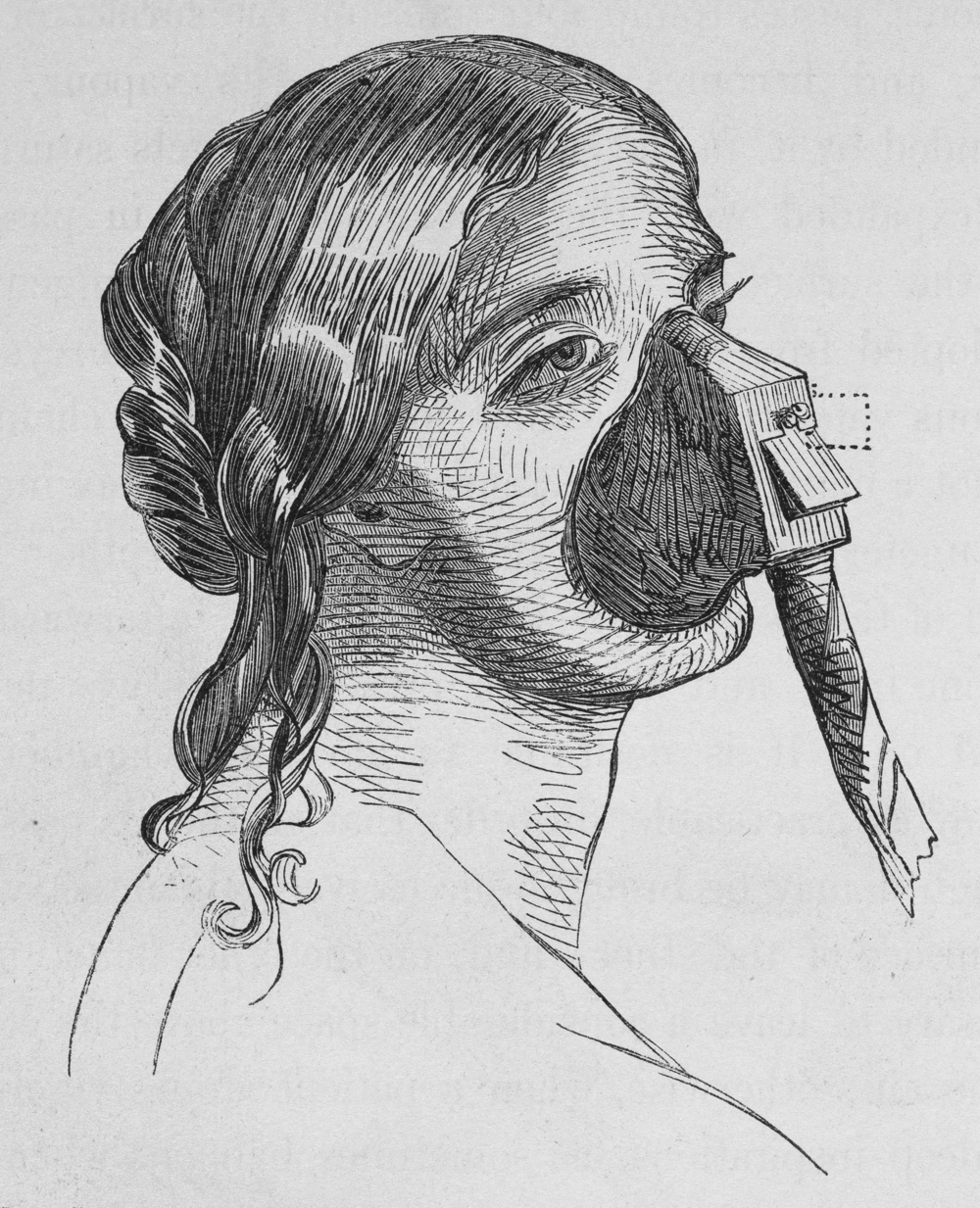
Critics have occasionally noticed how Snow's epidemiological studies inform Dickens's representations of disease in Bleak House.Footnote 14 Yet the doctor's study of atmospheric gasses and their consciousness-altering effects provides a vital, and previously unexplored, insight into the novel's aerial environments. Most notably, Snow developed an inhaler that regulated the ratio of “atmospheric air” to “vapourized” ether (Figure 13), which reinforced the popular association between aerial conceptions of the ether and the eponymous chemical agent. Although surgeons had previously administered ether using a handkerchief or pipe, Snow's device used the patient's breath to draw the vapor of liquid ether through a spiral chamber warmed by a water bath: “When an inspiration is taken,” Snow explains in his description of the apparatus, “the air, having entered by [a] tube . . . passes round four times on the surface of the ether and becomes saturated with its vapour, and expanded by it, in the same way that air gets saturated and expanded with the vapour of water in passing over the surface of the sea” (19). Snow's simile not only illustrates the ways in which he understood the vapor of ether in terms of climatic conditions but also adopts a discourse of anesthetized air central to eighteenth- and early nineteenth-century physiology – in particular, the study of “Pneumatic medicine” and the work of natural philosopher Joseph Priestley.
Illustration of John Snow's ether apparatus. Engraving, from On the Inhalation of the Vapour of Ether in Surgical Operations (London: John Churchill, 1847),18. Photograph courtesy of the History & Special Collections for the Sciences, Library Special Collections, UCLA.

Priestley's multi-volume publication Experiments and Observations on Different Kinds of Air (1774) describes the author's discovery of seven gases including, most famously, the one French chemist Antoine-Laurent Lavoisier later named oxygen.Footnote 15 Following his investigations into the contents of the air, Priestley recommended that physicians experiment with the inhalation of gas as a treatment for respiratory illnesses, including tuberculosis. Four years later, fellow scientist Humphrey Davy discovered that the inhalation of nitrous oxide (one of the seven gases Priestly had discovered during the 1770s) could be used to alter consciousness and make people insensible to pain (Sykes and Bunker 7). By the early 1800s, the notion that the atmosphere contained gasses that could alter human consciousness was well established. Poet laureate Robert Southey's recreational use of nitrous oxide and rhapsodic claim to Davy that “the atmosphere of the highest of all possible heavens must be composed of this gas,” suggests a larger cultural interest in the relationship between nineteenth-century notions of atmosphere and its potentially mind-altering effects (Jay 176).
Thus, although the historically appropriate concern about contagious miasmas and industrial-cum-moral pollutants undoubtedly informs Dickens's depiction of air in Bleak House, the novel also sustains the common perception that the air was an origin of, and repository for, vapors that suspended sensation. This dual significance consequently shapes its protagonist and first-person narrator, whose very name encrypts the influence of atmospheric and anesthetic agents. Although critics have often associated Esther's Christian name with the biblical queen, given the ability of aerial environments to control her embodiment and obfuscate her interiority, it is only fitting to regard the chemical meaning of an “Ester,” or a compound ether formed by oxygen-acids, as an element constitutive of her identity.Footnote 16 At seeming odds with the etymology of the name Esther (or “ester”), however, the surname “Summerson” evokes clear and unobstructed weather. This inconsistency in Esther's name accentuates the instability of her identity and narrative function. Like the other forms of volatility her character demonstrates – the oscillation between character and narrator, bodily coherence and dissolution, being some one and being “no one,” for example – her name discloses the extent to which the air in Bleak House defines who and what “Esther” is.
Viewed in light of mid-Victorian biomedical perceptions of female embodiment, the opposing significations of Esther's name also imply a characteristic female precariousness. As Poovey reminds us, contemporary medical professionals deemed “periodicity,” or a physical and emotional fluctuation governed by women's life cycles, to be a cause of both emotional and physiological instability (36). This concept of inherent variability “constructed the woman as essentially different from man . . . a creature who needed constant and expert superintendence by medical men” and fostered the belief that “woman's reproductive function defined her character, position, and value.” The notion that women's bodies were defined by their reproductive function, Poovey also claims, fosters diagnoses of nervous disorders and hysteria, which were frequently viewed as a result of periodicity and childbearing (37). The administration of ether, and later chloroform, to anesthetize women during childbirth and subdue hysterical fits, therefore emphasizes the degree to which their psychology and physicality were deemed worthy of medical and chemical regulation. This perception of women's subjectivity and embodiment sustains the practice of treating hysterics with ether well into the 1870s, as neurologist Jean-Martin Charcot's infamous treatment of female patients at the Salpêtrière makes clear (Didi-Huberman 215–16).
In the mid nineteenth century, however, the use of anesthetics to regulate female embodiment was inseparable from debates about their safety, efficacy, and propriety.Footnote 17 Dickens was personally familiar with these debates and had gone to great lengths to ensure that his spouse, Catherine Hogarth, had access to chloroform during the delivery of their eighth child in 1848. In a letter to his friend William Macready announcing his son's birth, Dickens writes:
I had made myself thoroughly acquainted in Edinburgh with the facts of chloroform – in contradistinction to the talk about it – and had insisted on the attendance of a gentleman from Bartholomew's Hospital, who administers it in the operations there, and has given it four or five thousand times. I had also promised her that she should have it. The doctors were dead against it, but I stood my ground and (thank God) triumphantly.
Dickens's self-proclaimed inquiry into the “facts” of chloroform establishes his interest in the physical and psychological effects of the drug, just as his reference to the popular “talk about it” establishes his familiarity with disputes about its use on female patients. His close attention to Catherine's behavior under the influence of chloroform similarly suggests his interest not only in his wife's physical comfort and the safe delivery of their child, but also in the effect of the drug on her thought and perception. “It spared her all pain,” he writes, “([and] she had no sensation, but of a great display of sky-rockets)” (Letters 5: 487). Catherine's loss of physical sensation and Dickens's interest in what replaces that sensation – “a great display of sky-rockets” – arguably informs his representation of Esther's physically unmoored sensation of being “no one” as well as the repeated substitution of aerial phenomena for her embodied self-perception. As the following section of my discussion makes clear, the author's replacement of what we traditionally perceive as the unwavering physicality and transparent interiority of the realist subject with disembodiment and semi-conscious thought, has pressing implications for our understanding of female characterization in Bleak House and the Victorian novel at large.
IV. “Something Different from What I Then Was”: The Anodyne of Omniscience
Esther's awkward embodiment – her struggle to maintain a first-person point of view amid the obfuscating air of Bleak House – stands in direct opposition to the effortless anonymity of Dickens's omniscient narrator. Although the presumably masculine (but ultimately un-gendered) voice of the third person narrator goes everywhere and sees everything, Esther's “little body” is decidedly female and habitually entrenched in the disorienting ether. Yet, despite the ability of the environment to prevent her from seeing or describing events as authoritatively as Dickens's third-person speaker, Esther occasionally takes on the mantle of her omniscient narratorial counterpart by becoming “no one.” The following passage, which has traditionally been read as predicting Esther's illness, plays an essential role in mediating her precarious narrative position:Footnote 18
It was a cold, wild night, and the trees shuddered in the wind. . . . The sky had partly cleared, but was very gloomy. . . . [T]here was a pale dead light both beautiful and awful; and into it long sullen lines of cloud waved up like a sea stricken immovable as it was heaving. Towards London a lurid glare overhung the whole dark waste; and the . . . fancy which the redder light engendered of an unearthly fire, gleaming on all the unseen buildings of the city, and on all the faces of its many thousands of wondering inhabitants, was as solemn as might be.
I had no thought that night – none, I am quite sure – of what was soon to happen to me. But I have always remembered since, that when we had stopped at the garden-gate to look up at the sky, and when we went upon our way, I had for a moment an indefinable impression of myself as being something different from what I then was. I know it was then, and there, that I had it. I have ever since connected the feeling with that spot and time and with everything associated with that spot and time, to the distant voices in the town, the barking of a dog, and the sound of wheels coming down the miry hill. (380; ch. 31)
In the first paragraph, the “beautiful and awful” atmosphere implies the presence of the Sublime. In an earlier generic form (the Gothic fictions of the long eighteenth century, for example), the “whole dark waste” that Esther observes would most likely incite pleasurable terror or prompt her to reflect upon her insignificance in the face of such an overwhelming landscape.
In Dickens's 1853 novel, however, the “lurid glare” of the sky in the passage above encourages the protagonist's ambiguous sensation of “being something different from what I then was.”Footnote 19 One way of understanding the presence of anesthetizing atmospheres in Bleak House, then, is to compare their flattening of Esther's emotion to the surfeit of affect heroines in Gothic fiction experience under similar atmospheric conditions. As Jayne Lewis persuasively argues, atmosphere in the Gothic romances of Ann Radcliffe “attracts emotion: ambivalence, anxiety, trepidation, melancholy . . . tend to be mixed, albeit not so much with each other as with thought. We should therefore call them moods. And anyone compelled to breathe Radcliffean air is bound to be moody. ‘Gloomy ideas’ lower on her heroines like clouds (Udolpho, 49)” (193–94). Lewis's examination of how atmosphere stimulates thought and mood in Radcliffe's heroines foregrounds the substantial shift between representations of atmosphere in Gothic and Romantic literature and Victorian fiction. If late eighteenth-century and earlier nineteenth-century fictions employ atmosphere as a means of amplifying and externalizing subjective emotion, the ether in Bleak House displaces embodiment and effaces emotion. Dickens's female protagonist therefore experiences the quality and conditions of the air as something utterly overpowering yet absolutely separate from herself: It is the sky that is gloomy, not her.
In addition to the anesthetizing influence of the ether in this scene, however, Esther gains what we might call an “uneasy” omniscience. Despite her claim that the buildings of London are “unseen,” she describes their appearance with apparent insight. She does not “fancy” the effects of the “lurid glare” so much as she actually perceives them. Similarly, her ability to envision “many thousands of wondering inhabitants” and comprehend “the distant voices in the town, the barking of a dog, and the sound of wheels coming down the miry hill” demonstrates a knowledge and perception incompatible with her restricted physical position. Although the dissociative impression Esther ambiguously refers to as “it” is clearly associated with the “spot and time” she recalls, the feeling she experiences in this scene does not appear to be a “feeling” at all but rather an experience that lacks proprioception. Her claim, “I had no thought that night,” therefore assumes an embodied human subjectivity that her description of spatially discreet sights and sounds contradicts.
On the one hand, Esther's role as a narrator who recalls past events presumably offers her some degree of poetic license – namely the ability to suppose an artificial simultaneity of disparate perceptions and sensations. On the other hand, the declarative phrases – “I have always remembered since,” “I know it was then and there,” and “I have ever since connected” – insist on a precise memory and temporal specificity attendant to the perceptions she describes. Put another way, in this scene Esther appears to adopt the diffuse and pervasive quality of the omniscient narrator as well as the atmosphere itself. This partial omniscience affords her a means of speaking through – and also in spite of – her gendered embodiment. In the same way that the Victorian medical establishment identified anesthetizing vapors as a means of stabilizing fluctuating female bodies, the atmosphere in the passage above temporarily levels the unevenness of Esther's narrative voice by allowing her to leave her “self” behind.
Esther assumes this ethereal omniscience at climactic moments in Bleak House – just before and during her near fatal illness (as in the aforementioned scene), for example, and in the moments leading up to her discovery of her mother's death. She describes each of these events not from a position of self-conscious perception but rather as a subject acted upon by the disorienting effects of the ether. Her muddled description of London during her search for Lady Dedlock in the novel's fifty-ninth chapter demonstrates exactly this kind of anodyne perplexity:
I have the most confused impressions of that walk. I recollect that it was neither night nor day; that morning was dawning, but the street-lamps were not yet put out; that the sleet was still falling, and that all the ways were deep with it . . . I recollect the clogged and bursting gutters and water-spouts, the mounds of blackened ice and snow over which we passed. . . . At the same time I remember
. . . that great water-gates seemed to be opening and closing in my head, or in the air; and that the unreal things were more substantial than the real. (712; ch. 59)
While the weather draws all of Esther's attention to its insistent presence, to the abundant wet and cold that will soon reveal itself to be of the same distressing materiality as her “mother cold and dead,” the phantasmal water-gates she imagines have no substance and are nowhere (714; ch. 59). Esther's description of the “great water-gates” that are opening and closing either “in the air” or “in [her] head” thus exposes the uneasy equivalence of these two origins of subjectivity in Bleak House. Her insistence that the “unreal things” are more substantial than the real bespeaks a fundamental truth about her gendered subjectivity: as a locus of embodiment, a “real” self who thinks and feels, Esther is as prone to fluctuation as are the conditions of the air. Inside the fictional world, the omniscient narrator possesses an incorporeal voice that is more stable than that of Dickens's tentatively embodied female narrator. It is in this disembodied voice, the authority of a pure and impossible omniscience, that Esther and her readers find the real guarantee of narrative authority.
V. Conclusion
Although there is not sufficient space here to discuss fully the thematic “ghostliness” of Esther and her mother Lady Dedlock, it is worth pausing for a moment on the confluence of this ghosting with Esther's tentative embodiment and ethereal surroundings. In chapter thirty-six, after her discovery that she is Lady Dedlock's illegitimate daughter, Esther makes a canny assertion as she passes along the “haunted” terrace of her mother's home at Chesney Wold, known as the “Ghost's Walk”: “[M]y echoing footsteps brought it suddenly into my mind that there was a dreadful truth in the legend of the Ghost's Walk; that it was I, who was to bring calamity upon the stately house; and that my warning feet were haunting it even then.” Esther's realization that the existence of her very body may bring about her mother's condemnation causes her to acknowledge that “I ran from myself and everything” (454; ch. 36).
Yet if Esther understands the problems attendant to her own embodiment, the novel shares her concern. In a moment that renders Esther's body interchangeable with the rain once again, the third-person narrator proclaims at the commencement of chapter eight, “While Esther sleeps, and while Esther wakes, it is still wet weather down at the place in Lincolnshire. The rain is ever falling, drip, drip, drip, by day and night, upon the broad flagged terrace-pavement, The Ghost's Walk” (76; ch. 7). Here, the narrator elides Esther's sleeping and waking states in order to succinctly describe the passing of time. Yet this perfunctory compression of Esther's lived experience establishes her embodiment and interiority as subsidiary to the formal constraints of the novel. This pretension to diegetic expediency thus blurs her unconscious and conscious states in a manner reminiscent of her first-hand experiences with the obfuscating air. The immediacy of the enduring rain in this scene consequently affords Dickens's protagonist an unmistakably ghostly quality, albeit one that demonstrates the ethereality of her body in formal and atmospheric, rather than in supernatural, terms. Unlike the ghostly figures in both Collins's and Conan Doyle's equally well known narratives, Esther Summerson is a precarious signifier of a problematically embodied selfhood.
Like Dickens, authors such as Charlotte Brontë and Thomas Hardy also evoke the diffuse materiality of air to personify the evasive interiority and gendered physicality of their female protagonists. While Esther's ether has an anesthetic function, however, in Jane Eyre (1847) and Villette (1853), Brontë affords the evocatively named Jane Eyre and Lucy Snowe a persistent sensitivity to atmospheric transmissions. Jane recalls how she “derived . . . a strange excitement” from “the disconsolate moan of the wind outside” of Lowood School (54; vol.1, ch. 6). In Villette, the equally transmissive properties of the air grant Lucy access to the “Creative Impulse,” which she describes as “some long-trembling sob of the wind . . . some rushing past of an unseen stream of electricity” (356; ch. 30). In each of these scenes, Brontë locates female agency outside the body, thereby making it permeable to the effects of an atmosphere that is more meaningful than it is mystifying.
Thomas Hardy's female protagonists are not able to embrace or adapt to the conditions of the atmosphere so readily as Brontë’s, nor does he allow them the anesthetic escape from embodiment that Dickens bestows upon Esther. In The Return of the Native (1878), Eustacia Vye is an embodied but opaque outline, a “Figure against the Sky” of whom we know little more than that “it might reasonably have been supposed that she was listening to the wind . . .” (49; bk. 1, ch. 6). In Tess of the D'Urbervilles (1891), Hardy's diversion of narrative attention away from the embodiment and interiority of his female protagonists takes on more sinister implications. The fog that enshrouds Tess's body during the novel's infamous rape scene transforms her into a “pale nebulousness” practically indistinguishable from the “webs of vapour . . . which . . . form[ed] veils between the trees” (73; bk. 1, ch. 11). This visual and atmospheric ambiguity allows Alec D'Urberville, as well as the reader, to perilously overlook the “coarse pattern” he traces upon her.
For Dickens, then, as for many mid-to-late nineteenth-century authors, atmospheric characterization expresses the difficulty of embodying female subjectivity in narrative form. While debates about periodicity and the supposed instability of women's bodies lead to the occasional etherization of Esther Summerson, atmospheric phenomena bespeak the difficulty of characterizing the feminine, of making language seem to breathe. As the examples above disclose, this process is largely one of attenuation and reconfiguration – not only of the female body, but also its psychology, subjectivity, and desire. This dissolution is not anomalous, not simply limited to the self-effacements of a protagonist such as Esther or the allegorical function of a minor character such as Krook. Instead, atmospheric representation is part of a larger cultural uneasiness with female embodiment that poses problems for what we traditionally understand as realist characterization. The female bodies that find their way into the Victorian novel are therefore neither flat nor round. It is better perhaps to see them as floating uneasily through the ever-changing air.