Contact between different languages and between different varieties of the same language are both at work in modern-day cities, which are characterized not only by high degrees of international migration but also by intranational mobility. There now exists a considerable literature addressing the question of how contact between different languages impacts local varieties of the majority languages in cities in Europe and North America (see Kotsinas [Reference Kotsinas, Linell, Adelswärd, Nilsson and Petersson1988b/Reference Kotsinas and Hellberg2014], Ganuza [Reference Ganuza2008], and contributions to Källström & Lindberg [Reference Källström and Lindberg2011] for Swedish; Quist & Svendsen [Reference Quist and Svendsen2010] for Scandinavia in general; Schoonen & Appel [Reference Schoonen and Appel2005] for the Netherlands; Quist [Reference Quist2008] for Denmark; Svendsen & Røyneland [Reference Svendsen and Røyneland2008] for Norway; Wiese [Reference Wiese2009] for Germany; and Eckert [Reference Eckert2008] for the United States). Although some studies also consider features associated with dialect contact (e.g., Hoffman [Reference Hoffman2010] and Hoffman & Walker [Reference Hoffman and Walker2010] in Canada; and Cheshire, Kerswill, Fox, & Torgersen [Reference Cheshire, Kerswill, Fox and Torgersen2011] in the United Kingdom), less attention has been paid to the simultaneous effect that urbanization has on bringing dialects in closer contact with each other (but see Nordberg [Reference Nordberg1994]). These two processes are usually examined separately: either features associated with language contact in the population with foreign origins or leveling and diffusion of dialectal features in the “native” population are investigated.
Linguistic interest in language contact in Sweden has focused on the new multilingual neighborhoods of its three largest cities (Stockholm, Gothenburg, and Malmö), where the majority of new immigrants have settled and where previous and ongoing urbanization of the Swedish population have taken place. Kotsinas (Reference Kotsinas1988a) claimed early on that large-scale immigration to these neighborhoods and relatively few native speaker models (due to segregation in housing, workplaces, and schools) had resulted in the emergence of new varieties of Swedish, spoken predominantly by young people of foreign background (Kotsinas, Reference Kotsinas, Linell, Adelswärd, Nilsson and Petersson1988b/Reference Kotsinas and Hellberg2014, Reference Kotsinas, Smith and Veenstra2001) and characterized by features traced to second language Swedish: for example, violation of the verb-second rule, lexical borrowing from the first languages of adult immigrants, nonstandard gender assignment, and simplified morphology. In other words, attention was drawn to features that could be considered stereotypes or markers (Labov, Reference Labov1994:78) salient to Swedish speakers and subject to overt commentary. Clyne (Reference Clyne2000:87, based on Kotsinas [Reference Kotsinas, Palmgren, Löfgren and Bolin1992] and Rampton [Reference Rampton1995]) coined the term multiethnolect to describe what he interpreted as new ethnolectal varieties. Although this term has gained some acceptance in Europe (Cheshire et al., Reference Cheshire, Kerswill, Fox and Torgersen2011; Quist, Reference Quist2008; Svendsen & Røyneland, Reference Svendsen and Røyneland2008; Wiese, Reference Wiese2009), others have criticized the naming practice, since it makes these groups of speakers and their ways of speaking appear more homogeneous than they actually are (Boyd, Reference Boyd, Falk, Nord and Palm2010; Jaspers, Reference Jaspers2008).
In the early 2000s, a large-scale project (called Språk och språkbruk bland Ungdomar i Flerspråkiga storstadsmiljöer [SUF], ‘Language and Language Use among Young People in Multilingual Urban Settings’) was carried out to describe the sociolinguistic situation in Sweden's three largest cities (see the data and sampling of informants section). Since Kotsinas's (Reference Kotsinas, Linell, Adelswärd, Nilsson and Petersson1988b/Reference Kotsinas and Hellberg2014) claims were the inspiration for this project, SUF investigated many of the features she mentioned. However, several of these features were not only found to be rare in the Swedish of young people with foreign or immigrant backgrounds, they were also presentFootnote 1 (albeit not to the same extent) in the Swedish of young people who did not have this background (Källström & Lindberg, Reference Fraurud, Boyd, Källström and Lindberg2011).
Unlike previous work considering adolescents with a foreign background, in this paper we focus on a feature of Swedish that has only recently been reported as an ongoing change in the dialect areas outside Gothenburg and Stockholm (Leinonen, Reference Leinonen2010). Standard descriptions of Swedish identify a prerhotic allophone [æ:] of the vowel phoneme /ε:/ (Riad, Reference Riad2014; see section, ‘The Swedish vowel system’ for further details). The ongoing change, which involves a putative merger of allophones to a more open [æ:] in all environments, has not yet been studied acoustically in urban Swedish. Although Kotsinas (Reference Kotsinas1988a:136,138) did not mention specific vowels, her original discussion claimed that the vowel system of the emerging variety was, in her words, less “marked” than other local varieties. If this claim were true, we would expect to see differences among young people with different backgrounds in the conditioning of vowel variation (cf. Hoffman & Walker [Reference Hoffman and Walker2010] for the Canadian vowel shift in Toronto).
In this study, we address three main questions about the patterning of variation in the use of /ε:/ and its allophones by young people in Stockholm and Gothenburg.Footnote 2
1. Are there differences between speakers in Stockholm and those in Gothenburg as regards this variable?
2. Do young people with foreign-born parents behave differently from those with Swedish-born parents regarding this variable?
3. Are the effects of foreign background, sex, and linguistic context on this variable the same or different in the two cities?
The results of our study provide further evidence to test the claim that a new variety, used by young Swedes with foreign-born parents, is emerging in the multilingual neighborhoods of Stockholm and Gothenburg.
SWEDEN AS A MULTILINGUAL SOCIETY
Despite Sweden's short-lived attempts at establishing overseas colonies,Footnote 3 throughout the 17th and early 18th centuries it was a country of emigration to various parts of the world (especially North America). After the Second World War, this process began to be reversed as Sweden received increasingly large numbers of refugees and labor market migrants, particularly since the late 1970s. However, unlike other European powers (such as the United Kingdom and France), where postwar immigration largely originated from former colonies, the ethnic and linguistic composition of Sweden's foreign origin population is much more diverse. In 2014, 16.5% of Sweden's population of 9.7 million was born abroad and 21.5% had a foreign backgroundFootnote 4 (Statistics Sweden, 2015). The traditional immigration from continental Europe or other Nordic regions (mainly Finland) has either held steady or declined, with an increasing representation of residents with more varied backgrounds in Europe (mainly from the Balkans), Asia (mainly from the Middle East), and Africa (mainly from Somalia and Ethiopia). The increasing ethnic and linguistic diversity is more pronounced in Sweden's three largest cities, where most new arrivals tend to settle. In Stockholm, Gothenburg, and Malmö, the proportion of foreign-born residents is currently 17% to 22% (compared to 9% to 14% in the rest of the country; Statistics Sweden [2013]). Within these cities, new arrivals tend to settle in publically owned apartments in specific neighborhoods, in Stockholm and Gothenburg, on the outer edges of the city (Rinkeby in Stockholm and Angered in Gothenburg), and in Malmö nearer the city center (Rosengård). In these “multiethnic” enclaves, no one ethnic group or heritage language dominates (in contrast with the situation in many North American cities), and it is estimated that there are up to 150 different heritage languages that children bring to the schools in these neighborhoods (The Language Council of Sweden, 2014). The increasing ethnolinguistic diversity of Sweden's population and these patterns of settlement have resulted not only in greater likelihood for contact between immigrant heritage languages and Swedish, but also for sharpening differences between rural and urban Swedish, since the rural areas are losing population, while urban areas are gaining population, both due to urbanization and to international migration.
IMMIGRATION AND “NEW VARIETIES” OF SWEDISH
Contact between immigrant languages and Swedish in these urban settings has been argued to result in new linguistic practices. Kotsinas (Reference Kotsinas, Linell, Adelswärd, Nilsson and Petersson1988b/Reference Kotsinas and Hellberg2014) was the first to identify a new youth language in Stockholm as an emerging dialect that she called Rinkebysvenska ‘Rinkeby Swedish’, allegedly adopted from the young people's own name for their way of speaking (see Stroud [Reference Stroud, Hyltenstam and Lindberg2013] for an analysis of the name Rinkebysvenska and its history). Kotsinas (Reference Kotsinas, Smith and Veenstra2001) stressed that Rinkeby Swedish was not the result of incomplete language learning but was to be seen in the light of language contact and sociolinguistic factors, arguing that typologically marked subsystems such as word order, gender, agreement, prepositions, and vowel systems were most likely to be affected in the new dialect. According to her, the most striking feature of this new dialect was its pronunciation, with vowel quality and quantity as well as prosody deviating from the standard while still containing traces of the typical Stockholm dialect (Kotsinas, Reference Kotsinas, Androutsopoulos and Scholz1998:145). Using these claims as a point of departure, Bodén (Reference Bodén, Quist and Svendsen2010) carried out perceptual experiments in which she found that listeners from Stockholm, Gothenburg, and Malmö heard something “foreign” in the accent of some Stockholm, Gothenburg, and Malmö speakers, but there was still a strong regional element. The adolescent speakers in her studyFootnote 5 did not necessarily have a foreign background to produce this “foreign sounding” way of speaking, although most of the speakers identified as speaking Rinkeby Swedish and its equivalents in Gothenburg and Malmö did. Bodén (Reference Bodén, Quist and Svendsen2010) discounted a substratum explanation for the origin of the foreign features, concluding instead that the adolescents probably identified prosodic and segmental features (from a Swedish point of view) of a more general “foreign-sounding” Swedish and incorporated these into their way of speaking. Bijvoet and Fraurud's (Reference Bijvoet, Fraurud, Quist and Svendsen2010) folk-linguistic perceptual experiments (cf. Preston, Reference Preston1999) found that what was considered Rinkebysvenska (or “foreign-sounding”) and identifications as to what part of Stockholm a speaker came from depended on the listener. Even judgments of what was “good Swedish” varied from neighborhood to neighborhood, suggesting that different norms exist in different parts of the capital.
This putative new variety also contained a number of deviant grammatical features. For example, Kotsinas (Reference Kotsinas, Androutsopoulos and Scholz1998) observed frequent use of uninverted word order (XSV)Footnote 6 where Swedish has obligatory verb-second (V2) order (i.e., XVS or SVX). However, Ganuza (Reference Ganuza2008) showed that XSV was limited to a small group of adolescents, related to a combination of interacting linguistic and sociopragmatic factors, and the apparent frequency of XSV resulted from its salience to native listeners. Other grammatical and discourse features analyzed in connection with multilingual adolescents (Ekberg, Reference Ekberg, Källström and Lindberg2011; Svensson, Reference Svensson2009; Tingsell, Reference Tingsell2007) involved more or less salient markers of a potential new youth variety. However, none were able to show the systematic and frequent use of new features that would be expected based on Kotsinas's original claims. Bijvoet and Fraurud (Reference Bijvoet, Fraurud, Hyltenstam and Lindberg2013) argued that Rinkebysvenska (and similar ways of speaking in Gothenburg and Malmö) is best seen as a social construct associated with a heterogeneous group of speakers with the common denominator that the adolescents are making use of immigrant- and youth-related features associated with lexical borrowing, learner language, and slang. Under this view, they regard this way of speaking as a style without reifying it as a “lect,” whether it be a dialect or a (multi)ethnolect.
VARIATION IN SWEDISH VOWELS
The Swedish vowel system
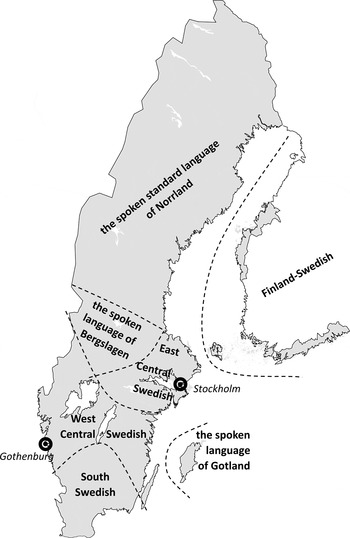
Previous work on variation in the vowel system of Swedish has mainly been carried out in rural areas or smaller cities, where variation between spoken varieties is considerable. This variation has led to the proposal that more than one standard Swedish is spoken. Elert's (Reference Elert and Edlund1994) sevenfold division, shown in Figure 1, divides standard Swedish into South Swedish, Central Swedish (East and West), the spoken language of Bergslagen, the spoken standard language of Norrland, Gotland, and Finland-Swedish. In this division, both Gothenburg and Stockholm are in the central Swedish area, although Gothenburg is in the West Central area and Stockholm is in the East Central area.
The seven-fold dialect division of spoken standard Swedish (adapted and translated from Elert, Reference Elert and Edlund1994:228).

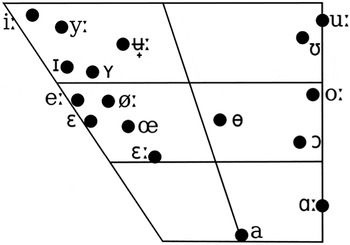
Most descriptions of Swedish (Elert, Reference Elert2000; Riad, Reference Riad2014) and textbooks (Beite, Reference Beite1970; Bolander, Reference Bolander2012) present a single vowel system, based on a generalization of the spoken language in the East Central Swedish dialect area, where Stockholm is the largest city. This vowel system is fairly rich, usually described as having nine vowels, with a distinction between long and short vowels, as shown in Figure 2. Here we focus on the long vowels, which consist of five front vowels /i:, y:, e:, ε:, ø:/, one central vowel /ʉ:/, and three back vowels /u:, o:, ɑ:/. If we look at the vowel space as a whole, there is crowding in the close to close-mid area, especially in the front. In addition to the nine phonemes, /ε:/ and /ø:/ have “prerhotic” allophones [æ:] and [œ:] (mapped separately in Figure 3) that occur before /r/ and before the retroflex consonants [ʂ, ʈ, ɖ, ɳ, ɭ]. These consonants result from a fusion of /r/ with a following coronal consonant /t, s, d, n, l/ (Riad, Reference Riad2014).
The long and short vowels of central standard Swedish (Engstrand Reference Engstrand1999:140–142).

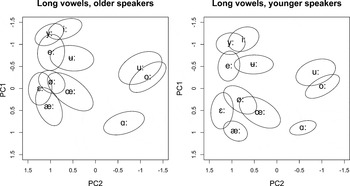
The Swedish long vowel systems of older and younger speakers from the SweDia 2000 project (plotted using data from Leinonen, Reference Leinonen2010:165).

The phonetic realization of the Swedish long vowels among older and younger speakers is shown in Figure 3,Footnote 7 based on acoustic measurements of the long vowels of nearly 1200 speakers from different parts of the Swedish language area (Leinonen, Reference Leinonen2010). Compared to older speakers (those born in the 1920s to 1940s), the younger speakers (born in the late 1960s and the 1970s) tend to lower the front vowels, hence filling the vowel space more evenly. This was first noted by Nordberg (Reference Nordberg and Dahlstedt1975) in Eskilstuna (a town 112 km west of Stockholm), where younger working class speakers had more open /ε:/ and /ø:/. This lowering was accompanied by the lowering of /ʉ:/ in what he interpreted as a drag chain shift, which would result in a more symmetrical system without allophones, as shown in Figure 4.
Nordberg's (Reference Nordberg and Dahlstedt1975) description of the emerging new long vowel system of Eskilstuna working class.

This change in progress, with decreasing distance between the prerhotic and non-prerhotic allophones, especially in the rural areas around Stockholm and Gothenburg, is reported by Leinonen (Reference Leinonen2010), based on apparent time data from the SweDia projectFootnote 8 (Eriksson, Reference Eriksson and Henrichsen2004), which sampled rural dialect speakers using high-quality digitized recordings. She predicted that decreasing distance between the allophones would eventually result in a simplification of the central Swedish vowel system such that the allophonic relation between [ε:] and [ø:] and their pre-/r/ allophones would disappear, a prediction in line with that of Nordberg (Reference Nordberg and Dahlstedt1975). Our aim in this paper is to determine whether the change of /ε:/Footnote 9 is also proceeding in the cities of Stockholm and Gothenburg and the extent to which social factors such as speaker sex and foreign background influence the participation in this ongoing change.
/ε:/
/ε:/ in Stockholm
Before looking at evidence concerning /ε:/ in Stockholm today, it is important to provide some background on the reported merger of the two long front unrounded vowels /e:/ and /ε:/ to [e:], which is a salient feature of the traditional dialect of Stockholm. Reports of this merger can be found as far back as the 17th century (Gjerdman, Reference Gjerdman1927:150). The merger has resulted in minimal pairs becoming homophonous. For example, in most Swedish varieties, veta ‘to know’ is pronounced [ve:ta] and väta ‘dampness/wetness’ is pronounced [vε:ta], but both were pronounced something like [ve:ta] in the traditional Stockholm dialect. However, the merger has never been complete, because the prerhotic allophone of /ε:/ was still [æ:], resulting in minimal pairs like ber [be:r] ‘ask (present tense)’ and bär [bæ:r] ‘berry’ or lera [le:ra] ‘mud’ and lära [læ:ra] ‘to learn’ (Elert, Reference Elert2000; Gjerdman, Reference Gjerdman1927; Kotsinas, Reference Kotsinas, Berg and Kotsinas1991; Wellander, Reference Wellander1973). Thus, the merger occurred only in nonrhotic environments.
Gjerdman (Reference Gjerdman1927) noted that the close pronunciation of /ε:/ (which he called Stockholm-e) seemed to appear variably in the towns surrounding Stockholm but became more frequent the closer the town was to Stockholm. In his observations, he also mentioned that the prerhotic allophone [æ:] was produced more openly in Stockholm than elsewhere. This observation is repeated by Elert (Reference Elert2000), who mentioned that the most open production of /ε/ before /r/ and retroflex consonants is on the east coast of Sweden, for example, in Stockholm.
Despite its association with the capital and largest city, the Stockholm-e has never been a prestige form in Sweden. Its use is often associated with the variety known as ekenssnack ‘Eken-talk’ (Eken is a nickname for Stockholm) used by low status youth and the working class. In Kotsinas's (Reference Kotsinas, Berg and Kotsinas1991) examination of historical attitudes toward the regional dialect of Stockholm in local newspaper debates, she found the first discussion of the /e:/ ~ /ε:/ merger in 1890, when it was seen as destroying the beauty and purity of Swedish. In 1918 it was connected with low status and claimed to create ambiguity, an attitude that continued throughout the 20th century. As late as 1968, speech therapists approached the then minister of education (Olof Palme), explaining to him that ekenssnack desecrated Swedish, damaged the vocal cords, and enfeebled articulation (Kotsinas, Reference Kotsinas, Berg and Kotsinas1991:174).
To date, the most systematic quantitative study of Stockholm's vowels is that of Kotsinas (Reference Kotsinas1994), who examined the various realization of /ε:/ among adolescents. However, because she designated the western suburbs as “immigrant,” she only reported on the pronunciation of /ε:/ in the southern and northern suburbs.Footnote 10 According to her, the reported merger of /e:/ and /ε:/ seems to have been reversed among young people in Stockholm in the 1990s. However, because Kotsinas did not consider young people with a foreign background to be bona fide speakers of Stockholm Swedish, we have no data on how these vowels were being used by these speakers.
/ε:/ in Gothenburg
Research on /ε:/ in Gothenburg is even sparser. Probably the most exhaustive description is that of Björseth (Reference Björseth1957:2–3), who distinguished between “Gothenburg local standard” and the “Gothenburg dialect.” The main focus of his research was to describe the former, whose speakers (he stated) are most likely to be found in the middle class (although this group is very heterogeneous), since upper class speakers try to avoid local features. Thus, Björseth seems to imply that speakers of “Gothenburg dialect” would be found in the lower social classes.
Björseth's “Gothenburg dialect” featured a fairly close pronunciation of /ε:/ in all positions including before /r/, though not as close as the Stockholm-e. In some rare cases, he reported a closer realization of /ε:/ before retroflex consonants, with a more [e:]-like pronunciation. Interestingly, he noted that traditional “Gothenburg dialect” contained no assimilation of /r/ to coronal consonants but rather elision of the /r/, implying homophony between words such as faten [fɑ:tən] ‘the plates’ and farten [fɑ:tən] ‘the speed’ (the latter pronounced [fɑ:ʈən] in most varieties). It is unclear whether or how this tendency may later have affected the production of the preceding vowel, since this reported merger never went to completion either. Like the Stockholm-e, this feature of “Gothenburg dialect” is largely absent today.
In Björseth's “Gothenburg local standard,” the vowel /ε:/ seems to have had the same close pronunciation, with a more open realization before /r/, though not as much as in other varieties of Swedish. He also noted a new (for Gothenburg) production of the pre-/r/ allophone, a more standard [æ:], which he claimed to be especially common among some adolescent girls. More recently, Holmberg (Reference Holmberg1976) described the Gothenburg-/ε:/ as a close-mid vowel, though not as close as /e:/. He also pointed out that there was a more open form of the vowel before /r/, though not as open as in Stockholm.
Summary
Reports of variation and change in /ε:/ present rather different pictures in the two cities.
In Stockholm, the merger of /e:/ and /ε:/ was reportedly kept from being completed by the allophonic rule /ε:/ → [æ:] / _ /r/, which preserved the phoneme in the prerhotic context (such as lera/lära) by creating minimal pairs. During the 1980s, the “unmerger” of the two vowels reported by Kotsinas (Reference Kotsinas1994:113–114) seemed to lead to a weakening of the allophonic relation between /ε:/ and [æ:], such that /ε:/ was produced with the more open pronunciation in all contexts. However, this weakening might not be that unexpected, since [æ:] already existed in the phonological system of the Stockholmers as an allophone, so they overshot the goal when attempting to produce [ε:]. In addition, the difference between the two phonemes is preserved in Swedish orthography, where /ε:/ and /e:/ have different graphemes, {ä} and {e}, although spelling does not always give a safe guide to pronunciation here (Widmark, Reference Widmark1972). Together with the fact that Stockholm-e was discouraged in the school system (Elert, Reference Elert2000), prescriptive pressures may very well have favored the unmerger. If so, the prerhotic allophone would be used in all contexts of /ε:/, and [æ:]'s allophonic role would be lost.
In contrast, studies in Gothenburg point in the direction of a raised /ε:/ almost merging with, but still being kept distinct from, /e:/. The distance between the two allophones of /ε:/ is not as great as in Stockholm, and in some cases the allophonic difference does not seem to be upheld. Although there are indications of change, here the change appears to favor allophonic variation.
DATA AND METHODS
Data and sampling of informants
The data used in this study were taken from the corpus created for the SUF project, carried out during the first decade of the 2000s. The project collected spoken and written data from 222 adolescents (between the ages of 16 and 17 years) all attending upper secondary school and the social science program in two or three schools in each of the three cities (Stockholm, Gothenburg, and Malmö). The corpus consists of recordings and transcriptions of interviews, group discussions, class presentations, and self-recordings of spoken language, as well as written essays.
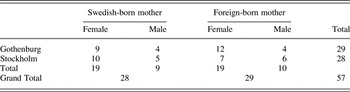
For the present study, we selected a sample of 57 informants from the SUF materials, distributed as evenly as possible between Stockholm and Gothenburg and between young people whose mothers were born in Sweden and those whose mothers were foreign-born, as shown in Table 1.Footnote 11 For this study we do not use the social class or socioeconomic status of the young people to stratify the sample. The schools in the sample differed in status and in the socioeconomic background of the pupils’ parents, but we found no statistically significant differences according to school in the results we present.
Distribution of informants by city, sex, and mother's birthplace

In order for an informant to be included in the sample, she/he needed to produce at least three tokens of /ε:/ before /r/ or retroflex consonants and three tokens of /ε:/ elsewhere (the highest number of tokens of /ε:/ from one informant was 15 and for /ε:/ before /r/ it was 5).Footnote 12 We extracted tokens from the spoken language interviews recorded in various school locales, each of which lasted between 20 and 30 minutes. The purpose of the interviews was to gather data on the informant's social situation and language use, with a Labovian “interview schedule” (Labov, Reference Labov, Baugh and Sherzer1984:33) as the point of departure, although the conversation tended to become more informal and relaxed as the interview progressed. Because of the nature of the questions asked in the interview schedule, some lexical items tended to occur more frequently, especially läsa ‘to read’, lära ‘to learn’, and träna ‘to practice (a sport)’. In two cases, where there were insufficient tokens for an informant, we extracted two to three additional tokens from recordings from the same informant of a similar nature as the interviews,Footnote 13 since these had comparably high levels of sound quality.
Vowel measurement and coding
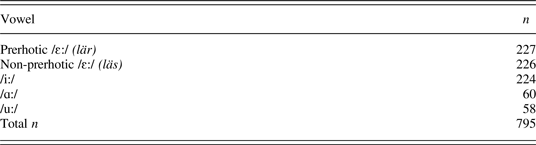
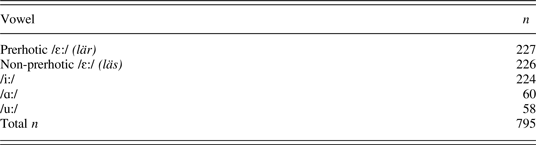
Each of the vowel tokens extracted was segmented and transcribed phonemically using Praat (Boersma & Weenink, Reference Boersma and Weenink2013), and the center of the vowel segment was then marked out in a point tier.Footnote 14 This resulted in an overall dataset of 795 tokens, distributed by vowel as shown in Table 2. The vowel token was coded for a series of social and linguistic factors to use as independent variables to test the three questions posed at the beginning of this paper: the speaker's city of residence (Stockholm or Gothenburg) and sex (female or male) as well as the birthplace of her/his mother (Sweden or abroad). The only linguistic factor we test in this paper is whether or not the allophonic distinction is maintained. Thus, each token was coded as prerhotic (which we refer to as the lär vowel) or non-prerhotic (the läs vowel). Vowel measurements were normalized using the formant-intrinsic Nearey1 procedure in the R package vowels (Kendall & Thomas, Reference Kendall and Thomas2014). Since the number of tokens per vowel varied across speakers, using the normalization procedure directly on the measured vowel tokens would bias the results. Therefore, mean formant values per vowel per speaker were computed before normalization was carried out on five F1 and five F2 values per speaker: the three corner vowels /i:/, /ɑ:/, and /u:/ plus the two allophones of /ε:/ that are the focus of this study.
Overall distribution of tokens by vowel
RESULTS
Two linguistic questions are of interest concerning these vowels.Footnote 15 First, is the allophonic distinction maintained? Second, does the position of the vowel in the vowel space as a whole vary across groups of speakers? These questions are most easily addressed by first plotting the data graphically and inspecting it visually, which we discuss as part of the visual analysis, and then by conducting tests of statistical significance between subsets of the speakers, which we discuss as part of the quantitative analysis.
Visual analysis
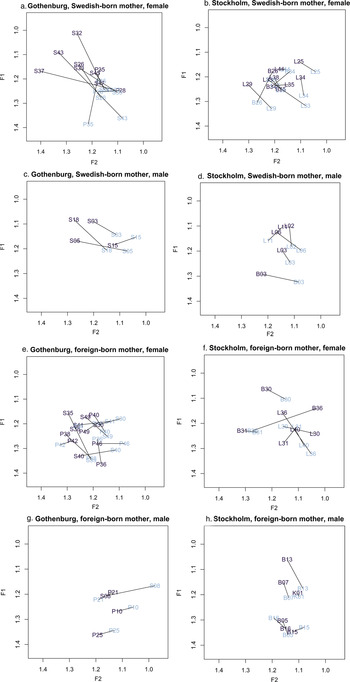
The mean of each speaker's läs and lär vowels is plotted in the F2-by-F1 vowel space in Figures 5a to 5h. Each of the figures represents one group of informants characterized by their combination of the three social factors (city, sex, and mother's birthplace). Each speaker's pair of vowels is connected by a line indicating the distance between the vowels.Footnote 16
To determine the extent to which speakers maintain the allophonic distinction, for each speaker we calculated the Euclidean distance d with the equation in (1), where (F1i, F2i) and (F1j, F2j) are the first and second formants of vowels in prerhotic (i) and non-prerhotic (j) positions.
 $${d_{ij}} = \sqrt {{{\left( {{\rm F}{{\rm 1}_i} - {\rm F}{{\rm 1}_j}} \right)}^2} + {{\left( {{\rm F}{{\rm 2}_i} - {\rm F}{{\rm 2}_j}} \right)}^2}} $$
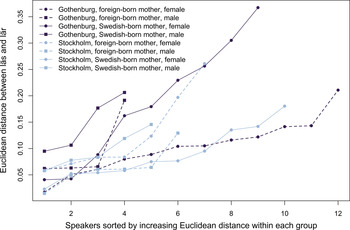
These distances are plotted in Figure 6 where each speaker is represented by one symbol and each group of speakers is indicated with a different combination of shading, line, and symbol. Speakers within each group are ordered from left to right according to increasing Euclidean distance between the vowels. As Figure 6 shows, although there are clear differences between some of the speaker groups as a whole, there is also a range of distances within each group.
The plots in Figures 5 and 6 are best considered together. The largest distances between läs and lär are found among females with a Swedish-born mother in Gothenburg. In Figure 5a, we see that there is some variation in height in the realization of the läs vowel. For example, P35's läs vowel is closer to S32's lär vowel than to S32's läs vowel, but the Euclidean distance between läs and lär for P35 is comparable to that of S32. In other words, P35 has the allophonic rule /ε:/ → [æ:] /_/r/ but not the quality ascribed to the läs vowel in standard descriptions. In light of this variation, if we look at the results for the Stockholm females with Swedish-born mothers to the right (Figure 5b), most speakers have a läs vowel similar to that of P35, but the Euclidian distance is considerably smaller. In Figure 6, we note two quite different patterns in the girls with Swedish-born mothers: the group in Gothenburg (the dark line of circles) starts low and rises steeply, while the Stockholm group (the light line of circles) has a flatter contour. This means that the girls with Swedish-born mothers in Stockholm on average have a smaller distance between the vowels than do those in Gothenburg. Returning to Figure 5a, we can also see a group in the middle with läs values similar to those of their Stockholm counterparts, with almost no distance between vowel allophones. How should we interpret the higher degree of variation among the speakers in Gothenburg? If we assume that the change in which läs lowers and merges with lär, so that the phonological rule is lost, has almost gone to completion in Stockholm, the variation in Gothenburg could be interpreted as an earlier stage in the change.
Plots (a to h) of normalized values of läs (dark) and lär (light) in the F2-by-F1 vowel space for each combination of city, birthplace of mother, and sex (each line represents one speaker).

Euclidean distance between läs and lär for each combination of city, birthplace of mother, and sex (each point represents one speaker).

The flatter pattern that is prevalent in all groups in Stockholm is also found among speakers with foreign-born mothers in Gothenburg (dark dashed lines), which suggests that they are leading the change there. Many of the other groups show no clear pattern of an allophonic distinction, and some speakers even have lär tokens with slightly lower F1 and/or slightly higher F2 values than their läs tokens (cf. L35 [Swedish-born mother] and B36 [foreign-born mother], both Stockholm females). Both patterns provide a clear indication that the expected Standard Swedish allophonic variation between läs and lär does not occur for all speakers, especially those in Stockholm.
When it comes to the position of läs and lär in the vowel space, the F1 values for Gothenburg males with a Swedish-born mother (Figure 5c) seem lower than those of any other group. Other speakers with small Euclidean distances between the two vowels generally have higher F1 values for both vowels (indicating a more open pronunciation). The F1 of the läs vowel values for Gothenburg males with Swedish-born mothers are in the same range as those of the läs vowel of the females with Swedish-born mothers in the same city. The F2 values of the läs vowel from Gothenburg females with Swedish-born mothers are higher than those of any other speaker group. The vowels for Gothenburg speakers with a foreign-born mother are very similar to those of Stockholm speakers, whereas the Gothenburg speakers with Swedish-born mothers (females and males) diverge more strongly from the Stockholm speakers.
Quantitative analysis
In this section, we test the statistical significance of the social factors on the realization of the vowels and their distances.
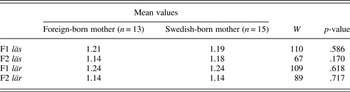
As we saw in the previous section, the vowel plots (Figure 5) of all speakers in Stockholm look quite similar. To test whether the F1 and F2 values of the läs and lär vowels of speakers with a foreign-born mother are similar to those with a Swedish-born mother, we carried out a Wilcoxon rank sum testFootnote 17 for each of these four measurements (two vowels × two formants). As Table 3 shows, none of the measurements show a significant difference between speakers in Stockholm depending on mother's birthplace.
Wilcoxon rank-sum test of differences between Stockholm speakers depending on mother's birthplace for two formant values of two vowels

Despite the lack of a significant difference among speakers in Stockholm according to mother's birthplace, we would like to know more generally whether these speakers maintain the allophonic difference between the läs and lär vowels. Paired t-tests for all the Stockholm speakers reveal a significant difference in F1 (t = −3.73, df = 27, p < .001; mean difference = −.041), but not in F2 (t = 1.33, df = 27, p = .196; mean difference = .020). The significant difference in F1 is surprising, considering the vowel plots in Figure 5 in which the two vowels cannot be clearly separated. Apparently, the F1 values are systematically somewhat lower for the läs vowel than they are for the lär vowel. Questions remain as to whether this difference is perceptible and whether there are coarticulation effects that we have not accounted for.Footnote 18
For the Gothenburg speakers, it is the females with a Swedish-born mother who have the largest difference regarding the Euclidean distance between läs and lär. Is this difference significantly larger than that of the Stockholm speakers? A Wilcoxon rank sum test was carried out (W = 182, p = .048) and confirms that the females with a Swedish-born mother have a significantly larger Euclidean distance (n = 9, M = .186) between the vowels than do speakers in Stockholm (n = 28, M = .094).
In contrast, the vowels of Gothenburg speakers with a foreign-born mother look very similar to those of the Stockholm speakers (Figure 5). The next step was therefore to test whether there is a difference between these speakers in Gothenburg and the Stockholm speakers. Each of the four vowel measurements (two vowels + two formants) was tested in a Wilcoxon rank-sum test. The only significant difference was the F2 of the läs vowel (W = 338, p = .005), although the actual difference in mean values is quite small (1.22 vs. 1.16). The Gothenburg speakers that deviate most from other groups in their vowels plots are males with a Swedish mother. However, since there are only four speakers in this group, we could not test for statistical significance.
DISCUSSION
In answer to our first research question about the patterning of variation in the use of /ε:/ and its allophones by young people in Sweden's two largest cities, there are differences in these vowels between Stockholm and Gothenburg, though these differences are further complicated by social factors in each city. Stockholm does seem to show systematic patterning conditioned by the linguistic context, such that läs and lär are kept separate, although the Euclidean distance between the allophones is small. In Gothenburg, there is social conditioning of the variation, such that girls with Swedish-born mothers seem to maintain a more standard pronunciation and boys with Swedish-born mothers seem to be closer to what Björseth (Reference Björseth1957:2–3, 11) described as traditional “Gothenburg dialect,” while young people with foreign-born mothers behave, in this respect, more like the Stockholm speakers.
In answer to our second question, the difference between young people with a foreign-born mother and those without depends on the city: in Stockholm, these two groups do not behave differently from each other regarding these vowels, while in Gothenburg there is a difference. Does this mean that young people with foreign-born mothers in Gothenburg are developing a new variety? Although the possibility of this new variety cannot be dismissed, we argue that since this group is behaving like young people in Stockholm and large parts of the central-Swedish dialect area, and because this change is more widespread, it may also be the case that this group is leading the change in Gothenburg.Footnote 19
Finally, in answer to our third question, the effect of sex and mother's birthplace on the variation depends on location. As we saw, in Gothenburg both sex and mother's birthplace play a role in conditioning the variation, while in Stockholm neither of these factors is significant. The results for Stockholm suggest that a change from a close [e:]-like pronunciation to a more open [æ:]-like pronunciation has occurred, although this change has as yet not resulted in the loss of the allophonic rule (/ε:/ → [æ:] /_/r/).
Because there was a significant difference between the two cities (question one), we will interpret the results of our study for one city at a time, beginning with Stockholm.
Stockholm
The results reported in this study confirm previous observations of these vowels, but they also complicate the picture somewhat. Though Kotsinas (Reference Kotsinas1994:113–114) reported that some young people in Stockholm produced an open läs vowel, it is difficult to say whether there was an allophonic distinction between läs and lär among the young people with an open pronunciation of läs in the early 1990s, because no observations of the lär vowel were reported in Kotsinas (Reference Kotsinas1994). We know from other reports (Elert, Reference Elert2000; Gjerdman, Reference Gjerdman1927) that the Stockholm dialect maintained the allophonic distance, in part because of Stockholm-e, but also because the prerhotic allophone was realized as an even more open form of [æ] than in other parts of Sweden. However, our results indicate that this is no longer the case: the Euclidean distance between the allophones in Stockholm is small and it is an open question whether it is even perceptible.
One explanation we could offer for this change is that when the younger generation “reacted” against the older generation's stigmatized Stockholm-e, they used what they already had in their phonological system (i.e., the open allophone [æ]) in all environments. This hypothesis would predict that the allophonic contrast will disappear with the “unmerger” of /e:/ and /ε:/, with the result that the linguistic context will no longer be significant. However, the linguistic context is still highly significant for F1, which implies that, even though the Euclidean distance is small, it is systematic, falsifying this hypothesis.
A phonetic explanation could be advanced, such that regressive coarticulation is taking place. In this case, however, as /r/ is produced as an alveolar in these varieties of Swedish, it seems strange that the F1 of lär has a higher Hz value (i.e., is more open) due to phonetic reasons, where the expected effect would be less openness. Nonetheless, since the lowering of vowels preceding /r/ + consonant is attested in older forms of Swedish (Wessén, Reference Wessén1962), these results call for a more thorough investigation (albeit beyond the scope of this paper) into the phonetics of Swedish /r/ and its effect on the preceding segment.
The unlikely effect of coarticulation, together with Elert's (Reference Elert2000) report that the most open production of /ε:/ before rhotic consonants occurs in Stockholm, suggest a third hypothesis. Leinonen (Reference Leinonen2010) showed that there was a general trend in the rural areas close to Stockholm and Gothenburg, as well as in other parts of central Sweden, for /ε:/ to be realized with a more open pronunciation by the younger generation in the data from the SweDia corpus. The opening of /ε:/ as a general trend in central Swedish reminds us of what Cheshire et al. (Reference Cheshire, Kerswill, Fox and Torgersen2011:156) called “current global changes.” They used this term to refer to features such as quotative be like and fronting of long /u/ (so-called GOOSE-fronting), which have spread by diffusion (Labov, Reference Labov2007) across English speech communities. While it may seem strange to use a word like “global” with a geographically restricted language like Swedish (perhaps “widespread” is a better term in this context), there is some similarity in the mechanism of diffusion. If /ε:/ is the subject of a widespread change in Swedish, the variable becomes available in the pool of resources that Swedish speakers can make use of in their sociolinguistic repertoire. This hypothesis might explain why Stockholm adolescents use a more open pronunciation. In reacting against the older generation's pronunciation, they did not use the local system; rather, they oriented themselves toward the more widespread change of open /ε:/, keeping their extra open lär vowel to preserve a small but significant difference between the allophones. Since mother's birthplace is not statistically significant, this is a change in which all adolescents in Stockholm seem to be participating. In other words, although they may differ in other ways, all Stockholm young people share a single linguistic system in this respect. Crucially, this result questions Kotsinas's (Reference Kotsinas1988a, Reference Kotsinas, Linell, Adelswärd, Nilsson and Petersson1988b/Reference Kotsinas and Hellberg2014) claim that young people in the western suburbs of Stockholm are developing a variety separate from that of adolescents from other parts of the same city.
Also, as mentioned, Nordberg (Reference Nordberg and Dahlstedt1975) showed that the distinction between /ε:/ and /ø:/ and the prerhotic allophones [æ:] and [œ:] was disappearing in the speech of working-class people in Eskilstuna. The result of our study offers some support for Nordberg's idea of a drag chain shift, although we would need more evidence and measurements of /ε:/, /ø:/, and /ʉ:/ to make any strong claims that this process is also taking place in Stockholm.
Gothenburg
The picture is quite different in Gothenburg, where we can see differences among the three groups both visually and statistically: females with Swedish-born mothers, males with Swedish-born mothers, and speakers (female and male) with foreign-born mothers. Each of these groups seems to orient toward (or away from) quite different trends. Females with Swedish-born mothers seem to follow what Björseth (Reference Björseth1957) described as a more standard-like pronunciation, orienting away from the local dialect. Their pronunciation of läs is not as open as that of the Stockholm speakers and they seem to uphold the allophonic difference between läs and lär. We underline here that the difference in Euclidean distance for this group is significantly larger than that of the Stockholm speakers. In other words, Gothenburg females with Swedish-born mothers do not seem to be participating in the widespread change (increasing openness of läs). On the other hand, Gothenburg males with Swedish-born mothers seem to be maintaining the Gothenburg local standard described by Björseth (Reference Björseth1957) (i.e., the läs vowel is close, though not as close as [e], and becomes open before /r/, albeit not as open as in other varieties of Swedish). We caution that the number of young men studied here is too small (n = 4) to make a confident generalization about the group as a whole in Gothenburg. However, like their female cohorts with Swedish-born mothers, they seem not to follow the widespread change of läs as described by Leinonen (Reference Leinonen2010). Finally, Gothenburg speakers with foreign-born mothers behave rather differently, in that they are following the widespread trend of a more open pronunciation of läs, and they seem to be behaving similarly to the Stockholm speakers. This result is reminiscent of Cheshire et al.'s (Reference Cheshire, Kerswill, Fox and Torgersen2011) finding that young people in multilingual areas of London make use of the global changes discussed herein. Thus, the open läs vowel could be seen as a feature available to index belonging to a certain group. The use of features to construct and express identity has been shown in other contexts to be a motivating factor for sound changes (Eckert, Reference Eckert2008; Hoffman, Reference Hoffman2010; Hoffman & Walker, Reference Hoffman and Walker2010). In other words, variation and change within groups such as ethnolinguistic minorities is not motivated by incomplete language learning or substrate transfer. Rather, they are driven by socially indexed values connected to the feature when the speaker chooses to mark membership to a group. With this interpretation in mind, we suggest that the Gothenburg speakers with foreign-born parents may be at the forefront of the widespread change of the open läs vowel in Gothenburg.
CONCLUSION
In this paper, we have demonstrated that language and dialect contact are phenomena that should be considered together when investigating language use in modern-day cities. The change in the Stockholm dialect of the more open läs vowel, with its concomitant tendency to reduce the allophonic difference, can be attributed to urbanization (i.e., dialect contact), although other factors such as attitudes toward features in the local dialect and the teaching of standard orthography in schools may also play a role. More importantly, this change is adopted by adolescent speakers from groups previously claimed to have introduced foreign features into Swedish because of their ethnolinguistic background (i.e., language contact).
In Gothenburg it is also evident that adolescents with foreign-born mothers are aligning with the more geographically widespread change, separating them as a group from their cohorts with Swedish-born mothers—that is, they are not using foreign features to mark their difference but rather features that are undergoing widespread changes, which may make them the leaders of the change in Gothenburg. Results from other cities such as Toronto (Hoffman & Walker, Reference Hoffman and Walker2010) and London (Cheshire et al., Reference Cheshire, Kerswill, Fox and Torgersen2011) point in the same direction, showing how people in an ethnolinguistically mixed speech community can adapt widespread or global changes in shaping their language.
The results of this study provide further insight into the way that young people adapt linguistically to Sweden's increasingly multilingual and multiethnic urban environments. In contrast to previous claims about the linguistic transgressions of young Swedes of foreign background, we find little support for explanations based on interference from heritage languages or imperfect acquisition of Swedish. Rather, their linguistic behavior is better viewed in the context of ongoing processes of urbanization and ethnic diversity. Our ongoing and future research will further widen our knowledge of the interaction between different processes of language and dialect contact and change.