

Fossil Trichoceridae currently comprise 76 species in 13 genera: 12 genera in the Trichocerinae (nine in the tribe Trichocerini and three in Nothotrichocerini); and one genus in the extinct subfamily Kovaleviinae (Krzemińska et al. Reference Krzemińska, Krzemiński and Dahl2009). Compared to this diversity, Recent Trichoceridae appear impoverished, with only four genera and c.150 species.
The oldest Trichoceridae known to date were described from the European Toarcian (Lower Jurassic; c.181.5 Ma) localities of Grimmen and Dobbertin in Germany (Krzemińska et al. Reference Krzemińska, Krzemiński and Dahl2009). The three species described from there – M. mikereichi, M. variabilis and M. zessini Krzemińska, Krzemiński & Ansorge, 2009 in Krzemińska et al. (Reference Krzemińska, Krzemiński and Dahl2009) – are only known from wings and, based on the venation, they were placed in the genus Mailotrichocera Kalugina, Reference Kalugina and Kovalev1985 in Kalugina & Kovalev (Reference Kalugina and Kovalev1985). This oldest known trichocerid genus also contains five younger species from Asian localities, ranging from the uppermost Middle/Late Jurassic (M. jurassica Kalugina, Reference Kalugina and Kovalev1985 in Kalugina & Kovalev (Reference Kalugina and Kovalev1985) from Uda; age determination from Rasnitsyn Reference Rasnitsyn1985) to the Jurassic/Cretaceous boundary (four species from Transbaikalian localities Daya, Unda and Shevia: M. gracilis, M. ovifera, M. Prisca and M. sukachevae Krzemińska, Krzemiński & Dahl, Reference Krzemińska, Krzemiński and Dahl2009; age determination from Rasnitsyn & Quicke Reference Rasnitsyn and Quicke2002). The most prominent features of the wing venation of this genus are: a considerably short subcostal vein (less than 0.6 times wing length) and a long, narrow discal cell. A short subcosta was therefore recognised as the plesiomorphic condition for the entire family, including fossil and Recent representatives. It appeared to be exceptional amongst all branches of the phylogenetic tree of the family (Krzemińska et al. Reference Krzemińska, Krzemiński and Dahl2009, fig. 227) and is shared by only one lineage, including, along with Mailotrichocera, the fossil subfamily Kovalevinae Krzemińska, Krzemiński & Dahl, Reference Krzemińska, Krzemiński and Dahl2009 and the Trichocerinae genera Paleotrichocera Kalugina, Reference Kalugina and Rasnitsyn1986 and Rasnitsynina Krzemińska, Krzemiński & Dahl, Reference Krzemińska, Krzemiński and Dahl2009.
Here we describe the oldest known Trichoceridae from the Sinemurian (ranging from c.199.3 Ma to 190.8 Ma; see Ogg & Hinnov Reference Ogg, Hinnov, Gradstein, Ogg, Schmitz and Ogg2012) of Sogyuty (also called Issyk-Kul) on the south shore of Lake Issyk-Kul near Kadzhi Say (Tong District, Issyk Kul Region, Kyryzstan; Dzhil Formation). Although the age of Sogyuty is only determined by plant macrofossils, it can be supposed that the trichocerids under description are c.10–20 Ma older than the Toarcian ones from Europe. The specimens have a short subcostal vein and a long, narrow discal cell; these characters allow placement into the genus Mailotrichocera.
The importance of a short Sc to the phylogeny of the family, and some implications about properties of wings in these oldest Trichoceridae are discussed below.
1. Material and methods
The specimens under description were collected in 1942 by the expedition of the Paleontological Institute AS USSR, under the direction of O. M. Martynova. The specimens are isolated wings preserved as negative and positive compression fossils on two slabs of yellow mudstone in close vicinity to each other. Altogether, there are four wings of the same size and shape on these slabs, but only the two described below are in a sufficient condition to allow their determination as Trichoceridae (the remaining two indeterminate wings are numbered 371/1303 and 371/1304). In general, the condition of the specimens is poor; only some veins and, surprisingly, mostly the thinner ones, are well preserved, whilst strong longitudinal veins (R, basal Sc, Cu) are preserved as massive folds which, however, convey the shape of the original veins.
The locality Sogyuty (= Issyk-Kul) is famous for its fossil insects (Rodendorf Reference Rodendorf1947; Martynova Reference Martynova1948). The age of the insect-bearing continental Dzhil Formation was established by Genkina (Reference Genkina1966), on the basis of plant macrofossils, as ‘Lower Liassic' (Early Jurassic), probably Sinemurian. The Dzhil Formation (18–65 m) covers the Koktui (11–57 m) and Aktash (12–120 m) Formations. The basal Early Jurassic Aktash Formation rests on the outwash surface of a Palaeozoic granite (Gomolitzky Reference Gomolitzky, Lucas and Morales1993).
Numerous Diptera from Sogyuty were described by Rohdendorf (1962, 1964), who regarded the material as Rhaetian (Upper Triassic). Revision of the Rohdendorf type material by Ansorge & Krzemiński (Reference Ansorge and Krzemiński1994; Oligophrynidae), Blagoderov (Reference Blagoderov1996; Protopleciidae), Lukashevich (Reference Lukashevich1996; Chaoboridae) and Lukashevich et al. (Reference Lukashevich, Ansorge, Krzemiński and Krzemińska1998; Ptychopteridae) provided evidence that this material requires re-evaluation. A comprehensive list of described taxa from Sogyuty can be found at http://palaeoentomolog.ru/Collections/jur_i.html.
The vein nomenclature follows that used in the literature on Trichoceridae (e.g., Dahl & Alexander (Reference Dahl and Alexander1976)) and differs from the system of Wootton & Ennos (Reference Wootton and Ennos1989) (e.g., see Shcherbakov et al. Reference Shcherbakov, Lukashevich and Blagoderov1995), in which the veins treated here as A1 and A2 are considered as CuP and 1A respectively.
The measurements of venation landmarks were taken as described by Krzemińska et al. (Reference Krzemińska, Krzemiński and Dahl2009, fig. 5), but the starting point is the basal curve of R, not the humerus, which is not visible. Both these landmarks are very close, often in the same position. The landmarks chosen for the description are the same as in the above-mentioned monograph (Krzemińska et al. Reference Krzemińska, Krzemiński and Dahl2009), to enable comparison, and can also be seen in Recent wings of Trichoceridae (Krzemińska Reference Krzemiński1992). The program ImageJ (Rasband Reference Rasband1997–2016) was used to calculate the proportion of the wing sectors.
2. Systematic palaeontology
Order Diptera
Suborder Polyneura Brauer, Reference Brauer1883
Infraorder Trichoceromorpha Krzemiński, Reference Krzemiński1992
Family Trichoceridae Rondani, Reference Rondani1841
Subfamily Trichocerinae Rondani, Reference Rondani1841
Tribe Trichocerini Rondani, Reference Rondani1841
Genus Mailotrichocera Kalugina, Reference Kalugina and Kovalev1985
Mailotrichocera praedicta, n. sp.
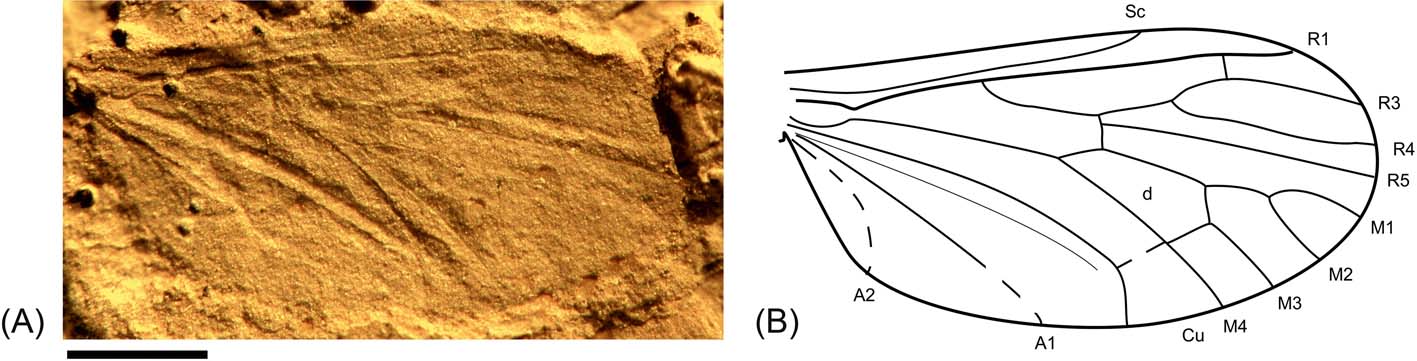
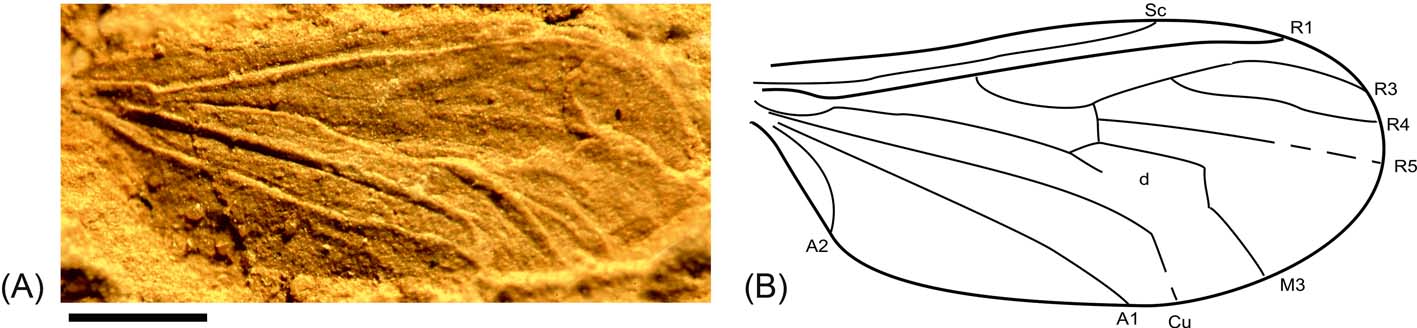
(Figs 1–2)
Mailotrichocera praedicta, n. sp., holotype PIN 371/1302: (A) photograph; (B) drawing. Scale bar = 0.5 mm.

Mailotrichocera praedicta, n. sp. specimen PIN 371/1303. (A) photograph; (B) drawing. Scale bar = 0.5 mm.

Etymology. Praedicta (Latin) means “predicted”; the name alludes to the fact that such a short subcosta was expected to be found in the oldest trichoceriid wings.
Material examined. Holotype PIN 371/1302, isolated wing (part & counterpart); coll. O. M. Martynova Reference Martynova1942.
Locality. Sogyuty (= Issyk-Kul), Dzil Fm, possibly Sinemurian, Early Jurassic (housed in the Borissiak Palaeontological Institute, Russian Academy of Sciences, Moscow). Additional specimen PIN 371/1301 (part & counterpart, on the same slab as the holotype), other details as for the holotype.
Diagnosis. Wing small, 2.2 mm long, greatly rounded, with short Sc (0.55 times wing length), triangular d cell, a little longer than a quarter of the wing; cell m1 very wide, with inner angle rounded.
Description. Wing rounded, more than half as wide as long, 2.2 mm long in both specimens (Figs 1–2). Venation better preserved in the holotype; Sc 0.55 times wing length, fork of Rs in half of wing length; d cell long (0.28 times wing length) and narrow, subtriangular; cell m1 very broad and short, only 1.5 times as long as wide, its inner angle conspicuously rounded; A2 better preserved in specimen 371/1303 (Fig. 2B), short, curved to wing margin.
3. Discussion
The present finding of Trichoceridae in sediments some 10–20 million years older than the previously described Toarcian ones (Krzemińska et al. Reference Krzemińska, Krzemiński and Dahl2009) is remarkable because of the short subcostal vein. According to a phylogenetic tree of Trichoceridae presented in Krzemińska et al. Reference Krzemińska, Krzemiński and Dahl2009, fig. 227, the stem of the family comprises genera with a short Sc (shorter than 0.6 times the wing length). The elongation of this vein is a secondary acquired, apomorphic condition. The polarisation of this character was indicated by the then oldest (Toarcian) species of Mailotrichocera from Germany. The hypothesis of a short Sc being a plesiomorphic condition is now strongly supported.
However, it is surprising that all younger lineages had developed a longer Sc; as a result, it is always longer in Recent genera (at least 0.7 time the wing length), with the only known exception being one species, Nothotrichocera antarctica (Edwards, Reference Edwards1923) (compare Krzemińska & Lukashevich Reference Krzemińska and Lukashevich2009, fig. 2I). The question arises as to the possible biomechanical differences between the wings with long Sc and those with a short one, and some features are presented below.
During flight, insect wings undergo deformation, which is controlled in the most part by the architecture of the wing veins (Wootton Reference Wootton1979) (for further reading see also Wootton Reference Wootton1981, Reference Wootton2003; Wootton & Ennos Reference Wootton and Ennos1989; Shcherbakov et al. Reference Shcherbakov, Lukashevich and Blagoderov1995; Dudley Reference Dudley2000). During the flying stroke, a camber is developed shaped by the deformable and supporting zones in the wing. The main deformable zone runs along longitudinal veins and is flexible lengthwise. The zone supporting the camber may be strengthened in various ways; for example by fluting (as in the leading edge of the wing), thickening of the veins or their fusion into a stronger, stiff structure. In the anteriodistal section of the dipteran wing, this strengthening can be seen in the arrangement of the distal radial and medial veins oblique to the longitudinal deformable zone (Wootton Reference Wootton1981, Reference Wootton2003). This anteriodistal portion of the wing rotates first during the stroke reversal, and thus causes a concave camber at the dorsal side (Ennos Reference Ennos1989).
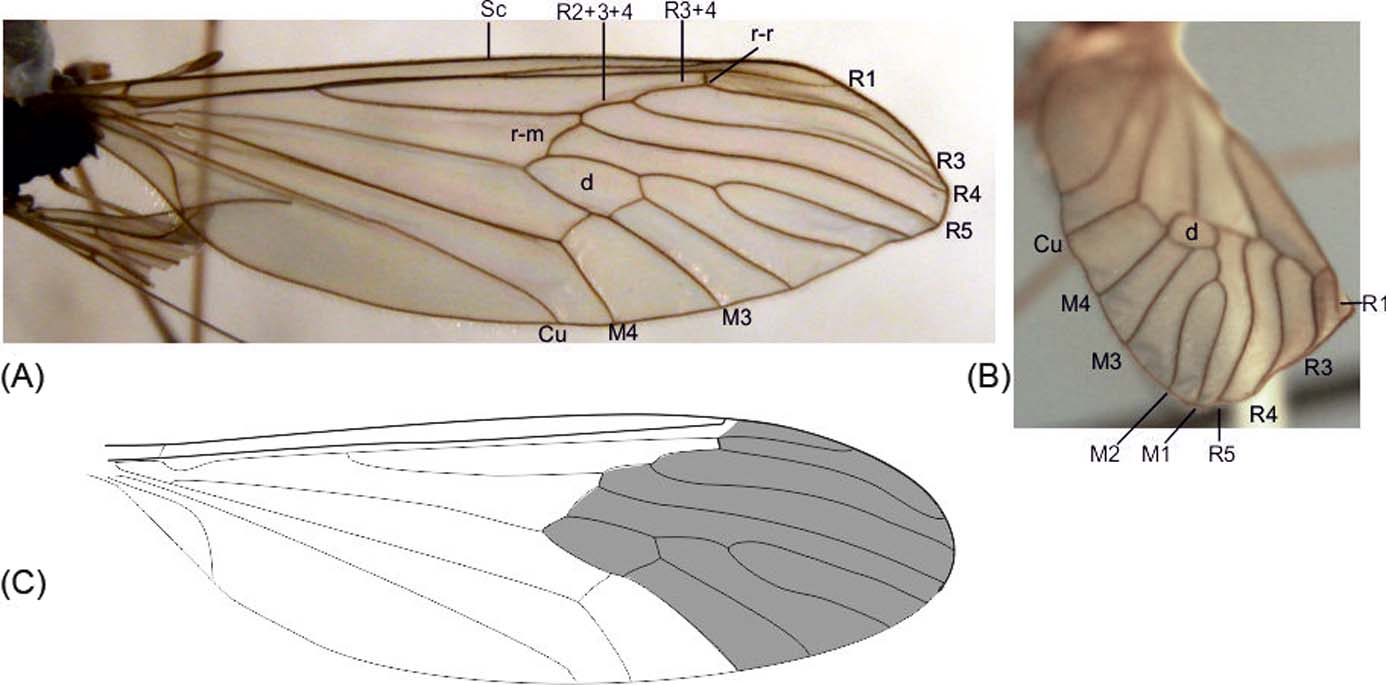
In wings with complete venation, as in the Trichoceridae, this supporting zone of the wing is delimited by a sequence of short, strong sections of veins (Fig. 3A, C) running obliquely from the anterior distal wing margin to the inside of the wing: r–r, R3+4, R2+3+4, and the veins forming the discal cell, to cross-vein m–cu. The functional entity of the sector becomes apparent when tickling the wing of a freshly killed insect; it is also preserved in dried wings and recognisable especially in apical view (Fig. 3B). The apparent role of the discal cell is to stabilise the interiormost portion of the sector. The bending of the costal wing margin, which is the ‘starting point' of the sector, is possible only beyond the end of Sc, as this vein, together with the parallel sections of the costal and basal radial veins, form the leading edge, the strongest and most rigid portion of an insect wing. Its rigidity is enhanced by its corrugated structure: the subcostal vein is dorsally depressed, or negative, in relation to the adjacent C and R.
Wing of a Recent trichocerid, Trichocera major Edwards, Reference Edwards1921: (A) photograph of complete wing; (B) photograph, distal view; (C) drawing; the supporting sector is shaded.

The conclusions of the wing function as deduced from the veination can also be extended to fossil wings (Wootton & Ennos Reference Wootton and Ennos1989; Wootton Reference Wootton2003). When comparing fossil trichocerid wings with long and short Sc (Fig. 4), it becomes apparent that the supporting sector is larger in wings with a shorter Sc, because all the landmarks along the line are shifted to the inside of the wing. Therefore, these oldest trichocerids and their possible descendants (Rasnitsynina, Mailotrichocera, Kovalevinae) must have exhibited different biomechanical characteristics of flight than those characterised by a longer Sc. Another difference is the starting point of the sector on the wing margin: in wings with a long Sc, the bend starts just beyond the end of this vein, which is close to the section of veins delimiting the sector. In wings with a short Sc, the distance between the tip of this vein and the cross-vein r–r at the beginning of the sequence is long, and the camber starts to form far beyond the Sc. Further research is in progress.
Shape of supporting sector in wings of fossil Trichoceridae with short (A, B) and long (C) subcostal: (A) Mailotrichocera variabilis (after Krzemińska, Krzemiński & Dahl Reference Krzemińska, Krzemiński and Dahl2009, fig. 15B); (B) Rasnitsynina minae (after Krzemińska, Krzemiński & Dahl Reference Krzemińska, Krzemiński and Dahl2009, fig. 54D); (C) Trichocera corami (after Krzemińska, Krzemiński & Dahl Reference Krzemińska, Krzemiński and Dahl2009, fig. 59). Star indicates end of Sc; black dots mark the limit of supporting sector shaded in grey; its area in proportion to the entire wing is given (number in white). Not to scale; length unified.

The evolutionary trend to expand the subcostal vein is apparently not limited to Trichoceridae; this was also noticed in another nematoceran family, the Chaoboridae. The oldest chaoborid genus, Rhaetomyia Rohdendorf, 1962 (also from Sogyuty) possesses an extremely short Sc, ending before the midwing, whereas all extant members of the family have developed a longer Sc (Lukashevich Reference Lukashevich1996).
4. Acknowledgements
Jörg Ansorge (Germany) and the second, anonymous, reviewer are thanked for their constructive criticism and suggestions for improving the paper. The research of EDL was partly supported by the Russian Foundation for basic Research, project no. 16-04-01498.