

The (neo)classical idea that, by focusing exclusively on the creation of financial value, corporations automatically provide sufficient value for stakeholders and society as a whole has recently come under closer scrutiny (Jones et al., Reference Jones, Donaldson, Freeman, Harrison, Leana, Mahoney and Pearce2016; Jones & Felps, Reference Jones and Felps2013a). Porter and Kramer, for example, propose a more practitioner-oriented variation of financial value creation as corporate objective by suggesting that corporations should “pursue financial success in a way that also yields societal benefits” (Kramer & Pfitzer, Reference Kramer and Pfitzer2016: 82). Jones and Felps, in turn, argue for a revision of the normative objective of corporations around the enhancement of the “aggregate happiness of its normatively legitimate stakeholders over the foreseeable future” (2013b: 358). These monistic conceptions have been criticized for being one-dimensional and reductionist by scholars advocating value pluralism instead of monism in value creation stakeholder theory (VCST) (Mitchell, van Buren, Greenwood, & Freeman, Reference Mitchell, van Buren, Greenwood and Freeman2015; Mitchell, Weaver, Agle, Bailey, & Carlson, Reference Mitchell, Weaver, Agle, Bailey and Carlson2016; van der Linden & Freeman, Reference Linden and Freeman2017). In this vein, Harrison and Wicks conceptualize value creation beyond the exclusive focus on financial value by proposing “the sum of the utility created for each of a firm’s legitimate stakeholders” (Reference Harrison and Wicks2013: 102) as a more pluralistic measure for firm performance.
However, accepting stakeholder value pluralism as a necessary condition for value creation poses a significant new challenge for research: conceptualizing processes that assist firms to navigate stakeholder value pluralism in order to create value for stakeholders (van der Linden & Freeman, Reference Linden and Freeman2017). There exists a clear need to investigate “processes for engaging stakeholders and understanding value creation from their perspective” (Harrison & Wicks, Reference Harrison and Wicks2013: 118). Consequently, Mitchell et al. call for research on processes to “better match corporate objectives to the preferences of stakeholders and managers” (Reference Mitchell, Weaver, Agle, Bailey and Carlson2016: 270). Scholars have started to address this issue by conceptualizing either an agonistic or a deliberative approach to stakeholder engagement. While proponents of the agonistic approach stress the importance of dissensus and contestation to empower less powerful stakeholders (Brown & Dillard, Reference Brown and Dillard2013, Reference Brown and Dillard2015; Dawkins, Reference Dawkins2015), deliberative scholars propose a more consensual approach that aims at identifying temporary accommodations of value differences through a reasonable exchange of arguments between conflicting stakeholders (Gilbert, Rasche, & Waddock, Reference Gilbert, Rasche and Waddock2011; Goodman & Arenas, Reference Goodman and Arenas2015; Marti & Scherer, Reference Marti and Scherer2016; Scherer & Palazzo, Reference Scherer and Palazzo2007; Scherer & Palazzo, Reference Scherer and Palazzo2011; Scherer, Rasche, Palazzo, & Spicer, Reference Scherer, Rasche, Palazzo and Spicer2016).
These types of stakeholder engagement are particularly relevant in situations where value pluralism leads to situations of value conflict amongst stakeholders (Patzer, Voegtlin, & Scherer, Reference Patzer, Voegtlin and Scherer2018). Stakeholder value conflicts are characterized by incongruent, i.e., strongly diverging or even opposing, value perspectives of stakeholders (Dentoni, Bitzer, & Schouten, Reference Dentoni, Bitzer and Schouten2018), leading to combative behavior amongst stakeholders that significantly constrains the potential for pluralistic stakeholder value creation (Bundy, Vogel, & Zachary, Reference Bundy, Vogel and Zachary2018). Therefore, stakeholder value conflicts can jeopardize the mutually beneficial cooperation of stakeholders, as shared values (i.e., values held in common by stakeholders) are considered to be necessary for the creation of pluralistic stakeholder value in the long term (Mitchell et al., Reference Mitchell, van Buren, Greenwood and Freeman2015). However, the existing agonistic as well as deliberative approaches to stakeholder engagement fall short in providing sufficient conceptual and practical means to assist firms to fulfill VCST’s fundamental claim: that firms need to resolve value conflicts in a way that ultimately creates value for all stakeholders involved (Freeman, Harrison, Wicks, Parmar, & Colle, Reference Freeman, Harrison, Wicks, Parmar and Colle2010; Mitchell et al., Reference Mitchell, van Buren, Greenwood and Freeman2015). In fact, both the agonistic as well as the deliberative approach prove to be insufficient, as agonists struggle to chart constructive pathways for the actual resolution of value conflicts and deliberative scholars largely underestimate the issue of power imbalances between stakeholders. In the face of this tension, in the literature between dissensual and consensual approaches to stakeholder engagement, scholars have recently started to call for the development of a so-called integrative approach that is neither overly oriented toward dissensus nor consensus, providing further conceptual and practical means to address stakeholder value conflicts in a more effective way (Levy, Reinecke, & Manning, Reference Levy, Reinecke and Manning2016). In this article, we address this research gap by pursuing the following research question: How should firms engage with stakeholders in situations of value conflict in a way that creates pluralistic stakeholder value?
We address this research question by drawing on novel insights from the theory of justification as developed by the philosopher Rainer Forst (Reference Forst2002, Reference Forst2012, Reference Forst2014b), who has advanced and extended Habermasian ideas in important ways in recent years. Grounded on a critical pragmatic (Forester, Reference Forester2009, Reference Forester2012), weak-foundationalist account (White, Reference White2015, Reference White2017) of Rainer Forst’s theory of justification, we develop a procedural framework based on a discursive sharing process between affected stakeholders oriented toward discursive justification involving five steps: First, firms need to assess the degree to which the procedural preconditions for discursive sharing (i.e., reciprocity and generality) are met. Second, firms need to assess the stakeholder value conflict in detail by exploring who is affected and what the key concerns of the affected are. Third, firms need to convene the affected stakeholders and create conducive conditions for reciprocal dialogue through skilled and independent facilitation. Fourth, firms need to enable mutual learning by engaging stakeholders in joint and open fact-finding. Fifth, firms and stakeholders can find solutions that accommodate diverging stakeholder value perspectives through discursive justification without either ignoring, limiting, or absolutizing relevant value perspectives. Outcomes of such a discursive value-sharing process range from stakeholder value dissensus (continuing value incongruence), to low (value agreement to disagree) and increasing levels of stakeholder value congruence (value agreement/compromise), to stakeholder value consensus (shared values). Each outcome can be associated with a potential for pluralistic stakeholder value creation with the lowest potential being assigned to situations of value dissensus and the highest being connected to value consensus.
This article contributes to the emerging integrative approach to stakeholder engagement (Levy et al., Reference Levy, Reinecke and Manning2016; Patzer et al., Reference Patzer, Voegtlin and Scherer2018) as well as to the literature on pluralistic stakeholder value creation (Harrison & Wicks, Reference Harrison and Wicks2013; Mitchell et al., Reference Mitchell, Weaver, Agle, Bailey and Carlson2016; Soundararajan, Brown, & Wicks, Reference Soundararajan, Brown and Wicks2019; van der Linden & Freeman, Reference Linden and Freeman2017) by providing a comprehensive procedural framework to guide firms and stakeholders to manage value conflicts in a value creating way through the discursive accommodation of diverging value perspectives of stakeholders. The proposed procedural framework enables an evaluation of stakeholder value conflicts before, during, and after communicative exchanges with stakeholders and provides material guidance for corporate decision-making and actual stakeholder deliberations. Furthermore, the Forstian notion of sharing provided in this article moves beyond the consensus orientation of Habermasian discourse theory by conceptualizing a communicative sharing process of discursive justification that replaces the orientation toward consensus with an orientation toward sufficient justification facilitated by specific criteria of justification as well as actionable guiding questions. Thus, our framework is less susceptible to criticisms voiced against consensual CSR in the recent literature (Dawkins, Reference Dawkins2015; Sabadoz & Singer, Reference Sabadoz and Singer2017; Whelan, Reference Whelan2012, Reference Whelan2013) by adopting a moderating position between dissensual and consensual approaches to stakeholder engagement.
The article is organized as follows. In the next section, we provide an overview of the debate on monistic and pluralistic conceptions of stakeholder value creation. On this basis, we identify the need to investigate in more detail how firms should engage with stakeholders to resolve value conflicts in a way that creates pluralistic stakeholder value. In the following section, we then address this research question and develop a procedural framework based on a discursive sharing process that is grounded on both elements of Forst’s theory of justification and practical insights into dealing with stakeholder value conflicts from John Forester. As we will show, this framework provides important conceptual as well as practical advancements to the literature, which provide firms with procedural guidance for the resolution of stakeholder value conflicts through discursive sharing. We illustrate the practical implications of our framework by analyzing the Accord for Fire and Building Safety (hereafter, Accord), which was initiated in 2013 to improve working conditions in garment factories in Bangladesh. We conclude with an elaboration on the key contributions of our paper for advancing theory and a discussion of several limitations of our framework that provide fruitful avenues for further research.
MONISTIC VS. PLURALISTIC CONCEPTIONS OF STAKEHOLDER VALUE CREATION
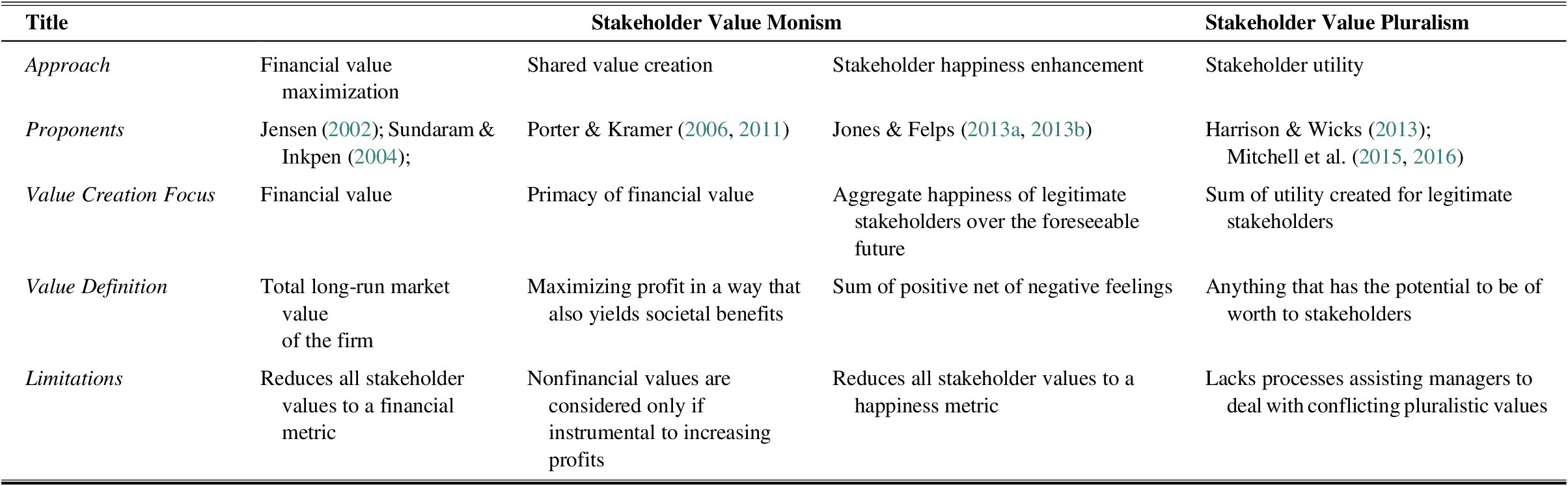
Within the recent debate on the corporate normative objective, two fundamental approaches to stakeholder value creation in particular can be identified: On the one hand, monistic approaches conceptualize a single value, such as profit or happiness, as the value to be created by corporations. Pluralistic conceptions, on the other hand, propose that businesses should refer to concepts such as stakeholder utility to create multiple values for stakeholders at the same time. In the following section, we detail both sides of this controversy in order to develop the research question that we will address in this article (see Table 1 for a short overview of this controversy).
Overview of Conceptions of Monistic and Pluralistic Stakeholder Creation

Stakeholder Value Monism
Arguably, the most prominent single value that corporations ought to create is financial value or profit. Several scholars have argued in favor of financial value maximization (FVM) as a corporate objective (Friedman, Reference Friedman1970; Porter & Kramer, Reference Porter and Kramer2011; Sundaram & Inkpen, Reference Sundaram and Inkpen2004), positing that “managers should make all decisions so as to increase the total long-run market value of the firm” (Jensen, Reference Jensen2002: 236). According to Jensen, this single-valued objective is necessary to avoid “confusion and lack of purpose that will fundamentally handicap the firm in its competition and survival” (Reference Jensen2002: 238). Governing a firm in the financial interest of owners or shareholders is then also instrumental to creating value for all other stakeholders of the firm. However, it is important to point out that FVM does not imply that non-financial values, such as job security or meaningful work, are not important for the creation of financial value. On the contrary, these values are included in the FVM-process by way of considering their consequences for the profitability of the firm.
The most recent variation of FVM as the corporate objective is provided by Porter and Kramer’s (Reference Porter and Kramer2006; Reference Porter and Kramer2011) approach to shared value creation, suggesting that corporations should “pursue financial success in a way that also yields societal benefits” (Kramer & Pfitzer, Reference Kramer and Pfitzer2016: 82). Emphasizing that shared value is about approaching “societal issues from a value perspective,” which is characterized by an understanding of the notion of value as “benefits relative to costs, not just benefits alone” (Reference Porter and Kramer2011: 66), Porter and Kramer state that shared value is “integral to profit maximization” (Reference Porter and Kramer2011: 76, 75).
Jones and Felps (Reference Jones and Felps2013a, Reference Jones and Felps2013b), in turn, conceptualize the corporate objective based on a neo-utilitarian perspective advocating stakeholder happiness as the single value that corporations should seek to create. While agreeing with the argument of FVM-proponents that management needs a single-valued objective in order to manage the firm effectively for stakeholders, they criticize FVM for providing only indirect and increasingly insufficient contributions to social welfare. Instead they propose stakeholder happiness enhancement (SHE) as a more direct and effective objective to create value for stakeholders and society as a whole. SHE suggests that firms should “enhance the aggregate happiness of normatively legitimate stakeholders over the foreseeable future” (Jones & Felps, Reference Jones and Felps2013b: 358), defining happiness as the “sum of positive feelings … net of negative feelings” (Jones & Felps, Reference Jones and Felps2013b: 355). Hence, Jones and Felps contend that firms can make decisions based on a principled criterion providing happiness with a common metric to which all other values are commensurable. As a consequence, within SHE, financial value creation constitutes a “necessary condition for the provision of happiness to stakeholders” (Jones & Felps, Reference Jones and Felps2013b: 360) rather than being the single value to be created by firms as in the FVM-approaches outlined above.
Stakeholder Value Pluralism
Pluralistic conceptions of stakeholder value creation start from the assumption that human values in business are so diverse and manifold that efforts to reduce this plurality of values to one common metric or evaluative standard constitute a “humanly unrealistic goal” (Mitchell et al., Reference Mitchell, Weaver, Agle, Bailey and Carlson2016: 259). Accordingly, stakeholder value pluralists refuse the argument that firms need a single-valued objective in order to ensure firm survival, suggesting instead that “the simultaneous consideration of different values appears not to be a problem, but rather the very basis for managerial decision making” (van der Linden & Freeman, Reference Linden and Freeman2017: 374). Hence, applying a monistic value mindset to the task of stakeholder value creation would ultimately result in less overall value created by firms. Consequently, SHE is criticized to “arbitrarily truncate the potential range of factors” (Mitchell et al., Reference Mitchell, Weaver, Agle, Bailey and Carlson2016: 263) valuable to stakeholders. From the perspective of value pluralism, FVM as well as shared value, in turn, are best described as reductionist and one-dimensional perspectives conceptualizing value creation as little more than striving for positive and possibly high digits on a balance sheet. Harrison and Wicks criticize such narrow conceptions of value for disregarding “other critical aspects of utility relevant to a discussion of value—particularly dimensions that extend beyond profitability and economic returns” (Reference Harrison and Wicks2013: 100). Other stakeholder theorists argue that the value corporations create can only be understood by referring to a multiplicity of stakeholder value perspectives (Freeman et al., Reference Freeman, Harrison, Wicks, Parmar and Colle2010). Value judgments of individual stakeholders are based on a multifaceted process, which, in turn, ultimately determines the degree to which value has been created by the corporation (Lankoski, Smith, & van Wassenhove, Reference Lankoski, Smith and Wassenhove2016). Accordingly, to incorporate said pluralism, Harrison and Wicks (Reference Harrison and Wicks2013: 100–101) propose to define value “broadly as anything that has the potential to be of worth to stakeholders.” They conclude that firms should be managed to create utility for each of a firm’s legitimate stakeholders and propose to operationalize utility by considering stakeholder’s utility functions “express[ing] the stakeholder’s preferences for particular types of value” (101).
While accepting stakeholder value pluralism as a necessary condition for value creation solves important conceptual problems, it poses a significant new challenge for research: the question arises how to conceptualize processes that assist firms to navigate stakeholder value pluralism in order to create value for stakeholders (Mitchell et al., Reference Mitchell, Weaver, Agle, Bailey and Carlson2016; Soundararajan et al., Reference Soundararajan, Brown and Wicks2019; van der Linden & Freeman, Reference Linden and Freeman2017). This challenge is particularly great in situations of stakeholder value conflict where a firm is confronted with incongruent, i.e., strongly diverging or directly opposing, value perspectives of one or more of its stakeholders. This type of value conflict can lead to the disruption of stakeholder cooperation whereby the joint value creation process of the firm is jeopardized through combative behavior amongst stakeholders (Bundy et al., Reference Bundy, Vogel and Zachary2018). This phenomenon is particularly relevant for so-called multistakeholder governance processes that are often characterized by the clash of incongruent value perspectives of firms, NGOs, and marginalized stakeholders (Bakker, Rasche, & Ponte, Reference Bakker, Rasche and Ponte2019; Dentoni et al., Reference Dentoni, Bitzer and Schouten2018; Patzer et al., Reference Patzer, Voegtlin and Scherer2018; Soundararajan et al., Reference Soundararajan, Brown and Wicks2019).
The prospects of resolving such value conflicts in a value-creating way largely rest on two factors: First, the degree to which the fundamental strategic interests of the affected stakeholders and the firm diverge. The more the strategic interests diverge or even oppose each other, the less likely it becomes to find a mutually acceptable solution of the value conflict (Bundy et al., Reference Bundy, Vogel and Zachary2018). Second, the resolution of a stakeholder value conflict hinges upon the quality and procedural characteristics of the associated stakeholder engagement process. Arguably, the latter aspect is the most important, as stakeholder engagement processes assist stakeholders to clarify their interests and values through communicative exchanges (Dentoni et al., Reference Dentoni, Bitzer and Schouten2018). Scholars have started to address this issue by conceptualizing either an agonistic or a deliberative approach to stakeholder engagement. While proponents of the agonistic approach stress the importance of dissensus and contestation to empower the less powerful, deliberative scholars propose a more consensual approach that aims at identifying temporary accommodations of value differences through a reasonable exchange of arguments between conflicting stakeholders (see the first two columns of Table 3 for an overview of this discussion).
While the recent discussion on this topic is largely driven by the controversy between either agonistic or deliberative forms of stakeholder engagement as suitable means for addressing stakeholder value conflicts, more research is called for that investigates “how managers … reconcile multiple (possibly competing) values” (Bundy et al., Reference Bundy, Vogel and Zachary2018: 496). In this article, we address this problem by exploring how firms should engage with stakeholders in situations of value conflict in a way that creates pluralistic stakeholder value. In the next section of this article, we will address this research question by developing a procedural framework based on a discursive sharing process among firms and stakeholders geared towards including the pluralism of stakeholder value perspectives.
ADDRESSING STAKEHOLDER VALUE CONFLICT THROUGH DISCURSIVE SHARING OF VALUE PERSPECTIVES—A PROCEDURAL FRAMEWORK
In the following section, we develop a procedural framework that is based on recent advancements of Habermasian ethics by Forst (Reference Forst2002, Reference Forst2012, Reference Forst2014b), as well as current developments on deliberative democracy both in theory (Curato, Dryzek, Ercan, Hendriks, & Niemeyer, Reference Curato, Dryzek, Ercan, Hendriks and Niemeyer2017; Owen & Smith, Reference Owen and Smith2015; Thompson, Reference Thompson2008; Warren, Reference Warren2017) and practice (Forester, Reference Forester2009, Reference Forester2012). We begin by briefly discussing the relevance of the concept of sharing for VCST before elucidating the notion of sharing from the perspective of Forst’s theory of justification. Having conceptualized sharing as a process of communication oriented toward discursive justification, we then proceed by explaining our five-step procedural framework for accommodating pluralistic stakeholder value perspectives through this discursive sharing process.
The Concept of Sharing and Its Relevance for Value Creation Stakeholder Theory
While the concept of sharing has been theorized in many research streams (John, Reference John2016), in this section we focus on its core meaning as well as its direct relevance for VCST. Recent research points out that the notion of sharing “incorporates a wide range of distributive and communicative practices, while also carrying a set of positive connotations to do with our relations with others and a more just allocation of resources” (John, Reference John2012: 176). Thus, sharing can be understood as both an act of distribution and an act of communication. The former has received the most attention so far within the literature, as sharing has been conceptualized as a distinct form of social exchange (Belk, Reference Belk2007, Reference Belk2010), as a mode of “collaborative” consumption (Botsman & Rogers, Reference Botsman and Rogers2010), as well as an “access-based” form of consumption (Bardhi & Eckhardt, Reference Bardhi and Eckhardt2012). Within VCST, the notion of sharing plays an important role since value creation rests on shared stakeholder interests, constituting a situation of harmony where, metaphorically speaking, “the notes are different but they must blend together” (Freeman et al., Reference Freeman, Harrison, Wicks, Parmar and Colle2010: 27). The essence of stakeholder management is described “as a sequential risk-sharing process of stakeholder organization … toward the end of value creation” (Mitchell et al., Reference Mitchell, van Buren, Greenwood and Freeman2015: 858). While John sheds light on the notion of sharing in social media communications (2012) and links sharing to the concept of a “therapeutic discourse” (2013), very few other studies further investigate the communicative aspect of sharing. Recent research on deliberative approaches to the valuation of ecosystem services in the realm of public policy link the notion of shared values to a deliberative process of valuation among citizens. It is argued that through deliberations, citizens can identify shared, i.e., common values, that can guide their valuations of local ecosystem services (e.g., water or nature) beyond mere monetary valuations (Kenter et al., Reference Kenter, O’Brien, Hockley, Ravenscroft, Fazey, Irvine, Reed, Christie, Brady, Bryce, Church, Cooper, Davies, Evely, Everard, Fish, Fisher, Jobstvogt, Molloy, Orchard-Webb, Ranger, Ryan, Watson and Williams2015; Kenter, Reed, & Fazey, Reference Kenter, Reed and Fazey2016). In the following, we approach the notion of sharing as an act of communication from the perspective of Forst’s theory of justification (Reference Forst2002, Reference Forst2012, Reference Forst2014b). Forst is a member of the third generation of German-speaking critical theorists (Marti, Reference Marti2018), who advanced Habermas’s theory in important ways as we will further elaborate on in the next section.
Sharing as Process of Discursive Justification: Implications from Rainer Forst’s Theory of Justification
In the context of VCST, scholars have argued for the normative complexity of business and value creation based on the paradigmatic insight that business and society must be conceived as deeply entangled rather than completely separated from each other (Freeman et al., Reference Freeman, Harrison, Wicks, Parmar and Colle2010; Harris & Freeman, Reference Harris and Freeman2008). From a Habermasian standpoint, these findings have been reflected in the view that communicative processes of justification are not only the building blocks of society, but also an essential part of the value creation process of businesses (Gilbert & Behnam, Reference Gilbert and Behnam2009; Gilbert & Rasche, Reference Gilbert and Rasche2007; Smith, Reference Smith2004). In modification of the (neo)classical characterization of business as a nexus of contracts, scholars supporting a relational view of economic activity conceptualize businesses as a “nexus of social relationships” arguing that “firms are also moral communities in which communicative action explains their ability to enhance the interests of all members” (Smith, Reference Smith2004: 329–330).
Habermasian business ethics research has proliferated in recent years with scholars drawing on Habermas’s seminal conceptions of discourse ethics (Gilbert & Behnam, Reference Gilbert and Behnam2009; Gilbert & Rasche, Reference Gilbert and Rasche2007; Goodman & Arenas, Reference Goodman and Arenas2015; Patzer et al., Reference Patzer, Voegtlin and Scherer2018; Reed, Reference Reed1999; Scherer, Reference Scherer2015; Stansbury, Reference Stansbury2009; Ulrich, Reference Ulrich2008) and deliberative democracy (Mena & Palazzo, Reference Mena and Palazzo2012; Scherer, Palazzo, & Baumann, Reference Scherer, Palazzo and Baumann2006). Particularly Habermas’s political writings (Reference Habermas1996, Reference Habermas1999) have inspired a fairly influential stream of research called Political CSR, which states that societal acceptance of corporate value creation is increasingly dependent upon processes of argumentation and deliberation with affected stakeholders (Palazzo & Scherer, Reference Palazzo and Scherer2006; Scherer et al., Reference Scherer, Rasche, Palazzo and Spicer2016; Scherer & Palazzo, Reference Scherer and Palazzo2007, Reference Scherer and Palazzo2011). However, this research has recently been criticized for being overly focused on consensus and for grounding its theory on a too idealistic concept of communication resulting either in the overburdening of corporations or the rather naïve disregard of power imbalances and communication strategies aiming at dissent rather than consent between stakeholders (Dawkins, Reference Dawkins2015; Sabadoz & Singer, Reference Sabadoz and Singer2017; Whelan, Reference Whelan2012, Reference Whelan2013).
Particularly relevant for our research problem is that Forst shifts the theoretical focus from discursive consensus to a process of discursive justification guided by criteria of justification driven by the insight that “justification in real life … need[s] criteria beyond consensus” (Forst, Reference Forst2014a: 196). Hence, Forst agrees with other scholars in arguing that deliberation needs to be conceptualized in a less consensus-oriented way in order to harness its full normative potential (Curato et al., Reference Curato, Dryzek, Ercan, Hendriks and Niemeyer2017; Owen & Smith, Reference Owen and Smith2015; Thompson, Reference Thompson2008; Warren, Reference Warren2017). Forst grounds his concept on the so-called “principle of justification,” which states that “normative answers to practical questions are to be justified in precisely the manner referred to by their validity claims” (Forst, Reference Forst2012: 18). This principle expresses the key insight of Habermas’s communicative approach, according to which normative validity is tied to the rational acceptability of reasons in practical discourses (Reference Habermas1993, Reference Habermas1996, Reference Habermas1999). Forst assumes with Habermas that actors “have reasons for their actions that they can justify to themselves and can communicate and justify to others, so that these reasons … can be shared” (Forst, Reference Forst2002: 256, emphasis added). Thus, on Forstian grounds, sharing is understood as a process of communication oriented toward discursive justification.
On this basis, Forst develops the procedural criteria of discursive justification by performing a recursive analysis of the conditions of justifying values, norms, and actions through moving “inquiringly from normative validity claims back to validity reasons and validity justifications” (Reference Forst2002: 193). Accordingly, Forst inquires into the fundamental procedural preconditions that need to be met in order to discursively resolve a value conflict. He identifies two key criteria of discursive justification: reciprocity and generality. The criterion of reciprocity forbids one to “raise any specific claims while rejecting like claims of others” and to “simply assume that others share one’s perspective, evaluations, convictions, interests, or needs” (Forst, Reference Forst2012: 49). The criterion of generality aims at making sure that the objections of anyone affected are included. Consequently, the criteria of reciprocity and generality are geared toward ensuring equal status and concrete respect of individuals as well as guaranteeing the inclusion of all affected stakeholders. These criteria prompt the affected stakeholders of a value conflict to ask themselves whether they considered the plurality of stakeholder value perspectives in an equal, neutral, and empathic way without excluding affected stakeholders.
Therefore, the criteria of reciprocity and generality aim at establishing a discursive situation where the conflicting parties can openly voice their concerns and can try to put themselves in the shoes of the other and to understand the value perspectives of one another. Hence, these criteria can be understood as necessary preconditions for the discursive resolution of stakeholder value conflicts, as low levels of reciprocity and generality imply that important stakeholders have not been included, and that the conflicting parties are unwilling or unable to meaningfully engage with each other’s justifications and value perspectives. Hence, low levels of reciprocity and generality are not conducive to the discursive resolution of a value conflict. A discursive situation, characterized by a low level of generality and a high level of reciprocity, is also unlikely to resolve a value conflict, as relevant objections from affected stakeholders are not included in the process. A high level of generality and a low level of reciprocity, in turn, make the discursive resolution of a value conflict improbable as relevant objections of affected stakeholders are unlikely to be accommodated in a process where each participant acknowledges only his or her own value perspective.
Managing Stakeholder Value Conflict through Discursive Sharing: A Procedural Framework
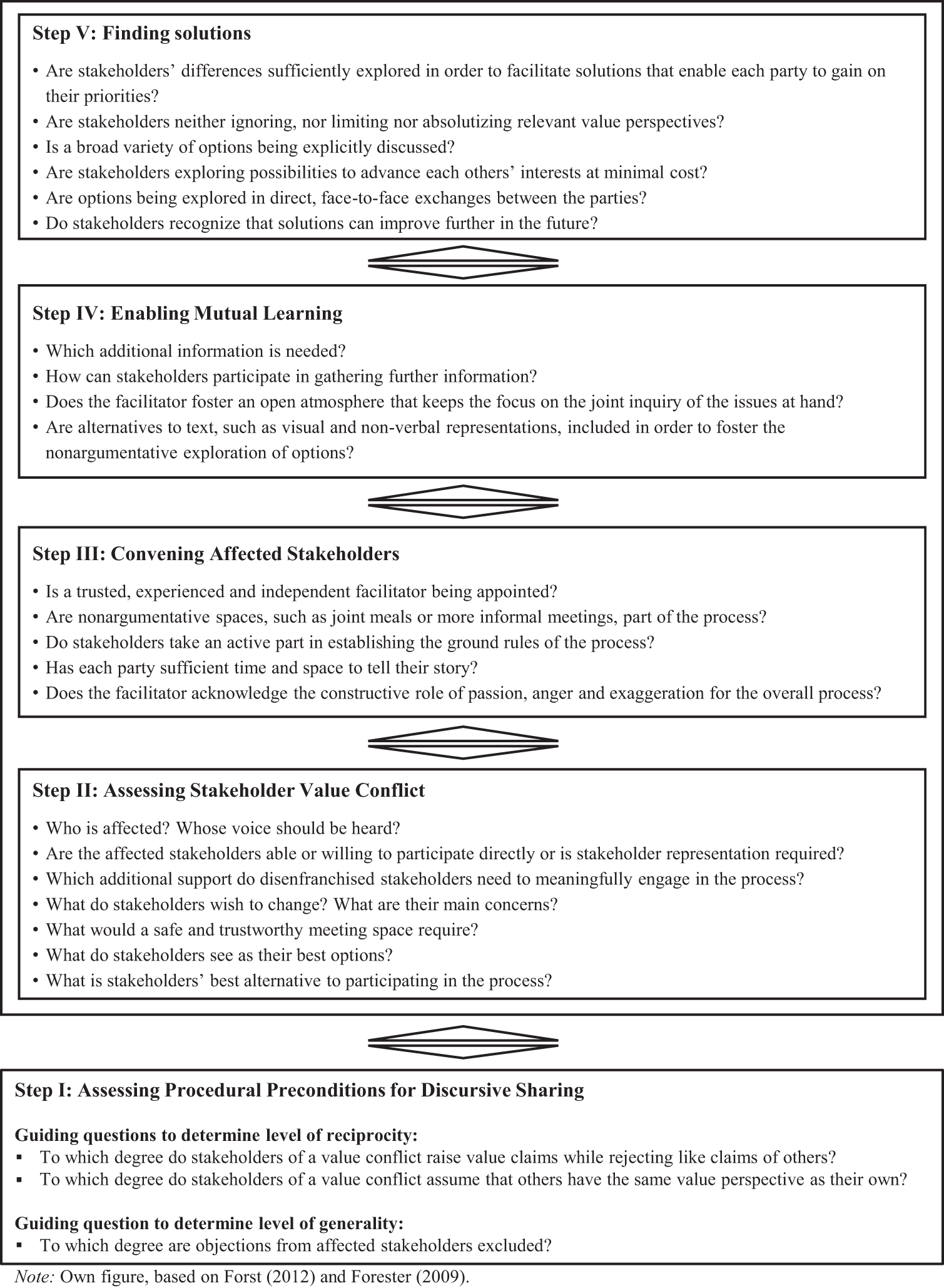
On this basis, we can now sketch in more detail how the Forstian notion of discursive sharing can facilitate the accommodation of conflicting stakeholder value perspectives. We argue that to deal with stakeholder value conflict, firms should engage in a communicative sharing process between stakeholders oriented toward discursive justification involving five steps (Forester, Reference Forester2009; Forst, Reference Forst2002, Reference Forst2012). These five steps are depicted in Figure 1 and will be outlined in more detail in the following section. The bi-directional arrows in Figure 1 indicate that the five process steps are closely interrelated. Although analytically distinct, all steps contain a certain degree of overlap with each other.
Managing Stakeholder Value Conflict through Discursive Sharing – A Procedural Framework

Step 1: Assessing Procedural Preconditions for Discursive Sharing
According to Forst, high levels of both reciprocity and generality make it more likely that a discursive sharing process can lead to the resolution of a stakeholder value conflict. Forst’s criteria can be used by firms and stakeholders to evaluate the initial situation of a stakeholder value conflict by referring to several guiding questions, as indicated in Figure 1. Therefore, the first step of our framework prompts firms to assess the level of reciprocity and generality displayed by the stakeholders that are involved in the value conflict. Firms can base their assessment on public assertions of stakeholders as well as on observations of stakeholder behavior. To determine the level of reciprocity, firms need to pursue the following two guiding questions: 1) To what degree do stakeholders of a value conflict raise value claims while rejecting like claims of others? and 2) To what degree do stakeholders of a value conflict assume that others have the same value perspective as their own? If both guiding questions indicate a low degree, the initial level of reciprocity is high. To assess the level of generality, firms, in turn, need to refer to the following guiding question: To what degree are objections from affected stakeholders excluded? If no, or if only a very limited number of objections are excluded (indicating a low degree of exclusion), the initial level of generality can be assumed to be high.
However, Forst is not arguing that high levels of reciprocity and generality automatically lead to a successful resolution of a stakeholder value conflict. Establishing the initial level of reciprocity and generality of a stakeholder value conflict rather helps firms to manage their expectations and to better prepare the following steps of the process. While high levels of reciprocity and generality at the beginning of a discursive value conflict resolution process certainly represent the ideal scenario, lower levels of reciprocity and generality are more likely to be encountered in practice. At this point, it is important to point out that the criteria of justification represent a necessary idealization, or in Habermasian terms a “regulative idea.” This means that calling for their full realization at every point in time is beside the point. Rather than prescribing abstract ideal outcomes, these procedural criteria aim at elucidating procedural pathways along which affected stakeholders can reach an understanding of their value perspectives in order to create value together. Thus, these criteria provide a useful yardstick for firms and stakeholders that is as much an integral part of real dialogic conflict resolution processes as it transcends these practices by indicating avenues toward more inclusive and stakeholder-sensitive engagement.
Therefore, further process steps are required to foster a discursive sharing process that, as a whole, is oriented toward the criteria of reciprocity and generality. Accordingly, we turn to insights from practitioners on how to conduct discursive value conflict resolution processes. Thus, in the following, we further operationalize our Forstian, discursive sharing process by including practical insights into successful conflict resolution processes by John Forester (Reference Forester2009, Reference Forst2012), a leading scholar in the field of urban planning and dialogic conflict resolution.
Step 2: Assessing Stakeholder Value Conflict
The second step of our framework aims at providing firms with a more thorough understanding of the underlying value differences of a stakeholder value conflict (Forester, Reference Forester2009). Ultimately, firms first need to explore who is affected and which stakeholders need to be heard. It is important to find out the main concerns of these stakeholders and to know more about what specifically they want to change. Furthermore, firms need to determine whether stakeholders are either willing or able to participate in a discursive conflict resolution process. In addition, firms should clarify what additional support (i.e., financial support, support from relatives or family, legal or expert council) is required to ensure that all affected stakeholders can participate in the process in a meaningful way. Moreover, firms should inquire about the perceptions of stakeholders concerning their best options as well as their best alternatives to engaging in the process.
Step 3: Convening Affected Stakeholders
After assessing the interdependence of the stakeholders of the value conflict, firms should proceed with step three of the discursive sharing process: convening affected stakeholders (Forester, Reference Forester2009). A fundamental prerequisite at the beginning of this step is the appointment of a trusted, experienced, and independent facilitator that is responsible for conducting the subsequent face-to-face interactions of stakeholders. External, independent facilitation is important to address power imbalances between stakeholders and secure sufficient trust by the conflicting parties to participate in the process. Skilled facilitation ensures that no stakeholder group has undue influence on the process and that face-to-face interactions remain focused on finding mutually acceptable solutions for all parties involved. Furthermore, recent research on multistakeholder processes stresses the need to establish basic meeting norms and ground rules together in order to generate joint expectations. In addition, such stakeholder discourses should include “nonargumentative spaces,” such as joint meals or visits, to build trust among the involved parties (Forester, Reference Forester2009). Furthermore, participants should not expect only sober argumentation but also anger, passion, and emotion during stakeholder discourse concerning conflicting value perspectives. Firms should listen even more carefully to the passionate and emotional accounts of stakeholders, since this additional expressive energy holds the potential for positive change by signaling priorities, deeper interests, or vulnerabilities of stakeholders. Moreover, the discourse should be structured in a way that gives participants sufficient space to tell their story (Patzer et al., Reference Patzer, Voegtlin and Scherer2018).
Step 4: Enabling Mutual Learning
In step four, stakeholders should be empowered to engage in joint fact-finding and should be able to access the best available knowledge on the issue at hand. Ambiguities of values and interests should be considered productive resources since they can foster joint inquiry into creative solutions (Forester, Reference Forester2009). To this end, it can be useful to complement textual representations of important facts and information with alternative forms of representation, such as visual or nonverbal, to foster an open exploration of options. In this step, it is particularly important to actively engage all stakeholders in a joint effort to learn additional facts related to the value conflict at hand. The facilitator needs to make sure that knowledge disparities between stakeholders are bridged not only through the inclusion of external expertise but also through a joint effort by the affected parties themselves to gather the information and facts required. The joint experience of learning new facts about the conflict, combined with the impact of the open exchange of stories and perspectives within the previous step, lay the foundation for finding joint solutions.
Step 5: Finding Solutions
Having convened the affected stakeholders and engaged in a discursive process of mutual learning, firms and stakeholders proceed to the fifth and final step of our framework: finding solutions by accommodating value differences through discursive justification. Firms and stakeholders can reach working agreements by exploring their differences, which opens up pathways for mutually beneficial accommodations. Hence, accommodating diverging value perspectives of stakeholders implies avoiding to ignore, limit, or absolutize the relevant value perspectives of stakeholders. Ignoring means that firms should not disregard relevant value perspectives in a given context. Limiting, in turn, describes restricting the content and scope of relevant value perspectives. Absolutizing, on the other hand, means singling out one value perspective and giving this single perspective total priority over all other perspectives. Hence, it is neither required nor necessarily desirable to aim for consensus or value congruence in processes of discursive justification. It is precisely the joint and creative inquiry into value differences that can ultimately result in agreements allowing all parties to gain on their priorities (Forester, Reference Forester2009). Consensus or value congruence can be an outcome of discursive sharing without being its normative ideal (Curato et al., Reference Curato, Dryzek, Ercan, Hendriks and Niemeyer2017; Warren, Reference Warren2017). Therefore, discursive justification also includes “agreements to disagree,” where stakeholders might not have reached a decision on a joint course of action but have at least gained a better understanding of each other’s values.
Four main outcomes of a discursive sharing process can be distinguished, as depicted in Figure 2. First, a discursive sharing process can result in a situation of stakeholder value dissensus, meaning that the value perspectives of stakeholders remain incongruent, i.e., strongly divergent or opposing, after having engaged in a reciprocal and general communicative exchange. Although this outcome implies a very low potential for pluralistic stakeholder value creation, even situations of protracted stakeholder value conflict might imply at least a residual potential of monistic stakeholder value creation as long as the key strategic interests of stakeholders remain aligned (e.g., exploitative working conditions might persist because all parties involved remain at least financially better off when continuing to cooperate). Second, a discursive sharing process can lead to a low level of stakeholder value congruence, where stakeholders of a value conflict come to an agreement to disagree. This outcome can be associated with a low potential for pluralistic stakeholder value creation, as stakeholders were largely unable to accommodate their diverging value perspectives. Third, a discursive sharing process can result in high levels of stakeholder value congruence, where stakeholders achieve value convergence by jointly identifying actual working agreements and compromises that indicate a medium potential for pluralistic stakeholder value creation. Fourth, discursive sharing can result in stakeholder value consensus, meaning that stakeholders come to a shared (i.e., common and fully congruent) value perspective indicating a high potential for pluralistic stakeholder value creation.
Outcome-Spectrum of Discursive Sharing

However, it is important to point out that this outcome-spectrum of discursive sharing has to be understood as analytical rather than prescriptive distinction. We do not claim that full value congruence or shared values are the sole reference point for the discursive accommodation of conflicting stakeholder value perspectives. We argue, in line with Habermas (Reference Habermas1999), Forst (Reference Forst2012), and Forester (Reference Forester2009) that processes of discursive justification are less about treating value pluralism as a problem to be overcome through consensus-oriented discourse, but rather about enabling actors to deal with their inevitable value differences in a productive rather than destructive way. We contend that discursive sharing provides a viable process by which stakeholders can address their conflicting value perspectives in a way that, potentially, creates pluralistic stakeholder value.
Nonetheless, as long as stakeholder value perspectives are not diverging to a degree that risks disrupting stakeholder cooperation through combative behavior (as can be expected in situations of value incongruence), firms and stakeholders can rely on alternative coordination mechanisms, such as markets, hierarchy, or intermediate hybrid forms of coordination (Ebers & Oerlemans, Reference Ebers and Oerlemans2016). Assuming that fundamental strategic interests of stakeholders converge, transactions between stakeholders can be coordinated by the price mechanism or the internal command and control arrangements of the firm (Williamson, Reference Williamson1987, Reference Williamson1991). In cases where stakeholder values are incongruent and key strategic interests are divergent, our discursive sharing framework arguably has the greatest impact, as the alternative coordination mechanisms become less viable.
We proceed by illustrating both the normative requirements as well as the practical implications of our framework with a short analysis of the Accord for Fire and Building Safety (Accord) in Bangladesh. The Accord is a democratically structured multistakeholder initiative (MSI) that brings together global unions, international companies, and NGOs with the common goal of improving fire and building safety standards in Bangladeshi textile factories.
ACCOMMODATING CONFLICTING STAKEHOLDER VALUE PERSPECTIVES THROUGH DISCURSIVE SHARING: THE EXAMPLE OF THE ACCORD
The Accord was initiated after the collapse of the Rana Plaza factory complex that cost the lives of more than 1,100 Bangladeshi garment workers in 2013. It represents a legally binding agreement between over 200 mostly European garment brands and retailers and two global unions (IndustriAll and UNI Global Union) as well as the NGO Clean Cloth Campaign (CCC) as witness signatory to the agreement. The Accord contains a fire and building safety program with regular independent inspections of textile factories in Bangladesh, as well as the instalment of worker safety committees in factories that aim at enabling workers to take an active role in the safety oversight of factories. Currently, the Accord covers over 1,600 garment factories in Bangladesh that employ approximately two million workers (Accord, 2018). The initiative is governed by the Steering Committee (SC), which is composed of three representatives from trade unions and three elected signatory company representatives, as well as a neutral chairperson from the International Labour Organization (ILO).
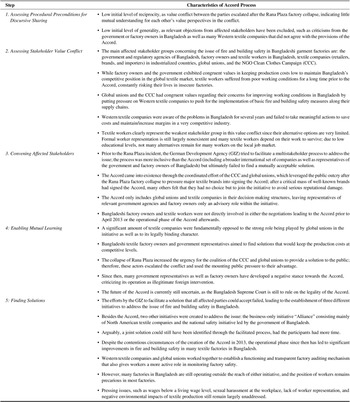
Taking the Accord as an illustrative example serves to elucidate the theoretical argument developed in this article by giving a concrete example of its application. In addition, the illustration enables us to demonstrate the empirical relevance of the framework developed in this article. The Accord represents a suitable empirical example for several reasons. First, the Accord is the result of an open and protracted value conflict between Western textile companies, global unions, the CCC, textile workers, factory owners, and the government of Bangladesh. While fundamental strategic interests of key actors converge at least to some degree (e.g., all actors involved benefit in different ways from the status quo), the value perspectives of these stakeholders strongly diverge, leading to an open value conflict driven by a clash of opposing values (e.g., safe and decent working conditions against the competitive position of Bangladesh as a low-cost textile producer). Thus, the Accord exemplifies the kind of stakeholder value conflict that our framework aims to address. Second, the Accord has received great attention by scholars, practitioners, and the media over the past years resulting in a rich body of both empirical and conceptual academic papers (Baumann-Pauly, Labowitz, & Banerjee, Reference Baumann-Pauly, Labowitz and Banerjee2015; Donaghey & Reinecke, Reference Donaghey and Reinecke2017; Huber & Schormair, Reference Huber and Schormair2019; Reinecke & Donaghey, Reference Reinecke and Donaghey2015), independent research reports (Barrett, Baumann-Pauly, & Gu, Reference Barrett, Baumann-Pauly and Gu2018; Baumann-Pauly et al., Reference Baumann-Pauly, Labowitz and Banerjee2015), media coverage (Taeubner, Reference Taeubner2013), and stakeholder publications (CCC, 2013; IndustriAll Global Union, 2017). Third, the Accord is considered a leading MSI in terms of transparency providing detailed insights into internal governance processes, factory audits, and performance data on its website (Accord, 2018). Therefore, the Accord allows us to analyze a relevant value conflict in sufficient detail without necessitating additional empirical research. Accordingly, our analysis of the Accord, as summarized in Table 2, draws on the aforementioned sources.
Overview of Analysis of Illustrative Case: Stakeholder Value Creation through Discursive Sharing and the Bangladesh Accord for Fire and Building Safety

Step 1: Assessing Procedural Preconditions for Discursive Sharing
The first step of our procedural framework requires firms to determine the initial level of reciprocity and generality amongst the affected stakeholders of a value conflict. Although it is difficult to reconstruct in hindsight how signatory companies of the Accord perceived the initial situation of the value conflict, some tentative remarks can be made to illustrate this first step in relation to the Accord. From the perspective of the Western signatory companies, the initial level of generality was not particularly elevated at the beginning of the Accord, as relevant objections from affected stakeholder groups, such as the government or factory owners in Bangladesh, were not included in the decision-making processes of the Accord. These excluded stakeholders then publicly raised doubts about the Accord’s legitimacy. In addition, many Western textile companies remained critical of the Accord and decided not to participate in the initiative. After the Rana Plaza factory collapse, the escalation of the conflict between global unions and the CCC, on the one side, and Western textile companies, on the other, indicates that key stakeholders of the value conflict had serious difficulties accepting or even relating to the value perspective of the other. Hence, it can be inferred that the initial level of reciprocity was also rather low at the beginning of the Accord in 2013.
Step 2: Assessing Stakeholder Value Conflict
The second step of our framework asks firms to assess the multiple interdependencies of the stakeholders of a value conflict to gain a deeper understanding of the underlying stakeholder value differences. To this end, firms need to explore which stakeholders are affected and what their main concerns are. An analysis of the core value conflict of the Accord reveals the following main affected stakeholder groups: the government and regulatory agencies of Bangladesh; factory owners and textile workers in Bangladesh; textile companies (retailers, brands and importers) in industrialized countries; global unions; and the CCC. The local political institutions proved unwilling or unable to enforce the existing building code. The political influence of the textile industry is very high in Bangladesh, and practices of corruption are rather widespread. The parliament and many government agencies are dominated by the interests of the textile industry that focus on preserving Bangladesh’s competitive edge as a low-cost garment producer.
While Bangladeshi factory owners and government representatives shared the concern for keeping the production costs low to maintain Bangladesh’s competitive advantage, textile workers suffered from poor working conditions for a long time prior to the Accord. Global unions and the CCC, on the other hand, shared the concern of improving both the working conditions in Bangladesh and the representation of workers’ interests at the factory level. Therefore, global unions and the CCC joined forces to put increased pressure on Western textile companies to implement safety measures at their supplier factories. Western textile companies, in turn, had been aware of the fire and building safety problems in Bangladesh for several years prior to Rana Plaza but had failed to take action due to concerns regarding higher sourcing costs and lower margins. However, many Western brands and customers at least publicly also committed to upholding production standards that do not systematically violate basic human rights.
Furthermore, the second step of our framework requires firms to explore how weaker stakeholder groups can be supported to facilitate their meaningful participation in the process. In the case of the Accord, the Bangladeshi textile workers clearly represent the weakest stakeholder group in this value conflict. These workers are exposed to dangerous working conditions on a daily basis and depend on stable employment to sustain their lives. Most textile workers in Bangladesh are women, often with low educational backgrounds. In addition, the degree of unionization of factories in Bangladesh is still very low, leaving workers mostly without effective representation on both the factory as well as political levels (Baumann-Pauly et al., Reference Baumann-Pauly, Labowitz and Banerjee2015; Donaghey & Reinecke, Reference Donaghey and Reinecke2017).
Step 3: Convening Affected Stakeholders
The next steps of our framework suggest that firms convene the affected stakeholders and enable a process of mutual learning that ultimately leads to an accommodation of value differences through discursive justification. In the case of the Accord, most firms did not take such a proactive posture. Although the problematic working conditions in the industry in Bangladesh have been known for years, most firms remained passive. It took the joint effort of the NGO CCC and international trade unions to draft a memorandum of understanding (MoU) aimed at improving the factory safety situation in Bangladesh. They started to engage with companies already in 2011, but the MoU failed to get sufficient support from companies in order for it to go into effect by the end of 2012 (CCC, 2013). In 2013, the German development agency (GIZ) facilitated a last effort to bring all parties, i.e., Western textile companies, unions, and Bangladeshi factory owners, together to come to an agreement to improve the safety situation in Bangladesh. Despite the fact that the Rana Plaza collapse happened just five days before the final meeting, the parties failed to come to an agreement (Taeubner, Reference Taeubner2013). While the public pressure to act was mounting after Rana Plaza, North American companies started their own factory safety initiative, called the Alliance, without the participation of unions or other nonbusiness stakeholders (Donaghey & Reinecke, Reference Donaghey and Reinecke2017). In Europe, the coalition of the CCC and unions was able to leverage the situation to their advantage by inducing a sufficient number of large European and international brands to sign an altered version of the initial MoU (Reinecke & Donaghey, Reference Reinecke and Donaghey2015).
However, after the Accord rapidly garnered a sufficient number of signatories to come into effect, the agreement was implemented and the MSI entered into its operational phase. During that phase, signatory companies met at least once a year in a company caucus to discuss relevant issues and elect their representatives to the SC of the Accord. Within the SC, company representatives and unions worked together to set up the necessary procedures to implement the agreement and to deal with the many operational challenges the Accord encountered, particularly at the beginning. Most companies displayed a defensive and passive attitude toward engaging in or initiating a stakeholder discourse on the issue of factory safety and only reacted under intense public pressure (Huber & Schormair, Reference Huber and Schormair2019). In addition, important Bangladeshi stakeholders, such as workers and factory owners, were and continue not to be part of the SC of the Accord and have no direct influence on decisions that directly affect them.
Step 4: Enabling Mutual Learning
During the multistakeholder process facilitated by the GIZ in April 2013, a significant number of Western textile companies were fundamentally opposed to a strong role of global unions in the initiative as well as to its planned legally binding character. Bangladeshi textile factory owners and government representatives, in turn, aimed their efforts at finding solutions that avoided substantial increases in production costs. The Rana Plaza factory collapse on April 23, 2013, increased the urgency and perceived leverage for the coalition of the CCC and global unions to provide a solution to the public; this ultimately led to the final escalation of the conflict by which the negotiations on a joint solution ended with global unions and the CCC pressuring the most publicly exposed companies to either accept their terms for the Accord or risk being publicly exposed as irresponsible. Since then, many government representatives as well as factory owners in Bangladesh have developed a negative stance toward the Accord, criticizing its operation as illegitimate foreign intervention. In this vein, the legality of the Accord was contested by the High Court of Bangladesh in 2018, leading to an agreement in May 2019, whereby the Accord was required to hand over its activities to a new public-private partnership called the RMG Sustainability Council within 281 working days (Accord, 2019). Ultimately, in the case of the Accord, mutual learning between stakeholders largely occurred in the operational phase. During the interactions between companies and unions, as well as factory owners that implemented the safety measures on the ground, all parties learned from each other. However, during the negotiations leading to the Accord, the potential for mutual learning was not strong enough to bring about a solution that was acceptable to all parties.
Step 5: Finding Solutions
This disagreement, however, did not inhibit action; after the last effort to find a common solution under facilitation from the GIZ failed, the Accord, the Alliance, and the national safety initiative of the Bangladeshi government were started to address the problem. Arguably, a joint solution could still have been identified through the facilitated process, had the participants had more time. Our framework suggests that, through skilled facilitation, the affected stakeholders could have explored additional solutions that would have enabled each party to gain on their priorities. The increased urgency to act after the Rana Plaza incident might have inhibited the identification of a shared solution. The initial discursive conflict resolution effort by the GIZ, therefore, resulted in a situation of stakeholder value dissensus, leaving the parties with diverging value perspectives (see Figure 2) after the process. However, after this failed attempt to find a comprehensive solution, the Accord was initiated, transforming an initial situation of value incongruence into increasing levels of value congruence over time. Since then, stakeholder value has been created, first and foremost, for workers by improving factory safety. More than 767 factories of the Accord reported over 90 percent progress in the implementation of the required fire and building safety measures (Accord, 2018; Barrett et al., Reference Barrett, Baumann-Pauly and Gu2018). In addition, value has been created for the textile industry as a whole since the Accord established a level playing field regarding basic factory safety standards in Bangladesh. Therefore, businesses no longer compete against each other by selecting the cheapest suppliers with low factory safety, and reputational damages like those caused by the Rana Plaza factory collapse are less likely to occur in the future. However, a considerable number of signatory companies agreed to extend the Accord for three more years, recognizing that more time is needed to achieve the Accord’s objectives in terms of factory and worker safety (IndustriAll Global Union, 2017). Safety committee trainings, for example, have only been completed in about 219 factories (Accord, 2018; Barrett et al., Reference Barrett, Baumann-Pauly and Gu2018). Moreover, it is important to point out that a significant number of garment factories in Bangladesh still operate below the radar of any international safety initiative. Several pressing problems, such as low wages and low environmental standards in the Bangladeshi garment sector, also remain largely unaddressed so far (Baumann-Pauly et al., Reference Baumann-Pauly, Labowitz and Banerjee2015).
This illustrative analysis of the Accord clearly shows several normative shortcomings of the Accord process: First, the Accord failed to engage with important affected stakeholders, such as factory owners and government representatives from Bangladesh, leaving the initiative in a precarious situation, as important local stakeholders have raised doubts about the legitimacy and legality of the Accord. Skilled facilitation, as required in our framework, might have been able to identify an acceptable solution for all stakeholders. Second, the Accord does not cover the most vulnerable textile factories in Bangladesh, leaving a significant number of textile workers without factory safety improvements (Barrett et al., Reference Barrett, Baumann-Pauly and Gu2018). However, the Accord case also shows the potential of discursive sharing, as the conflicting parties worked constructively together within the Accord after the escalation of the value conflict in the immediate aftermath of the Rana Plaza incident. The value perspectives of unions and the signatory companies in the SC of the Accord became more congruent over time, fueled by pragmatic compromises between the parties aimed at achieving tangible improvements in factory safety. In the remainder of this article, we discuss the contributions of our research to theory and we elaborate on several limitations of our procedural framework that open up fruitful avenues for future research.
DISCUSSION AND CONTRIBUTIONS
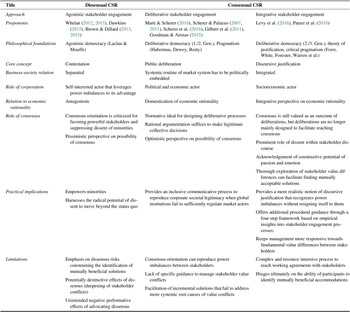
In the following, we elucidate the key contributions to theory of our procedural framework by discussing the central differences between the existing approaches to communicative stakeholder engagement and the discursive sharing framework of this article. We provide an overview of this discussion in Table 3.
Comparison of Approaches to Communicative Stakeholder Engagement

According to Whelan (Reference Whelan2013), the current state of the debate regarding communicative stakeholder engagement can be divided into two main research streams: consensual and dissensual CSR. We proceed by discussing the key characteristics and differences between the most established dissensual approach, which we call agonistic stakeholder engagement (Brown & Dillard, Reference Brown and Dillard2013, Reference Brown and Dillard2015; Dawkins, Reference Dawkins2015), and the most established consensual CSR approach, which we call deliberative stakeholder engagement (Gilbert et al., Reference Gilbert, Rasche and Waddock2011; Goodman & Arenas, Reference Goodman and Arenas2015; Marti & Scherer, Reference Marti and Scherer2016; Scherer et al., Reference Scherer, Rasche, Palazzo and Spicer2016; Scherer & Palazzo, Reference Scherer and Palazzo2007; Scherer & Palazzo, Reference Scherer and Palazzo2011). We contrast these two approaches with a third, emerging, consensual CSR research stream called integrative stakeholder engagement (Levy et al., Reference Levy, Reinecke and Manning2016; Patzer et al., Reference Patzer, Voegtlin and Scherer2018), within which we situate our own conception of discursive sharing.
Agonistic Stakeholder Engagement
Agonistic approaches to stakeholder engagement rest on insights from agonistic democracy theory (Laclau & Mouffe, Reference Laclau and Mouffe1985; Mouffe, Reference Mouffe2005) that stress the importance of dissensus and contestation for counterbalancing hegemonic structures and policies in democracies. Agonistic democrats highlight the importance of dissensus to empower minorities and weaker societal groups that risk being marginalized by the dominant consensus position of the majority within a democracy. The relationship between business and society is seen as separated, and corporations are mainly conceptualized as self-interested and hegemonic actors that aim at exploiting power differentials to their benefit. Therefore, the rationality of economic actors is largely viewed as antagonistic to democratic ideals, such as equality or social justice. The role of consensus in the deliberative conception of democracy is criticized for favoring powerful stakeholders and for suppressing dissenting views and perspectives from minorities or less powerful groups. In addition, the very aim of finding consensus is criticized for being unrealistic as well as counterproductive, as finding consensus in pluralistic societies is often either not possible at all or only possible by ignoring or marginalizing the views of the less powerful. Hence, consensus ultimately risks reproducing the power imbalances that are inherent in the status quo, leaving minorities without effective influence on decisions that affect them. Accordingly, agonistic stakeholder engagement aims at empowering less powerful stakeholders by stressing the importance of dissensual interactions between firms and stakeholders. Heated exchanges and emotional contestation of adversely affected stakeholders can open up the potential for more radical solutions that take all perspectives into account and move a situation of conflict beyond the reproduction of the status quo.
However, from the perspective advanced in this article, this emphasis of conflict, contestation, and dissensus risks significantly constraining the ability of conflicting stakeholders to identify mutually beneficial solutions. As pointed out by Forester (Reference Forester2009), protracted situations of heated exchanges can lead to low levels of trust that keep the conflicting stakeholders locked into lose-lose scenarios where both parties make each other worse off through nurturing the conflict. Stakeholders can even become so attached to the conflict as to block any reasonable attempt of resolving the issue. In this context, emphasizing dissensus in a value conflict can have potentially destructive effects as it risks deepening the conflict. Stakeholders can become ever more entrenched in their positions, which further reduces the possibilities for some form of conflict resolution. Furthermore, with reference to research on performativity (Ghoshal, Reference Ghoshal2005; Gond, Cabantous, Harding, & Learmonth, Reference Gond, Cabantous, Harding and Learmonth2016), it can be argued that advocating for dissensus and contestation can have unintended consequences. Not only will lauding dissensus potentially exacerbate stakeholder conflicts by keeping stakeholders overly focused on nurturing their disagreements rather than on finding some form of workable agreement, ultimately, it might also fall short of empowering less powerful stakeholders when their increased voice does not result in any changes to the conflict situation (Forester, Reference Forester2009).
Deliberative Stakeholder Engagement
The deliberative approach to stakeholder engagement, by contrast, mainly draws on the later political writings of Juergen Habermas (Reference Habermas1996, Reference Habermas1999), who argues that the administrative as well as the economic system of a society need to be embedded into a system of deliberative politics. This system enables the self-regulation of society through legitimate law that is established on the basis of the constant reasonable exchange of arguments between an open public sphere and the democratically elected parliamentary bodies. Therefore, the notion of public deliberation represents the core construct of this approach with deliberation being defined as “a process through which participants address their conflicts, share information, exchange arguments and make decisions” (Palazzo & Scherer, Reference Palazzo and Scherer2006: 80). Within the deliberative approach to stakeholder engagement, Habermas’s theory is interpreted from a more pragmatic perspective, arguing that deliberation is less about presupposing strong normative conditions for reaching a consensus (i.e., the ideal speech situation) than it is about finding “a rational basis for a (more likely) disagreement” (Scherer & Palazzo, Reference Scherer and Palazzo2007: 1107). It is argued that through inclusive deliberative exchanges with stakeholders, compromises and incremental improvements of the status quo can be identified. Accordingly, the systemic routine of the market has to be politically embedded through deliberative political processes that contribute to the “domestication” of economic rationality. Hence, corporations are conceptualized as political as well as economic actors that need to engage in stakeholder deliberations to uphold their societal legitimacy, as well as to collectively solve social and ecological challenges along their supply chains.
Despite the “less idealistic and more pragmatic approach” (Scherer & Palazzo, Reference Scherer and Palazzo2007: 1107), deliberative stakeholder engagement ultimately maintains an optimistic perspective regarding the possibility as well as the benefits of finding consensus through deliberative processes. The normative ideal of consensus is still upheld, even if in a weaker, more realistic form that leaves space for disagreement and compromise between stakeholders. The deliberative approach remains committed to one of Habermas’s core contentions that in pluralistic and post-metaphysical societies, processes of rational argumentation alone provide the means to make legitimate collective decisions. Within this approach, it is argued that under the conditions of value pluralism, firms cannot simply presume knowing their stakeholders’ value perspectives but instead have to take “seriously the priorities of those who are concerned” (Scherer, Reference Scherer2017: 9) through democratic processes of deliberation among stakeholders. Accordingly, deliberative stakeholder engagement provides an inclusive communicative process to reproduce corporate societal legitimacy as well as to fill regulatory voids in situations where global governance institutions fail. In particular, issues that are novel, evoke a high level of stakeholder contestation, involve a wide range of conflicting values among stakeholders, or relate to unaccounted organizational externalities are prone to the deliberative approach to stakeholder engagement of firms with adversely affected stakeholders (Marti & Scherer, Reference Marti and Scherer2016; Patzer et al., Reference Patzer, Voegtlin and Scherer2018).
However, the deliberative approach to stakeholder engagement has been criticized for falling short on providing effective means to address power imbalances between stakeholders (Fooks, Gilmore, Collin, Holden, & Lee, Reference Fooks, Gilmore, Collin, Holden and Lee2013; Kourula & Delalieux, Reference Kourula and Delalieux2016). Moog, Spicer, and Böhm (Reference Moog, Spicer and Böhm2015), for example, show in their detailed case study of the Forrest Stewardship Council (FSC) how an initiative that is widely lauded for its deliberative credentials (Mena & Palazzo, Reference Mena and Palazzo2012; Scherer & Palazzo, Reference Scherer and Palazzo2007, Reference Scherer and Palazzo2011) ultimately failed to achieve its original aspiration to fundamentally transform global forest management and settled instead for a largely ineffective incremental approach. Several scholars perceive deliberative stakeholder engagement as a rather naïve and overly idealistic approach that is ill-suited to decrease the power differentials between corporations and less powerful stakeholders, particularly in emerging economies (Banerjee, Reference Banerjee2014; Levy et al., Reference Levy, Reinecke and Manning2016; Sabadoz & Singer, Reference Sabadoz and Singer2017). In addition, the Habermasian conceptions of deliberation are criticized for putting too much emphasis on rational argumentation, thus largely neglecting the importance of more emotional and passionate accounts of affected stakeholders (Dawkins, Reference Dawkins2015). These more emotional accounts, however, can trigger transformative dynamics within a stakeholder dialogue that enable the creative identification of workable solutions (Forester, Reference Forester2009). Accordingly, the deliberative approach to stakeholder engagement needs additional conceptual as well as practical tools to address power imbalances more effectively and to deal with stakeholder value differences in a more accommodating way. Clearly, the currently available concepts fall short on providing more specific guidance on how to address these remaining challenges.
Integrative Stakeholder Engagement
In reaction to these criticisms, an integrative approach to stakeholder engagement has been emerging over the past few years (Levy et al., Reference Levy, Reinecke and Manning2016; Patzer et al., Reference Patzer, Voegtlin and Scherer2018), which can be considered as a further theoretical advancement of the consensual CSR research stream. The notion of integration is used here with a twofold meaning: First, stakeholder engagement is conceptualized as integrative in the sense that it specifically aims at integrating the different value perspectives of stakeholders through explicit dialogic engagement with their values. Integration here then refers to the accommodation of differing value perspectives through discursive processes (Patzer et al., Reference Patzer, Voegtlin and Scherer2018). Second, integration refers to the effort to establish a moderating position between agonistic and deliberative approaches to stakeholder engagement that aims at combining the strengths of both approaches while addressing their weaknesses. The goal is to conceptualize a more realistic approach that is neither overly pessimistic nor idealistic with regards to the potential of communicative stakeholder engagement (Levy et al., Reference Levy, Reinecke and Manning2016).
Our five-step framework of discursive sharing aims at contributing to this emerging research stream by providing a more specific procedural framework for firms to deal with stakeholder value conflicts in a way that creates value for all affected stakeholders. The discursive sharing process is based on the notion of discursive justification as conceptualized by Rainer Forst (Reference Forst2002, Reference Forst2012, Reference Forst2014b) as well as recent theoretical insights of deliberative democracy theory (Curato et al., Reference Curato, Dryzek, Ercan, Hendriks and Niemeyer2017; Owen & Smith, Reference Owen and Smith2015; Warren, Reference Warren2017; White, Reference White2017; White & Farr, Reference White and Farr2012) and stakeholder value conflict resolution (Forester, Reference Forester2009, Reference Forester2012). Based on the insight that business and society must be understood as deeply interrelated rather than separated (Harris & Freeman, Reference Harris and Freeman2008), the integrative approach to stakeholder engagement assumes that discursive processes of justification are not only the building blocks of society but also an essential part of the value creation process of businesses. Corporations are hence understood as socioeconomic actors whose core objective is the creation of pluralistic value for all affected stakeholders (Freeman et al., Reference Freeman, Harrison, Wicks, Parmar and Colle2010; Mitchell et al., Reference Mitchell, van Buren, Greenwood and Freeman2015; Soundararajan et al., Reference Soundararajan, Brown and Wicks2019).
The process of discursive sharing still conceptualizes stakeholder value consensus as one possible outcome of the process, but no longer maintains that stakeholder engagement should ultimately facilitate reaching consensus. Equally valuable are outcomes, such as compromises, what has been recently theorized as “temporary resting points” (Reinecke & Ansari, Reference Reinecke and Ansari2015) or even only agreements to disagree. These outcomes avoid the risk of consensus-oriented approaches to merely reproduce rather than mitigate power imbalances between stakeholders, as pointed out by several critics (Brown & Dillard, Reference Brown and Dillard2013; Dawkins, Reference Dawkins2015). The function of processes of discursive justification is less about finding actual consensus than it is about the joint and continuous “struggle to find meaning in the world” (White, Reference White2015: 211) through sorting out insufficient justifications and providing better ones. The spectrum of potential outcomes of processes of discursive sharing in Figure 2 underlines this important characteristic of our approach.
In addition, the Forstian notion of discursive justification strengthens the role of dissent within the consensual CSR research stream. In fact, Forst’s conception emphasizes the right of stakeholders to object to circumstances that are sufficiently justified according to the criteria of reciprocity and generality. Therefore, the right to object, to “no-saying” (White, Reference White2017; White & Farr, Reference White and Farr2012), becomes an integral part of the process enabling affected stakeholders to voice their concerns. In addition, the importance of less rational accounts of stakeholders, such as storytelling or other forms of passionate or emotional speech, are explicitly acknowledged and incorporated into the procedural framework (see, e.g., step 2 in Figure 1). Furthermore, high levels of reciprocity and generality can encourage the constructive and creative exploration of stakeholder value differences that can lead to mutually acceptable solutions amongst conflicting stakeholders. Through skilled and independent facilitation, as well as through specific guiding questions for each process step, stakeholders can openly voice their concerns without becoming entrenched in their conflicting positions. Within a facilitated process of discursive sharing, value differences can be accommodated without risking to either exacerbate or artificially placate the conflict to the detriment of weaker stakeholders. The weaker stakeholders need to be explicitly supported early on to avoid marginalizing them throughout the process (see, e.g., step 2 in Figure 1).
Therefore, our five-step discursive sharing framework is based on a more realistic notion of discursive justification that recognizes the importance of both the right to object for all affected stakeholders, as well as the possibility to identify workable agreements through reciprocal and general discursive stakeholder engagement. In the spirit of critical pragmatism, the discursive sharing process thus “practically works to explore possibilities rather than to presume impossibility” (Forester, Reference Forester2012: 19). This means that it recognizes power imbalances and aims at proactively addressing them throughout the process rather than simply accepting them as an unavoidable fact. Hence, our discursive sharing framework provides additional procedural guidance for firms to deal with situations of stakeholder value conflict in a way that creates pluralistic value for all those involved. Accordingly, the notion of discursive justification is more realistic in the sense that it expands on the normative requirements of deliberative stakeholder engagement (Patzer et al., Reference Patzer, Voegtlin and Scherer2018; Scherer & Palazzo, Reference Scherer and Palazzo2007, Reference Scherer and Palazzo2011) by providing a differentiated procedural framework with actionable and specific guiding questions geared toward addressing stakeholder value conflicts.
The proposed criteria of justification, process steps, and the associated guiding questions facilitate the discursive sharing process providing a normative orientation for accommodating potentially diverging perspectives among stakeholders. Thus, these criteria and process steps can be particularly useful for mitigating “missing the risk boat” (Mitchell et al., Reference Mitchell, van Buren, Greenwood and Freeman2015), which describes the risk of losing stakeholder value creation opportunities due to firms failing to take stakeholder perspectives sufficiently into account. Since these criteria and process steps encourage firms and stakeholders to consider the multiple value perspectives of stakeholders, firms are more likely to remain responsive to additional value creation possibilities for stakeholders (Harrison & Wicks, Reference Harrison and Wicks2013; Mitchell et al., Reference Mitchell, Weaver, Agle, Bailey and Carlson2016). It is important to note, however, that these criteria are no panacea in that they describe the procedural pathways for including different stakeholder value perspectives without prescribing actual solutions in advance. These solutions ultimately rest upon the engagement of affected stakeholders in discursive sharing processes. Hence, our framework is in line with the recently advocated “formal approach” (van der Linden & Freeman, Reference Linden and Freeman2017: 365) within VCST by limiting itself to the conceptualization of a procedure and procedural criteria that facilitate a context-sensitive adoption by firms.
Recent empirical research provides further support for our procedural approach, suggesting that the process design of stakeholder engagement processes is more important than the sociocultural context in which a value conflict is embedded (Vente, Reed, Stringer, Valente, & Newig, Reference Vente, Reed, Stringer, Valente and Newig2016). The authors of this study state that “the most important factors determining process outcomes are who participates, how the process and communication among participants is organized, and how the outputs of the process are linked to policy and implementation of solutions” (Vente et al., Reference Vente, Reed, Stringer, Valente and Newig2016: 12). In particular, this study stresses the importance of an independent and professional facilitation as well as the equal provision of information and decision-making power for all participants. Our procedural framework incorporates these crucial aspects within the different process steps and guiding questions (see Figure 1). Vente et al. (Reference Vente, Reed, Stringer, Valente and Newig2016) ultimately emphasize that a well-designed and context-sensitive approach to stakeholder engagement, such as the discursive sharing approach of this article, can be fruitfully applied to a broad variety of socio-cultural contexts. Local contextual factors, such as a lack of experience or power imbalances between stakeholders, can be mitigated through a facilitated stakeholder engagement process, potentially leading to the effective resolution of a value conflict.
LIMITATIONS AND DIRECTIONS FOR FURTHER RESEARCH
Despite these theoretical and practical advancements, our framework is also subject to several limitations. Therefore, we conclude this article by elaborating on these limitations as well as by showing how these limitations open up future research opportunities. First, it needs to be highlighted that the discursive sharing process, as advocated in this article, is a complex and resource intensive process that requires significant attention from management and the stakeholders involved in order to address stakeholder value conflicts. Accordingly, it would be interesting to explore in more detail, which types of stakeholder value conflicts are particularly conducive to a discursive sharing process. Recent research, for example, suggests that the potential for reaching an agreement on value differences rests upon the specific characteristics of the values involved (Irvine et al., Reference Irvine, O’Brien, Ravenscroft, Cooper, Everard, Fazey, Reed and Kenter2016; Kenter et al., Reference Kenter, O’Brien, Hockley, Ravenscroft, Fazey, Irvine, Reed, Christie, Brady, Bryce, Church, Cooper, Davies, Evely, Everard, Fish, Fisher, Jobstvogt, Molloy, Orchard-Webb, Ranger, Ryan, Watson and Williams2015). Conflicts based on fundamental values that are constitutive of a stakeholder’s identity and worldview are likely more difficult to moderate than conflicts about more contextual value judgements. Therefore, future conceptual as well as empirical research might investigate more closely the underlying values of stakeholder value conflicts resulting in, e.g., a value conflict typology indicating different types of value conflicts as well as suitable resolution mechanisms. Moreover, cross-cultural research would be interesting in this regard in order to draw out more culture-specific features of stakeholder value conflicts.
Second, as the successful resolution of a stakeholder value conflict through discursive sharing ultimately rests on the discursive dynamics between the participants of the process, it is very important to get contextually rich accounts of such a process, ideally based on participant observations. Although we leveraged the insights of urban planning and conflict resolution practitioners in this article, it is necessary to complement our framework with additional empirical insights. For example, we need to know more about the role of the facilitator in these integrative stakeholder engagement processes. As our framework assigns an important role to skilled and independent facilitation, we need further insights into specific types of facilitation that might be conducive to specific types of value conflicts. In addition, it would be interesting to explore the interactions as well as the relationships between the facilitator and the company that initiated the process to establish how the important notion of independence of the facilitator is co-constructed among stakeholders.
Third, future research needs to closely investigate the relationship between stakeholder value conflict and pluralistic stakeholder value creation. Currently, we particularly lack empirical studies on this subject. For example, recent conceptual research suggests that low levels of shared values among stakeholders might not automatically result in an escalated, open conflict as long as key strategic interests of stakeholders (i.e., profitability of continued cooperation) remain aligned (Bundy et al., Reference Bundy, Vogel and Zachary2018). However, from the perspective of VCST, the expectation is that situations like this are not stable over time as significant value creation opportunities for affected stakeholders are ignored. At least, it can be assumed that a threshold of shared values might exist below which a business is unable to operate. Therefore, we need more empirical research exploring the relationship between different levels of value sharing and stakeholder value creation. Conducting multiple case studies within the same industry would be a particularly suitable approach in order to gain insights into the different value perspectives of stakeholders, as well as to be able to compare different levels of value sharing and the associated value creation potential.
ACKNOWLEDGEMENTS
We want to thank associate editor Andreas Georg Scherer for his thoughtful guidance and the anonymous reviewers for their critical and constructive comments. In addition, we express our gratitude to the helpful feedback that earlier versions of this article received at the Society for Business Ethics annual conference in 2014 as well as the Academy of Management annual meeting in 2017. The authors declare that no external or third party funding was used for this research.
Maximilian J. L. Schormair is assistant professor in business ethics at Trinity Business School, Trinity College Dublin, Ireland. He received his PhD in the field of business ethics from the University of Hamburg (Germany) in 2018. His research interests focus on multistakeholder governance, stakeholder engagement, political CSR, deliberative democracy, business and human rights, and the sharing economy. His research has been published in edited volumes as well as in Business & Society and the Journal of Business Ethics.
Dirk Ulrich Gilbert is a professor of business ethics and management at the University of Hamburg (Germany). He received his PhD from the University of Frankfurt (Germany) and held positions at the University of New South Wales (Sydney, Australia) and the University of Nuremberg (Germany). His most recent research focuses on international accountability standards, labor rights in global supply chains, political CSR, and responsible management education. He published in internationally acclaimed journals such as Business Ethics Quarterly, Business & Society, Academy of Management Learning and Education, Journal of Management Inquiry, Management International Review, and the Journal of Business Ethics.