Introduction
Fascioliasis is an important veterinary and medical problem across the world (Hurtrez-Boussès et al., Reference Hurtrez-Boussès, Meunier, Durand and Renaud2001; Mas-Coma et al., Reference Mas-Coma, Valero and Bargues2009) and is also one of the most widely distributed (latitudinal, longitudinal and altitudinal) of the vector-borne diseases (Mas-Coma et al., Reference Mas-Coma, Bargues and Valero2005). Strategies of control are therefore needed; they undoubtedly have to be supported by a better understanding of the transmission of this disease. In particular, it is extremely important to further understand the role played by lymnaeid molluscs in the life cycle of Fasciola spp. trematodes. Among them, Fasciola hepatica (the common liver fluke) is the species which has the largest geographical distribution and the widest definitive-host spectrum, and which is the main cause of human infections (Hurtrez-Boussès et al., Reference Hurtrez-Boussès, Meunier, Durand and Renaud2001; Mas-Coma et al., Reference Mas-Coma, Valero and Bargues2009). Lymnaeid snails have been subjected to many studies (taxonomical, ecological and parasitological) regarding their role as intermediate hosts of parasites with medical and veterinary importance, and particularly for their involvement in fascioliasis transmission (Bargues & Mas-Coma, Reference Bargues and Mas-Coma1997; Gutiérrez et al., Reference Gutiérrez, Perera, Yong, Sánchez and Wong2000, Reference Gutiérrez, Hernández and Sánchez2005; Rondelaud et al., Reference Rondelaud, Vignoles and Dreyfuss2004; Correa et al., Reference Correa, Escobar, Noya, Velasquez, Gonzalez-Ramirez, Hurtrez-Boussès and Pointier2011). Indeed, about 20 species of lymnaeids have been described to host F. hepatica (Correa et al., Reference Correa, Escobar, Durand, Renaud, David, Jarne, Pointier and Hurtrez-Boussès2010). The success of the extremely wide geographical distribution of this trematode can probably be attributed to its extraordinary ability to adapt to a wide range of definitive (Hurtrez-Boussès et al., Reference Hurtrez-Boussès, Meunier, Durand and Renaud2001) and intermediate hosts (Correa et al., Reference Correa, Escobar, Durand, Renaud, David, Jarne, Pointier and Hurtrez-Boussès2010). While mammals are infected with the adult stage of the parasite (liver deterioration and obstruction of bile ducts), the introduction and spread of the parasite depends ultimately on the occurrence and compatibility with the snail hosts inhabiting new localities (Rondelaud et al., Reference Rondelaud, Hourdin, Vignoles and Dreyfuss2005). Several studies have pointed out how sympatric strains of F. hepatica and lymnaeid species may increase transmission through possible local adaptation (Hurtrez-Boussès et al., Reference Hurtrez-Boussès, Meunier, Durand and Renaud2001). Other observations, however, state that under certain conditions, allopatric combinations of flukes and snails turn out to be highly compatible and thus may enhance transmission (Gasnier et al., Reference Gasnier, Rondelaud, Abrous, Carreras, Boulard, Diez-Baños and Cabaret2000; Coelho et al., Reference Coelho, Lima and Guimarães2009).
In Cuba, fascioliasis is a major veterinary problem in most cattle farms and in other minor hosts, such as goats (Beovides et al., Reference Beovides, Silveira, Pérez and Olazábal2006). Although it is not recognized as a huge health problem for humans, several outbreaks have been recorded in the past two decades (Rojas et al., Reference Rojas, Vázquez, Domenech and Robertson2010), and it is feared that new outbreaks will occur in the future. The only lymnaeid snails so far described in Cuba are Galba cubensis and the invasive species Pseudosuccinea columella, for which populations are yet to establish in the eastern region of the country (Vázquez et al., Reference Vázquez, Sánchez and Hevia2009). The former is considered the main intermediate host of F. hepatica (Perera, Reference Perera1996; Rojas et al., Reference Rojas, Vázquez, Domenech and Robertson2010). The latter, however, although perfectly compatible when infected under laboratory conditions (Gutiérrez et al., Reference Gutiérrez, Yong, Perera, Sánchez and Théron2002), has been found naturally infected only once (Gutiérrez et al., Reference Gutiérrez, Vásquez, Hevia, Sánchez, Correa, Hurtrez-Boussès, Pointier and Théron2011). Interestingly, some populations of P. columella have been described to be completely resistant to experimental infestations with F. hepatica (Gutiérrez et al., Reference Gutiérrez, Pointier, Yong, Sánchez and Théron2003; Calienes et al., Reference Calienes, Fraga, Pointier, Yong, Sánchez, Coustau, Gutiérrez and Théron2004). However, the potential diversity of F. hepatica isolates has been neglected in these preliminary studies.
In this paper, we describe the results of experimental infections using different combinations of F. hepatica geographic isolates and populations of G. cubensis and P. columella from different localities. The aim of this study is to better understand and discuss the possible outcomes of these combinations and their impact on fascioliasis transmission in Cuba.
Materials and methods
Sampling of snail populations and parasite isolates
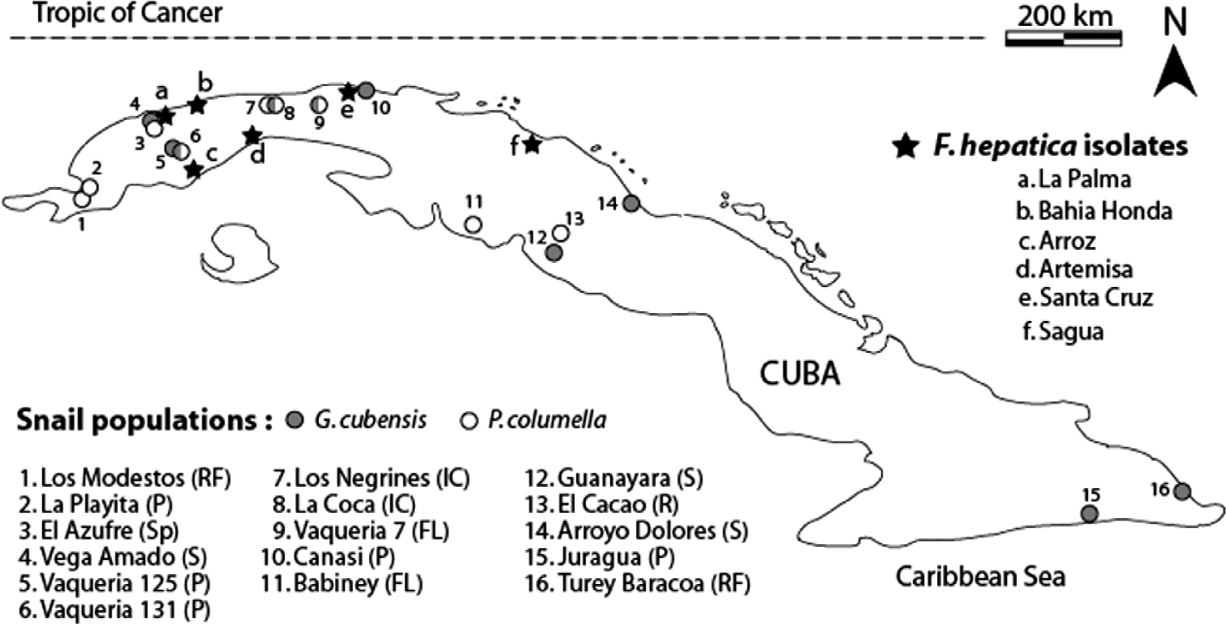
Biological samples of both lymnaeid snails and F. hepatica isolates were collected from different localities in Cuba (fig. 1) and brought back to the Laboratory of Malacology at the Tropical Medicine Institute in Havana. Ten populations of G. cubensis and eight of P. columella were collected from different habitats during 2011 and 2012, using sieves and soft forceps (up to 50 individuals per locality). The snails from each population were reared in laboratory conditions at a temperature ranging between 26 and 28°C until a subsequent generation was obtained. Snails were fed with algae using a routine method (Sánchez et al., 1995) in Petri dishes containing up to ten individuals. Three of the eight P. columella populations were resistant (La Coca, La Playita and Babiney) and were included considering the phenotypic markers of resistance as described by Gutiérrez et al. (Reference Gutiérrez, Pointier, Yong, Sánchez and Théron2003). Briefly summarized, resistant snails have a significantly less rounded shell and aperture than susceptible ones and the intensity and distribution pattern of the spots of the mantle pigmentation are clearly different between resistant and susceptible populations.
Geographical distribution of collecting sites for lymnaeid snails and parasite isolates in Cuba. RF, rice field; P, pond; Sp, spring; S, stream; IC, irrigation channel; FL, flooded land; R, river.

A total of six isolates of F. hepatica were sampled in slaughterhouses from different localities in Cuba (Arroz, Bahía Honda, La Palma, Artemisa, Santa Cruz and Sagua) (fig. 1). Adults of F. hepatica were recovered alive from infected bovine livers and placed in a solution containing glucose (9%) and sodium chloride (0.85%), ideal for egg laying. Three hours later, the eggs were placed in a saline solution (0.85%) and stored in the dark at 4°C. Adults were extracted and saved in ethanol (95%) for further studies.
Experimental infections
Once the snails started laying egg masses, the eggs of F. hepatica were placed in spring water, in the dark at 28°C for miracidia maturation. After 14 days, the eggs were exposed to white light to induce miracidia hatching. Thirty snails of age 1 week from each locality were placed in a 96-well plate containing spring water (one snail per well). Five free-swimming miracidia were collected and placed into each well. Spring water was added to completely fill each well, and the wells were then covered with a glass plate in order to keep the snails submerged. Three hours post-exposure, the snails were returned to their rearing containers. All exposed snails were checked for infection through dissection 25 days post-exposure. A total of 15 individuals of each species/population were kept unexposed as controls. Dead snails during the trials were always checked for infection.
In order to measure redial intensity, the snails were squashed on day 25 post-exposure and carefully dissected using a common dissection kit and a stereomicroscope, in order to count all free rediae (Caron et al., Reference Caron, Rondelaud and Losson2008). Results are divided into: (1) susceptibility of the lymnaeid snails to F. hepatica infection; (2) differences in susceptibility among snail populations; and (3) compatibility of Fasciola isolate/snail populations in terms of redial intensity (Rondelaud et al., Reference Rondelaud, Vignoles and Dreyfuss2004) (some snail populations tested with certain isolates of F. hepatica were not available when rediae were counted). Compatibility was evaluated in terms of infection rate (% of infected snails), number of rediae per snail and survival of individuals post-infection.
Data analysis
Comparisons among groups were analysed by one-way and factorial analysis of variance (ANOVAs; snail populations and F. hepatica isolates as factors) and between species of lymnaeids by means of a Mann–Whitney U-test for non-parametric data. A Tukey test was used to determine which means were different. Differences were always considered statistically significant at values of P< 0.05.
Results
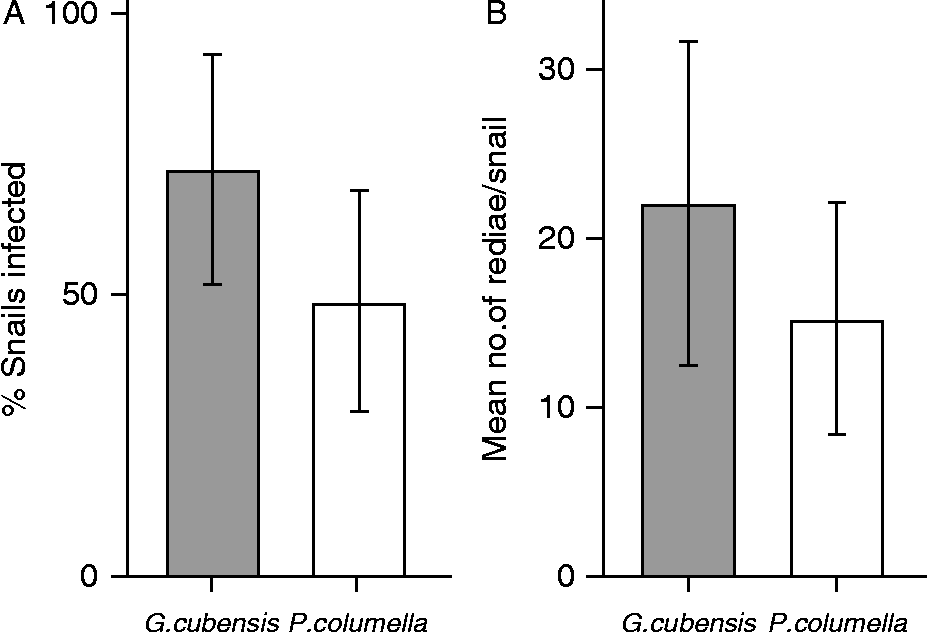
Experimental infection assays with each lymnaeid species showed different levels of susceptibility towards F. hepatica (fig. 2, table 1). Galba cubensis was globally more susceptible to infection (mean 71%, range 52–93%) than P. columella (mean 49%, range 17–56%). Not only were a greater number of G. cubensis individuals infected but greater numbers of rediae were found per snail (fig. 2). The mean value of rediae was 22.43 ± 11.82 (SD) in G. cubensis whereas P. columella showed a lower mean value of 15.35 ± 8.35 (SD). However, individuals of both species reached maximum values of approximately 55 rediae per snail, although such intensities were usually rare.
The proportion (%) of infected snails (A) and production of rediae (B) in G. cubensis (grey) and P. columella (white); resistant populations of P. columella are not included and vertical bars denote standard deviation.
Infection rates (%) of G. cubensis and P. columella from different localities experimentally exposed to different F. hepatica geographic isolates (data on day 25 post-exposure, N=30 for every population). Three populations of P. columella originating from Babiney, La Playita and La Coca were resistant to the six isolates of F. hepatica (data not shown).

The three populations of P. columella showing the typical phenotype of resistance (see Gutiérrez et al., Reference Gutiérrez, Pointier, Yong, Sánchez and Théron2003) showed no evidence of infection when exposed to any isolate of F. hepatica.
Variability was observed among the populations of G. cubensis, with some of them being 100% susceptible to a particular isolate of F. hepatica (table 1), while other populations showed infection rates less than 30%. More pronounced variations in infection rates was observed among populations of P. columella exposed to various isolates of F. hepatica.
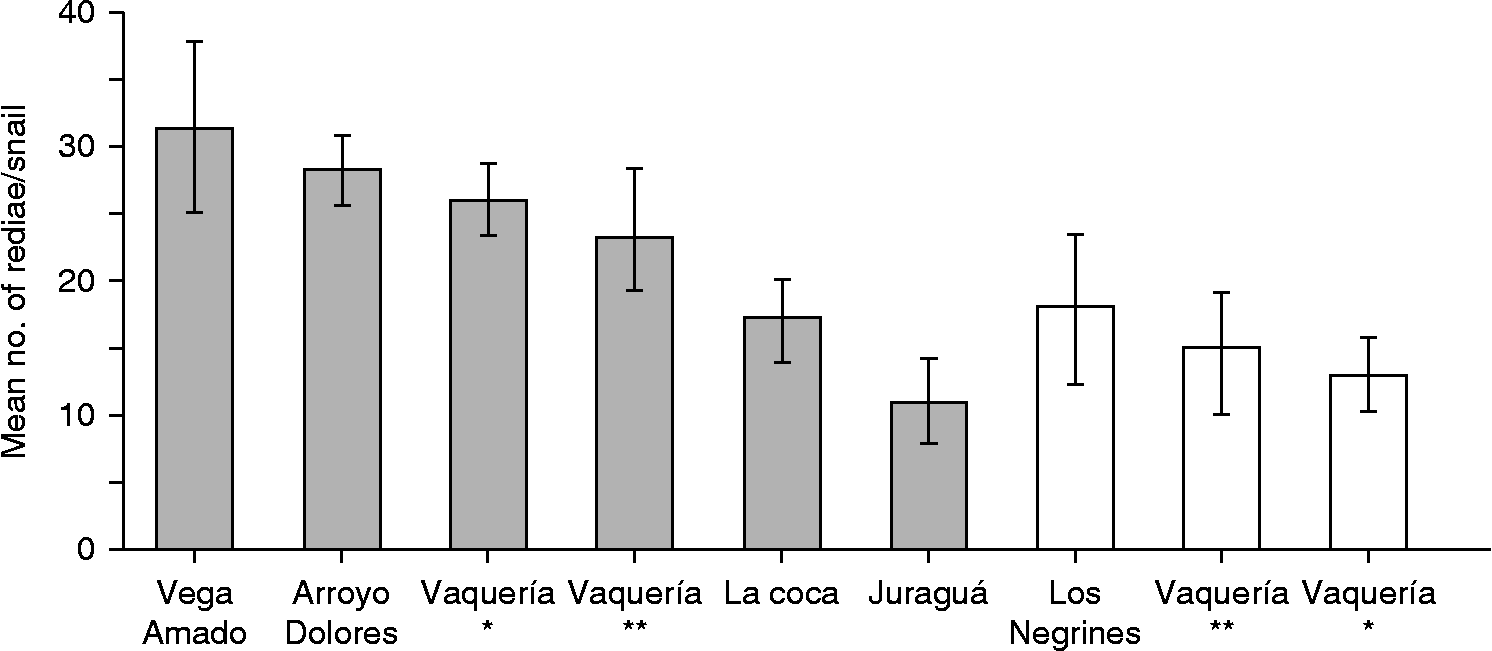
Galba cubensis snails from Vega Amado, Arroyo Dolores, Vaquería 7 and Vaquería 125 produced twice as many rediae (mean 28 ± 8.5) than those from La Coca and Juraguá (mean 14 ± 6.5) regardless of the isolate of F. hepatica used (fig. 3). On the contrary, populations of P. columella, displayed a more constant result, similar to the values of the least productive populations of G. cubensis (fig. 3). It is important to note, however, that no correlations were found between the infection rates and the number of rediae per snail in either species (G. cubensis: r= − 0.118, P= 0.542; P. columella: r= 0.144, P= 0.569).
The production of rediae in infected G. cubensis (grey) and P. columella (white) from collecting sites (*, 7 and **, 125) on exposure to five miracidia of F. hepatica; vertical bars denote standard deviation.
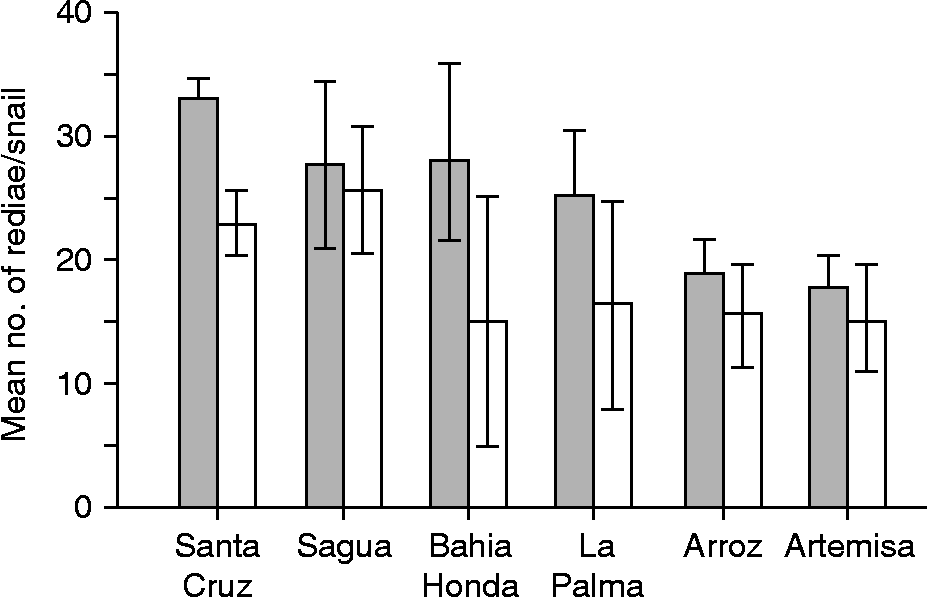
Whatever the snail population or the snail species exposed, the infectivity of the F. hepatica isolates from Arroz and Artemisa appeared highly infective (97 and 85% for G. cubensis, and 92 and 87% for P. columella, respectively), while the parasite isolate of Sagua always had very low infection rates (19 and 21%) (table 1). Isolates of F. hepatica also produced different numbers of rediae per snail regardless of the combination of lymnaeid species/populations used (fig. 4). Santa Cruz and Bahia Honda were the most productive isolates and Artemisa the least.
The production of rediae of F. hepatica isolates from six collecting sites infecting G. cubensis (grey) and P. columella (white); vertical lines denote standard deviation.
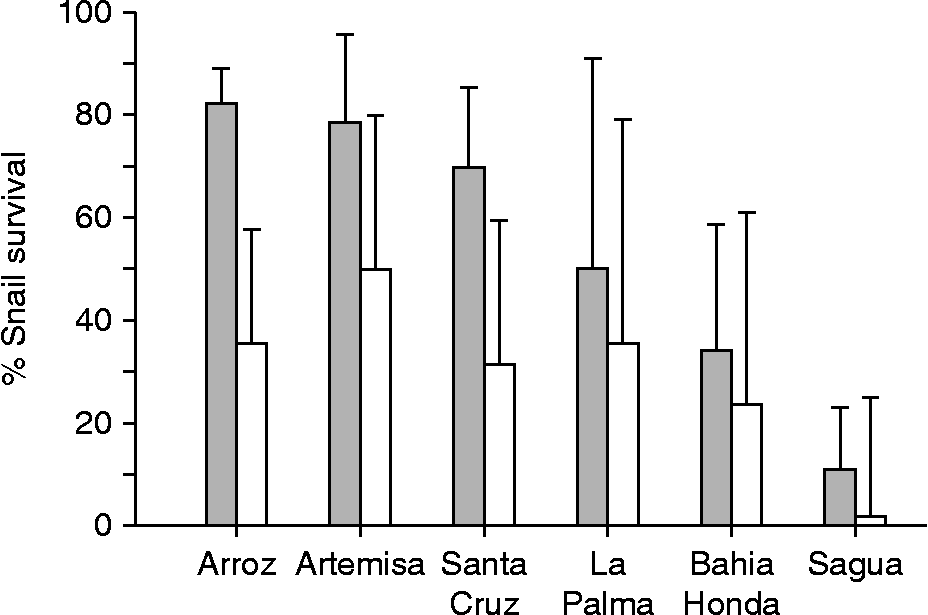
Compatibility regarding the number of snails that remained alive on day 25 post-infection varied slightly within snail species and between parasite isolates (fig. 5). Parasite isolates from Artemisa, Santa Cruz and Arroz were the most compatible with G. cubensis. Survival was clearly different between lymnaeid species, indicating the lower compatibility of parasites with P. columella and little difference in compatibility between parasite isolates with P. columella.
Survival of infected G. cubensis (in grey) and P. columella (in white) on day 25 post-exposure with each F. hepatica isolate.
Discussion
Differences found between both species regarding the infection rates, the production of rediae and survival, clearly show that G. cubensis is actually the most compatible host for F. hepatica in Cuba, and that P. columella is a snail host of secondary importance. Perera (Reference Perera1996) and Vázquez et al. (Reference Vázquez, Sánchez and Hevia2009) predicted this result based on both the presence of G. cubensis in every epidemiological event and the distribution patterns of both lymnaeids. However, variation in compatibility between the two species was never confirmed through experimental infection series using various isolates of F. hepatica. Galba cubensis is capable of settling in a wide range of freshwater ecosystems (even some sites highly influenced by human activity, where P. columella is unable to settle), including those suited for fascioliasis transmission (Vázquez et al., Reference Vázquez, Sánchez and Hevia2009). It is also important to note that in the most endemic areas of fascioliasis transmission in western Cuba (Rojas et al., Reference Rojas, Vázquez, Domenech and Robertson2010), at least three populations of resistant P. columella have been found, reducing the probability of transmission by this species. Although these findings may suggest that transmission would be reduced in this region, it is bolstered by the number of G. cubensis usually found sharing resistant P. columella habitats (Gutiérrez et al., Reference Gutiérrez, Hernández and Sánchez2005; Vázquez et al., Reference Vázquez, Sánchez and Hevia2009). Finally, our results showing variation in infectivity among isolates of F. hepatica may explain why some regions in Cuba are more commonly subjected to fascioliasis outbreaks (resulting in more infected individuals) than others. Unfortunately, it was not possible to test other parasite isolates from the eastern region in this study, but our results matched expectations regarding F. hepatica transmission in western Cuba.
However, beside the populations of P. columella totally resistant to F. hepatica, some others (e.g. El Azufre) showed high susceptibility but low post-infection survival when challenged with a particular isolate of F. hepatica (e.g. Arroz). Furthermore, studies comparing the susceptibility to infection in North America have shown that P. columella was more susceptible than G. cubensis to F. hepatica infection (Cruz-Reyes & Malek, Reference Cruz-Reyes and Malek1987). The species P. columella has also been commonly found infected in the field in Argentina (Moriena et al., Reference Moriena, Moriena, Alvarez, Pietrokovsky, Rubel, Prepelitchi, Racioppi and Wisnivesky2008) and Brazil (Oliveira et al., Reference Oliveira, Fujii, Filha and Martins2002). It is interesting to note that such variations observed in susceptibility between P. columella populations seem not to be correlated with their genetic diversity. Indeed, recent studies with both highly polymorphic (microsatellites) and conserved markers (ITS-1, ITS-2, 16S) showed that P. columella samples collected across the world, and including 22 populations from Cuba, belong to the same species and display very little or no genetic diversity between populations (Nicot et al., 2008; Correa et al., Reference Correa, Escobar, Durand, Renaud, David, Jarne, Pointier and Hurtrez-Boussès2010, Reference Correa, Escobar, Noya, Velasquez, Gonzalez-Ramirez, Hurtrez-Boussès and Pointier2011). Therefore, P. columella plays a role in fascioliasis transmission under certain conditions, and it has been recently observed in a rice field population in Cuba (Gutiérrez et al., Reference Gutiérrez, Vásquez, Hevia, Sánchez, Correa, Hurtrez-Boussès, Pointier and Théron2011).
Our results in terms of host–parasite interactions suggest that some snail populations confronted with allopatric F. hepatica may result in infections. Certain species/populations were more compatible with distant parasite isolates, indicating that poor management of infected cattle or the introduction of highly compatible snails might trigger new outbreaks of fascioliasis in some areas. Similar results were obtained in Brazil (Coelho et al., Reference Coelho, Lima and Guimarães2009) and in France (Gasnier et al., Reference Gasnier, Rondelaud, Abrous, Carreras, Boulard, Diez-Baños and Cabaret2000) with allopatric combinations. However, diversity was found in this type of interaction, suggesting that relationships between snails and parasites may vary according to several variables (e.g. snail ecology, parasite and snail genetic diversity, definitive host management). Sympatric combinations of snails and parasites have been found to be more (Osnas & Lively, Reference Osnas and Lively2011) or less efficient (Goumghar et al., Reference Goumghar, Dreyfuss, Rondelaud, Benlemlih and Cabaret2001). Local adaptation in this interaction has been reviewed by Hurtrez-Boussès et al. (Reference Hurtrez-Boussès, Meunier, Durand and Renaud2001). The outcome of this relationship in terms of parasite infection is likely to be strongly related to: (1) evolutionary time of interaction (older combinations might be expected to be more adapted); (2) dispersal abilities of host and parasite (see Gandon et al., Reference Gandon, Capowiez, Dubois, Michalakis and Olivieri1996; Gandon & Michalakis Reference Gandon and Michalakis2002), local adaptation being expected when parasite dispersal is higher than host dispersal, which is probably the case for the mollusc/liver fluke system; (3) ecology of intermediate and definitive hosts (similar ecological requirements boost the probability of encounter); and (4) genetic diversity (compatible alleles of snails and parasites may increase infection and parasite reproduction).
According to Correa et al. (Reference Correa, Escobar, Noya, Velasquez, Gonzalez-Ramirez, Hurtrez-Boussès and Pointier2011), the scenario of fascioliasis transmission strongly depends on the presence of lymnaeid diversity, since susceptibility to F. hepatica infection varies across species. Fortunately, the Cuban scenario is easier to describe, with the presence of only two potential lymnaeid snail hosts of different ecology and distribution patterns. While G. cubensis is widely distributed in Cuba with populations in natural and polluted habitats, P. columella is yet to be found in the eastern region and seems to prefer natural habitats (Vázquez et al., Reference Vázquez, Sánchez and Hevia2009). This paper shows that the two species are also different in susceptibility and their transmission abilities are closely related to the particular isolate of F. hepatica. Studies on the genetic diversity of F. hepatica are therefore needed to elucidate the problem of the diversity of this parasite.
Acknowledgements
This work was supported by the Institut de Recherche pour le Développement (BEST grant to A.A.V.).