Introduction
During emergencies and disasters, daily tasks and obligations of Local Health Departments (LHDs) are often interrupted. Reference Gossip, Gouda and Lee1–Reference Schoch-Spana, Sell and Morhard3 In order to ensure population health, LHDs must continue to meet regular obligations, as well as, provide emergency or disaster response. Regular activities include the provision of Public Health Essential Services such as diagnosing and investigating cases of communicable diseases and other health hazards, conducting public health surveillance, and enforcing laws and regulations that protect health and safety. 4 Depending on the size and capabilities of the LHDs, additional operations and responsibilities brought on by emergencies and disasters may represent a burden that impacts the efficacy and efficiency of regular departmental procedures. The purpose of this study was to quantify these burdens in local health departments in a Southeastern U.S. state with a decentralized public health system recently impacted by 2 hurricanes.
Natural disasters have a variety of health impacts, ranging from acute physical injuries to complications that result from the exacerbation of chronic health conditions and complex mental health sequelae. Reference Abramson, Stehling-Ariza, Garfield and Redlener5–Reference Goldmann and Galea9 In 2019, the U.S. President approved 101 requests for major disaster declarations, most for hydro-meteorological natural disasters. 10 According to the National Association of County and City Health Officials, there are nearly 3000 LHDs in the U.S, which represents part of the front line of the public health response to these disasters. 11 Public health nurses staff evacuation shelters to ensure that evacuees receive medical treatment, maintain pharmaceutical and other types of therapy, and ensure that there are no outbreaks of infectious diseases. Reference Rivera-Rodriguez12 Environmental health staff monitor the safety of public and private water systems, inspect facilities like restaurants, and hotels before they reopen, and conduct environmental health assessments. Reference McDavid and Cruz13 Epidemiologists and public health surveillance staff set up post-disaster health monitoring, respond to outbreaks, and provide disaster-related data analysis. Reference Malilay, Heumann and Perrotta14 Due to the importance of these and other post-disaster roles, LHDs need an improved understanding of their capacity to continuously provide essential public health services while fulfilling their post-disaster responsibilities.
Post-disaster, LHD response is often evaluated as part of an After Action Report (AAR). Reference Landesman and Burke15 These evaluations can be used to identify process and policy changes that may be necessary to improve public health emergency preparedness, and response strategies before the next disaster. While these reviews are an important part of determining agency preparedness capabilities by identifying what works and why, the methods and mechanisms for analysis and dissemination of AAR data for systematic evaluation remains largely undefined. Reference Schuh, Eichelberger and Stebbins16,17 Accordingly, research to measure and scientifically calculate the burden of emergencies and disasters on LHDs is scarce. Reference Stoto and Nelson18 As part of the Preparedness and Emergency Response Research Centers (PERRCs), the Centers for Disease Control and Prevention (CDC) funded the development of the Adaptive Response Metric (ARM), which was designed to help LHDs plan, manage, and adapt their activities during a public health emergency response. A pilot study of the ARM conducted during the LHD response to the 2009 novel influenza A (H1N1) pandemic, estimated the impacts of the H1N1 response on LHD staffing and personnel availability, service delivery, and infrastructure. Reference Potter, Schuh, Pomer and Stebbins2,Reference Schuh, Eichelberger and Stebbins16 However, to our knowledge, due in part to cuts in funds to the academic public health preparedness centers including the PERRCs, the ARM has not been tested on another type of public health emergency response, such as a natural disaster, nor has it been tested in an LHD outside of California. The ARM metric was subsequently used in the development of the Indicators for Stress Adaptation Analytics, a protocol that could be used to assess deviation from normal activities in public health agencies responding to disasters and emergencies. Reference Schuh, Basque and Potter19 As there is still little consensus among public health officials and scholars on how to measure LHD preparedness or document LHD’s ability to balance the provision of essential public health services with public health emergency response, Reference Asch, Stoto and Mendes20,Reference Nelson, Lurie, Wasserman and Zakowski21 we developed, and implemented an assessment of LHD burden following Hurricanes Florence (2018), and Dorian (2019). The intent of the study was to quantify the impacts of a disaster on local health department’s leadership, staffing and ability to continue to provide essential public health services.
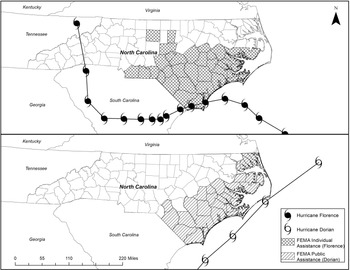
Hurricane Florence made landfall in Southeastern N.C. near Wilmington as a relatively weak Category 1 storm but caused widespread inland flooding, with 33 counties designated by the Federal Emergency Management Agency (FEMA) for both individual and public assistance (Figure 1). 22 In anticipation of Hurricane Florence, the Governor of North Carolina issued an Executive Order 51 on September 7, 2018 ordering a coordinated “emergency response among state and local entities and officials.” 23 Hurricane Dorian made landfall in Eastern N.C. near Cape Hatteras, spawning several tornados, and causing coastal flooding due to storm surge. FEMA therefore designated 27 counties for public assistance. 24 The types of assistance provided varied based on the extent of the disaster damage, with public assistance including support of local governments for debris removal and emergency protective measures, and individual assistance providing direct assistance to individuals and households for temporary housing, emergency home repairs, and personal property losses. 25
North Carolina counties designated for individual or public assistance by the Federal Emergency Management Agency (FEMA), Hurricanes Florence (2018) and Dorian (2019)

Methods
A web-based survey was developed in the Qualtrics platform (Qualtrics XM, Provo, Utah) in collaboration with the N.C. Association of Local Health Directors’ Preparedness and Epidemiology Committee, who sent the link to complete the survey to all N.C. Local Health Directors on behalf of the research team. In the first section of the survey, respondents were asked to indicate their LHD’s jurisdiction. The second section of the survey asked if an Emergency Operations Center (EOC) was opened or an Incident Command System (ICS) was activated in their jurisdiction for Hurricane Florence. Whether or not an EOC was activated, respondents were asked to describe Hurricane Florence’s impact on their LHD using categories adapted from the stages of burden developed as part of the ARM (i.e., normal activities unaffected, normal activities altered for some staff, normal activities altered or postponed, normal activities suspended). Respondents indicated the level of burden on 9 domains (health department staff, functions, or areas of operation) including senior staff and leadership (director, medical director); professional staff (nursing, epidemiology); functional staff (human resources, finance); support personnel (administrative); ability to deliver client services (Special Supplemental Nutrition Program for Women, Infants, and Children; childhood vaccinations); budget; health department facilities; facility hours; and public health services (infection control, vital records, environmental health inspections). The third section repeated this assessment for Hurricane Dorian. Next, respondents were asked to assess the importance on a scale of 1–5, with 1 being not at all important, and 5 being very important, of measuring the overall burden of public health emergency response on their agency’s ability to continue to provide essential functions and services, and to identify priority areas for the development of metrics. Finally, respondents were provided an opportunity for open-ended response related to priorities, or concerns related to the impacts of natural disasters on LHD capacity that were not addressed in the survey. Data were collected from March 2 to 19, 2020 and analyzed using Stata version 16 (Stata Corp LLC, College Station, TX). Prevalence differences and Fischer’s Exact tests were used to compare the levels of burden reported by jurisdictions that opened an EOC or activated ICS, versus those that did not for Hurricanes Florence and Dorian separately. The survey and other documents, including the recruitment email, were reviewed by the Institutional Review Board of the University of Delaware and determined to be exempt (IRB 1334233-1).
Results
From March 2 to 19, 2020, respondents from 50 of N.C.’s 85 LHDs (58.8%) completed the survey online.
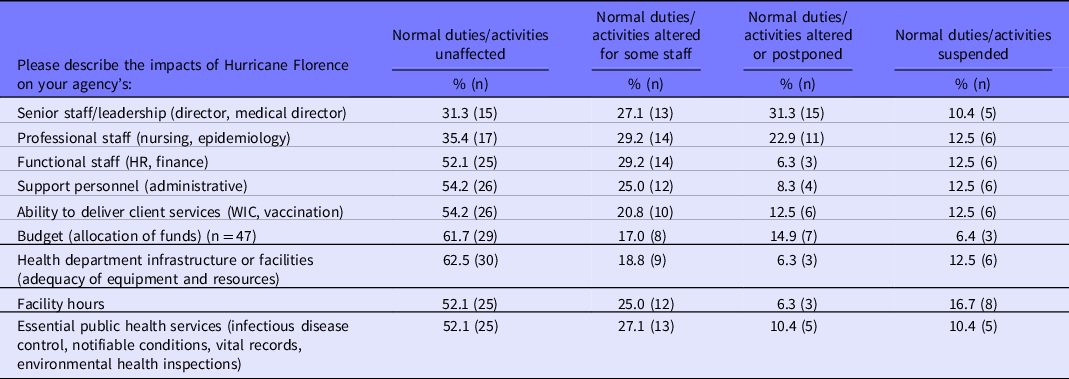
The majority of respondents (32 of 48; 66.7%) reported that their jurisdiction opened a local EOC or activated ICS in response to Hurricane Florence. Normal duties and activities were most frequently postponed by the disaster for senior staff/leadership (15 of 48; 31.3%) and for professional staff such as those in nursing and epidemiology (11 of 48; 22.9%) (Table 1). However, with the exception of budget functions (3 of 48; 6.4%), normal duties and activities were suspended for about the same percentage in all domains (5 of 48; 10.4%, or 6 of 48; 12.5%). Normal facility hours were the most frequently suspended activity (8 of 48; 16.7%). Descriptive findings were similar in response to Hurricane Dorian. Nearly 66.7% of respondents (29 of 45; 64.4%) reported their jurisdiction opened an EOC or activated ICS in response to Hurricane Dorian, compared to 32 of 48 in Hurricane Florence. Normal duties and activities were most frequently postponed by the disaster for senior staff/leadership (14 of 46; 30.4%) and for professional staff such as nursing and epidemiology (14 of 46; 30.4%). Normal facility hours were the most frequently suspended activity (5 of 44; 11.4%) (Supplemental Table 1).
Impacts of hurricane Florence on local health departments (N = 48)

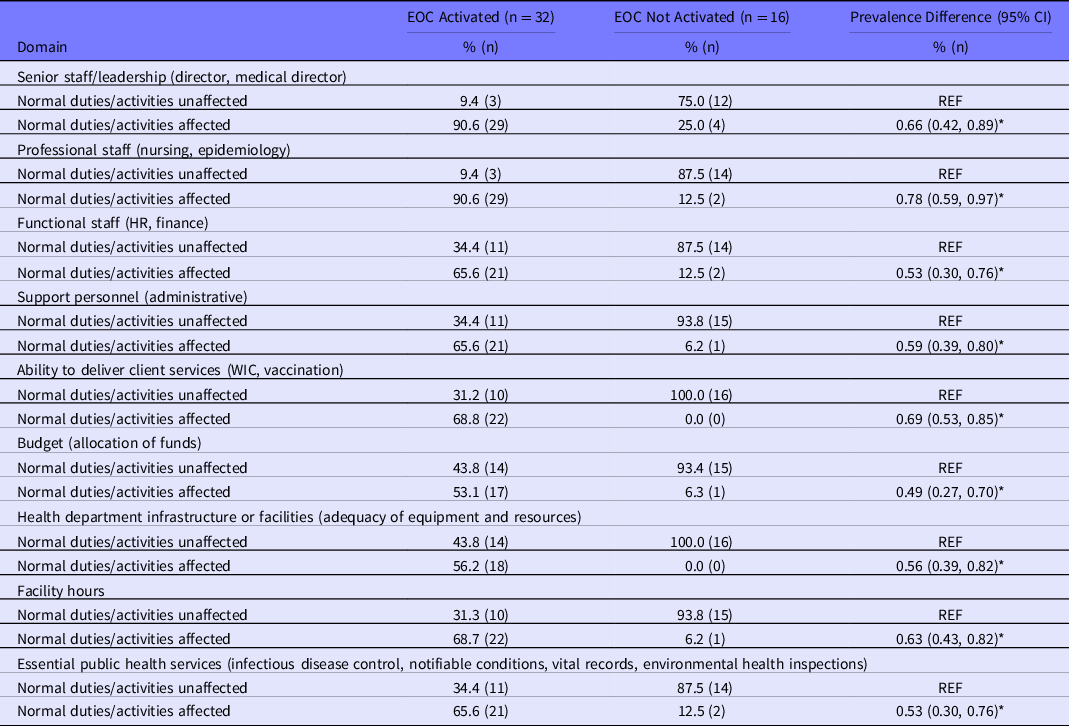
Since all N.C. LHDs were invited to complete the survey, results were stratified to compare LHDs that indicated they opened an EOC or activated ICS in response to Hurricanes Florence and Dorian. Compared with LHDs that did not open an EOC or activate ICS, LHDs that did open an EOC or active ICS were statistically, significantly more likely to report that normal duties, and activities were affected across all 9 domains (Table 2).
Prevalence differences for burden on local health departments stratified by activation of emergency operations center in hurricane Florence Response (N = 48)

Respondents indicated that it was very important to them to measure the burden of public health emergency response on their ability to continue to provide essential LHD functions (Mean = 4.7; Standard Error 0.58), perhaps because according to the State’s Emergency Management authorities, all parts of North Carolina are at risk from the impacts of tornadoes, floods, hurricane, severe storms, and snow and ice storms. Local Health Directors were most interested in having metrics that could track disaster impacts on the provision of services related to nursing clinic operations (n = 44); environmental health services (n = 43); and nursing field services (n = 40). Other regular activities and services that were identified as important to track post-disaster included administrative and financial (n = 36), epidemiology (n = 36), emergency medical services (n = 35), and immunizations (n = 35).
In open-ended comments, the most frequently mentioned impacts of natural disasters on LHD capacity to continue providing essential public health services were related to their public health’s responsibility for shelters (8 of 20; 40%), and funding (8 of 20; 40%). Staffing shelters for all phases (from disaster response through long-term recovery) was identified as a burden by LHDs, particularly for nursing staff. Staffing shelters were seen as an activity that failed to “utilize the extent of nurses’ training” and required the suspension of “most or all normal clinical activities.” Recouping costs for staffing shelters for long-term recovery, funds available for reimbursement for both provided and disrupted services, and funding for repairing damaged facilities were all mentioned by respondents. A total of 6 out of 20 open-ended comments referred to impacts on regular LHD communications, including communications related to available funding for reimbursement for LHD response and service disruption, communications between LHDs deploying nurses from outside of the hurricane-impacted areas, and regular communication with clients for continuity of care and for communicable diseases like sexually transmitted infections. Respondents also mentioned other priorities that should be measured such as disaster impacts on the regular provision of animal control (n = 3), vector control (n = 3), the availability of supplies such as vaccines (n = 2) and Personal Protective Equipment (n = 1).
Discussion
Better measures of the burden that natural disasters place on LHD’s regular activities and provision of essential services are needed. To partially address this need, a survey was developed and administered in North Carolina to assess the impacts of Hurricanes Florence and Dorian on LHD’s provision of essential services. Analysis of survey responses quantified ways in which the hurricanes impacted LHD functions. Responses to open-ended questions provided information that could be used to refine the survey tool for future use in quantifying impacts of disasters on LHD functions.
Although out of the scope of this brief survey, measurements of the impact of disaster-related interrupted LHD services more directly on population health would also be important. Many indirect approaches to measuring the impacts of disasters on population health have been attempted, including the use of Medicaid claims, Reference Phillippi, Beiter and Thomas26,Reference Sharp, Sun, Ledneva, Lauper, Pantea and Lin27 Medicare claims, Reference Rosenheim, Grabich and Horney28 and Federal health surveys. Reference Gould, Teich, Pemberton, Pierannunzi and Larson29,Reference Zotti, Williams and Wako30 However, findings from these studies have been mixed, and none have adequately quantified the potential, direct health effects of interrupted LHD services after a disaster. Similarly, in non-disaster settings, it has been difficult to estimate the full public health value of services frequently provided by LHDs in the U.S. For example, calculating the overall value of vaccination is difficult due to challenges in measuring the impacts of vaccination on health equity, school absenteeism, antibiotic resistance, and other factors. Reference Gessner, Kaslow and Louis31 Little is known about the effectiveness of environmental health inspections, typically under the purview of LHDs, in the prevention of cases of food-borne illness, with studies attempting to measure the risks of outbreaks producing mixed results. Reference Lee and Hedberg32
Like much of public health, LHD’s successful balancing of the provision of ongoing, often invisible, public health essential services with public health disaster response continues, against all odds, even with relatively low wages, funding cuts that limit job security, and limited opportunities for career development. Reference Wisniewski, Jacinto, Yeager, Castrucci, Chapple-McGruder and Gould33 Since 2008, local public health agencies have lost 20% of their workforces, or 34000 jobs since 2008, while 62% of local health departments had flat or reduced funding, and average overall declines in spending averaged 10.3%. 34,35 In part, due to these reductions in funding and staff, any disaster likely interrupts LHD function to some extent. However, in this study, LHDs in jurisdictions that opened an EOC were statistically, significantly more likely to report that normal duties and activities were affected across all domains studied. We do not have data on factors that may mitigate these interruptions such as total funding or total number of staff.
The study has several important limitations. Data were collected 6 months after Hurricane Dorian, and 18 months after Hurricane Florence impacted the State of N.C., hence information reported may be subject to recall bias. The study did not collect information on the job tenure of the Local Health Directors who responded and can therefore not be certain if they were in this role at the time of the hurricanes, meaning they may have been unfamiliar with certain elements of the response. Non-response bias is possible if the LHDs who did not participate were different than those who did respond; however a similar percentage of respondents (20 of 50; 40%) and non-respondents (13 of 35; 37.1%) had disaster declarations that included both individual and public assistance indicating similar impacts. The ARM utilized LHD budget information to calculate the relative burden of disaster by department or function. This survey did not collect budget information; to minimize respondent burden, the survey only asked Local Health Directors to report whether budgets or funding allocations were affected or unaffected by the LHD’s role in the disaster response (i.e., normal activities unaffected, normal activities altered for some staff, normal activities altered or postponed, normal activities suspended). The opening of a local EOC was used as a proxy for LHD involvement in emergency response because emergency operations in North Carolina are decentralized, with each county having an emergency operations plan and personnel to manage an emergency from a local EOC. 36 This could have resulted in misclassification bias since only 18 out of 33 (55%) responding local health department jurisdictions designated by FEMA for individual and public assistance following Hurricane Florence, reported that they activated an ICS structure or an EOC. These data also provide no insight as to the quality of the emergency operations plans or the actual operation of the EOC following Hurricanes Florence or Dorian.
This survey was fielded in March 2020, and only 1 respondent referred to a lack of funding and staffing making it difficult for their LHD to maintain regular services and activities while responding to the novel coronavirus pandemic in the open-ended portion of the survey. On March 20, the day after this survey closed, the cumulative number of cases of Covid-19 in the U.S. was only 14200, and testing availability was extremely limited. 37 By early April, it was becoming clear that the U.S. public health system was severely understaffed to fight a global pandemic. Reference Wilson, Troisi and Gary-Webb38 Globally, by July 2020, 29 countries had suspended their vaccination programs, citing a lack of funding and staff to continue them in light of the Covid-19 response, with 18 of them reporting outbreaks of measles. Reference Hoffman and Maclean39 The lack of tools to measure the impact of interruptions in essential public health services due to the COVID-19 pandemic is a major limitation in estimating the indirect health impacts of this, and future public health emergencies. The wider implementation of assessments that quantify the burden of public health emergency response on local health departments and estimate the essential public health services that cannot be provided because of emergency response are an essential part of ensuring continuity of service provisions is supported through more stable funding for public health emergency preparedness going forward.
Conclusion
LHDs provide essential public health services, critical for protecting and improving the health of populations, such as epidemiology, environmental health, and clinical services. When a public health emergency like a natural disaster occurs, LHDs are expected to maintain regular activities while simultaneously performing their roles as part of the public health emergency response. Given the well-documented funding and staffing shortages in governmental public health, which have happened concurrently with the increasing populations and complexity of public health emergency challenges (e.g., frequent and severe disasters, H1N1 Swine Flu, Deepwater Horizon, Ebola, Zika, etc.) it is often impossible for LHDs to maintain both regular services and emergency responsibilities. Quantifying the amount of regular LHD services interrupted by a disaster response, and documenting the impacts to the public’s health, are critical gaps that should be addressed through research-practice partnerships.
Supplementary Material
To view supplementary material for this article, please visit https://doi.org/10.1017/dmp.2021.193
Funding
This research was supported by seed funding from the D’Youville College’s Faculty Senate Research Committee. Any opinions, findings, conclusions, or recommendations expressed in this material are those of the author(s), and do not necessarily reflect the views of D’Youville College.
Abbreviations
AAR, After Action Report; ARM, Adaptive Response Metric; CDC, Centers for Disease Control and Prevention; EOC, Emergency Operations Center; FEMA, Federal Emergency Management Agency; ICS, Incident Command System; LHD, Local Health Department; PERRC, Preparedness and Emergency Response Research Centers.