Introduction
Demographic ageing and the accompanying shifts in the ratio of social security contributors to recipients poses a major challenge for European welfare states. For many decades, the persistent trend towards early retirement before reaching mandatory retirement ages, prevalent among the majority of European labour markets, has further exacerbated this unbalance. Most recently, early retirement thus increasingly has been considered financially unsustainable, reflected in a ‘paradigmatic turn’ of national policy makers from fostering early retirement to promoting longer working life since the mid-1990s. Among such policy reforms, often summarised under the label of ‘active ageing’ (Jepsen, Foden and Hutsebaut Reference Jepsen, Foden and Hutsebaut2002), increases in retirement ages and the closing of early retirement pathways have played a central role. Recent reviews of active ageing policies (European Employment Observatory 2012) point to sometimes remarkable reforms in this area, and indeed, in more recent years, the previously dominant early exit trend appears to have halted or even substantially reversed (Ebbinghaus and Hofäcker Reference Ebbinghaus and Hofäcker2013).
However, while there exists extensive retrospective evidence on past trends in retirement behaviour under the active ageing paradigm, comparatively little is known about the retirement preferences of current employees. It thus remains open whether institutional reforms are in fact reflected in the retirement plans and preferences of future retiree cohorts. Against this background, this paper empirically analyses how far current policy reforms are in line with the preferences of older workers approaching retirement age, using most recent data on desired retirement ages from the fifth wave of the European Social Survey (ESS). On the one hand, it descriptively juxtaposes current policy trends and aggregated retirement preferences of older workers in European countries. Yet, assuming that not all groups of older workers are able to adapt to the new challenges associated with current active ageing reforms, the paper also investigates whether specific ‘problem groups’ are emerging for which individual retirement intentions and institutionalised expectations differ disproportionately, and whether the composition of such groups differs across countries.
To this end, the paper is structured as follows: following a short outline of the general rationale of studying retirement preferences and desires, the relevant determinants of individual retirement preferences are discussed, considering both institutional as well as individual determinants. For the former, the paper provides a stylised overview of major developments in pension policies as well as other relevant policy fields affecting older workers’ employment. Subsequently, we discuss organisational and individual-level determinants of retirement preferences, as well as possible interactions between these and the institutional context. The next section introduces the fifth wave of the ESS as the database and outlines the methods applied for the subsequent analyses. We then present a descriptive overview of retirement preferences in European countries, followed by a multivariate analysis of their inter- and intra-national variations. A final summary and critical discussion of the main findings concludes the paper.
Theoretical background
Why analyse retirement preferences?
At first sight, studying retirement preferences rather than actual transitions into retirement appears to be a surprising choice. Retirement preferences represent a time-bound intention of individuals to organise their retirement transitions, considering the specific contextual conditions at the time of voicing this intention. Apparently, it remains speculative whether these intentions will be put into practice in the future. Previous studies investigating the effects of institutional changes on retirement behaviour thus have rather relied on the retrospective analysis of actual retirement transitions, using either cross-sectional (Ebbinghaus and Hofäcker Reference Ebbinghaus and Hofäcker2013) or longitudinal data (Blossfeld, Buchholz and Kurz Reference Blossfeld, Buchholz and Kurz2011). However, despite the undisputable value of this analytical perspective, the significance of such analyses to identify the effects of recent ‘active ageing’ reforms is inherently limited, given that current cohorts of pensioners had often spent virtually their entire employment life under the old ‘early exit regime’ and thus have been subject to respective pension and labour market policies. In other words, they were often not fully affected by more recent reform measures. This paper thus takes a prospective focus on retirement plans and preferences of future retiree cohorts which more likely have been affected by recent reform measures, thus allowing for a better assessment of their effectiveness.
To date, only a little research has focused on individual retirement preferences and desires to retire, from a cross-nationally comparative perspective. This neglect may partly have been due to the lack of adequate quantitative data, especially on an international scale. More recently, comparative research has been able to make use of indicators from either Eurobarometer studies (Esser Reference Esser and Han2006; Hofäcker, Frommert and Heien Reference Hofäcker, Frommert and Heien2010) or the Survey of Health, Ageing and Retirement in Europe (SHARE; e.g. Blanchet and Debrand Reference Blanchet and Debrand2009). This paper employs more recent data from the fifth wave of the ESS to reconstruct individual desired retirement ages and its determinants across 25 European countries.
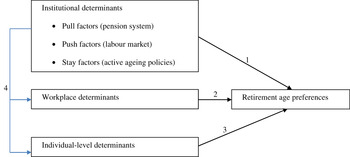
The subsequent analyses are informed by the assumption that individual retirement plans and desires, despite their subjective nature, are not ‘free-floating’ preferences, dependent only on individual predisposition, but that they are simultaneously being shaped by individual contexts, conditions that older workers take into account when planning for their own retirement. Previous research (e.g. Komp, Van Tilburg and Broese van Groenau Reference Komp, Van Tilburg and Broese van Groenau2011; Wang and Shultz Reference Wang and Shultz2010) has identified at least three groups of factors affecting individual retirement preferences (see Figure 1).
Determinants of retirement preferences.

On the one hand, individuals will orient their retirement decisions at institutionally provided conditions for leaving the labour force under financially acceptable conditions versus the available options for continued employment. Second, individuals will make their retirement plans dependent on the concrete opportunities for employment continuation or exit provided at their workplace. Finally, older workers will consider how far their individual predisposition – reflected, for example, in individual health, financial situation or labour market capital – promotes either continued employment or (early) employment exit. In the following, I shall discuss these three sets of determinants consecutively in more detail.
Determinants of retirement preferences: institutional level
Nation-specific institutional settings represent the most abstract set of factors that may impact on retirement preferences. Their interplay creates the available opportunities and constraints for older workers to either continue working or to retire. Ebbinghaus and Hofäcker (Reference Ebbinghaus and Hofäcker2013) analytically distinguish three different types of such institutional factors (see Figure 1): first, there are so-called pull factors, i.e. institutional incentives through pension systems or other ‘welfare state subsystems’ (Guillemard Reference Guillemard1991) that provide incentives for employment exit at a given age and thus literally ‘pull’ older workers out of the labour force. Second, there are institutional factors that exert pressures on older workers’ employment participation, such as demand shocks or age discrimination, and thus ‘push’ older workers out of employment. While both ‘pull’ and push’ factors are assumed to promote early employment exit, more recent ‘active ageing’ policies may be regarded as ‘stay’ factors that enhance older workers’ employability and thus facilitate their maintenance within the active labour force. In the following, I shall describe these institutional factors and their more recent development within European countries in more detail, using stylised institutional and aggregate labour market data for an empirical illustration.
Institutional pull factors: pension systems and retirement incentives
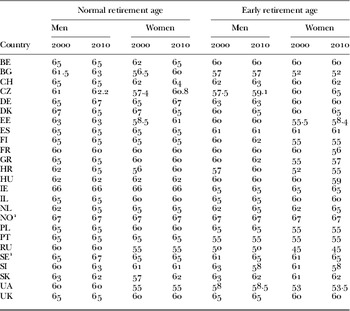
Rational individuals will plan their withdrawal from paid employment at least close to the time when they become eligible for financially sufficient public or private old-age benefits. It thus can be assumed that preferred retirement ages will strongly correlate with the ages at which pension benefits (first) become available, i.e. the standard (early) retirement age (see Gruber and Wise Reference Gruber and Wise1999). In addition to the age of eligibility, the financial generosity of benefits may be crucial for retirement planning: individuals will more likely strive for exit from employment if benefits allow for a decent living standard rather than if only a subsistence minimum is ensured. Furthermore, if accrual patterns of pension systems are not actuarially neutral and effectively provide incentives for early retirement, individuals ‘gain’ little by continuing to work beyond first eligibility ages. In consequence, they likely will prefer a premature exit (Blöndal and Scarpetta Reference Blöndal and Scarpetta1999; Gruber and Wise Reference Gruber and Wise1999). Low retirement ages, high pension replacement rates and actuarially non-neutral pension accrual schemes thus frequently have been regarded as the main drivers of early retirement (Blöndal and Scarpetta Reference Blöndal and Scarpetta1999; Gruber and Wise Reference Gruber and Wise1999). Correspondingly, increases in the (earliest) age of eligibility to retirement benefits, cutbacks in the generosity of retirement incentives and shifts towards a more neutral accrual pattern of benefits have been regarded as appropriate measures for early retirement reversal. Reforms of standard retirement ages and pension generosity thus have enjoyed great popularity in recent years (Hofäcker Reference Hofäcker2012). As an illustration, Table 1 provides an overview of both standard as well as early retirement ages through the public pension system for men and women in those countries also featured in the ESS, comparing 2000 with 2010.Footnote 1
Standard and early retirement ages of men and women in European Social Survey countries, 2000 and 2010

Notes: 1. Flexible retirement age between 61 and 67 (Sweden) and 62 and 67 (Norway). BE: Belgium. BG: Bulgaria. CH: Switzerland. CZ: Czech Republic. DE: Germany. DK: Denmark. EE: Estonia. ES: Spain. FI: Finland. FR: France. GR: Greece. HR: Croatia. HU: Hungary. IE: Ireland. IL: Israel. NL: Netherlands. NO: Norway. PL: Poland. PT: Portugal. RU: Russian Federation. SE: Sweden. SI: Slovenia. SK: Slovakia. UA: Ukraine. UK: United Kingdom.
Source: Own illustration based on MISSOC (2012).
Table 1 indeed indicates a trend across numerous countries to increase the normal and/or early retirement age throughout the last decade, reduc-ing cross-European differences in retirement ages and promoting a ‘convergence’ towards ‘normal’ retirement at age 65 (or higher) for both sexes. Nonetheless, there still remain notable cross-national variations in retirement ages that may be grouped into four ‘types’.
In countries such as Denmark, Sweden, Norway, Ireland and the Netherlands, retirement ages are high, i.e. set at age 65 or above for both men and women. At the same time, early retirement opportunities do not play a prominent role. Sweden and Norway, in fact, recently have enacted a ‘flexible’ retirement age between ages 61 and 67 (Sweden) and 62 and 67 (Norway). Statistics on effective retirement ages indicate that within this ‘age corridor’, actual retirement transitions are oriented rather at late retirement (in Sweden, 66.3 for men and 64.4 for women; in Norway, 64.4 for men and 64.3 for women; Organisation for Economic Co-operation and Development 2013). These countries may be described as traditional ‘late exit’ countries with high retirement ages already in the year 2000, with no major changes within the following decade.
A number of other countries, such as Germany, Spain, Portugal and Belgium, exhibit comparatively high standard retirement ages, but simultaneously still offer opportunities for early retirement five to ten years before the ‘normal’ retirement age. Belgium, for example, successfully has equalised formal retirement ages for both men and women at age 65, but still features the opportunity for both sexes to retire prematurely at age 60. In other countries, such as Greece, Poland, Switzerland and the United Kingdom (UK), early retirement opportunities are gender-biased, allowing women an earlier exit via the public retirement system.
Most Central and Eastern European countries (i.e. the Czech Republic, Hungary, Estonia, Slovenia, Slovakia and Croatia) currently exhibit moderate normal retirement ages, ranging between age 61 and 64. Even though in many of these countries, these levels represent the outcome of substantial pension reforms and retirement age increases throughout the last decade, their retirement ages still remain below that of many Central and Northern European states.
Finally, there are countries such as France, Bulgaria, the Russian Federation or Ukraine where standard retirement ages are low (i.e. mostly at age 60 and below) and in some cases are complemented by further opportunities for an even earlier exit. Ukraine is a vivid illustration of such persistent early exit regimes, with normal retirement at age 60 for men and 55 for women, and additional opportunities to exit up to two years prior to this age. In Bulgaria, men can work up to age 63. Yet, early retirement opportunities allow for a much earlier exit at age 57 (men) or even 52 (women), justifying an allocation of Bulgaria to the ‘early exit’ category as well.
Institutional push factors: economic cycles and the demand for older workers’ labour
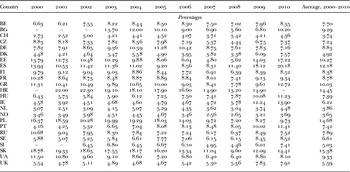
While pull approaches treat retirement as ‘free’ individual decisions to supply labour under given pension system constraints, it seems equally important to consider institutional restrictions for continuing employment, i.e. factors influencing the demand for older workers. Declining labour demand throughout the oil crisis can be regarded as one major driver for the emergence of the early exit trend in the 1970s. Similarly, economic downturns throughout the ‘transformation’ period of the 1990s may have reduced labour force demand – both among older workers and the workforce in total – and thereby likely have triggered the large-scale use of early retirement schemes in Eastern European countries (Blossfeld, Buchholz and Hofäcker Reference Blossfeld, Buchholz and Hofäcker2006). To assess the general labour market demand for work as a potential determinant of older workers’ retirement preferences, it thus seems sensible to consider unemployment rates throughout more recent years. To that end, Table 2 provides an overview of yearly unemployment rates between 2000 and 2010, as well as the average level throughout this period.Footnote 2
Yearly unemployment rates and ten-year average, 2000–2010

As Table 2 shows, unemployment has been highest in Poland, Slovakia and Croatia, where unemployment rates have been persistently above the 10 per cent margin throughout most of the previous decade. More recently, these countries have been able to reduce unemployment somewhat, despite a pick-up after the financial crisis in 2008. Only slightly lower average unemployment rates are found in Estonia, Bulgaria, Greece and Spain. Given the strained labour market in both groups of countries, older workers will have found it difficult to remain in employment. At the other end, Denmark, Norway, the Netherlands and the UK exhibit comparatively low unemployment from 2000 to 2010, mostly ranging around or below the 5 per cent margin. Especially in these countries, economic development may have helped the maintenance and re-integration of older workers into employment. Other countries cluster between these two extremes, mostly exhibiting unemployment rates between 5 and 10 per cent.
Institutional stay factors: active labour market policies (ALMP) and lifelong learning
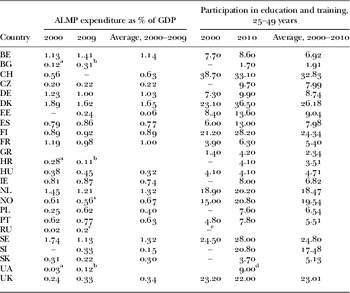
While both pull and push factors promote the employment withdrawal of older workers, stay factors aim at a better integration of older workers into employment. A high incidence of such measures likely will raise the individual willingness and ability to work longer. ALMP, aiming to create jobs for older workers or to reintegrate them into employment, make up a major component of such ‘stay policies’. Furthermore, measures of continued education and training throughout the lifecourse (‘lifelong learning’) improve older workers’ qualification levels and thus increase their potential ‘employability’ (Blossfeld, Buchholz and Hofäcker Reference Blossfeld, Buchholz and Hofäcker2006). As an indication of the prevalence of such measures within the countries studied in this paper, Table 3 provides an overview of the yearly public expenditure on ALMP as a percentage of a country's Gross Domestic Product (GDP)Footnote 3 for the years 2000 and 2009 as well as the participation rate in education and training among the 24–49-year-old population.Footnote 4
Expenditure on active labour market policies (ALMP; as a percentage of Gross Domestic Product (GDP)) and participation rates in education and training (last 12 months) among individuals aged 25–49 between 2000 and 2009

Notes: For country abbreviations, see Table 1. 1. Data for 2007.
Source: Organisation for Economic Co-operation and Development (2011); Eurostat (2012); aCazes (Reference Cazes2002; data for 1998); bKuddo (Reference Kuddo2009; data for 2008); cGimpelson and Kapliushnikov (Reference Gimpelson and Kapeliushnikov2011; data for active and passive policy expenditure); dBetliy and Feiler (Reference Betliy and Feiler2011; data for entire population); eno data available but country studies report a ‘lack of a coherent system’ (Veits, Khokhlova and Kozlovskiy Reference Veits, Khokhlova and Kozlovskiy2011: 34).
As Table 3 indicates, there exists considerable variation in the incidence of active ageing policies across European countries. Such measures are traditionally most widespread in Scandinavia, where between a fifth (Finland) and a third (Denmark) of middle-aged employees participate in lifelong learning measures. At the same time, ALMP expenditure makes up around 1 per cent of GDP or more (with the single exception of Norway where unemployment has been persistently low). In these countries, high investments into older workers’ employability have made it easier for them to remain employed longer and thus to more likely prefer higher retirement ages. Training rates are similarly high in both Switzerland and the UK. However, here the high incidence of training – often provided through the employer – is accompanied by a more residual orientation of ALMP which make up clearly less than 1 per cent GDP.
Both types of stay policies are of minor importance in most Eastern European countries where ALMP programmes make up less than 0.5 per cent of GDP and, even among middle-aged individuals, less than one-tenth (Czech Republic, Estonia, Poland, Ukraine) or even one-twentieth (Bulgaria, Croatia, Hungary, Slovakia) participate in lifelong learning measures. The only exception is Slovenia, where by the year 2010, around 20 per cent of individuals aged 25–49 participated in training measures. However, the incidence decreases sharply beyond that age (Ignjatovic 2010), while ALMP expenditure does not exceed 0.2 per cent of GDP. Similar figures also apply to Southern Europe. In most of the aforementioned countries, the already critical labour market chances of older workers due to high unemployment rates thus are exacerbated through insufficient investments into their employability.
Most Central European countries, such as France, Belgium and Germany, combine high investments into labour market policies – slightly above 1 per cent of GDP – with persistent deficits in lifelong learning measures. The only exception is the Netherlands where training rates for the middle-aged are higher; yet again, their incidence declines markedly for the older age group, making older workers ‘very vulnerable in the light of skill upgrading processes’ (Gesthuizen and Wolbers Reference Gesthuizen, Wolbers, Blossfeld, Buchholz and Kurz2011: 69). Employment support for older workers in these countries thus is at least ambiguous and therefore can be expected to delimit rather than foster preferences for later retirement ages.
Synthesis: a combined measure of institutional determinants of retirement preferences
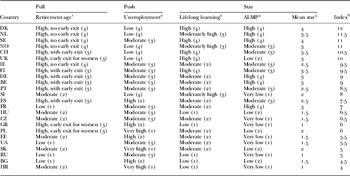
Table 4 combines the evidence from the previous discussion of institutional frameworks. For each of the dimensions discussed – i.e. pull, push and stay factors – countries are attributed a score between 1 and 4, with 4 denoting the highest and 1 denoting the lowest level of institutional support for later retirement (for details, see Table 4 notes). All three-dimensional values are then added up to an overall index of institutional support for later retirement, ranging from a minimum of 3 to a maximum of 12 index points.
Synthesis of institutional contexts and index for promoting later retirement

Notes: For country abbreviations, see Table 1. ALMP: active labour market policies. 1. Classification according to text. 2. Percentages: very high 12–15, high 9–12, moderate 6–9, low <6. 3. Percentages: high >20, moderate 10–20, low 5–9, very low <5. 4. Percentages: high >1, moderate 0.5–1, low 0.25–0.49, very low <0.25. 5. Calculated as (Lifelong learning + ALMP/2). 6. Calculated as sum of single dimensions: Pull + Push + Stay (mean).
Source: Own illustration.
According to this additive index of institutional conditions for continued employment, three groups of institutional context patterns may be differentiated:
1. Scandinavian countries, as well as Switzerland and the UK, exhibit the highest level of support for later retirement with index values ranging between 9.5 and 12. Few ‘pull’ incentives, reflected in high retirement ages in these countries, are complemented by moderate to high investments into ‘stay’ policies that enable older workers to remain in employment longer. Modest push forces, reflected in comparatively low unemployment rates throughout the last decade, furthermore facilitate employment maintenance.
2. At the other end, most Eastern European countries and Greece provide little support for continued employment (reflected in index values between 4.5 and 6). Push forces through national unemployment rates are high, while active ageing policies play only a marginal role. Persistently lower retirement ages for the entire population (Estonia, Ukraine, Slovakia, Russia and Bulgaria) and for women (Greece, Poland) mirror these unfavourable employment conditions for older employees.
3. An intermediate group is formed by a mix of Central (Germany, France, Belgium), Eastern (Czech Republic, Hungary, Slovenia) and Southern European countries (Spain, Portugal) where policy incentives are rather ambiguous. Formal retirement ages are moderate to high, but in the majority, pension systems still allow for early exit before mandatory ages. Unemployment has been modest throughout last years, thus in principle fostering the demand for labour. However, until now, employment support through active policies and lifelong learning institutions has remained modest.
Determinants of retirement preferences: organisational level
Beyond institutional influences, further research has pointed to organisational characteristics and their effects on older workers’ retirement desires (see Figure 1). Differences may be expected between the public and the private sector: within many European countries, retirement ages have been defined as mandatory in the public sector (European Commission 2011; Hochman and Lewin-Epstein Reference Hochman and Lewin-Epstein2013; Schröder, Muller-Camen and Flynn Reference Schröder, Muller-Camen and Flynn2012), and frequently allow for earlier exit than in the private sector. Public servants thus likely will adhere more strongly to such institutionalised mandatory retirement regulations and will be less responsive to recent reform measures.
Differences in retirement desires may be also expected to correlate with the degree of trade union influence on industrial relations. It has often been trade unions that have negotiated favourable early retirement arrangements for their members (Ebbinghaus Reference Ebbinghaus2006). It thus can be assumed that individual trade union membership may actually allow for better access to early retirement pathways, thus reducing employment desires for union members as compared to non-members.
Determinants of retirement preferences: individual level
Even when controlling for national- and organisational-level contexts, retirement preferences will differ between individuals, depending on various social-demographic characteristics (see Figure 1). Individual health undoubtedly represents an important and necessary precondition for wishing to continue working (Blanchet and Debrand Reference Blanchet and Debrand2009; Büsch, Dittrich and Lieberum Reference Büsch, Dittrich and Lieberum2010; Micheel, Roloff and Wickenheiser Reference Micheel, Roloff and Wickenheiser2010; Taylor and Shore Reference Taylor and Shore1995). Furthermore, in most studies, chronological age was found to have a positive effect on desired retirement age (Büsch, Dittrich and Lieberum Reference Büsch, Dittrich and Lieberum2010; Taylor and Shore Reference Taylor and Shore1995). This effect may be due to the fact that individuals are better able to evaluate retirement alternatives realistically when actually approaching retirement ages (Esser Reference Esser and Han2006). High human capital endowment, i.e. the possession of labour market skills and qualifications in demand on swiftly changing labour markets, often is associated with better employment prospects and more favourable working conditions, and thus can also be assumed to promote preferences for late retirement. Micheel, Roloff and Wickenheiser (Reference Micheel, Roloff and Wickenheiser2010), for example, show that in Germany, higher-skilled employees exhibit higher preferences for continued employment and prefer later retirement ages.
In addition, material and employment insecurity may affect individual retirement desires. Raymo et al. (Reference Raymo, Warren, Sweeney, Hauser and Ho2011), for example, argue that the individual experience of unemployment may promote later retirement, as in most pay-as-you-go pension systems, more contribution years will be required to achieve the same level of pension eligibility after an employment interruption. On the other hand, however, unemployed older workers likely will face a higher risk of becoming permanent labour market outsiders given their frequent disadvantages as compared to young labour market competitors (Blossfeld, Buchholz and Hofäcker Reference Blossfeld, Buchholz and Hofäcker2006). Following this alternative reasoning, unemployment may promote preferences for earlier rather than later retirement.
Similarly, financial difficulties to make ends meet may push older workers to remain employed in order to ensure a decent standard of living in old age. At the same time, however, financial difficulties may be indicative of lower labour market potential, thus suggesting rather a negative than a positive effect on retirement desires.
Finally, previous research has highlighted the significance of the household context in making retirement decisions. Within couples, partners often tend to co-ordinate their retirement decisions in order to spend their free time after employment together. This pattern of ‘coupled retirement’ appears to be somewhat more pronounced among women (who on average are younger than their spouses), making them more prone to early retirement desires. In contrast, men are known to take their retirement decisions more independently (Drobnič and Schneider 2002).
Cross-level interactions
It can be assumed that the effects of both individual-level as well as organisational-level determinants will differ, depending on the respective institutional context in which they are embedded. In other words, macro-level characteristics of a country may not only influence individual retirement desires on the aggregate level, but will also mediate the influence of context factors at the organisational and the individual level (see the arrow labelled 4 in Figure 1).
At the organisational level, it can be assumed that unions will only be able to exert their protective power when their general influence on collective bargaining is high, while in countries with low union density and coverage, the influence of union membership on retirement preferences will be lower. In a similar manner, public-sector employment may only have a ‘shielding’ function on older workers’ employment, where employment security between the public and private sector differs substantially.
In a similar manner, at the individual level, the effect of unemployment for retirement desires may differ depending on the overall national prevalence and nature of unemployment. Especially in country contexts where overall (long-term) unemployment is high and public policy measures provide only little support for the re-integration of older workers, it can be assumed that unemployment will rather discourage older workers from continued employment. In contrast, in country contexts where both the general economic climate as well as public policies facilitate employment re-entries, older workers with previous unemployment experience or those facing financial difficulties more likely will be prepared to work longer and thus may prefer rather later retirement ages.
Data and methods
The following analyses use data from the fifth wave of the ESS, fielded in 2010/11. The ESS is a cross-national representative study aiming ‘to measure and interpret changes over time in the underlying attitudes, values and perception and behaviour patterns of people in Europe’ (O'Shea, Bryson and Jowell n.d.: 6). Each wave of the survey consists of a core module, largely identical across waves, and two rotating modules, each focusing on a specific topical field. Among the first part of the module on ‘Family, Work and Well-being’, the ESS also includes indicators on retirement, among them a prospective indicator of desired retirement ages. Its simultaneous coverage of individual attributes and workplace characteristics allows this indicator to be related to both organisational- and individual-level determinants. High methodological standards and cross-national harmonisation of indicators finally make it possible to conduct comparable analyses across a variety of different European societies.
Retirement preferences were surveyed using the open question ‘At what age would you like to/would you have liked to retire?’, which was asked to both retired individuals as well as those still in the labour force. As the main focus of the paper lies on investigating the retirement plans of future pensioner cohorts, analyses are restricted to those either employed or unemployed at the interview date; those reporting to be still in education as well as those who are already retired or inactive for some other reason are excluded from the analysis. Information on desired retirement ages is available only for those individuals born in 1964 or earlier, thus restricting the target sample to those aged 45 and older. However, this restriction appears to be well justified, as retirement options only become realistic when approaching older ages (Esser Reference Esser and Han2006). An analysis of the age group immediately approaching retirement age thus will yield a more valid forecast of future retirement behaviour. The request to declare a concrete numerical retirement age furthermore appears to be more conclusive than the more general investigation of the desire to exit from employment at the earliest possible date, used in other studies.Footnote 5
In a first analytical step, descriptive methods are used to provide an overview of retirement desires in European countries. Assuming that gender differences exist, results are reported separately for men and women. In a second step, we explore the determinants of individual retirement preferences using linear logistic regression models. In order to account for the multi-level structure of the data, we estimate multi-level random intercept models.
Various different socio-demographic characteristics are introduced as control variables at the individual level. Age is included as a continuous variable, calculated as the difference between the date of birth and the survey date. Individual health status is approximated by a dummy variable indicating whether respondents perceive themselves to be either in good or very good health against all other (less favourable) assessments on a five-point scale. A further dummy for the self-employed is introduced, as due to higher work commitment and an often incomplete coverage in national pension systems, these are known to work longer (Blossfeld, Buchholz and Hofäcker Reference Blossfeld, Buchholz and Hofäcker2006).
Information on the highest completed education level is used to analyse human capital influences on desired retirement ages. To account for a possible non-linearity in the effect of education, we introduce four dummy variables, reflecting a lower secondary degree or less (EU-ISECD I/II), upper secondary education (EU-ISCED III/IV), a higher vocational degree (EU-ISCED V) and tertiary education (EU-ISCED VI/VII). Assuming that employed individuals will likely show a higher desired retirement age than those unemployed, we differentiate these two groups using dummy variables. The experience of unemployment longer than 12 months throughout the previous employment career is used to assess the effect of previous unemployment spells also for those in paid employment at the time of the interview. A further dummy variable indicates whether the respondent lives together with a partner (either in marriage or non-marital co-habitation) to account for possible partner effects. Finally, the self-assessment of the respondent of whether it is difficult or very difficult to live on the present household income is used to reflect financial difficulties.
Organisational-level influences are approximated by two different variables: to address the assumed effect of economic sector, we introduce a dummy indicating whether the respondent is employed in the public or private sector. A dummy on trade union membership is introduced in order to assess the protective power of unions with regard to retirement decisions.
The results estimated are based on those cases with complete information for all relevant variables, leading to a sample of 9,187 respondents – 4,428 women and 4,759 men – with national sample sizes varying between 214 (Croatia) and 718 (Germany). Due to a lack of information on macro-economic indicators, Cyprus and Israel needed to be excluded, so that the final sample comprises a total of 25 countries. All reported results are based on applying the respective sampling weights provided by the ESS.
Results
Descriptive results: comparing retirement desires across institutional regimes
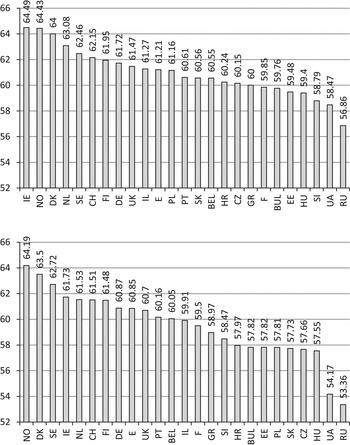
To begin with, Figure 2 provides an overview of mean desired retirement ages within the 25 countries under study, differentiating results for men and women. As Figure 2 shows, average desired retirement ages still lie below age 65, the politically envisioned age target by the European Union. Even when comparing individually desired retirement ages with nation- and gender-specific retirement regulations, desired retirement on average still lies below mandatory retirement ages in virtually all of the countries considered (with the only exception being women in the UK), suggesting that future retiree cohorts apparently still adhere to an ‘early retirement culture’. Furthermore, in virtually all of the countries, desired retirement ages of men are somewhat higher than that of women, with most pronounced gender differences in countries where also formal and early retirement ages differ between the sexes (such as Poland, Russia and the Ukraine, where women intend to retire on average three to four years earlier than men).
Mean desired retirement ages for men (top) and women (bottom) in European countries.

For both sexes, results furthermore point to considerable cross-national differences in desired retirement ages which largely are in line with the institutional classifications developed earlier in the paper. For both men and women, desired ages are highest in Scandinavian and Anglo-Saxon countries, followed by a mixed group of Central and Southern European countries. Lowest ages expectedly are observed among Eastern European countries, though notable cross-national variations exist among them. While they are especially low in Ukraine and Russia, values are more moderate for Central and Eastern European countries.
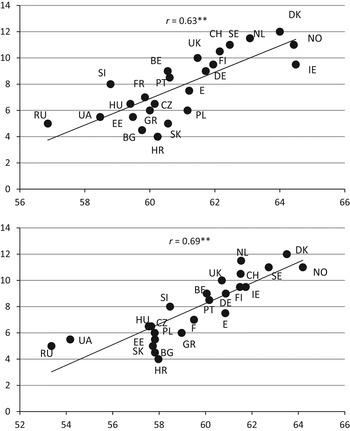
The picture of a strong correspondence between individual retirement preferences and nation-specific framework conditions is reinforced when directly contrasting desired retirement ages with the institutional index developed previously in this paper (Figure 3). There exists a strong association between retirement preferences and institutional backgrounds for both men (Pearson's r=0.63**) and women (Pearson's r=0.69**). This strong correlation does not only apply to the summary index, but also to the single sub-dimensions of retirement ages (r=0.77** for men and r=0.87** for women), ALMP (r=0.63** for men and r=0.70** for women) and participation in lifelong learning (r=0.55** for men and 0.63 for women). Only for unemployment rates does the relationship appear to be weaker, even though the direction of effects is in line with theoretical expectations (r=−0.34 for men and −0.42** for women; own calculations based on ESS data).Footnote 6
Mean desired retirement ages versus institutional support for continued employment, men (top) and women (bottom).

Taken together, the descriptive results confirm that the design of nation-specific institutions plays a key role for explaining international differences in desired retirement ages for both men and women. Furthermore, results suggest that it is not the isolated effect of one single institutional determinant but the mutual interplay between pull, push and stay factors – reflected in nation-specific ‘institutional packages’ – that can be held responsible for cross-national differences. Countries where both retirement incentives, a favourable economic climate and active employment support policies foster work continuation, are also among those countries where older workers intend to work longest and vice versa. In between these two poles, countries where institutional configurations produce ambiguous signals, e.g. by combining high retirement ages with modest or low employment support, consequently take an intermediate position.
Multivariate analysis: comparing retirement desires within institutional regimes
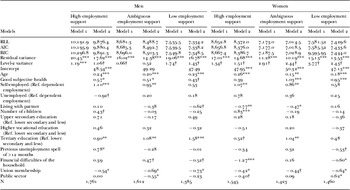
Following the investigation of cross-national differences in the preceding section, I now shall turn to the analysis of intra-national variations in retirement intentions, considering both organisational-level as well as individual-level characteristics. Since we expect that the effect of these determinants may vary across institutional regimes, the following analyses are split for the different institutional clusters identified earlier, i.e. (a) countries with ‘high employment support’, i.e. high retirement ages, low unemployment and well-developed employment-sustaining policies (Denmark, Finland, Sweden, Norway, Ireland, Switzerland, UK and the Netherlands; institutional index score ⩾9.5); (b) countries with ambiguous employment support (Germany, Belgium, France, Portugal, Spain, Slovenia, Hungary and the Czech Republic; institutional index score <9.5 and ⩾6.5); and (c) ‘low employment support’ countries with high unemployment, little employment support and consequently low (early) retirement ages (Estonia, Slovakia, Croatia, Ukraine, Russia, Bulgaria, Poland and Greece; institutional index score <6.5). Table 5 presents the results of separate linear regression models explaining desired retirement ages in these three different institutional regimes.
Multi-level linear regression on desired retirement age in 25 European countries

Notes: 2RLL: 2 Log Likelihood. AIC: Akaike Information Criterion. BIC: Bayesian Information Criterion. Ref.: reference category.
Source: European Social Survey, wave 5 (own calculations).
Significance levels: † α<0.1, * α<0.05, ** α<0.01, *** α<0.001.
Effects for control variables appear to be largely in line with expectations. As shown by earlier studies (e.g. Esser Reference Esser and Han2006), desired retirement age indeed increases with chronological age in all institutional regimes. Similarly, good subjective health increases the likelihood of retiring later.Footnote 7 Furthermore, as expected, self-employed workers tend to prefer later retirement. The only exception is the ‘low employment support’ countries of Eastern Europe, where entrepreneurial self-employment in general plays a rather marginal role. Living together with a partner tends to decrease the desired retirement age, especially for women, a finding well known from earlier research on coupled retirement. Finally, the presence of under-age dependent children in the household increases the desire to postpone retirement, especially in country contexts where institutional contexts provide comparatively favourable prospects for work continuation.
Turning to the major determinants at the individual level, regression results corroborate the significance of educational attainment for planning one's own retirement transition. In all three institutional regimes, it is highly qualified men that exhibit a preference for later retirement as compared to those with more basic qualification levels. Educational effects appear to be somewhat less pronounced for women, even though the direction of effects points to a similar direction. Potential explanations for this gender difference may be either the higher career orientation of men in the cohorts under study (i.e. born 1964 and before) which still predominantly act as main earners within their households and thus more likely show a higher work commitment at higher qualification levels. On the other hand, educational cleavages may be more pronounced due to the more polarised educational and occupational profiles among men.
Effects for previous unemployment spells reveal notable differences between the institutional regimes under study. In regimes with ‘high employment support’, previous unemployment experience of at least 12 months encourages men to postpone their retirement transition and accumulate forgone pension rights. In contrast, for women in countries with ‘low employment support’, previous unemployment experience in fact decreases desired retirement ages relative to those without such employment interruptions. These opposing effects may be regarded as a reflection of the labour market opportunities and constraints provided through the differential institutional frameworks: in the former group of countries, both the general economic cycle as well as ALMP promote work continuation up to (or even beyond) retirement ages, while the mere absence of early retirement opportunities promotes employment maintenance. Under these conditions, there thus exists both the opportunity as well as the necessity to make up for lacking pension contributions by prolonging one's employment career. In contrast, in countries with low employment support and high unemployment pressures, lack of opportunities for work continuation discourages workers with previous unemployment experience from work continuation. Considering the often low pension replacement rates in these countries, this trend towards a crowding out of those with previous employment interruptions from further employment may have detrimental consequences for their material wellbeing in old age. Observed gender differences in effects of unemployment point to a still asymmetric share of employment roles among the cohorts under study. While men – who are frequently still the main earners in their householdFootnote 8 – more likely are ready to prolong their employment careers in cases of opportunity, women more likely desire earlier retirement ages in cases of employment difficulties.
Effects for financial difficulties of the household confirm mechanisms of social exclusion in countries with low employment support. Findings for both men and women indicate that in these countries, it is especially those facing financial hardships that are expecting to withdraw earlier from employment, even though employment continuation may be required to ensure financial maintenance in old age. For women in systems with high employment support, a similar effect is found. However, in these countries with often more well-developed safety nets, it can be expected that national policies will be able to ‘cushion’ the premature exit from employment better than in the often only rudimentary welfare states of Eastern European ‘early exit’ countries.
Turning to organisational-level effects, results indicate that in all countries under study, union membership has a negative effect on desired retirement age. This result may be taken as an indication that – even within countries with comparatively lower coverage rates such as Anglo-Saxon or Eastern European countries – unions still are able to negotiate more favourable early exit opportunities for their members.
Notable cross-national variations can be observed with regard to the effect of public-sector employment on retirement preferences. While in countries with high or ambiguous employment support, public-sector employment actually decreases desired retirement age for men (ambiguous employment support regimes) and women (high employment support regimes), and it increases desired retirement age for women in countries with low employment support. In the former case, employment in the public sector may be related to access to institutionalised early retirement programmes. In contrast, in Eastern Europe, public-sector employment – which has traditionally been a stronghold for women in these countries – may provide better shelter against persistent labour market risks and thus promote plans for longer employment maintenance than under the more unstable circumstances in the private economy (Heyns Reference Heyns2005).
Conclusions
The aim of this paper has been to reconstruct the retirement preferences of men and women within European countries under the paradigmatic political shift from early retirement to active ageing. To this end, the paper reconstructed key developments in active ageing policies within European countries and systematically contrasted them with aggregate-level trends in desired retirement ages. Furthermore, regression analyses were conducted to identify whether under specific institutional conditions, there exist regime-specific problem groups of older workers that may find it difficult to adjust their employment and retirement planning to the emerging expectations of longer working life.
We found that older workers approaching retirement age still intend to retire before the politically envisioned age of 65, and in many cases also before nationally defined standard retirement ages. Thus, even though compared to the millennium turn, desired retirement ages have risen, individual retirement plans still continue to be oriented at the idea of withdrawing from employment before mandatory eligibility ages. Despite visible progress in implementing active ageing measures, the challenge of motivating older workers to continue working until or even beyond retirement age thus remains.
The close correspondence between desired retirement ages and nation-specific institutional patterns indicate that further institutional reforms may provide a viable strategy to promote later retirement intentions. Significant correlations between retirement desires and various types of institutional factors suggest that a multi-dimensional and co-ordinated approach will be required to sustainably promote retirement at later ages. Even though increases in formal retirement ages and the abolition of early retirement opportunities may play a central role in this respect, political reforms need to go beyond these measures. Economic incentives for work continuation need to be accompanied by policies that enable older workers to actually remain in the labour force up to these ages. Both the investment in human capital through the expansion of lifelong learning as well as active employment support through targeted labour market policies may be key measures in this respect. Furthermore, positive economic development proved to be a vital precondition for continued employment, given that high unemployment rates can discourage individuals from employment continuation. Policies promoting overall job growth thus inherently are policies for older workers as well.
Beyond these aggregate-level trends, there are regime-specific problem groups that face difficulties in adjusting to the active ageing paradigm of a longer working life. Especially in countries with little employment support, those with unstable work careers, employment interruptions and few financial resources are at a high risk of being crowded out from late career employment and thus from the possibility of ensuring a decent standard of living in old age. Especially in these countries, co-ordinated active ageing reforms thus are urgently required, not only to lift the overall low level of employment among older workers but also to reduce social inequalities among them.