The increasing prevalence of obesity and associated health risks is a concern in many societies. Nevertheless, relatively little is known about the atypical or disordered eating patterns that may be associated with overweight and obesity (Carter & Jansen, Reference Carter and Jansen2012; Tanofsky-Kraff & Yanovski, Reference Tanofsky-Kraff and Yanovski2004). Eating behaviours contributing to obesity appear to be heterogeneous, and many of them are not included among the criteria that define eating disorders in the Diagnostic and Statistical Manual of Mental Disorders (DSM-IV-TR; American Psychiatric Association [APA], 2000). Descriptions of atypical eating behaviours associated with overweight and obesity include ‘binge eating’ (e.g., Darby, Hay, Mond, Rodgers, & Owen, Reference Darby, Hay, Mond, Rodgers and Owen2007), ‘constant overeating’ (Mitchell, Devlin, de Zwaan, Crow, & Peterson, Reference Mitchell, Devlin, de Zwaan, Crow and Peterson2008), ‘hyperphagia’, ‘stuffing syndrome’ (Kornhaber, Reference Kornhaber1970), ‘nibbling’, ‘picking’ (Fairburn, Reference Fairburn2008), ‘grazing’ (Saunders, Reference Saunders2004), ‘between-meal snacking’ (O'Connor, Jones, Connor, McMillan, & Ferguson, Reference O'Connor, Jones, Conner, McMillan and Ferguson2008), ‘night eating’ (Colles, Dixon, & O'Brien, Reference Colles, Dixon and O'Brien2007), and a general ‘chaotic’ and unstructured eating style (Hagan, Whitworth, & Moss, Reference Hagan, Whitworth and Moss1999).
To date, binge eating has received the greatest amount of research attention among these overeating behaviours. The proposed diagnosis of Binge Eating Disorder (BED) in DSM-IV (APA, 2000) is defined by the presence of discrete binge-eating episodes that are characterised by an unusually large intake of food in a single sitting. These episodes are accompanied by a sense of a lack of control over eating, behavioural manifestations of a lack of control, and emotional distress. Excessive and inappropriate compensatory behaviours for the purpose of weight control are absent. Individuals engage in binge eating both in response to negative affect (Deaver, Miltenberger, Smyth, Meidinger, & Crosby, Reference Deaver, Miltenberger, Smyth, Meidinger and Crosby2003), and in response to the availability of food-related cues in the environment (Davis et al., Reference Davis, Levitan, Carter, Kaplan, Reid, Curtis, Patte and Kennedy2008). They report shape and weight concerns similar to individuals with other eating disorders (Goldschmidt et al., Reference Goldschmidt, Hilbert, Manwaring, Wilfley, Pike, Fairburn and Striegel-Moore2010). Binge-eating behaviour and BED are associated with overweight and obesity (Darby et al., Reference Darby, Hay, Mond, Rodgers and Owen2007). However, the majority of research studies concerning treatment for obese binge-eaters have found that treatments targeting only binge eating do not generally result in appreciable weight loss, despite a resolution of binge symptoms by the end of treatment (e.g., Grilo, Masheb, Wilson, Gueorguieva, & White, Reference Grilo, Masheb, Wilson, Gueorguieva and White2011). Such results indicate the presence of alternative overeating behaviours among obese binge-eaters that continue beyond the resolution of binge symptoms.
Consistent with this suggestion, it has been shown that individuals with BED are not always able to distinguish and report on distinct binge episodes; their eating behaviour often follows a pattern of continuous consumption (APA, 2000), or general ‘unstructured overeating’ instead (Cooper & Fairburn, Reference Cooper and Fairburn2003, p. S91). Binge episodes can also overlap with mealtimes and extend throughout the evening (Allison & Timmerman, Reference Allison and Timmerman2007), with individuals continuing to eat small amounts of food after planned meals. In other words, some individuals’ subjective reports of ‘binges’ do not meet formal DSM-IV criteria for a binge-eating episode, and represent long periods of unstructured, repetitive eating of small amounts of food instead. This highly understudied form of eating behaviour has been labelled ‘grazing’ and is currently gaining increasing research attention, particularly in the field of obesity treatment (Carter & Jansen, Reference Carter and Jansen2012; Saunders, Reference Saunders2004).
The majority of our current knowledge concerning the ‘grazing’ eating pattern has been derived from research concerning bariatric surgery in extreme obese populations. Both grazing and binge-eating behaviours have been documented in these populations pre-operatively (Saunders, Reference Saunders1999; Busetto et al., Reference Busetto, Segato, De Luca, De Marchi, Foletto, Vianello, Valeri, Favretti and Enzi2005). Binge-eaters lose less weight than others after surgery (Sallet et al., Reference Sallet, Sallet, Dixon, Collis, Pisani, Levy, Bonaldi and Cordas2007), and a post-operative shift towards a grazing-type eating pattern has been commonly observed among these individuals (Colles, Dixon, & O'Brien, Reference Colles, Dixon and O'Brien2008; Saunders, Reference Saunders2001). Indeed, up to 80% of bariatric patients report that they still experience a loss of control over their eating post-operatively, when objectively large binge episodes are no longer physically possible (Saunders, Reference Saunders2004). Such a shift towards ‘grazing’ following surgery has been shown to reduce post-operative success (Faria, Kelly, Faria, & Kiyomi, Reference Faria, Kelly, Faria and Kiyomi2009; Kofman, Lent, & Swencionis, Reference Kofman, Lent and Swencionis2010).
Taken together, the available literature suggests that grazing may represent a clinically significant form of overeating that is associated with binge eating, weight gain and reduced treatment success for obesity. Moreover, this eating pattern may not be limited to obese populations; healthy-weight students approaching examinations have also been shown to overeat in this manner to alleviate stress (Macht, Haupt, & Ellgring, Reference Macht, Haupt and Ellgring2005). Nevertheless, the precise extent of such inappropriate overeating behaviours in the wider community is largely unknown. One possible reason for such limited research attention to date may be our lack of ability to assess ‘grazing’ via a reliable and valid assessment tool. Only two measures of disordered eating are known to assess grazing-type behaviours, the interview-based Eating Disorder Examination (EDE; Fairburn, Reference Fairburn2008), and the Structured Interview for Anorexia and Bulimia Nervosa (SIAB; Fichter, Herpertz, Quadflieg, & Herpertz-Dahlmann, Reference Fichter, Herpertz, Quadflieg and Herpertz-Dahlmann1998; Fichter, & Quadflieg, Reference Fichter and Quadflieg1999). Both measures, however, merely incorporate single items to assess grazing. More recently, Carter and Jansen (Reference Carter and Jansen2012) have provided a self-report questionnaire aiming to identify eating behaviours that are important to consider when treating obesity. In spite of these authors’ proposal that grazing plays a significant role in obesity, their questionnaire also includes only a single item to assess grazing. In other words, no comprehensive, unique scale that is able to assess all known aspects of grazing behaviours currently exists.
‘Grazing’ has been described by several authors as repetitious, continuous and unplanned eating between mealtimes, where the amount of food at each intake may be small, but overall intake is relatively large (Saunders, Reference Saunders1999, Reference Saunders2004; Carter & Janson, Reference Carter and Jansen2012). It is differentiated from binge eating by its lack of discrete time limits, the relatively slow manner in which eating occurs, and the relatively small amounts of food at each intake. In addition, grazing is differentiated from planned snacking, a behaviour associated with positive outcomes (Fairburn, Reference Fairburn2008). Unlike planned snacking, and similar to binge eating, grazing may also involve the perception of a loss of control (Kofman et al., Reference Kofman, Lent and Swencionis2010; Saunders, Reference Saunders2004). However, some authors query whether a loss of control over eating is in fact present during grazing, given the small amounts of food consumed (Fairburn, Reference Fairburn2008). Others suggest that a loss of control may be a specifier within the ‘grazing’ category (Carter & Jansen, Reference Carter and Jansen2012).
To enable high quality research into this potentially important eating pattern, a psychometrically sound instrument of grazing, that takes account of all known aspects of this behaviour, is now needed. To that aim, the present study developed the Grazing Questionnaire and evaluated its initial psychometric properties. We sought to provide a comprehensive assessment of this eating behaviour, as previously described in the literature. Questionnaire items were designed to reflect unplanned, continuous and repetitive eating of small amounts of food through extended time periods, and sought to distinguish these behaviours from both binge eating and planned snacking. Items reflecting a perception of loss of control over eating were also included, in order to evaluate whether a loss of control is in fact associated with grazing behaviours. To complement research that has so far been conducted primarily in obese patients, our initial examination of grazing behaviours was conducted in a non-clinical population. This strategy allowed us to assess the extent of this behaviour in a healthy sample and provide a background against which further research in clinical populations can be carried out. In addition, we aimed to evaluate the association of grazing with other eating patterns related to weight gain, including binge eating, night eating and chaotic eating. Finally, we assessed whether grazing is similar to binge eating in its pattern of associations with negative emotion, eating triggers, weight and shape concerns, and BMI.
Method
Participants
A group of 248 undergraduate psychology students (73% women) took part in the study after volunteering via a standard university-based participant recruitment website. The mean age of the sample was 20.04 years (SD = 4.28; min = 18, max = 53), with no significant difference in age between men and women, t(246) = .24, p > .05. The majority of the participants reported being single (n = 148, 59.7 %) or in a dating relationship without living together (n = 85, 34.3%). Only 13 (5.2%) individuals reported to be in a live-in (married or de facto) relationship, and 2 (.8%) were divorced or separated. Among the 170 participants who provided information concerning their suburb of residence, 74 (43.5 %) reported residing in suburbs representing the highest socio economic status (SES), and 66 (38.8%) reported residing in suburbs representing the second highest. Only 19 participants (11.1%) reported living in suburbs representing the lowest SES quintiles (Adhikari, Reference Adhikari2006).
The participants’ relevant health characteristics were assessed by measuring height and weight and asking participants to report on factors that could influence weight status. Two women reported having a medical condition necessitating rigorously controlled diets. Their data were judged to be unsuitable for this study and are not included in the analyses. About one third of female participants (n = 56) reported taking oral contraceptives; this accounted for the majority of participants taking prescription medications in this sample (n = 66). In addition, 32 participants (12.9%, 26 women and 6 men) reported that they have previously sought help for eating or weight-related concerns.
The mean Body Mass Index (BMI) in this sample was 21.67, SD = 3.15; min = 15.67, max = 34.10. Men (M = 23.03, SD = 3.09) had significantly higher BMI than women (M = 21.17, SD = 3.03; t(246) = 4.27, p < .001). The majority of participants (n = 183, 73.8%) were classified in the healthy weight range (BMI = 18.5–24.9), but 31 (12.5%) participants were classified as underweight, 30 (12.1%) as overweight and 4 (1.6%) as obese. An equal percentage of men and women were classified in the healthy weight range (77.6 and 72.4%, respectively; χ2 = 0.69, df = 1, p > .05) and in the combined overweight/obese range (19.4 and 11.6%, respectively, χ2 = 2.51, df = 1, p > .05). However, relatively more women than men were underweight (16 and 3%, respectively, χ2 = 7.59, df = 1, p < .005).
A subset of participants (n = 62, 50 women and 12 men) completed the Grazing Questionnaire a second time, to test its temporal stability. Analyses of the differences between this subgroup and the rest of the sample found no significant differences in socioeconomic and health characteristics, with the exception that relatively more participants in the re-test group reported being single (χ2 = 6.50, df = 1, p < .01).
Materials
Sociodemographics and Health Status Questionnaire
Participants completed a questionnaire asking about their age, postcode for the purpose of calculating socioeconomic-status (SES), relationship status, and relevant health characteristics including pregnancy, specific medical conditions (e.g., liver and kidney disease), their usage of prescription medication, and their history of having sought help for eating or weight-related concerns.
Body Mass Index
Body Mass Index (BMI; weight[kg] /height [m2]) was calculated from objective height and weight measurements and categorised according to World Health Organization guidelines (WHO, 1998). According to WHO classifications, a BMI under 18.5 is ‘underweight’, a BMI between18.5 to 24.9 is within the healthy or ‘normal’ weight range, a BMI between 25 and 29.9 is ‘overweight’ and BMI greater than 30 is defined as ‘obese’.
Grazing
A brief Grazing Questionnaire (GQ) was developed by the authors for the current study. Eight new items were created to measure behaviours and cognitions specific to grazing. Five items were created to assess eating behaviours; for example, ‘Do you “graze” between meals (i.e., repeatedly eating small quantities of food)?’ or ‘Would you describe the way you generally eat as unplanned and repetitious (i.e., eating between planned meals and snacks?’ Three items pertaining to cognitions about loss of control over eating were also created; for example, ‘Do you have a feeling that you have lost control over your eating while “grazing?”’ Items were rated on a 5-point Likert-type rating scale, from Never (0) to All of the time (4). Scores are summed to form a total score (range: 0–32), where higher scores represent more grazing behaviours and cognitions. The items are presented in the Appendix.
Binge eating
Two measures of binge eating were used. The 16-item Binge Eating Scale (BES; Gormally, Black, Daston, & Rardin, Reference Gormally, Black, Daston and Rardin1982) was used to measure the extent and severity of binge eating tendencies. Items on this questionnaire are rated on either a 3- or 4-point scale, and summed into a continuous total score (range: 0–46). The BES has demonstrated adequate psychometric properties in female binge eating and obese treatment seeking samples (Freitas, Lopes, Appolinario, & Coutinho, Reference Freitas, Lopes, Appolinario and Coutinho2006; Timmerman, Reference Timmerman1999). In the current study, internal consistency estimate for the BES was high (Cronbach's α = .85). To measure symptoms that more closely correspond with the definition of Binge Eating Disorder in DSM-IV-TR (APA, 2000), the second measure of binge eating was a composite score (BED-EDDS), formed from nine items from the Eating Disorder Diagnostic Scale (EDDS; Stice, Telch, & Rizvi, Reference Stice, Telch and Rizvi2000). Participants rate items according to a dichotomous Yes/No response format, except for item 7, which asks for the number of days per week for the past 6 months in which overeating with a loss of control had occurred. The binge-eating composite score forms a continuous variable with total scores ranging between 0 and 15. Previous studies have reported on the favourable psychometric properties of the EDDS (Stice et al., Reference Stice, Telch and Rizvi2000; Stice, Fisher, & Martinez, Reference Stice, Fisher and Martinez2004). In the current study, internal consistency of the EDDS binge eating composite score was high (α = .77).
Night eating
The Night Eating Questionnaire (NEQ; Allison et al., Reference Allison, Lundgren, O'Reardon, Martino, Sarwer, Wadden and Stunkard2008) is a 14-item scale measuring the severity of symptoms associated with night eating; for example, morning anorexia (lack of eating or appetite in the morning), evening hyperphagia (overconsumption of a large percentage of daily calories at night), waking up to eat at night, and sleep and mood disturbances. Items are rated on a 4-point scale (range 0–52), with instructions to stop answering items as cut-off points are reached (at item 9 and item 12). Item 3 is reverse scored, and except for item 13 (which screens out sleep-related disorders), scores are summed to form a total continuous score. Higher scores indicate a greater propensity to engage in night eating behaviours. The validity of this measure has been previously demonstrated via its convergence with other measures of disordered eating, mood, and sleep (Allison et al., Reference Allison, Lundgren, O'Reardon, Martino, Sarwer, Wadden and Stunkard2008).
Chaotic eating
The Semistarvation-Associated Behaviors Scale (SSABS; Hagan et al., Reference Hagan, Shuman, Kimberley, Corcoran, Profitt, Blackburn and Birbaum2002) is a 49-item questionnaire initially intended to assess chaotic and unusual eating behaviours thought to be associated with the starvation syndrome; for example ‘Hoarding or hiding food’. It has subsequently been found that 18 items from this scale assess eating behaviours that differentiate between groups of binge-eaters from non-binge eating controls (Hagan et al., Reference Hagan, Shuman, Kimberley, Corcoran, Profitt, Blackburn and Birbaum2002). These 18 items (e.g., ‘Eating food disliked at any other time’) from the original SSABS were included in the present study to form the SSABS-composite score. Participants were asked to rate these items on a 6-point scale from 0 (Never engaged in the behaviour) to 5 (Always doing so). A total score was formed from summing individual items (range: 0–90). In the present study, the 18-item composite SSABS score had a high internal consistency (α = .78).
Eating triggers
The Dutch Eating Behaviour Questionnaire (DEBQ; Van Strien, Frijters, Bergers, & Defares, Reference Van Strien, Frijters, Bergers and Defares1986) is a 33-item measure of eating-related cues and triggers, with three subscales assessing Restrained Eating (DEBQ-R; 10 items), Emotional Eating (DEBQ-EM; 13 items), and External Eating (DEBQ-EX; 10-items). Participants rate items on a 5-point Likert-type scale from 1 (Never) to 5 (Very often), where higher scores represent a greater tendency to engage in restrained, emotional, or external eating. Scores for the Restrained Eating and External Eating subscales range from 10–50, and the range for the Emotional Eating subscale is 13–65. Internal consistency was excellent for all three subscales in the present study (DEBQ-R α = .93; DEBQ-EM α = .95; DEBQ-EX α = .86).
Shape and weight concerns
Two subscales from the Eating Disorders Inventory-3 (EDI-3; Garner, Reference Garner2004), a measure of eating disorder pathology, were used to measure shape and weight concerns. Shape concerns were measured with the 10-item Body Dissatisfaction (EDI-BD) subscale (e.g., ‘I think my hips are too big’), and weight concerns were assessed with the 7-item Drive for Thinness (EDI-DT) subscale (e.g., ‘I am preoccupied with the desire to be thinner’). Participants were asked to rate items on a 6-point scale, scored from 0 = Never or rarely to 4 = Always (range 0–68). Two of the lowest out of the six possible responses were coded 0, as per EDI-3 instructions (Garner, Reference Garner2004). Total scores are summed for each subscale, where higher scores represent greater shape and weight concerns. Excellent internal consistency was observed for both subscales (EDI-DT α = .91; EDI-BD α = .88) in the present study.
Negative emotion
The 21-item version of the Depression Anxiety Stress Scales (DASS-21; Lovibond & Lovibond, Reference Lovibond and Lovibond1995) is a brief self-report measure of depression, anxiety and stress symptoms experienced during the previous week. Participants rate emotional symptoms on a 4-point scale, where scores range from 0 (Did not apply to me at all) to 3 (Applied to me very much). Each scale includes 7 items, with total scores ranging from 0 to 21. The DASS has been shown to possess excellent psychometric properties (Antony, Bieling, Cox, Enns, & Swinson, Reference Antony, Bieling, Cox, Enns and Swinson1998; Brown, Korotitsch, Chorpita, & Barlow, Reference Brown, Korotitsch, Chorpita and Barlow1997; Lovibond & Lovibond, Reference Lovibond and Lovibond1995). Consistent with previous reports (Lovibond & Lovibond, Reference Lovibond and Lovibond1995), Cronbach's alpha scores were high in the current study for DASS Depression (α = .86), Anxiety (α = .74), and Stress (α = .82).
Procedure
The study protocol was approved by the relevant institutional ethics committee. Students volunteered for participation via an online recruitment system, and received course credit for participation. Data were collected in small groups of up to six participants at a time. Objective height and weight measurements were taken at the beginning of data collection. Participants were asked to stand on the scales without shoes and other weight-bearing items (coats, keys). Height was measured using a tape measure affixed to the wall. Following these measurements, participants completed a questionnaire package that included Background Demographics Information, Binge Eating Scale (BES), Grazing Questionnaire (GQ), Eating Disorder Diagnostic Scale (EDDS), Night Eating Questionnaire (NEQ), Semistarvation-Associated Behaviours Scale (SSABS), Dutch Eating Behavior Questionnaire (DEBQ), Eating Disorder Inventory (EDI) subscales, and the Depression Anxiety Stress Scales (DASS21), in this order. To calculate temporal stability, a subgroup of students (n = 74) was randomly selected and asked to complete the Grazing Questionnaire a second time, 7 days after initial data collection took place. Of this group, 62 individuals returned the completed questionnaires via email (83.8% response rate), between 7 and 62 days following the first data collection session.
Results
The construct validity of the new 8-item Grazing Questionnaire (GQ) was initially examined using exploratory factor analysis, which aimed to identify whether the newly developed items measure the same common underlying construct. To that aim, Fabrigar, Wegener, MacCallum, and Strahan (Reference Fabrigar, Wegener, MacCallum and Strahan1999) recommend the use of maximum likelihood procedures in data sets with multivariate normal distribution, and principal axis factoring in data sets where the assumption of multivariate normality is not met. In the current data set, Kolmogorov-Smirnov statistics indicated that the distribution of each of the eight items was non-normal (Kolmogorov-Smirnov statistics ranged from .20 to .29, all ps < .001). Therefore, the use of principal axis factoring was judged to be more appropriate in this sample.
The first step in these analyses was to determine whether the eight variables were in fact related to each other. An examination of the item intercorrelation matrix indicated that a majority of the correlation coefficients were greater than 0.30. The adequacy of the magnitude of these correlations was tested using Bartlett's Test of Sphericity and the Kaiser-Meyer-Olkin (KMO) statistic. Bartlett Test of Sphericity suggested that the sample correlation matrix differs significantly from the identity matrix, χ2(28, N = 248) = 618.26, p < .001, and a high KMO value of 0.85 indicated that there was probably a factor structure underlying these eight variables. While the results so far suggested that at least some of the variables may be useable in an exploratory factor analysis, it was noted that item 3 (‘Do you find yourself taking extra helpings or picking at extra food once you've finished your main meal?’) and item 6 (‘Have you ever felt compelled or driven to eat, even when not hungry?’) exhibited a pattern of relatively low associations with the other variables, and needed to be examined further.
The strength of the linear association among these eight variables was further explored by examining the communalities for this analysis. Inspection of the results suggested that items 3 and 6 had little variance explained either by all other variables (i.e., initial communality) or by the extracted factors (i.e., extraction communality). Both the initial and the extraction communalities were below the generally recommended cut-off of .30 for item 3, but the initial communality only was below this threshold for item 6. On the basis of this pattern of results, a decision was made to omit item 3 from the subsequent factor analysis, as this item exhibited little covariance with all other items and the underlying factors. However, considering that the development of this questionnaire was still in its initial stages, a conservative decision was made to retain item 6 for the present analyses.
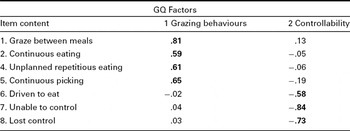
Following these initial considerations, a principal axis factoring procedure was carried out, involving the seven retained items. The number of factors with Eigenvalues over 1 and the scree plot was examined to extract the right number of factors needed to adequately describe the data. These indicators suggested the presence of two factors, with the first factor explaining 48.10% of the variance, and the second factor explaining an additional 16.40%, leading to a cumulative 64.50% of variance explained by the two factors. Direct Oblimin rotation was carried out, allowing the two factors to correlate. The rotated factor loadings for the seven items are presented in Table 1. A clear two-factor solution was obtained, with Factor 1 reflecting continuous, unplanned, and repetitive eating behaviours, and Factor 2 reflecting perceived control over eating. Items reflecting a lack of perceived control loaded negatively on this second underlying factor. The two factors were moderately negatively correlated (r = -.58, p <. 001). Repeating the same analyses while retaining all 8 items yielded highly similar results. However, item 3 showed a week factor loading of .27, further supporting the decision to omit this item from the Grazing Questionnaire.
Pattern Matrix for the Seven Grazing Questionnaire Items (N = 248)

Note: Extraction Method was Principal Axis Factoring with Oblimin Rotation (converged in 6 iterations). Significant loadings on each factor are printed in bold.
Reliability Estimates for the Grazing Questionnaire
The reliability of the newly constructed seven-item Grazing Questionnaire was explored via calculating a Cronbach's α coefficient to estimate internal consistency, and Pearson correlation coefficients to estimate temporal stability.
The Cronbach's α value of .82 indicated excellent internal consistency. To establish temporal stability, 62 participants completed the GQ the second time. Overall test–retest reliability of the seven-item GQ, that is, the association between GQ scores at two different time points, was .67 (p < .01). However, because there was a wide range in the time taken for participants to complete the Grazing Questionnaire the second time, further tests of the stability of GQ scores were carried out. A median split in participant response times indicated that half of the participants responded within 3 weeks of their original participation. A comparison of GQ scores between the ‘immediate’ group (those who completed the GQ a second time within 3 weeks), and the ‘late’ group (responses 3 weeks after original participation) indicated that there were no differences between the ‘immediate’ and ‘late’ groups on average GQ scores at time 1, t(60) = -.82, p > .05, or at time 2, t(60) = -.14, p > .05. Test–retest reliability for the ‘immediate’ group (r = .62, p < .01) and the ‘late’ group (r = .71, p < .01) was similarly strong, demonstrating that grazing, as measured by the Grazing Questionnaire, is a stable behaviour over a period of 7-62 days.
Associations Between Grazing and Other Eating Patterns
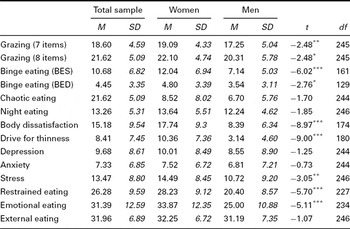
To further explore the nature of the construct underlying the Grazing Questionnaire, the association between grazing (as measured by the seven-item Grazing Questionnaire) and other forms of disordered eating patterns was explored, followed by analyses of the relationships between grazing and eating-related cognitions, emotions and eating triggers. Descriptive statistics for these measures for the total sample and for men and women separately are presented in Table 2, which shows that compared to men, women reported significantly higher level of binge eating, shape and weight concerns, stress, emotional eating and restrained eating.
Eating Patterns, Shape and Weight Concerns, Negative Emotions, and Eating Triggers in the Total Sample (N = 248), and in Women (n = 181) and Men (n = 67) Separately

Note: *p < .05, **p < .01, ***p < .001, two-tailed.
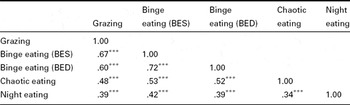
The results of correlational analyses involving the measures assessing grazing, binge eating, night eating and chaotic eating are presented in Table 3, which shows a pattern of significant positive intercorrelations among these measures. Grazing had an especially strong positive association with binge eating, but its relationships with the other variables were also substantial. When the analyses were repeated in groups of men and women separately, a nearly identical pattern of results was found. For example, a strong association between binge eating (BES) and grazing was clearly observable for both women (r = .67, p < .001, n = 171) and men (r = .70, p < .001, n = 66). Similar relationships between grazing and night eating were found for women and men (rs = .37 and .42, respectively, p < .001) and the relationship between grazing and chaotic eating was the same in both genders (rs = .48, p < .001).
Interrelationships Among Scores on the 7-item Grazing Questionnaire and Measures of Binge Eating, BED Symptoms, Chaotic Eating, and Night Eating

Note: ***p < .001, two-tailed.
In light of the strong relationship between grazing and binge eating scores, further correlational analyses were carried out involving items reflecting these behaviours only, to more specifically explore the nature of this relationship. For example, it is possible that the association between scores on the seven-item GQ and those on the BES partly reflected overlapping items in the two questionnaires. Specifically, in the BES, item 13 appear to describe grazing type-behaviours: ‘There are regular periods when I seem to be continually eating, with no planned meals.’ This item was removed from the BES, and a new BES total score (which excluded item 13) was calculated. The correlation between the BES and the 7-item GQ remained strong after the removal of this item (r = .66, p < .01).
A second analysis was performed to explore whether the relationship between binge eating and grazing scores could partly be a reflection of overlap in perceived loss of control, or alternatively, whether these eating behaviours themselves are associated with each other. To that aim, three items relating to loss of control were removed from the BES (items 3, 11, and 14), and from the seven-item GQ (items 6, 7, 8; i.e., factor 2). For example, item 3 from the BES stated: ‘Because I feel so helpless about controlling my eating I have become very desperate about trying to get in control’, and item 7 from the GQ asked: ‘Have you ever felt that you were unable to stop grazing?’ New total scores, excluding the loss of control items, were calculated for the BES and the GQ, resulting in a slightly lower correlation (r = .49, p < .01), which still remained significant and positive.
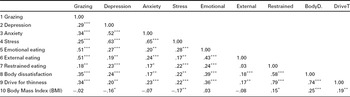
The final analyses in this study explored whether grazing, as assessed by the new Grazing Questionnaire, is associated with cognitions, emotions and behaviours previously shown to be relevant to other types of disordered eating. As shown in Table 4, positive relationships were found between scores on the 7-item Grazing Questionnaire and negative emotions, where the highest association was between grazing and anxiety. Grazing was also strongly and positively related to emotional eating and external eating, but it had a much smaller relationship with restraint. Finally, grazing had a positive association with shape and weight concerns, but no significant relationship with BMI. These analyses were repeated in groups of men and women separately. The pattern of correlations in the group of women was highly similar to that in the total sample. In men, however, only emotional eating (r = .55, p < .01), external eating (r = .56, p < .01) and anxiety (r = .37, p < .01) were significantly associated with grazing.
Interrelationship Among Grazing, Negative Affect, Eating Triggers, Eating-Related Cognitions, and BMI

Note: *p < .05, ** p < .01, *** p < .001, two tailed.
Discussion
The unplanned, repetitious, and uncontrolled eating of small amounts of food, or ‘grazing’, has been described in the literature as a potentially clinically important eating behaviour (Carter & Jansen, Reference Carter and Jansen2012; Colles et al., Reference Colles, Dixon and O'Brien2008; Saunders, Reference Saunders2004; Tanofsky-Kraff & Yanovski, Reference Tanofsky-Kraff and Yanovski2004). Nevertheless, a lack of a reliable and valid measure of grazing has hampered investigations of this eating behaviour to date. The central purpose of the present study was, therefore, to develop a self-report measure of grazing, and to provide initial data on its psychometric properties. Following descriptions of this eating behaviour in the existing literature (e.g., Saunders, Reference Saunders2004), eight questionnaire items were constructed to reflect unplanned, repetitious eating of small amounts of food, and an accompanying sense of a lack of control over this eating behaviour. In constructing these items, we aimed to differentiate ‘grazing’ from both binge eating, which is defined by both its time limited nature and the large amount of food consumed (APA, 2000), and from planned snacking, an eating behaviour usually associated with positive outcomes (Fairburn, Reference Fairburn2008).
The eight new items were subjected to exploratory factor analysis to examine whether participants’ responses to these items reflect one or more distinct underlying constructs. Our initial analyses indicated that item 3 (‘Do you find yourself taking extra helpings or picking at extra food once you've finished your main meal?’) and to a lesser extent, item 6 (‘Have you ever felt compelled or driven to eat, even when not hungry?’), exhibited a pattern of relatively low associations with the other variables and underlying constructs. Considering these results, the decision was made to omit item 3 from further analyses, but to retain item 6. The factor analysis involving the retained seven items yielded a clear two-factor solution. The first factor, a behavioural component relating to ‘Grazing’ itself, represents continuous eating behaviours, while the second factor reflects a cognitive appraisal component relating to perceived control over eating. Items relating to the perception of loss of control over eating had high negative loadings on this factor. The two factors had a moderately high negative association with each other, suggesting that higher levels of grazing behaviour are associated with lower levels of perceived control over eating.
The results obtained from our factor analyses contribute to the first formal, empirically supported definition of grazing as a continuous, repetitive and unplanned style of eating small amounts of food, accompanied by a perception of a lack of control over eating. Because eating while grazing appears less hurried or frenzied than it has been observed in binge eating, it has been suggested that grazing may not be accompanied by a sense of loss of control (Fairburn, Reference Fairburn2008). The present results show that grazing behaviour is in fact associated with a perception of loss of control over eating. Further, this perception is not only present in extreme obese patients opting for bariatric surgery (Colles et al., Reference Colles, Dixon and O'Brien2008; Kofman et al., Reference Kofman, Lent and Swencionis2010; Saunders, Reference Saunders2004), but it can also be observed in a healthy young adult sample of university students. Nevertheless, a two-factor solution underlying participants’ responses to the Grazing Questionnaire suggests that, at least in a young, normal-weight population, some individuals do engage in grazing behaviours without an accompanying sense of loss of control. Further research is now needed to explore the strength of association between grazing and loss of control in different populations. Such research needs to answer the question whether the Grazing Questionnaire would retain its two-factor structure in clinically obese samples as well, or alternatively, whether a one-factor structure would be found, indicating that grazing is more strongly associated with a sense of loss of control among the obese than among healthy-weight individuals. Answering this question may also be able to contribute to a better delineation of a loss of control as a potential indicator of a (perhaps more pathological) subcategory of grazing (Carter & Jansen, Reference Carter and Jansen2012).
A closer examination of the two items (items 3 and 6) that had relatively lower associations with the other items in our analyses may also further our understanding of the ‘grazing’ construct. Item 3 was developed to assess a tendency to continue eating food after a main meal, previously observed among binge-eaters (Raymond, Neumeyer, Warren, Lee, & Peterson, Reference Raymond, Neumeyer, Warren, Lee and Peterson2003; Allison & Timmerman, Reference Allison and Timmerman2007). This item was found to be less reflective of a specific underlying grazing construct compared to the other items, and was deleted from the Grazing Questionnaire. It is possible that this behaviour is more reflective of binge eating, or not being able to stop eating after having already consumed a large amount of food in one sitting. Future research aiming to cross-validate the present findings may further investigate whether this item, in its original or revised form, is in fact associated with the underlying Grazing factor. Similarly, although the decision was made to retain item 6 (‘Have you ever felt compelled or driven to eat, even when not hungry?’) in the present analyses, it may be important to further explore whether it is possible to increase its association with the underlying control factor. One possibility may be to reword the item to reflect the extent to which the respondents lack an ability to control the eating behaviour in spite of being ‘driven’ or ‘compelled’ to eat, rather than simply assessing the presence of these urges.
Further contributing to the definition of the grazing construct, the Grazing Questionnaire demonstrated high internal consistency, test–retest reliability and convergent validity. The high test–retest correlation coefficients suggested that grazing is a stable behaviour, and that the Grazing Questionnaire is able to assess such stability over time. The positive associations of scores on the Grazing Questionnaire with scores on measures of binge eating, night eating and chaotic eating further helped to define the grazing construct as reflecting a clinically important eating behaviour. Individuals who graze are also more likely to engage in other forms of disordered or atypical eating behaviours, and there is a particularly strong association between grazing and binge eating. The removal of the overlapping items between the Binge Eating Scale (Gormally et al., Reference Gormally, Black, Daston and Rardin1982) and the Grazing Questionnaire did not substantially alter the strength of the relationship between the two constructs, indicating that the relationship was not an artefact of overlapping items in the measures used to operationalise each construct. In other words, the tendency to graze is related to a tendency to binge eat, and the relationship is not accounted for by a sense of loss of control common to both eating behaviours. This study is therefore the first to empirically show that binge eating and grazing in fact represent related constructs.
The association between grazing and variables previously identified in theoretical models of binge eating and overeating (e.g., van Strien, Engels, van Leeuwe, & Snoek, Reference Van Strien, Engels, van Leeuwe and Snoek2005) was also examined. External eating and emotional eating, but not restrained eating, were found to be positively associated with grazing in both men and women. Previous studies have shown similar patterns of associations between emotional eating and external eating with BED in both genders (Burton, Smit, & Lightowler, Reference Burton, Smit and Lightowler2007; Davis et al., Reference Davis, Levitan, Carter, Kaplan, Reid, Curtis, Patte and Kennedy2008), and our study is the first to extend this relationship to grazing. Results indicate that, similar to binge eating (Deaver et al., Reference Deaver, Miltenberger, Smyth, Meidinger and Crosby2003), grazing may represent individuals’ attempts to regulate negative emotional states. Future research may explore whether such emotion regulatory responses may indeed play a role in both grazing and binge eating, and establish whether grazing is best seen as an alternative form of binge-eating.
Unlike in previous studies (Saunders, Reference Saunders1999), weight status in the current sample was not related to grazing behaviours. However, replicating this study in a more diverse sample may yield a different pattern of results and increase our understanding the relationship between weight status and grazing that has previously been detected in obese samples (e.g., Saunders, Reference Saunders2004). Such studies may also further explore the potential relationship between ‘grazing’ patterns and weight or shape concerns, which were relatively low in the present, predominantly healthy-weight, young sample.
Summary and Directions for Future Research
The principal aim of this study was to construct a new self-report measure of ‘grazing’ and evaluate its initial psychometric properties. Taken together, the results provided initial evidence for the favourable psychometric properties of the Grazing Questionnaire and contributed to the first empirically derived operational definition of grazing that includes both unplanned, repetitive eating of small amounts of food and a sense of loss of control over eating. At the same time, it is also important to acknowledge that the homogenous nature of the present sample may limit the generalisability of our findings. Participants in the present study were predominantly healthy, young, educated individuals representing high socioeconomic backgrounds. Further research concerning the prevalence of the ‘grazing’ pattern of eating in the wider community, in individuals with binge-eating difficulties, and in overweight and obese populations is now needed. In addition to the need for establishing the generalisability of our findings to other populations, future research may now follow on the promising results from the present study by further developing the Grazing Questionnaire and by exploring the nature, causes and effects of the grazing pattern of eating in more detail. Improvements to items 3 and 6 via refinement of their wording, as well as adding new items based on expert or participant feedback on the item content of the Grazing Questionnaire may be promising avenues for future research. Examining whether scores on the Grazing Questionnaire predict subsequent weight gain or response to treatments would be an important step in evaluating the importance of grazing in obesity and its treatment. In the meantime, our current results provide the first empirical description of a potentially important eating pattern, and the only psychometrically sound self-report measure available to assess it.
Appendix
THE GRAZING QUESTIONNAIRE
Please circle the number that best describes you.
0 — Never
1 — Rarely
2 — Sometimes
3 — Most of the time
4 — All of the time