Introduction
Cash transfers have been increasingly adopted by low- and middle-income countries as central elements of their poverty reduction and social protection strategies (Barrientos, Reference Barrientos2013; Hanlon et al., Reference Hanlon, Barrientos and Hulme2010; Honorati et al., Reference Honorati, Gentilini and Yemtsov2015; ILO, 2014). This expansion has been accompanied by a growing number of evaluations, resulting in an expanding body of evidence on the effects of different policies and programmes.
This article presents the results of a systematic literature review of the empirical evidence on the impact of cash transfers on individuals and households covering 15 years of literature (2000 to 2015) for low- and middle-income countries. Its interventions of focus are non-contributory monetary transfers, including conditional and unconditional cash transfers, social pensions and enterprise grants. The primary objectives of the review were to retrieve, assess and synthesise the evidence on the impacts, intended and unintended, of cash transfers on individuals and households, paying particular attention to the role of transfer design and implementation features.Footnote 1 Compared with existing reviews on cash transfers, this review displays some key distinguishing features in terms of methods, breadth of the evidence covered, and focus on the role of programme design and implementation features.
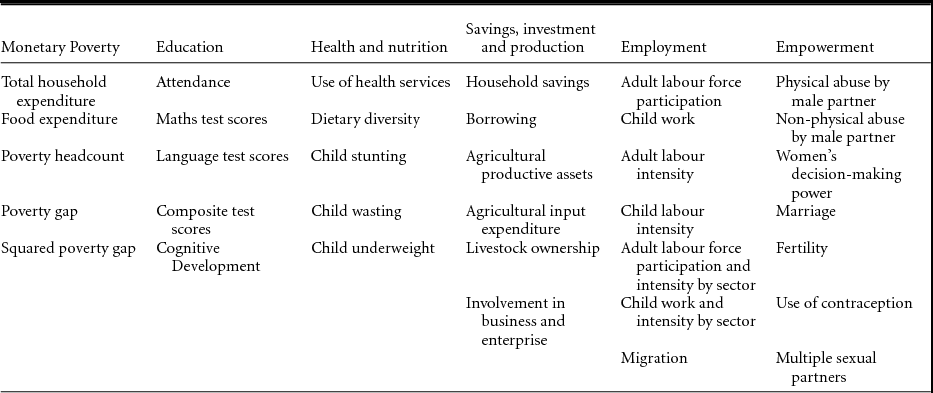
In terms of the evidence reviewed, the six outcome areas covered by the study are: monetary poverty; education; health and nutrition; savings, investment and production; work; and empowerment. For each outcome, five to seven indicators were identified on the basis of their policy relevance, coverage in the literature and prevalence of sex-disaggregated results (Table 1).Footnote 2
The six outcomes and selected indicator areas under review

The article is structured as follows. The following section provides an overview of the methodological approach adopted. The article then discusses the evidence base from which information was extracted and synthesised. The next section reports the findings by outcome and indicator. Given word count limitations, the focus is on the overall impact of cash transfers on the selected indicators, not on the role of programme design and implementation features. The final section concludes.
Methods
This article draws from a literature review that complied with core systematic review principles – breadth, rigour and transparency – while allowing for a more flexible handling of retrieval and analysis with the objective of ensuring comprehensiveness and relevance.
The methodological approach was written up in protocol form, reviewed by cash transfer and information specialists, and tested prior to being revised and published, as is standard regular practice in systematic reviews, to promote rigour, transparency and replicability (Waddington et al., Reference Waddington, White, Snilstveit, Garcia Hombrados, Vojtkova, Davies, Bhavsar, Eyers, Perez Koehlmoos, Petticrew, Valentine and Tugwell2012). The protocol includes detailed information on the study's research questions, inclusion and exclusion criteria and literature search methods. It is publicly available in Annex 2 of the full report (Bastagli et al., Reference Bastagli, Hagen-Zanker, Harman, Barca, Sturge, Schmidt and Pellerano2016).
The literature searches were conducted in mid-2015. The inclusion criteria applied in the first instance were set as follows:
– Interventions: cash transfers paid to individuals or households by the State or non-governmental organisation, defined as non-contributory or social assistance transfers, funded out of general taxation or by donors, including conditional cash transfers, unconditional cash transfers, social pensions and enterprise grants (contributory social security transfers, social funds and public works programmes were not included).
– Type of study: original analysis using primary or secondary data, using either counterfactual analysis (experimental or quasi-experimental methods) or descriptive analysis investigating links between cash transfer design and implementation features and the outcomes of interest. Both peer-reviewed and grey literature were considered with the view of minimising publication bias, as non-significant or negative findings are less likely to be published in academic journals (Waddington et al., Reference Waddington, White, Snilstveit, Garcia Hombrados, Vojtkova, Davies, Bhavsar, Eyers, Perez Koehlmoos, Petticrew, Valentine and Tugwell2012).
– Year of publication: 2000–2015.
– Language of publication: English.
– Geographic and population coverage: low- and middle-income countries as defined by the World Bank in 2015. The study's focus on individual- and household-level outcomes means the review excluded studies only reporting community- or country-level outcomes.
– Outcomes: monetary poverty, education, health and nutrition, savings, investment and production, work and empowerment.
– Cash transfer design and implementation features: core design features; conditionality; targeting; payment mechanism; grievance mechanism and programme governance; complementary interventions and supply-side services.
Four distinct literature search tracks were used: (1) bibliographic databases, (2) other electronic sources (i.e. websites and search engines), (3) expert recommendations, (4) past reviews and snowballing. Separate searches were carried out for the six outcomes of interest and the six cash transfer design and implementation features.
More than 38,000 studies were retrieved at the initial search stage. Studies were additionally screened to test whether they met the inclusion criteria, followed by a screening of relevant studies by research team members at the study abstract and full-text level. At this initial screening stage, 50 studies were double-screened and discrepancies were discussed, in order to reduce subjectivity.
Over 610 studies met the initial inclusion criteria and underwent a second-stage screening that considered the methodological rigour or ‘quality’ of each study. Two assessment tools were developed, one for quantitative counterfactual studies, the second for the qualitative descriptive studies.Footnote 3 For quantitative studies, the assessment tool builds on the definitions and tools in Higgins et al. (Reference Higgins, Altman, Gotzsche, Juni, Moher, Oxman, Savović, Schulz, Weeks and Sterne2011), Hombrados and Waddington (Reference Hombrados and Waddington2012) and Yoong et al. (Reference Yoong, Rabinovich and Diepeveen2012). It identifies four sets of issues against which the methodological approaches of studies are assessed: (1) selection bias and confounding factors (e.g. whether information was presented on comparison and treated group equivalence and what means were used to control for selection bias); (2) attrition bias (e.g. what attempts were made to determine the effects of attrition on outcomes? Was any non-random attrition in the sample a threat to validity?); (3) statistical significance (e.g. issues of unit of analysis errors, sufficiently large sample size and any heterogeneity or heteroscedasticity accounted for); and (4) ‘other bias’ (e.g. performance bias, detection bias, outcome reporting bias). For qualitative studies, building on DFID (2014) and Spencer et al. (Reference Spencer, Ritchie, Lewis and Dillon2003), the assessment tool considers: clarity and transparency of the approach; credibility of findings; acknowledgement of potential internal bias or limitations; external validity.
The assessment tools were used to make a judgment over whether a study employing counterfactual analysis demonstrates ‘high risk’ or ‘low risk’ of bias for each of the four domains identified and whether a qualitative study displayed ‘no concerns’, ‘some concerns’ or ‘major concerns’. The studies that showed ‘no concerns’ or ‘low risk’ in terms of risk of bias and methodological rigour were included in the review.
The final 201 studies that passed the search, retrieval and assessment stages are listed in an Annotated Bibliography (Harman et al., Reference Harman, Bastagli, Hagen-Zanker, Sturge and Barca2016), containing detailed information on each entry, including the intervention analysed, methods used and outcomes covered. It is available as online supplementary material to this paper.Footnote 4
For each outcome, evidence was extracted and synthesised for five to seven indicators (Table 1). For studies relying on quantitative counterfactual analysis, the magnitude, sign and statistical significance of coefficients measuring the effects of cash transfers and of variations in their design features on individual- and household-level outcomes were extracted, at the highest level of aggregation reported. Indicators covered include first-order, second-order and third-order outcomes. First-order outcomes are understood to capture effects triggered as a direct consequence of receiving a cash transfer. Second-order, or intermediate, outcomes broadly refer to those behaviours and actions that may be influenced by cash transfer participation (e.g. school attendance, work participation). Third-order outcomes capture measures that commonly manifest themselves in the medium to long term (e.g. learning/test scores, health status).
Descriptive evidence of links between variations in cash transfer design and implementation features and the outcome indicators under review was also extracted, where available. Due to word count restrictions, these are not reported in detail here, although findings are included in the concluding discussion.
In synthesising the evidence, the review used both a vote counting and narrative synthesis approach. The vote counting approach reports the number of studies showing an increase/decrease in a specific indicator. For quantitative counterfactual analyses, regression coefficients and statistical significance were systematically extracted and used to conduct an unweighted vote count, providing an indication of the size and strength of the evidence available for each indicator. The review also used a narrative synthesis approach, including examples of the ranges and magnitudes of effects and discussion of results that are not statistically significant.
Limitations of the review
The review has two main limitations. The first is linked to the inclusion criteria which, by definition, determine that some sources of potentially relevant evidence are excluded from the review. While for most criteria, the review made a special effort to ensure that the coverage of the evidence base was as comprehensive as possible, for others this was not possible given the available resources. For example, the review only considered studies in the English language. This means that studies published in languages such as Spanish and Portuguese, whose numbers are growing with the expansion of cash transfers across Spanish- and Portuguese-speaking countries, are not captured by the present review, potentially affecting its findings.
The second main limitation concerns the approach adopted in the synthesis of the evidence, outlined above. As a result of the high number of outcomes and related indicators covered, it was not possible to implement a meta-analysis approach. The vote-counting approach adopted is a valuable tool in summarising the results of a review with the breadth of indicators covered here. However, it has its limitations (Waddington et al., Reference Waddington, White, Snilstveit, Garcia Hombrados, Vojtkova, Davies, Bhavsar, Eyers, Perez Koehlmoos, Petticrew, Valentine and Tugwell2012). It typically does not take study sample sizes or magnitude of effects into account. Moreover, the nature of underlying programmes, for instance whether they are local pilots or nationally implemented government programmes, may not be considered. To address these shortcomings, we complement the vote count with a narrative synthesis of findings which provides examples and ranges of the size of effects and adds details about the underlying policy to the vote count exercise.
The evidence base
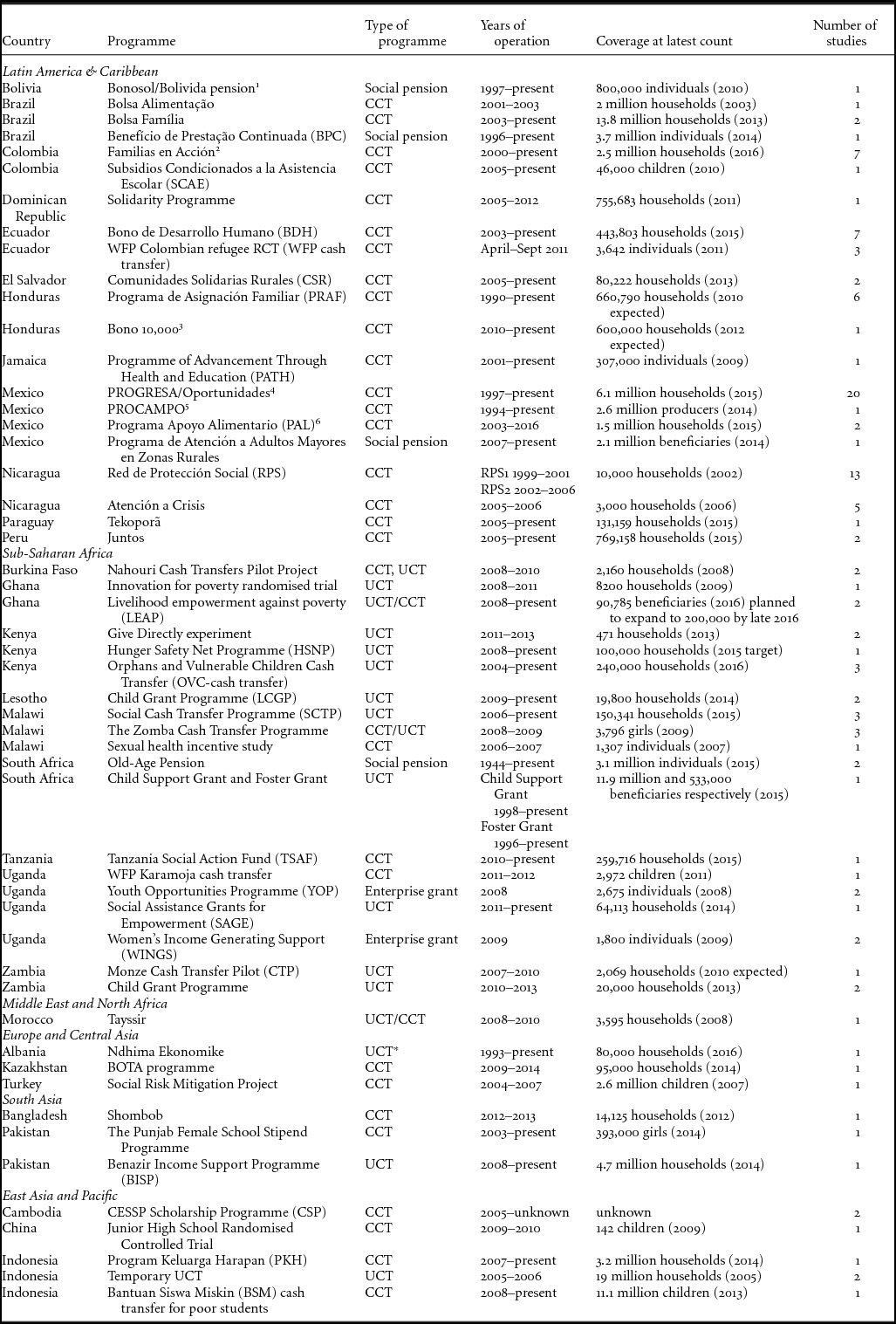
Information on the underlying studies, particularly on geographic coverage and types of cash transfer programmes covered, sets the context against which the findings need to be understood (see Table 2). In total, 165 studies met both the inclusion and quality assessment criteria and reported on the specific indicators considered. Of these, 114 reported on overall impact of cash transfers relative to a counterfactual for non-beneficiaries. These were the studies included in the evidence extraction stage, ranging from 44 studies for ‘work’ and 44 studies on ‘monetary poverty’, to 27 on ‘empowerment’ and 24 studies for ‘savings, investment and production’.
Cash transfer programmes covered and number of studies from which evidence was extracted

1The programme is now called Renta Dignidad and the latest coverage figure given is for this programme.
2The programme is now called Más Familias en Acción.
3The programme is now called Bono vida Mejor.
4The programme is now called Prospera.
5The programme is now called PROAGRO.
6Merged in 2016 with PROSPERA.
The majority of these studies focused on cash transfer programmes in Latin America (61 per cent). Around 29 per cent of the studies focused on a programme in sub-Saharan Africa, with studies looking at East Asia and the Pacific, Europe and Central Asia, and the Middle East and North Africa accounting for around 11 per cent.
In total, evidence on 52 different cash transfer programmes is analysed here, with some studies analysing more than one programme. The majority of interventions covered are conditional cash transfers (CCTs) (55 per cent), mostly located in Latin America. Twenty-five per cent of the programmes are unconditional cash transfers (UCTs), mostly implemented in sub-Saharan Africa. Of the remaining programmes, 9 per cent involve a combination of CCTs and UCTs, 7 per cent are social pensions and 4 per cent are enterprise grants (Table 2).
Within these broad groupings, it is worth highlighting the range of programmes covered in terms of programme objectives, transfer levels and coverage. The review draws on studies of programmes which range from Uganda's WINGS cash transfer, which targeted 1,800 individuals in 120 war-affected villages with the aim of supporting them to start small retail and trading enterprises, to national programmes such as Brazil's Bolsa Familia, reaching over 26 per cent of Brazil's population (around 55 million people) with the objective of providing a minimum income to low-income households while promoting education and health service use, and to Mexico's Adultos Mayores social pension, providing support to individuals aged 70 and over, covering 2.1 million beneficiaries across Mexico.
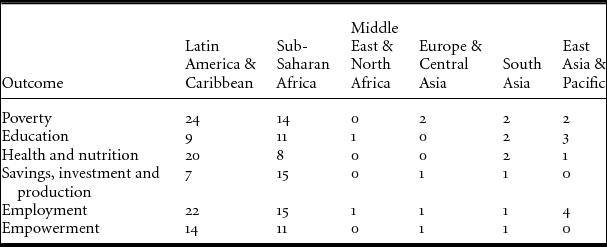
Finally, we note that the distribution of studies by geographical region differs by outcome area (see Table 3). There are examples of studies, included in the review, that evaluate the same programme(s) and report on the same indicator. This is taken into account in the review of the evidence, and cautions against making generalisations based on simply counting the number of studies with significant results for a given indicator, without considering that geographical clustering could be producing the appearance of a trend.
Number of studies from which evidence on cash transfer impact was extracted by broad outcome area and geographical region of the intervention being studied

Note: These figures should be read by outcome. They do not add up to the total absolute number of studies by geographic region as some studies reported results for more than one outcome area.
The impact of cash transfers
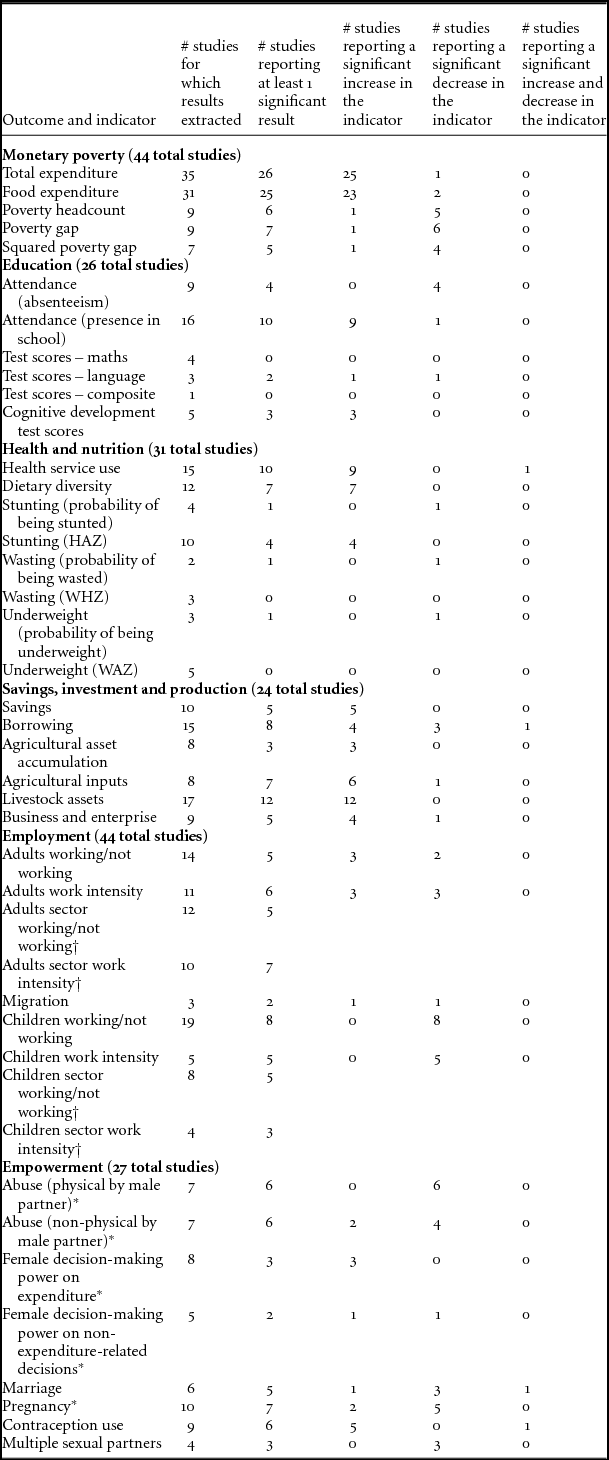
The following sub-sections report the findings arising from the vote counting and narrative synthesis analysis by outcome. For each outcome and indicator, we discuss the number of studies available and direction of cash transfer effects by indicator; as well as examples of the ranges of such effects and descriptive evidence of the ways in which design and implementation features may be driving such results. The results of the vote counting analysis are summarised in Table 4, providing an indication of the size and strength of the evidence available for each outcome and indicator.
Number of studies from which evidence was extracted by outcome, statistical significance and direction of the results reported

Note: This table reports the number of studies for which evidence was extracted at the most aggregate level reported by the study. Some studies consider more than one programme, but results are reported by study, not by programme. The number of studies on indicators by outcome area does not always match the sum of studies on specific indicators, as some studies cover more than one indicator.
The number of studies that do not report a statistically significant result is given by the number of studies from which evidence was extracted, minus the number of studies for which at least one significant result was found.
† The analysis of sector of employment cannot be considered in terms of increases or decreases in the indicator, as studies consider a number of different sectors which are mostly not comparable across studies. The narrative synthesis below describes specific findings by study.
*These indicators capture outcomes for women and girls only.
Monetary poverty
The evidence is consistent across all three sets of indicators covered in this outcome, indicating that cash transfer receipt mostly leads to an increase in total expenditure and food expenditure and a decrease in the Foster-Greer-Thorbecke (FGT) poverty measures. Thirty-five studies reported findings on total expenditure, with 26 of these studies demonstrating at least one significant impact. All but one of these studies (25/26) find an increase in total expenditure. The increases range from a 2.8 percentage point change in total per capita expenditure for Colombia's Atencion a Crisis, a temporary pilot programme (Macours et al., Reference Macours, Schady and Vakis2012), to a 33 percentage point change in total expenditure for Peru's Juntos – a CCT with poverty-reduction objectives (Perova and Vakis, Reference Perova and Vakis2012). One study considering Albania's Ndhima Ekonomike, a poverty-targeted transfer, found a significant reduction in total per capita household expenditure, due to a drop in labour supply of beneficiaries (Dabalen et al., Reference Dabalen, Kilic and Wane2008). Studies that do not find any statistically significant effect on total expenditure point to design and implementation features as potential explanations, including low level of transfer and delays in disbursement, as well as related changes in household behaviour.
Among the 31 studies reporting on impacts on food expenditure, 25 studies show at least one statistically significant effect, with 23 of these being an increase in food expenditure. Two studies report a decrease owing to a reduction in labour supply and possible prioritisation of savings over consumption (Dabalen et al., Reference Dabalen, Kilic and Wane2008; Ribas et al., Reference Ribas, Soares, Teixeira, Silva and Hirata2010). Six studies find no significant impact, possibly due to changes in household behaviour or due to programme design and implementation features. To take just one example, Cheema et al. (Reference Cheema, Farhat, Hunt, Javeed, Pellerano and O'Leary2014) relate the lack of impact of Pakistan's BISP on food expenditure to the irregularity of transfer payment.
A high number of studies reporting on total expenditure and food expenditure are on Mexico's PROGRESA (7 studies) and Nicaragua's RPS (6 studies) and in almost all cases these find significant and positive impacts. This could lead to concerns that these countries are driving the trend. However, the impacts observed in studies from other regions, notably Sub-Saharan Africa, are in the same direction and we do not observe patterns in any of them that contradict the trend emerging from the region with most studies.
Nine studies consider cash transfer impacts on FGT poverty measures (poverty headcount, poverty gap, squared poverty gap). Among these studies, around two-thirds find a statistically significant result. While cash transfers were shown to mostly increase total and food expenditure, it appears that in some cases this impact is not large enough to have a subsequent effect on aggregate poverty levels. With the exception of the study on Albania's Ndhima Ekonomike programme, studies reporting statistically significant effects found reductions in poverty. Findings on the reduction of the poverty headcount range from a reduction of about four percentage points for Zambia's unconditional Child Grant (AIR, 2014) to almost nine percentage points for PROGRESA (Skoufias et al., Reference Skoufias, Unar and Gonzalez de Cossio2013). The poverty gap impact ranges from a reduction of around four percentage points for PROGRESA (Skoufias and Di Maro, Reference Skoufias and Di Maro2008) to about eight percentage points for Zambia's Child Grant (AIR, 2014), showing a reduction in poverty levels for poor households.
Education
Overall, there is a sizeable and consistent evidence base on the links between cash transfer receipt and school attendance. A smaller number of studies and less clear-cut pattern of impact was found for learning outcomes (as measured by test scores) and cognitive development outcomes (information processing ability, intelligence, reasoning, language development and memory).
A total of 20 studies reported on the overall effect on school attendance, of which 13 reported a significant effect. The direction of effect is mostly in accordance with policy objectives: an increase in school attendance and a decrease in school absenteeism. Of the studies reporting on a measure of school absenteeism all significant effects were negative; for all but one study reporting on a measure of attendance, all of the significant impacts were positive. For Uganda, Merttens et al. (Reference Merttens, Pellerano, O'Leary, Sindou, Attah, Jones and Martin2015) find a negative impact on the share of children in SAGE beneficiary households currently attending formal education after one year of the programme. One explanation put forward by the authors is that the need for the child to help at home was a reason for keeping children out of school, more so than the ability to pay for schooling. Seven studies found non-significant impacts on school attendance measures. Examples of possible reasons for these results (provided by the authors) generally refer to design and implementation features, such as small transfer size, and contextual factors, such as high baseline attendance rates.
Five studies examined overall effects on learning, as measured through test scores in maths, language or a composite test score, and the majority of the studies find no statistically significant impact. Four studies reported overall impacts on maths, three studies reported on language test scores, and one on a composite score. Two studies found a statistically significant effect, both of these referred to language test scores, one being an improvement (Akresh et al., Reference Akresh, de Walque and Kazianga2013) for the Nahouri Cash Transfers Pilot Project in Burkina Faso and one a decrease for Colombia's Familias en Accion (Baez and Camacho, Reference Baez and Camacho2011). Five studies provided an overall effect estimate of cash transfers on cognitive development scores. Of these, three studies found a statistically significant positive effect. The smaller evidence base available on these third-order outcomes is partly due to the causal mechanisms underpinning these outcome areas, which are affected by a variety of mediating factors (e.g. children's nutrition, rearing practices, parents’ human capital, quality of service delivery, etc.).
For education, geographical coverage of studies is diverse. Latin-American studies do not drive findings for this outcome area and impacts in the intended direction are found for both Latin-American and African studies.
Health and nutrition
The available evidence for all three health indicator areas – use of health services, dietary diversity and child anthropometric measures – is largely consistent in the direction of effects, showing improvements in the indicators. It highlights how cash transfers are mostly associated with increased use of health services and improved dietary diversity; both second-order outcomes. The evidence also underscores how variations in cash transfer design or implementation features, including investment in supply services and complementary actions, e.g. nutritional supplements or behavioural change training, may be required to achieve greater and more consistent impacts on child anthropometric measures, a third-order outcome. This is reflected in the greater proportion of significant results found relating to health service use and dietary diversity and a lower proportion for anthropometric measures.
The evidence consistently shows that cash transfers lead to increases in use of health facilities. Of the 15 studies reporting cash transfer effects in this area, nine report statistically significant increases, ranging from an additional 0.28 of a preventative visit in Jamaica's PATH programme (Levy and Ohls, Reference Levy and Ohls2007) to an extra 2.3 general health visits in Tanzania's Social Action Fund (Evans et al., Reference Evans, Hauslade, Kosec and Reese2014). Programmes with no significant impacts suffered from implementation problems (e.g. disbursement delays, communication failures), as well as supply-side constraints.
Findings also consistently show increases for dietary diversity. Among the 12 studies reporting on impacts on dietary diversity, seven show statistically significant changes across a range of dietary diversity measures, all being improvements. Statistically non-significant findings are explained by implementation problems and contextual factors (e.g. limited availability of diversified foods) among other reasons. Evidence of statistically significant changes in child anthropometric outcomes is limited to just five out of 13 studies for stunting, one out of five for wasting and one out of eight for being underweight. All significant overall changes were improvements, with the evidence base strongest for stunting.
For health and nutrition there are considerably more studies focusing on Latin-American countries, compared with other regions, and this should be taken into account when considering the results synthesised above. Again, however, for indicators with evidence available from different regions, the overall results in terms of statistical significance of effects and direction of effects is consistent across regions. In the case of stunting, the two studies reporting statistically significant effects (reductions) in stunting are both on CCTs in Latin American countries, Nicaragua and Mexico. All other studies reporting results on stunting, including from Latin America, Sub-Saharan Africa and South Asia, consistently report statistically non-significant effects.
Savings, investment and production
The evidence on the impact of cash transfers on savings, investment and production mostly confirms the argument that receiving a guaranteed and predictable source of income can help households lift liquidity, savings and credit constraints, enabling investments.Footnote 5 Overall, impacts on livestock ownership/purchase, and purchase/use of agricultural inputs, and savings were consistent in their direction of effect, with almost all statistically significant findings highlighting positive effects of cash transfers, though not universal to all programmes, or to all types of livestock and inputs. Impacts on borrowing, agricultural productive assets and business/enterprise were less clear-cut or had a smaller evidence base.
Of the 10 studies that examined the overall effect of cash transfers on household savings, half found statistically significant increases in the share of households reporting savings (ranging from 7 to 24 percentage points) or the amount of savings accumulated. Evidence showed that households could afford to marginally increase their precautionary savings because of increased income and, in some cases, increased access to formal and informal financial institutions. However, no impact was found for five studies, with explanations given by authors pointing to design (e.g. low transfer level) and implementation (e.g. beneficiaries for the BOTA transfer in Kazakhstan were told to withdraw their transfer immediately upon receipt). Impacts on the selected borrowing indicators were mixed, as households either used the cash to increase their access to credit or to pay off existing debt. Overall, of the 15 studies considering this, four report significant increases in the share of households in debt or borrowing and/or on total amount of debt, three report significant reductions, one reports mixed findings (Handa et al., Reference Handa, Park, Darko, Osei-Akoto, Davis and Daidone2014) and the remaining seven studies find no significant impacts. The authors explain that, in the case of non-significant findings, low transfer size and irregularities in transfer payments may partly explain the results.
Of the eight studies reporting on relevant indicators to households’ accumulation of agricultural productive assets for crop production, three find a positive and significant impact on a wide variety of indicators with impacts ranging from three to 32 percentage points depending on the asset and programme and the remaining five studies find no significant impacts. Lack of impact was explained in several ways, including behaviour influenced by strong programme labelling (money was to be spent for children) and low value or unpredictability of the transfer.
Of the eight studies reporting on agricultural inputs for crop production, six report a significant increase in expenditure or use (with impacts ranging from 4 to 18 percentage points depending on the input and programme), primarily for fertiliser and seeds, while one reports a significant, but small, decrease for Kenya's cash transfer-OVC (Orphans and Vulnerable Children) on the use of pesticides and on seed expenditure, partly explained by the authors as a result of the low value of the transfer, which was eroded over time (Asfaw et al., Reference Asfaw, Davis, Josh, Handa and Winters2014). Of 17 studies that assessed indicators on livestock ownership and value, 12 report some form of increase (with impacts ranging from one to 59 percentage points depending on livestock type and programme), with the remaining five reporting non-significant impacts. Impacts were particularly concentrated on smaller livestock such as goats and chickens.
Impacts on business and enterprise were mixed, and more difficult to interpret than others reported for this outcome area, because of the range of indicators adopted in different studies. Of the nine studies reporting any indicator for this specific outcome area, four found significant increases in the share of households involved in non-farm enterprise or in the total expenditure on business-related assets and stocks, while one found a significant decrease for Mexico's PROCAMPO (Davis et al., Reference Davis, Handa, Ruiz Arranz, Stampini and Winters2002).
With regards to the geographic spread of the evidence, this is the one outcome area for which the majority of studies focus on Sub-Saharan Africa (15), followed by Latin America (7). Across all six of the indicators covered here the results are thus largely driven by evidence from Sub-Saharan Africa. No region-specific patterns in terms of statistical significance and direction of the results are observed.
Work
For both adult and child work, three indicators were considered that measured whether the individual works or does not work (participation), the time spent working (work intensity) and the sector/type of work. The evidence extracted for this review shows that, for just over half of studies, the cash transfer does not have a statistically significant impact on adult employment indicators. Furthermore, among those studies reporting a significant effect among adults of working age, the majority find an increase in work participation and intensity. In the cases where a reduction in work participation or work intensity is reported, these reflect a reduction in participation among the elderly or amongst those caring for dependents or are linked to reductions in casual work.
As with adult work participation, most of the available evidence on child labour finds that cash transfer receipt is not associated with a change in child work participation (although it is worth noting that in the majority of studies reporting non-statistically significant effects, the sign of the coefficients reported is negative). However, among the studies reporting statistically significant results for child work indicators, the evidence consistently shows a reduction in the prevalence and, particularly, in the intensity of overall child labour – consistent with the increases in school attendance found for education.
Fourteen studies report on the effect on overall adult labour force participation: among the eight that report on adults of working age, four found statistically significant impacts, three being increases and one a decrease. Among the two studies on elderly adults, one found a significant effect for PAAMZR social pension in Mexico, of reducing pensioners working for pay (Galiani et al., Reference Galiani, Gertler and Bando2014). Ten studies report on overall adult intensity of work, with six studies showing statistically significant impacts. Three involved reductions in time worked, though one was among the elderly who received Brazil's BPC pension (Kassouf and De Oliveira, Reference Kassouf and De Oliveira2012) and another reduction was only significant for those who did not receive all disbursements of Indonesia's temporary UCT (Bazzi et al., Reference Bazzi, Sumarto and Suryahadi2012). The two interventions resulting in increases in time spent working resulted from large enterprise grants in Uganda – YOP and WINGS – which had the specific objective of increasing employment. Studies on sector/type of work show that in over half of the studies cash transfers did not significantly affect overall participation in the specific sectors studied. There is stronger evidence, however, regarding cash transfers impacting on time allocation towards different activities.
A total of 12 studies estimate the impact of cash transfers on overall adult labour force participation by sector/type of work. Of these, five find at least one significant effect, which include three showing increased self-employment, one an increase in unpaid family work for PAAMZR beneficiaries (among the elderly) (Galiani et al., Reference Galiani, Gertler and Bando2014) and two showing reductions in casual work outside the household. Ten studies report the impact of cash transfers on the intensity of adult labour in different sectors/types of work; of these, seven report a statistically significant effect. These include increased time spent on work, including market activities and skilled work in the two enterprise grants in Uganda, a shift from paid work to unpaid work due to a social pension among elderly adults in Mexico (Galiani et al., Reference Galiani, Gertler and Bando2014), and a combination of increases and decreases in time spent in agricultural employment. Three studies report on the impact on migration, with findings showing that cash transfers can either increase or decrease the probability of migrating internally or internationally.
A total of 19 studies report cash transfer impacts on child labour. Of the eight studies that find a statistically significant result, all show a decrease in child labour. In terms of child labour participation by sub-sector, of the eight studies, five report significant results, indicating reductions in various forms of market work, domestic work, own-farm work and one shift from physical labour to non-physical labour. Five studies report on the impacts on the intensity of child labour. All find statistically significant reductions in the number of hours spent working, ranging from 0.3 fewer hours a week in Colombia's SCAE (Barrera-Osorio et al., Reference Barrera-Osorio, Bertrand, Linden and Perez-Calle2008) to 2.5 fewer hours a week in Ecuador's BDH (Schady and Araujo, Reference Schady and Araujo2006). Four studies report cash transfer impacts on number of hours worked by children by sector/type of work. Three studies report at least one significant result, showing a mixture of increased time on a family enterprise, reductions in time spent on own-farm work, and reduced time in domestic work outside the household.
For work, evidence from all geographic macro regions was retrieved and analysed, with the majority of studies based on cash transfers in Latin America (22) followed by Sub-Saharan Africa (15). The one indicator on which a difference by region in findings is observed concerns child labour: all of the studies reporting a statistically significant reduction in child work are based on cash transfers in Latin America, with the exception of a study on Indonesia also reporting such a result. However, studies reporting no statistically significant effect on child work cover cash transfers in both Sub-Saharan Africa and Latin America.
Empowerment
The evidence reviewed finds that cash transfers can reduce physical abuse by a male partner, but also that they can increase non-physical abuse by a male partner, such as emotional abuse or controlling behaviour. It finds support both for the theory that increased income lowers stress-related abuse (Farmer and Tiefenthaler, Reference Farmer and Tiefenthaler1997) and for the theory that increased income enables the woman to negotiate her way out of abuse (Tauchen et al., Reference Tauchen, Witte and Long1991). The relatively strong evidence that decision-making power increases for women in beneficiary households also offers substance to this latter theory. The available evidence also reveals that, for women and girls, directly or indirectly receiving a transfer reduces the likelihood of having multiple sexual partners, indicating that cash transfers may reduce the incidence of relationships that are transactional. In contrast, the evidence for men and boys suggests that cash transfers can lead to an increase in risky sexual activity among this group. The evidence also points to cash transfers having a significant impact on women's fertility choices.
Coming to the specific findings, eight studies considered the impact of cash transfers on physical or non-physical abuse by a male partner. Six reported significant results for physical or sexual abuse, all showing a reduction in abuse (the non-significant results also indicated a reduction). The findings for non-physical (e.g. emotional) abuse were mixed: six studies found significant results for non-physical abuse, of which two studies indicated a rise in reports of abuse and four studies indicated a decline (the non-significant results also indicated a negligible rise in non-physical abuse).
Eight studies examined the impact of cash transfers on women's decision-making power. All eight looked at expenditure-related decisions and the four studies reporting significant results all indicated a rise in a woman's likelihood of being the sole or joint decision-maker. Five studies also looked at involvement in non-expenditure decisions, with mixed findings: one showed a significant decrease in the likelihood of the female being the sole or joint decision-maker and one showed a significant increase (both were for decisions relating to contraceptive use). One study reported differential impacts according to the sex of the household head, finding that only in female-headed households were female transfer recipients more likely to become the main budget decision-maker (Merttens et al., Reference Merttens, Hurrell, Marzi, Attah, Farhat, Kardan and MacAuslan2013).
Six studies looked at marriage, of which five yielded statistically significant results. Three of these indicated delayed marriage for beneficiary women (by 1.5 years at one estimate in Alam and Baez, Reference Alam and Baez2011). One study yielded results which differed by gender: a non-significant effect for female beneficiaries and a delay for male beneficiaries (Siaplay, Reference Siaplay2012). A study on Honduras's PRAF found that the transfer actually increased the rate of marriage, which may be linked to an element of the programme's design that incentivised fertility by linking transfer eligibility to pregnancy or childbirth (Stecklov et al., Reference Stecklov, Winters, Todd and Regalia2006; Reference Stecklov, Winters, Todd and Regalia2007).
Ten studies reported results on the impact of cash transfers on fertility (pregnancy or giving birth) and, of the seven studies yielding significant results, five indicated that the transfer decreased the likelihood of pregnancy or giving birth. The two exceptions again related to the unique case of Honduras's PRAF, with the authors arguing that with transfer levels being linked to number of children, programme design could have potentially played a role (Stecklov et al., Reference Stecklov, Winters, Todd and Regalia2006). Of the three studies reporting non-significant results, two indicated a decline in the likelihood of pregnancy and one a rise.
There were nine studies dealing with the impact of a cash transfer on the use of contraception. Five of the six studies with significant results found unambiguous evidence that the transfer increased the use of contraceptives or reduced the likelihood of unsafe sex for both men and women (one estimate was that females were 17 per cent more likely to report safe sex). The one other study with statistically significant results, on the Kenyan OVC transfer, found that, while males were more likely to report condom use, they were also less likely to report having had safe sex, which the authors interpret as a higher rate of sex in general (Handa et al., Reference Handa, Park, Darko, Osei-Akoto, Davis and Daidone2014).
Of the four studies considering the effect of the transfer on an individual having multiple sexual partners, three yielded significant results, all of which indicated that the transfer lowered this likelihood – interestingly, the effect was only observed for females.
The evidence on empowerment indicators is drawn from studies on Latin America (14) closely followed by sub-Saharan Africa (11) and a study from Europe and Central Asia and South Asia respectively. No region-specific patterns in results, in terms of statistical significance and direction of effect are observed.
Conclusion
The impact of cash transfers: a review of the evidence
Overall, the available evidence reflects a wide range of potential beneficial impacts of cash transfers on individuals and households. For studies reporting statistically significant results, the vast majority are in the direction policy-makers intend to achieve. This finding is consistent across the six outcome areas and the high number of indicators covered by this review.
Clear and significant impacts are especially well documented for intended first- and second-order outcomes, such as expenditure on food and other household items, access to schooling and use of health services. Cash transfers are also shown to have impacts on a range of outcomes simultaneously: for instance, greater school attendance is consistently accompanied by a reduction in child labour.
There is also robust evidence that cash transfers can affect first- and second-order outcomes that are generally not the immediate focus of many programmes, such as savings, productive investments and diversification of livelihood strategies. Positive impacts on investment in livestock and agricultural inputs are consistently found across CCTs in Latin America and UCTs in sub-Saharan Africa, suggesting that cash transfers not only play a role in reducing poverty by transferring resources, but can also foster people's economic autonomy and self-sufficiency.
The review highlights that the evidence is more limited in size and less strong for changes in third order outcomes – that is, medium- to long-term effects – linked to cash transfers. This is partly due to the nature of these indicators, which are influenced by more than income alone and may require longer time periods for impacts to become manifest, meaning the timescale of the evaluations reviewed here does not enable the capture of such impacts.
The review also uncovered a number of studies that find no statistically significant effect of transfers on the indicators reviewed and some studies that flag unintended effects. The review highlights how these vary, depending on the underlying indicator and on factors linked with programme design and implementation features.
Two results of particular interest are summarised here concerning (1) the potential for cash transfers to generate work disincentive effects, to be associated with a reduction in labour supply and work effort, and (2) the potential for cash transfers, especially those targeted at households with children, to be associated with an increase in fertility. Interestingly, the evidence reviewed does not support these concerns. With regard to work, more than 50 per cent of studies on adult work participation and intensity rates showed that work outcomes were unaffected by the transfer. Among those studies reporting a significant effect among adult workers, the majority find an increase in work participation. Where a reduction in work participation or work intensity is reported, this reflects a reduction in participation among the elderly or is linked to reductions in casual work. With regard to fertility, the review shows that for five out of seven studies, the cash transfer led to a statistically significant decrease in the number of pregnancies or births among beneficiaries, compared to those who did not receive the transfer.
The role of cash transfer design and implementation features
The review pays special attention to the role of cash transfer design and implementation features. While these are not covered in detail in this article, the findings of overall impact reflect the critical role played by such features. In particular, transfer levels and the duration of participation in a programme matter to the indicators covered here, with evidence indicating how higher transfer values and longer participation are linked to larger impacts in terms of increased service utilisation in education and health, and health and education outcomes. The timing of the transfer matters too, with evidence of the linking of transfer schedules to the school cycle associated with higher impact on school attendance, for example.
The review finds that making transfers conditional on certain behaviours or actions does not necessarily affect the outcomes relating to the conditions set, for instance in terms of school attendance and health care visits. In the limited number of studies indicating a statistically significant impact of conditionality on the indicators of interest (service use), it was not always possible to disentangle which aspect of the conditions was driving results. However, the available evidence indicates that the communication and people's awareness of conditionality requirements in terms of school and health service utilisation can influence programme outcomes, contributing to progress in such indicators.
Finally, the review found that supplementing cash transfers with appropriate supply-side interventions can play a key role in strengthening intended impacts of a cash transfer programme. Supply-side barriers such as low-quality schooling and health services were among the most widely cited reasons for the low or no impact of cash transfers on the health and education indicators reviewed, especially for third-order outcomes.
Areas for future research
The review indicated areas where further research could usefully contribute to understanding how cash transfers work, and promote informed policy debate. Five of these are summarised below.
First, additional rigorous evaluations of cash transfer programmes in low- and middle-income countries beyond Latin America and, to a lesser extent, sub-Saharan Africa are needed. The majority of the studies in the review were from these two regions, despite a growing number of cash transfer programmes, including several with comparatively high population coverage, implemented in other regions.
Second, in terms of interventions, the review highlights how much of the available evidence is drawn from the experience of CCTs. Such information could be usefully complemented with additional evidence on UCTs, especially regarding the role of their specific design and implementation features. In addition, given the growing interest in the use of enterprise grants for supporting productive inclusion, and the large number of social pensions that now exist, there is scope for a greater focus on evaluations of these types of cash transfers.
Third, future evaluations should have a greater focus on higher order outcomes that are of ultimate policy interest, such as child growth measures and health status or educational performance. However, given the particular challenge of influencing such outcomes through cash transfers alone, greater attention should also be given to evaluating the role of service provision and quality.
Following on from this point, the review highlights the role of programme design and implementation features in mediating cash transfer impacts, but also finds that the evidence base explicitly assessing such features remains small. If one of the motivations of policy evaluations is to generate information to be used to improve policy effectiveness through appropriate policy design and implementation, then future research could usefully investigate further the role of variations in specific cash transfer parameters in shaping policy impact.
Supplementary material
To view supplementary material for this article, please visit https://doi.org/10.1017/S0047279418000715
Acknowledgments
This article is based on the findings of a research project on cash transfers funded by the UK's Department for International Development (DFID). The findings and conclusions of the paper are those of the authors and do not necessarily reflect the UK Government's official policies. We are grateful to the project's advisory group for suggestions over the course of the project and to two anonymous referees for their helpful comments on the paper.