Introduction
Compared to depression in community-dwelling older adults, depression in nursing home residents is more prevalent (Blazer, Reference Blazer2003) with estimates ranging widely from 11% to 78% (Gaboda et al., Reference Gaboda, Lucas, Siegel, Kalay and Crystal2011). In a rigorous study that utilized psychiatrists and standardized depression assessments, the prevalence of probable/definite major depressive disorder and minor depression in nursing home residents were 14.4% and 16.8%, respectively (Teresi et al., Reference Teresi, Abrams, Holmes, Ramirez and Eimicke2001), which is consistent with other estimates of major depressive disorder in this setting (Boyce et al., Reference Boyce, Hanlon, Karp, Kloke, Saleh and Handler2012). Late-life depression often has a chronic course and can have severe consequences such as increased disability, functional decline, heart disease, utilization of services, death-by-suicide, and non-suicide mortality (Beekman et al., Reference Beekman2002; Blazer, Reference Blazer2003; Alexopoulos, Reference Alexopoulos2005). In nursing facilities, depression historically has been under-recognized and inadequately treated (Teresi et al., Reference Teresi, Abrams, Holmes, Ramirez and Eimicke2001; Blazer, Reference Blazer2003; Kramer et al., Reference Kramer, Allgaier, Fejtkova, Mergl and Hegerl2009). Evidence prior to the implementation of the Minimum Data Set 3.0 (which regularly monitors depressive symptoms) suggests that depression identification and treatment was increasing (Gaboda et al., Reference Gaboda, Lucas, Siegel, Kalay and Crystal2011). However, the adequacy or appropriateness of nursing facility antidepressant use remains uncertain (Oslin et al., Reference Oslin2003).
Depression management in nursing homes can be broadly divided into non-pharmacological interventions (e.g. psychotherapeutic, psychosocial) and pharmacologic or other biologic interventions. Non-pharmacological approaches are highly varied and consist of interventions such as individual and group therapies, staff/provider training and implementation of depression care best practices, and physical activity, recreation, and rehabilitation activities. There is relatively little guiding the pharmacological management of depression in nursing home residents with much of the antidepressant evidence base arising from younger and healthier populations and because antidepressant trials in older adults often have excluded disabled and medically frail participants (Burrows et al., Reference Burrows, Salzman, Satlin, Noble, Pollock and Gersh2002). Extrapolating antidepressant trial results based on younger and healthier samples may be suboptimal as older adults can be more susceptible to side effects and have different response profiles.
The breadth of this literature makes it challenging to comprehensively review approaches for depression treatment in nursing facility residents. Furthermore, review articles examining depression treatment in long-term care settings have been relatively heterogeneous and have included both lower level dependency facilities (e.g. assisted living facilities) and higher level dependency facilities (e.g. nursing facilities) (Cody and Drysdale, Reference Cody and Drysdale2012), residents with dementia and cognitively intact residents (Boyce et al., Reference Boyce, Hanlon, Karp, Kloke, Saleh and Handler2012; Cody and Drysdale, Reference Cody and Drysdale2012), and open-label trials as well as randomized controlled trials (RCTs) (Boyce et al., Reference Boyce, Hanlon, Karp, Kloke, Saleh and Handler2012). Distinguishing residents by cognitive impairment status is relevant because non-pharmacological and pharmacological approaches to depression management can differ accordingly. For example, reminiscence therapy is relatively well studied for alleviating depression in residents with dementia (Cody and Drysdale, Reference Cody and Drysdale2012) and researchers have found differential responses to antidepressants based on cognitive impairment status (Streim et al., Reference Streim2000). Likewise, residents who are cognitively intact are more likely to transition from a nursing facility to the community (Thomas et al., Reference Thomas, Gassoumis and Wilber2010; Gassoumis et al., Reference Gassoumis, Fike, Rahman, Enguidanos and Wilber2013), consistent with the goal of Money Follows the Person demonstrations (Irvin et al., Reference Irvin2015); yet depression is a known risk factor for long-term placement (Yoo et al., Reference Yoo2013). This review therefore aims to systematically assess RCTs in nursing facilities that evaluate depression as an outcome in residents without moderate or severe cognitive impairment because these residents may be more likely to transition back to the community as part of a short or long-stay placement and optimal depression management may differ by cognitive impairment status.
Methods
Inclusion and exclusion criteria
We searched for RCTs that (1) evaluated depression or depressive symptoms as primary or secondary outcomes, (2) were conducted in nursing homes (i.e. healthcare facilities which provide around-the-clock nursing staff), (3) included participants with a mean age of 65 years and over, (4) had 50% or more of the sample with mild cognitive impairment or better, as indicated by mean scores on standardized measures of cognition within treatment arms (e.g. Mini-Mental Status Exam score of 21 or higher (Folstein et al., Reference Folstein, Folstein and Mchugh1975)), and (5) were published in English in peer-reviewed journals. We excluded RCTs not meeting our inclusion criteria as well as RCTs that were as follows: (1) based in intensive post-acute care rehabilitation settings, assisted living facilities, or facilities that were determined to be unlikely to meet our definition of a nursing home and (2) based on dissertation or thesis research that was not subsequently published in a research journal. We included interventions that randomized at the individual, unit, or facility levels.
Data sources and search method
We searched the following databases to identify articles published between January 1991 to when the searches were performed: PubMed (search completed in 12/2015), PsycINFO (search completed in 12/2015), and CINAHL (search completed in 3/2016). We combined strings of search terms that included descriptors of the setting (e.g. “long-term care,” “residential care,” “nursing home*”), depression (e.g. “depress*,” “dysthym*,” “mood”), the population of interest (e.g. “older adult*,” “elder*,” “geriatric*”), and intervention approaches (e.g. “antidepres*,” “medication,” “psychother*”). January 1991 was selected as the start date for the review as it coincides with implementation of the Nursing Home Reform Act in the United States, which ushered in an era of reforms aimed at improving nursing home quality of care and quality of life (Hawes et al., Reference Hawes1997). In December 2015, we screened ClinicalTrials.gov, the International Standard Randomized Controlled Trial Number (ISRCTN) Registry, and the World Health Organization International Clinical Trials Registry Platform (WHOICTRP) for relevant RCTs. Please see Appendix I published online as supplementary material to this paper at: http://journals.cambridge.org/ipg.
Literature screening and quality appraisal
Both investigators screened all titles and abstracts as well as the clinical trial websites. Articles that appeared to meet our inclusion criteria were identified as falling within the following broad treatment categories: (1) psychotherapeutic interventions, (2) psychosocial and recreation interventions, and (3) pharmacologic or other biologic interventions. When there was uncertainty as to whether an article met our criteria, both investigators reviewed the full text of the article and a consensus was reached. For certain articles in which eligibility remained unclear, we attempted to contact the article's corresponding author for further clarification. Articles meeting our inclusion criteria were assessed for quality with the Jadad Scale, a validated 3-item scale scored from 0 (lowest quality) to 5 (highest quality) that evaluates randomization (scored 0–2), blinding (scored 0–2), and study dropout (scored 0– 1) (Jadad et al., Reference Jadad1996). Double blinding was not always feasible in some of the interventions (e.g. group therapy) and, for these situations, we scored blinding a 2 if the assessors were blinded to the intervention assignment.
Results
Search results
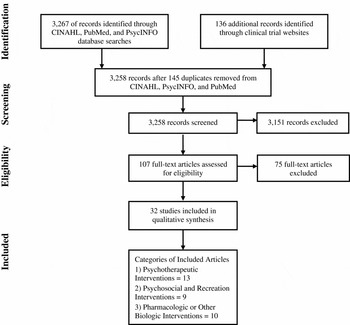
Our search strategy yielded 510 articles in CINAHL, 1,535 articles in PubMed, and 1,222 articles in PsycINFO for screening (see Figure 1, which is based on the Preferred Reporting Items for Systematic Reviews and Meta-Analyses recommendations (Moher et al., Reference Moher, Liberati, Tetzlaff and Altman2009)). With regards to the clinical trial databases, our search of ClinicalTrials.gov, the ISRCTN Registry, and the WHOICTRP, produced 87, 34, and 15 studies, respectively. After removing 145 duplicates, we were left with 3,258 records for the initial review of which 3,151 were excluded, at the outset, for not meeting our criteria. We ultimately examined 107 full text articles of which 35 articles met our criteria. We excluded three articles that had duplicated results or probable issues with data integrity. A total of 32 articles were thereby included in our systematic review.
Preferred reporting items for systematic reviews and meta-analyses-based flow diagram.

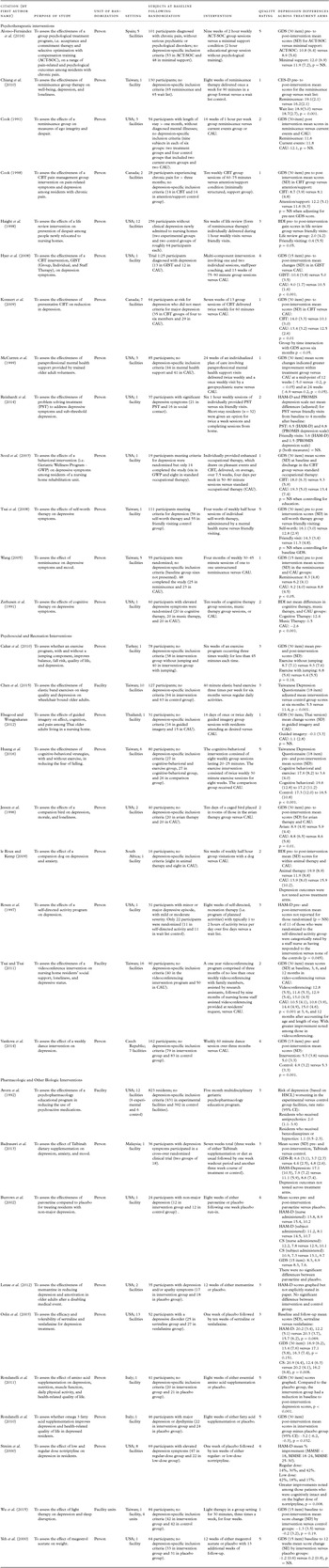
As the goal of an RCT is to directly compare interventions to one another or a control group, we presented p-values that tested between group differences in Table 1. Due to the heterogeneity across studies with regards to participant characteristics, inclusion criteria, intervention approaches and duration, and outcome measurements, we did not calculate overall effect sizes.
Randomized controlled trials of depression treatment in nursing home residents

Notes: CAU = care-as-usual; CI = confidence interval; BDI = Beck Depression Inventory; CES-D = Center for Epidemiologic Studies Depression Scale; CS = Cornell Scale for Depression; DASS-D = depression, Anxiety, and Stress Scale-Depression; GDS = Geriatric Depression Scale; GDS-R = Geriatric Depression Scale Residential; HAM-D = Hamilton Depression Rating Scale; HSCL = Hopkins symptom checklist; MMSE = Mini-Mental State Exam; NH = nursing home; NS = not significant; PROMIS = Patient Reported Outcomes Measurement Information System; RCT = randomized controlled trial.
Quality scores
The mean quality rating was 2.2 (95% confidence interval (CI): 1.40 to 3.07) among psychotherapeutic interventions, 2.8 (95% CI: 1.99 to 3.56) among psychosocial and recreation interventions, and 3.6 (95% CI: 2.82 to 4.38) among pharmacologic and other biologic interventions. These differences were not significant (F [2,29]=2.84, p = 0.075). Many RCTs did not provide an adequate description of randomization, blinding procedures, and within group attrition.
Psychotherapeutic interventions
Thirteen RCTs were included in this category, and the interventions were divided among those utilizing cognitive behavioral therapy (CBT) (Zerhusen et al., Reference Zerhusen, Boyle and Wilson1991; Cook, Reference Cook1998; Sood et al., Reference Sood, Cisek, Zimmerman, Zaleski and Fillmore2003; Hyer et al., Reference Hyer, Yeager, Hilton and Sacks2008; Konnert et al., Reference Konnert, Dobson and Stelmach2009), reminiscence therapy (Cook, Reference Cook1991; Haight et al., Reference Haight, Michel and Hendrix1998; Wang, Reference Wang2005; Chiang et al., Reference Chiang2010), and other types of psychotherapies and therapeutic approaches (McCurren et al., Reference Mccurren, Dowe, Rattle and Looney1999; Tsai et al., Reference Tsai, Wong, Tsai and Ku2008; Reinhardt et al., Reference Reinhardt, Horowitz, Cimarolli, Eimicke and Teresi2014; Alonso-Fernández et al., Reference Alonso-Fernández, López-López, Losada, González and Wetherell2016). Most studies (n=7) were conducted in the United States (Zerhusen et al., Reference Zerhusen, Boyle and Wilson1991; Cook, Reference Cook1998; Haight et al., Reference Haight, Michel and Hendrix1998; McCurren et al., Reference Mccurren, Dowe, Rattle and Looney1999; Sood et al., Reference Sood, Cisek, Zimmerman, Zaleski and Fillmore2003; Hyer et al., Reference Hyer, Yeager, Hilton and Sacks2008; Reinhardt et al., Reference Reinhardt, Horowitz, Cimarolli, Eimicke and Teresi2014), while the rest were conducted in Taiwan (Wang, Reference Wang2005; Tsai et al., Reference Tsai, Wong, Tsai and Ku2008; Chiang et al., Reference Chiang2010), Canada (Cook, Reference Cook1998; Konnert et al., Reference Konnert, Dobson and Stelmach2009), and Spain (Alonso-Fernández et al., Reference Alonso-Fernández, López-López, Losada, González and Wetherell2016).
Interventions involving CBT included a pain management group in which reduction of depressive symptoms was a secondary outcome (n=38) (Cook, Reference Cook1998), a multi-component intervention that involved several modalities (group, individual, and staff therapy – “GIST”; n=25) (Hyer et al., Reference Hyer, Yeager, Hilton and Sacks2008), a group intervention targeting residents at risk for depression (“Coping with Stress in Seniors”; n=64) (Konnert et al., Reference Konnert, Dobson and Stelmach2009), a group-based cognitive therapy intervention for residents with moderate to severe depression (n=60) (Zerhusen et al., Reference Zerhusen, Boyle and Wilson1991), and an enhanced occupational therapy intervention for individuals that took place within a short-term rehabilitation unit of a nursing facility (“Geriatric Wellness Program”; n=19) (Sood et al., Reference Sood, Cisek, Zimmerman, Zaleski and Fillmore2003). Evidence of CBT effectiveness was mixed. For example, compared to a minimally structured support group, the pain management group did not reduce depressive symptoms among nursing home residents with chronic pain (Cook, Reference Cook1998). Likewise, those assigned to Geriatric Wellness did not experience a significant reduction in depressive symptoms when compared to standard occupational therapy treatment, after controlling for education. However, fewer participants in the experimental group had depression (two of six) compared to those within the control group (six of eight) post-treatment in this very small study (Sood et al., Reference Sood, Cisek, Zimmerman, Zaleski and Fillmore2003). The remaining three studies, which included tests of GIST (Hyer et al., Reference Hyer, Yeager, Hilton and Sacks2008), Coping with Stress in Seniors (Konnert et al., Reference Konnert, Dobson and Stelmach2009), and group-based cognitive therapy (Zerhusen et al., Reference Zerhusen, Boyle and Wilson1991) demonstrated significant effects at post-test when compared to care as usual (CAU). GIST involved two individualized sessions related to goal setting and barrier reduction, a staff or peer coach, and 13 weekly group sessions of 75 to 90 minutes each involving behavioral activation as a key component. Coping with Stress in Seniors met twice a week for 60 minutes over seven weeks and covered topics that included a mood diary, coping with stress, and scheduling pleasant events. The group-based cognitive therapy relied on training nursing home staff to deliver the ten week intervention and involved techniques such as using a dysfunctional thought record (Zerhusen et al., Reference Zerhusen, Boyle and Wilson1991).
Studies involving reminiscence therapy were conducted in both group (Cook, Reference Cook1991; Chiang et al., Reference Chiang2010) and individual modalities (Haight et al., Reference Haight, Michel and Hendrix1998; Wang, Reference Wang2005) with sample sizes ranging from 54 to 256 (Cook, Reference Cook1991; Haight et al., Reference Haight, Michel and Hendrix1998). Interventions in this subgroup involved the following: (1) a series of group sessions organized by topics (e.g. identifying positive relationships, recalling family history and life stories) (Chiang et al., Reference Chiang2010); (2) weekly group sessions designed to focus on each decade of life (Cook, Reference Cook1991); (3) a structured life review occurring during one to one visits (Haight et al., Reference Haight, Michel and Hendrix1998); and (4) one to one unstructured reminiscence (Wang, Reference Wang2005). Three out of four of these studies demonstrated treatment effects favoring the reminiscence conditions when compared to either CAU (Wang, Reference Wang2005) or to another control condition (i.e. wait list (Chiang et al., Reference Chiang2010), friendly visiting (Haight et al., Reference Haight, Michel and Hendrix1998)).
There were four other RCTs included in this category, which included interventions based on the following: (1) Acceptance and Commitment Therapy enhanced with selective optimization with compensation training, delivered to residents with chronic pain (n=101) (Alonso-Fernández et al., Reference Alonso-Fernández, López-López, Losada, González and Wetherell2016); (2) problem-solving treatment delivered to a sample of primarily short-stay residents (n=37) (Reinhardt et al., Reference Reinhardt, Horowitz, Cimarolli, Eimicke and Teresi2014); (3) a novel intervention described as “self-worth therapy,” delivered on an individual basis (n=111) (Tsai et al., Reference Tsai, Wong, Tsai and Ku2008); and (4) use of older adult volunteers as trained para-professional mental health providers engaging in twice weekly visits (n=85) (McCurren et al., Reference Mccurren, Dowe, Rattle and Looney1999). Most of these studies did not achieve statistically significant effects between intervention arms immediately following treatment. The exception was the use of trained older adult volunteers as paraprofessional mental health providers that, when compared to CAU, demonstrated improvement in depressive symptoms at 24 weeks (McCurren et al., Reference Mccurren, Dowe, Rattle and Looney1999). Likewise, while self-worth therapy did not demonstrate a significant effect in reducing depression at post-test, those who had received this intervention had fewer depressive symptoms at a two month follow-up (Tsai et al., Reference Tsai, Wong, Tsai and Ku2008).
Psychosocial and recreational interventions
Nine RCTs were grouped in this broad category, which included studies from Taiwan (n=3) (Tsai and Tsai, Reference Tsai and Tsai2011; Chen et al., Reference Chen, Huang, Cheng, Li and Chang2015; Huang et al., Reference Huang, Chung, Chen, Chin and Wang2016), the United States (Jessen et al., Reference Jessen, Cardiello and Baun1996; Rosen et al., Reference Rosen, Rogers, Marin, Mulsant, Shahar and Reynolds1997), the Czech Republic (n=1) (Vankova et al., Reference Vankova, Holmerov, Machacova, Volicer, Veleta and Celko2014), South Africa (n=1) (le Roux and Kemp, Reference Le Roux and Kemp2009), Thailand (n=1) (Elsegood and Wongpakaran, Reference Elsegood and Wongpakaran2012), and Turkey (n=1) (Cakar et al., Reference Cakar2010). The following types of interventions were tested: exercise programs (n=78–127 participants) (Cakar et al., Reference Cakar2010; Chen et al., Reference Chen, Huang, Cheng, Li and Chang2015; Huang et al., Reference Huang, Chung, Chen, Chin and Wang2016), guided imagery sessions provided in a group setting (n=31) (Elsegood and Wongpakaran, Reference Elsegood and Wongpakaran2012), individually provided avian therapy (n=40) (Jessen et al., Reference Jessen, Cardiello and Baun1996), group visitations with a companion dog (n=16) (le Roux and Kemp, Reference Le Roux and Kemp2009), self-directed activity (n=22) (Rosen et al., Reference Rosen, Rogers, Marin, Mulsant, Shahar and Reynolds1997), videoconferencing with family members (n=90) (Tsai and Tsai, Reference Tsai and Tsai2011), and weekly dance sessions (n=162) (Vankova et al., Reference Vankova, Holmerov, Machacova, Volicer, Veleta and Celko2014). The evidence supporting the effect of these interventions was also mixed. For example, guided imagery (Elsegood and Wongpakaran, Reference Elsegood and Wongpakaran2012) and self-directed activity (Rosen et al., Reference Rosen, Rogers, Marin, Mulsant, Shahar and Reynolds1997) were not found to significantly reduce depression symptoms compared to control groups when evaluated with standardized measures of depression. However, a staff nurse was more likely to rate those taking part in the self-directed activity program as having positively responded to this intervention. Further highlighting the mixed results is that two Taiwanese exercise interventions showed a reduction in depression symptoms (Chen et al., Reference Chen, Huang, Cheng, Li and Chang2015; Huang et al., Reference Huang, Chung, Chen, Chin and Wang2016), while a Turkish exercise intervention did not (Cakar et al., Reference Cakar2010). A short course of avian therapy, which involved ten days of a caged bird placed in participants’ rooms, contributed to a decrease in depressive symptoms when compared to CAU (Jessen et al., Reference Jessen, Cardiello and Baun1996), as did a year-long videoconferencing intervention when controlling for age and length of stay (Tsai and Tsai, Reference Tsai and Tsai2011). Examining only within subjects effects, depressive symptoms among those receiving visits from a companion dog decreased from pre- to post-intervention, but those assigned to CAU did not experience a significant decrease in symptoms (le Roux and Kemp, Reference Le Roux and Kemp2009). Lastly, a weekly dance intervention that included functionally impaired and wheelchair-bound residents reduced depression symptoms (Vankova et al., Reference Vankova, Holmerov, Machacova, Volicer, Veleta and Celko2014).
Pharmacologic and other biologic interventions
Ten RCTs were included in this category, which spanned antidepressant (n=3) (Streim et al., Reference Streim2000; Burrows et al., Reference Burrows, Salzman, Satlin, Noble, Pollock and Gersh2002; Oslin et al., Reference Oslin2003), other pharmacological agents (n=2) (Yeh et al., Reference Yeh2000; Lenze et al., Reference Lenze, Skidmore, Begley, Newcomer, Butters and Whyte2012), prescriber and staff education (n=1) (Avorn et al., Reference Avorn1992), supplementation (n=3) (Rondanelli et al., Reference Rondanelli2010; Rondanelli et al., Reference Rondanelli2011; Badrasawi et al., Reference Badrasawi, Shahar, Abd Manaf and Haron2013), and bright light therapy (n=1) (Wu et al., Reference Wu, Sung, Lee and Smith2015) interventions. Six of these RCTs were based in the United States (Avorn et al., Reference Avorn1992; Streim et al., Reference Streim2000; Yeh et al., Reference Yeh2000; Burrows et al., Reference Burrows, Salzman, Satlin, Noble, Pollock and Gersh2002; Oslin et al., Reference Oslin2003; Lenze et al., Reference Lenze, Skidmore, Begley, Newcomer, Butters and Whyte2012).
An antidepressant RCT examining the effectiveness of paroxetine in treating non-major depression in older adults (n=24) (Burrows et al., Reference Burrows, Salzman, Satlin, Noble, Pollock and Gersh2002) found that, compared to placebo, paroxetine was not more effective and may have been more likely to cause delirium and worsening Mini-Mental State Examination (MMSE) scores (Burrows et al., Reference Burrows, Salzman, Satlin, Noble, Pollock and Gersh2002). A trial comparing venlafaxine to sertraline among residents with a depressive disorder (n=52) examined tolerability and depression treatment efficacy (Oslin et al., Reference Oslin2003). This trial found no evidence that venlafaxine had superior efficacy in treating depression than sertraline, and venlafaxine was more poorly tolerated with 12 of 27 venlafaxine participants not completing treatment due to either a side effect or serious adverse event (compared to 5 of 25 in the sertraline group) (Oslin et al., Reference Oslin2003). A third antidepressant trial investigated nortriptyline in depressed residents (n=69) and showed a differential response to the antidepressant based on cognitive impairment status (Streim et al., Reference Streim2000). A “regular dose” of nortriptyline (60–80 mg/day) demonstrated a 42% mean improvement in depression in residents with a MMSE of 25 or higher compared to a 14% improvement in residents with a MMSE score less than 18. In the low-dose (10–13 mg/day) group, however, the mean improvement was 17% in the cognitively intact group and 42% in the cognitively impaired residents (Streim et al., Reference Streim2000). Another pharmacological trial evaluated whether an N-methyl-D-aspartate antagonist, memantine, was effective in reducing depression in those newly admitted to a nursing home for rehabilitation following a disabling medical condition (n=35) (Lenze et al., Reference Lenze, Skidmore, Begley, Newcomer, Butters and Whyte2012). While the effect sizes were not explicitly stated, the investigators reported no difference between memantine and placebo after 12 weeks. Another 12 week RCT was designed to examine megestrol acetate's effect in improving weight gain in residents with weight loss or weighing less than 20% of their ideal body weight (n=64); there were no depression-specific inclusion criteria and residents with weight loss secondary to depression were excluded. Compared to placebo, megestrol acetate did not improve depression symptoms (Yeh et al., Reference Yeh2000).
Our review identified a large trial (12 facilities, n=823) that employed a multidisciplinary geriatric psychopharmacology education intervention targeting the prescribing behaviors of nursing home physicians and included education sessions for nursing home staff and physicians (Avorn et al., Reference Avorn1992). While the intervention successfully reduced the use of antipsychotics, benzodiazepines, and hypnotics, residents in the experimental nursing homes who had received antipsychotics were at elevated risk of worsening depression compared to the non-intervention group. Depression was a secondary outcome, however, and only assessed in approximately one in three participants (Avorn et al., Reference Avorn1992).
Three small (fewer than 50 participants each) nutrient supplementation trials were identified and occurred in either Malaysia (Badrasawi et al., Reference Badrasawi, Shahar, Abd Manaf and Haron2013) or Italy (Rondanelli et al., Reference Rondanelli2010; Rondanelli et al., Reference Rondanelli2011). These RCTs included essential amino acids (Rondanelli et al., Reference Rondanelli2011), long chain omega 3 polyunsaturated fatty acids (Rondanelli et al., Reference Rondanelli2010), and Talbinah (a carbohydrate-rich food reportedly used by Arabs to alleviate depression) (Badrasawi et al., Reference Badrasawi, Shahar, Abd Manaf and Haron2013) and, relative to the control group, they improved depression symptoms (Rondanelli et al., Reference Rondanelli2010; Rondanelli et al., Reference Rondanelli2011; Badrasawi et al., Reference Badrasawi, Shahar, Abd Manaf and Haron2013).
Lastly, a Taiwanese bright light therapy RCT (n=84) exposed residents to 30 minutes of light therapy administered in a group setting three times a week for four weeks and did not demonstrate a light therapy benefit; there were no depression-specific inclusion criteria (Wu et al., Reference Wu, Sung, Lee and Smith2015).
Discussion
To our knowledge, this is the first systematic review examining treatment of depression or depression symptoms in nursing facility residents with relatively intact cognition. Our systematic review uncovered a wide array of depression treatment approaches from which several conclusions can be drawn: (1) there is a paucity of high-quality, large-scale RCTs from which to guide the management of depression in this population, (2) psychotherapeutic approaches have had mixed results with some CBT and reminiscence-based interventions decreasing depression symptoms, (3) a larger proportion of the psychosocial and recreation interventions (six of nine RCTs) decreased depression symptoms in nursing home residents, and (4) the evidence base guiding pharmacological management of depression within our population of interest is limited.
The psychotherapeutic interventions had considerable heterogeneity and included both manualized interventions as well as those that were less structured. Approximately half of these interventions had non-significant effects compared to control conditions. Likewise, only reminiscence (Haight et al., Reference Haight, Michel and Hendrix1998; Wang, Reference Wang2005; Chiang et al., Reference Chiang2010) and CBT (Zerhusen et al., Reference Zerhusen, Boyle and Wilson1991; Hyer et al., Reference Hyer, Yeager, Hilton and Sacks2008; Konnert et al., Reference Konnert, Dobson and Stelmach2009) therapies demonstrated significant effects in more than one of the included studies in this category. The cumulative evidence for both of these treatments, however, is still limited given the small pool of studies and varying treatment approaches. This finding is congruent with a prior systematic review evaluating RCTs of psychotherapeutic interventions targeting depression in long-term care with a broader set of inclusion criteria than our review (e.g. other settings and participants with dementia were allowed) (Cody and Drysdale, Reference Cody and Drysdale2012).
Compared to the other intervention categories, while many of the studies were of lesser methodological quality, psychosocial and recreational activities were more promising with six of the nine interventions demonstrating favorable outcomes. In particular, exercise and interventions targeting social isolation (e.g. companion bird, videoconferencing with family members) reduced depression symptoms (these studies did not select residents based on depression status, however). Furthermore, a 2013 Cochrane Review found exercise interventions to be moderately effective for depression treatment and potentially comparable to psychological and pharmacological interventions (Cooney et al., Reference Cooney2013).
The pharmacological interventions examined in this systematic review are too limited (e.g. small samples sizes, heterogeneous study populations, at times lacking a placebo control) to meaningfully guide clinical decision-making. However, there were some interesting findings that warrant further investigation. For example, venlafaxine had more significant adverse events requiring treatment discontinuation while being similarly efficacious as sertraline for treating depression; the authors suggested that there may be “a trend for decreased tolerability of venlafaxine with increasing age” (Oslin et al., Reference Oslin2003). Also of interest is that the antidepressant effect of nortriptyline was greater at higher doses for residents with relatively intact cognition and was more effective at lower doses for residents with severe cognitive impairment (Streim et al., Reference Streim2000). This is suggestive that optimal depression management in cognitively intact depressed nursing home residents may differ from depressed residents with dementia (Streim et al., Reference Streim2000). While amino acid, omega 3 fatty acid, and Talbinah supplementation were associated with lower depression scores, there are some caveats with these findings. For example, the amino acid RCT was not specifically tested in residents with depression, thereby limiting its clinical utility (Rondanelli et al., Reference Rondanelli2011); the omega 3 fatty acid RCT excluded participants with major depression or dysthymia who were on antidepressants (Rondanelli et al., Reference Rondanelli2010); and the Talbinah supplementation RCT did not directly compare treatment arms, had higher depression scores in the Talbinah supplementation group, and excluded residents receiving antidepressants (Badrasawi et al., Reference Badrasawi, Shahar, Abd Manaf and Haron2013). Additionally, a recent systematic review and meta-analysis found little evidence indicating that omega 3 fatty acids are effective in treating depression, with much of the reported effect likely due to publication bias (Bloch and Hannestad, Reference Bloch and Hannestad2012). Lastly, paroxetine (Burrows et al., Reference Burrows, Salzman, Satlin, Noble, Pollock and Gersh2002), memantine (Lenze et al., Reference Lenze, Skidmore, Begley, Newcomer, Butters and Whyte2012), and megestrol acetate (Yeh et al., Reference Yeh2000) were not superior to placebo in treating depression.
Our systematic review has several limitations. First, our examination of CINAHL, PubMed, and PsycINFO only included publications written in English, which may have excluded some relevant RCTs. Second, the RCTs we included were highly heterogeneous in their inclusion and exclusion criteria as well as their primary outcome measures, which makes direct comparison between studies difficult and conducting a meta-analysis not feasible. Third, given our focus on RCTs, other study methods and approaches to improving depression in nursing facilities were not reviewed. For example, we did not evaluate studies on nursing home culture change, which in a prior review demonstrated mixed results with regards to reducing depression symptoms (Shier et al., Reference Shier, Khodyakov, Cohen, Zimmerman and Saliba2014). Fourth, to maintain the focus of our review on a population often excluded from clinical trials – older adults with a high level of medical comorbidity, disability, and frailty residing in nursing homes – we did not examine non-pharmacologic and pharmacologic interventions that treated late-life depression in other settings. There were many studies that did not meet our inclusion criteria and some promising interventions were likely excluded from our review. Fifth, although we systematically reviewed the results from the CINAHL, PubMed, and PsycINFO search engines, we did not similarly systematically examine the reference lists of the articles we reviewed, which increases the possibility that we may have overlooked some relevant RCTs. Lastly, we did not contact experts in the treatment of depression in nursing home residents as part of our systematic review process and it is possible that there are pertinent treatment approaches and guidelines that are not discussed in our review.
Conclusions and implications
Our systematic review ultimately shows that the evidence base for treating depression in nursing facility residents who are cognitively intact or with only mild impairment has significant limitations: (1) there was a notable lack of high-quality, large-scale RCTs, (2) participant characteristics varied widely with many lacking depression-specific inclusion criteria, (3) many RCTs included did not account for concurrent antidepressant treatment, which limits their clinical utility, (4) studies inconsistently presented their findings, with some presenting only within group differences, and (5) the majority of studies relied on p-values as the primary basis for hypothesis testing, a practice that has recently gained additional scrutiny (Wasserstein and Lazar, Reference Wasserstein and Lazar2016). Nonetheless, this review provides some evidence that CBT, reminiscence, interventions to reduce social isolation, and exercise-based interventions have some promise for alleviating depression. Given that residents without dementia are more likely to transition back to the community and that depression may increase the risk of institutionalization, developing interventions for these residents has the potential to both reduce the considerable morbidity associated with depression and the costs of their care. In particular, newly admitted residents may comprise a high-yield group for interventions as depression can interfere with physical recovery and may increase their risk of long-term institutionalization.
Conflicts of interest
None.
Description of authors’ roles
A. Simning and K. V. Simons designed the study, implemented the search strategy (with assistance from K. Liljequist), reviewed the papers, interpreted the findings, and wrote and approved of the paper.
Acknowledgments
The authors thank Karen Liljequist, MLIS, AHIP, of the University of Rochester Miner Library for her invaluable assistance in developing, initiating, and reviewing the searches necessary for this project as well as Yeates Conwell, MD, for reviewing and providing feedback on this paper. Dr Simning is supported through the Empire Clinical Research Investigator Program (ECRIP), sponsored by the New York State Department of Health. Dr Simons is employed by the VISN 2 Center of Excellence for Suicide Prevention, which supported this work through resources and the use of facilities. The contents do not represent the views of the U.S. Department of Veterans Affairs or the United States Government.
Supplementary material
To view supplementary material for this paper, please visit http://dx.doi.org/10.1017/S1041610216001733.