Introduction
Cardiovascular risk factors, and in particular some independent lipoproteins, have been associated with cardiovascular disease and with cognitive function in middle age (Anstey et al., Reference Anstey, Lipnicki and Low2008; Kaffashian et al., Reference Kaffashian2011; Yaffe et al., Reference Yaffe2014). But the literature provides conflicting results when it comes to older adults (Panza et al., Reference Panza2006; Mielke et al., Reference Mielke, Xue, Zhou, Chaves, Fried and Carlson2008; van den Kommer et al., Reference van den Kommer, Dik, Comijs, Jonker and Deeg2012). Despite robust evidence linking lipid levels to increase dementia risk (Anstey et al., Reference Anstey, Lipnicki and Low2008; van den Kommer et al., Reference van den Kommer, Dik, Comijs, Jonker and Deeg2012), much remains to be known about the association between lipoproteins and cognitive performance among older adults.
Research shows that in older ages, higher levels of TC have correlated with improved cognitive function (Elias et al., Reference Elias, Elias, D’Agostino, Sullivan and Wolf2005; Panza et al., Reference Panza2006) and may serve as a protective cognitive factor (Mielke et al., Reference Mielke2005; Schreurs, Reference Schreurs2010); however, some studies find no association (Reitz et al., Reference Reitz, Luchsinger, Tang, Manly and Mayeux2005). Lower levels of LDL-C have also been associated with lower general cognitive performance (van den Kommer et al., Reference van den Kommer, Dik, Comijs, Jonker and Deeg2012) and lower processing speed among older adults (Packard et al., Reference Packard2007). Yet other investigators have not found any links between LDL-C and cognition (van Exel et al., Reference van Exel2002; Reitz et al., Reference Reitz, Luchsinger, Tang, Manly and Mayeux2005; Anstey et al., Reference Anstey, Lipnicki and Low2008). And high levels of HDL-C known to protect from cardiovascular events, have also been associated with better cognitive performance in some studies with older adults (Atzmon et al., Reference Atzmon, Gabriely, Greiner, Davidson, Schechter and Barzilai2002; van Exel et al., Reference van Exel2002; van den Kommer et al., Reference van den Kommer, Dik, Comijs, Jonker and Deeg2012), but not others (Reitz et al., Reference Reitz, Luchsinger, Tang, Manly and Mayeux2005; Anstey et al., Reference Anstey, Lipnicki and Low2008). In another study, older adults with low TG levels and high HDL-C performed better on the Mini-Mental State Exam (MMSE) (Atzmon et al., Reference Atzmon, Gabriely, Greiner, Davidson, Schechter and Barzilai2002).
Gender also seems to be an important factor in the association between lipid levels and cognition. For example, results from the Melbourne Women's Midlife Health Project indicated that high concentrations of LDL-C and a recent increase in TC were both associated with better memory (Henderson et al., Reference Henderson, Guthrie and Dennerstein2003). Results from the Women's Health and Aging Study II revealed that higher TC and HDL-C levels were associated with better psychomotor speed (Mielke et al., Reference Mielke, Xue, Zhou, Chaves, Fried and Carlson2008). Finally, the Swedish Adoption/Twin Study (Reynolds et al., Reference Reynolds, Gatz, Prince, Berg and Pedersen2010) concluded that lipid levels are more indicative of cognitive aging in women than in men, with higher HDL-C and lower TG related to better cognitive outcomes in women.
Finally, apolipoprotein ε4 allele (APOE4) has been found to influence the association between lipid levels and cognition. Some studies suggest that APOE4 magnifies the association between lipoproteins and cognitive performance (de Frias et al., Reference de Frias2007). On the other hand, higher HDL-C was related to better cognition for those without but not with the APOE4 gene (Yasuno et al., Reference Yasuno2012). Therefore, further investigation of the association between APOE4 and lipoproteins is warranted in order to clarify the relationship.
Few studies have assessed cognitive abilities as opposed to cognitive impairment or dementia as the primary outcome. Thus, we aimed to build on previous research that has looked at the association between lipoproteins and cognitive performance by examining individual serum lipoproteins TC, LDL-C, TG, HDL-C, and HDL/LDL ratio in relation to cognitive performance. We measured cognition as a CCSs as well as by evaluating the following domains: nonverbal and verbal memory; visuospatial function; executive function; attention and working memory; and language. In addition, we examined the associations separately by gender and by the presence of at least one APOE4 allele. Based on previous findings which suggest significant associations between lipoproteins and cognitive performance (Elias et al., Reference Elias, Elias, D’Agostino, Sullivan and Wolf2005; Mielke et al., Reference Mielke2005; Schreurs, Reference Schreurs2010), we expected that higher levels of TC, LDL-C, and HDL-C and lower levels of TG would be associated with better cognitive performance.
Methods
Study sample
Our cross-sectional study uses pooled data from participants recruited between 2005 and 2012 from the Memory Clinic at University Hospital Motol in Prague, Czech Republic participating in a longitudinal study. Participants in this study (a) came to the memory clinic due to concern about their memory expressed by themselves or by a relative, (b) were recruited from the University of the Third Age, or (c) were relatives or caregivers of patients with MCI or AD. All participants underwent a thorough neuropsychological examination and provided medical history.
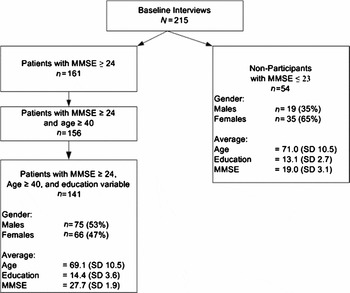
The sample included 215 adults (Figure 1) with biomarker data ±60 days from the administration of the neuropsychological battery. After restricting the sample to those with MMSE scores ≥24, age ≥40 years, and information about education, 141 adults remained for analysis.
Study flow diagram; SD = standard deviation.

The study was approved by the institutional ethics committee from the Memory Clinic at 2nd Faculty of Medicine, Charles University and University Hospital Motol in Prague, Czech Republic and written informed consent was obtained from all subjects participating in the study.
Neuropsychological battery
The psychometric battery included the MMSE which we used to screen for cognitive impairment, with a cut point greater or equal to 24 which is recommended for clinical practice (Tombaugh and McIntyre, Reference Tombaugh and McIntyre1992), and the assessment of the following domains:
-
• Nonverbal (Rey–Osterrieth Complex Figure Test – the Immediate Recall condition (ROCFT-R) (Fastenau et al., Reference Fastenau, Denburg and Hufford1999)).
-
• Verbal memory (Auditory Verbal Learning Test (AVLT) (Ivnik et al., Reference Ivnik, Malec, Tangalos, Petersen, Kokmen and Kurland1990) trials 1–6, AVLT-30 minute recall trial and the free and cued selective reminding test (FCSRT) = Total Recall Score (Howard, Reference Howard1980; Schmidt et al., Reference Schmidt, Tombaugh and Faulkner1992)).
-
• Visuospatial function (Rey–Osterrieth Complex Figure Test – the Copy condition ROCFT-C (Fastenau et al., Reference Fastenau, Denburg and Hufford1999)).
-
• Executive function (Control Oral Word Association Test (COWAT) (Sumerall et al., Reference Sumerall, Timmons, James, Ewing and Oehlert1997), Digit Span Forward (Wechsler, Reference Wechsler1939)).
-
• Attention and working memory (Backward Digit Span (BDS) (Wechsler, Reference Wechsler1939)).
-
• Language (Boston Naming Test (30 item version) (Saxton et al., Reference Saxton2000).
-
• A composite cognitive score (CCS) was constructed to assess overall cognitive performance.
Biological measures
Specimen collection of participants was performed at the University Hospital Motol in Prague, Czech Republic. For this analysis we included subjects with specimens collected ±60 days from the administration of the neuropsychological battery. Serum lipoprotein samples were collected in the morning after a 12-h fasting period. Standard venipuncture methods were used to collect approximately 6 tablespoons of blood. Specimens were stored and processed in-house within 1–3 h after collection. Lipoproteins were measured in mmol/l; included in this study were: TC, LDL-C, TG, and HDL-C. The HDL-to-LDL ratio was calculated for this study. APOE4 genotyping was obtained from leukocyte samples using standard technique.
Covariates
Demographic variables were obtained at the time of cognitive testing and included gender, age (years), and maximum achieved education level. Age and education were analyzed as continuous variables. Since the sample was highly educated, education variable was categorized as follows: secondary or below (≤11 years of school), some university (≥12 and ≤15) and university degree or above (≥16 years of school).
The Geriatric Depression Scale (GDS) was also used as one of the descriptive variables to assess depressive symptoms among participants. This is a 30-item self-report assessment with scores 0–4 considered normal, 5–8 mild depression, 9–11 moderate, and 12–15 severe depression.
Statistical analysis
Statistical analysis was performed using SAS 9.3. We examined baseline characteristics overall and for men and women separately. Scores for cognitive tests were standardized to z-scores (mean = 0 and one unit standard deviation) to enable comparison across the cognitive measurements scored on different scales. Higher z-scores reflect better cognitive performance. APOE4 variable was coded to a dichotomous variable as ε4 carriers (ε2/ε4, ε3/ε4, or ε4/ε4) and non-carriers (ε2/ε2, ε2/ε3, ε3, ε3). Two-thirds of our sample was non-APOE4 carriers, this result correlates with the proportion of APOE4 non-carriers found in other studies (Packard et al., Reference Packard2007; Barnes et al., Reference Barnes, Arvanitakis, Yu, Kelly, Jager and Bennett2013).
Pearson correlation coefficients were obtained for all dependent and independent variables. Ordinary least square regressions were employed to examine the relationship between lipoprotein levels and cognitive performance while controlling for age, gender, education, and depressive symptoms. We adjusted for these covariates because they are known to be correlated with cognitive performance. Models were subsequently also adjusted for APOE4.
All participants at least 40 years of age were retained in the analyses. The results were unchanged when we restricted the sample to adults at least 65 years of age. However, the sample was retained at age 40 to maintain statistical power. Using the G*Power statistical software, we found adequate power (>0.80) for the reported analyses in the main models when we specified a medium effect size (standardized regression coefficient = 0.5, which corresponds to Cohen's d = 0.5), a sample size of 141, and six covariates in a two-tailed test. However, in analyses conducted separately for men and women, the power was about 0.60 for men and slightly over 0.50 for women.
Results
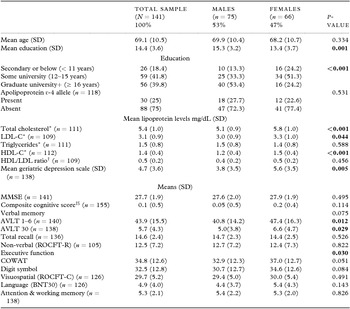
Characteristics of the entire analytical sample, as well as of men and women separately, are presented in Table 1. The mean MMSE score was 27.8 (SD 1.9) and there were no significant differences in MMSE scores by: gender (p = 0.495), age categories (p = 0.846), or APOE4 status (p = 0.531). There were slight more men (53%, n = 75) than women; the mean age was 69.1 (SD 10.5) years. The sample was highly educated with the majority having some university education (41.8%, n = 59). As expected for this cohort, males had higher levels of education than females (p = 0.001). Depressive symptom scores were higher in women than in men (p = 0.005). Two-thirds of our sample was APOE4 non-carriers and this did not differ by gender (p = 0.531). Significant gender differences were observed for most lipoprotein levels such that females had higher levels of TC (p < 0.001), LDL-C (p = 0.044), and HDL-C (p < 0.001) than males, but no differences were observed for TG or HDL-to-LDL ratio.
Baseline characteristics of participants

Note. LDL-C = low-density lipoprotein; HDL-C = high-density lipoprotein; MMSE = mini-mental state exam; AVLT 1–6 = auditory verbal learning test trials 1–6; AVLT 30 = auditory verbal learning test 30 minute recall; ROCFT-R = Rey–Osterrieth complex figure test – the immediate recall condition; COWAT = control oral word association test; ROCFT-C = Rey–Osterrieth complex figure test – the copy condition.
*Optimal range: TC < 5.2 mmol/l; LDL-C < 3.4 mmol/l; Triglycerides < 1.7 mmol/l; HDL-C ≥ 1.5 mmol/l. † HDL/LDL ratio optimal > 0.4 ‡z-scores. §Composite cognitive score = mean of the sum of cognitive domains.
When we evaluated CCS, there were no statistically significant differences by gender (p = 0.114), age (p = 0.261), education (p = 0.143), or depressive symptoms score (p = 0.123). Among the specific cognitive domains, gender differences were only observed in executive function where females outperformed males (p = 0.030).
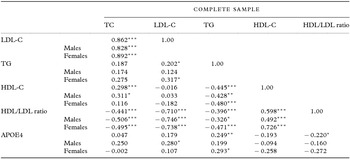
Pearson correlation coefficients among lipoproteins are presented in Table 2. There was a significant positive correlation between TC, LDL-C, and HDL-C and a negative correlation between HDL-C and TG (ps < 0.001). The positive correlation between TC and HDL-C was only significant among men (r = 0.31, p < 0.05).
Pearson correlation coefficients among lipoproteins for the complete sample and stratified by gender

Note: TC = total cholesterol, LDL-C = low-density lipoprotein cholesterol, TG = triglycerides, HDL-C = high-density lipoprotein cholesterol. *p < 0.05, **p < 0.01, ***p < 0.001.
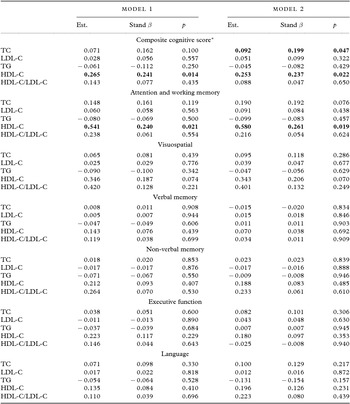
The associations between lipoproteins and each cognitive domain are shown in Table 3. Controlling for age, gender, education, and depressive symptoms (Model 1), higher levels of HDL-C were significantly associated with better CCSs and better attention and working memory. After also adjusting for APOE4 (Model 2), the association between higher TC and better CCSs reached statistical significance, while HDL-C remained significantly associated with both composite scores and attention and working memory.
Adjusted multivariate regressions of the association between lipoproteins and cognitive domains

Note: *Composite cognitive score = mean of the sum of cognitive domains. Est. = unstandardized regression coefficient; β = standardized regression coefficient. Results in model 1 were adjusted for age, gender, education, and depressive symptoms. Results in model 2 were also adjusted for APOE4.
We followed by estimating moderation by gender in models adjusted for age, education, and depressive symptoms. The interaction of gender by each of the lipoproteins was not statistically significant for any of the cognitive measures (ps > 0.05) except for the interaction of gender by TG in relation to visuospatial skills (p = 0.03), where lower TG levels were associated with better visuospatial skills in women (standardized regression coefficient (β = −0.37, p = 0.015) but not in men (β = 0.14, p = 0.348). However, we still conducted exploratory gender-stratified analyses in order to match this study with recent previous research on lipoproteins and cognition (Atzmon et al., Reference Atzmon, Gabriely, Greiner, Davidson, Schechter and Barzilai2002; Reynolds et al., Reference Reynolds, Gatz, Prince, Berg and Pedersen2010) in which separate results for men and women were presented. In our data, higher HDL-C levels were associated with better CCSs (β = 0.30, p = 0.026 and better attention and working memory (β = 0.37, p = 0.012) among women (corresponding result for men: β = 0.20, p = 0.124 and β = 0.15, p = 0.271, respectively). Furthermore, in men, a significant association was observed between higher TC levels and better performance in attention and working memory (β = 0.26, p = 0.046), and not in women (β = 0.12, p = 0.415).
With respect to modification by APOE4, only the interaction of APOE4 by TG in relation to visuospatial skills was significant (p = 0.02), indicating that having lower TG levels was associated with better visuospatial skills (β = −0.25, p = 0.044) among APOE4 non-carriers but not among carriers (β = 0.38, p = 0.200). Although no other statistically significant interactions of APOE4 status by lipoproteins were observed (p > 0.05), given the central role of APOE4 status presented in previous related research (Yasuno et al., Reference Yasuno2012), we again proceeded with analyses examining APOE4-stratified results for lipoproteins and cognitive outcomes. We found that high HDL-C was significantly associated with higher CCS (β = 0.32, p = 0.009) among APOE4 non-carriers but not among the APOE4 carriers (β = −0.09, p = 0.682). No other results were statistically significant in relation to the CCS.
Discussion
Using a convenience sample of adults tested at a memory clinic in Prague, Czech Republic, we assessed TC, LDL-C, TG, HDL-C, and HDL-to-LDL ratio in relation to overall cognitive performance and scores on six well-established cognitive domains (verbal memory, non-verbal memory, visuospatial, executive function, attention/working memory, and language). We found an association between higher HDL-C and better overall cognitive performance after adjustment for age, gender, education, depressive symptoms, and APOE status, which is consistent with previous research findings (Atzmon et al., Reference Atzmon, Gabriely, Greiner, Davidson, Schechter and Barzilai2002; Károssy et al., Reference Károssy, Kerekes, Horváth, Gőocze and Kállai2007; Reynolds et al., Reference Reynolds, Gatz, Prince, Berg and Pedersen2010; van den Kommer et al., Reference van den Kommer, Dik, Comijs, Jonker and Deeg2012).
Since the 1980’s, HDL-C has been known to be a protective factor for atherosclerosis and cardiovascular disease (Gordon et al., Reference Gordon, Castelli, Hjortland, Kannel and Dawber1977). But only more recently have higher levels of HLD-C been associated with better cognitive performance, especially among older adults (van Exel et al., Reference van Exel2002; Mielke et al., Reference Mielke, Xue, Zhou, Chaves, Fried and Carlson2008; Reynolds et al., Reference Reynolds, Gatz, Prince, Berg and Pedersen2010; Formiga et al., Reference Formiga, Ferrer, Chivite, Pinto, Cuerpo and Pujol2011). In our study, higher levels of HDL-C were related to better attention and working memory (i.e. executive function). This finding is in agreement with Károssy and colleagues who found similar results for HDL-C and executive function (Károssy et al., Reference Károssy, Kerekes, Horváth, Gőocze and Kállai2007). They also suggested that HDL-C may be specifically protecting frontal lobe functions on which working memory is dependent (Károssy et al., Reference Károssy, Kerekes, Horváth, Gőocze and Kállai2007). However, like other studies (van Exel et al., Reference van Exel2002; Reitz et al., Reference Reitz, Luchsinger, Tang, Manly and Mayeux2005), we were not able to find any association between TC or LDL-C and cognitive function.
In line with the findings from other recent studies (Reitz et al., Reference Reitz, Luchsinger, Tang, Manly and Mayeux2005; Arsenault et al., Reference Arsenault2009), women in our sample had higher levels of TC, LDL-C, and HDL-C than males. The associations we observed for HDL-C and cognition were more slightly pronounced for women, which is in agreement with previous research (Mielke et al., Reference Mielke, Xue, Zhou, Chaves, Fried and Carlson2008; Henderson, Reference Henderson2010; Reynolds et al., Reference Reynolds, Gatz, Prince, Berg and Pedersen2010), although it is important to note that no gender-by-HDL-C interactions were statistically significant. Still, one possible explanation for the stronger associations among women may be that a greater range of HDL-C levels tends to be observed in women compared to men. Gender-stratified results for TG mimicked those of HDL-C, with the association with visuospatial skills being significantly stronger for women than men. Similar results in relation lower TG and better verbal ability in women was found by Reynolds et al. (Reference Reynolds, Gatz, Prince, Berg and Pedersen2010).
When looking at TC levels in relation to all cognitive scores, although the interaction was not significant, we found that higher TC levels were associated with better attention and working memory in men while this result fell short of statistical significance in women. Results obtained from previous research have seen similar linear trends in the association between TC and attention/concentration measures for both males and females (Elias et al., Reference Elias, Elias, D’Agostino, Sullivan and Wolf2005). Reynolds et al. (Reference Reynolds, Gatz, Prince, Berg and Pedersen2010) found that only in men were higher TC levels associated with improved performance in perceptual speed but faster decline before the age of 65 years.
We were able to include in the analyses all commonly used measures of blood lipids. Still, only HDL-C showed consistent association with cognition. The lack of association between other measures of blood lipids and cognition has also been observed in other cross-sectional studies (van Exel et al., Reference van Exel2002; Reitz et al., Reference Reitz, Luchsinger, Tang, Manly and Mayeux2005). Theoretically, this is not completely surprising given that only the relatively small HDL-C particles are known to actively pass the brain barrier, prevent the formation of amyloid-β in the brain (Wang and Eckel, Reference Wang and Eckel2014) and have anti-inflammatory properties (Vaisar et al., Reference Vaisar2007; Fogelman, Reference Fogelman2010). Perhaps, to better capture the combined effects of these blood lipids on cognitive function, longitudinal analysis with multiple consistent lipoproteins and cognitive measures are needed from mid adulthood into older ages.
Additional adjustment for APOE4 affected the results minimally and did not reduce the associations visibly. As a matter of fact, it could be argued that this adjustment strengthened some of the results. The finding that higher TC levels were significantly associated with better CCSs when APOE4 was adjusted for provides support for this point.
Consistent with previous findings (Yasuno et al., Reference Yasuno2012), when we stratified the sample by APOE4 carriers versus APOE4 non-carriers, high levels of HDL-C were associated with higher CCSs in non-APOE4 carriers but not in APOE4 carriers. An analysis from the Whitehall II Study also showed that non-carriers of APOE4 showed greater decreases of HDL-C across time and this was associated with an increased risk of memory decline in midlife (Singh-Manoux et al., Reference Singh-Manoux, Gimeno, Kivimaki, Brunner and Marmot2008). Conversely, de Frias found stronger associations between TC and cognition among APOE4 carriers compared to non-carriers. However, it is important to note that the authors did not analyze HDL-C. Further, our APOE4-by-HDL-C interactions were not significant, suggesting that the differences between HDL-C-cognition associations were relatively small for APOE4 carriers versus non-carriers. We also found that lower TG levels were associated with better visuospatial abilities in APOE4 non-carriers but not among the carriers. DeFrias and colleagues were not able to find any significant interactions between APOE4 and TG (de Frias et al., Reference de Frias2007). Further studies are needed to confirm/refute these findings.
The results have an important policy implication. Blood lipid levels are modifiable through diet, exercise, medications, and/or change in adverse lifestyle habits such as smoking. Existing cardiovascular research suggests that HDL-C can be raised relatively easily through a diet containing monounsaturated and polyunsaturated fats, exercise, eliminating smoking, and using medications such as niacin, statins and fibrates among others when necessary (Andersen and Fernandez, Reference Andersen and Fernandez2013). Therefore, strategies to increase HDL-C levels may be a viable population-wide intervention strategy to help maintain cognitive function with age.
Some limitations should be mentioned. Due to the cross-sectional nature of this study, we were not able to indicate whether lipoprotein levels relate to change in cognitive functioning. Further, our sample was homogeneous (white) and highly educated. Although our neuropsychological battery is comprehensive, we must note that only using the BDS test to measure the broad category of “Attention and Working Memory” may pose some measurement limitations. It is also important to note that the associations of HDL-C with verbal, non-verbal, language or executive function measures were not significant. The higher levels of HDL-C were only related to better attention and working memory, specifically the BDS test. Our finding that the composite measure was significantly associated with HDL-C while most individual cognitive measures were not provides additional evidence that the effect of HDL-C may occur mainly on the global level (Atzmon et al., Reference Atzmon, Gabriely, Greiner, Davidson, Schechter and Barzilai2002). We also lacked data in some important socio-demographic variables such as income, medical comorbidities and medications, and 19% of the sample did not have data regarding APOE status. Finally, gender-specific analyses were underpowered.
In conclusion, our results point to HDL-C as the main lipoprotein driving the associations with cognitive performance. In addition, lipid profile may be more indicative of cognitive functioning in women than in men. Future research aimed at understanding the factors underlying the role of HDL-C, as well as the gender-based differences in the link between lipids and cognition, is needed. Additionally, the possibility that boosting HDL-C levels may promote cognition should be investigated.
Conflict of interest
None.
Description of author's roles
M. Chanti-Ketterl formulated the research questions, managed and analyzed the data, and wrote the article. R. Andel assisted with formulation of research questions, supervision of data analysis and assisted writing the article. J. Hort & R. Andel designed the study. J. Laczo and O. Lerch collected the data. All authors revised the manuscript.
Acknowledgments
Special thanks to Sarah Eisel and Collen Pappas from the School of Aging Studies at the University of South Florida for their help with data management. The study was funded by the European Regional Development Fund – Project FNUSA-ICRC (No. CZ.1.05/1.1.00/02.0123) and by project ICRC-ERA-HumanBridge (no. 316345), European Social Fund and the State Budget of the Czech Republic, European Social Fund within the project Young Talent Incubator II (reg. no. CZ.1.07/2.3.00/20.0117) and Ministry of Health, Czech Republic – conceptual development of research organization, University Hospital Motol, Prague, Czech Republic 00064203.