INTRODUCTION
The role of the therapy radiographer has developed as a direct result of a more flexible approach to multi-disciplinary team working and skills mix within departments of clinical oncology.1 The Calman-Hine report2 provided recommendations concerning delivery of care by non-medical staff; it has identified training and educational issues for the staff groups concerned to allow them to function effectively in this new multi-disciplinary approach to cancer care. The NHS White Paper, The New NHS: Modern, Dependable3 acknowledges the Calman-Hine model as the framework of choice to deliver this high-quality health care for the future.
In 2002, the Scottish Executive4 advocated the further development of health-care professionals to meet the diversity and flexibility required of a modern health service. Patient-centred care requires effective clinical teams, equipped and empowered to implement service change and develop new roles and skills.5 Multi-disciplinary teams are necessary to deliver improved outcomes to patients and this can only be achieved by using an integrated approach to improve patient care.
Patients, staff and service delivery may all benefit from this new model of team working.1 Patients can get quicker access to more focused and flexible services. Staff benefit from increased knowledge and skills, assuming greater responsibility for their actions and the service benefits from a positive impact on recruitment and retention of staff and improved utilisation of the expertise of the allied health professionals thereby targeting the use of the skills of the medical profession.6
Research funded by the College of Radiographers 1997, 1999Reference Price, High and Miller7, Reference Colyer, Hammick, Sinclair, Fell, Richards and Travis8 has also demonstrated the diversity of radiographers’ roles and has identified a number of radiographers who have developed their role beyond treatment to the more formal role of on-treatment review. It is also suggested that the needs of patients are better served by a radiographer and it can be argued that this role adds value to the cancer service provision. A study by Campbell et al. Reference Campbell, German, Lane and Dodwell9 confirms that specialist non-medical staff may actually provide more effective care for patients undergoing radiotherapy.
LITERATURE REVIEW
The aim of radiotherapy in patients who have undergone breast-conserving surgery is to sterilise the tumour area and surrounding breast tissue to prevent local recurrence. Randomised trials comparing breast-conserving surgery with or without breast irradiation show a 4–5-fold reduction in risk of relapse from the addition of breast irradiation.Reference Fisher, Anderson, Redmond, Wolmark, Wickerham and Cronin10–Reference Veronesi, Marubini and Mariani13 Likewise, in post-mastectomy patients, trial data has shown a reduction in the local recurrence rate from 35 to 8% with the addition of radiotherapy.Reference Overgaard, Jensen and Overgaard14 Also with the addition of radiotherapy a 9–10% survival benefit at 10 years is seen.Reference Overgaard, Hansen and Overgaard15, Reference Ragaz, Jackson and Le16
The benefit of radiotherapy in breast cancer is well documented; however, there are risks and morbidity associated with this treatment. Radiotherapy review clinics are therefore designed to monitor radiotherapy reactions, identify adverse effects and manage treatment-related side effects including medically induced menopausal symptoms. These clinics also provide an opportunity to assess and attempt to attend to the wide variety of physical, psychological and social problems experienced by patients with malignant disease.Reference Campbell, German, Lane and Dodwell9
The review clinics have traditionally been the remit of doctors; however, recommendations by the Royal College of Radiologists sought to include other members of the multi-disciplinary team.1 Following on from this, the Scottish Executive in 2002 outlined a new vision where multi-professional teams would be tasked with streamlining the care process, removing delays and unproductive work and offering a better overall service to patients.4 This vision is still valid today and is reinforced by the NHS Education for Scotland whose strategic workplan outlines a direction of travel, which supports future workforce development including role development and new ways of working.17
In light of the drive to improve cancer services, the Breast Team Clinical Oncologists at the Edinburgh Cancer Centre agreed a new multi-disciplinary team approach for the on-treatment review clinics. The initiative was designed to reduce the number of patients attending the busy medical review clinic as the doctors would only review patients in weeks 1 and 4 of their radiotherapy treatment and offered the staff a chance to extend their existing roles within the department.
METHODOLOGY
The standard procedure involved the Consultant Oncologist or the Specialist Registrar undertaking the weekly review of all the breast cancer patients undergoing outpatient radiotherapy. However the new multi-disciplinary team comprised four consultant oncologists, one registrar, two senior radiographers and a staff nurse. In response to this new role development, the radiographers underwent an induction schedule before commencing the review clinics and also undertook a Master's module in Treatment Review at Glasgow Caledonian University.
There were two parts to the audit process. The first part of the process was the treatment review form, which was completed by the review staff at each clinic visit. A proforma recorded details of skin reactions, fatigue, menopausal symptoms and new medication. This form was also signed by an oncologist to confirm that the patient was suitable for radiographer/nurse review based on the inclusion/exclusion criteria.
Patients with severe co-morbidities, recurrent disease or T4 tumours were excluded from radiographer/nurse review. These patients would continue to be reviewed weekly by the doctor. The remaining patients would be seen at weeks 1 and 4 by the doctor and the radiographers/nurse would see the patients at weeks 2 and 3.
The second part of the process was a structured questionnaire to collect patient perception of waiting times, time spent in the review clinic, confidence and trust in the review staff, the opportunity to ask questions and whether questions were answered to their satisfaction. Patients were also invited to comment on any other aspects of their visit to the review clinic. The questionnaire was distributed to all eligible breast cancer patients during a 7-month period. The radiographers/nurse conducting the review clinics distributed the questionnaires each week and patients were asked to complete all questions. Each patient would receive four forms in total, one for each visit to the review clinic. Anonymity was guaranteed as each questionnaire was numbered and patients were asked to return completed questionnaires in a sealed envelope and put it into a box at their treatment machine.
Patient consent to use the questionnaires for data purposes was assumed if the completed questionnaires were returned to the treatment machines. The research project had approval from the Local Research Ethics Committee and the Trust Data Protection Officer.
Patients were seen in the clinic once they had received their radiotherapy treatment; therefore, there were no fixed appointment times for the clinic as this could be subject to change depending on transport or machine waiting times. The recommended waiting time to be seen is 30 minutes and patients should be advised if there is a significant delay beyond this time.18
RESULTS
A total of 230 forms were distributed and 153 were returned, giving a return rate of 67%. Of these, only 113 had three or four forms completed. The Statistical Package for Social Sciences (SPSS) was used to analyse the statistical data.
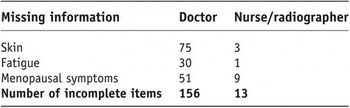
When the results were analysed it was found that the review forms filled in by the radiographers/nurse had 13 items of missing information; however, the doctors omitted 156 pieces of information. The nature of the missing data is highlighted in Table 1.
Total review form omissions

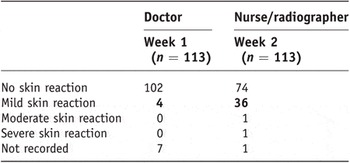
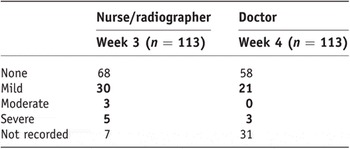
The completed review forms were also analysed, specifically looking at skin reactions and menopausal symptoms. There was some disparity between both the week 1 and week 2 comments and the week 3 and week 4 comments from the different staff groups. There were 32 cases of mild skin reaction noted at week 2 not noticed at week 1 and this was statistically significant (p = 0.025).
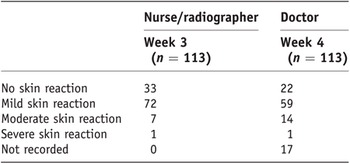
There were 24 patients whose skin reaction was not recorded by the doctor in weeks 1 and 4. There was also discrepancy between mild and moderate skin reactions between staff groups from week 3 to week 4 in some patients and this was statistically significant (p = 0.003) (Tables 2 and 3).
Skin reactions noted week 1 and week 2

Bold figures highlight statistically significant differences between staff groups.
Skin reactions noted week 3 and week 4

Bold figures highlight statistically significant differences between staff groups.
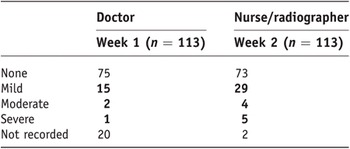
Menopausal symptoms were also rated less by the doctor compared to the nurse/radiographer and the results are shown in Tables 4 and 5.
Menopausal symptoms noted on treatment review form weeks 1 and 2

Bold figures highlight statistically significant differences between staff groups.
Menopausal symptoms noted on treatment review form weeks 3 and 4

Bold figures highlight statistically significant differences between staff groups.
The difference of opinion regarding the grade of menopausal symptoms was also highly statistically significant p < 0.01 (Wilcoxon Test) for weeks 1 and 2 and p = 0.02 for weeks 3 and 4.
The data shown in the tables highlight the significant differences between the staff groups reporting the severity of the patients’ menopausal symptoms. This could be due to real changes in symptoms but this seems unlikely due to the short time frame involved; however, it could have resulted from inaccurate reporting or failure of the patient to divulge the information. The doctors also omitted to record the menopausal symptoms on 51 patients in weeks 1 and 4 compared to 9 patients by the nurse/radiographer team.
Discussion
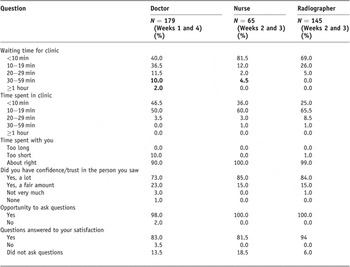
The audit illustrated that the doctors had the longest waiting times for the review clinic, which was unsurprising as they also saw the largest number of patients as breast cancer patients are treated on four different machines and may all have the same appointment times (Table 6). The majority (83.5%) of patients in all groups were seen in <30 minutes, 14.5% were kept waiting up to an hour (by both the doctor and the nurse) and 2% waited over an hour to see the doctor. The doctors reviewed 46.5% of the patients in <10 minutes compared to 36% of the patients (nurse) and 25% of the patients (radiographers). It could be argued that the doctors could not allow more time per patient based on their long waiting times; however, the radiographers also saw a large number of patients and were able to allow patients more time in the consultation.
Results of patient perception questionnaire

Bold highlights patient waiting time outside of Patient Charter recommendations.18
The questionnaire asked patients about their confidence and trust in the staff who reviewed them and although this can be subjective the results were extremely interesting. Only 73% of patients had a lot of confidence and trust in the doctors and 4% had very little or no confidence in the doctor who reviewed them. In contrast the radiographers and nurse scored 84 and 85%, respectively on this question. This can be perceived as support for the policy of integrating the radiographer/nurse into the review team.
Patients were asked whether they had their questions answered to their satisfaction and the doctors scored 83% compared to the nurses who had 81.5% and the radiographers with 94%. The authors believe that the radiographers scored so highly in this category as a result of the patient questions being technically based regarding treatment and set-up as this staff group is best placed to answer these specific questions. It seems that 13.5% of patients did not ask the doctor questions in the clinic compared to 18.5% with the nurse and only 5.5% with the radiographers. This appears to suggest that the patients felt more able to ask questions to the radiographers.
The results of the comparison of the review forms were also interesting as the nurse and radiographers appeared to identify more skin reactions than the doctors. For example in week 1 the doctor only reported 4 mild reactions whereas the nurse/radiographer team in week 2 identified a total of 36 mild reactions. Also there was 1 moderate and 1 severe skin reaction not recorded by the doctor. Therefore, there were 34 cases of skin reaction, which was potentially missed by the doctors. However, it should be noted that some patients may begin to develop a skin reaction in week 2, which would not be visible in week 1; therefore, the results may not be comparable. It may also be possible that the patient's skin was not actually observed by the doctor during the review clinic and this is why a mild skin reaction was not recorded.
The severity of skin reaction based on mild, moderate and severe scoring can also be difficult to define and can be subjective between individuals; therefore, in hindsight this perhaps was not the most consistent scoring system to use.
The scoring of menopausal symptoms was another area where there were discrepancies between the staff groups. There was a consensus of opinion on 73 patients having no symptoms and there was agreement on a further 18 patients having mild, moderate or severe symptoms. However, the nurse/radiographer team scored a further 14 mild, 2 moderate and 4 severe symptoms compared to the doctors. The doctors omitted to record menopausal scores on 20 patients all of whom by week 2 were experiencing mild, moderate or severe symptoms.
This appears to highlight that doctors may underestimate patient symptoms versus the patients’ actual perceived symptoms, which is well documented in the literature.Reference Stephens, Hopwood, Girling and Machin19–Reference Fisch, Titzer and Kristeller21 It is extremely unlikely that menopausal symptoms will appear in the duration of a week and therefore a reasonable explanation could be that the doctor simply did not ask if the patient was experiencing menopausal symptoms.
Conclusion
The Treatment Review Audit highlights the patients’ perceptions of the quality of their care while undergoing radical radiotherapy. The results illustrate that patients are satisfied with the care shown to them by the radiographers and the nurse. It is evident from the results that both of these staff groups have the necessary skills and experience to support this extended role. There is also a substantial time saving for the medics as a result of this new initiative and a key benefit for the patients is the reduction in clinic waiting times as a result of the radiographer and nurse-led review clinics.
The review form was designed to encourage reporting of patient side effects to treatment; however, it is clear when the forms were evaluated that there was missing data. Omissions in the recording of information do not facilitate good continuity of care when the patient subsequently attends for a follow-up visit.
In conclusion, this audit has provided good evidence to support the continuation of the radiographer and nurse-led review clinics as the patients have a lot of confidence and trust in these staff groups to deliver high-quality care and support throughout the period of the patients’ treatment. It also highlights the need for good collaboration and communication between the professional team members.
As a result of the success of this new initiative, the radiographers and the nurse now routinely review patients at weeks 1, 2 and 3 of their treatment and the medics review them at their fourth week before completion of treatment.
Also in an attempt to standardise the reporting of skin reactions the Radiation Therapy Oncology Group (RTOG) Skin Scoring System has been initiated based on the Society of Radiographers guidelinesReference Glean, Edwards and Faithfull22 and the Best Practice Statement.23 This method would appear to be less subjective than the method used for the purposes of this audit. Therefore, the research has also provided information, which has allowed the department to further develop the service to benefit the patients. In addition, the success of this multi-disciplinary approach has prompted a new initiative of radiographer-led simulation for all breast patients. This has positively impacted upon patient waiting times for radiotherapy and will form the basis of a future study.