INTRODUCTION
Scyphozoan jellyfishes are a conspicuous component of the pelagic marine community. One of the most studied functions of this organisms is its feeding habits because they are considered voracious zooplankton predators that feed during day and night (Fancett & Jenkins, Reference Fancett and Jenkins1988) on a wide variety of taxa (Larson, Reference Larson1991; Riascos et al., Reference Riascos, Villegas and Pacheco2014).
Most jellyfish are tactile predators that capture prey using nematocysts (Arai, Reference Arai1997) by ambush or cruising strategies (Gerritsen & Strickler, Reference Gerritsen and Strickler1977). Variation in feeding habits and prey selectivity in jellyfish is consistent with differences in functional morphology (Fancett & Jenkins, Reference Fancett and Jenkins1988; Larson, Reference Larson1991; Costello & Colin, Reference Costello and Colin1994; D'Ambra et al., Reference D'Ambra, Costello and Bentivegna2001) and type of nematocyst (Purcell & Sturdevant, Reference Purcell, Nemazie, Dorsey, Houde and Gamble2001; Peach & Pitt, Reference Peach and Pitt2005). In addition, jellyfish diet may shift ontogenetically (Graham & Kroutil, Reference Graham, Martin, Felder, Asper and Perry2001; Nogueira-Júnior & Haddad, Reference Nogueira-Júnior and Haddad2008; Higgins et al., Reference Higgins, Ford and Costello2008).
Despite the emphasis on the role of scyphomedusae as key species of coastal plankton, most inferences regarding their trophic interactions are derived from indirect evidence with limited laboratory experiments (Gibbons et al., Reference Gibbons, Stuart and Verheye1992; Toonen & Chia, Reference Toonen and Chia1993; Olesen et al., Reference Olesen, Frandsen and Riisgård1994) on few cosmopolitan species (Arai, Reference Arai1997; Purcell, Reference Purcell1997). Therefore, the comparison reliability of scyphomedusa feeding impacts is limited because relatively few species have been studied in sufficient detail (D'Ambra et al., Reference D'Ambra, Costello and Bentivegna2001). Nevertheless class Scyphozoa contains ~200 extant species (Mianzan & Cornelius, Reference Mianzan, Cornelius and Boltovskoy1999); not all of them are relevant at community level. Much of the importance of jellyfish is due to the occurrence of seasonal outbreaks, which can cause negative impacts on human activities such as fishing (Graham et al., Reference Graham and Kroutil2003; Hong et al., Reference Hong, He-Qin, Hai-Gen, Arreguin-Sanchez, Zetina-Rejon, Luna and Le Quesne2008; Nagata et al., Reference Nagata, Haddad and Nogueira2009; Quiñones et al., Reference Quiñones, Monroy, Acha and Mianzan2013), aquaculture (Doyle et al., Reference Doyle, De Haas, Cotton, Dorschel, Cummins, Houghton, Davenport and Hays2008), tourism and nuclear power plants (Galil, Reference Galil2007), and far less attention is given to the potential of such species to provide benefits, such as climate regulation, nutrient cycling, food provision amongst others (Doyle et al., Reference Doyle, Hays, Harrod, Houghton, Lucas and Pitt2014).
Cannonball jellyfish Stomolophus meleagris (Agassiz, 1862) is a relatively big and conspicuous species that looks like a hemispherical mushroom-shaped organism swimming just under the sea surface, which inhabits the Atlantic and Pacific Ocean coastlines from Florida to Argentina and from California to Ecuador (Kramp, Reference Kramp1961; Balech & Ehrlich, Reference Balech and Ehrlich2008). Numerous outbreaks of this organism have been reported in several states of Mexico, such as Tabasco, Veracruz, Oaxaca, Nayarit, Sinaloa and Sonora (Gómez-Aguirre, Reference Gómez-Aguirre1991; Ocaña-Luna & Gómez-Aguirre, Reference Ocaña-Luna and Gómez-Aguirre1999; Álvarez-Tello, Reference Álvarez-Tello2007). Stomolophus meleagris has been successfully exploited in Mexico since 2000 (López-Martínez & Álvarez-Tello, Reference López-Martínez and Álvarez-Tello2013) but there is still not enough information about its biology and ecology, as is the case with the vast majority of edible jellyfishes (Omori & Nakano, Reference Omori and Nakano2001; Kitamura & Omori, Reference Kitamura and Omori2010).
As in most scyphozoans, cannonball jellyfish has a metagenic life cycle with a microscopic polypoid stage that can reproduce asexually (Calder, Reference Calder1982) and a planktonic medusoid stage with short lifespan (Álvarez-Tello, Reference Álvarez-Tello2007; López-Martínez & Álvarez-Tello, Reference López-Martínez and Álvarez-Tello2013), sexual reproduction and high fecundity (Carvalho-Saucedo et al., Reference Carvalho-Saucedo, López-Martínez and García-Domínguez2012). This medusa possesses developed oral arms that extend well below the margin of the swimming bell and are fused into complex oral arm cylinders containing hundreds to thousands of small mouthlets used to consume prey (Costello et al., Reference Costello, Colin and Dabiri2008).
Regarding its function as a zooplankton predator, S. meleagris exhibits a cruising predator behaviour (Gerritsen & Strickler, Reference Gerritsen and Strickler1977). Further studies on this species by Costello & Colin (Reference Costello and Colin1995) found that feeding and swimming are concurrent activities, and prey selection appears to depend first on prey vulnerability to entrainment in the flow created by swimming medusae. Larson (Reference Larson1991) and Puente-Tapia (Reference Puente-Tapia2009) found that S. meleagris feeds mainly on zooplankton with emphasis on copepods followed by tintinnids, veliger larvae, and fish eggs from specimens captured in the Gulf of Mexico.
Recently, a study carried out by Padilla-Serrato et al. (Reference Padilla-Serrato, López-Martínez, Acevedo-Cervantes, Alcántara-Razo and Rábago-Quiroz2013) showed that fish eggs were the main item in stomachs of S. meleagris from the central Gulf of California, followed by bivalve and cirriped larvae, which contradict those of previous research. The main goal of this study was to determine diet composition and feeding patterns, particularly trophic niche breadth, dietary overlap and prey selectivity of S. meleagris, an important species for both coastal ecosystem and jellyfish fisheries from the central Gulf of California.
MATERIALS AND METHODS
Samplings
Five samplings were carried out in the coastal lagoon Las Guásimas (27°51.258′N 110°37.951′W) to cover all sizes of S. meleagris present in the environment (one in April 2010, two in December 2010 and two in January 2011). Note that no specimens were found from June to November. Samplings consisted of two fixed stations for zooplankton sampling and collections of jellyfish between these stations for stomach content analysis (Figure 1). Zooplankton were collected with a conical net (50 cm diameter, 300 µm mesh size) by horizontal tows while jellyfish were selected individually by random with a scoop net (40 cm diameter, 1 cm mesh size). A GPS was used to locate stations and estimate distance of plankton tows for 5 min. Filtered volume was calculated from the towed distance and the mouth area of the net (0.1963 m2). Once on board, zooplankton samples were preserved with 5% formalin buffered with sodium borate. Jellyfish specimens were fixed immediately after catch with 10% formalin buffered with sodium borate and stored individually in plastic bags for subsequent analysis (Larson, Reference Larson1991).
Location of the coastal lagoon Las Guásimas in the central Gulf of California and stations for zooplankton (in circle) tows and jellyfish collections (rhombus) (modified from Arreola-Lizárraga, Reference Arreola-Lizárraga2003).

Sample processing
For zooplankton counting, each sample was adjusted to 100 mL, homogenized, and analysed by sequential aliquots (10 mL) until at least 1000 organisms were counted (Harris et al., Reference Harris, Weibe, Lenz, Skjodal and Huntley2000). The counts were performed using a stereomicroscope, and identification was carried out to the lowest taxonomic level using guides of Smith & Johnson (Reference Smith and Johnson1996), Palomares-García et al. (Reference Palomares-García, Suárez and Hernández-Trujillo1998), Harris et al. (Reference Harris, Weibe, Lenz, Skjodal and Huntley2000) and Conway (Reference Conway and John2012). The zooplankters were recorded quantitatively in individuals by each 100 cubic metres filtered (ind 100 m−3) and in terms of relative abundance (%N) (Smith & Richardson, Reference Smith and Richardson1979).
Each medusa was weighed to the nearest 1 g (W), and its length (L) determined to the nearest 1 mm (from top of umbrella to distal end of manubrium) before dissection was done to extract stomach contents. Prey were removed from jellyfish by extraction of gastric tissues and rinsing oral arms and gastric cavity on a 60 µm mesh-size sieve. Food items from pleated gastric membranes were extracted following Larson (Reference Larson1991). The items found in each stomach were identified with literature used for zooplankton.
Data analyses
The zooplankters were recorded quantitatively in individuals by each 100 cubic metres filtered (ind 100 m−3) and in terms of relative abundance (%A) (Smith & Richardson, Reference Smith and Richardson1979). Zooplankton composition between months was compared using the Kruskal–Wallis test with α < 0.05 significance level (McDonald, Reference McDonald2014).
Diet composition was evaluated by group of prey using three measures described by Hyslop (Reference Hyslop1980): numeric (%N); gravimetric (%W) and frequency of occurrence (%O). The Index of Relative Importance (IRI) was calculated using the equation proposed by Pinkas et al. (Reference Pinkas, Oliphant and Iverson1971) and modified by Hacunda (Reference Hacunda1981).
 $${\rm IRI}_{\rm i} = (\% {N_i} + \% {G_i}) \times \% {O_i}$$
where %N is the numeric percentage, %G is weight percentage and %O is the relative frequency of occurrence for each i prey group. To readily allow comparisons among prey items, the IRI was then standardized to %IRI for each prey group (Cortés, Reference Cortés1997).
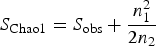
Using the content of each stomach as sampling unit, a cumulative curve was performed plotting the number of stomachs analysed against corresponding number of prey taxa, applying 1000 randomizations with the software EstimateS (Colwell, Reference Colwell2013), which allowed assessment of sample size sufficiency by comparing the richness observed (S obs) with the Chao1 non-parametric estimator (S Chao1).
 $${S_{{\rm Chao1}}} = {S_{{\rm obs}}} + \displaystyle{{n_1^2} \over {2{n_2}}}$$
where n 1 is the number of singletons (species found once) and n 2 is the number of doubletons (species found twice) (Chao et al., Reference Chao, Colwell, Lin and Gotelli2009). We considered that the sampling effort was sufficient when the observed richness was at least 80% of S Chao1, according to Jiménez-Valverde & Hortal (Reference Jiménez-Valverde and Hortal2003).
Stomolophus meleagris were separated into three arbitrary size classes to assess possible ontogenetic shifts, named ‘small’ (L ≤ 29 mm), ‘medium’ (L from 30 to 69 mm) and ‘large’ (L ≥ 70 mm). Kruskal-Wallis test with α < 0.05 significance level was used to test differences in diet composition between size classes (McDonald, Reference McDonald2014). Association between size of specimens and stomach contents was evaluated with Spearman's correlation test, which does not require normally distributed data.
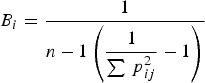
Feeding patterns of S. meleagris were assessed in general and by ontogenetic classes by means of trophic niche breadth, diet overlap between stages and selectivity toward main prey groups. Niche breadth was calculated using Levin's standardized index (Krebs, Reference Krebs1999):
 $${B_i} = \displaystyle{1 \over {n - 1\left( {\displaystyle{1 \over {\mathop \sum \nolimits{\,p}_{ij}^2 }} - 1} \right)}}$$
where B i = Levin's standardized index for predator i, p i = proportion in diet of predator i that is made up of prey j, and n = number of prey categories. This index ranges from 0 to 1, with low values indicating diets dominated by a few prey items (specialist predators) and higher values indicating generalist diets (Krebs, Reference Krebs1999).
Diet overlap among jellyfish ontogenetic classes was estimated with simplified Morisita's index of similarity C H (Horn, Reference Horn1966), which is not biased by sample size or number of resources (Wolda, Reference Wolda1981).
 $${C_{\rm H}} = 2 \cdot \displaystyle{{\mathop \sum \nolimits{({P_{\rm ij}}} \cdot {P_{{\rm ik}}})} \over {\mathop \sum \nolimits {P_{\rm ij}}^2 + \mathop \sum \nolimits {P_{\rm ik}}^2}} \; $$
where C H = Simplified Morisita index of overlap between species j and k, P ij = proportion resource i of the total resources used by species j, P ik = proportion resource i of the total resources used by species k and n = total number of food items. Dietary overlap increases as the Morisita's index increases from 0 to 1. Overlap is generally considered to be biologically significant when the value exceeds 0.6 (Langton, Reference Langton1982).
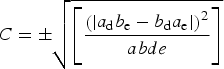
The selectivity ‘C’ index was calculated from the relative abundance (%N) of each prey item ingested in relation to prey availability in the zooplankton community (Pearre, Reference Pearre1982), which has been used previously in studies of jellyfish selectivity (Larson, Reference Larson1991; Sullivan et al., Reference Sullivan, Garcia and McPhee-Klein1994; Graham & Kroutil, Reference Graham, Martin, Felder, Asper and Perry2001) with the following equation:
 $$C = \pm \sqrt {\left[ {\displaystyle{{{{\left( {\left \vert {{a_{\rm d}}{b_{\rm e}} - {b_{\rm d}}{a_{\rm e}}} \right \vert} \right)}^2}} \over {abde}}} \right]} $$
where, a and b represent the relative abundance of a particular species and all others, respectively, and subscripts d and e indicate the diet and the environment. The index ranges from +1 to −1. Positive values indicate selection, negative values indicate avoidance, and a value of zero indicates no selection (Pearre, Reference Pearre1982). Fisher's exact test was used for the analysis of contingency tables by food item to test for significance of selection indices (McDonald, Reference McDonald2014).
RESULTS
Zooplankton composition
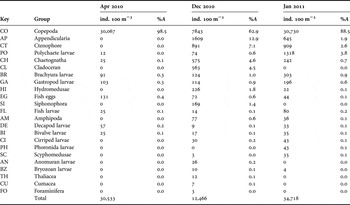
Zooplankton densities were contrasting between months, with high values in April 2010 (30.5 × 10³ ind. 100 m3), lower values in December 2010 (12.5 × 10³ ind. 100 m3), and high values again in January 2011 (34.7 × 10³ ind. 100 m3). At a coarse taxonomic group level, the zooplankton community was dominated numerically by copepods, particularly during April when their relative abundance reached 98.5%. The most numerous copepods were Acartia tonsa, Paracalanus spp. and Oithona spp. Other abundant groups (%A > 1%) were appendicularians, ctenophores, polychaete larvae and chaetognaths (Table 1). Significant differences were found in composition of zooplankton groups between months (H = 10.53, P < 0.01).
Monthly mean of zooplankton densities and relative abundance (%A) in the coastal lagoon Las Guásimas.

Stomolophus meleagris catches
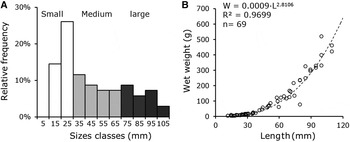
Fifteen specimens of S. meleagris were collected during April, both inside and outside of Las Guásimas lagoon. Jellyfish fishing season ended in mid-May and after that no jellyfish were observed until December. During this month 24 organisms were collected mainly inside the lagoon and during January 30 additional jellyfish were sampled. The longitudinal length of the specimens ranged from 12 to 110 mm, with a mean value of 48 mm (SD = 28.2, n = 69). Three of 69 stomachs analysed were empty. Only large organisms were captured in April while in December there were mainly small medusae. During January 2011 a wide range of sizes was collected, but medium jellyfishes clearly predominated. Size structure of samples was composed of 27 small, 23 medium and 19 large organisms (Figure 2A). Power regressions between jellyfish size and weight were significant and explained 97% of the data (Figure 2B).
Size structure (A) and Length-wet weight relationship (B) of S. meleagris dissected for stomach contents analyses from the coastal lagoon Las Guásimas, Sonora Mexico.

General diet composition
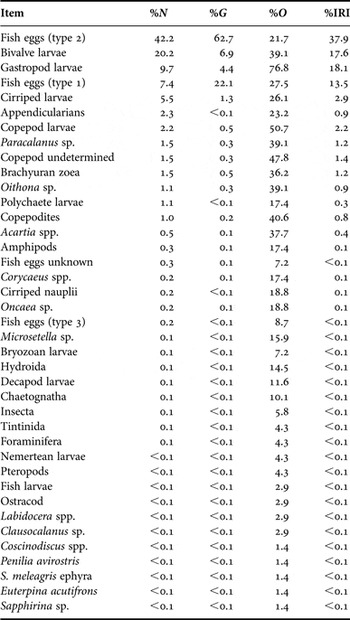
A total of 9766 prey items were found in 66 stomachs, from which 39 food types were identified (Table 2). The most abundant were oval fish eggs (42.2%), bivalve larvae (20.2%), gastropod larvae (9.7%), spherical fish eggs (7.4%) and cirriped larvae (5.5%), which adds up to more than 85% of the total. Average content was 142 items per stomach although it ranged widely from one prey in small specimens (16 mm) to 2017 prey in one large organism (110 mm).
General diet composition of Stomolophus meleagris by food item. %N, %G, %O and %IRI represent percentages in number, wet weight, occurrence and index of relative importance.

The cumulative curves from randomized counting of richness observed (S obs) were convergent with the values of Chao1 estimator (S Chao1) and reached sufficiency criteria (S obs>80% of S Chao1) after specimen number 39 (Figure 3). The likelihood of finding new food items at this sample size was very low (<0.05).
Cumulative prey curves (±SD) for S. meleagris from Las Guásimas. Circle plots represent the average of 1000 permuted curves constructed using randomized ordering of samples (S obs) and squares are data of prey species richness estimates (S Chao1). The arrow indicates the point at which S obs reaches sufficiency criteria (80% S Chao1).

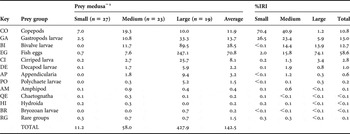
For subsequent analyses, prey were grouped in 13 major taxonomic categories shown in Table 3. Fish eggs were the most abundant by number (%N = 50.1%) and weight (%G = 84.9%) while copepods were the most common between stomachs (%O = 87.0%). Integrating the previous values into the index of relative importance (IRI) resulted that the main prey group of S. meleagris were fish eggs (IRI = 58.6%). Secondary prey were gastropod larvae (IRI = 13.0%), bivalve larvae (IRI = 12.7%) and copepods (IRI = 10.8%). Cirriped larvae (IRI = 2.8%) and decapods (IRI = 1.0%) were considered occasional prey (Figure 4). In addition, another seven groups were present at less than 1%, which were treated as ‘rare prey’.
Trophic spectrum of S. meleagris from Las Guásimas, Sonora Mexico. Where: CO, copepods; EG, fish eggs; GA, gastropod larvae; BI, bivalve larvae; DE, decapod larvae and RG, rare groups.

Mean prey content of individual S. meleagris by size classes and index of relative importance (IRI) for each prey group.

Feeding pattern
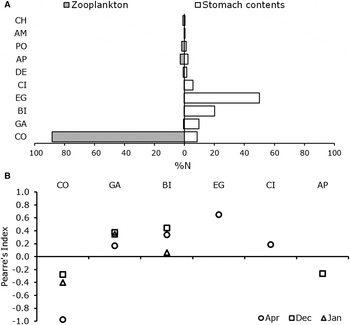
The trophic niche breadth value showed a specialist pattern of feeding (B i = 0.131) based essentially on five (>80%) of 39 available prey. It was evident that prey composition in jellyfish stomach contents varied greatly from the zooplankton composition observed (Figure 5A). This medusa showed a clear positive selection for bivalves (C = 0.28, P < 0.01) and gastropods (C = 0.30, P < 0.01) in every month. Fish eggs and cirriped larvae only showed positive and significant selection during April. These prey were relatively scarce in zooplankton (<1%) while copepods, which were abundant in the environment, showed a significant and negative selectivity index every month (C = −0.55, P < 0.01) while appendicularians only during December. No significant values of selectivity were obtained for the rest of prey in stomachs (Figure 5B).
General selectivity of S. meleagris from Las Guásimas. (A) Gross comparison between numeric percentage (%N) of main zooplankton groups in environment vs percentage of prey in stomach contents and (B) monthly selectivity of main prey groups. Where CO, copepods; EG, fish eggs; GA, gastropod larvae; BI, bivalve larvae; CI, cirriped larvae; DE, decapod larvae; AP, appendicularians; PO, polychaete larvae; AM, amphipods and CH, Chaetognaths.

Ontogenetic changes
Prey number and richness in stomachs of S. meleagris were significantly correlated with specimen size (rs = 0.8862, n = 66, P < 0.001 and rs = 0.7854, n = 66, P < 0.001, respectively) and showed an exponential pattern in prey contents (Figure 6A) and a linear tendency for prey richness (Figure 6B). Small jellyfish averaged 11 prey (SD = 10, n = 26) in their stomachs, medium jellyfish ingested 58 (SD = 81, n = 22) while large organisms consumed 428 prey (SD = 619, n = 18).
Relationship between the size of S. meleagris with (A) number of prey and (B) prey richness of food items from the coastal lagoon Las Guásimas, Sonora, México.

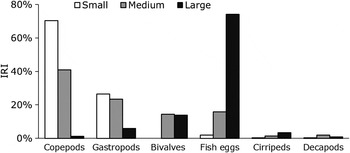
The composition of main prey groups exhibited an evident change between size classes of S. meleagris (Figure 7). Copepod and gastropod IRI showed a strong tendency to decrease with jellyfish growth while fish eggs tended to increase. Small and medium jellyfish showed a diet based on copepods and gastropods while adults ingested primarily fish eggs and bivalves (Table 3). Composition of diets between size classes were statistically different (H = 11.25, P = 0.0036).
Change of %IRI values in main prey groups related with ontogenetic classes of S. meleagris from Las Guásimas, Sonora Mexico.

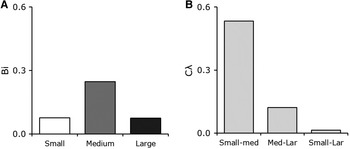
Trophic niche breadth values showed a specialist pattern of feeding for every medusa stage with the highest value for medium specimens (B i = 0.25) and the narrowest for the smallest and largest classes (B i < 0.1) (Figure 8A). Morisita's index of similarity indicated that small and medium jellyfishes were the most similar (C H = 0.534) while small and large organisms were the least (C H = 0.014). Large and medium sizes also had a slight niche overlap value with a Morisita's index of similarity of 0.122 (Figure 8B).
(A) Trophic niche breadth and (B) diet overlap between ontogenetic classes of S. meleagris from Las Guásimas, Sonora Mexico.

Selectivity was associated with change in size of medusa for the main groups of prey. Meroplanktonic larvae of gastropods, bivalves, fish eggs and cirripeds showed a tendency to be positively selected while copepods were negatively selected by medusae of medium and large size classes (Figure 9). Change in selection of copepods (rs = −0.580, P < 0.01) and gastropods (rs = −0.515, P < 0.01) was negatively correlated with change in size of S. meleagris, and the converse was observed for bivalves (rs = 0.416, P = 0.03), fish eggs (rs = 0.657, P < 0.01), cirripeds (rs = 0.601, P < 0.01) and decapods (rs = 0.549, P < 0.01).
Selectivity index of mean prey groups by ontogenetic classes of S. meleagris from Las Guásimas.

DISCUSSION
Stomolophus meleagris exhibited a clearly carnivorous specialist diet with a tendency to select some of the food resources available in the environment, such as fish eggs, bivalve, gastropod, copepod, decapod and cirriped larvae, which is partially concurrent with findings of previous research in the Gulf of Mexico by Larson (Reference Larson1991) and Puente-Tapia (Reference Puente-Tapia2009) and in the Gulf of California by Padilla-Serrato et al. (Reference Padilla-Serrato, López-Martínez, Acevedo-Cervantes, Alcántara-Razo and Rábago-Quiroz2013). In addition, the diet of medium cannonball jellyfish is comparable to other scyphozoans like Chrysaora plocamia, which consumes mainly fish eggs, copepod, bivalve, polychaete and cirriped larvae (Riascos et al., Reference Riascos, Villegas and Pacheco2014).
We hypothesize that some differences in the general composition of diet between our work and previous research on feeding habits of S. meleagris were probably due to geographic and temporal differences of samples, but mainly due to the structure of size of samples for stomach content analyses. Interestingly, at size class levels we found some similarities with previous literature. Larson (Reference Larson1991) determined 24 taxa in the diet of S. meleagris composed of 20% small and 65% medium medusae where the main prey were bivalve, gastropods and copepods, which is similar to the diet found in our work if we only consider the proportion of small and medium sizes of jellyfish from our sample. More recently, Padilla-Serrato et al. (Reference Padilla-Serrato, López-Martínez, Acevedo-Cervantes, Alcántara-Razo and Rábago-Quiroz2013) identified 13 food items in the gut contents of S. meleagris composed of 90% large and 10% medium jellyfishes where fish eggs and bivalves comprised 90% of the diet, which is similar to our findings in the subsample of large medusae (88%). Puente-Tapia (Reference Puente-Tapia2009) also analysed the diet for this species and reported a composition based mainly on copepods and fish eggs but the size structure of his sample is unknown.
In our study the dominant taxa from zooplankton samples, excluding copepods, did not dominate the jellyfish gut contents. Padilla-Serrato et al. (Reference Padilla-Serrato, López-Martínez, Acevedo-Cervantes, Alcántara-Razo and Rábago-Quiroz2013) found that S. meleagris is a specialist predator with B i = 0.12, which is very similar to our estimate of Levin's index (0.13) for the entire sample. Values of selectivity were negative for copepods and positive for bivalve larvae, which is analogous to Larson's (Reference Larson1991) results. However, it is not possible to compare ontogenetic differences in the diet of S. meleagris or on any other rhizostome due to the lack of information in this field. The most similar studies on this matter are the estimation of predatory potential by Phyllorhiza punctata (García & Durbin, Reference García and Durbin1993), the analysis of gut contents on field-caught Aurelia aurita by Graham & Kroutil (Reference Graham, Martin, Felder, Asper and Perry2001), quantification of change of feeding in Cyanea capillata (Higgins et al., Reference Higgins, Ford and Costello2008) and study of dietary shift in cubomedusae Chiropsalmus quadrumanus (Nogueira-Júnior & Haddad, Reference Nogueira-Júnior and Haddad2008), whose findings have confirmed that size change of predator can influence the clearance rates, quantity of prey ingested and diet composition.
In our work, we found an increase in prey numbers and taxa richness related with jellyfish size, which agrees with the findings of Graham & Kroutil (Reference Graham, Martin, Felder, Asper and Perry2001) in Aurelia aurita, Kanagaraj et al. (Reference Kanagaraj, Ezhilarasan, Sampathkumar, Morandini and Sivakumar2011) in Chrysaora cf. caliparea and Riascos et al. (Reference Riascos, Villegas and Pacheco2014) in C. plocamia. However, Graham & Kroutil (Reference Graham, Martin, Felder, Asper and Perry2001) mentioned that it is not surprising that the number of prey increases with the size of the jellyfish, which is attributable to the fact that larger organisms have higher clearance rates because of the increased contact area with the environment, larger inertial forces and thus higher probabilities to contact a potential prey. Costello & Colin (Reference Costello and Colin1994) theorized that larger jellyfish could trap larger and faster organisms due to stronger inertial forces in jellyfish swimming. However, our results seem to contradict this prediction: while mollusc larvae showed little variability through ontogenetic stages, IRI values of copepods decreased whereas IRI of fish eggs increased, suggesting a gradual loss in the ability to capture more moving prey types and a growing dependence for slow or motionless food resources.
Change in feeding pattern of S. meleagris could be explained by the presence of more vulnerable prey to certain nematocysts, as in the case of larvaceans, fish larvae and gelatinous prey (‘soft-bodied’) that appear vulnerable to nematocysts of the isorhizas type from Aequorea victoria and C. capillata while ‘hard-bodied prey’ such as crustaceans and bivalve larvae were more vulnerable to euryteles from Aurelia labiata (Purcell, Reference Purcell and Sturdevant2003). In another study, Peach & Pitt (Reference Peach and Pitt2005) determined the composition of nematocysts and prey in Catostylus mosaicus and Phyllorhiza punctata captured at the same place and time, finding differences in the composition of nematocysts and in the proportion of prey between species. Calder (Reference Calder1983) investigated the composition of nematocysts of polyps, ephyrae and adult of S. meleagris and found a changing composition based on two basic types: isorhizas and euryteles, each one with different morphology and distribution in the body. This relates to the research by Arai (Reference Arai1997), who determined that discharged nematocysts were not reusable and therefore constituted a considerable cost of energy for the animal. More recent investigations in this field in Chironex fleckeri (Carrette et al., Reference Carrette, Alderslade and Seymour2002), C. quadrumanus (Nogueira-Júnior & Haddad, Reference Nogueira-Júnior and Haddad2008) and C. capillata (Higgins et al., Reference Higgins, Ford and Costello2008) confirmed the link between changes in morphology and composition of cnidome and dietary shifts, during jellyfish growth.
The information above suggests that observed changes in the diet of S. meleagris could be due to the gradual loss of certain types of nematocysts during ontogenetic development, along with changing inertial forces around the jellyfish body. However, for a better understanding of this feeding behaviour, future studies should focus on these patterns beyond the limits examined in this study, for example, considering the influence of cnidome development during the medusoid stage of S. meleagris and prey size.
Remarkably, S. meleagris displayed a clear pattern of change in selection for copepods from slightly positive in early stages to strongly negative in adults. The existence of avoidance strategies, immunity to certain nematocysts and escape capacity as a possible explanation for the negative selection of copepods was suggested by Purcell (Reference Purcell and Sturdevant2003). Positive selection of fish eggs and larvae of molluscs (bivalves and gastropods) could be partially related to their limited ability to escape, which could imply a significant source of mortality for these species (Fancett & Jenkins, Reference Fancett and Jenkins1988; Purcell et al., Reference Purcell1994; Purcell, Reference Purcell1997). Additionally, we are aware that sampling zooplankton with a 300 μm mesh-size net can cause an underestimation of the smallest planktonic larvae (nauplii, copepodites and early bivalve and gastropod veliger), which indirectly can influence selectivity values. Indeed, estimation of more reliable selection indices require good information on the prey abundance in the water column. Therefore, more exhaustive zooplankton studies, perhaps using a 200 μm mesh-size net for sampling, are needed to better understand the selective feeding behaviour of S. meleagris.
In the wild, most marine fish larvae feed on copepods and other small crustaceans during the first few weeks of life (Das et al., Reference Das, Mandal, Bhagabati, Akhtar and Singh2014), and it is generally believed that copepods can meet the nutritional requirements of fish larvae (Evjemo et al., Reference Evjemo, Reitan and Olsen2003). Nogueira-Júnior & Haddad (Reference Nogueira-Júnior and Haddad2008) also reported a diet based on crustaceans for the larval and juvenile phases of cubomedusae C. quadrumanus before a shift in preference for fish and suggest that this behaviour may be a strategy to avoid competition between large and small individuals. Therefore, a similar phenomenon may be occurring for S. meleagris, which fed on copepods, mostly on copepodites and nauplii during larval and juvenile stages. On the other hand, Carvalho-Saucedo et al. (Reference Carvalho-Saucedo, García-Domínguez, Rodríguez-Jaramillo and López-Martínez2010) discussed whether lipid increase in S. meleagris tissues registered during March and April 2005 and 2006 could be related with feeding and the need to store energy reserves for gonadal development. From an evolutionary point of view, this change in diet could be advantageous for the species, which initially can feed on prey rich in proteins, such as copepods, to grow rapidly and change when mature to a food rich in lipids, such as fish eggs, to improve gonadal development (Carvalho-Saucedo et al., Reference Carvalho-Saucedo, García-Domínguez, Rodríguez-Jaramillo and López-Martínez2010; Padilla-Serrato et al., Reference Padilla-Serrato, López-Martínez, Acevedo-Cervantes, Alcántara-Razo and Rábago-Quiroz2013). This variable feeding pattern supports the hypothesis that S. meleagris is a species highly coupled with zooplankton abundance cycles (Larson, Reference Larson1986) because it can select food sources to satisfy physiological needs through its ontogenetic development during the pelagic stage.
The results of this study allow us to suggest that S. meleagris is a relatively more passive predator than others that have been documented with zooplanktivorous habits since most of their prey were zooplankters with reduced or no swimming capabilities, and thus unable to escape the turbulent flow used by this jellyfish to swim and catch prey (Costello & Colin, Reference Costello and Colin1995). However, despite its apparently low individual consumption (0.05% of wet weight), the presence of swarms of millions of organisms could involve a significant daily removal rate on plankton by massive effect. This extreme abundance of jellyfish is very plausible in this region where jellyfish fishery has been regular since 2000 with annual catches of more than 10,000 tonnes wet weight during recent years (López-Martínez & Álvarez-Tello, Reference López-Martínez and Álvarez-Tello2013).
Our results show that S. meleagris is a highly specialized and selective zooplanktivorous species, with a clear change in diet in terms of quantity and types of prey as it grows. The increase in number and types of prey in stomachs was proportional to the size of medusa, while the ontogenetic shift in the proportion of prey was possibly due to changes in the composition of nematocysts throughout the development of the medusa, changing inertial forces around jellyfish and prey availability in the environment. Copepods were the main prey of newly recruited small and medium size medusae while large animals mainly selected fish eggs, probably favouring initial growth of the jellyfish and later its gonadal maturation. Despite the feeding habits of S. meleagris seeming to be partially analogous to other jellyfish species, similar studies of shift in diets between ontogenetic stages of other jellyfishes will be necessary to determine whether it is a regular pattern of the feeding habits of other members of the class Scyphozoa, in order to gain a better understanding of the ecological importance of this conspicuous group of marine animals.
ACKNOWLEDGEMENTS
The authors thank Eloisa Herrera, Jesus Padilla and Rufino Morales. We acknowledge the valuable contributions of Dana Arizmendi, Ira Fogel, Diana Dorantes and anonymous reviewers to the improvement of this work.
FINANCIAL SUPPORT
The authors acknowledge the funding provided by the projects CONACYT-106787 and SEMARNAT-CONACYT 2015-249458 as well as for the support scholarship No. 245148 from CONACYT.